Evolution of E-Learning as A Strategy Of Improving Teaching
And Learning In Nigerian Universities: Challenges And Prospects
Ahmed Mohammed
Department of Library and Information Sciences, Faculty of Education Bayero University, P.M.B 3011, Kano-Nigeria E-mail: [email protected]
Abstract
World over, education has been recognized as a strategic tool that a society needs in order to succeed, to empower citizens, to sustain a global competitive advantage, create a better standard of living and development. Today, we have witnessed a proliferation of universities worldwide including Nigeria, and part of the efforts of these universities is to ensure smooth delivery of teaching and learning, they resorted to implement e-learning as one of the strategy for enhancing quality, equity, share instruction technology resources environment, and meet the rising demand for tertiary education. It is on this notes, this paper is designed to explore and trace the antecedent of e-learning in Nigeria. Emphases were placed on the state of e-learning in universities funded by the federal government. Equally, the role and benefits of ICT and ICT policy were highlighted by the paper. Challenges as factors hindering the development of e-learning in universities in question are also discussed. The paper concluded by highlighting some recommendations as prospects for the project future advancement.
Keywords: e-learning; teaching and learning; Universities; Federal Universities of Nigerian; ICT policy -Nigeria 1. Introduction
Education and training are strategic tools that a society needs to continuously apply in order to sustain a global competitive advantage, create a better standard of living and development (Getachew: nd). Increasingly, a number of universities worldwide including some in Africa are making positive attempts to implement e-learning strategies in order to enhance equity, quality, share instruction technology resources, compete in global environment of higher education and meet the rising demand for tertiary education.
It has been observed that the problems that are bedeviling Africa’s tertiary education sector are compelling for the implementation of e-learning strategies. (Mutula, 2003). It equally emphasises that, part of the factors identified as reasons for the paradigm shift is the rapid growth of Information and communication Technology (ICT) which has made teaching and learning delivery conviniently. Keeping pace with this change, requires new thinking about how we acquire knowledge and skills as well as how we develop learning resources. The advent of Information and Communication Technology (ICT) and the Internet has greatly influenced the way knowledge is conveyed. This has resulted in the development of e-learning.(Mahmud,2010).
In addition, many candidates who qualify for University or tertiary education in Nigeria are not able to join due to limited physical infrastructure which is another factor. However, with evolution of e-learning, these students can be admitted in extra mural programs. Other factors could be attributed to the changing trend brought by ICTs such that the concept of brick universities has to be replaced with click technology such as World Wide Web and advances in Open Source Software have led to an e-Learning revolution, where students can access a plethora of learning materials, easily and conveniently. This has been propelled by the Hardware Industry,reduction of expences among others(Naidu,2006). Interestingly, these problems perhap lead to the observation made by (Bassy etal, 2007) that the shift from the traditional approach of teacher-directed / didactic to modern methods where computer technology plays a significant role in promoting e-learning in many developing countries including Nigeria.
2. Theoretical/Conceptual Overview
Several theories have emerged that viewed e-learning differently. For instance, (Keegan, 1993) cited in (Andrews,2011) explores theoretical principles of distance education with the student at the centre of considerations (and thus, has a focus on learning rather than teaching).while in veiw of (NetTOM, 2007) cognitive gains from e-learning include hypertext e-learning which is non-linear and can be structured to engage learners into making greater use of critical thinking skills. Educational gains of e-learning include being forced to consider the requirements of learners and becoming more flexible with curriculum. Also, it enables learners to look towards teachers for perspective interpretation, analysis, motivation and guidance and teachers will expect learners to become more critical users of information and to generate their own contributions to knowledge. In another dimension, (Board et al, 2007) expressed that experiential learning is the integration of theory with practice. The two are regarded as not independent but as a continuous process of interaction between the development of theoretical frameworks and their testing in reality. Theory underpins practice lead to the development of a more applicable theory. To explain it better, a case study was conducted to illustrates how the video and the supporting text provided on the CD-Rom have been used to create a more lifelike experience for distance learning students (Board et al ,2007). Others,sets out “a framework for
re-thinking learning from a multimodal perspective in order to explore what real difference the use of new technology can make for learning” (Jewitt, 2008). Moreso, in the opinion of (Haythornthwaite, 2009) that participatory learning entails instructors ceding leadership and control of learning, giving it over to participants, and encouraging a new form of co-learning pedagogy as part of the responsibility for learners to the need for choice as to how research is conducted, what sources are used, what degree of cross-checking is employed, E-learning “is a re-conceptualization of learning that makes use of not only instructor- led pedagogy but all the flexibility that asynchronous, multi-party contribution can bring” (Andrews and Haythornthwaite, 2007, p. 19). among others e-learning theories developed.
3. E-learning: Concept, Tools and Modalities
E-learning as a concept is commonly referred to as the intentional use of networked information and communications technology in teaching and learning. A number of other terms are also used to describe this mode of teaching and learning. They include online learning, virtual learning, distributed learning, network and web base learning. (Naidu,2006). Further remarked that the term was coined when electronics, with the personal computer, was very popular and internet was still at its dawn. It is a very successful term, by now firmly in schools, universities, and Small and Medium Enterprises, education and training among others. Similarly, (Hedge and Hayward, 2004) explaines it as “an innovative approach for delivering electronically mediated,well-designed,learner-centred and interactive environment to any one, at any place, at any time”. This is by utililizing the internet facilities and other digital technologies in consonance with instructional design principles. Another definition was offered by (Ahmad, 2012) who sees e-learning as “learning that involves the use of electronic technology to deliver education and training,monitor learners’ performance and to report the learners progress”. Hence e-learning is all about learning with the use of technologies,presumably computer and other modern day tools(technology and communication infrustraucture) for teaching and learning delivery.
In concise, e-learning is the expression broadly used to describe “instructional content or learning experience delivered or enabled by electronic technologies” (Ong,etal 2004). However, the term e-learning comprises a lot more than online learning, virtual learning, distributed learning, networked or web-based learning. As the letter “e” in e-learning stands for the word “electronic”, e-learning would incorporate all educational activities that are carried out by individuals or groups working online or offline, and synchronously or asynchronously via networked or standalone computers and other electronic devices (Naidu,2006). To sum it up,from the above, one could agree that all the definitions of e-learning were aimed at promoting teaching and learning delivery from teacher dominated domain to learners centered approach.
Regarding the tools used in the delivery of learning, scholars have identified quite a number of tools used in the e-learning thus:
a) Face to Face communication; b) Video Conferencing tools; c) Audio Conferencing tools; d) Telephone/mobile; e) Net Radio;
f) Chat/ Instant Messaging;
g) E-mail.(Ţolea and Răzvan,2011). Other tools or resources used by students in e-learning classes including Download podcasts of course lectures and professors' audio study notes to their PDAs, mobiletelephone, smartphones or MP3 players to review wherever and whenever they have time. They can also:
• Check and copy information from the professor's daily or weekly blog, including the course syllabus, assignment changes, study notes and other important information.
• E-mail or text message study partners to set up study sessions and get answers to each other's questions about the material they're studying.
• Send instant messages to professors with quick questions or to set up a time to talk more extensively by phone.
• Log in to an online forum or visit a private chat room to discuss the topics being studied with the professor and other students in the class.
• Take notes, photos or video with an iPod or smartphone during lab experiments or in the field to use later as part of papers, presentations or test preparation.
• Bring work home from campus, share information for a collaborative project or submit a project to a professor with a USB flash drive.
• Buy and use educational software available for PDAs to review the subject they're studying.
• Complete written, video or presentation assignments and hand them in via e-mail to the professor.
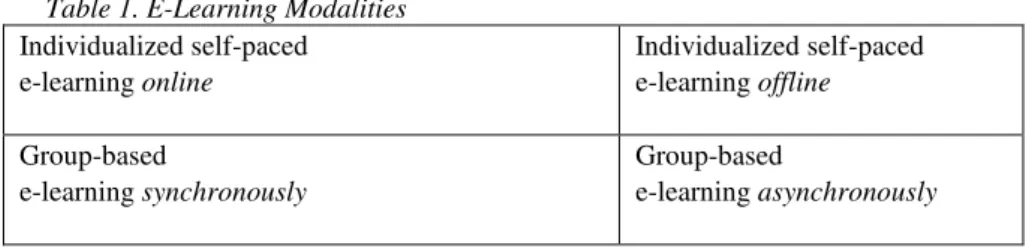
• Log in with a secure password to check their ongoing grades in each course, etc (EDUCAUSE,2012) Regarding the modalities of e-learning, various types have been identified as presented in Table 1 below:
Table 1. E-Learning Modalities Individualized self-paced e-learning online Individualized self-paced e-learning offline Group-based e-learning synchronously Group-based e-learning asynchronously Sources:Naidu(2006)
It can be seen that from the above table that Individualized self-paced e-learning online refers to situations where an individual learner is accessing learning resources such as a database or course content online via an Intranet or the Internet. A typical example of this is a learner studying alone or conducting some research on the Internet or a local network.
Individualized self-paced e-learning offline is another mode which refers to situations where an individual learner is using learning resources such as a database or a computer-assisted learning package offline (i.e., while not connected to an Intranet or the Internet). An example of this is a learner working alone off a hard drive, a CD or DVD. While Group-based e-learning synchronously refers to situations where groups of learners are working together in real time via an Intranet or the Internet. It may include text-based conferencing, and one or two-way audio and videoconferencing. Examples of this include learners engaged in a real-time chat or an audio-videoconference. Group-based e-learning asynchronously refers to situations where groups of learners are working over an Intranet or the Internet where exchanges among participants occur with a time delay (i.e., not in real time). Typical examples of this kind of activity include on-line discussions via electronic mailing lists and text-based conferencing within learning managements systems (Naidu,2006). At this juncture, what ever mode of e-learning adopted the most essential things to note is that e-learning is all about avenue to create knowledge or concept, deliver it to the intended audiance and for them to concieve and manage so as to make meaning (change) in learners’ behavior.
4. The Benefits of E-learning
Several benefit and reasons as why e-learning should be embraced by universities in Nigerian has been advanced by a number of scholars and authorities, for instance, (NetTOM,2007) cited in (Bassey et al,2007) emphasises that e-learning should be seen as offering solutions to several challenges currently facing higher education including the move towards lifelong learning, demand for continuous professional development, and the drive to wider participation, increasing pressure on resources, increasing diversity in the student population and their modes of attendance, including learning that is part-time, at a distance open or flexible, and work based.
E-learning if adopted, can improve the flexibility and quality of learning in the following ways: a) Reduce and/or eliminate the costs for instructor fees and materials to a certain level; b) Reduce time of learning and the time employee’s absence from duty;
c) Increased retention and enhanced hands-on application unlike traditional methods; d) Help managed instruction and progress via portal;
e) Make easy use of multimedia in practice and assessment according to learners’ abilities; f) Allow for automated monitor of users’ progr ess with supervisor and teachers;
g) Be highly interactive as it engages users and pushes them than pulling them to progress; h) Help past learners to go with their speed in any course and avoid redundancy;
i) Make slow learners go on their own pace by eliminating frustration with themselves, their fellow learners, and the subject matter;
j) Make knowledge cumulative as lessons are build consecutively and more flexible; k) Make learning takes place anytime-anywhere and greatly increases knowledge retention; l) Assist e-learners create, have access, view, modify and print or send documents;
m) Enhance evaluation as it become self-paced because e-learning is a networked phenomenon; n) Make easy delivery of content using standard Internet technology as it enhances surf ability;
o) E-learning supersedes training and instruction as it is a tool that improve behavior performance among others (Ahmad,2012).
5. E-Learning its origin and Development in Nigeria
World over, the growing interest in e-learning have evolved from several dimention and directions . These include organizations that have offered traditional distance education programs either in a single, dual or mixed mode setting. These catagory see the incorporation of online learning in their repertoire as a logical extension of their distance education activities.
The corporate sector, on the other hand, is interested in e-learning as a way of rationalizing the costs of their in-house staff training activities.in another perspective e-learning is of interest to residential campus-based educational
organizations as well. They see e-learning as a way of improving access to their programs and also as a way of tapping into growing niche markets (Naidu,2006),further observes that the growth of e-learning is directly related to the increasing access to information via ICT getways. The origin and development of e-learning in Nigeria, could be traced back to the development of Telecommunication which began in 1886 when e-cable connection was established by the colonial masters between lagos and the colonial office in london to transmit information and recieve feedback. By 1893, all government offices in lagos were provided with telephone service for easy communication, feedback and easy access, later all other parts of the country were provide with telephone services(Yusuf; 2011). The country had few Internet Service providers (ISPs) in the year 2000,but by the year 2006, it has risen to above 100 and many got connected to the informtion super-highway,through broadband Very Small Aparture Terminal (VSAT) connection (Yusuf; 2011).
In similar development,(World Bank, 2002), has observed that the awareness to advances in e-learning in Nigeria started gathering momentum two decades ago. The early exposure came through lecturers who studied abroad and had opportunities of attending conferences on e-learning technologies. Even though at some universities like that of Abuja had aspect of ICT such as print, audio/video tapes and digital radios, but it was at lowest level. The most commonest e-learning mode adopted in universities was the open and distance e-learning which is conducted inform of lecture note on CD-ROM which played as at the learners desires. The challenge behind this method is that the number of students per computer are inadquate or noncomensurate. However, innovators among institutions have resorted to the use of internet facilities,but this is not well maintained becouse of some factors ranging from erratic power interuption, high cost of running generating set to low bandwith among others.
Notably among universities in the forefront in the e-learning adoption including university of Ibadan, Obafemi Awolowo University,University of Benin,University of Abuja,university of Lagos, National Open University of Nigeria, Bayero University,Kano,federal University of Technology Akure,etc among others have all advanced in terms of e-learning facilities. Although a number of Nigerian universities are fully aware on the benefits of e-learning but investment and commitment to develop its application remain very minimal and below expectations.
The most noticeble form of e-learning in Nigeria as mentioned earlier is the one runs by NOUN which first began in 1983 but was suspended in 1985 and later resuscitated in 1999 during the regime of former civilain President Chief Olusegun Obasanjo. The course delivery was through a combination of web-based modules, textual materials, audio and video tapes as well as CD-ROMs. The university, currently has study centers in all states of the federation and plans to have at least one study center in each of the 774 local governments of Nigeria. However, a semblance of e-learning exist, at the departmental levels in some of the universities as noted by (Curran and Fox, 1999). And these departments are more in the medical, engineering, agricultural sciences, environmental sciences, computer science or informatics and Library and Information Sciences departments and faculties, where the synergy between research and teaching was strongest, and the essential infrastructure for course development and delivery were mostly accessible.
Similarly, due to accreditation criterion set by the National University Commission for certain programs to pass acreditions they must satisfy certain requirements like equiped ICT facilities, laboratories and libraries among others, in this regards, students use learning equipment for their lectures. Other project that have semblance with e-learning include the initiative of the Nigerian university Commission to set up Management Information Sytem (MIS) project, about fifteen years ago. (Bassey et al, 2007). Many Nigerian universities today have local area networks in their libraries, finance departments, MIS Units, some faculties/departments, etc. The need to link up these and be able to link up to the National University Commission’s network gave rise to another project initiated by the NUC, called NUNet project. The NUNet stands for Nigerian Universities Networks (Nwamarah,2002). In more elaborate manner, (Mac-Ikemenjima,2005) traced the origins of NUNet which dates back to 1994 with the following objectives:
1. To end isolation of Nigerian academic staff and students from each other and from the global academic community;
2. To ameliorate staff shortages arising from the brain-drain, by providing the ICT facilities required by our academic staff-in-Diaspora to make their contributions regardless of where they live or work;
3. To encourage the sharing of resources, foster academic and research collaborations among Nigerian Universities, and with their counterparts throughout the world;
4. To provide universities with access to electronic databases, journals and books many of which are increasingly available only in digital formats;
5. To serve as vehicle to expand access to education at minimal cost of capital building expenditure; and 6. To place Nigerian universities at the forefront of the information revolution, that they might serve their
proper roles as foci for national (Nwamarah,2002;Mac-Ikemenjima,2005).
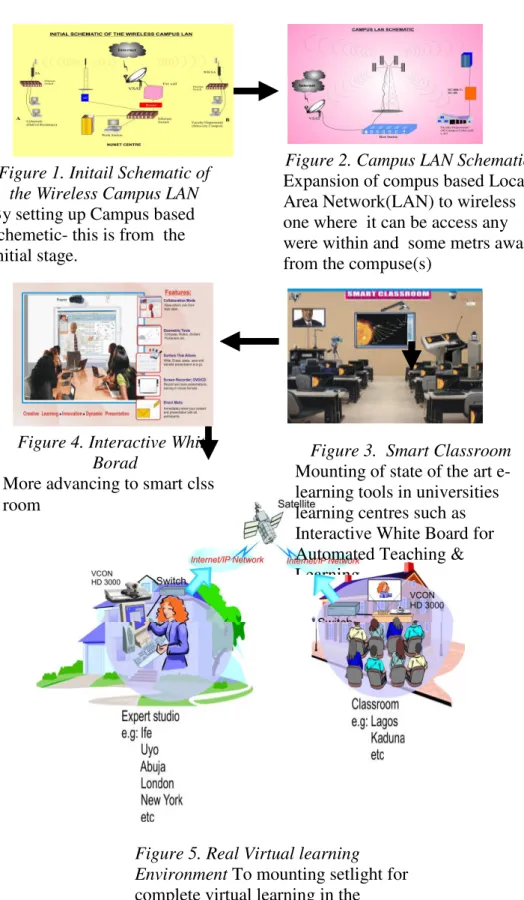
Source: Adopted in Ekuwem(2012)
Despite the fact that the NUNET project did not attain it sets objectives as expected, however, Nigerian universities and their governing body NUC should strive hard to revisit the NUNET road map again so as to come up with some
Figure 5. Real Virtual learning
Environment To mounting setlight for
complete virtual learning in the
country
Figure 1. Initail Schematic of
the Wireless Campus LAN
By setting up Campus based
schemetic- this is from the
initial stage.
Figure 2. Campus LAN Schematic
Expansion of compus based Local
Area Network(LAN) to wireless
one where it can be access any
were within and some metrs away
from the compuse(s)
Figure 4. Interactive White
Borad
More advancing to smart clss
room
Figure 3. Smart Classroom
Mounting of state of the art
e-learning tools in universities
learning centres such as
Interactive White Board for
Automated Teaching &
Learning
modifications towards realizing their dreams of making Nigerian Universities a competitor to their counter part in the developed countries, in line with the state of the arts and quality of teaching and learning provided through teaching and learning by electronic means (e-learning).
Other e-learning project initiated at university level of education in Nigeria including:
The National Virtual (Digital) Library Project (NVLP) of the Ministry of Education, which is supervised by the National Universities Commission.
The National Virtual Library Project of the Ministry of Science and Technology is supervised by the National Information Technology Development Agency. (NITDA).
Nigerian Virtual Library Consortium (VLC)
Nigerian Education and Research Network (NEARNet: a collaboration of NUNet, PolyNet and TeachNet) An ongoing effort by UNESCO to develop a virtual Library for all Nigerian Higher Education Institutions in Nigeria. (Mac-Ikemenjima, 2005; Ibrahim, 2006)
6 The Roles of ICT Policy
The roles of Information and Communcation Technology (ICT) in facilitating e-learning cannot be overemphasised, couple to say that computer/technology can assist in e- learning, instruction and delivery in a number of ways such as:
• Computer-based Presentation • Dial-in Service
• Electronic Message Groups • Videoconferencing
• TELNET • Desktop Data • World Wide Web • Interactive Multimedia • Hyper Text/Hypermedia. • Viable networking • Internet connectivity
• E-mail services (yahoo user groups) • Websites and Databases creation
• National Portal to information and services, etc (Majumder and Bose,2008) cited in (Mohammed,2012).
From the above, the likely question that one might ask could be that is there specific and clear ICT Policy for e-learning in Nigeria? The answer to this question is likely no, the justification to this is that there exist revised proposed ICT policy in Nigeria which was prepared by the ministerial Commitee on ICT Policy Harmonization and submitted on January 9,2012. Part of the rationale that prompted the revision of the document as quoted in the document was
Over the years, the Federal Government of Nigeria has initiated to adopt several ICT related policies and laws aimed at guiding the development of the sector and harnessing its power for national development. But Nigeria,like other nations,faces the inevitability of the fast technological and market convergence of the global ICT industry and must therefore continue to evolve new ICT policy Frameworks to accomdate convergence and maximize the potectial of ICT tool for national development (Proposed ICT policy, 2012).
This is despite the advancement in the countries’ ICT infrustructures, for instance, Prior to 1999, development in the ICT sector of Nigeria was far below expectation for a country of its size and resources. For example a total of fixed telephone lines less than 400,000 while regular internet users were less than 200,000. However, presently the country has recorded the following improvement to its credit:
Mobile penetration(per100 people - 55.76 Fixed penetration(per 100 people) - 0.48
Internet Penetration (per 100 people -23.48(2010)
Internet user(000) 43.270(2010)
Broadband Penetration 61% (2010)
PC Penetration (Number of PCs Per 100 - 4.7 (2010) Computer Assembled in Nigeria - less 500,000 List of Registered ICT companies - 350
Broadcasting dtations nationwide - 308 Pst offices (total inc,postal agencies and post shops - 1,065(3,000+)
Internet Service Providers -Morethan 27
Fixed wireless Operatos -Morethan 35
7. Challenges Faced by E-Learning In Nigeria
Successful implementation of e-learning rested upon on the successful delivery of contents, courses and training via electronic media including the Internet, intranets, extranets, satellite broadcast, audio/video tape, radio, interactive television, and compact disk read only memory, etc. Weaker economy and absence of adequate infrastructural facilities are main obstacles of effective e-learning practices in Universities in Nigeria. As a member of least developed countries, Nigeria has lots of challenges associated with e-learning adoption despite the level of interest in e-learning. These challenges includes:
1. Lack of funds to acquire the state of the art equipment needed for implementing e-learning.
2. Inadequate ICT infrastructure including computer hardware and software and bandwidth/access,Electric power supply,telecommunication etc;
3. Lack of skilled manpower, to manage available systems and inadequate training facilities for ICT education at the tertiary level;
4. High cost of soft software would not encourage and permit e-learning to succeed, perhaps becouse they are not produced locally in the country
5. Resistance to change from traditional pedagogical methods to more innovative, technology based teaching and learning methods, by both students and academics;
6. The over-dependence of educational institutions on government for everything has limited institutions ability to collaborate with the private sector or seek alternative funding sources for ICT educational initiatives.
7. Ineffective coordination of all the various ICT for education initiatives due to lack of clear ICT policy in the country. (Mac-Ikemenjima, 2005 and Mahmud,2010)
8. Cost of Internet connectivity in Nigeria is so high in west afria it is as high as z8/kbp,while cost a ridiculous amount of Z0.52Kbps in North Africa and even lesser in euope. Most students make use of Cyber cafe who charges between 100 and 50 per hour despite their poor service and slow rate of their server.
9. School curriculum is another critical factor faced by e-learning in Nigeria becouse most of the universities did not entrenched computer courses at their curriculum as this could not encourage e-learning to be effictive in our institutions(Yusuf,2011)
8. The Prospects for Improvement
Based on the aforementioned problems faced by e-learning and initiative body, the following suggestion as prospect for e-learning advancement in Nigeria are hereby proffered:
1. Substantail budget for education most be ensured by the federal government of Nigeria perhaps to rise it to 26% as proposed by the UNESCO, this will go along way in addressing many problems including subscription of the state of arts ICT equipment for enhencement of e-learning in the country.
2. To meet the objectives of e-learning embarked upon by Nigerian universities, there is urgent need for the government to make provision of ICT equipment available,afordable and accessible such as steady power supply,effeicient telecommunication services etc among other.
3. Members of the university community such as academic staff, students and non-teaching staff who lack computer literacy should be encouraged and trained by the university management as this will go in line with the attainment of e-learning project objectives among others.
4. Nigerians especially those with advanced IT skills could be promoted to emback on software development who should be trained and supported with the necessary equipment to develop nationally usable e-learning software and this will assist in making the cost of software affordable by the Nigerian universities;
5. Teachers and students in Nigerian universities should be encouraged to embraced ICT to enable them cope with trend in world to enable the teaching and learning to be effective and flexible.
6. Provision of ICT infrastructure through university-private partnerships should be encouraged i.e to say donor agencies should rob mine and breanstorm so as to develop an integrated broad-based model/ strategy for education with a definitive timeline for its completion of ICT development projects for instance NUNET project could be revisited and complited for national development;
7. A friendly policy environment which encourages investment in ICT should be put in place including tariffs on import of ICT infrastructure, in order to promote affordability and wide range usage at all levels of the
educational system; ( Mac-Ikemenjima,2005 and Yusuf,2011)
8. Cost of internet connectivity should be made to be affordable by all in Nigeria, as this will go along way in encouraging e-learning by the universities and other institutions and individual in general
9. ICT course content should be developed and encorporated in all levels of education currirulum so as to train stuents at all levels of education to appreciated and acquire knowledge of computer for the individual and country’s development.
9. Conclusion
It is now evident to admit that e-learning in Nigeria is one of the strategies for improving teaching and lerning in educational system especially at university level, the paper has discussed and highlited a number of issues related to the possibilities,benefits drivable from the project, history and challenges faced by Institutions in the course of conducting e-learning were all identified bythe paper. It is on that basis prospects as measure of ameleorating the identified problems were proposed for advancement and development.
References
Ahmad,S.A(2012) E-learning in the Nigerian Education system: A Fit Model Bayero Journal of Edcucation in Africa Maiden issue Vol.1(1) p.239-252
Ahmad,S.A (2012) Essentialities for E-Learning: The Nigerian Tertiary Institutions In Question Academic Research International Vol.2(2) available at www.savap.org.pk accessed on 15-7 2012
Andrews R (2011) Does e-learning require a New Ttheory of Learning? Some Initial Thoughts Journal for Educational Research Online Volume 3 ( 1), 104–121
Andrews,R and Haythornthwaite, C. (2007). Digital divide and e-learning. In R. Andrews & C.Haythornthwaite (Eds.), The handbook of e-learning research London: Sage (pp. 97–118).
Azeta, A. A, C. K. Ayo Atayero A. A and Ikhu-Omoregbe N. A(2010) Application of VoiceXML in E-learning System in Bolance C(2010) Edited Cases on Sucessful E- learning Practices in the Developed and Developing World: methods fro Global Information EC
Bassey, U.U Umoren G. U.; Akuegwu B. A.; Udida L. A. Ntukidem E. P.; and Ekabua O.O. (2007)Nigerian Graduating Students’ Access to e-learning Technology: Implications for Higher Education Management being a paper delivered at ICT-Learn200 Sixth International Internet Education Conference September 2-4, 2007 held at Ramses Hilton, Cairo, Egypt p.59-76
Boad,C;Wilson,J.P and McCater,R(2007) towards a theory of e-learning: experientail e-learning in journal of Hospitality,Leaisure,sport and tourism education Vol6(2) accessed on 6/8/2012
CHECKpoint eLearning/INFObases GmbH (2012) accessed on 12/8/2012
Curran, C. and Fox, S. (1999). Telematics in open and distance learning. Weinheim: Deutscher Studied Verlagwww.journals.sava
EDUCAUSE available at http://www.educause.edu/ero/search?keys=e learning%20tools
Ekuwem,E.E(2012) teledom Group a Nigerian experience ICT4Africa/country Report Nigeria.Retrieved from file http://www.wikieducator.org/ ICT4Africa/country Report Nigeria on 11/5/2007.
Getachew, Y.(n.d) Access and Utilisation of ICTs: the Case of Distance Education in Ethiopia.:
Gunawardana, K. D. (2006). An empirical study of potential challenges and benefits of implementing e-learning in Sri Lanka. Special issue of the International Journal of theComputer, the Internet and Management, 33, 1-8.
Haythornthwaite, C. (2009). Participatory transformations. In W. Cope & M. Kalantzis (Eds.), Ubiquitous learning
Champaign, IL: University of Illinois Press. (pp. 31–48).
Hedge, N. and Hayward, L. (2004). Redefining roles. University e-learning contributing to Lif long in e-Learning Systems in Cases on Successful E e-Learning Practices in the Developed and Developing World: Methods for theGlobal Information Economy edited by Olaniran,B(2010) Texas Tech University, USA,- IGI Global. P.92-102
Ibrahim, A(2006) Networking steps in Nigeria, 2: The “Vessel” Takes Shape AAU Regional Research and Education Networking Workshop (Accra, Ghana: 2006 Nov 14 & 15) The Nigeria ICT Forum of Partnership Institutions accessed 07/08/2012 available at http://forum.org.ng
Information and Comunication Technology Policy(2012) Draft by the Federal Committee on Policy Harmonization 9th January, 2012 p.9-10
Jewitt, C. (2008). Technology, literacy, learning: A multimodal approach. Abingdon,
VA: Routledge learning in a networked world. E-Learning, Journal of theNigerian cartography Association. 771, Mac-Ikemenjima,D (2005) e-Education in Nigeria: Challenges and Prospects Being a presentation at the 8th UN ICT Task Force Meeting April 13-15, 2005 Dublin, Ireland
Mohammed, A(2012) Collaboration Among Library And Information Science Schools For Effective Teaching In The Knowledge Society In Nigeria: A Proposed ModelFouth coming in Bayero Journal of Library and Information Science, Vol.1(1) Maiden Edition
Mahmud, K (2010) “E-learning for tertiary level in least developed countries: implication,obstacles and way outs for Bangaladash International Journal of Computer theory and Engineering Vol2(2) April 2010 Mutula, S.M (2003) Assessment of Africa’s Telematics, Policy and Regulatory Infrastructure: Potential for E-learning. Conference paper. Available online at: http://www.ntesu.org.za/html/conference/papers/mutula.pdf
NetTom (2007). Why is e-learning important? Retrieved from file
http://ebdd.wsu.edu/eder/NetTom_ToT/unit.1/whyelearning.htm on 25/2/2007.
Nwamarah,G.M(2002) Networking the Nigerian University system a paper presented at the Seminar on Treands in the Development of ICT in the nigerian University sstem P.1-10
Ong, C. S., Lai J. Y and Wang, Y. S.,(2004) Factors affecting engineers’ acceptance of asynchronous e-.learning systems in high-tech companies, Information & Management, 41 (6), 2004, pp. 795 804
Russel,D and lamini, H (2002) Mission Report (4-18 November, 2002) with the purpose of launching the feasibility dtudy for the development of a Virtual Library for Universities and Institutions of Higher Learning in Nigeria Ţolea, E E and Răzvan, CA (2011) Collaborative E-Learning Model The 6th InternationalConference on Virtual Learning ICVL 2011 http://www.icvl.eu/2011/disc/icvl/index.htm
WorldBank (2002). Enhancing learning opportunities in Africa. Washington, D.C: International Bank for Reconstruction and Development.
Yusif,AA(2011) Electronic Learning and Studens’ Academic Performance Being a Project submitted to the Department of Educational aoundations and Management,Facultuy of Education,University of Ado-Ekiti, Ekiti State inPartialfulfilment of the requirements for the award of Bachalor of Science in Degree in Education BSC (ed) in Economics p. 20-21
Publishing service based in the U.S. and Europe. The aim of the institute is
Accelerating Global Knowledge Sharing.
More information about the publisher can be found in the IISTE’s homepage:
http://www.iiste.org
CALL FOR JOURNAL PAPERS
The IISTE is currently hosting more than 30 peer-reviewed academic journals and
collaborating with academic institutions around the world. There’s no deadline for
submission.
Prospective authors of IISTE journals can find the submission
instruction on the following page:
http://www.iiste.org/journals/
The IISTE
editorial team promises to the review and publish all the qualified submissions in a
fast
manner. All the journals articles are available online to the readers all over the
world without financial, legal, or technical barriers other than those inseparable from
gaining access to the internet itself. Printed version of the journals is also available
upon request of readers and authors.
MORE RESOURCES
Book publication information:
http://www.iiste.org/book/
Recent conferences:
http://www.iiste.org/conference/
IISTE Knowledge Sharing Partners
EBSCO, Index Copernicus, Ulrich's Periodicals Directory, JournalTOCS, PKP Open
Archives
Harvester,
Bielefeld
Academic
Search
Engine,
Elektronische
Zeitschriftenbibliothek EZB, Open J-Gate, OCLC WorldCat, Universe Digtial