University of Connecticut
OpenCommons@UConn
Doctoral Dissertations University of Connecticut Graduate School
8-20-2013
Wavelet Neural Network Based Very Short-term
Load Forecasting and Prediction Interval
Estimation
Che GuanUniversity of Connecticut - Storrs, [email protected]
Follow this and additional works at:https://opencommons.uconn.edu/dissertations
Recommended Citation
Guan, Che, "Wavelet Neural Network Based Very Short-term Load Forecasting and Prediction Interval Estimation" (2013).Doctoral Dissertations. 172.
Wavelet Neural Network Based Very Short-term
Load Forecasting and Prediction Interval
Estimation
Che Guan, Ph.D.
University of Connecticut, 2013
Very short-term load forecasting predicts the loads in electrical power network one or
several hours into the future in steps of a few minutes (e.g., five minutes) in a moving
window manner based on online data collected every few seconds (e.g., four seconds). In
order to quantify forecasting accuracy in real-time, the forecasting process should also
estimate good prediction intervals online. Accurate forecasting with prediction intervals is
important for resource dispatch and area generation control, and helps power market
participants make prudent decisions. It is, however, difficult in view of the noisy data
collection process with possible malfunctioning of data gathering devices, the different
characteristics of load frequency components, and the accurate derivation and evaluation for
prediction interval estimation in real-time.
This thesis presents a method of multilevel wavelet neural networks with data
pre-filtering. The key idea is to use a spike filtering technique to detect spikes in load and correct
them without altering the normal load. Wavelet decomposition is then used to decompose
the load into multiple components at different frequencies, separate neural networks are
then combined to form the final forecast. To perform moving forecast over an hour, twelve
dedicated structures are used based on testing results.
Because wavelet neural networks are based on back propagation without estimating
prediction intervals, the method is extended by using hybrid Kalman filters to produce
forecasting with prediction interval estimates online. Based on data analysis, a neural
network trained by an extended Kalman filter is used for the low-low frequency component
to capture the near-linear relationship between the input load component and the output
measurement, while neural networks trained by unscented Kalman filters are used for
low-high and low-high frequency components to capture their nonlinear relationships. The overall
variance estimate is then derived and evaluated for prediction interval estimation.
Testing results demonstrate the effects of data pre-filtering, the accuracy of wavelet
neural networks, the effectiveness of hybrid Kalman filters for capturing different features of
load components, and the accuracy of derived prediction interval estimates, based on a data
Wavelet Neural Network Based Very Short-term
Load Forecasting and Prediction Interval
Estimation
Che Guan
B.S., Changchun University of Science and Technology, Changchun, China, 2004
M.S., Chinese Academy of Sciences, Beijing, China, 2007
M.S., University of Connecticut, Storrs, USA, 2011
A Dissertation
Submitted in Partial Fulfillment of the
Requirements for the Degree of
Doctor of Philosophy
At the
University of Connecticut
2013
Copyright by
Che Guan
APPROVAL PAGE
Doctor of Philosophy Dissertation
Wavelet Neural Network Based Very Short-term
Load Forecasting and Prediction Interval
Estimation
Presented by
Che Guan, B.S., M.S.
Major Advisor:
Peter B. Luh
Associate Advisor:
Yaakov Bar-Shalom
Associate Advisor:
Laurent D. Michel
University of Connecticut
2013
Acknowledgements
It has been a great pleasure to spend six years as a graduate student at UConn. Here I
met many wonderful scientists and friends who play important roles on me to become a
researcher, and have contributed significantly to the work in my dissertation.
I would like to express my sincerest gratitude to my advisor, Professor Peter B. Luh,
for his continuous guidance, encouragement, patience, and opportunities given to me to
practice and grow up. All the works could not be accomplished without his persistent
supervision, and I am appreciated very much. I am also very grateful to Dr. Ying Chen. As
a graduated member from the lab as well as a best friend, she has been selflessly sharing her
precious experiences and helping me overcome many difficulties on the way to the Ph.D.
target. It is really a fortunate to work with her.
I would like to thank my co-advisors Professor Yaakov Bar-Shalom and Professor
Laurent Michel for their supervision and help on my research. I am also thankful to
Professor Zhiyi Chi for his consistent help on my research, and Professor Shengli Zhou for
his review of this dissertation. I would also like to thank Dr. Kwok Cheung at the Alstom
Grid, and Peter B. Friedland who was at the ISO New England for their continuous supports
on my research, as well as Mr. Matthew A. Coolbeth, Mr. Yuting Wang, and Mr. Stephen
Corbo, for their continuous supports on my research. I am also thankful to Miss Fang Chen,
Dr. Yi Yang, Dr. Tian Mi, Dr. Shuo Zhang, Dr. Ying Wang, etc., for their information and
consistent help on my dissertation.
I would like to thank all the past and present lab members at Manufacturing Systems
Dr. Jin Sun, Dr. Guoyu Tu, Dr. Mingyang Li, Mr. William E. Blankson, Mr. Abhinaya Joshi,
Mr. Majid Chauhdry, Mr. Peng Wang, Mrs. Bingjie Zhang, Miss Congcong Wang, Mr. Xu
Han, Mr. Liangliang Sun, Mr. Yige Zhao, Mrs. Weihua Wang, Mrs. Bing Yan, Mr. Mikhail
Bragin, Mrs. Yu Chen, Mr. Ying Yan, Mr. Yaowen Yu, Miss Xiaorong Sun, Mr. Weiji Han,
Mr. Biao Sun, Mr. Christian Wilkie, etc. It was a great pleasure to meet you, and I've
enjoyed working with you and take tremendous pride in what we've been able to accomplish.
The six-year life in the lab leaves with me many fond memories and valued relationships.
I would like to express my sincere appreciation for my colleagues at the Dun and
Bradstreet, especially for: Dr. Nipa Basu and the whole worldwide predictive analytic team’s
consistent supports, and Dr. Anthony Scriffignano for his encouragement, help, and support
on my oral defense of dissertation.
Finally I would like to thank my family, especially for my parents Mr. Yongjun Guan
and Mrs. Jun Sun. Whenever, wherever, and whatever I am in need, you are always there.
Without your support, I would have not been able to accomplish as much as I have.
Table of Contents
1. Introduction... 1 1.1 Research Motivation... 1 1.2 Dissertation Outline... 1 1.3 Major Contributions ... 4 1.4 Publications ... 42. Very Short-term Load Forecasting: Wavelet Neural Networks with Data Pre-filtering ... 7
2.1 Introduction ... 7
2.2 Literature Review ... 9
2.3 Data Pre-filtering ... 13
2.3.1 Micro Spike Filtering... 14
2.3.2 Macro Spike Filtering ... 16
2.4 Wavelet Neural Networks ... 17
2.4.1 Load Property Analysis... 18
2.4.2 Filter Bank in Wavelet Transform ... 20
2.4.3 Neural Networks ... 24
2.4.4 Moving Forecasts... 27
2.5 Numerical Test Results ... 27
2.6 Conclusion... 43
3. Hybrid Kalman Filters for Very Short-term Load Forecasting and Prediction Interval Estimation ... 45
3.1 Introduction ... 45
3.2 Literature Review ... 49
3.2.1 Prediction Interval Estimation ... 49
3.2.2 Wavelet Neural Networks... 51
3.4 Wavelet Neural Networks Trained by Hybrid Kalman Filters... 52
3.3.1 EKFNN for the Low-Low Load Component... 55
3.3.2 UKFNN for the Low-High and High Load Components ... 58
3.4 Prediction Iinterval Estimation and Evaluation ... 61
3.4.1 Prediction Interval Estimation ... 62
3.4.2 Evaluation of Prediction Interval Estimates ... 64
3.5 Numerical Testing Results ... 65
3.6 Conclusion ... 81
4. Summary and Future Research ... 83
4.1 Summary ... 83
4.2 Future Research Directions... 84
List of Figures
FIGURE 2-1. BEFORE (TOP) AND AFTER (BOTTOM) MICRO AND MACRO SPIKE FILTERING BASED ON TWO DAYS OF CONTINUOUS ISO-NE LOAD DATA AT THE FOUR-SECOND RESOLUTION16 FIGURE 2-2. BEFORE (TOP) AND AFTER (BOTTOM) MACRO SPIKE FILTERING AT THE FIVE
-MINUTE RESOLUTION... 17
FIGURE 2-3. POWER SPECTRUM DENSITY FOR FIVE-MINUTE LOAD DATA (JANUARY 1ST,2007 TO JUNE 30TH,2008) ... 19
FIGURE 2-4. AMPLITUDE SPECTRUM FOR FIVE-MINUTE LOAD DATA... 20
FIGURE 2-5. THREE-CHANNEL FILTER BANK... 21
FIGURE 2-6. STRUCTURE OF WAVELET NEURAL NETWORKS... 24
FIGURE 2-7.A. AMPLITUDE SPECTRUM FOR NORMALIZED LOW-LOW FREQUENCY BEFORE APPLYING RI; FIGURE 2-7.B. AMPLITUDE SPECTRUM FOR NORMALIZED LOW-LOW FREQUENCY AFTER APPLYING RI ... 26
FIGURE 2-8. BOX PLOTS FOR FORECASTING ERRORS FOR 5 TO 60 MINUTE OUTS... 38
FIGURE 3-1. SCHEMATIC OF THE WAVELET NEURAL NETWORKS (WNN) ... 51
FIGURE 3-2. SCATTER PLOTS OF 60-MIN-AHEAD PREDICTIONS AND RESIDUALS FOR INDIVIDUAL LL,LH, AND H LOAD COMPONENTS (BASED ON 1000 PAIR DATA FOR INDIVIDUAL PLOTS) ... 53
FIGURE 3-3. SCHEMATIC OF WAVELET NEURAL NETWORKS TRAINED BY HYBRID KALMAN FILTERS (WNNHKF) ... 54
FIGURE 3-4. SCHEMATIC OF THE PREDICTION INTERVAL ESTIMATION... 62
FIGURE 3-5. QUANTILE-QUANTILE PLOT OF THE 5 MIN-AHEAD FORECASTING ERRORS VERSUS THE STANDARD NORMAL... 73
FIGURE 3-6. THE AMOUNT OF ESDS AS A FUNCTION OF COVERAGE RATES RANGING FROM 10% TO 90% FOR EACH LOOK-AHEAD TIME WHEN COMPARED WITH THE AMOUNT OF SIGMAS UNDER THE STANDARD GAUSSIAN... 76
FIGURE 3-7. THE AMOUNT OF ESDS AS A FUNCTION OF COVERAGE RATES RANGING FROM 91% TO 99% FOR EACH LOOK-AHEAD TIME WHEN COMPARED WITH THE AMOUNT OF SIGMAS UNDER THE STANDARD GAUSSIAN... 77
List of Tables
TABLE 2-1. MAES (MW) FOR MULTIPLE WNNS... 31
TABLE 2-2. MAPES (%),MAES (MW), AND SDS (MW) FOR MULTIPLE WNNS IN MOVING FORECASTS WITH AND WITHOUT SPIKE FILTERING METHODS... 32
TABLE 2-3. MAES (MW) AND SDS (MW) FOR SPIKE FILTERING METHODS WITH DIFFERENT M VALUES... 33
TABLE 2-4. MAES (MW) AND SDS (MW) FOR WNN1 WITH DIFFERENT DECOMPOSITION LEVELS... 34
TABLE 2-5. MAES (MW) FOR WNN1 WITH DIFFERENT DAUBECHIES WAVELETS... 35
TABLE 2-6. MAES (MW) FOR THE WNN1 WITH DIFFERENT PADDING STRATEGIES... 35
TABLE 2-7. MAES (MW) FOR WNN1 WITH DIFFERENT TIME INDICES... 36
TABLE 2-8. MASES,MAPES (%),MAES (MW), AND SDS (MW) FOR OUR METHOD... 37
TABLE 2-9. MAPES (%) AND MAES (MW) COMPARING OUR METHOD’ RESULTS TO ISO-NE’S RESULTS... 40
TABLE 2-10. MEANS AND STANDARD DEVIATIONS FOR MAPES (%),MAES (MW), AND SDS (MW) FROM MONTE CARLO SIMULATIONS WITH A RANDOM WEIGHT INITIALIZATION (WITH N=20SIMULATIONS) ... 42
TABLE 2-11. MEANS AND STANDARD DEVIATIONS FOR MAPES (%),MAES (MW), AND SDS (MW) FROM MONTE CARLO SIMULATIONS WITH RANDOM RE-SAMPLING STEPS (WITH N=20SIMULATIONS) ... 43
TABLE 3-1. NO. OF HIDDEN NEURONS,AVERAGED MAES, AND AVERAGED SDS COMPARING THE RESULTS OF WNNHKF TO THE RESULTS OF PERSISTENCE,LINEAR AR,SINGLE NN, AND WNN ... 67
TABLE 3-2.MAPES (%) AND SDS (MW) FOR DIFFERENT COMBINATIONS OF NNS TRAINED BY KALMAN FILTER(S) FOR INDIVIDUAL LOAD COMPONENTS... 68
TABLE 3-3.MAPES (%),MAES (MW),SDS (MW),ESDS (MW), AND ONE SIGMA COVERAGE (%) FOR WNNHKFMETHOD (BASED ON VALIDATION DATA SET) ... 70
TABLE 3-4.MAPES (%),MAES (MW),SDS (MW),ESDS (MW), AND ONE SIGMA COVERAGE (%) FOR WNNHKFMETHOD (BASED ON TEST DATA SET) ... 71
TABLE 3-5. TOTAL PROBABILITY MASS (%) OF TAILS OF ERROR REMOVED TO MAKE KOLMOGOROV–SMIRNOV TEST INSIGNIFICANT (P>0.1) ... 73
TABLE 3-6.AMOUNT OF ESD TO ACHIEVE ALMOST THE SAME COVERAGE RATES... 74
TABLE 3-7. ACTUAL COVERAGE RATES (%) OF EMPIRICAL QUANTILE-BASED PIS FOR DIFFERENT NOMINAL COVERAGE RATES... 78
TABLE 3-8. WIDTHS (MW) OF EMPIRICAL QUANTILE-BASED PIS FOR DIFFERENT NOMINAL COVERAGE RATES AS SHOWN IN TABLE 3-7 ... 79
TABLE 3-9. WIDTHS (MW) OF STANDARD-DEVIATION-BASED PIS ACHIEVING THE SAME ACTUAL COVERAGE RATES AS SHOWN IN TABLE 3-7... 79
TABLE 3-10. MAPES (%) COMPARING THE RESULTS OF WNNHKF TO THE RESULTS OF PERSISTENCE,LINEAR ARMODEL,ISO-NE’S METHOD, AND WNN ... 81
1
1.
Introduction
1.1
Research Motivation
Very short-term load forecasting (VSTLF) predicts the loads in electrical power
network one or several hours into the future in steps of a few minutes (e.g., five minutes) in a
moving window manner based on online data collected every few seconds (e.g., four
seconds). To quantify forecasting accuracy in real-time, the forecasting process should also
estimate accurate prediction intervals (PI) online. Accurate VSTLF with good PIs is
important for resource dispatch and area generation control, and helps power market
participants make prudent decisions. Based on data analysis, load time series have multiple
frequency components, and each may have its unique pattern, such as monthly, weekly, and
hourly patterns. Effective VSTLF, however, is difficult in view of the noisy data collection
process with possible malfunctioning of data gathering devices, different characteristics of
load components, and the accurate derivation for estimating prediction intervals online.
1.2
Dissertation Outline
The research of this dissertation is to advance real-time load forecasting methods in
electrical power network. The study is an extension of the previous method for short-term
load forecasting (STLF) which predicts the loads of tomorrow in hourly steps based on the
single-level wavelet decomposition and neural networks trained through using a data set from
ISO New England (Chen et al., 2010). The method presented a way for handling load
2
the ones of VSTLF because short-term load data have fewer patterns than very short-term
load data to be analyzed. Also, spikes were not considered because they had been removed
by ISO New England before STLF was performed, whereas removing spikes is a critical
issue for VSTLF.
In Chapter 2, wavelet neural networks (WNN) with data pre-filtering will be developed
to forecast the loads one hour into the future in five-minute steps in a moving window
manner. To effectively remove spikes, it is observed that spikes may have different
magnitudes and widths. Thus, they are classified into micro and macro spikes at either
four-second or five-minute resolutions. Micro and macro filtering techniques will be developed to
effectively detect and filter them out. To accurately capture load features, the wavelet
technique will be used to decompose the loads into multiple frequency components. Each
component is then appropriately transformed, normalized, and fed with time and date indices
to a neural network, so that the features of individual components are properly captured.
Forecasts from individual neural networks are then transformed back and combined to form
the final forecasts. To perform moving forecasts, twelve dedicated wavelet neural networks
will be used based on preliminary simulation results.
In Chapter 3, the method of wavelet neural networks will be further improved to
provide prediction intervals. By replacing the first-order back propagation algorithm with
second-order Kalman type algorithms, dynamic covariance can be produced for prediction
interval estimation. The method of wavelet neural networks trained by hybrid Kalman filters
(WNNHK) will be developed. It forecasts the loads one hour into the future in 5-min steps in
a moving window manner with associated PI estimates online. After a data analysis, it is
3
the low frequency load input and its measurement, whereas the Low-High (LH) and High (H)
frequency components have the nonlinear relations. To capture the near-linear relationship
between the input and measurement for the LL component, the extended Kalman filter is
used to train a neural network (EKFNN) because the extended Kalman filter is derived by
linearizing the system and is good for near-linear systems. To capture highly nonlinear
relationships for the LH and H components, the unscented Kalman filter is used to train
neural networks (UKFNN) because the unscented Kalman filter is good for highly nonlinear
systems. To accurately estimate prediction intervals online, the overall variance estimate will
be calculated by summing up the three orthogonal variance estimates from H, LH, and LL
frequency neural networks. The estimates for H and LH components are directly obtained.
The estimate for the LL component is further derived because the relative increment, a
nonlinear transformation, is applied to the LL component. The relative increment is used to
make the series stationary so that the transformed series can be easily captured.
All the works are implemented in MATLAB, and configured through training,
validation, and test data sets. The open source code and the part of the test data and results
are open, and can be obtained from http://github.com/ldmbouge/vstlf. The software was run
on a server with dual Xeon quad core Intel E5620 2.4GHz processors and a 36 GB memory.
Testing results will demonstrate the values of data pre-filtering, wavelet decomposition, load
transformation, neural networks, and dedicated wavelet neural networks for VSTLF. The
results will also illustrate the effectiveness of hybrid Kalman filters for capturing different
features of load components, and the accuracy of the overall variance estimate derived based
4
1.3
Major Contributions
Spikes are analyzed with respect to magnitudes and widths, and then classified at either
4 second or 5 minute resolutions. Micro and macro filtering techniques are further developed
to effectively filter spikes out.
Amplitude spectrum shows loads have several components. A wavelet method is
selected to separate the load into proper levels. Parameters in wavelet transform are
discussed, derived, and selected. To help capture load features, each component is properly
transformed and fed with time and date indices to an NN. Finally, twelve dedicated WNNs
are used for moving forecasts.
To produce prediction interval estimate online, hybrid Kalman filters are developed to
train wavelet neural networks and to capture the complicated load features.
Based on data analysis, an NN trained by an extended Kalman filter is used to capture
the near-linear relation between the Low-Low input and output measurement, whereas NNs
trained by unscented Kalman filters are developed to capture highly nonlinear relations for
Low-High and High frequency components.
Due to the nonlinear transformation for load inputs, the overall variance is further
derived. The distribution of the forecasting errors is analyzed, and prediction interval
estimates are thoroughly evaluated in several ways.
1.4
Publications
Journals:
[1] Y. Chen, P. B. Luh, C. Guan, Y. Zhao, L. D. Michel, M. A. Coolbeth, P. B. Friedland,
5
Networks," IEEE Transactions on Power Systems, Vol. 25, No. 1, pp. 322-330,
February 2010.
[2] C. Guan, P. B. Luh, L. D. Michel, Y. Wang, and P. B. Friedland, "Very Short-term
Load Forecasting: Wavelet Neural Networks with Data Pre-filtering," IEEE
Transactions on Power Systems, Vol. 28, No. 1, pp 30-41, February 2013.
[3] C. Guan, P. B. Luh, L. D. Michel, and Z. Chi, "Hybrid Kalman Filters for Very
Short-term Load Forecasting and Prediction Interval Estimation," IEEE Transactions on
Power Systems, to appear.
Conference Proceedings:
[4] C. Guan, P. B. Luh, M. A. Coolbeth, Y. Zhao, L. D. Michel, Y. Chen, C. J. Manville, P.
B. Friedland, and S. J. Rourke, “Very short-term load forecasting: Multilevel wavelet
neural networks with data pre-filtering,” Proceedings of the IEEE Power and Energy
Society 2009 General Meeting, Calgary, Alberta, Canada, July 2009.
[5] C. Guan, P. B. Luh, L. D. Michel, Y. Bar-Shalom, and P. B. Friedland, "Interacting
Multiple Model Approach for Very Short-Term Load Forecasting and Confidence
Interval Estimation," Proceedings of the 8th World Congress on Intelligent Control
and Automation, Jinan, Shandong, China, June 2010.
[6] P. B. Luh, L. D. Michel, P. B. Friedland, C. Guan, and Y. Wang, "Load Forecasting and
Demand Response," Proceedings of the IEEE Power and Energy Society 2010 General
Meeting, Minneapolis, Minnesota, July 2010.
[7] C. Guan, P. B. Luh, L. D. Michel, M. A. Coolbeth, and P. B. Friedland, "Hybrid
6
estimation," Proceedings of the IEEE Power and Energy Society 2010 General
Meeting, Minneapolis, Minnesota, July 2010.
[8] C. Guan, P. B. Luh, and W. Cao, "Short-term Wind Generation Forecasting and
Confidence Interval Estimation Based on Neural Networks Trained by Extended
Kalman Particle Filter," Proceedings of the 9th World Congress on Intelligent Control
and Automation, Taipei, Taiwan, June 2011.
[9] C. Guan, P. B. Luh, W. Cao, L. D. Michel, and K. W. Cheung, "Dual-tree M-band
Wavelet Transform and Composite Very Short-term Load Forecasting," Proceedings of
the IEEE Power and Energy Society 2011 General Meeting, Detroit, Michigan, July
2.
Very Short-term Load Forecasting: Wavelet Neural
Networks with Data Pre-filtering
2.1
Introduction
Very short-term load forecasting predicts the loads one or several hours into the
future in steps of a few minutes (e.g., five minutes) in a moving window manner based on
online data collected every few seconds (e.g., four seconds). Accurate load forecasting
has traditionally been important since it is critical for automatic generation control and
resource dispatch, and it also ensures revenue adequacy for the Independent System
Operator (ISO) multi-settlement markets. Effective VSTLF, however, is difficult in view
of the noisy data collection process with possible malfunctioning of data gathering
devices and complicated load features.
Methods for very short-term load forecasting are limited. Existing methods of
persistence, extrapolation, time series, Kalman filtering, fuzzy logic, and neural networks
(NN) will be reviewed in Section 2.2. Among these methods, neural networks have been
widely used. A standard NN was used for VSTLF (Liu et al., 1996). To improve data
stationarity, inputs to an NN were transformed by using logarithmic differences in
(Shamsollahi et al., 2001) and by using relative increments in (Charytoniuk and Chen,
2000). A single neural network, however, may not be able to accurately capture
complicated load features because the load data have multiple frequency components,
and each may have its unique pattern. Furthermore, spikes are randomly distributed over
time and have different magnitudes and widths. They affect neural network training, and
8
measured and predicted loads, and if the absolute value of the difference is greater than a
threshold, a spike is said to be detected. The spike was then replaced by the interpolated
value (Shamsollahi et al., 2001) or the predicted value (Xie et al., 1996). This way,
however, may not be effective. To reduce the effects of spikes, further analysis and
filtering are needed.
Recently, we have developed a method for short-term load forecasting (STLF)
which predicts the loads of tomorrow in hourly steps based on the single-level wavelet
decomposition and neural networks trained through using a data set from ISO New
England (Chen et al., 2010). A correction coefficient scheme was also developed to
enhance predictions around holidays (Zhao et al., 2009). These methods presented a way
for handling load features at different frequencies. However, the load features of STLF
are quite different from the ones of VSTLF because short-term load data have fewer
patterns than very short-term load data to be analyzed in Subsection 2.4.1. Also, spikes
were not considered because they had been removed by ISO New England before STLF
was performed, whereas removing spikes is a critical issue for VSTLF.
In this chapter, wavelet neural networks (WNN) with data pre-filtering are
developed to forecast the loads one hour into the future in five-minute steps in a moving
window manner. To effectively remove spikes, it is observed that spikes may have
different magnitudes and widths. Thus, they are classified into micro and macro spikes at
either four-second or five-minute resolutions. Micro and macro filtering techniques are
developed in Section 2.3 to effectively detect and filter them out. The advantage of
9
operator of a potential SCADA telemetry problem in real-time. Filtering spikes in the
five-minute data series is often a lagging indicator of faulty load telemetry.
Wavelet neural networks are developed in Section 2.4. The wavelet technique is
used to decompose the loads into multiple frequency components. Each component is
then appropriately transformed, normalized, and fed with time and date indices to a
neural network, so that the features of individual components are properly captured.
Forecasts from individual neural networks are then transformed back and combined to
form the final forecasts. To perform moving forecasts, twelve dedicated wavelet neural
networks are used based on test results.
In Section 2.5, the method is configured through training, validation, and test data
sets as presented in (Ripley, 1996: Chapter 2). Example 1 uses a classroom-type problem
to illustrate the effects of the wavelet decomposition. Based on the data set from ISO
New England (ISO-NE), Example 2 demonstrates the values of data pre-filtering, wavelet
decomposition, load transformation, neural networks, and dedicated wavelet neural
networks for VSTLF. The code as well as part of the test data and results are open, and
can be downloaded at http://github.com/ldmbouge/vstlf.
2.2
Literature Review
Not many papers report the handling of spikes. One way is to compare measured
and predicted loads, and if the absolute values of the differences are greater than a
threshold, spikes are declared and then replaced by predicted values in (Xie et al., 1996).
Another way is to replace observed spikes by zeros which are then fixed by using a
10
loads are used to fill zero-valued data (Shamsollahi et al., 2001). These methods are
valuable. However, they are prone to errors due to the uncertain nature of the load data
and the various magnitudes and widths of spikes. Spikes replaced by bad values may
degrade future predictions. Therefore, spikes have to be further analyzed, and effective
ways are highly needed for filtering them out.
Spike filtering has also been reported for short-term load forecasting. In
comparison to VSTLF, spikes in STLF have different features with respect to magnitudes
and widths because of the integrative nature of short-term load data and the fact that most
spikes should have been removed before STLF is performed. The simple techniques
consisting of if-then rules, low pass filtering, and NN based self-filtering were used to
handle STLF spikes in (Fidalgo and Peças Lopes, 2005). Recently, entropy related
functions, which are robust to noisy data, were developed in (Liu et al., 2007) and were
further applied to the training of neural networks for future three-day wind power
forecasting (Bessa et al., 2009). To perform the online training, a self-adaptive approach
was used in (Bessa et al., 2009), where "the information potential of the error" was
recursively estimated. Although these methods are robust to noisy data, in order to help a
forecasting model learn normal load patterns rather than complicated noisy data in
real-time, it is desirable to remove spikes before data are used for VSTLF.
Limited VSTLF methods have been reported in the literature, and they include
methods of persistence, extrapolation, time series, fuzzy logic, Kalman filtering, and
neural networks. Persistence forecasting (Fox et al., 2007) may be the simplest method,
and it assumes that the forecast data will be the same as the last measured values. This is
11
Extrapolation predicts the load based on the past by using a least square algorithm (Wang
et al., 1996) or by using a curve fitting algorithm based on a shape similarity criterion
(Luo and He, 2007). The load increment was predicted through a weighted average of
increments of previous loads in (Zhou et al., 2005). A dynamic clustering method was
used to pre-group the loads into multiple groups, and load increments were then
forecasted in (Yang et al., 2005).
Similar to the extrapolation method, the auto-regression method uses a simple
linear combination of the previous load series for prediction(s). Its coefficients were
tuned on-line using the least mean square algorithm in (Liu et al., 1996). The method
was extended to autoregressive integrated moving average (ARIMA) for load forecasting,
and parameters were updated via a recursive least square algorithm with a forgetting
factor in (Lu et al., 2005). ARIMA was extended to seasonal autoregressive integrated
moving average to capture the seasonal load feature in (De Andrade and Da Silva, 2010).
Support vector regression method was developed for VSTLF, which was used with
kernel functions to create complex nonlinear decision boundaries in (Setiawan et al.,
2009). Holt-Winters adaptation and the new intraday cycle exponential smoothing
method were used together for predictions in (Taylor, 2008).
Kalman filter was applied to VSTLF in a few references. For example, the loads
were separated into deterministic and stochastic components, and both were predicted via
Kalman filters in (Trudnowski and Mcreynolds, 2001). While in (Xie et al., 1996), the
deterministic and stochastic components were predicted via the least square algorithm
and Kalman filter, respectively. Fuzzy logic methods convert input data to fuzzy values
12
similar fuzzy value was chosen and then mapped to the prediction in (Liu et al., 1996).
Fuzzy logic was also combined with neural networks to form a fuzzy neuron system, and
the parameters of which were configured via chaotic dynamics reconstruction techniques
in (Yang et al., 2006; Kawauchi et al., 2004). A hybrid neuron-fuzzy approach was
developed in (de Andrade and da Silva, 2010), which used the cross validation
methodology to choose inputs, membership functions, and optimization methods.
Among all these VSTLF methods, neural networks have been widely used. They
assume a nonlinear functional relationship between the loads to be forecasted and
affecting factors, and estimate the weights based on historical data. Their inputs may
include the time and date indices, the loads of previous hour, and the loads of yesterday
and last week with the same time and date indices to the forecasting hour. For example,
different feature sets of historical load data were tested in (Koprinska et al., 2010).
Weather information is seldom used for VSTLF due to the large time constant of the load
(Charytoniuk and Chen, 2000). Transformations of load inputs, e.g., the logarithmic
difference and relative increment, have been reported to improve data stationarity in
(Shamsollahi et al., 2001; Charytoniuk and Chen, 2000). Also, different neural networks
were used for different periods of a day in (Charytoniuk and Chen, 2000). These neural
network methods provide valuable information for the input selection and transformation.
However, very short-term load data have complicated features, and few papers present
13
2.3
Data Pre-filtering
For ISO New England, load data are collected from data collecting devices every
four seconds and then aggregated into five-minute loads. Because of possible
malfunctioning of collecting devices, spikes exist within load data. These spikes do not
reflect true loads and, as a result, affect NN training and degrade predictions. Potential
spikes are observed having varying magnitudes and widths at either four-second or
five-minute resolutions, and they are randomly distributed over time. A spike is said to be
detected if the absolute value of the difference between the original load and this
smoothed load exceeds a threshold. Spikes are then classified as "micro spikes" and
"macro spikes" based on their widths. A micro spike is defined if its width is smaller
than a threshold w1 (in terms of number of resolution units of either four seconds or five
minutes), whereas a macro spike is defined if its width is in-between two thresholds w1
and w2. These thresholds are determined based on training, validation, and test data sets.
It is difficult to differentiate the spikes with widths larger than w2 from regular load
changes. However, this situation usually requires human intervention, and will not be
considered.
To filter these spikes, micro spikes are first recognized at the four-second resolution
and are removed by using the micro spike filtering method which will be presented in
Subsection 2.3.1. After aggregating into five-minute loads, micro spikes are again
recognized and filtered at the five-minute resolution by using the same method. Finally,
macro spikes are recognized and processed at the five-minute resolution by using the
14
filtering is only applied to the loads at the five-minute resolution because macro spikes at
the four-second resolution may become micro spikes after integration.
2.3.1 Micro Spike Filtering
The key idea for filtering the micro spike is the use of a zero phase filter to obtain
the smoothed load. If the absolute value of the difference between the original load and
this smoothed load exceeds a threshold, a spike is said to be detected. Then, the spike is
replaced by the smoothed load. This method is first applied to the loads at the
four-second time resolution and then at the five-minute time resolution.
Intuitively, the response of a zero phase filter to a rectangular pulse function should
be a smoothed and symmetric function without shifting in time. This filter is realized by
a unit impulse response symmetric with respect to the time zero axis. When taking
Fourier transform, the resulting function should have the phase identically equal to zero.
Such a filter is called a zero phase filter as described in (Smith, 1999: Chapter 19). In
practice, the idea is to take the average of the actual data in the time-forward and reversed
operations with equal weights over the filter window as explained below (Mitra, 2006:
pp. 604-605). The result from the zero phase filter has precisely zero phase distortion
and magnitude modified. Let the input sequence at time t+N be denoted as X = {x(t+1),
…, x(t+N)}, where N is the length of the latest load inputs to be processed in real-time.
Sequence Y = {y(t+w), …, y(t+N)} is sequentially produced by the filter with the width w
in the following time-forward operation of the zero phase filter:
(
t n)
x( )
t i w n w Ny + =∑inn w 1 + , = ,L,
+ −
15
The above sequence is appended by {x(t+N+1), …, x(t+N+w-1)} (explained in the
next paragraph) to make sure the sequence {y(t+N-w+1), …, y(t+N)} after the
time-reversed operation of the zero phase filter has a similar magnitude to the load segment
{y(t+w), …, y(t+N-w)}. Following (Mitra, 2006), the resulting sequence is reversed and
run through the same filter again. The output of this second filtering is then time
reversed to generate the final smoothed series Z = {z(t+w), …, z(t+N)}.
Since a zero phase filter is causal, the load inputs have to be appended. The load
segment {x(t+N+1), …, x(t+N+w-1)} is available during training. However, it is not
available during real-time forecasting. To append load inputs with a reasonable
sequence, the load segment {x(t+N-w+1), …, x(t+N)} is mirrored horizontally and flipped
vertically with respect to the point (t+N, x(t+N)) in the coordinate space. Based on
observation, this is because the changes of load series over a short time period have
similar slopes for most of the times.
To detect spikes, a sequence of the difference D = {d(t+w), …, d(t+N)} between the
smoothed and actual is obtained by:
(
t n) (
zt n) (
xt n)
n w Nd + = + − + , = ,L, . (2)
A micro spike is said to be detected if the absolute value of d(t+n) exceeds a
threshold m, and the width of the spike is smaller than a threshold w1 (the width of the
processing window). To replace a spike with a corrected signal, the value of x(t+n) is
replaced with z(t+n). These thresholds are analyzed and then determined through
training, validation, and test processes in a three way data split.
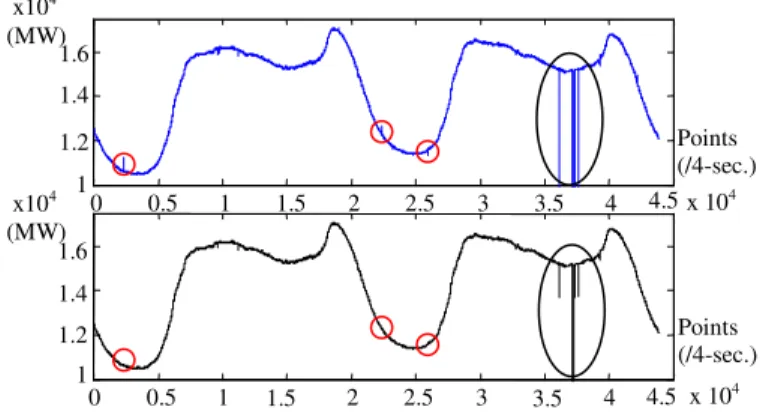
Figure 2-1 depicts the four-second load series before and after the micro spike filter
16
as marked by the three small red circles) are removed by the filter. Spikes with widths
close to or greater than the processing window w1 (macro spikes, as marked by the large
black ellipse) are only attenuated or cannot be handled by the micro spike filter at the
four-second time resolution. However, they may become micro spikes after integration,
and can then be handled by the same method at the five-minute resolution. In this way,
all micro spikes within the processing window are detected and replaced by smoothed
loads, whereas the load data outside the window are not touched.
0 0.5 1 1.5 2 2.5 3 3.5 4 4.5 1 1.2 1.4 1.6 1 1.2 1.4 1.6 x10⁴ (MW) x104 (MW) 0 0.5 1 1.5 2 2.5 3 3.5 4 4.5 x 10⁴ Points (/4-sec.) Points (/4-sec.) x 104
Figure 2-1. Before (top) and after (bottom) micro and macro spike filtering based on two days of continuous ISO-NE load data at the four-second resolution
2.3.2 Macro Spike Filtering
The key idea for filtering out macro spikes is to detect a pair of edges, and fix the
loads between the two edges with linear interpolation values. This method is only applied
to the loads at the five-minute resolution because macro spikes at the four-second
resolution may become micro spikes after integration. To detect edges, the first-order
differencing transformation is applied to the load series at the five-minute resolution.
17
threshold m. A macro spike is then said to be recognized when two sequential edges are
located, and the width of the two edges is less than a threshold w2 and equal to or greater
than the threshold w1. The spike whose width is less than w1 is a micro spike, and should
have been removed in micro spike filtering which is described in Subsection 2.2.1. To
fix a macro spike, the load in-between the two edges is replaced by a value from linear
interpolation. This interpolation method is used because the changes of five-minute loads
over a short time period have similar slopes for most of the times based on observation.
Figure 2-2 depicts the five-minute load series (four-second integrated into five-minute
loads depicted in the second plot of Figure 2-1) before and after the macro filtering is
applied. 0 100 200 300 400 500 600 1 1.2 1.4 1.6 1.8 0 100 200 300 400 500 600 1 1.2 1.4 1.6 1.8 x10 (MW) 4 4 x10 (MW) Points (/5-min.) Points (/5-min.)
Figure 2-2. Before (top) and after (bottom) macro spike filtering at the five-minute resolution
2.4
Wavelet Neural Networks
To perform accurate predictions after pre-filtering, load properties are analyzed in
18
very fast changing component from five to fifteen-minute resolutions, a fast changing
component from fifteen-minute to one-hour resolutions, and a slow changing component
with hourly, weekly, and monthly patterns. The WNN method is developed to capture
the complicated load properties. To accurately capture load features at multiple
frequencies, a wavelet technique is used to decompose the loads into several frequency
components in Subsection 2.4.2. Due to the use of convolution in the wavelet transform,
additional data need to be padded at the end side of the load segment in real-time.
Relationships among the padding parameters are discussed and derived. Different
padding strategies are then tested, and the best one is determined via the test data set. In
Subsection 2.4.3, each load component is properly transformed and then fed with other
time and date indices to a separate neural network. Predictions from individual neural
networks are combined to form the forecasts. Finally, twelve dedicated wavelet neural
networks are used to perform moving forecasts in Subsection 2.4.4.
2.4.1 Load Property Analysis
Very short-term load data have complicated properties. They are illustrated by the
power spectrum density which describes how the power of load data is distributed with
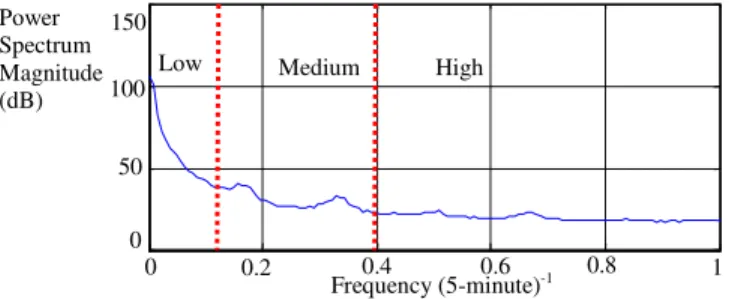
frequency. As shown in Figure 2-3, the main power lies in the low frequency and several
small pedals afterward, and each one has a unique frequency component. Intuitively, this
frequency domain is divided into three frequency components as denoted by low,
medium, and high frequencies. If each one is further magnified by amplitude spectrum
(explained in the next paragraph), it is observed that these components have different
19 Frequency (5-minute)-1 0 0.2 0.8 1 0 50 100 150
Low Medium High
0.4 0.6 Power
Spectrum Magnitude (dB)
Figure 2-3. Power spectrum density for five-minute load data (January 1st, 2007 to June 30th, 2008)
As depicted in Figure 2-4, the amplitude spectrum shows that the low, medium, and
high load frequency components have different features. Spectral lines for the low
frequency component in the eclipse are magnified further. These spectral lines represent
unique load patterns, and the ones located at frequencies corresponding to hourly,
weekly, and monthly information are marked. The amplitude spectrums for the medium
and high load frequencies (reflecting fast changes in load data) have small magnitudes,
and hence are not magnified. Dashed lines are used to separate load components as they
are in the separation in Figure 2-3.
0 0.05 0.1 0.15 0.2 0.25 0.3 0.35 0.4 0.45 0.5 0 0.5 1 1.5 2 2.5 3 3.5 x 10⁴ 0 2 4 6 8 x10⁻³ 0 1000 2000 3000 Week 24-hours Season 12-hours Low freq.
Load Amplitude |Y(f)| (MW)
Medium freq. High freq. 1-hour 15-minutes
20
Figure 2-4. Amplitude spectrum for five-minute load data
2.4.2 Filter Bank in Wavelet Transform
The load data have multiple frequency components as depicted in Figure 2-3, and
each may have a unique pattern as depicted in Figure 2-4. An intuitive idea is to
decompose the loads into multiple frequency components and process each
independently. For example, the load data were decomposed into multiple resolution
scales in (Rocha Reis and Alves da Silva, 2005; Benaouda et al., 2006). Fourier
transform is a straightforward technique to represent the signal as a sum of sinusoids
which are only localized in frequency. In contrast to Fourier transform, wavelets are
localized in both time and frequency and often give a better representation using
multi-resolution analysis. A detailed introduction to wavelets can be found in (Mallat, 2009:
Chapter 1). Motivated by the successful one-level wavelet decomposition for short-term
load forecasting in our previous work (Chen et al., 2010), a wavelet technique is chosen
to decompose input loads into multiple frequency components. The input loads are first
decomposed into low (L) and high (H) frequency components at level one. The L
frequency component called "approximation" represents a general trend of the signal,
whereas the H frequency component is viewed as a difference between two successive
approximations (Rocha Reis and Alves da Silva, 2005). Since the load has a large
magnitude and multiple frequency information, the L frequency component is further
decomposed into low-low (LL) and low-high (LH) frequency components. There is no
need to decompose the H component because it has a small magnitude as compared to the
21
LH, and H are very similar to the low, medium, and high frequencies described in
Subsection 2.4.1.
To implement the two-level wavelet transform, a three-channel filter bank is used
as shown in Figure 2-5. The high frequency channel consists of the analysis and
synthesis stages. At the analysis stage, a high pass filter (a wavelet function that plays
the role of the anti-alising) G1 filters out the low frequency component. A
down-sampling step then removes the odd-numbered data points. At the synthesis stage, the
up-sampling step pads zeros to down-sampled data to recover the data length. A high
pass filter H1 then removes the replicas of signal spectrum caused by up-sampling.
Similarly, the low-high frequency channel uses a low pass filter G0 to compute the
general trend, and then holds the even-numbered points. Next, these points are further
decomposed into two parts. The low-high part convolves with G1 and then takes steps
similar to those for the high frequency channel. To recover the initial input length, the
output from H1 has to be up-sampled and convolve with H0. These are the steps to
produce the LH frequency component. The same is true for the low-low frequency
channel. Filters G0, G1, H0, and H1 have to satisfy perfect reconstruction and
orthogonality in (Strang and Nguyen, 1997).
H0 G0 G1 ↑2 H ↑2 H0 LL ↓2 G1 G0 ↓2 ↓2 ↑2 H1 H1 H0 ↑2 ↓2 ↑2 LH Synthesis Stage Analysis Stage Loads
22
The filter bank in the wavelet transform described above adopts a circular
convolution as explained in (Strang and Nguyen, 1997: Chapter 8). Circular convolution
causes boundary distortions which affect neural network predictions. To reduce the
distortion, it is necessary to extend the signal beyond the boundaries. In the high
frequency channel shown in Figure 2-5, the distortion length for a convolution between
the input loads and G1 is (lw-1) based on the convolution theory, where lw is the filter
length. Down-sampling and up-sampling do not produce the distortion. H1 introduces
another distortion with the same length (lw-1). The total distortion length is 2(lw-1). The
low-high frequency channel sequentially convolves the inputs with four filters (G0, G1,
H1, and H0) with a final length of the distortion 4(lw-1), doubling that of the high
frequency channel. The same is true for the low-low frequency channel. The distortion
length is thus roughly doubled for a component which is further decomposed one more
level. A detailed analysis can be found in (Guan and Luh, 2010). To make sure that at
least one value is not affected by distortion, the load inputs to NN need to be padded.
The padding length has to be equal to or greater than the distortion length (wmaxlev
function in MATLAB Wavelet Toolbox):
(
lw)
lvllx= −1⋅2 , (3)
where lx is the distortion length which indicates the minimum padding length, and lvl is
the level of the decomposition. Hence, the total length for load inputs to be decomposed
has to be equal to or greater than the sum of the minimum padding length lx and the
length of the load inputs of the last hour (12 points). For VSTLF, the latest historical
data are available and used to pad the last hour’s loads at the front. Additional data are
23
From (3), the relationships among the decomposition level lvl, the filter (G and H) length
lw, and the minimum padding length lx are very close. It can be concluded that fixing lvl
and increasing lw, or vice versa, will increase lx. This indicates that the padding length
will increase, which may not be good because a long padding to load inputs can result in
a poor training and prediction for NN. However, lvl should not be too small because the
features of load components cannot be fully captured. The same is true for lw because a
small lw has a poor ability to represent the load component behaviors. It is clear that
neither lw nor lvl should be too large or small, so that a reasonable lx can be obtained.
Therefore, a balance among lvl, lw, and lx has to be made due to their close relationships
in (3).
To choose a good lvl for decomposition, different values are tested and compared,
while lw and lx remain fixed. Two-level decomposition is found to be the best among
levels from zero to three in Example 2 in Section 2.5. This corresponds to the scheme
presented in Figure 2-5 with three decomposed frequency components H, LH, and LL.
To choose a good filter length lw, a proper wavelet has to be chosen using the previous
fixed lx and newly determined lvl (=2). Daubechies (Db) wavelets are adopted in our
method because they belong to a family of orthogonal wavelets and are characterized by
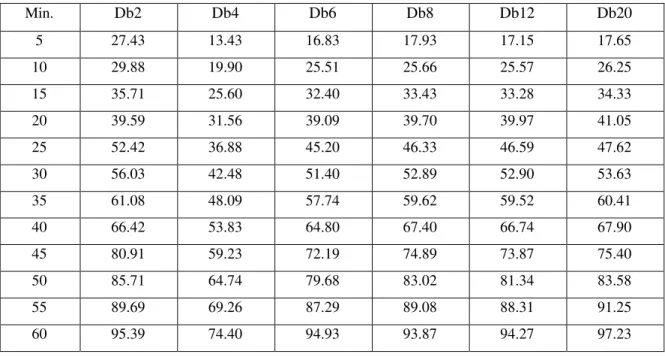
frequency responses having maximum flatness (at 0 and π). Db members tested are
Db2-Db20 (even index numbers only). The index number refers to the filter length lw, and
has the ability to represent complicated behaviors of signal components. For example,
Db2 encodes constant components, and Db4 encodes constant and linear ones. However,
the Db number cannot be too large. Otherwise, the minimum padding length will
24
similar slopes for most of the times. Hence, Db4 seems to be a reasonable choice
because it encodes linear signal components, and is demonstrated to be the best among all
the index numbers tested as presented in Section 2.5.
Once lvl (=2) and lw (=4) are fixed in equation (3), lx can be calculated ((lw
-1)·2lvl=12). Since the last hour’s loads (12 points) are used as NN inputs, the total length
for load inputs to be decomposed has to be equal to or greater than the sum of the
minimum padding length and the length of the last hour’s loads (i.e., the total length
≥24). A more precise number can be calculated from the derivation in (Guan and Luh,
2010). To further reduce distortion effects, padding strategies (e.g., zero-padding,
periodic extension, and symmetrization) are tested. According to the test in Example 2 in
Section 2.5, symmetrization, a boundary replication which pads the loads by adding
points symmetric to the original, is demonstrated to be the best strategy. This also
corresponds with the conclusion on page 263 in (Strang and Nguyen, 1997). These
parameters are determined through training, validation, and test processes in a three way
data split. NNH NNLH NNLL + High Freq. (H) Low-High Freq. (LH) Low-Low Freq. (LL) WD Forecasts N RI N N N: Normalization;
RI: Relative Increment;
WD: Wavelet Decomposition (Subsection IV-B) Last Hour’ Loads
(12 points)
Hourly, Weekly, Monthly, and Sunset Time Indices
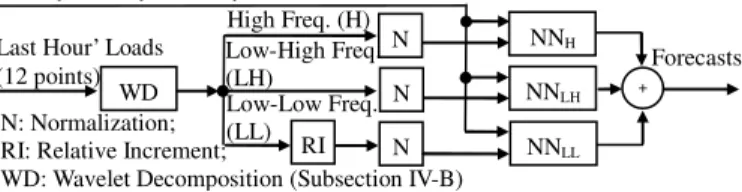
Figure 2-6. Structure of wavelet neural networks
2.4.3 Neural Networks
To capture decomposed frequencies, our idea is to properly transform individual
25
to separate neural networks. Finally, individual predictions from NNs are added to form
the forecasts as depicted in Figure 2-6.
The load components are treated differently. The LL frequency represents the
majority of load information, including hourly, weekly, and monthly patterns as analyzed
in Subsection 2.4.1. Since the loads from 5 to 60 minute outs are predicted each time, the
loads of the last hour (lag=12) are used as inputs. Loads with other lags are also tested,
but the results are not further improved. To remove a first-order trend and anchor the
predictions by the latest load, the relative increment (RI) in loads in (Charytoniuk and
Chen, 2000), is applied:
( )
t =(
LL( )
t −LL( )
t−1)
LL( )
t−1LLRId d d d , (4)
where LL represents the low-low frequency load component at day index d, and t is the
time index in a five-minute period. RI indicates the relative increment transformation
and is used to stationarize the load component series. This transformation reveals more
of the hidden information in the LL frequency component in Figure 2-7.b than the one
without applying RI in Figure 2-7.a. But the other observation shows that RI reveals less
of hidden information in the LH and H components than the one without applying RI.
Hence, RI transformation is only applied to the LL load component. All the components
then have to be normalized and fed to individual NNs.
0 0.1 0.2 0.3 0.4 0.5 0 0.005 0.01 0 0.1 0.4 0.5 0 0.005 0.01 7.a 7.b Normalized Low-Low Frequency Load Amplitude |Y(f)| (MW) Frequency (5-minute)-1
26
Figure 2-7.a. Amplitude spectrum for normalized low-low frequency before applying RI; Figure 2-7.b. Amplitude spectrum for normalized low-low
frequency after applying RI
In addition to load inputs (5 to 60 minutes), time and date indices are parts of the
neural network inputs, including hourly, weekly, and monthly indices. Furthermore,
sunset time is included to capture the load feature related to the street lighting. These
indices are used to help NNs indentify the periodical patterns of load data. Similarly,
low-high and high frequency NNs adopt the same time and date indices but use the load
components without RI transformation. Finally, results from three NNs are summed up
to form final forecasts. Other additional inputs were tested but not considered because
the results were not significantly improved. These inputs include: area control errors,
frequencies, and some selected loads from history (e.g., loads of the last several hours,
loads of selected hours from yesterday, similar day’s loads, and so on). Based on the
literature review, actual weather data and weather forecasts from related methods, e.g.,
the climatology method (weather world 2010 project), are seldom used for VSTLF inputs
because of the large time constant of the load and weather relationship. Also, real-time
weather data are not available from ISO New England.
To narrow the numerous choices of input candidates down, different combinations of
data inputs are screened based on small data sets. For example, load data from
November 2007 to December 2007 are used for training, and loads for January 2008 are
then predicted. The resulting candidate inputs are then examined through training,
27
2.4.4 Moving Forecasts
When performing moving forecasts every five minutes, the intuitive approach
would be to train a single WNN offline with historical data as presented in (Haykin,
2009: Chapter 4) and train the WNN online whenever a new data point is available. This
is the same as the self-adaptive training process of (Herrera et al., 2010). However, test
results using this approach are not satisfactory. Based on further testing, our final
configuration consists of twelve dedicated WNNs, one for each five-minute period in the
hour. In this way, individual WNNs can be properly trained. For example, at 2:55 am,
WNN1 predicts the loads from 3:00 am to 3:55 am in five-minute periods; WNN2 at time
3:00 am predicts the loads from 3:05 am to 4:00 am in five-minute periods, etc. Then at
3:55 am, when the measured values are known for the past 12 time steps, WNN1 is
trained online (updated) with the data from 3:00 am to 3:55 am and then predicts the
loads from 4:00 am to 4:55 am, and the process repeats.
2.5
Numerical Test Results
The method was developed in MATLAB for prototype implementation and then
converted to JAVA using Eclipse. The open source can be downloaded at
http://github.com/ldmbouge/vstlf. In this section, the software was run on a server with
dual Xeon quad core Intel E5620 2.4GHz processors and 36 GB memory. The
performance measures include mean absolute error (MAE), mean absolute scaled error
(MASE) as presented in (Hyndman and Koehler, 2006; Hyndman, 2006), mean average
percentage error (MAPE), and standard deviation of sample errors (SD):
( )
= 1∑12 +( )
−( )
, =1,L,12 = − L t L t k n k MAE t nk k p A , (5)28
( )
k MAE k out of sample MAEin sampleMASE = ( ) − − − , (6)
( )
k =n−1∑12t=nk+k(
Lp( )
t −LA( )
t LA( )
t)
×100% MAPE , (7)( )
[
(
( )
(
( )
( )
)
)
]
2 1 12 1 12 1∑ − ∑ − = − =n+k − = + k t Lp t n t nk k Lp t LA t n k SD . (8)In the above equations, index k represents 5 to 60 minutes in five-minute steps, n
indicates the number of hours in the forecasting horizon, and LA(t) and LP(t) denote actual
and predicted loads at sample time t, respectively. The general performance measures
include MAE, MAPE, and SD. MASE provides a scale-free error metric for comparing
forecasting methods on a single series (Hyndman and Koehler, 2006). In (6), the
numerator MAE(k)out-of-sample for k-step out (k = 1, …, 12) is calculated for the multistep
WNN forecasts computed out-of-sample (in the testing data set). The denominator
MAEin-sampleis calculated for the one-step "naïve forecast" computed in-sample (in the
training and validation data sets). The naïve forecast for each future period is the actual
value for the previous period (Hyndman, 2006). This denominator MAEin-sampleis used to
scale the numerator MAE(k)out-of-sample to generate a scale-free error metric that is stable,
easy to compute, and in the correct unit. If the MASE value is less than one, this
indicates that the forecast of the presented method is better than the one-step naive
forecast. However, if the MASE value is greater than one, this indicates the opposite.
Multistep MASE values are often larger than one as the forecasting horizon increases
because one step naive forecast is used for scaling (Hyndman and Koehler, 2006;
Hyndman, 2006). Equations (5) to (8) can also be applied to moving forecasts with
multiple WNNs.
Two examples are presented to demonstrate our method. Example 1 uses a
29
so that our method can be duplicated and verified in a simple way. Example 2
demonstrates the values of spike filtering methods, two-level decomposition, Db4
wavelet, Symmetrization padding, selected time and date indices (hourly, weekly,
monthly, and sunset time), and relative increment transformation to the LL frequency
component.
In both examples, standard neural networks based on the back-propagation learning
algorithm in (Haykin, 2009: Chapter 4) are used. The training, validation, and test
processes in a three way data split are used to determine and demonstrate the parameters
in the model. All NNs are trained offline by using historical data with weights randomly
initialized, and the training terminates when the stopping criteria is reached to be
described in Examples 1 and 2. These NNs are then trained online with the latest twelve
loads as explained in Subsection 2.4.3
Example 1.Consider the signal:
( )
t =100sin(
2 10t)
+20sin(
2 150t)
+sin(
2 200t)
y π π π , (9)
where the signal y(t) is composed of a low frequency component 100sin(2π10t), a
medium component 20sin(2π150t), and a high component sin(2π200t). The signal is
similar to the actual load in terms of relative amplitude and frequency. A total of 3600
data points (t, ỹ(t)) were randomly generated:
( ) ( ) ( )
t =yt +ε t y~ , (10)
where t ∈ [1, …, 3600] and {ε(t)} were independent and identically distributed normal noises with zero mean and unit variance N(0, 1). The first one-third of data points were
30
used for training, the second one-third of data for validation, and the last one-third of data
for testing.
A single NN without wavelet decomposition is compared to neural networks with
two-level wavelet decomposition. The relative increment transformation is not used for
this example because y(t) consists of three sine functions which are periodical, and there
is no need to use this transformation to make {y(t)} stationary. Based on the training,
validation, and test processes in a three way data split, the number of hidden neurons for
the standard NN method is set to be 11, and the numbers of hidden neurons for our
method are set to be 8, 7, and 13 for H, LH, and LL NNs, respectively. For both
methods, NN training processes stop when MAE thresholds (stopping criteria) are
reached. From the test data set, the overall MAE and SD are respectively 1.73 and 2.33
for standard NN method, whereas the overall MAE and SD are respectively 0.85 and 1.06
for our method. MAPE is not adopted since {y(t)} may have zero values. MAEs and
SDs indicate that the predictions obtained from using two-level wavelet NNs are both
closer to the true values in data series {y(t)} and have smaller standard deviations than
the ones obtained using a single NN.
Example 2. Wavelet neural networks with spike filtering are tested with system load
data provided by ISO New England. The training period is from January 1st, 2007 to
December 31th, 2007, the validation period is from January 1st, 2008 to June 30th, 2008,
and the test period is from July 1st, 2008 to December 31th, 2009. Ten cases are tested.
Since there are many factors in setting the forecasting model, and each factor has
31
practical way to demonstrate the appropriateness of options selected for individual
factors, the configuration determined through training, validation, and test processes is
treated as the nominal configuration. Based on it, each factor is then examined in
individual cases below. Cases 1 -7 are for training and validation: Case 1 for micro and
macro spike filtering, Case 2 for spike filtering thresholds, Case 3 for decomposition
levels, Case 4 for selecting Daubechies wavelets, Case 5 for padding strategies, Case 6
for date and time indices, and Case 7 for relative increment transformation. Cases 8-10
are for testing: Case 8 for test results and prediction interval construction, Case 9 for
comparing with ISO-NE’s method, and Case 10 for Monte Carlo simulations.
To reduce computation time, Cases 3-7 are based on WNN1 because its results are
very similar to the individual results from other WNNs as reported in Table 2-1, while the
other cases are based on the twelve dedicated WNNs. For all the cases, there are three
layers in all the neural networks: one input layer, one hidden layer, and one output layer.
Through training, validation, and test processes in a three way data split, the numbers of
hidden neurons are 6, 13, and 18 for H, LH, and LL NNs, respectively. They are not
identical because the decomposed load components have different features. Based on
testing, a single WNN is trained offline for three hours (stopping criterion), and twelve
WNNs require a total of thirty six hours for training offline.
Table 2-1. MAES (MW) FOR MULTIPLE WNNS
Min. WNN1 WNN2 WNN4 WNN6 WNN8 WNN10 WN