Prevalence of Alcohol Dependence and
Abuse in a General Hospital;
Sensitivity and Specificity of MAST
ABSTRACT
Aim: Alcohol abuse and dependence is an important public health con-cern in most countries. It is also a big problem among the hospitalized patients.
Method: This study was undertaken to determine the number of the patients with alcohol related problems in a general hospital sample, to compare the prevalence rate among clinics, to determine the sen-sitivity and specificity of MAST (Michigan Alcoholism Screening Test) for an inpatient sample. The data were collected from 13 inpatient clinics of Ankara Numune Research and Training Hospital.
Result: A sample of 800 patients was enrolled in the study. 60 patients were (%7,5) diagnosed alcohol addiction and 11 were (%1,4) diagnosed as alcohol abuse. Alcohol addiction was most common in gastroenter-ology clinic. MAST sensitivity and specificity were found 0,74 and 0,98 respectively.
Conclusion: MAST might be a useful instrument for screening alcohol related problems in a general hospital setting.
Key words: MAST, alcohol dependence, alcohol abuse, prevalence
INTRODUCTION
Alcohol related problems are important public health concern in most countries. Most of the people who drink alcohol are at risk of having al-cohol-related problems and their life-threatening consequences. Alcohol and drug use disorders are the most frequent causes of disability among all mental disorders and 12% of the people in western countries suffer from alcohol and drug related disabilities (1). Estimation of the preva-lence rates of alcohol use disorders (alcohol abuse and dependence) is crucial among inpatient samples because of high rates of physical co morbidity.
1Ankara Numune State Hospital, De-partment of Psychiatry, Ankara
2Pamukkale University, Medical Faculty, Department of Psychiatry, Denizli 3Sincan State Hospital, Department of Psychiatry, Ankara, Turkey
Eur J Gen Med 2010;7(1):9-16
Correspondence: Dr. Cem Şengül
Pamukkale Üniversitesi, Psikiyatri
Bölümü, Denizli, Türkiye Tel: +90 258 4440728-1144 GSM: +90 532 6450585 E-mail:[email protected]
Alcohol-related morbidity includes not only alcohol abuse and dependence but also damage to liver, pancreas, gas-trointestinal tract, heart and central and peripheral
ner-vous systems (2). On the other hand, significant propor -tions of problems related to alcohol use especially occur in people who are not alcohol dependent (3). In general practice and hospital care, screening alcohol consump-tion and related problems allow health care professionals to identify individuals who have the risk of alcohol-re-lated consequences. Screening alcohol-realcohol-re-lated problems usually involves asking the patients about their drink-ing habits through structured interviews of self-report questionnaires such as CAGE (Cut down, Annoy, Guilt, Eye opener), MAST (Michigan Alcoholism Screening Test),
AUDIT (Alcohol Use Disorders Identification Test) and
TWEAK (Tolerance, worried, eye-opener, amnesia, K/Cut down) (4,5).
Several studies were undertaken to determine the preva-lence of alcohol related problems among inpatient sam-ples in different countries. The results of the National Longitudinal Alcohol Epidemiologic Survey in the United States showed that 15% to 42% of men and 4% to 35% of women admitted to general medical-surgical services have alcohol related problems (6). Alcohol abuse is the leading cause of liver-related mortality in the USA. The health statistics suggest that the number of people suf-fering from some form of alcoholic liver disease exceeded 2 million. An estimated 900 000 people have cirrhosis and 26 000 of them die each year, among these people at least 40% and perhaps 90% have a history of alcohol abuse (7).
In order to determine the prevalence of current DSM-IV Alcohol- use disorders in short-stay general hospital admissions, Smothers et al designed a multistage prob-ability sample to represent acute care admissions to nonfederal, short-stay, general hospitals. An estimated 1.8 million annual hospital admissions met the crite-ria for a current DSM-IV alcohol use disorder. Overall prevalence was estimated to be 7.4% among current-drinking related admissions; estimated prevalence was
24.0%. Pair wise comparisons showed significant eleva -tions in the prevalence of alcohol use disorders in current-drinking related admissions who were younger, unmarried, of a lower socioeconomic status, smokers,
or drug users (8,9). Interesting finding that had point -ed out the data that may be important for further research, treatment, and screening procedures came
colleguages in the UK, in which 14% of an inpatient sample was positive for alcohol misuse and people misusing one substance were more likely to be misus-ing others (10).
In Turkey, until now date only one study has been per-formed to determine the prevalence of alcohol-use dis-orders among inpatient samples. In that study involving 500 inpatients in a University Hospital in Ankara, the rate of patients who were still using alcohol was %17.6. The alcohol dependence rate was 3.2% in males and 0.03% in females. The study determined that the alcohol depen-dency rate was 7 times higher in men among inpatient sample (11). The prevalence rates seem to be lower than Western countries; however, recent epidemiological data indicates that there is an increasing trend in prevalence rates of alcohol-use disorders in general population. Thus, the prevalence estimation of alcohol-use disorders may not represent the current situation (12).
In routine clinical practice, doctors sometimes have
difficulties in detecting alcohol related problems in
many of their patients (13). In a study by Rumpf, it was pointed out that the physician’s detection rate of alcohol related problems could be improved by 10% in general hospital and 20% in general practice through the additional use of a screening questionnaire (14). Among patients detected as alcohol dependent in the general hospital, 38.2% had received no previous help in their life-time and 70.8% did not seek help in the year prior to admission (3). Another study showed that screening the patients for alcohol related prob-lems will help clinician to reach to a less problematic sample with lower motivation to change (15). Based on this evidence it can be claimed that the general hospital can be regarded as a suitable place to pro-vide secondary prevention for the patients that have alcohol related disorders and provides the opportunity
to initiate first treatment for a substantial part of
alcohol-dependent subjects (15).
An important study that was conducted by Ulrich et al in Germany involved a sample of 1309 inpatients (in six
medical clinics and five surgical clinics) aged between 18
and 64, who were followed for one year. The patients were screened for alcohol related disorders by CAGE and MAST questionnaires, the type of medications used in the hospital for the treatment of withdrawal symptoms, laboratory tests like GGT, AST, ALT and MCV, that can be
assessment with SCAN (Schedules of Clinical Assessment in Neuropsychiatry) was performed. The authors stated that only 0.4% of the total sample could not be detected by CAGE and MAST. In addition, 2% of the patients that
were positive in CAGE or MAST could not be confirmed
by SCAN. In the six medical clinics, alcohol abusers or dependents varied between 3.5% and 32.1%. This study showed that screening instruments were sensitive and
specific for detecting alcohol-related problems among
general hospital cases (16). The objectives of this study were; to determine the number of the patients that have alcohol related problems in a general hospital, to com-pare the frequencies of alcohol dependence and abuse among clinics and to determine the sensitivity and
speci-ficity of MAST for an inpatient sample.
MATERIALS AND METHODS Subjects
The study involved the patients who were admitted to Ankara Numune Research and Training Hospital.
The data were collected from eight medical and five
surgical clinics from the patients who had been ran-domly selected out of the patient lists of each clinic. The medical clinics consisted of gastroenterology, im-munology, endocrinology, oncology, hematology, neu-rology, nephneu-rology, and cardiology clinics. The surgi-cal clinics consisted of three general surgisurgi-cal clinics, one orthopedics and neurosurgery clinics. Especially orthopedics and neurosurgery clinics involved trauma patients. In the three general surgical clinics, there were patients with abdominal, thyroid, and periph-eral vascular diseases. The intensive care clinics were excluded because almost all of the patients were not able to participate in the study. The informed con-sents of the patients were obtained, and the tasks of the study were explained to the patients before the study. The consents of clinic directors were also obtained.
Eight hundred patients (age range: 18–65; 45.59±13.28) volunteered to enroll in the study. Of the total sample, 50.8% (n:406) were female, and 49.3% (n:394) were male. While 40.6% (n:327) patients were in the medi-cal clinics, 59.4% (n:473) patients were in the surgimedi-cal clinics.
Screening And Diagnostic Procedures
MAST questionnaire was administered to all the pa-tients enrolled in the study by two trained psychia-trists and a psychologist, who were not involved in the ongoing care of the patients. A chart review was performed to determine the demographic data, such as age, gender, marital status, occupation, residence, and education of the patients. The questionnaire was performed in the clinics. There was no time limit, and the interviewers helped the illiterate patients by reading the questionaire. After the administra-tion of the MAST, SCID-I was performed by another trained psychiatrist blinded to the MAST scores of the patients.
Assessment Tools
Michigan Alcoholism Test (MAST
Michigan Alcoholism Screening Test (MAST), a 25-item questionnaire originally described by Selzer in 1971, is one of these screening tests, which has been extensively validated in several clinical and epidemiological studies (17,18). The 25 yes/no re-sponses are assigned weighted points, and the total score obtained is used to designate the subject as alcoholic or non-alcoholic. A score of 5 points or greater is associated with alcoholism in 80% of the subjects, whereas a score of 10 and greater is 100% associated with alcoholism. Validity and reliability of Turkish version of the MAST was made by Coskunol et al (19).
SCID-I
The structured Clinical Interview for DSM-IV axis I Disorders (SCID-I) is a clinician-administered semi structured interview for use on psychiatric patients or with non patient community subjects who are undergoing evaluation for psychopathology. The SCID-I was developed to provide broad coverage of psychi-atric diagnosis according to DSM-IV (20). Reliability of Turkish version was made Ozkurkcugil et al (21).
Statistical Analysis
Descriptive statistics were used to find the sociodemo -graphic characteristics, distribution of patients among clinics and the prevalence of alcohol-related diagnosis. Categorical variables were tested by X2 analysis and continuous variables were tested by independent sam-ples t test.
I n
addition, the sensitivity and specificity analyses of MAST
were performed according to SCID diagnosis taken as a gold standard. Taking 5 points as a cut-off value, the patients were distinguished as false negative, true posi-tive, false posiposi-tive, and true negative. P<0.05 was
con-sidered significant. The sensitivity and specificity analy -ses were performed based on the formulas below:
Sensitivity = true positive X 100
---True positive+false negative Specificity = true negative X 100
---False positive+true negative
RESULTS
The number of the total eligible patients was 800. The patients who were unable to participate (37 patients), refused screening procedure (23 patients), and were
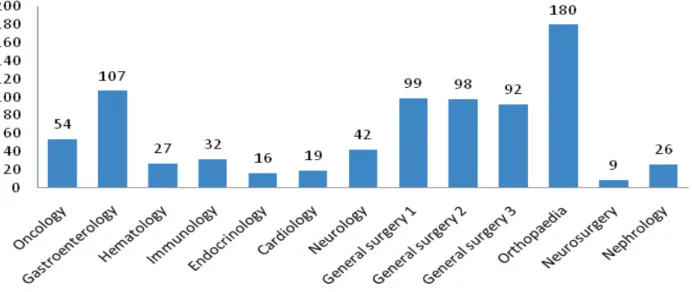
discharged before the screening procedure could be fin -ished (44 patients) were excluded from the study. The socio-demographic characteristics of the patients are provided on Table 1. Three hundred and twenty-seven (40.6%) patients were hospitalized in the medical clinics and 473 (59.4%) patients were hospitalized in the sur-gical clinics. Distribution of patients among clinics has been presented on Figure 1.
The gastroenterology clinic had the highest ratio of patients (13%), while the endocrinology clinic had the lowest ratio (2%) of the patients among the medical clinics. As for the surgical clinics, orthopedics depart-ment had the highest ratio of the patients (29%) and the neurosurgery clinic had the lowest ratio (1%) of the patients (Figure 1). The mean age of the patients was 45.32±13.12 in medical clinics and 45.78±13.40 in the
surgical clinics. There was no significant age difference
between the medical and surgical clinics ( p<0.05). Out of 800 inpatients, 735 (91.9%) patients had scored 4 or less and were designated as non-alcoholic based on the results of MAST (MAST negative). In the MAST negative group, 3 (0.4%) patients were diagnosed as al-cohol abusers, and 15 (1.9%) patients were diagnosed as alcohol dependent cases according to the results of
SCID-I. Sixty-five patients (8.1%) scored 5 or higher on
the MAST and were designated as MAST positive, among whom 40 (5%) patients had a score of 10 or higher with a
nearly 100% specificity for alcoholism. All of the patients
of this group were diagnosed as having either alcohol abuse or alcohol dependence problems. Thirty-eight pa-tients were diagnosed as alcohol dependent (4.8%), and 2 patients were diagnosed as alcohol abusers (0.3%) The remaining 25 patients had scores of 5 to 9 on the MAST, also matching to the cutoff values for a positive result. In this group, 7 (0.9%) patients had alcohol dependence, whereas 6 (0.8%) patients received a diagnosis of alco-hol abuse and 12 (1.5%) patients were not diagnosed
ac-cording to SCID-I (Table 2). The sensitivity and specificity
of MAST questionnaire were 0.74 and 0.98 respectively based on the cut-off score of 5. Of the eligible sample, 60 (7.5%) patients were diagnosed as alcohol dependent and 11 (1.4%) patients were diagnosed as alcohol abus-ers (Table 2). All of the patients diagnosed as alcohol
Table 1. Sociodemographic characteristics of the sample Number (n) % GENDER Male 394 49,2 Female 406 50,8 AGE 15-24 77 9.6 25-34 127 15.9 35-44 187 23.4 45-54 182 22.8 55-64 227 28.4 RESIDENTAL AREA Urban 627 78,4 Rural 173 21,6 MARITAL STATUS Single 84 10.5 Married 608 76 Divorced or widow 108 13.5 EDUCATION Illiterate 180 22,5 Literate 17 2,1 Primary school 483 60,4 High school 93 11,6 University 27 3,4
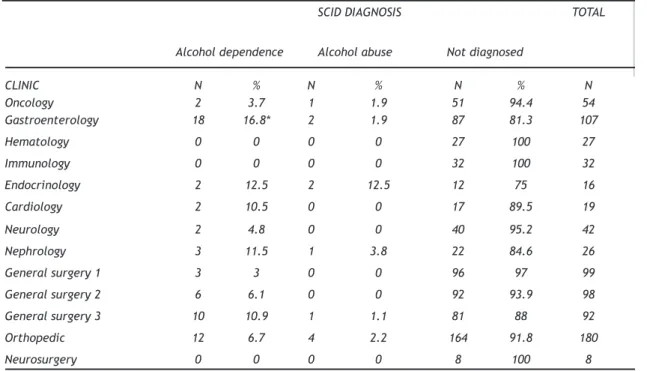
dependent were male. Only one female patient was di-agnosed as an alcohol abuser. When the SCID diagnoses were evaluated according to distribution of patients in each department, no patients had alcohol-related diag-nosis in hematology, immunology and neurosurgery clin-ics. The most frequent alcohol related diagnoses were in the gastroenterology clinic (18 alcohol dependence, 2 alcohol abuse) (Table 3). There were statistically
sig-nificant differences when the clinics were compared for
SCID diagnoses (p<0.05). The rates of alcohol depen-dence in the seven medical clinics ranged from 0% to 16.8%, and the rates of alcohol abuse ranged between 0% and 12.5%. Among the surgical clinics, the rates of alcohol dependence ranged from 0% to 10.9% and abuse rates were between 0% and 2.2%. Whereas one of the general surgery clinics had the highest ratio of alcohol dependents (10.9%), orthopedics clinic had the lowest
ratio for alcohol abusers (2.2%), (Table 3). No statistical difference seen between the medical and surgical clin-ics, considering the prevalence of alcohol dependence (9% versus 6.5%) and abuse (1.9% versus 1%).
DISCUSSION
One of the objectives of this study was to estimate the prevalence of alcohol dependence and abuse in a gen-eral hospital. Of our sample, 7.5% (n:60) of the patients were diagnosed as alcohol dependent, while 1.4% (n:11) of the patients diagnosed as alcohol abusers in the light
of SCID-I results. The prevalence was significantly higher
among males than among females. Data from the pre-vious studies show that the proportion of alcohol de-pendence in hospitalized patients ranges 10% to 20% (22). In our patients, the prevalence of alcohol-related problems seems to be lower than it was in the
previ-Table 2.Distribution of SCID diagnosis of the patients among MAST scores
MAST SCORES
SCID DIAGNOSIS
TOTAL
Alcohol dependence Alcohol abuse Not diagnosed
n % n % n % n %
0-4(MAST negative) 15 1.9 3 0.4 717 89.6 735 91.9
5-9(MAST positive) 7 0.9 6 0.8 12 1.5 25 3.1
>10(MAST positive) 38 4.8 2 0.3 0 0 40 5
TOTAL 60 7.5 11 1.4 729 91.1 800 100
ous studies performed in other countries; on the other hand, the prevalence rate of our patients might have been affected by the rates of alcoholism among general
Turkish population. In the Turkish Mental Health Profile
study, which was performed on the general population between 1995 and 1996, the alcohol dependency rates were detected as 1.7% for men and 0.1% for women based on the results of CIDI (23). In an epidemiological study that had been performed among general popula-tion in Turkey, 3,6% of the populapopula-tion had equal or more than 2 points in CAGE that points out risk for this group. According to the results of this study, almost 2.5 fold of the general population that is nearly 9% of the inpa-tients had alcohol related diagnosis (24). These data are
nearly confirmed by our results (alcohol dependence:
7.5%, alcohol abuse: 1.4%).
A striking finding of our study was that there was only
one female patient who was diagnosed as having alco-hol-related problem. In our clinical practice, there is a male dominance in alcohol-related at tendencies. We think that cultural factors are playing an important role on the women’s’ drinking habits in Turkey, but new data indicate that especially in the young population, alco-hol consumption rates are increasing in metropolitan
We used only MAST as a screening questionnaire, and considering the SCID interview as a gold standard, 2.2% (n:18) of the patients could not be detected by MAST.
The MAST is relatively sensitive and specific for
DSM-diagnosed alcohol abuse or dependence and this ques-tionnaire has some limitations as a screening instrument such as: an emphasis on symptoms of dependence rather than early drinking problems, lack of information on lev-el and pattern of alcohol use, and failure to distinguish current from lifetime problems (27). In our sample,
the sensitivity and specificity of the MAST questionnaire
were 0.74 and 0.98 respectively. Because of a tendency of the patients to deny some symptoms, few symptoms might have been overlooked during MAST, since it’’s a self-rating instrument. The alcohol-related problems of 18 patients were detected by SCID interview after es-tablishing a good doctor-patient relationship. However,
this may not be sufficient for all patients. As was done
by Ulrich et al. the two-step diagnostic procedure would be better for estimation (MAST+CAGE). Clinical observa-tion and anamnesis in combinaobserva-tion with other screening questionnaires, biochemical and hematological markers would be very effective at detecting problem drinking (16,28,29).
Table 3. Distribution of SCID diagnosis of the patients in each clinic.
CLINIC
SCID DIAGNOSIS TOTAL
Alcohol dependence Alcohol abuse Not diagnosed
N % N % N % N Oncology 2 3.7 1 1.9 51 94.4 54 Gastroenterology 18 16.8* 2 1.9 87 81.3 107 Hematology 0 0 0 0 27 100 27 Immunology 0 0 0 0 32 100 32 Endocrinology 2 12.5 2 12.5 12 75 16 Cardiology 2 10.5 0 0 17 89.5 19 Neurology 2 4.8 0 0 40 95.2 42 Nephrology 3 11.5 1 3.8 22 84.6 26 General surgery 1 3 3 0 0 96 97 99 General surgery 2 6 6.1 0 0 92 93.9 98 General surgery 3 10 10.9 1 1.1 81 88 92 Orthopedic 12 6.7 4 2.2 164 91.8 180 Neurosurgery 0 0 0 0 8 100 8 X2 test P<0.05, comparison of rates of SCID diagnosis of patients among clinics, * Most frequent alcohol related diagnosis
ics in our study. In the medical clinics, the sample size of cardiology (n:16) and endocrinology (n:19) clinic was small. Thus, the prevalence rates of alcohol related problems among these clinics are not as reliable as the prevalence rates of other clinics. This limitation was also encountered in neurosurgery clinic (n:8) among the surgical departments. When the prevalence rates were compared with the study of Ulrich et al.; similarly the abuse rates were found to be lower than dependence rates. For the whole sample, the prevalence rates were lower in our sample, and also the rates were higher in the gastroenterology clinic (16).
In conclusion, alcohol abuse and addiction were gener-ally well diagnosed and treated in psychiatry clinics. But alcohol related problems could not be recognized easily in general hospital and emergency clinics. Researchers were suggesting screening tests and biological markers for detection of alcohol related problems in these
set-tings. We found MAST as a sensitive and specific instru -ment for detecting alcohol related problems and MAST might be a useful instrument for screening alcohol re-lated problems in general hospital settings.
ACKNOWLEDGEMENTS
The authors would like to thank the clinical directors of Ankara Numune Research and Training Hospital for their close cooperation during the study.
REFERENCES
1. Rehm J, Taylor B, Room R. Global burden of disease from alcohol, illicit drugs and tobacco. Drug Alcohol Rev
2006;25:503-13.
2. Leon DA, McCambridge J. Liver cirrhosis mortality rates in Britain from 1950 to 2002: an analysis of routine data. Lancet 2006;367:52–6.
3. Rumpf HJ, Hapke U, John U. Previous help-seeking and motivation to change drinking behavior in alcohol- de-pendent general hospital patients Gen Hosp Psychiatry
1998;20:115-9.
4. Niemela O. Biomarkers in alcoholism. Clin Chim Acta
2007; 377: 39-49.
5. Gül S, Akvardar Y, Taş G, Tuncel P. The diagnostic validity
of screening tests and laboratory markers in alcohol use
disorders. Turk Psychiatry J 2005;16:3-12.
6. Grant BF. Prevalence and correlates of alcohol use and
DSM-IV alcohol dependence in the United States: Results of the National Longitudinal Alcohol Epidemiologic Survey. J Stud Alcohol 1997;58:464-73.
7. Dufour MC, Stinson FS, Caces ME. Trends in cirrhosis morbidity and mortality. USA 1979-1988. Semin Liver Dis
1993;13:109-25.
8. American Psychiatric Association Diagnostic and
Statistical Manual of Mental Disorders American Psychiatric Association 1994.
9. Smothers BA, Yahr HT, Ruhl CE. Detection of alcohol use
disorders in general hospital admissions in the United
States. Arch Intern Med 2004;164:749-56.
10. Kouimtsidis C, Reynolds M, Hunt M, et al. Substance use in the general hospital. Addict Behav 2003;28:483-99.
11. Özel MA, Güleç C. A study about epidemiology of chron
-ic alcoholism. 23th congress of National Psychiatry and Neurological Sciences, Congress booklet, 1987 İstanbul 12. Akvardar Y, Turkcan A, Yazman U, Aytaçlar S, Ergor G,
Cakmak D. Prevalence of alcohol use in Istanbul. Psychol
Rep 2003;92:1081-8
13. Chick J, Kemppainen E. Estimating alcohol consumption.
Pancreatology 2007;7:157-61
14. Rumpf HJ, Hapke U, Meyer C, John U. Motivation to change drinking behaviour: Comparison of Alcohol depen -dent individuals in a gen Hosp and a general population
sample. Gen Hosp Psychiatry 1999;21:348-53
15. Hapke U Rumpf HJ, John U Differences between hospital patients with alcohol problems referred for counselling by physicians’routine clinical practice versus screening
questionnaires. Addiction 1998;39:1777-86
16. Ulrich J, Rumpf HJ, Hapke U. Estimating alcohol
depen-dence and abuse in one general hospital: An approach
to Reduce sample selection bias. Alcohol& Alcoholism
1999;34:786-94.
17. Selzer ML. The Michigan Alcoholism screening Test: the
quest for a new diagnostic instrument, Am J Psychiatry
1971;127:1653-8.
18. Hedlund JL, Vieweg BW: The Michigan Alcoholism Screening Test (MAST): A comprehensive review. J Operational Psychiatry 1984;15:55-64.
19. Çoşkunol H, Bağdiken İ, Sorias S, Saygılı R. Validty and reliability of Turkish version of MAST. Ege Medical J 1995;34:15-8.
20. American Psychiatric Association (APA). Diagnostic and Statistical M.I anual of Mental Disorders. 4th ed. Washington (DC): American Psychiatric Association; 1994
21. Özkürkçügil A, Aydemir Ö, YILDIZ M, Danacı AE, Köroğlu
E, The adaptation and validity study of The structured
Clinical Interview for DSM-IV axis I Disorders (SCID-I) to Turkish. Med Treatment J 1999;2:233-6
22. Dongier M, Hill JM, Kealey S, Joseph L Screening for alco
-holism in general hospitals. Can J Psychiatry 1994;39:12-20.
23. Erol N, Kılıç C, Ulusoy M, Keçeci M, Şimşek Z. Profile of Turkey Sanity. Mean Report. Turkish Health Ministry Press, 1998 Ankara.
24. Turkish Psychological Association The profile of the
substance use and dependency in Turkey. December
25. Nelson CB, Heath AC, Kessler RC Temporal progression
of alcohol dependence symptoms in the U.S. Household Population: Results from the national Comorbitity Survey. J Consult and Clin Psychol, 1998;66:474-483.
26. Akvardar Y, Aslan B, Ekinci B. Cigarette smoking, alcohol and substance abuse in second year medical students of 9 Eylul Faculty of Medicine sigara, alkol, madde kullanımı. Bağımlılık Dergisi, 2001;2:49-52.
27. Bowman PT, Gerber S. Alcohol in the older population, Part 2: MAST you speak the truth in an AUDIT or are you too CAGE-y? Case Manager. 2006;17:48-53
28. Niles BL, McCrady BS Detection of alcohol problems in a hospital setting. Addict Behav. 1991;16:223-233
29. Babor TF, Higgins Biddle JC. Alcohol screening and brief
intervention: dissemination strategies for medical prac