PEOPLE
WITHOUT
JOBS
JOBS
WITHOUT
PEOPLE
ONTARIO’S LABOUR
MARKET FUTURE
Rick Miner, Ph.D.February 2010
First, a sincere thank you to all those colleagues who took the time to review earlier versions of this report. Your willingness to provide supportive and critical comments was most appreciated and contributed significantly to the form and content of the final document. Because of the enormity of their involvement, I would like to publically recognize two of these colleagues. David Cameron provided invaluable writing and editorial assistance. He has an astonishing ability to make complex issues understandable and help readers
comprehend the relevance of what has been discovered. It is a talent that deserves to be recognized. Suzanne Dwyer is an exceptional researcher who can not only “find things” but creates visual images that tell a story and complement David’s written communication skills. To both of you, thanks does not adequately cover the contributions you have made, but it is provided as a way of recognizing your significant involvement.
While much of the world is understandably focused on the current recession, there is a looming demographic and labour market crisis which has the potential to shake the very foundations of our society and economy.
Our population is aging; as the baby boomer generation advances into the age of normal retirement, there will be a significant decline in the proportion of our population in the prime working years (15 to 64). Using Ontario Ministry of Finance data, the projected shortfall in the availability of workers is shown to rise to at least 200,000, and to as high as 1.8 million by 2031, depending on our levels of population growth. Even in the midst of a recession, we have to understand that a labour shortage looms.
Unfortunately, this is only half of the bad news. At the same time as our population is aging, the requirements of the labour market are changing. With the emergence of our knowledge economy, the proportion of the labour force requiring some form of education or training beyond high school will increase dramatically. Using a variety of Canadian and U. S. estimates, it is concluded that by 2031 we will need 77%
of our workforce to have post-secondary credentials (apprenticeship, university, college, industry, professional). Overall, we now stand at about 60%, with our younger population (25 to 34 years of age) at just over 66%.
So, we will need both a larger workforce and increased skills. For potential solutions, increasing the size of the population (immigration) with more skilled workers could help, but it will not solve the problem. Increasing the participation rates of those currently under-represented in the labour force is another option that needs to be explored, as do ways of accelerating graduations, increasing employer-provided training, improving literacy rates, and creating a more unified educational system. But what is most clearly needed is a change in our society’s attitude towards post-secondary education. We have to accept attainment of post-secondary education or training as the expectation for all but a small minority of Ontarians.
Without effective action, we face a future with large numbers of unskilled workers looking for jobs that require skills they do not possess, and a large number of jobs that will go unfilled. The time for action is now. It will take planning, hard work, cooperation, and difficult decisions to secure our future. An alternative outcome is simply unacceptable.
EXECUTIVE
SUMMARY
THIS CRISIS ARISES FROM THE INTERSECTION OF TWO MEGA-TRENDS: AN AGING POPULATION AND AN EMERGING KNOWLEDGE ECONOMY.
ONTARIO’S LABOUR MARKET FUTURE
One of the most dramatic and far-reaching transformations of Ontario’s education system was foreshadowed by the arrival of the baby boomer generation, beginning in the U.S. in 1946 and a year later in Canada. They kept arriving for another seventeen years or so, to be followed by a second bulge as the children of the boomers, the so-called baby boom echo, swelled the system once again. In the process, Ontario’s education system was utterly transformed: new schools were opened almost on a daily basis, the high school curriculum was completely revamped, new universities were established, affiliated institutions gained their independence, and a new and unique system of community colleges came on the scene. In 2011-2012, just over a year from now, the first of the baby boomers will reach the age of 65 and most will retire, although the lure of “Freedom 55,” particularly for those in the public sector, has already started that process.
Just as the arrival of the boomer generation transformed Ontario’s education system, the pending retirements promise to present the province with challenges to public policy that will prove to be no less severe. As this paper will show, Ontario and the rest of Canada – indeed most countries in the developed world – are about to encounter a set of demographic changes so profound that, if appropriate policy responses are not devised, and quickly, they have the potential to shake the very foundations of
our society and our economy. Some countries have already begun to adapt in response to this challenge (EFMD, 2007). Ontario and Canada cannot afford to be left behind.
This paper reviews what we know about the demographic changes in store, analyses the implications for Ontario’s labour force, and discusses a range of policy options that the government, industry, and our post-secondary institutions will have to consider. It also identifies an urgent challenge that is about to face our post-secondary system, a challenge that has not been part of the policy discourse to date.
A word of warning before we begin our detailed analysis. Right now, it is perhaps understandable that the world has its attention focused on the prospects of economic recovery, after the calamity of the recent recession. As understandable as it may be, it would be truly unfortunate if the focus on economic recovery were to blind us to the demographic reality that lies just around the corner. We know the economy will recover. Hopefully sooner rather than later. Ironically, if it takes a little longer, we may have a little more time to confront the demographic change that literally stares us in the face. Indeed, what we have to understand is that if we do not meet the challenge of an aging population, we may discover we have limited our ability to accelerate economic growth.
JOBS
WITHOUT
PEOPLE
PEOPLE
WITHOUT
JOBS
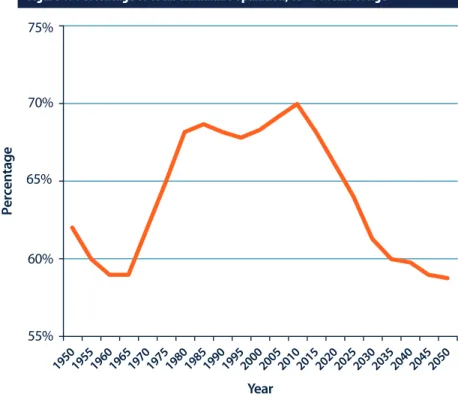
Let us begin by confronting what we know about the impact of the aging boomer generation. Figure 1 (Barnett, 2007) presents a graphic
representation of the historical and future impact of the aging population on Ontario’s workforce. The proportion of our population in the prime working years (15 to 64) increased from below 60% in the mid sixties to near 70% by 1980, with a projected peak of 70% by 2010/2011. After 2011, Ontario’s population in these prime working years will decline dramatically, falling to 61% by 2030, and continuing to decrease thereafter, to reach 59% by 2050.
There is nothing magic about these projections. We are simply watching the baby boom “bulge” in the provincial population work its way through the years of childhood, into the prime years of
productive work (15 to 64) and out into retirement (65 and beyond). It is no coincidence, therefore, that the increase in the working age population began in 1965, 19 years after the birth of the first baby boomer, and will begin to decline in 2011 when that same baby boomer reaches the age of normal retirement at 65.
Projections, of course, are not predictions. Circumstances can change. The birth rate could, for whatever reason, increase. Immigration could shift Ontario’s demographic reality. But we need to keep in mind that the vast majority of those who will make up Ontario’s labour force in 2030 have already been born and are now living in our midst. Yes, things can change, but only by degree. The basic structure of Ontario’s labour force of the coming decades is already in place and is not amenable to more than incremen-tal change without dramatic policy modifications.
Yet that shrinking labour force will have to support a larger and larger number of people who will need
OUR AGING
POPULATION
Source: Russell Barnett, Bank of Canada Review, Summer 2007, p.7
WHAT WE HAVE TO CONFRONT IS THE FACT THAT WHILE THE TOTAL POPULATION OF ONTARIO AND CANADA WILL CONTINUE TO GROW, MUCH OF THAT GROWTH WILL CONSIST OF PEOPLE OVER 65 YEARS OF AGE. WHAT THIS MEANS IS THAT THERE WILL BE FEWER AND FEWER PEOPLE IN THE LABOUR FORCE.
and expect a variety of services, some of which will become very expensive. Health care, pensions, and old age assistance, for example, will have to be paid for by a shrinking population of working citizens. The implications of this reality will be manifold. It is a future that we must take seriously and prepare for. Planning must start now, not tomorrow.
The demographic shift that is upon us will result in a continuous decline in workforce participation rates. According to Dugan and Robidoux (1999, p.49), “…looking ahead, the …participation rate will continue to fall gradually as a result of downward pressure from demographic changes. By 2015, it is estimated it will be at about 63 per cent….” What will be the likely impact on Ontario?
About a decade ago, these demographic shifts were analyzed for Canada, resulting in a projection of an eight percentage point drop in the labour force participation rate. Figures 2 and 3 present a similar analysis for Ontario, using 2008 data. This was done by taking current labour force participation rates, and calculating the impact of the projection of an aging population. In Figure 2 (Statistics Canada, 2009) we see how these rates vary by age and gender. The highest rates for both men and women occur between the ages of 25 and 54, with participation rates dropping significantly after 55 and falling to just over and under 10% for men and women respectively at the historic age of retirement (65+). The lower rates for younger people (15 to 24) simply reflect the fact that many of them are still in high school or enrolled in a post-secondary program.
Clearly, gender makes a difference, reflected in the consistently lower participation rates for women as compared to men. In Figure 3 we use
the same approach to calculate the projected change in the labour force participation rates for Ontario, indicating a decline from 68% in 2006 to just over 60% by 2031.
Source: Statistics Canada, 2009
Source: Created using Statistics Canada data
Figure 2. Ontario Participation Rates by Gender and Age: 2008
Using this approach, the participation rate for Ontario turns out to be slightly higher than that calculated for Canada by Dugan and Robidoux (1999), but that can be explained by the fact that Ontario’s participation rates do, in fact, tend to be slightly higher than the Canadian average. The projected eight percentage point drop is virtually identical in the two analyses.
So, we can safely assume that Ontario is about to face a dramatic change in the structure of the workforce as the population continues to age, and an increasing proportion of the population
reaches the normal age of retirement. What is less obvious is what the impact of these changes will be on the lives and well-being of the population. Will they create problems? If so, how serious will they be, and when will they occur? To get a clearer picture of what the future portends, we need to know more precisely what the population of Ontario will look like and, more particularly, what the size of the labour force will have to be to maintain our economic viability. Fortunately, both of these questions have already been addressed by Ontario government projections.
IMPACT ON THE
LABOUR FORCE
Ontario’s Ministry of Finance (2008) produced three population projections covering the years from 2007 to 2031. The three projections were marked high, medium and low, and reflected different assumptions regarding rates of immigration and emigration, along with births and deaths. Similarly, the Ministry of Finance (2005) produced estimates of employment growth through to 2025. It should be noted that in 2009 the Ministry did revise its estimates (Ministry of Finance, 2009) for the years 2009 to 2012 to reflect the impact of the current recession. We are using the 2005 estimates here both because of their longer horizon and because the differences between the two, even with today’s higher unemployment rates, are not significant over the longer period.
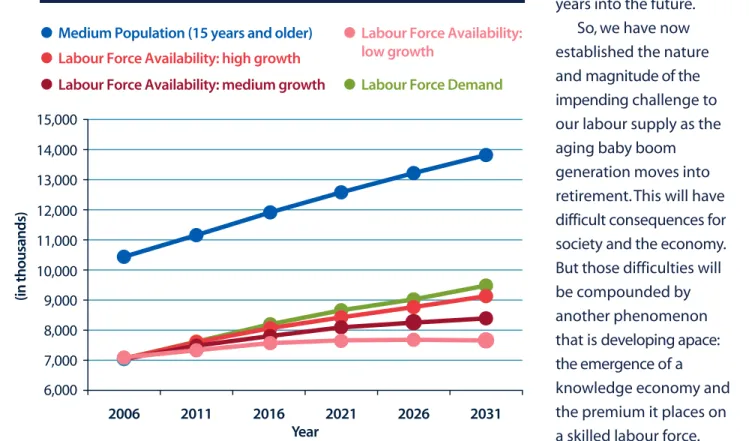
On the basis of the information contained in these data, we can now begin to see (Figure 4) the projected impact of the demographic changes on the Ontario labour force. We begin with the blue line, which portrays the total population aged 15 and above, using the
Ministry’s medium projection. Next come the three lines portrayed in shades of red. These are taken from the three population projections, but have been converted into labour force estimates of supply or availability. This was done by applying the 2008 labour force participation rates by age to the three estimates of growth in population aged 15 and over (high, medium and low). At this point, one can observe that the measure of labour force availability is highly sensitive to the population projection used. By 2031, the high population growth rate yields a projected availability of workers of some 9.1 million Ontarians. This would fall to 8.4 million for the medium growth rate, and 7.6 million for the low growth rate.
Now we come to the most telling feature of this graph. The green line represents the projected demand for labour based on the Finance Ministry’s employment growth projections (Ministry of Finance, 2005). By 2011, there will be a demand for 7.6 million workers. This will increase to 9.5 million by 2031. The remarkable feature of these projections
is that demand for labour is projected to outstrip supply under all three projections of labour availability. The reason, of course, takes us back to the fact that the population is aging, the baby boom population “bulge” is about to enter the traditional age of retirement, and Ontario’s labour force participation rate is therefore going to fall.
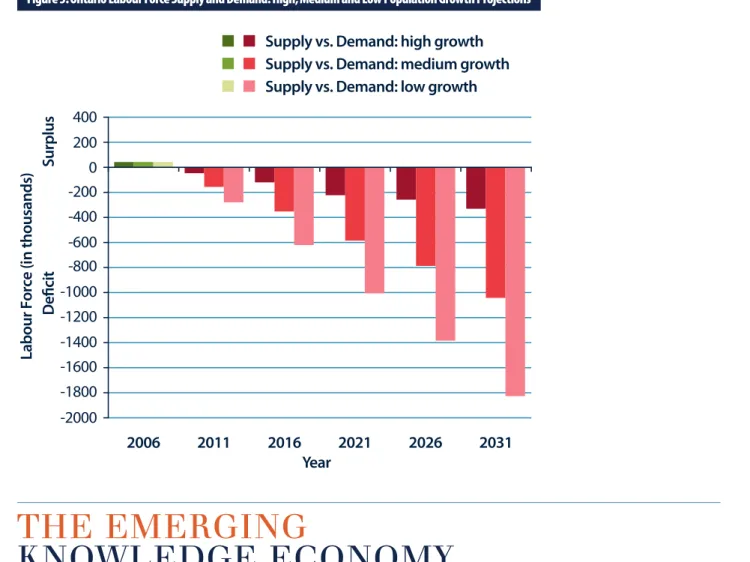
The same data are shown in a different way in Figure 5, which depicts the actual shortfalls in the supply of labour under each of the three assumptions of labour force growth. The implications of the high growth assumption are relatively modest, at least in the early years.
By 2011, the high growth assumption yields a deficit of just 40,000 workers. This would swell to over 250,000 if the slow growth assumption were to materialize, but this is probably still a manageable situation. The situation changes dramatically, however, as we move farther into the future and the impact of the aging boomers cuts more deeply. By 2021, for example, the medium growth assumption yields a workforce deficit of some 600,000. By 2026, this rises to 800,000, and by 2031 it passes the one million mark. A high population growth rate modifies this projection considerably, but the deficit in the labour supply still reaches more than 300,000 by 2031. A low growth outcome would have catastrophic conse-quences, with the deficit between labour force supply and demand passing the 1.8 million mark. Any of these outcomes, and certainly the medium or low population assumptions would have most serious implications for Ontario’s economy,
implications that would last years into the future.
So, we have now established the nature and magnitude of the impending challenge to our labour supply as the aging baby boom generation moves into retirement. This will have difficult consequences for society and the economy. But those difficulties will be compounded by another phenomenon that is developing apace: the emergence of a knowledge economy and the premium it places on a skilled labour force.
Source: Ontario Ministry of Finance, 2005 and 2008
THE INEVITABLE RESULT, IF SOMETHING IS NOT DONE TO CHANGE THINGS, IS THAT THE DEMAND FOR LABOUR WILL INCREASINGLY OUTSTRIP SUPPLY.
Thus far we have established that Ontario’s future economic success will require an expanded workforce achieved by means of an increased population and/or participation rate. But the question now becomes: what kind of workforce? It is beyond the scope of this analysis to explore in detail the actual jobs that will be required in the future. Many of them do not even exist at present. What we do know is that an increasing proportion of the jobs that will exist will require a level of education or training beyond secondary school, be it an apprenticeship, a diploma, a degree, a certificate, an industry credential, or a professional qualification. To keep the analysis as
simple as possible, we consider all forms of post-secondary education or training to have achieved the skilled threshold. So, how many skilled workers will Ontario need?
The federal department of Human Resource and Skill Development Canada in 2007 provided what might be taken as the minimum requirement. They said “About 65% of all new jobs created over the next five years are expected to require some form of post-secondary education/training” (Service Canada, 2007, p.3). An earlier study by the government of British Columbia put the level somewhat higher: “Forecasts for employment by education and training …indicate that three
THE EMERGING
KNOWLEDGE ECONOMY
quarters (75%) of new and replacement jobs …will require at least some post-secondary education and/or training equivalent” (BC Ministry of Skills, Training and Education, 1997, p. 1). A more recent study (Ministry of Advanced Education and Labour Market Development, 2009) in British Columbia put the proportion of skilled workers required in the future at 76.2%.
A similar sentiment, if not exactly quantified, was echoed in a recent study by the Obama administration in the U.S. “In general, the U.S. appears to be shifting towards jobs that require workers with greater analytical and interpretive skills – skills that are typically acquired with some post-secondary education” (Executive Office of the President Council of Economic Advisors, July 2009, p. 21). Moreover, the study noted (p. 22), “Undoubtedly, some of the fastest growing jobs over the next decade have yet to be identified…. For example, in 2003 a quarter of …[current] jobs …were not even listed among the Census Bureau’s occupational codes in 1967.”
On a more predictive note, the futurist Adam Gordon (2009) has listed 23 jobs that do not currently exist but will in the next decade or so. Gordon’s future jobs include nano-mechanic, old age wellness manager, memory augmentation surgeon, weather modification police, waste data handler, social networking worker, and personal brander. The point is not whether these precise jobs will actually emerge in the future. The point is that they, or jobs like them, are the jobs of the future and will require more than a high school graduation certificate. Keep in mind that 20 years ago there was no Internet.
Still, in the United States, Holzer and Lerman (2007) predicted that fully 78% of job openings between 2004 and 2014 will require education or training beyond high school. And in the same vein, the U.S. based Lumina Foundation (2009, p. 2)
predicted that without change to a more educated workforce, there will be a shortage of 16-million post-secondary educated adults in America by 2025.
HERE AT HOME, THE ONTARIO MINISTRY OF EDUCATION (2005) CONCLUDED THAT 81% OF THE NEW JOBS CREATED IN THE PROVINCE BETWEEN 1996 AND 2001 REQUIRED MANAGEMENT TRAINING, APPRENTICESHIP TRAINING, OR A COLLEGE OR UNIVERSITY DIPLOMA OR DEGREE.
What is truly amazing is that while these studies vary in the details of their analysis, they all agree on the nature and direction of the changes that are occurring and can be expected to continue and accelerate. What is also revealed is the fact that there are actually two types of “new” jobs being created. One is the type envisaged by Adam Gordon and documented in reference to the U.S. occupational codes. These are jobs that are truly new, that literally did not previously exist. The second type are jobs that have changed so much over time that while their names may or may not remain, the actual work done and the training required are so different as to qualify them as new. It has been estimated that jobs evolve approximately every 15 years. After 15 years a job that could be done by an unskilled worker will require skilled training as the result of technological change, increased responsibility, and/or different processes or systems.
What this all comes down to is confirmation that a more highly educated and trained workforce will be needed. What we need now is to address the question of how much. What proportion of the workforce will need to be skilled and what proportion unskilled? What assumptions can we reasonably make about Ontario’s future skill requirements?
ONTARIO’S FUTURE
SKILL REQUIREMENTS
We begin by taking the most conservative of the projections of Canada’s skilled workforce requirements by Human Resources and Skills Development Canada (Service Canada, 2007), which put the proportion of new jobs that will require skilled workers at 65%. Since all the other predictions are higher, and some significantly so, it is assumed that this rate will increase to 70% by 2011 and that it will increase by .5% every year (half a percent) to reach 80% by 2031. Even here, the 2031 assumption is lower than the conclusion reached by the Ontario Ministry of Education and only slightly above the British Columbia and U. S. predictions that were for a much earlier time frame. Hence, the projections are seen to be “conservative.” These data are presented in the first line of Table 1 below.
The second line in Table 1 shows our actual current and projected skilled labour force. Based on 2006 Canadian census data, the Canadian Council on Learning (CCL) reported that six out of ten, i.e. 60%, of Canadians between the ages of 25 to 64 “…had completed some form of PSE….” (2009, p. 113). This placed Canada among the
highest in the world in terms of educational achievement. What is even more impressive is that in the age group 25 to 34, fully 66.6% had attained that level (CCL, 2009, p.119). Norrie and Lin (2009) propose that with even a younger group (ages 20 to 24), the percentage might be 70% if one assumes all students complete their credentials. Hence, an estimate in the mid to high 60s seems to be reasonable. Based on that knowledge, we can reasonably assume that the impact of the younger, better educated workforce will gradually work its way through the population, increasing the overall level of education and training even if we did nothing more. On this basis, we can assume that by 2031 some 66% of the workforce will have a post-secondary credential.
From here we calculate the third line of the
table, which is an estimate of the proportion of skilled workers required. This is essentially a blend of the first two lines, based on the assumptions that most new jobs will be filled by skilled workers but that some unskilled workers will continue to be required. Thus, by 2031 about 77% of the workforce will need to
To answer these questions, we need to separate out the projections for skilled and unskilled workers. We do this by combining the three population scenarios (high, medium and low) provided by the Ontario Ministry of Finance (2005) with the skill require-ments portrayed in Table 1. With these data we can calculate the skilled and unskilled workers that will be required through 2031. Figures 6 and 7 show the results of this analysis for the medium and high growth scenarios respectively.
In both cases the red bars represent the total labour force shortage (below the line) or surplus (above the line). These are the same results as shown earlier in Figure 5. The green and mauve bars represent the shortage or surplus of skilled (mauve) and unskilled (green) labour shown separately. As we can plainly see, a new dimension becomes evident. What we see at once is far more complex and alarming.
have post-secondary education or training. The question now, of course, is whether the projected demand for skilled workers is in
balance with the projected supply or, as the case may be, to what extent and in what direction is there an imbalance.
SUPPLY AND DEMAND:
A LOOMING IMBALANCE
Figure 6. Ontario Labour Force Balance: Medium Population Growth
SHORTAGE IN THE
MIDST OF SURPLUS
This is the clear consequence of combining the current trend in education and training with the movement towards a knowledge-based economy.
If we take the medium population growth model shown in Figure 6, we see that by 2016 there will be almost 450,000 unskilled workers (green bar) who will not be able to qualify for the skilled vacancies that will exist. Again, unless something is done to correct the situation, this figure will rise to 700,000 in the years that follow. At the very same time, we will have some 500,000 skilled vacancies (mauve bar) by 2011. This figure will grow almost exponentially to well over a million by 2021 and approach 2 million by 2031. To repeat, if we stay on our present trajectories, and assuming the medium population growth model, we are headed to a situation where large numbers of people will be looking for work but cannot find it because they lack the skills required. At the very same time, an even larger number of jobs will go unfilled because there are not the skilled workers qualified to fill them. This exact situation has recently been highlighted in a Canadian Press article (Kelley, 2009) where high technology companies in Waterloo, Ontario, have vacancies they cannot fill in the middle of a recession.
The high population growth model shown in Figure 7 may appear at first sight to be somewhat more manageable, given the lower level of overall labour market shortages projected (red bar). But on closer examination, the situation may not be so simple since there would also be a much larger group of unskilled workers seeking work. The social consequences of such a situation are barely imaginable. The results of the low population growth model were calculated but not shown for the simple reason that they are unacceptably alarming.
What these data demonstrate is that there are two challenges emerging simultaneously. On the one hand, we need to find ways to increase Ontario’s labour force and/or its participation rate to compensate for the consequences of the baby boomers’ retirements. At the same time, we need to find ways to increase the skill levels of the workforce in order to adapt to the transition to a more knowledge-based economy. Can we do this? We begin the search for solutions by examining some of the options that can be considered.
If we are to meet the challenge that faces Ontario, we have to look at two ways of addressing the problem. One is to find ways to increase the population base. The second is to increase the workforce participation of skilled workers. The two, of course, are not mutually exclusive. We turn first to the challenge of increasing Ontario’s workforce population.
UNLESS WE TAKE EFFECTIVE ACTION TO INCREASE THE PROPORTION OF SKILLED LABOUR IN OUR ECONOMY, WE FACE A FUTURE WITH LARGE NUMBERS OF UNSKILLED WORKERS LOOKING FOR JOBS THAT REQUIRE SKILLS THEY DO NOT POSSESS.
1Born in Canada, 2 Very Recent = 5 years or less Recent = 5 to 10 years Established = 10 years or more, Source: Statistics Canada, 2008a
THE SEARCH FOR SOLUTIONS:
GROWING OUR WORKFORCE
INCREASING IMMIGRATION HAS OFTEN BEEN PROFFERED AS A MEANS OF INCREASING THE TOTAL NUMBER OF WORKERS. DRAMATICALLY INCREASING THE NUMBER OF NEW CANADIANS COULD MITIGATE THE PROBLEM PROVIDED THEY HAD THE NECESSARY SKILLS.
However, experience reveals some real limitations to this as a possible strategy. For one thing, there are often difficulties getting foreign credentials recognized as equivalent to Canadian standards. Language skills can be a barrier, as can difficulty obtaining relevant Canadian work experience. Indeed, the reasons behind the difficulties facing many immigrants in their transition to productive employment have much to do with the very issue we are here addressing: the movement to a knowledge-based economy. In an earlier era, immigrants with a strong back, a healthy body and a willingness to work hard could find employment even if not at the level for which they had been trained. Those jobs are now disappearing. Knowl-edge is now at a premium, and the reason many people were recruited or encouraged to come to Canada has been based on their education and
training. But our own institutional barriers serve as roadblocks to their integration.
Table 2 brings this issue into sharper focus. Using 2007 data (Statistics Canada, 2008a) and comparing individuals at the peak of their employable years (25 to 54), what becomes clear is that immigrants do not fare as well as native-born Canadians in terms of their employability. While on average 88% of all Canadians are in the labour force, the proportion for recent immigrants is less than 75%. Even after ten or more years in Canada, the rate of workforce participation for established immigrants is marginally below that for native-born Canadians. The conclusion is clear: simply recruiting more immigrants as we are now doing will not solve our problem. For increased immigration to contribute to increasing our overall labour force participation, the immigrants admitted would need to have educational or training credentials, language capabilities, and work experience that are much more readily accepted so that little, if any, additional qualifications are required. Moreover, they need to be younger, so that they will be in the workforce for a longer period of time. We must also recognize that we will not be the only province or country, for that matter, in the recruitment market.
A second approach to getting more people in the workforce might be to increase participation rates among groups that are currently under-represented. The most prominent such groups are aboriginals, women, and persons with disabilities.
Table 3 (Statistics Canada, 2008b) shows that regardless of age, the participation rate for aboriginals is significantly lower than for the rest of the population, from eight to 11 percentage points lower, depending on the age group compared. This could be an important source of additional workers, especially since the aboriginal population is growing faster than the general population.
Another group currently under-represented in the labour force consists of people with disabilities. Using 2006 census data, the participation rate for persons with disabilities between the ages of 15 and 64 was only 54.9%. For all other Ontarians it was 77.3%, a difference of 22.4%. There is obviously room for growth here. The rates vary widely depending on the type of disability. For example, the labour force participation rates by disability (Statistics Canada, 2008c) include: Hearing (64.1%), Seeing (49.9%), Learning (47.6%),
Developmental (32.7%), Mobility (53.6%), Memory (40.2%), Agility (52.8%) and Psychological (45.2%).
The growing labour force participation by women has been one of the most profound social phenomena of recent years. In 1976, only 59.2% of women aged 24 to 44 were in the labour force. For those aged 45 to 54, it was only 53.1%.
In contrast, by 2008 those proportions had risen to 82.2% and 81.9%. That is a truly remarkable change in economic and social behaviour, and contributed substantially to the province’s overall success. But looking back at Figure 2, we are reminded that the labour force participation rate for women still lags behind that for men in all age categories. There is obviously still some room for growth here.
Increasing participation rates for currently under-represented groups clearly has the potential of at least ameliorating the coming shortages in the labour force, even if it will not completely solve the problem. As Dale Kirby (2009, p. 1) has argued: “With the demographic reality of an aging population and the secondary school population declining, Canada must devote attention to increasing the educational attainment levels for disadvantaged and under-represented groups in order to meet the growing social and economic challenges.”
1Taken from 2006 Census data, Statistics Canada, No. 97-559-XCB2006008, 2Includes the Aboriginal population which makes the difference less
Another potential source of additional workers exists among our young people. If we could modify our educational system to allow students to move through to graduation more quickly, without sacrificing the quality of their education or training, we could get them into the labour force more quickly. Admittedly controversial, it is an option that should at least be considered. How might it work?
The current structure of our high school and most of our post-secondary academic programs is inherited from an agrarian past when students were out of school during the summer months so they could help on the farm. The pattern of two semesters in school and the summer off is now often justified by the need for students to find employment during the summer to help pay for their tuition for the coming school year. But if university students, for example, spent only two of their summers in school, they could be out of school and in the labour force a year earlier. Of course there would be costs associated with such an accelerated program, but there would also be savings. There would need to be adjustments to our student aid support, as recommended by the Canada Millennium Scholarship Foundation (Berger, Motte and Parkin, 2009), in order to avoid increasing the level of student debt and attracting students from lower socio-economic groups. And there would have to be changes in faculty com-pensation and workload arrangements to facili-tate year-round operation. But the savings from increased efficiency could also be substantial. It is at least an idea that is worth further exploration.
Similarly, efficiencies might also be obtained by encouraging the various players in the
post-secondary system to work more closely together for the benefit of students. Credit transfer
arrangements are often a nightmare for students who want or need to move between universities or between a college and a university or vice versa. Ontario in particular has considerable room for improvement in this regard. The upshot is that students often spend much longer than necessary getting to graduation in the program they have finally chosen because their prior learning experiences were not fairly and effectively recognized.
Another possibility would be to increase the number of joint college-university programs. There is a recent and interesting trend by which Ontario colleges are becoming “finishing schools” for 4-year university graduates. Students are increasingly completing a degree and then enrolling in a one- or two-year postgraduate certificate or diploma program in a college. The concern is not that such arrangements are somehow wasteful and therefore should not be available. Quite the contrary. They reflect a recognition by students that an academic
education is often not enough, that an employable skill is also required. The concern is that this skill component could be built into the program, obviating the need for an extra year, or two, before employment. In the United States, there has been a renewed debate over the “reinstate-ment” of the old 3-year B. A. (Goldstein, 2009). This coupled with a colleges skills program might be an option to consider.
There is also a need to improve relations between high schools and both universities and colleges. Using comparative data from a few years
ago, graduation rates from high schools have been in the high 60s to mid 70s (King, 2009) for some time. Recent figures report a 77% rate, but for students taking five years to complete their high school education. The four year rate is 69%. This high rate of attrition is attributed to students not being effectively engaged in their schooling (Willms, Friesen and Milton, 2009) and not seeing its value for their future lives. Are there not ways to get the various players to work more effectively together for the benefit of students, so that the barriers that currently exist between the components of the system are at least reduced, if not eliminated? The goal should be to make the transition from one component of the system to another as seamless as possible. Among the possibilities to be considered might be joint programming, teacher exchanges, prior learning assessments, etc. What we have to recognize is that students who drop out of school are much more likely to be unemployed. Many will find their way back to school eventually, whether high school, college, or university, but in the meantime they have lost valuable time and the economy has lost valuable skills.
Of course, one obvious means of increasing participation in the labour force is to address the very cause of the problem in the first place: the impending retirement of the baby boom generation. Referring back to Figure 2, it is evident that participation rates start falling in the 55 to 64 age group and virtually disappear after the age of 65. Given the ever-increasing size of this group, even small increases in
participation rates would have a very substantial impact on the availability of labour. For example,
if the participation rate increased just 5%, from 62.6% to 67.6% for those aged 55 to 64, and from 9.5% to 14.5% for those over 65, then 173,750 people would be added to the labour force. The trick, of course, is to find a way of doing this without resorting to draconian measures. Perhaps changes to the tax system would work. Or perhaps a scheme by which people might be assisted in making the transition to retirement gradually, so they could enjoy greater leisure but not drop out of the workforce entirely. Perhaps mentoring programs could assist in the gradual transfer of skills to a younger generation. Might entrepreneurial programs help to develop a whole new generation of business persons who could work according to their own schedule? Would making age discrimination illegal help? Can pension arrangements be changed?
Not all of these ideas will prove to be feasible or even acceptable, but the list of possibilities is sufficiently long that it is reasonable to assume that we can, in fact, increase the size of Ontario’s labour force to compensate for the aging population. Some combination of changes to our immigration policies, accelerated learning and training experiences for young people, positive improvements in the involvement of historically under-represented groups and higher participation rates among the older portion of our workforce may indeed yield positive results. But then we have to face the second challenge. We have to find ways to ensure that a larger proportion of this labour force is qualified as skilled.
THE SEARCH FOR SOLUTIONS:
GROWING OUR SKILLED WORKFORCE
While we cannot say precisely what skills will be required in Ontario’s economy of the future, we do know that more and more of those in the labour force will need an education or training that goes beyond high school. Historically, technological advances have increased rather than decreased the need for both the volume and type of skilled labour. This means an apprenticeship, college, polytechnic, university or industry certificate must become the norm for the vast majority of Ontarians.
FOR SOME, THE GREATEST HURDLE IN REACHING THIS GOAL WILL BE TO ACCEPT THE REALITY OF ITS NECESSITY.
We know that people with higher levels of education earn more, are healthier, are less likely to be involved in crime, and are more satisfied with their lives. Yet too many people are either unaware of this, or do not accept its relevance for them. Too many Ontario high school students drop out before graduation. The graduation rate is too low at 68%. According to King (2009) many are accepted into a college program (80% of applicants) but never show up (60% register). In short, we have to change attitudes and expectations. We have to get more people to see further education not as an expense but as a necessity.
Canadian industry is clearly both part of the problem and part of the solution. It has not been as fully engaged in its training responsibilities as it could. According to the Canadian Council on Learning, employer-sponsored training was virtually stagnant between 1997 and 2002 (CCL, 2007). According to the same source, one-third of Canadian workers report unmet training needs in their workplace (CCL, 2007, p. 3).
In 2005-2006, Canadian firms spent only 1.88% of their payroll on training. The U.S. average is 2.25% (Grant and Hughes, 2007). Ontario employers provide proportionately less formal training than British Columbia, Alberta, Saskatchewan, Manitoba, Nova Scotia, or New Brunswick (Peters, 2004).
When asked, employers provide explanations. They fear poaching by other firms, they cite the lack of government assistance, and they claim not to be aware of training options. The list goes on: lack of time; difficulty in calculating the return on investment in training; the high cost of customized training; a belief that training is not the responsibility of business; and a claim that employees are not really interested (Conference Board of Canada, 2007).
Employees also share responsibility for the low investment in training. Even when given the opportunity to take advantage of further education or training, employees often take a pass. They indicate further training is not needed, they claim they were not aware of their options, they say the costs are too high, they also claim they do not have enough time, they lack confidence in their abilities and they sometimes claim that training is not a priority for them or they simply are not interested (Conference Board of Canada, 2007). We also have a large group of young people who will remain unemployed or at best fill occasional, unskilled jobs because they have chosen to terminate their learning too soon. They are mostly male. They dropped out of school before graduation. They are from a lower socio-economic family. They are not sure of the benefits of further schooling and, indeed, they are uncertain about their own future. And they often lack good role models.
Here we confront one of the two fundamental problems that we have to address and resolve if we are to grow the skill level of our labour force. We have to change the attitudes of many in our society, both employers and employees. Indeed, this is a challenge that has to be taken up by all sectors of society: government, business, unions and non-unionized employees, and our educational institutions. The challenge is to move the proportion of skilled workers from the existing level of 60% to at least 77%. And we have to accomplish this by 2031 or so. This will take planning, hard work and cooperation.
And it has to start now.
There is a second problem that we will also have to overcome. We have an appalling rate of illiteracy in this country. ABC Canada estimates that four out of 10 Canadians aged 16 to 65 strug-gle with low literacy rates to the point that their ability to advance their skills training is inhibited. The illiteracy rate among immigrants is six in 10 (ABC, 2009). So we have to add illiteracy to the list of barriers to our ability to upgrade our work-force. Yet only 2.2% of our workplace training expenditures is devoted to basic skills training (CCL, 2007, p. 3).
WE HAVE A TWO-FOLD TASK AHEAD OF US. WE NEED TO INCREASE OUR LABOUR FORCE, AND WE NEED TO INCREASE THE PROPORTION OF THE LABOUR FORCE WITH POST-SECONDARY EDUCATION OR TRAINING.
There is a lot to be done and not a lot of time in which to do it. The Council of Ministers of Education of Canada has recognized that “Canada must develop an accessible, diversified and integrated system of Adult Education learning and skills development that delivers training when Canadians need it” (Learn Canada 2020, April 2008, p. 1). Yet, as Dale Kirby observed, “Despite considerable rhetoric about the need for a learning society and the importance of lifelong learning for Canada to remain or become a competitive knowledge-based economy, the progress in effectively supporting adult and older learners has been disconcertingly slow. Adult education participation levels in Canada appear to have remained
relatively stagnant since the early 1990s….” (Kirby, 2009, p. 10). Kirby is right.
Our European neighbours seem to have got the message. The European Foundation for Management Development (EFMD) states “The economy and competitiveness of the companies will much depend on the skills of the workforce. It is mainly in the mind of high skilled workers that we can find innovative solutions and competitive advantage” (EFMD, January 2007, p. 10). Some in Canada get the message, as well. A recent article by the Canadian Policy Research Network put it this way: “The social and economic importance of encouraging adults to engage in continuous learn-ing throughout their worklearn-ing lives is undisputed” (Myers and de Broucher, June 2006, p. 1).
One recent experience sheds some light on the challenge facing Ontario. Ontario’s Second Career program has enrolled 20,939 students as of October 2009 (Ministry of Finance, 2009). While things improved later on, the process of getting there was painful. There were obvious literacy
CONCLUSION:
issues, students were often unprepared, there were territorial battles between various elements of the system, and there were inefficiencies caused by unclear organizational mandates. Nonetheless, in one year we were able to respond to more than 20,000 workers who needed
retraining. Our projections indicate that over a 22-year period, and based on the medium population growth projections, we will need to train, retrain, or recruit some 1.73 million workers. That translates into an increase of 78,636 post-secondary graduates per year, an increase four times the number simply admitted into Second Career programs. Of course, we would expect the challenge ahead will be met by many more providers than colleges, which was the case in the Second Career initiative. New initiatives must include colleges, universities, polytechnics, employers, and unions.
We now need to address not just the need for the growth of the total labour force, but also the need for an increased proportion of skilled workers. In Table 4, we use the medium population growth assumptions, and the needed skill requirements to determine the balance between retraining and growth. In the initial years, retraining unskilled workers should take precedence, both
since the resource is readily available and the need is obvious. Unemployment can be reduced and the skill requirement satisfied simultaneously. But there will also be a need to increase the total labour force, through a combination of increasing participation rates and/or an increase in the total workforce population. Nonetheless, if we do our job, by 2026 we will have largely exhausted the pool of unskilled labour that is available for retraining and will have to rely totally on growing the size of the labour force.
In the midst of an economic recession, with significant budget deficits and rising unemploy-ment, it may be difficult for some to accept the fact that there is a very different, and very problematic future looming on the horizon. The fact of the matter is that unless we adopt proactive policies now, we will face a world in
which there will be a lot of people without jobs and simultaneously an even larger number of jobs without people. This is surely not a world anyone can, or should, look forward to. The current recession may actually provide a breathing spell, giving us a little more time to prepare for the inevitable labour market shortages and surpluses that await us. We know that the
recession will pass, as all recessions do, but what we have to accept is that the demographic changes that are coming cannot be wished away. They are real, and their implications are both imminent and frightening. The current recession may affect the timing of our response, but it cannot affect it by very much. By 2011, the problem will begin to appear. And if we delay our response,
then we will find that when we are ready to grow we will be constrained by a workforce that is out of balance with the needs of our economy. The time for action is now. Delay at this point could cost us an important strategic and comparative advantage, if others understand and act on the implication of the emerging knowledge economy and demographic shifts before we do.
ABC Canada Literacy Foundation, (2009). ABC Literacy Facts.
Retrieved from: http://www.abccanada.org/en/adult_literacy/facts.
Barnett, R. (Summer, 2007). Trend Labour Supply in Canada: Implications of Demographic Shifts
and the Increasing Labour Force Attachment of Women. Bank of Canada Review.
Berger, J., Motte, A., and Parkin, A. (Eds.), (2009). The Price of Knowledge: Access and Student Finance in Canada
(4th ed.). Canada Millennium Scholarship Foundation.
British Columbia. Ministry of Education, Skills and Training, (1997). Skills Training and
Education and the British Columbia Labour Market: Challenges and Opportunities.
Retrieved from: http://www.llbc.leg.bc.ca/public/PubDocs/bcdocs/294136/Future_Skills_Needs.pdf British Columbia. Ministry of Advanced Education and Labour Market Development, (August, 2009). Ten-Year Employment Outlook for British Columbia COPS B.C. Unique Scenario, 2001 - 2017.
Retrieved from: http://www.aved.gov.bc.ca/labourmarketinfo/reports/COPS_BC_Unique_Scenario_2007-2017%20.pdf
Canadian Council on Learning, (2009). 2008-2009 Post-Secondary Education in Canada Meeting our Needs?
Retrieved from: http://www.ccl-cca.ca/pdfs/pse/2009/pse2008_english.pdf Canadian Council on Learning. Lessons in Learning, (March, 2007).
Canada’s Biggest Economic Challenge: Improving Workplace Learning in Canada.
Retrieved from: http://www.cclcca.ca/ccl/reports/lessonsinlearning/linl20070315_improving_workplace_ learning.htm
The Conference Board of Canada, (2007). Ontario’s Looming Labour Shortage Challenge Projectors of Labour
Shortages in Ontario and Possible Strategies to Engage Unused and Underutilized Human Resources.
Council of Ministers of Education of Canada, (April, 2008). Learn Canada 2020 Joint Declaration Provincial and Territorial Ministers of Education.
Retrieved from: http://www.cmec.ca/Publications/Lists/Publications/Attachments/187/CMEC-2020-DECLARATION.en.pdf Dugan, B., and Robidoux, B. (Summer, 1999). Demographic Shifts and Labour Force Participation Rates in Canada.
Canadian Business Economics.
EFMD. European Foundation for Management Development, (2007). Ageing Workforce: What Future for The Knowledge Worker?
Retrieved from: http://www.efmd.org/attachments/tmpl_1_art_070219sqku_att_070219xvqb.pdf Executive Office of the President of the United States. Council of Economic Advisors, (July, 2009).
Preparing the Workers of Today for the Jobs of Tomorrow.
Retrieved from: http://www.cfr.org/publication/19850/preparing_the_workers_of_today_for_the_jobs_of_tomorrow.html
Goldstein, E. (8 November, 2009). Renewed Debate Over the 3 Year B.A. The Chronicle of Higher Education.
Gordon, A. (13 August, 2009). Jobs of the Future, Science and Technology Enabled Employment for 2020 - 2030.
Retrieved from: http://futuresavvy.net/2009/08/jobs-of-the-future-technology-enabled-employment-for-2020-2030/
Holzer, H., and Lerman, R. Skills 2 Compete Workforce Alliance, (2007).
America’s Forgotten Middle-Skill Jobs Education and Training Requirements in the Next Decade and Beyond.
Retrieved from: http:www.skills2compete.org
Hughes, D.P., and Grant, M. The Conference Board of Canada, (2007). Learning and Development
Outlook 2007. Retrieved from: http://www.wln.ualberta.ca/seminar_resources/learning_devt_outlook2007.pdf
Kelley, S. (12 November, 2009). Jobs Disconnect in RIM’s hometown. The Canadian Press.
King, A.J.C., Warren, W.K., King, M.A., Brook, J.E. and Kocher, P.R. (2009) Who Doesn’t Go To Post-Secondary Education?
Retrieved from www.collegesontario.org
Kirby, D. (April, 2009). Widening Access: Making the Transition from Mass to Universal Post-Secondary
Education in Canada. Journal of Applied Research and Learning, No. 2, Article 3.
Lumina Foundation for Education (February, 2009).
AStronger Nation Through Higher Education How and Why America Must Meet a “Big Goal” for College Attainment.
Retrieved from: http://www.luminafoundation.org/publications
Ministry of Finance, (2009). Ontario Economic Outlook and Fiscal Review, Background Papers.
Queen’s Printer for Ontario. Retrieved from: http://www.fin.gov.on.ca
Ministry of Finance, (Spring, 2008). Ontario Population Projections Update 2007-2031.Ontario Ministry of Finance.
Retrieved from: http://www.fin.gov.on.ca/english/economy/demographics/projections/
Ministry of Finance, (2005).Toward 2025. Ontario Ministry of Finance. Queen’s Printer for Ontario.
Retrieved from: http://www.fin.gov.on.ca
Ministry of Education, (2005). Ontario Learns - Strengthening our Adult Education System.
Queen’s Printer for Ontario. Retrieved from: http://www.edu.gc.on.ca/adultedreview/ontariolearns.pdf Myers, K., and de Boucher, P. (June, 2006). Too Many Left Behind: Canada’s Adult Education
and Training System. Canadian Policy Research Network Inc. Research Report, w/34.
Retrieved from: http://www.cprn.org/doc.cfm?doc=1479
Norrie, K. and Lin, S. (November, 2009). Post-secondary Education Attainment and Participation in
Ontario. Higher Education Quality Council of Ontario.
Retrieved from:http://www.heqco.ca/SiteCollectionDocuments/FINAL%20PSE%20Attainment%20Research%20Note%20ENG.pdf
Peters, V. Statistics Canada, (2004). Working and Training: First Results of the 2003 Adult Education and Training
Survey.Retrieved from: http://www.statcan.gc.ca/pub/81-595-m/81-595-m2004015-eng.pdf
Service Canada, (2007). Job Futures World of Work. Retrieved from: http://www.jobfutures.ca/en/brochure/JobFuture.pdf
Statistics Canada, (January, 2009). Labour Force Participation Rates by Sex and Age Group. Retrieved from: http://www40.statcan.ca/l01/cst01/labor05-eng.htm
Statistics Canada, (2008a). Labour Force Survey. The Canadian Immigrant Labour Market in 2007. Retrieved from: http://www.statcan.gc.ca/bsolc/olc-cel/olc-cel?catno=71-606-XWE2008003&lang=eng
Statistics Canada, (2008b). Labour Force Activity (8), Aboriginal Identity (8B), Age Group (13A), Sex (3), and Area of
Residence (6A) for the Population 15 Years and Over of Canada, Provinces and Territories 2001 and 2006 Census- 20% Sample Data. Retrieved from: http://www12.statcan.ca/english/census06/data/topics/RetrieveProduct
Table.cfm?ALEVEL=3&APATH=3&CATNO=&DETAIL=0&DIM=&DS=99&FL=0&FREE=0&GAL=0&GC=99&GID=614143&GK=NA& GRP=1&IPS=&METH=0&ORDER=1&PID=92101&PTYPE=88971&RL=0&S=1&SUB=0&ShowAll=No&StartRow=1&Temporal=200 6&Theme=74&VID=0&VNAMEE=&VNAMEF=
Statistics Canada, (2008c). Labour Force Participation and Unemployment Rates by Disability Type, Canada, 2006. http://www.statcan.gc.ca/pub/89-628-x/2008007/t/5201154-eng.htm
Willms, D.J., Friesen, S., and Milton, P. Canadian Association of Education, (2009). What did you do in School Today?
Transforming Classrooms Through Social Academic and Intellectual Engagement. Retrieved from: http://www.cea-ace.ca/media/en/WDYDIST_National_Report_EN.pdf
DR. RICK MINER has over 35 years experience working in Canada’s post-secondary sector. He was most recently the President of Seneca College, and before that held senior
administrative positions at the University of New Brunswick and Saint Mary’s University. He is now a principal at Miner and Miner Management Consultants (minerandminer.ca).