Open Research Online
The Open University’s repository of research publications
and other research outputs
Education Workforce Initiative: Initial Research
Other
How to cite:
Wolfenden, Freda; Buckler, Alison; Santos, Cristina and Mittelmeier, Jenna (2018). Education Workforce Initiative: Initial Research. International Commission on Financing Education Opportunity (The Education Commission).
For guidance on citations see FAQs.
c
2018 International Commission on Financing Education Opportunity (The Education Commission) Version: Version of Record
Copyright and Moral Rights for the articles on this site are retained by the individual authors and/or other copyright owners. For more information on Open Research Online’s data policy on reuse of materials please consult the policies page.
Education Workforce Initiative: Initial Research
Freda Wolfenden, Alison Buckler, Cristina Santos and Jenna Mittelmeier
The Open University
April 2018
This paper has been prepared for the International Commission on Financing Education Opportunity (the Education Commission) as initial research to inform the approach to the Education Workforce Initiative’s Education Workforce Report.
List of Acronyms
AUF Agence Universitaire de la Francophonie CPD Continuing Professional Development DAPP Development Aid from People to People
DFID Department for International Development (UK) DIET District Institute for Education and Training (India) DISE District Information System for Education (India) DISS Deployment
EFA Education for All
EGRA Early Grade Reading Assessment EWI Education Workforce Initiative EWR Education Workforce Report
GEMR Global Education Monitoring Report (UNESCO) GNAT Ghana National Association of Teachers
ICFGEO International Commission on Financing Global Education Opportunity ILO International Labour Organization
IRI Interactive Radio Instruction ITfC IT for Change
MDG Millennium Development Goals (United Nations) MOOC Massive Open Online Course
NCCE National Commission for Civic Education (Ghana) NCEE National Center for Education and the Economy (USA)
NCFTE National Curriculum Framework for Teacher Education (India) NGO Non-Governmental Organisation
NIE National Institute of Education (Singapore) NTIP New Teacher Induction Program (Canada)
NUEPA National Institute of Educational Planning and Administration (India) OECD Organisation for Economic Co-operation and Development
OER Open Educational Resources OLPC One Laptop Per Child
P21 Partnership for 21st Century Skills
PAT Projecto Aprendizagem para Todos (Learning for All, Angola) PTR Student-teacher ratios
RAIS Remote Area Incentive Scheme (Australia)
SABER Systems Approach for Better Education (World Bank) SDG Sustainable Development Goal (United Nations) STEM Science, Technology, Engineering and Mathematics STF Subject Teacher Forum
TALIS Teaching and Learning International Survey (OECD) TCAT Teacher Capability Assessment Tool
UIS UNESCO Institute for Statistics UNICEF United Nations Children’s Fund
UNESCO United Nations Educational, Scientific and Cultural Organisation USAID United States Agency for International Development
WB World Bank
WDR World Development Report WHO World Health Organization
Table of Contents
1. Introduction 3
2. Key messages from the initial research 5
3. Re-envisioning and strengthening the education workforce: Challenges and opportunities 7
3.1 Challenges: Introduction 7
3.2 Student learning 8
3.3 Teacher supply 8
3.4 Teacher activity 10
3.5 Teacher roles, competencies and standards 11
3.6 Educator preparation and practice development 11
3.7 Opportunities: digital technologies 13
3.8 Education and neuroscience 14
4. Education workforce goal: Student learning outcomes 16
4.1 Student learning outcomes 16
4.2 Implications for the educators: teachers and other learning support staff 17 4.3 Implications for school functions and roles 17
5. Education workforce design 19
5.1 Defining education workforce design 19
5.2 Current innovations in pedagogic workforce design 22
5.3 Specialist Teachers 22
5.4 Learning support staff 23
5.5 Volunteer Support Staff 25
5.6 New school models 25
5.7 School Leaders 27
5.8 District level reform 27
5.9 Design of the wider education workforce: student welfare, finance, administration and
leadership / management 28
5.10 Principles for workforce design 28
6. Education workforce strengthening: recruitment, professional learning and retention 30
6.1 Defining education workforce strengthening 30 6.2 Expansion of the workforce: recruitment and initial professional training for teachers 32 6.3 Enhancing workforce skills: in-service professional learning for teachers and learning
support staff 37
6.5 Professional learning across the education workforce 43
6.6 Enhancing workforce motivation 44
6.7 Teacher retention 45
7 Lessons on workforce reform from the health sector 46
7.1 Towards the design of the education workforce 46 7.2 Short- and long-term, direct and indirect, tangible and intangible costs and benefits of
workforce reforms 47
7.3 Shortage of adequate staff as part of a system and recruitment of local staff 47
7.4 Data limitations 47
8 References 48
Project Websites 58
Appendices 60
Appendix 1: Synthesis of 21st Century Skills 60
Appendix 2: Trends in Curriculum Changes across 52 countries since 2000 62
Appendix 3: Synthesis of what teachers need to do and be 63
1.
Introduction
The Education Commission (EC) report ‘The Learning Generation‘, describes in detail the global challenges in school education; millions of children and adolescents are out of school and millions more attend school but are not learning the skills and knowledge they need to live fulfilled, healthy and productive lives in the 21st century. This has a lasting impact on the lives of each one of these children and their communities. The Education Commission aims to offer progressive ways forward to address these challenges to ensure each child and young person has the opportunity to benefit from a quality education in a safe environment free from violence and abuse, wherever they live in the world.
The Education Commission recognises that an effective education workforce is critical to a quality education system and that workforce costs are the main expenditure item in education systems. Teachers are central to the education workforce, high talent teachers are essential to improving student learning outcomes in school and their long term outcomes such as participation in higher education and future employment (Popova et al, 2017). But multiple challenges currently prevail: in many countries, teaching is neither an attractive nor publically valued career choice; a considerable number of trained teachers do not enter teaching or leave after only a few years; gender imbalances are found across the teaching workforce; the rising demands for early childhood and secondary education in many systems require large numbers of additional teachers with specialist subject knowledge and pedagogic skills; many teacher education curricula are outdated and much teacher training has been shown to make little difference to teacher performance; in many contexts teachers are required to undertake a range of non-teaching duties including those external to the school, with very limited support from other professional roles, limiting the time they spend facilitating student learning; school leaders can be focussed on management and administrative duties with little training in pedagogic leadership; there are few formal role descriptors or training opportunities for learning support staff and so on. How these challenges might be addressed is the focus of the work of the Education Workforce Initiative (EWI), an initiative of the Education Commission.
Providing universal access to quality education demands addressing these challenges with new holistic solutions. Radical changes and new thinking are needed if we are to guarantee every child and young person is adequately prepared for life and work in an increasingly uncertain, unequal and volatile world. Expanding current practices will not be enough; in Sub-Saharan Africa, for example, there are insufficient maths and science graduates to staff the secondary schools needed to meet student demand. This has consequences for policy relating to the education workforce. It suggests, for example, that consideration should be given to thinking about the recruitment of teachers, how schools are organised, how staffing structures might be redesigned at school and district level, how education related professionals can be most effectively deployed and how education systems can articulate with other systems such as health to engender a cross-sectoral approach. The overarching aim of any proposed change must be to contribute to safe and healthy school environments, to improve student learning outcomes and support the social and physical development of students – the ‘whole child’.
There are a number of opportunities and tools which offer promise to support the design and implementation of new solutions to meet these challenges of changing curricula, uncertain environments, expanding student enrolment and teacher supply, training and motivation. Advances in neuroscience are deepening our understanding of the process of learning, new forms of partnerships offer possibilities for mobilising resources and sharing expertise, lessons can be learnt from the approaches taken by other sectors such as health where the workforce is becoming more diversified, and as digital technologies become more ubiquitous and affordable they offer potential
as tools to support new practices. Digital tools are becoming increasingly adaptive and oriented to meeting the personal learning needs of students and professionals, and we are beginning to understand how their use can amplify and expand the impact of effective student centred teaching practices in multiple contexts. Technology-enabled assessments, for example, can be embedded to reduce interruptions to teaching and learning processes and provide near real-time feedback to teachers, school leaders and most importantly students and their families. Use of such tools expands what teachers need to know and do in their classrooms and in their collaborative working with other staff.
In this context a lens on workforce reform prompts us to reconsider roles and personnel within the workforce (workforce design) and new practices to build and sustain a strong, professional, motivated and effective education workforce (workforce strengthening). Investment in both is required to provide a workforce equipped with the capacity, skills and respect to deliver the goals of education as these evolve to address contemporary and future individual and societal needs.
Education workforce design entails stepping back from current arrangements to systematically review education workforce roles within (inside and outside classrooms) and across schools to see what roles are needed to achieve education system goals. Existing roles may require clarifying, differentiating and further professionalising and new roles may need to be conceptualised. The central aims of education workforce design are to enable teachers to focus their professional capabilities more fully on facilitating student learning and to ensure all students have access to specialist staff to address their learning and related needs, for example mental health support. Such roles include but are not limited to: lead and specialist teachers; learning support staff; pedagogic advisers and trainers; health practitioners; social work / student welfare practitioners; psychologists; technology and administrative staff and school and district1 leadership.
This is an opportunity to re-think the education workforce as a set of teams centred on the student and her learning and wellbeing. Such teams might be distributed over different sites and work across multiple groups of students. Composition of teams will shift over time and be driven by local needs and contextual factors. Workforce design involves considering not just the roles in these teams and the skills required for these roles but also the personnel recruited and trained for these roles; a key aspect of workforce design is broadening the demographic composition of the education workforce such that it reflects more fully the communities it serves.
Education workforce strengthening aims to ensure that all students are guided by trained, appropriately qualified, motivated and supported educators, to achieve the learning outcomes they need for the future (see section 4). It is concerned with expansion of the workforce to meet local needs and investment in improvements in the recruitment, deployment, initial training and professional development of groups within the education workforce. Enabling factors such as improved working conditions will be needed alongside the generation and use of robust data. To date there has been a tendency to focus on system inputs such as teacher qualifications and attracting teachers in particular subjects and localities, and outputs such as teacher evaluation. These issues remain important but the extent of the challenges in education systems is such that new design solutions are required: Solutions which can be operationalised at scale – within national and global frameworks – whilst also adapted to meet local needs, recognising that many systems are currently weak. Digital technologies in particular have exciting potential for accelerating change in workforce reform. Whilst there is an urgency to address needs, solutions need to acknowledge that
1
system change is complex and not accomplished overnight. Thus solutions should look beyond the SDGs to 2040 or 2050.
The purpose of this initial research is to offer evidenced possibilities in the key areas of education workforce roles, recruitment, training, deployment and leadership, along with suggested areas for further research to inform innovation in the design and strengthening of the public sector education workforce. The examples described were identified through the process outlined in the methodology section of this report, whilst we recognise that separation of examples from their context is problematic – effective innovations are highly sensitive to context and uncritical transfer of initiatives is rarely successful.
The research aims to support the Education Workforce Initiative (EWI) in moving forward with engaging education leaders and other key actors in radical thinking around the design and strengthening of the education workforce to meet the demands of the 21st century. EWI policy recommendations will be drawn from a number of country level workforce reform activities and research activity associated with the production of an Education Workforce Report (EWR). This research has informed the key questions, approach and structure of the EWR as outlined in the Education Workforce Report Proposal.
Issues pertaining to teaching and learning in primary and secondary education are at the centre of the research reported here; the focus is on moving towards schools as safe places where all children/ young people are able to engage in meaningful activity. The majority of the evidence shared here relates to teachers and school leaders; evidence on learning support staff, district officials and the wider education workforce is scant. Many of the issues examined are also pertinent to the early childhood care and education sector but these are being examined in depth by the Early Childhood Workforce Initiative. Resourcing for the Education Workforce was out of scope of this initial research but the EC recognises, as outlined in the Learning Generation Report, that provision of additional finance is a critical factor in achieving a sustainable, strong and well-motivated education workforce, particularly but not exclusively, in low and middle income countries. The next stage of EWI work will consider the relative costs of current initiatives and modelling of the cost implications of proposed reforms.
EWI aims to complement the work on teacher policy design and teacher career frameworks (including salary structures) being undertaken by other bodies and institutions such as Education International, the International Task Force on Teachers for 2030 and the Teachers’ Alliance, most particularly by bringing a focus on school and district leadership, the role of Education Support Professionals (ESPs) and inter-agency working.
2.
Key messages from the initial research
Overall
Education workforce reform is complex and requires holistic context appropriate solutions to strengthen systems. It requires paying attention to multiple interconnected and interdependent subsystems within an education system, all contributing to enabling educators to support children to achieve their full potential.
Implementation and integration of new roles and changed practices will require ongoing evaluation to facilitate connections between processes and outcomes and to reduce negative unforeseen outcomes.
In many contexts there is currently a lack of robust empirical data on the daily activities of teachers, school leaders, district officials and other roles to support workforce design and implementation.
There is very little available information on the financial costs of implementing education workforce reforms; financial modelling of proposed reforms should include both short and long term cost analysis and requires robust data – gaps in current data make accurate predictions difficult.
Education workforce design
Preparing all students for living and working in the rapidly changing context of the 21st century, requires radical re-imaginings of the school and classroom, drawing on digital technologies where appropriate. We suggest drawing on the concept of ‘social capital’ to design learning teams to guide and support student learning.
There are currently few formal training programmes or formal role descriptors for education support professionals and other members of the wider education workforce in low and middle income countries and many of these roles are not deemed professionals in their own right.
Drawing on lessons from the health sector, education workforce design could benefit from a
focus on the competencies and skills needed by education systems when designing roles and associated training programmes.
Education workforce strengthening
Successful innovations to improve workforce professionalism integrate vertical decision making (such as formal policy approval) and horizontal leadership and ownership of change. The latter is both at ministry level and, most critically, at local level by different agencies, district officials, school leaders, teachers and other education and related personnel (such as health professionals) in and across formal and informal sites of learning.
District support structures have a key role to play in coordinating services, offering guidance and enabling sharing of expertise across schools and collaborating with pre-service training programme providers.
Learning within school-based practice, whether through professional learning communities, action research projects or other approaches, is critical to strengthening pedagogical practices andpedagogic leadership. Time needs to be allowed for education professionals to engage in these activities.
Digital technologies offer possibilities to strengthen teacher and school leader professionalism (through automation of routine tasks freeing up time for teaching, leadership and management activities) and to shift the paradigm of educator professional learning through enabling new kinds of networks and communities, and innovative modalities for learning including personalised social learning. Technology has a role in enabling adaptive, personalised learning for students but it is recognised that it will not substitute for or diminish the importance of the relationship between the teacher and the student.
3.
Re-envisioning and strengthening the education workforce: Challenges and
opportunities
A number of complex issues point to the need for education workforce reform.
The shortage of classroom teachers in many localities is restricting student access to specialist trained teachers. Furthermore, there is a lack of evidence to help understand what teachers are doing in school and, thus, how they might best be supported by other professionals and digital technologies to focus on professional tasks and activities directly linked to preparing students for productive, healthy lives and improving student learning outcomes.
Transformation in teachers’ classroom practice is critical to improving students’ learning. However, in numerous contexts teacher morale is low and many teacher education programmes – both pre-service and in-service – are not sufficiently disrupting embedded forms of didactic practice and empowering teachers to engage their students in meaningful activities. Detailed conceptualisations of ‘teacher equality’ are far from universally agreed with competing perspectives on how to identify, quantify and analyse indicators relating to teacher quality.
The increasing availability of digital technologies offers possibilities for supporting growth in the professional competence of educators, for enhancing student access to specialist teaching, and for automation of routine tasks at classroom, school and district level. All potentially shift what teachers do in their classrooms. In addition, neuroscience research is prompting new thinking on the role of the teacher.
3.1 Challenges: Introduction
‘The challenge facing education and schools is not to do a better job at what they are already doing, but to do a fundamentally different job. They are now in the business of preparing students for a new world.’
(Levine 2006:104)
In a recent report on Education and the Fourth Industrial Revolution, Graham Brown-Martin (2017) suggested that ‘nothing in our formal education systems today is designed to meet the human challenges of the 21st century’ (p.8). ‘Old tasks’ across all workplaces are increasingly being automated but simultaneously automation can lead to the creation of new tasks, roles and industries which are deeply dependent on and responsive to geographical, social, economic and political contexts. This has implications both for the outcomes of education systems and the ways in which these goals might be achieved. Increasingly, uncertainty over food security, environment changes and so on, further heighten the demands on education systems, schools, headteachers and particularly teachers. The environment of many schools is unsafe and there is an urgent need to ensure all children are protected.
Brown-Martin’s report focused on high-income countries, yet has an additional and problematic relevance for global education agendas focussed primarily on striving to make education systems in low-income countries ‘look like’ and perform like those in high-income contexts. The challenges relevant to these agendas are well-known and we do not intend to simply repeat them here. Rather, this section presents some of these challenges as they relate to the issue of education workforce
reform, and specifically, the kinds of workforce reform that it is hoped will support the goals of 21stcentury learning set out in Section 4 of this report.
3.2 Student learning
While concerns over the ‘quality’ of education were raised during, and prior to, the launch of international education campaigns at the start of this century, data published in the last decade have sharpened the focus on what is commonly called the ‘learning crisis’. Headline findings from these data are well-known and often cited; only half of primary school students and just over a quarter of secondary school students are learning basic skills (ICFGEO, 2017). Globally, around 250 million children each year finish their fourth year of primary education unable to read, write or count well enough to meet basic standards (UNESCO, 2016). For example, one recent study from rural India found that only half of grade 5 students could read fluently grade 2 level texts (World Bank, 2018). In a large-scale study involving data from over 2000 schools in seven Sub-Saharan African countries, Bold et al. (2016) found that only one in 200 children in Sub-Saharan Africa (i.e. 0.5%) attend a school where key quality factors are in place. Current monitoring systems (such as SDG Target 4.7 and ASER) focus on measuring competency in numeracy and literacy but of course the purposes of education are much broader, however there is, as yet, little data on these broader learning outcomes, for example those related to civic education.
Furthermore in many countries levels of adult skills, in particular literacy, are low, potentially limiting parental/carer support for children’s learning (UNESCO, 2017). It is well-established that the teacher is the main factor in student learning and it is clear that teachers’ skills, and the support given to teachers in their schools and classrooms, needs to be a core focus moving forward.
The student curriculum is also changing – see section 4: it needs to be adapted to incorporate new technologies, both as a subject (computer coding and programming) and to make best use of new technologies to support learning. Assessing new student learning outcomes also presents a challenge.
3.3 Teacher supply
Teacher supply is an established and major challenge across the world, particularly in and low-middle income countries (LMIC). UNESCO has reported that 74 countries worldwide are facing acute teacher shortages, with Nigeria facing the greatest challenge (UIS, 2017). Globally nearly 69 million additional teachers are needed if every child is to learn in a class with 40 or fewer students at primary level and 25 or fewer students at the secondary level (UIS, 2016). These headline figures are powerful reminders of the staffing shortages facing education systems, particularly in Sub-Saharan Africa, where population growth and increased access to primary school has led to a surge in demand for secondary education. But focusing on student-teacher-ratios (PTR) for qualified teachers, at the regional or national level can mask disparity at local levels, such as differences in gender deployment and specific subject teacher requirements in particular locations. For example, in 2012 the average PTR for Sub-Saharan Africa was 42:1, but for the poorest quartile of schools in Nigeria it was 150:1 (Their World, 2018) while in India approximately one-third of elementary schools have no female teachers (NUEPA, 2016).
Shortages in particular subjects are highly contextual although shortage of mathematics and science teachers are seen in the majority of regions; media reports and academic papers frequently report, for example, severe mathematics and science teacher shortages in Sub-Saharan African, in 2013, 84 secondary schools in South Africa (1.3% of all high schools) were unable to offer mathematics as a subject to grades 10-12 due to a shortage of mathematics teachers (News 24, 2013). Urwick and Kisa (2014) similarly found that, while mathematics and science subjects take up half of the Ugandan
secondary curriculum, only a quarter of teachers specialised in these areas. Such shortages in specialist teachers are not unique to Sub-Saharan Africa; in the United States, large numbers of mathematics and physical science classes have been taught by teachers without university qualifications in these subjects for some time (Ingersoll, 2004). In other contexts teacher shortages are in other subjects; in Trinidad and Tobago there is a shortage of teachers in the visual arts and physical education (UNESCO, 2015).
The relationship of teacher salaries and teacher supply is complex and depends on multiple factors including historic and contemporary public value accorded to the teacher role, current remuneration and working conditions. For example teachers in Finland, regularly lauded as having one of the best global education systems and where competition for teacher training places is fierce, are paid a salary similar to those received by professionals in other disciplines with similar experience and training and in line with OECD averages but teachers’ salaries here do increase significantly with experience (OECD, 2017).
In the context of education workforce reform, use of PTRs as a core metric for education policy planning can frame the teacher supply debate around the pursuit of an ‘acceptable’ PTR, aligned with standard conceptualisations of school and classrooms. This can limit consideration of alternative models of school organisation. Of course there is evidence to suggest that students have more focused individual attention and support in smaller classes (Blatchford et al, 2007) but this still constitutes a small part of any individual student’s experience of teaching, a factor which may account for the absence of a relationship between class size and student attainment in high income contexts. However few people would argue that one teacher with a class of 80 or 100 or even 200 students is acceptable. But where funds – either nationally (OECD, 2012), or locally (Duflo et al., 2012) – have been invested in more teachers, there has often been a disappointing impact on student learning within the timeframe of the research.
Governments are frequently criticised for not training sufficient people to become teachers to meet the demands of expanding education system. For example, the pre-service college system in Ghana trains 9000 teachers per year (GNAT, 2009), yet the proportion of qualified teachers in the education system is declining (UNESCO, 2015). Indeed, the reality is often more complex. For example, a side effect of countries raising the minimum qualification for teaching (a common policy shift since 2000) has been a muddling of the data on the proportion of teachers who are trained compared to those who are ‘qualified’; in many countries, the stroke of a pen on a policy document rendered a huge proportion of ‘qualified’ teachers ‘unqualified’. Recruitment issues are also critical to understanding the relationship between teacher training and teacher supply. Nigeria, as highlighted above, recently topped the global list of teacher shortages, but a British Council study (2016) of teacher graduates in five Nigerian states found that most were not working as teachers a year after graduating; in one state only 5% were working in schools.
Teacher shortages can be exacerbated by low teacher retention for example in Ghana over 10,000 teachers leave the profession each year (GNB, 2017). UNESCO Institute of Statistics (UIS) data on attrition rates for primary school teachers, when available, can be as high as 56.5% (Honduras in 2015) or fluctuate massively, from 27% to 5% in Qatar between 2014 and 2015 (UIS, 2016). The reasons for teacher attrition are multiple and complex and require solutions which are context-specific and pay attention both to working conditions and teacher motivation. In some contexts teachers are leaving due to poor student motivation and difficult classroom behaviours, often caused by health and social problems. However in the UK teachers cite the pressure of workload arising from constant curriculum and assessment changes and increased bureaucracy as the main reasons for leaving the classroom (Guardian, 2018). Similarly a recent study in the US found that
dissatisfaction with testing and accountability pressures and a lack of administrative support were the most frequently cited reasons for teachers leaving their jobs (Carver-Thomas & Darling-Hammond, 2017).
To date many countries have prioritised teacher recruitment and training over issues of teacher allocation, deployment and utilisation (UNESCO, 2016) with the result that there are high levels of randomness – non-correlation between the number of teachers and the number of students in a school, in many education systems. School student-teacher ratios (PTRs) often vary significantly across and within districts and within and between sub-districts. Unsurprisingly schools with better facilities e.g. an electricity supply, and proximity to trading centres are more attractive to teachers. This can lead to severe local shortages of teachers in some schools alongside relative surpluses in others, in some cases within the same small geographic area. A recent World Bank report reports that in one ‘peri-urban sub-district area in Southern Malawi, Khombwe Zone, for example, school-level PTRs vary from 27 to 130 within an area of a few square kilometres’ (World Bank, 2017). Multiple factors often act to constrain more coherent and equitable teacher ‘density’ even though changes to teacher allocation processes could dramatically increase the efficiency of public education expenditure and lead to system improvements. Such factors include political influence by teachers (common in many Indian states for example), limited community influence over the process, and most importantly, weak data on which to base teacher deployment (World Bank, 2017:3). However an emphasis on achieving equity through distribution of teachers to equalise PTRs across a district ignores contextual factors and pays little attention to student learning needs. Workforce design offers an opportunity for a more nuanced lens on equity.
3.4 Teacher activity
A further challenge in contemporary education debates with relevance for the workforce reform agenda is the complex and under-researched area concerning what teachers are expected to do compared to what they actually do. There is evidence to suggest that teachers in low-income countries teach for fewer hours per week than they are contracted (Mulkeen, 2010) due to various reasons, including absenteeism, accommodation and transport challenges, pressures to engage with non-teaching tasks, weak accountability frameworks, unpredictable school closures and inefficient time-tabling. Often this means that teachers are in school, but not in the classroom. These challenges are most severe in the communities which serve the poorest students (Alhassan & Adzahlie-Mensah, 2010; World Bank, 2018).
Teachers’ working hours spent in class vary across countries but we were not able to locate any data relating this to student learning outcomes. Recent OECD data indicates a range of 15 -27 hours per week for the statutory time teachers spend in class (OECD, 2017) and that this varies widely as a proportion of their total working time. At the top end, teachers in Columbia spend 75% of their working time teaching, more commonly teachers spend slightly less than 50% of their working time in class. In Japan, at the other end of the scale, teachers spend considerably more time on other tasks each week (66% of their working time) than they do on being in-front of a class (34% of working time). This reflects policy in Japan, where 40% of teachers’ time at school is devoted to professional development, teacher collaboration and mentoring. Similarly in Finland teachers spend less time in classrooms than the average for OECD countries with the additional time used for planning and assessment, activities which are almost wholly delegated to schools. In Kenya, although lesson preparation activities are recognised in teacher policies, no time is allocated for them at school; ‘official working time is exclusively the time spent teaching’ (World Bank / SABER, 2014, p. 4). However changes in teachers’ terms and conditions do not always lead to improved teaching practices without support; in 2014 a federal initiative in Brazil 30% of teachers’ working hours were
designated for lesson preparation and professional learning but these activities have been most frequently observed in schools where they are collaboratively planned and undertaken.
Research from the United States and Latin America suggests a highly variable relationship between what teachers do in classrooms and the results children achieve (Bruns & Javier, 2014) and recent TALIS data reveals considerable differences across countries in what teachers do in the classroom. For example, in lower secondary schools teachers can spend between 67% and 90% of their time in class engaged in teaching, with 9% to 20% of their time occupied by keeping order. In some countries (Brazil, Mexico and Malaysia, for example), teachers spend around 10% of their in-class time undertaking administration, but that percentage is much higher in other locations (OECD, 2014). In studying classrooms in Latin America and the Caribbean Bruns and Luque (2014) found consistently substantial in-school differences in how teachers spend time in class.
Outside classrooms teachers’ role in shaping and contributing to school development and curriculum and pedagogic visions is far from common; recent research for the International Task Force on Teachers for Education 2030looking at teacher responsibilities across 25 countries revealed that only in 8% of cases did teachers participate in internal evaluation in their schools; most are not active participants in a highly ‘top down’ process (Attias – Delattre, 2018). Similarly only a few participated in mentoring or collaborative working (approx. 20%) indicating highly privatised practices with limited joint planning and constraining the development of teaching communities.
3.5 Teacher roles, competencies and standards
The 2017-2018 UNESCO Global Education Monitoring Report (GEMR) on accountability emphasised the importance of having clearly defined roles in education systems, arguing that clarity and transparency of roles and responsibilities can enhance trust and feelings of fairness. Other key institutions promote the development of teacher performance standards and have highlighted the role they can play in professionalising teaching and, in turn, boosting the prestige of the profession (Care et al 2017; Education International/ Oxfam 2011; OECD 2017).
However, research carried out for this report located examples of teacher competence and standards lists (see Section 4.2) that included up to 100 different competencies, sometimes conflicting, and with progression associated with qualification and seniority, rather than experience. This implied epistemological positioning represents a challenge for re-thinking the teacher role. Many HIC have much briefer lists of competencies and skills in their teacher standards frameworks, for example 11 in England, 7 in New York, 6 – 12 in various Canadian states; such brevity may allow teacher training institutions ‘space and autonomy’ to respond to specific contextual needs (UNESCO, 2015). Reports have found that teachers are often unaware of these lists or feel insufficiently supported to develop core competencies (Care & Luo, 2016), which can be especially problematic when they are linked to career progression and salary. This is also important for design of the workforce because lessons from other sectors (see Section 7.0) indicate that a focus on competencies and skills, rather than merely qualifications, is important for diversifying the roles associated with different functions. Of course qualifications are important but too frequently qualifications are an indicator of skills and knowledge which bear little relation to core classroom teaching tasks.
3.6 Educator preparation and practice development
Core to questions about what teachers do in classrooms is how they are prepared for their role as teachers. It is increasingly being suggested that models of campus-based colleges (where up to 80% of investment in an individual teacher’s development is ‘front-loaded’) need to change (Anamuah-Mensah et al., 2013; Lewin & Stuart, 2003). Not only is it impossible for most countries to recruit the
necessary numbers of teachers to meet global goals through this model but for many student teachers the relatively short period of training, particularly in school classrooms, does little to challenge implicit ideas about teaching that they bring to their training (Britzman, 1986; Pajares, 1992). In this way, the college experience is ‘sequestered’ from the school context (Murphy & Wolfenden, 2013). Pre-service colleges in Sub-Saharan Africa have been criticised for being overly theoretical (Dembélé & Miaro-II, 2013), with limited attention given to use of digital technologies and working within local contexts and languages (Bird et al., 2013; Kaphesi, 2003; Lewin & Stuart, 2003). There are few opportunities for critical reflection on how such contexts impact learning (Buckler & Gafar, 2013; Fertig, 2012). In Ghana, for example, Akyeampong et al. (2011) highlighted the unpreparedness of teachers for the realities of classrooms and Agbenyega and Deku (2011, p.3) reported ‘intensely oppressive’ pedagogical practices in programmes which are ‘prescriptive and mechanistic’. In 2017, Akyeampong reported examples of college pedagogy which aligned with the processes, but not the principles, of learner-centred teaching promoted in policy.
This evidence suggests that merely training more teachers in current programmes will not transform education outcomes; instead what is needed is teachers who are confident connecting subject knowledge and pedagogy for different students and who have the skills and aptitude for career long professional learning linked to transparent motivating career paths. But there is, as yet, little agreement on indicators for teacher quality with several competing frameworks. There is little evidence that either current or historic formal teaching qualifications or years of teaching experience are good predicators of teacher effectiveness (Aslam & Kingdom, 2011). This uncertainty is reflected in a lack of clarity around what might be expected from teacher emerging from Colleges of Education and universities and what these teachers should be able to be and do.
Similar issues are found within in-service professional learning opportunities: cascade models continue to dominate despite robust evidence challenging their effectiveness; training is often dislocated from the context of the classroom, school and subject being taught; there is little planned follow up; few concrete goals for practice and limited examples of collaborative methods such as observing others, reflecting as a group and exchanging experiences (Popova et al, 2017). These latter techniques are complex to implement and require specialist skills, perhaps one reason for their limited use despite evidence of their effectiveness (UNESCO, 2013). In addition practitioners often lack familiarity with alternative practices thus tending to teach the way they were taught, and headteachers and other school leaders frequently have few incentives to encourage and reward improvement in classroom practices.
Quality of leadership is a ‘chief factor’ in school performance – student outcomes (Schwatz & Mehta, 2014; Crawfurd, 2017) – but in many contexts role descriptors for headteachers are weakly understood and focus primarily on issues of management and administration rather than pedagogic guidance and teachers supervision and mentoring. In many countries teachers are appointed to headship because they are efficient classroom teachers and, with little preparation, many operate on a ‘trial and error’ method particularly around school timetabling, often hindered by their inability to select and hire staff to meet needs within their school (Odubuker, 2008). Pathways to promotion and professional development for headteachers are similarly often neglected (EdQual, 2010; UNESCO, 2009).
However increasing decentralisation in many systems is delegating responsibility for implementing reforms to the headteacher and other school leaders. Their roles are both evolving and expanding as they take on new areas such as children’s rights (Ortega-Salazar, 2018). The shift towards 21st century skills requires headteachers to increasingly work between global and local agendas and to define and lead a school plan which is ‘based on a vision of the future that both rests on shared
values and breaks with tradition’ (UNESCO, 2009). This leads many headteachers to be in conflict between leadership of ‘building a community’ and ‘contractual’ view of their role as primarily management and administration. However there is currently little data on the actual tasks and activities undertaken by school leaders in LMIC and there is need for empirical based evidence on these to inform and validate the efficacy of proposed and agreed policies on school leadership.
3.7 Opportunities: digital technologies
The headline finding of the World Bank’s recent World Development Report on the digital revolution (2016) was that, while digital technologies have the potential to be transformative (in education, and other fields), those most likely to benefit are those who are already advantaged. As such, the largest barriers are not technological (see also Trucano, 2016). The report argued that we need to ‘strengthen the analog foundation of the digital revolution’. Where the fundamentals of education, health and governance are weak, digital technologies struggle to fulfil their potential for individuals and communities. Brown-Martin (2017) also argued that, while technologies offer unimaginable potential for the personalisation of education (a direction seen as critical in aligning skills with future recruitment needs), powerful global corporations and institutions are instead investing in the opportunities technology offers for standardising the education experience at local, national and international levels (see also Blewett, 2016). Rather than transforming education, teaching and learning to meet the challenges of the 21st century, we frequently witness a digitisation of 19th and 20th century practice to be delivered by 21stcentury platforms (Brown-Martin, 2017), the focus is on doing the same old things better rather than empowering teachers and students to do better things
(Dale, 2014).
However, there are a number of areas where there is emerging evidence of digital technologies leveraging change pertinent to education workforce reform as a result of rapid growth in feature phone/ smartphone ownership and internet connectivity: initial and pre-service professional learning; the nature of classroom teaching and learning processes and management and administration at different levels. Use of digital technologies can range from integration of web-based content in a traditional face-to-face setting, to deployment of a Learning Management System in a fully online learning experience.
In professional development programmes, pre-service and in-service, technologies such as Massive Open Online Course platforms (MOOCs) and micro-SD cards offer the potential for quality at scale, particularly where they are combined with, or complemented by, opportunities to develop relationships in face-to-face settings (Wolfenden et al., 2017). The quality of the learning experience in online and distance learning programmes is frequently questioned but recent research (Siemens, Gašević & Dawson, 2015) found that when students (educators in this case) are supported by the use of appropriate (i.e. contextually appropriate) technology, the pedagogy in these programmes is equivalent to, or in certain scenarios more effective than traditional face-to-face classrooms. Social media tools enable participation in professional networks and communities of practice which are not co-located, providing opportunities to overcome professional isolation (Tarisayi & Manhibi, 2017), to fill gaps in government provision and to enable grassroots interest groups to flourish.
Learning analytics2 and machine learning have the potential to deliver personalised learning plans for students and new emerging adaptive3 learning platforms enable students to track their goals and
2 Learning analytics is defined as the measurement, collection, analysis and reporting of data on students and their contexts with the aim of understanding and optimising their learning and the environment in which it occurs.
engage with recommended content which has been adapted to their specific learning needs. Use of such platforms could free time for teachers to engage in deep discussions with individuals or small groups and to focus on supporting students with learning difficulties. However care is needed in selecting learning technologies to ensure that they enable a ‘high touch’ student centred approach, fostering creativity and criticality (Siemens, 2015). To date results from use of classroom technologies have been disappointing because they have been used mainly to automate conventional teaching models. But when more innovative uses are employed – for example immersive authentic simulations or improving access to personalized learning software on computers or tablets that adjusts learning opportunities for the child – there are considerable benefits for students (Dede, 2014; Escueta et al, 2017). But such uses require investments in connectivity or hardware and are not currently feasible options in many LMICs where the majority of schools do not have institutional access to the internet or the funding to support associated costs such as servicing and consumables. However progress is rapid and the exponential growth in the computing power of small mobile devices and their increasing ubiquity suggests that digital technologies will play an important role in future education scenarios.
The advent of big data, from learning analytics to more traditional large-scale tests, has the potential to inform system improvements. However, attention is needed towards local contexts and needs in order to ensure its use does not constrain and homogenise the enacted curriculum and pedagogy in schools and teacher training institutions (Rabella, 2016).
Implementation of online digital technologies also offers potential to relieve teachers and other pedagogic-focussed staff from routine tasks, such as attendance monitoring, resource creation (particularly through the use of OER) and to support school leaders in school management functions. Such technologies also offer the potential for teachers and other education workforce personnel to collaborate more easily with colleagues in different locations, to bring experts into their classrooms (for example in science) to enhance and augment student learning experiences, to cooperate with other professionals such as health and social welfare professionals and to support dialogue with parents and carers. Use of digital technologies in education is also prompting a rethink of the design of learning spaces to engender and support new and expanded relationships between students, teachers and other professionals.
However, implementation must be accompanied by easy access and comprehensive training and ongoing support for educators (Selwood, 2005) and draw on strategies that adopt appropriate knowledge of the management of change, using pertinent management approaches and in ways that consider wider organisational impacts (Passey, 2002).
3.8 Education and neuroscience
Recent scientific advances have dramatically increased understandings of how the brain works, as well as the impact and potential of learning on brain development and function. Whilst much of the relevance of this research relates to pedagogy and student learning, there are implications for strengthening the education workforce both in terms of how teachers and other education professionals engage with this work, the design of schooling experiences (in particular, for very young children and adolescents), and issues of motivation for both educators and their students. The connection between strong and sustained relationships with adults and the ability of children to retain and use information, which is especially challenging for children in highly stressful or deprived contexts (World Bank, 2018), has clear implications for education workforce planning in relation to
3 Adaptive learning systems modify the level and sequence of learning activities in response to student performance in tasks and assessment leading to provision of a more personalised experience.
teacher deployment and retention. The OECD (2008) highlighted the potential of using knowledge about brain development to create highly personalised learning environments; these may require re-thinking the standard model of teachers and classrooms. However, OECD also highlighted how this emerging field raises important ethical questions, which have resonance for education workforce reform. It cautions against a hypothetically ‘excessively scientific and conformist’ approach to teacher assessment (and therefore, potentially, recruitment and deployment) based on individual teachers’ impact on students’ brains. A report from The Royal Society (2011) echoes the optimism and potential for developments in education systems which draw on neuroscience but emphasised that if the benefits are to be realised, there is a need for much more collaboration between neuroscientists and educationalists at research and policy levels.
4.
Education workforce goal: Student learning outcomes
An increasing focus on 21st century skills (including life skills) in the student curriculum has profound implications for teachers, as they need to develop capabilities to teach these skills to all students. Currently these skills feature in few teacher education frameworks. Changes in desired student outcomes also have implications for the organisation and management of schools; here an organisational design approach may usefully support alignment of structures, staff roles and capabilities to maximise their benefit for improved student learning outcomes.
4.1 Student learning outcomes
‘…how do we best prepare our students for a future of work that does not yet exist, careers that have not yet been created and an economy that prizes creativity and innovation?’
(Trilling and Fadel 2009: 104)
One key driving force for education workforce changes is the shifting focus towards developing students’ 21st century skills, defined as the skills and abilities required for success in societies or workplaces in response to the societal, economic, technological and globalisation changes arising during the turn of the century (Binkley et al. 2012). Collaboration between educators, business leaders and government ministries has generated a variety of frameworks for building capacities for students to engage flexibly with a rapidly changing digital and global world, with perhaps the most prominent being the US-based Partnership for 21st century skills (p. 21, 2015).
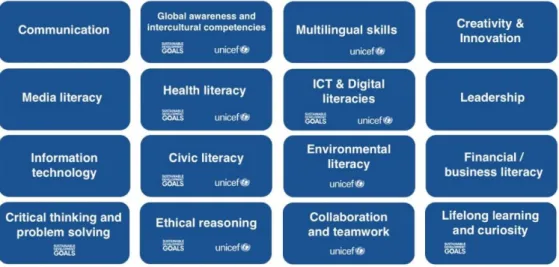
In addition to 21st century skills, related literature has outlined a need for building ‘life skills,’ particularly in relation to children from least advantaged backgrounds and low-income countries. These life skills are typically defined around issues pertaining to health, gender equality, human rights, peace and development. An in-depth evaluation of various life skills education programmes is outlined by UNICEF (2012). Life skills perhaps more explicitly link with the skills and outcomes outlined by SDG4, which focuses on the development of basic literacy and numeracy skills, as well as skills relating to sustainable development, sustainable lifestyles, human rights, gender equality, peace and non-violence, global citizenship, and appreciation of cultural diversity. A further set of traits or ‘soft skills’ is identified by scholars such as Heckman (2011) who argue that these are frequently undervalued but critical to success in school and later life. A framework of 16 skills embracing 21St century skills and life and soft skills, synthesised from 25 reports including those from OECD, NESTA, European Framework of Key Competencies is shown in Appendix 1.
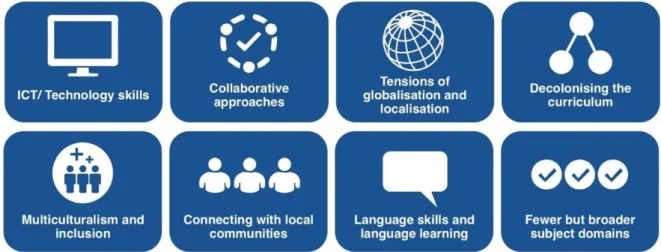
In a likely response to a growing focus on these various 21st century skills, we identified over 50 countries that have made major content-related changes to their student curriculum since 2000. Across these curriculum changes, eight common themes are identified (outlined in Figure 1). These changes include some of the 21st Century skills but there are notable omissions. Positioning 21st century skills as central to student curricula will, however, also require changes to assessment systems; current standardized testing has a focus on numeracy and literacy skills. Not only will the focus of the assessment need to shift but new assessment methodologies will be needed.
These trends in curriculum and assessment mean profound changes in what is required from the education workforce, with new content-related knowledges and teaching practice skills required to meet the demands of curriculum and assessment changes (further details in Appendix 2).
Figure 1: Curriculum changes since 2000 in 50 countries: 8 themes
4.2
Implications for the educators: teachers and other learning support staff
Contemporary national education policies present teachers simultaneously as ‘basic inputs’ to be ‘produced’, ‘utilised’ and redeployed as necessary, but also as community leaders who are socially, culturally and linguistically literate (Buckler, 2015). The latter resonates with the 21st century
literature, but is not new: over fifty years ago, UNESCO and the International Labour Organization (ILO) co-published a report on teacher status that set out the ‘essential role of teachers in educational advancement and the importance of their contribution to the development of man [sic] and modern society’.
For this report, we analysed documents from 10 low-income countries that outlined competencies and standards expected of teachers, along with key relevant, globally-focused reports from UNESCO, Education International (EI), The Brookings Institute and the British Council (all published since 2000). From this analysis emerged fifteen key ideas (Appendix 3) about what teachers need to do and be in order to teach students in the 21st century. While few explicitly reference the 21st century skills agenda, competencies and standards resonate both with this forward-looking lens and that outlined by UNESCO/ILO in the middle of the last century.
There are, however, important caveats. There remains a lack of clarity around what many of these 21st century skills look like at different levels of competence and the role of the classroom teacher in this endeavour. Further, teaching 21st century skills is a new practice for a large number of teachers already in service and there are serious questions about whether they have the capacity to teach these skills given the demands of assessment regimes and the increasing shortage of teachers. In addition although frameworks are often extensive there are a number of notable absences from these contemporary lists of teacher competencies and skills: the inclusion of technology to support learning rather than learning about technology; collaboration with colleagues and other adults; incorporation of global citizenship issues; and supporting students with disabilities or learning difficulties (IIEP, 2017). Finally, across these frameworks formal qualifications continue to be valued over expertise gained through practical problem-solving in classrooms.
4.3 Implications for school functions and roles
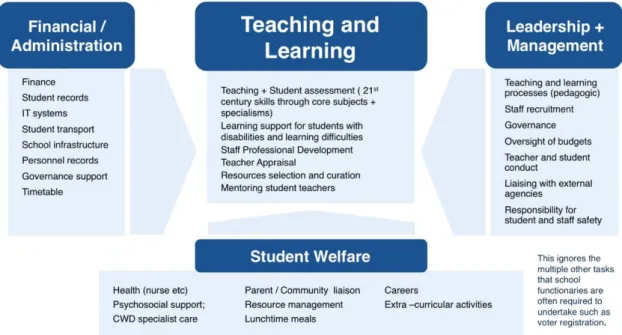
Across the globe, schools are becoming increasingly complex organisations; additional functions, tasks, students and curricula have been added, often in the absence of an analysis of structures, resources, roles and capabilities. Figure 2 offers an overview of all the possible functions within a generic school whilst Figure 3 offers a diagrammatic representation of the functions found in many schools in LMICs.
Figure 2: Possible functions of a generic idealised school
Figure 3: Functions found in many schools in LMICs
Responding effectively to changing, and increasingly diverse, student needs and parental/community and regulatory pressures, as well as changes to the formal curriculum discussed above requires many schools to transform themselves and align roles, structures and processes. Such a transformation needs to embrace consideration of how personnel can be shared with other schools and institutions in the locality. Here, an organisational design approach may be effective if undertaken at either a high level to inform role design or at local level to inform role implementation (Goold & Campbell, 2002; Knowles, 1997). Part of such a process is a critical interrogation of role accountabilities, responsibilities and tasks within a school system, to identify general and structural aspects that would benefit from change. A caveat is that such an approach may result in a loss of local sense making and the detail of teachers’ professional work if insufficient attention is paid to actual behaviours and activities (Blossing et al, 2015).
5.
Education workforce design
The imperative of addressing the challenges outlined above leads us to propose ways in which the education workforce can be redesigned to relieve the burden on teachers and enable high talent teachers to flourish, whilst acknowledging that these changes will demand investment. In this chapter we draw on global examples to propose education workforce teams centred on the learning needs of the student. These teams involve: learning professionals (teachers, specialist staff, learning support staff, pedagogic advisers); education leaders (school leaders, district officials and so on) and support staff (health and welfare professionals, administrators, technical staff, finance staff). The composition and ways of working of these teams will differ over time and context depending on geographical factors, availability of technology infrastructure, student demographics and national and local goals. Role definitions, professional standards, career structures and pathways, and associated training, need to be defined in many contexts to differentiate and professionalise roles.
5.1 Defining education workforce design
The combination of challenges to improving educational outcomes, especially for the most disadvantaged, and the opportunities afforded by technology outlined in previous sections prompt a reimagining of school and district workforce structures. The aim is to enable teachers to devote more time to teaching and learning processes and for students to benefit from the professional skills of teachers including specialists, and other professionals. High talent teachers remain critical to the education endeavour of improvement in student learning outcomes; in all contexts the student – teacher relationship is central to quality learning experiences.
Whilst the objective of workforce design is to improve teaching–learning interactions and support accelerating progress towards equity in student learning outcomes, workforce design is not limited to the school and classroom but embraces the whole education ecosystem. It impacts on the roles and activities of districts officials (including those charged with inspecting schools), school administrators, psycho-social support professionals and so on.
We are proposing that education workforce design is based on the following principles: - recognition that teaching is a collective endeavour;
- classroom teachers are freed where possible from non-teaching tasks, less specialist pedagogic activities and non-learning related student support to focus developing relationships with their students and on planning, guiding and assessing their learning;
- all students have access to teachers with specialist knowledge and skills in key areas of the curriculum (for example in STEM subjects);
- students in lower primary classes taught by limited numbers of teachers / learning support staff; - school leaders are freed from administrative duties to focus on pedagogic leadership and
strategic organisational leadership;
- each role (school leader, teacher, education support personnel) should be clearly defined and recognised as professions in their own right with appropriate training, support and career pathways;
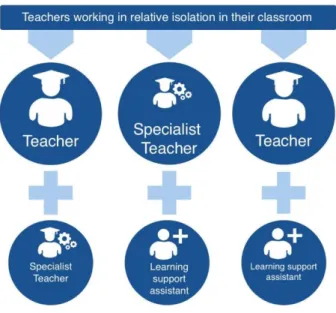
- the education workforce is a positive model for the student body such that all students encounter staff including teachers who are able to act as positive role models for them: female school leaders/teachers, those from marginalised groups, those with disabilities and so on. Two possible future scenarios are offered in Figure 4. In both scenarios the teacher is no longer working in relative isolation in their classroom, but, instead, the learner (child or youth) is central and their learning is supported by a range of adults working in a team.
An imagined future for a primary school
Every child in the school has a ‘home room’ teacher responsible for their academic progress and identifying key learning needs. Children are ‘taught’ core subjects by their homeroom teacher. In other curriculum areas, their learning is guided by a range of different adults (including learning support staff or community members) and their peers working under the direction of the homeroom teacher. Thus learning practices include peer tutoring and peer feedback.
Digital technologies are used to provide a range of learning materials appropriate to individual student needs.
Key functions, such as business administration, are shared by a group of schools.
An imagined future for a lower secondary school
The school has a local presence but not all the students attend daily, some study at home, others in local community spaces for part of the week.
In some subjects, students work in traditional ways with teachers in the classrooms. In other subjects, students do much of their study online (social or independent learning) or engage with radio (digital or analog) broadcasts involving non-co-located specialist teachers. These latter study sessions are mediated and guided by learning support staff.
The school has a number of support staff lead by a School Business Manager, who also supports 3 local primary schools.
Figure 4: Possible future scenarios for school organisational design
Numerous other scenarios for team working can be imagined to tackle problems in particular contexts. This draws on research, albeit in high income contexts, which shows the impact of in– school collaboration - social capital - on improved student learning outcomes. Educators who are in a school with high social capital, that is around others who are collaborating effectively, are able to support better student outcomes. The effect of social capital on improved student achievement is, significantly, more than the effect of individual talent - human capital (Hargreaves & Fullan, 2013). At classroom level, learning support staff (assistants) will play an important role, sometimes in combination with specialist teachers depending on local needs. The key point, as figure 5 illustrates, is the utilisation of teams of education professionals to guide and support student learning and wellbeing. In implementing such teams it will be important to work with all stakeholders including the teacher unions, to understand any reservations and ensure that their concerns over the position of teachers are taken into account.
Figure 5: Teacher Plus: Simple modifications to the classroom / school workforce
Moving beyond the school, the specialist teacher and other professionals may be working across several schools, therefore it is important to consider the school district or entire education system. This lens helps to identify potential economies of scale which can yield benefits in terms of reducing the budgetary burden on the system and, through participation in communities or networks of practice, enrich the experiences and motivation of the workforce (see STIR example in section 6.4).
Implementation of new or changed roles arising from workforce design will need to ensure that the following issues are considered:
- that the challenges of EWR do not dilute the overarching focus on student learning in safe environments with specialist staff;
- that communities are sensitised to changes; community pressure can be intense;
- the need for sufficient training for school leaders who are frequently unaware of principles around good management and pedagogic practice.
Implementation of new ideas about the composition of the workforce will not be easy to enact. Short term political cycles in both host and donor countries, and the need to manage environmental and societal issues - conflict, climate change, food security, demographic shifts and so on, divert attention from the long term collaborative planning required.
5.2 Current innovations in pedagogic workforce design
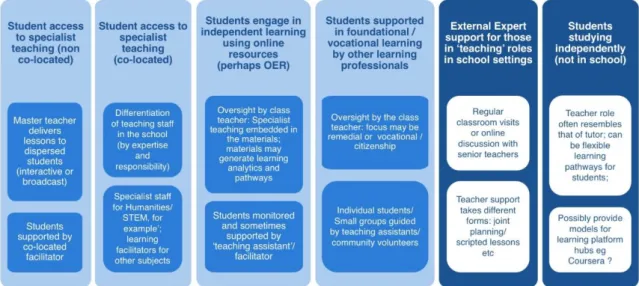
Extensive research revealed no policy driven examples of workforce design or re-design of this nature at scale in low- and middle-income countries. Hence, to explore evidence which might inform the workforce design we analysed a large number of pedagogic innovations involving education staff (teachers and learning support staff) from around the world. Analysis suggested these might be grouped as shown in Figure 7.
Figure 7: Typologies of interventions for school students which involve workforce modifications
Across these different innovations a number of education workforce roles emerge discussed below. It is recognised that implementation of many of these ideas will require considerable investment in professional development of the personnel involved. However at this initial stage establishing