Kridan, A B and Goulding, J S (2005) Change management and human resource management as potential success areas for knowledge management implementation within the Libyan banking sector.
In: Khosrowshahi, F (Ed.), 21st Annual ARCOM Conference, 7-9 September 2005, SOAS, University
CHANGE MANAGEMENT AND HUMAN RESOURCE
MANAGEMENT AS POTENTIAL SUCCESS AREAS FOR
KNOWLEDGE MANAGEMENT IMPLEMENTATION
WITHIN THE LIBYAN BANKING SECTOR
Ahmed B Kridan1 and Jack S Goulding, J.2
School of Construction and Property Management, University of Salford, Salford, M7 1NU, UK
It has been widely acknowledged that the role of senior management commitment, information technology, change management, human resource management, and knowledge management processes (in term of knowledge management
implementation) is an essential consideration for any company wishing to exploit these issues and manage their holistic knowledge assets. This paper presents research undertaken within the Libyan banking industry using a real estate investment bank specialising in the construction industry; and uses the Capability Maturity Model concept as a context for knowledge management implementation. This paper explains the knowledge capturing process vis-à-vis understanding the user
requirements of change management, human resource management, and knowledge management implementation within the context of the Libyan banking industry.
Keywords: capability maturity models, change management, human resource management, information technology, knowledge management.
INTRODUCTION
Knowledge is essential and critical to obtain competitive advantage in modern organisations. Hence, today’s organisations are increasingly paying more attention to the initiation of knowledge management (KM) activities for building their assets (intellectual capital) and knowledge-based systems (processes) in order to increase and maximise their results. However, there are numerous issues concerning the promoters and dissenters of knowledge management implementation. For example, issues related to knowledge management implementation include: senior management commitment (SMC), information technology (IT) focus, change management (CM) procedures, and KM processes. In this context, the difficulty for many organisations manifest from the fact that the ‘implementation’ component of the KM initiatives often face barriers, especially if implemented without a logical framework and methodology (Kridan and Goulding 2005).
The continuous process of change often places considerable demands on organisations, which naturally embraces change in the norms and values of the stakeholder positions. The success of KM initiatives depends upon people’s
motivation, their willingness and their ability to share knowledge of others. Barriers therefore, need to be identified and removed. Existing enablers also need to be
enhanced, and additional ones created. This is often where the greatest KM challenges lie (Cong and Pandya 2003).
LITERATURE REVIEW
The Role of an Organisation’s Policy and Procedures
A policy is a formal statement of a principle (or rule) that members of an organisation must follow. Each policy addresses an issue important to the organisation's mission or operations. A procedure informs members of the organisation how to carry out or implement a policy. Policy is the "what", and the procedure is the "how to" (HRVS 2004). Some important policies and procedures are needed that make knowledge management implementation easy to interpret and use (Kridan and Goulding 2005), for instance, the policy has to address issues that are current and relevant to KM, and also has to be flexible and respond to individual requirements of knowledge and information. Therefore, organisations have to identify the important policy issues for its knowledge implementation activities, and run them in the right way, and at the right time.
The Role of Organisation’s Structure in KM
Edvinsson and Malone (1997) define an organisation’s structure or structure capital as: “the context, empowerment of employees, structures supporting human capital, organisational capital, innovation capital, and process capital”. Empowerment of the employee is based on the distribution of knowledge and decision-making. Structures that support knowledge management include, for example, development of KM activities, motivating strategies and organisational culture. Organisation capital consists of systems and tools that enhance knowledge flow and organisational competence. The presence of ‘right’ organisational structure (Byrne 2001) and development of a culture that supports organisational change and growth is important to improve KM and knowledge transfer across organisations (Schein 1996). The organisational structure provides the framework for the formal distribution of authority. Formalisation is the degree to which tasks are standardised, and rules and regulations govern employee behaviour. It influences the amount of discretion an employee has over their job. In an organisation with high degrees of formalisation, job descriptions and policies provide clear direction. Where formalisation is low,
employees have a great deal of freedom in deciding how they conduct their work (Davenport and Volpel 2001).
The Role of Training and Learning
The importance of training capabilities for any organisation is well recognised,
especially for those agents concerned with preserving intellectual capital. This concept can be useful for integrating the capacity to solve problems and to participate actively in the decision making process. According to this point of view, organisations can be place to develop relationships and manage working groups in which the learning process can lead to knowledge improvement, and contributes to better performance levels (Carneiro 2001). Training also plays an important part in the process of knowledge management, although conventional training tends to be based upon passive learning. Learning must be an experiential and interactive process, so that systems employ techniques based on these principles (Pemberton and Stonehouse 2000; Rus et al 2001). Education and training programmes are powerful tools for transferring knowledge, but they are not the main routes of the learning process. Intelligent agents have to be prepared to gather external data, because many powerful insights may come from competitors, clients and providers. If attention is motivated and focused on an immediate environment, new perspective can often be gained.
Organisations in completely different industries can also suggest innovative solutions and reinforce creative thinking (Carneiro 2001).
The Role of Teamwork
In term of teamwork, technical staff, and human resources (HR) should be rewarded for good work. Change requests of the team can have a major impact on the KM processes, and the prioritisation of initiatives for design and implementation of KM (Soliman and Spooner 2000). Teams should regularly exchange knowledge and reach conclusive decisions related to the major change requests at a pace commensurate with business needs. Organisations that promote teamwork may be a step in the right direction to start its knowledge processes. This raises new challenges of how team knowledge can be replicated and shared with other teams in terms of KM
implementation (Skelin 1999). Work teams are groups of operating employees empowered to plan and organise their own work and to perform that work with a minimum of supervision. Empowered employees create their own schedules, design their own processes, and are held responsible for outcomes regarding to their own knowledge. This facilitates efficiencies in work processes, and the ability to detect and react to changes in the environment. Employees with the skills and knowledge to manage more than one specialised task are also able to promptly provide customers with quality products and services.
The Role of Organisational Culture
Organisational culture has an important role to play in creating less formal systems for knowledge building and transfer. In essence, the harder and softer aspects of the organisation’s infrastructure must be supportive of the developing organisational intelligence (Stonehouse and Pemberton 1999). If the process of knowledge management is a function of the organisational culture and employees’ collective knowledge, then it follows that organisational knowledge is almost certainly a strategic asset (de Hoog and van der Spek 1997). Culture often encompasses many different notions and meanings (Young, 1989), ranging from beliefs, language and ceremonial acts, through to stories and perceptions. From an organisational
perspective, it tends to encompass the internal and external environment, and therefore embodies the whole essence and driving force of an organisation.
Corporate culture is thus often ingrained and very difficult to influence and change. It is affected by employees’ deep-rooted values and beliefs, the nature and causes of which, can often have far reaching consequences (Johnson 1992; Mockler and Dologite 1995; Geletkanycz 1997). Thus, the infrastructure of an organisation comprises the systems and technology that underpin its learning and knowledge management activity. Cultures that explicitly favour knowledge sharing and knowledge integration into the organisation encourage debate and dialogue in facilitating contributions from individuals at multiple levels of the organisation (Davenport and Prusak 1997).
RESEARCH METHODOLOGY
Many organisations have turned to the Capability Maturity Model (CMM) developed by Software Engineering Institute (SEI) to improve software engineering processes (by setting goals to achieve higher SEI levels) (Paulk et al 1993). In this paper CMM is cited as method to implement knowledge management within the banking industry. Organisations are now looking to knowledge management to address ever-increasing challenges, brought on by marketplace pressures and the nature of the workplace. To
be successful, a KM strategy must do more than just outline high-level goals, such as 'become a knowledge-enabled organisation'.
The strategy must identify the key needs and issues within the organisation, and provide a framework for addressing these. This has created the need instrumentation and processes that can be used to evaluate an organisation’s current status relative to the implementation of KM. A method has been developed for assessing and
evaluating an organisation’s current status relative to the success factors in KM implementation identified as: information technology; change management; senior management commitment and knowledge management process. The exploratory case study research design was selected for this study upon examination of the counsel of several experts. Authors that supported the selection of the exploratory case study design included the following: Long et al. (1985), Yin (1994), Robson (1993), Merriam (1988), and Kerlinger (1986). The use of this methodology results in an indispensable understanding of phenomena at early stages in research (Snow and Thomas, 1994), such things occurs with KM.
This method serves as an effective means to start assessing the strategic exploitation of SMC, IT, CM and knowledge management processes (KMP) as well as grassroots participation and support in achieving KM implementation.
This progress-assessment process is not intended as a replacement for any formal assessment instruments developed by the SEI, but rather as an internal tool to help banks prepare for the successful implementation of KM. In this paper only, CM is going to be addressed, as this is seen as one of the most success factors for
implementing KM within banking industry.
Developing an Instrument for CM Assessment:
Each CMM level has several associated key process areas. The instrument lets organisations determine the score associated with the CMM level the bank should try to achieve. Each key process area contains several key activities. Scoring guidelines for measuring how well an organisation implements a specific key activity, were based them on several common CMM themes. The activities are expanded and grouped under three primary evaluation dimensions, and the developed criteria for evaluating them can be seen in table 1.
Table 1: Evaluation Dimensions
Activities Best practice Criteria
Organisation’s Policy and Procedures
Organisation policy, procedures, and processes are enhanced
KM initiatives and business functions.
• A written policy for change management exists, which defines all roles, responsibilities, and procedures related to CM in knowledge management.
• Change management procedures and standards are communicated by senior management that define the techniques and technologies be used throughout the bank in support of CM & KM policies.
• Policies, procedures, and standards are reviewed continually (at least annually) by knowledge officer.
• The change management process follows a logical order and is controlled by top management to ensure the logical evaluation of effective enhancements to services environment.
Organisation’s
Structure Organisation structure is fully supported and adapted to KM and business functions.
• Organisational structure has to be flexible for the new job functional, and to have advanced change management developed as key part of the business.
• KM has to be developed by KM department, and KM chief executive.
Training & Learning
Running intensive training and learning programmes to promote
KM implementation and performance.
• Having well-trained and learned end users who are comfortable with their knowledge and skill in implementing KM in all levels.
• Good training and learning fosters acceptance of new work processes, efficiency of processing and accuracy in data and information collection.
• For purposes of KM implementation , training and learning are required including but are not limited to: class room, on-the-job training, the production and use of user guides, the update and specific IT for KM, and the manual instructions for KM.
Teamwork
A team of business managers and KM officer review requests
of KM and prioritise them based on businesses needs to provide enough resources, also supporting teams to exchange knowledge
• Team reviews change requests determined to be of major impact to the business, and prioritise initiatives for design and implementation.
• Team regularly exchange knowledge and reaches conclusive decisions related to major change requests at a pace commensurate with business needs.
• Change management enable the business to streamline projects and re-allocate resources as necessary during the KM processes, within business requirements. Culture Promoting and measuring collaboration and knowledge acquisition; moreover, incentives, rewards and appraisals are essential
for knowledge processes at the
organisation.
• Fellowship and collaboration is promoted among peers.
• Personal satisfaction is measured considering the knowledge acquisition and application.
• Creative of internal forum to reflection, debate and practice that enable idea exchange among experts with similar and complementary knowledge is encouraged.
• Conventional compensation system has to be changed to encourage the KM activities and compensatory policies adequate to enhance education levels and KM.
From the CM structure, 22 questions are identified as important to the development, procurement, and exploitation of CM in context of KM. Each question was
accompanied by a grid containing four possible answers (in scenario format) represented by the letters D, C, B and A.
The questionnaire was undertaken in three Libyan banks (central bank, real state and investment bank; and commercial bank) as a tool for gathering information regarding the overall use, application, and maturity of CM in the banks, and conducted with five core members from each bank. The interviewees can be seen in table 2.
Table 2: Category of Interviews
Position in the Bank Total No. of interviews
Senior Manger (Head of the bank or deputy) 3
Executive (Head of IT, HR, Department) 3
Managerial (Head of information, training division) 3 Technical (Structural engineer, programmatic) 3 Administrative or supportive (Secretary, accountant ) 3
Total 15
Each question was carefully explained to the interviewees because of the ambiguity of the concept of KM in the Libyan context, which served to improve the data reliability. All results were recorded anonymously. Science Planning and Scheduling Subsystem (SPSS) software was used in data analysis process; the raw results from this
questionnaire are shown in table 3. Table 3: the Questionnaire-Raw Data
Evaluation Dimensions
Bank 1 Bank 2 Bank 3 Total
A B C D A B C D A B C D A B C D answers Total Policies and Procedures 1 4 7 18 2 5 9 14 5 5 9 11 8 14 25 43 90 Structure 0 0 6 9 0 0 1 14 0 2 2 11 0 2 9 34 45 Training and Learning 3 2 16 9 3 12 10 5 4 9 10 7 10 23 36 21 90 Teamwork 1 9 5 0 2 1 9 3 1 5 5 4 4 15 19 7 45 Culture 0 8 10 2 2 12 4 2 3 8 6 3 5 28 20 7 60 Total 5 23 44 35 9 30 33 38 13 29 32 36 27 82 109 112 330
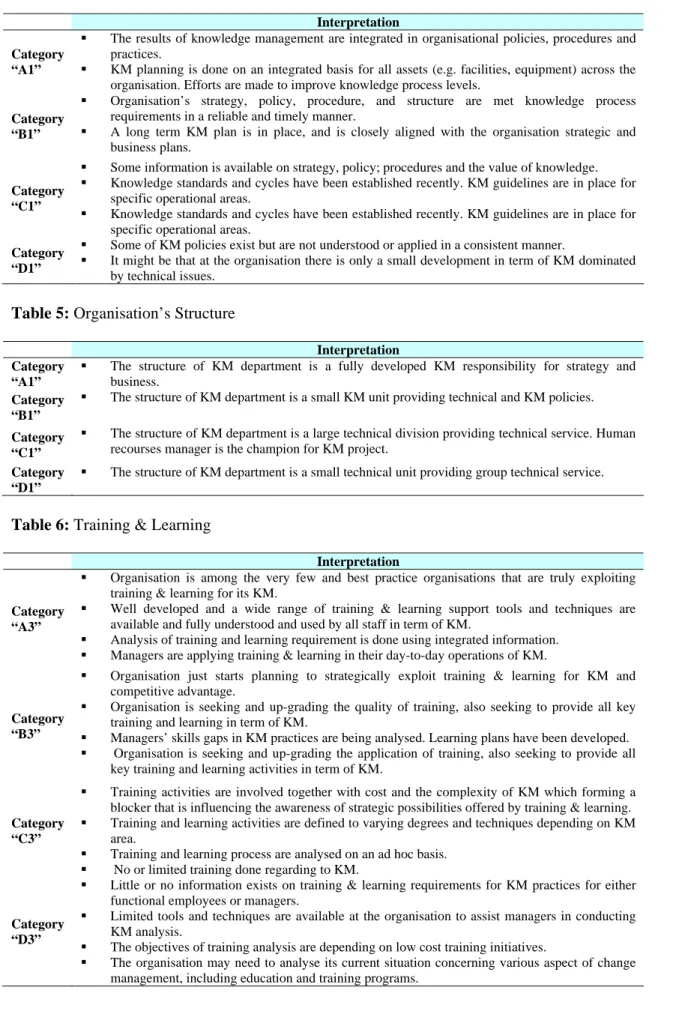
These results were then applied to a matrix to help identify the exact status of CM exploitation in the all banks. Five outcomes in each category are presented and the precise interpretations of each of these categories are presented in table 4,5,6,7 and 8.
Table 4: Organisation’s Policy and Procedures
Interpretation Category
“A1”
The results of knowledge management are integrated in organisational policies, procedures and practices.
KM planning is done on an integrated basis for all assets (e.g. facilities, equipment) across the organisation. Efforts are made to improve knowledge process levels.
Category “B1”
Organisation’s strategy, policy, procedure, and structure are met knowledge process
requirements in a reliable and timely manner.
A long term KM plan is in place, and is closely aligned with the organisation strategic and business plans.
Category “C1”
Someinformation is available on strategy, policy; procedures and the value of knowledge. Knowledge standards and cycles have been established recently. KM guidelines are in place for
specific operational areas.
Knowledge standards and cycles have been established recently. KM guidelines are in place for specific operational areas.
Category “D1”
Some of KM policies exist but are not understood or applied in a consistent manner.
It might be that at the organisation there is only a small development in term of KM dominated by technical issues.
Table 5: Organisation’s Structure
Interpretation Category
“A1”
The structure of KM department is a fully developed KM responsibility for strategy and
business. Category
“B1”
The structure of KM department is a small KM unit providing technical and KM policies. Category
“C1”
The structure of KM department is a large technical division providing technical service. Human recourses manager is the champion for KM project.
Category “D1”
The structure of KM department is a small technical unit providing group technical service.
Table 6: Training & Learning
Interpretation
Category “A3”
Organisation is among the very few and best practice organisations that are truly exploiting training & learning for its KM.
Well developed and a wide range of training & learning support tools and techniques are available and fully understood and used by all staff in term of KM.
Analysis of training and learning requirement is done using integrated information. Managers are applying training & learning in their day-to-day operations of KM.
Category “B3”
Organisation just starts planning to strategically exploit training & learning for KM and competitive advantage.
Organisation is seeking and up-grading the quality of training, also seeking to provide all key training and learning in term of KM.
Managers’ skills gaps in KM practices are being analysed. Learning plans have been developed. Organisation is seeking and up-grading the application of training, also seeking to provide all
key training and learning activities in term of KM.
Category “C3”
Training activities are involved together with cost and the complexity of KM which forming a blocker that is influencing the awareness of strategic possibilities offered by training & learning. Training and learning activities are defined to varying degrees and techniques depending on KM
area.
Training and learning process are analysed on an ad hoc basis. No or limited training done regarding to KM.
Category “D3”
Little or no information exists on training & learning requirements for KM practices for either functional employees or managers.
Limited tools and techniques are available at the organisation to assist managers in conducting KM analysis.
The objectives of training analysis are depending on low cost training initiatives.
The organisation may need to analyse its current situation concerning various aspect of change management, including education and training programs.
Table 7: Teamwork
Interpretation Category
“A4”
Strong sense of teamwork exists across the organisation.
A strong link exists between incentives, rewards, recognition and teams’ contribution.
Teams at the organisation are regularly exchanging knowledge and reaches conclusive
decisions related to major change.
Category “B4”
The organisation appears to be truly planning to exploit co-operation culture for improving its position, capabilities and expertise.
A mix of national and local rewards, recognition and incentive programs are in place for teams.
Teamwork is encouraged to share and exchange information in order to promote KM
initiatives, and work distributed in line with individual competencies and preferences.
Category “C4”
The organisation starts to create a number of teamwork and culture that would support KM initiatives and corporate goals.
Some recognition and incentive programs are in place for teams regarding to KM.
Some knowledge exchange through some integrated systems with some of information sharing exists at the organisation.
Category “D4”
The relation between teamwork and KM is completely separate entities.
Teamwork is not encouraged in term of KM, and work distributed in line with individual competencies and preferences.
The teamwork is not exchanging any knowledge in term of KM.
Table 8: Culture
Interpretation
Category “A”
KM supports a cultural shift to knowledge -smart workforce and environment.
The integration of KM into decision-making is supported by a corporate philosophy and culture that KM is everyone’s business.
The organisation embraces innovation and responsible knowledge -taking. Results of KM are used to support innovation, learning and continuous improvement.
The organisation is seen as a leader in KM. People are highly committed to the success of the organisation.
Category “B”
Information flows freely within functional areas, and is shared between functional areas. People in the organisation are treated with value and respect. People are able to speak out and
participate in discussions without fear of reprimand.
Organisation fosters a culture of continuous learning and participation. Pro-active effort is made to share new ideas and approaches across the organisation.
People are empowered to take responsible for KM, and are encouraged to be innovative.
Category “C5”
People are encouraged to increase interactions and look for efficiencies by providing input and are allowed to make suggestions when changes occur.
People tend to work independently with some interaction.
Information is available for monitoring purposes and shared amongst functions where
interrelationships exist.
People are consulted and given opportunity some times to participate in major change
initiatives.
Category “D5”
The prevailing culture reinforces compliance and risk adverse behaviour where people are expected to follow orders and defined procedures.
Weak fit exists between organisational and individual aspirations as the communication tends to be downward, with management controlling and limiting information to staff.
Changes are decided by management and communicated as necessary to staff. Culture barriers that prevent efficient delivery of KM still exist.
From a metrics perspectives, the evaluation criteria are to determine the levels range from A to D where, A = Strategic, B = Tactical, C = Operational and D = None. Although the guidelines are generic, the assessor can easily use them to determine the level of each specific key activity.
SUMMARY OF FINDINGS
The findings presented are the collective results obtained from the three banks (see Table 3). Due to the participants’ indication, policies and procedures at the banks might need to be reformulated to support the implementation of KM as “43” answers related to the category “D” out of “90” (see Table 3). This means that KM policies and procedures in existence but are not fully understood or applied in a consistent manner. Furthermore, no formal procedures and measures are in place for KM, and the KM is not well understood. It appears that policy and procedures are not viewed as an important part in KM, but the results indicate some improvements, as the category “C” has “25” answers. According to the interviewees, it appears that typically an HR department may formulate a certain set of policies, but the other operational/line departments have to implement these policies in their own method. Organisational policies, procedures and workflow are central to successful bank operations. The KM implementation strategy must therefore be aligned with these organisational
distinctions.
To be able successfully implement KM; each bank’s structure has to be flexible for the new job function, and to have advanced change management developed as key part of the business strategy. The structure of the KM department in all banks is a small technical unit providing group technical service only, as the most answers are related to category “D” “34” answers out of “45”, and the technical staff is only the champion for any KM project (see Table 5).
The banks are mainly in category “C” in terms of training and learning, with results of “36” out of “90”; which means, training and learning activities are defined to varying degrees, depending on KM area. However, there is very limited training done
regarding KM initiatives (see Table 6). The banks are just starting plan to strategically, to exploit training & learning for KM and competitive advantage. The banks are starting to create teamwork and culture that can support KM initiatives and corporate goals and objectives of KM. Teamwork is encouraged at the banks to share and exchange information in order to promote KM initiatives, and work is distributed in line with individual competencies and preferences (see Table 7). The banks appear to be truly planning to exploit co-operation culture for improving their position, capabilities and expertise. The information seems to flow freely within functional areas of the banks, and is shared between functional areas. People in the banks are treated with value and respect as the results show the banks are related to category “B” with number of “28” out of “60”. Therefore, people at the banks are empowered to take responsibility for KM, and are encouraged to be innovative. Culture barriers that prevent efficient delivery of services by staff are removed. Banks foster a culture of continuous learning and participation. Proactive effort is made to share new ideas and approaches across each bank (see Table 8).
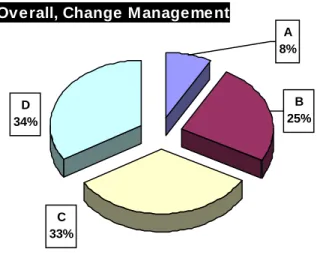
Change management and HR are taken as whole to see where the banks are in term of change management and HR In terms of CM, the Figure 1 shows that the banks related mainly to categories “D” and “C”; therefore, these banks should not ignore change management in terms of KM implementation, and exploitation.
Overall, Change M anagement B 25% A 8% D 34% C 33%
Figure 1 Overall CM for KM
Overall, the integrated KM methodologies and systems should be embedded in the bank’s corporate strategy and shapes to reach the full advantage of KM as the banks have to reach category “A”.
CONCLUSIONS
The banking industry has its own needs, and knowledge management in banking should be developed to improve their business efficacy. Therefore, it is essential to develop a framework which describes the fundamental problems for the
implementation of knowledge management within the Libyan banking industry. However, a “Knowledge Management” framework needs to completely illustrate the SMC, IT, CM, HR; and KMP gaps that might occur when implementing knowledge management. These gaps have to be identified, along with approaches to avoid these gaps. Through the definition of these four gaps, banks can assess the gaps before implementing the knowledge management initiatives. Furthermore, through the evaluation of the knowledge management gap, banks can make corrections and
adjustments accordingly for enhancing the chance of success of the implementation of knowledge management initiatives. Implementing knowledge management
programmes within an organisation can be very costly, and time consuming, especially during the start-up stage. Therefore, looking at the business case for
knowledge management is essential to ensure that each organisation has in place a set of strategies suitable for the implementation of the knowledge management efforts.
REFERENCES
Byrne, R (2001) Employees: capital or commodity? The Learning Organization, 8 (1), 44 -50. Carneiro, A (2001) The Role of Intelligent Resources in Knowledge Management. Journal of
Knowledge Management, Vol. 5 No.4 pp.358-367.
Cong, X, and Pandya, K.V (2003) Issues of Knowledge Management in the Public Sector. UK Electronic Journal of Knowledge Management Volume 1 Issue 2 (2003) 25-33. Also available at: www.ejkm.com accessed 12-02-05.
Davenport, T.H., Prusak, L (1997) Working Knowledge: How Organizations Manage What They Know, Harvard Business School Press, Cambridge, MA.
Davenport, T and Volpel, S (2001) The rise of knowledge towards attention management. Journal of Knowledge Management, Volume 5 Number 3 2001 pp. 212-222 De Hoog, R. and van der Spek (1997) Knowledge Management Hope or Hype? Expert
Systems with Applications (Guest editorial), Vol. 13 no.1, pp.v-vi.
Geletkanycz, M (1997) The Salience of ‘Culture’s Consequences’: the Effects of Cultural Values on Top Executive Commitment to the Status Quo, Strategic Management Journal, Vol. 18, Part 8, pp 615-634
HRVS., (2004) Guide to Human Resource Policies and Procedures, available at
http://www.hrvs.ca/policies/pg002_e.cfm#defining. Accessed on 18-04-05 22:09. Johnson, G (1992) Managing Strategic Change – Strategy, Culture and Action, Journal of
Long Range Planning, Vol. 25, Part 1, pp 28-36
Kerlinger, F. N (1986) Foundations of Behavioral Research, Harcourt Brace, Orlando, FL. Kridan,A.B and Goulding,J.S (2005) Exploring the Important Factors for Knowledge
Management Implementation within the Libyan Banking Industry. Proceeding of 5th International Postgraduate Research Conference, April 14th-15th 2005, Salford, UK. Long, R. J., Convey, J. J. and Chwalek, A. R (1985) Completing Dissertations in the
Behavioral Sciences and Education: A Systematic Guide for Graduate Students,, Jossey-Bass, San Francisco, CA.
Merriam, S (1988) Case study research in education: A qualitative Approach, Jossey-Bass, San Francisco, CA, USA.
Mockler, R and Dologite, D (1995) Easing Information Technology Across Cultural Boundaries – A Contingency Perspective, International Journal of Computer Applications in Technology, Vol. 8, Part 3-4, pp 145-162
Paulk, M.C, Weber, C.V, Garcia, S.M, Chrissis, M.B and Bush, M (1993) Key Practices of the Capability Maturity Model Version 1.1, Software Engineering Institute Technical Report CMU/SEI-93-TR-25 and ESC-TR-93-178, Carnegie Mellon University, Pennsylvania, USA.
Pemberton, J. and Stonehouse, G (2000) Organisational Learning and Knowledge Assets- an essential partnership. The learning organisation Journal. Vol.7. No. 4, pp 184-193. Robson, C (1993) Real World Research,, Blackwell, Oxford.
Rus, I., Lindvall, M. and Sinha, S (2001) Knowledge Management in software Engineering, Tech, Report, DoD Data Analysis Centre for Software, Rome, N.Y.
Schein, E (1996) Culture: The missing concept in organisation studies, AdministrativeSciences Quarterly, 41, 229 – 40.
Skelin, O (1999) Knowledge-based expert systems in production, PhD dissertation
Soliman, F., Spooner, K (2000) Strategies for implementing knowledge management: role of human resources management", Journal of Knowledge Management, 4, 4, 337-45. Stonehouse, G., and Pemberton, J (1999) Learning and Knowledge Management in the
Intelligent organisation. An International Journal, Vol. 7 No.5. pp. 133-144. Yin, R (1994) Case study Research, design and Methods,, 2nd ed. SAGE Publications,
London.
Young, E (1989) On the Naming of the Rose: Interests and Multiple Readings as Elements of Organisational Culture, Journal of Organisational Studies, Vol. 10, Part 2, pp 187-206