Event-based Application Management
A. Buchmann, C. Bornh¨ovd?, M. Cilia, L. Fiege, F. G¨artner??, C. Liebig???, M. Meixner, and G. M¨uhl†
[email protected] Databases and Distributed Systems Group Darmstadt University of Technology, Germany
Summary. New applications and the convergence of technologies, ranging from
sensor networks to ubiquitous computing and from autonomic systems to event-driven supply chain management, require new middleware platforms that support proactive event notification. We present a system overview of Dream, a reactive middleware platform that integrates event detection and composition mechanisms in a highly distributed environment; fault-tolerant and scalable event notification that exploits a variety of filter placement strategies; content-based notification to formulate powerful filters and concept-based notification to extend content-based fil-tering to heterogeneous environments; middleware-mediated transactions that inte-grate notifications and transactions; and scopes, which are administration primitives for both deployment- and runtime configurability, as well as for the management of policies. We discuss four prototypes that were implemented as proof of concept systems and present lessons learned from them.
1 Introduction
We are experiencing a convergence of technologies that results in an explosion of information and requires new paradigms for data and information manage-ment and processing.
• The World Wide Web is a huge source of information that was conceived for interactive search by humans. To exploit the Web in a mode other than human browsing confronts us with the need for filtering and interpreting a large amount of heterogeneous and often short-lived data.
? IBM Almaden Research Center, USA ?? EPFL, Switzerland
??? SAP AG, Germany
• The deployment of smart devices requires the continuous monitoring of events as well as the appropriate context information to interpret them properly.
• The miniaturization of sensors and their ubiquitous deployment will result in massive amounts of sensor signals that must be processed, often in real time.
• Huge distributed systems must be capable of detecting and correcting failures and return autonomously to stable operation.
• New business strategies, such as event-driven supply chain management andzero-latency enterprise, depend on the timely dissemination of infor-mation and business events.
Common to the above is that signals and data, which we abstract into the notion of events and event notifications, will flow to us. When dealing with streams of events our traditional, pull-based access mechanisms to stag-nant data do no longer work. Compare traditional pull-based data processing, where queries are issued against a database, with drinking water with a straw from a glass. The same straw (and the pull mechanism) is useless when trying to drink from the garden hose.
To understand the fundamental difference between traditional applications and the scenarios described above we will analyze the information space and its interactions. There are two major dimensions that characterize an inter-action pattern (see Table 1): who initiates an interinter-action and the knowledge that exists about the counterpart. Along the first dimension we distinguish the requestor of a service or consumer of a unit of information from the provider of a service or information. Along the second dimension we distinguish be-tween having knowledge of the identity of one’s counterpart and having no knowledge.
In the well-known request-reply interaction pattern, the interaction is ini-tiated by the client or consumer of information and the request is directed at a specific server or information provider. If the identity of the service provider is unknown we have a case of anonymous request-reply. On the other hand, if the interaction is initiated by the producer of information, we have the cases depicted in the right column of the table. If the producer knows the identity of its counterpart, we have a classical messaging interaction. However, if the pro-ducer does not know the consumer a priori, we have the typical event-based
Initiator of Interaction Consumer Producer Knowledge of Yes Request/Reply Messaging
Counterpart No Anonymous
Request/Reply Event-based
interaction that depends on a mediator or broker to connect the interested parties.
While traditional applications in which the user is in control or where the responsiveness of the system is not critical are well served by user initiated request-reply interactions, automated processes in distributed environments must react to (possibly large quantities of) events and cannot rely on consumer initiated processing. In event-based systems the producers of the events can be unaware of the consumers, thereby allowing a loose coupling between pro-ducers and consumers. This facilitates the evolution of the system, since new applications that react to events can be added without affecting the deployed infrastructure. The inherent reconfigurability of event-based systems directly addresses volatile environments, which require agile applications and infras-tructures, as was noted, for example, for enterprises that want to expedite their crucial business processes [87].
The fundamental difference in the interaction pattern found in emerging applications suggests, that slowing down the flow of events to use traditional tools, e.g. through the use of caches or databases, is only a patchwork solution. It is our contention that a reliable infrastructure for management of stream-ing information is needed and that the importance of this infrastructure will increase as we move to a world populated by huge amounts of interconnected devices, services, and applications with different capabilities that will react and automate processes on our behalf. Streaming events must be detected, interpreted, aggregated, filtered, analyzed, reacted to and eventually disposed of.
In this chapter we present a system overview of Dream, a distributed reactive middleware layer that consists of a publish/subscribe event notifi-cation service and the reactive capabilities to consume and react to events in heterogeneous environments. Specific research results and the details of the individual components of Dreamhave been published elsewhere and the reader is referred to them throughout the text. Here we will concentrate on the motivation, the design decisions and their consequences, and we will illustrate the feasibility of our approach with four implemented prototypes.
We want to emphasize that different applications may have different no-tions of events and will stress different porno-tions of the middleware. Therefore, we do not propose a one size fits all platform. However, the interaction prin-ciples we discuss here are common to many application domains. We present here the issues and one possible incarnation of a publish/subscribe reactive middleware.
2 Related Work
A reactive middleware platform draws on many existing technologies. Accord-ingly, related work is vast. Related work is, therefore, organized according to
the technologies involved and discusses in Section 2.1 data and event dis-semination; Sections 2.2 and 2.3 deal with event and data aggregation and integration; Section 2.4 is devoted to the reactive functionality needed to re-spond to events; Section 2.5 discusses work related to fault tolerance and the integration of notifications and transactions; finally, Section 2.6 addresses software engineering and management issues.
2.1 Event/Data Dissemination
Early work on broadcast disks addressed the issues of push-based information dissemination in asymmetric communication environments [2]. Under this ap-proach data is simply broadcasted (pushed) to all consumers. Notification services (also called event notification services) are in charge of propagating data/events to interested consumers. For instance, in CORBA an event ser-vice [73] was introduced to provide a mechanism for asynchronous interaction between CORBA objects. Here, an event channel acts as a mediator between suppliers and consumers of events. To overcome deficiencies of this service specification, the notification service [74] was proposed as a major extension with support for quality of service specifications and basic event filtering.
The Java Message Service (JMS) [55] provides the Java technology plat-form with the ability to process asynchronous messages. JMS was originally developed to provide a common Java interface (API) to legacy Message Ori-ented Middleware (MOM) products like IBM MQ-Series or TIB/Rendezvous. In this way, the JMS API provides portability of Java code allowing the un-derlying messaging service to be replaced without affecting existing code. JMS provides two models for messaging among clients: point-to-point (us-ing a queue) and publish/subscribe (by means of topics). JMS has been part of Java Enterprise Edition (J2EE) since its origin but it was incorporated as an integral part of the Enterprise Java Beans (EJB) component model in the EJB 2.0 specification. It includes a new bean type, known as message-driven bean (MDB), which acts as a message consumer providing asynchrony to EJB-based applications.
In recent years, academia and industry have concentrated on publish/ subscribe mechanisms because they offer loosely coupled exchange of asyn-chronous notifications, facilitating extensibility and flexibility. The channel model has evolved to a more flexible subscription mechanism, known as subject-based, where a subject is attached to each notification [78]. Subject-based addressing features a set of rules that defines a uniform name space for messages and their destinations. This approach is inflexible if changes to the subject organization are required, implying fixes in all participating applica-tions.
To improve expressiveness of the subscription model the content-based ap-proach was proposed where predicates on the content of a notification can be used for subscriptions. This approach is more flexible but requires a more com-plex infrastructure [22]. Many projects in this category concentrate on
scala-bility issues in wide-area networks and on efficient algorithms and techniques for matching and routing notifications to reduce network traffic [79, 69, 42]. Most of these approaches use simple Boolean expressions as subscription pat-terns and assume homogeneous name spaces.
2.2 Event Aggregation
Events and associated data can be aggregated according to aggregation op-erations. In the context of active databases event aggregation involves the occurrence of two or more events. Complex situations can be specified in or-der to aggregate information from “low-level” events into more complex ones. These are known as composite events and are usually expressed using an event algebra, such as those defined in HiPAC [37], Ode [50], SAMOS [48], or Snoop [26]. Such algebras require an order function between events to apply event operators (e.g. sequence), or to consume events. To determine which of these events should be consumed or selected, different consumption modes were defined [29]. Usually, events are point based and timestamped to provide a time-based order with the purpose of facilitating event selection. However, in open distributed environments global time is not applicable.
An approximation for modeling the clock imprecision in distributed sys-tems has been proposed. Assuming a sparse time base (where the points at which events can be generated are discretized and predetermined), Kopetz [57] proposed the2g-precedence model. This model establishes that if events are at least two time granules apart, the sequence of these events can be de-termined unequivocally. Here an upper bound to the precision is assumed and a virtual clock granularity gis defined. Since the granularity depends on the assumed precision, it is not a feasible approach for wide area networks and open distributed systems.
Schwiderski [88] adopted the 2g-precedence model to deal with distributed event ordering and composite event detection. She proposed a distributed event detector based on a global event tree and introduced 2g-precedence-based sequence and concurrency operators. However, event consumption is non-deterministic in the case of concurrent or unrelated events. Additionally, the violation of the granularity condition (2g) may lead to the detection of spurious events.
Dyreson [40] proposed the notion of valid time indeterminacy for temporal databases, to model that it is not known exactly when an event occurred. An interval timestamp together with a probability distribution is suggested, to represent the time span during which the event is supposed to have occurred. As a consequence, querying the temporal database eventually results in multi-sets that represent alternative answers to the query.
In [62] an approach for timestamping events in large-scale, loosely coupled distributed systems is proposed. This uses accuracy intervals with reliable error bounds for timestamping events that reflect the inherent inaccuracy in time measurements.
Many projects on event composition in distributed environments such as [66, 51, 96] either do not consider the possibility of partial event ordering or are based on the 2g-precedence model. Therefore, they suffer from one or more of the following drawbacks [62]: they do not scale to open systems, they provide the possibility of spurious events, or they present ambiguous event consumption.
Systems that support composite events must also address the semantic issues associated with processing composite events. For example, how times-tamps are generated and the way in which events are selected and consumed. Several recent projects are dealing with queries on streaming data [21, 6, 68, 27]. They are basically data flow systems where tuples flow through an acyclic directed graph of processing nodes that apply stream operators. These systems are mostly centralized and they monitor and aggregate data. The aggregated data serves as triggering event.
2.3 Event Integration
As it has been clearly identified additional semantic metadata for the exchange of data or messages among independent applications or services is needed, not only in the context of B2B frameworks like ebXML [41], BizTalk [67], or RosettaNet [86] but also by the W3C in efforts like Semantic Web [7], DAML+OIL [35], or OWL [92].
In the first case, XML [16] and XML Schema [43] are used to define com-mon vocabularies to describe data and business processes. XML supports a textual representation of data as attribute/value pairs organized in a tree-like structure using user-defined tags. These tags may be explicitly defined in a XML Schema and can be used to give hints about the assumed meaning of the represented data. XML Namespaces [15] allow to contextualize XML tags in the sense of distinguishing different meanings of the same tag name. Other data models similar to XML include OEM [81] and the models described in [1, 38].
In the context of W3C’s Semantic Web initiative RDF [59] and RDF Schema [17] are used to provide additional semantic metadata to better enable computer and users to exchange and integrate data. RDF provides an infras-tructure that supports the representation and exchange of sinfras-tructured data to describe Web resources, like (parts of) Web pages, or other RDF meta-data. RDF allows the description of properties of and interrelationships among those resources in terms of<resource, attribute, value>triples. The attributes used can be declared in RDF Schemas which, similar to XML Schemas, give information about their intended meaning, and specify restrictions on their values. RDF Schemas and XML Schemas can play a role similar to ontologies as a common semantic basis for data and metadata representation.
In our framework we use the MIX model [14, 12] for the representation of data (i.e., event content). Like XML/XML-Schema or RDF/RDF Schema
MIX provides a flexible representation model for data plus additional meta-data based on a common domain-specific vocabulary. However, in addition to the functionality provided by the data models discussed above, MIX di-rectly supports data integration by making the concept of semantic context (i.e., the explicit description of implicit assumptions about the meaning of the data) and conversion functions (which allow the automatic conversion of data/events from different sources to a common context) first class citizens of the model itself. MIX should not be seen as an alternative to the models being developed in the context of the W3C but as a complementing approach that provides features that hopefully will find their way into the other XML-based models and standards.
2.4 Reactive Functionality
Reactive mechanisms were introduced in the late ’80s in the form of Event-Condition-Action rules (ECA-rules) in active databases (aDBMS) [82]. The goal of active databases was to avoid unnecessary and resource intensive polling in monitoring applications where events are detected as changes to a database and the application reacts to the occurrence of these events.
Reactive functionality is used to support a wide spectrum of “applications” ranging from workflow management [51, 60], personalization [65, 32], alerters [25], business rule enforcement [3, 94] up to the internal support for relational and object-oriented databases [95] particularly with the purpose of supporting integrity of constraints, view maintenance, access control, etc. Most recently active functionality is been used in the context of XML repositories [11, 5].
Active database functionality developed for a particular DBMS became part of a large monolithic piece of software (the DBMS). Monolithic software is difficult to extend and adapt. Moreover, active functionality tightly coupled to a concrete database system hinders its adaptation to today’s Internet ap-plications, such as e-commerce, where heterogeneity and distribution play a significant role but are not directly supported by traditional (active) database systems [49].
Another weakness of tightly coupled aDBMSs is that active functionality cannot be used on its own without the full data management functionality. However, active functionality is also needed in applications that require no database functionality at all, or that require only simple persistence support. As a consequence, active functionality should be offered not only as part of the DBMS, but also as a separate service that can be combined with other services to support, among others, Internet-scale applications.
Unbundling active databases consists of separating the active part from ac-tive DBMSs and breaking it up into components providing services like event detection, rule definition, rule management, and execution of ECA rules on the one hand, and persistence, transaction management and query processing services on the other [49]. Afterwards, only necessary components can be re-bundled in order to provide the required functionality. A separation of active
and conventional database functionality would allow the use of active capabili-ties depending on given application needs without the overhead of components that are not needed. Various projects like C2offein [58], FRAMBOISE [46],
and NODS [34] have followed this approach.
From our point of view, unbundling active functionality from a concrete system and then rebundling the corresponding components in an open dis-tributed environment is questionable. Unbundling in this context means to give up the “closed world” assumption that traditionally underlies a DBMS. Inherent characteristics of open distributed environments impose new require-ments that were not considered in centralized environrequire-ments, such as the lack of global time, independent failures of nodes or communication channels, mes-sage delays, etc. The consideration of these characteristics has an enormous impact on the event detector [62], which is the essential component of an aDBMS [20].
In [19] crosseffects and potential incompatibilities arising from the combi-nation of selective features of active, real-time and distributed object systems are discussed.
2.5 Notifications and Transactions
Transactions are a well known concept to provide reliability of execution and have been well studied in research [10, 52, 93]. In database systems, data access operations are grouped into logical units of work and executed under transaction control. Database transactions guarantee atomicity, consistency, isolation and durability (ACID) for the execution of operations in a unit of work, despite concurrency and despite the presence of application errors and system failures. Thereby, the programmer is shielded from a variety of com-plex situations that otherwise arises in the presence of concurrency and the possible multitude of failures modes. Finally, this clear separation of responsi-bilities into application-specific logic and generic middleware services renders the abstraction concept oftransaction so powerful [93].
Traditional transactions focus on the server-side of programming - i.e. where the data is managed. They are tied to the notion of backward error recovery, as intermediate changes of a unit of work will be backed out, in case the transaction cannot be completed successfully. A database thereby either reaches a new and consistent state, once the unit of work is successfully completed, or sets back to the successor state in case of errors. Backward recovery based on atomicity enables forward recovery and reliable execution by adding redundancy in time - i.e. retry of submitted, but failed transactions. The idea behind that approach is that the error has the nature of a Heisenbug and is caused by transient faults. After restart the same operations may be retried in a new transactions and are likely to succeed, because the fault disappeared ([52]).
In the area of reliable workflow and process management systems, the ap-plication process accesses diverse, possibly remote, cooperative information
systems to fulfill its goals [61, 4]. Such processes are long running and cannot be realized as single units of work, nor in a single program. Realizing a long running process as a single database transaction is not an option, because the isolation property requires resources to be locked for the duration of the transaction, resulting in a non-scalable solution. Typically, the stringent isola-tion (e.g. serializaisola-tion) as found in database transacisola-tions is not even desired, as intermediate results need to be shared with other processes and activities. Therefore, the access to transactional information systems in an activity is executed on behalf of a separate transactions, while individual activities are reliably chained [84] using transactional queues. Queued transactions are well known in the area of transaction processing monitors [9] and enterprise appli-cation integration. Queued transactions are based on the concept of message recovery [8, 93] and provides for the exactly once execution of a request issued from a client system to a transactional information server. Both, client and server are loosely coupled in terms of time-dependency, as they do not share a synchronous communication state nor a single transaction context.
In aDBMS, database transactions provide the basis for reliable execution and preservation of consistency. Additionally, the concept of coupling modes has been introduced [37, 18] to determine the transaction context for the triggered action with respect to the triggering user-submitted transaction. Basically, the triggered action could be executedimmediately on behalf of the triggering transaction, deferred as a pre-prepare phase (mentioned asphase 0) of the commit processing, or detached in a new and separate transac-tion. In addition, more advanced couplings are suggested which encompass a dependency between the triggering transaction and a separately spawned transaction for the rule. The execution of the triggered action could causally depend on the commit or failure of the triggering transaction. As depicted above, the aDBMS have been designed on top of a central and monolithic database server. In particular, the event triggering and rule dispatching is integral part of the dbms and not separated into a generic middleware layer. In transactional publish/subscribe [28] push-style event notifications and database transactions are integrated, separating this active functionality in a middleware layer. In [90] the authors identify the restrictions of queued trans-actions in common message oriented middleware and suggest message delivery and message processing transactions. Middleware mediated transactions [64] are a synthesis of queued transactions, transactional publish subscribe and distributed object transactions, including database transactions.
2.6 Software Engineering/Management
To be useful in an event-based setting a notification service has to support an external control of its layout and operation, outside of producers and con-sumers to not dilute the loose coupling. Event systems are different in their ability to partition the sets of producers, consumers, notifications, and the
underlying (distributed) infrastructure itself to apply and bind management tasks to these structures.
The channels of theCorbanotification service [74] are structuring mech-anism for notifications, which are only visible within the channel they were published in. The channels can be interconnected and managed in event man-agement domains [75]. The domains provide a uniform manman-agement interface, but do not offer any filtering of notifications between coupled channels. How-ever, producers must still explicitly publish into a specific channel, moving information about application structure into the components and limiting system evolution; a problem which is only recently addressed by reflective middleware [36].
In subject-based addressing schemes for notification delivery, a predefined tree of subjects is used to classify, partition and select notifications [78]. The subject tree can only be defined according to a specific viewpoint in mind, be it notification content, network or application layout. In any way, different points of view are impeded, and thereby easy integration of systems [56]. Many commercial systems exists (e.g. from TIBCO, IBM, etc.) that extend the basic features with bridges connecting multiple busses, transactional processing, and security. However, the management of notification services is separated from the application functionality, which is affected only implicitly, obscuring the interdependencies and complicating management of the overall system.
The Java Message Service [55] uses topics, which are a combination of hierarchical subjects and content-based filtering, but it does not offer a man-agement interface beyond selecting the persistence and time-to-live of notifi-cations.
TheSienaevent notification service is a popular example of a distributed service utilizing content-based filtering [23]. As for all other content-based filtering approaches, the filters may be used to realize visibility constraints, but these issues are not explicitly addressed. The idea of defining event zones is present in several prototypes [77, 54] to limit the distribution of notifications. Unfortunately, none of the approaches focus on visibility control as the central mechanism to coordinate applications and to localize management tasks.
With respect to management issues, peer-to-peer systems tackle a number of interesting problems. They are self-organizing, maintain a well-defined net-work topology despite of frequent node failures, offer bounded delivery depth and load sharing. Several recent efforts [83, 24, 91] try to combine publish/ subscribe and peer-to-peer to complement the communication efficiency of the first with the manageability of the latter.
In classical software engineering event-based interaction is also known. The observer pattern [47] directly follows this approach, and events are used in graphical user interfaces and in software integration and composition. Sul-livan and Notkin introduce mediators [89] as a design approach to explicitly instantiate and express integration relationships. An implicit invocation ab-straction is used to bundle components and mediators, and, with their own interfaces, to compose new components. The Field environment [85] is an
early work on tool integration that relies on a centralized server to distribute events. The original approach realizes content-based filtering in a flat space of notifications, which was later extended with the Field Policy Tool by intro-ducing a (manual) mapping of any sent message to a set of message-receiver pairs.
3 Architecture
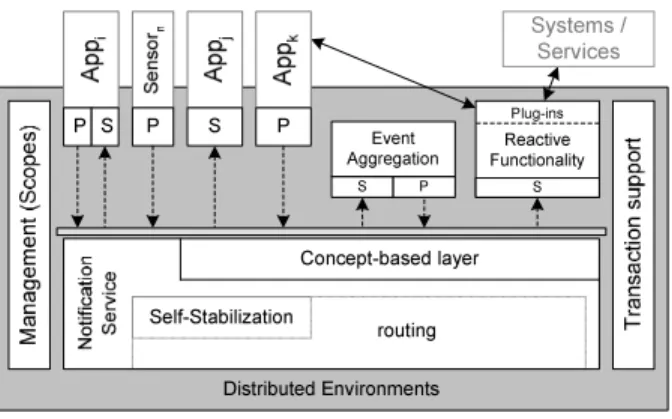
The Dream middleware platform consists of two main portions: the event notification subsystem and the reactive functionality service. These two sub-systems are complemented by the mechanisms for transaction support and scopes, an orthogonal management support. Figure 1 describes schematically the architecture. 6\VWHPV 6HU Y L F HV !" " # $%& "' ( ) *"+-,".0/ 13224,256/78". )9:<;>=?@<A B,5C0/7+-, D"E.6C>/78.65F7/G (
HIHEJF7K6L-,4NM3I6MEJ6K0C647J6,4 I-5K0G.0COP.0/,45C>/78". I6Q56RK>G.-CO67.>/,45C>/78".
Fig. 1. DreamArchitecture
Events are produced by sensors or applications. They can be consumed either by a reactive application, i.e. an application that integrates the reac-tive functionality, or by the reacreac-tive functionality service that handles events on behalf of passive applications and invokes them as needed. The reactive functionality service handles events on behalf of applications and can invoke, via plug-ins, external systems or services. Details are given in Section 3.4.
Event producers publish event notifications. An event is the observation of a happening of interest. A notification is the reification of an event and includes the event’s identity, a timestamp, and time-to-live for an event. An event notification also includes the parameters of the event, i.e. data, and in the case of heterogeneous environments, the event’s context. Details of the event representation are given in Section 3.2.
The notification service is the delivery mechanism responsible for matching published event notifications with subscriptions. It routes events from their
sources to their destinations. The routing mechanism may be realized at the physical level (IP addresses), at the level of subject hierarchies, on the basis of message content if all parties belong to one homogeneous context, or on the basis of concepts, i.e. the terms of an ontology, if publishers and subscribers belong to heterogeneous contexts. The Dream architecture allows you to bypass a layer if it is not needed.
Publish/subscribe systems work on the basis of filters. Filters reduce the number of notifications by forwarding only those for which subscriptions ex-ist. As such, filters typically do not combine events. In many applications, however, added value can be derived from aggregating events and reacting to a combination of primitive events. The aggregated event should then be forwarded to the subscriber. Event aggregation is discussed in Section 3.3. Although aggregation could be viewed as being part of the notification mech-anism, inDreamwe have realized event aggregation outside the notification mechanism. Event aggregators are treated like any other event consuming ap-plication that can subscribe to events, aggregate them and publish a new, aggregated event. In this way we can accommodate different kinds of event aggregation, e.g. based on event graphs or on streaming queries. Details of the notification service, as well as the optimizations for filter placement and how to achieve fault-tolerance via self-stabilization are given in Section 3.1.
In publish/subscribe systems the quality of service of the delivery mecha-nism is not compatible with traditional notions of transactions. Transactional behavior is usually limited to guaranteed delivery of the notification from the publisher to the broker but does not include the delivery to the subscriber. In Dreamwe developed a transaction mechanism, that allows the client, i.e. the subscriber, to determine the transactional quality of an interaction. Details of how notifications and transactions interact are given in Section 3.5.
Finally, theDreamarchitecture includes a component that supports mod-eling and management of event-based systems. The notion of scopes is used to structure the applications and to manage policies bound to this structure. Policies may determine the range of visibility or relevance of events, adapt the notifcation service functionality, and may be used for the enforcement of security policies. Scopes are described in Section 3.6.
3.1 Notification Service
The foundation of theDreamarchitecture is a delivery mechanism that spans the underlying distributed system. It consists of a distributed event notifica-tion service to which applicanotifica-tions and other system services are connected as clients. These clients act as producers and consumers of notifications. The notification service itself is an overlay network in the underlying system, con-sisting of a subset of nodes connected in a network of event brokers. The brokers receive notifications, filter and forward them in order to deliver pub-lished notifications to all attached consumers having a matching subscription. This well-known architecture is used in a number of existing systems. However,
we studied the influence of the routing strategy on the scalability and perfor-mance of the notification mechanism, specified its characteristics formally to analyze the routing and extended its dependability with self-stabilization. Routing
We assume content-based routing to develop the routing strategies.
Flooding is the simplest approach to implement routing: brokers simply forward notifications to all neighboring brokers and only those brokers to which clients are connected test on matching subscriptions. Flooding guar-antees that notifications will reach their destination, but many unnecessary messages (i.e. notifications that do not have consumers) are exchanged among brokers. The main advantage of flooding is its simplicity and that subscrip-tions become effective instantly since every notification is processed by every broker anyway.
An alternative to flooding is filter-based routing. It depends on routing tables that are maintained in the brokers and contain link-subscription pairs specifying in which direction matching subscriptions have to be forwarded. The table entries are updated by sending new and cancelled subscriptions through the broker network. Different flavors of filter-based routing exist. Simple routing assumes that each broker has global knowledge about all ac-tive subscriptions. It minimizes the amount of notification traffic, but the routing tables may grow excessively. Moreover, every (un)subscription has to be processed by every broker resulting in a high filter forwarding overhead if subscriptions change frequently.
Our experiences have shown that in large-scale systems, more advanced content-based routing algorithms must be applied [70]. Those algorithms ex-ploit commonalities among subscriptions in order to reduce routing table sizes message overhead. We have investigated three of them, identity-based routing, covering-based routing [23], and merging-based routing [69]. Identity-based routing avoids forwarding of subscriptions that match identical sets of notifi-cations. Covering-based routing avoids forwarding of those subscriptions that only accept a subset of notifications matched by a formerly forwarded sub-scription. Note that this implies that it might be necessary to forward some of the covered subscriptions along with the unsubscription if a subscription is cancelled. Merging-based routing goes even further. In this case, each broker can merge existing routing entries to a broader subscription, i.e., the bro-ker creates new covers. We have implemented a merging-based algorithm on top of covering-based routing [72]. In this algorithm, each broker can replace routing entries that refer to the same destination by a single one whose filter covers all filters of the merged routing entries. The merged entries are then removed from the routing table and the generated merger is added instead and forwarded like a normal subscription. Similar, the merger is removed if there is an unsubscription for a constituting part of the merged filter or if a subscription arrives that covers a part or the whole merger.
Advertisements can be used as an additional mechanism to further opti-mize content-based routing. They are filters that are issued (and cancelled) by producers to indicate (and revoke) their intention to publish certain kinds of notifications. If advertisements are used, it is sufficient to forward subscrip-tions only into those subnets of the broker network in which a producer has issued an overlapping advertisement, i.e., where matching notifications can be produced. If a new advertisement is issued, overlapping subscriptions are forwarded appropriately. Similarly, if an advertisement is revoked, it is for-warded and remote subscriptions that can no longer be serviced are dropped. Advertisements can be combined with all routing algorithms discussed above. Fault-Tolerance and Self-Stabilization
Among the notification services practitioner’s approaches dominate. These systems perform well but it is difficult to identify their distribution seman-tics clearly or even reason about their implementation. Being able to formally reason about the correctness of a system is however an often neglected pre-requisite for avoiding bugs and misconceptions. For Dream a formalization of the desired semantics is used to evaluate the routing strategies and imple-mentation [45, 72].
Based on these formal semantics it was also easier to incorporate and validate a very strong fault-tolerance property into the notification service: self-stabilization. Self-stabilization, as introduced by Dijkstra [39], states that a system being in an arbitrary state is guaranteed to eventually arrive at a legitimate state, i.e., a state starting from which it offers its service cor-rectly. The arbitrary initial state models the effect of an arbitrary transient fault. Therefore, self-stabilization is generally regarded as a very strong fault-tolerance property. A self-stabilizing publish/subscribe system is guaranteed to re-satisfy its specification in a bounded number of steps as long as the broker topology remains connected and the programs of the surviving brokers are not corrupted.
Self-stabilization in the broker network is realized by discarding broken and outdated information about neighbors. This is accomplished by the use of leases. A node must renew its subscription to maintain it in the network. Since the process of lease renewal is idempotent, multiple renewals don’t af-fect the functioning of the system and it is enough to renew the lease any time before it expires. A lease renewal just updates the timestamp for the lease expiration time that is stored by the brokers with each entry. If filter merging is performed, the resulting routing entries must be renewed, too. To clean up the effects of internal transient faults, brokers validate their routing tables periodically to remove entries with expired leases. Transient failures of network links are not masked by this approach and lost notifications are not automatically retransmitted. However, the approach using leases guarantees that transient faults do not upset system operation longer than necessary. In this sense, the system infrastructure can be regarded asself-healing.
The timing conditions for lease renewal depend on the link delay and the network diameter, i.e., the time needed to process and forward a subscrip-tion message and the number of links that must be traversed, respectively. The leasing period is the time for which a lease is granted and determines the stabilization time needed to recover from an error. There is an obvious tradeoff between these values in that more accurate behavior demands more control messages and increases the overhead. The system has been designed to adapt leasing periods to changing network characteristics. For this, the self-stabilization methodology can be applied again.
3.2 Concept-based Layer
In order to express subscriptions consumers need to know about the content of the events/messages that are being exchanged. That means, that consumers must know details about the representation and assumed semantics of message content. Notification services describe/specify message content by means of IDLs or simply no explicit specification is made. Thus, in the best case only the data structure of the notification content is specified while leaving required information about data semantics implicit. This reflects a low level of support for event consumers that based on this scarce information must express their interest (subscriptions) without having a concrete definition of the meaning of messages assumed by their producers. Without this kind of information event producers and consumers are expected to fully comply with implicit assumptions made by participants.
The approach taken here tries to solve this problem by providing a concept-based layer on top of the delivery mechanism. This layer provides a higher level of abstraction in order to express subscription patterns and to publish events with the necessary information to support their correct interpretation outside the producers’ boundaries.
Representing Events
Events are represented using the MIX model (Metadata based Integration model for data X-change) [14, 12]. MIX is a self-describing data model since information about the structure and semantics of the data is given as part of the data itself. It refers to concepts from a domain-specific ontology to enable the semantically correct interpretation of event content, and supports an explicit description of the underlying interpretation context in the form of additional metadata. In other words, the underlying ontology defines the set of concepts that are available to describe data and metadata from a given domain.
In our infrastructure ontologies are organized in three categories [33]:
• TheBasic Representation Ontologycontains the basic numeric and char-acter data types, URL, currency, date, time and physical dimensions. The
representation ontology contains the necessary definitions for (un)mar-shalling.
• TheInfrastructure-specific Ontology contains events (primitive, temporal, composite, etc.), notifications, and policies, such as consumption modes or lifetimes of events and notifications. These are the basic concepts of an event-based distributed infrastructure.
• TheDomain-specific Ontologies contain the concepts for the various ap-plication domains, for example, auctions, car-specific services, or air traffic control. Some detail on these application domains is given in Section 4. Events from heterogeneous sources can be integrated by converting them to the target context required by the respective consumer. This can be done by applying conversion functions that may include the calculation of a simple arithmetic function, a database access, or the invocation of an external service. Conversion functions can be specified in the underlying ontology if they are domain-specific and application-independent. Application-specific or service-specific conversion functions may be defined and stored in an application-specific conversion library and will overwrite those given in the ontology. Concept-based Addressing
Since events are represented with concepts of the ontology, we can provide a high-level subscription specification. Consumers define their subscription pat-terns by also referring to the underlying ontology (what we callconcept-based addressing). Subscriptions include the possibility of expressing consumers’ in-terests using local conventions for currency, date time format, system of units, etc. In this way, consumers do not need to take care of proprietary represen-tations and all participants use a common set of concepts to express their interests. Moreover, event consumers are allowed to express their interests without previously knowing the assumptions made by event producers. This means that one producer can send events that contain prices expressed in USD while other producers can express prices in EUR. Consumers of these events simply need to specify at subscription time the context (in this case the currency) in which they want to get the content of events. This is done by automatically applying the respective conversion functions to events before they are passed to consumers. Additionally, event consumers can benefit from the ontology and their relationships, e.g. generalization/specialization (IS-A). They can use abstract concepts for specifying their subscriptions and receive instances of specializations of the abstract concept.
3.3 Event Aggregation
Events can be either primitive or composite. In most practical situations prim-itive events, e.g. events detected by basic sensors or produced by applications, must be combined. Usually, this composition or aggregation relies on an event
algebra that may include operators for sequence, disjunction, conjunction, etc. Existing event algebras were developed for centralized systems and depend on the ability to determine the order of occurrence of events [97]. .
However, these event algebras and consumption policies depend on a total order of events and are based on point-based timestamps of a single central clock. These assumptions are invalidated by the inherent characteristics of distributed and heterogeneous environments. Exact knowledge of event oc-currence as a point on the timeline ignores the effects of granularity and inde-terminacy of time instants. As a matter of fact, granularity and indeinde-terminacy of event occurrence time are two sides of the same coin. The timestamp gran-ularity might reflect the inaccuracy of clocks and time measurements [76], as well as the inaccuracy of event observation - think of a polling event detector running once an hour. While one event may be reported to have occurred at a particular day, but not at which hour, minute or second, other events might be reported with a granularity of milliseconds. A coarse granular event oc-currence time might be chosen by purpose, because in the world of discourse a finer granularity is not appropriate. For example, the event could be asso-ciated with an activity that itself has a duration but this duration is not of interest. In that case, the presumed atomicity of an event is a result of an abstraction. As another example, consider planning and scheduling of activi-ties, which is best modelled at an appropriate time granularity related to the heart beat of the process. In typical Supply Chain Management scenarios for example, events are recorded at the granularity of calendar day, and only in some cases down to hours and minutes.
In all cases, the event occurrence time must be considered to be indetermi-nate to some extend. As a consequence, time indeterminacy must be reflected in the time model and explicitly recognized and reported when composing events in distributed and heterogenous systems.
Three factors are crucial in a generic event composition service: i) the proper interpretation of time, ii) the adoption of partial order of events, and iii) the consideration of transmission delays between producers and consumers of events.
The first point is basically related to timestamping events. Here, times-tamps are represented with accuracy intervals with reliable error bounds that reflect the inherent inaccuracy of time measurements [62]. In our infrastructure an abstract timestamp concept is defined and particular timestamp represen-tations can be specialized for different scenarios and environments according to the adopted time model.
In regard to the second point, we adopted a partial order of events. Conse-quently, correlation methods include the possibility of throwing an exception (e.g. CannotDecide) in order to announce such an uncertainty when com-paring events. In this way, the underlying infrastructure is responsible for announcing an ambiguous situation to a higher level of decision allowing the use of application semantics for the resolution [33]. In this approach, user- or pre-defined policies can be configured in order to handle these situations.
Third and final, we handle transmission delays and network failures by using a combination of a window scheme with a heartbeat protocol. The win-dow mechanism is used to separate the history of events into stable pastand theunstable past and presentthat are still subject to change. For composition purposes only events in the stable past are considered. With all this, it can be guaranteed in all cases that: a) situations of uncertain timestamp order are detected and the action taken is exposed and well defined, and b) events are not erroneously ordered.
The infrastructure of the event aggregation service is based on the princi-ples of components and containers. Containers control the event aggregation process while components define the event operators logic. As mentioned be-fore, the aggregation service is treated like any other event consumer that can subscribe to events, it aggregates them and finally publishes the aggregated event. The handling of time indeterminacy and network delays are encapsu-lated in such a container.
3.4 Reactive Functionality
An event-based system depends on the appropriate reaction to events. Be-cause we are targeting open environments the reactive components must be able to interpret events originating from heterogeneous sources. Therefore, the context information presented in Section 3.2 is not only needed for event composition and notification, but also for interpretation of events and their parameters by the components reacting to them.
In Dream the traditional processing of Event-Condition-Action rules (ECA-rules) is decomposed into its elementary and autonomous parts [30]. These parts are responsible for event aggregation, condition evaluation and action execution. The rule processing is then realized as a composition of these elementary services on a per rule basis. This composition forms a chain of ser-vices that are in charge of processing the rule in question. These elementary services interact among them based on the notification service. As mentioned before, the reactive service is treated like any other event consumer that can subscribe to events. When events of interest (i.e. those that trigger rules) are notified the corresponding rule processing chain is automatically activated. El-ementary services (i.e. action execution) that interact with external systems or services useplug-insfor this purpose. Besides that, plug-ins are responsible for maintaining the semantic target context of the system they interact with making possible the correct exchange of data.
On the foundations of an ontology-based infrastructure, a reactive func-tionality service was developed providing the following benefits: services inter-act using an appropriate vocabulary at a semantic level, events from different sources are signaled using common terms and additional contextual informa-tion, and rule definition languages can be tailored for different domains using a conceptual representation, providing end-users the most appropriate way to define rules. This conceptual representation enables the use of a “generic”
reactive functionality service for different domains, making the underlying ser-vice independent from the rule specification. For instance, this serser-vice is used in the context of online meta-auctions as well as the Internet-enabled car as described in section 4. Details related to the reactive functionality service can be found in [33].
3.5 Notifications and Transactions
In the event-based architectural style the event producer is decoupled from the event consumer through the mediator. Therefore, any transaction concept in an event-based system must include the mediator. On the other hand, appli-cations will be implemented in some (object-oriented) programming language. Object transactions, as provided for example byCorbain the OTS, are based on a synchronous, 1:1 request/reply interaction model that introduces a tight coupling among components. The challenge is therefore, to combine notifi-cations with conventional transactional object requests [63] into middleware mediated transactions (MMT) [64].
MMTs extend the atomicity sphere of transactional object requests to include mediators and/or final recipients of notifications.
To properly understand MMTs and their benefits, one needs to understand the basic issues of component connection, interaction, and reliability.
Topologymay befixedorvariableand could be 1:1, 1:n, or n:m.
Binding may be reference-based (at least one party has an exact refer-ence to the other) ormediator-based(parties have no direct reference to each other but interact through the mediator based on subjects, topics, content or concepts).
Life-cycledependencies may betime-independent(components need not be available at the same time) ortime-dependent(components must be avail-able at the same time).
Synchronicity describes the synchronization between components and whether they block while waiting or not, and may be synchronous, asyn-chronous, ordeferred synchronous.
Delivery may bebest-effort, at-most-once,at-least-once or exactly-once. The first two are unreliable while the last two are reliable.
Processingmay bebest effortor atomic transactionally coupled.
Recoverycould be forward(outgoing) or backward (incoming) from the point of view of the publishing transaction.
To illustrate the differences among well known mechanisms we con-sider object-oriented communication and transactions (1:1, fixed topology, reference-based, time-dependent, synchronous, atomicity only) and traditional publish/subscribe (n:m, variable topology, mediator-based, time-independent, asynchronous, transactional delivery to mediators but not to final recipients). There is a clear need to integrate producers, mediators and subscribers into a flexible transactional framework. This framework must provide the means
to couple the visibility of event notifications to the boundaries of transac-tion spheres and the success or failure of (parts of) a transactransac-tion. It must also describe the transactional context in which the consumer should execute its actions. It must specify the dependencies between the triggering and the triggered transactions, dynamically spanning a tree of interdependent trans-actional activities.
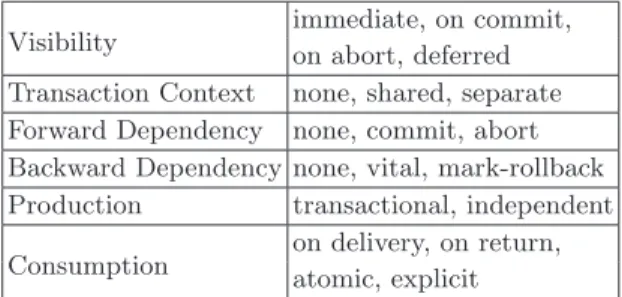
Table 2 illustrates the possible options for coupling event producers, me-diators and recipients of notifications.
Visibility immediate, on commit,on abort, deferred Transaction Context none, shared, separate Forward Dependency none, commit, abort Backward Dependency none, vital, mark-rollback Production transactional, independent Consumption on delivery, on return,atomic, explicit
Table 2.Transaction framework provided couplings.
Withimmediate visibility, events are visible to consumers as soon as they arrive at the consumer’s site and independent of the outcome of the trigger-ing transaction.On commit (on abort) visibilityspecifies that a consumer may only be notified of the event if the transaction has committed (aborted). De-ferred visibilityrequires that the consumer be notified as soon as the producer starts commit processing.
A commit (abort)forward dependencyspecifies that the triggered reaction only commits if the triggering transaction commits (aborts).
A backward dependencyconstrains the commit of the triggering transac-tion. If the reaction is vitally coupled, the triggering transaction may only commit if the triggered transaction has been executed successfully. If the con-sumer is coupled in mark-rollback mode, the triggering transaction is inde-pendent of the triggered transaction’s commit/abort but the consumer may explicitly mark the producer’s transaction as rollback-only. Both backward dependencies imply that a failure to deliver the event will cause the triggering transaction to abort.
If the reaction is coupled in shared mode, it will execute on behalf of the triggering transaction. Of course this implies a forward and a backward dependency, which is just the semantics of spheres of atomicity. Otherwise, the reaction is executed in its own atomicity sphere, i.e.separate topand the commit/abort dependencies to the triggering transaction can be established as described above.
Once an event has been consumed, the notification is considered as deliv-ered and will not be replayed in case the consumer crashes and subsequently
restarts. The consumption modes allow a loose or tight coupling of event con-sumption to the consumer’s execution context and its transaction boundary.
We have implemented the above framework in theX2T S prototype [63].
It is discussed in section 4 with the other prototypes. 3.6 Scopes
Despite the numerous advantages offered by the loose coupling of event-based interaction, a number of drawbacks arise from the new degrees of freedom. Event systems are characterized by a flat design space in which subscriptions are matched against all published notifications without discriminating pro-ducers. This makes event systems difficult to manage. A generic mechanism is needed to control the visibility of events, e.g. for security reasons, and for structuring the system components, extending visibility beyond the transac-tional aspects presented in Section 3.5.
Scopes [44] allow the system engineer to exert explicit control on the event-based interaction; it is a functionality orthogonal to the transaction mecha-nism that stretches across the different layers of theDreamarchitecture (see Figure 1). The following examples illustrate the kinds of explicit control of-fered. In order to overcome the flat design space of event systems, scopes offer interfaces that limit the distribution of published notifications. A scope bun-dles several producers and consumers, it limits the visibility of events in the sense that notifications are delivered to consumers within the same scope but are a priori invisible elsewhere. According to an assigned interface a scope may forward internal notifications to the outside, and vice versa. It encapsu-lates the composed producers and consumers and may itself be a member of other scopes, thus creating new clients of the notification service as long as the resulting graph is acyclic [45]. The achieved information hiding may be used to abstract from details of application structure.
Ontologies are used to map notifications between producers and consumers of different application contexts. However, context is typically not identified with arbitrary single producers or consumers, but instead characterizes differ-ent (parts of) applications that are to interact at runtime. Context descrip-tions can be bound to scopes, which bundle coherent groups of cooperating clients and share a common application context. For example, a scope could restrict visibility to trade-event notifications originating from NASDAQ. The scope could have an associated context ”US-exchange” that defines the cur-rency, the valid fractions in a quote, the date and time formats, etc.
Scopes are also used to exert a finer control of who is going to receive a given notification. A typical example for such a delivery policy is a 1-of-n delivery to only one out of a set of possible consumers. Note that, from the producer’s and consumer’s point of view, event-based semantics is kept up, only the interaction within a specific scope is to be refined. Delivery policies bound to a scope specify the refined semantics of delivery in this scope.
Different aspects of controlling visibility of events are addressed in a num-ber of existing products and research contributions, ranging from administra-tive domains [53] to full database access control [80]. However, so far we missed an approach that is orthogonal to the other aspects ofDream. We see scopes as the means by which system administrators and application developers can configure an event-based system. Scopes offer an abstraction to identify struc-ture and to bind organization and control of routing algorithms, heterogeneity support, and transactional behavior to the application structure. They delimit application functionality and contexts, controlling side effects and associating ontologies at well-defined points in the system. This is of particular impor-tance as platforms of the future must be configurable not only at deployment time but also once an application is in operation.
4 Proof of Concept Systems
In this section we present prototypical implementations that illustrate the concepts discussed above.
4.1 Rebeca
Rebeca (Rebeca Event-Based Electronic Commerce Architecture) [45, 71] is a content-based notification service that implements the event notification and routing described above and does not rely on only a single routing algorithm, but implements all the algorithms presented in Section 3.1.
Scopes are implemented on top of Rebeca. Several options exist which differ in the degree of distribution, flexibility to evolve, and the necessary management overhead. A completely distributed solution divides the existing routing tables into scope-specific tables and uses the plain routing mecha-nisms for intra scope delivery. Cross scope forwarding and the application of interfaces and context mappings are handled when notifications are trans-fered between routing tables. A number of alternatives are available here: scope crossing may be centralized to enforce some security policy, to audit traffic, or to bridge specialized implementations of notification delivery. On the other hand, single scopes may be realized by a centralized notification broker, offering a finer control of notification forwarding and delivery policies. Measurements of the characteristics of the routing algorithms were con-ducted with the help of a stock trading application that processed real data feeds taken from the Frankfurt stock exchange [70]. The results clearly show the beneficial effects of using advanced routing algorithms in the Rebeca notification service.
4.2 X2TS
X2TS integrates distributed object transactions with publish/subscribe
prop-agation, interposition for distributed object transactions and the XA protocol for RDBMS resource management. The prototype supports a push-based in-terface with one-at-a-time notifications. It assumes that events are instances of types and that subscriptions may refer to specific types and to patterns of events. Subscription to patterns of events and coupling modes are imposed by the consumer by configuring the service proxy.
The X2TS prototype implementation currently supports the following
mid-dleware mediated transaction (MMT) features:
• Deferred, on abort and on commit visibility.
• X2TS managed transactions at the consumer. The consumer may provide
its own transaction context, select a shared context or let X2TS create
a new transaction for each notification. Grouping of notifications in one transaction is possible through the definition of one composite event.
• Checked transactions to support forward couplings and vital backward dependencies.
• Backward processing dependencies with the possibility to define groups of subscribers to be vital. Conditional delivery is currently not supported.
• Production policy is non-transactional but can be explicitly programmed as transactional.
• Consumption policies are on delivery, on return and explicit. Atomic con-sumption will be supported in the future.
X2TS allows subscribers to the same event to specify different couplings. While
one subscriber may react on commit of the triggering transaction, the other may need to react as soon as possible. This means that notifications are pub-lished immediately and a visibility guard enforces the appropriate policy at the consumer. Status change events are used to enforce forward dependencies in a push-based manner.
Detection of event patterns is realized through pluggable event compositors that are created by a specific CompositorFactory. The event compositors take into consideration the lack of global time and consider the accuracy intervals and supplier heartbeats as described in Section 3.
Reliable delivery and recovery of events leverages the persistent ledger of the underlying messaging middleware. To implement different consumption policies, X2TS implements its own acknowledgment and sequence number
logging.
X2TS proved to be a good testing ground for the ideas on event
compo-sition in the presence of timing inaccuracies, and for the integration of the flexible transaction framework with a messaging service.
4.3 Meta-Auctions
Auctions are a popular trading mechanism. The advent of auction sites on the Internet, such as eBay or Yahoo has popularized the auction paradigm and has made it accessible to a broad public that can trade practically anything in
a consumer to consumer interaction. However, the proliferation of sites makes life more difficult for the buyer. Consider the case of a collector. With the current auction sites, she has to manually search for the item of interest, pos-sibly visiting more than one auction site. If successful, she might end up being engaged in different auctions at multiple auction sites. There are two obvious shortcomings to this approach: first, the user must poll for new information and might miss the window of opportunity, and second, the user must handle different auction sites with different category setups and different handlings. This motivates the need for the meta-auction broker [13], which provides a unified view of different auction sites and services for category browsing, item search, auction participation and tracking (see Figure 2).
Notifications about events, such as the placement of a highest bid, and their timely delivery represent valuable information. Propagation of events leads to a useful and efficient non-polling realization of an auction tracking service. Therefore, publish/subscribe as an additional interaction paradigm is needed for disseminating process-related information efficiently. Events related to the auction process are disseminated using the concept-based notification service presented in this paper. This way, publishers and subscribers use a common semantic level of subscription.
VQRRSLQJ VQRRSLQJ Q G H O LY H U \ $ SS 3 6 6 Q G H O LY H U \ ' % G RP D LQ D X F W LRQ F RP : : : JD W H Z D \ D SH U LRG LF QRW LI LF D W LRQ D SH U LRG LF QRW LI LF D W LRQ G D W D VW RU H E D F N H QG W LH U RSH U D W LRQD O G D W D : : : E U RZ VH U P H VVH QJH U D SSO H W : : : E U RZ VH U P H VVH QJH U D SSO H W & 2 5 % $ 3 6 6 1 RW LI LF D W LRQ 0 H VVD JH % X V : : : JD W H Z D \ G D W D VW RU H $ X F W LRQ 6 LW H $ SSO LF D W LRQ O RJLF 0 H W D $ X F W LRQ % U RN H U Z U D SSH U 1 RW LI LF D W LRQ 6 H U Y LF H 1 RW LI LF D W LRQ 6 H U Y LF H
Each site participating in the meta-auction system provides information about items and the auction process but does not share a global data schema nor may we assume a global schema for notifications. Today, the exact mean-ing of terms, entities and notifications used by different auction sites is still left implicit. To enable the brokering between different participating auction sites, the precise understanding of the terms used by each site is needed and should be made explicit through a domain-specific ontology. We introduced an ontology-based infrastructure for explicit metadata-management on top of which the meta-auction service can be realized and the mappings through which the domain-specific ontlogies can be combined..
The auction process itself can be defined using state charts. Since they are event-driven, they can be easily implemented with ECA-rules. Different sets of rules can describe different types of auction processes (ascending, reverse, dutch, etc.) [31].
To track an item of interest during an auction process, e.g. to detect that another bidder has reached a highest bid, or that the deadline of an auction is approaching, an agent can be used. Bidders can benefit from the reactive service to program their own agents. In contrast to current agent bidders that are owned, controlled and implemented by the auction house, these agents can react to happenings of the auction process according to the bidders’ strategy. 4.4 Internet-enabled Car
Similar to other pervasive computing environments, cars will see a conver-gence of Internet, multimedia, wireless connectivity, consumer devices, and automotive electronics. Wireless links to the outside world open up a wide range of telematics applications. Automotive systems are no longer limited to information located on-board, but can benefit from a remote network and service infrastructure.
Consider the scenario, where vehicles, persons and devices have a web presence (or portal). Within this scenario new possibilities emerge, e.g. the adjustment of instruments according to personal preferences, favorite news channels, sports, music or access to one’s e-mail and calendar through the portals. Through the portals this can be made independent of a particular car and could be applied to any rental car. But not only instruments can be adjusted, services can be personalized too. Services such as, “find and set the route to the next gas station”, or “book an appointment to change oil” can take into account company’s, and/or driver’s preferences.
The portals are enhanced with the reactive functionality service in order to react to events of interest according to user preferences. Preferences are stored and managed by the portal manager.
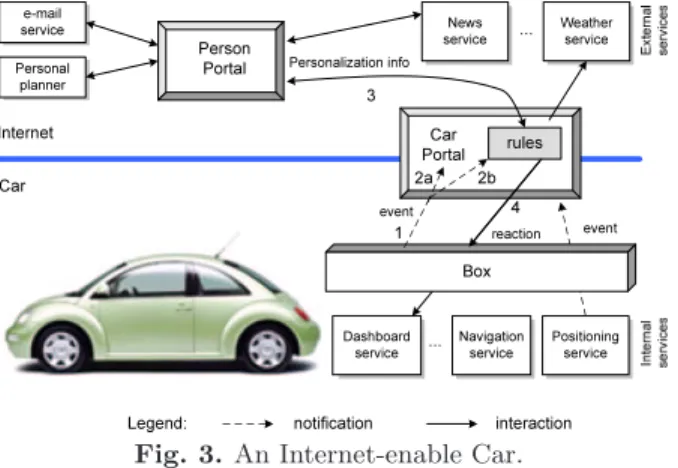
Vehicles are equipped with a GPS receiver and a box. This box plays the role of a mediator between the vehicle itself and the external world. It can access a vehicle’s electronic and diagnostic interfaces (like interfaces J1850, ODB-II) and it is responsible for announcing status changes to its portal.
The portal manager can react to them by using the reactive functionality service (see Figure 3).
'DVKERDUG VH UY L F H 3 RVL W L RQ L Q J VH UY L F H 1DY L J DW L RQ VH UY L F H UX O H V & DU 3 RUW DO : H DW KH U VH UY L F H 1H ZV VH UY L F H 3 H UVRQ 3 RUW DO H Y H Q W H Y H Q W UH DF W L RQ 3 H UVRQ DO L ] DW L RQ L Q I R , Q W H UQ H W & DU % R[ D E H P DL O VH UY L F H 3 H UVRQ DO S O DQ Q H U / H J H Q G Q RW L I L F DW L RQ L Q W H UDF W L RQ
Fig. 3. An Internet-enable Car.
A prototype [32] was developed in conjunction with industry to show the reaction of a personalized car to different situations according to a set of user-defined rules. Implmented services include:
Adjustment of instruments:When the driver gets into the car all her pref-erences (preferred language, units used for temperature, distance and velocity, format of date/time, radio stations, music preferences, etc.) are automatically loaded. The driver’s identity is detected (e.g. smartkey) when getting into the car and the car’s box communicates this event to its portal. As a reaction, a rule is fired which reads the driver’s preferences and contacts the box to set/load them into the car’s instruments.
Low fuel:A sensor signals this event and a location service is invoked to find the next gas station considering current geographical position, destination and the preferred vendor.
Driving to work: A commuter gets into the car on a workday and the current time is between 8:00am-9:00am. As a reaction the best route to work avoiding traffic jams is offered and passed to the navigation service; today’s scheduled meetings are reviewed; company news and other personalized news are obtained; and e-mails can be read. Because drivers should concentrate on driving, all this information is read out by using a text-to-speech service.
5 Conclusions and Future Work
We have shown the main properties that we expect a reactive event-based middleware platform to exhibit:
• event detection and composition/aggregation mechanisms in a highly dis-tributed environment;