Iffah Shabirah and Leo Aldianto School of Business and Management
Institut Teknologi Bandung [email protected]
.
In this modern time, money and its necessity become very crucial. Most of our activities need money to be done. Because of that situation, Bankers play very important roles in the economic life of the nation. The health of the economy is closely related to soundness of its banking.
In some countries, and most of them are developing countries, many people do not have bank account or access to basic financial service. 9 out of 10 people are unbanked ( ). This thing can happen because of some reasons such as geographic; infrastructure, sociologic, and security (Wangsadibrata, 2014).
By the development of technology, bank and the other non-bank parties create a new innovation to solve those problems. The innovation called as “Branchless Banking”. Branchless banking represents a new distribution channel that allows financial institutions and other commercial actors to offer financial services outside traditional bank premises. Branchless banking have been implemented in some of developing countries that have the same problems. Those countries are Brazil, India, South Africa, The Philippines, and Kenya.
Vol . 3, No.6, 20 14: 63 3-645
THE SUITABLE MODEL OF BRANCHLESS BANKING IMPLEMENTATION IN
INDONESIA
Introduction
Abstrat-Keyword:
Branchless banking as the new distribution channel in banking industry is becoming a new solution to offer financial service to untapped society. Branchless banking will help Indonesia to decrease its number of unbanked people. This Final project is to find out the right model of branchless banking that can be implemented in Indonesia, regarding the society respond and hope towards banking the reliable technology, collaboration of parties that involve, and how to avoid branchless banking risks. The respond and hope society towards banking measured by spreading the questionnaires to 112 middle class society in Depok. The questionnaires results were calculated by frequency analysis method. The reliable technology, collaboration of parties, and the way to avoid risks were find out by interviewing three people from different parties, which are Telkomsel from Telco Company, Bank BJB, and PT Cyberport as the company between bank and Telco. The result of this research is, branchless banking in Indonesia can be implemented by collaboration of Telco Company, Bank, and private sector The reliable technology to implement branchless banking is using USSD connectivity and EDC machine that has been modified to be branchless banking technology. The risks in branchless banking can be avoided by risks mitigation from technology and regulation. The respondents’ perception towards banking is, bank is secure but bank do not have flexible opening hour. The expectation of respondents is bank become more secure, flexible, and have easier way and requirement to open bank account. To create a suitable model of branchless banking in Indonesia, those three parties have to conduct another similar research in the different area, to know the demand of the society. After those parties knowing about society needs and demand, they should do the three approaches to meet the demand. Those approaches are Price, feature, and process approach.
Branchless banking, Collaboration, reliable technology, perception, expectation
,
)
,
Learned from another countries, Indonesia is also trying to develop branchless banking to increase the economic, by decreasing the number of unbanked people. To help unbanked communities become easier to use bank services, the government build financial inclusion program. Financial inclusion helps Indonesia decreasing the number of unbanked people. To implement financial inclusion, banks have to increase the number of bank branches all around Indonesia. Based on the data from World Bank, if a bank in Indonesia wants to open a new bank branch, it will cost US$ 250 and bank need US$ 10.000 to build one Automatic Teller Machine (ATM). The cost to build a new bank branch is very high, and the revenue from its new branch will not cover the operating cost. On the other hand, if bank implement branchless banking, the cost needed to invest in branchless banking is only US$ 400.
In Indonesia itself, the population of the country is about 237,641,326 million people (Badan Pusat Statistik, 2010), while the number of people who already have bank account is only 40% from them (International Finance Corporation, 2010). IFC defined three typical of unbanked people in Indonesia, which are people who don’t have financial capability, people who do not feel comfortable or have some difficulties to do transaction in a bank branch, and Bank worthy but Remote.
Those three typical of unbanked people are separated to the different areas in Indonesia. Each of an area has its own characteristics of unbanked people. Depok, as one of an area that represent an urban area in Indonesia is becoming a city that has potential as the area to implement branchless banking there (Setyadi, 2014). Mr. Setyadi (2014) said that middle low class societies in Depok need branchless banking. Depok meet two out of three categories of unbanked people in Indonesia, which are unbanked because the society is lack of financial capability, and for borderline bank worthy who does not feel comfortable to go to bank.
To build Branchless-Banking service, government has to synergize with private sector and societies (President of Indonesia 2012), because to operate it in an area, there are so many information and communication technologies, such as cell phones, debit and prepaid cards, and card readers to transmit transaction details from the retail agent or customer to the bank.
Branchless banking is the distribution of financial services to people who are not reached by traditional bank branch networks. It lowers the cost of delivery to banks, including costs of building and maintaining a delivery channel and to customers of accessing services. Two models of Branchless Banking through retail agent are emerging: one led by banks, the other by nonbank commercial actors (Lyman, Ivatury, and Staschen, 2006:2)
Business model can be described through nine basic building show the logic of how a business intends to make money. The nine blocks cover the four main areas of a business: customers, offer, infrastructure, and financial viability (Osterwalder & Pigneur, 2010 . The business model is like a blueprint for a strategy to be implemented through organizational structures, process, and systems.
Collaborations vary enormously depending in goals, settings, teams and resources. Yet all collaborations are human activity, and the following six elements play an important role in all of them (Salonen 2012). Collaboration consists of six elements, which are motivation, communication, diversity, sharing, support, and problem solving.
Literature Review
Definition of Branchless Banking
Definition of Business Model Canvas
).
Marketing mix is the set of tactical marketing tools that the firm blends to produce the response it wants in the target market. The marketing mix consists of everything the firm can do to influence the demand for its product (Kotler and Armstrong, 2012 The many possibilities can be collected into four groups of variables: product, price, place, and promotion.
The concept of service innovation first time discussed by Miles (Dhewanto, 2014:93-94) has been developed for the last two decades. Service innovation divided into three categories, which are innovation in service, innovation in process, and innovation in Service Company, organization, and industry.
Perception can be defined as a process which each of individual organize and interpret their sense of impressions, so they can give benefits to their environment (Robbins, 2001: 88). Based on Horovitz theory (Riyani, 2007), perception can be affected by three factors. Those factors are psychology factor, physical factor, and formed image.
Based on Hill (Riyani, 2007), expectation is everything that consumer think have to be presented by service providers. Expectation is not prediction from everything that service providers will provide to its consumers. Based on Horovitz (Riyani, 2007), consumers’ expectations can be formed by four factors, which are needs, mass media, past experience, and word of mouth.
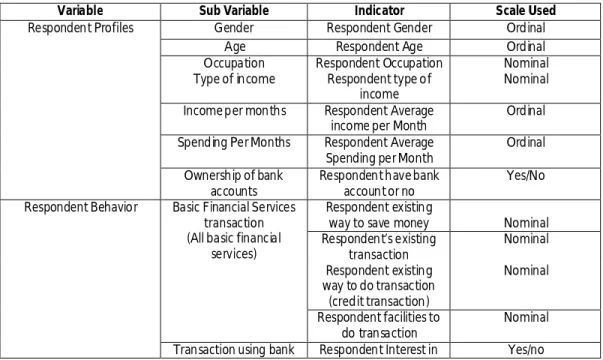
This research is using quantitative and qualitative study. The data in this study were obtained through spreading questionnaire given to the middle-low class society in Depok, and interview to the parties who involved in branchless banking. Those parties consist of a bank, which are Bank Jabar Banten, a Telco company that is Telkomsel, and company between bank and Telco that is Cyberport Company. The table below will show the design of the questionnaire.
Respondent Profiles Gender Respondent Gender Ordinal
Age Respondent Age Ordinal
Occupation Respondent Occupation Nominal Type of income Respondent type of
income
Nominal Income per months Respondent Average
income per Month
Ordinal Spending Per Months Respondent Average
Spending per Month
Ordinal Ownership of bank
accounts
Respondent have bank account or no
Yes/No Respondent Behavior Basic Financial Services
transaction (All basic financial
services)
Respondent existing
way to save money Nominal Respondent’s existing transaction Nominal Respondent existing way to do transaction (credit transaction) Nominal Respondent facilities to do transaction Nominal Transaction using bank Respondent Interest in Yes/no
Definition of Marketing Mix
Definition of Marketing Mix
Definition of Perception
Definition of Expectation
Methodology
Variable Sub Variable Indicator Scale Used
using bank Respondent existing
bank branch
Nominal Features Features that
Respondent want to use in bank
Nominal
Respondent Perception about current condition of bank branch
Place Near Likert
Convenience in using day to day clothes to
bank
Likert
Easiness Easiness in transaction procedure
Likert Easy to understand
(Informative)
Likert
Time Flexible open hours Likert
Time to reach bank branch
Likert Security Money secure from
theft
Likert Money secure from
disaster
Likert Cost Cost to reach financial
service
Likert Cost in every
transaction
Likert
Respondent hope towards transaction using bank
Place Closer Likert
More convenience Likert Easiness Easier transaction
procedure
Likert Easier to understand Likert Time Time opening of bank
more flexible
Likert Less time needed to go
to bank
Likert Security Money secure from
theft
Likert Money secure from
disaster
Likert
Cost
Cost to reach bank is cheaper
Likert Cost to do transaction in
a bank is cheaper
Likert Banking method Bank come to
respondent’s place
Likert
The non-probability sampling technique is used in this research to define the target respondents segment with using the judgments sampling. Researcher spread the questionnaire to approximately 100 respondents that fulfill the target segment of this research.
The method to determine the number of samples in this research is using the opinions of Slovin theory with error 10% indicated by the following formula:
n =
n = = 99.99 100
n: number of sample N: number of population e: limitation of tolerance error
In this research the limitation of tolerance error is 0.1.
N 1+(Ne2)
1.898.567
The result of sampling determination is 100 samples. In order to avoid the occurrence of sample error, there are 120 questionnaires distributed between 24thJuly – 4th August 2014. From 120 physical questionnaires that were spread, 112 of them were back.
On respondent perception, the reliability is 0.641 and on respondent expectation the reliability is 0.808. This means that the data are acceptable in the medium level of reliability level, which is higher than 0.6 (Nunally, 1967).
The requirement for an item to be considered as valid is, if r higher than 0.3 (Sugiono, 2001: 124). There are some not valid data in respondent perception and expectation. Researcher divided two categories of not valid data. First is higher than 0.2, and second is lower than 0.2. Researcher will use the not valid data that higher from 0.2 by supporting the data from interview result to the respondent. If a data is lower than 0.2, the difference between the r data and r standard is very high, researcher will not use those data.
There are 10 questions from 5 sub-variables of respondent perception used in branchless banking survey. From this survey we can analyze the current perception of Depok middle-low class society towards banking. There are questionnaire of perception result
Based on the data from figure, it can be concluded that trust of respondents towards banking is quite high. It can be seen from item point 7 and 8, that respondent think banking can save society’s money from theft and disaster. Securities can be concluded as the highest respondent perception because securities data are valid.
The second highest score of respondents perception achieved by place sub-variable’s, with the indicators of near and convenience in using day-to-day clothes to bank. The first indicator of place shows the not valid score, which is 0.260. To support the first indicator data, researcher conducts interview to the respondents.
The third highest score of respondents’ perception is cost with the indicators of cost to reach bank, and cutting cost from each of transaction. In those indicators, the validity is very low, which are 0.158 and 0.163. It is very far from the validity standard, which is 0.3. Researcher decides not to use both of indicators
Reliability
Validity
Result of Respondent Perception
Figure 1
Respondent Perce ption
Respondents Perception Towards Banking 1.0 1.75 2.5 3.25 4.0 Respondent Perception Strongly Agree Agree Disagree Strongly Disagree
E asiness Time Security C ost Place
The fourth highest score of respondents’ perception in the sub-variable of easiness indicates two indicators, which are easiness in transaction procedure and easiness in understanding the way to use bank (informative). Both of those indicators have high level of validity that are 0.595 and 0.562. It is shows that the respondents are agreeing that bank is quite easy to be used.
The lowest score of respondent’s perception is time, which is show in the item number 5 and item number 6. Item number 5 is indicating time to reach bank branch, while 6 is indicating the flexibility of bank opening hours. Because of the validity of time’s indicator is below than 0.3, researcher will support the data by interview result.
Respondent expectation questionnaires made by the interview result and the theory of expectation by Horovitz. There are ten questions with the same sub-variables as respondents’ perception and one additional sub-variable from BJB, which is the new branchless banking method that already implemented in West Java.
From figure 2 shows that the highest score of respondent expectation achieved by security. It can be seen that item number 7 which indicates money security from theft in bank give 3.8 score to expectation. The validity of item number 7 is 0.172. This validity has a high differentiation with validity standard, which is 0.3. On the other hand, the validity of item number 8 meets the standard of validity, which is 0.493. Item number 8 has highest score of respondent expectation, which is 3.9. It means that respondent really expect that they money can be safe from disaster in bank. Based on the theory of Horovitz, security include to the first factor, which is the expectation that influence by need. The reason why security is categorized based on needs is because every human basic needs is to feel secure.
Item number 3 have validity score 0.257. The validity of easiness in process indicator is lower than the standard of validity, but the differentiation is not too high. Researcher will support the data with interview result to the respondent. For the number 4 indicator’s, which is the easiness to understand the way to use bank has a high validity. The validity is 0.593. It is shows that the data is valid. From Result of Respondent Expectation
Agree 1.0 1.75 2.5 3.25 4. Strongly Agree Disagree Strongly Disagree
Place Easiness Time Security Cost
Banking Method Respondents Expectation Towards Banking
0
the item number 4 result, it can be known that respondent really expect that bank is easier to be understood by the customers.
There are two items that represent cost, which are item number 9 and 10. Both of item numbers 9 and 10 have high validity that are 0.603 and 0.660. It means that the data are valid. It is shows that respondent really expect that bank cost become cheaper than before.
The validity of item number 5 is 0.589 and for item number 6 is 0.467. Picture 4.16 shows that there are different expectations for time to reach bank branch indicator’s and flexible working hours indicator’s. Respondents are realy expect on item number 5, but they do not expect too much on item number 6. If all of the indicators being compared, item number 6 has the second lowest score. For the indicator of place becomes more convenience in using day-to-day clothes, which can be seen from item number 2. Validity from item number 2 is is 0.158, so the data from item number 2 cannot be used. Item number 1 has 0.391 validity score. From item number 1, it can be known that respondents are really expect that bank branch can be closer to their places.
For the additional indicators from BJB in item number 11 the score is not high enough. This thing can happen because some of the respondents are still do not realize how can that method works.
In this part, author will explain about the result of interviews from those three parties, which are company between bank and Telco (PT Cyberport), Telco Company (Telkomsel), and Bank (BJB). Author chooses those companies as the sources because those three companies are the parties that already do synergize to implement branchless banking in Indonesia.
Result of Branchless Banking Parties Interest
Bank BJB PT Cybe rport
PT Telekomunikasi Seluler (TELKOMSEL) Roles in imple menting branchless banking The party Interest Table 2 • • • • • • • • • • • • • Bank BJB as the financial institution who provide the financial service to consumers (the end users)
BJB is a party that can directly distribute branchless banking to the consumers.
PT Cyberport as a company between Bank BJB and Telkomsel become enabler for both parties.
PT Cyberport provide a technology to support branchless banking, called as Mobile Mini ATM. Not only the technology, but PT Cyberport is also provide a procedure system to run branchless banking.
PT Cyberpot provide platform to branchless banking as manage service to fi nancial institution
Telkomsel as one of Telecommunication Company, help bank BJB and cyberport to
implement branchless banking in Indonesia. Telkomsel provide a telecommunication technology that can reach rural area, with a good quality of connectivity, that technology called USSD
Telkomsel is also providing their best coverage in telecommunication connectivity to support branchless banking implementation. BJB can widen their
business by implementing branchless banking without have to invest in infrastructure
PT Cyberport will get revenue from providing platform of branchless banking as manage service to fi nantial institutions. PT Cyberport will get revenue base on fee-based
In this era, Telkomsel as one of
Telecommunication Company in Indonesia faces the tight
competitive market with the other Telco
Based on the theory from Salonen (2012), three parties implement collaboration to make branchless banking success in Indonesia. They create same motivation and try to meet each other interest; they communicate their goal, they create a diverse group, they make a sharing, support each other, and solve problem together.
This part will explain the suitable method to run branchless banking in Indonesia regarding the technology and regulation. There is a correlation between technology and regulation, because they are supporting each other. The technology that already implemented by those parties is in a form of electronic data capture that usually use for payment transaction in shops. PT Cyberport modified the EDC machine becomes a Mobile Mini ATM that reliable to be used in implementing branchless banking. These are the specification of mobile mini ATM technology that provided by PT Cyberport and PT Telkomsel, which are USSD Network Based, Centralized Mobile Application, have flexibility on features, and have bank standard security
Besides the technology, the regulation is also playing an important role in branchless banking. Based on the interview to parties that involved in branchless banking, it can be known that the method of branchless banking in Indonesia are led- by bank, where a licensed financial institution (typically a bank) deliver financial services through retail agent who handle all or most customer interactions. This method is different with the model of branchless banking in Kenya and Philippine where they use non led-by bank model. This picture below will show the regulation that offered by PT Cyberport to be implemented in Indonesia:
Based on figure 3, it can be seen how the regulation of branchless banking that provided by PT Cyberport. First, customer comes to retail agent near them. The retail agent can be cooperation, shops, Bumdes, and village halls. Then the agent will do authentication. After agent do authentication, customers will also do authentication by their card. In bank, one officer cannot have
•
•
•
•
By branchless banking, more people will do transaction through banking. The more people do transaction with Bank BJB features, the more margins they will get.
income. Companies.
One of Telkomsel strategies to compete with others is to create a new business by using something that they already have, which is USSD.
USSD mostly used by Telkomsel for internal need, but apparently it can be a reliable technology to support branchless banking. By providing USSD as technology to implement branchless banking, Telkomsel will get profit from it selling. Customers request financial service Agent authentication Customer authentication T ransaction using mobile mini AT M m achine
Credits and debits bank accounts of customer and other
party to the transaction.
Branchless Banking Method Result of Model in Running Branchless Banking
Step 1 Step2 Step 3 Step 4 Step 5
two authorities at the same time. By using card as the authentication the machine can be use by different person with different authorities. The examples of different authorities are teller and customer services. This process will mitigate the risk of fraud in branchless banking. Then customers do transaction, helped by agent. A mobile mini ATM machine is routed directly to the bank.
The agent is also get benefit from bank. Agent will get 5 million per month, but the money is not giving cash by the bank. Bank will transfer the money to agent’s account. If customer gives cash money to agent, in example customer want to save money through agent, bank will credit money in agent’s account, and bank will debit money to customer account.
The other method of branchless banking is, bank officer comes to customers place. Bank BJB already applies this method in some place, such as Lembang. The different in this method is, BJB use bank officer as the retail agent. Bank officer will go to customers place as the agent.
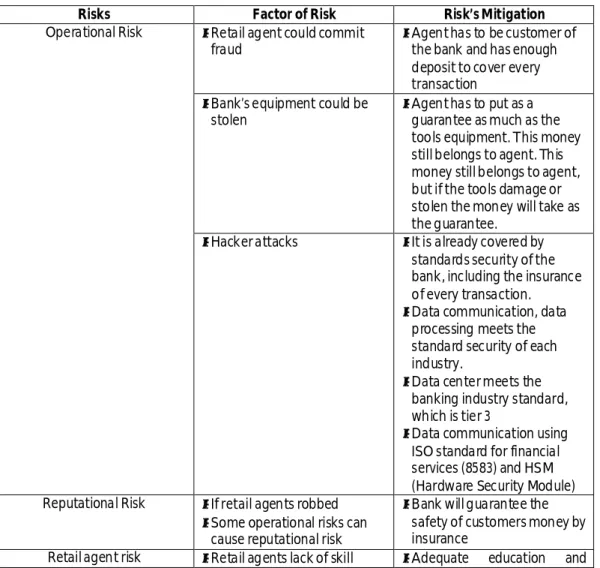
From a typical regulator’s perspective, entrusting retail customer contact to the types of retail agents used in both the bank-led and nonbank-led models would seem riskier than these same functions in the hands of bank tellers in a conventional bank branch. To prevent the risk, the parties that implement branchless banking should mitigate the risk of it. This is the mitigation of risks gets by the interview to PT Cyberport:
Operational Risk Retail agent could commit fraud
Agent has to be customer of the bank and has enough deposit to cover every transaction
Bank’s equipment could be stolen
Agent has to put as a guarantee as much as the tools equipment. This money still belongs to agent. This money still belongs to agent, but if the tools damage or stolen the money will take as the guarantee.
Hacker attacks It is already covered by standards security of the bank, including the insurance of every transaction.
Data communication, data processing meets the standard security of each industry.
Data center meets the banking industry standard, which is tier 3
Data communication using ISO standard for financial services (8583) and HSM (Hardware Security Module) Reputational Risk If retail agents robbed
Some operational risks can cause reputational risk
Bank will guarantee the safety of customers money by insurance
Retail agent risk Retail agents lack of skill Adequate education and Result of Risk and Mitigation in Branchless Banking
Risks Factor of Risk Risk’s Mitigation
• • • • • • • • • • • • • •
hands on training
Standard of retail agent, have to have SIUP or a part of government structure such as village hall
Legal Risk
Compliance to Regulation Have to ensure that the procedure compliance with the regulation
Based on the theory from Osterwalder and Pigneur (2010), a business model is like a blueprint for a strategy to be implemented through organizational structures, processes, and systems. The business model below will show how branchless banking works to creates, delivers, and captures value. The picture below will show the business model canvas for bank in Depok
• • • • • • • • • • • • • • • • • • • • • • • • • • • • • • • • • • • • • • • • • • •
Business Model Canvas Analysis
Key Partners Key Activities
K ey Resources
Value Proposition Customer Relationship
C hannel
Custo mer segment
Cost Structure Revenue Stream
Figure 4 Telco company P rivate company/ enabler Government Investor Retail agent Machine supplier Card supplier Having platform Building ecosystem Card management Solve market problems by simplify banking process S imple Banking Service Affordable F ast F lexible S ecure R eliable EDC Machine Partnership Software developers Business architecture Investment USSD Platform Personal assistance (agent) Communities (middle-low class societies) Cooperation Shop Bank officer Middle-low class society Communities (ojeg driver, gathering, SME, cooperation, student, labor) Card ED C machine Agent incentive P rinted paper Connectivity (USS D) Insurance
P latform (hardware, software, infrastructure) Officer
Fee based income (from transaction)
ojeg
Based on the questionnaire result, the service product that really wanted by the society is they can save money in bank. The second is, they can transfer their money, and the third is to do payment, and the fourth is to get loan from bank. It means that bank should provide those four-service products through branchless banking to middle-low class society in Depok.
For now the implementers of branchless banking already set the transaction price, which is the cutting cost of each transaction is Rp 4.000,00. This price is cheaper than the cutting cost in ATM which is Rp 5.000,00.
.
The place of branchless banking in Depok should be in middle-low class society area such as the residential of middle-low class society, school, market, terminals, headquarters of driver, cooperation, and other place that usually many people do their activities there,
In this sub-chapter, author will discuss about baranchless banking as a form of service innovation. Based on the theory of service innovation by Miles (1993), branchless banking is a form of innovation in service, where there is a development and improvement of service product. Nowadays, most of banking service enjoyed by people who can afford it. Middle-low class society and people who live in rural area are often not reach by banks. By the development of new service innovation, branchless banking is creates to become affordable for ubanked people. Based on the theory of TEKES (2006) , branchless banking can be classified as one example of the new channel for customers interaction, distribution system, and concept of technology.
If we see from the sample of respondent in Depok, it can be known that the demand of basic financial services from bank are high, especially for saving and payment services. Saving account is very good to bank and goverment because by money from middle-low class societies, both of those parties can get low-cost funds as an economic driver, in compare between the funds from deposits. Besides that, payment can increase the margin that can be get by bank, private sector, and Telco. In fact, behind the high demand and benefits of banking services, most of the respondents that represents Depok societies are not having bank account. people whom not having bank account is think that to do transaction in bank, they need a lot of time to spend. The way and requirement to open bank account is also not easy for them. Thus sample research represents a characteristic of societies in one area. Besides Depok, there are a lot of areas that have different characteritics of various needs such as Depok.
In order to meet the demand of banking services in middle-low class societies, service innovation in branchless banking will bring bank to reach the untapped market. Even branchless banking is already exist before, there is no banking services that spesifically targetted the middle-low class society or people who live in rural area. Most of branchless banking before, are for personal banking or not efficient because it need a lot of costs. One of the example is branchless banking that using car to come to customer’s place. It needs a lot of investment to open a branchless banking like that. Bank need more flexible and reliable technology to be able to meet the demand. GPRS that ever been used is not reliable because it cannot reach the rural area in Indonesia.
By the development of existing technology such as USSD and electronic data capture, bank sinergize with Telco Company and private sector, so they can create reliable technology to reach unbanked society. Firstly USSD is already used for internal in PT Telkomsel. Apparantly USSD can Marketing Mix Analysis
Product:
Price:
Promotion:
Place:
Analysis of Service Innovation
•
•
•
•
The existing promotion of branchless banking is using direct marketing to reach its target market branchless banking should promote itself through communities in middle-low class society. By using promotion through communities, branchless banking will be easier to communicate with its customers and understand their different needs.
bumdes
be use as connectivity because it has wide coverage, even to the remote area in Indonesia. The second is electronic data capture. Now, electronic data capture characteristic is passive because it can be use only for purchasing. By the devlopment on technology, electronic data capture can turns into an active technology which becomes a mobile mini ATM machine. It has many features and flexible, so bank can use it to open a new branchless banking in an area by using these machine with minimum cost.
The new improvement and development of branchless banking through service innovation can answer the demand of middle-low class societies towards banking. Banking services can be felt by untapped societies with the different value propositions, which are simple, affordable, fast, flexible, secure, and reliable.
Respondent perception in Depok towards banking is bank is secure. Respondents have trust on bank security. They believe that bank can save their money from theft and disaster. The lowest perception of Depok society is they need a lot of time to go to bank, and the flexibility of working hours in bank is low.
Respondent expectation towards banking is they hope that bank can become more secure to save money. The lowest expectation in Depok towards banking is for the indicator of respondent need less time to go to bank.
From the analysis in previous chapter, it can be conclude that each party in branchless banking implementation, which represent by Telkomsel from Telco industry, Bank BJB from banking industry, and PT Cyberport from private sector are doing synergize to implement branchless banking
Branchless banking in Indonesia is led-by bank. There are two aspects of suitable model of branchless banking in Indonesia, which are from technology and regulation.
Technology: Technology in branchless banking is using mobile mini ATM, provided by PT Cyberport and PT Telkomsel. The specifications of branchless banking technology are: USSD network based, centralized mobile application, flexible, and secure.
Regulations: there are two regulation in branchless banking that are provided by Bank BJB and PT Cyberport, which are through retail agent, such as cooperation, , shops, and village hall. The second method is, branchless banking by bank officer who comes to customer place. This method is already run by bank BJB in some area. Each of agent and officer, and also the customers have to following authentication step to avoid fraud.
There are some risks in branchless banking. Those risks are related to operational risk, reputational risk, retail agent risk, and legal risk. It can be reduce by mitigation of risks through regulation and technology.
From this research, there are several recommendations from the author that might help the improvement of branchless banking implementation in Indonesia:
In the future, there should be more parties that involve in branchless banking. More bank, Telco, and private sectors that involve can form a strong synergize in branchless banking implementation.
Bank should convince society to believe that the new channel in banking, which is branchless banking, can work very well and give much benefit for them. Some of people are doubt that branchless banking can be trusted as the usual bank branch.
Conclusion Recommendation
•
•
•
•
•
•
Ø Øojeg
Manajemen Inovasi: Peluang Sukses Principle of Marketing, 14thEdition.
Psychometric Methods
Business Model Generation.
Use of Agents in Branchless Banking for the Poor: Rewards, Risks, and Regulations
Designing Collaboration,
Financial Services Through Branchless Banking, Metode Penelitian Administrasi.
Branchless Banking Platfform
Branchless banking implementers should conduct the similar research on the different area. Depok represent middle-low class society in the urban area, but for the other area, especially in rural area of Indonesia, will show the different needs towards banking.
Based on the questionnaire results and marketing mix analysis, bank should make different approach to different communities in middle-low class society. Those approaches are: : For the price, there should be different approach to different segment. The example is transaction cost for students. Based on questionnaire result, it can be known that all of students’ incomes are lower than Rp 1,000,000,00. Besides that, most of students’ incomes are daily income. If students save his/her money in amount of Rp 10.000,00 in bank, bank will cut for administration price about a half from the amount of his/her money. The balance in the bank will be dropped if the interest from bank is much lower than administration cost. Bank should lower the transaction price for students.
There should be a differentiation approach of features for different communities. The features have to be adjusted with each of community needs. For example is the community of driver. The feature that can be made is payment for motorcycle credit. Feature for merchant is loan to expand their business and for transfer money, or feature for housewife is credit of basic household furniture (refrigerator, bed).
Bank should simplify the process of transaction through branchless banking. Small medium entrepreneur often feel difficult to get loan from bank to expand their business. By cooperate with cooperation; bank should simplify the process of capital lending to middle-low class society.
Researcher suggest bank to use business model canvas that have been provided in previous chapter. Business model canvas that already provided by researcher is a basic model of branchless banking. Bank and the other parties who involve should make improvement of branchless banking business model canvas by do research in the different area, and improve the quality of questionnaire.
Telco, private company, and bank should keep innovate and update the technology and procedure of branchless banking. The rapid innovation development in this era make all parties have to be ready to all of the changes that will come in the future.
For further research, in order to get the valid data, there should be more respondents for the research. Another way to increase the data validity is by improve the questions of the research. Researcher should also increase the number of the respondents to get the valid data
Andrew, W. 2009. Thesis of Mobile Banking in Developing Countries (a case study on Kenya). Badan Pusat Statistik, retrieved on August 27th2014 of http://www.bps.go.id/
Dhewanto, W; Hendrarti, D.M; Anggraeni, P; Grisna, A.I.A. 2014.
Kotler, P and Garry, A. 2012. Boston: Pearson Education
Nia Riyani. 2007. Skripsi Analisis Harapan dan Persepsi Pelanggan terhadap Kualitas Kartu Indosat Multimedia Mobile (IM3) pada Mahasiswa Fakultas Ekonomi dan Fakultas Hukum USU
Nunnaly, J. 1967. . New York: Mc-Graw-Hill.
Ostelwalder, A and Yves, P. 2010. New Jersey: John Wiley & Sons, Inc R.L, Timothy; Gautam, I; Stefan, S, October 2006,
Salonen,E, 2012, retrieved on August, 27th2014 of
http://www.designingcollaboration.com/Essi_Salonen_DesigningCollaboration.pdf
Setyadi, M,B. 2014 Margonda, Depok
Sugiyono (2001), Bandung: Penerbit Alfabeta.
Wangsadibrata, S. 2014. . Atlantica Building 2ndFloor, Jl. Kuningan Barat No.7, Jakarta.