E-Commerce Implementation in Australia: a Case Study
Approach
Caroline Chan
School of Management Information Systems Deakin University, Burwood, Victoria 3125, Australia
Phone: +61-3-9244 6565 Fax: +61-3-9244 6928 Email: [email protected]
Paula M. C. Swatman
School of Business Information Technology, RMIT University GPO Box 2476V, Melbourne, Victoria 3001
Phone: +61-3-9925 1355 Fax: +61-3-9925 5850 Email: [email protected]
Abstract
Despite the popularity of E-commerce technologies and applications, very few studies have attempted to examine in depth the factors which underpin the adoption process and the impact which the adoption of one innovation may have on subsequent E-commerce implementations within a single organisation. The study upon which this paper is based approaches the adoption of E-commerce technologies and applications from the perspectives of technological diffusion and change management, with a view to understanding the implications of implementing major E-commerce innovations.
In this paper we develop a conceptual understanding of the implementation process on the basis of the literature and previous empirical research into E-commerce related implementations such as EDI. We then make use of a model to guide the qualitative data collection process in a single company which has a history of mature implementation of E-commerce and present a qualitative analysis of these data using a chronological format from the first implementation of the company's E-commerce application in 1988 up to its most recent developments. The analysis shows that business and trading partner relationships play a crucial role in the implementation process; and that technology or media hype is recognised as a new driving force for E-commerce implementation. These results provide a useful insight into the real E-commerce implementation process. Business issues as well as technology hype, which were not predicted during the conceptualisation process in this study, appear to be very important in real world E-commerce implementation.
Introduction
Wigand (1997) defines E-commerce as denoting: "the seamless application of information and communication technology from its point of origin to its endpoint along the entire value chain of business processes conducted electronically and designed to enable the
accomplishment of a business goal. These processes may be partial or complete and may encompass business-to-business as well as business-to-consumer and consumer-to-business transactions” (p. 5).
There are four basic types of E-commerce relationship:
1. Business to Business E-commerce (B2B E-commerce) – this relationship includes the primarily supply chain-related activities which include electronic data interchange (EDI), electronic payment systems (EPS) and data sharing activities.
2. Business to Consumer E-commerce (B2C E-commerce); - this relationship includes the primarily Internet-related direct selling and marketing activities which occur between
companies and their customers, including online retailing, internet banking, and pre and post-sales support activities.
3. Administration to Business (A2B E-commerce) – this relationship presently includes either the provision of information or, at best, procurement-related activities between business and government, although both government and business are working towards the provision of many existing government/business activities online.
4. Administration to Citizen (A2C E-commerce) – this relationship presently includes either the provision of information to citizens or, at best, the provision of simple electronic services such as downloading forms electronically. As with A2B E-commerce, however, there is interest from both government and citizen groups in improving the quantity and sophistication of the services offered via the Internet.
While all four of these E-commerce types are of importance to the growth of the information economy, this paper focuses on the first type of commerce implementation: B2B E-commerce alone.
In previous work (Chan and Swatman 1998) we suggested that a better understanding of what happens during the implementation process would lead to better handling of the implementation and thus improve the likelihood of success of subsequent implementations. Understanding the implementation process is not an easy task, due to the dynamic and turbulent environment in which organisations must function, yet it is clear that those organisation which learn from their past experiences will gain a head-start in such an environment. In this paper we describe our investigation of the experiences of a major Australian organisation with a mature history of E-commerce implementation, with a view to developing a model which can be used to assist other, less advanced E-commerce using businesses. It is important to note that this project was part of a long-term project designed to understand the behavior of E-commerce implementation in Australia.
Background
In most organisations, information systems are used to provide cost savings (Meier 1992) by allowing the company to reduce inventory, streamline business processes and operations, integrate billing and payments systems into supply chain management, and improve customer service (Bolisani and Scarso 1998). The business functions supported by E-commerce technologies and applications are extremely varied and include manufacturing/production, sales and marketing, finance and accounting. In many organisations, however, implementing E-commerce requires management and staff to deal with quite new technologies and applications, and it even has to demonstrate the benefits gained by the implementation. In many cases, a whole range of technological, management and environmental issues arise during the implementation, which management needs to be aware of so that it can better address them.
The earliest “E-commerce” implementations in Australia, during the 1970s, involved the sharing of databases between suppliers and their customers. The next stage of development involved electronic trading initiatives, such as Electronic Data Interchange (EDI) – which was, until recently, the backbone of B2B E-commerce. EDI was introduced into Australia in 1986/87 with two major initiatives – the Coles-Myer K-Mart implementation and the automotive industry’s larger-scale scheme linking all four auto manufacturers with many of their suppliers. Other large companies, including BHP Steel, APM, the Australian Customs Service (ACS) and the Australian Quarantine and Inspection Service (AQIS) developed major EDI initiatives during the later 1980s. In 1988, the Electronic Data Interchange Council of Australia (EDICA) was formed as a peak user organisation to facilitate the implementation of EDI. EDI’s benefits for larger companies, particularly in terms of its ability to enhance their systems integration have been recognised for some time (Swatman 1993), but these benefits have not been so evident to smaller companies (Ferguson et al. 1990; Scala and McGrath 1993; Parker and Swatman 1997). In the last few years, the Internet
has provided an alternative medium for electronic exchange at a much cheaper cost EDI over the Internet. Although business-to-business Internet-based E-commerce such as Web based EDI is still comparatively new in Australia, a number of companies are starting to investigate the opportunities it provides.
The process of implementing a technical innovation is an area of active academic investigation, although up until now, little attention has been paid to the process of E-commerce implementation. Two major academic theories provide a jumping-off point for such an investigation – the theories of diffusion of innovation and change process theory. Diffusion of innovation theory is concerned with the characteristics of the technology or application, and change theory emphasises various stages occurring during the implementation. Both of these theories have been widely used to describe the implementation process. In earlier work (Chan and Swatman 1998), we summarised these approaches and suggested an integrated approach of literature and case studies to develop a more realistic model of implementation.
The factors driving and inhibiting the adoption of technology are also popular subjects for research. A number of researchers (see, Land, Quesne, Wijegunaratne 1992, Cragg and King 1993, Doukidis and Fragopoulou 1994, Howells and Wood 1995) have been concerned with the early stage (initiation) of the implementation: adoption. While these research studies unquestionably enrich the knowledge of why organisations choose to accept or reject an adoption of technology, we believe it is equally important to understand how organisations deal with the problems and issues which arise during such an implementation.
The Research model
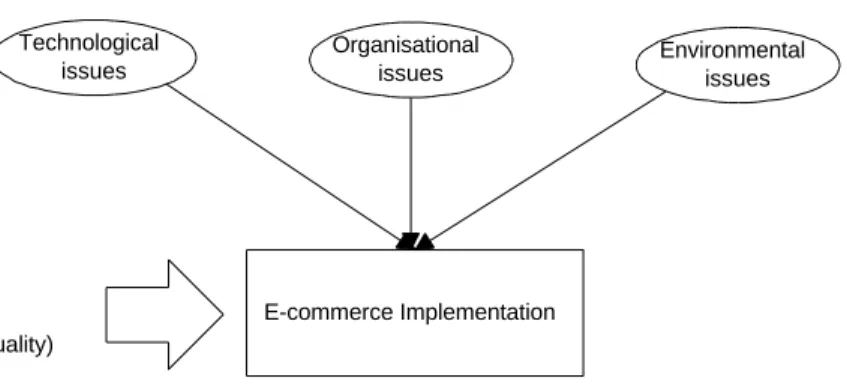
The research model developed in this study integrates change process theories with existing empirical research into IT/IS implementation. The conceptual model was kept simple in order to allow us to refine it during our empirical investigation:
Figure 1. Conceptual model
During the early days of E-commerce development (particularly in the case of EDI implementation), larger companies tended to pressure their smaller trading partners into adopting the technology – the so-called “EDI or die” approach. Doukidis and Fragopoulou (1994) found that, in such situations of forced adoption, smaller trading partners had no alternative to adopting the technology. Iacovou et al (1995) believed that this response was inevitable within a business environment –competitive pressure and imposition by trading partners were the dominant influence in EDI adoption for smaller companies.
There are, of course, real benefits (both direct and indirect) to be obtained from the introduction of EDI, as Pfeiffer (1992) and Iacovou et al (1995) point out. While not all of
E-commerce Implementation Driving Forces
-Customers request -Benefits (time, cost, quality)
Technological
issues Environmental issues Organisational
the benefits have been achieved, this factor has succeeded in encouraging some companies to adopt these technologies. Nonetheless, the major benefits have tended to be gained by the larger, “hub” companies involved in EDI implementations, such as supermarkets or manufacturers.
During our earlier investigation of implications of E-commerce implementation (Chan and Swatman 1998) we found that when a company has adopted a technology or application, three factors - technological, organisational and environmental - generally affect the process of the implementation. Technology-related factors are associated with the characteristics of the technology/application itself, including complexity, compatibility and relative advantage. Organisational factors are primarily concerned with the people involved in the implementation in organisations and affect such issues as management support, user resistance and the level of expertise available. Environmental factors focus on the environmental context of the organisation and include such factors as supplier-customer relationships and competitive pressure.
Methodology
There are a number of limitations for researchers to address the E-commerce implementation problems:
• While E-commerce is unquestionably a type of IS, there are specific problems and issues which would not generally arise in the wider information systems implementation such as inter organisational or trading partner issues.
• Where a number of factors that influence IS implementation success have been identified, the majority of studies use quantitative methods, such as surveys, to identify these factors. Although this approach provides a broader coverage and offers the benefits of generalisation, it also limits our understanding of what actually happened and how to overcome those problems which did arise.
In attempting to address these issues, we decided to make use of a three-stage approach to develop a more realistic implementation process model:
1. Firstly, we made extensive use of existing literature to develop the conceptual model: In this study, we develop the concept of the implementation process from the change management and innovation diffusion literature. Based on this, we have developed the simple model of the implementation process which is shown in figure 1.
2. Next we undertook an intensive case study of a single organisation to refine the conceptual model. This in-depth understanding of the problem enriches our model and provides us with insight into the E-commerce implementation process in greater detail. To provide the greatest depth of insight for our case study, we selected an organisation with extensive experience in E-commerce implementation - BHP Steel.
3. The final stage of our implementation process model involves the refinement of our preliminary model and the development of a more complex, insightful model which will incorporate a more realistic view of the E-commerce implementation process. This stage will be based on a comparative evaluation of the experiences of another 20 companies (currently underway) which have implemented E-commerce of various sorts, to provide additional depth and richness to the model, which has emerged from the BHP Steel case study. We will test the results of this model during a survey of Australian companies to be undertaken at the end of 1999.
There are at least two advantages to be gained from using this three-stage approach and a survey:
• Longitudinal: Conducted over a period of 8 years covering two separate pieces of work, this study provides an observation over a long period of the implementation process conducted in a single Australian organisation.
• Intensive case studies and survey: The use of an intensive case study in the early stage of the overall study provided an in-depth understanding of issues arising during the implementation process, which is a useful approach to better understand the processes of change (Kaplan 1991). This understanding will also lead to a better design of the next step of the research - comparative case studies and survey.
Case study discussion
BHP Steel is one of Australia’s largest companies with significant international interests in steel, minerals, copper and petroleum. It also has major associated interests in services companies such as engineering, transport, and Information Technology. Established in 1885 at Broken Hill in New South Wales, Australia, BHP is a public company, employing over 60,000 people and operating in more than 60 countries, BHP Steel is one of BHP’s major businesses. It is a steel manufacturer which produces a wide variety of steel products such as steel slabs, steel plate, rolled steel and pre-painted steel. It has annual sales amounting to A$7.6 billion (BHP Steel 1997) and depends on trading relationship with more than 2500 suppliers as well as more than 8000 customers, which vary from small to large companies. The use of information technology in BHP is not “new”_ computers and their applications have been important to BHP Steel since the early 1970s in a number of departments. In general, however, these computer applications were being used within departments such as marketing, which only shared the information with key customers.
The use of computers for business transactions or E-commerce with appropriate standardised documents, which we know as EDI, began for BHP Steel at the end of the 1980s when the company realised that electronic trading could provide it with a more efficient and productive way of trading.
E-commerce implementation in BHP Steel can be divided into four major phases that have been and are being undertaken in the company:
• Early implementation - E-commerce implementation 1: This was the first implementation of electronic trading in BHP Steel, starting around 1988 and ending in 1992, when this project was merged with the integrated EDI project electronic trading gateway (ETG). The system used in this implementation was a PC-based purchasing system with built-in EDI capabilities, allowing the company to send/receive business documents to/from trading partners (suppliers). This was one of the first EDI implementations in Australia, and at its inception BHP Steel had to experiment in many of the design aspects of the system.
• Electronic Trading Gateway (ETG)-E-commerce implementation 2: This was the biggest E-commerce project undertaken by BHP Steel in terms of effort and resources and involved an attempt by BHP Steel to centralise and integrate all aspects of their supply of steel by means of an electronic gateway. It commenced in 1990 when the initial project had already been underway for some three years. Officially, this project was finalised at the end of 1994, but the diffusion and expansion of this project is still going on with new applications documents, and business units as well as trading partners being added constantly.
• Bar-coding project-E-commerce implementation 3: An extensive study undertaken in
1993 led to a realisation of the benefits that could be achieved from the integration of EDI and bar-coding applications. This study resulted in the bar-coding project, which was a company-wide project, commencing in 1994 and finalised in 1997 with the production of a general implementation guide for the company. Up to date, the implementation of bar-coding was continuing to spread to other divisions and business units.
• Internet-related implementation-E-commerce implementation 4; began in 1996, when the rapid growth of Internet Commerce began to affect even the resources sector of the economy. BHP Steel is focusing this delivery mechanism on its smaller trading partners, who find the technical and intellectual infrastructure required for traditional EDI beyond
their means. A strategy for this new wave of E-commerce was developed and several business applications have already been made available. A pilot trial of Internet-based transaction has already been undertaken and the implementation continues to grow. Other simpler web-based applications have also been implemented such as Test certificate delivery and order status information.
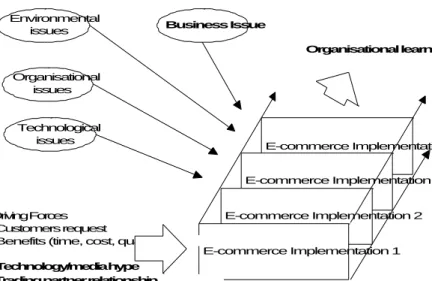
Mapping what we have learned from the literature and what happened in the case study, we discovered that the implementation of E-commerce in this organisation was anything but a simple process. We assumed in our previous model that the implementation is a one straightforward implementation steadily develops into a mature concept. However, we found that until 1999, BHP Steel had been involved in four different E-commerce implementations, each driven by different forces. Further, during the process of these implementations, a range of issues appeared to reshape the implementation process. The diagram below shows the four E-commerce implementations in the company:
Figure 2. BHP Steel E-commerce implementation
Benefits to be gained from E-commerce implementation has always been the main factor driving the implementation in BHP Steel. The company has taken an innovative approach and become the first mover in the early implementation of bar coding and automated data capture (Osianlis 1995), as well as EDI implementation. Although they have achieved significant benefits from the implementation – such as reduced order cycle times, reduced clerical errors and reduced inventory, the company has also invested a lot of money, time and effort into this process.
The Electronic Trading Gateway (ETG) implementation, BHP Steel’s major EDI-based E-commerce project, was started in 1990 when companies in the US were busy discussing EDI and the benefits it could bring. One of its customers (the major automotive manufacturer, Ford) became very involved in EDI implementation and BHP wanted to be the supplier that was “easy to trade with”. The same phenomenon occurred again when the Internet “bubble” appeared to offer high transaction volumes at very low prices. Although EDI has never fulfilled its potential, current business activity suggests that Internet Commerce may well be more successful.
The publicity surrounding EDI in 1990 and the Internet in 1996 played an important part in bringing about the various BHP Steel E-commerce implementations. In 1990, it was argued in both the academic and business literature that EDI would take the world by storm and would provide enormous benefits in all industry sectors (Meier 1992). These claims proved to be somewhat exaggerated, but led to the uptake of EDI in a number of industry sectors,
E-commerce Implementation 4 E-commerce Implementation 3 E-commerce Implementation 2 E-commerce Implementation 1 Driving Forces -Customers request
-Benefits (time, cost, quality) -Technology/media hype -Trading partner relationship
Technological issues Environmental issues Organisational issues Business Issue Organisational learning
including automotive and retail. In 1995, similar claims began to be advanced for Internet Commerce or E-commerce over the Internet (Horback 1995). BHP Steel as one of main players in the Steel industry was affected by this climate of enthusiasm for the new technology.
A driving force that came up again and again during interviews with BHP Steel staff is the value of trading partner relationships. The company has committed for long term relationships with its trading partners, believing that these relationships (particularly in the case of key customers) are crucial to the company’s long-term success. Previous research (Cox and Ghoneim 1996) has also confirmed that in manufacturing industry, this factor has been one of the drivers in the implementation of EDI in Britain.
Driven by a combination of the factors described above, BHP steel has engaged in four separate E-commerce initiatives: implementations 1-to-4 as described in figure 2 above. A few points should be noted from the simplified figure 2:
• We separated the implementation into four phases in this diagram to simplify what was actually a rather complex process. In the real implementation, of course, there was no absolute separation of the four phases, but rather a continuous flow from one initiative to the next. It is only for such administration purposes as budgeting, that each initiative is differentiated.
• Each of the implementations consisted of a number of phases, from initiation to the integration of the applications, which are not described specifically in this paper.
• Organisational learning (Senge 1990) is a term used to describe the learning process of the organisation from one implementation to the next implementation and should be seen as a cyclical relationship between implementations.
All E-commerce implementation in the BHP Steel has in some manner been influenced by issues identified in the literature: technological, organisational/management, and environmental. In addition to these, business issues have also played an important role in the implementation process by costing the company significant amount of money to maintain these systems.
We summarise these issues into four categories:
1. Technological issues
• Lack of technical knowledge: Although this issue has been a concern for small and medium enterprises (MacGregor et.al. 1996), BHP Steel as a big company has also been affected. As the first mover of E-commerce implementation, this issue occurred in the early implementation initiatives. A brilliant idea to have an electronic trading network was not enough to make it happen. In the early implementation (around 1987), there were not many organisations had this idea and even if they had, they would have seen other companies as competitors therefore they would not have shared their knowledge. This time was considered to be at the “bleeding edge” of electronic trading. The lack of technical knowledge has made the staff to be directly involved in the electronic trading experimentation. A trial and error approach had been used to determine the right technology for them, which consume quite big amount of effort to achieve the objective. The hard work put in by the staff has resolved this problem and BHP steel has gained valuable knowledge from this early implementation as well as significant advantage from the “first mover” effect.
• Complexity and compatibility (technology and process): the very nature of
E-commerce, which works by linking multiple organisations, tends to lead to complexity of both technology and process. Although technological complexity can be minimized if there is commitment and willingness to work together with trading partners to solve problems as they arise, complex processes can cause an implementation to falter. In E-commerce implementations, issues such as cultural differences and the problems of
integrating systems belonging to very different organisations should be carefully considered. BHP Steel had a success story with the APEC international electronic trading project with New Zealand, yet a similar pilot project which involved electronic trading with Japan and the U.S. did not deliver the same result.
• Standards immaturity issue: Standard immaturity has always been an important issue in the B2B E-commerce. It has been one of the major obstacles to EDI uptake, both within Australia and globally, with a particular issue being industry sector variations in optional data elements. BHP Steel was able to resolve this issue by taking an active role in the development of “Industry guidelines” for the steel industry, which define the “sub-set” of optional data elements to be used for each document, working with the EDI Council of Australia (EDICA) and other industry and government bodies. In the ETG implementation, BHP Steel commenced the implementation by using the U.S. ANSI X12 standards, which were then the most widely used, but supported the international UN/EDIFACT standards. As the implementation growing they gradually migrated to the UN/EDIFACT standards as their level of acceptance and usability increased. The same issue of the standard immaturity has been arising again this day. Issues associated with the immaturity of the standards used for Internet transactions and the readiness of third parties to handle the implementation are become a concern in the Internet based applications such as web-based EDI.
• Operational and technical issues: Although these issues can always be resolved, they also played a role in making this one of the most complex E-commerce implementations ever attempted in Australia (see Swatman 1993 for more detail on this implementation). Examples of these issues in EDI implementation including response times for EDI documents, availability of the Gateway, trading partner agreements, legal aspects of EDI, connection to third party networks, audit trails and archives and connection to overseas customers. In bar-coding implementation a number of technical issues (such as labeling of steel products in hot condition, the use of fixed bar-code readers on mobile equipment, and standard locations for labels to assist handling automation) arose during the implementation process. Business-related issues were largely confined to the cost of the technology (scanner and other equipment related costs) compared with the benefits to be obtained from their use. While all of these issues can not be avoided, the need to collaboratively work together with all parties involved is the key to resolve the problem. A good example for this is the experience that occurred during the implementation of the Steel Test Certificates, which are legally required documents with every sale of steel products. BHP Steel, realising that these documents could not be distributed via the Gateway until the underlying paper document had been standardised, actively promoted the development of standard, A4 document type, which lent itself to electronic transmission. Quite independently of the uptake of the Gateway, these certificates have proved immensely successful within the industry. Later on, this document are made available over the Internet (web-based application).
2. Organisational issues
• Commitment; Commitment has been identified in many information technology
implementations (Lucas 1986) as the major factor influencing the success of the implementation. In E-commerce implementation, too, the BHP Steel case shows that commitment can be identified as one of the significant factors contributing to the progress of the implementation. BHP Steel believed that without commitment it would be impossible to successfully conclude an implementation. As an example, the company’s first international pilot, the APEC international electronic trading project, was very successful. This pilot involved BHP Steel, its New Zealand partner Fletcher Steel, Customs authorities in both Australia and New Zealand, and the shipping agent Seatrans in both countries. This project has been identified as being a major catalyst for EDI within the New Zealand steel industry, as well as providing a boost for the
use of EDIFACT in the Australasian region. The commitment of other steel suppliers in NZ was achieved through the establishment of a New Zealand EDI Association (NZEDIA) and a Steel Industry Working Group, which provides a local industry network of suppliers and customers focusing on EDI.
• Training and educational program; Training is part of the unfreezing stage (Lewin 1952) in the whole implementation program, where employees are introduced to a new system and encouraged to become involved in improving the system and process. During the ETG project, Electronic Commerce awareness sessions were conducted by the Steel Group and BHP IT, to promote the use of E-commerce solutions across BHP divisions. Later, when the use of the Internet and browser applications became available (1997), the company established an electronic commerce newsgroup to encourage an E-commerce environment and provide a place for the E-commerce discussion. Another example of the training and educational program conducted by EAN Australia in this company is the Bar-coding demonstration which consist of practical replica of real life supply chain, with an interactive model of a factory, a warehouse and a retail outlet.
3. Environmental issues
• Supplier vs. customer: As BHP Steel discovered during the ETG implementation,
however, good trading partner relationships could not overcome the disadvantage of being a supplier-implementor. While customers (particularly large customers) are in a strong position to encourage their suppliers, the reverse is not true. Even after developing customer-oriented applications and assisting customers with cost/benefit analyses and training, the uptake of the ETG continued to be disappointing. Being a major customer helped BHP Steel to achieve its goal by having 80 percent of its suppliers trade electronically in 18 months: early implementation. Being, in the next implementation, the supplier rather than the customer, BHP Steel found that market penetration of the ETG was more difficult than they had anticipated. Suppliers are far more likely to take up a new initiative than customers, who have no real requirement to participate. This barrier can be summarised as being related to initial set up cost, culture (or resistance to change), failure to understand the benefits (lack of knowledge) and inability to justify the cost-benefits of compliance with the ETG. Good relationships and trust that both parties will work together for the success of the implementation has also proven very important.
• Pro-active approach; Implementation of E-commerce systems is quite different from implementation of intra-organisational information technologies. The need to market the concept and persuade trading partners to get involved is critical. BHP Steel found that multiple approaches to trading partners were required before agreement was given to trade electronically. One of the managers involved said that BHP Steel had to knock on doors actively and chase their trading partners to become involved in implementation. Success in E-commerce implementation is dependent on other parties, so that without a proactive approach, it is quite impossible to get other parties involved. While a few other factors inhibiting the progress of the implementation, pro-active approach is actually act as catalyst to the implementation process.
4. Business issues
Business is always associated with making money and related to the return on investment. The following issues have been identified influencing the E-commerce implementation process in BHP Steel.
• Business value: Businesses are most concerned with the benefits that E-commerce can bring, what level of savings can be expected? In the case of BHP Steel’s early EDI implementation, most trading partners believed that EDI implementation would bring real benefits to their company and it did. ETG, on the other hand has been a huge investment for BHP Steel and the company also believed that the costs of the system
could be recovered in a few years time. However, this was not the case. The need to fully utilise the system by having more documents and applications processed is crucial to recover the cost. At the moment, the cost of transaction is still higher than the average rate of standard electronic document exchange. Increasing the number of applications and documents means trying to get more trading partners and units involved, and this is not an easy task. To resolve this issue, BHP Steel has involved its own business units and customers by providing a detailed cost-benefit analysis showing how they could gain significant business process advantages from the Gateway. In the case of Internet Commerce, the lower cost means that potential trading partners require a less detailed business case. Indeed, many smaller companies are attracted to BHP Steel’s latest E-commerce offering by its lower cost structure.
• Rapid changes in technology; The rate of change of the technologies and systems used in information systems applications, as well as the business needs which result from these changes, have forced organisations to modify their business practices and processes increasingly rapidly. The costs associated with technology change are very high and must be included in calculations of the benefits expected from the implementation of new systems (transaction costs saved, etc). BHP Steel has experienced this process of system change few times. For example, the company’s EDI system has changed three times since its first implementation; and BHP Steel is now considering engaging in significant modifications to the ETG system because of its inflexibility in handling document translations (with a new system, it is less expensive to incorporate new trading partners). The ETG system has to be changed or updated and this will cost a lot of money. On the other hand, this system has not yet been fully utilised and the cost savings originally anticipated have not been achieved. Thus a complex cost/benefits issues needs to be resolved.
Conclusion
Our in-depth study of BHP Steel (which has occurred in two quite separate pieces of research undertaken by two researchers over an eight-year period) has shown that the E-commerce implementation process is not as straightforward as it initially appeared and as the company would have hoped. There are many hurdles on the path to E-commerce implementation success. We found that while a few technological factors such as complexity, standard and lack of technical knowledge may negatively affect the implementation process, we discovered that commitment, educational program and pro-active approach for dealing with the company's position (supplier/customer) will be able to solve those issues. We also found that two other important factors should be concerned: the business value and rapid change of the technology. Depending on the type of project, factors mentioned vary in their intensity. For example, in the ETG project, all these factors were crucial to the success of the implementation, while for the bar-coding implementation business value, commitment, proactive approach and training/education played the major roles in the implementation. While many academic articles consistently used theory of change and innovation of diffusion to understand the implementation process, the result of this study indicate that these literature are really only two theories that have been widely used. Organisational learning and strategic system theories (Senge 1990, Agryris and Schon 1996, Porter 1980, 1985, Scott Morton 1991) have also played important roles in explaining the implementation process.
In the business environment, business value is considered the most important issue. In most cases, people determine the benefits of the implementation in terms of cost savings, frequently ignoring other benefits such as accuracy or speed. The need to show trading partners these benefits and translate them into dollar terms then becomes very important. In the case of the ETG, for example, BHP Steel is trying hard to win over trading partners by providing them with cost benefit analyses and support. The benefits of E-commerce implementation must be justified and if trading volume is not significant, it can be sufficiently difficult to justify the benefits so that the implementation may simply not occur
or it may make later implementations more difficult to “sell” to trading partners. Although it is generally accepted that trading partners, especially big customers, have good values, it has to be kept in mind that the E-commerce initiatives taken have to be fully justified.
BHP has learnt that E-commerce implementation is not easy. The company’s position as major customer and suppliers gave them quite different view in creating a successful electronic trading system. While the ETG implementation was a very expensive investment, this implementation did not have the same excitement as the initial electronic trading system. Perhaps because the commitment did not come equally from both parties to solve problems as they arose. In many ways, the ETG was an ideal system implementation BHP Steel involved staff at all levels of the organisation, planned carefully and thoroughly and made use of best practice in almost every aspect of the development. Despite this, customers did not rush to take advantage of the many benefits the system offered (and still offers to purchasers of steel products). It is not clear that vision, authority and drive are enough to achieve successful E-commerce implementation it also requires trading partners who are willing to reengineer their own organisations to take advantage of the opportunities available from such a complex, integrated approach to electronic trading. Although training and educational opportunities were provided throughout the implementation of BHP Steel’s E-commerce initiatives, the company found that it needed more than this. They realised that the active participation of everyone involved, as well as an understanding of others’ perceptions and expectations are equally important for the success of E-commerce implementation.
Overall, the experiences of this major, four-part E-commerce implementation has brought a new perspective to BHP Steel’s attitude to E-commerce. They realise that being the leader in the E-commerce implementation has cost them a lot of money and energy and that quite possible being the leader in the newest of new technology is not the best position for a company whose core business is the production of steel and steel products. It would be more satisfactory for them to work together with other companies interested in implementing the new technology. In the new E-commerce implementation, success will beIn the new E-commerce implementation, success will be
defined by the combined and collaborative efforts of companies with common
defined by the combined and collaborative efforts of companies with common
and complementary objectives
and complementary objectives
BHP Steel’s experience is, of course, unique. But there are many other large, primary sector organisations around the world, which have become involved in major E-commerce implementations. Indeed, many of BHP Steel’s experiences would be equally applicable to companies within the manufacturing sector (automotive manufacturers, for example, are both supplier and customer and would find much to learn from BHP Steel’s adventures). We believe that this study, which forms part of a larger research project investigating the implementation process for E-commerce, offers both insights and experience to researchers and practitioners in the field of E-commerce.
Acknowledgment
The authors are grateful to the assistance provided by many people from BHP Steel and BHP IT, without whom this paper could never have been written.
References
Agryris C. and Schon D.A. (1996). Organisational Learning 11. Reading, M.A.: Addison Wesley.
BHP Steel (1997). BHP Steel Company Report.
Bolisani and Scarso (1998). Knowledge Management and Electronic Commerce Applications: Aprilia's After-Sales Service System. 6th
European Conference on Information Systems.
Chan C. and Swatman P.M.C. (1998). EDI implementation: EDI Implementation: A Broader Perspective, Eleventh International Bled Electronic Commerce Conference, Slovenia.
Chan C. and Swatman P.M.C. (1999). B2B E-commerce Implementation: The Case of BHP Steel. To appear in the European Conference on Information System (ECIS) proceeding. Cox B. and Ghoneim S. (1996). Drivers and Barriers to Adopting EDI: A Sector Analysis Of UK Industry. European Journal of Information System, 5 (1), 24-33.
Cragg P. and King M. (1993). Small-Firm Computing: Motivators and Inhibitors. MIS Quarterly, 17(1), March.
Ferguson D.M., Hill N.C. and Hansen J.V. (1990) Electronic Data Interchange: Foundations and Survey Evidence on Current Use. Journal of Information Systems, 4(2), 81-91.
Horback R. (1995). Electronic Commerce in the 21st
Century. In Journal of System Management, May/June.
Iacovou C.L., et.al. (1995), Electronic Data Interchange and Small organizations: Adoption and Impact of Technology. MIS Quarterly, 19(4), 465-485.
Kalakota R. and Winston A.B. (1996). Frontiers of Electronic Commerce. Addison Wesley Publishing company.
Kaplan B. (1991). Models of Change and Information Systems Research in Contemporary Approaches and Emergent Traditions, H.E. Nissen, H.K.Klein, R.Hirschheim (Eds), IFIP. Kwon T.H. and Zmud R.W. (1987). Unifying the Fragmented Models of Information Systems Implementation. In Critical Issues In Information Systems Research (BOLAND R.J. and Hirschheim, R.A. Eds, John Willey & Sons Ltd, 227-251.
Lewin K. (1952). Group Decision and Social Change. In readings in Social Psychology, Newcomb and Hartey (eds), Holt (New York).
Lucas H.C. (1986). Information Systems Concepts for Management. McGraw Hill company. Meier J.J. (1992). EDI: A Practical Approach in CMA Magazine, September.
Osianlis T. (1995) Automatic Data Capture Integration and Application: the BHP Steel Experience, Monash University Department of Information Systems Honours thesis.
Parker C.M. and Swatman P.M.C. (1997) The Importance of EDI Education: a Survey of Australian SMEs, "CollECTeR'97" -- 1st Annual CollECTeR Workshop on Electronic Commerce, Adelaide, October 3rd, 78-94.
Pfeiffer H.K.C. (1992). The Diffusion of Electronic Data Interchange. Physica Verluc, Heidelberg.
Porter M.E. (1980). Competitive Strategy. The Free Press, New York. Porter M.E. (1985) Competitive Advantage. The Free Press, New York.
Scala S and McGrath Jr R. (1993) Advantages and Disadvantages of Electronic Data Interchange – an Industry Perspective. Information and Management 23(2), 85-91.
Scott Morton M.S. (1991). The Corporation of the 1990s: Information Technology and Organizational Transformation. Oxford University Press.
Senge P.M. (1990). The Fifth Discipline: The Art & Practice of The Learning Organisation. Random House Australia.
Swatman P.M.C. (1993). Integrating Electronic Data Interchange into existing organisational structure and internal application systems: the Australian Experience. PhD thesis, School of Computing, Curtin University of Technology, Australia.
Wigand, R. T. (1997). Electronic Commerce: Definition, Theory, and Context. The Information Society, 13, 1-16.
Williams L. (1994). Understanding Distribution channels: an interorganizational study of EDI Adoption. Journal of Business Logistics, 15(2).