UNIVERSIDAD POLITÉCNICA
DE MADRID
ESCUELA TÉCNICA SUPERIOR DE INGENIEROS INFORMÁTICOS
MÁSTER UNIVERSITARIO EN INGENIERÍA DEL SOFTWARE –
EUROPEAN MASTER IN SOFTWARE ENGINEERING
Study on Heuristic Usability Evaluation for Mobile
Applications
Master Thesis
Jorge Avilés Monroy
II This thesis is submitted to the ETSI Informáticos at Universidad Politécnica de Madrid in partial fulfillment of the requirements for the degree of Master of Science in Software Engineering.
Master Thesis
Master Universitario en Ingeniería del Software – European Master in Software Engineering Thesis Title: Study on Heuristic Usability Evaluation for Mobile Applications
Thesis no: EMSE-2015-08 July 2015
Author: Jorge Avilés Monroy
Information System Computer Engineering Escuela Superior Politécnica del Litoral – Ecuador
Supervisor:
Xavier Ferré Grau
Ph.D in Computer Science
Universidad Politécnica de Madrid
Lenguajes y Sistemas Informáticos e Ingeniería de Software Escuela Técnica Superior de Ingenieros Informáticos Universidad Politécnica de Madrid
ETSI Informáticos
Universidad Politécnica de Madrid Campus de Montegancedo, s/n 28660 Boadilla del Monte (Madrid) Spain
III Dedicated to people who changed my journey. It is possible to avoid failure, to always be safe. But that is also the route to a dull, uninteresting life ― Donald A. Norman. The Design of Everyday Things
IV
Acknowledgment
I cannot find words to express my gratitude to my thesis director Xavier, without his experience, understanding and patience this thesis would not have been possible. Since I became his student, his teachings inspired me to focus my way to this research area.
I would like to thank to my family for being my support especially to my wife for her encouragement and quiet patience, to my mother and father for being my strength, to my brother and sister for being my inspiration.
I would like to thank my Master classmate and friends with whom we shared good moments during this adventure.
This thesis would not have been possible without the participation of the different teams of developers, thanks for your contributions in the various activities of this study.
I owe my deepest gratitude to the government of Ecuador and SENECYT for the scholarship which enabled me to undertake an international Master program.
V
Abstract
Usability guidelines are a useful tool for the developers to improve interaction with systems. It includes knowledge of different disciplines related to usability and provides solutions and best practices to achieve the objectives of usability. Heuristic evaluation is one of the methods most widely used to evaluate and user interfaces.
The objective of this study is to enrich the process of heuristic evaluation with the design guidelines focusing it on the evaluation of applications for mobile devices. As well as generate a homogeneous classification of guidelines content, in order to help that from design and development process, be included solutions and good practices provided by the guidelines.
In order to achieve the objectives of this work, it is provides a method for generating heuristics for mobile applications, with which four applications were evaluated, and a web tool has also been developed that allows access to the content of the guidelines using the homogeneous classification of guidelines content.
The results showed the ease and utility of performing heuristic evaluations using a set of heuristics focused on mobile applications.
VI
Table of Contents
1 Introduction ... 1 1.1 Motivation ... 1 1.2 Objectives ... 3 1.2.1 Specific Objectives ... 4 1.3 Document Structure ... 41.4 What is not contained in This Thesis ... 5
2 State of the Art ... 6
2.1 User-Centered Design and Usability ... 6
2.1.1 Definition of Usability ... 6
2.1.2 Process of User-Centered Design ... 6
2.2 Usability guidelines ... 8
2.3 Heuristic Evaluation ... 10
2.3.1 Usability heuristics for User Interface Design ... 10
2.4 Bibliographic research on Conceptual Frameworks for Designing Methods and Heuristics ... 12
2.4.1 How Applicable is Your Evaluation Methods – Really? ... 12
2.4.2 A Methodology to Establish Usability Heuristics ... 14
2.4.3 Evaluating a Methodology to Establish Usability Heuristics ... 16
2.4.4 Usability Heuristics for Touchscreen-based Mobile Devices ... 17
2.4.5 Heuristic Evaluation on Mobile Interfaces: A New Checklist ... 20
2.4.6 Conclusions of the bibliographic research ... 23
3 Study of Current Status of UX Practices for Mobile Applications ... 25
3.1 Methodology ... 25
3.2 Data Analysis ... 26
3.2.1 About the companies ... 26
3.2.2 About the processes and activities of usability ... 26
3.3 Conclusions ... 29
4 Redefining Usability Heuristics for Mobile Application ... 31
4.1 Introduction ... 31
4.2 Method ... 31
4.3 Results ... 32
4.3.1 Scoping the problem ... 32
VII
4.3.3 Description of the most important of the collected information (3) .. 33
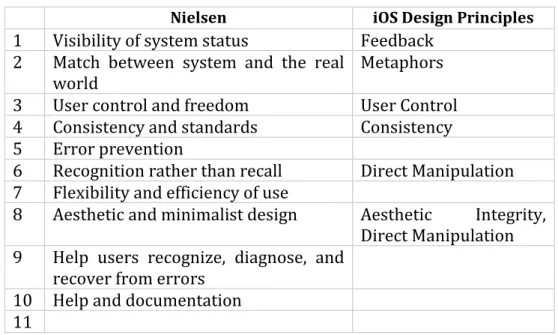
4.3.4 Correlation of the information collected with traditional heuristics . 38 4.3.5 Homogenization and formal definition of the heuristic (5) ... 40
4.3.6 Evaluation of heuristics ... 47
4.4 Study Design ... 48
4.4.1 Preparing Heuristic Evaluation ... 48
4.4.2 Conducting a Heuristic Evaluation... 52
4.4.3 Results of Heuristics Evaluations ... 54
4.4.4 Results of Post-evaluation Questionnaire ... 64
4.4.5 Discussion ... 66
5 Content Classification of Guidelines ... 68
5.1 Introduction ... 68
5.2 Method ... 68
5.2.1 Analysis and classification of categories of the guides ... 68
5.2.2 Definition of general categories ... 72
5.2.3 Unified Classification ... 73
5.3 Web Tool ... 78
5.3.1 Technology ... 78
5.3.2 Structure ... 78
5.4 Study Design ... 79
5.4.1 Usability Evaluation Methods ... 80
5.4.2 Longitudinal Study ... 80
5.5 Results ... 81
5.5.1 UX Measurement via Questionnaires ... 81
5.5.2 Analysis... 83
6 Discussion ... 84
6.1 Supporting Usability Heuristic Creation ... 84
6.2 Supporting Mobile Heuristic Evaluation ... 84
6.3 Guideline Content Classification ... 85
6.4 Integration in the design process ... 85
6.5 Limitations of the study ... 86
7 Conclusions and Future Work ... 87
7.1 Introduction ... 87
7.2 Conclusions ... 87
7.3 Future lines of research ... 88
VIII
9 ANNEXS ... 92
9.1 Result of the Survey on Usability and UX Practices in Mobile Applications Development ... 92
9.2 Individual Heuristic Evaluation - Instructions ... 112
9.3 Heuristic Evaluation Check List ... 114
9.4 Heuristic Evaluation - Record Sheet ... 118
9.5 Heuristic Evaluation Post-evaluation Questionnaire ... 120
9.6 Expert Evaluator Questionnaire ... 124
IX
List of Figures
Figure 1: Phases for the UCD process ... 7
Figure 2: Types of guidelines. ... 9
Figure 3 Two types of evaluation processes showing the evaluation ... 13
Figure 4: Final framework for classification of detected sub-heuristics. ... 22
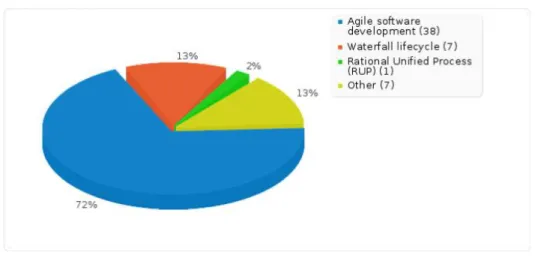
Figure 5 Please state the software development methodology or approach you follow in your organization ... 27
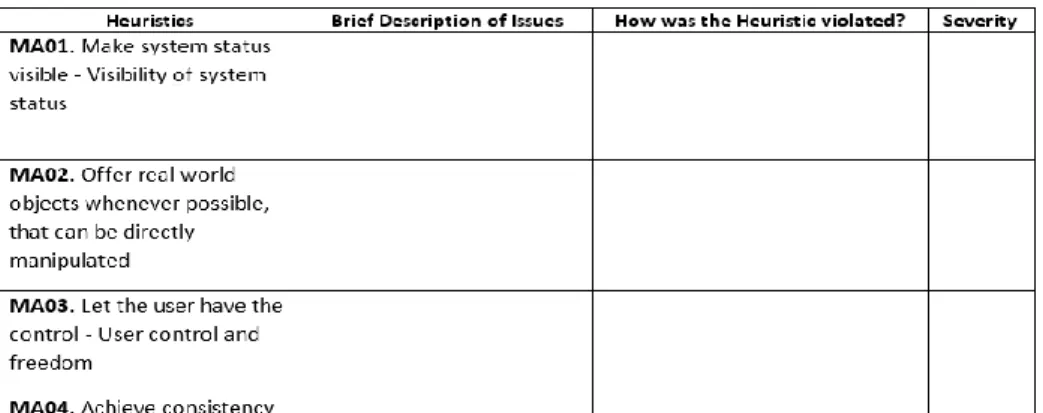
Figure 6: Extract of the Record Sheet Document ... 50
Figure 7: Extract of the Post-evaluation Questionnaire ... 50
Figure 8: Extract of Expert Evaluator Questionnaire... 51
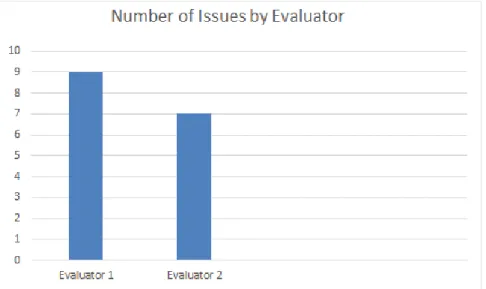
Figure 9: ETSIINF UPM - Usability issues by evaluator ... 55
Figure 10: ETSIINF UPM - Usability issues by Heuristic ... 56
Figure 11: ETSIINF UPM - Severity of usability issues by heuristic ... 57
Figure 12: ETSIINF UPM - Usability issues by severity ... 57
Figure 13: UPM Titulaciones - Usability issues by Heuristic ... 58
Figure 14: UPM Titulaciones - Severity of usability issues by heuristic ... 59
Figure 15: LAN PRAM - Usability issues by Heuristic ... 59
Figure 16: LAN PRAM - Severity of usability issues by heuristic ... 60
Figure 17: LAN PRAM - Usability issues by severity ... 61
Figure 18: Sport Ecuador - Usability issues by evaluator ... 62
Figure 19: Sport Ecuador - Usability issues by Heuristic ... 62
Figure 20: Sport Ecuador - Severity of usability issues by heuristic ... 63
Figure 21: Sport Ecuador - Usability issues by severity ... 64
Figure 22: Heuristic Evaluation, Post-evaluation questionnaire results ... 65
Figure 23 Unified Platform Guidelines, Sections ... 79
Figure 24 Item Sections ... 79
Figure 25 Do you know anything about the Android or iOS UI guidelines? ... 81
X
Table of Tables
Table 2.1: Methods for human-centred design ... 8
Table 2.2 Touchscreen-based mobile device heuristics ... 19
Table 3.1 How often the following usability activities are carried out in your organization? - [Usability inspection (by experts)] ... 27
Table 3.2 Please mark the methods used at least once in your organization in design-related activities ... 28
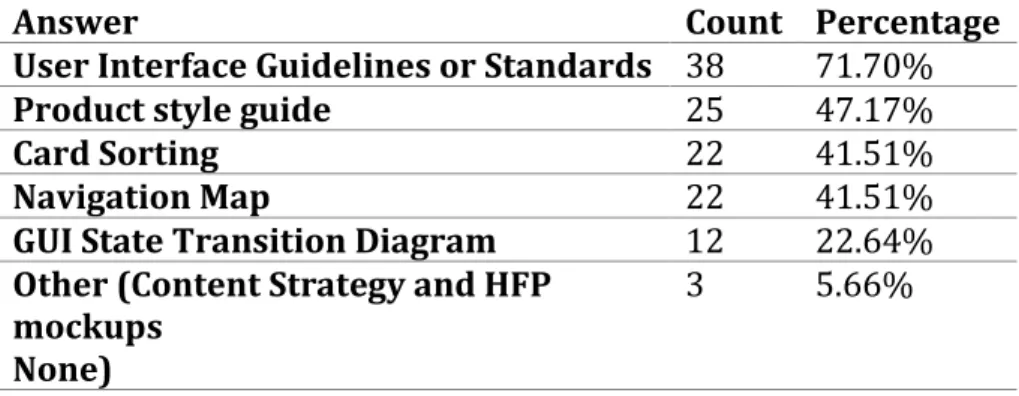
Table 3.3 Please mark the User Interface Guidelines used at least once in your organization ... 28
Table 3.4 Please mark the usability methods used at least once in your organization in evaluation-related activities ... 28
Table 3.5 Who was in charge of applying usability methods? ... 29
Table 4.1: Comparison between Nielsen Heuristics, Android Design Principle of User Experience and Design Principles for Android Developers and Designers. .... 33
Table 4.2: Comparison between Nielsen heuristics, iOS Design Principle and iOS Design Basics ... 36
Table 4.3: Nielsen vs Android Heuristics ... 39
Table 4.4: Nielsen Heuristics vs. iOS Design Principles ... 40
Table 4.5: Nielsen, Android and iOS Heuristics Correlation ... 41
Table 4.6: Heuristics for Evaluating Mobile Applications ... 42
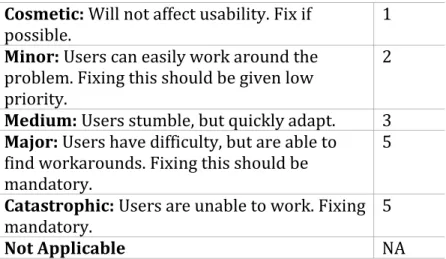
Table 4.7: Five-point rating scale for severity of usability ... 47
Table 4.8: Heuristic Evaluation Procedure ... 49
Table 4.9 : Information of mobile applications for heuristic evaluation ... 51
Table 4.10: Configuration of the heuristic evaluation of ETSIINF UPM ... 52
Table 4.11: Configuration of the heuristic evaluation of UPM Titulaciones ... 53
Table 4.12: Configuration of the heuristic evaluation of LAN PRAM ... 53
Table 4.13: Configuration of the heuristic evaluation of Sport Ecuador ... 54
Table 4.14: ETSIINF UPM - Usability issues by evaluator ... 55
Table 4.15: ETSIINF UPM - Ranking of usability issues by heuristic ... 56
Table 4.16: UPM Titulaciones - Ranking of usability issues by heuristic ... 58
Table 4.17: LAN PRAM - Ranking of usability issues by heuristic ... 60
Table 4.18: Sport Ecuador - Usability issues by evaluator ... 61
Table 4.19: Sport Ecuador - Ranking of usability issues by heuristic ... 63
Table 5.1 Android guideline, structure of the information... 70
Table 5.2 iOS guidelines, structure of the information ... 71
Table 5.3 Unified classification of the guidelines elements ... 73
Table 5.4 Unified classification of the UI elements ... 75
Table 5.5 SUS Results for Web Tool ... 82
1
1
Introduction
1.1 Motivation
At the end of 2014 half of the world population had at least one mobile subscription, a total of 3.6 billion of unique mobile subscriptions, is expected that by 2020 three-fifths of the world population have a mobile subscription, a total of 4.6 billion unique subscriptions, these data are provided by GSMA at the Mobile World Congress 2015 (GSMA, 2015). According to the report, the growth of improvements in digital coverage reflects the acceleration in the rate of adoption in the use of smartphone, this rate reaches 60% of connections in the developed world, 51% Europe, and 70% in North America and market is expected to reach by the next four years a ceiling of 70-80%. The terminals calculated by the end of 2014 reached 2.6 billion of smartphones and market is expected that by the end of 2020 to reach 5.9 billion.
The numbers and trends show that the mobile ecosystem is huge, growing and aims to penetrate every market in the world, already in the developed world the rate of adoption is reaching its ceiling, but in the emerging markets are foreseen substantial increases. The mobile industry became an engine of the world economy in 2014 generated 3.9 of world GDP, calculated only as a direct impact of the industry without regard more extensive socio-economic effects, and market is expected that by 2020 increase to 4.2% of world GDP.
The mobile ecosystem formed by the Infrastructure, Operators, Handset Manufacturing, Distribution, Content, Apps and Services, has as a central point the mobile devices, and promotes innovation and development of new services that will be consumed by devices. Experience in the use of mobile devices nowadays not only is limited by the use of a single smartphone or device, data and services can be shared with any device that has access to the network. During the last years have grown up business models and services in unimaginable ways, with the Internet of Things and Big Data, the concept of mobile service might leave the boundaries of the smartphone even share services and data with other types of devices. The future is being built with a digital ecosystem made up various technologies, brands and services that need to interoperate transparent way for the user.
According to a report provided by comScore (comScore, 2014), in early 2014 the first milestone about the use of devices and consumption of data and services from the Internet, mobile devices surpassed desktop terminals with regard to daily data consumption. The type of content consumed by a user from a mobile device depends of several external factors, interests, context and even location, and according to the same report the content type most consumed is for Social Networks, Games, Radio, Multimedia, Shopping, Courier photography, which correspond to the categories in the app stores that have more growth and downloads, also according to according to a report from the State of the Nation
2 developers for Q3 2014, shows that business applications are overthrowing entertainment applications and are becoming the new gold mine for developers and generating sales revenues for the applications. 43% of business applications produce about $ 10K per month compared with the consuming applications that only 19% of these applications reach the same income.
App stores are growing regarding the number of applications offered in an accelerated manner, payments through stores are growing, and smartphone sales reach record numbers. Although this is transparent to the user, within the digital ecosystem created for mobile technology, a war of platforms currently is happening. The manufacturing companies are included in this war and the OS, the universe of applications and development teams also play an important role. According to data from International Data Corporation (IDC, 2015) Worldwide Quarterly Mobile Phone Tracker, vendors shipped a total of 3334.4 million of devices worldwide during the first quarter of 2015 1Q2015. From the point of view of installed platforms on devices, Android and iOS are those with 96.3% of the world market, leaving 3.7% to platforms such as Windows Phone BlackBerry OS and others. Android leads and share 78% of the market (1Q2015), with Samsung as the biggest contributor, Apple with 18.3% (1Q2015) share market is gaining ground, according to the report Mobility Index Report Q1 2015, iOS in the first quarter of 2015 reached 72% of activations of that period, and Android 26%, only Apple's flagship iPhone 6 was responsible for 26% of activations.
Each platform installs and provides access to their respective store, according to the last report of Statista.com (Statista, 2015), the market share of the universe of Google Play (Android), there are over 1500000 published applications, and about Apple App Store (iOS) there are over 1400000 published applications. Each store has its own characteristics, different publication policies, quality control of applications, design guides and payment systems. Apple Store is known to have a universe of premium user regarding to Google Play if are considering the revenue generated by application. The market offers differences options in order to allow develop mobile applications, and the development teams know that each market has its own rules, taking care to details about to details like the programming language, knowledge of developers for each platform, design and usability guidelines suggested by each platform, type of target users, payment system of each platform, these details should be fulfilled to achieve publication process in store, especially in the case of the Apple Store.
The market increasingly calls for more and better applications, the capacity of the devices and platforms currently allows creating more visually richer applications and that they provide a better user experience. Usability and user experience are important factors related to the success of a mobile application.(Hussain & Kutar, 2009) The unique characteristics of mobile devices, which are even limitations, beside the novelty of mobile application, these are a challenge to the activity of measuring and evaluating usability. Heuristic evaluation is one of the most widely used methods for evaluating user interfaces, there are studies (Rusu, Roncagliolo, Rusu, & Collazos, 2011a) have changed the focus of this evaluation to different domains, even some authors (Inostroza, Rusu, Roncagliolo, Jimenez, & Rusu, 2012; Xu, 2013) determines that the heuristic evaluation of a touch interface can be performed by adapting of traditional heuristics and including an approach to
3 evaluate the physical and ergonomic interaction. By contrast, other authors consider risky mixing the approach of applications with NUI and GUI characteristics, in the case of tactile interaction.
There is a need for new methods of evaluation, especially usability evaluation that are customized for mobile devices (Inostroza et al., 2012). The platforms offered through their guidelines, information about the user interface and way of interaction between the user and each platform, as well as principles and best practices, this information can be used to enrich current evaluation methods in order to which meet the quality standards required by the stores.
This study focused on enriching the process of heuristic evaluation using the principles and good practice provided by guidelines of Android and iOS platforms, and also provide a tool for the design and development stage to allow access to the content of the guidelines using the homogeneous classification of guidelines content.
To achieve these goals was performed an analysis of the content of the guidelines in order to generate a list of heuristics for mobile applications, a study was conducted carried out heuristic evaluations to four different mobile applications and getting impressions of their evaluators. And it was also made a re-classification of the content of the guide. Finally was developed a web tool that allows access to the content of the guidelines using the new classification of the guidelines content.
1.2 Objectives
Each platform regularly publishes its design guidelines within which includes recommendations and principles, these recommendations may be about the graphical interface, user experience, some other facilities available, and standard platform (SDK) (Alamri & Mustafa, 2014). The guidelines differ between platforms, and can even differ between devices. The purpose of each platform to promote the use of standards is to promote the integration of applications with the operating system, as Apple mentions in his guide, Integrating With iOS Means giving users a compelling, delightful experience That feels at home on the platform, it does not mean creating an app that looks like a copy of a built-in app. (Apple, 2015)
In the case of Apple, the violation of Apple's iOS Human Interface Guidelines is one of the most common causes why a Submitted application is rejected (Wooldridge & Schneider, 2011), Regarding Google Play the publishing process does not verify the compliance to the guidelines, which causes that within the ecosystem of Google Play there are many differences of styles and designs of applications. Despite this, with the introduction of the latest design guideline called "Material Design” about latest stable version of Android, aims to develop a single underlying system that allows for a unified experience across platforms and device sizes. (Google Inc. and the Open Handset Alliance, 2015)
4 In the war of platforms, the UX is one of the important things to consider, platforms put a lot of effort to publish guides in order to enhance the quantity and quality of the ecosystem of published applications in their stores, the following open question arises: Following the guidance of the platforms ensures better user experience or is necessary to add something else? Where do principles of guidelines come from? Within the philosophy of User Centred Design (UCD), may the guidelines be used only by designers and developers, or also in the evaluation stage? Are the contents of the guides homogeneously classified? The objective of this study is to explore these questions, performing the analysis of the guidelines, principles and its content, also perform the process of usability evaluating on mobile applications.
More specifically, the objective of this study is to analyse the guidelines in order to enrich the process of heuristic evaluation, focusing it to mobile applications, as well as the generation of a homogeneous content classification.
1.2.1 Specific Objectives
The specific objectives for the study are:
To study of current status of User Experience (UX) practices for mobiles applications.
To establish heuristics for mobile applications using a methodology that extracts principles from platforms guidelines.
To conduct heuristic evaluation of mobile applications.
To analyse the results of heuristic evaluations and to get impressions of the evaluators about the procedure.
To analyse and classify the content of the guidelines.
To build a web tool for the access to the guidelines content.
1.3 Document Structure
This master thesis document is divided into seven chapters:
This chapter, entitled Introduction, is chapter one. It includes introduction, motivation and objectives of this work.
Chapter 2, entitled State of the Art, presents a review of the concept of usability, User-Centered Design, guidelines, heuristic evaluations, and finally includes a bibliographic research about frameworks for designing methods and heuristics. Chapter 3, entitled Study of Current Status of UX Practices for Mobile Applications, presents a study of the current state of UX practices for mobile applications, during which a survey was conducted. This chapter describes the methodology used, and analysis of results.
5 Chapter 4, entitled Redefining Usability Heuristics for Mobile Application, presents a detailed process to generate heuristics for mobile applications, this section provides an analysis of the principles of each guideline and its relationship with the heuristic evaluation, the methodology used to generate heuristics, the preparation of heuristic evaluations, the analysis of the results of evaluation, and impressions of the evaluators.
Chapter 5, entitled Content Classification of Guidelines, presents the process used to get a general classification of the guidelines content, the methodology followed, the building of a web tool, and usability analysis of this.
Chapter 6, entitled Discussion, addresses the meaning of the thesis findings, which are: Supporting usability heuristic creation, supporting mobile heuristic evaluation, guideline content classification, integration in the design process, and limitation of the study.
Finally, in chapter 7, entitled Conclusions and Future Work, the conclusions and the future lines of works are detailed.
1.4 What is not contained in This Thesis
As the main purpose of this thesis is to enrich the process of heuristic evaluation with the design guidelines focusing it on the evaluation of applications for mobile devices. As well as generate a homogeneous classification of guidelines content, in order to help that from design and development process, be included solutions and good practices provided by the guides. This work will not describe in depth the development process of the web tools. It only presents its structure in order to show its functioning, and any mobile applications evaluated.
6
2
State of the Art
2.1 User-Centered Design and Usability
2.1.1 Definition of Usability
Usability is defined by the standard "ISO / IEC 9241-11: 1998" as the effectiveness, efficiency and satisfaction With Which specified users Achieve goals specified in special environments (International Organization for Standardization, 1998). Another well-known definition is given by Nielsen: “Usability is a quality attribute that assesses how easy user interfaces are to use” (Nielsen Norman Group, 2005). The word "usability" also refers to methods for improving ease-of-use during the design process. Nielsen determines that usability is not a single property of the user interface with a dimension. Usability has multiple components and is traditionally associated with five attributes. Learnability, Efficiency, Memorability, Error, Satisfaction.
2.1.2 Process of User-Centered Design
The term "User Centered Design" was proposed by Donald Norman in 1986 (Gulliksen et al., 2003) in his book Psychology of Everyday Things (now known as Design of Everyday Things) UCD was described as "a philosophy based on the needs and interest of the user, with an emphasis on making products usable and understandable.”(Norman, 2013)
There are other definitions of UCD as provided by Usability Professionals Association: "UCD is an approach to design that grounds the process in information about the People Who will use the product" (Usability Professionals Association, 2015). Usability.gov defined it as "UCD is an approach for employing usability. Its product is a structured development methodology That Involves users throughout all stages of web site development, in order to create a Web site that meets users' needs” (Usability.gov, 2015). The standard ISO 9241-210 (2010) (ISO 13407: Human-Centred Design Process) generally define a process for including Human-Centered development activities through a life-cycle, but does not specify exact methods (Bertholdo, da Silva, Melo, Kon, & Silveira, 2014).
Six key principles are described in the standard:
The design is based upon an explicit understanding of users, tasks and environments.
Users are involved throughout design and development.
The design is driven and refined by user-centred evaluation.
7
The design addresses the whole user experience.
The design team includes multidisciplinary skills and perspectives.
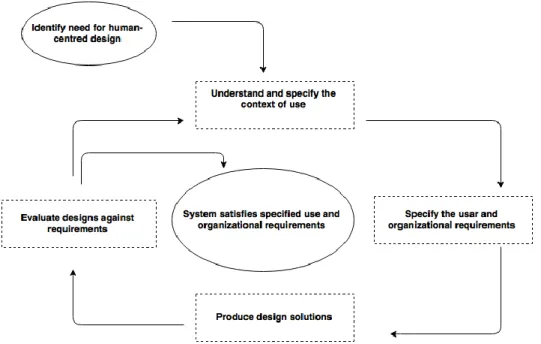
The standard also propose four general phases for the UCD process:
Specify the context of use: Identify the people who will use the product, what they will use it for, and under what conditions they will use it.
Specify requirements: Identify any business requirements or user goals that must be met for the product to be successful.
Create design solutions: This part of the process may be done in stages, building from a rough concept to a complete design.
Evaluate designs: Evaluation - ideally through usability testing with actual users - is as integral as quality testing is to good software development. (Usability.gov, 2015)
Figure 1: Phases for the UCD process
There are several ways to classify the methods and activities of UCD, in order to assist in the selection of methods at each stage (Ferre, Bevan, & Escobar, 2010). The four steps shown in the Table 2.1 correspond to the standard ISO 13407, from this standard ISO has developed two models called ISO TR 18529: 2000 - Ergonomics - Ergonomics of human-system interaction - Human-centered lifecycle process descriptions and ISO 18152: 2003 - Ergonomics of human-system interaction - Specification for the process assessment of human-system issues. Also the ISO TR 16982: 2002 - Ergonomics of human-system interaction - Usability methods supporting human-centered design, which is being revised as ISO 9241-230 NP - Ergonomics of human-system interaction - Part 9241-230: Human-centered design and evaluation methods, it provides information about HCD methods that can be used to the design and evaluation (Jordi Sánchez, 2011).
8 Table 2.1: Methods for human-centred design
Planning Context of use Requirements Design Evaluation Usability planning and scoping Usability cost-benefit analysis Identify stakeholders Context of use analysis Survey of existing users Field study/user observation Diary keeping Task analysis Stakeholder analysis User cost-benefit analysis User requirements interview Focus groups Scenarios of use Persona Existing system/comp etitor analysis Task/function mapping Allocation of function User, usability and organizational requirements Brainstormi ng Parallel design Design guidelines and standards Storyboardi ng Affinity diagram Card sorting Paper prototyping Software prototyping Wizard of Oz prototyping Organization al prototyping Participator y evaluation Assisted evaluation Heuristic or expert evaluation Controlled user testing Satisfaction questionnair es Assessing cognitive workload Critical incidents Post-experience interviews
Table 2.1 shows a compilation of list of methods based on HUSAT Research Institute and the EC UsabilityNet project (Maguire, 2001). Places the Design Guidelines and Heuristic Evaluation like the methods used within the design and evaluation stage. Even the tasks of criteria to select the methods into UCD of Nigel Bevan that use the standard ISO TR 16982, includes the heuristic evaluation as part of the stage of "Understanding needs". (Bevan, 2009)
2.2 Usability guidelines
Usability guidelines are a useful tool for the developers to improve the interaction with systems. It includes knowledge of different disciplines related to usability and provides to developers with solutions and best practices in order to achieve the usability objectives (Påhlstorp & Gwardak, 2007). The guidelines include information from the high-level approach applied to a variety of topics until the smallest granularity, or low level, applied to specific cases (Mariage, Vanderdonckt, & Pribeanu, 2005). The usability guidelines contained in a style guide can be principles, Recommendations rules or Figure 2 shows the order and types of guidelines. (Akoumianakis & Stephanidis, 1999)
9 Figure 2: Types of guidelines.
Guidelines for user interfaces can be divided according to their purpose, the following division is taken from the Book User-Centred Engineering (Richter & Flückiger, 2014), and shows the different types of guidelines according to the purpose of use:
Legal stipulations: Regulations, principally aimed at ensuring the safety of workers when dealing with technical devices (especially devices with monitors)
Standards: National and international standards which aim to standardise the use of technology and make using technology simpler for users by setting out design rules.
Collections of rules: Collections of rules for optimising development of user interfaces. They are usually freely available. These include general usability principles.
User interface patterns: An attempt to describe recurring or similar design problems and to offer proven approaches to their resolution by using patterns.
Vendor or platform style guides: These describe the prescribed look and feel of an application for a specific operating system.
Corporate style guides: Rules pertaining to look and feel and corporate design with which a company’s various applications are expected to comply. Project style guides: Guidelines for ensuring the consistency of the user interface during development of an application (e.g. when using several UI designers) or consumer product.
This document is focused on the analysis of the Guidelines provided by Google and Apple, Android User Guidelines (Google Inc. and the Open Handset Alliance, 2015), iOS Human Interface Guidelines (Apple, 2015), and the principles contained therein. Each guideline will be analysed in the sections 4.3.2 and 4.3.3. They will also be discussed the general principles of usability provided by Nielsen for heuristic evaluations in section 4.3.4.
10 2.3 Heuristic Evaluation
Heuristic evaluation is considered as a method of inspection of analytical evaluation, another approach involves theoretically based models (Preece, Sharp, & Rogers, 2015). It is the best-known usability inspection techniques and was developed by Jakob Nielsen of Bell Labs and after SunSoft (Constantine & Lockwood, 1999). Nielsen determined heuristic evaluation as a systematic inspection of the user interface by the observation of an interface and in finding good and bad things, usually performed by evaluators who can use certain documented rules (guidelines).(Nielsen, 1994)
According to subsequent investigations of Nielsen, it established that the recommended number of evaluators to perform a heuristic evaluation is between three and five, any additional evaluator could be used in alternative methods of ensuring the effectiveness of the inspection. They found that there was a rapid increase in discovering problems on in the range of 1 to 5 evaluators, and for the interval between 5 and 10, it decreased drastically. (Molich & Nielsen, 1990)
The 80% of significant usability issues were found by four or five evaluators in an experiment conducted in 1990 by Virzi but, in 1994, Lewis using a data collected from a different study, he determined that there is no relationship between the frequency and severity of problems and he recommended handle the severity and frequency like an independent way.
From the point of view of business and marketing it is a good strategy to invest in evaluations during the development process, from the point of view of quality it is more expensive to fix bugs after the product development stage. Conducting a heuristic evaluation, the designers to have an early feedback about their designs, this is an advantage because they would have the ability to apply any change or improvement over the product early. (Virzi, Resnick, & Ottens, 1992)
2.3.1 Usability heuristics for User Interface Design
Nielsen proposed a set of 10 general principles for interaction design, the original set of heuristics was introduced together with his colleagues and was described empirically from an analysis of 149 usability issues, they called it “heuristics" because they are broad rules of thumb and not specific usability guidelines. (Nielsen Norman Group, 2015)
Visibility of system status
The system should always keep users informed about what is going on, through appropriate feedback within reasonable time.
11 The system should speak the users' language, with words, phrases and concepts familiar to the user, rather than system-oriented terms. Follow real-world conventions, making information appear in a natural and logical order.
User control and freedom
Users often choose system functions by mistake and will need a clearly marked "emergency exit" to leave the unwanted state without having to go through an extended dialogue. Support undo and redo.
Consistency and standards
Users should not have to wonder whether different words, situations, or actions mean the same thing. Follow platform conventions.
Error prevention
Even better than good error messages is a careful design which prevents a problem from occurring in the first place. Either eliminate error-prone conditions or check for them and present users with a confirmation option before they commit to the action.
Recognition rather than recall
Minimize the user's memory load by making objects, actions, and options visible. The user should not have to remember information from one part of the dialogue to another. Instructions for use of the system should be visible or easily retrievable whenever appropriate.
Flexibility and efficiency of use
Accelerators -- unseen by the novice user -- may often speed up the interaction for the expert user such that the system can cater to both inexperienced and experienced users. Allow users to tailor frequent actions. Aesthetic and minimalist design
Dialogues should not contain information which is irrelevant or rarely needed. Every extra unit of information in a dialogue competes with the relevant units of information and diminishes their relative visibility.
Help users recognize, diagnose, and recover from errors
Error messages should be expressed in plain language (no codes), precisely indicate the problem, and constructively suggest a solution.
Help and documentation
Even though it is better if the system can be used without documentation, it may be necessary to provide help and documentation. Any such information should be easy to search, focused on the user's task, list concrete steps to be carried out, and not be too large.
12 2.4 Bibliographic research on Conceptual Frameworks for Designing
Methods and Heuristics
This section provides a review of the Frameworks selected from literature through a research and selection process based on our discretion. The set of publications bet on the heuristic evaluation as a method of inspection of easy use and low cost, but looking to improve their effectiveness on specific domains in which traditional heuristics may not be enough.
2.4.1 How Applicable is Your Evaluation Methods – Really?
2.4.1.1 Summary
The domain explored in this paper is the evaluation of methods for evaluating fun and entertainment, though the approach can be generalized for different domains. (Wiberg, Jegers, & Desurvire, 2009) The authors conducted this research about heuristic evaluations applied to emerging domains motivated by the lack of literature about the subject and knowing that in publication since 1990 published methods only includes description and usage of heuristic with a little guidance about how it were developed. For this reason, the authors propose a process or method to develop "methods".
There were intentions to bring Nielsen’s heuristics to the field of entertainment such as heuristics applied for videogame development, however some problems arose eventually each new set of heuristics had to be validated and modified for each individual videogame, even due to physical differences in the hardware, was necessary to create sub-versions of heuristics for the same videogame. This paper proposes a conceptual framework for developing heuristics as a tool for experts evaluation of product that generate a set of heuristic focused on specific domains. The study cases presented in the paper covers products within the domain of entertainment it: video games and entertainment pervasive web sites.
Early research were conducted about methodology development for the HCI, despite the knowledge to analyse, evaluate and design methods developed earlier years, the research were only focused to the methods results, few efforts were made about the procedure itself. The process of methods evaluation is briefly mentioned in publications, this has motivated the authors to present a standard procedure for the analysis and design of usability evaluation methods.
The conceptual model for developing or designing evaluation methods and heuristic lists, is presented as a diagram with two types of outputs, P and M.
13 Figure 3 Two types of evaluation processes showing the evaluation
[P] The final product to which the assessment was applied and already contains the improvements obtained as results of evaluations.
[M] The method that was used to evaluate [P], but containing improvements as a result of Meta-evaluation.
In order to achieve these two outputs it is necessary to evaluate an object [Os] using evaluation method [Me], a knowledge is obtained like a result of this evaluation [Ks], while a method of evaluation [Mm] will be applied to a target evaluation method [Me] and provide knowledge [Km] which is used as input for the designing of a new and more appropriate method [M], finally [Ks] is used as input for the final product [P].
The first study in which the methodology was applied to define and evaluate "Methods of Evaluation" was conducted in the project called SupaFly, which is a special kind of game that makes use of multiple technologies (such as both mobile and stationary computing technology, cell phones, RFID technology, Embedded and Augmented reality systems, the Web, etc.). The overall aim was: to conduct methodological research considering evaluation methods for user experiences in pervasive gaming settings, to improve the quality of the SupaFly game prototype and to improve the general understanding of user experience in pervasive gaming usage settings/situations.
Laboratory studies had a technical challenge to handle a large number of user interactions including the daily life interactions of the player, so a possible solution would be the use of ethnographic methods, capturing user interaction from the context of everyday life, nevertheless due to the logistics, lack of resources and another management problems it was impossible to perform, finally the solution consisted of the joining of three methods to capture the gameplay and user experience: Qualitative questionnaires, System logs of user activities and focus group interviews.
Due to commercial reasons, the delivery date of the prototype was brought forward, the processes to improve the interaction were reduced and this generated a significant negative impact on the expected results, but this change of
14 approach proposed a modification in the methodology, in which, the constraints such as budget, resources and time were included.
In the second study the methodology was applied to the domain of entertainment services, specifically the EWSs sites (Entertainment web sites), that provide some kind of entertainment. Within the study a heterogeneous group of seven EWSs were included, the overall impact was the change of process approach, which moved from a linear structure to another in which at each stage considered the usability. As a result were defined a list of 10 heuristics, with a rating system used into the experts evaluation stage in order to exclude less-ranked heuristic in each iteration of the list. Finally the authors conclude that the implementation of the methodology in the cases presented had two purposes: 1) to give particular designers feedback on design solutions 2) become input in the process of redefining or redesigning methods.
2.4.1.2 Valuable Information
This paper presents a conceptual framework to design methods and heuristic, the framework has two important elements: the model to be applied and the object to be evaluated, both are evaluated and refined in order to obtain two finished products, this idea expressed by the authors can lay the foundations to design and test methods, especially if you want to establish methodologies for evaluation, re designing or creating of an entirely new evaluation framework for new technologies or unexplored domain.
In this study, the methodology is applied to obtain a list of heuristics that will be used to the evaluation of websites, although the websites belonged to the same domain, evaluators added a ranking system and they argued that for special cases, some heuristics might not be used because it is not compatible or is not covered within the domain. The important value of this work is the ranking system provided by the evaluators.
2.4.2 A Methodology to Establish Usability Heuristics
2.4.2.1 Summary
This paper propose a new methodology to define usability heuristics focused to specific domains, and it present a case study about the emerging information technology: Grid Computing, Interactive Television, Virtual Worlds (Rusu, Roncagliolo, Rusu, & Collazos, 2011b). Within the benefits to be gained by having customized the heuristics, the authors argue that, the Nielsen’s heuristics do not cover broadly the current universe of technologies especially the growing field of mobile application.
15 The motivation of the authors was similar to that presented in the analysis of the paper of the previous section (How Applicable is Your Evaluation Methods – Really?) but it was focused directly on the method of usability inspections. The lack of information in the literature regarding the development of new methods of inspection as well as about usability heuristics and the growing interest about usability of applications belonging to emerging technologies were the motivations to propose a methodology.
The methodology for establishing new usability heuristics for specific applications has six steps:
Step 1: Exploration Stage, to conduct research on the device characteristics and related work.
Step 2: A descriptive stage, to highlight the most important characteristics of the previously collected information, in order to formalize the main concepts associated with the research.
Step 3: Pre-heuristic approach based on traditional heuristics.
Step 4: Formal definition for heuristics for touchscreen-based Mobile Step 5: Validation Stage.
Paso 6: A refinement stage, based on the feedback from the validation stage. In order to validate the methodology, were conducted a set of experiments in order to apply the new heuristics to each one of the three above-mentioned domains; the authors finally concluded that the methodology allow the development of usability heuristics and an associated usability checklist.
In later publications, the authors achieved to perform the implementation and validation of the heuristics proposed. Finally they reached a conclusion: If the heuristics are very specific, probably becoming hard work to understand and apply, must be found the right balance between generality and specificity; General heuristics may be supplemented by specific checklist.
2.4.2.2 Valuable Information
This paper provides a well-defined framework and it is a starting point for future research which are focused on identifying a specific sets of heuristics. The framework proposed a set of six steps ranging starting from the research or exploratory stage and ending with the validation and refinement of the final product.
The objective of this study is to define a list of heuristics using the framework and use this heuristic in order to conduct an expert evaluation, furthermore to present the result for applying the methodology on two real-life examples: the usability heuristics for Grid Computing Applications and Interactive Television. The stage of validation of the method is widely detailed in the paper presented by the same
16 authors and some are analysed in this work. The ease and simplicity to apply the methodology have been key to be used for various research work that are seeking to define heuristics for particular domains, and even different authors have proposed new methodologies based on this research.
2.4.3 Evaluating a Methodology to Establish Usability Heuristics
2.4.3.1 Summary
This work belongs to the stage of validation of previously revised methodology (A Methodology to Establish Usability Heuristics) (Rusu et al., 2011b). The authors after of applying the methodology to to different projects in order to obtain and validate a list of heuristics, they decided to validate the methodology using a meta-evaluation, which aimed to determine the ease of apply the technique and go identify aspects which could be improved. (Jiménez, Rusu, Roncagliolo, Inostroza, & Rusu, 2012)
This paper includes the results of four experiments and involved five researchers to perform it, who through the methodology generated some heuristics for the following areas: Grid Computing, Interactive Television, Virtual Worlds and Touchscreen Mobile Device. Each validation has an individual publication that shows the process in detail in order to analyse the usability and usefulness of the methodology, the five evaluators once completed evaluation task, their participated in the method evaluation sharing their impressions through a survey. This survey was focused on capturing the individual experiences of each participant while they applied the methodology, and some information about the experience of evaluation of each individual area into the process.
Finally the authors concluded that it was possible to validate the pertinence for formalizing and applying a methodology. In order to perform the experiment of validation, a group of 5 researchers who had previously used the methodology participated in a survey and shared their impressions, the results showed that the methodology is neutrally easy to apply, and maybe there was lack of specificity in some stages of the methodology, which could be noticeable if you want to reach a low granularity.
2.4.3.2 Valuable Information
This paper presents the validation through a meta-evaluation of a methodology used to generate heuristics. The framework of evaluation allow to the future research to verify the process of generation of heuristics. For purposes of our research we have focused on validation of Touchscreen Mobile Devices. Researchers agreed that the phase of experimental validation was the most once of the most difficult to perform “The coordination of the evaluators and the interpretation of new heuristics is a complicated task”. In this process was
17 generated a set of 11 heuristics that can be used as a starting point for defining the heuristics of mobile applications. And using this heuristics, the evaluation have identified more usability problems that using the traditional heuristics. Furthermore, the researcher highlighted that the problems identified through the new set of heuristics were related with this particular domain.
Although the results of the methodology showed that new heuristics were more efficient than Nielsen’s, finally the evaluators’ comments and results of individual stages provided valuable information to improve the methodology.
2.4.4 Usability Heuristics for Touchscreen-based Mobile Devices
2.4.4.1 Summary
This paper presents in detail the implementation of the previously revised methodology on a project of touchscreen-based mobile devices. The purpose is to define a set of usability heuristics for evaluating devices with touch screens. The method is based on the methodology that the authors themselves raised, finally the results will be the evaluations and their validations. (Inostroza et al., 2012)
As part of the literature review proposal according to the methodology, the authors conducted a review of the main features of mobile devices based on touch screens, also about of the features of the mobiles such as the taxonomy, the physical interface and its main challenges for usability. The stage of validation presented in this document corresponds to the validation of the results regarding the effectiveness of the heuristics applied, the validation regarding the effectiveness of the methodology itself was reviewed in the previous section. The steps followed according to the methodology are: An exploration Stage, a descriptive stage, pre-heuristic approach based on traditional heuristics, formal definition of heuristics, validation, a refinement stage. The object to be analysed is the mobile device itself. The researchers performed a description of its concept and features based on the literature, and they defines the mobile device like a small gadget with basic processing capabilities, permanent or itinerant network connection and a limited memory capacity.
Despite the fact that the context of mobile device usage it initially consisted of fewer features, with time were increasing, this features can be summarized over three key aspect that affect the design of user interface:
These are devices generally used with the hands
They use wireless connection
They support adding new applications, and connection to internet If we look for not so general features of the devices:
18
They can contain buttons that generally have more than one function
They are limited in processing power and storage
Within the literature reviewed, there is the classification for mobile devices carried out by Schiefer and Decker, it is regarding to the size, weight, modes of input and output data, implementation, kind of use, the ability to communicate, operating system type. This classification can be summarized in the following groups: (1) mobile standard PC, (2) mobile internet devices, (3) handhelds or PDAs, (4) smartphones, (5) feature phones, (6) simple phones and (7) special terminals. Terminals based on touch screens according to the previous classification, it fall into the categories (1) (2) (3) (4), and have been identified the key features for analysing usability of these devices: Mobile context of use, Small screen size, Screen resolution, Limited processing, memory and energy capabilities, Data entry methods.
Three iterations were carried out the experiment, each provides information to the next, in this way is refining process. During the first iteration steps 1, 2, 3 consisted of a literature review and classification of the device, in step 3 was used as the basis of the heuristics defined by Nielsen in order to define their own new heuristics, making a match with the characteristics device and general heuristics Nielsen. Finally a set of "11 heuristics" was obtained. During the second iteration heuristics previously obtained were refined and the steps 5, 6, 4 in this order were executed. The third iteration were followed by the steps 5 and 6 with the difference that two of the most experienced evaluators used the heuristics of Nielsen and the two less experienced newly defined heuristics, the data obtained in step 5 were analysed in step six for create a list of observations and possible improvements, so a mapping of both heuristics.
Among the results of the research, was presented a comparative table of the heuristics obtained by applying the method compared with heuristics Nielsen, Table 2.2 shows a mapping between Touchscreen-based mobile device heuristics and Nielsen.
19 Table 2.2 Touchscreen-based mobile device heuristics
Touchscreen-based mobile device
heuristics Nielsen’s heuristics
Id Name Id Name
TMD1 Visibility of system status H1 Visibility of system status TMD2 Match between system and
the real world H2 Match between system and the real world TMD3 User control and freedom H3 User control and
freedom TMD4 Consistency and standards H4 Consistency and
standards
TMD5 Error prevention H5 Error prevention
TMD6 Minimize the user’s memory load
H6 Minimize the user’s memory load TMD7 Customization and shortcuts H7 Flexibility and efficiency
of use TMD8 Aesthetic and minimalist
design H8 Aesthetic and minimalist design TMD9 Help users recognize,
diagnose, and recover from error
H9 Help users recognize, diagnose, and recover
from error TMD10 Help and documentation H10 Help and documentation TMD11 Physical interaction and
ergonomics
Although both lists look similar by their names, the definitions and the way to apply are substantially different, an example is the case of TMD5 y H5 “error prevention”
TMD5 - Error prevention
“The device should have a careful graphic user interface and physical user interface design, in order to prevent errors. The non-available functionalities should be hidden or disabled and the user should be able to get additional information about all available functionality. Users should be warned when errors are likely to occur.” H5 - Error prevention
“Even better than good error messages is a careful design which prevents a problem from occurring in the first place. Either eliminate error-prone conditions or check for them and present users with a confirmation option before they commit to the action.” Finally the validation stage presents evidence on the effectiveness on applying heuristics focalized to the context of use. The inspections were conducted by two separate groups of evaluators, some using heuristics for touch mobile devices and other those of Nielsen, a total of 53 usability problems were found by the evaluators, but more problems captured by the group using heuristics for touch devices, including an analysis of severity, problems with a slight rise in severity were detected by the group of heuristics based on touch devices.
20 Among the conclusions presented by the authors emphasize that there should be a proper balance between specificity and generality, if you have very specific heuristics probably will be very hard and difficult to implement and understand.
2.4.4.1.1 Valuable Information
The valuable information is the detailed application of the methodology on a similar context of the mobile applications. Within of the steps some key points were obtained such as the classification of devices and the extraction of the main characteristics thereof, the templates used to collect information could be used as basis for future applications of the methodology. The iterations show us the evolutionary cycle that list heuristics suffered during the entire process and especially the results of the validation shows the importance of specific heuristics. Not only have the details of the implementation of the methodology is also important to know that the authors themselves in the conclusions argue about the granularity of the wanted heuristics, and its balance between ease / specificity, is something that would be taken as an next research topic.
2.4.5 Heuristic Evaluation on Mobile Interfaces: A New Checklist
2.4.5.1.1 Summary
This paper presents a compilation of heuristic evaluation checklists adopted from literature and adapted to the context of mobile device interfaces. The methodology used is a variation of the methodologies for developing heuristics taken from the literature, the aim of the authors is to provide a tool that not only works for expert assessments, also as a checklist of best practices. (Yáñez Gómez, Cascado Caballero, & Sevillano, 2014)
The methodology used to obtain the guidance of heuristics for mobile environment, is based on the methodology presented by Rusu in his work "A Methodology to Establish Usability Heuristics" (Rusu et al., 2011a) although it differ in a small details, the process to establish the new set of usability heuristics is the same.
The six steps outlined in the methodology are:
A clear definition of the problem scope.
Rearrange existing and well-known heuristics into a new compilation.
Develop a compilation of different proposed subheuristics. (“Heuristic” in this paper refers to a global usability issue that must be evaluated or taken into account when designing. In contrast, the term “subheuristic” refers to specific guidelines items.)
21
To homogenize the redaction and format of subheuristics in order to make it useful for non-experts.
Evaluation.
Step1) Problem Scope Definition: From literature is extracted a division of mobile devices which it grouped into three broad categories:: feature phones, Smartphones, touch phone/touch tablets, a division that reminds us the generations of mobile, the current generation is for touch devices. Each generation has strong differences in their interaction and interface due to physical constraints. Such restrictions also were reviewed and analysed by the authors, and they proposed a classification that used as axis the improvement of usability, according to the literature, the main constraints when designing for mobile devices are:
Limited input/output facilities
Mobility and varying context
Type of Task
Multi Devices access
Limited processing capability and power
Adoption
Step 2) Rearrangement of Traditional Heuristic: The first step was to collect heuristics known from literature, an important source for this collection was the research work of Torrente (Torrente, Prieto, Gutiérrez, & de Sagastegui, M Elena Alva, 2013), in which the author selected the most influential heuristic guides, a compilation of 9 guides heuristics that make up 83 globally heuristics and 361 individual sub heuristics, in this research the authors only took the heuristics, the sub-heuristics to be more specific should be related to mobile devices. Finally a set of 13 main heuristics regrouped.
Step 3) Compilation of Sub heuristics from Traditional General Heuristic Checklists: Of the 361 sub-heuristics posed by Torrent, were excluded those that did not fit the context of usability on mobile devices, such heuristics applied for desktop applications, etc. During this step were obtained 158 sub-heuristics, some were regrouped and reclassified into a hierarchy of sub-heuristics, the first proposal can be seen in the original document.
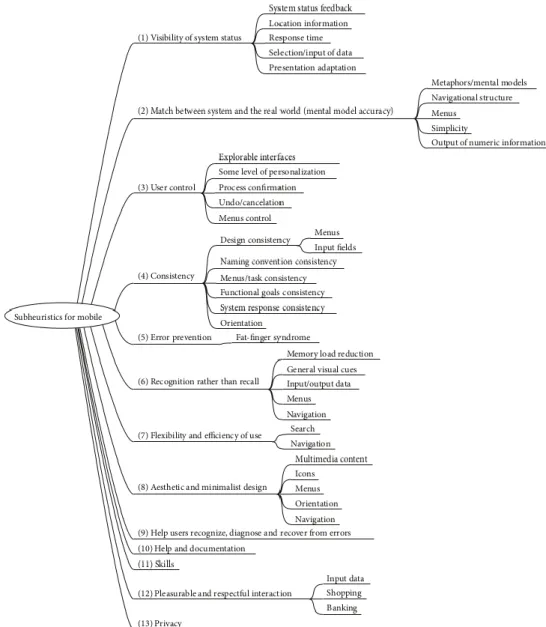
Step 4) Compilation of Mobile-Specific Sub heuristics: Because the extraction of sub-heuristics literature not correspond to a specific context of mobile device during this step was enriched the list with mobile-specific sub-heuristics taken from mobile usability studies and best practices that actually do not provide HE. As a final result 72 new sub-heuristics were added and the final compilation like the graph below.
22 Figure 4: Final framework for classification of detected sub-heuristics.
Step 5) A total of 13 heuristics and 230 sub-heuristics was obtained as a result of the heuristics homogenize, in the final compilation the intermediate classifications were omitted, also semantically related item were together reaching a common presentation of heuristic guides in the literature.
The final set, the sub heuristic list is formed by 69% of items extracted from literature and the 13 main heuristics have a remarkable influence of the proposals by Nielsen with an order and different approach, emphasize concepts such as skills adaptation and pleasurable and respectful interaction with the user and privacy, elevating them to the category of heuristic item.
The validation of the heuristics obtained was not performed thoroughly during the experiment, but preliminary tests were performed and the results show that the Proposed HE guideline is a helpful tool for engineers, designers and technicians with little specific knowledge of usability, such conclusion is based on a hypothesis
23 presented by the authors in which the "sub heuristics" actually are more a specific and detailed heuristics, proved to be easy to use for non-experts evaluators.
2.4.5.2 Valuable Information
The valuable information provided by the study is a depth research and review of the literature in order to develop the first four steps of the methodology, although the methodology presented is valuable, does not vary much from that presented by other authors analysed above, is important to emphasize the amount of re-used heuristics correspond to 69% of the sub proposals heuristics, and the rest are taken from best practices and recommendations for mobile interfaces. Although the authors did not validate this in the research, provided the idea that the more granular heuristics are obtained, will help inexperienced evaluators but also would provide a guide or tool for designing more usable interfaces in pre-evaluating stage, in this case they would be referring to the design guidelines as a proactive tool.
Best practices, principles and design guidelines are currently presented by companies such Apple and Google that they have a high market share as platforms for mobile devices. In the case of iOS guides are conceivable as minimum requirements to fulfil by an application for that it can be accepted in the markets, the review of these requirements may be considered in the design and evaluation stages. The question remains open, Are Nielsen heuristics aligned with current guidelines for mobile? Or are only the starting point?
2.4.6 Conclusions of the bibliographic research
Heuristic evaluation is one of the inspection methods most used as it has several advantages over other techniques, such as: its implementation is easy, fast and cheap, it is suitable for every software life-cycle. (Yáñez Gómez et al., 2014) 10 Nielsen heuristics are widely known and widely used within heuristic evaluations. (Rusu et al., 2011a)
There is the need to upgrade the usability evaluation methods for emerging technologies, such as mobile applications (Rusu et al., 2011a) , the traditional methods do not regard particularities on emerging technologies, such as unique features in smart phones or mobile applications. Therefore it is important to create a more accurate assessment methods and adapt them to the new context. (Inostroza et al., 2012)
There are approaches or conceptual frameworks that aim to propose the necessary steps to develop new methods of evaluation or heuristics. (Wiberg et al., 2009). The methodologies were applied to different types of projects and were validated against Nielsen heuristics.
24
The experiments conducted showed that for new specific heuristics are more effective than the heuristics of Nielsen finding problems. (Jiménez et al., 2012) The potential offered by the methodologies to develop methods is valuable in the case of future research on evaluation methods for specific domains. (Wiberg et al., 2009)
One of the features of heuristic customization is the ability to determine the granularity, if heuristics are more specific with high granularity (greater number and analysis depth) it is beneficial for novice evaluators, but directly affecting the execution time, becoming the evaluation like a tedious and impractical method.
To define new heuristics, the work analysed took as the basis Nielsen heuristics and proceeded to enrich them with different sources of heuristics, research, principles, best practices and all information related to the domain. Upon completion and to validate heuristics the researcher conducted an experiment in which it is measured the effectiveness of new heuristics versus Nielsen at the time of collecting usability problems.
In some experiments it was necessary to include a ranking method in order to establish weight to the issues in terms of the criticality, this helps to the validation stage of methodology identifying heuristics which help to find critical problems, and also it helps for prioritizing problem resolution.
It is remarkable to mention that none of the research papers trying to define heuristics totally based on the principles of the platform guidelines, nor attempt to analyse how these principles are related to traditional Nielsen’s.