repository: http://orca.cf.ac.uk/122189/
This is the author’s version of a work that was submitted to / accepted for publication.
Citation for final published version:
Zhao, Hui-Huang, Rosin, Paul, Lai, Yukun, Zheng, Jin-Hua and Wang, Yao-Nan 2019. Adaptive
gradient-based block compressive sensing with sparsity for noisy images. Multimedia Tools and
Applications 10.1007/s11042-019-7647-8 file
Publishers page: https://doi.org/10.1007/s11042-019-7647-8
<https://doi.org/10.1007/s11042-019-7647-8>
Please note:
Changes made as a result of publishing processes such as copy-editing, formatting and page
numbers may not be reflected in this version. For the definitive version of this publication, please
refer to the published source. You are advised to consult the publisher’s version if you wish to cite
this paper.
This version is being made available in accordance with publisher policies. See
http://orca.cf.ac.uk/policies.html for usage policies. Copyright and moral rights for publications
made available in ORCA are retained by the copyright holders.
(will be inserted by the editor)
Adaptive Gradient-based Block Compressive Sensing with
Sparsity for Noisy Images
Hui-Huang Zhao, Paul L. Rosin, Yu-Kun Lai, Jin-Hua Zheng and Yao-Nan Wang
Received: date / Accepted: date
Abstract This paper develops a novel adaptive gradient-based block compressive sensing (AGbBCS SP) methodology for noisy image compression and reconstruc-tion. The AGbBCS SP approach splits an image into blocks by maximizing their sparsity, and reconstructs images by solving a convex optimization problem. In block compressive sensing, commonly used square block shapes cannot always produce the best results. The main contribution of our paper is to provide an adaptive method for block shape selection, improving noisy image reconstruction performance. The pro-posed algorithm can adaptively achieve better results by using the sparsity of pixels to adaptively select block shape. Experimental results with different image sets demon-strate that our AGbBCS SP method is able to achieve better performance, in terms of peak signal to noise ratio (PSNR) and computational cost, than several classical algorithms.
Keywords Block Compressive Sensing (CS)·Adaptive·Convex Optimization·
Sparsity
Hui-huang Zhao
Hunan Provincial Key Laboratory of Intelligent Information Processing and Application, Hunan, China and College of Computer Science and Technology, Hengyang Normal University, Hengyang China E-mail: [email protected]
Paul L. Rosin
School of Computer Science and Informatics, Cardiff University, Cardiff, UK E-mail: [email protected]
Yu-Kun Lai
School of Computer Science and Informatics, Cardiff University, Cardiff, UK E-mail: [email protected]
Jin-Hua Zheng
College of Computer Science and Technology, Hengyang Normal University, Hengyang China E-mail: [email protected]
Yao-Nan Wang
College of Electrical and Information Engineering, Hunan University, Changsha, China E-mail: [email protected]
1 Introduction
Compressive Sensing (CS) is a sampling paradigm that provides signal compression at a significantly lower rate than the Nyquist rate [15], [16]. It is based on signal sparse representation [24] and has been successfully applied in a wide variety of applications in recent years, including image processing [9, 27, 30, 45], Synthetic Aperture Radar (SAR) [2], Internet of things [25, 43, 28], Magnetic Resonance Imaging (MRI) [38], video [51, 29], and solder joint image compression [53]. The authors in [32] proposed a novel reconstruction method for X-ray images based on CS. The authors in [41] developed a new method of fast encoding for SAR raw data by using CS theory to compress and reconstruct SAR raw data. In [40] compressive sensing and matrix completion techniques are applied to recover the original spectral signals. Simulation results proved that the output was improved.
In this paper, we develop a novel CS algorithm named AGbBCS SP for image compression and reconstruction, which is particularly beneficial for noisy images. The main contributions of this paper are summarized as follows:
– We find that the square block shape used in existing methods cannot always achieve best results. Therefore, we propose a multi-shape block splitting strategy for block Compressive Sensing. Besides splitting the image into square blocks, we also split it into rectangular blocks with different shapes (i.e. aspect ratios). By doing so, nearby pixels which are similar have a high probability to be assigned to the same block, leading to more effective compression.
– Our adaptive Compressive Sensing scheme makes a practical assumption that only a small, randomly chosen part of the image needs to be known. Our method automatically selects the appropriate block shape which maximizes the sparsity of the signal in the known region.
– The control factor for sparse regularization is also important for effective image reconstruction. We propose an adaptive approach to selecting a suitable control factor, by comparing the sparsity of the reconstruction results.
After the block shape selection, the image is split using this block shape, and then the recently proposed gradient-based method for Compressive Sensing [53] is applied. Our method involves two adaptive selection steps, optimizing the block shape and control factor, respectively. The results show that the reconstruction performance is improved significantly.
The rest of this paper is organized as follows. In section 2, we introduce some related work on CS. In section 3, we introduce the theory of Compressive Sensing and the gradient-based method for the convex optimization problem. In section 4, we describe the AGbBCS SP method for image compression. Experimental results and comparison are shown in section 5. Finally, we conclude our paper in section 6.
2 Related work
2.1 Compressive Sensing Algorithms
The major challenge in CS is to approximate a signal given a vector of samples. In recent years, many methods have been proposed which can be roughly divided into six categories:
1. Convex Optimization Algorithms. These techniques solve a convex problem which is used to approximate the target signal, including Basis Pursuit [8], Greedy Basis Pursuit (GBP) [21], Basis Pursuit De-Noising (BPDN) [31].
2. Greedy Iterative Algorithms. These methods build up an approximation by making locally optimal choices step by step. Examples include Matching Pursuit (MP), Orthogonal Matching Pursuit (OMP) [44], regularized OMP (ROMP) [36], Compressive Sampling MP (CoSaMP) [35] and Subspace Pursuit (SP) [10]. 3. Iterative Thresholding Algorithms. Iterative approaches for the CS recovery
problem are faster than the convex optimization method. For this type of algo-rithm, which assumes that the signal is sparse, correct measurements are recov-ered by soft or hard thresholding [4], [14] starting from an initial random noise measurement matrix.
4. Combinatorial / Sublinear Algorithms. This type of algorithm recovers a sparse signal through group testing [20], such as Heavy Hitters on Steroids (HHS) [39]. 5. Non Convex Minimization Algorithms. Non-convex local minimization tech-niques recover compressive sensing signals from far less measurements by re-placing thel1-norm by thelp-norm wherep≤1 [7]. An example of an algorithm
proposed in the literature that uses this technique is Iterative Re-weighted Least Squares [11].
6. Bregman Iterative Algorithms. When applied to CS problems, the iterative ap-proach using Bregman distance regularization achieves reconstruction in four to six iterations [37].
2.2 Block Based Compressive Sensing (BCS)
In the methods above, a column or row of an image is normally viewed as a vec-tor. But in many applications the nonzero elements of sparse vectors tend to clus-ter in blocks [17]. In this case the sampling problems over unions of subspaces can be converted into block-sparse recovery problems. In order to improve the perfor-mance, [19] proposed and studied block compressive sensing for natural images and this method involves Wiener filtering and projection onto the convex set and hard thresholding in the transform domain. For 512×512 size images, the author sug-gested block dimension 32. [33] proposed a BCS SPL method with a variant of projected Landweber (PL) iteration and smoothing. It needed more than 200 itera-tions and they used different block dimensions (16, 32 or 64) according to differ-ent image sizes. [34] studied a DDWT BCS method which was based on a 5-level dual-tree discrete wavelet transform (DDWT) which was used as the sparsity basis. For a 512×512 image, they set the block size as 16×16. [50] proposed a BCS
method based on a Bayesian learning framework for Fetal ECG (FECG) telemonitor-ing, and it could greatly reduce code execution time in the data compression stage. They used certain block partitions and the block size ranged from 4 to 90. Both [42] and [48] proposed an adaptive block-based compressive sensing approach which col-lected a different number of samples of the measurement matrix for each block. [9] studied block compressive sensing in wireless sensor networks and [3] analyzed the block sampling strategies in compressive sensing. They showed the optimal number of blocks depended on the properties of block coherence.
[49] and [26] studied block compressed sensing with projected Landweber (PL). [18] developed BCS SPL method based on a smoothed projected Landweber recon-struction algorithm. BCS SPL has obvious defects since the Wiener filter and iter-ative projected Landweber discard partial information in the image. [46] proposed a block compressed sensing method based on iterative re-weightedl1 norm
mini-mization. [52] developed a block compressed sensing method for solder joint images based on CoSaMP. In those methods the row and column sizes of the measurement matrix are the square of the block size. So with increased block size, the algorithm requires substantially more memory.
Despite many CS algorithms appearing in the literature, there are still many chal-lenges in compressive sampling to approximate a signal, especially for noisy signals. On one hand, in most methods, a column or row of an image is normally viewed as a vector, and so the local 2D spatial image information is ignored. All the block com-pressive sensing methods mentioned above usedfixedblock size and are not adap-tive. On the other hand, the computational cost for many methods, such as CoSaMP, is unsatisfactory. Some classical methods, such as OMP, have good computational efficiency, but their reconstruction performance needs to be improved. Third, some of the algorithms require tuning several parameters, and are not adaptive.
3 Compressive Sensing Methodology
3.1 A Brief Review of Compressive Sensing
Given an image, the first step of CS is the construction of ak-sparse representation, wherekis the number of the non-zero entries of the sparse signal. Most natural sig-nals can be made sparse by applying orthogonal transforms, such as Wavelet Trans-form, Fast Fourier Transform and Discrete Cosine Transform (DCT) [6]. This step is represented as
x=Ψs, (1)
wheresis anN-dimensional noise free image,xis a weightedN-dimensional vector (sparse signal withknonzero elements), andΨ is anN×Northogonal basis matrix.
The second step is compression. In this step, a random measurement matrix is applied to the sparse signal according to the following equation:
whereΦ is an M×N random measurement matrix (M <N). In most images or
videos, there is some noise [5, 54]. For a noisy image, the equation is generalized as:
y=ΦΨs+w, (3)
wherewis anN-dimensional noise signal (or measurement error). LetMbe the num-ber of measurements (the row dimension ofy) sufficient for high probability of suc-cessful reconstruction. As expected, signalxin Eq.(2) and Eq.(3) may be estimated from measurementyby solving the convex minimization problem [44, 35] as follows.
minimize kxk1
subject to : kΦx−yk2≤ε, (4)
whereεis an upper bound on the noise in the data.
The robustness of CS heavily relies on a notion called the restricted isometry property(RIP) [47]. RIP is defined as follows,
(1−δk)kxk2
2≤ kΦxk22≤(1+δk)kxk22, (5)
wherek · k2
2 defines the l2 norm, andδk is the k-restricted isometry constant of a
matrix. RIP is used to ensure that all subsets ofkcolumns taken fromΦ are nearly
orthogonal.
3.2 Gradient-Based Method for Convex Optimization Problems
Generally Eq.(4) is a constrained minimization problem of a convex function. One of the simplest methods for solving a convex minimization problem is the gradient-based algorithm which generates a sequencexkvia
x0∈RN,xk=xk−1−tk∇g(xk−1), (6)
whereg(x)is a convex function, andtk>0 is a suitable step size. For a signal in
Eq.(3), let us think about an objective function F(x) =g(x) +f(x), whereg(x)is convex, and f(x) =λkxk1. In our method, it is more natural to study the closely
related problem
arg min
x
kΦx−yk2
2+λkxk1. (7)
At point xk−1, the function F(x)can be approximated by the following quadratic
function QL(x,xk−1) = g(y)+<x−xk−1,∇g(xk−1)>+ 1 2tk kx−xk−1k22 , (8)
which admits a unique minimizer,
PL(xk−1) =arg min
x
{QL(x,xk−1),x∈RN}. (9)
We solve this problem using a gradient-based method, in which an iteration pa-rametertkis replaced by a constant 1/Lwhich is related to the Lipschitz constant [1].
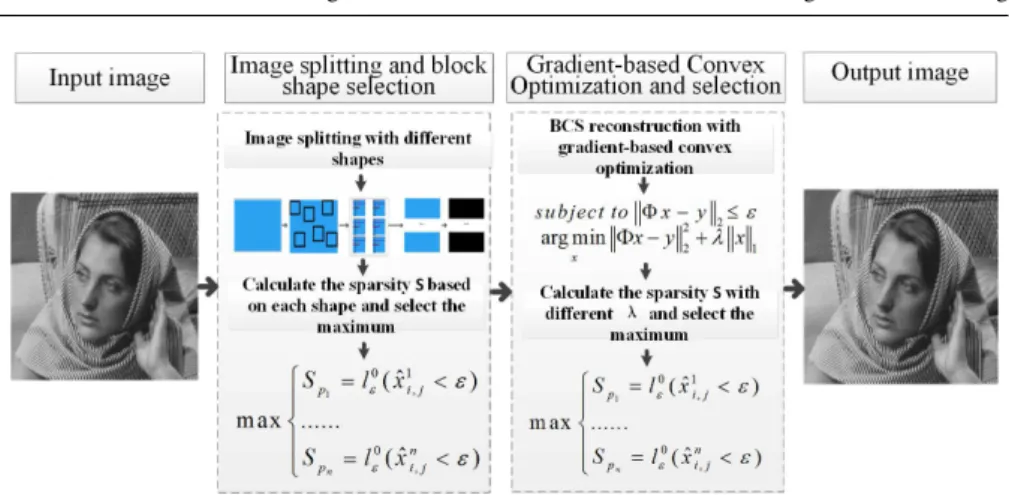
Fig. 1 The flow chart of our AGbBCS SP approach.
4 The Adaptive Gradient-based Block Compressive Sensing with Sparsity
4.1 Framework of our method
The framework of our AGbBCS SP approach is shown in figure 1. For an image, the main steps are:
– We propose an adaptive block CS approach in which we consider different block shapes for splitting the image into a set of non-overlapping blocks of equal shape. Assuming that the information of the entire image is unknown, our method ran-domly selects a small part of the image and reconstructs it, and adaptively selects one block shape which can maximize the sparsity of the signal.
– The original image is sparsified by an orthogonal transformation, treating its compression as a convex optimization problem, followed by applying a gradient-based method. Each block is then transformed into a one-dimensional data vector. Here, we assume the problem to be convex with the Lipschitz gradient. Aiming at improving the efficiency, we replace an iteration parameter by the Lipschitz constant [53].
– We apply the proposed gradient-based method for reconstruction. The proposed method also adaptively selects a control factor which controls anl1norm
expres-sion in the optimization problem by comparing the sparsity of the reconstruction results. After an inverse transformation, the reconstructed signal can be obtained. Finally, each one-dimensional data vector is transformed into a two-dimensional block, and those make up the image.
4.2 Block Compressive Sensing and Multi-shape Block Split Strategy
Given anN1×N2image, it is split into small blocks of sizen1×n2. Let firepresent
N1N2
n1n2. One is able to get anm-dimensional sampled vectoryBthrough the following
linear transformation,
yB=ΦBfi, (10)
whereΦB is anm×n1n2 measurement matrix,m≪ n1n2. The block CS method
is memory efficient as we just need to store anm×n1n2Gaussian random matrix
ΦB, rather than the fullM×N1N2one. Small data requires less memory storage and
allows faster processing, while large data produces more accurate reconstruction. In existing methods, the blocks in the Block Compressive Sensing are fixed as squares. However, there are many different block aspect ratios with the same number of pixels. Unlike common methods, we split the image into different shapes. Given an ˜N×N˜ image (assuming ˜Nis a power of 2 for simplicity), the shape of a block is
w×h, so w=2a, h=2b, a=0,1,2,3, ...log2N˜. b=log2N˜−a, (11)
For example, 9 aspect ratios are defined to split a 256×256 image with the fol-lowing block-shapes: 1×256, 2×128, 4×64, 8×32, 16×16, 32×8, 64×4, 128×2 and 256×1. As we will discuss later in section 5.1, some block shapes (especially those closer to squares) are more likely to provide effective reconstruction. Also, using closer-to-square blocks also means that these blocks can be fit in smaller square re-gions, e.g. 8×32, 16×16, 32×8 blocks can be fit in 32×32 squares, whereas 1×256 blocks cannot. As we will discuss in section 4.3, this makes adaptive selection more effective. Detailed discussions will be presented in the experimental results.
4.3 Adaptive Block Shape Selection
In most cases, the information of the entire signal (image) is unknown. It is hard to select one block shape from several shapes if the image content is unknown. So we make a practical assumption that only a small part of the image is known and propose a new approach based on sparsity for block shape selection. We highlight the block shape selection step in our approach.
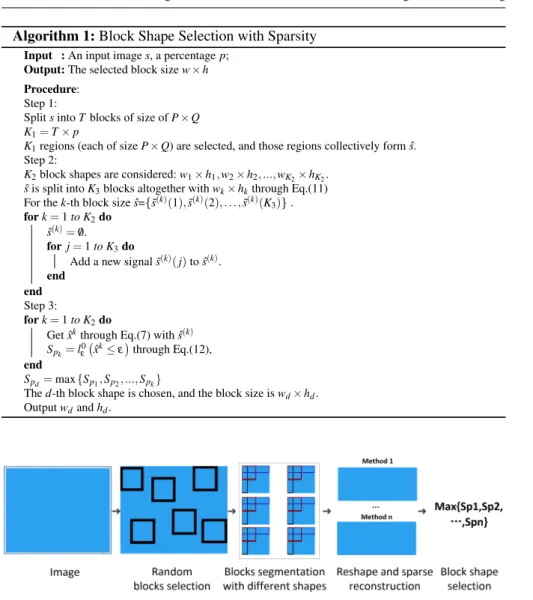
First, we randomly select a small percentage of image pixels that make up known regions. These regions are then split into smaller block shapes considering the various aspect ratios specified in Eq.(11). We reconstruct them, calculate their sparsity, and then select the block shape which maximizes sparsity.
For an image, firstly, it is split into T non-overlapping regions of sizeP×Q, whereK1=T×pare known regions, and pis the proportion. So K1regions (size P×Q) are selected. There areK2block sizes in Eq.(11) wk×hk,(k=1,2, ...,K2)
that fit withinP×Qregions. Then forK1regions (sizeP×Q), they are split intoK3
blocks of sizewk×hk. Given that ˆxis defined as the reconstructed result in Eq.(7),
the summed sparsity of its blocks is defined as
Algorithm 1:Block Shape Selection with Sparsity
Input :An input images, a percentagep; Output:The selected block sizew×h
Procedure: Step 1:
SplitsintoTblocks of size ofP×Q K1=T×p
K1regions (each of sizeP×Q) are selected, and those regions collectively form ˆs.
Step 2:
K2block shapes are considered:w1×h1,w2×h2, ...,wK2×hK2.
ˆ
sis split intoK3blocks altogether withwk×hkthrough Eq.(11) For thek-th block size ˆs={s˜(k)(1),s˜(k)(2), . . . ,s˜(k)(K3)}.
fork=1to K2do
ˆ
s(k)=/0.
forj=1to K3do
Add a new signal ˜s(k)(j)to ˆs(k).
end end Step 3:
fork=1to K2do
Get ˆxkthrough Eq.(7) with ˆs(k) Spk=l 0 ε xˆk≤ε through Eq.(12), end Spd=max{Sp1,Sp2, ...,Spk}
Thed-th block shape is chosen, and the block size iswd×hd. Outputwdandhd.
Fig. 2 Adaptive block selection based on sparsity.
where ˆxi,j is the element at location(i,j)in the reconstructed result ˆx, andlε0(·)is a
function defined in [22]. Thus, we propose the adaptive block shape selection with sparsity algorithm whose details are shown in Algorithm 1. For example, given a 256×256 image, we setp=0.25. We consider splitting the image intoT =64 re-gions of sizeP×Q=32×32, andK1=64×0.25=16 blocks are randomly selected,
so thatK3=16×4=64. With 32×32 regions, we considerK2=3 block sizes 8×32, 16×16 and 32×8 which fit within the region. The process of block shape selection is shown in figure 2.
In this paper, we consider splitting an image into blocks in different ways, and the configuration with the largest sparsity is chosen for CS.
Algorithm 2:Adaptive Gradient-based Block Compressive Sensing
Input :An imageIof size ˜N×N˜; a sparse signal transform matrixΨ∈RW H×W H; a measurement matrixΦ∈RM×W H; whereWandHare the chosen block width and height, andMis the sampling rate; Lipschitz constantL=0.5; the number of iterations
J=M/4.
Output:The reconstructed images. Procedure:
Step 1:
begin:Iis split intoTregions, andpis a percentage,K1=T×pregions are selected.
One block shapeW×His chosen by Algorithm 1,
Iis split intoK4blocks withW×Hblock size.
end Step 2:
begin: Set the block counterk=1,λ=1, and the iteration counterj=1,Spmax=0. whileλ≤100do
whilek≤K2do
Transform each block into a data vector;y0=x0=0∈RW H,t1=1;
whilej≤Jdo zk j=PL(ykj), solved through [53]. tk j+1= 1+q1+4tkj2 2 xkj=argmin{F(xk):xk=zkj,xkj−1} yk j+1=xkj+ tk j tkj+1( zk j−xkj) + tk j−1 tkj+1( xk j−xkj−1) end
Collect all the ˆxk
Jto form ˆx. end Sp=lε0(xˆ≤ε)through Eq.(12), IfSp>Spmax Spmax=Sp ˆˆ x=xˆ Endif end s′=Ψ−1xˆˆ.
For each one-dimensional data vector ins′, transform it into anW×Hblock. Collect all the blocks to form the reconstructed images.
end
4.4 Adaptive Block Compressive Sensing with Sparsity Algorithm
During the minimization of Eq.(7),λcan be used to improve the result with different
sampling rates. Usuallyλ =M/4, but in our proposed method, we setλ ∈[1,100],
and we adaptively chooseλ such that the largest sparsity is achieved. Thus, we
pro-pose our AGbBCS SP algorithm whose details are shown in Algorithm 2, where the basic sparse optimization is based on [53].
There are two steps in our method. The first step compares the sparsity for block shape selection. The second step uses the selected block shape to split the image and reconstruct the image. In comparison with other reconstruction algorithms, our algorithm has the following characteristics:
– Unlike the traditional block compressive sensing approaches, in which the block is a fixed square shape, our method considers splitting an image into multiple
Table 1 Correct ratio of AGbBCS SP (M=128)
dataset image number best shape selected ratio
Holidays 157 136 86.62%
Copydays 812 691 85.10%
block shapes. Similar pixels have a high probability to be assigned to the same block.
– Furthermore the block shape selection is adaptive and it is determined by maxi-mizing sparsity.
– Suppose the information of the entire image is unknown. Our algorithm randomly selects a small part of the image to perform block shape selection.
– The algorithm also adaptively selects the control factorλaccording to the sparsity
of the results.
5 Experiments and Discussion
In order to evaluate the quality of the reconstructed results, many researchers used the Peak Signal to Noise Rate (PSNR) to measure the result quality in image pro-cessing [13]. In our study, PSNR is also used to compare the experimental results. The experiments were implemented on an Intel Core i5 with 2.70 GHz CPU. The test images include some standard ones (such aswoman), INRIA Copydays dataset (157 images), and INRIA Holidays dataset (812 images) [23] to whichsalt&pepper
noise is added withδ=0.05 by default. Since some methods require the image size
to be a power of 2, we have cropped all the images to 256×256.
5.1 Experiments with different block aspect ratios
Given a 256×256 image, the block-shapes 1×256, 2×128, 4×64, 8×32, 16×16, 32×8, 64×4, 128×2 and 256×1 are considered. We used the INRIA Copydays and the INRIA Holidays datasets and the noise level is setδ =0.05. With the sampling
rateM=128 andλ =M/4, we test different block shapes. Then we select the best
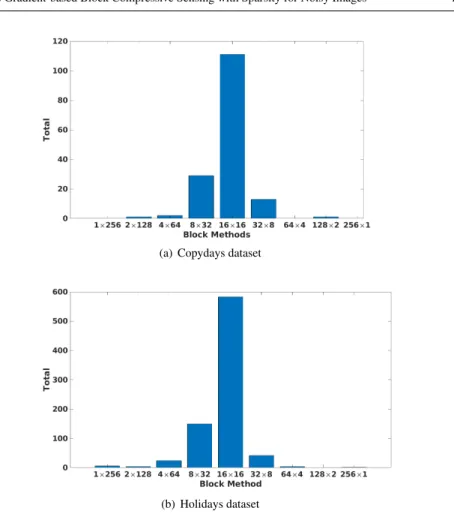
shape, and the number of times that each block shape is best is shown in figures 3(a) and (b) for the two datasets, respectively.
We find that a square block (16×16) cannot always get the best results, and 8×32, 16×16, and 32×8 can achieve the top three results. So in our AGbBCS SP method, three block shapes are chosen. As described above, we consider splitting a 256×256 image into 64 regions, each of size 32×32, and 64×0.25=16 blocks are randomly selected to calculate sparsity for three block shapes (8×32, 16×16, and 32×8). Then we choose the block shape which can get maximum sparsity for the given image.
Based on the introduction above, we do a test with the INRIA Copydays dataset and the INRIA Holidays dataset with added noiseδ=0.05, and we count the number
of images our method selects the best block shape for based onM=128, and the results are shown in table 1.
(a) Copydays dataset
(b) Holidays dataset
Fig. 3 The number of images that each block shape is best in the (a) INRIA and (b) Holidays datasets.
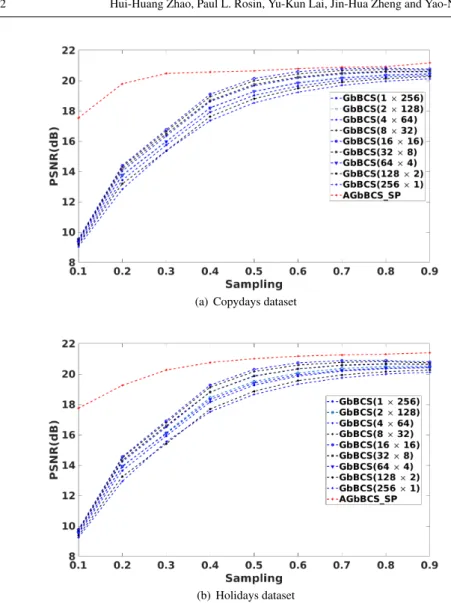
From table 1, one can see that the proposed AGbBCS SP approach can achieve a good result for block shape selection, where the ratios of correctly selecting the best block shapes are 86.62% and 85.10%. The average reconstruction results with different block shapes and our method are shown in figures 4 (a) and (b).
One can see from figures 4 (a) and (b) that AGbBCS SP, which can adaptively select block shape andλ which can adjust thel1norm in the minimization problem,
achieves the best results. Especially when the sampling rateu≤0.6, the PSNR is improved greatly.
5.2 The comparison of reconstruction results
Now let us compare the proposed AGbBCS SP with the popular methods SP [10], OMP [44], BOMP [17], CoSaMP [12], BCoSaMP [52] BCS SPL [18] and Deep Image Prior [45]. In BOMP, BCoSaMP and BCS SPL, the block is set to a square shape (size 16×16). Deep Image Prior is not based on blocks, and we simply recover
(a) Copydays dataset
(b) Holidays dataset
Fig. 4 Quantitative comparison based on different block shapes for INRIA datasets
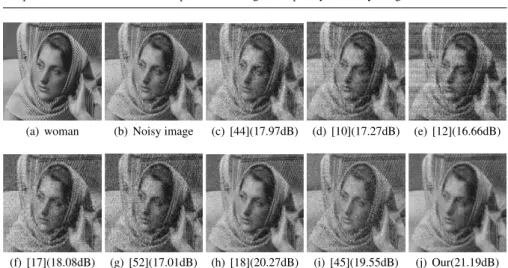
images based on a sparse sampling using the authors’ code. The test imagewoman
is used (size 256×256) with added noise δ =0.03, as shown in figure 5(a). The
reconstruction results based on popular methods with sampling rate M =200 are shown in figures 5(b-g) and the reconstruction result based on our AGbBCS SP with the same sampling rate, is shown in figure 5(h).
We can see that our method can achieve a better result than SP, OMP, BOMP, CoSaMP, BCoSaMP, BCS SPL and Deep Image Prior.With more noise added and
M=128 in test imagewoman, the PSNR comparisons are shown in figure 6. One can see from figure 6 that, compared to SP, OMP, BOMP, CoSaMP, BCoSaMP and Deep Image Prior, our method achieves the best result.With increasing noise in the
(a) woman (b) Noisy image (c) [44](17.97dB) (d) [10](17.27dB) (e) [12](16.66dB)
(f) [17](18.08dB) (g) [52](17.01dB) (h) [18](20.27dB) (i) [45](19.55dB) (j) Our(21.19dB) Fig. 5 Reconstruction results based on different methods
Fig. 6 PSNR comparison of different levels of added noise
image, Deep Image Prior can achieve a constant PSNR value. Whenδ >0.025, our
method achieves a better PSNR result than BCS SPL.
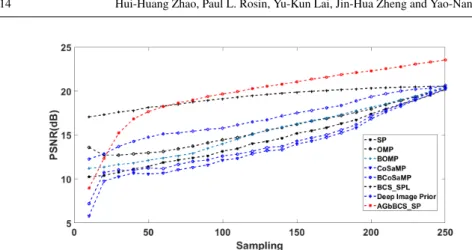
With increasing numbers of samples in the noisy image (see figure 5(a)) the PSNR comparisons are shown in figure 7. One can see from figure 7 that, compared to SP, OMP, BOMP, CoSaMP, BCoSaMP and Deep Image Prior, our method can achieve best result. WhenM≥70, our method achieves a better result than BCS SPL. We also compare their number of iterations for reconstructing figure 5(a) with sampling rate
M=200, the iteration and the PSNR comparison are shown in figure 8 and figure 9. One can see that our method achieves the best result after 20 iterations. It achieves a better result than SP, OMP, BOMP, CoSaMP, BCoSaMP after 7 iterations. From figure 9, one can see that Deep Image Prior can achieve a better PSNR around 350 iterations. So in the following experiments, the number of iterations is set to 350 for Deep Image Prior.
Fig. 7 PSNR comparison based on different sampling rates forwoman
Fig. 8 PSNR comparison for different numbers of iterations forwoman
(a) (b) Fig. 10 Source example images.
(a) Image (b) Noisy image (c) [44](19.57dB) (d) [10](18.85dB) (e) [12](18.41dB)
(f) [17](19.04dB) (g) [52](17.53) (h) [18](21.14dB) (i) [45](20.99dB) (j) Our(23.73dB) Fig. 11 More reconstruction experiments based on different methods applied to figure 10(a)
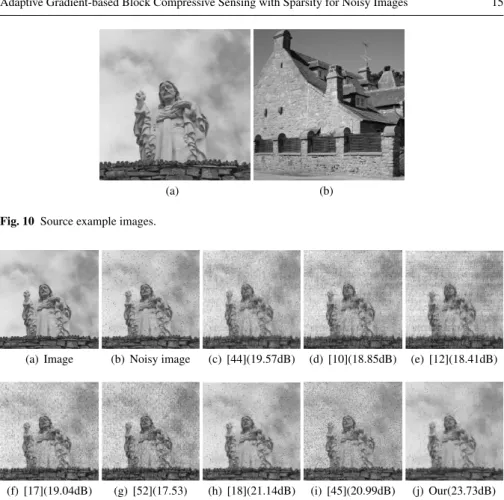
More image reconstruction results with sampling rate M=200 and δ =0.03
based on different methods are shown in figures 11 and 12 which contain special content or background (shown in figure 10).
We can see that figure 10(a) contains sky as its background, while in figure 10(b), the buildings have lots of blocky areas. The content for these images is well suited for using block compressive sensing. Compared with other methods, our method can achieve the best PNSR results, but there are some blocky artifacts in the reconstructed images. This is because some blocks are sparser than other blocks, so it can generate better results than the blocks around them.
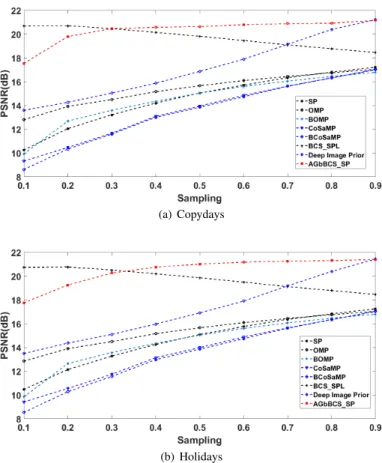
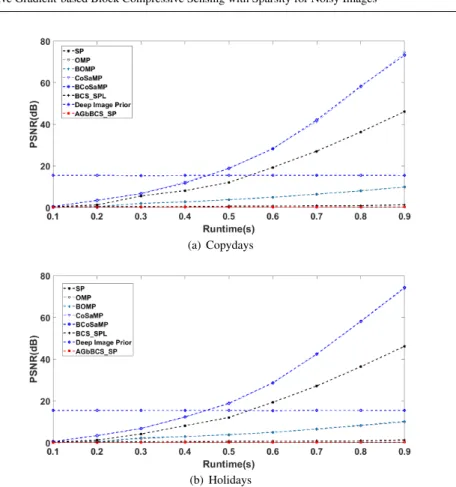
In the next experiment, we used the INRIA Copydays and Holidays datasets with added noise δ =0.05. The comparison results are shown through the experiments
with different numbers of samples (from sample rate 0.1 to 0.9). The results are shown in figures 13, 14(a) and (b).
From figures 13 and 14, one can see that the proposed AGbBCS SP approach al-ways obtains better PSNR results compared to SP, OMP, BOMP, CoSaMP, BCoSaMP and Deep Image Prior. Increasing the number of samples can improve the
reconstruc-(a) Image (b) Noisy image (c) [44](18.97dB) (d) [10](18.14dB) (e) [12](17.45dB)
(f) [17](18.99dB) (g) [52](17.70dB) (h) [18](21.13dB) (i) [45](21.04dB) (j) Our(22.78dB) Fig. 12 More reconstruction experiments based on different methods applied to figure 10(b)
(a) Copydays
(b) Holidays
(a) Copydays
(b) Holidays
Fig. 14 Running time comparison based on different methods for the INRIA dataset
tion results. When the sampling rate u=M/N>0.3, the proposed algorithm can achieve better results than BCS SPL too. When the sampling rateu=M/N>0.9, Deep Image Prior can achieve a similar results with AGbBCS SP . We also find that BCS SPL has a poor performance on de-noising. With an increasing number of sam-ples, BCS SPL gets worse reconstruction results. Deep Image Prior can keep a con-stant runtime around 15s with an increasing number of samples. At the same time, our AGbBCS SP method has lower computational cost than BCS SPL, CoSaMP, BCoSaMP and SP. Increasing the sample rate can improve the reconstruction result. Unlike BCS SPL, CoSaMP, BCoSaMP and SP, our method can keep the low compu-tational cost with the increasing sample rate.
5.3 Reconstruction for Images withGaussianNoise
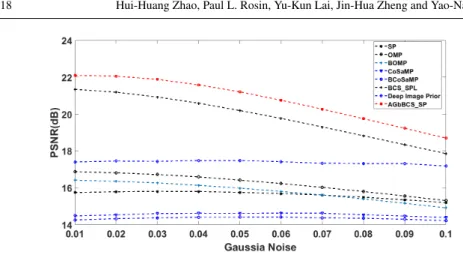
In the next experiment, we used the INRIA Copydays dataset with addedGaussian
noiseσ∈[0.01,0.1]. The comparison results are shown through the experiments with
Fig. 15 Quantitative comparison based on different methods for the INRIA Copydays dataset.
Fig. 16 Parameter analysis with differentδandλforwoman
From figure 15, one can see that the proposed AGbBCS SP approach always obtains the best result in terms of PSNR as compared to SP, OMP, BOMP, CoSaMP, BCoSaMP, Deep Image Prior, and BCS SPL.
5.4 Parameters Analysis
λ can be used to improve the result for AGbBCS SP to cope with different noise
levelsδ. We do an experiment with the imagewomanwith different values ofδ and λ, and set M=200. We find that for different values ofδ, λ ∈[15,60] typically
achieves the best results, and largerλ tends to produce better results with higher
noise level (largerδ). Note that in our approachλ is automatically selected, which
6 Conclusions
This paper proposes an adaptive gradient-based block compressive sensing (AGb-BCS SP) approach on the basis of the sparsity of the image.
– Besides splitting the image into square blocks, a new image block splitting method for compressive sensing is proposed. We split the image into rectangular blocks with different shapes (aspect ratios). Our adaptive Compressive Sensing scheme makes a practical assumption that only a small, randomly chosen image part re-quires to be known. The proposed method automatically selects the control factor and the appropriate block shape that maximizes the sparsity of the signal in the known region.
– After block shape selection, the image is split by using the selected block size, the proposed gradient-based method is applied for reconstruction. The proposed method also adaptively selects a control factor which controls anl1norm
expres-sion in the optimization problem by comparing the sparsity of the reconstruction results. Finally through an inverse transformation, the reconstructed signal can be obtained.
– Experiments reveal that in block compressive sensing the square block shape does not always produce the best results. Our algorithm can adaptively achieve better results by using the sparsity of pixels to adaptively select block shape. The pro-posed algorithm can achieve better results according to PSNR than classical algo-rithms with different block shapes (1×256, 2×128, 4×64, 8×32, 16×16, 32×8, 64×4, 128×2 and 256×1). The performance is improved greatly. WhenGaussian
noise [0.01, 0.1] is added, the proposed algorithm maintains better performance than SP, OMP, BOMP, CoSaMP, BCoSaMP and BCS SPL according to their av-erage PSNRs. For different levels of noiseδ, the proposed method for adaptive
selection ofλ produces better results than existing methods. The proposed
algo-rithm can achieve the best results in average PSNR than the classical algoalgo-rithms SP, OMP, BOMP, CoSaMP and BCoSaMP on several datasets. With addedsalt
&peppernoiseδ=0.05. BCS SPL can achieve better results than the proposed
algorithm when the sampling rateu≤0.3. However, BCS SPL has a poor per-formance on de-noising. With an increasing number of samples, BCS SPL gets worse reconstruction results. When the sampling rateu>0.3, the proposed algo-rithm can achieve better average PSNR than BCS SPL.
– We also find that if a block can achieve greater sparsity than its neighboring blocks, it can generate a better reconstruction result than its neighbors. Such vi-sual differences lead to some blocky artifacts in the reconstruction image. Future work will investigate how to avoid blocky artifacts, and more relationships be-tween sparsity of pixels and block shape will also be researched.
Acknowledgements
This work was supported by National Natural Science Foundation of China (61503128), Science and Technology Plan Project of Hunan Province (2016TP102), Scientific Re-search Fund of Hunan Provincial Education Department (16C0226,17C0223,18A333),
Hengyang guided science and technology projects and Application-oriented Special Disciplines (Hengkefa [2018]60-31), Double First-Class University Project of Hunan Province (Xiangjiaotong [2018]469), Hunan Province Special Funds of Central Gov-ernment for Guiding Local Science and Technology Development (2018CT5001) and Subject Group Construction Project of Hengyang Normal University (18XKQ02). We would like to thank NVIDIA for the GPU donation.
References
1. Beck, A., Teboulle, M.: A fast iterative shrinkage-thresholding algorithm for linear inverse problems. Siam Journal on Imaging Sciences2(1), 183–202 (2009)
2. Bi, D., Xie, Y., Li, X., Zheng, Y.R.: Efficient 2-D synthetic aperture radar image reconstruction from compressed sampling using a parallel operator splitting structure. Digital Signal Processing50, 171– 179 (2016)
3. Bigot, J., Boyer, C., Weiss, P.: An analysis of block sampling strategies in compressed sensing. IEEE Transactions on Information Theory62(4), 2125–2139 (2016)
4. Blumensath, T., Davies, M.E.: Iterative hard thresholding for compressed sensing. Applied and Com-putational Harmonic Analysis27(3), 265–274 (2009)
5. Bo, C., Wang, D.: A registration-based tracking algorithm based on noise separation. Optik-International Journal for Light and Electron Optics126(24), 5806–5811 (2015)
6. Cai, T.T., Wang, L.: Orthogonal matching pursuit for sparse signal recovery with noise. Information Theory, IEEE Transactions on57(7), 4680–4688 (2011)
7. Chartrand, R.: Exact reconstruction of sparse signals via nonconvex minimization. Signal Processing Letters, IEEE14(10), 707–710 (2007)
8. Chen, S.S., Donoho, D.L., Saunders, M.A.: Atomic decomposition by basis pursuit. SIAM journal on scientific computing20(1), 33–61 (1998)
9. Cui, H., Zhang, S., Gan, X., Shen, M., Wang, X., Tian, X.: Information recovery via block compressed sensing in wireless sensor networks. In: 2016 IEEE International Conference on Communications (ICC), pp. 1–6 (2016)
10. Dai, W., Milenkovic, O.: Subspace pursuit for compressive sensing signal reconstruction. Information Theory, IEEE Transactions on55(5), 2230–2249 (2009)
11. Daubechies, I., DeVore, R., Fornasier, M., G¨unt¨urk, C.S.: Iteratively reweighted least squares mini-mization for sparse recovery. Communications on Pure and Applied Mathematics63(1), 1–38 (2010) 12. Davenport, M.A., Needell, D., Wakin, M.B.: Signal space CoSaMP for sparse recovery with redundant
dictionaries. IEEE Transactions on Information Theory59(10), 6820–6829 (2013)
13. Deswal, S., Singhania, S., Gupta, S., Garg, P.: An optimised fuzzy approach to remove mixed noise from images. International Journal of Signal Processing, Image Processing and Pattern Recognition 9(4), 293–322 (2016)
14. Donoho, D.L.: De-noising by soft-thresholding. Information Theory, IEEE Transactions on41(3), 613–627 (1995)
15. Donoho, D.L.: Compressed sensing. IEEE Transactions on information theory52(4), 1289–1306 (2006)
16. Donoho, D.L., Elad, M., Temlyakov, V.N.: Stable recovery of sparse overcomplete representations in the presence of noise. IEEE Transactions on information theory52(1), 6–18 (2006)
17. Eldar, Y.C., Kuppinger, P., Blcskei, H.: Block-sparse signals: Uncertainty relations and efficient re-covery. IEEE Transactions on Signal Processing58(6), 3042–3054 (2010)
18. Fowler, J.E., Mun, S., Tramel, E.W.: Multiscale block compressed sensing with smoothed projected Landweber reconstruction. In: Signal Processing Conference, 2011 European, pp. 564–568 (2015) 19. Gan, L.: Block compressed sensing of natural images. In: Digital Signal Processing, 2007 15th
Inter-national Conference on, pp. 403–406. IEEE (2007)
20. Gilbert, A.C., Hemenway, B., Rudra, A., Strauss, M.J., Wootters, M.: Recovering simple signals. In: Information Theory and Applications Workshop (ITA), 2012, pp. 382–391 (2012)
21. Huggins, P.S., Zucker, S.W.: Greedy basis pursuit. Signal Processing, IEEE Transactions on55(7), 3760–3772 (2007)
22. Hurley, N., Rickard, S.: Comparing measures of sparsity. IEEE Transactions on Information Theory 55(10), 4723–4741 (2009)
23. Jegou, H., Douze, M., Schmid, C.: Hamming embedding and weak geometric consistency for large scale image search. Computer Vision–ECCV 2008 pp. 304–317 (2008)
24. Li, F., Lu, H., Wang, D., Wu, Y., Zhang, K.: Dual group structured tracking. IEEE Transactions on Circuits and Systems for Video Technology26(9), 1697–1708 (2016)
25. Li, S., Da Xu, L., Wang, X.: Compressed sensing signal and data acquisition in wireless sensor net-works and internet of things. IEEE Transactions on Industrial Informatics9(4), 2177–2186 (2013) 26. Liu, H., Wang, W.: Block compressed sensing reconstruction with adaptive-thresholding projected
landweber for aerial imagery. Journal of Applied Remote Sensing9(1), 095,037–095,037 (2015) 27. Lu, H., Li, B., Zhu, J., Li, Y., Li, Y., Xu, X., He, L., Li, X., Li, J., Serikawa, S.: Wound intensity
cor-rection and segmentation with convolutional neural networks. Concurrency and computation: practice and experience29(6), e3927 (2017)
28. Lu, H., Li, Y., Chen, M., Kim, H., Serikawa, S.: Brain intelligence: go beyond artificial intelligence. Mobile Networks and Applications23(2), 368–375 (2018)
29. Lu, H., Li, Y., Mu, S., Wang, D., Kim, H., Serikawa, S.: Motor anomaly detection for unmanned aerial vehicles using reinforcement learning. IEEE Internet of Things Journal (2017)
30. Lu, H., Li, Y., Uemura, T., Kim, H., Serikawa, S.: Low illumination underwater light field images re-construction using deep convolutional neural networks. Future Generation Computer Systems (2018) 31. Lu, W., Vaswani, N.: Modified basis pursuit denoising (modified-BPDN) for noisy compressive sens-ing with partially known support. In: Acoustics Speech and Signal Processsens-ing (ICASSP), 2010 IEEE International Conference on, pp. 3926–3929 (2010)
32. Melli, S.A., Wahid, K.A., Babyn, P., Montgomery, J., Snead, E., El-Gayed, A., Pettitt, M., Wolkowski, B., Wesolowski, M.: A compressed sensing based reconstruction algorithm for synchrotron source propagation-based x-ray phase contrast computed tomography. Nuclear Instruments and Methods in Physics Research Section A: Accelerators, Spectrometers, Detectors and Associated Equipment806, 307–317 (2016)
33. Mun, S., Fowler, J.E.: Block compressed sensing of images using directional transforms. In: Image Processing (ICIP), 2009 16th IEEE International Conference on, pp. 3021–3024. IEEE (2009) 34. Mun, S., Fowler, J.E.: DPCM for quantized block-based compressed sensing of images. In: Signal
Processing Conference (EUSIPCO), 2012 Proceedings of the 20th European, pp. 1424–1428. IEEE (2012)
35. Needell, D., Tropp, J.A.: CoSaMP: Iterative signal recovery from incomplete and inaccurate samples. Applied and Computational Harmonic Analysis26(3), 301–321 (2009)
36. Needell, D., Vershynin, R.: Uniform uncertainty principle and signal recovery via regularized orthog-onal matching pursuit. Foundations of computatiorthog-onal mathematics9(3), 317–334 (2009)
37. Osher, S., Mao, Y., Dong, B., Yin, W.: Fast linearized Bregman iteration for compressive sensing and sparse denoising. arXiv preprint arXiv:1104.0262 (2011)
38. Parikh, N., Ream, J.M., Zhang, H.C., Block, K.T., Chandarana, H., Rosenkrantz, A.B.: Performance of simultaneous high temporal resolution quantitative perfusion imaging of bladder tumors and conven-tional multi-phase urography using a novel free-breathing continuously acquired radial compressed-sensing mri sequence. Magnetic resonance imaging34(5), 694–698 (2016)
39. Qaisar, S., Bilal, R.M., Iqbal, W., Naureen, M., Lee, S.: Compressive sensing: from theory to applica-tions, a survey. Communications and Networks, Journal of15(5), 443–456 (2013)
40. Qin, Z., Liu, Y., Gao, Y., Elkashlan, M., Nallanathan, A.: Wireless powered cognitive radio networks with compressive sensing and matrix completion. IEEE Transactions on Communications65(4), 1464–1476 (2017)
41. Ren, X., Qiao, L.: A novel strategy for inverse synthetic aperture radar imaging based on improved compressive sensing. IEEJ Transactions on Electrical and Electronic Engineering11(2), 140–145 (2016)
42. Safavi, S.H., Torkamani-Azar, F.: Sparsity-aware adaptive block-based compressive sensing. IET Signal Processing11(1), 36–42 (2016)
43. Serikawa, S., Lu, H.: Underwater image dehazing using joint trilateral filter. Computers & Electrical Engineering40(1), 41–50 (2014)
44. Tropp, J.A., Gilbert, A.C.: Signal recovery from random measurements via orthogonal matching pur-suit. Information Theory, IEEE Transactions on53(12), 4655–4666 (2007)
45. Ulyanov, D., Vedaldi, A., Lempitsky, V.: Deep image prior. In: IEEE Conference on Computer Vision and Pattern Recognition, pp. 9446–9454 (2018)
46. Unde, A.S., Deepthi, P.: Block compressive sensing: Individual and joint reconstruction of correlated images. Journal of Visual Communication and Image Representation44, 187–197 (2017)
47. Wang, J., Kwon, S., Li, P., Shim, B.: Recovery of sparse signals via generalized orthogonal matching pursuit: A new analysis. IEEE Transactions on Signal Processing64(4), 1076–1089 (2016) 48. Xu, J., Qiao, Y., Fu, Z.: Adaptive perceptual block compressive sensing for image compression. IEICE
TRANSACTIONS on Information and Systems99(6), 1702–1706 (2016)
49. You, H., Zhu, J.: Image reconstruction based on block-based compressive sensing. In: Proceedings of the 38th Australasian Computer Science Conference (ACSC 2015), vol. 27, p. 30 (2015)
50. Zhang, Z., Jung, T.P., Makeig, S., Rao, B.D.: Compressed sensing for energy-efficient wireless tele-monitoring of noninvasive fetal ecg via block sparse bayesian learning. IEEE Transactions on Biomedical Engineering60(2), 300–309 (2013)
51. Zhao, C., Ma, S., Zhang, J., Xiong, R., Gao, W.: Video compressive sensing reconstruction via reweighted residual sparsity. IEEE Transactions on Circuits and Systems for Video Technology27(6), 1182–1195 (2017)
52. Zhao, H., Wang, Y., Qiao, Z., Fu, B.: Solder joint imagery compressing and recovery based on com-pressive sensing. Soldering & Surface Mount Technology26(3), 129–138 (2014)
53. Zhao, H., Zhao, H., Chen, J., Chen, J., Xu, S., Xu, S., Wang, Y., Wang, Y., Qiao, Z., Qiao, Z.: Com-pressive sensing for noisy solder joint imagery based on convex optimization. Soldering & Surface Mount Technology28(2), 114–122 (2016)
54. Zhao, W., Lu, H., Wang, D.: Multisensor image fusion and enhancement in spectral total variation domain. IEEE Transactions on Multimedia20(4), 866–879 (2018)