Introducing Component Based Software Engineering at an Embedded
Systems Sub-Contractor
Mikael Åkerholm, Kristian Sandström and Ivica Crnkovic
Mälardalen Real-Time Research Centre (MRTC)
Mälardalen University, Västerås, Sweden
{mikael.akerholm, kristian.sandstrom and ivica.crnkovic}@mdh.se
Abstract
Attractive benefits with successful implementation of component-based principles include managing complex-ity, reduction of time-to-market, increased qualcomplex-ity, and reusability. Deployment of component-based develop-ment is however not simple - it depends on many strate-gic, technical, and business decisions. In this paper we report experiences from our attempts with finding a cor-rect implementation of component-based principles for the business situation of sub-contractors of embedded systems.
Findings related to suitable component models, com-ponent technologies, and comcom-ponent management are presented. Overall the results confirm the suitability of component-based principles for the domain, but also show the need (and potential) in further development of CBSE theory and technology for embedded systems.
1
Introduction
In this paper we report our experiences from introducing Component-Based Software Engineering (CBSE) [11, 14] at the company, CC Systems1, act-ing as sub-contractor and Commercial Off The Shelf (COTS) components supplier for embedded systems.
CBSE can be seen as analogous to engineering ap-proaches in other engineering domains. For examples, mechanical engineers build systems using well-specified components such as nuts and bolts, and the building industry uses components as large as walls and roofs (in turn assembled from smaller components). CBSE has proven to be effective for desktop and web-applications, however, not yet for development of software for em-bedded systems. Implementation and deployment of
1Cross Country Systems, http://www.cc-systems.com
CBSE for development of embedded systems is not trivial. As its success depends on many factors where some of them are selection (or development) of a com-ponent technology that can be efficiently used in the development and maintenance process, and satisfy the run-time requirements of the particular domain.
We present experiences from four cases in this pa-per. One case, SaveCCT, is a study where a group of researches demonstrates a prototype component tech-nology in a real industrial environment. The second case, CrossTalk, utilises CBSE principles for realizing a software platform supporting "any" system consisting of the company’s hardware. The third case, CC Com-ponents, make use of a component repository when possibilities to create or reuse components arise in the development projects. Finally, the fourth study is an evaluation of a method supporting the sometimes nec-essary work with adaptation of components to fit usage in different development projects.
Our findings indicate that CBSE principles are suit-able for embedded systems sub-contractors, but it might be harder to practice CBSE as sub-contractor than product owning company. The necessary tech-nical needs of, e.g., expressiveness in the component models, resource efficiency of component based applica-tions, and analysis possibilities can be considered met. The following section (section 2) presents the mo-tivation and goals with the research presented in this paper. Section 3 presents data for the different cases we have studied. The findings from our experiences when working with the different cases are reported in section 4. A discussion of the results is provided in section 5. Finally, section 6 concludes the paper.
2
Goals and Motivation
The primary goal of this experience paper is to con-tribute to the overall understanding of the needs of 1
component technologies and processes for practicing CBSE in the domain of embedded control systems for vehicles and machines.
The studies have all been performed at CC Systems engineering sites in Finland and Sweden. CC Systems develops electronics targeting vehicles and machines in rough environments. From software and hardware con-trolling safety critical by-wire functions, to software and hardware for powerful on-board display based in-formation systems with back-office connections.
The studies focus on the control related part of the systems. The focus is chosen because CBSE as ap-proach have had a limited success for development of such systems, in comparison to the domain of PC ap-plications where the approach has emerged. The major reason to this is a number of important qualities that leaven all through the software life-cycle, e.g., safety, reliability, timing, and resource efficiency. It known that these qualities are not addressed by most existing commercial component technologies, and consequently these systems cannot be developed with such compo-nent technologies. However, many component tech-nologies that might be suitable exists within academia and some are to a limited extent used within indus-try, e.g., Koala [24] used internally at Philips2, Rubus [18] used by some Swedish vehicle manufacturers, and different implementations of the IEC61131-3 standard [16]. However, as pointed out in [9], there is currently no de-facto standard component technology within the domain of vehicular systems; although CBSE seams to get a lot of attention from industry, e.g., East3 and Autosar4. This leads us to the goal of assessing if the limited success of CBSE in the domain is depending on an inability of existing commercial technologies to support the requirements of embedded vehicular appli-cations.
Another very interesting question is how an ideal component model for the domain should take the trade-off between supporting predictability, and ease to ex-press common functionality in vehicular control sys-tems? The core part of a component model is related to defining what a component is, and possibilities for component interaction. There are several important design decisions that have to be made when defining a component model and one is the trade-off between flexibility and predictability. It is the trade-off with re-spect to ease of implementing vehicular control systems (high degree of flexibility), and support for prediction of quality attributes considered important in the do-main (high degree of predictability). A design choice
2Philips, http://www.philips.com/ 3East, http://www.east-eea.net/ 4Autosar, http://www.autosar.org
of our suggested component model, SaveCCM [12], is in contrast to many of the current component mod-els to sacrifice some flexibility to facilitate analysis and predictability.
Finally resource-efficiency (the consumption of a minimum of resources in achieving an objective) is important in the domain since products are typically produced in high volumes. Poor resource efficiency in component frameworks might be an important reason for not choosing CBSE [9]. At the same time the ba-sic ideas of CBSE has been driven from the needs of PC/Internet applications where resource efficiency typ-ically is not an issue. A reusable component should according to CBSE theory be general. An obvious method to create a general component is to implement support for many methods that might suit different purposes. Using this approach imply that you might end up with using only a small part of the component, and the rest is "dead code" in the application. This might be a problem for resource constrained embedded systems, and highly recommended to avoid for systems with high Safety Integrity Level (SIL), i.e., SIL 2 and above in IEC61508 [15].
3
CBSE Activities
Four CBSE activities are summarized in the fol-lowing sub-sections, denoted Case 1-4. Case 1 is a study by a group of researchers in a real industrial environment; the study evaluates technical properties of a component technology. In Case 2, the company utilises CBSE principles for realizing a Product-Line Architecture (PLA) [7] for platform software, here the suitability of CBSE and the component technology are evaluated. In Case3 component-based reuse is prac-ticed when opportunities arise, here the CBSE princi-ples in this context are evaluated. Finally,Case 4 is an evaluation by researchers in an industrial environment of a method related to component adaptation, here the method itself is evaluated. The experiences and lessons learned of the cases are summarised in section 4.
3.1
Case 1, SaveCCT
Case 1 is a demonstration of the component tech-nology SaveCCT [1], by usage on a fictive but repre-sentative application in a real industrial environment at CC Systems. The main purpose with this case is evaluation of the technical properties of the component technology.
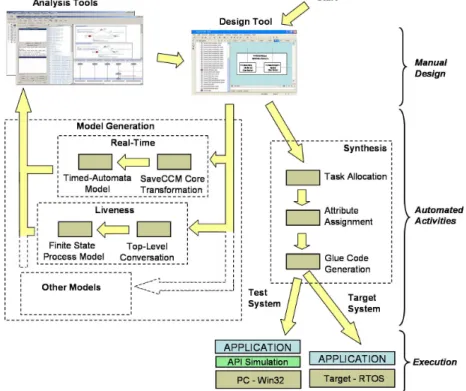
The research prototype of the SaveComp Compo-nent Technology (SaveCCT) used during this study is visualized in Figure 1. SaveCCT is described at the
Figure 1. An overview of our research prototype SaveCCT
top level, by distinguishing manual design, automated activities, and execution.
Manual design is the entry point for the develop-ment; here a component-based strategy is used, sup-ported by a set of tools for design and analysis. The SaveCCT design tool provides support for graphical as-sembly of applications from existing components. The tool allows designers to specify the component inter-connection logics, and express high level constraints on the resulting application. Assembling components is done with respect to the rules of the SaveComp Component Model (SaveCCM) [12]. The component model defines different component types that are sup-ported by SaveCCT, possible interaction schemes be-tween components, and clarifies how different resources are bound to components. As shown in the figure, SaveCCT incorporates a number of analysis tools, which can be used for verifying specific attributes of the application, e.g., related to timeliness and safety. To efficiently incorporate an analysis tool, as much as possible of the translation from the model created with the design tool to the model required by the desired analysis tool should be automated. In this study we incorporated LTSA [19], and Times [3].
Automated activities produce necessary code for the run-time system (i.e., glue-code), and different spe-cialized models of the application for analysis tools.
The synthesis activity generates all low level code (i.e., hardware and operating system interaction), meaning that components are free from dependencies to the underlying platform. Furthermore, the code genera-tion step statically resolves resource usage and timing, with the strategy to resolve as much as possible during compile-time instead of depending on costly run-time algorithms.
To achieve efficient and predictable run-time be-haviour, and reliable support for pre-runtime anal-ysis, SaveCCT assumes a real-time operating sys-tem (RTOS) as underlying platform. The prototype used the Quadros5 RTXC operating system, which is a standard fixed-priority pre-emptive multitasking RTOS used in some applications by CC Systems. The supported target hardware in the current version is CrossFire MX1 from CC Systems, which is an elec-tronic control unit intended for control systems run-ning in rough environments. To facilitate testing and debugging we incorporate CCSimTech [20], which is a simulation framework that offers generic hardware em-ulation components for common hardware in embed-ded systems, e.g., I/O (digital and analogue), network technologies, and memories. This environment repre-sents a typical platform used in development projects
by CC Systems, and thus serves as an example of an industrial environment for the SaveCCT prototype.
3.2
Case 2, CrossTalk
Case 2, CrossTalk [6], is an initiative driven by CC Systems, which have taken influences from the re-search demonstrated in Case 1. The main goal with this initiative is to take advantage of the support for product-line architectures that component-based ap-proaches give. The goal is rapid and cost effective assembly of platform software, through enabling ad-dition and/or replacement of components to a baseline platform depending on the needs from a certain ap-plication. The CrossTalk platform has been used in numerous real development projects by CC Systems.
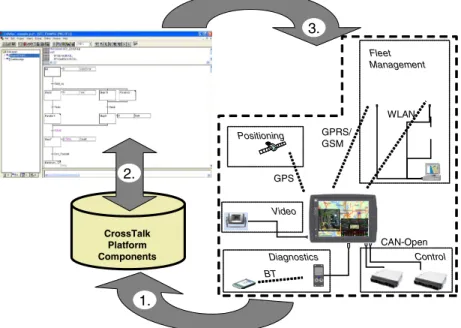
A CrossTalk based system is built on an open-ended component-based CrossTalk platform, the concept is to haveoneplatform to buildany system consisting of the company’s own hardware. Figure 2 illustrates the concept, which we describe here with the following list: 1. System architecture, in terms of computer nodes and their responsibility is established. The hard-ware for a CrossTalk system are selected among more than ten different nodes, e.g., control mod-ules, communication gateways, and display units. The communication between the different nodes on the machine is based on CANopen6this means that it is also possible to integrate any third-party node in the system that uses the CANopen pro-tocol, but treatment of such nodes is beyond the scope of this paper.
2. Based on the functionality designated to each computer node, platform components from the CrossTalk repository are selected to constitute software platform for each node in the system. The repository is based on a standard version control system, and the components are IEC61131-3 [16] components. The components are assembled using the CoDeSys tool from 3S7.
3. The open-ended platform software is deployed on each of the nodes in the system; the application is then built by the customer or by CC Systems in a separate project, by continuing the work in the CoDeSys tool.
3.3
Case 3, CCComponents
CC Components is another initiative with influences fromCase 1. Here the intention is to package reusable
6CiA, CANopen, http://www.can-cia.org/ 73S CoDeSys, http://www.3s-software.com/
parts of applications into software components, and to reuse components when suitable. Notice here that the intention is not to build entirely component-based sys-tems; systems are built through a combination of com-ponents and non-component-based software.
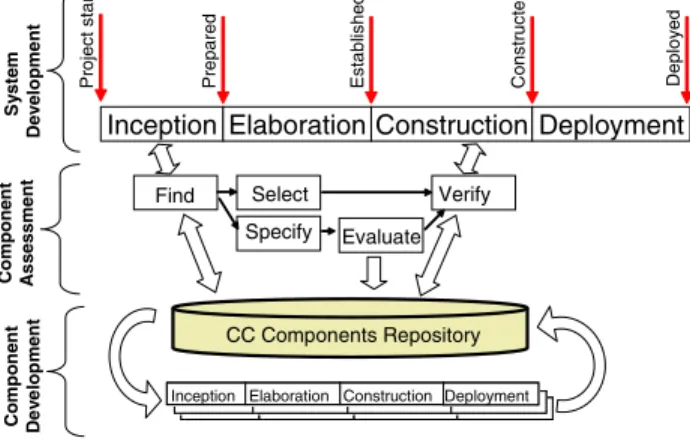
To efficiently take advantage of CBSE, development processes for system development, component assess-ment, and component development are separated, as proposed in e.g., [10].
As demonstrated in Figure 3, CC Systems has a system development process based on Rational Unified Process (RUP)8, thus this process needs no further de-scription here. In the inception phase all development projects should initiate a component assessment pro-cess with the intention to find suitable components to reuse, and suggestions for specifications of components to develop. The component assessment process has the following steps:
Find, component assessment starts with finding com-ponents that might provide the required function-ality for some part in the project.
Select, if candidate components for reuse are found, the selection of which components to reuse in the project is documented and motivated.
Specify, if no candidate components are found, but the project finds a certain part of the system very suitable to be packaged as a reusable component a specification for such a component is created. Evaluate, specifications are evaluated by the CC
Components board (a group responsible for the repository). Generally, the board must be con-vinced that the suggested component will be tar-get for reuse in other projects, before a separate component development project is initiated. Verify, this step is required to test that the
compo-nent really fits the intended purpose as soon as possible to avoid that the component is assumed to be fit and well-tested until the very late stages in the system development project.
Component development is guided by the same RUP-based process as system development, but the target to develop reusable components is made clear through lifting the development from the process of a particular project to a separate process ending with de-livery to the common company-wide CC Components repository. There is no formal component definition. The only technical requirement is that the components
CrossTalk Platform Components GPRS/ GSM Control Fleet Management Video Diagnostics Positioning WLAN 1. 2. 3. CAN-Open GPS BT
Figure 2. Workflow when assembling a software platform for a CrossTalk-based system
in the repository must have all their dependencies spec-ified in the interfaces, combined with requirements on standardized documentation.
3.4
Case 4, Component Metadata for Traceability
Case 4, is an evaluation of a prototype implemen-tation [22] of a method supporting component assess-ment, and component development. The theory behind the method is described in [2], it is based on work by Orso et.al. [21] suggesting to (re)use component meta-data to support software engineering tasks. The need is based on experiences fromCase 3, where component assessments often results in needs for component adap-tations, this will be further discussed in section 4. This case is based on a prototype demonstration on a rep-resentative software component, for a group consisting of two project managers, four developers, and one sales manager.
Figure 4, gives an overview of the method. The method affects the processes of component assessment, and component development, and there is a metadata associated with all components which is central in the method. The purpose of the metadata is to maintain traceability of requirements through design and testing during component development.
The metadata is collected during component devel-opment, and the arrows in the metadata in the figure illustrates that the metadata contains references be-tween requirements, design, and test cases associated with the component. This information is traceability
information of how the requirements fulfilled by the component are related to the internal realization of the component, and how the different test cases relate to different parts of the realization and different require-ments.
The component assessment process has, in compari-son toCase 3 Figure 3, a new activity after Find called Modify:
Modify, here modification requests of existing com-ponents are created, when modifications are nec-essary for the system development project. These requests are then evaluated by the board of CC Components in the following Evaluation step, as previosly desribed inCase 3.
During the component assessment the metadata with traceability is utilized for performing impact anal-ysis of a desired modification of a component. The pur-pose of the impact analysis is to estimate the amount of work and consequences of performing the desired modification. A prototype tool has been developed that automatically produces analysis of which parts of a components design and test cases that are affected by a modification. Where the modifications are de-fined through giving the desired change of the require-ments. The output is used as input to the evaluation step where the board decides whether the component modification should be performed or dismissed.
During the component development process where a new variant of a component is developed, the impact
Inception Elaboration Construction Deployment Pr ojec t s tar t Pr epar ed Es tabl is he d Cons tr uc ted Deploy ed S y st em Dev e lo pme n t Co mpo n en t A s sessme n t Comp on ent De v e lop m en t CC Components Repository Select Verify Find Specify
Inception Elaboration Construction Deployment Inception Elaboration Construction Deployment
Evaluate
Figure 3. CC Components development pro-cesses
analysis gives guidance to the work. It gives informa-tion of which parts of the component that should be modified. It also specifies which test case that should be used for regression testing after the change, i.e., points out which test cases that must produce the same results.
The need to adapt software components have been known in the CBSE community, e.g., a survey on the topic in 1999 [13]. Common for many of the proposed techniques is the support for configuration of compo-nents, e.g., [8, 4]. However, the flip-side with these techniques is that future scenarios must be predicted, and that the configuration code increase complexity and thereby resource usage. The other main principle for existing techniques is to apply external adaptation through wrappers [5], adaptors [25], or connectors [17]. The main limitation here is that optimization of the component’s internal realization is not possible, e.g., it is not possible to remove functionality. Thus, none of these techniques is perfect for the problem we have en-coutered with resource constrained embedded systems.
4
Experiences
In this section we summarize the findings from the above reported cases. We do this case by case.
4.1
Case 1
The component model is based on data-flow (or pipes-and-filters) interaction, this has been chosen to give good support for expressing the key functionality of control systems. Designing the fictive application according to component-based principles was relatively
Component As sessmen t Component Devel opmen t Requirements
Inception Elaboration Construction Deployment
Design Verification Me ta d a ta Select Verify Find Specify Evaluate Modify
Requirements Design Verification
Figure 4. Using metadata in component as-sessment and component development
straight-forward, and SaveCCM proved sufficiently ex-pressive for this type of system.
The close integration of analysis tools, exemplified by LTSA and Times, enabled the researchers to de-rive a number of non-trivial properties automatically or with little manual intervention. In particular, the high predictability imposed by the SaveCCM semantics allowed analysis of properties crucial to ensure correct real-time behaviour, such as end-to-end response times. Likewise, the integration of CCSimTech provided good support for testing.
The resulting system was sufficiently resource effi-cient. It utilizes only a small part of the available ca-pacity in the target hardware, which is approximately the utilization expected for this application in com-bination with state-of-practice programming methods (i.e., C and C++). The explicit triggering allows the synthesis mechanism to minimize communication over-head by identifying static triggering patterns.
We should also make clear that the demonstrated component technology was considered unusable in real development projects, since the quality and usability of the included prototype tools was considered below tolerable levels. Mature tools is a basic need in prac-tice.
4.2
Case 2
The component model, i.e., IEC61131-3 with its roots in the automation domain, is based on data-flow (or pipes-and-filters) interaction. Studying this case fortify that this is a suitable component interface also in the vehicular domain for control related systems. Numerous control systems have successfully been built for vehicles and machines based on the CrossTalk con-cept.
Reuse of low-level components (i.e., CrossTalk plat-form components) through component based princi-ples is successfully practiced in this case. The expe-rience is that product-line architectures for platform software can be efficiently created with component-based principles. The company also stresses that the component-based principles in this case results in short and predictable development projects, and higher soft-ware quality.
Regarding resource efficiency, it is known that the CoDeSys run-time framework requires additional pro-cessing compared to realizing the system with lower level programming of the hardware. Thus, it is a trade-off between resource efficiency and development effi-ciency.
4.3
Case 3
Overall the introduction of a company-wide compo-nent repository is a success, every time a well-tested component can be reused "as is" without modification there is a good return of the investments made in the component development. Reuse was practiced before, but more unstructured, depending of the knowledge about reusable software assets inside the project team. The evaluation step of component specifications is seen as promising for the future to ensure that only reusable components are developed.
However, problems with reusing components have also been identified, which might be similar for other sub suppliers to customers with high volumes or safety critical applications. The basic foundation of CBSE, to build general components that can be (re)used in many applications, is harder to practice for a sub-supplier, especially in the domain of embedded control systems. Components may require functional additions or adap-tation associated with reuse. The adaptation needs seems to be higher for the sub-suppliers business case. At the same time, due to domain requirements, com-ponents can often not include any extra functional-ity. Instead of being based on general components, applications must be dedicated and specialized to its task for high volume products. Safety critical applica-tions are even worse since no "dead code" is allowed in source files or on target for certification according to the higher SIL levels of, e.g., IEC61508 [15]. Practicing reuse under these circumstances often require adapta-tions.
4.4
Case 4
The conclusion from Case 4 is that the method is promising to support the adaptation needs. The
method causes no overhead in the internal realisation of software component itself, and the components can be highly specialized for every scenario. If this can be efficiently implemented in practice, it supports the adaptation needs identified at the company.
Another positive side is reuse of the documenta-tion of the traceability informadocumenta-tion given through the graphs in the metadata. This is becoming more and more important for all companies in the domain, due to legislation of using system safety standards in de-velopment. The IEC61508 standard [15], which is the main standard for functional safety of electronic pro-grammable systems, requires traceability of require-ments through the different stages of development. CMMI [23], a process improvement approach, even re-quires bidirectional traceability. This is the ability to trace requirements both forward and backward, i.e., re-quirements through the development process into the product and from the product backwards to require-ments. This becomes possible, reusable, and well-documented, through the metadata.
On the negative side were the developers’ concerns about using one tool more, when you ideally would like as few tools as possible to work efficiently. Another concern was the effort to create the dependency graphs, which might be time consuming and complex for big components.
5
Discussion
Here we discuss the findings related to the goals stated in section 2.
One of the purposes with the studies was to eval-uate CBSE as engineering approach for the domain. To start with, the continuous interest and investments from the company in these activities indicates that CBSE is an attractive engineering approach. The suc-cess with both increased efficiency and quality inCase 2 andCase 3, generally demonstrates the potential of CBSE and especially when it comes to PLA. It also shows that component technologies with tool-suites that are mature enough for industrial needs exist, here manifested through CoDeSys. Whether the functional blocks of the IEC61131-3 standard qualify as real soft-ware components according to some definition remains unsaid, but it is here proven that it is possible to treat them as components. The conclusion is that the use of CBSE in the domain should not be limited by lack of existing commercial technologies, even if we cannot dismiss this as a reason.
We could also observe that it can be problematic to reuse components for sub-contractors, primary from
might take contracts on realizing similar functions with slightly different requirements for different customers. If the target systems are safety-critical or produced in high volumes, general components (with the side-effect of being bigger) must often be discarded in favour of solutions tailored for the particular system.
It is interesting that within the same company it was possible to observe the usage of CBSE as product owner in Case 2, and as sub-contractorCase 3. The experiences from this is that it is definitively easier to take advantage of CBSE being a product-owner, in fact being a product owner you actually plan for reuse. The next generation of the system will most likely be an improvement of the existing system; it becomes natural to take reuse of existing components into consideration when planning for the next generation.
Next important concern from section 2 is the trade-off between flexibility and predictability in component models. Both in Case 1 and Case 2, where more formal component models were used, the component model was based on data-flow (or pipes-and-filters) interaction, this has been chosen to give good sup-port for expressing the key functionality of control systems. Designing the fictive application according to component-based principles was relatively straight-forward, and SaveCCM proved sufficiently expressive for this type of system. CrossTalk has been used for numerous real control systems and it has proven to be suitable in every case. The basic interaction mecha-nism is thus well proven in practice, but important to stress is that we cannot dismiss other component in-teraction approaches from our studies. The analysis of real-time and reliability properties demonstrated in
Case 1 shows that is possible to create a component model that is expressive enough for the applications and at the same restrictive enough to allow this type of predictions. However this has not been proven in real projects.
The experiences also justify apprehensions concern-ing risks of poor resource efficiency of component-based applications. However, it is also demonstrated inCase 1that it is possible to resolve resource usage and timing statically during compile-time without costly run-time mechanisms, but this is not yet common in commercial mature technologies. This might actually be one of the reasons for the limited usage of CBSE in the domain today. Furthermore, Case 4 demonstrated a method supporting the adaptation needs, which got positive feedback to address the specialization problem, but it has not been used in real projects.
6
Conclusions and Future Work
In this paper we have reported experiences from four cases where we have introduced/demonstrated CBSE principles at CC Systems.
Overall our findings indicate that CBSE principles are suitable for embedded systems sub-contractors, but also that it might be harder to practice CBSE as sub-contractor than product owner. The most technical needs of expressiveness in the component models, re-source efficiency of component based applications, and analysis possibilities can be considered possible to ful-fil with a combination of the contents in the differ-ent cases. According to our studies the most impor-tant need is related to resource efficiency. Resource efficient component frameworks with mature tools to-gether with support for adaptation of software compo-nents themselves are needed.
For future work it would be interesting to explore more about the impact from the business situation on CBSE. In the domain of control systems for vehicles and machines we can identify three major business sit-uations sub-suppliers on contract basis, COTS suppli-ers, andproduct owners. Note that it might be possible to study all these within a single company, as e.g., CC Systems, hopefully with increased possibilities to limit influences from other differences. Different goals with practicing CBSE would also be interesting to explore in combination with the different business models.
7
Acknowledgements
This work was partially supported by the Swedish Foundation for Strategic Research (SSF) via PROGRESS and Save, and the KK-Foundation (KKS) via Save-IT.
References
[1] M. Åkerholm, J. Carlson, J. Fredriksson, H. Hansson, J. Håkansson, A. Möller, P. Pettersson, and M. Tivoli. The save approach to component-based development of vehicular systems.Journal of Systems and Software, 80(5):655–667, May 2007.
[2] M. Åkerholm, J. Fröberg, K. Sandström, and
I. Crnkovic. A model for reuse and optimization of
embedded software components. In29th International
Conference on Information technology Interfaces, (ITI
2007). IEEE, June 2007.
[3] T. Amnell, E. Fersman, L. Mokrushin, P. Pettersson,
and W. Yi. Times: a tool for schedulability
In Proceedings of 1st International Workshop on
For-mal Modeling and Analysis of Timed Systems. LNCS
Springer, 2003.
[4] J. Bosch. Superimposition: A component
adapta-tion technique.Information and Software Technology, 5(41), 1999.
[5] J. Brant, B. Foote, R. e. Johnson, and D. Roberts.
Wrappers to the rescue. In Proceedings of 12th
Eu-ropean Confernece on Object-Oriented Programming
(ECOOP98), July 1998.
[6] CC Systems. Crosstalk generic control system plat-form. Technical report, CC Systems, 2007.
[7] P. Clements and L. Northrop.Software Product Lines:
Practices and Patterns. ISBN 0-201-70332-7.
Addison-Wesley, 2001.
[8] K. Cooper, J. Zhou, H. Ma, I. L. Yen, and F. Bastani. Code parameterization for satisfaction of qos
require-ments in embedded software. In Proceedings of the
International Conference on Engineering of
Reconfig-urable Systems and Algorithms, 2003.
[9] I. Crnkovic. Component-based approach for
em-bedded systems. In 9th International Workshop on
Component-Oriented Programming, Oslo, June 2004.
[10] I. Crnkovic, M. Chaudron, and S. Larsson.
Component-based development process and
compo-nent lifecycle. In Proceedings of the International
Conference on Software Engineering Advances,
ICSEA’06. IEEE, October 2006.
[11] I. Crnkovic and M. Larsson. Building Reliable
Component-Based Software Systems. Artech House
publisher, 2002. ISBN 1-58053-327-2.
[12] H. Hansson, M. Åkerholm, I. Crnkovic, and M.
Törn-gren. SaveCCM – a component model for
safety-critical real-time systems. In Proc. 30th Euromicro
Conference, pages 627–635, 2004.
[13] G. T. Heineman. An evaluation of component
adaptation techniques. In 2nd ICSE Workshop on
Component-Based Software Engineering, 1999.
[14] G. T. Heineman and W. T. Councill.
Component-based Software Engineering, Putting the Pieces
To-gether. Prentice-Hall, 2001. ISBN: 0-201-70485-4.
[15] International Electrotechnical Commission IEC.
Stan-dard: IEC61508, Functional Safety of
Electri-cal/Electronic Programmable Safety Related Systems. Technical report.
[16] International Electrotechnical Commission IEC.
In-ternational Standard IEC 61131, Programmable
con-trollers, 1992.
[17] K.-K. Lau, L. Ling, and Z. Wang. Composing com-ponents in design phase using exogenous connectors.
In Proceedings of the 32nd Euromicro Conference
on Software Engineering and Advanced Applications.
IEEE, 2006.
[18] K.-L. Lundbäck, J. Lundbäck, and M. Lindberg. De-velopment of dependable real-time applications. Arcti-cus Systems, Dec. 2004.
[19] J. Magee and J. Kramer. Concurrency: State Models
& Java Programs. John Wiley & Sons, Inc., New York,
NY, USA, 1999.
[20] A. Möller and P. Åberg. A Simulation Technology for
CAN-based Systems. CAN Newsletter, 4, December
2004.
[21] A. Orso, M. J. Harrold, D. Rosenblum, G. Rothermel, M. L. Soffa, and H. Do. Using component metacon-tents to support the regression testing of
component-based software. In Proceedings of the International
Conference on Software Maintenance, November 2001.
[22] Q. Tien Le. Component design tool for embedded sys-tem components. Technical report, Masters Thesis, MRTC, Mälardalen Univ., 2008.
[23] SEI. CMMI for development, version 1.2. Technical re-port, Technical Report CMU/SEI-2006-TR-008, 2006, 2006.
[24] R. van Ommering, F. van der Linden, K. Kramer, and J. Magee. The Koala component model for consumer
electronics software. IEEE Computer, 33(3):78–85,
march 2000.
[25] D. M. Yellin and R. E. Strom. Protocol specification
and component adaptors. ACM Trans. on
Program-ming Languages and Systems, 2(19):292–333, March