This
is
the
accepted
version of
this
journal
article:
Walsh,
Shari
P.
,
White,
Katherine
M.
,
Cox,
Stephen
,
&
Young,
Ross
McD.
(2011)
Keeping
in
constant
touch
:
the
predictors
of
young
Australians’
mobile
phone
involvement.
Computers in Human
Behavior,
27(1),
pp.
333
‐
342.
RUNNING HEAD: Mobile phone involvement
Keeping in Constant Touch: The Predictors of Young Australians’ Mobile Phone Involvement
Shari P. Walsh1 Katherine M. White1
Stephen Cox2 Ross McD. Young3
1School of Psychology and Counselling Queensland University of Technology
Victoria Park Road
Kelvin Grove, Qld, Australia 4059 [email protected] [email protected]
2Faculty of Business
Queensland University of Technology 2 George Street
Brisbane, Qld, Australia 4000 [email protected]
3Institute of Health and Biomedical Innovation Queensland University of Technology
60 Musk Avenue
All correspondence concerning this manuscript should be addressed to:- Assoc Prof Katherine White, School of Psychology and Counselling, , University of Technology, Kelvin Grove, Queensland, 4059, Australia.
Abstract
Little is known about the psychological underpinnings of young people’s mobile phone behaviour. In the present research, 292 young Australians, aged 16 to 24 years, completed an on-line survey assessing the effects of self-identity, ingroup norm, the need to belong, and self-esteem on their frequency of mobile phone use and mobile phone involvement, conceptualised as people’s degree of cognitive and behavioural association with their mobile phone. Structural equation modelling revealed that age (younger) and self-identity significantly predicted the frequency of mobile phone use. In contrast, age (younger), gender (female), self-identity and ingroup norm predicted young people’s mobile phone involvement. Additionally, a trend suggesting that the role of self-esteem on mobile phone involvement was related to participants’ need to belong was identified. The present study contributes to our understanding of this phenomenon and provides an indication of the characteristics of young people who may become highly involved with their mobile phone.
Keeping in Constant Touch: The Predictors of Young Australians’ Mobile Phone Involvement.
Since their introduction over 20 years ago, mobile phones have become highly prevalent with youth, in particular, adopting mobile phones as an integral part of their daily lives. Young Australians’, aged in their late teens to mid twenties, are more likely than any other demographic group to use their mobile phones to communicate with others by calling and text messaging and also for additional functions such as downloading music, taking photographs, and accessing the internet to watch sport (Access Economics, 2008; Australian Communications and Media Authority [ACMA], 2007). These
additional functions have moved mobile phones from being telecommunication tools to mobile computers, increasing the popularity of these technological devices (ACMA, 2007). Additionally there are a number of psychological benefits arising from mobile phone use including enhanced connectivity facilitating social inclusion (Peters & ben Allouch, 2005; Wei & Lo, 2006); feelings of safety due to rapid contactability should an emergency occur (Carroll, Howard, Peck, & Murphy, 2002; Pain et al., 2005); and enabling workers to remain contactable by employers and clients (Eost & Flyte, 1998).
In addition to the acknowledged benefits of mobile phone use, however, young people’s involvement with their mobile phones is leading to some problematic outcomes. For instance, the presence and use of mobile phones in schools and other educational institutions (for example, universities and colleges) is disruptive and reduces students’ attention in class (Hiscock, 2004; Selwyn, 2003); debt from mobile phone use is an increasing problem for many young people, leading to financial hardship and, in some cases, bankruptcy (Australian Communications Authority, 2004; Griffiths & Renwick,
2003); and young people frequently use mobile phones while driving, a widely
acknowledged unsafe driving practice (Pennay, 2006; Walsh, White, Hyde, & Watson, 2008). Determining the factors influencing young people’s mobile phone involvement will assist in understanding the development of patterns of mobile phone behaviour which may result in negative outcomes.
Previous mobile phone research has primarily assessed the frequency that people use their mobile phones for calling and text messaging (e.g., Ozcan & Kocak, 2003; Walsh & White, 2006, 2007). However, these measures may not adequately gauge the extent of people’s interactions with their mobile phone given that using mobile phones as mobile computers is becoming more widespread (ACMA, 2007) and that some people are cognitively pre-occupied with their phone when not using it. For instance, young people report thinking about their mobile phone when not using it, being distracted from other tasks when they have their phone with them, and prominently displaying the phone keeping it constantly in their awareness (Walsh & White, 2006; Walsh, White, & Young, 2008). These activities indicate that mobile phone behaviour incorporates both cognitive and behavioural aspects, conceptualised by Walsh, White, and Young (in press) as mobile phone involvement.
Walsh et al. (in press) posit that mobile phone involvement represents a person’s cognitive (such as the extent to which a person thinks about their mobile phone when not using it) and behavioural (such as constantly checking the mobile phone for missed messages or calls) association with their mobile phone. Thus, mobile phone involvement is a broader construct than frequency of use due to its encapsulation of both the cognitive and behavioural aspects of mobile phone behaviour. Similar to highly engaged computer
users (Charlton & Danforth, 2004) and other behavioural addictions (Orford, 2004), people who are involved with their mobile phone may not always be frequent or high users of the technology due to the cognitive component of the construct. Mobile phone involvement is similar to a behavioural addiction but without pathologising
consequences. Nevertheless, characteristics of addiction are posited to underlie mobile phone involvement and form the foundation of the Walsh et al.’s (in press) measurement tool and for the investigation of young people’s mobile phone behaviour in the present research.
Recent literature has drawn on addiction symptoms to measure problematic (Bianchi & Phillips, 2005), compulsive (James & Drennan, 2005), heavy (Jenaro, Flores, Gomez-Vela, Gonzalez-Gil, & Caballo, 2007), intensive (Sanchez-Martinez & Otero, 2008), maladaptive (Beranuy, Oberst, Carbonell, & Chamarrow, 2009), dependent (Billieux, Van der Linden, d'Acremont, Ceschi, & Zermatten, 2007) and addictive tendencies for (Ehrenberg, Juckes, White, & Walsh, 2008; Walsh, White, & Young, 2007) mobile phone use. However, some conceptual and methodological issues have been identified in some of these studies. For instance, Bianchi and Phillips’ (2005) measure of problematic mobile use included items assessing social influences, such as how much friends used a mobile phone, which may have confounded results. In Jenaro et al.’s (2007) study mobile phone over-use was categorised as a pathological behaviour whilst Beranuy et al. (2009) use the term maladaptive, classifications which may be premature as it is not yet clear that negative outcomes of mobile phone use are severe enough to warrant the behaviour being diagnosed as a pathological condition. Other studies have either not reported scale items (Sanchez-Martinez & Otero, 2008); or have
assessed some, but not all, of the proposed indicators of addiction (Ehrenberg et al., 2008; Walsh et al., 2007). These studies, however, indicate that it is younger people whose mobile phone behaviour is most likely to resemble an addictive pattern of behaviour. For this reason, this study focussed on a youth cohort. Additionally, problematic and
inappropriate mobile phone use is more likely among young people reporting symptoms of addiction in relation to their mobile phone behaviour (Bianchi & Phillips, 2005; James & Drennan, 2005; Walsh, White, & Young, 2008).
In addition to identifying that younger users are most likely to be highly involved with their mobile phones and to engage in concerning patterns of behaviour, a number of internal and external factors, such as self and social influences respectively, may impact on young people’s mobile phone behaviour. For instance, mobile phones are reportedly a form of self-expressive identity (Mannetti, Pierro, & Livi, 2002; Walsh & White, 2007) with some users incorporating mobile phones into their sense of self (Srivastava, 2005). Additionally, significant others affect young people’s frequency of mobile phone use and also their type of mobile phone use (Srivastava, 2005; Walsh, White, & Young, 2009) suggesting that social influences, in particular ingroup norms (how much a behaviourally relevant reference group engages in the activity), impact on mobile phone behaviour. Finally, some young mobile phone users report having a mobile phone increases their sense of self-worth as they feel connected to others (Walsh et al., 2009; Wei & Lo, 2006). Thus, psychosocial motivations, such as self-esteem enhancement and the need to belong, may also underlie young people’s mobile phone behaviour. As yet, however, there has been little empirical investigation of the role of these internal and external factors on young people’s mobile phone behaviour. Given the pre-dominantly social nature of
mobile phone use, the present research drew on major concepts in social psychology to develop a preliminary understanding of the role of psychosocial factors in determining young people’s mobile phone behaviour.
It is acknowledged that there may be a number of alternate theoretical approaches which may be utilised to investigate mobile phone behaviour. However, the relatively new nature of research in this domain has not allowed for a coherent theoretical model to be developed. Thus, the present research drew on earlier research, in particular qualitative studies, to identify variables for examination in this study. Specifically, the research assessed the effect of self-identity, ingroup norm, self-esteem, and the need to belong on young people’s mobile phone behaviour as a preliminary examination of factors that may influence this behaviour.
Self-identity
As opposed to mobile phone involvement which focuses on the psychological and behavioural interactions a person has with their phone, self identity reflects the value of the behaviour (in this case, mobile phone use) to a person’s self-concept. According to identity theory, self-identity is formed when externalised roles and behaviours and internal characteristics such as goals, moral concerns, values, and affective components, become incorporated into the self-concept (Gergen, 1971; Stryker, 1987). One method that people use to express their self-identity is by the ownership and use of material objects, particularly objects which represent social status, personality, and a person’s attitudes and values (Dittmar, 1992). Young people seek out and use material objects which both symbolise their identity and enhance their emotional state (Dittmar, 2005;
Dittmar, Long, & Bond, 2007). Behaviours which are highly salient are subsequently integrated into an individual’s self-identity (Gergen, 1971).
Mobile phone use is a highly salient part of many young people’s daily lives suggesting that being a mobile phone user has become integrated into many young people’s self-identity (Walsh, White & Young, 2008). Additionally, young people personalise their mobile phones with unique ring-tones and screen-savers (e.g., Baron & Ling, 2007; Goggin, 2006; Katz & Sugiyama, 2005) and believe mobile phones
symbolise their growing independence from their parents (Ling, 1999) and their
individuality (Campbell & Yong, 2008). The adoption of mobile phones as a form of self-expressive identity within this cohort influences both type and frequency of mobile phone behaviour (Mannetti et al., 2002; Walsh & White, 2007) suggesting that mobile phones have become a materialistic representation of the self. Thus, a number of processes appear to have led to mobile phones becoming a valued part of young people’s self-identity such that some young mobile phone users cannot imagine life without their mobile phone and view their mobile phone as an appendage (Walsh, White & Young, 2008).
Although self-identity has been found to predict frequency of mobile phone use (Walsh & White, 2007; Walsh et al., in press) and high involvement with mobile phones amongst Australian youth (Walsh et al., in press), it is important to assess the relationship between self-identity and other potential influences on young people’s mobile phone behaviour. Adolescents and young adults are at a life-stage in which they are developing their identity in a wider social context (Smetana, Campione-Barr, & Metzger, 2006) with the influence of their friends and peers leading to performance of potentially addictive
behaviours (Orford, 2001; Piko, 2006). Thus, social influences, such as ingroup norms, are also likely to impact on young people’s mobile phone behaviour.
Ingroup Norms
According to the social identity theory/self-categorisation perspective, the self and behaviour is socially constructed when salient group memberships become incorporated into a person’s identity (Hogg & Abrams, 1988; Turner, 1991). By monitoring group processes people form evaluations about their role within the group and their place in the group hierarchy. When people feel valued as a group member they incorporate shared intra-group characteristics into their self-concept so that they conform to group standards with ingroup norms subsequently becoming the reference point for beliefs, attitudes, and behaviours (Hogg & Abrams, 1988; Turner, 1991). Whilst social influence is most likely to influence behaviour under conditions when the group is present, internalisation of perceived norms influences behaviour in contexts removed from the group presence (Ellemers, Spears, & Doosje, 2002) particularly when the group is highly salient (White, Hogg, & Terry, 2002) or if the approval of others is important to the person’s sense of self-worth (Crocker & Wolfe, 2001).
Young people, in particular, are influenced by the behaviour of other group members (Smetana et al., 2006), and, as such, ingroup norms may be a particularly important influence on mobile phone behaviour in this cohort. Mobile phones provide constant connection to others potentially increasing the psychological relationship that people have with their friends and peers (Walsh et al., 2009; Wei & Lo, 2006). Although the link between social identity processes and mobile phone use is yet to be established empirically, Cassidy (2006) argues that mobile phone use is positively viewed within
young people’s social groups and that this perception influences the uptake and frequency of mobile phone use by young people. Additionally, young people have reported that normative influences impact on the purchase of their mobile phone and that group behaviour dictated, in part, which type of mobile phone use (calling or text messaging) became their preferred communication method (Walsh et al., 2009). Although this effect may also be related to personality factors, such as neuroticism and extraversion, it is the importance of maintaining peer relationships which has been found to be highly
influential on young people’s mobile phone behaviour (Igarashi, Motoyoshi, Takai, & Yoshida, 2008). Thus, ingroup norms appear to be related to young people’s mobile phone behaviour and, as such, will be explored further in this study. In addition to
maintaining group memberships, young people actively seek out new relationships which enhance their psychological well being (Smetana et al., 2006). Thus, social motivations may also influence young people’s mobile phone behaviour.
Social Motivations: Belonging and Self-esteem
Behavioural motivations arise from a complex interaction of the individual’s needs, desires and concerns, contextual and situational variables, and stimulus attributes (Pittman, 1998). People actively choose why, when, and how to behave according to their most salient motivation (Fiske, 2002; Ruggiero, 2000) and seek out the most effective device or behaviour to fulfil this need (Pittman, 1998). Social motivations, in particular, impact on social behaviours (see Fiske, 2002).
Of the five commonly agreed social motives, shared understanding, control, trust, self-enhancement (or maintaining self-esteem), and belonging (Fiske, 2004), it is
behaviour. Belonging, a need for strong stable interpersonal relationships (Baumeister & Leary, 1995), is posited to be the most fundamental social motivation which underpins the other four motives (see Fiske, 2002). To enhance belonging, people seek out frequent contact with others and cultivate personal relationships so that they feel connected to, and valued by, other people (Baumeister & Leary, 1995). Belonging is posited to promote self-esteem and psychological well-being whilst a lack of belonging is related to poor mental health and low self-esteem (Baumeister, 1991).
Self-esteem, or an individual’s perception of their value or worth as a person, is important for overall psychological health, resilience and coping (Baumeister, Tice, & Hutton, 1989; Rosenberg, 1965). Young people’s self-esteem is often related to their relationships with, and feedback from, friends and peers (Arnett, 2004; Rosenberg, 1965) particularly if their self-worth is contingent on approval from others (Crocker & Wolfe, 2001). As mobile phones are valued for providing connection to others, self-esteem may impact on young people’s mobile phone behaviour. To date, however, investigations of the effect of self-esteem on mobile phone use have produced mixed results. Whilst some authors found that low self-esteem predicted problematic (Bianchi & Phillips, 2005) and excessive mobile phone use (Ha, Chin, Park, Ryu, & Yu, 2008), other authors found no relationship between self-esteem and amount of mobile phone use (Butt & Phillips, 2008; Ehrenberg et al., 2008; Phillips, Butt, & Blaszczynski, 2006) or mobile phone addictive tendencies amongst youth (Ehrenberg et al., 2008). Thus, the relationship between self-esteem and mobile phone behaviour remains unclear. It may be, however, that rather than directly influencing mobile phone behaviour, the effect of self-esteem on mobile phone use is mediated by one’s need to belong.
A relationship between belonging and self-esteem, in the context of mobile phone use, was revealed in a study investigating ostracism from text message conversations (Smith & Williams, 2004). Participants who were excluded from SMS conversations reported reduced levels of belonging and lower self-esteem (Smith & Williams, 2004). This trend has also been found when young people perceive that they are not being included in contact between members of their social group (Charlton, Panting, & Hannan, 2002). As low self-esteem is believed to result in a stronger need to belong (Baumeister & Leary, 1995), these findings suggest that the effect of self-esteem on young people’s mobile behaviour may be mediated by the need to belong. The present research explored these relationships to further our understanding of the interaction between self-esteem and need to belong in the context of young people’s mobile phone behaviour.
The Present Research
Although there is a growing body of mobile phone research conducted from a psychological perspective, our understanding of social psychological factors
underpinning young people’s mobile phone behaviour is limited. The present research, then, sought to develop a model representing the psychosocial predictors of both the frequency of mobile phone use and mobile phone involvement amongst Australian youth, aged between 16 and 24 years. Specifically, the research assessed the effect of self-identity, ingroup norm, self-esteem, and the need to belong on both young people’s frequency of mobile phone use and mobile phone involvement which represents a person’s cognitive and behavioural association with their mobile phone (Walsh et al., in press). Based on previous research, the following hypotheses were proposed:
It was expected that self identity, ingroup norm, and need to belong would each predict frequency of mobile phone use and mobile phone involvement respectively (Hypothesis 1). Specifically, it was believed that young people who reported high levels of self-identity, ingroup norm, and the need to belong would be more likely to use their phone more frequently and report a higher degree of involvement with their mobile phone. It was proposed also that a negative relationship would be found between self-esteem and the need to belong with young people who reported low self-self-esteem being more likely to report a stronger need to belong (Hypothesis 2). Finally, in an exploratory manner, it was expected that the effect of self-esteem on young people’s frequency of mobile phone use and the degree of their mobile phone involvement would by mediated by the need to belong (Hypothesis 3).
In addition to including psychological variables in the model, the demographic factors of age, gender, and mobile phone payment method were assessed to control for the effect of these factors on young people’s mobile phone behaviour. Explicit
hypotheses were not formulated in relation to these demographic variables. In the first test of the proposed model, paths were specified between these demographic factors and the outcome measures of frequency of mobile phone use and mobile phone involvement to control for their effects.
Method Design
The study was a cross-sectional design with participants completing an online self-report survey. The outcome measures were frequency of mobile phone use and mobile phone involvement. The predictor variables were self-identity, ingroup norm,
need to belong, self-esteem, and there were three control variables, age, gender, and payment method.
Participants and Procedure
Prior to commencement of the study, ethical approval was obtained from the university’s Human Research Ethics Committee. Participants were recruited by posting information on various online youth news-lists (for example, youthGAS a website which advertises events for young people and people who work with them
http://www.youthgas.com/), and sending emails to youth organizations (such as church youth groups), high schools and universities throughout Australia for distribution to their members and students. The online postings and emails explained the purpose of the study and provided a link to a website specifically created for the research project. Due to the use of third parties to advertise the survey, it was not possible to ascertain how many advertisements were distributed online or the number of young people who received details of the study.
The front page of the survey website outlined the study and included age screening criterion (“Are you aged between 16 and 24 years?”). Participants who answered ‘yes’ to the screening criterion were then able to access the survey site. Upon completion of the survey, participants were directed to another website where they provided their contact details in order to be entered into a draw to win one of five $20 (AUD) shopping vouchers. To protect participants’ anonymity, this data file was unable to be linked to the data file containing their survey responses. All contact details were deleted once the prize draw was conducted. Data collection occurred in October to December 2007 with the website closed upon completion of the data collection period.
In total, 303 participants entered the survey site during the 3 month data collection period. However, as the primary data analysis technique, structural equation modelling, is not effective with missing data, 11 cases with missing data were removed. In total, data from 292 (males 30%, females 70%) Australian youth aged between 16 and 24 years (M = 20.22, SD = 2.50) were analysed representing a completion rate of 97.3%. Youth from all states in Australia took part in the study.
Measures
The questionnaire assessed demographic information, frequency of mobile phone use, mobile phone involvement, identity, ingroup norm, need to belong, and self-esteem. Reversed items were included throughout the questionnaire to overcome the potential for response bias.
Demographics. Participants selected their age, gender, and mobile phone payment method (pre-paid versus not pre-paid) from pre-determined categories.
Frequency of mobile phone use. Participants indicated the average number of calls made, calls received, text messages read, and text messages received each day in four open-ended questions. These items were then summed to create a scale reflecting the average frequency of use per day (α = .68).
Mobile phone involvement questionnaire (MPIQ). The eight-item Mobile Phone Involvement Questionnaire developed by Walsh et al. (in press) assessed participants’ cognitive and behavioural association with their mobile phone. Based on Brown’s (1997) behavioural addiction components and qualitative descriptions of mobile phone
behaviour (Walsh, White & Young, 2008), the MPIQ includes items measuring withdrawal, cognitive and behavioural salience, euphoria, loss of control, relapse and
reinstatement, conflict with other activities, and interpersonal conflict, specifically worded to relate to mobile phone behaviour. Example items are “I often think about my mobile phone when I am not using it”, “Arguments have arisen with others because of my mobile phone use”, and “I lose track of how much I am using my mobile phone”. Items were scored 1 strongly disagree to 7 strongly agree. Summing and averaging the items resulted in a moderately reliable scale (α = .80).
Self-identity. Three items adapted from Terry, Hogg and White (1999) assessed self-identity, or the value of a behaviour to a person’s self-concept, in the context of mobile phone use. Items included “Being a mobile phone user is an important part of who I am”, scored from 1 strongly disagree to 7 strongly agree. A moderately reliable scale (α
= .81) was formed by summing and averaging the items.
Ingroup norm. Two items (adapted from Terry & Hogg, 1996) assessed ingroup norm, or the level to which a behaviourally relevant reference group performs the behaviour. An example item is “Mobile phone use is common amongst my friends and peers”; scored 1 strongly disagree to 7 strongly agree. Items were summed and averaged forming a moderately reliable scale (α = .80)
Need to Belong Scale. The 10-item Need to Belong Scale developed by Leary et al. (Leary, Kelly, Cottrell, & Schreindorfer, 2007) assessed the strength of people’s desire for relationships with others, for example “I need to feel that there are people I can turn to in times of need”; scored 1 not at all to 5 extremely. Items were summed and averaged to form a moderately reliable measure (α = .74).
Rosenberg Self-Esteem Scale. The Rosenberg Self-Esteem Scale (1965), a 10-item measure, assessed global self-esteem. An example 10-item is “On the whole, I am
satisfied with myself”; scored 1 strongly disagree to 4 strongly agree. Items were summed and averaged to form a reliable scale (α = .89).
Data Analysis
Prior to the commencement of data analysis, reversed items which were included to reduce response bias were subsequently recoded so that all scale items were in the same (positive) direction. Additionally, the open-ended responses in the frequency of use measures were converted to numerical data (e.g., four = 4). Descriptive statistics were obtained for participants’ demographic information and their self-reported level of mobile phone use. Bivariate correlations assessed the overall relationships between the variables in the study. Path modelling using AMOS 16 was then employed to assess the
relationships between the predictor variables and the outcome measures.
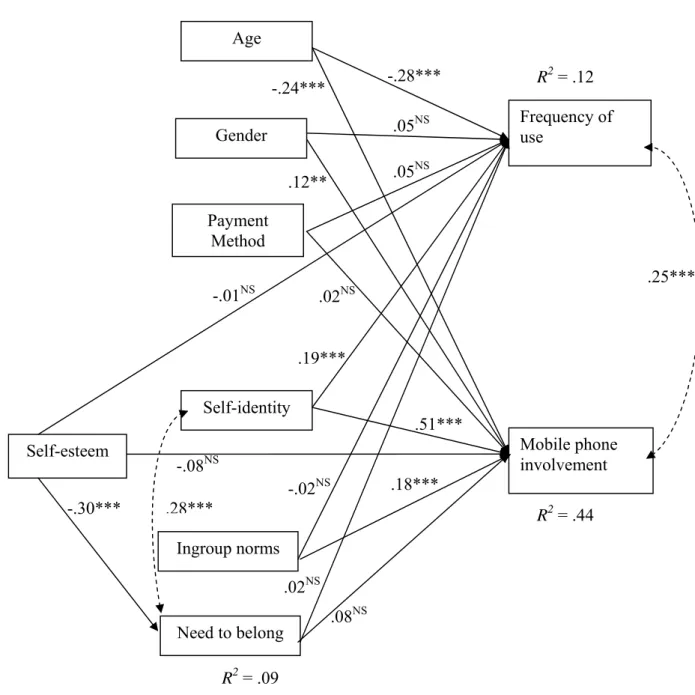
The specified model included two outcome measures, frequency of mobile phone use and mobile phone involvement (see Figure 1), to enable the relationships between the predictors and both outcome variables to be assessed in the one analysis. The model allowed both outcome measures to be predicted by the four psychological variables and the three control variables. Additionally, need to belong was predicted by self esteem. Finally, all exogenous variables, (i.e., the controls and the psychological variables excluding need to belong) were allowed to covary. Model parameters were estimated by the maximum likelihood method and a number of indicators were used to assess the fit of the model. For a satisfactory fit, the chi-squared test should be non-significant (Kline, 2005).Additional indices used to evaluate the model fit were the Comparative Fit Index (CFI) and the Root Mean Square Error of Approximation (RMSEA). For amoderate model fit, the CFI should be above .90 and the RMSEA below .08 (Marsh, Balla, & Hau,
1996). The predictive ability of the model was evaluated by inspecting the path coefficients and R2values.
Results Descriptive Statistics
Examination of data revealed that young people were more likely to send (M = 13.29, SD = 20.33) and receive (M = 13.12, SD = 20.61) text messages than to make (M = 2.41, SD = 2.28) or receive (M = 2.76, SD = 2.28) voice calls 1. Mobile phone payment method was fairly evenly split with 54.1% using pre-paid payment with the remainder of participants (45.9%) paying following use.
As shown in Table 1, participants’ self-identification as mobile phone users was average. In contrast, mobile phone use was reported to be a highly common behaviour among participants’ friends and peers. The levels of self-esteem and belongingness needs reported by participants in this study were both reasonably high. Although the overall frequency of mobile phone use was relatively high and varied widely,this variation in young people’s mobile phone use is consistent with Australian mobile phone data (ACMA, 2008).
________________________
1 In addition to the frequency of daily use measure, separate scales were also developed for average daily level of inbound use (calls and text messages received), outbound use (calls made and text
messages sent), calls only (both made and received) and text messages only (sent and received). Separate
analyses using each of these scales were conducted to identify whether results differed according to type of
mobile phone use. Results of these analyses were consistent with the pattern of results from the overall
measure of daily frequency of all types of mobile phone use. For this reason, results for overall frequency
Insert Table 1 about here ________________________ Correlations between Variables
As shown in Table 2, correlations between study variables ranged from minimal to moderate. A moderate, but significant, positive relationship was revealed between the outcome measures of frequency of mobile phone use and mobile phone involvement, r = .36, p < .01. Thus, although frequency of use is somewhat related to mobile phone involvement, they appear to be separate constructs. Only age and self-identity were correlated with frequency of use, whilst all of the other predictors, apart from payment method, were correlated with mobile phone involvement. Self-identity was the strongest correlate for both frequency of use and mobile phone involvement. Among the predictor variables, ingroup norm and need to belong were correlated with self-identity.
________________________ Insert Table 2 about here ________________________ Assessing the Model Fit
Structural equation modelling was employed to test the hypothesised relationships between the predictor variables and the outcome measures, frequency of use, and mobile phone involvement. As shown in Figure 1, age, gender, payment method, self-esteem, self-identity, ingroup norm, and need to belong were specified as the direct predictors of both frequency of mobile phone use and mobile phone involvement. Additionally, a mediated pathway between self-esteem and the outcome measures was specified with the effect of self-esteem predicting the need to belong which subsequently influenced
frequency of mobile phone use and mobile phone involvement. Additionally, all independent variables were allowed to co-vary as no hypotheses were developed to explain these relationships.
________________________ Insert Figure 1 about here ________________________
The initial model did not fit the data well (2 (6) = 46.58, p < .001, CFI = .87, RMSEA = .15). Inspection of the residuals and modification indices suggested that two constraints in the model accounted for the misfit. A significant residual (p < .001) was found between the outcome measures of frequency of use and mobile phone involvement, indicating that these two outcomes are correlated beyond that explained by the
predictors2. Although it is likely that a reciprocal relationship exists between the two outcomes, the current design did not allow a test of reciprocity, and there were insufficient degrees of freedom in the model to conduct such an analysis. Rather than arbitrarily forming a post-hoc directional hypothesis, it was decided to covary the residuals. As a sensitivity test, two other models were also conducted in which a
directional path was included from one outcome to the other. In both of these alternative models, the magnitude of the standardized estimates varied minimally and did not alter the conclusions.
2 While a relationship between the two outcomes is not unexpected, the constructs are conceptually different. Mobile phone involvement encapsulates cognitions and behaviours relating to addiction-like symptoms (Walsh et al., in press), thus measuring broader aspects of mobile phone behaviour than frequency of use alone. Additionally, the psychological association a person has with an activity can differ from the level to which they perform the behaviour (Orford, 2001). For instance, some infrequent
A second significant residual (p < .01) was found between need to belong and self-identity. Although not hypothesised, there may be a theoretical link between need to belong and self-identity as a person’s desire for attachment to others may lead them to value certain behaviours more than others (Baumeister & Leary, 1995). Thus, on theoretical grounds, the model was re-specified to include these two additional paths (Figure 1). Analysis revealed the second model was a good fit to the data (2 (4) = 2.26, p = .69, CFI = 1.00, RMSEA = .00) with no changes suggested in the modification indices and no significant residuals. The final model explained 12% of the variance in frequency of mobile phone use (R2 = .12) and 44% of the variance in mobile phone involvement (R2 = .44).
Inspection of thesecond model revealed that there were a number of significant covariances among the predictor and control variables. Specifically, payment method covaried with age, ingroup norms, and self-identity, with younger people who report weaker norms, and weaker self-identity being more likely to pre-pay for their mobile phone use. Gender also weakly covaried with self-esteem with men reporting slightly higher self-esteem than did women. There were also significant positive covaried relationships between both need to belong and identity; and ingroup norm and self-identity. Thus, self-identity was higher when participants perceived their friends and peers used a mobile phone or when participants had a strong need to belong. Finally, there was a significant positive residual covariance between frequency of use and mobile phone involvement as indicated by the modification indices.
A significant negative relationship was found between self-esteem and need to belong indicating that people with lower self-esteem were more likely to have a higher belongingness need.
The Direct Predictors of Frequency of Use and Mobile Phone Involvement
As shown in Figure 1, there were differences in the direct predictors of frequency of use and mobile phone involvement. Age and self-identity were the only significant direct predictors of frequency of use with younger people and people with higher self-identity engaging in more frequent mobile phone use. All other paths were non-significant.
With respect to mobile phone involvement, the majority of predictors; age, gender, self-identity, and ingroup norms had significant direct effects on mobile phone involvement. Thus, younger people, females, people who had incorporated mobile phone use into their self-identity and people, who perceived mobile phone use to be common amongst their friends and peers were likely to report high involvement with their mobile phones. Self-identity was the most significant predictor of both frequency of use and involvement. Payment method did not significantly predict either outcome measure. Mediation Analysis
Hypothesis three predicted that the effect of self-esteem on young people’s frequency of mobile phone use and the degree of their mobile phone involvement would by mediated by the need to belong. To test this hypothesis, a bias-corrected bootstrapping procedure requesting 1000 samples was employed to check for the significance of the indirect path. As shown in Table 2, neither self-esteem nor need to belong was correlated with frequency of mobile phone use, and indeed, the standardized indirect effect was
trivial in magnitude (-.01) and non-significant (p = .69). Therefore, hypothesis three was not supported for frequency of mobile phone use. For mobile phone involvement, the standardized indirect effect was -.02, with a 95% confidence interval of -.06 to .00 of the bootstrapped sample (Shrout & Bolger, 2002). Using a p < .05 significance level cut-off, this mediated pathway was non-significant, although it approached significance (p = .06). The direct effect of self-esteem on involvement (standardized path = -.08, p = .10) was not significant. The generally weak effects were reflected in the weak but significant total effect (-.11, p = .01) from self esteem to involvement after controlling for the other predictors and control variables. Given the significant total effect it was surprising that the path to mobile phone involvement from self-esteem and need to belong was not significant at the .05 level (p < .10). However, taken together these results do not support a significant mediation. Thus, the hypothesized significant mediation effect between self-esteem and mobile phone involvement via the need to belong was not supported,
although a trend was identified.
Discussion
The present research aimed to improve our understanding of psychosocial factors influencing young people’s mobile phone behaviour by exploring the effect of self-identity, ingroup norm, need to belong, self-esteem, and demographic factors on the frequency of mobile phone use and mobile phone involvement amongst Australian youth. Results revealed that frequency of mobile phone use and mobile phone involvement are related, but separate, constructs and differences were identified in the predictors of each behaviour. Specifically, age (younger) and self-identity significantly predicted young people’s frequency of mobile phone use whilst age (younger), gender (female),
self-identity and ingroup norm all significantly influenced their level of involvement with their mobile phones. Additionally, a trend suggesting that the effect of self-esteem on mobile phone involvement is mediated by the need to belong was identified. As mobile phone involvement encapsulates both the cognitive and behavioural aspects relating to mobile phones, these results indicate that different psychological process underpin how frequently people use their mobile phone and how involved they are with their phone. These results provide useful information in relation to the characteristics of those young people most likely to become highly involved with their mobile phone.
Three hypotheses were tested in the study. First, it was expected that self identity, ingroup norm, and need to belong would each predict young adults’ frequency of mobile phone use and mobile phone involvement respectively. Partial support was found for this hypothesis. Self-identity predicted both frequency of mobile phone use and mobile phone involvement, whereas ingroup norm was only impactful on young people’s level of involvement with their mobile phone. Need to belong did not significantly predict either frequency of use or involvement, although results indicated a trend for need to belong to influence level of involvement. Thus, it is those people who perceive that mobile phone use is an integral part of who they are who are more likely to engage in frequent use and to report being highly involved with their phone. These findings support previous research which found self-identity was associated with mobile phone behaviour (Mannetti et al., 2002; Walsh & White, 2007; Walsh et al., in press) and that linking objects with self-identification processes affects behaviour (Dittmar et al., 2007). In addition to impacting on both types of mobile phone behaviour, self-identity was the
most strongly weighted predictor of both frequency of use and mobile phone involvement in this study.
The strength of self-identity as a predictor may also be due to the finding that ingroup norm and need to belong were associated with self-identification as a mobile phone user. Participants who reported that mobile phone use was common within their friendship group and who sought strong relationships with others, were more likely to identify strongly as a mobile phone user than participants whose friends did not use a mobile phone as commonly. These findings are consistent with identity theories which posit that socially reinforced behaviours which produce a positive outcome are likely to become entrenched in a person’s self-identity (Gergen, 1971; Stryker, 1987). The
strength of self-identity as a predictor of both frequency of mobile phone use and mobile phone involvement amongst young people suggests that mobile phone use has become an intrinsic part of some young people’s self-concept, so much so that they are behaving in a manner similar to a behavioural addiction. This pattern of behaviour may create
difficulties in designing strategies to reduce young people’s problematic mobile phone use. People who strongly identify with a behaviour are less likely to reduce behavioural performance even if negative outcomes result (Koski-Jannes, 2002). Encouraging young people to discover a wider sense of self-identity (e.g., from values, additional interests) beyond being a mobile phone user may be effective in overcoming some of the
problematic patterns of mobile phone behaviour (e.g., use when driving) developing among young people. As the form of self-identity measured in this study primarily related to role identity, or the value of the behaviour to the self-concept, it may also be that
gauging the relationship between other forms of self-identity, involving self-fulfillment and fashion/brand sensitivity, would be beneficial.
In addition to self-identity, ingroup norm directly influenced young people’s mobile phone involvement, but not frequency of use. Thus, young people who perceive that mobile phone use is a common behaviour amongst valued friends and peers are more likely to become highly involved with their mobile phone in a manner which is similar to a behavioural addiction. These results support social identity theorists who posit that a person’s behavioural performance is influenced by the behaviour of referent group members (Hogg & Abrams, 1988; Turner, 1991) and also support Orford’s (2001)
argument that social factors influence the development of addictive patterns of behaviour. As addictive patterns of behaviour develop, the range of alternate activities performed to produce positive outcomes narrows (Loonis, Apter, & Sztulman, 2000). Additionally, mediated communication has been found to replace face to face contact for some people (Joinson, 2004). Thus, it is possible that young people who are highly involved with their mobile phone may rely almost exclusively on the phone for their contact with others and may not develop other avenues for social connection.
Finally, in contrast to expectations, need to belong did not significantly influence either frequency of use or participant’s mobile phone involvement. Although not
significant in the final model, the association between need to belong and mobile phone involvement was stronger than between belonging and frequency of use suggesting that people’s desire for relationships is more likely to be related to how involved they are with their mobile phone than how frequently they use their mobile phone.
The second hypothesis that self-esteem and the need to belong would be negatively related was supported in this study. Consistent with belongingness research (Baumeister & Leary, 1995; Leary, Tambor, Terdel, & Downs, 1995), the results of the present research revealed a relationship between a person’s self-esteem and their need to belong with low self-esteem being related to a high need to belong. It was also predicted that the effect of young people’s self-esteem on the frequency of their mobile phone use and their mobile phone involvement would by mediated by their need to belong
(Hypothesis 3). This hypothesis was not supported although the effect approached significance (p = .06) suggesting a trend for this relationship.
The trend of a mediated relationship between self-esteem and mobile phone involvement revealed in this study may provide some initial indication as to why some previous research has not found a direct effect of self-esteem on amount of mobile phone use (Butt & Phillips, 2008; Phillips et al., 2006) or mobile phone addictive tendencies (Ehrenberg et al., 2008). Results in this study indicate that there may be a more complex process occurring in which self-esteem influences the need to belong which subsequently impacts on young people’s involvement with their mobile phone. Thus, these findings indicate a trend suggesting that young people who feel unworthy have a strong desire for attachment to others, most probably to enhance their feeling of self-worth, and are likely to become highly involved with their mobile phone. Further research comparing both direct and indirect effects is required to disentangle the relationship between self-esteem and belonging on mobile phone behaviour.
Youth are transitioning through a developmental life-stage in which they are developing their sense of identity, thoughts and behaviours which will continue through
adulthood (Arnett, 2004). While using a mobile phone provides an avenue to receive positive feedback and to remain connected to others, it may be also that young people who use a technological device to enhance their sense of self-worth develop fewer internal mechanisms to maintain their self-esteem over time. Encouraging young people to see the mobile phone as a tool, rather than as a method of receiving positive
reinforcement from others, may assist in broadening the strategies young people use to maintain or enhance their self-esteem.
Demographic factors were also associated with young people’s mobile phone behaviour. Younger participants reported more frequent use and higher levels of involvement with their mobile phone. This finding may appear surprising given the restricted age range of participants in this study (16 to 24 years); however, environmental factors may be relevant. Younger participants would be more likely to be living at home (Arnett, 2004) and parental restrictions may limit their access to other commonly used communication technologies (Giles & Price, 2008), constraints which have potentially led to the mobile phone being the primary communication technology for younger people (ACMA, 2008). As youth become more independent, their use of communication
technologies diversifies (Madell & Muncer, 2004; ACMA); thus, it may be that older participants accessed a number of communication technologies, such as social
networking sites, rather than one specific device. Further longitudinal research assessing young people’s use of a range of communication technologies over time would assist in determining whether people who are highly involved with their mobile phone broaden this involvement to other communication technologies including email, instant
Gender was also associated with mobile phone involvement, but not frequency of use, with females, more likely than males, to report being involved with their mobile phone. Previous research has found that the reasons males and females use their mobile phones differ with males more likely to use their phone for functional purposes (e.g., work-related use) whereas females primarily use their phone to keep in contact with valued people in their lives (Lemish & Cohen, 2005; Rees & Noyes, 2007), a trend which may relate to broader communication patterns rather than specifically to mobile phones. Given that 70% of the sample in this study was female, it may be that gender bias influenced results. Thus, future research should attempt to include equal numbers of males and females so that gender differences and their potential impact on young people’s mobile phone and communication behaviour can be fully investigated.
This research provides an important initial investigation into psychological factors underpinning young people’s mobile phone behaviour. By developing a model which applies specific social psychological constructs to measure frequency of mobile phone use and mobile phone involvement amongst Australian youth, the study informs our understanding of factors influencing one of the most prevalent forms of communication for young people today. The results of this study not only improve our understanding of the relationship between the frequency of young people’s mobile phone use and the level of their mobile phone involvement, they also provide important information about the characteristics of those young people who may become highly involved with their mobile phone. Overall, the research found that psychological processes related more to high involvement with mobile phones than with frequency of use. An additional consideration is the potential for a positive feedback loop to develop whereby psychological processes
lead to mobile phone behaviour with positive outcomes subsequently reinforcing continued behaviour. While the inclusion of the two behaviours allowed factors influencing both frequency of use and mobile involvement to be differentiated,
disentangling the possible bi-directional effects were unable to be explored presenting a major limitation in the study. Further research is required to explore the relationship between frequency of mobile phone use and mobile phone involvement and the possible feedback loops or mediated processes which may contribute to the behaviours.
There are a number of additional limitations which may have impacted on results. First, the participants in this study reported relatively high frequencies of mobile phone use. As the data collection method comprised an on-line survey hosted by an external provider, it was not possible to obtain statistics on the numbers of people who accessed the website and did not proceed to the survey. Additionally, as the method of advertising was via third party organisations, the number young people who heard about the study but did not participate could not be gauged. Thus, no response rate data are available and non-response bias may have affected results. It may be that non-response bias impacted on results in that the young people who participated were more interested in
technological devices than those young people who did not take part in the study. Use of a number of data collection methods, including online and paper based surveys, which enable calculation of the numbers and characteristics of those people who choose not to participate would allow for a comparison of responses to determine this possibility. Further, the use of an on-line survey methodology precluded the verification of the ages of participants where inflation of reported age may have occurred.
It should also be noted that the mean score for ingroup norm was relatively high which may have resulted in a restriction of range influencing the results. Additionally, at the time of data collection, the extent of young people’s mobile phone ownership was unclear and there was noted variability in the frequency of mobile phone use among those young people with phones which may have impacted on results. More specific data would allow for validation of findings. Finally, the lack of an existing theoretical model for examining mobile phone behaviour presents another limitation to the study. Future research could attempt to use and extend on well validated decision-making models, such as the theory of planned behaviour (Ajzen, 1991), to further our understanding of
frequency of mobile phone behaviour (see also Walsh & White, 2007).
The results of the present study reveal a number of additional directions for future research. The relationship between young people’s frequency of mobile phone use and their mobile phone involvement was not very large. Additionally, the amount of variance explained in young people’s frequency of use was relatively low (12%) compared to the amount of variance explained in their mobile phone involvement (44%). These results suggest factors, other than the variables included in this study, impact on how often people use their phones. It may be that other variables such as self-enhancement motivations (Ozcan & Kocak, 2003), neuroticism (Ehrenberg et al., 2008), and
impulsivity (Phillips et al., 2006) influence young people’s frequency of mobile phone use. As mobile phones are often used for work and functional purposes (Leung & Wei, 2000; Walsh, White, Hyde et al., 2008), it is also likely that practical considerations impact on frequency of mobile phone use. Future research could assess the role of additional factors on young people’s mobile phone behaviour. Age (younger) was found
to be a predictor of both frequency of use and mobile phone involvement. In addition to the effect of parental rules mentioned previously, it may be that, as adolescents mature, they form close romantic relationships and are less likely to contact large groups of friends (Arnett, 2004). Inclusion of factors such as living environment, relationship status, and use of other communication technologies may improve our understanding of young people’s mobile phone use.
Finally, complex psychological processes were revealed between the variables in the study. First, self-esteem influenced participants’ need to belong and the need to belong and ingroup norms were associated with participants’ self-identification as a mobile phone user. Self-identity and ingroup norm both directly affected participants’ level of mobile phone involvement. Further research, possibly using qualitative methods, could explore the relationship between these factors on young people’s mobile phone behaviour and their personal and social development in greater depth. Additionally, frequency of use and mobile phone involvement were revealed to be related, but separate, constructs. Further research is required to explore the developmental trajectory and the relationship between the behaviours.
Overall, this study aimed to assess the effect of psychological factors influencing frequency of mobile phone use and mobile phone involvement amongst youth. The inclusion of cognitive and behavioural factors in the measure of mobile phone involvement allowed for a broader understanding of young people’s mobile phone behaviour than would be obtained by frequency of use measures alone. Whilst frequency of mobile phone use and mobile phone involvement were related, the level of variance explained in each construct and the effect of the predictors on each behaviour differed.
Self-identity was the strongest predictor of both frequency of use and mobile phone involvement whilst ingroup norm was only associated with young people’s involvement with their phone. Additionally, there was a trend indicating that the effect of self-esteem on mobile phone involvement may be via the need to belong. Results suggest
implications for social development of youth and who may become reliant on the mobile phone to enhance their relationships with others and to maintain or increase their sense of self-worth. Whilst the positive benefits of mobile phone use are well established, it is important to understand the characteristics of those young people who may develop an over-involvement with the pre-eminent communication tool used by young people today.
Table 1
Means, Standard Deviations, and Range of Study Variables
Mean SD Range
Self-identity 3.52 1.53 1 - 7 Ingroup norm 6.36 0.86 1 - 7 Need to belong 3.52 1.54 1 - 5 Self-esteem 2.98 0.53 1 - 4 Frequency of mobile phone use 31.44 45.44 0 - 150 Mobile phone involvement 3.60 1.14 1 - 7
Table 2
Bivariate Correlations, Means, and Standard Deviations for Study Variables
Variable 1 2 3 4 5 6 7 8
1. Age _
2. Gender .13*
3. Payment method (pre-paid vs not) .28** -.09
4. Self-identity .02 .06 .13*
5. In-group norms .03 .03 .12* .21**
6. Need to belong -.01 .06 .00 .30** .05
7. Self-esteem .08 -.10 .11 -.06 .09 -.30**
8. Frequency of mobile phone use -.26** .02 -.01 .20** .02 .09 -.05
9. Mobile phone involvement -.21** .12* .03 .59** .28** .28** -.15* .36**
Figure 1. Standardized coefficients for final model predicting frequency of mobile phone use and mobile phone involvement (N = 292). Broken curved arrows represent additions to hypothesized model. All exogenous variables were permitted to covary. *p < .05, **p < .01, ***p < .001. Age Gender Payment Method Self-identity Ingroup norms Need to belong Mobile phone involvement Frequency of use Self-esteem R2 = .12 R2 = .44 R2 = .09 -.28*** .18*** .51*** .19*** -.30*** -.24*** .12** .05NS .05NS -.01NS .02NS -.08NS .08NS -.02NS .02NS .28*** .25***
References
Access Economics. (2008, June). Australian mobile telecommunications industry: Economic significance and contribution. Retrieved January 11, 2009, from http://www.amta.org.au/amta/site/amta/downloads/pdfs_2008/AE%20AMTA%20 Final.pdf
Ajzen, I. (1991). The theory of planned behaviour. Organizational Behaviour and Human Decision Processes, 50, 179-211.
Arnett, J. J. (2004). Emerging adulthood. New York: Oxford University Press. Australian Communications and Media Authority. (2007, September ). Consumer
attitudes to take-up and use. Telecommunications today. Retrieved January 11, 2009, from http://www.acma.gov.au/WEB/STANDARD/pc=PC_9058
Australian Communications and Media Authority. (2008, December). Communications report 2007-08. Retrieved January 11, 2009, from
http://www.acma.gov.au/WEB/STANDARD/pc=PC_311541
Australian Communications Authority. (2004). Not waving, drowning in debt: Young people and debt in Australia. Consumer Bulletin, Summer 2004(23), 6-9. Baron, N., & Ling, R. (2007). Emerging patterns of American mobile phone use:
Electronically mediated communication in transition. In G. Goggin & L. Hjorth (Eds.), Mobile Media 2007: Proceedings of an international conference on social and cultural aspects of mobile phones, media and wireless technologies (pp. 218-230). Sydney: University of Sydney.
Baumeister, R. F., & Leary, M. R. (1995). The need to belong: Desire for interpersonal attachments as a fundamental human motivation. Psychological Bulletin, 117, 497-529.
Baumeister, R. F., Tice, D. M., & Hutton, D. G. (1989). Self-presentational motivations and personality differences in self-esteem. Journal of Personality, 57, 547-579. Beranuy, M., Oberst, U., Carbonell, X., & Charmarro, A. (2009). Problematic internet
and mobile phone use and clinical symptoms in college students: The role of emotional intelligence. Computers in Human Behaviour, 25, 1182-1187.
Bianchi, A., & Phillips, J. G. (2005). Psychological predictors of problem mobile phone use. CyberPsychology & Behavior, 8, 39-51.
Billieux, J., Van der Linden, M., d'Acremont, M., Ceschi, G., & Zermatten, A. (2007). Does impulsivity relate to perceived dependence and actual use of the mobile phone? Applied Cognitive Psychology, 21, 527-537.
Brown, R. I. F. (1997). A theoretical model of the behavioural addictions - Applied to offending. In J. E. Hodge, M. McMurran & C. R. Hollin (Eds.), Addicted to crime. Chichester, UK: John Wiley.
Butt, S., & Phillips, J. G. (2008). Personality and self-reported mobile phone use. Computers in Human Behavior, 24, 346-360.
Campbell, S. W., & Yong, J. P. (2008). Social implications of mobile telephony: The rise of personal communication society. Sociology Compass, 2, 371-387.
Carroll, J., Howard, S., Peck, J., & Murphy, J. (2002). A field study of perceptions and use of mobile telephones by 16 to 22 year olds. Journal of Information
Cassidy, S. (2006). Using social identity to explore the link between a decline in
adolescent smoking and an increase in mobile phone use. Health Education, 106, 238-250.
Charlton, J. P., & Danforth, I. D. W. (2004). Differentiating computer-related addictions and high engagement. In K. Morgan, C. A. Brebbia, J. Sanchez & A.
Voiskounsky (Eds.), Human perspectives in the internet society (pp. 59-68). Southhampton: WIT Press.
Charlton, T., Panting, C., & Hannan, A. (2002). Mobile telephone ownership and usage among ten and 10 & 11 year olds: participation and exclusion. Emotional and Behavioural Difficulties, 7, 152-163.
Crocker, J., & Wolfe, C. T. (2001). Contingencies of self-worth. Psychological Review, 2001, 593-623.
Dittmar, H. (1992). The social psychology of material possessions: To have is to be. New York: St. Martin's Press.
Dittmar, H. (2005). A new look at "compulsive buying": Self-discrepancies and materialistic values as predictors of compulsive buying tendency. Journal of Social and Clinical Psychology, 24, 832-859.
Dittmar, H., Long, K., & Bond, R. (2007). When a better self is only a button click away: Associations between materialistic values, emotional and identity-related buying motives and compulsive buying tendency online. Journal of Social and Clinical Psychology, 26, 334-361.
Ehrenberg, A., Juckes, S., White, K. M., & Walsh, S. P. (2008). Personality and self-esteem as predictors of young people's technology use. CyberPsychology & Behavior, 11, 739-741.
Ellemers, N., Spears, R., & Doosje, B. (2002). Self and social identity. Annual Review of Psychology, 53, 161-186.
Eost, C., & Flyte, M. G. (1998). An investigation into the use of the car as a mobile office. Applied Ergonomics, 29, 383-388.
Fiske, S. T. (2002). Five core social motives, plus or minus five. In S. J. Spencer, S. Fein, M. P. Zanna & J. Olson (Eds.), Motivated social perception: The Ontario
Symposium (Vol. 9, pp. 223-246). Mahwah, NJ: Erlbaum.
Fiske, S. T. (2004). Social beings: Core motives in social psychology. Hoboken, N.J.: Wiley.
Gergen, K. J. (1971). The concept of self. New York: Holt, Rinehart and Winston, Inc. Giles, G., & Price, I. R. (2008). Adolescent computer use: Approach, avoidance, and
parental control. Australian Journal of Psychology, 60, 63-71.
Goggin, G. (2006). Cell phone culture: Mobile technology in everyday life. London: Routledge.
Griffiths, M., & Renwick, B. (2003). Misfortune or mismanagement: A study of consumer debt issues. Ourimbah, NSW: Central Coast School of Business, University of Newcastle.
Ha, J. H., Chin, B., Park, D.-H., Ryu, S.-H., & Yu, J. (2008). Characteristics of excessive cellular phone use in Korean adolescents. CyberPsychology & Behavior, Online pre-print, DOI: 10.1089/cpb.2008.0096.
Hiscock, D. (2004). Cell phones in class -- This, too, shall pass? Community College Week, 16, 4-5.
Hogg, M. A., & Abrams, D. (1988). Social identifications: A social psychology of intergroup relations and group processes. London: Routledge.
Igarashi, T., Motoyoshi, T., Takai, J., & Yoshida, T. (2008). No mobile, no life: Self-perception and text-message dependency among Japanese high school students. Computers in Human Behavior, 24, 2311-2324.
James, D., & Drennan, J. (2005). Exploring addictive consumption of mobile phone technology. Paper presented at the Australian and New Zealand Marketing Academy conference, Perth, Australia.
Jenaro, C., Flores, N., Gomez-Vela, M., Gonzalez-Gil, F., & Caballo, C. (2007). Problematic internet and cell-phone use: Psychological, behavioral, and health correlates. Addiction Research and Theory, 15, 309-320.
Joinson, A. N. (2004). Self-esteem, interpersonal risk, and preference for email to face-to-face communication. CyberPsychology & Behavior, 7, 472-478.
Katz, J. E., & Sugiyama, S. (2005). Mobile phones as fashion statements: The co-creation of mobile communication's public meaning. In R. Ling & P. Pederson (Eds.), Mobile communications: Re-negotiation of the social sphere (pp. 63-81). Surrey, UK: Springer.
Kline, R. B. (2005). Principles and practice of structural equation modeling (2 ed.). New York: The Guilford Press.
Koski-Jannes, A. (2002). Social and personal identity projects in the recovery from addictive behaviours. Addiction Research and Theory, 10, 183-202.
Leary, M. R., Kelly, K. M., Cottrell, C. A., & Schreindorfer, L. S. (2007). Individual differences in the need to belong: Mapping the nomological network. Unpublished manuscript, Duke University.
Leary, M. R., Tambor, E. S., Terdel, S. K., & Downs, D. L. (1995). Self-esteem as an interpersonal monitor: The sociometer hypothesis. Journal of Personality and Social Psychology, 68, 518-530.
Lemish, D., & Cohen, A. A. (2005). On the gendered nature of mobile phone culture in Israel. Sex Roles, 7/8, 511-521.
Leung, L., & Wei, R. (2000). More than just talk on the move: Uses and gratifications of the cellular phone. Journalism and Mass Communication Quarterly, 77, 308-320. Ling, R. (1999, July 29-31, 1999). 'We release them little by little': maturation and
gender identity as seen in the use of mobile telephone. Paper presented at the International Symposium on Technology and Society (ISTAS'99) Women and Technology: Historical, Societal and Professional Perspectives, Rutgers University, New Brunswick, New Jersey.
Loonis, E., Apter, M. J., & Sztulman, H. (2000). Addiction as a function of action system properties. Addictive Behaviors, 25, 477-481.
Madell, D., & Muncer, S. (2004). Back from the beach but hanging on the telephone? English adolescents' attitudes and experiences of mobile phones and the internet. CyberPsychology & Behavior, 7, 359-367.
Mannetti, L., Pierro, A., & Livi, S. (2002). Explaining consumer conduct: From planned to self-expressive behavior. Journal of Applied Social Psychology, 31, 1431-1451.
Marsh, H. W., Balla, J. R., & Hau, K. T. (1996). An evaluation of incremental fit indices: A clarification of mathematical and empirical properties. In G. Marcoulides & R. Schumaker (Eds.), Advanced Structural Equation Modeling Techniques (pp. 315-353). Mahwah, NJ: Erlbaum.
Orford. (2001). Excessive appetites: A psychological view of addictions (2nd ed.). Chichester, UK: Wiley.
Ozcan, Y. Z., & Kocak, A. (2003). Research note: A need or a status symbol? Use of cellular telephones in Turkey. European Journal of Communication, 18(2), 241-254.
Pain, R., Grundy, S., Gill, S., Towner, E., Sparks, G., & Hughes, K. (2005). 'So long as I take my mobile': Mobile phones, urban life and geographies of young people's safety. International Journal of Urban & Regional Research, 29, 814-830. Pennay, D. (2006). Community Attitudes to Road Safety: Community Attitudes Survey
Wave 18, 2005 (No. CR 227). Canberra: Australian Transport Safety Bureau. Peters, O., & ben Allouch, S. (2005). Always connected: A longitudinal field study of
mobile communication. Telematics and Informatics, 22, 239-256.
Phillips, J. G., Butt, S., & Blaszczynski, A. (2006). Personality and self-reported use of mobile phone for games. CyberPsychology & Behavior, 9, 753-758.
Piko, B. F. (2006). Adolescent smoking and drinking: The role of communal mastery and other social influences. Addictive Behaviors, 31, 102-114.
Pittman, T. S. (1998). Motivation. In D. T. Gilbert, S. T. Fiske & G. Lindzey (Eds.), The handbook of social psychology (4 ed., Vol. 1). New York: McGraw-Hill.
Rees, H., & Noyes, J. M. (2007). Mobile telephones, computers, and the internet: Sex differences in adolescents' use and attitudes. CyberPsychology & Behavior, 10, 482-484.
Rosenberg, M. (1965). Society and the adolescent self-image. Princeton, NJ: Princeton University Press.
Ruggiero, T. E. (2000). Uses and gratifications theory in the 21st century. Mass Communication and Society, 3(1), 3-37.
Sanchez-Martinez, M., & Otero, A. (2008). Factors associated with cell phone use in adolescents in the community of Madrid (Spain). CyberPsychology & Behavior, Online pre-print, DOI: 10.1089/cpb.2008.0164.
Selwyn, N. (2003). Schooling the mobile generation: the future for schools in the mobile-networked society. British Journal of Sociology of Education, 24, 131-144. Shrout, P. E., & Bolger, N. (2002). Mediation in experimental and nonexperimental
studies: New procedures and recommendations. Psychological Methods, 7, 422-445.
Smetana, J. G., Campione-Barr, N., & Metzger, A. (2006). Adolescent development in interpersonal and societal contexts. Annual Review of Psychology, 57, 255-284. Smith, A., & Williams, K. D. (2004). R U There? Ostracism by Cell Phone Text
Messages. Group Dynamics, 8(4), 291-301.
Srivastava, L. (2005). Mobile phones and the evolution of social behaviour. Behaviour and Information Technology, 24(2), 111-129.