xqttiv
DOCUMENT RESUME 2.
ED 339 685 SP 033 423
AUTHOR Osguthorpe, Russell T.; Wong, Mei Jivan
TITLE The Ph.D. versus the Ed.D.1 Time for a Dcision.
PUB DATE 91
NOTE 20p.
PUB TYPE Reports - Research/Technical (143) EDRS PRICE MF01/PC01 Plus Postpie.
DESCRIPTORS *Degree Requirementi; *Doctoral Degrees; Doctoral
Programs; Higher Education; National Surveys; Professional Edt.cation; *Schools of Education;
*Teacher Education Programs; Trend Analysis;
Universities ABSTRACT
A survey was taken of the 664 U.S. institutions that offer doctoral prograys in education and institutional catalogues were reviewed to determine trends regarding the Doctor of Philosophy
(Ph.D.) versus the Doctor of Education (Ed.D.). Analysis of the 407 (61 percent) questionnaires that were returned indicated that: (1) there is no clear institutional movement toward one degree title or the other; (2) research universities are increasingly reluctant, while comprehensive colleges and universities are increasingly
likely, to offer the Ed.D. as their only doctoral degree title; and (3) requirements for the two doctoral programs are remarkably
similar, including competencies in research and statistics. The
findings are discucsed in relation to three common positions of those who favor the over the Ph.D.: (1) the professional school
argument (schools of edacation are professional schools and therefore should pattern themselves after other professional schools rather than attempt to mimic the social sciences); (2) the unification argument (the Ed.D. would provide the needed mechanism to unify the field of education by bringing together the various disciplines
grouped into schools of education); and (3) the autonomy argument (a unique doctoral title might allow schools of education to enjoy the kind of autonomy enjoyed by law and medical schools). Findings also indicate that increased national dialogue is necessary to strengthen the education profession by reducing confusion between its two
doctoral degree titles. (Author/LL)
*********************************************************************** * Reproductions supplied by EDRS are the best that can be made
*
* from the original document.
*
The Ph.D. Versus the Ed.D.: Time
for a Decision
Russell T. Osguthorpe
Associate Dean, College of Education, 343 MCKB, bdgham Young University, Provo UT 84602
Phones: (w) (801) 378-3694 (10 (801) 226-7804
Specialization: Special education technology, instructional design
Honors: Who's Who in the West, Who's Who in American Education, Phi Kappa Phi Officer Publications: 40 articles, book chapters, instructional software
Mei Jivan Wong
Doctoral Candidate, College of Education, 343 MCKB,
Brigham Young University, Provo, UT 84602 Phone: (801) 378-3694
Specialization: Instructional design
Publications: A National Study of Graduate Programs in Education, AERA. 1991
Runn Head: The Ph.D. Versus the Ed.D.
U.S. DEPARTMENTOf EDUCATION Ottica ol EclucabonaiRaeearch and Improvement
EDUCATIONAL RESOURCES INFORMATION
CENTER (ERIC)
ri This document halt been reproduced as received Irpnt the parson or organization
originating II
r Minor Changes haveWon made to Improve reproduction duality
Ponta ot view Or OPrniOna staled in this docu
mom do not necesaardy rpresent official OEM position or policy
"PERMISSION TO REPRODUCE THIS MATERIAL HAS BEEN GRANTED BY
T. 0
TO THE EDUCATIONAL RESOURCES INFORMATION CENTER (ERIC)."
2
The Ph.D. Versus the Ed.D. 2
Abstract
The authors surveyed the 225 U.S. institutions that offer doctoral programsin
education and reviewed institutional catalogues during the past decade to determine trends regarding the Ph.D. versus the Ed.D. Results of the study showed that: (a) there is no clear institutional movement toward one degree title or the other, (b) research universities are increasingly reluctant--while comprehensive colleges and universities are increasingly likely--to offer the Ed.D. as their only doctoral degree title, and (c) requirements for the
two doctoral programs are remarkably similar, including competencies in research and statistics. The authors discuss the findings in relation to three common positions of those who favor the Ed.D. over the Ph.D.: (a) the professional school argument, (b) the
unification argument, and (c) the autonomy argument. The article concludes with a call for increased national dialogue to strengthen the education profession by reducing confusion between its two doctoral degree titles.
The Ph.D. Versus the Ed.D. 3
The Ph.D. Versus the Ed.D.: Time for a Decision
Schools of law offer the J.D. as their terminal degree, schools of medicine the M.D., but schools of education have not yet settled on a single degree title. Most offer both the Ph.D. and the Ed.D. One might logically conclude that education holds on to both degree titles because there are fundamental differences between the purposes and
requirements of programs leading to each degree. After all, an Ed.D. program most be distinguishable from a Ph.D. program, or why would the profession perpetuate two
different titles?
Previous research has shown that although philosophical premises differ for the two degree titles, specific degree requirements are remarkably similar (Andersen, 1983; Dill & Morrison, 1985). However, while these studies report admissions, residency, and credit hour requirements, none gives much detail regarding specific expectations in research competencies--presumably the touchstone of difference between the two degree titles.
In addition to knowing how program requirements for the two degree titles differ, educational leaders need to understand the patterns, if any, that are emerging in the way various institutions are using these two title designations. For example, is thc re evidence that the field is following Clifford & Guthrie's (1988) recommendation to eliminate the Ph.D. as a degree title in education, Courtenay's (1988) recommendation to eliminate the Ed.D., or Good lad's (1990) recommendation to eliminate both degrees in favor of an altogether new title? What pattern has been observed for institutions over the past decade? What trends do educational leaders predict for the future? What role, if any, does the type of institution play in the degree titles it chooses to offer? Do research universities, for example, prefer to offer the Ph.D. over the Ed.D.?
There is little extant data on doctoral degree programs in the field of education. For example, although the National Center for Educational Statistics records the number of doctoral degrees and master's degrees awarded each year, the data do not differentiate by
r
:pr
The Ph.D. Versus the Ed.D. 4
degree title (Ed.D. or Ph.D.). In addition, former researchers have limited their survpys to a small subsample of the population of institutions that offer graduate programs in
education, usually to Research I Universities (Schneider, et aL, 1984; Brown, 1990). Others have limited their studies to subdisciplines within the field of education (Dill &
Morrison, 1985). Andersen's (1983) study was the most comprehensive,but even he did not differentiate trends based on types of institutions.
The present study addressed the previously stated questions
from three =jot
information sources: (a) The Peterson's Guide to Graduate Programs in Business,Education, Health, and Law for both 1979 and 1989 (Moore, 1979; 1989), (b) catalogues from the entire population of institutions granting graduate degrees in education for 1979 and 1989, and (c) a survey questionnaire mailed to all 664 such institutions.
Data Analysis
Using Peterson's Guide and institutional catalogues as data sources, researchers calculated the number of institutions offering various doctoral degree titles in education for
both 1979 and 1989. To determine whether the type of institution played a role in the type of doctoral degrees offered in education, researchers used the Carnegie Classification
of
Universities and Colleges to categorize all institutions (Boyer, 1987).A total of 407 questionnaires were returned, constituting a 61% return rate. A preliminary analysis showed that the percentage of research, doctorate granting, and comprehensive universities were nearly identical when respondents and nonrespondents were compared. These results give some assurance that the sample of questionnaires received was representative of the entire population.
The data gathered from the survey questionnaire are also reported by number or percentage, with the exception of the final question dealing with programrequirements. The results of this question were analyzed using the chi square test of association to determine if research requirements for the Ed.D. differed significantly from those of the Ph.D.
The Ph.D. Versus the Ed.D. 5
Results
The results section first focuses on the data gathered from the Peterson's Guide and institutional catalogues showing the number of institutions offering each type of doctoral degree for both 1979 and 1989. The results of the survey questionnaire, focusing on the differences between Ed.D. and Ph.D. program requirements, follow.
Types of degrees offered. Figure 1 shows that the Ed.D. and the Ph.D. are
by far the most common doctoral degree titles in education. However, in 1989 there were a total of 23 institutions that offered doctoral degrees with other titles, compared to only six institutions in 1979. No previous study has mentioned these more aberrant degree titles, although Andersen (1983) inferred that seven institutions in his sample offered a doctoral degree other than the Ph.D. or Ed.D. As indicated by the figure, during the past decade the number of institutions offering doctoral degrees in education increased by 24% (157 in
1979, 202 in 1989). 200 111 1979 eel 11 1989 VD VD
am 0
Ed.D. Ph.D. P.D. D.Ed. Psy.D. D.A. 'D.A.Edl.
Doctoral Degree Title
Figure 1. The number of institutions offering various doctoral degree titles in education.
6
The Ph.D. Versus the EcLD. 6
Figures 2 and 3 show that during the past decade there has been a slight decrease in the percentage of institutions offering the Ed.D. as their only doctoral degree title, and a slight increase in the percentage offering only the Ph.D. The most important finding from these two figures is that neither the Ed.D. nor the Ph.D. clearly dominates as the doctoral degree of choice in the field of education. Nearly half of the doctorate granting institutions in the country offer both degrees; the other half offer the Ph.D. or the Ed.D. as their only doctoral degree title in education.
37% 17% 111 PhD & EdD 111 PhD Only EdD Only Total Institutions. 157 46%
Figure 2. Percentage of institutions offering the Ed.D. & Ph.D., Ed.D. only, and Ph.D. only in 1979.
33%
22%
The Ph.D. Versus the Ed.D. 7
PhD & EdD
111 PhD Only
111 EdD Only
Total Institutions= 206
45%
Figure 3. Percentage of institutions offering the Ed.D. & Ph.D., Ed.D. only, and Ph.D. only in 1989.
Table 1 shows the number of institutions offering each type of degree in 1979 and 1989 according to the Carnegie classification of universities. These data show clearly that research universities are increasingly reluctant to offer the Ed.D. as their only doctoral degree, their preference being to offer both degrees. Moving from the doctorate granting universities to the comprehensive colleges and universities, there is a gradual shift to the Ed.D. In 1989, for example, 91% of the research universities offered the Ph D., 64% of the doctorate granting universities, and only 35% of the comprehensive universities. Thus the data show a relatively large increase in the number of comprehensive universities that offer the Ed.D. as their only degree and a concomitant decrease in the number of research universities offering only the Ed.D.
t1,4,,?.1'77,; .
The PhD. Versus the Ed.D. 8
Table 1
Comparison of types of institutions offering Ph.D. & Ed.D. programs in 1979 and 1989
Type of Institution Ph.D. & Ed.D. 1979 1989 Change Ph.D. Only 1979 1989 Change
Ed.D. Only
1979 1989 Change Research 47 57 +10 13 17 +4 12 7 -5 Doctorate Granting 21 29 +8 12 17 +5 26 26 +0 Comprehensive 4 9 +5 2 8 +6 19 32 +13Degree requirements. Because the.Ed.D.
is more likely to be the degree ofchoice for less reseamh-oriented institutions, it might be assumed thatthere would be less emphasis on the dissertation and on courses designed to prepare students to complete a
dissertation. The results of the questionnaire, however, did not confirm such an
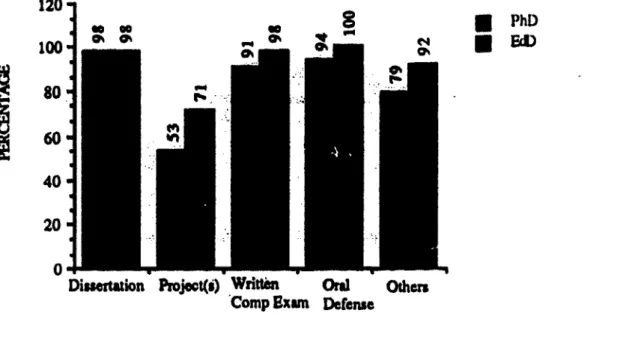
assumption. For example, Figure 4 shows that exactly the same percentage of respondents reported that their institutions required a dissertation for the Ed.D. as reported a dissertation required for the Ph.D. (98%). Of those rare institutions that did not require a dissertation, most reported that they required some other type of research or evaluation project 'n lieu of
the dissertation. Thus, the requirements of a dissertation, a written comprehensive
examination, and an oral defense are as standard for the Ed.D. as they are for the Ph.D.--the degree to which such requirements have traditionally been tied.
120 -00 00 so 100 01 01 ...,ch cp. 80 7! 60 eeltm II-40 20 -0 :-.F:Irs7-1"
The Ph.D. Versus the Ed.D. 9
8
PhDIII ED
a%
cp.
Dissertation Projecgi) Written Orel Others
'Comp Exam Defense
TYPES OF REQUIREMENTS
Figure 4. Percentage of institutions reporting selected requirements for their EcLD. and Ph.D. programs.
When institutions were asked to indicate specific research and evaluation competencies required for each type of degree program, again results showed only slight differences between the Ph.D. and the Ed.D. programs as they are currently administered. Table 2 shows that of nine competencies included on the questionnaire, only one was significantly different for the two degree titles-- "advanced inferential statistics." Even though significantly fewer Ed.D. than PhD.
programs required students to master this competency, more than two thirds (71%) required this skill for Ed.D. students. In essence, with the exception of the "advanced naturalistic methods" required by slightly more than half of the institutions, most common research and evaluation competencies are required for both Ph.D. and Ed.D. students.
The Ph.D. Versus the Ed.D. 10
Table 2
Percentage of institutions requiring selected research and evaluation competenoies for Ed.D. and Ph.D. programs
Ed.D Ph.D x2 DF 1)
Conduct literature searches 88 93 1.00 1 .32
Basic Naturalistic Methods 67 73 0.61 1 .44
Advanced Naturalistic Methods 54 53 0.01 1 .93
Single Subject Designs 60 70 2.10 1 .10
Advanced Experimental Design 74 78 0.35 1 .55
Basic Inferential Statistics 84 90 1.50 1 .21
Advanced Inferential Statistics 71 89 8.10 1 .01*
Product-Program Evaluation 74 69 0.42 1 .51
Educational Measurement 72 74 0.11 1 .73
Discussion and Conclusions
The following conclusions can be drawn from the data gathered in this study:
The Ed.D. and Ph.D. continue to he the most common doctoral degree titles in the field of education, although there has been an increase during the past decade in the number of institutions offering doctoral programs with other titles.
Although the number of institutions offering doctoral programs in the field of education has increased during the past decade, the percentage offering the Ed.D., Ph.D., or both degrees has changed only slightly. The data do not indicate a clear movement toward either degree titk.
During the past decade the percentage of research universities offering the Ed.D. as their only doctoral degree title in education has decreased, while the percentage of comprehensive universities offering the Ed.D. has increased.
Program requirements are remarkably similar for Ed.D. and Ph.D. programs, including competencies in research and statistics.
' 0
The Ph.D. Versus the Ed.D. 11
How might these findings inform the current debate regarding doctoral programs in education? The debate itself is not easy to characterize since so little currently appears in the
literature regarding the topic. Rather the arguments for one degree or the other have emerged from departmental, college, and university discussions over how a specific degree program shouldbe
titled. Some have argued for eliminating the Ed.D. in favor of the Ph.D. (Brown, 1990;
Courtenay, 1988; Schneider, personal communication, April 1991). Their arguments usually center on the practical realities that students seem to prefer the Ph.D.; it is a more established doctoral title; and it allows students to pursue more logically a content specialization in the artsand
sciences. Others, of course, have argued that education should offer its own doctoral degree title. In addition to Clifford & Guthrie (1988), others including Good lad (1990), Wisniewski (1990), and Dill & Morrison (1985) have all suggested that the field of education would benefit from
having its own professional degree title. Indeed, the Ed.D. conceived at Harvard with the rationale that education must have its own title separate from the arts and sciences.
From the few who have formally entered the debate regarding doctoral study in the field of education, a variety of arguments have been offered in favor of the Ed.D. over the Ph.D. Though
labels differ, the arguments might be grouped into one of the following three categories: (a) the professional school argument, (b) the unification argument, and (c) the autonomy argument.
The Professional School Argument
Clifford and Guthrie (1988), among others, argue that schools of education should recognize that they are professional schools and should, therefore, pattern themselves more after other professional schools rather than attempt to mimic the social sciences. Since law and medicine offer their own uniquedegree titles, the J.D and the M.D., education should offer its own unique
title--the Ed.D. This argument reasons that professions are not academic disciplines themselves, but fields which draw on a variety of disciplines to prepare their degree recipients for the
profession. Thus research in the professions should focus on application rather than theory. And since the Ph.D. has its roots in theoretical research, the Ed.D. is a more appropriate designation for
The Ph.D. Versus the Ed.D. 12
education graduates. In addition, since the majority of those receiving doctorates in the field of education emphasize teaching and administration rather than research in their careers, doctoral programs in education should not focus on research in the same manner as a Ph.D. program in the hard sciences.
Compelling as this reasoning may be, a few contrasting issues should be raised before the professional school argument can be accepted. First, the data in this study show that the
requirements for the two degree programs are nearly identical. This is not to suggest that some Ph.D. programs do not differ substantially from some Ed.D. programs. But it does suggest that there may be as much variance between Ph.D. programs as there is between Ph.D. and Ed.D. programs. Thus the titles themselves cannot be viewed as signalling a clear difference. Second, Brown's (1990) findings indicate that students at institutions that offer both degree titles prefer the Ph.D. over the Ed.D. This finding may be precisely because the degree requirements are not indistinguishable, ard the Ph.D. has a more respected place in academia because of its longer history.
Less frequently discussed is a third counter argument related to the nature of the teaching profession. One may compare the doctoral recipient in the field of education with the Ph.D. recipient in the hard sciences and conclude that the nature of the disciplines differs so greatly that the doctoral title should also differ. Doctoral recipients in education do not, after all, find
themselves in research laboratories following graduation. Law and medicine, which are based on application rather than theory, have created separate doctoral degree titles; business, engineering, and several other professional areas have chosen overwhelmingly to offer the Ph.D. as their doctoral degree. The dissertation in business or engineering is normally more applied in nature than the dissertation in physics or chemistry. And students of the humanities, although they too are awarded the Ph.D., seldom pursue research-oriented careers.
Much of the dialogue regarding the Ed.D.-Ph.D. contioversy centers on the role research should play in the education profession. For example, if the professional school argument is carried far enough, one might conclude that the dissertation should be eliminated from all education
The Ph.D. Versus the Ed.D. 13
doctoral programs since law and medicine do not require a dissertation. But the results of this study show that nearly all doctoral programs, both Ph.D. and Ed.D., require thedissertation along with an array of research competencies necessary to complete a dissertation. One justification for the dissertation as a requirement for the Ed.D. may be that the knowledge bases for educators are developed differently from the knowledge bases for law or medicine. For example, medical research is conducted by a host of related professionals (i.e., biologists, bacteriologists,
pharmacologists, etc.) in addition to medical doctors who pursue a university career. The courts extend the legal knowledge base each time a judge or a supreme court justice writesthe justification
for a decision on a case.
This line of reasoning leads to the conclusion that the present characterization of the Ph.D. as "research oriented" and the Ed.D. as "non-research oriented" is too simplistic and serves neither the students nor the faculty in schools of education. To assume that educators in public schools need not worry about their own ability to engage in educational inquiry is tantamount to saying that they need not worry about improving themselves. Research, in its broadest sense, is the process of asking questions and finding answers. Since educators, of all professionals, should be the most
committed to modeling this type of learning, they should master certain research competencies regardless of the degree they pursue.
The Unification Argument
Some have argued that the Ed.D. would provide the needed mechanism to unify the field of education--bringing together the varied disciplines that are grouped into schools of education
(Wisniewski, 1990). The education profession, they argue, is splintered because of the variety of specialty areas, such as health, physical education, industrial education, speech pathology, and counseling psychology that often sponsor doctoral programs in schools of education. Eliminating
the Ph.D. in favor of the Ed.D. would serve as a symbol to help focus the school of education's mission on preparing educators, rather than supplying professionals for clinics, hospitals, and private business. Drawing this argument further, one might assume that a school of education
The Ph.D. Versus tb. d.D. 14
could move to a single Ed.D. degree in "education," and, like law and medicine, allow specialization without designating the specialty in the degree title itself.
While the idea of unifying doctoral programs has merit, there was no indication in the findings of this study that such a movement is in process. In fact, the results show that schools
of
education, instead of converging on a single doctoral degree title that signifies the masteryof certain knowledge and skills, are creating new titles that, because of their newness, areincreasingly less meaningful, even within the profession itself. Those institutions that offer only a single doctoral degree title do not appear to show a preference for the Ph.D. or the Ed.D.
Although some institutions currently offer a single degree title (i.e., Ph.D. or Ed.D. in Education) and allow students to pursue various specializations, such unification can apparently occur as well under the Ph.D. as under the Ed.D.
The Autonomy Argument
There are those who argue that if schools of education hold onto the Ph.D. they must march to the drumbeat of the arts and sciences, subject to graduate school administrators who are more concerned about the quality of Ph.D. programs than they are about professional degree programs. As administrators of schools of(Alw.lation view the autonomy enjoyed by law schools and medical schools, they sometimes conclude that if schools of education had their unique doctoral title, specific to the education profession, that same autonomy might be given to their
schools. For example, eliminating the dissertation from an Ed.D. program would be much easier than eliminating it from a Ph.D. program because graduate school administrators would be willing to allow the school of education to define "their own" degree, whereas eliminating the dissertation from the Ph.D. program would reflect negatively on other Ph.D. programs in the institution. This line of reasoning was put forth when the first Ed.D. program was created at Harvard (Dill & Morrison, 1985).
Although the autonomy argument was not tested directly in this study, one might infer from the results of the questionnaire that, because Ed.D. programs are so similar to Ph.D. programs,
The Ph.D. Versus the Ed.D. 15
they may not be as free from external control as some might think. Other research, such as the recent study by Good lad (1990), also give no evidence that schools of education enjoy increased prestige or autonomy due to the titles of doctoral degrees that they offer. After all, university
administrators must rely on criteria set in a given discipline when they judge the quality of graduate or undergraduate programsin a school or college. However, the standards for the Ed.D. and Ph.D. in education are so similar that education faculty cannot justify different requirementsfor programs carrying eithertitle.
Future Directions
Schools of education have three basic options in regards to doctoral programs: (a) continue to offer both the Ed.D. and Ph.D. in their current undifferentiated state (Carpenter, 1987), (b) continue to offer both degree titles, but clearly differentiate between program requirements for each, and (c) offer only one degree title and define more clearly the expectations for the degree, specifically the role of the dissertation. The first option is the easiest but, perhaps, the most dangerous. Continuing to offer both degree titles without differentiating the programs within the profession keep :he education profession, even at the doctoral level, underrated and confused.
The second option (differentiating between the two degree titles) is preferred by many because it leaves maximum freedom for institutions to offer and students to pursue either or both degree titles, but demands that the profession indicate clearly how the graduate programs differ.
However, previous efforts to differentiate between the two degrees at a national level ended in a stalemate (Moore, Russell, & Ferguson, 1960). From the results of the current study, there is little to indicate that such an effort would be more fruitful in the 90s than it was in the 60s. The number of institutions offering doctoral degrees in the field of education has more than doubled during that time, and the finding that the type of institution greatly affects the type of degree offered. While there are a few notable research institutions that offer only the Ed.D. through their schools of education (i.e., Harvard and Johns Hopkins), most of the increase in the Ed.D. over the past decade can be traced to the comprehensive colleges and universities which, by definition, do not
The Ph.D. Versus the Ed.D. 16
emphasize doctoral study and may not be allowed to offer the Ph.D. in any field, including education.
The third option, although it would be the most difficult to pursue, has the potential of bringing the most benefit to the profession--not only because it would result in less confusion over the meaning of the doctoral degree in education, but because it would causeeducators to come to agreement regarding fundamental requirements for the degree. For example,if the dissertation is retained as a requirement for doctoral study in education, the profession must agree on what criteria the profession will put forth to judge the quality of the final product, and how these criteria will differ from those in other professions and disciplines. The current national effort to define more
clearly what is meant by scholarship in higher education (Boyer, 1990; Smith, 1990) has direct implications for graduate study in the field of education. It has recently been said: "It is
unrealistic, not to say unwise, to think of the common standards, expectations, formats, .ind the like that are equally applicable.. . to dissertations in experimental physics on the one hand and English literature [or, we might add, education] on the other (Council of Graduate Schools, 1991,
p. 14).
Regarding dissertation requirements, the final question on the survey from the present study asked respondents to estimate the percentage of dissertations in the field of education that resulted in some type of state or national publication. The results of this question were not summarized because too many respondents could not estimate the percentages. This finding is important in itself because it gives some indication of the importance placed on professional publication in current doctoral programs in education. If option three were followed, the field could address this issue directly by defining the role publication should play and determining the
types of publications appropriate in the field. Such expectations could then be integrated eventually in accreditation standards, as well as communicated directly to faculty and students in schools of education.
The important aspect of option three is not the specific degree title that is to be selected, but rather that once a title is agreed upon, the major effort must focus on degree requirements. Option
4
The Ph.D. Versus the Ed.D. 17
two would be highly preferable to option one, because it too would focus the field on doctoral requirements in a way that has not occurred for decades. Baccalaureate and master's programs would need to be included in the dialogue regarding doctoral requirements (see Osguthorpe, Zhou & Schneider, 1990). For example, the data collected in the study showed that some master's programs appear to be as demanding as some doctoral programs. And as extended teacher
preparation programs emerge, there is some question as to whether some baccalaureate programs are as demanding as some master's programs. This type of confusion must be greatly reduced if education is to increase in stature as a profession. Because so many schools of education are currently re-examining their missions and programs, there has never been a more appropriate time to rethink doctoral study and its place in the education profession.
0 The Ph.D. Versus the Ed.D. 18
Referencer
Andersen, D. G. (1983). Differentiation ofthe Ed.D. and Ph.D. in education.
Journal of
Teacher Education, 36 (3), 55-58.Boyer, E.L. (1991). Scholarship reconsidered: Priorities of the professoriate. Princeton, N.J.: Carnegie Foundation for the Advancement of Teaching.
Brown, L. D. (1990, April). A perspective on the Ph.D.-Ed.D. discussion in schools
of
education. Paper presented at the annual meeting of the American Educational Research Association, Boston, Massachusetts.Carnegie Foundation for the Advancement ofTeaching. (1987). A Classification of Higher Education. Princeton, New Jersey: Princeton University Press.
Carpenter, D. S. (1987). On-going dialogue: Degrees of difference. The Review of Higher Education, 10(3), 281-286.
Clifford, G.J. and Guthrie, J.W. (1988). EdSchool: A brief for professional education. Chicago: The University of Chicago Pross.
The Council of Graduate Schools in the United States (1991). Role and nature of the doctoral dissertation. Washington, D.C.
Courtenay, B.C. (1988). Eliminating the confusion over theEd.D. and Ph.D. in colleges and schools of education. Innovative Higher Education, 13(1), 11-21.
Dill, D.D. and Morrison, J.L. (1985). Ed.D. and Ph.D. research training in the field of higher education: A survey and proposal. The Reviewof Higher Education, 8 (2),
169-186.
Goodlad, J.I. (1990). Teachers for our nation's schools. San Francisco: Jossey-Bass. Moore, RE. Russell, J.H., & Ferguson, D. G. (1960). The doctorate in education (Vol.
2). Washington D.C.: The American Association of Colleges for Teacher Education.
Moore, T.C. (1979). Peterson's Guide to graduate programs in business, education, health and law. Princeton, N.J.: Peterson's Guides.
The Ph.D. Versus the Ed.D. 19
Moore, T.C. (1989). Peterson's Guide to graduate programs in business, education, health and law, 23rd edition. Princeton, N.J.: Peterson's Guides.
Osguthorpe, R.T., Zhou, L. & Schneider, C. (1990, April). The Graduate Degree
Dilemma: A school of education's mission and its programs. Paper presented at the annual meeting of the American Educational Research Association, Boston,
Massachusetts.
Schneider, B. L., Brown, L., Denny, T., Mathis, B.C. & Schmidt, W. (1984). The deans' perspective on the status of doctoral programs in schools of education, Phi Delta Kappan, 65, 617-620.
Schneider, B. L. (April, 1991). Personal communication, American Educational Research Association, Chicago, Ill.
Smith, P. (1990). Killing the spirit: Higher education in America. New York: Viking Press.
Wisniewski, R. (1990, February). Colleges of education twenty years hence. Paper presented at the annual meeting of the American Association of Colleges for Teacher Education, Chicago, Illinois.