Self-adaptive Structure
Semi-supervised Methods for
Streamed Emblematic Gestures
Von der Fakult¨at
Elektrotechnik und Informationstechnik der Technischen Universit¨at Dortmund
genehmigte
Dissertation
zur Erlangung des akademischen Grades Doktor der Ingenieurwissenschaften
eingereicht von
Husam Jumaah Naeemah Al-Behadili
Dortmund, 2017
Tag der m¨undlichen Pr¨ufung: 25.10.2017
Hauptreferent: Prof. Dr. rer. nat. habil. Christian W¨ohler Korreferent: Prof. Dr.-Ing. J¨urgen G¨otze
iii
Abstract
Although many researchers try to improve the level of machine intelligence, there is still a long way to achieve an intelligence similar to what humans have. Scientists and engineers are continuously trying to increase the level of smartness of the modern technology, i.e. smartphones and robotics. Humans communicate with each other by using the voice and gestures. Hence, gestures are essential to transfer the information to the partner. To reach a higher level of intelligence, the machine should learn from and react to the human gestures, which means learning from continuously streamed gestures. This task faces serious challenges since processing streamed data suffers from different problems. Besides the stream data being unlabelled, the stream is long. Furthermore, “concept-drift” and “concept evolution” are the main problems of them. The data of the data streams have several other problems that are worth to be mentioned here, e.g. they are: dynamically changed, presented only once, arrived at high speed, and non-linearly distributed. In addition to the general problems of the data streams, gestures have additional problems. For example, different techniques are required to handle the varieties of gesture types. The available methods solve some of these problems individually, while we present a technique to solve these problems altogether.
Unlabelled data may have additional information that describes the labelled data more precisely. Hence, semi-supervised learning is used to handle the labelled and unlabelled data. However, the data size increases continuously, which makes training classifiers so hard. Hence, we integrate the incremental learning technique with semi-supervised learning, which enables the model to update itself on new data without the need for the old data. Additionally, we integrate the incremental class learning within the semi-supervised learning, since there is a high possibility of incoming new concepts in the streamed gestures. Moreover, the system should be able to distinguish among different concepts and also should be able to identify random movements. Hence, we integrate the novelty detection to distinguish between the gestures that belong to the known concepts and those that belong to unknown concepts. The extreme value theory is used for this purpose, which overrides the need for additional labelled data to set the novelty threshold and has several other supportive features. Clustering algorithms are used to distinguish among different new concepts and also to identify random movements. Furthermore, the system should be able to update itself on only the trusty assignments, since updating the classifier on wrongly assigned gesture affects the performance of the system. Hence, we propose confidence measures for the assigned labels.
We propose six types of semi-supervised algorithms that depend on different techniques to handle different types of gestures. The proposed classifiers are based on the Parzen window classifier, support vector machine classifier, neural network (extreme learning machine), Polynomial classifier, Mahalanobis classifier, and nearest class mean classifier. All of these classifiers are provided with the mentioned features. Additionally, we sub-mit a wrapper method that uses one of the proposed classifiers or ensemble of them
to autonomously issue new labels to the new concepts and update the classifiers on the new incoming information depending on whether they belong to the known classes or new classes. It can recognise the different novel concepts and also identify random movements. To evaluate the system, we acquired gesture data with nine different gesture classes. Each of them represents a different order to the machine e.g. come, go, etc. The data are collected using the Microsoft Kinect sensor. The acquired data contain 2878 gestures achieved by ten volunteers. Different sets of features are computed and used in the evaluation of the system. Additionally, we used real data, synthetic data and public data as support to the evaluation process.
All the features, incremental learning, incremental class learning, and novelty detection are evaluated individually. The outputs of the classifiers are compared with the original classifier or with the benchmark classifiers. The results show high performances of the proposed algorithms.
v
Acknowledgements
I’m genuinely grateful to my supervisor, Prof. Christian W¨ohler for his unlimited support. Words cannot express my thanks for all valuable suggestions, advice, learning opportu-nities, and trust that he provided me during this dissertation. His reviews encouraged me to be more precise in my work, and his critiques guided me to think more prudently about the proposed approaches.
I’d also like to thank my colleague Dr. Arne Grumpe. His comprehensive interdisci-plinary knowledge and his dynamic personality caused new impulses to my work. This dissertation is hard to complete without his tips and suggestions.
I further would like to express my thank to my colleague Daniela Rommel. She did not hesitate to provide me with any assistance. Similar thanks, for all other colleagues, who I enjoyed working with them and with their discussions. I’m fortunate to have such a friendly group who make my life here so excellent. I also would like to thank my friend Majed Edan, who support me by being my formal representative in my country during my research.
I also thank the “Establishment of Martyrs” for funding, along with the management of the Iraqi Ministry of Higher Education.
Finally, I would like to express my thanks and gratitude to my parents and my family, particularly my wife, for their love, understanding and strong support along the way. Great thanks for my children Jumana, Mohammed and Wafaa for being patients while I’m busy and away from them.
vii
List of related Publications
This thesis is based on the following publications of the author. The publications are listed in descending chronological order.
Peer-reviewed journal articles and book chapters
(Al-Behadili et al., 2016c) Al-Behadili, H., Grumpe, A., and W¨ohler, C. Confidence band and extreme value theory based outlier detection for semi-supervised learning of incremental polynomial classifier. International Journal of Simulation Systems, Science & Technology, 17(34), 2016c.
(Al-Behadili et al., 2016b) Al-Behadili, H., Grumpe, A., Migdadi, L., and W¨ohler, C. Incremental parzen window classifier for a multi-class system. International Journal of Simulation–Systems, Science & Technology, 17(34), 2016b.
(Al-Behadili et al., 2014) Al-Behadili, H., Grumpe, A., and W¨ohler, C. Semi-supervised learning of emblematic gestures.At-Automatisierungstechnik, 62(10):732–739, 2014.
Conference contributions
(Al-Behadili et al., 2016e) Al-Behadili, H., Grumpe, A., and W¨ohler, C. Non-linear distance-based semi-supervised multi-class gesture recognition. In Proceedings of the 11th Joint Conference on Computer Vision, Imaging and Computer Graphics Theory and Applications - Volume 3: VISAPP,, pages 280–286, 2016e. ISBN 978-989-758-175-5. doi: 10.5220/0005674102800286.
(Al-Behadili et al., 2016d) Al-Behadili, H., Grumpe, A., and W¨ohler, C. Neural net-work based novelty detection for incremental semi-supervised learning in multi-class gesture recognition. In Proceedings of the 11th Joint Conference on Com-puter Vision, Imaging and ComCom-puter Graphics Theory and Applications - Vol-ume 3: VISAPP,, pages 287–294, 2016d. ISBN 978-989-758-175-5. doi: 10.5220/ 0005674202870294.
(Al-Behadili et al., 2015c) Al-Behadili, H., Grumpe, A., Dopp, C., and W¨ohler, C. Non-linear distance based large scale data classifications. In 2015 IEEE Interna-tional Conference on Progress in Informatics and Computing (PIC), pages 613–617, Dec 2015c. doi: 10.1109/PIC.2015.7489921.
(Al-Behadili et al., 2015d) Al-Behadili, H., Grumpe, A., Dopp, C., and W¨ohler, C. Incremental learning and novelty detection of gestures using extreme value theory. In IEEE International Conference on Computer Graphics, Vision and Information Security (CGVIS), pages 169–174, Nov 2015d. doi: 10.1109/CGVIS.2015.7449915.
(Al-Behadili et al., 2015a) Al-Behadili, H., Grumpe, A., Dopp, C., and W¨ohler, C. Extreme learning machine based novelty detection for incremental semi-supervised learning. InThird IEEE International Conference on Image Information Processing (ICIIP), pages 230–235, Dec 2015a. doi: 10.1109/ICIIP.2015.7414771.
(Al-Behadili et al., 2016a) Al-Behadili, H., Grumpe, A., Migdadi, L., and W¨ohler, C. Semi-supervised learning using incremental support vector machine and extreme value theory in gesture data. In 18th IEEE International Conference on Computer Modelling and Simulation (UKSim-AMSS), pages 184–189, 2016a. doi: 10.1109/ UKSim.2016.5.
(Al-Behadili et al., 2015b) Al-Behadili, H., Grumpe, A., Dopp, C., and W¨ohler, C. Incremental class learning and novel class detection of gestures using ensemble. In
Workshop New Challenges in Neural Computation 2015, pages 122–132, 2015b.
(Al-Behadili et al., 2015e) Al-Behadili, H., Grumpe, A., Dopp, C., and W¨ohler, C. Semi-supervised learning using incremental polynomial classifier and extreme value theory. In 3rd IEEE International Conference on Artificial Intelligence, Modelling and Simulation (AIMS), pages 332–337, 2015e. doi: 10.1109/AIMS.2015.60.
(Al-Behadili et al., 2015f) Al-Behadili, H., Grumpe, A., and W¨ohler, C. Incremental learning and novelty detection of gestures in a multi-class system. In 3rd IEEE In-ternational Conference on Artificial Intelligence, Modelling and Simulation (AIMS), pages 304–309, 2015f. doi: 10.1109/AIMS.2015.55.
Contents
Contents ix 1 Introduction 1 1.1 Thesis Outline . . . 4 1.2 Contribution . . . 4 2 Related work: Gesture Recognition Systems 7 2.1 Gesture Definition and Categories . . . 82.1.1 Gesture definition . . . 8
2.1.2 Gesture categories . . . 8
2.2 Sensors . . . 11
2.2.1 Contact based technology . . . 11
2.2.2 Vision based technology . . . 12
2.3 Gesture Segments . . . 14
2.4 Gesture Spotting . . . 17
2.5 Hand Tracking and Feature Extraction . . . 18
2.6 Gesture Recognition Approaches . . . 19
2.6.1 3D model-based approaches . . . 21
2.6.2 Appearance based approaches . . . 21
2.6.3 Machine learning algorithm based approaches . . . 22
2.6.4 Rule-based approaches . . . 27
2.6.5 Syntactic approaches . . . 27
2.6.6 Local feature approaches . . . 28
2.7 On-line Recognition Algorithms . . . 28
2.8 Gesture Application . . . 28
2.8.1 Virtual reality . . . 29
2.8.2 Sign Language Recognition . . . 29
2.8.3 Human Machine/Robot Interaction . . . 29
2.8.4 Medical Systems and Healthcare Technology . . . 30
2.8.5 Presentations/Gesture-to-Speech . . . 32
2.8.6 Video Surveillance . . . 33
3 Related work: Semi-Supervised Learning and Data Stream 35 3.1 Machine Learning . . . 36 3.2 Supervised Learning . . . 37 3.3 Unsupervised Learning . . . 37 3.3.1 k-means . . . 38 3.3.2 Mean-shift . . . 38 3.4 Semi-Supervised Learning . . . 40 3.4.1 Self-training methods . . . 41 3.4.2 Co-training . . . 41
3.4.3 Probabilistic generative models . . . 42
3.4.4 Semi-supervised support vector machines . . . 44
3.4.5 Graph-based methods . . . 44
3.5 Data Streams . . . 46
3.6 Incremental Learning . . . 47
3.7 Incremental Class Learning . . . 49
3.8 Ensemble Learning . . . 49
3.9 Novelty Detection . . . 50
3.9.1 Conventional novelty threshold setting . . . 53
3.9.2 Extreme value theory . . . 53
3.9.3 Extreme value theory in multi-variate and multi-modal novelty de-tection . . . 55
3.9.4 Transformation . . . 55
3.9.5 Parameters Estimation . . . 58
3.9.6 Confidence bands . . . 59
4 Datasets and Feature Extraction 61 4.1 Gesture Data Set . . . 61
4.1.1 Different features for the gesture dataset . . . 66
4.2 Artificial data set . . . 68
4.3 Iris dataset . . . 69
4.4 Lunar data set . . . 70
4.4.1 Near-global mosaic . . . 70
4.4.2 Region of interest . . . 71
CONTENTS xi
5 Contribution:
Non-parametric Learning Based Semi-supervised Methods 75
5.1 Extreme Value Theory Implementation . . . 77
5.2 Experimental Set-up . . . 78
5.3 Semi-Supervised Learning Using Parzen Window Kernel Density Estimators 80 5.3.1 Parzen window kernel density estimators (PKDE) . . . 80
5.3.2 Incremental Parzen window kernel density estimators (IncPKDE) . 81 5.3.3 Experiments . . . 84
5.4 Semi-Supervised Support Vector Machine . . . 100
5.4.1 Experimental set-up . . . 103
5.4.2 Results and discussion . . . 104
6 Contribution: Semi-supervised Methods Based on Non-linear Classifiers 109 6.1 Semi-Supervised Extreme Learning Machine . . . 109
6.1.1 Incremental learning phase . . . 111
6.1.2 Novelty detection phase . . . 112
6.1.3 Believability conditions . . . 114
6.1.4 Experiments and results . . . 114
6.2 Auto-encoder Extreme Learning Machine . . . 117
6.2.1 The auto-associative extreme learning machine . . . 117
6.2.2 Novelty detection . . . 118
6.2.3 Incremental learning of ELM . . . 119
6.2.4 Results and performance study . . . 121
6.3 Semi-supervised Polynomial Classifier . . . 127
6.3.1 Incremental learning phase . . . 127
6.3.2 Novelty detection phase . . . 128
6.3.3 Believability Conditions . . . 129
6.3.4 Experiments and Results . . . 129
7 Contribution: Semi-Supervised Methods Based on Metric Learning 135 7.1 Incremental Update of Mahalanobis Distance Parameters . . . 136
7.1.1 Novelty detection using Mahalanobis distance . . . 138
7.1.2 Experiments and results . . . 138
7.2 Semi-supervised Kernel Nearest Class Mean . . . 142
7.2.1 Non-linear NCM with multiple class centroid (NCMC) . . . 143
7.2.2 Kernel based metrics . . . 144
7.2.3 Proposed kernel NCM (KNCM) . . . 145
8 Contribution:
Semi-supervised Learning Based on Self-adaptive Structure 157
8.1 Incremental Class Learning . . . 158
8.1.1 Extreme learning machine – EVT . . . 160
8.1.2 Extreme learning machine – auto encoder . . . 161
8.1.3 Metric learning – Mahalanobis distance . . . 162
8.1.4 Polynomial classifier . . . 162
8.1.5 Parzen window kernel density estimators . . . 163
8.1.6 Support vector machine classifier . . . 164
8.2 Self-adaptive Structure Semi-supervised Learning . . . 164
8.3 Mahalanobis Distance and Polynomial Classifiers Ensemble . . . 171
8.3.1 Evaluation of the new class construction . . . 171
8.3.2 Evaluation of the outlier detection . . . 173
9 Summary and conclusion 175
Bibliography 179
List of Figures 211
List of Tables 213
List of Symbols 215
1
Introduction
Sometimes when humans speak about whatever subject, they use some gestures to give more information about the subject or make it more spectacular. For example, if someone narrates an adventure of climbing, he may use his hand to mimic the event (McNeill, 2008). Although the gestures are mostly performed by hand, other parts of the body may be utilised in the gesture’s forming e.g. head, the whole body or even by the face, such as nodding the head to say yes. The gestures also may be used to give an order or say something to another human. For example moving the index finger repeatedly towards the person, who is performing the gesture, while other fingers are clenched fist is meaning “come here” in Northern Europe Fig. 1.1(a) and extending the thumb upward gives approval Fig. 1.1(b).
These motions are used to communicate with machines in Human-Machine Interaction (HMI) and they are called “gesture”. The Human-Machine interface starts moving toward using gestures and voices as an input to smart devices instead of keyboards, mice, gloves or other input devices. This is because the interaction through the gesture is exactly like the conversation with other humans. Additionally, with the new technology of virtual reality displays, mice and keyboards have been very limited to use as input devices (Pavlovic et al., 1997). If a high accuracy of gesture recognition is achieved, great applications can be implemented using gestures. An example, an application that control many monitors by using gestures, e.g. if you point towards a monitor it will turn on, if you show your palm toward the another it will stop or may move your hand from right to left to go to the next page, etc., exactly as in the science fiction films. If the social robotics can understand the gestures, its reactions will be like humans. Gesture recognition is included in a wide range of computer games e.g. (Lee et al., 2005; Lee and Hong, 2010). Furthermore, Gestures are considered an intuitive, fast and safe way in HMI (Wachs et al., 2006; Soutschek et al., 2008; Yusoff et al., 2013). Hence, an important application for gestures are the medical devices, for example, during the surgery touching the keyboards, mice or any other non-medical tools may cause a spread of infection hence the gesture will be the ideal solution
(a) Come here (b) Approval Figure 1.1: Some of Well-Known Gestures1.
for this case (Wachs et al., 2006).
Unfortunately, gesture recognition is not as simple as recognising the words written by the keyboard, since gestures are done freely mid-air. The same type of gesture cannot be implemented in the same manner by different persons. Additionally, the same individ-ual might change his/her performing of the same gesture from time to time. Moreover, the gestures are used to simulate the real communications, this leads to the possibility of receiving data continuously from the data stream. The significant problems of data streaming are the “infinite length” , “concept-drift” and “concept-evolution”. They were addressed by most of the existing online algorithms (Masud et al., 2012). Due to the infinite length, the size of the data collected from the stream will be increased, and then both unlimited hardware resources and an indefinitely long time will be required to train the system with these data. The concept-drift, in contrast, requires the system to be re-trained with the data continuously to overcome the effects of concept-drift, e.g. changing statistical properties of the classes or the appearance of novel classes. It will be very com-plicated to retrain the system continuously if the data originate from streams of infinite length. The immersion of new classes within time, the vanishing of some of the existing classes, non-linearly separable classes, and the scarcity of labelled data are additional serious problems of data streams. Most of the studies of data streams offer a solution to each problem separately, but they happen together in real-life. Hence, we need to
3
resolve all these problems (“infinite length”, “concept-drift”, “novel classes”, “unlabelled training data”, “unlimited size of training data”, “continuous incoming training data”, “non-linearly separable classes” and “multi-class system”) in one algorithm.
In principle, the classifier should be trained with all possible gestures performed in all possible manners to get an acceptable recognition rate. As mentioned the manually labelled data in the data stream are costly and it is impossible to get labels for all possible gestures. In contrast, unlabelled data may be streamed continuously. Hence, a possible solution is to use semi-supervised learning instead of fully supervised learning. Semi-supervised learning corresponds to first training a classifier on a small number of manually labelled training samples in a fully supervised manner and updating the training set using the labels assigned by the classifier itself (Zhu and Goldberg, 2009). Semi-supervised approaches are also called “self-training” (Rosenberg et al., 2005; Zhu and Goldberg, 2009). Thus, by using the semi-supervised learning scenario the model should update itself autonomously to new partner’s gestures instead of enforcing the persons to limited ways of performing the gesture.
Recently, the most interesting field to companies is to submit smart devices that can react like humans and may learn independently, i.e. simulate the intelligence of humans. To achieve these features, the system should react to the actions around it in real-time and also be able to learn new information and new concepts from the data stream. Therefore, the system should recognise if the samples belong to the known concepts or not. If a sample belongs to the known concept, the system should measure if the system believes its assignment to update its information if this assignment is highly believable. While, if the sample does not belong to the known concepts, the system should be able to recognise if it is a random movement or it belongs to a novel concept. Thus, if more than one group of data belong to novel concepts, the system should be able to recognise the various concepts and update its structure to these new classes. All of these processes should be implemented independently by the system without the intervention of the human. We expect implementing these features increases the smartness of the machine, which may help to improve the technology that used to implement the virtual reality.
We submit several semi-supervised methods to fit the various types of gesture data. The system that we proposed has the ability to label the new gesture with three outputs. The first output is the label of the most probable class. The second output represents the believability flag, which will be set only if the first output is trusted. This flag is used in the semi-supervised learning to select only the samples that the system is sure of their labels (in the standard incremental learning). The last output is the novelty flag, which is set on only if the sample does not belong to the concept the classifier was trained on. This flag helps to distinguish between the gesture and random movements and those gestures belonging to novel/unseen class. The novelty flag is used in the process of updating the classifier on new classes by the incremental class learning. A sample of the classifier output is shown in Table 1.1.
Table 1.1: A sample of the proposed algorithms’ outputs, where each row represents different test sample. The first column corresponds to the most similar class label; the second column is the believability flag which indicates if the label in the first column is believable, and the last column contains the novelty flag.
Sample No. 1 2 3 4 5 6 7 8 9 10 11 12 13
Label 3 7 9 6 2 4 5 7 4 5 9 1 3
Believability 1 0 0 1 1 1 0 0 1 0 1 1 0
Novelty 0 0 1 0 0 0 1 1 0 0 0 0 1
1.1
Thesis Outline
The reminding parts of the thesis are arranged as follows. Reviews of the related work for the gesture recognition, and semi-supervised learning are provided in Chapter 2 and Chapter 3, respectively. The acquired and used datasets are presented in Chapter 4. Chapter 5 – Chapter 7 present the details of the proposed semi-supervised methods of non-parametric, non-linear classifiers and Metric Learning Based Semi-supervised, re-spectively. A novel algorithm for the self-adaptive structure semi-supervised learning is proposed in Chapter 8. The last chapter concludes the thesis and puts the suggestion of the future extension.
1.2
Contribution
Due to the varieties of the gesture data, we present several accurate semi-supervised meth-ods that can update themselves autonomously to the concept-drift. The semi-supervised methods are incorporated with the ability to indicate the outliers and the novel gestures. As the data are streamed continuously, an incremental learning is proposed for each algo-rithm to reduce the time of the retraining in the online system and the ability to update the class structure of the classifier is also combined. The summary of the contribution of the thesis include:
• Proposal of a professional gesture data set that can be integrated into robotic sys-tems or smart devices to control them.
• A simple and effective method is presented to spot the gestures. Where the segmen-tation of the gesture is the most difficult challenge that faces the gesture recognition systems. This is done by presuming the pre- and post-stroke. We assume the ges-ture is occurring between two non-moving hand points. Additionally, the velocity and the direction of the movement are taken into account.
1.2. CONTRIBUTION 5
• Proposal of efficient and effective features for the gesture recognition. This help to represent the gesture with compact features, which leads to fast computations. As an example of these features, we used the PCA to detect the most effective dimensions, where we encode the movement direction in the new space by one feature called “direction code”.
• An incremental computational of the covariance is proposed and used in the Ma-halanobis distance to produce incremental metric learning. Then manipulate the output of the metric learning to fit the extreme value theory (EVT) for novelty detection.
• An incremental approximation method for Parzen window is proposed. The output is adapted to fit the EVT.
• The output of incremental SVM classifier is adapted to fit the EVT.
• A confidence band calculation method is proposed on the output of the extreme machine learning (ELM) to use it in the novelty detection in combination with the output of the EVT. The outputs of the ELM are also manipulated to fit the EVT. Additionally, we proposed a method to update both the confidences band and the residual of the outputs incrementally.
• Proposal of a method of using the ELM as auto-encoder for novelty detection.
• Computation of a confidence band on the output of the polynomial classifier and making use of it in the novelty detection in combination with the output of the EVT. The outputs of the polynomial are also adapted to fit the EVT. Both the residuals and the confidences band are updated incrementally.
• Proposal of a method to use the kernel trick in metric learning with decreasing the dimension instead of increasing it.
• Implementation of the incremental learning and incremental class learning for all proposed classifiers.
• Proposal of a general method to update the structure of the classifier (and also ensemble classifier) independently based on incremental learning and incremental class learning method.
• Proposal of a method to increment the number of classes autonomously using the metric learning and the polynomial classifier.
2
Related work:
Gesture Recognition Systems
The main aim of gesture recognition approaches is to implement algorithms that can recognise particular human gestures and response to these gestures in a way that fit the system requirements, which is served by the recognition application. Previously, the analyses of gestures in the computer science were limited. They have been increased with the growth of the science of equipment and the development of sensors devices. With the new high power of processing and large capacity of memories, the straightforward mechanical input devices in the Human-Computer Interaction (HCI) such as keyboards or mice have become insufficient to interact with these processors. This problem becomes clearer with new technologies e.g. virtual reality displays or smart home environment (Pavlovic et al., 1997; Madeo et al., 2016). Additionally, social robots need to recognise what humans are doing and may able to guess why are they doing it to respond correctly (Nehaniv, 2005). Although the long-term attempts in HCI to integrate the automatic speech recognition and their successful implementation (e.g. Rabiner and Juang, 1993), recently the gesture recognition becomes the most interest field in both academic and industrial research (Madeo et al., 2013a) and it turned into a relentlessly vital part of our daily lives. This technique introduces a new model of human-human communication into HCI, which follows the pose/movement of human’s hand, arm, or any other part of the human’s body depending on the application. Gestures are a non-vocal method used to convey information among people (Pavlovic et al., 1997).
There are a variety of gestures types, and different parts of body implement these gestures; consequently, various gesture recognition techniques are proposed to deal with these categories. Turk (2014) mentions some ways of interacting, while Tran et al. (2012) investigated the gestures that executed with different body parts. Interactions with robots are studied by Salem et al. (2012) and with avatars by Kopp et al. (2003). Baraldi et al. (2008) explored a method to recognise several gestures at the same time, where these gestures may be implemented by a different individual on one or more devices (Madeo
et al., 2016). Before going further into the details of the gesture recognition, we will explain some important terms in details to understand the recognition system efficiently.
2.1
Gesture Definition and Categories
A basic background and definition of the gesture are presented in this section. The concepts in this section are discussed in the view of Human and Computer Interface (HCI), psycholinguistic, and Linguistics; simultaneously to comprehensive, the readers view.
2.1.1
Gesture definition
The gesture is non-vocal information conveyance, commonly used instead of or together with the verbal communication (Kaˆaniche, 2009). There is a comprehensive range of gesture types and it has been studied in different fields including linguistics, psychology, and HCI. This variety leads to expand the concept of the gesture; consequently, there is no exact definition of the gesture. In the view of the linguistics, McNeill (1992) defines the gesture in his book (Hand and Mind: What Gestures Reveal about Though, page 1) as: “the movements of the hands and arms that we see when people talk”. He also wrote (page 2) “gestures are an integral part of the language as much as are words, phrases, and sentences gesture and language are one system”. This concept is settled by Xu et al. (2009) when they prove that the same neural system processes the symbolic gestures and the spoken language. Kendon (2004), another pioneer in the linguistic field, defines the gesture in his book (Gesture: Visible action as utterance) as: “a label for acts that have the features of manifest deliberate expressiveness”. Thus, not all the gestures are used for interaction. However, the definition of the gesture in the HCI fields considerably different. Pavlovic et al. (1997) described the gesture as: “In a computer controlled environment one wants to use the human hand to perform tasks that mimic both the natural use of the hand as a manipulator and its use in human-machine communication (control of computer/machine functions through gestures)”. However, this definition is limited since the gesture approaches not restricted to the hand gestures e.g. in the smartphones, looking down while reading a website or document leads to automatic scrolling upwards. The gesture can be implemented by using particular shape or by using precise movement as will be shown in Section 2.1.2.
2.1.2
Gesture categories
Similar to the definition of the gesture the categories are highly related to the field of the study. From the linguistic point of view, Kendon (2004) identify different types of gestures including:
2.1. GESTURE DEFINITION AND CATEGORIES 9
• Gesticulation: is the most daily used gesture along to humanism’s conversations;
• Speech-linked gestures: replace some words in the conversations i.e. it has own slot within the sentences;
• Emblems: are familiar conventionalized signs used instead of the vocal interaction and they are culture-based gestures;
• Pantomime: is a series of gestures as dumb show; and
• Signs: are lexical words in sign language such as American sign language (ASL). This taxonomy is known as “Kendon continuum” (McNeill, 1992). While Ottenheimer (2008); Kaˆaniche (2009) widen the categorization of the gestures into:
1. Emblems: for each gesture there is a direct interpretation of spoken words. It replaces the verbal communications and culture-related exactly same as the emblems in (Kendon, 2004).
2. Illustrators: correspond to the Gesticulation in the Kendon’s taxonomy which is implemented in combination with the speech. A further division for this type into four sub-categories is proposed by McNeill (1992) includes: (a) “iconic” have the same scene of the speech; (b) “metaphoric” present an image of an abstract concept; (c) “deictic” performed by pointing figure toward an object; and (d) “beats” such as quick flick on the hand.
3. Affect displays: reflect the emotion or the intention of the communicator e.g. the voice of the communicator may change if he is embarrassed.
4. Regulators: is a type of gesture used to control the interaction e.g. turn-taking in the conversation.
5. Adaptors: is employed for a personal convenience, which may release the body tension e.g. fast head shaking. This type of gesture is not used for communication and might turn into a habit.
On the other side, Pavlovic et al. (1997) present a taxonomy of the gesture based on (Quek, 1994, 1995) that fits the HCI. First, the movement of the hand may belong to one of two major classes, gesture or unintentional movements. Secondly, the gesture is subdivided to manipulative gesture, act on object e.g. object movement, or communicative gesture, which is the most significant gesture. Thirdly, the communicative gesture further subdivided into acts, related to the motion itself, and symbols gestures, which have some linguistic roles. Finally, each of last two groups is divided into two subgroups. The symbolic gestures are classified as either referential, e.g. move the index finger around a
Table 2.1: The gesture taxonomy concerning the linguistics and HCI, the suggested unified taxonomy at the last column.
Nehaniv McNeil Ottenheimer Pavlovic Unified
Symbolic Gestures
Iconic Illustrators Modalizing
Emblems Modalizing
Methaphoric Emblems Referential Referential
Deixis Deictic Deictic Acts Deictic
Mimetic Mimetic
Side Effect Beats Affect Displays Beats
Manipulative Adaptors Manipulative Manipulative
Interactional Regulators Regulators
Unintentional Unintentional
Movements Movements
mean circle wheel or modelling gestures, which is the most used in HCI. It uses some particular pose of the hand to represent specific means. The acts gestures are further divided into mimetic, i.e. imitate action, and deictic i.e. pointing acts.
A new gesture categorization in terms of HCI is proposed by Nehaniv (2005) including:
• Irrelevant’/Manipulative Gesturesare spontaneous movements along with the motion of the human body but not reflect any meaning e.g. playing with a paper clip,
• Side Effect of Expressive Behaviourare casual movements during the commu-nication with others e.g. moving hands with emphasis speech,
• Symbolic Gesturesare related to emblems gesture and has specifically prescribed interpretation, like nodding,
• Interaction Gestures used to control and synchronise the interaction with the partner such as the initialization and the termination of a particular behaviour, and
• Referential/Pointing Gestures are related to the deictic gestures in (McNeill, 1992) and also called Deixis, which used to indicate an object while communicating.
It is clear that there is a considerable overlap among all these gesture taxonomies. The most common taxonomies are consolidated in Table 2.1 to simplify the disarrayed classification, and we have proposed a unified taxonomy. The most important types concerning HCI are written in a Bold font in the unified taxonomy Table 2.1.
Among the variety of gestures types, the symbolic/emblems gesture has been mostly used in the HCI especially of the gestures that implemented by hands or arms. These gestures are represented by either single hand or by both hands, and they are performed either by hand pose “static gesture”, hand movement “dynamic gesture” or by both. In this work, we track the emblematic dynamic gestures implemented by a single hand through tracking the hand path for gestures acquired by Microsoft Kinect Sensor.
2.2. SENSORS 11
2.2
Sensors
In order to use the power of the HCI in term of the gesture, the movement and configura-tion of the hand or any other part in the body that incorporate with the gesture should be provided to the computers by using some technique. Acquiring the gesture has been a target of different types of technology. This technology can be divided into two main types: Contact-based Technology, and Vision-based Technology.
2.2.1
Contact based technology
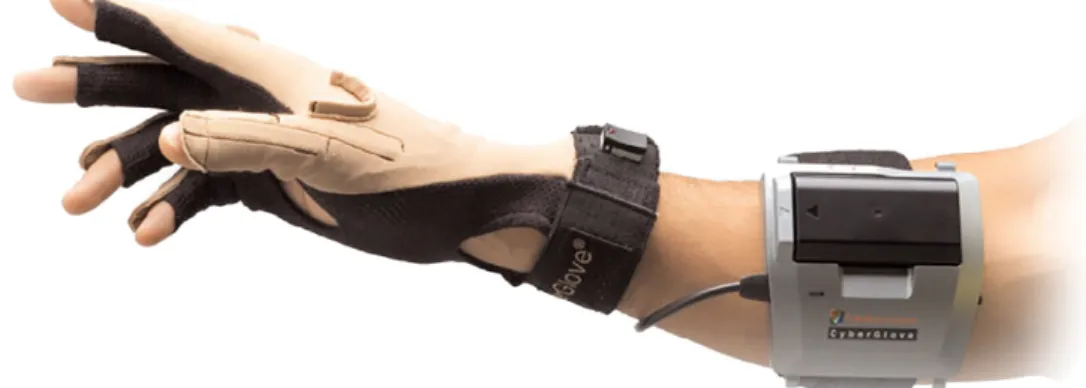
Contact-based technology may be subdivided into five categories: Mechanical, Inertial, Haptics, Magnetic and Ultrasonic (Kaˆaniche, 2009). Earliest devices have been a wear-able mechanical device like the glove-based devices CyberGloves (Fels et al., 2009) and DataGloves (Quam, 1990). This type of devices was heavy due to the cables connect-ing the device to the computer and hence it restricted the naturalness of the interactconnect-ing with the machine (Pavlovic et al., 1997). A wireless connection between this device and the computer is proposed to reduce the weights in CyberGrove II glove-based devices (Fig. 2.1). These devices are used in gesture recognition e.g. (Kevin et al., 2004). A full body suit “IGS-Cobra” is proposed by Synertial company to acquire the whole body gesture (Fig. 2.2).
Inertial devices detect the movements with respect to the ground magnetic fields change. They are available in two types: accelerometers and gyroscopes. The Wii-mote sensors, which belong to the accelerometers type, are used in gesture recognition proposed by Schl¨omer et al. (2008). Additionally, the most recent smart-watches are equipped with an inertial measurement unit (IMU); whose main components are accelerometers, gyro-scopes and magnetometers. These sensors are accurate and position independent. The output of the IMU is a measure of velocity, acceleration or orientation. These measures
Figure 2.1: CyberGlove sensor (CyberGlove Systems LLC, 2017) as an example of contact based technology. ©2017 CyberGlove Systems LLC.
Figure 2.2: Synertial IGS-Cobra (Synertial Labs LTD, 2017), the body suit that contains up to 47 sensors. ©2017 Synertial Labs LTD
can be used directly as features without further processing. Unfortunately, the IMU cannot capture the pose information (Yin et al., 2014b). The public data ChAirGest (Ruffieux et al., 2013) uses the IMU in combination with other sensors.
Recently, the Haptics including the multi-touch screen become essential in our daily life through smartphones, tablets, laptops, etc. Although it becomes sophisticated, it is still limited to one or more fingers in 2D space. The Magnetic devices estimate the motion by measuring the variation of the artificial magnetic field. Finally, there are three types of Ultrasonic sensors: an emitter, discs and multiple sensors. The position is estimated through the time delay of the sonic propagation.
2.2.2
Vision based technology
Initially, some gesture recognition approaches used markers on gloves (without electronics) to interpret the gesture using computer vision on the output of an RGB cameras (Mistry and Maes, 2009; Schr¨oder et al., 2012). Wearing gloves in each gesture acquiring increases the affectation of the interaction in HCI therefore, Shin et al. (2004) and Fothergill et al. (2012) used stereo RGB cameras with bare-hands considering the skin colour. The gesture recognition approaches were augmented to include an IR-sensing (for both far- and near-IR) to overcome the light condition problems in the RGB cameras (e.g. Starner et al., 2000; Toriyama et al., 2016). Different types of cameras are used in the context of the gesture recognition e.g. traditional cameras for a cheap cost, stereo cameras to deduce 3D information (Elmezain et al., 2008), and Pan-Tilt-Zoom (PTZ) cameras to focus on particular details for more accuracy (Bodor et al., 2004). A depth sensing is added to the vision-based approaches to acquire a gesture in 3D space e.g Microsoft Kinect Sensor and Leap Motion Controller. The Microsoft Kinect sensor is used in this work as (Section 4.1),
2.2. SENSORS 13
Figure 2.3: Microsoft’s Kinect Sensor for the Xbox gaming system. The image is down-loaded from Amos (2017a).
therefore the remind of this section discuss the Microsoft Kinect sensor. Recently, new research object to use the Radar in gesture acquisition e.g. Soli project, which is adopted by Google I/O 20151.
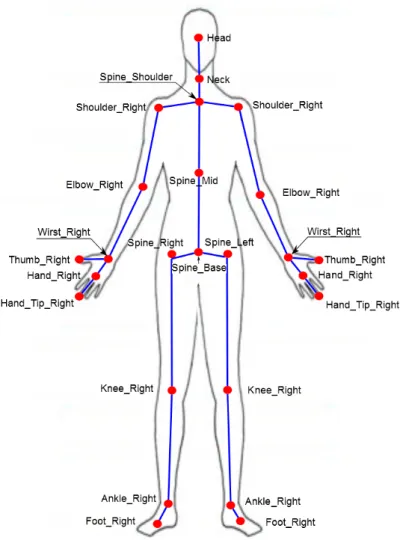
The well-known Kinect sensor (Fig. 2.3) is produced by PrimeSence. The first version of it was announced in 2011 by Microsoft for Xbox video gaming while the newer one was released in 2014. It contains an RGB camera, a depth sensor (Infrared sensor and infrared light source), and multi-microphone arrays (Webb and Ashley, 2012). Thus, the information received from the Kinect sensor is an RGB video stream, a depth data stream, a stereo sound and a skeleton data stream. The video resolution in the first version was (640×480 px at 30 Hz) or (1280×960 px at 12 Hz), while the resolution in the new version is (1920×1080 px at 30 Hz). The depth data stream has a resolution of (640×480 px). The sensor range limit is 1.2−3.5 m (extended range 0.7−6 m), and the required area is about 6 m2 (Yin et al., 2014b). Additionally, it streams a full-body skeleton of 20 joints in
the first version or 25 joints (including the thumbs and hands tips) in the newer version as seen in Fig. 2.4, which is presented by Microsoft. The error in the depth measurements is increased proportionally with increasing the distance from the Kinect sensor, start with few millimetres till 4 cm in the distance range of 0.5−5 m (Khoshelham, 2011; Yin et al., 2014b).
In contrast to the Kinect sensor, the Leap Motion Controller pay attention to the accuracy within a limited area, particularly the hand region. It can track all ten fingers with an accuracy of 10µm (Leap Motion Inc., 2017) through using two IR cameras and three IR LEDs (Fig. 2.5). It can observe the hand motion up to 1 m distance. It optimised to track the fingers and hence it may be considered as a challenge if trying to follow the hand with “fist” pose (Yin et al., 2014b; Wikipedia, 2016).
Figure 2.4: Skeleton positions of the Microsoft Kinect relative to the human body. The figure is adapted from Microsoft (2013a).
2.3
Gesture Segments
Speaking differs from the gesticulation by the starting and ending the discourse. There are periods of silence between the words in the speech; this disappearing of the voice may give an indication of the starting and the end of the word. In contrast, when a human wants to start a gesture, for example using hand motion, the hand is available before the gesture and still available after ends it i.e. the system receives a continuous movement. Thus, detecting the start and the end of the discourse is more complicated than in speech. The manual segmentation leads to several problems including high cost, unnatural interaction with the system, and time-consuming e.g. 10 days were required to segment one video (Quek et al., 2002). In order to solve this problem, arest position is proposed
2.3. GESTURE SEGMENTS 15
(a) The Construction of Leap Motion Sensor©2017 Leap Motion Inc.
(b) Using the Leap Motion Sensor to simulate the Hand©2017 Leap Motion Inc. Figure 2.5: Leap Motion Sensor (Leap Motion Inc., 2017)
(Kendon, 1980; McNeill, 1992). The discourse should start from the rest position and end with it. Although this assumption simplifies the segmentation process, it limits the naturalisation of the interaction with the machine. Therefore, some research is applied to detect the start and the end of the gesture without the need to use the rest position (Yin et al., 2014b). However, the more difficult challenge in the gesture recognition scope is the gesture segmentation. Following Madeo et al. (2016); Kita et al. (1997), which are based on McNeill (1992); Kendon (1980), the discourse of the gesture is divided into gesture units (G-units). The G-unit represents the movement of the hand or any part of the body that is doing the gesture, between two consequent rest positions. The G-unit is decomposing to gesture phases, which are described by Madeo et al. (2016); Kendon (1980); McNeill (1992) as:
• Preparation: moving the hand from the rest position to the position, where the gesture’s starting point.
• Pre-stroke: brief pause before starting the gesture to find and configure the hand.
• Stroke (or nucleus as in (Pavlovic et al., 1997)) the meaningful movement that represents the gesture.
• Post-stroke: short pause after ending the gesture with maintaining the hand con-figuration and position.
• Retraction: returning the hand to the rest position.
These phases are illustrated in Fig. 2.6. The G-unit, as proposed by Kita et al. (1997) may have more than one descriptive phrases and some phrases may (or may not) have preparation or retraction phases. Only the stroke phase is compulsory, and all the other aspects are optional i.e. it may be included or not. In addition to the dependent hold (pre-/post- stroke), Kita et al. (1997) mentioned that some independent holds may occur during the stroke phase (Madeo et al., 2016). These variations besides to the similarity between some parts of the phases e.g the rest and holding make the segmentation more complicated. Additionally, the exact instance of the transition from one phase to another depends on the opinion of the specialist who is segmenting the gesture (Madeo et al., 2016). These lead to different decisions of experts about the beginning and end of the stroke as well as the same stroke may be extracted differently by the same specialist if he segments the gesture more than once. Hence, it has become necessary for the researchers to propose a solution for these challenges. In this thesis, we proposed an automatic segmentation, which is explained in details in Section 4.1.
2.4. GESTURE SPOTTING 17
Figure 2.6: Illustration of the gesture phases (Ren, 2017). ©2017 Ada Ren
2.4
Gesture Spotting
Several kinds of literature discussed the gesture spotting e.g. (Alon et al., 2009; Yin et al., 2014b; Bhuyan et al., 2014; Elmezain, 2010). Since Alon et al. (2009) argued the spotting in details, several of their discussed items are covered here. As we mentioned early, the movements of the body’s part (e.g. hands) may contain a meaningful gesture, unintentional movements or manipulative gesture. Thus, the most challenging assignment in the gesture recognition approaches is finding the start and the end of the meaningful gesture from the continuous data stream i.e. temporal segmentation. Additionally, the location of the gesturing body’s part (e.g. hands) should be determined in all data framing i.e. spatial segmentation. Extracting only the meaningful gesture from the continuous stream is called spotting, which requires spatiotemporal segmentation. Some research is presented to solve gesture spotting, but most of them suppose that the gesturing body’s part has been precisely localised in each data frame as in (Alon et al., 2005; Lee and Kim, 1999; Morguet and Lang, 1998; Oka, 1998; Yoon et al., 2001; Zhu et al., 2002). Unfortunately, this assumption is subject to several problems since in reality, locating the gesturing body’s part is ambiguous in the existence of clutter, other people, skin-colour objects, or background motion. According to Alon et al. (2009), gesture spotting, existing algorithms can generally be categorised into two: direct and indirect approaches. Algorithms that belong to the direct strategies implement the temporal segmentation before starting the recognition while other type intertwined the temporal segmentation with the recognition. If we assume that each gesture recognition algorithm contains two modules, which are the low-level module, where the spatial segmentation is applied, and the high-level module, where the final trajectory should be recognised. Thus, the temporal segmentation is implemented within the low-level module indirect methods and within the high-level module in the indirect methods. The low- and mid-level motion parameters e.g. velocity, acceleration, and orientation are used in the direct approaches like (Kang et al., 2004; Kahol et al., 2004). The foremost constraint of the direct methods is the assumption that the gesture should arise between two non-gesturing intervals. The boundaries of the gesture in the indirect approaches are found by matching the input sequence with the
known gesture classes and select the input interval that gives a good recognition score as in Alon et al. (2005); Lee and Kim (1999); Oka (1998). Commonly, the indirect methods of extracting the gesture are based on one of the Dynamic Programming (DP) extensions such: Hidden Markov Models (HMMs) (Lee and Kim, 1999; Wilson and Bobick, 1999; Vogler and Metaxas, 1999; Brand et al., 1997; Starner et al., 1998; Stefanov et al., 2005; Chen et al., 2003), Dynamic Time Warping (DTW) (Darrell et al., 1996; Kruskall and Liberman, 1983), Continuous Time Programming (CTP) (Oka, 1998), and Conditional Random Fields (CRF) (Quattoni et al., 2007; Lafferty et al., 2001). Those methods find the end point of the gesture by comparing the recognition likelihood to a fixed or an adaptive threshold. Using a fixed threshold is non-practical assumption to deal with the inconstant data stream’s likelihoods. Hence, several kinds of research are proposed to estimate an adaptive threshold by using a non-gesture model, for example, Lee and Kim (1999); Yang et al. (2006) used HMMs model, and Yang et al. (2009a) used CRFs. The primary constraint of the indirect methods is that first detect the end point of the gesture then they use the backwards spotting to track the starting point of the gesture. This process leads to a time delay between the segmentation and the recognition modules. Additionally, they need more time of processing and more complicated techniques e.g. an optimisation process. Regularly, the highly accurate spotting often leads to more complexity, thus less reality.
Some other types of research mixed the direct and indirect methods by candidate more than one frontier in the low-level module, and the most accurate one is selected in the high-level module e.g. Alon et al. (2009).
2.5
Hand Tracking and Feature Extraction
The first module in the gesture spotting is the spatial segmentation which is the locating of the body’s part of the actor in the streamed images. In the case of hand gesture, this process is called hand tracking, and it is needed particularly in vision-based sensors. The hand tracking differs from application to another. For example, the hand shape is important in the applications that are used to recognise static (hand pose) gestures, therefore, the whole hand is extracted from the rest of the image by using one of some methods. The well-known method uses the skin colour to segment and tracks the hand (Yin et al., 2014b; Dadgostar et al., 2005). The applications that employ the dynamic gesture effort to estimate the trajectory of the hand rather than the shape of the hand (Cutler and Turk, 1998). These applications may look to the hand as a blob, and they estimate the 3D axis of the hand’s centre only in each of the successive streamed image. Consequently, the trajectory of the hand is tracked only. In our work, the 3D axis of the hand is obtained directly by the Kinect sensor.
In the case of pose gestures, the main two types of features are hand contour and hand texture features. Frequently, the Fourier transform is used with the contour features
2.6. GESTURE RECOGNITION APPROACHES 19 (Yao, 2014) while the texture features have different representations where the Histogram of Gradients (HoG) (Dalal and Triggs, 2005) and the Scale Invariant Feature Transform (SIFT) (Lowe, 2004) are the best-known methods. In contrast to the hand pose recog-nition approach, the approaches that track the dynamic hand trajectories have a limited number of features, which can be divided into two types: local and global features (Yao, 2014). Hand orientation, speed, movement direction, acceleration, and location of the Cartesian and Polar axis, are an example of local features (Yoon et al., 2001; Elmezain et al., 2009). While the pattern shape features extracted from the complete hand trajec-tory, represent the global features.
2.6
Gesture Recognition Approaches
As mentioned earlier, there are several types of acquiring the gesture. Consequently, the gesture recognition algorithms are diverse according to the acquisition methods, the body part that makes the gesture, and the type of the tracked gesture. We will cover the hand gesture approaches in this section since the most dominant gestures in the HCI topic are implemented by hand(s). Additionally, most of contact-based sensor’s outputs are used directly as features without further processing; hence we will focus on the vision-based methods. An enormous amount of studies target vision-based methods because they help to interact naturally with the machines with bare hands or without any additional wearable device. Furthermore, the dynamic hand gesture is the main goal of our study. Since static gestures have been covered in a large number of studies, some topics in this section will deal with it. Previously, the hand gesture algorithms were divided into two main types: model-based algorithms and appearance-based algorithms(Pavlovic et al., 1997). Recently, new techniques are proposed to solve the hand gesture problems. Hence, we follow the categories proposed by Abid (2015) including:
• 3D Model-based Approaches,
• Appearance-based Approaches,
• Machine Learning Algorithm Based Approaches,
• Rule-based Approaches,
• Syntactic Approaches, and
• Local Feature Approaches.
Figure 2.7: Sc hematic diagram represen t the w ell-kno wn metho ds of the gesture recognition approac hes
2.6. GESTURE RECOGNITION APPROACHES 21
2.6.1
3D model-based approaches
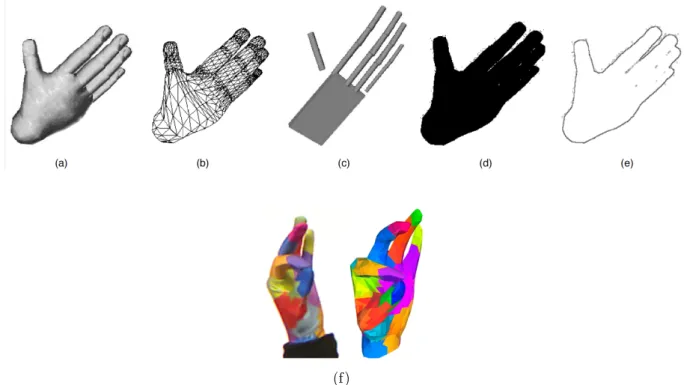
The 3D hand/arm models can be further subdivided to volumetric and skeletal models. Volumetric models have been mainly used in computer animation industry (Thalmann and Thalmann, 1990) and then used in computer vision applications (e.g. Koch, 1993). They are used to represent the 3D visual appearance of the human hand/arm. The 3D hand model’s parameters are estimated by minimising the error between the 2D input im-ages of the hand with the 2D projection of the proposed 3D model. Complex 3D surfaces such as NURBS (non-uniform rational B-splines), generalized cylinder, and Super-quadric (Pavlovic et al., 1997) are mostly used by the volumetric models in computer animation (Fig. 2.8). NURBS models provide a rich description to the hand, which allowed recog-nising a wide range of static hand gestures. Although they become realistic, they are computationally intensive, and they are too complicated to use in the online recognition. Additionally, they require a large database to train on the entire characteristic shapes for different views (Abid, 2015). The other types i.e. generalized cylinder and super-quadric, are used to simplify the body part rendering (e.g. Murugappan et al., 2013). Even though this simplification, the estimation of the model’s parameters is still very complex and the dimension of the parameters is very high (Pavlovic et al., 1997). In order to overcome these problems, the skeletal-based models are used instead of the volumetric models. In these models, only the joint angles and the segments lengths are used to represent the hand or the arm. These models are discussed in details in Thompson (1981). In the recent researches, the skeletal details of the whole body can be directly gotten from the Microsoft Kinect sensor. In this work, we have used the Kinect sensors to acquire the skeletal of the human. Unfortunately, the most recent version of the Kinect sensor represents the hand by only three joints including the centre of the hand, the tip of the index and thumb fingers. In the proposed work the centre of the hand has been quite sufficient.
2.6.2
Appearance based approaches
This type of approaches derives the parameters directly from the images, without needs to construct a spatial model to the body. Pre-define templates of the hand or any other body’s part are used for this purpose. Following Kaˆaniche (2009) and Pavlovic et al. (1997), different models belonging to this type of approaches include:
• Colour based models: body markers are used in this model to track the motion of the body. A multi-scale colour feature together with particle filtering may be used in this methods in a hierarchal way (e.g. Bretzner et al., 2002).
• Silhouette geometry based models: the silhouette geometric properties, e.g. perimeter, surface, convexity, rectangularity, bounding box/ellipse, orientation, elon-gation and centroid are used in this methods (e.g. Birdal and Hassanpour, 2008).
• Deformable based models: deformable 2D templates are represented by a set of points located on the outline of the hand, or any body’s part. They are used to approximate the object outline by considering the points as interpolation nodes (Pavlovic et al., 1997). These templates consist of two types of parameters, which are the internal parameters and external deformation. The internal parameters are represented by the average point sets, which describe the average shape of a specific group of shapes, and the point variability parameters, which describe the possible variation within a certain group of shapes. For example, all the open hand posture belongs to the same group specified by the same shape on average. Any possible posture of an open hand may slightly vary from the average. The external deformations describe the overall motion of the template e.g. rotation and translation. This method is used in a wide range of applications, for example, (Cipolla and Hollinghurst, 1996; Cootes et al., 1995; Ju et al., 1996; Ramani et al., 2016).
• Motion based models: 2D image sequences are used as gesture templates. Each of these image sequences models one type of the used gesture types. The parameters that used in these methods are the images themselves or features derived from them. Either the complete hand image sequence (e.g. Darrell et al., 1996) or the fingers image sequence (e.g. Crowley et al., 1995) can be used as templates depending on the application. Another type of approaches called motion history images (MHIs) (Bobick and Davis, 1996), which are 2D images represent the visual image over a temporal window. The intensity of each pixel in this image is related to the period of the motion sustained at this pixel (Pavlovic et al., 1997). Some other applications, which concern about the deictic gesture, used a single fingertip and a reference point only. These approaches assume the location of the fingertips relative to the palm is different in most of gestures (e.g. Fukumoto et al., 1994; Vogel and Balakrishnan, 2005).
2.6.3
Machine learning algorithm based approaches
Learning the machine means giving it the ability to discriminate among classes that it had been previously trained on. Commonly, the accuracy of the learning algorithms is increased with increasing the training data. This section gives a short overview of machine learning algorithms for gesture recognition. Using the machine learning in the pattern recognition is described in details in Chapter 3. Some of the massive machine learning algorithms are used in the gesture recognition field. Among these algorithms, the Hidden Markov Model (HMM) and also the Conditional Random Fields (CRF), the Artificial Neural Network (ANN), Dynamic Time Warping (DTW), Support Vector Machine (SVM) and instant based approaches are dominant in the gesture recognition. A brief description
2.6. GESTURE RECOGNITION APPROACHES 23
(f)
Figure 2.8: Hand models. Different hand models can be used to represent the same hand posture. (a) 3D Textured volumetric model. (b) 3D wireframe volumetric model. (c) 3D skeletal model. (d) Binary silhouette. (e) Contour (f) Colour. The sub-figures (a)–(e) are adopted from Pavlovic et al. (1997) (©1997 IEEE) and the sub-figure (f) is adopted from Schr¨oder et al. (2012) (©2012 IEEE).
of these approaches is presented in this section in separate paragraphs. Despite the advantage of the machine learning in the gesture recognition e.g. high accuracy, flexible, fast, etc., they are suffering from two major problems: feature selection and training dataset (Elmezain, 2010). Using a large number of features raises the dimensionality, which may affect the speed of the recognition and in some cases, affects the accuracy. In contrast, a significant reduction in the number of the features leads to poor recognition accuracy. Hence, finding only the useful features is crucial. On the other side, training the algorithm with a sufficient number of the training samples is vital to work properly. Unfortunately, in this thesis, we work on data streaming, which means scarcity in the training data with abundant unlabelled data. This is the main problem that we try to solve in this thesis.
Hidden Markov model
Hidden Markov Model (HMM) is widely used to solve the Spatio-temporal problems (Elmezain, 2010). Initially, the HMM was used in terms of speech recognition (e.g. Ra-biner, 1989) then it extended to the gesture recognition (e.g. Starner et al., 1998; Gao et al., 2004; Elmezain, 2010). It has been used in about 29% of all gesture recognition studies (Madeo et al., 2013b). The segmentation phase and the recognition phase can be optimised simultaneously (e.g. Yin et al., 2014b), which is the main feature of the HMM. Commonly, HMM used to recognize pre-defined gestures (e.g. Chen et al., 2011). An ex-tension of the HMM has been used to discriminate more gesture classes (e.g. Kettebekov et al., 2005). Harper and Shriberg (2004) proposed three different models and combined their outputs in one HMM model in order to achieve a final decision. Wilson and Bobick (2000) used the HMM to estimate the temporal model structure only, while training the HMM model is implemented at the beginning of online phase rather than offline phase. Corradini (2001) used the Neural Networks to compute the transition probabilities for the HMM in a hybrid model.
Conditional random fields
Conditional Random Fields (CRFs) are a undirected graphical model, which unlike HMMs, that model the joint probability p(x, y), CRFs model the probabilityp(x|y) of a label se-quence Y given the input sequence X (Vail et al., 2007). This gives CRFs the ability to consolidate complex input features and maintaining the independence assumption. The linear-chain CRF is well-known in the language processing (e.g. Roark et al., 2004). Since, the gesture is similar to the language, CRFs presented in term of gesture recognition (e.g. Yang et al., 2009a; Vail et al., 2007).
The CRFs are augmented by adding hidden states to present the Hidden Conditional Random Fields (HCRFs). The HCRFs can represent the complex dependencies of the training data or their implicit structure (Chang et al., 2009b). It is used in the gesture recognition in several approaches, for example, (Wang et al., 2006; Quattoni et al., 2007).
Artificial neural networks
The Artificial Neural Networks (ANN) simulate the biological neural network in the brain of humans or animals. Normally, ANNs have been used in the machine learning to estimate non-linear functions, which may depend on multiple inputs. The nodes in the ANN are the fundamental units, which may act similar to the neurons in the brain. The neural networks consist at least of 3 layers; the input layer, where the input should apply to the ANN; the hidden layer(s), which contain the nodes (neurons); and the output layer. By increasing the number of hidden layers (as in deep learning) it becomes able to approximate very complex functions but at the expense of the complex training. The nodes are fully connected via weighted links. These weights are estimated during
2.6. GESTURE RECOGNITION APPROACHES 25 the training phase. Additionally, each node has an activation function e.g. radial basis, sigmoid, etc. The activation function’s parameters are also estimated during the training phase. Mainly, there are two structures of ANN, which are the recurrent neural network and a multi-layer feed forward neural network. Although the recurrent structure may model more complex systems than the feed-forward structure, its training is very complex and it may behave chaotically. An example of using the neural network in the gesture recognition is the Gesture Driven Interface in Virtual Environments (GIVEN) proposed by Vaananen and Bohm (1993). They used two models of ANN; the first one is for static gesture recognition and the second model is for dynamic gesture recognition (Elmezain, 2010). A real-time gesture to speech approach is implemented by Fels (1994) based on a neural network. Another application of using neural networks in the gesture recognition is proposed by Kjeldsen and Kender (1995) to control a window-based interface system. The system is based on two layers; in the first layer, the hand is spotted in real time and the second layer (or the action layer) uses a grammar to map the detected images by the first layer with the required action. Regarding stereo cameras, Stiefelhagen et al. (2004) used two neural networks to process the head’s disparity and intensity in a combined grey and depth data. The first network is used for the tilt in the head’s orientation and the second for panning.
Template matching
Before comparing a gesture with the template, it should be normalised. The main tech-nique of the normalisation is the dynamic programming. The dynamic programming includes Dynamic Time Warping (DTW), Continuous Dynamic Programming (CDP) and Dynamic Time Alignment (DTA). DTW algorithm is used for the normalisation in many applications, particularly the speech recognition (Rabiner and Juang, 1993; Bhuyan et al., 2008). It can measure the similarity between two sequences even they differ in time, speed, acceleration and length. We may get an inaccurate result if we used the Euclidean distance to compute the similarity between two out of scale gestures. Normalising the gestures in the Spatio-temporal space is very important to get a realistic result when comparing two gestures because it is very difficult to perform two identical gestures in length and dimensions even if the person insist. Even if we assume the gestures are iden-tically performed, the result of comparing them using direct Euclidean distance will be not accurate if there is a time shift between the two gestures. Initially, the DTW was used with 1D sequences especially, audio signals but then it was extended to work with multi-dimensional data (Gillian, 2011). In this work, it is modified to fit 2D data, which represent the location of the hand in 2D space (cf. Section 4.1.1). The CDP is also used in several approaches to segment and classify the gestures. It is successfully applied in different approaches (e.g. Takahashi et al., 1992; Li and Greenspan, 2007; Seki et al., 1993).
Support vector machine (SVM)
Support Vector Machine (SVM) is a technique that maps two distributions, non-linearly separated, from the original features space to a high-dimensional space to find the op-timum hyperplane that separates these two distributions. The optimised hyper-plane is then used to perform a classification or regression for the new samples (Vapnik, 1998; Madeo et al., 2013a). Originally, SVM was announced by Vapnik (1963) and then de-veloped by Boser et al. (1992). It can be simplified by the following example (Madeo et al., 2013a), suppose N is the number of samples in the training set. The samples are in the form {#»xi, yi}Ni=1, where the #»xi is the feature vector and the yi ∈ {−1,+1} is the
label of the #»xi. Then the goal of the SVM is finding a hyperplane that separate the
two classes optimally using fsvm(#»xi) = w#»svmTϕ#»(#»xi) +b0. The w#»svm here represents the
optimal weights, b0 is the optimal bias. The input feature vectors are mapped to the high-dimensional space using the non-linear mapping ϕ#». The hyperplane is optimised by maximising the distance between hyperplane and the nearest data from each class in the training phase, which leads to computing the optimal weights wi and optimal bias b0.
Initially, the SVM was a binary classifier i.e if the output ˆy > 0 then the sample belongs to first class else it belongs to the second class. Solving the optimisation of the hyperplanes for multi-classes together is more complicated in comparison to solving it into several binary classes. This problem is solved by looking at the multi-classes problem as several binary problems, Zhang et al. (e.g. 2006). The multi-classes problem decomposed to either one-vs-all or one-vs-one binary classifiers. In one-vs-all taking each class and consider all other classes as one class and find an SVM model for this class. This process is repeated for all classes and the output of each new sample is computed for each model. Hence, if the number of the classes isNclassthen the number of models in this approaches
will equal to Nclass. While one-vs-one is taken each possible combination of two classes
and compute the hyperplane. This method gives a number ofNclass(Nclass−1)/2 models.
The final output is obtained by different methods e.g. voting by majority. The SVM classifier is used in the gesture segmentation and recognition in some approaches (e.g. Madeo et al., 2016; Ramakrishnan, 2011; Ramakrishnan and Neff, 2013).
In the systems that need to increment the number of classes without train new classi-fiers from the start as we supposed in this thesis, the one-vs-one configuration needs to add several new SVM models for each new class. Hence, we adopt the one-vs-all configuration in Section 5.4.
Instance/Distance based approaches
In this type of approaches, the training data samples are explicitly used to classify the new samples. Literally, there is no real training process and no any prior pieces of information otherwise the training data. It assumes that the samples which have the same label should lie close each other in the Euclidean space (Dasarathy, 1991). The clearest example of
2.6. GESTURE RECOGNITION APPROACHES 27 this approaches the metric learning and particularly, the K-nearest neighbour algorithm (KNN) (Altman, 1992). The KNN algorithm classifies the new sample by finding the labels of the k-nearest training samples and make a majority voting. Although these approaches are simple and have acceptable accuracy in the gesture recognition topic (Ali and Shah, 2010), they need to store all the old samples, which it is difficult especially when training data are streamed continuously as in our case.
Other approaches
There are extensive studies in the field of machine learning related to gesture recognition. We explain the most used in the field of the gesture recognition, but the studies are not limited to these methods. Spano et al. (2012) used a Petri Nets based meta-model to implement a compositional model gesture definition. While, Choi et al. (2008) apply the k-means. Some other techniques used the probabilistic methods (e.g. Eisenstein et al., 2008) used Bayesian analysis and (Wong and Cipolla, 2006) used Relevance Vector Machine .
2.6.4
Rule-based approaches
Manual rules are encoded in this type of approaches, and the gesture’s label will provide the output if the input features justify the corresponding rule (Abid, 2015). A set of rules is proposed by Cutler and Turk (1998) to classify human actions. Su (2000) predicts the hand’s motion that is related to low-level features. Trajectories of the motions are analysed and predicted in Hassan et al. (2010) using the rule-based technique. Whereas Chang et al. (2009a) suggest a method which accepts the variation in the input gesture if it is performed by different people. They based on fuzzy rules to track and recognise the posture and action.
2.6.5
Syntactic approaches
Syntactic pattern recognition is also called structural pattern recognition. Sometimes the simple features are not enough to represent complex structural objects in the recognition system. Instead, the Syntactic approaches represent them by a set of elementary parts called Primitives (Abid, 2015). The primitives are a variable-cardinality set of symbolic and nominal features2. The elementary part should satisfy some rules to be identified
as Primitive (see Sonka et al., 2014). Thus, Syntactic approaches consider the interre-lationships among the attributes, which leads to the ability to