Iyed Khammassi
∗†, Rachid Elazouzi
∗, Majed Haddad
∗and Issam Mabrouki
†∗University of Avignon, 84000 Avignon, FRANCE Email: [email protected] †University of Manouba Manouba, Tunisia
Abstract—The network virus propagation is influenced by various factors, and some of them are neglected in most of the existed models in the literature. In this paper, we study the network virus propagation based on the the epidemiological viewpoint. We assume that nodes can be equipped with protection against virus and the security of a node depends not only on his protection strategy but also by those chosen by other nodes in the network. A crucial aspect is whether owners of device, e.g., either smartphones, machines or tablets, are willing to be equipped to protect themselves or to take the risk to be contaminated in order to avoid the payment for a new antivirus. We model the interaction between nodes as a non-cooperative games where the node has two strategies: either to update the antivirus or not. To this aim, we provide a full characterization of the equilibria of the game and we investigate the impact of the price of protection on the equilibrium as well as the efficiency of the protection at equilibrium. Further we consider more realistic scenarios in which the dynamic of sources that disseminate the virus, evolves as function of the popularity of virus. In this work, the interest in the virus by sources evolves under the Influence Linear Threshold (HILT) model.
I. INTRODUCTION
The Internet continues to grow exponentially and many ap-plications continue to multiply on the Internet, with immediate benefits to end users. However, these network-based applica-tions and services can pose security risks to devises. Recently many attacks have been launched against business, users and governments, that are attributed to some decentralized online communities acting anonymously in a coordinated manner. However, despite the important efforts spent by the many security companies, researchers, and government institutes, information systems security is still a great concern [1], [2]. One of important security risks is the propagation of some sophistical virus in the internet in which each infected node becomes a new source of infection. The problem of virus propagation has been studied through huge papers focusing on mainly on epidemic thresholds for real and realistic network and immunization policies [3], [4], [5]. Many researchers have taken help of the biological system to study the behavior of spread of virus in a computer network and how to immune the computer system [6]. These epidemic models were very useful in network security modeling and immunization strategy.
To manage the network security, lots of efforts have been devoted to study virus propagation and characteristics [7]. To protect from the spread of virus in the network, nodes, e.g.,
either smartphones, machines or tablets, can use some anti-virus software with curing tools. In existing research, there are many perspectives to protect against network infections [8]. An important issue of protection is the frequency of the update in order to provide a protection against new virus. But many of the anti-virus applications are of server-client in which the system may provide the last update especially when there is an intensive epidemic of new virus. But an important fundamental source of difficulty in developing efficient protection is the difficulty to fully observe and control the network. As a conse-quence, full control and observability is impossible, leading to systems that are vulnerable to local as well as remote attacks. Other factor has to be considered when evaluating the security risk from virus, is the decentralized decision on the protection. Indeed, the protection against virus is typically autonomous nature of decision making in the network and the performance of such security is usually made under the assumption that nodes are willing to use an anti-virus for protection. But, a crucial aspect is whether owners of devices are willing to be equipped to protect them self or to take the risk to be contaminated in order to avoid the payment for a antivirus. Any successful security solution should consider those factors. To date, the problem that attached the most attention from the research community is how efficiency the protection against the virus when the decisions are taken autonomously by nodes according to the cost of antivirus as well as the risk to be contaminated. In fact, the bigger the number of nodes equipped with protection, the lower the infection probability for a node without protection. We model the problem as non-cooperative games in order to establish the behavior of nodes against virus infection. Furthermore, we consider a source S which propagates the virus through the network. We are concerned with spread of sources that disseminate the virus. In particular, we associate the dynamic of sources with the popularity of virus which is measured by the number of infected nodes at least one time. We model this influence process using Homogeneous Influence Linear Threshold (HILT) model [9]. The HILT model focuses on the threshold behavior in influence propagation, which we can frequently relate to when enough of our friends bought a product, we may be influenced and converted to follow the same action. In our context, when a virus reaches some level of popularity, other sources may participate in dissemination of this virus.
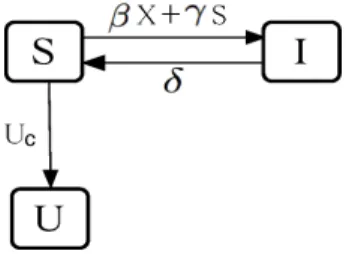
Fig. 1. Transition condition of activation state.
The remainder of this paper is organized as follows. The epidemic model and the network game is introduced in section II. In section III, we study the dynamics and the different equilibrium properties of the proposed security game. Numer-ical illustrations of the system behaviors and the equilibrium characteristics are given in Section IV. In order to enhance the readability of the paper, the mathematical proofs are given in Appendices.
II. NETWORK MODEL
Consider a sparse network that consists of a large population of N computer systems (CS) or nodes. We assume that the network is a complete graph where all computers can com-municate with each others. A set of sources generates a virus with a rate µsand nodes in the network becomes susceptible
to be infected by this virus. Each node ichooses or not to be equipped in order to protect himself from the virus by paying a relative price of protection. Mixed strategies, i.e, probability distribution over the actions, are also possible. Obviously, all nodes have an incentive to protect themselves until the virus extinction. However, every antivirus update costs a price Uc.
Hence, the strategy adopted by a node corresponds to a certain utility it receives and this utility depends on actions performed by N nodes. Nodes with outdated antivirus are vulnerable to the virus spread process, and lose an infection costIc if they
were infected. An infected node can recover after a curing time using various tools (e.g., through a clean-up software). Under this setting, nodes shall immunise themselves during the period of the virus spread while minimizing the antivirus update cost.
A. Modeling active sources evolution
Assume that there are a set of sources that generate the virus. We associate the dynamic of active sources, which still disseminate the virus, with the dynamic of the number of infected nodes. In particular, we associate the dynamic of the number of active sources with the popularity of virus which is measured by the number of infected nodes at least one time. We model this influence process using Homogeneous Influ-ence Linear Threshold (HILT) model [9]. The HILT model focuses on the threshold behavior in influence propagation. The evolution of the number of active sources is modeled following process evolving in continuous time. Each source j chooses a random threshold θj from an arbitrary threshold
distribution with cumulative density function (c.d.f)F. Hence a source becomes active if the popularity, which measured by
Fig. 2. Flow chart of states’ transitions.
the number of infected nodes, exceeds its threshold. An active source disseminate the virus during a random timeTm, which
follows the exponential distribution with rate δS. Under the
HILT model, the following proposition describes the dynamic of the number of actives sources at timet.
Proposition 1. The dynamic of the number of active sources that disseminate the virus, is given by
˙
S(t) =−δSS(t) +λ
f( ¯X(t))
1−F( ¯X(t))(N−S(t)),
whereX¯(t)is the number of infected nodes till timet. Proof:See appendix.
B. Modeling Infection Dynamic
To model the spreading process under the influence of a curing process, we choose the SIS (Susceptible Infected Susceptible) model, which is one of the most studied epidemic models [10], [11]. A node at time t can be in one out of two states: infected or susceptible. We assume that the curing process is a Poisson process with rateδ, after which the node becomes healthy, but susceptible again to the virus. LetX(t)
denote the number of infected nodes and each infected node can infect healthy nodes with a contact rateβ. Note that the total infection rate of a susceptible node is β times the size of infected nodes.
C. The Security Game
We consider a security game, in which nodes choose indi-vidually whether or not to invest in the protection by updating their antivirus versions. Indeed, nodes prefer to not invest in antivirus update if the network is enough protected, i.e., there is enough nodes in the network that have chosen to update. Each node has two strategies: either to invest in the antivirus protection, i.e., pure strategyupdate(U), or not to invest, i.e., pure strategynot update (N U). Each strategy corresponds to certain playoff for the node. Notice that, a node may also be protected by the other nodes’ update: the risk to be infected decreases with the number of antivirus activated throughout the network. Accordingly, the payoff of a node depends on the actions performed by theN−1 nodes.
We denote by Vj(kU) the long term fitness of a computer,
where Pi is the probability to be infected until the virus
extinction.
III. CHARACTERIZATION OFEQUILIBRIUM
The nodes which invest in the antivirus protection are directly immune to the virus. Therefore, they can not infect the other nodes or be infected. The dynamic of sources S(t)
depends on the the virus popularity. The activation process describes how the infectious nodes cause the inactive sources to become active. A sourcejis influenced by the accumulative number of infected nodesX¯ and it will be active when
¯
X(t)≥θ (2)
We assume that a node contacts an active source with a rate γ. Before evaluating the dynamics of the the infected nodes XN(t), we study the dynamic of sources SN(t) under the activation process.
A sourceSis active when the number of infected nodesX¯N(t)
reaches the target valueθ. LetX¯(t)be the dynamic of infected nodes disregarding the curing process. The dynamics ofX¯(t)
is given by
˙¯
X(t) = (βX(t) +γS(t))(N−kU−X(t))
Proof: See appendix.
Recall thatSN(t)is the set of active sources which partici-pate in the infection process by timet, andδSSN(t)is the set
of the sources which are no longer interested to the virus and move from the active state to the susceptible state. A source is influenced by the accumulative infection process with a rateλ. By applying Condition (2), we can write the sources dynamics as follows
˙
S(t) =−δSS(t) +λ
f( ¯X(t))
1−F( ¯X(t))(N−S(t))
We know that the hazard function [12] for the c.d.f F(.)is given by hF(x) = 1−f(Fx()x) where f(x) is the corresponding
density function. Hence, the ordinary differential equation (ODE) becomes
˙
S(t) =−δSS(t) +λhF( ¯X(t))(N−S(t))
Proof: See appendix.
The sources contact (N−kU−XN(t))susceptible nodes
with a rate γ.Therefore, we can write the dynamics of X(t)
as following
˙
X(t) =−δX(t) + (βX(t) +γS(t))(N−kU−X(t))
This growth equation gives the dynamics of infected nodes under the sources activation process. All nodes aim to be
Pi(t) = 1−E Z τc 0 e−(βx(t)+γS(t))dt (3) 1) Pure Nash Equilibrium:
Definition 1. At a Nash equilibrium (NE), no player
can improve its fitness by unilaterally deviating from the equilibrium.
For the proposed game a NE in pure strategies exists if and only if the following two conditions are satisfied
∀1≤j≤N =
Vj(N U, kU −1)≤ Vj(U, kU) Vj(N U, kU) ≥ Vj(U, kU+ 1)
(4) We are interested in the existence and uniqueness of the pure NE which is characterized by the number Ψof players investing in the antivirus.
A unique pure NE exists for the proposed security game when Vj(N U, ψ) =Vj(U, ψ).
Proof:See appendix.
2) Mixed Nash Equilibrium: Let us now discuss the case when every node maintain a probability distribution over the two actions(U, N U). The advantage of this mixed equilibrium compared to the pure one is that a node can invest in protection only for a fraction of the time and stay susceptible the rest of the time. This kind of equilibrium is more efficient for our case because we study a homogeneous population with fixed update and infection cost. In a mixed strategy game, a nodei can decide to invest in protection (playingU) with probability pi or keep protected only by his neighbors (playingN U) with
probability(1−pi).
p= (p1, p2, . . . , pN),∀ipi ≥0, is the mixed strategy profile.
For pi ∈ {/ 0,1} we have a fully mixed strategy profile. We
note(pi, p−i)if nodei uses strategypi and other use p−i = (p1, . . . , pi−1, pi+1, . . . , pN).
We denote byVj(p, p−i)the playoff of a nodeiwhich invest
in antivirus with probability p.
Definition 2. A mixed strategyp∗i ∈[0,1]is a NE if for each playeri (wherei= 1, . . . , N) we have
Ui(p∗1, . . . , p∗i−1, p∗i, p∗i+1, ., p∗N)≥Ui(p∗1, . . . , p∗i−1, pi, p∗i+1, . . . , p∗N)
(5) for every mixed strategypi∈[0,1].
If∀i, p∗i∈ {/ 0,1} then we callp∗ fully mixed NE.
Every finite strategic game has a mixed strategy NE [13]. There exists a unique fully mixed NE p∗ for the proposed game and it is solution of
N X
k=1
CkN−−11(p∗)k−1(1−p∗)N−kV(U, k) = 0 (6)
3) Equilibrium with Mixers and Non-Mixers: The mixers are the players that choose a mixed strategy. We suppose that a part of the population chooses to play a pure strategy U or N U and the rest of the players are mixers. We will study the existence of the equilibrium in this case. Let NU ∈ {0,1, . . . , N} be the number of players choosing the
pure strategyU, and NN U ∈ {0,1, . . . , N}be the number of
players choosing the pure strategy N U.
The N −NU −NN U players use the mixed strategy. Let p∗ ∈ (0,1) be the probability with which the mixers choose the strategy U. Moreover, we denote by VU(NU, NN U, p)
the fitness of the node who updates its antivirus and VN U(NU, NN U, p) the fitness for the node who does not
update its antivirus. A necessary condition for the strategy
(NU, NN U, p∗)to be a NE (with at list one mixer) is that the
mixer is indifferent whether it chooses a pure strategy U or N U. This translates mathematically as follows
VU(NU+ 1, NN U, p∗) =VU(NU, NN U+ 1, p∗) (7)
Proof: See appendix.
A unique NE of type(NU, NN U, p∗)exist for this case, and
is solution of N−NU−NN U X k=0 CN−NU−NN U k−1 (p ∗)k−1 ·(1−p∗)N−NU−NN U−kV(U, N U+k) = 0. (8)
We prove that this NE of type (NU, NN U, p∗) exists only
for NU < ψ andNU +NN U≤N−2.
Proof: See appendix.
In this section, we have studied different NE types under the S(t)activation process. We summarize the different Nash equilibrium types as following:
• Pure Nash Equilibrium: There exists a unique NE when the utility ofU is equal to the utility ofN U and we must update exactly ψnodes to get this equilibrium,
• Mixed Nash Equilibrium: A unique fully mixed NEp∗ exists and it is solution of Equation (6),
• Mixer and Non-Mixer Nash Equilibrium: We
char-acterize this equilibrium by a necessary condition (7). A unique NE exists and it is solution of Equation (8). Moreover, we have proved that a NE exists only for NU < ψand forNU +NN U≤N−2.
IV. NUMERICAL EVALUATION
In this section, we provide a numerical analysis of the performances of the proposed security game. We first evaluate the infection probability at the equilibrium. To do so we solve Equation (6) to get the activation probability at the equilibrium. We show how the activation and the infection process depend on the system parameters, such as the number of nodesN and the update cost U c.
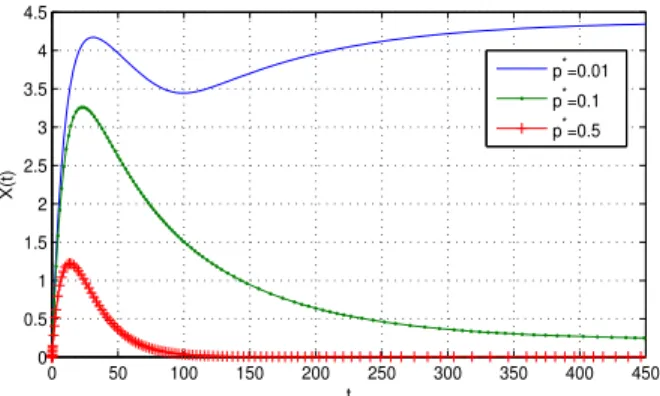
0 50 100 150 200 250 300 350 400 450 0 0.5 1 1.5 2 2.5 3 3.5 4 4.5 t X(t) p*=0.01 p*=0.1 p*=0.5
Fig. 3. The infection process for different activation probabilitiesp, where
N = 100,Ns = 50,β = 1×10⁻³,γ = 1×10⁻³,δ = 1×10⁻¹,
δS = 1×10⁻¹,λ = 5×10⁻⁶,X(0) = 0,S(0) = 5, Ic = 1 and
U c= 0.1.
A. System characteristics
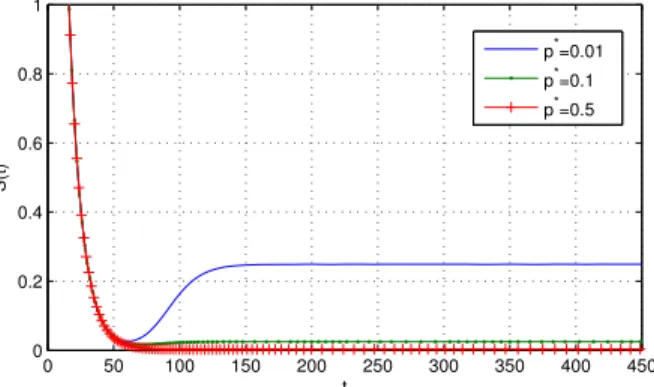
Fig. 3 and Fig. 4 illustrate the behavior of the infected nodes X(t) and the sourcesS(t)as function of the time for different activation probabilities(0.01,0.1,0.5) and a contact rate β= 1×10⁻³. We further takeX(0) = 0andS(0) = 5. As expected, we remark a cause-effect phenomenon between the nodes and sources. The number of infected nodes increases as a result of the virus spread till reaching a given infection rate. Then, when the virus popularity reaches a certain level, the participating in the virus spread increases yielding an increase in the number of sources.
In the proposed game model, activation probability is a fundamental parameter and is related to how many nodes install the new anti-virus software. To analyze effects of the activation probability, p is set to three different values
(0.01,0.1,0.5). Fig. 3 shows that the number of infected nodes X(t) slightly fluctuates before reaching a stable (absorbing) state. In general, the higher the activation probability is, the faster X(t) decreases. This is due to the fact that increasing the activation probability implies a decrease in the risk of being infected for susceptible nodes. Notice that, depending on the activation probability, the virus may disappear completely or become scars. We will discuss this point later in the paper.
Fig. 4 depicts the dynamics of the interested sources in the virus spread for different p. We clearly notice that, for low activation probability values, e.g., p = 0.01, S(t) decreases until the virus popularity reaches a target value. When the activation probability increases to p = 0.5, we can see that the number of sources are decreasing gradually to vanish eventually.
Fig. 5 illustrates the time evolution of the infection probabil-ity for different activation probabilitiesp. We remark that, from p= 0.495, the infection probability monotonically decreases till completely vanishing att= 230. This suggests that using an activation probability higher that0.495is worthless as, from p= 0.495, the virus is going to disappear in any case.
0 50 100 150 200 250 300 350 400 450 0 0.2 0.4 0.6 t S(t)
Fig. 4. Sources behaviour for different activation probabilities.
0 100 200 300 400 500 600 700 800 900 1000 0 1 2 3 4 5 6 7 8 9x 10 −3 t Infection probability p=0.4 p=0.42 p=0.45 p=0.47 p=0.495
Fig. 5. The infection probability for different activation probabilities, where
N= 100,β= 1×10⁻³,γ= 1×10⁻³,δ= 1×10⁻¹,δS= 1×10⁻¹,
λ= 1×10⁻⁴,X(0) = 0,S(0) = 5,Ic= 1andU c= 0.1.
Unless otherwise stated, we will use the following parameters: N = 500,Ns = 50,β = 1×10⁻⁴, γ= 1×10⁻³, δ= 0.1, δS = 0.1,λ= 1×10⁻⁴, X(0) = 0,S(0) = 10,Ic= 1and U c = 0.1. We notice by tf the time of epidemic extinction
corresponding to the time for which we have X(t) = 0. For this parameters, a virus extinction time tf exists and we can
compute the infection probability in [0, . . . , tf].
B. System Performances at the Equilibrium
1) Fully Mixed equilibrium : Let us now evaluate the per-formances of the proposed security game. We characterize the equilibrium in Section III by solving the polynomial Equation in (6). We solve (6) to get a unique solutionp∗= 0.29at the equilibrium.
2) Mixer and Non-Mixer Equilibrium : For this case, we haveNU nodes that always update their antivirus (pure
strat-egy update) and NN U that never update their antivirus (pure
strategy not update). The N−NN U−NU mixers update the
antivirus with an activation probabilityp. Verifying Condition (7), we vary the NU and the NN U to find the activation
probability for the mixers at the equilibrium. For N = 500
and U c = 0.1, we get p∗ = 0.19 for all the mixers when NU = 50andNN U = 70. 100 200 300 400 500 600 700 800 900 1000 0 0.2 0.4 0.6 0.8 Number of nodes Activation probability epidemic
threshold
Fig. 6. The activation probability for increasing number of nodes.
C. Effects of network size
To proceed further with the analysis, we resort to evaluate the impact of the network size on the system behavior at the equilibrium.
In Fig. 6, we plot the activation probability as function of the network size. It is clearly shown that the activation probability increases when the network is larger which is somehow obvious as a larger network tends to provide greater risk of infection among nodes. On the other hand, we know from [14] that the relation between the epidemic threshold τc and the transmission to disease-induced mortality ratio βδ
translates to the following conditions:
• if βδ < τc, the virus dies out over time,
• if βδ > τc, the virus survives and the infection becomes
an epidemic.
In the particular case of a complete graph, the epidemic threshold is given by τc = N1−1. Thus, in the proposed
network, the infection dies when N < βδ + 1. Increasing
β
δ, the number of nodes satisfying the epidemic threshold is
larger. This result gives incentive to companies to manage their network parameters (β,δ,N) so that the infection dies out over time.
To evaluate the performance of the equilibrium, we compare, in Fig. 7, the gainG= UcN−p∗UcN
UcN to simpler policies where
one may activate a given percentage of the nodes in the system depending on the general policy of the company. For instance, a conservative policy is more likely to update 90% of the nodes, whereas a lax policy is more likely to update10% of the entire nodes in the system.
So far, we have been interested in the influence of network parameters (β, δ, N) on the company server’s security man-agement. Now, we will study how the network parameters influence the antivirus producers decision.
D. Effects of update cost
Let us now study the impact of the update cost on the system behavior at the equilibrium.
100 200 300 400 500 600 700 800 900 1000 0 0.002 0.004 0.006 0.008 0.01 0.012 Number of nodes
Overall cost gain
10% 50% 90% p* 0.001 0.005 0.009
Fig. 7. The overall cost gain as function of the number of nodes.
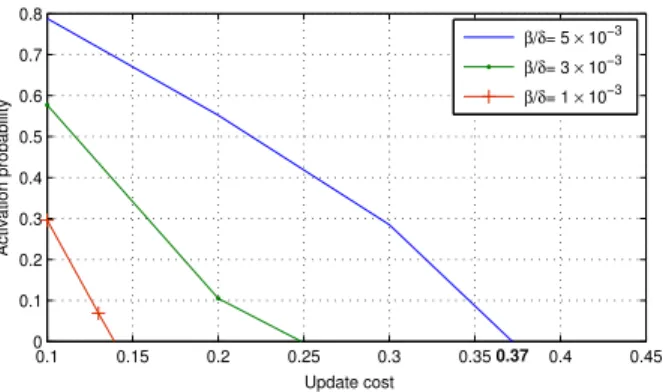
0.1 0.15 0.2 0.25 0.3 0.35 0.4 0.45 0 0.1 0.2 0.3 0.4 0.5 0.6 0.7 0.8 Update cost Activation probability β/δ= 5 × 10⁻³ β/δ= 3 × 10⁻³ β/δ= 1 × 10⁻³ 0.37
Fig. 8. The activation probability as function of the update cost.
considering different values of β/δ. We find the update cost Uc∗ for which the probability of activation is equal to 0. This specific valueUc∗is very important for the antivirus producers to manage the Uc, as approachingUc the this limit value Uc∗.
The Uc∗ increases withβ/δ, as the risk of infection increases withβ/δ.
Fig. 9 illustrates the infection probability in [0, . . . , tf] as
function of the update cost. At the equilibrium, the infection probability increases with the update cost. This is justified by the fact that the number of nodes participating in the antivirus activation decreases as the update cost increases, yielding a higher infection risk. In Fig. 10, we plot the infected node evolution in time at the equilibrium considering different update costsUc. We observe thatX(t)increases until a certain t∗and then it decreases till the epidemic extinction, i.e., when X(t) = 0. It is shown that the more the update cost is lower, the more the t∗ and the epidemic extinction are lower. This result helps the antivirus producers to manage the update cost. Increasing theUc, we have more infected nodes in the network,
but reaching Uc∗, no node is interested in the update. The antivirus producers are interested to reach a target performance of update cost to maximize the gain.
V. CONCLUSION
We have studied a game theoretic model for network virus protection under an activation process. The virus spread
0.1 0.2 0.3 0.4 0.5 0.6 0.1 0.15 0.2 0.25 0.3 0.35 0.4 Update Cost Infection probability β/δ= 5 × 10⁻³ β/δ= 3 × 10⁻³ β/δ= 1 × 10⁻³
Fig. 9. The infection probability as function of the update cost.
0 50 100 150 200 250 300 0 5 10 15 t X(t) Uc=0.1 Uc=0.2 Uc=0.3
Fig. 10. Infected nodes for different update costs withN= 100,Ns= 50,
β = 1×10⁻⁴, γ = 1×10⁻³,δ = 0.1,δ
S = 0.1, λ = 1×10⁻⁴,
X(0) = 0,S(0) = 10andIc= 1.
dynamics is modelled as an epidemic process. The strategy of each node is either to update or not to update the antivirus. We have established the existence and the uniqueness of different types of Nash equilibria. We have studied the dynamic of both the infection process and the activation process. Both the company server’s security management and the antivirus producer’s strategies have been addressed. It has been shown that, depending on the network topology, the companies have incentive to manage their network parameters in order to ensure that the infection dies out finite-time horizons.
APPENDIX
A. Dynamic of infected nodes
XN(t+ ∆t) =XN(t)(1−δ∆t)
+ (βNXN(t) +γNSN(t))(N−U−XN(t))∆t XN(t+ ∆t)−XN(t)
∆t =−δXN(t)
+ (βNXN(t) +γNSN(t))(N−U−XN(t))
We evaluate this expression for∆t→ 0 to get:
˙
X (t+ ∆t)−X (t)
∆t = (β
NXN(t) +γNSN(t))(N − U −XN(t))
We evaluate this expression for ∆t →0 to get:
˙¯
X(t) = (βX(t) +γS(t))(N−U−X(t))
B. Dynamic of the active sources
SN(t+ ∆t) =SN(t)(1−δS∆t) +λF( ¯X N(t+ ∆t))−F( ¯XN(t)) 1−F( ¯XN(t)) (NH−S N(t)) SN(t+ ∆t)−SN(t) ∆t =−δSSN(t) +λ F( ¯XN(t+ ∆t))−F( ¯XN(t)) ∆t 1−F( ¯XN(t)) (NH−S N(t))
Let f(·) be the density function ofF(·), we have
lim ∆t→0
F( ¯XN(t+ ∆t))−F( ¯XN(t))
∆t =f( ¯X(t))
We evaluate this expression for ∆t→0:
˙
S(t) =−δSS(t) +λ f( ¯X(t))
1−F( ¯X(t))(N−S(t))
We know that the hazard function [12] for the c.d.f F(.)is given by hF(x) =
f(x)
1−F(x) where f(x) is the corresponding
density function. Hence, the ODE can be written as following,
˙
S(t) =−δSS(t) +λhF( ¯X(t))(N−S(t))
C. Pure Nash equilibrium
Pi(kU)is decreasing in the number of updatesKU: Pinf(ψ−1)≥Pinf(ψ)
Ic>0 and fixed for all players so:
−IcPinf(ψ−1)≤ −IcPinf(ψ)
−IcPinf(ψ−1)≤Vj(N U, ψ) =Vj(U, ψ) Vj(N U, ψ−1)≤Vj(U, ψ)
which is the first Condition (4.1).
Vj(N U, ψ) =Vj(U, ψ) =−Uc=Vj(U, ψ+ 1)
and we have the second Condition (4.2).
We conclude that Vj(N U, ψ) = Vj(U, ψ)) is a pure NE.
Hence, a NE at ψexists for the proposed game.
Second, we will prove by contradiction the uniqueness of ψ at the NE. Let kU > ψ, we have: Vj(N U, kU −1)> Vj(U, kU −1) =−Uc=Vj(U, kU) Vj(N U, kU)> Vj(U, kU), so that (4.1) fails. Let Ku< ψ, we have: Vj(N U, kU + 1)< Vj(U, kU + 1) =−Uc=Vj(U, kU) Vj(N U, kU + 1)< Vj(U, kU), so that (4.2) fails.
The existence and the uniqueness of NE means that the
Letpthe symmetric mixed strategy adopted by every node in the proposed game, pi = p, ∀i. The new fitness of every
node will be given by: Vj(p∗i, p−i) = p∗i PN k=1C N−1 k−1 p k−1 −i (1−p−i)N−kV(U, k) + (1−p∗i)PNi=1CkN−−11p−k−i1(1−p−i)N−kV(N U, k) We have:V(N U, k)=−V(U, k)so, Vj(p∗i, p−i)=(2p∗i−1) PN k=1C N−1 k−1 p k−1 −i (1−p−i)N−kV(U, k) =(2p∗i −1)D(N, pi) withD(N, pi) = PN k=1C N−1 k−1 p k−1 −i (1−p−i)N−kV(U, k)
A mixed strategy is obtained whenD(N, pi) = 0because for D(N, pi)<0 the best response for the node iis pi = 0and pi = 1is a best response whenD(N, pi)>0. We characterize
the mixed equilibrium by
D(N, pi) = N X
k=1
CkN−−11pk−−i1(1−p−i)N−kV(U, k) = 0 (9)
We haveD(N,0) =V(U,1) andD(N,1) =V(U, N). From (3), the infection probability is decreasing with the number of active antivirus. the fitness of updated systemU is decreasing with the numberkU of updates. We getV(U, N)< V(U,1), D(N,0)> D(N,1).Thus,D(N, pi)is strictly decreasing with p. Hence, the mixed symmetric NE is unique.
E. Mixers and no-Mixers Nash Equilibrium
1) Equilibrium condition: To prove the necessary condition to have a NE in our case, we have to show that under this condition the Non-mixes can’t improve their fitness with diving from the equilibrium. We have VU(NU, NN U, p) is
decreasing withNU. VU(NU, NN U, p∗)≥VU(NU+ 1, NN U, p∗)and from (7) VU(NU+ 1, NN U, p∗) =VN U(NU, NN U+ 1, p∗) VU(NU, NN U, p∗)≥VN U(NU, NN U+ 1, p∗) ≥VN U(NU−1, NN U+ 1, p∗) ≥p∗VU(NU, NN U, p∗) + (1−p∗)VN U(NU−1, NN U+ 1, p∗)
Therefore, under Condition (7) a player who playsU strategy cannot improve his fitness by deviating from the strategy
(NU, NN U, p∗)using any strategy p∗∈[0,1[.
2) Equilibrium: We have proved thatkU=ψis a pure NE.
Suppose that there is at least one player updates its antivirus. Let p = 0+, reps. p = 1− be the mixed strategy infinitely
close to zero, reps. to one. We have VU(NU, NN U, p∗) is
strictly decreasing with NU and p∗. We can write (7) as
follows
VU(NU+ 1, NN U,0+)> VN U(NU, NN U+ 1,0+) VU(NU+ 1, NN U,1−)≤VN U(NU, NN U+ 1,1−)
IfNU ≥ψ, then
not satisfy Condition (7) to have a NE. A NE exists forl < ψ.
ForNU +NN U+ 1> N−1, there is also no NE.
We suppose that we have l < ψ, let NU +NN U + 1 = N
(only one node plays mixed strategy) then ∀p,
VU(NU+ 1, NN U, p) =C1 andVN U(NU, NN U+ 1, p) =C2
MoreoverVU(NU, NN U, p)is strictly decreasing withNU, we
haveC2> C1 which contradicts Condition (7).
We conclude that the NE of type (NU, NN U, p∗)exists only
for NU < ψ andNU +NN U≤N−2.
REFERENCES
[1] J. Sen, “A survey on security and privacy protocols for cognitive wireless sensor networks,”CoRR, vol. abs/1308.0682, 2013.
[2] S. Sharma, G. Gupta, and P. R. Laxmi, “A survey on cloud security issues and techniques,”CoRR, vol. abs/1403.5627, 2014.
[3] C. Castillo-Ch´avez, W. Huang, and J. Li, Competitive exclusion in Gonorrhea models and other sexually-transmitted diseases. Technical report (Cornell University. Mathematical Sciences Institute), Mathemat-ical Sciences Institute, Cornell University, 1993.
[4] N. Masuda, “Immunization of networks with community structure,” 2009. cite arxiv:0909.1945 Comment: 3 figures, 1 table.
[5] J. Omic, J. M. Hernndez, and P. V. Mieghem, “Network protection against worms and cascading failures using modularity partitioning.,” inInternational Teletraffic Congress, pp. 1–8, IEEE, 2010.
[6] S. M. Abdulla and O. Zakaria, “Devising a biological model to detect polymorphic computer viruses artificial immune system (aim): Review,” in Proceedings of the 2009 International Conference on Computer Technology and Development - Volume 01, ICCTD ’09, (Washington, DC, USA), pp. 300–304, IEEE Computer Society, 2009.
[7] C. Jin, J. Liu, and Q. Deng, “Network virus propagation model based on effects of removing time and user vigilance.,”I. J. Network Security, vol. 9, no. 2, pp. 156–163, 2009.
[8] J. Omic, A. Orda, and P. V. Mieghem, “Protecting against network infections: A game theoretic perspective.,” inINFOCOM, pp. 1485– 1493, IEEE, 2009.
[9] D. Kempe, J. Kleinberg, and E. Tardos, “Maximizing the spread of influence through a social network,” inKDD ’03, 2003.
[10] P. V. Mieghem, J. Omic, and R. Kooij, “Virus spread in networks.,”
IEEE/ACM Trans. Netw., vol. 17, no. 1, pp. 1–14, 2009.
[11] P. V. Mieghem, “The viral conductance of a network.,” Computer Communications, vol. 35, no. 12, pp. 1494–1506, 2012.
[12] D. Cox,Renewal Theory. Methuen’s monographs on applied probability and statistics, Science Paperbacks, 1961.
[13] K.-K. Tan, J. Yu, and X.-Z. Yuan, “Existence theorems of nash equilibria for non-cooperative n-person games,” International Journal of Game Theory, vol. 24, no. 3, pp. 217–22, 1995.
[14] D. Chakrabarti, Y. Wang, C. Wang, J. Leskovec, and C. Faloutsos, “Epidemic thresholds in real networks,”ACM Trans. Inf. Syst. Secur., vol. 10, pp. 1:1–1:26, Jan. 2008.