University of Stuttgart Universitätsstraße 38 D–70569 Stuttgart
Masterarbeit
Conception of a Blockchain Client
for Secure Transmission of
Production Data
David MichelCourse of Study: Informatik
Examiner: Prof. Dr. Dr. h. c. Frank Leymann Supervisor: M. Sc. Ghareeb Falazi,
M. Sc. Tobias Korb
Commenced: January 8, 2018
Blockchain technology has its origins in the financial industry, but also other areas of application are currently being investigated by many sides. One potential application field is the manufacturing industry. The immutability of once stored data makes blockchains interesting for the storage of various kinds of production data. For this purpose, a secure way from a production machine into a blockchain has to be ensured. It may not happen that data can be manipulated before becoming part of the immutable ledger. Currently used gateway solutions often run on general purpose computers, communicate with a production machine and simultaneously operate a blockchain client. Attacks on such gateways pose severe risks to the integrity of the measured data. This work focuses on the conception of a more secure way for saving data into a blockchain. The goal is the creation of a concept using hardware-near components and a prototypical implementation of it. The resulting prototype should enable both the collection of data and the transport of said data into a blockchain. At the same time, the use of lower level hardware in comparison to gateway solutions should reduce potential attack vectors.
Die Ursprünge der Blockchain Technologie finden sich in der Finanzindustrie, doch auch andere Anwendungsbereiche werden derzeit von vielen Seiten untersucht. Ein mögliches Anwendungsgebiet ist die Fertigungsindustrie. Die Unveränderlichkeit einmal gespeicherter Daten macht Blockchains für die Speicherung verschiedener Arten von Produktionsdaten interessant. Für diesen Zweck muss ein sicherer Weg von einer Produktionsmaschine hinein in eine Blockchain gewährleistet sein. Es darf nicht passieren, dass Daten manipuliert werden können, bevor sie Teil des unveränderlichen Speichers werden. Die gegenwärtig verwendeten Gateway Lösungen laufen häufig auf Universalcomputern, kommunizieren mit einer Produktionsmaschine und betreiben gleichzeitig einen Blockchain Client. Angriffe auf solche Gateways bergen schwerwiegende Risiken für die Integrität der gemessenen Daten. Diese Arbeit konzentriert sich auf die Konzeption eines sichereren Weges zum Speichern von Daten in eine Blockchain. Ziel ist die Erstellung eines Konzepts, das hardwarenahe Komponenten nutzt, sowie eine prototypische Implementierung desselben. Der entstehende Prototyp sollte sowohl das Sammeln von Daten als auch den Transport dieser Daten in eine Blockchain ermöglichen. Gleichzeitig sollte die Verwendung einer Hardware, die einfacher ist verglichen mit der von Gateway Lösungen, mögliche Angriffsvektoren reduzieren.
1 Introduction 15 1.1 Motivation . . . 15 1.2 Scope of Work . . . 16 1.3 Document Structure . . . 16 2 Fundamentals 19 2.1 Blockchain Technology . . . 19
2.1.1 History and Definition . . . 19
2.1.2 Blockchains in Cryptocurrencies . . . 20
2.1.3 Distinctions and Features of Blockchains . . . 22
2.2 Different Blockchain Implementations . . . 25
2.2.1 Bitcoin . . . 25
2.2.2 Ethereum . . . 27
2.2.3 Hyperledger . . . 29
2.2.4 IOTA . . . 32
2.3 Blockchains in the Industry . . . 34
2.3.1 Industrial Application Examples . . . 34
2.3.2 Remarks on Current Solutions . . . 36
3 Conception 39 3.1 Requirements . . . 39 3.1.1 General Requirements . . . 39 3.1.2 Functional Requirements . . . 39 3.1.3 Non-functional Requirements . . . 40 3.2 Choice of Technology . . . 40 3.2.1 Hardware Technology . . . 41 3.2.2 Software Technology . . . 42 3.3 Transaction Detail . . . 44 3.3.1 Client . . . 44 3.3.2 Communication Interface . . . 45 3.3.3 Building a Transaction . . . 48
3.4 Different System Architecture Approaches . . . 58
3.4.1 Sign on Ethereum Client . . . 58
3.4.2 Sign on Microcontroller . . . 59
4 Prototypical Implementation 63 4.1 General Microcontroller Program Information . . . 63
5 General Blockchain Security Aspects 73
5.1 Possible Attacks on Blockchains . . . 73
5.2 Degree of Trust Measurement . . . 75
5.2.1 Possible Parameters . . . 76
5.2.2 Designing a Metric . . . 78
6 Evaluation 81 6.1 Evaluation of the Implementation . . . 81
6.1.1 Smart Contract . . . 81
6.1.2 Code Execution Time Analysis . . . 86
6.2 Retrospect of Requirements . . . 87
6.3 Conclusion . . . 89
7 Summary & Future Work 91 7.1 Summary . . . 91
7.2 Future Work . . . 92
2.1 Simplified illustration of a blockchain structure [Nak08] . . . 20
2.2 Signing transaction data with asymmetrical cryptography . . . 21
2.3 Transaction data signature verification with asymmetrical cryptography . . . 22
2.4 Mining and sending transactions in the Bitcoin P2P network . . . 27
2.5 Steps of a transaction in Hyperledger Fabric . . . 32
2.6 Comparison of a classic blockchain with the IOTA tangle . . . 33
2.7 Attack vectors on blockchain gateway solutions . . . 37
3.1 Layout of NodeMCU pins [Sah17] . . . 42
3.2 Effect of nonces in the Ethereum blockchain . . . 49
3.3 Different steps for generating a signed Ethereum transaction . . . 54
3.4 System architecture with Ethereum node signing a transaction . . . 60
3.5 System architecture with microcontroller signing a transaction . . . 61
4.1 UML diagram of the different implementation components . . . 64
4.2 Schematic of the hardware setup . . . 67
4.3 UML flow chart for code execution on the microcontroller . . . 70
5.1 Schematic of a successful double-spending attack . . . 74
6.1 Serial output of the setup phase . . . 84
2.1 Comparison of different consensus algorithms . . . 24 3.1 Overview of different blockchain implementations . . . 43 4.1 Configuration parameters for the microcontroller code that should not be changed 69 4.2 Configuration parameters for the microcontroller code that may be adapted by a user 71 4.3 Transaction specific configuration parameters for the microcontroller code . . . . 71 6.1 Duration of the single steps in the transaction creation process in milliseconds . . 86
3.1 Exemplary JSON object for the user of a web shop . . . 46
3.2 Unsigned Ethereum transaction as a JSON structure . . . 50
3.3 Step 1: Creating an unsigned Ethereum transaction . . . 53
3.4 Step 2.1: Organizing the transaction data in an ordered list . . . 55
3.5 Step 2.2: RLP encoding of an unsigned transaction . . . 55
3.6 Step 3: Keccak-256 hash of the RLP encoded unsigned transaction . . . 55
3.7 Step 4: Signing the Keccak-256 hash with ECDSA . . . 56
3.8 Step 5.1: Signed transaction ready to be RLP encoded . . . 56
3.9 Step 5.2: RLP encoded signed transaction . . . 57
3.10 Optional Step 6: Calculate the transaction ID . . . 57
API application programming interface. 48 B2B business-to-business. 30
DAG directed acyclic graph. 29
DAO decentralized autonomous organization. 37 dApp decentralized application. 27
DSA Digital Signature Algorithm. 20
ECDSA Elliptic Curve Digital Signature Algorithm. 20 EOA externally owned account. 48
ETH Ether. 27
EVM Ethereum Virtual Machine. 28 HTTP Hypertext Transfer Protocol. 47
HTTPS Hypertext Transfer Protocol Secure. 66 IDE integrated development environment. 44 IoT Internet of Things. 29
JSON JavaScript Object Notation. 45 LED light-emitting diode. 68
M2M machine-to-machine. 33 MCU microcontroller unit. 41 P2P peer-to-peer. 23
PoS Proof of Stake. 23 PoW Proof of Work. 23 RLP recursive length prefix. 49 RPC remote procedure call. 45 SPI Serial Peripheral Interface bus. 41
UML Unified Modeling Language. 63 USB Universal Serial Bus. 41
This chapter explains the motivation behind the work. Derived from this motivation, the scope of work is presented. Finally, an overview on the structure of the thesis is given.
1.1 Motivation
With the upcoming of what is generally referred to as the “Fourth Industrial Revolution” [Sch17], the image of production machines has drastically changed. They are no longer centrally controlled and run in isolation. Instead, production systems have become distributed and interconnected cyber-physical systems. This means that both software components and hardware like actuators or sensors share common data infrastructure and thereby communicate with each other.
Simultaneously, the blockchain technology is on the rise and it is observed with great interest from different perspectives. Though originally mainly applied in the financial world, the fundamental technology underlying blockchains is promising for various other fields of application, e.g. also for intertwined production systems [Swa15]. What makes blockchains so interesting for industrial applications is one of their main features: the immutability of recorded data. Once data was added to a blockchain, it cannot easily be deleted or altered. Through this property, production data can be immutably stored and also a proof for product quality can be made transparent.
Yet, the immutability of stored data requires for a secure path beginning from data acquisition and ending with the successful storage inside a blockchain. If there is the danger of data being altered on this path, the risk of manipulated data getting immutably stored arises.
At this time, there already exist a variety of interconnections between production machines and blockchain instances [GPM17]. Many of them are solutions using a gateway. Such a gateway is usually a software that is run on a general purpose computer. The gateway is connected to both the production machine and a blockchain instance. This blockchain connection is achieved by running a blockchain client which communicates with other clients via the Internet.
While such gateway solutions offer fast and easy data processing as well as blockchain communication, they can also be targets for attackers. If a general purpose computer is connected to the Internet, this opens a variety of attack vectors. The way from the production machine to the gateway creates further possibilities for attacks, namely manipulation of the measured data.
It is therefore necessary to explore new ways of enabling machines to communicate with a blockchain, while simultaneously reducing potential attack vectors.
1.2 Scope of Work
The goal of this work is the development of a concept for achieving storage of production data within a blockchain. This concept has to be a hardware-near system architecture. This means that it should not be a concept suitable for a general purpose computer, but a more low-level hardware. Before that, existing approaches and technologies for communication between data sources and blockchains have to be analyzed and weak points identified.
Taking these results into account, an appropriate system architecture has to be developed. The design then has to be prototypically implemented in order to verify its practicability. The resulting prototype has to be able to both collect data directly and store it in a blockchain instance, while offering a higher security level than usual gateway solutions.
In addition to analyzing existing concepts, developing and implementing an own one, there also has to be a discussion on blockchain finality, i.e. when can a transaction be considered immutable. As a result, an approach to measure the degree of trust that data is durably stored within a blockchain has to be found.
1.3 Document Structure
The work is structured as follows:Chapter 2 – Fundamentals: This chapter gives an overview on the prerequisites necessary to grasp the work. This comprises a definition and description of blockchains, their usage and underlying concepts such as hashing or asymmetrical encryption. Furthermore, different implementations will be presented and the application areas as well as shortcomings for industrial applications are discussed.
Chapter 3 – Conception: Here, the different requirements that are posed on this work’s result are given. Choices in terms of software and hardware technology are discussed and important concepts for the generation of valid transactions in the chosen implementation are presented. Resulting from these observations, two system architecture approaches are developed and the better suited one is chosen for implementation.
Chapter 4 – Prototypical Implementation: In this chapter, the chosen system architecture is prototypically implemented as a proof of concept. The different components of the design as well as the program’s structure are explained.
Chapter 5 – General Blockchain Security Aspects: Possible security issues inherent in blockchains are presented here. Afterwards, an approach for a metric measuring the chance of a transaction becoming immutable is designed.
Chapter 6 – Evaluation: This chapter evaluates both the design and the implementation in form of the prototype. Code execution timings and output will be analyzed and a comparison with the requirements shown earlier is made here.
Chapter 7 – Summary & Future Work: The final chapter wraps up the work and summarizes its results. Finally, an outlook on possible future work is given.
This chapter gives an overview on blockchain technology in general and different implementations of it. Furthermore, actual projects using a blockchain structure are discussed.
2.1 Blockchain Technology
In this section, the history and also a definition of blockchains is introduced. The features of different blockchain concepts are discussed as well as their relation to cryptocurrencies.
2.1.1 History and Definition
In order to fully grasp the concept of the whole blockchain technology, one must first define the term itself. Up to now, there is no strict definition of what a blockchain is, what belongs to it and what does not [Mat16]. Though the term itself does not appear in his paper, Satoshi Nakamoto is often credited the invention of blockchain technology [Nak08]. In his paper called “Bitcoin: A Peer-to-Peer Electronic Cash System” from the year 2008, he describes how blocks of data could be organized in a chain where one block always references its predecessor. The author uses the concept of chained data blocks as the foundation for a decentralized and purely virtual currency. Later, the first cryptocurrency “Bitcoin” emerged from this idea.
In fact, the basic blockchain idea reaches even further in the past. In the year 1991, S. Haber and W. Scott Stornetta described how digital signatures and time stamps for various kinds of documents could be created by the use of hash functions. Furthermore, they propose to link the different data for verification purposes [HS91].
A few years later, R. J. Anderson described a data storage concept called “The Eternity Service”. The author suggests to store data decentralized all over the globe. That way, information cannot be easily destroyed or kept under tight wraps by government regulations [And96].
This work follows the general and widely accepted definition of a blockchain: different data blocks are generated and linked with the use of hash functions and cryptography. The result is a chain of blocks where each block depends on its predecessor, thereby also creating a time consistency throughout the blockchain.
More precisely, a block consists of several transactions and a header. The transactions represent the data that is to be stored within a block. The header consists of two hash values: the hash value of the previous block header and the hash value calculated from the current block’s transactions. Figure 2.1 shows a simplified illustration of such a blockchain structure.
Block 1
Transaction 1Transaction2 Transaction x
Block 1 Header
Hash of previous Block Header n/a Hash of current Block 1
Hash Function
Block 2
Transaction 1 Transaction2 Transaction y Block 2 HeaderHash of previous Block Header 1 Hash of current Block 2
Hash Function
Block n
Transaction 1 Transaction2 Transaction z Block n HeaderHash of previous Block Header n-1 Hash of current Block n
Hash Function
…
Figure 2.1:Simplified illustration of a blockchain structure [Nak08]
In the last few years, the success and growing prominence of Bitcoin drew more and more attention to its underlying and at this time innovative blockchain concept. This led to the development of additional cryptocurrencies, most of which use some variation of the original blockchain technology.
2.1.2 Blockchains in Cryptocurrencies
The core element of a cryptocurrency are tokens which can be sent from one user to another, like a real currency, e.g. the US-Dollar.
More specifically, the tokens are sent from one address to another. An address is either calculated from the public key of an asymmetrical cryptographic key pair or it is the public key itself. Such a key pair consists of two parts, a public and a private key.
As mentioned above, the address that a user can send coins to is related to the public key. The key is called “public” because itself or the derived address should be known by other parties who want to send funds to it. To each public key, there belongs exactly one private key. More precisely, a public key is calculated via a cryptographic function from the private key. The private key allows the address owner to access coins that were sent to the respective public key. Therefore, the private key is to be kept secret by the user who owns it.
The keys as well as signatures in many cryptocurrencies are created via a cryptographic process called Elliptic Curve Digital Signature Algorithm (ECDSA). The basic algorithm was proposed back in 1999 [JM99] and combines the classic Digital Signature Algorithm (DSA) [Nat13] with elliptic curve cryptography.
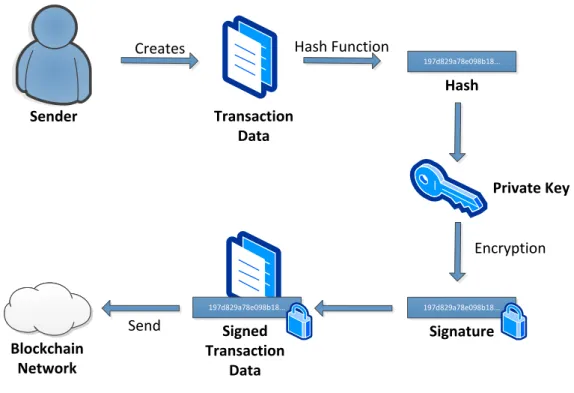
Sender Transaction Data Creates 197d829a78e098b18... Hash Function Hash Encryption Private Key 197d829a78e098b18... 197d829a78e098b18... Signed Transaction Data Send Blockchain Network Signature
Figure 2.2:Signing transaction data with asymmetrical cryptography
The main feature of asymmetrical cryptography is the following: it is easy to verify that data was encrypted with a private key belonging to a certain public key. On the other hand, the public key itself does not give away any information about the corresponding private key. This means that it is an extremely hard mathematical problem to calculate a secret private key from a known public key.
In order to send coins from one address to another, a transaction is executed. The transaction states how many coins are sent from which sending address to which receiving address. For reasons of authentication, the issuer of a transaction signs the transaction with its private key. This is where ECDSA comes into play. Signing means creating a digital signature of some data with the use of a private key via a cryptographic function. The transaction data (or rather a hash of it) gets signed with the private key, resulting in a digital signature. This signature gets added to the original data and the signed transaction can then be issued. This process is pictured in Figure 2.2.
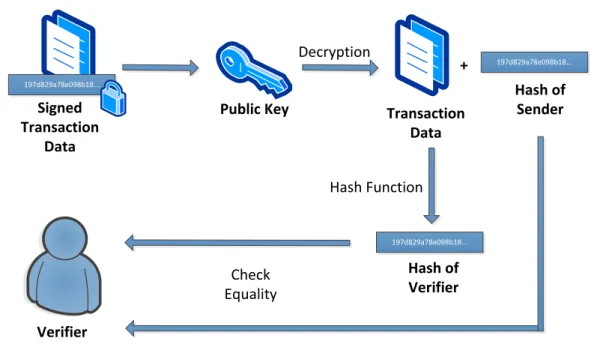
Receiving parties can now easily verify the authenticity of the sender. Therefore, they first decrypt the signature with the senders public key. The result of this operation is the hash value of the initial transaction data. Then the verifying parties just have to hash the transaction data they received and compare the obtained hash with the hash from the decrypted signature. If the two hashes match, the integrity of the data and the authenticity of the sender are proven.
Verifier Transaction Data Decryption 197d829a78e098b18... Hash Function Hash of Sender Public Key 197d829a78e098b18... Signed Transaction Data Check Equality + 197d829a78e098b18... Hash of Verifier
Figure 2.3:Transaction data signature verification with asymmetrical cryptography
With the use of an asymmetrical encryption method for signature generation, the following three properties are ensured [SSUF16]:
• The transaction was issued by the person that was in possession of the private key, i.e. the owner of the coins
• It is not possible to change the transaction once it was sent
• The sender cannot deny the intention of actually wanting this transaction to be executed In a cryptocurrency context, the blockchain is a ledger where every transaction that was ever made is stored in. Yet, the blockchain itself does not directly store how many coins are held by which address. But by containing a complete list of each transaction, the current state of the token distribution can be calculated at any arbitrary point in the past and at present [Ant14].
2.1.3 Distinctions and Features of Blockchains
Abstracting from the financial aspect, the blockchain itself is nothing more than a data structure, comparable to a classic database.
A first distinction of different kinds of blockchains can be made by considering them permissioned or permissionless. A permissioned blockchain only allows access to a certain group of users, e.g. when it is a blockchain used within a company only by the company’s employees, or if several companies work together on a shared blockchain.
Permissionless blockchains on the other hand allow access and participation to everyone [Bit15]. Every user who follows the given protocol can interact with the blockchain, and all users have the same rights.
Another distinction that resembles the one in permissioned and permissionless is public and private blockchains. Public blockchains can be used by anyone willing to do so, private blockchains restrict their userbase according to certain regulations.
A key feature of any blockchain is decentralization. A decentralized blockchain consists of many nodes where every node runs an own blockchain client [PP15]. This corresponds to a peer-to-peer (P2P) network [MKL+02]. Each node stores a version of the blockchain. The nodes communicate with each other and try to reach consensus over the current valid state. That way, no centralized authority is needed to verify the validity of the current blockchain.
A decentralized blockchain is resistant to failures of single nodes. As it is always the majority of active nodes that decides the current blockchain state, it is irrelevant whether single nodes fail. More importantly, it is also resistant to manipulation enforced by a corrupt node. The corresponding mathematical problem is known as the “Byzantine Generals Problem” described by Lamport et al. [LSP82].
In the original problem, a group of Byzantine generals communicate with each other to coordinate an attack on a city. They all have to agree on a certain maneuver, but some of the generals might be traitors trying to sabotage consensus or even create a bad consensus due to manipulated information.
This problem resembles the problem of independent nodes reaching consensus over the current blockchain state. One of the solutions that is used in many blockchain implementations is the following: The “correct” version of the blockchain is always the longest chain [Zoh15]. This makes sense if the creation of new blocks follows the Proof of Work (PoW) principle. That means that a mathematical problem has to be solved via guessing the correct solution in order to add a new block containing recent transactions to the blockchain. As it is a hard problem, a fair amount of time and especially computational power is needed to solve it. Thus, the longest chain is the one where the most computational effort was put it and thereby also the one that is least likely to have been manipulated by an attacker. The people trying to solve this PoW puzzle are called miners. They get rewarded with newly created tokens whenever they are the first to discover a new block.
Apart from the PoW consensus mechanism, there exist many other mechanisms with their respective advantages and disadvantages. Several of them are presented in the following:
• Proof of Stake (PoS)
This consensus mechanism considers a user’s stake, i.e. the amount of tokens held by an address, in order to determine the creator of a new block. The user adding a new block is usually chosen randomly, but the higher a user’s stake, the higher is also the probability that the user’s block is chosen [Nxt14]. There are different variants, e.g. also taking into account how long an address already possesses the tokens [KN12].
• Proof of Activity
Proof of Activity combines both PoW and PoS mechanisms [BLMR14] [TS16]. First, an empty block, i.e. a block without transactions in it, is mined in a PoW manner. When it is found, a certain amount of stakeholders are chosen. Each of these stakeholders must sign the block with their respective private keys. The higher a user’s stake is, the higher the probability to get chosen as one of the signatories. This is the PoS component. If one of the signatories is offline, i.e. the block does not get signed within a certain period of time, a new set of stakeholders is chosen. This means that inactive users are left out of the block generation process. Hence the name, Proof of Activity. The transaction fees are split between the one discovering the block and the signatories.
• Proof of Authority
Another consensus algorithm is the Proof of Authority [Par18]. Here, a set of trustworthy authorities is chosen beforehand. Only they have the right to create new blocks, and the majority of these authorities must agree upon a created block. This concept is rather likely to be used in private blockchains.
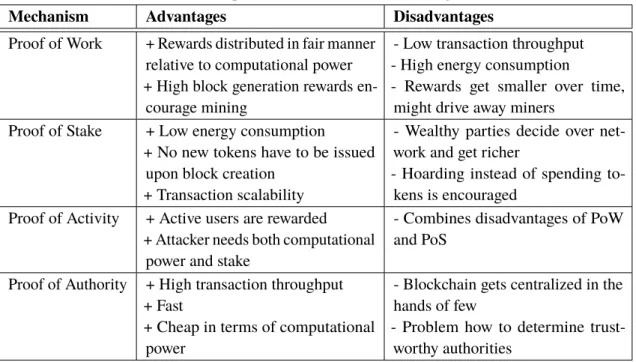
The advantages and disadvantages of the different presented consensus mechanisms are discussed in Table 2.1.
Table 2.1:Comparison of different consensus algorithms
Mechanism Advantages Disadvantages
Proof of Work + Rewards distributed in fair manner relative to computational power + High block generation rewards
en-courage mining
- Low transaction throughput - High energy consumption
- Rewards get smaller over time, might drive away miners
Proof of Stake + Low energy consumption + No new tokens have to be issued
upon block creation + Transaction scalability
- Wealthy parties decide over net-work and get richer
- Hoarding instead of spending to-kens is encouraged
Proof of Activity + Active users are rewarded + Attacker needs both computational
power and stake
- Combines disadvantages of PoW and PoS
Proof of Authority + High transaction throughput + Fast
+ Cheap in terms of computational power
- Blockchain gets centralized in the hands of few
- Problem how to determine trust-worthy authorities
After a certain number of blocks are appended to a specific block, the transactions in said block can be considered as safe [BMC+15]. The amount of necessary blocks heavily depends on the respective implementation.
• Decentralization via multiple nodes that form some sort of P2P network • Resistance to failure or manipulation of single nodes
• Immutability of data that was once successfully added into the blockchain
2.2 Different Blockchain Implementations
In the following, several implementations of blockchains and the differences between them are investigated.
2.2.1 Bitcoin
Bitcoin is the oldest and probably best known implementation of a blockchain [Nak08].
It is a decentralized blockchain which is used as a digital currency system. There are several thousand nodes participating in the P2P network all over the world [Bit18c]. As already described in Section 2.1.2, Bitcoin uses asymmetrical encryption for generating addresses, i.e. public keys, and private keys that allow a user to send funds from an address. A public key always starts with either a 1 or a 3 and has a length between 26-35 characters [Bit18a]. The private keys are 256 Bit numbers, which equals to 64 hexadecimal digits.
Transactions are often performed by the use of a wallet application. This application saves the private and public key and performs all the necessary steps to satisfy the Bitcoin transaction protocol. In order to perform a transaction, the sender only needs to know the address of the recipient [Fra15]. The transaction steps are as follows [Ant14]:
First, unspent incoming transactions of the sender have to be found. As the blockchain only stores transactions, the difference between incoming and outgoing Bitcoins determines the current balance of an address. If one or more yet unspent transactions that equal or surpass the new transaction’s value are available, the wallet can begin to build up the transaction. Therefore, a stack-based, not Turing-complete scripting language is used [Fra15]. The wallet creates a script that contains one or more previous incoming and unspent transactions, as well as a signature generated with the sender’s private key, to verify the possession of the Bitcoins. As an output, the sender specifies one or more addresses and also the amount of tokens that is to be sent to each address. For a valid transaction, the sum of Bitcoins of incoming transactions must be greater or equal to the sum of Bitcoins of the outgoing transactions.
Because incoming transactions are always fully used up, the sender can specify its own address as a receiving address in order to send resulting change back to itself. The difference between incoming and outgoing Bitcoins is used as a transaction fee, which will be explained later.
In order to access the funds within a transaction, the receiver also creates a script. This script contains a signature created with the receiver’s private key.
The two scripts are being concatenated and run sequentially. If the script evaluates to “True”, the transaction can be considered completed.
Before the receiver can try to solve the sender’s script, the transaction must be added to the blockchain. In order to achieve this, the transaction is first sent to a network node. Each transaction has a unique ID. As the network nodes form a P2P network, the unexecuted transaction is propagated through the network to other nodes. It is now in the “mempool”, which is a term for the set of issued but not yet executed transactions. Transactions from the mempool can be appended to the blockchain via a process called “mining”.
A mining node takes transactions from the pool of not yet executed transactions and puts them together in a block. Such a block contains a number representing its size, a block header, a transaction counter for the amount of transactions included in the block, and the actual transactions’ data (which is by far the biggest part of each block’s size). The block header itself consists of several elements, namely [Ant14]:
• A version number of the Bitcoin protocol that was used • The hash of the previous block in the blockchain
• A hash of the Merkle-Tree root for the block’s transactions, which is a special encoding of all the transaction hashes
• A timestamp of the blocks creation (created during the mining process)
• The difficulty target, i.e. a parameter for the PoW algorithm (created during the mining process)
• A nonce used for the PoW algorithm (created during the mining process)
After putting together the required information, the miner tries to solve the PoW puzzle. The task is to create a hash which has a value smaller than a certain target. The hashing algorithm is performed multiple times with different nonces until a miner finds an appropriate hash. The miner is now allowed to add the block to the blockchain and the result is again propagated to the other network nodes.
The used hashing algorithm is SHA-256. Its output is always fixed-length and can be interpreted as one big number. Though the amount of digits is always the same, it is not possible to determine the size of the output number beforehand. So finding an appropriate block is based on pure luck. With the difficulty target, adjustments can be made so a block is found approximately every 10 minutes, independent of how many miners perform how many hashes.
The miner who is allowed to append a new block is rewarded with the fees of the block’s transactions as well as a fixed amount of newly generated Bitcoins for each block. The amount of new Bitcoins halves multiple times, the longer the blockchain gets. Because this is the only way how new Bitcoins are generated, the total amount can never surpass 21 million Bitcoins.
Because miners may keep all the fees within their found block, it is a common approach for miners to include transactions with higher fees first. This leads to the general assumption: the higher the fees, the faster a transaction will be executed.
Sender Receiver Winning Miner Miner Node Node Node 1 1 1 1
Step 1: A sender issues a transaction to its peers. The transaction is propagated through the network and
eventually reaches a mining node.
2 2
2 2
Step 2: A mining node solves the PoW puzzle and adds the transaction into a
block. The newly found block is propagated through the network and
the information of the transaction’s success eventually reaches both the
sender and the receiver.
2
Step 3: The newly found block gets part of the blockchain, the receiver now possesses the tokens that were
transferred.
Figure 2.4:Mining and sending transactions in the Bitcoin P2P network
Figure 2.4 shows the different roles of participants in the Bitcoin network. Sender, Receiver and Miner in this figure can be active P2P network nodes, too, but they do not necessarily have to be. This means that Bitcoin accounts and miners do not need to operate their own nodes. It is sufficient for them to communicate with an active node, e.g. over a wallet or a website.
The Bitcoin blockchain is optimized to save space, as it grows larger with every transaction. That is why it does not allow a user to store big amounts of data within it. In fact, there is no mechanism intended to store arbitrary data at all. A transaction can have a description that both the sender and the receiver see, though this data does not become part of the blockchain. Other ways of storing data result from abuse of fields that accept user input. One way is sending a transaction to a receiving address which consists of the data that is to be stored. This method allows the storage of 35 hexadecimal digits, i.e. 17 and a half bytes. Another way is the “OP_RETURN” script opcode of the Bitcoin scripting language. It marks transaction outputs invalid and allows for the storage of up to 80 bytes, though this is not a recommended procedure [Bit17]. All in all, storing arbitrary data is not naturally supported and very expensive considering the transaction fees.
2.2.2 Ethereum
The Ethereum Project was developed after the potential and success of Bitcoin were proven. Many of the concepts from Bitcoin were absorbed directly or slightly changed. In addition to transferring tokens in a blockchain, the founder Vitalik Buterin also added a Turing-complete programming language for smart contracts and decentralized applications (dApps) [But14]. Like in Bitcoin, tokens named Ether (ETH) can be sent from one address to another. Addresses are either part of an asymmetrical key pair, or, in contrast to Bitcoin, smart contract addresses.
The concept of smart contracts was first introduced by Nick Szabo back in 1996 [Sza96]. He describes how real world contracts about various things like property rights or liens could be implemented into computer soft- or hardware. The goal why such contracts should be virtualized is making them harder to be breached or manipulated.
In Ethereum, smart contracts are pieces of code which can be written in different programming languages. The most prominent one is a programming language called Solidity, which was exclusively developed for Ethereum [Sol16]. Each deployed smart contract has an own address and is stored in the Ethereum blockchain. A runtime environment called the Ethereum Virtual Machine (EVM) executes parts of the smart contract code whenever a transaction is sent to the smart contract’s address. This can also result in the contract receiving or sending Ether.
The term dApp is used in the Ethereum context to describe an application which is written in a smart contract and interacts with users [Git18a]. As the application’s code is stored in the blockchain, it is per se decentralized. The Ethereum project distinguishes between three different types of dApps:
• Financial Applications
A dApp can create and issue its own tokens which are different from ETH, basically creating its own currency. DApps could also be used to create saving accounts or manage wills. All these application fields focus exclusively on the monetary aspect a dApp can have.
• Semi-financial Applications
This comprises dApps which have a financial aspect but also a real world reference. An example would be dApps that send money to the first person solving a specific real world problem.
• Non-financial Applications
The third and last category can be used for dApps that handle e.g. online voting or public administration.
The transactions in the Ethereum network resemble the ones of Bitcoin, though there are some slight differences. A transaction in Ethereum has a receiving address, the sender’s signature, an amount of ETH to be sent (can be 0, e.g. when interacting with smart contracts), a data field where arbitrary data can be put into, a gas limit and a gas price.
Gas is used to determine the transaction fee. Each computational step consumes 1 gas, and each byte of transaction data costs another 5 gas. The user can specify a limit, how much gas should not be exceeded by the transaction. If the gas limit is reached, the transaction fails.
The gas price is usually given in “wei”, which is a fraction of ETH. One wei is equivalent to 10-18 ETH. The gas limit multiplied with the price per gas used determines the maximum fee that a user is willing to pay for a transaction.
The idea behind this concept is preventing users from spamming and clogging the network with unnecessary transactions or huge data blocks. The fees are a reward for the miner who finds the block where the transactions were put into. Like in Bitcoin, the only way of generating new ETH, in
addition to the amount that was issued initially, is the mining reward. Currently, a miner is rewarded 3 newly generated ETH for each new block. This reward was and will be reduced further to cap the amount of maximum ETH circulating.
The PoW algorithm in Ethereum is called Ethash [Eth16][Git17a]. The goal is once again to produce a hash that is smaller than a certain target. The hash is generated on a subset of a big directed acyclic graph (DAG) which changes every 30,000 blocks. As the average time between the finding of two blocks is about 12 seconds, the DAG gets recreated every 100 hours [Git18e]. The used hashing algorithm is a variant of the SHA-3 standard which is called Keccak-256.
In the future, the consensus algorithm will change from PoW to PoS. In Ethereum’s proposal of a PoS algorithm, consensus is reached by the participants voting for the valid blockchain and their votes get weighted with the amount of ETH that a participant owns. This process would completely substitute the regular PoW-based mining [Git18f]. The idea behind this procedure is to reduce electricity costs, hinder centralization and mitigate the token inflation.
2.2.3 Hyperledger
Hyperledger was started at the end of 2015 by the Linux foundation [Lin15]. In the meantime, multiple companies joined the project to collaboratively work on the development of open source blockchains. Hyperledger aims for a broad variety of application fields, e.g. manufacturing, banking or Internet of Things (IoT). Therefore, it provides several permissioned blockchain implementations.
What it offers is a modular architectural framework that all Hyperledger projects are built on. The modular components comprise [Hyp17]:
• A Consensus Layer
Defines how agreement on blocks and transactions is reached. • A Smart Contract Layer
Executes business logic embedded in smart contracts. • Communication Layer
Handles the message transport between the participating nodes. • Data Store Abstraction
Allows different data stores to be used by other modules. • Crypto Abstraction
Defines and abstracts the crypto algorithms that are used. • Identity Services
• Policy Services
Handle policies, e.g. for endorsement, consensus or group management. • APIs
Defines interfaces for applications and clients to interact with the blockchain. • Interoperation
Supports the interoperation between different blockchain instances.
Several implementations of blockchain frameworks have been published since the start of Hyperledger. Each project puts an emphasis on different blockchain aspects. Hyperledger Iroha focuses on mobile application development [Sor18], while Hyperledger Indy has its main advantage in identity management [Git18c].
Another prominent project in this environment is Hyperledger Fabric [Hyp18a]. It is a platform for distributed ledger solutions that looks at blockchains more as data structures and not as a foundation for token-based cryptocurrency applications. Like other Hyperledger projects, it also supports smart contracts (here called “chaincode”) and the key mechanism are transactions sent from one participant to another. The architecture is modular so that different components can be replaced or interchanged.
One of the main differences to the other presented blockchain implementations is the fact that it is private and permissioned [ABB+18]. Therefore, only trusted members that were previously approved may participate in a Hyperledger Fabric instance. This shows that small groups like companies that share a production process are the targeted audience. Business-to-business (B2B) blockchain designs demand special requirements that differ from those of public distributed ledgers.
Some of those key features that Hyperledger Fabric focuses on are identity management, privacy and a modular design.
The blockchain itself consists of two elements: The first is a so called “world state” which is a representation of the blockchain’s state at a certain point in time. The second element is the “transaction log” which stores all performed transactions. The world state is therefore the result of
all executions of transactions in the transaction log up to a fixed point in time.
Hyperledger Fabric supports transactions in multiple channels, and each channel has its own blockchain and privacy management. A dataset in the blockchain is represented by a key-value pair that can either be created, updated or deleted.
The nodes participating in a Hyperledger Fabric instance can be distinguished into three different categories:
• (submitting-)Clients
This is the entity that an end-user runs in order to issue transactions. For communicating with the blockchain, a client must be connected to a peer.
• Peers
These nodes maintain copies of the ledger and execute transactions on them. They can also have an endorsing functionality. Every chaincode has an endorsement policy which specifies which peers have to endorse transactions in which way. Only if the endorsement policy gets fulfilled, the corresponding transaction is executed.
• Ordering Service Nodes
These nodes provide a shared communication channel between peers and clients within a channel. They are also responsible for reaching consensus in a blockchain instance as they order transactions and put them together into blocks.
As there is no native currency that gets sent between users, the core element of interaction is defined in the chaincode. Each channel that multiple peers share with each other has to define functions for interaction. Such a function could e.g. define trading two goods for each other.
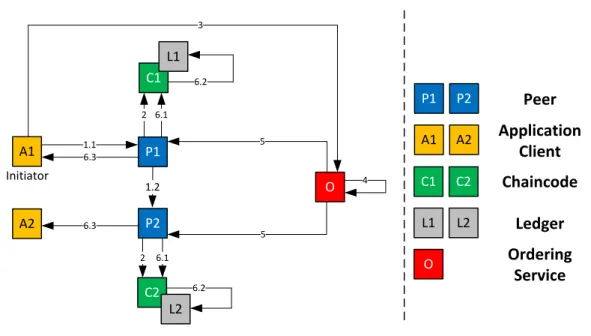
Let’s assume that both trading parties have a client connected to a network peer, a channel set up between these peers and they have both verified their respective identity and authenticated to the network. The two peers are the only ones connected via the used channel and they both have to endorse each transaction. The steps of a transaction then look as follows [Hyp18b], with a visualization given in Figure 2.5.
1. Transaction Initiation and Proposal
One client initiates a transaction via the peer it is connected to. As a result of the transaction, some part of the chaincode has to be invoked. The initiator’s request gets built, signed and sent to both endorsing peers as a proposal.
2. Signature Verification and Transaction Execution Proposal
Both peers have to verify that the transaction proposal is well-formed and that it has not been submitted at some point in the past. Additionally, they have to verify the validity of the signature and the authorization of the initiator. If these steps are successful, the addressed chaincode gets executed with the passed arguments and a proposal for a result is created. At this point, no change to the ledger’s state has occurred yet.
3. Proposal Inspection
The two parties’ proposed results are compared by the initiator. If they are the same and the transaction would result in a change of the ledger state, the transaction has to be forwarded to an Ordering Service. This is also done by the initiating client.
4. Building of Transaction
The Ordering Service receives a transaction message containing the datasets that have to be read or written as well as the signature of the endorsing peers. The Ordering Service then orders all the transactions it received in the corresponding channel and creates blocks containing the transactions of the channel.
A1 P1 Application Client 1.1 Peer Chaincode O A2 P2 1.2 2 2 4 5 5 C2 L2 C1 L1 6.1 6.2 6.3 6.3 6.1 6.2 P1 P2 A1 A2 C1 C2 L1 L2 O Ledger Ordering Service Initiator 3
Figure 2.5:Steps of a transaction in Hyperledger Fabric
5. Transaction Validation and Execution
All peers in the channel receive the blocks constructed by the Ordering Service. The requested ledger updates are again checked before the final execution. If this check is successful, the transaction is tagged as being valid.
6. Ledger Update
As a last step, each peer updates its copy of the ledger by executing the transaction. Afterwards, the client which issued the transaction gets informed that the transaction was successfully executed.
In contrast to other blockchain implementations, there exists not one certain consensus algorithm in Hyperledger Fabric. Consensus is rather reached over multiple steps performed by different parties. Each authentication and signature generation along this way can be considered a part of the consensus algorithm. The pure act of constructing blocks though is performed by the Ordering Service nodes.
2.2.4 IOTA
The fourth and last presented distributed ledger technology is IOTA. It was released in 2016 and is currently under the control of the IOTA Foundation [The18b]. Alike Ethereum and Bitcoin, the distributed ledger is permissionless and open source. The main field of application differs though.
Classic Blockchain
IOTA Tangle
...
...
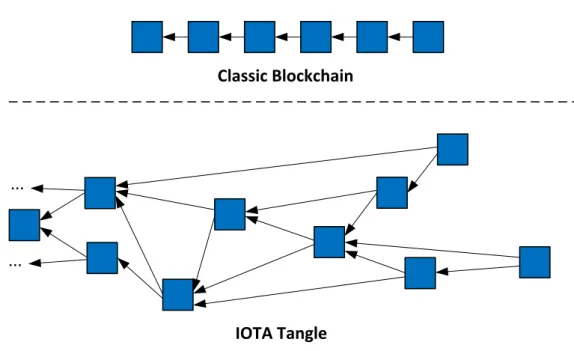
Figure 2.6:Comparison of a classic blockchain with the IOTA tangle
IOTA targets machine-to-machine (M2M) transactions in an IoT environment [Pop17]. Therefore exists a currency within the ledger which is also called IOTA. As the total amount of IOTA tokens is over 2.7 quadrillion, the token is often referred to as MIOTA, which means 106IOTA.
The feature where IOTA most differs from the already presented distributed ledgers is the data structure itself. Instead of a linear blockchain where each block contains the hash of its predecessor, IOTA uses a DAG for connecting single transactions. This DAG is called “the tangle”. Like a classic blockchain, the tangle holds all transactions that were ever issued in a chronological order. Let us now further investigate how the tangle is being constructed: each transaction is represented by a node in the graph. When a user issues a new transaction, this transaction must approve two previous ones. For each approval, a directed edge gets added to the graph. The direction of the edge is always from the approving transaction to the approved one. Every block further backwards in such an approval path gets also approved by the new transaction. This is then called indirect approval.
The structural difference between a classic blockchain and the tangle is illustrated in Figure 2.6. While each block in a classic blockchain contains a multitude of transactions, the IOTA tangle holds single transactions, each of which approves two previous transactions.
In the beginning there was one initial transaction called the “genesis transaction”. It held all the tokens that would ever get distributed. This means that no new tokens will ever be created, and consequently there is no process like mining new tokens. Instead of the classic PoW done by miners, every transaction issuer must solve a PoW puzzle themselves in order for the transaction to get sent. This once again prevents spamming the network with a multitude of transactions.
In addition to solving the PoW puzzle, a transaction issuer also has to verify two previous transactions. When a conflict is discovered while approving a transaction, the approval should fail. If not, there is the risk that the transaction approving an invalid one gets considered invalid by following transactions, too.
It still happens that two conflicting transactions both get added to the tangle. The network participants then have to decide which transaction is more likely to be valid. The other one then gets orphaned, meaning it will not be indirectly approved by new transactions anymore.
A transaction is more likely to be valid, the higher its cumulative weight is. Each transaction has a certain weight representing its importance. It is of course not possible for a single user to create many transactions with high weight in a short period of time. The cumulative weight is the weight of a transaction itself plus the weight of all transactions directly or indirectly approving a transaction.
The concept of cumulative weight resembles the block confirmations in other blockchain implemen-tations. The more transactions follow a certain transaction, the safer one can be that it is durably stored.
As there is little PoW necessary to issue a transaction or to sign one, it is easy for an attacker to manipulate the tangle state, as long as there is a low frequency of transactions and participating nodes [IOT18]. Out of that reason, the IOTA Foundation decided to use a coordinator until the network throughput gets high enough to resolve security issues. This coordinator signs every transaction and stores its location in the tangle. Transactions cannot be considered successful until referenced by the coordinator.
This basically makes the current tangle a centralized distributed ledger, as one party has the power to decide which transactions get signed and can be deemed confirmed.
The developers claim that IOTA enables almost instant and feeless transactions. Also, in contrast to classic blockchains, the more transactions are issued, the faster other transactions get verified.
2.3 Blockchains in the Industry
The potential application fields of blockchain technology in the industrial context are numerous. In the following, a few exemplary concepts are presented. Afterwards, reasons and challenges for an industrial blockchain adoption are discussed.
2.3.1 Industrial Application Examples
Three industrial applications where the use of blockchains is discussed or even already implemented are presented in this section.
Machine-to-Machine Electricity Market
Sikorski et al. propose the use of blockchain technology in the electricity market for M2M interaction [SHK17]. The idea is that electricity producers publish their offers, i.e. how much a consumer currently has to pay for a certain amount of electric energy. The consumer can observe and compare different offers and choose the cheapest or generally best fitting electricity provider. Both the offer and the consumer’s purchase process take place in a blockchain. The participants have to lock their trading goods, i.e. the electricity provider guarantees the delivery of the offered amount of energy, and the consumer ensures the possession of the required amount of money to pay for it.
The benefit of this model is the fact that no human interaction is needed in the whole process. Consuming machines can specify their energy demand and take care of their power supply themselves. The machine of the electricity provider on the other hand can produce the energy on demand. The blockchain is used here both for automation of the trading process and as a trustful intermediary, as it guarantees both sides that the trading goods actually exist.
Construction Engineering Management
Another application field proposed by Wang et al. is the use of blockchains in construction engineering management [WWWS17]. They identify three different categories.
The first are notarization-related applications. The need to have a notary verify the validity and integrity of documents is expensive and time-consuming. By using a distributed ledger to track every document creation, update and deletion, the blockchain could replace a notary in some specific points.
A further category are transaction-related applications. If the ownership of goods is controlled by the blockchain, a lot of trades can be automated. This can comprise tangible goods like building materials or construction machines or even intangible goods, e.g. the transfer of certain technology or knowledge.
The third and last identified category is provenance-related applications. As all the supply chains of a construction project would become transparent, it is easy to check if quality standards were fulfilled. If material-related problems arise during the construction, responsible parties can be identified and made accountable.
As an exemplary use case, a process for leasing construction cranes based on a Hyperledger blockchain instance is introduced. In this prototypical blockchain, a crane manufacturer can register a new crane in the blockchain which is then offered for lease to a customer. Therefore, the manufacturer invokes a certain piece of chaincode that creates a record for the new crane. Afterwards, a customer can lease the crane via another piece of chaincode for a certain period of time. If the customer’s payment is verified, the crane can be used by the customer for construction works. During the lease period, the customer updates the operational status of the crane once again on the blockchain. This data, e.g. breakdown events, electricity consumption or daily lifting load, updates the crane record.
Like in the previous concept, the blockchain is used here mainly to automate steps that would normally require human interaction. Additionally, the blockchain’s immutability is used for property rights and document validity.
3D Printing Supply Chain
Blechschmidt et al. describe how to improve the manufacturing industry by the use of blockchain technology [BS16]. They state that the cost overhead in 3D printing supply chains could be reduced if producers and customers both collaboratively used a blockchain. Therefore, they brought into being a project called “Genesis of Things” [The18a]. Their platform connects owners of 3D printers, customers who need parts printed as a service and designers of 3D parts.
The creator of a 3D design file which can be printed uploads the encrypted design to the blockchain. A customer can now decide to buy a certain amount of the product. Via smart contracts, the pricing as well as other terms and conditions are negotiated between the three parties automatically. Additionally, the best fitting 3D printer in terms of price and local proximity gets chosen. Each product is assigned a unique ID and its whole production history is made transparent via blockchain records.
The design file creator gets a royalty each time a design is printed. The owner of the printer gets paid for every print job. The customer can find the nearest and cheapest 3D printer for the production of otherwise costly spare parts or small series products.
As a proof of concept, cufflinks made of titanium were designed and the 3D printing file was uploaded to the blockchain. Along with the design itself, meta-information like used material are stored as well. A customer can then order any amount of cufflinks produced on demand with the already uploaded design. Each item gets a serial number and, through the transparency of the production process, also a digital product memory.
2.3.2 Remarks on Current Solutions
The exemplary solutions proposing or even actually using blockchains in an industrial context show certain advantages, but also challenges.
Benefits of Blockchain Adoption
Although many of them are just prototypical suggestions, a lot of use cases exist for the application of blockchains in various industrial fields. The main reasons why these applications try to use blockchain technology are automation and a need for trust. If several parties interact with each other and do not know each other, or even worse, do not trust each other, a blockchain can facilitate this interaction. Together with smart contracts, the technology offers transparency, automated execution of previously defined actions and resistance to manipulation by single participants.
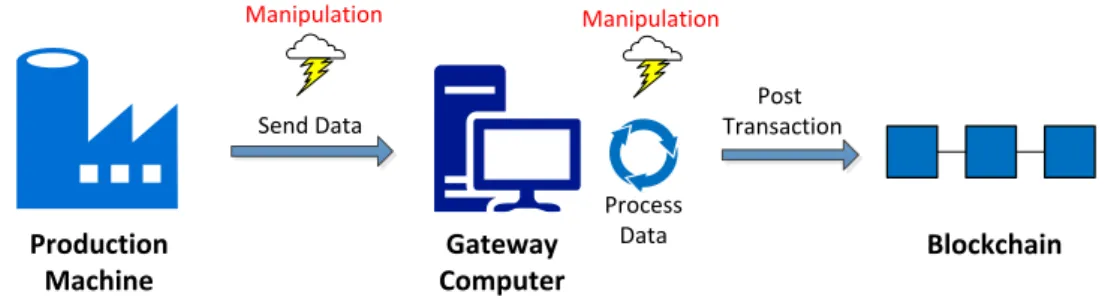
Blockchain Production Machine Gateway Computer Send Data Manipulation Process Data Manipulation Post Transaction
Figure 2.7:Attack vectors on blockchain gateway solutions
When multiple parties work together on a blockchain-based platform, they can form a so called decentralized autonomous organization (DAO). The rules of interaction between the members of a DAO are written in computer code, i.e. smart contracts define the business structure [Cho17]. That way, the need for a neutral but also costly intermediary is no longer present, as the blockchain can fulfill this task.
A further important factor is the immutability of stored data. The decentralized blockchain structure is resistant to both failure and manipulation of single nodes. Once data was successfully stored, it cannot be deleted or altered as long as the majority of nodes does not agree.
Challenges
When considering blockchain technology within a manufacturing process, the integrity of data must be ensured on the whole way from production machine to blockchain. Machine data obtained e.g. by sensors must not be altered before reaching the blockchain [Sob17]. Otherwise, wrong or manipulated data gets immutably stored, destroying the whole concept of trust.
Many of the existing prototypes use some kind of gateway between blockchain and production machine [Ste17]. Such a gateway consists of a software that communicates with a production machine, collects data and stores it in the blockchain. The software is run on a general purpose computer, together with a full blockchain node. That way, both the production machine and the blockchain interaction can be achieved by a single computer.
While this is the easiest way to connect a production machine to a blockchain, gateway solutions can pose severe security risks. Possible attack vectors can be seen in Figure 2.7. On the way from the production machine to the computer, the sent data could potentially be manipulated. That way, measurement values could be involuntarily changed before reaching the blockchain. Further on, the computer running the blockchain node and communicating with the production machine could be attacked, too. The computer needs an Internet connection and therefore offers a variety of attack
vectors. Every virus or malware running on the computer poses severe risks to the production measurement process. If the collected data gets altered before a blockchain transaction is built up, the integrity of the blockchain can then no longer be guaranteed.
That is why the concept of blockchains for production data only makes sense if a secure way from the sensor measuring data to a finished blockchain transaction is ensured.
One way to reduce the described security risks is changing the gateway design. If instead of a general purpose computer, a more primitive, single-purpose computer is used, this could potentially increase the security of the whole system.
The goal of this work is to answer the question: is it possible to develop a concept that enables communication with a blockchain without the necessity of a general purpose computer running a blockchain client? In the following chapters, this topic will be further investigated.
This chapter comprises the development of a concept for a secure transmission of production data. Beforehand, requirements are presented and used technologies as well as functionalities are introduced.
3.1 Requirements
In the following section a concept for data transmission between a production machine and a blockchain will be developed. Therefore, one first needs to identify requirements that the design has to meet.
3.1.1 General Requirements
• Use Appropriate Blockchain Implementation
As already stated in Section 2.2, a lot of different implementations based on blockchain technology exist. As the underlying concepts differ from each other, a technology has to be chosen that is best fitting for both the functional and non-functional requirements.
• Hardware-near Implementation
The developed prototypical component has to run on a platform that is close to hardware, so it can both retrieve data from a production machine and send it to the blockchain.
• Direct Sensor Connection
Retrieving data has to be able without the need for an intermediary between a sensor or a production machine and the prototype.
3.1.2 Functional Requirements • Sending Data to the Blockchain
The component must be able to communicate with a blockchain. As transactions are the core element of blockchain communication, the component must be able to issue transactions.
• Permanent Storage
The designed prototype must be able to send production data to the blockchain which is then put into a block and stored immutably. The successful sending of a transaction must be checked.
• Retrieving Blockchain Data
The prototype has to be able to access data that is already stored in the blockchain. • Minimize Time Between Transactions
As the production machine may have to update values frequently, building and sending a transaction may not take longer than 10 seconds.
• Real World Interaction
The designed component must offer means to communicate with the real world and obtain data that is to be stored.
3.1.3 Non-functional Requirements • Minimize Security Risks
Gateway solutions are vulnerable to attacks like data manipulation on the way from machine to gateway or while a transaction is built in the gateway, see Section 2.3.2. The developed system architecture must have as little attack vectors from the outside as possible to minimize security risks.
• Measure Degree of Trust
Along with the prototype concept development, it is also required to develop an approach to measure the degree of trust that some data is durably stored in the blockchain.
3.2 Choice of Technology
Before developing a design, different decisions concerning the used technologies have to be made. In this case, it comprises both hardware and software technologies.
3.2.1 Hardware Technology
The key point of the design is that it differs from the usual gateway solutions. This means, it is not making sense to run the design on a general purpose computer. The platform should have as little underlying operation system functionalities as possible. This is useful for various reasons: First, it reduces the possibility for attacks. For an attacker it is easier to manipulate a machine the more interfaces it has to the outside. By having a hardware as primitive as possible but still powerful enough to complete its task, the amount of attack vectors is minimized.
Secondly, the less overhead caused by a full operation system, the faster simple calculations and operations can be made.
Besides, the component should be used to retrieve and process machine data. A lot of machines, especially older ones, do not offer high-level interfaces for communicating with the world outside. They often use a serial data bus interface to exchange data, and a general purpose computer might not be able to interpret the data without the use of additional software.
That is why a microcontroller is the ideal platform to program the required prototype on. A microcontroller unit (MCU) can be defined as “...a computer present in a single integrated circuit which is dedicated to perform one task and execute one specific application” [Tec18].
One central feature that the MCU is required to have is a WiFi capability. This is essential for the MCU to exchange data with a blockchain that is only accessible via the Internet. This requirement massively narrows down the choice of an appropriate MCU.
Computational power and memory storage are negligible criteria, as the MCU will not be needed for complex timing-critical calculations or as a storage of big amounts of data.
A further criterion is the price of the MCU. It should be kept low in order to be able to equip multiple machines with the MCU in the future.
All these criteria led to the NodeMCU with an EPS8266 WiFi module as the technology of choice [Nod18b]. NodeMCU is the name of a firmware as well as the corresponding MCU board. The firmware is based on eLua and it runs on the ESP8266 WiFi module which has a Tensilica Xtensa L106 processor [Nod18a] [Esp18].
Programming the MCU can be done via a Universal Serial Bus (USB) interface and with different tools. Apart from Lua, there are several other programming languages supported by the ESP8266. The programming language used in the scope of this work is Arduino C/C++ [Ard18][Gro18]. The NodeMCU Development Kit board is powered with 5V via micro USB either from a regular USB port or with a power adapter. It has a total of 30 pins which can be plugged e.g. in a development breadboard. Some of the pins have general purpose digital input/output functionality, others are ground pins or constant 3.3V output. Certain pins do also support interfaces like universal asynchronous receiver-transmitter (UART) or Serial Peripheral Interface bus (SPI).
Figure 3.1:Layout of NodeMCU pins [Sah17]
The board can be purchased on the Internet for less than 10 Euro a piece. The low price together with the broad functionality and WiFi capability makes the NodeMCU the ideal choice for programming the desired prototype.
3.2.2 Software Technology
In the following, some decisions about the used software components are discussed. They comprise the targeted blockchain implementation as well as the prototype’s programming language and development environment.
Blockchain Implementation
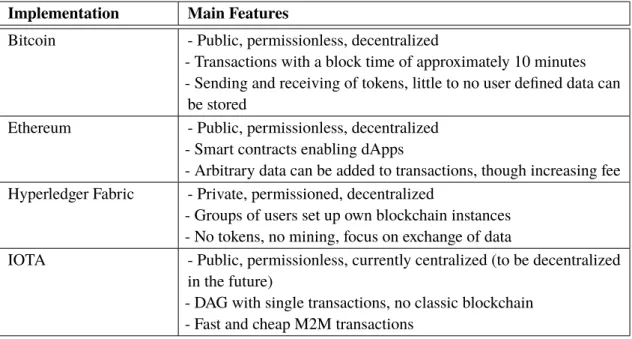
The four blockchain implementations that were presented in Section 2.2 are some of the best known and most widely used ones. While Bitcoin and Ethereum are similar to each other, a comparison to Hyperledger Fabric or IOTA is more sophisticated and will be done as a second step.
Table 3.1 gives a brief overview of the four presented blockchain implementations. Bitcoin and Ethereum both offer an open source blockchain implementation with their respective tokens, BTC and ETH. In both technologies, transactions can be issued sending tokens from one address to
Table 3.1:Overview of different blockchain implementations
Implementation Main Features
Bitcoin - Public, permissionless, decentralized
- Transactions with a block time of approximately 10 minutes - Sending and receiving of tokens, little to no user defined data can
be stored
Ethereum - Public, permissionless, decentralized - Smart contracts enabling dApps
- Arbitrary data can be added to transactions, though increasing fee Hyperledger Fabric - Private, permissioned, decentralized
- Groups of users set up own blockchain instances - No tokens, no mining, focus on exchange of data
IOTA - Public, permissionless, currently centralized (to be decentralized in the future)
- DAG with single transactions, no classic blockchain - Fast and cheap M2M transactions
another. For an industrial application, sending tokens plays a subordinate role. More important is the ability to send arbitrary data, e.g. information about a fabrication process or a machine’s status. But the data should not be just sent to the blockchain, but also processed there and potentially trigger further events or actions. That is where smart contracts come into play. Bitcoin does not offer any smart contracts or similar possibilities in contrast to Ethereum. The latter was specifically designed to expand Bitcoin’s concept e.g. for the development of smart contracts [But14]. As smart contract functionality is essential for an industrial application, Ethereum is superior to Bitcoin in this aspect. In addition to smart contracts, Ethereum also has a shorter block time (10-15 seconds in contrast to 10 minutes) which makes new transactions visible faster. That is why Ethereum is superior to Bitcoin for the required use case.
As Bitcoin has been ruled out as a potential technology, Ethereum must now be compared to Hyperledger Fabric. This comparison cannot be done as easily as the one before, because Hyperledger Fabric has a fundamentally different design and therefore different properties. Hyperledger Fabric targets a group of users who want to work together on one Hyperledger Fabric instance, which consists of private and permissioned blockchains. An instance has to be initially set up and rules for endorsement and interaction have to be agreed upon. While this makes sense for a private, B2B blockchain, it also poses a huge overhead of work that has to be invested before there is an up and running instance. For a prototypical client implementation, a blockchain with one single peer is rather pointless. As the main task of this work is designing a prototype, it makes more sense to use an already existing blockchain instance. Additionally, a blockchain client for Hyperledger Fabric would result in a very special solution tailored for the many specific properties that this implementation has. When designing a prototype for e.g. Ethereum, the concepts can be transferred to many similar blockchain implementations with little effort. Therefore, this also facilitates the portability of the design. That is why Ethereum is favored over Hyperledger Fabric in this work.
Last but not least, IOTA is to be compared with Ethereum. IOTA focuses on M2M transactions which are fast and cheap. Yet it does not support any kind of native smart contracts. This means that a transaction can be issued and also measured data from a production environment can be put into the transaction, but the data would only get stored. IOTA is still undergoing a lot of development and the amount of transactions in the network is rather low, with a few transactions per second [The18c]. Another point of criticism is the de facto centralization via the coordinator which is still present at the time of this work’s creation in June 2018. If one day the IOTA Foundation decided to lock out certain accounts, there is little that could be done about it. Out of all these reasons, Ethereum should be preferred over IOTA, at least until IOTA overcomes the ma
![Figure 2.1: Simplified illustration of a blockchain structure [Nak08]](https://thumb-us.123doks.com/thumbv2/123dok_us/425040.2548799/20.892.143.745.175.489/figure-simplified-illustration-blockchain-structure-nak.webp)

![Figure 3.1: Layout of NodeMCU pins [Sah17]](https://thumb-us.123doks.com/thumbv2/123dok_us/425040.2548799/42.892.189.704.160.590/figure-layout-of-nodemcu-pins-sah.webp)