Chapter 5: Invest in Capacity Building
Capacity building is one of the least understood yet most important aspects of development work. Building human and social capital is integral to strategic community investment because it leverages and multiplies the impact of CI resources by strengthening local partner organizations, promoting self-reliance, and increasing the likelihood of project success. Effective capacity building benefits both the company and local stakeholders by generating inclusive processes that strengthen trust and build commitment and good relationships.For many companies, capacity building is their exit and sustainability strategy rolled into one. Capacity building requires careful planning to target the right people and build the right skills at the right time and over time. Evidence suggests that capacity-building initiatives tend to be more effective when they are conceived as an ongoing strategic commitment. There is a range of different capacity-building interventions that companies can choose to support depending on need, context, and desired outcomes.
BE STRATEGIC—5 qUESTIONS TO ASK UP FRONT
Because “capacity building” tends to be a general term which is not always well-defined, there is a risk that companies can waste time and money on programs and activities that end up building the wrong skills, targeting the wrong people, or being detached from the CI process. “One-off” events or training without hands-on learning and follow-up also tend to have limited effectiveness. Capacity building investments often work best when they are conceived as longer-term programmatic interventions that are targeted and integrated with the CI project cycle (see Figure 5.2). To get the most out of such efforts, companies may find it helpful to ask a few simple, yet strategic, questions upfront:
• WHoSe capacity are we trying to build? • Capacity to do WHAt and WHY?
• WHen do we need to build these capacities? • WHo should deliver the capacity building? • HoW will we know if we have succeeded?
TARGET THE RIGHT PEOPLE
There are several target groups that usually require some form of capacity building or skills enhancement within the context of CI planning and
management. These include the company, communities (individuals, groups, and community organizations), NGOs, and local government. In some cases, capacity-building efforts will need to target a broad group; in other cases, individuals or smaller sets of representatives may be selected for training based on the specific roles or functions they are expected to carry out.
Building human
and social capital
is integral to
strategic community
investment because
it leverages and
multiplies the
impact of CI
resources.
Communities
A company may choose to work with communities directly, through local
organizations that operate in the area, or through more informal community-based organizations (e.g., church groups, women’s cooperatives, and farmers’ groups). Made up of community members, CBOs, if properly constituted, often have the best understanding of community issues and the most legitimacy.
CBOs can also face a number of issues, such as lack of formal registration, that make it difficult for them to gain recognition from outside groups (including the company). In addition, CBOs can at times be poorly managed and lack proper organization and resources. Many have no bank accounts or formal systems in place, posing a challenge for companies wanting to work with them. Not all CBOs may be representative of communities or have democratically elected members or be socially inclusive. For these reasons their accountability to the wider community may be weak. Despite the challenges, targeting CBOs for capacity building can be a worthwhile investment given their direct links at the community level.
Nongovernmental Organizations (NGOs)
NGOs can play an important role in delivering local services and serving as advocates for community interests. In some cases, they are seen by communities as more impartial than government organizations and company representatives. While NGOs tend to be better managed and better resourced than community-based organizations, some also struggle with capacity issues related to effective management systems, funding, skills, and transparency. NGO interests may not necessarily be aligned with the communities they are intended to serve or with the company’s objectives. Companies that invest in capacity building of NGOs (and CBOs) usually do this in order to serve CI-specific needs and objectives related to their project. It is worth remembering, however, that many NGOs will be around long after
Figure 5.1: Examples of Stakeholder Groups Targeted for Capacity Building32
In Peru, Minera Yanacocha
partners with IFC to provide modern financial management systems and on-the-job training to the local municipality receiving the mine’s tax revenues.
In Colombia, Ecopetrol has partnered with key oil companies and IFC to help civil society organizations in five regions improve the performance of Royalty Investment Monitoring Committees. These committees hold local governments account-able for their use of oil and mining royalties.
DFCU Bank in Uganda provides basic financial training to current and prospective female clients and women's organizations on topics that range from developing good savings habits to applying for bank financing.
Kinross Maricunga, a Chilean gold mining company operating in the Andes close to indigenous people and a national park, organized training programs for local communities to enable them to start their own income-generating enterprises around ecotourism.
BHP Biliton organizes practice-based training programs for its commu-nity relations professionals around the globe. The aim is to improve their knowledge, skills, and competencies in working with local communities.
Local Communities Government Civil Society/ NGOs Women’s Groups Company Capacity Investments
projects are completed; so connecting the capacities they are gaining in the short term to a longer-term perspective is important. If capacity building is effective, NGOs should be able to apply their acquired experience and skills to manage future projects in other areas and with other companies or organizations.
Local Government
Local government is not always included in capacity-building considerations, yet it is frequently the critical “missing link.” It is the institution most likely to provide continuity in an area after the company has left and it usually has the statutory responsibility to provide basic services to communities—often the very services that companies will help support through CI. Capacity building of local government institutions, however, has its own particular challenges (including governance issues, lack of resources, management capacity, and technical skills, as well as constraints at the policy level). Nevertheless, companies can and do engage to help address some of these gaps.
Company Staff
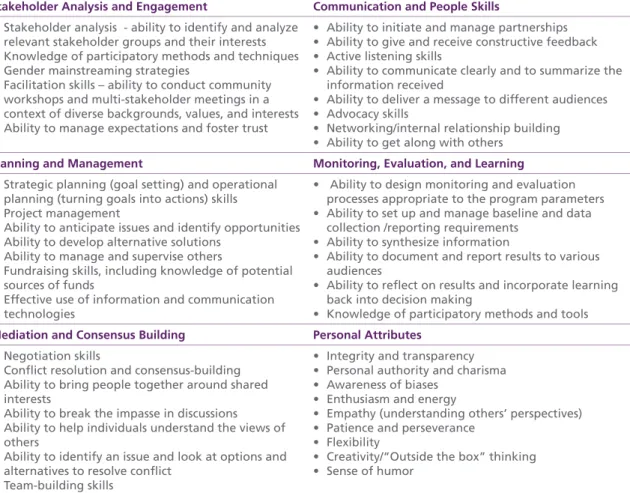
Engaging with local stakeholders to develop successful CI initiatives requires a set of competencies and skills that many companies might not have up front and may need to acquire either through training, recruitment, or the hiring of consultants and others with specific expertise. Table 5.1 illustrates some of these skills and areas of expertise. Table 5.1: Sample of Company Competency Dimensions/Key Skill Areas for CI
Stakeholder Analysis and Engagement Communication and People Skills
• Stakeholder analysis - ability to identify and analyze relevant stakeholder groups and their interests
• Knowledge of participatory methods and techniques
• Gender mainstreaming strategies
• Facilitation skills – ability to conduct community workshops and multi-stakeholder meetings in a context of diverse backgrounds, values, and interests
• Ability to manage expectations and foster trust
• Ability to initiate and manage partnerships
• Ability to give and receive constructive feedback
• Active listening skills
• Ability to communicate clearly and to summarize the information received
• Ability to deliver a message to different audiences
• Advocacy skills
• Networking/internal relationship building
• Ability to get along with others
Planning and Management Monitoring, Evaluation, and Learning
• Strategic planning (goal setting) and operational planning (turning goals into actions) skills
• Project management
• Ability to anticipate issues and identify opportunities
• Ability to develop alternative solutions
• Ability to manage and supervise others
• Fundraising skills, including knowledge of potential sources of funds
• Effective use of information and communication technologies
• Ability to design monitoring and evaluation processes appropriate to the program parameters
• Ability to set up and manage baseline and data collection /reporting requirements
• Ability to synthesize information
• Ability to document and report results to various audiences
• Ability to reflect on results and incorporate learning back into decision making
• Knowledge of participatory methods and tools
Mediation and Consensus Building Personal Attributes
• Negotiation skills
• Conflict resolution and consensus-building
• Ability to bring people together around shared interests
• Ability to break the impasse in discussions
• Ability to help individuals understand the views of others
• Ability to identify an issue and look at options and alternatives to resolve conflict
• Team-building skills
• Integrity and transparency
• Personal authority and charisma
• Awareness of biases
• Enthusiasm and energy
• Empathy (understanding others’ perspectives)
• Patience and perseverance
• Flexibility
• Creativity/“Outside the box” thinking
PERU LNG (Liquid Natural Gas Project) is the largest foreign direct investment in Peru’s history. The shareholders include Hunt Oil, Repsol YPF, SK Energy Co. Ltd, and Marubeni Corporation. The project’s pipeline passes through four regions—two of which are among the poorest in Peru. In light of the significant anticipated royalty flows to the local municipalities, PERU LNG recognized the business imperative of ensuring that these royalties directly benefit the local population.
In 2008, the company started working with IFC’s revenue management advisory services program in Peru to strengthen municipal investment management in three provinces. This program was based on a two-pronged “push-pull” approach. On the “push” front, local governments receive capacity building to efficiently plan, manage, and make sound investment decisions. On the “pull” side, which is known as the social accountability component, or “Mejorando la Inversión Municipal” (MIM), civil society organizations receive support on how to monitor revenue inflows and municipal investments in order to increase both transparency and accountability. They publicly disseminate the information and create channels for feedback to muncipalities about local demand and perceptions of their performance.
Results To Date
After one year of implementation, results have been encouraging. The participating municipalities have received in-depth technical support and training that helped to resolve several bottlenecks in the investment cycle. Investment committees have been established in each municipality to promote sound investment practices. Work to develop multi-annual investment plans is underway. A number of strategic projects have been selected by municipalities for implementation, including installation of a potable water and sanitation system, building of a waste management system, and a health project to reduce child malnutrition.
On the social accountability side, several respected local institutions, including the local chamber of commerce, professional schools of economists and lawyers, the local university, and NGOs, participate in the MIM component of the program. Baseline and follow-up surveys showed an increased level of understanding among the local population about the royalties and their rights to receive information on how they are being spent.
Lessons Learned
• Directly involve and build capacity of the key municipal staff in charge of the investment efforts. Consider both investment quantity and quality (linked to the development priorities of the local population) while supporting local governments in the improvement of their investment practices. • Promote a culture of social accountability by showing municipal authorities that a two-way flow of information is in their interest. This can be done by: i) helping civil society to make itself heard and gain the means to effectively engage authorities, ii) engaging the media so it plays a key role in disseminating information, monitoring municipal affairs, and furthering an informed public discussion, and iii) providing local authorities and municipal officers with incentives for sharing information with respect to municipal activities.
• Provide action-oriented feedback to mayors to help them understand local perceptions and to act on key areas that need their attention. This in turn signals to the population that their voice is being heard by government.
PERU LNG (PERU) – PROMOTING MUNICIPAL STRENGTHENING AND SOCIAL ACCOUNTABILITY AROUND REVENUES FROM ExTRACTIVE INDUSTRIES33
BUILD THE RIGHT TYPES OF CAPACITIES
Another challenge for effective capacity building is getting clear on what sorts of competencies, awareness, and skills need to be built. The United Nations
Development Program’s classification of two general types of capacities, “functional” and “technical,” provides a useful framework for thinking about capacity building in the CI context.34 A third category, “behavioral,” relates to awareness and attitudes.
FUNCTIONAL CAPACITIES are “crosscutting” capacities that are relevant across various levels and are not associated with one particular sector or theme. They are the management capacities needed to formulate, implement, and review strategies, programs, and projects. Since they focus on “getting things done,” they are of key importance for any successful capacity development. These capacities are the ones that companies are most likely to target as part of CI.
TECHNICAL CAPACITIES are those associated with particular areas of expertise and practice in specific thematic areas or sectors. For CI, the technical skills may closely relate to a sector or program focus, such as microfinance, small business training, education, health, or agriculture. Technical capacities tend to be acquired through more formalized instruction, study, and practical training. Because this tends to be a more specialized set of skills, the target audience is generally much narrower. BEHAVIORAL CAPACITIES have to do with cultural shifts and changes in attitude. An important component of capacity building, especially in a multi-stakeholder context, is raising awareness in order to affect changes in the attitudes, practices, and behaviors of individuals, groups, and organizations. These changes include partnering, building alliances, and interacting in new or different ways. Behavioral capacity building can also prompt changes in strategy direction, policies, and institutional culture.
UNDP’S FIVE FUNCTIONAL CAPACITIES35
The United Nations Development Programme places emphasis on building the following five functional capacities:
• Engage Communities
This involves building the capacity to facilitate participatory development and multi-stakeholder processes by building trust, using participatory methods, listening, helping to give voice to the silent majority, and working toward putting the community members into the “driver’s seat.” • Assess a Situation and Define a Vision and Mandate
Skills in analysis, systems view, visioning, imagination, assets and opportunity assessment, goal setting, and project design, are a part of this capacity area. • Formulate Policies and Strategies
Skills in this area include strategic thinking, strategy mapping and development, social network mapping, prioritization, operational planning, feasibility analysis, and risk analysis.
• Budget, Manage, and Implement
Skills in this area include forecasting, participating, budgeting, cost analysis, funds allocation, reporting, financial oversight, and bookkeeping.
• Monitor and Evaluate
Skills in setting measurable goals and objectives, defining outcomes, developing indicators, formulating and asking appropriate questions, gathering and analyzing data, using tools for conducting participatory evaluations, and creating a positive learning environment.
During a capacity assessment of three rural Fijian communities for a health promotion program, nine “capacity domains” were identified and assessed to identify problem areas and define capacity-building strategies to address them. These were:
1. Participation 2. Leadership
3. Organizational structure (committees, church, youth, and other community groups) 4. Problem assessment (identification of problems,
solutions, and actions to resolve problems) 5. Resource mobilization (ability to mobilize
resources from within and to negotiate resources from beyond the community) 6. Asking “why” (the ability of the community
to critically assess causes of problems) 7. Links with others (links between the
community and other organizations, partnerships, and coalitions)
8. Role of outside agents (links between the community and external parties)
9. Program management (includes control by stakeholders over decisions on planning, implementation, evaluation, finances, administration, reporting, and conflict resolution)
Each domain consisted of five elements that ranged from the least to the most empowering situation and was presented as a short statement derived from community discussions. Each statement was then discussed and the community made the selection of the one that most closely represented the current situation. The following matrix is an example of how the community assessed the “participation” domain.
Domain Assessment Reasons Why How to Improve Strategy Resources Required Participation Not all
community groups (e.g., women, youth) are participating in activities and meetings There is a lack of knowledge, skills, focus, and interest in the community; personal differences are also creating divisions Work through traditional structures and processes, chiefly leadership, to address the issues Develop a directive with a timeline, activities, and responsibilities though follow-up meetings Human resources to develop a plan for better targeting of women and youth COMMUNITY CAPACITY ASSESSMENT (FIjI)36
Start by Assessing Existing Capacities
To build capacity effectively, one must first understand what capacity already exists. A good place to start is to involve stakeholders in assessing their own capacities and jointly defining a range of “competency areas” linked to the CI program. Once key competencies have been identified, the desired level of capacity (target) and the existing level of capacity (baseline) can be determined. This can be done through a series of questions intended to investigate each skill area to find out where the strengths and weaknesses of the group, organization, or individual lie. The development of such a capacity-building questionnaire can be done in a participatory setting and should include a discussion of what success might look like. Capacity levels can be assessed using other qualitative and quantitative techniques. For examples of existing tools and methods to assess organizational capacity, please see Tools 6 and 7.
Consider a Range of Capacity-Building Investments
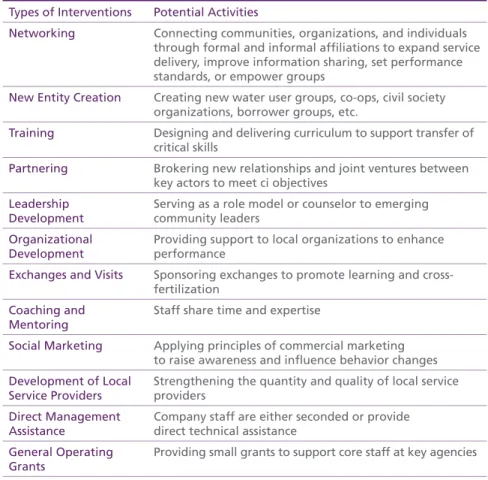
Local capacity development is increasingly viewed as a worthwhile investment in and of itself, and not just as a means of facilitating projects in other areas. Once capacity needs have been assessed and agreed upon, specific interventions can be identified. Table 5.2 provides a menu of options that can be used to identify the major components of a company’s capacity-building strategy.
The interventions listed below have different purposes. When choosing among different types of capacity-building investments it is useful to think about what objective a particular intervention would achieve, if it is demand-driven, and what outcomes are expected.
Table 5.2: Investing in Local Capacity Building - A Menu of Options Types of Interventions Potential Activities
Networking Connecting communities, organizations, and individuals through formal and informal affiliations to expand service delivery, improve information sharing, set performance standards, or empower groups
New Entity Creation Creating new water user groups, co-ops, civil society organizations, borrower groups, etc.
Training Designing and delivering curriculum to support transfer of critical skills
Partnering Brokering new relationships and joint ventures between key actors to meet ci objectives
Leadership
Development Serving as a role model or counselor to emerging community leaders Organizational
Development
Providing support to local organizations to enhance performance
Exchanges and Visits Sponsoring exchanges to promote learning and cross-fertilization
Coaching and Mentoring
Staff share time and expertise
Social Marketing Applying principles of commercial marketing to raise awareness and influence behavior changes Development of Local
Service Providers Strengthening the quantity and quality of local service providers Direct Management
Assistance
Company staff are either seconded or provide direct technical assistance
General Operating
EVALUATE CAPACITY-BUILDING RESULTS
Measuring the success of capacity-building efforts is perhaps the biggest challenge. Assessing results is nevertheless worth trying given that levels of local capacity are an important factor in determining whether or not CI will be sustainable. In most cases, an outcomes-focused approach that utilizes both quantitative and qualitative data can be useful in measuring the changes in behavior and perceptions among individuals, organizations, groups, and communities.
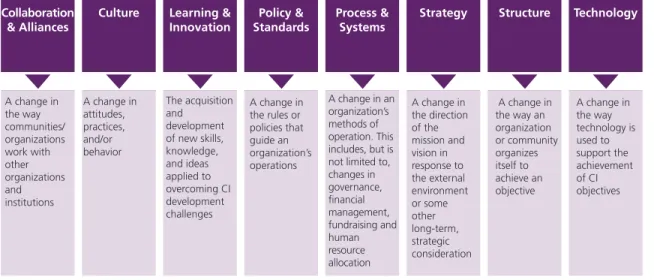
Changes resulting from capacity building efforts may take many different forms, such as those given in Figure 5.3. Once the expected changes have been defined, these can be developed into specific indicators.
Some important considerations when building a results framework for capacity building include:
• Objectives, targets, and baseline need to be clearly defined to allow assessment of results
• Beneficiaries can have multiple perspectives on the nature of the conducted capacity-building activities
• The capacity-building exercise should be as participatory as possible to ensure that a range of opinions is captured relating to performance
• Changes in capacities may only be demonstrated over the long term • Results can be greatly affected by the quality of the intervention
Figure 5.2: Areas in which Change May Occur due to Capacity-Building Measures37 Collaboration
& Alliances
Culture Learning & Innovation
Policy & Standards
Process & Systems
Strategy Structure Technology
A change in the way communities/ organizations work with other organizations and institutions A change in attitudes, practices, and/or behavior The acquisition and development of new skills, knowledge, and ideas applied to overcoming CI development challenges A change in the rules or policies that guide an organization’s operations A change in the direction of the mission and vision in response to the external environment or some other long-term, strategic consideration A change in the way an organization or community organizes itself to achieve an objective A change in the way technology is used to support the achievement of CI objectives A change in an organization’s methods of operation. This includes, but is not limited to, changes in governance, financial management, fundraising and human resource allocation
CAPACITY BUILDING PRACTICE POINTERS
Make it Demand Driven
Whenever possible, capacity building should be demand driven, responding to the interests and needs expressed by NGOs, community members, local government, and others.
• Has there been a request for capacity building?
• Have we properly identified the community’s needs?
• Is there a solid decision-making process in place to prioritize critical needs?
Take a Systems View
Consider the impact that an intervention might have on the broader system. For example, capacity building for women may be looked at with suspicion by men, or an organization’s capacity building around a particular CI project may sidetrack it from its core mission.
• Do we have a clear understanding of the wider context?
• Have we thought about potential consequences related to our intervention?
Understand the History
Ask about other capacity-building efforts in which stakeholders have participated. Find out what worked well and what didn’t.
• Have we inquired about past capacity-building efforts and their impact?
• Have we attempted to build on lessons from past interventions?
Work Through Indigenous Entities
Working with and through indigenous entities (e.g., local consulting firms, NGOs, private contractors) to do capacity building strengthens the host country’s service provider market and makes local experts more visible.
• Have we identified local groups that could facilitate our initiative?
• Have criteria been chosen for partner selection?
• For which activities can we rely on local organizations?
Integrate Gender
In most developing countries, gender inequality is still seen as a major obstacle to development. Closing the capacities gap between women and men involves specific efforts to create an enabling environment for woman to participate in capacity building and to incorporate gender perspectives when planning these interventions.
• Have we identified and involved women’s groups and networks?
• Have we created an enabling environment for the participation of women?
• Have we taken into account the perspectives of both women and men as well as the gender implications of our proposed interventions?
Promote Action Learning and Participation
Using participatory methods has been found to be the most effective way to build capacity. Participatory approaches help people actively contribute to teaching and learning, rather than passively receiving information from outside experts. When capacity building is directly connected to a “need to know,” people are more motivated to learn.
• How do we ensure that communities participate?
• Are we planning to use participatory methods?
• Is there “real work” around which we can organize capacity-building activities to promote action learning?