2017
Efficient cloud computing system operation
strategies
Min Sang Yoon
Iowa State UniversityFollow this and additional works at:
https://lib.dr.iastate.edu/etd
Part of the
Computer Engineering Commons
This Dissertation is brought to you for free and open access by the Iowa State University Capstones, Theses and Dissertations at Iowa State University Digital Repository. It has been accepted for inclusion in Graduate Theses and Dissertations by an authorized administrator of Iowa State University Digital Repository. For more information, please [email protected].
Recommended Citation
Yoon, Min Sang, "Efficient cloud computing system operation strategies" (2017).Graduate Theses and Dissertations. 15472.
by
Min Sang Yoon
A dissertation submitted to the graduate faculty in partial fulfillment of the requirements for the degree of
DOCTOR OF PHILOSOPHY
Major: Computing and Networking Systems Program of Study Committee: Ahmed E. Kamal, Major Professor
Guan Yong Zhu Zhengyuan
Wang Lizhi Akhilesh Tyagi
The student author and the program of study committee are solely responsible for the content of this dissertation. The Graduate College will ensure this dissertation is globally
accessible and will not permit alterations after a degree is conferred.
Iowa State University Ames, Iowa
DEDICATION
I would like to dedicate this dissertation to my father Tae Eun Yoon, my mother Ok Rye Seo, my sister Seung Hee Yoon, and fiancee, Ha Neul Lee. I believe I could not be able to complete PhD degree without their support. Thank you for trust me and wait me for five years. I know it has been really long time and feel deep gratitude for their sacrifice. I also would like to express thanks to all my families and friends who support me.
TABLE OF CONTENTS
LIST OF TABLES . . . vi
LIST OF FIGURES . . . vii
ACKNOWLEDGEMENTS . . . ix
ABSTRACT . . . x
CHAPTER1. INTRODUCTION . . . 1
1.1 Background . . . 1
1.1.1 Cloud Computing . . . 1
1.1.2 Software Defined Networks (SDN) . . . 3
1.1.3 Network Function Virtualization (NFV) . . . 4
1.2 Advantages of Cloud Systems . . . 5
1.3 Research Challenges . . . 6
1.4 Dissertation Contribution . . . 8
1.5 Dissertation Organization . . . 11
CHAPTER2. LITERATURE REVIEW . . . 12
2.1 Virtual Machine Placement in Clouds . . . 12
2.2 Power Consumption Minimization in Clouds . . . 13
2.3 Queuing Theory in Clouds . . . 14
2.4 Traffic Prediction in Clouds . . . 15
2.5 Virtual Network Embedding in Clouds . . . 16
2.6 Network Function Virtualization Deployment in Clouds . . . 17
CHAPTER3. OPTIMAL DATA SET ALLOCATION IN DISTRIBUTED HETEROGENEOUS CLOUDS . . . 20 3.1 Problem Formulation . . . 20 3.1.1 Processing Time . . . 21 3.1.2 Cost . . . 23 3.1.3 Constraints . . . 24
3.2 Algorithm for Multi Objective Optimization . . . 24
3.3 Simulation Model . . . 28
3.4 Simulation Result . . . 28
3.5 Chapter Summary . . . 31
CHAPTER4. ADAPTIVE DATA CENTER ACTIVATION WITH USER REQUEST PREDICTION LEARNING ALGORITHM . . . 32
4.1 System Model . . . 32
4.1.1 Distribution Parameter Adaptive Data Center Activation Model . . . . 32
4.1.2 Fat-tree Data Center . . . 33
4.1.3 SDN Based Data Center . . . 35
4.2 Request prediction Algorithm . . . 35
4.2.1 Histogram Analysis . . . 37
4.2.2 Maximum Likelihood Estimation (MLE) . . . 38
4.2.3 Local Linear Regression (LLR) . . . 38
4.2.4 Cyclic Window Learning Algorithm . . . 39
4.2.5 Experiment . . . 42
4.3 Adaptive data center activation . . . 48
4.3.1 Objective Function . . . 49
4.3.2 Load Distribution Constraint . . . 51
4.3.3 Performance Constraints . . . 54
4.3.4 Memory Constraints . . . 57
4.3.5 Connectivity Constraints . . . 59
4.5 Numerical Results and Discussion . . . 62
4.5.1 Adaptive Data Center Activation . . . 62
4.6 Chapter Summary . . . 67
CHAPTER5. NETWORK FUNCTION VIRTUALIZATION DEPLOYMENT IN CLOUDS . . . 69
5.1 Virtual Infrastructure Management (VIM) Algorithm: NFV Resource Allocation using Mixed Queuing Network Model . . . 70
5.1.1 System Model . . . 70
5.1.2 Problem Formulation . . . 72
5.1.3 Heuristic Algorithm Mixed Queuing Network Model . . . 77
5.1.4 Numerical Analysis . . . 81
5.2 NFVO and VNFM Algorithm: Power Aware NFV-SC Resource Allocation and Embedding in Hyper-scale Clouds . . . 84
5.2.1 System Model . . . 86
5.2.2 Problem Formulation . . . 97
5.2.3 NFV-SC Resource Allocation and Embedding Algorithm . . . 104
5.2.4 Numerical Analysis . . . 109
5.3 Chapter Summary . . . 117
CHAPTER6. CONCLUSION AND FUTURE WORK . . . 122
LIST OF TABLES
Table 3.1 Formulation Notations . . . 21
Table 4.1 Value of key parameters . . . 62
Table 5.1 Formulation Notations . . . 72
LIST OF FIGURES
Figure 1.1 Cloud computing architecture and service layers . . . 2
Figure 1.2 Traditional and SDN network architecture . . . 3
Figure 1.3 NFV architecture (taken from [82]) . . . 4
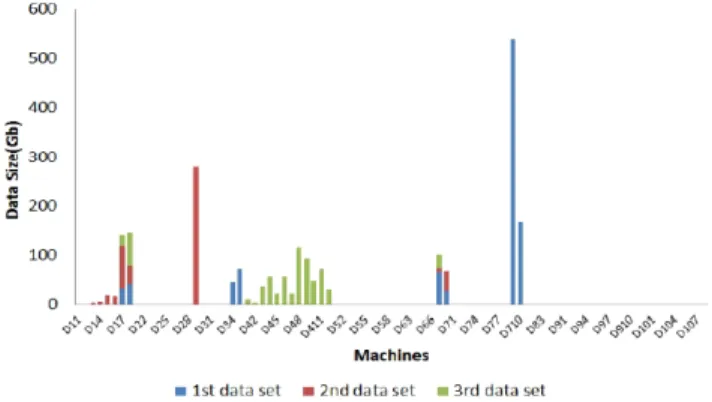
Figure 3.1 Minimum processing time optimization result . . . 29
Figure 3.2 Minimum cost optimization result . . . 29
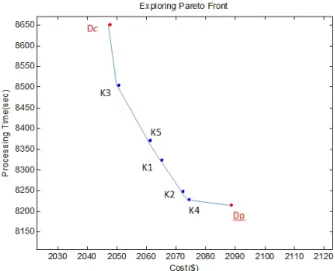
Figure 3.3 Pareto optimal points with iterations . . . 30
Figure 4.1 Cognitive cycle of system . . . 33
Figure 4.2 SDN fat-tree data center model (k=4) . . . 34
Figure 4.3 Prediction dataset . . . 36
Figure 4.4 Prediction dataset . . . 43
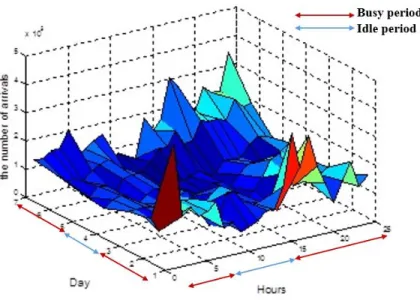
Figure 4.5 The number of tasks during the day . . . 44
Figure 4.6 Distribution of the first day . . . 44
Figure 4.7 MLE of the first hour . . . 45
Figure 4.8 Poisson distribution parameterλestimation of arrival tasks . . . 46
Figure 4.9 MAPE measurement of task arrivals prediction . . . 47
Figure 4.10 NMSE comparison between proposed algorithm and reference models . 48 Figure 4.11 Optimal and heuristic solution comparison . . . 64
Figure 4.12 Energy saving rate with Simulated Annealing algorithm . . . 65
Figure 4.13 Energy saving rate with Simulated Annealing algorithm for different bandwidth values . . . 66
Figure 4.14 Energy saving rate comparison between predicted and measured user requests . . . 67
Figure 4.15 Energy saving rate comparison with LCP algorithm . . . 68
Figure 5.1 System model . . . 71
Figure 5.2 Simulation Model . . . 81
Figure 5.3 The maximum expected waiting time of service chain . . . 82
Figure 5.4 The maximum expected waiting time of service chains with increase in capacity of server . . . 83
Figure 5.5 Service rate allocation to VNFs . . . 83
Figure 5.6 Neighbor solutions . . . 84
Figure 5.7 SDN cloud computing infrastructure . . . 87
Figure 5.8 Cloud Computing Infrastructure Generated by Poisson Point Process . 90 Figure 5.9 M/G/1/K queuing network expansion method analysis . . . 98
Figure 5.10 Round Trip Time comparison(RTT) with practical measurement and estimated value using proposed approach . . . 111
Figure 5.11 Total power consumption of the infrastructure . . . 119
Figure 5.12 Network power consumption of the infrastructure . . . 119
Figure 5.13 Server power consumption of the infrastructure . . . 119
Figure 5.14 Average service chain completion time . . . 119
Figure 5.15 Users’ SLA violation rate . . . 119
Figure 5.16 The number of cluster . . . 119
Figure 5.17 Total power consumption of the infrastructure . . . 120
Figure 5.18 Average service chain completion time . . . 120
Figure 5.19 Users’ SLA violation rate . . . 120
Figure 5.20 Total power consumption of the infrastructure . . . 121
Figure 5.21 User’s SLA violation rate . . . 121
ACKNOWLEDGEMENTS
I would like to express my thanks to my adviser professor Dr. Kamal and those who gave me excellent instructions during PhD. First and foremost, I sincerely feel gratitude to Dr. Kamal for his devotional help for research, lecture, and care. I believe I could not complete PhD without his help. His endless passion in research and consistent effort in his work has inspired me and taught an attitude of authentic scholar. I also would like to thank my committee members for their help to this dissertation.
ABSTRACT
Cloud computing systems have emerged as a new paradigm of computing systems by pro-viding on demand based services which utilize large size computing resources. Service providers offer Infrastructure as a Service (IaaS), Platform as a Service (PaaS), and Software as a Ser-vice (SaaS) to users depending on their demand and users pay only for the user resources. The Cloud system has become a successful business model and is expanding its scope through collaboration with various applications such as big data processing, Internet of Things (IoT), robotics, and 5G networks.
Cloud computing systems are composed of large numbers of computing, network, and stor-age devices across the geographically distributed area and multiple tenants employ the cloud systems simultaneously with heterogeneous resource requirements. Thus, efficient operation of cloud computing systems is extremely difficult for service providers. In order to maximize service providers’ profit, the cloud systems should be able to serve large numbers of tenants while minimizing the OPerational EXpenditure (OPEX). For serving as many tenants as pos-sible tenants using limited resources, the service providers should implement efficient resource allocation for users’ requirements. At the same time, cloud infrastructure consumes a signifi-cant amount of energy. According to recent disclosures, Google data centers consumed nearly 300 million watts and Facebook’s data centers consumed 60 million watts. Explosive traffic demand for data centers will keep increasing because of expansion of mobile and cloud traf-fic requirements. If service providers do not develop eftraf-ficient ways for energy management in their infrastructures, this will cause significant power consumption in running their cloud infrastructures.
In this thesis, we consider optimal datasets allocation in distributed cloud computing sys-tems. Our objective is to minimize processing time and cost. Processing time includes virtual machine processing time, communication time, and data transfer time. In distributed Cloud
systems, communication time and data transfer time are important component of processing time because data centers are distributed geographically. If we place data sets far from each other, this increases the communication and data transfer time. The cost objective includes virtual machine cost, communication cost, and data transfer cost. Cloud service providers charge for virtual machine usage according to usage time of virtual machine. Communication cost and transfer cost are charged based on transmission speed of data and data set size. The problem of allocating data sets to VMs in distributed heterogeneous clouds is formulated as a linear programming model with two objectives: the cost and processing time. After finding optimal solutions of each objective function, we use a heuristic approach to find the Pareto front of multi-objective linear programming problem. In the simulation experiment, we con-sider a heterogeneous cloud infrastructure with five different types of cloud service provider resource information, and we optimize data set placement by guaranteeing Pareto optimality of the solutions.
Also, this thesis proposes an adaptive data center activation model that consolidates adap-tive activation of switches and hosts simultaneously integrated with a statistical request pre-diction algorithm. The learning algorithm predicts user requests in predetermined interval by using a cyclic window learning algorithm. Then the data center activates an optimal number of switches and hosts in order to minimize power consumption that is based on prediction. We designed an adaptive data center activation model by using a cognitive cycle composed of three steps: data collection, prediction, and activation. In the request prediction step, the prediction algorithm forecasts a Poisson distribution parameter λ in every determined interval by using Maximum Likelihood Estimation (MLE) and Local Linear Regression (LLR) methods. Then, adaptive activation of the data center is implemented with the predicted parameter in every interval. The adaptive activation model is formulated as a Mixed Integer Linear Programming (MILP) model. Switches and hosts are modeled as M/M/1 and M/M/c queues. In order to minimize power consumption of data centers, the model minimizes the number of activated switches, hosts, and memory modules while guaranteeing Quality of Service (QoS). Since the problem is NP-hard, we use the Simulated Annealing algorithm to solve the model. We employ Google cluster trace data to simulate our prediction model. Then, the predicted data is
em-ployed to test adaptive activation model and observed energy saving rate in every interval. In the experiment, we could observe that the adaptive activation model saves 30 to 50% of energy compared to the full operation state of data center in practical utilization rates of data centers. Network Function Virtualization (NFV) emerged as a game changer in network market for efficient operation of the network infrastructure. Since NFV transforms the dedicated physical devices designed for specific network function to software-based Virtual Machines (VMs), the network operators expect to reduce a significant Capital Expenditure (CAPEX) and Opera-tional Expenditure (OPEX). Softwarized VMs can be implemented on any commodity servers, so network operators can design flexible and scalable network architecture through efficient VM placement and migration algorithms. In this thesis, we study a joint problem of Virtualized Network Function (VNF) resource allocation and NFV-Service Chain (NFV-SC) placement problem in Software Defined Network (SDN) based hyper-scale distributed cloud computing infrastructure. The objective of the problem is minimizing the power consumption of the in-frastructure while enforcing Service Level Agreement (SLA) of users. We employ an M/G/1/K queuing network approximation analysis for the NFV-SC model. The communication time between VNFs is considered in the NFV-SC placement because it influences the performance of NFV-SC in the highly distributed infrastructure environment. The joint problem is mod-eled by a Mixed Integer Non-linear Programming (MINP) model. However, the problem is intractable in large size infrastructures due to NP-hardness of the problem. We therefore pro-pose a heuristic algorithm which splits the problem into two sub-problems: resource allocation and the NFV-SC embedding. In the numerical analysis, we could observe that the proposed algorithm outperforms the traditional bin packing algorithms in terms of power consumption and SLA assurance.
In this thesis, we propose efficient cloud infrastructure management strategies from a sin-gle data center point of view to hyper-scale distributed cloud computing infrastructure for profitable cloud system operation. The management schemes are proposed with various ob-jectives such as Quality of Service (Qos), performance, latency, and power consumption. We use efficient mathematical modeling strategies such as Linear Programming (LP), Mixed In-teger Linear Programming (MILP), Mixed InIn-teger Non-linear Programming(MINP), convex
programming, queuing theory, and probabilistic modeling strategies and prove the efficiency of the proposed strategies through various simulations.
CHAPTER1. INTRODUCTION
1.1 Background
1.1.1 Cloud Computing
Cloud computing [1], [2], [3], [4] is a new paradigm of computing systems sharing enormous computing and networking resources with multiple tenants. Multiple tenants can simultane-ously use cloud computing resources by leasing Virtual Machines (VMs), containers, or physical servers depending on the purpose, and each of them can require heterogeneous amounts of CPU, memory, storage, and network resources. The resources should be provisioned to users immedi-ately when needed, and released when no longer needing users. Cloud service vendors provides near infinite resources to users, and should be able to satisfy all types of user demands.
Since users pay for the used resources only, small enterprises or personal users do not need to spend budget for building their own infrastructures by utilizing cloud computing. Generally, traditional server utilization rates are kept below 20 to 30% by most server operators. Therefore, this causes waste of resources for most of the service operators. Cloud computing supports automatic resource scaling without human intervention. If the service operator hosts their servers or services on the cloud infrastructure, they can elastically control and provisions servers, storage or network resources to VMs depending on the various capacity demands of users. Therefore, the service operator can minimize the waste of computing resources and maximize their profit while meeting the required levels of quality of service.
Cloud services exist with various architectures: private clouds, public clouds, and hybrid clouds. Public clouds are typical cloud system perceived by most of the public. Clouds are run by third party companies such as Amazon Web Services (AWS) [20], Google Cloud [19], Microsoft Azure [23], and others. Public clouds are composed of multiple geographically
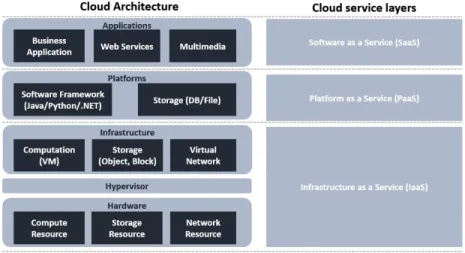
dis-Figure 1.1: Cloud computing architecture and service layers
tributed data centers and networking devices connecting data centers. Physical resources are abstracted by computing, storage, and network resources, its resources are virtualized by us-ing hypervisors such as KVM, Xen, or VMware vSphere. Since public clouds include multiple data centers, the configuration and provisioning of VMs or virtual networks are flexible in its architecture. Private clouds are more personalized cloud architectures built specifically to pro-vide services internally to an organization. A private cloud architecture is supported by many solution providers such as IBM, VMware, or OpenStack. It is composed of CPU, storage, and network resources as well but they are not highly dispersed geographically. Since a private clouds is managed by a private manager, it provides a more secure environment compared to public clouds. Hybrid clouds are the combination of private and public clouds. By taking advantage of public and private clouds, hybrid cloud gives greater flexibility and more opera-tional options for service providers. For example, the service provider can handle secure tasks in their private cloud and forward non-secure tasks to public clouds. Since the security issue is a controversial issue in cloud computing systems, a hybrid cloud is one of the appropriate so-lutions for customers who treat important data securely such as banks, investment companies, or insurance companies.
Fig 1.1 describes the basic architecture and service layers of cloud computing. Cloud sys-tems basically support three types of service layers: Infrastructure as a Service (IaaS), Platform as a Service (PaaS), and Software as a Service (SaaS). IaaS delivers computing, storage, and
network resources over the network as user demands. Cloud service vendors provide resources as VMs, containers, or bare metal machines and network for inter-communications between re-served resources. Users can build their own service infrastructure on rere-served resources. PaaS allows customers to develop, implement, and test software applications without the complex preparation of the operating systems and development environment. Users can still lease com-puting, networking, and storage resource depending on their needs but cloud service vendors support development platforms as well (e.g., Java runtime, NET runtime, etc). SaaS enables users to deploy application software in the cloud. Instead of installing and managing software in users infrastructure, users easily access this software via the Internet and the application software. SaaS applications are run on the cloud vendors’ infrastructure and they manage access to the applications including security, availability, and performance.
In order to improve the performance of cloud computing infrastructures, cloud service providers actively adopt new technologies such as Software Defined Networks (SDN) and Net-work Function Virtualization (NFV) paradigms [8].
1.1.2 Software Defined Networks (SDN)
Figure 1.2: Traditional and SDN network architecture
SDN [5] is proposed to enable cloud, network engineers, and administrators to manage networking environments more easily and more optimally through centralized control. Fig. 1.2
describes the difference between traditional network and SDN network architectures. Unlike traditional network switches, SDN decouples the control plane and data plane. Traditional
networks have a static architecture in which the control and data planes reside in each network switch. Therefore, network switches make distributed decisions and this prevents dynamic, scalable, and flexible network management. However, the centralized SDN controller has a global view of the whole network, so the controller serves as a federation of multiple controllers, network resource slicing, network resource management, or routing path calculation.
1.1.3 Network Function Virtualization (NFV)
Figure 1.3: NFV architecture (taken from [82])
NFV [6],[7] is proposed by the European Telecom Standards Institute (ETSI) with the aim of efficient network architecture and network system operation. NFV transforms traditional network functions, such as Firewalls, QoS functions, and WAN optimizaton, implemented in dedicated physical machines to softwarized VMs which can be run on any commodity server built for general purpose use. Since NFV replaces physical network devices by VMs, the ser-vice providers expect to reduce CAPEX and OPEX significantly. Also, this enables a flexible network configuration because the service providers can migrate Virtualized Network Func-tions (VNFs) when they can achieve higher operational advantages. In order to overcome performance issues, they can easily control the capacity or how many of VNFs are operating depending on traffic demand.
Fig. 1.3 represents NFV architecture proposed by ETSI NFV [82], which has a similarity with cloud computing infrastructure. Network or cloud administrator have distributed com-puting, storage, and network infrastructure and its resource can be utilized for NFV services through the resource virtualization. Virtual Network Function (VNF) is a specific software net-work function such as Firewall, Deep Packet Inspection (DPI), or QoS functions. NFV service providers form a service chain for providing services to users. The service chain is a connection of multiple VNFs having a sequence of processing. Its architecture has a flexibility and reusabil-ity. In other words, a certain VNF can be used for multiple service chains and service chain can compose its architecture by placing VNFs to distributed infrastructure. NFV Management and Orchestration (MANO) components enable overall management and configuration of NFV services. NFV MANO is composed of three components: Virtualized Infrastructure Manager (VIM), VNF Manager (VNFM), and NFV Orchestrator (NFVO). VIM controls and manages the NFVI computing, storage, and network resources within one infrastructure sub-domain. In distributed environments, each domain includes the VIM and they independently manage NFVIs. NFV Orchestrator and VNFM collect information and monitor overall state of NFVI and control the performance of VNFs. VNFM controls life cycle management of VNF instances. Depending on user requests or network state, they can coordinate VNF resources. NFVO works for global resource management, validation, and authorization of NFVI resource requests.
1.2 Advantages of Cloud Systems
Cloud systems bring a lot of advantages in utilizing computing resources. Fundamentally, it changes the way that IT services are delivered to organizations or users. Instead, organi-zations own and manage their infrastructure in traditional IT environment, deploying cloud infrastructure can help customers to meet their IT requirements with a flexible, on-demand, and scalable. The main advantages of cloud systems can be summarized as below.
· Cost: organizations can reduce the Operational Expenditure (OPEX) and Capital Ex-penditure (CAPEX) by using cloud systems. Since organizations do not need to spend budget for building their own IT infrastructure, it is obvious that using cloud systems will save a sig-nificant CAPEX. Also, organizations can reduce OPEX because cloud systems automatically
manage the system and maintenance of the system are operated by third party companies.
· Flexibility: cloud systems include near infinite CPU, memory, storage, and network resources. Thus, customers easily configure and set their virtual infrastructure as they need. Also, customers can scale up or down requested resources depending on their needs.
· Automation: one of the fundamental objects of cloud systems is system automation. Cloud systems should be able to provision VMs, instances, physical devices, or virtual networks without human intervention. This advantage causes a significant efficiency to cloud service vendors.
· Sustainability: through leveraging economies of scale and the capacity to manage re-sources more efficiently, cloud computing consumes far less energy and other rere-sources than a traditional IT infrastructure. This benefit can be achieved through efficient VM consolidation of load balancing strategies across the distributed cloud infrastructure.
Cloud service operators are making a significant profit by utilizing cloud computing service platforms. According to the recent report, Amazon’s revenue generated from cloud-based Amazon Web Service (AWS) already has exceeded their profit from the traditional online market business. Many major IT companies such as Google, Microsoft, and IBM actively provide cloud computing based services and solutions and make a huge profit from them. Cloud service platforms also emerge as promising solutions for Internet of Everything (IoT), 5G network, big data processing, and self-driving vehicles. So cloud computing’s importance and impact on future network and computing business are attracting many companies and researchers interest.
1.3 Research Challenges
Many challenges are faced by cloud service providers for efficient infrastructure operation. Since cloud service providers operate a myriad of computing, network, and storage devices in geographically distributed environments, efficient operation of the infrastructure is highly enforced by them for service quality, user experience, and operators’ revenue maximization. First of all, power consumption of the cloud computing infrastructure is an extremely impor-tant issue. Since cloud service vendors are running multiple data centers and network devices
for connecting geographically distributed data centers, this consumes a significant amount of energy for operation. In 2014, U.S. data centers consumed about 70 billion kilowatt-hours of electricity which corresponds to 2% of the country’s total energy consumption. Since traffic requests to cloud computing and data centers are explosively increasing, it is expected that the power consumption of the cloud computing will soar in the near future. According to [81], communication technology could use as much as 51% of global electricity in 2030 if not enough improvement is achieved in electricity efficiency of communication technology. With the goal of standardizing energy-aware network management, the European Telecommunications Stan-dards Institute (ETSI) published ETSI Standard (ES) 203 237, the Green Abstraction Layer (GAL), which is a framework to manage energy efficient networks of the future [61], [62], [63]. GAL is an architectural interface that provides information exchange between power managed data plane and the control plane. GAL supports discovery, provisioning, and monitoring of functionalities in the networks, and regulates QoS of the network and the overall network power consumption through adaptation of Network-wide Control Policies (NCP) and the Local Control Policy (LCP).
Also, the cloud infrastructure has a highly distributed infrastructure worldwide. Utilizing such a distributed infrastructure brings benefits in terms of distributed processing, reliability, resilience of the system, and so on. However, several challenges arise from this distributed computing environment. VMs and virtual link allocation problems are representative problems in distributed cloud systems. Some users request large numbers of VMs and virtual networks from the cloud computing infrastructure. If multiple users access virtual networks from dis-tributed regions, it is not easy to decide how to embed the virtual network onto the substrate network because the placement of virtual infrastructure affects service qualities of users and cloud infrastructure operation. In the cloud environment, VMs or virtual network resources are specified by users’ requests and that include CPU, memory, storage and network bandwidth. However, the specific VMs and virtual network placement problem still remains to be solved for cloud service providers. Cloud service providers need to decide how to place the specific virtual machines or virtual networks onto their infrastructure so that they can minimize OPEX and maximize the performance of the infrastructure. This problem is a well-known NP-hard
problem, so optimal operation of distributed infrastructure is an extremely hard problem for service providers.
Resource allocation is also a challenging problem in cloud infrastructures. Users reserve VMs, containers, or physical machines based on their needs. Service providers need to assign heterogeneous VMs or containers to physical servers while guaranteeing the service quality of users, capacity of servers, or minimizing OPEX of the service provider. If VMs are highly consolidated in a single server or data center, it causes high utilization of physical servers. So the performance of physical servers can be degraded remarkably. In contrast, if the VMs are highly spread across the wide area of the infrastructure, long communication times and high cost are incurred between VMs. Since reserved service resources by tenants generate virtual networks, efficient virtual network resource embedding is also required to be considered as part of the resource allocation problem.
1.4 Dissertation Contribution
In this dissertation, we propose an efficient cloud system operation strategy in terms of var-ious objectives: deployment cost, service time, power consumption, communication time, and Service Level Agreement (SLA) with the deployment of trending SDN and NFV technologies. In chapter 3, we propose a Big Data processing scheme in distributed heterogeneous cloud environment. The cloud computing platform has emerged as a promising big data processing platform because of its near infinite resources. For example, Google Map-reduce programming model enables large size data sets to be processed in distributed clusters by dividing them into smaller pieces of data sets and this strategy is practically implemented in many applications such as Hadoop Distributed File System (HDFS). However, if we distribute sub-data sets in extremely distributed environments without insightful consideration, this will cause high levels of sub-data set transmission time and communication time. Big data has very large size data sets. Even if we divide them to sub-data sets, its size will be on the Terabyte or Exabyte scales. Transmitting this scale of data sets consumes significant transmission times and cost even if we utilize high bandwidth network environments. Concurrently, if we assign the sub-data set to consolidated clusters or servers for reducing transmission and communication time,
it will cause the processing time to increase and lose the chance to reduce the processing time and cost by utilizing the benefit of distributed cloud environment. Thus, an efficient sub-data set distribution strategy is considered for minimizing big data processing cost and time. We model this problem by using multi-objective Linear Programming (LP) that minimizes data set processing time and processing cost, and find the Pareto front using efficient searching algorithms.
We also consider the data center power consumption minimization strategy with user request prediction in Chapter 4. As described in the previous Section, the power consumption is an extremely important issue for cloud computing service providers. According to [39], data centers spent 91 billion kWh of electricity and 50% of the energy is wasted in the data centers due to the lack of awareness of the traffic in 2013. This data shows how the accurate prediction of the request plays an important role in data center power saving. We propose an advanced interactive adaptive resource activation model that jointly controls network switches and servers simultaneously while satisfying QoS of the data center based on user request prediction. For the prediction step, we collect the history of data requests of data centers and estimate the probability distribution of user requests. Based on the user request prediction for the following time interval, the data center controller decides the number of activated switches and servers. The server activation can be determined while satisfying requirements of the user requests. However, activating network switches requires precise connectivity control for the intra-data center communication. We model an optimal SDN controlled data center using Mixed Integer Linear Programming (MILP). This problem minimizes the operation power of the data center by deciding active switches, servers and operating memory modules in each switch and host. In a network switch, we also control the port power consumption by efficiently consolidating data flow to low-cost switch port. The problem is NP-hard. Thus, Simulated Annealing is used to find near optimal solution of the problem within reasonable computation time.
In Chapter 5, we propose efficient NFV MANO strategies in the cloud computing infras-tructure. NFV service is offered by connecting multiple VNFs by service providers policy, which is called a Service Chain (SC). NFV-SC dedicates a set of VNFs having a sequence of processing required for service provider’s policy or user requirements. The service providers
force the sequence of VNF processing depending on the operational policy. Since VNFs receive heterogeneous requests from customers depending on service chains, it is important to allo-cate appropriate resources to VNFs. Also, the service chain embedding in distributed cloud infrastructures affects the performance of the service chain because the service chain needs to forward packets following the processing sequence of service providers. If VNFs in the same service chains are highly distributed across geographically dispersed data centers, it affects the communication time of the service chain. Thus, it will degrade the QoS of the service chain. We study efficient NFV-SC resource allocation and embedding strategies in two components of NFV MANO: 1) VIM and 2) NFVO and VNFM. VIM controls and manages the NFV infras-tructure computing, memory, and network resources in a single domain of the infrasinfras-tructure. Therefore, multiple VIMs exist across the wide area in each domain, and control and manage localized resources depending on NFVO requests. For the localized operation optimization, we propose a strategy which minimizes the processing time of NFV-SC within the given ca-pacity. We employ BCMP mixed queuing network model to analyze the system performance. Our purpose is minimizing the expected waiting time of service chains through optimal service rate allocation for each VNF depending on arrival rates to VNFs. The NFVO manages global resource management, validation, and authorization of NFVI resource requests. The NFVO and VNFM serve as NFV-SC lifecycle management including instantiation, scale-out/in, per-formance measurement, event correlation across the multiple network domains. Therefore, the role of NFVO is extremely important for the optimal performance of NFV services in cloud computing systems. We develop efficient NFV-SC resource allocation and placement strategy in hyper-scale cloud infrastructure. The purpose of NFVO is minimizing the power consump-tion of the infrastructure for serving NFV services. We consider the processing time and power in VNFs affected by resource allocation and network, and the network time and power affected by NFV-SC placement. NFV-SC is modeled by an approximate M/G/1/K queuing network and the resource allocation problem is modeled as a Mixed Integer Nonlinear Programming (MINP). Due to the complexity of the global optimization, we propose a heuristic algorithm which uses a correlation clustering, one of the unsupervised machine learning algorithm.
1.5 Dissertation Organization
The rest of dissertation is organized as follows. Chapter 2 introduces related literature that study cloud computing in terms of its operation optimization, performance analysis, and modeling strategies. Chapter 3 describes the detailed strategy of optimal data set allocation in distributed heterogeneous clouds. In Chapter 4, we introduce the adaptive data center activation model with user request processing algorithm. Chapter 5 presents the efficient NFV MANO strategy in cloud computing infrastructures. Chapter 6 concludes the dissertation and introduces future work to expand the research achieved of this dissertation.
CHAPTER2. LITERATURE REVIEW
2.1 Virtual Machine Placement in Clouds
Since clouds have heterogeneous resources, it is possible to achieve various objectives by allocating virtual machines according to different strategies. For example, in distributed Clouds, it is important to reduce latency that is mainly affected by the geographical distance between data centers. The model is optimized using one of two objective functions. This could be done by using standard assignment algorithms as in [9]. Alicherry et al. used an integer linear programming model for reducing latency between virtual machines. The first is minimizing the total access time and the other is minimizing the maximum access time. Minimizing total access time can reduce overall access time of running the job. However, minimizing maximum access time is used when performance of the job is the most important. In other words, minimizing the maximum access time could guarantee performance of the application but it was increased the total access time compared to minimizing total access time.
Anothre objective is minimizing power consumption, and many optimization formulations have been introduced to reduce the cost of power consumption in Clouds. Optimizing power allocation and load distribution has been achieved in [15] by using a queuing network model. Also, a load balancing model was introduced to reduce Carbon Emission in [13]. Minimizing the cost of virtual machine usage has not received enough attention even though it is a very important factor from a users perspective. Also, only a few attempts to optimize multiple objectives in Clouds exist in the literature. In [16], Ruiz-Alvarez et al. minimized cost, latency, and bandwidth. However, they have scalarized multi objectives to a single objective function. Consequently, the problem could not guarantee Pareto optimality of each objective.
2.2 Power Consumption Minimization in Clouds
Energy saving in data centers is considered in many aspects because of its importance. Junwei Cao et al. propose optimal power allocation and load distribution in a heterogeneous data center environment [33]. They model a multicore server processor as a queuing system with multiple servers and prove optimal server setting for two different core speed models, idle speed model and the constant speed model.
Kuangyu Zhenget al. propose joint power optimization of data center network and servers with correlation analysis [34]. They propose a power optimization strategy that leverages workload correlation analysis to jointly minimize total power consumption of servers and data center network. After they analyze the correlation between Virtual Machines (VMs), they consolidate VMs that are not correlated with each other onto the same physical servers in order to save server power consumption and consolidate network traffic to save data center network power. Through this approach, they could achieve up to 51.6% of energy saving in their testbed. The proposed approach in this thesis has a similarity with our proposal in Chapter 4 in terms of joint optimization of data center networks and servers. However, the author consolidates VMs based on correlation analysis between VMs, and then activates traffic flow between VMS having correlations, which means the activation of servers and switches are not jointly considered. Also, the traffic flow is consolidated between correlated VMs.
Our research has differences from all previous works in the following aspects: Our prediction model predicts the probability distribution parameter in a certain period instead of predicting quantified values of requests. Therefore, we make a more flexible prediction by deciding the desired probability of predicted distribution. The dynamic data center activation model inte-grates the dynamic operation of switch layer and host layer while guaranteeing the performance of the data center network. Since we jointly decide activated switches and hosts, we could save more energy compared to other dynamic activation models which determine operating hosts and switches independently.
2.3 Queuing Theory in Clouds
Jordi Vilaplanaet al studied the computer service QoS in cloud computing based on queuing theory [59]. Cloud platforms are modeled by an open Jackson network which consists of multiple nodes, where each node corresponds to a queue in which the service rates are node dependent. They modeled a multi-server system with Entering Server (ES) and Processing Server (PS). ESs are modeled by M/M/1 queues, which represents the load balancer, and PSs are modeled as M/M/m queuing system. However, all queues are assumed to have the same service rate so the heterogeneity of systems is not considered. By using the queuing system analysis, they analyzed the response time of the global cloud architecture with different parameters.
Wei-Hua Bai et al investigated the heterogeneous modern data centers and the service process in data centers by using queuing theory [60]. They built a complex queuing model composed of the master server and computing nodes. The master node works as the main scheduler to allocate resources for tasks to dispatch a node to execute tasks, which is modeled as M/M/1/K queue. Computing nodes which are multi-core servers are modeled as M/M/c queues because each multicore execution server can parallel-process multiple tasks. By using queuing theory analysis, they could investigate system metrics such as the mean response time, the mean waiting time, and other important performance indicators. Although they investigated the system performance of heterogeneous data center efficiently, they did not include the switch node in their consideration. Since the switch architecture and connections with servers significantly affect data centers performance, data center switches also need to be considered when analyzing the data center performance in queuing perspective.
Over the system performance analysis, Junwei Cao et al studied the problem of optimal multiserver configuration for profit maximization in cloud computing environments [61]. They included the amount of service, the workload of an application environment, the configuration of multiserver system, the service level agreement, the satisfaction of a consumer, the quality of service, the penalty of a low-quality service, the cost of renting, the cost of energy consump-tion, and the service provider’s profit margin in their profit modeling. They maximized their profit through the optimal multi-server configuration. They modeled a multiserver system as
an M/M/m queuing model so that the optimization problem can be formulated and solved analytically. For the more general analysis, they derived the density function of the waiting time of a newly arrived service request and the expected service charge to a service request is calculated.
2.4 Traffic Prediction in Clouds
Requests prediction in Cloud and data center has been studied by many researchers for the automatic scaling of systems.
Akindele A. Bankole et al. employ machine learning for predictive resource provisioning in Cloud [45]. Their prediction model is achieved with machine learning techniques includ-ing: Neural Network, Linear Regression, and Support Vector Machine. They predict the CPU utilization, response time, and throughput based on collected data from virtual machines web servers and database servers. The prediction model generates prediction values in every given minute with machine learning techniques and measure error rate with Mean Absolute Percent-age Error (MAPE) and Root Mean Squared Error (RMSE). However, the prediction model did not show a high prediction accuracy, and their results show 24% prediction error in predicting the CPU utilization at a certain point of time and a 21% error in the response time prediction. Sedeka Islam et al. present more advanced machine learning techniques for predicting resource usage in [57]. The error correction Neural Network (ECNN) and the Linear Regression techniques are employed for prediction. They included a sliding window method to reflect the current state of the system. They generated prediction values based on window sizes and evaluated them with MAPE, PRED(25), RMSE, and R2prediction accuracy. The CPU utilization data is collected from the Amazon EC2 cloud through the TPC-W benchmark and prediction values are generated with the ECNN and Linear Regression method. The prediction values of CPU utilization has around 19% error rate without the sliding window and has minimum 18.6% error rate when they employ the sliding window.
Many statistical approaches are also applied to the prediction in clouds. Bruno Lopes Dalmazo et al. propose a traffic prediction approach based on a statistical model where ob-servations are weighted with Poisson distribution inside a moving window [44]. They consider
the past information by means of a sliding window of size λ and this window is applied by weighting the past observations according to the Poisson distribution with parameterλ. Drop-box trace data is employed for testing their prediction model and Normalized Mean Square Error (NMSE) evaluation method is utilized for the error measurement. The prediction model could achieve NMSE values between 0.044 and 0.112. The prediction is ideal when NMSE value is equal to zero and worsens when NMSE is greater than one. This approach achieves a reasonably accurate prediction with this approach.
They also propose a traffic prediction model with a dynamic window approach [58]. The sliding window size is changed based on variance of the previous window size. A small variance indicates the predicted data is close to the actual data while a high variance means the predicted data is spread out from the mean. Therefore, they update the window size in every prediction interval by considering the size of the variance in the previous prediction. The prediction accuracy is improved from 7.28% to 495.51% compared to the previous statistical model.
2.5 Virtual Network Embedding in Clouds
Virtual Network Embedding (VNE) problems have been studied by many researchers. VNE problems are related to the NFV resource allocation problem in terms of dealing with virtual nodes and virtual links placement onto a substrate network with various objectives. The general, VNE problem has been shown to be NP-hard [94]. Since the problem is intractable, most of the proposals use heuristic solutions.
Juan Felipe Botero et al extended the traditional VNE problem to energy awareness and modeled the problem as a Mixed Integer Problem (MIP) [95], [96]. The exact optimal solution of the problem is obtained for small size networks [95]. Then they extended the problem to a scalable energy aware reconfiguration heuristic approach so that the algorithm can be applied to large size networks.
Vincenzo Eramoet alproposed reconfiguration cost and energy aware VNE policies in cyclic stationary traffic scenarios [97]. They considered the cyclically static traffic scenario and found an efficient VNE solution over the static time period. The reconfiguration cost is considered in their solution. If the benefit of the reconfiguration of the virtual network is greater than
the current embedding state, the virtual network is migrated to another substrate network. Since the problem is NP-hard, they proposed a heuristic algorithm which use Markov decision process. The numerical results showed they could achieve 35% cost reduction compared to the traditional migration policies.
The embedding cost minimizing virtual node and link mapping algorithm was proposed in [98]. The authors included the geographical location of the substrate and virtual nodes in the problem’s constraints and considered the influence of the geographical distance between nodes in the embedding strategy. The problem is formulated as an MIP and is solved using a relaxation strategy with two approaches: deterministic and random.
VNE was also studied in different perspectives. A security-aware VNE strategy is proposed in [99], [100]. The approach described in [101] proposed a way to increase the survivability of virtual nodes by introducing link failures in VNE. Also, the authors in [102] treated three types of failures: virtual node failure, physical node failure, and physical link failure.
As an extension of the traditional VNE embedding problems, many strategies are proposed in NFV resource allocation. A heuristic approach proposed in [103] solves service chain com-position and VNF Forwarding Graph (FG) embedding problem in a coordinated way. The VNF-FG is composed of a service chain that fulfills the service requirement and VNF-FG em-bedding strategy is searched while it computes the result within a reasonable runtime with negligible performance effects.
2.6 Network Function Virtualization Deployment in Clouds
The VNF placement problem has been studied widely because of its influence on system cost and efficiency. A VNF placement model is proposed by applying NFV and SDN to LTE mobile core gateways in [67].
In [68], virtual Deep Pack at Inspection (vDPI) function placement problem is studied. Mathieu Bouet et al. formulated the problem as an Integer Linear Program (ILP) and mini-mized the management and operation costs.
Sevil Mehraghdam et al. suggested a model formalizing the chaining of VNFs using a context-free language and proposed a mapping scheme to the network by using Mixed Integer
Quadratically Constrained Program (MIQCP) for finding the optimal placement in [69]. The VNF placement problem is also studied in the data center and cloud environments. Ming Xia et al. identified the possibility of minimizing expensive optical/electronic/optical conversions for NFV chaining in data centers. They formulated the problem of optimal VNF placement as a Binary Integer Program (BIP) and proposed a heuristic approach to solve the problem in [70].
Queuing network theory is studied by many researchers. However, the resource allocation problem in queuing network models has not been studied well enough. Optimal server resource allocation problem is presented in [71] only for open queuing network model. Alex Zhanget al. suggested nonlinear integer programming model for determining the number of machines in a multi-tier server network. They used an open queuing network model average response time to minimize the total number of machines while satisfying the average waiting time of open queuing network.
The service rate allocation problem in queuing systems is studied in [72] by Onno J. Boxma. He formulated the model that allocates the optimal service rates in Jackson networks and pro-vided closed form expressions for optimal service rate allocation to all stations in the network. Jocelyne Elias et al studied congestion mitigation network function composition problems as a non-linear optimization model [104]. They used a game theoritic approach to minimize the congestion of the physical infrastructure when all virtual operators independently select their network. They demonstrated that the NFV congestion minimization game has a unique Nash Equilibrium under general conditions, and the solution can be easily computed.
The game theoritic approach is also employed by other researchers in the NFV-RA problem [105]. Roberto Bruschiet alpresented an energy-aware game theory based solution for resource allocation of VNFs within NFV environment. They considered each VNF as a player who competes for substrate node while minimizing the individual energy cost.
Sijia Gu et alalso proposed an efficient auction mechanism solving the resource allocation problem as an NFV while pursuing the maximization of social welfare [106]. They formulated the problem by Integer Linear Program (ILP) which is NP-hard. They proposed an efficient primal-dual approximation algorithm to compute a close to optimal resource allocation solution.
2.7 Chapter Summary
This chapter introduces related works in cloud computing system modeling, analysis, and operations perspective. Although many research and contributions are achieved by many re-searchers, this dissertation has an originality compared to previous works. In utilizing queuing theory, this dissertation uses various practical queuing model. For example, M/G/1/K queuing network model is used to NFV-SC modeling by considering a high level of service time variation in NFV environment. Also, we used M/M/1 queuing model for data center switch and M/M/c queuing model for data center server. This helps to analyze the performance of the data center more practically.
In data center power saving, this dissertation proposes joint adaptive activation of data cen-ter switch and server layers. The proposed model efficiently minimizes the power consumption of the data center while guaranteeing QoS and connectivity.
CHAPTER3. OPTIMAL DATA SET ALLOCATION IN DISTRIBUTED HETEROGENEOUS CLOUDS
This Chapter introduces the optimal data set allocation strategy in heterogeneous cloud infrastructures. We formulate a problem as multi-objective linear programming model which minimizes the processing time and cost and propose a Pareto front searching algorithm.
3.1 Problem Formulation
Our goal is to optimize the allocation of data sets to cloud computing systems that have heterogeneous resources. We have two objective functions: 1) processing time and 2) cost. Processing time minimization and cost minimization are contradictory. In order to decrease processing time, it is helpful to allocate data sets to high performance virtual machines. How-ever, data set placement to high performance virtual machines increases the cost. Therefore, we attempt to find Pareto optimal points that guarantee optimality of processing time and cost simultaneously.
Large size data sets will be divided into small data set, and the data sets will be assigned to different virtual machines that have different resources. We assume parallel processing of data sets and do not consider serial processing of partitioned data sets.
We develop a linear programming model for this problem. There are two objective functions that have the data set size as a decision variable. Both objective functions share the same constraints. There are four types of constraints in the problem: Storage capacity, summation of total data set size, individual data set size, and communication latency. Table 1 shows the glossary of all terms used in our model.
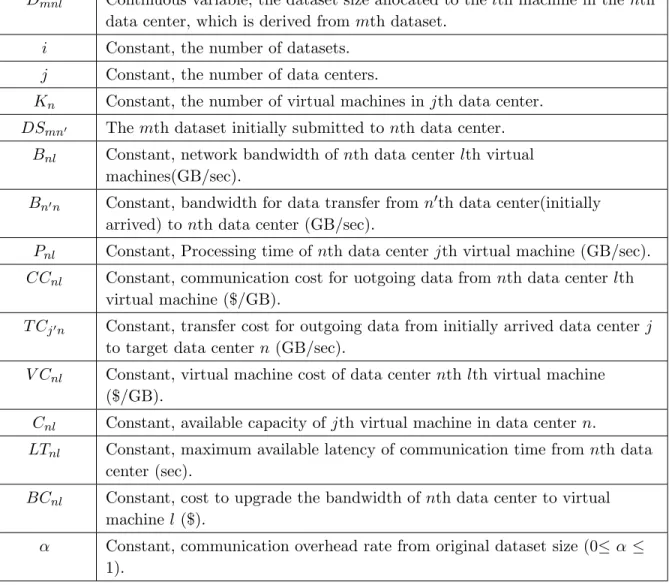
Table 3.1: Formulation Notations
Variable Description
Dmnl Continuous variable, the dataset size allocated to the lth machine in thenth
data center, which is derived from mth dataset.
i Constant, the number of datasets.
j Constant, the number of data centers.
Kn Constant, the number of virtual machines injth data center.
DSmn0 The mth dataset initially submitted tonth data center.
Bnl Constant, network bandwidth of nth data center lth virtual
machines(GB/sec).
Bn0n Constant, bandwidth for data transfer from n0th data center(initially
arrived) to nth data center (GB/sec).
Pnl Constant, Processing time of nth data center jth virtual machine (GB/sec).
CCnl Constant, communication cost for uotgoing data fromnth data center lth
virtual machine ($/GB).
T Cj0n Constant, transfer cost for outgoing data from initially arrived data center j
to target data centern (GB/sec).
V Cnl Constant, virtual machine cost of data center nth lth virtual machine
($/GB).
Cnl Constant, available capacity of jth virtual machine in data center n.
LTnl Constant, maximum available latency of communication time fromnth data
center (sec).
BCnl Constant, cost to upgrade the bandwidth ofnth data center to virtual
machinel ($).
α Constant, communication overhead rate from original dataset size (0≤ α ≤
1). 3.1.1 Processing Time minimize Dmnl i X m=1 [ j X n=1 kn X l=1 α Bnl Dmnl+ j X n=1 n6=j0 kn X l=1 (1 +α)Dmnl+ j X n=1 kn X l=1 Dmmnl Pnl ] (3.1)
The processing time objective function includes time to allocate sub-data sets to other data centers, virtual machine processing time, and time to send data set overhead to cloud manager for share their processing status. Each data center has a cloud manager. The data center that receives data set first becomes cloud manager for the data set. Therefore, we
consider data transfer time from initial arrived data center and communication time to send processing status to initial data center, and virtual machine processing time of sub-data sets in each virtual machine. The first term is communication time between all virtual machines. Since a large size data set is divided into several smaller data sets, each virtual machine needs to check processing status of sub-data sets. Therefore, after finishing the processing in each virtual machine, virtual machines send their status to the cloud manager. We consider only the outgoing time from allocated virtual machines for communication time. Some cloud service providers provide high bandwidth for outgoing data transfer from the virtual machine with additional cost. Thus, only considering outgoing time from the virtual machine will be the dominant factor in communication time. We do not need to transfer all data for communication. Communication overhead is configured with some rate from data set sizeDmnl, allocated
sub-data set in the lth virtual machine in nth data center. By dividing the data set overhead size with bandwidth of lth virtual machine in nth data center, communication time of the virtual machine can be obtained.
The second term refers to the data transfer time. The initial data set is such that their required resource exceeds available resources in a certain data center. If it is able to reduce processing time by dividing initial data set and allocating sub-data sets to other virtual ma-chines in a certain data center, we have to transfer the data sets to other data centers virtual machines. This process would consume some transfer time. So transfer time can be calculated by dividing allocated data set and communication overhead size by communication bandwidth of the initially allocated data center. We assume data sets have no serial relationship. All data sets are possible to be processed in parallel model in this problem.
The third term refers to the virtual machine processing time. Virtual machine processing time is one of the most important factors in deciding the processing time objective value. Cloud service providers offer different types of service depending on users demands. The most representative difference is the number of CPUs. High performance virtual machines provide more number of cores. So it is able to reduce processing time by the allocating more data to the virtual machine that has high performance processor or high processing ability.
3.1.2 Cost minimize Dmnl i X m=1 [ j X n=1 kn X l=1 αDmnlCCnl+ j X n=1 n6=j0 kn X l=1 (1 +α)DmnlT Cj0n+ j X n=1 kn X l=1 Dmnl Pnl V Cnl] + j X n=1 kn X l=1 BCnl (3.2) We consider similar factors in the cost objective function: communication cost, data transfer cost, virtual machine cost, and bandwidth cost. The first term stands for communication cost. Most cloud computing service providers charge for only outgoing data transfer depending on data size and communication bandwidth. In the first term, we only consider cost for data set size. Similar to communication time, only outgoing communication overhead is charged for communication cost.
The second term is the data transfer cost. As mentioned in section 3.1.1, initial data set has to be moved to other data center as necessary. Since data transfer cost is also only charged for outgoing data, we multiply cost by data set and overhead size.
The third term is virtual machine cost. Virtual machine cost charged depends on hours of use and its performance. High performance virtual machines are more expensive than low performance virtual machine. It may seem cheaper if we just use low performance virtual machine to reduce virtual machine cost, but virtual machine cost also increases with usage time of the virtual machine. If the virtual machine processing time increases, the virtual machine cost is increased simultaneously. So the virtual machine cost is multiplied by virtual machine processing time in the third term in order to make the best decision between performance and usage time of virtual machine.
Bandwidth cost is not proportional to data set size. When user wants to upgrade commu-nication bandwidth of certain virtual machines, most cloud service providers charge additional cost per month. We do not consider that long term processing time over a month. Therefore, bandwidth cost is fixed and is not affected by data set allocation.
3.1.3 Constraints Dmnl≤Cnl,∀m, n, l (3.3) j X n=1 kn X l=1 Dmnl≥DSmn0,∀m (3.4) Dmnl≤DSmj0 (3.5) kn X l=1 αDmnl Bnl ≤LTn,∀m, n (3.6)
(3.3) is virtual machine capacity constraint. Virtual machines have their own given amount of storage. New allocated data set size cannot exceed the current available storage size of virtual machine.
(3.4) is summation of allocated data set size constraint. Total size of assigned data sets originated from same data set has to be greater than or equal to the original data set size.
(3.5) is each data set size constraint. Allocated data set size cannot be greater than original data set size.
(3.6) is latency constraint. This provides performance guarantees on the communication time from each data center. Latency will be different according to the types of data sets. Some data sets are sensitive to latency but some are not. Therefore, we can set latency constraint depending on data sets property.
The problem is multi-objective linear programming model. There are many known algo-rithms for solving single objective linear programming model like Simplex algorithm, Criss-cross algorithm, and Conic sampling algorithm. After solving each objective function, we will use a special case Bensons algorithm to find Pareto front of optimal solutions.
3.2 Algorithm for Multi Objective Optimization
In this section, we introduce a heuristic algorithm for finding the Pareto front of the multi objective linear programming model. The algorithm, which is shown in Algorithm1, is designed
for the maximization problem. We will reformulate the problem to an equivalent vector form of the maximization problem.
minimize
Dmnl
Zetap=−P>D
Zetac=−C>D+b
(3.7)
P> denotes the transpose of processing time coefficient vector about each D. D denotes the vector of decision variablesDmnl. SinceP> andDhave the same dimension, we can obtain
the objective value of processing time. Let us assume we allocate one dataset to two data centers which have 2 virtual machines each. Then D vector becomes [D111 D112 D121 D122].
The elements of vector P are summation of each term in (3.1). The each element in P will be summations of the data transfer time, virtual machine processing time, and communication time about all Dmnl elements in the. CT is also transpose of cost coefficient vector having
same dimension with D. Elements of the C vector are the summations of each term in (3.2) for all elements ofD, just as like the P vector. b is the summation of all bandwidth cost, the last term in (3.2), which is not relevant to the decision variable Dmnl. So we can also obtain
objective function of cost.
The algorithm starts with two Pareto optimal solutions of each objective functions: Dpand
Dc. If Dp and Dc are on the same line, we can say all points between Dp and Dc are Pareto
solutions. In order to verify if the Dp and Dc are on the same line or not, a new objective
function is generated that has potential optimal points betweenDp and Dc.
Zetak= [P>(Dc−Dp)C+C>(Dp−Dc)P]topD (3.8)
(3.8) is a new objective function that has optimal values between the optimal values ofDp
andDc. The first term in (3.8) is processing time vector having size between processing time of
DpandDcin processing time. Also, the second term in (3.8) is cost vector having size between
cost ofDc andDp in cost axis.
By summing two vectors, we can get new vector having new Pareto optimal point not dominated by both ofDp and Dc. Since we solve new objective function by same constraints,
we can obtain new feasible optimal solution Dk. The next step is observing whether three Pareto points are in the same line or not. If Zetak(Dk) = Zetak(Dp) = Zetak(Dc), the three
points are in the same line. If they are on the same line, which guarantees that the line between
DpandDcis the Pareto front. If they are not on same line, we have to find new optimal points
between Dp and Dk, and then between Dk and Dc. If we can find all pairs of adjacent lines
connecting all Pareto points, we stop the iteration of the algorithm.
Algorithm 1 Exploring Pareto Front Algorithm
INPUT:Dp,Dc,Zetsp(Dp),Zetsc(Dp),Zetsp(Dc),Zetsc(Dc)
Di=Dp,Dj=Dc
Hash(Kl,Di=Dp,Dj=Dc, Optimal pairs)
l= 1
while do
Kl=
Zetap(Kl,Di)+Zetac(Kl.Di)+Zetap(Kl.Dj)+Zetac(Kl.Dj)
2 Klist←Kl ZetaKl= [P > (Kl.Di−Kl.Dj)C+C>(Kl.Dj−Kl.Di)P]>D Dkl=F indoptimalsolutionf orZetaKl
if ZetaKl(Di) =ZetaKl(Dkl) =ZetaKl(Dj)then Line betweenDiandDjare Pareto Front
Kl←Optimal Pair (Di,Dj)
if Lis the largest index amongKlinKlist then
break;
else
l=l+ 1
end if
else if ZetaKl(Di) =ZetaKl(Dkl)6=ZetaKl(Dj)then Line betweenDiandDklis Pareto Front
Kl←Optimal Pair (Di,Dkl)
Make hash
Hash(Kl+1 = (Di,Dkl),Di=Di,Dj=Dkloptimal pair)
l=l+ 1
else if ZetaKl(Di)6=ZetaKl(Dkl) =ZetaKl(Dj)then Line betweenDjandDklis Pareto Front
Kl←Optimal Pair (Dkl,Dj)
Make hash
Hash(Kl+1 = (Di,Dj),Di=Dkl,Dj=Dj, optimal pair)
l=l+ 1
else if ZetaKl(Di)6=ZetaKl(Dkl)6=ZetaKl(Dj)then Make hash
Hash(Kl+1 = (Di,Dj),Di=Di,Dj=Dkl, optimal pair)
Hash(Kl+2 = (Di,Dj),Di=Dkl,Dj=Dj, optimal pair) end if
end while
SortKlinKlistbyKlvalue
Klist0 : SortedKllist forn= 1;n=l;n++do
Obtain optimal value pairs of all Pareto points in optimal value domain On=(Zetap(Kn0.Di),Zetac(Kn0.Di)), (Zetap(Kn0.Dj),Zetac(Kn0.Dj)) end for
If we connect all pairs ofOn, we can get Pareto Front. OUTPUT: All pairs of Pareto points and Pareto front
The algorithm starts from two optimal points of each of the objective functions and objec-tive values (Line 1). In order to manage each point efficiently, hashmap function is employed including key value, two nearest optimal points not on the same line, and optimal pairs when optimal pairs exists (Line 4). Key value, which shows position of points, is determined depend-ing on optimal values of nearest two points. By averagdepend-ing optimal values of nearest two points, we can get key value sequentially to arrange optimal pairs (Line 8). After obtaining key value, Kl is saved in Klist (Line 9). New objective function is generated with two optimal points in Kl hashmap as explained in previous paragraph, and then solves the problem with the same constraints (Line 10 Line 11). If optimal value of Zetakl(Di) = Zetakl(Dkl) = Zetakl(Dj),
three points are in the same line. So we add optimal points Di and Dj to Kl hashmap as
optimal pairs. If we cannot find anymoreKlin theKlist, then the Pareto front has been found.
So we stop the iteration (Line 12 Line 21).
IfZetakl(Di) =Zetakl(Dkl)6=Zetakl(Dj),Di andDklare in the same line butDkl andDj
are not in the same line. Therefore, onlyDiandDklare added toKl hashmap as optimal pairs.
SinceDklandDj are not in the same line, new objective function having optimal point between
DklandDjhas to be generated again. So we make new hashmapKl+1 including two pointsDkl
andDj and empty optimal pairs (Line 23 Line 30). IfZetakl(Di)6=Zetakl(Dkl) =Zetakl(Dj),
Dkl and Dj are in the same line but Di and Dkl are not in the same line. As like previous
paragraph, we saveDklandDj to optimal pairs ofKl hashmap and make newKl+ 1 hashmap
including Di and Dkl (Line 31- Line 38).
If all three points are not in the same line, two hashmaps are generated including Di and
Dkl, and thenDkl and Dj (Line 39 Line 45).
The iteration is repeated until there is no moreKl in theKlist. If we cannot find any more
Kl, this guarantees that every hashmapkwill include optimal pairs or empty pairs. By sorting
Kl according to the Kl key value, Kl will be ordered sequentially. Then the Pareto front can
3.3 Simulation Model
In this section, we evaluate the performance of the model and find Pareto optimal points of the multi-objective problem by using the proposed algorithm. We consider a cloud consisting of 10 data centers having heterogeneous virtual machines. Data center resource information is configured from actual data of cloud computing service providers. Five types of cloud data center infrastructures are employed: Microsoft Azure, Rackspace, Google cloud, Amazon EC2, and IBM cloud. Each cloud provider offers different infrastructure services. For an example, Microsoft Azure has four options for CPU and has an option for upgrading network bandwidth. Rackspace provides all different network bandwidth depending on performance of virtual ma-chines. A single core virtual machine provides 60 Mbps of bandwidth, but a dual core virtual machine has 120 Mbps network bandwidth. Google cloud provides the highest performance virtual machine. Google services provide 16 core virtual machine model. All data centers have heterogeneous resources similar to this. Microsoft Azure (data centers number 1 and 6) includes 8 types of virtual machines, Rackspace(data centers number 2 and 7) has 10 types of virtual machines, Google cloud (data centers number 3 and 8) has 5 types of virtual machines, Amazon EC2 (data center number 4 and 9) has 12 types of virtual machines, and IBM cloud (data center number 5 and 10) includes 8 types of virtual machines, and two data centers exist from each data center platform. So we have a total of 86 types of virtual machines to allocate data set. Each virtual machine in a different data center has a different cost, processing time, and bandwidth. We generate the storage capacity of virtual machine randomly between 0 to data the storage size of virtual machines for constraint (3). Three data sets are allocated to the cloud. The first data set has 1000 GB size and assigned to data center 3. The second data set is assigned to data center 1 with 500 GB size. The third data set is placed to data center 4 with 700 GB size.
3.4 Simulation Result
We used GUSEK, open source Linear/Mixed Integer Linear Programming solver to solve the two objective functions separately. The problem includes 258 decision variables and 548
![Figure 1.3: NFV architecture (taken from [82])](https://thumb-us.123doks.com/thumbv2/123dok_us/521901.2561467/18.918.275.664.362.669/figure-nfv-architecture-taken-from.webp)