T R A F F I C E N G I N E E R I N G A P P R O A C H
A dissertation submitted to
t e c h n i s c h e u n i v e r s i t ä t d r e s d e n f a c u l t y o f c o m p u t e r s c i e n c e
for the degree of Doktor-Ingenieur (Dr.-Ing.)
presented by t a o l i, m.s c.
born on July1, 1988in Nantong, China
accepted on the recommendation of Examiner:
Prof. Dr. Silvia Santini (Università della Svizzera italiana) Co-examiner:
Prof. Dr. Burkhard Stiller (Universität Zürich)
Prof. Dr. Thorsten Strufe (Technische Universität Karlsruhe) Prof. Dr. Rainer Groh (Technische Universität Dresden) Prof. Dr. Diana Göhringer (Technische Universität Dresden)
Hiermit versichere ich, dass ich die vorliegende Dissertation zur Erlangung des akademis-chen Grades “Doktor-Ingenieur (Dr.-Ing.)” mit dem Titel Conserve and Protect Resources in Software-Defined Networking via the Traffic Engineering Approach selbstständig und ohne unzulässige Hilfe Dritter verfasst habe. Es wurden keine anderen als die in der Arbeit angegebenen Hilfsmittel und Quellen benutzt. Die wörtlichen und sinngemäß übernomme-nen Zitate habe ich als solche kenntlich gemacht.
Dresden, Febuary20,2020
Software Defined Networking (SDN) is revolutionizing the architecture and operation of computer networks and promises a more agile and cost-efficient network management. SDN centralizes the network control logic and separates the control plane from the data plane, thus enabling flexible management of networks. A network based on SDN consists of a data plane and a control plane. To assist management of devices and data flows, a network also has an independent monitoring plane. These coexisting network planes have various types of resources, such as bandwidth utilized to transmit monitoring data, energy spent to power data forwarding devices and computational resources to control a network. Unwise management, even abusive utilization of these resources lead to the degradation of the network performance and increase the Operating Expenditure (Opex) of the network owner. Conserving and protecting limited network resources is thus among the key requirements for efficient networking.
However, the heterogeneity of the network hardware and network traffic workloads ex-pands the configuration space of SDN, making it a challenging task to operate a network efficiently. Furthermore, the existing approaches usually lack the capability to automati-cally adapt network configurations to handle network dynamics and diverse optimization requirements. Addtionally, a centralized SDN controller has to run in a protected environ-ment against certain attacks. This thesis builds upon the centralized manageenviron-ment capability of SDN, and usescross-layernetwork optimizations to perform jointtraffic engineering, e.g., routing, hardware and software configurations. The overall goal is to overcome the man-agement complexities in conserving and protecting resources in multiple functional planes in SDN when facing network heterogeneities and system dynamics. This thesis presents four contributions: (1) resource-efficient network monitoring, (2) resource-efficient data forwarding, (3) using self-adaptive algorithms to improve network resource efficiency, and (4) mitigating abusive usage of resources for network controlling.
The first contribution of this thesis is a resource-efficient network monitoring solution. In this thesis, we consider one specific type of virtual network management function: flow packet inspection. This type of the network monitoring application requires to duplicate packets of target flows and send them to packet monitors for in-depth analysis. To avoid the competition for resources between the original data and duplicated data, the network operators can transmit the data flows through physically (e.g., different communication mediums) or virtually (e.g., distinguished network slices) separated channels having differ-ent resource consumption properties. We propose the REMO solution, namely Resource Efficient distributed Monitoring, to reduce the overall network resource consumption
in-In the second contribution of this thesis, we investigate the resource efficiency prob-lem in hybrid, server-centric data center networks equipped with both traditional wired connections (e.g., InfiniBand or Ethernet) and advanced high-data-rate wireless links (e.g., directional60GHz wireless technology). The configuration space of hybrid SDN equipped with both wired and wireless communication technologies is massively large due to the complexity brought by the device heterogeneity. To tackle this problem, we present the ECAS framework to reduce the power consumption and maintain the network perfor-mance.
The approaches based on the optimization models and heuristic algorithms are consid-ered as the traditional way to reduce the operation and facility resource consumption in SDN. These approaches are either difficult to directly solve or specific for a particular problem space. As the third contribution of this thesis, we investigates the approach of using Deep Reinforcement Learning (DRL) to improve the adaptivity of the management modules for network resource and data flow scheduling. The goal of the DRL agent in the SDN network is to reduce the power consumption of SDN networks without severely degrading the network performance.
The fourth contribution of this thesis is a protection mechanism based upon flow rate limiting to mitigate abusive usage of the SDN control plane resource. Due to the centralized architecture of SDN and its handling mechanism for new data flows, the network controller can be the failure point due to the crafted cyber-attacks, especially the Control-Plane-Saturation (CPS) attack. We proposes an In-Network Flow mAnagement Scheme (INFAS) to effectively reduce the generation of malicious control packets depending on the parameters configured for the proposed mitigation algorithm.
In summary, the contributions of this thesis address various unique challenges to con-struct resource-efficient and secure SDN. This is achieved by designing and implementing novel and intelligent models and algorithms to configure networks and perform network traffic engineering, in the protected centralized network controller.
Software Defined Networking (SDN) revolutioniert die Architektur und den Betrieb von Computernetzwerken und stellt ein agileres und kostengünstigeres Netzwerkmanagement in Aussicht. Wie andere Netzwerkinfrastrukturen auch kann ein SDN-basiertes Netzwerk als ein System modelliert werden, das Ressourcen anbietet, z.B. Netzwerkbandbreite für die Datenübertragung, und Betriebskosten verursacht, beispielsweise die benötigte Energie für den Betrieb der Anlagen. Eine unvernünftige Verteilung und Nutzung der Ressourcen reduziert die Leistungsfähigkeit des Netzwerks unt steigert die Betriebskosten (Operating Expense/Opex) des Netzwerkbesitzers. Folglich zählen der sparsame Umgang mit den begrenzten Netzwerkressourcen und die Senkung der Betriebskosten zu den wichtigsten Anforderungen an einen effizienten Netzwerkbetrieb.
Die Heterogenität der Netzwerkhardware und -nutzlast erweitern die Konfigurations-möglichkeiten von SDNs massiv, wodurch es zu einer Herausforderung wird, ein solches Netzwerk effizient zu betreiben. Darüber hinaus sind die vorhandenen Ansätze in der Regel nicht in der Lage, die Netzwerkkonfiguration automatisch an die Dynamik des Netzes und die zahlreichen Optimierungsanforderung anzupassen, da ihre Modelle und Algorithmen lediglich auf den Netzwerkeigenschaften und der erwarteten Netzwerklast basieren. Diese Arbeit macht sich sowohl die zentralisierten Verwaltungsfunktionen von SDN als auch schichtenübergreifende Netzwerkoptimierungen zunutze, um sog. “Traffic Engineering” (z.B. Routing), sowie weitere Hard- und Softwarekonfigurationen auszuführen. Das über-geordnete Ziel besteht darin, die Komplexitäten der Netzwerkverwaltung infolge der Het-erogenität und Systemdynamik zu überwinden. Zusätzlich wird im Rahmen dieser Arbeit ein Verfahren entworfen, das es einem zentralisierten SDN-Controllers erlaubt innerhalb einer gegen spezifische Angriffe geschützten Umgebung ausgeführt zu werden.
Durch innovative Software, die kontinuierlich im Gebiet des Anwendungs- und Net-zwerkmanagements entsteht, werden verschiedenste Arten von Datenflüssen im SDN-Netzwerk erzeugt. In dieser Arbeit betrachten wir einen eine bestimmte Art virtueller Net-zwerkfunktionen: die Inspektion von Paketen in Datenströmen (“Flows”). Bei dieser Art von Netzwerk-Verwaltungsfunktion müssen Pakete von Ziel-Datenströmen dupliziert und zur eingehenden Analyse an Paket-Monitore gesendet werden. Um einer Konkurrenzsitu-ation um Ressourcen zwischen den originalen und den duplizierten Daten vorzubeugen, können Netzbetreiber die Datenströme durch physisch (z. B. unterschiedliche Medien) oder virtuell (z. B. getrennte Netzwerksegmente) getrennte Kanäle übertragen, die mit unterschiedlichen Eigenschaften hinsichtlich ihres Ressourcenverbrauchs aufwarten. Zu-dem wird die sog. “REMO”-Lösung vorgestellt, die den durch beide Arten von Daten
Planungsstrategien für die Datenströme in Betracht gezogen werden.
Die Architektur von SDNs, wie beispielsweise die kommende Generation von Netzw-erken für das Rechenzentrum, entwickelt sich ständig weiter und umfasst auch heterogene Geräte und Kommunikationsverbindungen, um von den Vorteilen der jeweiligen Tech-nologien profitieren zu können. In dieser Arbeite untersuchen wir das Ressourceneffizien-zproblem in hybriden serverzentrierten Rechenzentrumsnetzwerken, die sowohl mit tradi-tionellen Kabelverbindungen als auch fortschrittlichen schnellen drahtlosen Verbindungen ausgerüstet sind. Aufgrund der den heterogenen Geräten inhärenten Komplexität ist der Konfigurationsraum von hybriden SDNs gigantisch. Zur Lösung dieses Problems stellen wir in dieser Arbeit "ECAS" vor, mit dem der Energieverbrauch bei gleichbleibender Net-zwerkleistung reduziert werden kann.
Die auf Optimierungsmodellen und heuristischen Algorithmen basierenden Ansätze werden als traditionelle Möglichkeit betrachtet, die Betriebskosten und den Ressourcenver-brauch in SDN zu verringern. Diese Anforderungen sind in der Regel schwer zu lösen oder auf einen spezifischen Problembereich zugeschnitten. In dieser Arbeit wird unter-sucht, inwiefern die Anwendung von Deep-Reinforcement-Learning (DRL) die Anpas-sungsfähigkeit der Managementmodule für die Netzwerkressourcen- und Datenflusspla-nung verbessert. Das Ziel des DRL-Agenten im SDN ist es, den Stromverbrauch des SDNs zu reduzieren, ohne dabei die Netzwerkleistung massiv zu beeinträchtigen.
Sowohl in der bestehenden Literatur als auch dieser Arbeit konnte gezeigt werden, dass die auf SDN basierenden Ansätze zur Ressourcenschonung und Datenflusssteuerung dazu in der Lage sind, die zuvor beschriebenen Ressourceneffizienzprobleme zu lösen. Auf-grund seiner zentralisierten Architektur und den Mechanismen zur Handhabung neuer Datenflüsse kann der Netzwerk-Controller im Falle von Cyber-Angriffen, insbesondere in Control-Plane-Saturation-Angriffen (CPS), der Flaschenhals sein. Mit dem Ziel, die Nachteile der bestehenden Controller-basierten Verteidigungslösungen, wie beispielsweise der hohe Ressourcenverbrauch in Bezug auf die Netzwerkbandbreite innerhalb der Steueru-ngsebene. Zu überwinden, stellen wir in dieser Arbeit "INFAS" vor, um die software-definierte Netzwerke vor CPS-Angriffen zu schützen. INFAS kann in Abhängigkeit von den für den Verteidigungsalgorithmus konfigurierten Parametern effektiv die Erzeugung bösartiger Kontrollpakete reduzieren.
Zusammenfassend tragen die Inhalte dieser Arbeit dazu bei, den verschiedenen einzi-gartigen Herausforderungen beim Aufbau von ressourcen- und kosteneffizienten SDNs zu begegnen. Erreicht wird dies durch die Konzeption und Implementierung von neuar-tigen und intelligenten Modellen und Algorithmen zur Netzwerkkonfiguration und zur Steuerung von Datenströmen im Netzwerk mittels eines geschützten zentralen Netzwerk-controllers.
It was a long and rough journey to pursue a Ph.D. degree. Along this road that is full of twists and turns, without the help and encouragement from many people, it is impossible for me to reach its destination. First of all, I would like to express my greatest gratitude to my supervisor, Prof. Silvia Santini. Recruiting a foreign student, who was studying in Sweden at that time, was not an easy decision. The opportunity of conducting research in Germany not only brought my goal of obtaining a higher degree closer but also has a profound impact on my personal experience of different cultures. I enjoyed much freedom in research topics, and she always encouraged me and shared her optimistic attitude no matter of success or failure. As a person pursuing perfection, she was never reluctant to push and help to improve my skills of paper writing and presentation through the entire Ph.D. life, despite the inconvenience caused by the distance.
I would also like to express my profound gratitude to my second supervisor, Prof. Thorsten Strufe, for taking over the project and providing me generous support in difficult situations. I am very grateful for his effort in integrating me into both the academic and daily activities of the research group. He was very patient in the discussion on research ideas, and always provided me with valuable and insightful feedback. Although I only started working with him at the late stage of the Ph.D. life, his wide range of knowledge always deeply impressed me.
Furthermore, I would like to greatly thank my external reviewer, Prof. Burkhard Stiller, for his precious time. I first met Prof. Stiller during NOMS’18when he gave the presenta-tion on blockchain and got acquainted with him at IM’19when he served as my session chair. Prof. Stiller left me with the impression that he is both knowledgeable and helpful. I also want to thank Prof. Groh for his kindness for serving as the chair of the defense committee and Prof. Diana Göhringer for reviewing my thesis. A special acknowledgment goes to Prof. Olaf Lansiedel who guided me to the door of the local research community during the master study at Chalmers and recommended me as a Ph.D. student.
Many thanks must be given to my former and current colleagues: It was a nice time with Martina Brachmann and Paul Baumann both in Darmstadt and after moving together to Dresden, despite that, we were a very small research group. The ADS group hosted me and shared their resources during the transition time. It was wonderful to keep the personal friendship with Ariel Podlubne, Patrick Selig and Lester Kalms. Sometimes, the members of the DuD group had to attend my research talks that are not relevant to security or privacy, but I can still get many useful comments from them. It was always informative to talk with Dr.-Ing. Stefan Köpsell, Dr.-Ing. Elke Franz, Amr Osman, Martin Byrenheid, Simon
discuss detailed research ideas and write papers together with Dr.-Ing. Hani Salah, Mu He from TU Münich and Denny Stohr from TU Darmstadt.
Additionally, I would like to thank several students who worked with me for helping to explore research ideas and conducting several experiments. Marek Sobe coded the initial GUI for the demo project, and Sun Yuanjun, who also worked on DRL-based network optimization, completed the project. Ding Xin made a great effort to explore the DPDK framework and helped with the INFAS project.
Special gratitude is owed to several supporting friends: Ivan Walulya, Fan Songchun, Zhu Qian, Yu Xiaoxi, Chen Lei and Wang Qiu, for your long-term friendship and positive influences on me. Many thanks go to Dr.-Ing. Liming Zeng and Dr.-Ing. Jianjun Wen for sharing their experience in APB and Dresden.
I am deeply indebted to my family for their unconditional love and support. Without the great emphasis on education, enormous sacrifice and tremendous effort of my parents, Song Yunxia and Li Keqing, it is unimaginable for me to transcend the internal and external limitations and to step into a broad world. Special thanks go to my aunts, Song Yunpin and Song Yunli, my uncles, Wang Dongming and Zhang Minghui, and my cousins, Wang Jiaxi and Zhang Zhewei, who have continuously supported me as a big family for so many years. Finally, I devote the sweetest gratefulness to Xu Fan, for always loving, tolerating and accompanying me in both joyful and tough times of life.
Li, Tao Dresden, August2020
The research conducted in this thesis was funded by the German Research Foundation (DFG) under the project agreements: SFB-1053"Multi-Mechanisms Adaptation for the Future Internet (MAKI)" and SFB-912"Highly Adaptive Energy-Efficient Computing (HAEC)".
l i s t o f f i g u r e s xii
l i s t o f t a b l e s xv
l i s t o f a c r o n y m s xvii
l i s t o f s y m b o l s xix
1 i n t r o d u c t i o n 1
1.1 Motivation and challenges . . . 2
1.2 Research goals and contributions . . . 5
1.2.1 Resource-efficient Network Monitoring . . . 6
1.2.2 Reduce resource consumption for heterogeneous SDN . . . 7
1.2.3 Resource optimization using self-adaptive algorithms . . . 7
1.2.4 In-network protection scheme for SDN control plane . . . 8
1.3 Thesis organization . . . 8
2 b a c k g r o u n d a n d r e l a t e d w o r k 11 2.1 Software Defined Networking . . . 11
2.1.1 Software defined networking architecture . . . 12
2.1.2 Cross-layer network control . . . 15
2.2 Traffic engineering based on SDN . . . 19
2.2.1 Basic concepts of traffic engineering . . . 19
2.2.2 Brief history of traffic engineering . . . 20
2.2.3 Traffic engineering assisted by SDN . . . 22
2.3 Challenges on resource efficiency in SDN . . . 24
2.3.1 Improving efficiency of bandwidth utilization in network monitoring plane . . . 25
2.3.2 Improving efficiency of power consumption in the network forward-ing plane . . . 27
2.3.3 Mitigating abusive usage of resources in the network control plane . 30 2.3.4 Summary . . . 32
3 r e s o u r c e-e f f i c i e n t n e t w o r k m o n i t o r i n g 33 3.1 System setups and a motivating example . . . 35
3.2.1 Flow monitor placement and switch binding . . . 37
3.2.2 Flow embedding and mirroring switch selection . . . 39
3.3 Near-optimal heuristic algorithm . . . 41
3.4 Evaluation . . . 43
3.4.1 Setup . . . 44
3.4.2 Evaluation metrics and focused parameters . . . 44
3.4.3 Results . . . 45 3.5 Related work . . . 49 3.6 Conclusion . . . 49 4 r e d u c e r e s o u r c e c o n s u m p t i o n f o r h e t e r o g e n e o u s s d n 51 4.1 Introduction . . . 51 4.2 System setups . . . 53 4.2.1 Network topology . . . 53 4.2.2 Energy model . . . 54
4.2.3 Power reduction opportunities in HSC-DCN . . . 55
4.2.4 Flow model . . . 56
4.3 Optimization model and algorithm for the ECAS problem . . . 57
4.3.1 Formal formulation for the ECAS problem . . . 57
4.3.2 NP Hardness of the ECAS problem . . . 59
4.3.3 Heuristic algorithm for the ECAS problem . . . 60
4.4 Evaluation . . . 63
4.4.1 Implementation and settings . . . 63
4.4.2 Computation time . . . 64
4.4.3 Power consumption . . . 65
4.4.4 Path length . . . 66
4.4.5 Coflow completion time . . . 67
4.5 Related work . . . 68
4.5.1 Hybrid server-centric data center networks . . . 68
4.5.2 Energy saving for HSC-DCN . . . 69
4.6 Conclusion . . . 70
5 r e s o u r c e o p t i m i z a t i o n u s i n g s e l f-a d a p t i v e a l g o r i t h m s 71 5.1 Introduction . . . 71
5.2 Scenario and assumptions . . . 72
5.2.1 Network setups . . . 73
5.2.2 Basic idea to reduce power consumption . . . 73
5.3 Formal model . . . 74
5.3.1 Power model and traffic model . . . 74
5.4 Model and algorithm based on multi-agent deep reinforcement learning . . . 77
5.4.1 Reinforcement learning . . . 77
5.4.2 Deep reinforcement learning . . . 78
5.4.3 DRL-based formulation: algorithm . . . 79
5.4.4 DRL-based formulation: modeling . . . 80
5.5 Evaluation . . . 81
5.5.1 Evaluation setups . . . 81
5.5.2 Evaluation results and discussion . . . 83
5.6 Related work . . . 88
5.7 Conclusion . . . 89
6 m i t i g a t e a b u s i v e u s a g e o f s d n c o n t r o l p l a n e r e s o u r c e 91 6.1 Introduction . . . 91
6.2 Our Solution:INFAS . . . 92
6.2.1 Motivation for proactive in-network protection . . . 92
6.2.2 Architecture design . . . 94
6.2.3 Flow rule design . . . 94
6.2.4 Flow management algorithm . . . 96
6.3 Implementation and Evaluation . . . 98
6.3.1 Implementation highlights . . . 98 6.3.2 Evaluation setup . . . 98 6.3.3 Results . . . 101 6.4 Related Work . . . 103 6.5 Conclusion . . . 105 7 c o n c l u s i o n 107 7.1 Contributions . . . 108
7.2 Limitations and future directions . . . 110
7.3 Concluding remarks . . . 112
a p p e n d i x 113 a a p p e n d i x 113 a.1 Using multi-agent DRL as a generic TE framework . . . 113
b i b l i o g r a p h y 117
a u t h o r’s p u b l i c a t i o n s 119
Figure1.1 Overview and components of thesis contributions . . . 6
Figure2.1 Layers of software defined networking . . . 13
Figure2.2 Flow rule structure defined in OpenFlow . . . 14
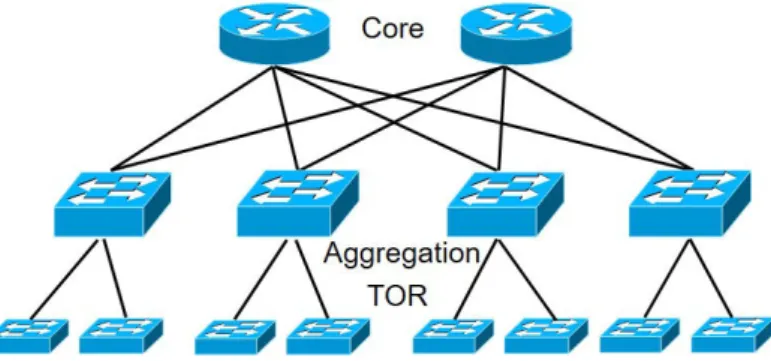
Figure2.3 SDN network of the fat-tree topology . . . 17
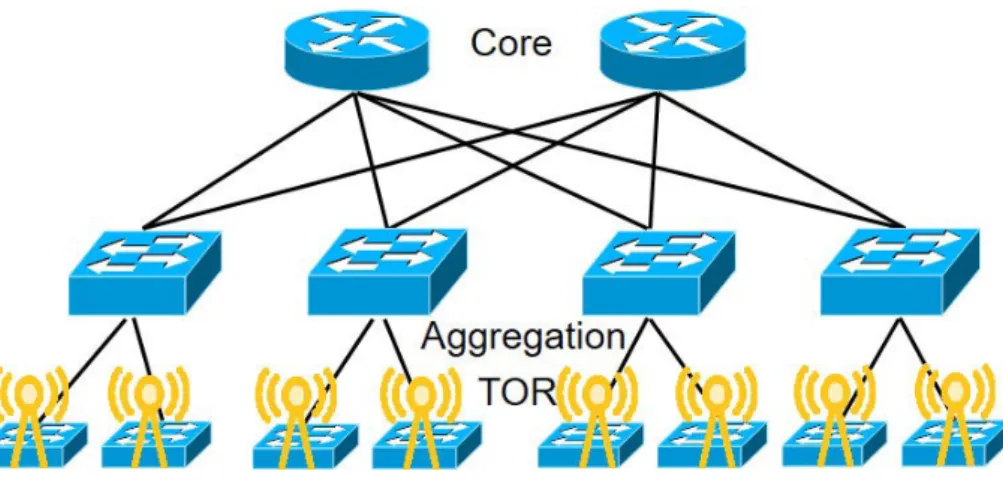
Figure2.4 Innovative Data Center Networking architectures with directional wireless links . . . 18
Figure2.5 Components of a Software Defined Networking (SDN)-assisted traffic engineering system . . . 23
Figure2.6 Reduce transmission cost in theSDNmonitoring plane . . . 27
Figure2.7 Reduce power consumption in theSDNdata plane . . . 28
Figure2.8 Principle of DoS attacks on the SDN control plane . . . 31
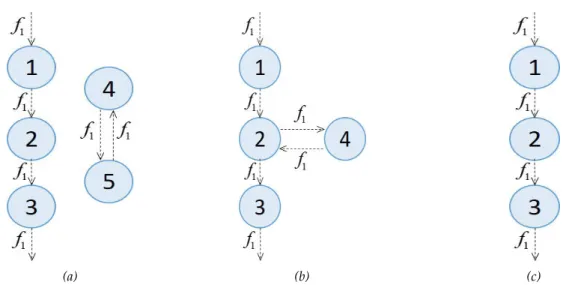
Figure3.1 Motivation example of the resource-efficient network monitoring . . 36
Figure3.2 Steps to generate a simple path . . . 40
Figure3.3 Impact of the path length stretch ratio and the link cost ratio on the resource consumption . . . 46
Figure3.4 Impact of the path length stretch ratio and the link cost ratio on the path length of original data flows . . . 46
Figure3.5 Impact of the number of flow monitors and the link cost ratio on the resource consumption . . . 47
Figure3.6 Impact of the number of flow monitors and the link cost ratio on the path length of original data flows . . . 47
Figure3.7 Performance comparison of difference strategies. . . 48
Figure4.1 An exemplary Hybrid, Server-Centric Data Center Networking (HSC-DCN) topology . . . 53
Figure4.2 Use link skipping to perform power reduction . . . 56
Figure4.3 Normalized power consumption produced by scheduling algorithms 66 Figure4.4 Hop count statistics . . . 67
Figure4.5 Coflow completion time . . . 68
Figure5.1 SDN network that has the typical fat-tree topology . . . 74
Figure5.2 Concept of reinforcement learning. . . 77
Figure5.4 Compare DeepGreen with the classical algorithms during the training 85 Figure5.5 Compare DeepGreen with the classical algorithms after the training
becomes stable . . . 86
Figure6.1 Architecture of INFAS . . . 93
Figure6.2 Flow management algorithm . . . 96
Figure6.3 Testbed setups . . . 99
Figure6.4 Impact of control message budget . . . 100
Figure6.5 Impact of unmatched packet proportion threshold . . . 102
Figure6.6 SDN switch performance . . . 104
Figure A.1 Performance of using multi-agent DRL formulation as a generic TE framework. . . 114
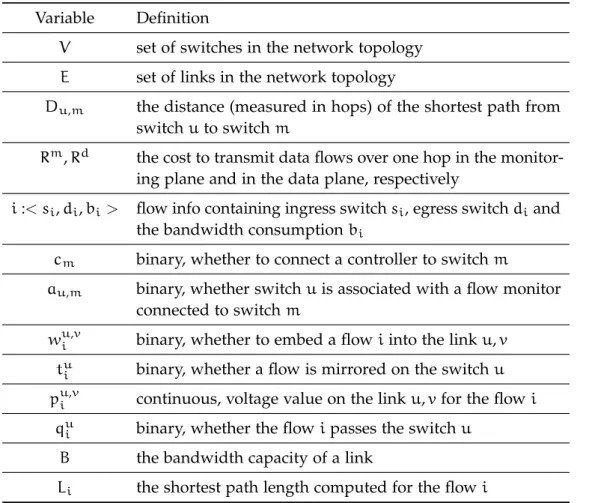
Table3.1 Variables used in the optimization model and heuristic algorithm of REMO. . . 38 Table4.1 Variables used in the optimization model and heuristic algorithm of
ECAS. . . 57 Table4.2 Comparison of computation time of scheduling algorithms . . . 65 Table5.1 Variables used in the optimization model of DeepGreen. . . 76 Table5.2 Important configurations of the simulations and the learning algorithm 84
A3C Asynchronous Advantage Actor-Critic
ANN Artificial Neural Networks ATM Asynchronous Transfer Mode BDQ Branching Dueling Q-Networks CPS Control Plane Saturation
CCT Coflow Completion Time
DCN Data Center Networking
DDPG Deep Deterministic Policy Gradients
DDoS Distributed Denial of Service
DoS Denial of Service
DPDK Data Plane Development Kit
DPI Deep Packet Inspection
DQN Deep Q-learning
DR Directional Routing
DRL Deep Reinforcement Learning
DFG Deutsche
Forschungsgemeinschaft
EEGFA Energy-Efficient Greedy Flow assignment Algorithm
FEC Forwarding Equivalence Class
FEMSS Flow Embedding and Mirroring Switch Selection
FMPSB Flow Monitor Placement and Switch Binding
GMPLS Generalized Multiprotocol Label Switching
HAEC Highly Adaptive Energy-Efficient
Computing
HPC High Performance Computing
HSC-DCN Hybrid, Server-Centric Data Center Networking
ICT Information and Communication Technologies
IGP Interior Gateway Protocol
ILP Integer Linear Programming
IoT Internet of Things
LDP Label Distribution Protocol
MER Minimum Edges Routing
MILP Mixed Integer Linear Programming
MMDCs Micro-Modular Data Centers
MPLS Multiprotocol Label Switching
NFV Network Functionality Virtualization
OFA Open Flow Agent
OSPF Open Shortest Path First
OvS Open vSwtich
Opex Operating Expenditure
PCE Path Computation Element
PPU Packet Processing Unit
QoS Quality of Service
RF Radio Frequency
RL Reinforcement Learning
SDN Software Defined Networking
SDR Software Defined Radio
TC Transfer Controller
TCP Transmission Control Protocol
TE Traffic Engineering
TM Traffic Matrix
ToR Top-of-Rack
VCC Virtual Channel Connection
VM Virtual Machine
WSONs Wavelength Switched Optical Networks
Rm Transmission cost on each hop in the monitoring plane.
Rd Transmission cost on each hop in the data plane.
Du,m The length of the shortest path from switchuto switchm.
Li The shortest path length computed for the flowi.
β Path length stretch ratio, that is the ratio of the maximum allowed path length to the shortest path length of a flow.
egress(fi) Egress switch of a flowfi.
ingress(fi)Ingress switch of a flowfi.
Ps Static power consumption of a packet forwarding device, used in both ECAS and DeepGreen.
Po Dynamic power consumption to maintain an active wired link, used in both ECAS and DeepGreen.
Pw Dynamic power consumption to main an active RF link, used in ECAS.
g(f,n) The score of the servernduring the scheduling process for the flowf.
Emax The total amount of power consumption when all elements are activated in a network.
df The euclidean distance between the flow source and destination of a flow.
k The importance factor to tune the balance between the importance of the net-work energy consumption and flow path length.
st Observed state by a learning agent at the stept.
at Action taken by a learning agent at the stept.
rt Reward received by a learning agent at the stept.
Mi A traffic matrix representing bandwidth demands at the stepi.
Ai The set of precomputed shortest paths of a flowi.
Pr The amount of reduced power consumption in a network.
α The ratio expressing the relative importance of reducing power consumption and avoiding link congestion.
∆u The number of packets that did not match with any flow rule.
∆m The number of packets that matched with one flow rule.
r The proportion of unmatched packets in total amount of packets from a net-work entity.
p The acceptance probability of the first packet of new flows, 1−p of the first packets of incoming new flows will be dropped.
αr The threshold of unmatched packets proportion. The proportion of unmatched packets from a network entity should not exceed this value
nc The number of unmatched packets that trigger generation of control messages.
Raccep The proportion of the unmatched packets that eventually triggered control messages. (1−Raccep)is the percentage of blocked first packets of incoming new flows
I N T R O D U C T I O N
The rapid development of Information and Communication Technologies (ICT) have fun-damentally changed human’s daily life and driven the modern society into the era of big data. The triumph of mobile devices, owned in 2017 by more than 5 billion peo-ple [1], allows uploading videos and photos to social media for "the needs to belong and self-presentation" [163]. The26.6 billion connected devices and sensors [105] belonging to Internet of Things (IoT) continuously monitor our environment and provide data to support
applications like smart home [238] and healthcare [176]. These services and applications generate enormous amount of data to collect, transmit and process. The Cisco Visual Networking Index forecasts that the volumn of traffic data generated by mobile devices, including smartphones andIoTdevices, is going to reach40Exabytes (109Gigabytes) by the year2021[42], and the annual global IP traffic will grow to4.8Zettabytes (1012 Gigabytes) by the year2022[41]. The transmission of such high data volumes places heavy burdens on the networking infrastructure in almost every phase of the data handling [26], which urges networks in the future to be agile, high-performance and secure.
Networks provide the facility resources to forward and process data for network users, while maintaining the functioning of devices causes the operational costs for network owners. The network facility resources commonly refer to the communication bandwidth to forward data packets [30] and computation capacity to perform operations on data packets [171]. The purpose of network facility resource management is to maximize the resource utilization so as to increase the system’s efficiency during processing of packets. The network performance, that is captured by the Quality of Service (QoS) parameters, degrades if network facility resource such as bandwidth is not efficiently allocated. At the same time, the functioning network facilities lead to large amount of operational costs. Besides the personnel expenditure to maintain the network infrastructure, the energy cost can contribute to over15% of the overall Operating Expenditure (Opex) of the backbone networks [181]. The four major US telecom companies – AT&T, Verizon, Sprint and T-Mobile – consumes over3 million MWh of electric power [81], which leads to the high
Opex for the network owners. In this thesis, we refer the problem of efficiently utilizing the network facility resources and reducing the operational cost as the resource efficiency problem in a network.
The concept of resource efficiency exists in different functional planes of a network. A network usually has three functional planes [182]: (i) the data plane that operates on data
packets for forwarding and filtering; (ii) the control plane that decides the states, such as forwarding decisions, in the data plane; (iii) the monitoring plane that continuously moni-tor and analyze network traffic and devices. In order to build an efficient and sustainable network, performing optimization on the utilization of corresponding resources in each of these three planes is necessary.
Software Defined Networking (SDN) allows to dynamically change the configurations of network devices, e.g., switches or routers, based on centrally collected operational in-formation in a network. It provides the great flexility to perform Traffic Engineering (TE) and control the behaviours of data flows in the network. Several approaches tackle the re-source efficiency problem in a network by intelligently scheduling, for example, the routing paths for data flows, as well as determining the configurations and states of the involved hardware and software components [32,98,204,208,246,251].
This thesis contributes novel models and algorithms to improve the ability of SDN
net-works to adapt to changing network conditions and performance requirements. The ulti-mate goal of such adaptation is to achieve the resource efficiency in the above mentioned functional planes of a network. The developed techniques are meant to run in a centralized SDN controller. Since this controller becomes a single point of failure due to the abusive usage of the control plane resource, we also contribute an approach to protect the control plane resource against certain security threats.
1.1 m o t i va t i o n a n d c h a l l e n g e s
Improving the resource efficiency has been a widely discussed topic in the networking community. As an important aspect of network management, approaches based on TE
provide the possibility to intelligently manage the operation status of network devices and utilize available network facility resources, without compromising the service quality of networks. The basic principle of conserving network resources and reducing its cost via
TE is twofold: (i) utilize available network resources in an efficient way; (ii) serve desired communication demands with minimum cost. The existing literature presents a plethora of models and algorithms to improve network resource utilization and reduce cost like energy [98,148,246] or bandwidth [32,204,208] inSDNnetworks. These approaches prove that TE-based methods have the potential to achieve the resource efficiency in the data, control and monitoring planes inSDN. TheseTE-based methods take the advantage of the centralized architecture ofSDNand its capability to perform network and traffic planning according to the communication demands of applications that transmit data.
As the newly developed technologies and emerging applications continuously integrate with the architecture ofSDN, the diversity of hardware used in the network and applications generating data flows, makes it a complex task to achieve secure and efficient utilization of resource in the functional planes of SDN. Newly arising scenarios require previously
developed the models and algorithms to be adapted to work under different assumptions. The work presented in this thesis inherits the idea of designing models and algorithms based on traffic engineering, to enhance the adaptivity of resource-efficient SDN when facing challenges described below.
Challenge1:Dynamic network conditions and optimization requirements
The optimality of a configuration for a communication network cannot be always guaran-teed at runtime. This is due to the increasing dynamics within the network. The common sources of such dynamics include but are not limited to: (i) changing conditions in the network (e.g., data transmission workloads); (ii) diverse co-existing requirements in the application scenarios (e.g., energy efficiency as well as congestion avoidance). Data com-munication demands and traffic patterns within networks are volatile in both the space and time domains [20], making it necessary for a network controller to be aware of current network conditions. Additionally, focusing solely on improving the resource efficiency could bring negative impacts on the quality of services, due to the scarce resources that are available for data flows. Normally, diverse requirements, such as end-to-end delays and transmission reliability, co-exist with the target of network resource efficiency. As a result, a network controller must be able to obtain or predict network conditions and to dynamically adjust its configurations to maintain the resource efficiency while meeting the desired service qualities of network services.
Challenge2:Joint optimization across network layers
The concept of designing programmable network devices does not impact only the way of packet processing as commonly known in the standard ofSDNprotocols [150]. It also influences the functioning of all protocols, from the network physical layer to the applica-tion layer. The termSDNcan generally refer to an integrated solution that handles different layers of a network and consists of several software defined technologies such as Software Defined Radio (SDR) [218], Software Defined Antenna (SDA) [122] and Software Defined Network Functionality Virtualization (SD-NFV) [135]. These key enabling technologies for software-defined, highly configurable networks can integrate with each other easily because they all rely on a centralized software control mechanism [233]. Performing optimization in such software-defined environment with heterogeneous technologies requires consid-ering the dependencies of the different network layers. For instance, in distributed big data processing frameworks, planning the locations of each individual task and bandwidth allocated along routing paths for data transferring among those tasks has the potential to speed up data movement [177]. In addition, for the purpose of resource and cost reduction, a network management system cannot only rely on traffic engineering to make the routing decisions, because the network performance degrades severely without proper coordina-tions of the accoordina-tions taken in multiple layers [197]. For example, the routing paths planned for traffic flows should not include the devices in sleep mode, otherwise packets may
expe-rience large end-to-end delays [115]. As a result, the developed approaches should follow the methodology ofjoint optimizationacross network layers, so that the configurations of a layer do not conflict with that of another layer.
Challenge3:Large configuration and solution space
In this thesis, the goal of theTE-based joint optimization approaches is to find a combi-nation of network configurations, possibly including hardware operation states, routing paths of data flows and placement of top-layer applications, so as to reduce the resource consumption inSDN. However, the search space of possible solutions can be very large because of: (i) the growing size of target SDN networks (horizontal), (ii) the increasing number of reconfiguration opportunities in the heterogeneousSDNenvironment (vertical).
A data center could consist of up to60,000hosts that are connected by a large-scale net-work [175]. The network controller must thus deal with high volumes of transmission demands of data flows generated by these many hosts. Additionally, as mentioned in the description of Challenge2, the heterogeneousSDNenvironment is built upon various software defined technologies, and performing joint optimization requires to coordinate configurations across network layers. To reduce the computation delay, the algorithms need to, at runtime, quickly find the network configuration that leads to the resource efficiency from a large solution space.
Challenge4:Vulnerable centralized controller
An essential property ofSDNis logical centralization of network management function-alities. Typically, network configuration algorithms and models reside in one of the many controller applications sharing the computation and network resource of the control chan-nel. Although the scalability and resilience of theSDNcontrol plane are improved by using multiple synchronized controller instances [113], the logically centralized controller still faces threats from illegitimate or abusive usage of theSDNparadigm [5]. The attacks, which targets on exhausting limited yet valuable control plane resources, e.g., computation and bandwidth, disrupt the obtaining of network state data and calculation of management strategies.
To address these challenges in achieving the resource efficiency in the functional planes ofSDN, a network and flow management framework, that is capable of monitoring network
states and controlling the network behaviours, is envisioned in this thesis. In particular, this framework monitors the operation status of a network and analyzes traffic flow packets to extract information to support traffic engineering and other configurations. To perform resource-efficient scheduling, it accepts real-time flow requests or predicted flow patterns. This envisioned framework allows different optimization tasks for the resource utilization of the functional planes ofSDN. We focus on the design of the resource-efficient scheduling
pre-sented above, we identify four common requirements on such a network flow management framework and its resource-efficient scheduling models and algorithms:
• Self-adaptive.The dynamic network conditions, such as data flow workloads, require the scheduling algorithms to be able to compute resource-efficient configurations adaptively. The computation relies on either explicitly received communication de-mands in future time slots or implicitly inferred traffic patterns. When communica-tion demands or traffic patterns evolve in real-time, the framework should be able to respond to their changes by automatically adjusting the parameters of its model or algorithm.
• Responsive.It takes time for the framework to obtain network states, calculate net-work management strategies according to collected information, and finally send control messages to configure networks. Although our framework does not intend to speed up the propagation of monitoring and control messages, it indeed requires efficient algorithms to improve the responsiveness of the controller to reduce the delays experienced by flow packets.
• Flexible.The diverse requirements in application scenarios demand the framework to be flexible so as to solve various resource optimization tasks. Meanwhile, the traffic engineering and management algorithms rely on diverse mathematical models. Thus, the framework should allow easy integration of different models and algorithms to compare their performance.
• Secure.Potential malicious users can take advantage of the centralized architecture of
SDNand abuse the computation and bandwidth resources of the control channel. In order to improve the resilience and security of the controller that performs resource-efficient scheduling in SDN, the framework should contain a security mechanism against malicious users at runtime.
1.2 r e s e a r c h g o a l s a n d c o n t r i b u t i o n s
The main goal of this thesis is to contribute novel algorithms, that run in a protected controller, to perform cross-layer optimization on the resource consumption in several functional planes, including data, control and monitoring planes, ofSDN. Figure1.1 pro-vides an overview and depicts the main components of the thesis contributions1. In this
thesis, we start with designing a resource-efficient packet flow monitoring system for the 1 The research presented in this thesis is funded by the Deutsche Forschungsgemeinschaft (DFG) projects
"Multi-Mechanisms Adaptation for the Future Internet (MAKI) [144]" and "Highly Adaptive Energy-Efficient Com-puting (HAEC)" [86].
Resource-efficient Network Monitoring
(Chap. 3)
Secure Control Plane (Chap. 6) Energy-efficient Networking Hybrid Network Architecture (Chap. 4) Self-adaptive Algorithm (Chap. 5)
Figure1.1:Overview and components of thesis contributions
purposes of collecting flow statistics and deep packet inspection. The controller not only receives monitoring results, but also performs traffic engineering and configuration of this monitoring system so as to reduce the overall bandwidth consumption. The collected flow statistics, together with explicitly communicated QoS demands of applications, serve as
input data to further optimize the energy consumption ofSDNnetworks. In particular, to improve the adaptivity of the centralized scheduling controller, we design algorithms for heterogeneousSDNintegrated with different communication technologies and investigate
self-adaptive algorithms based on Deep Reinforcement Learning (DRL). Additionally, we use the in-network approach to construct a secure control plane to protect the central-ized controller, without incurring waste of control channel resources. We describe these contributions in more details below.
1.2.1 Resource-efficient Network Monitoring
The first contribution of this thesis is a network flow monitoring solution that performs packet inspection on the predefined set of data flows. This solution is named REMO, which stands for Resource Efficient distributedMOnitoring. In the current deployment ofSDNnetworks, the forwarding devices, such as switches or virtual network functions, can be configured to duplicate and forward the packets of selected data flows to a packet monitor. The original data flows and duplicated data flows are separately transmitted in the data plane and monitoring plane to increase the transmission reliability of the monitoring system. This solution, however, incurs high transmission costs in the network. In REMO, the SDN controller performs a joint optimization of the placement of network monitors,
routing paths of original data flows and selection of locations to duplicate data flows. Comparing with similar approaches, REMO does not only consider the resource reduction in the monitoring plane, but takes the negative impacts (increased resource consumption) in the data plane into consideration. This contribution has appeared in the following publication:
• T. Li, H. Salah, M. He, T. Strufe and S. Santini: “REMO: Resource Efficient Distributed Network Monitoring”, in Proceeding of the IEEE Network Operations and Management Symposium (NOMS), April,2018.
1.2.2 Reduce resource consumption for heterogeneous SDN
The second contribution of this thesis is a centralized flow routing path planning and network topology management solution to reduce the power consumption of SDN net-works. This solution is named ECAS, which stands forEnergy-awareCoflow andAntenna
Scheduling. This solution is designed for software-defined Data Center Networking (DCN) equipped with heterogeneous communication mediums, namely wired links and high-frequency wireless links. ECAS achieves energy efficiency by: (i) aggregating traffic flows so as to limit the number of activated nodes and links; (ii) taking the advantage of "short-cuts" formed by directional wireless links so as to involve even fewer active nodes and links. We show the NP-Hardness of the problem and develop a heuristic algorithm to compute a network configuration within milliseconds. This contribution was presented in the following publications:
• T. Li and S. Santini: “Energy-aware Coflow and Antenna Scheduling for Hybrid Server-centric Data Center Networks”, in Proceeding of the IEEE International Con-ference on Communication (ICC), May2017. (Transmission, Access and Optical Sys-tems (TAOS) Best Paper Award and Green Communications & Computing (TCGCC) Best Paper Award)
• T. Li and S. Santini: “Energy-aware Coflow and Antenna Scheduling for Hybrid Server-centric Data Center Networks”, in IEEE Transaction on Green Communication and Networks,3.2(2019), pp. 356–365.
1.2.3 Resource optimization using self-adaptive algorithms
Existing solutions that optimize the resource efficiency, such as the power consumption, mainly rely on the formulation of an optimization problem and the design of heuristic algorithms. The formulated model and algorithm usually remain static and requires re-formulation for new network topologies or evolving traffic workloads. In addition, due to the hard constraints in the problem formulation, not every possible input value can lead to a valid solution. To improve the adaptivity of the controller that optimizes the power efficiency ofSDN, we investigated the possibility to use the approach based on deep rein-forcement learning. The actions produced by the algorithm are network configurations that lead to reduction of power consumption in a SDN-based data center network. We show that, despite the very cumbersome training processes,DRLbased scheduling approaches are able to optimize the power consumption of a regular data center network based onSDN
• T. Li, T. Strufe, and S. Santini. “MADeep-TE: A multi-agent reinforcement learning approach for network traffic engineering,” Prepared to submit to the IEEE Interna-tional Conference on Communication Technology (ICCT),2020.
1.2.4 In-network protection scheme for SDN control plane
The last contribution of this thesis is an in-network protection scheme for theSDNcontrol plane. A well-known approach to disrupt the SDN control plane is to initiate Denial of Service (DoS) attacks by deliberately generating large amount of control messages. Most existing countermeasure approaches require a module residing on the controller side. In these approaches, illegitimate control messages still need to be be firstly transmitted from switches to the controller, which incurs consumption of valuable control plane bandwidth. We propose INFAS, an in-network protection scheme, that is executed directly next to switches, to filter out packets that possibly belong to malicious network users. INFAS does not seek to completely block all packets of a flow that generates many control messages. Instead, in order to also handle workload peaks, it allows to configure different dropping rates for passing packets, depending on the realtime monitoring results. Parts of this contribution have been already published in:
• T. Li, H. Salah, D. Xin, T. Strufe, F. H. P. Fitzek, and S. Santini, “INFAS: In-network flow management scheme forSDNcontrol plane protection,” in Proceedings of the IEEE/IFIP Integrated Network Management Symposium (IM), April2019.
1.3 t h e s i s o r g a n i z a t i o n
The remainder of this thesis is structured as follows: Chapter2introduces the concept of software-defined networking andSDN-assisted traffic engineering, and it also introduces three major challenges in conserving or protecting resources in different functional planes ofSDN. We also summarize the related work that focuses on these three major challenges of protecting and efficiently utilizing resource in SDN. Chapter3presents REMO, a resource efficient monitoring framework that intends to reduce the overall bandwidth consumption for both data and monitoring planes. Chapter4and Chapter5address the power resource reduction in the data plane but focus on different aspects: (i) Chapter4presents ECAS, a joint energy-efficient scheduling framework to plan both the physical topology and flow paths in a hybrid SDN network; (2) Chapter5 focuses on using a type of self-adaptive algorithms, deep reinforcement learning, to optimize the power consumption for aSDNdata center networks of the fat-tree topology. In Chapter6, we develop a protection mechanism to mitigate abusive usage of the control plane resource inSDN. Finally, we summarize the achieved results, discuss limitations and possible future directions in Chapter7.
B A C K G R O U N D A N D R E L AT E D W O R K
In this chapter, we provide the readers with background and related work for the contri-butions of this thesis. We start by introducing theSDNtechnology and discuss how it can be extended to perform cross-layer optimization in a softwarized network in Section2.1. Section2.2further provides an overview of traffic engineering and the basic architecture of aSDN-assisted traffic engineering framework. The contributions presented in this thesis tackle the resource conservation issues of three functional planes in aSDNnetwork, namely the monitoring plane, data plane and control plane. As a result, Section2.3provides the overview of the corresponding solutions based on SDN-assisted traffic engineering. 2.1 s o f t w a r e d e f i n e d n e t w o r k i n g
Communication networks are defined as a collection ofautonomouscomputing devices that are interconnected so as to exchange information [210]. The autonomy of communication devices implies that they operate with distributed network control and transport protocols. The protocols running on devices make transmission decisions based on information that is locally collected or exchanged with neighboring devices. The widely used Internet routing protocol, Open Shortest Path First (OSPF), is an example of such a distributed network protocol [161]. InOSPF, each router maintains a database that contains link state information exchanged among adjacent devices. From the perspective of devices’ functional planes, autonomous networking devices have tightly-coupled control and data planes that are vertically integrated [6]. The design of distributed network protocols improves the availability and robustness of networks [58].
However, as growing communication scenarios (e.g., large-sized data centers) inspire the development of new network protocols, the paradigm of designing protocols relying on vertically integrated functionality planes exhibits the major shortcoming: complexity. Bensonet al. [19] point out that the management complexity of a network consisting of au-tonomous devices comes from: (i) the efforts to configure large volumes of devices; (2) the "inherent complexity"of implementing control policies and customizing them for network devices with distinct roles. Especially when facing continually changing network states, it is cumbersome for network operators to manually adjust configurations of devices [119].
In addition to the complexity brought by using fully distributed networking devices, the currently adopted network architecture also suffers from the problem of rigidity. The tightly coupled data and control planes make it difficult to change the network architecture. And a rigid network architecture does not allow extensibility of a new network functionality such as a flexible routing system [77].
Additionally, static and rigid bundling of the hardware and software of networking devices only allows a network to be controlled by"the proprietary protocols of a specific ven-dor"[200]. Modern communication networks face a dynamic environment in which traffic workloads, application demands and architecture evolve. A network should haveadaptivity andflexibilityto adjust its configurations according to these dynamics so as to maintain its functional and non-functional performance. In theDFGproject "Multi-Mechanisms Adap-tation for the Future Internet (MAKI)", the network adaptivity is achieved by dynamically selecting network protocols during runtime [144].
The ongoing network softwarization, which relies on software to control networking be-haviors and to implement networking functions, contributes to the adaptivity and flexibility of communication networks [97].
2.1.1 Software defined networking architecture
SDNis a novel control paradigm that brings more agility and flexibility into network man-agement. In the early stage of SDNresearch,SDN is usually considered as a synonym of the OpenFlow protocol for wired networks [150], that defines interfaces to instruct the behaviors of switches or routers.
Adaptively steering flows is part of the early research efforts that explore the benefits brought bySDN. Hedera [67] and Mahout [50] are two traffic load-balancing approaches. Both Hedera and Mahout have a monitoring component detecting and estimating the volumes of so-called elephant flows, i.e., flows that contain large volumes of data packets. The difference is that, Hedera obtains flow statistics from edge switches while Mahout collects such information by locally monitoring socket buffers of end hosts. The SDN
controllers of both frameworks react to the existence of elephant flows and intelligently assign non-conflicting paths for them.
RFC 7426 [87] gives a more general definition of SDN: "a new approach for network
pro-grammability, that is, the capacity to initialize, control, change, and manage network behavior dynamically via open interfaces". Feamster et al. [69] trace the origin of SDN back to the concept ofactive networkingproposed in the early- to mid-1990s. This approach advocates a set of programming interfaces that expose the resources (e.g., processing and storage) of network nodes and support the installation of customized packet processing functionality onto them. Compared with the early efforts of enhancing network programmability, such as active networking,SDNdistinguishes itself by decoupling control and data planes. More
Figure2.1:Layers of a typical software defined network, inspired by [27].
specifically, in SDN, network control logics run in an external entity that interacts with underlying data plane devices to program behavior of a network [69,87,126]. As a result, the term,SDN, can generally refer to a network architecture with this property. Figure2.1 shows the layers of a typical software-defined network, and the functionality of each layer is described as following:
• Infrastructure layer. This layer consists of devices that are interconnected with either wireless or wired channels and performs elementary operations on received data frames or packets [126]. The devices in the infrastructure layer do not run complex distributed network protocols. Instead, their control policies are implemented in an external entity in a logically centralized manner.
• Control layer. ASDNcontroller resides in this layer and programs devices in the
infras-tructure layer. Due to the logically centralized architecture, aSDNcontroller provides services (e.g., topology discovery and simple traffic workload counting) to collect and maintain global information of network states. These network-wide information can be obtained by management applications such as network monitoring. The control layer is also responsible of converting the abstract policies generated by management applications to the elementary operation set understood bySDNdevices in the lower
Figure2.2:Structure of a flow rule defined in the OpenFlow protocol.
• Management application layer. This layer comprises of a set of network management applications such as a load balancer and a gateway. The models and algorithms that perform traffic engineering on data flows are also implemented as the part of this layer.
We use the packet forwarding process defined in the OpenFlow protocol to illustate the interactions among these functional layers ofSDN. Each switch in the infrastructure layer has a flow table to store its configuration in the form of flow rules. Figure2.2shows the presentations of a flow rule defined in the OpenFlow protocol. Each of these rules consists of a flow matching field and actions to match and process a received packet. When a flow packet arrives at a switch, the switch looks for a matching flow rule in its flow table. If found, the switch simply performs the corresponding actions (e.g., forward, modify, or drop). Otherwise, the switch sends a control packet to the controller in the control layer to consult for the actions to perform on the incoming flow packets. The routing module, for instance, in the management application layer obtains relevant information, such as the source/destination of flow packets, from the controller and compute a flow path for these packets. In turn, the controller replies with another control packet containing a flow rule. The switch stores the received rule in its flow table and handles the flow packet accordingly. Particularly in OpenFlow, the switch consults the controller through apacket_inmessage which summarizes the header of the unmatched flow packet. The controller responds either with anofp_flow_mod message to add or modify flow rules, or with apacket_out
message to instruct the switch to forward the packet to a specific port.
SDN has become a crucial technology to revolutionize network management. It pro-vides network owners with great flexibility by defining standard interfaces for configuring operational status of networking devices and allowing implementation of network manage-ment policies in a logically centralized controller.SDNhas shown its capability to improve network performance, including link congestion reduction and power conservation, in a controllable environment such as data centers [92,109]. In recent years,SDNhas also grad-ually gained popularity in Wide Area Network (WAN) [83,184] and Mobile Core Network (MCN) [147,165].
The main purpose of this thesis is to develop mechanisms and algorithms to effectively reduce resource consumption in multiple layers of a computer network. Because of the flexibility of programming network behaviors and the central view over network states, we selectSDNas the fundamental technology to develop the novel algorithms for this purpose.
2.1.2 Cross-layer network control
Network softwarization is often referred as the integration of Software Defined Network-ing (SDN) and Network Functionality Virtualization (NFV) [52, 117]. Among the network softwarization technologies,SDNmainly serves the purpose of enhancing the network flex-ibility in flow configuration in the network layer [97]. NFVrefers to the concept of using
application-based networking functions instead of dedicated hardware [96]. In most of the time, flow configuration inSDNrefers to"creation, removal or adaptation of the course of flows"[97]. The functionality of flow configuration actually belongs to a broader concept, Traffic Engineering. We will introduce the concept ofTEin Section2.2.
In recent research efforts, the concept ofSDNevolves from two aspects: (i) extending the
currentSDNprotocol to convey additional control information so as to change the operation status of software or hardware components; (ii) integrating SDN with other centralized management frameworks of software and hardware components, sinceSDNis one of the
fundamental technologies supporting network softwarization. In this case, as we briefly discussed in Section1.1, flow configuration, together with parameter configuration and operation status of software and hardware, should be jointly considered to further optimize network performance. The solutions developed in this thesis to reduce the consumption of network resources, not only steer traffic in an adaptive manner but also determine component states, such as the locations of network monitors or the physical topology. In this section, we provide an overview and examples on using SDNto perform cross-layer optimization.
2.1.2.1 Network control usingSDNand software component management
One of the features ofSDNis allowing a network controller to interact with running soft-ware entities that use the network to transmit data. Information is shared via their channels in both directions. This feature makes it possible to design and buildapplication-aware net-works [34, 99], network-aware applications [51, 177] and joint optimization approaches [7, 110, 156, 249]. In the era of cloud and big data, applications refer to big data process-ing applications (e.g., Hadoop [9], Spark [10]), multi-tenant cloud resource management (e.g., OpenStack [170]), or virtualized network functions [135]. These applications share the following similarities: (i) they consist of distributed software components requiring exchange of data; (ii) they have a centralized management point (e.g., the master node of Hadoop); (iii) they have demands for network resources andQoSrequirements to transmit
data; and (iv) their resource demands and requirements can be explicitly declared by appli-cation users. Appliappli-cations with these properties have a single management point that can interface with aSDNcontroller to exchange status information and control messages [48, 222].
The concept of application-aware networks represents the integrated approaches in which a network controller accepts information of resource demands from applications and carefully configures networks to achieve network optimization goals. In the scheme named Application-aware Resource Allocation[99], the bandwidth requirements (together with other resource requirements such as CPU) of Virtual Machines (VMs) are firstly predicted using a neural network. ASDNcontroller uses the predicted bandwidth requirements to provision network resources. The concept of network-aware applications stands for the integrated ap-proach in which an application manager obtains information of network states from aSDN
controller and schedules execution of its distributed software components. BASS [177] can obtain real-time link bandwidth information from theSDNcontroller, and assign Hadoop tasks requiring data movement to the nodes having rich bandwidth. In addition, the joint optimization approaches coordinate configurations in both network and application layers so as to maximize the network efficiency and application performance. Alkaff et al. [7] consider cross-layer scheduling for big data processing frameworks in cloud computing to improve system throughput and reliability.
2.1.2.2 Network control usingSDNand hardware component management
If we simply referSDNas the technology to manipulate packet flows in the network layer,
thenSDNdevices are mostly switches or routers that forward packets [118]. The default transmission media, at least in most of theSDN-related literature, is based on the Ethernet technology. While a network may consist of various communication technologies, SDN
should integrate and "embrace all possible transmission media, including wired, wireless and opti-cal environment" [232]. For example, ÆtherFlow is anSDNframework for IEEE802.11(Wi-Fi) networks and a controller can configure a set of properties of an Access Point (AP) [236]. As we briefly mentioned in Section1.1, Software Defined Radio (SDR) allows using software to control wireless transmission strategies in the physical layer. CrossFlow [197] is a frame-work that combines SDR and SDN to enable physical layer adaptation, QoS provisioning, adaptive routing and joint optimization across physical and networking layers. Here, we provide two examples related to our contributions: (1) topology adaptation and (2) power adaptation in a network.
The first example of SDN-based network and hardware management is topology adap-tation. The above described network control usingSDNand hardware component
manage-ment enables hybrid network architectures in different scenarios, e.g., cloud data centers where network flexibility is needed. Traditionally, data center networks use an architecture based on the fat-tree topology, as shown in Figure2.3. The connections among Top-of-Rack (ToR), aggregation and core switches are usually wired Ethernet connections. The tree-based DCN has the oversubscription problem, in which the aggregated bandwidth demands of servers may exceed the provided capacity of links in the network. To cope with this problem, several authors considered introducing wireless links into the design
Figure2.3:SDNnetwork that has the typical fat-tree topology that only consists of Ethernet connec-tions.
ofDCN[88,90]. Figure2.4a depicts one of possible arrangement of coexisting wired and wireless links [88, 91, 228, 254]. In this DCN architecture, each ToR is equipped with a directional wireless transceiver that allows establishment of direct communication links among them by bypassing aggregation and core switches. TheDFGproject "Highly Adap-tive Energy-Efficient Computing (HAEC)" envisions a micro data center architecture that involves diverse transmission media [70,86], as shown in Figure2.4b. In this architecture, a micro data center consists of multiple stacked layers. Each layer contains several computing nodes that are interconnected by wired/optical links. To enable flexible communication among stacked layers, each computing node also has a directional wireless transceiver that allows them to establish direct communication links.
For suchDCNcontaining directional wireless links, the basic management tasks include: (i) monitoring and collecting traffic demands in networks; (ii) selecting a runtime topol-ogy by steering wireless transmitters and receivers to establish communication links; (iii) configuring forwarding paths for data flows [88,89,91,228,254]. More complex manage-ment tasks include channel allocation in the wireless spectrum [54]. In several proposed frameworks that focus on global management, aSDNarchitecture is assumed to support cross-layer data plane reconfiguration and enable efficient packet transmission inDCN.
The second example of using extension of SDNto configure networks shardware com-ponents is to adapt power consumption of devices, e.g., switches and routers, to conserve energy. It is due to the fact that modern networking devices allow using transmitted com-mand packets to switch on/off the whole device or their components such as a specific line card even a port [55]. More granular control on networking devices’ power states relies on the dynamic voltage and frequency scaling (DVFS) technique that adjusts the power and processing speed of devices’ processor and peripheral circuit [55]. This technique enables systems that perform traffic flow path scheduling and link data rate configuration to avoid unnecessary power consumption spent on providing unused bandwidth as we discuss in Section2.3.2. The cross-layer design, that jointly considers the hardware status and traffic
(a)HybridDCNarchitecture based on the traditional fat-tree topology.
channel coder/decoder network buffers
network processor CPU|memory|NoC
(b)Stacked computing cluster architecture envisioned in theDFGproject "Highly Adap-tive Energy-Efficient Computing (HAEC)" [86]. This figure is taken from its project proposal.
engineering for data flows, is a basic idea to conserve power consumption inSDNfor many frameworks, including the ones developed in Chapter4and Chapter5.
2.2 t r a f f i c e n g i n e e r i n g b a s e d o n s d n
The term, Traffic Engineering, is typically used to indicate approaches that measure, ana-lyze and regulate network traffic flows so as to improve the performance of data networks. Through the history of traffic engineering, many different supporting technologies, includ-ingSDN, have been developed to achieve this goal.
2.2.1 Basic concepts of traffic engineering
Traffic engineering achieves optimization of computer networks by addressing performance requirements of traffics and economically utilizing network resources. Lee and Mukher-jee [132] describe the goal of TE as "to put the data traffic where the network bandwidth is available in an efficient and effective way". According to RFC3272[11], the components of the traffic engineering process model include:
• Measurement.Measurement and monitoring provide operational states and environ-ment changes of a network as the data basis to adapt network device and software configurations [214] to the traffic engineering control system. A network measure-ment and monitoring subsystem also provides feedback to evaluate the effectiveness of the carried out traffic engineering policies.
• Modeling, Analysis and Simulation.Performing modeling and analysis of network struc-tures and behavior allows the abstract description of a network. These abstract models usually simplify the complexity of a network in reality. Despite of this drawback, researchers can still rely on these modeling and analysis results and use network simulators to test the performance of developed traffic engineering policies.
• Optimization.Optimizing network performance is a continuous process of identifying network issues, designing and implementation of corresponding solutions. Depend-ing on the timescale of operations and granularity of actions, real-time optimization andnon-real-time planningcan be further distinguished.
The frameworks and approaches developed in this thesis follow the above design rules of traffic engineering. The presented resource-efficient monitoring framework and SDN
control plane defense system perform measurement and monitoring on network traffic flows to provide data for characterizing workload statistics and identifying malicious packets. To optimize the bandwidth and power consumption, we formulate these problems using abstract models so that they can be solved by different mathematical tools and
![Figure 2.1: Layers of a typical software defined network, inspired by [27].](https://thumb-us.123doks.com/thumbv2/123dok_us/442129.2551144/35.892.158.689.140.524/figure-layers-typical-software-defined-network-inspired.webp)

![Figure 2.6: An example of reducing transmission cost in the monitoring plane using SDN -assisted TE , inspired by [204]](https://thumb-us.123doks.com/thumbv2/123dok_us/442129.2551144/48.892.146.778.138.378/figure-example-reducing-transmission-monitoring-plane-assisted-inspired.webp)
![Figure 2.7: An example of reducing power consumption in the data plane using SDN -assisted traffic engineering, inspired by [246]](https://thumb-us.123doks.com/thumbv2/123dok_us/442129.2551144/50.892.138.783.141.269/figure-example-reducing-consumption-assisted-traffic-engineering-inspired.webp)