DISCUSSION PAPERS
[email protected] | www.iaw.edu
Institut für Angewandte Wirtschaftsforschung e.V.
Ob dem Himmelreich 1 | 72074 Tübingen | Germany
Network and Border Effects:
Where Do Foreign Multinationals
Locate in Germany?
Julia Spies
IAW-Diskussionspapiere
Das Institut für Angewandte Wirtschaftsforschung (IAW) Tübingen ist ein unabhängiges außeruniversitäres Forschungsinstitut, das am 17. Juli 1957 auf Initiative von Professor Dr. Hans Peter gegründet wurde. Es hat die Aufgabe, Forschungsergebnisse aus dem Gebiet der Wirtschafts- und Sozialwissenschaften auf Fragen der Wirtschaft anzuwenden. Die Tätigkeit des Instituts konzentriert sich auf empirische Wirtschaftsforschung und Politikberatung.
Dieses IAW-Diskussionspapier können Sie auch von unserer IAW-Homepage
als pdf-Datei herunterladen:
http://www.iaw.edu/Publikationen/IAW-Diskussionspapiere
ISSN 1617-5654
Weitere Publikationen des IAW:
•
IAW-News (erscheinen 4x jährlich)
•
IAW-Forschungsberichte
Möchten Sie regelmäßig eine unserer Publikationen erhalten, dann wenden Sie
sich bitte an uns:
IAW Tübingen, Ob dem Himmelreich 1, 72074 Tübingen,
Telefon 07071 / 98 96-0
Fax
07071 / 98 96-99
E-Mail: [email protected]
Aktuelle Informationen finden Sie auch im Internet unter:
Network and Border Effects: Where Do Foreign
Multinationals Locate in Germany?
∗Julia Spies† March 11, 2009
Abstract
This study assesses the determinants of location choices of foreign multinational firms at the level of German federal states. Adjacency and existing firm networks are assumed to influence the investors’ prof-its in a given location by overcoming informational disadvantages when entering the new market. A conditional and a nested logit model re-semble the structure of the location choice process of individual in-vestors well. By using affiliate-level data between 1997 and 2005, the results confirm that firms react positively to local demand, a common border and existing firm networks, while unit labour costs exhibit the expected negative impact. In the sectoral estimations, it is shown that these effects vary in their relevance among manufacturing and service affiliates, and between upstream and downstream activities.
Keywords: Location choice, multinational firms, nested logit model JEL: F23, R39
∗This paper has partly been written during visits to the research centre of the Deutsche
Bundesbank. The hospitality of the Bundesbank and access to its firm-level Micro database Direct Investment (MiDi) are gratefully acknowledged. Special thanks go to Farid Toubal, Sebastian Krautheim, Claudia Buch and Lisandra Flach for giving inspir-ing advices. Katharina Decker has provided most efficient research assistance. I would also like to thank the participants of the ETSG 2008 conference and the MicroDyn 2008 workshop in Warzaw and the THE Graduate Workshop 2008 in Hohenheim.
†Institute for Applied Economic Research (IAW), Ob dem Himmelreich 1, D-72074
1
Introduction
The reunification of the formerly separated Eastern and Western German states in 1990 entailed exceptional interregional differences within one coun-try. Today, almost 20 years after the fall of the Berlin wall, a huge rift persists along various characteristic lines: low productivity, high unemployment and low network effects keep drawing down the attractiveness of the East Ger-man federal states for private investment in general, and for Foreign Direct Investment (FDI) in particular (see Uhlig, 2008). Over the period 1997-2005, only around 10% of all Multinational Entreprise’ (MNE) affiliates were es-tablished in East Germany, half of which in Berlin. Buch and Toubal (2008) confirm a low integration of East Germany into international markets with respect to trade and migration as well. Although these measures report a considerable dispersion also across West German federal states, it seems fair to state that multinational activity has not yet contributed to closing the East-West gap.
In response to the New Economic Geography (NEG) framework by Krug-man (1991), a range of empirical studies emerged investigating the regional and urban determinants in the location decisions of firms (see e.g. Crozet, Mayer, and Mucchielli, 2004 for France; Barrios, Görg, and Strobl, 2006 for Ireland and Basile, 2004 for Italy). In Germany, media and academic research have been heavily concerned with firms shifting their production facilities to low cost countries while staying comparably silent about the determinants and effects of inward FDI. Although recent papers find a significant positive impact of inward FDI on domestic firms (see e.g. Arndt and Mattes, 2008) and on the local economy (see e.g. Bitzer and Görg, 2008), there exists – to the best of my knowledge – no study investigating the regional determinants of the location choices of foreign multinationals in Germany.
In accordance with advances in location choice theory, this study adopts a monopolistic competition framework and assumes that a firm decides for a certain location if the achievable profits outweigh the profits that can be gained in all other available locations (for similar approaches compare also Head and Mayer, 2004; Inui, Matsuura, and Poncet, 2008 and Mayer, Méjean, and Nefussi, 2007). Among the variables influencing a firm’s profit, the fixed costs of market entry have often been ignored. Most studies that are based on a NEG framework refrain from specifying this term of the profit function despite the notion of Helpman, Melitz, and Yeaple (2004) that the fixed costs of establishing an affiliate abroad involve a plant- and a country-(or region-)level part. Fujita and Thisse (1996) confirm that the location choice of an MNE might depend crucially on information spillovers arising from industry clusters. Although the authors originally thought of spillovers as improving the production function, they can – if specific to each German federal state – drive a wedge between the entry costs into the potential markets. In addition to network effects, adjacency to the source country
may drive down fixed costs through information advantages. Thus, if fixed costs are a decisive parameter for market entry of foreign multinationals and vary across German federal states, they might explain part of the regional dispersion of the locations of MNEs’ affiliates. Hence, this study lays some importance on identifying these costs.
The fixed costs specification through national industry clusters and com-mon borders suggests that the determinants of inward FDI vary acom-mong in-vestors from different countries of origin as well as across sectors. Recent studies support a more differentiated examination of MNE activity. In par-ticular, the distinct role of trade affiliates (as opposed to foreign production plants or to other export modes) has called a lot of attention in the theoret-ical (Krautheim, 2007) and the empirtheoret-ical literature (Hanson, Mataloni, and Slaughter, 2001). Interregional differences may, consequently, also translate into a distinct sectoral composition of multinational activity.
This study aims at explaining the regional dispersion of foreign multina-tionals’ affiliates by exploiting the firm-level Micro database Direct Invest-ment (MiDi) of the Deutsche Bundesbank. The MiDi is a full sample survey of foreign firms’ affiliates in Germany.1 Merging the FDI data at the level
of individual affiliates with information on German federal states extracted from the Federal Statistical Office gives a very rich database that allows as-sessing the impact of the theoretically derived regional drivers of inward FDI. The conditional logit and the nested logit model are employed to estimate the relative probability with which a multinational investor chooses a certain location. By relaxing the restrictive Independence of Irrelevant Alternatives (IIA) assumption the nested logit is able to account for expected differences between East and West German federal states as location alternatives.
The analyses of this study add to the existing literature in three aspects: first, the combination of FDI data at the affiliate-level with regional data at the level of German federal states allows for a thorough assessment of the determinants of location choices of MNEs within Germany. Second, by explicitly modelling the fixed costs of firm entry, a border dummy and ag-glomeration variables are formally included into the empirical set-up. Third, the empirical evidence equips policy makers with useful information on how to attract MNEs in general and MNEs that have specific home countries and that operate within certain sectors.
The paper proceeds as follows: Section 2 lays out the theoretical model which motivates the empirical specification. Section 3 describes the estima-tion strategy with the condiestima-tional logit (Secestima-tion 3.1) and the nested logit (Section 3.2) model. After presenting some descriptive statistics on the de-pendent variable in Section 4.1, the indede-pendent variables are explained in
1
Direct investment enterprises with a balance sheet total below a certain threshold do not need to be reported. Since 2002, this threshold corresponds to a balance sheet total up to and including three millione.
Section 4.2. Section 5 discusses the results of the empirical examination. Section 6 concludes.
2
Theoretical Background
Multinational firms face a set of location options when deciding to undertake an investment abroad. The selection of a particular location depends on the potential profits associated with that location exceeding the potential profits associated with all other available locations. This study follows Redding and Venables (2004), Amiti and Javorcik (2008) and Mayer, Méjean, and Nefussi (2007) in adopting a Dixit-Stiglitz-type monopolistic competition model and extends it with regard to the specification of fixed costs and internal market access. The total profits of a single representative firm located in region i
but selling in all potential marketsj can be described as2
Πi=
X
j
[(1−ti) (pij−ciφij)xij]−fik (1)
with pij representing the prices to which the firm sells its output xij in
thej available markets. The firm’s profits are reduced by the taxesti a firm
has to pay in region i, by the marginal costs of productionci=wαiriβ (with
labour and land as the two production factors and wages and land rents as their prices), by the iceberg-type transport costsφij and by the sunk fixed
costs of the investment, fik. According to Helpman, Melitz, and Yeaple
(2004), fixed costs are higher for foreign than for domestic firms, because the former face an informational disadvantage when entering a new market.3
The fixed costs
fik= NikZ
1−σ
i
1/1−σ
(2) depend on the inverse of the costs of entry into a foreign market Zi and
on the costs of duplicating overhead production Nik. Variables in Zi are
region- and origin country specific, whereas the number of firms, Nik, may
also vary among industries (the index of the source country is omitted for the sake of simplicity). Both variables are assumed to reduce the informational disadvantage of foreign firms and facilitate thereby the entry into a specific marketi.4 In line with the propositions of Fujita and Thisse (1996), N
ik is
2
Firm heterogeneity with respect to location choice cannot be assessed with the avail-able information in the MiDi. For this reason, the simple model assumes one representative firm.
3
In contrast to the proximity-concentration literature, firms have to cover fixed costs only when setting up an additional affiliate abroad; exporting the output to any other market is only subject to variable transport costs.
4
A high number of firms in an industry also reflects low plant-level economies of scale. This interpretation corresponds more closely to Helpman et al.’s definition of the plant-level part of fixed costs.
an agglomeration variable that entails spillovers among firms from the same sector and the same country of origin. In the present set-up, a high elasticity of substitutionσ(σ >1)and thus, intense competition will, however, reduce each firm’s willingness to share information with new entrants. Hence, the positive externalities among firms in a certain location decrease withσ.
xij = EiPiσ−1 φσii−1pσi + X l ElPσ− 1 l φσil−1pσi (3)
is the effective demand level for the products sold by an affiliate on all potential markets depending positively on the expenditure shares Ei and
Ej and negatively on the mill price pi. It is assumed that a multinational
firm can either sell its output in the chosen region i or in all other regions
L(l∈L), but not abroad. In either case, goods face iceberg-type trade costs
φii(φil)before reaching their final destination. With the underlying demand
curve, a firm will charge the prices
pii =
ciσ
σ−1φii and (4a)
pij = ciσ
σ−1φil (4b)
in the home marketiand in all other marketsLrespectively; the mark-up over the marginal costs depending negatively on the elasticity of substitution. A few mathematical transformations lead to the testable equation
Πi = (1−ti) wαirβi 1−σ σ σ σ−1 1−σ EiPσ− 1 i φσii−1pσ i +X l ElPlσ−1 φσil−1pσ i ! −fik (5)
which motivates the following log-linear empirical specification where variables are allowed to vary over time
ln Πi =γ0+γ1lntit+γ2lnwit+γ3lnrit+γ4lnM Ait+γ5lnφiit +γ6ln X l M Alt φil +γ7lnNikt+γ8Zi+νi+ǫikt. (6)
Equation (6) subsumes the demand and the price indices into an internal and an external market access variable (M Ait and M Alt). It also includes
region dummies to account for unobserved heterogeneity among location alternatives such as the elasticity of substitutionσ.
Although equation (6) describes the profits of a representative firm, the magnitude of the independent variables may in fact vary for investors from
different countries and operating in different sectors. In an empirical pa-per, Hanson, Mataloni, and Slaughter (2001) emphasise that the motives underlying the establishment of wholesale and manufacturing affiliates differ and propose, therefore, a distinction of distribution- and production-related FDI activities. In this spirit, Krautheim (2007) shows that the decision be-tween various entry modes (in particular, these are exports and FDI through wholesale affiliates or through production plants) depends on their distinct cost structures. Although the present analysis assumes that the fundamental investment decision has already been taken, and that the only choice that has to be made is the affiliates’ location, a sectoral view seems appropriate. A simple discrimination of manufacturing from service industries misses out the specific role of wholesalers and retailers. In line with Defever (2006), this study additionally distinguishes upstream and downstream activities. Down-stream activities correspond to the post-production distributional activities of wholesalers and retailers. Upstream activities subsume the pre-production stage activities of R&D centres and headquarters. Weichenrieder and Mintz (2007) argue that, apart from taxes, the economically efficient bundling of activities in one country motivates the existence of holdings. In this sense, holdings act as local or third country headquarters and can be perceived as undertaking upstream activities. Despite of the notion of Weichenrieder and Mintz (2007), their classification as a pre-production service is, however, at best an approximation of upstream activities. In fact, the heterogeneous nature of holdings would require more detailed information about actual occupations and tasks for which data is not available in the MiDi.
In a nutshell, this study assumes fixed costs to play a predominant role in the profit-maximising location choice of a firm. The adopted specification assumes that existing firm networks and adjacency to the country of origin mitigate the information disadvantages of foreign over domestic firms and fa-cilitate thereby the entry into a specific regional market. The theroretically derived location choice determinants are expected to vary across different source countries and across sectors. Against the background of a recently raising interest in occupational and sectoral differences in firm international-isation, manufacturing and services and upstream and downstream activities will separately be examined.
3
Empirical Methodology
After formally deriving a testable equation, the identified push and pull factors with a special focus on the fixed costs of market entry will be assessed empirically. To this end, the following section introduces the econometric concepts of the conditional (3.1) and the nested logit model (3.2). Both estimation procedures fit the present questions particularly well since they allow presenting the choice of a certain location as the profit maximising
decision of a multinational firm.
3.1 The Conditional Logit Model
While the actual profits associated with each location cannot be observed, in-formation about the location choice and regional characteristics is available. The derived observable and unobservable variables (compare equation (6)) influence the profit of each alternative location and therefore the probabil-ity to invest in regioni. The firm-level database MiDi contains information
about the federal state, in which an MNE’s affiliate is located, about its sector and the source country of the investment. Since it does not contain any information about the foreign mother, the location choice is assumed to be made upon regional characteristics only (for a more detailed description of the dependent and explanatory variables, see Section 4). The conditional (fixed effects) logit model resembles well a firm’s location decision in a par-ticular market by estimating the relative probability of choosing a certain location i in dependence of its own characteristics xi and of the
character-istics xl of all alternative locations L (see e.g. Train, 2003 for a detailed
description), Pi = exp (γxi) P lexp (γxl) . (7)
The iid error terms follow an extreme value distribution which ensures the somewhat restrictive IIA property. Equation (7) reveals that the ratio of probabilities of investing in two locations is independent of the charac-teristics of the other alternatives. Hence, all alternatives exhibit the same degree of substitutability. This assumption is likely to be violated with data on location decisions of MNEs in Germany since the motives for undertaking a direct investment in distinct regions could differ. E.g., investors may take advantage of the persistent gap between Eastern and Western federal states to pursue differing strategies with affiliates in the two regions. Hence, it seems apt to assume that these investors do not perceive all German federal states as being equal substitutes one to another. If this assumption was true, the standard conditional logit model would, due to its IIA property, underestimate the probability of investing in some states and overestimate the probability of investing in other states. Although region-specific fixed effects help to mitigate unobserved correlations among alternatives, the strat-egy is costly and does not resolve problems associated with cross-sectoral, cross-country or inter-temporal differences in the perceived attractiveness of German federal states (see Section 5.1 for a discussion).
3.2 The Nested Logit Model
The restrictive IIA property inherent to the conditional logit model calls for a more flexible approach that allows for at least some correlation of the error terms. The nested logit model relaxes the IIA assumption by partitioning the set of alternatives into subsets. Within the specified nests, the unob-served factors ǫi are allowed to be correlated while independence continues
to hold across nests. A plausible nesting structure for the present analy-sis is the division of the entire set of alternatives into Eastern and Western federal states. Investors choose then between East and West Germany in the upper level and between regions within the two subsets in the lower level model.5 The probability of choosing regioni then depends on the product of
two probabilities: the probability of choosing regioni conditional on having decided for nestn Pi|n
times the marginal probability of choosing nest n (Pn). This can formally be expressed as
Pin= exp (γxin) P l∈nexp (γxln) exp (ρzn+λnIVn) P mexp (ρzm+λmIVm) (8)
whereIVn= lnPl∈nexp (γxln)is called the Inclusive Value (IV) and
gives the expected profit an average investor receives from choosing a lo-cation i within nest n. Its estimated parameter λn reflects the degree of
independence between the unobserved portions of the profit functions. For
λn = 1, the alternatives are completely independent and the nested logit
model collapses into the conditional logit model described above. Forλn= 0,
alternatives within nests are perfect substitutes and only the nest choice mat-ters for the location decision. McFadden (1978) shows that the nested logit specification is consistent only with random utility maximisation if λm is
significantly estimated to lie in the range of [0;1]∀m.
A potential problem arises with respect to the availability of data. By construction, the sample is restricted to multinational firms and excludes domestic firms and exporters. Hence, it is not possible to model a discrete choice process with a first step decision on the entry mode and a second step decision on the chosen location as proposed by Mayer, Méjean, and Nefussi (2007). As Basile, Castellani, and Zanfei (2008) point out, however, this shortcoming does not affect the explanatory variable coefficients if the error terms of the two nests (entry mode and location choice) are uncorrelated. In this case, changes in the profitability of one entry mode entail proportional changes in the profitability of each location choice without affecting the odds ratios.
5
The division into an upper and a lower level decision does not imply a sequential decision making process. Even when investors have decided for a certain nest, they still have some probability to choose a region from another nest, although this probability decreases in the preference towards the chosen nest.
4
Data and Variables
Section 4.1 provides a short description of the MiDi and how the dependent variable has been extracted from the database. It continues with giving some descriptive evidence of the distribution of MNE affiliates across German fed-eral states. Section 4.2 explains the construction of the explanatory variables measuring the location choice determinants.
4.1 The Dependent Variable
The data on inward FDI come from the firm-level MiDi provided by the Deutsche Bundesbank (for details on this database see Lipponer (2008). The MiDi is a full sample survey of foreign firms’ affiliates in Germany. Direct investment enterprises with a balance sheet total below a certain threshold (currently three million e) need not be reported, and the reporting limits
have changed over time. To avoid changes in the explanatory variables re-sulting from changes in reporting limits, all observations that are not covered by the most restrictive reporting requirements are dropped. At the regional level, this study distinguishes FDI projects into 16 German federal states which correspond to the Nomenclature des unités territoriales statistiques (NUTS) I regions of the European Union (EU). Note that firms report their FDI to the regional branches of the Bundesbank in the state where they are headquartered. Yet, the location of the firms’ headquarters may not coincide with the state in which they have their main production units.6 While this
fact may lead to incorrect inferences with respect to the intensive margins of FDI activity, the extensive margin is less affected. Hence, this study focuses on the location choices of the MNEs’ regional headquarters and refrains from making statements about the affiliates’ sales or employment levels.
In addition to the chosen federal state, information on the sector groups of the affiliates can be retrieved from the MiDi. The over 100 NACE Rev. 1 sectors are, for the purpose of this study, aggregated into 37 broader in-dustries. In order to capture the initial location choice, each affiliate enters the estimation sample only once – in the founding year. Thus, if an affiliate has parents from several countries, it is attributed to the country of origin of the first investor. For this reason, the original worldwide country sample reported in the MiDi reduces here to 79 countries that have established an affiliate in Germany within the considered time frame 1997-2005. In princi-ple, the MiDi is a panel dataset since 1996. To ensure, however, that only newly established affiliates are considered, affiliates already present in 1996 are excluded from the calculations.
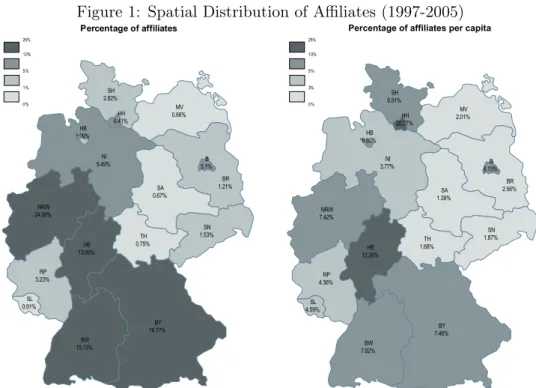
Figure 1 gives an overview of the distribution of foreign affiliates within Germany. The left map plots the percentage of affiliates established in each
6
For Germany as a whole (foreign and domestic firms), headquarters and affiliates are located in the same state in about 76% of the cases (Monopolkommission, 2006).
federal state over the period 1997-2005. Three regional groups can be distin-guished. North Rhine-Westphalia, Bavaria, Baden-Wurttemberg and Hesse hosted between 1997 and 2005 over 70% of all foreign multinationals’ affili-ates. In contrast, the nine lowest ranked states together did not even attract 10% of all investment objects. Although there is some variation also within the Eestern and the Western part of Germany, the observation translates into an East-West disruption.7 While foreign investors established between
1997 and 2005 766 affiliates in an average Western German federal state, they founded during the same time only 141 affiliates in an average Eastern German federal state.8
Figure 1: Spatial Distribution of Affiliates (1997-2005)
Percentage of affiliates per capita
BY 7.46% BW 7.82% HE 12.26% TH 1.68% SA 1.39% SN 1.87% BR 2.56% MV 2.01% SH 5.51% NI 3.77% NRW 7.42% RP 4.36% SL 4.59% HH 20.27% B 8.13% HB 8.90% Percentage of affiliates 25% 10% 5% 1% 0% BY 16.77% BW 15.13% HE 13.66% TH 0.75% SA 0.67% SN 1.53% BR 1.21% MV 0.66% SH 2.82% NI 5.49% NRW 24.58% RP 3.23% SL 0.91% HH 6.41% B 5.1% HB 1.09% 25% 10% 5% 3% 0%
Note: NRW: North Rhine Westphalia; BY: Free State of Bavaria; BW: Baden-Wurttemberg; HE: Hesse; HH: Hamburg; NI: Lower Saxony; B: Berlin; RP: Rhineland Palatine; SH: Schleswig-Holstein; SN: Free State of Saxony; BR: Brandenburg; HB: Bremen; SL: Saarland; TH: Thuringia; SA: Saxony-Anhalt; MV: Mecklenburg-Western Pomerania.
Source: Own calculations. Data from Deutsche Bundesbank.
This observation holds generally true for the percentage of per capita investments, plotted in the map on the right. With the exception of Berlin, each East German federal state hosted between 1997 and 2005 less MNEs’ affiliates per capita than each West German federal state.
The regional distribution looks similar for the five most important
coun-7
Note that Berlin is attributed to East Germany throughout the analysis. 8
Buch and Toubal (2008) report similar gaps for the degree of trade openness and immigration.
tries of origin (see Figure A.1), which account for 67% of all affiliate set ups in Germany over the period 1997-2005. It is striking that Switzerland and the Netherlands invest disproportionately into the adjacent federal states of Baden-Wurttemberg and North Rhine-Westphalia, respectively. In contrast, out of the six East German federal states, only Berlin and Saxony appear among the top ten locations of the biggest investors.
Eastern and Western German federal states do not only differ in terms of the total number of established MNE affiliates but also in terms of the sectoral composition of inward FDI. Four sectoral groups are considered in this paper: service affiliates, manufacturing affiliates and as complementing the latter, upstream (R&D and holdings) and downstream (wholesale and retail) activities. Figure 2 indicates that manufacturing activities make up for a larger part of inward FDI into East Germany, while services and es-pecially downstream activities such as wholesale and retail affiliates are a major factor in West Germany. This seems surprising at first sight since one might expect high-tech manufacturers to be located close to high-skilled human capital in West German industry clusters and downstream activities that do not rely on a specialised labour force to be spread across the coun-try. The discussions of Section 2, however, suggest that market access is of predominant importance for downstream activities, which is arguably higher in the West German federal states.
The descriptive analyses support the theoretically derived location choice determinants. Investors prefer large markets in the West, where a common border and existing firm networks also facilitate their entry. The tendency towards investing where the sales potential is high gets support from the sector composition of investments. Downstream activities make up for a large part of total foreign investment in the West, while the East hosts mainly manufacturing affiliates.
4.2 The Explanatory Variables
Information on German federal states is extracted from the Federal Statisti-cal Office.9 In a first set of regressions, the variables derived from equation
(5) are considered. The taxes tit are expected to lower a firm’s profit in
a location. For the present analysis, only those tax rates that vary at the federal state level are included – namely the real estate and the business tax. Wages and land rents are the prices of the two input factors. Following the critique by Bellak, Leibrecht, and Riedl (2008), gross wages are not an ade-quate measure for labour costs, so that unit labour cost are defined instead as ulcit = wit/empit gvait/empit (9) 9
Figure 2: Sectoral Composition of the Total Number of Affiliates in East and West Germany (1997-2005)
Services Downstream Upstream Manufacturing (30.04%) (3.93%) (30.24%) (35.79%) Services Downstream Upstream Manufacturing (57.61%) (35.00%) (4.88%) (2.51%) West East
Note: The service sector is defined as excluding wholesale, retail and R&D affiliates as well as holdings.
Source: Own calculations. Data from Deutsche Bundesbank.
with empit as the total employment and gvait as the gross value added
in regioni at time t. The unit labour cost measure bears the advantage of
being more directly linked to the profitability of FDI.10Regions lose
compet-itiveness (and are therefore expected to attract less FDI) if wages are high and/or if productivity is low. Market access in the chosen location i, a pull
factor for foreign investors, is represented by the GDP of market i. Low
in-ternal transport costs guarantee a good attainability of potential customers.
φiit is therefore approximated by a local infrastructure index, constructed
out of the relative length of motorways, roads, rivers and the number of airway passengers. Not only the local sales potential, but also the access to other markets influences the location choice of a foreign investor. The external market potential is calculated in accordance with Harris (1954), as the inverse distance-weighted sum of incomes,
10
In the absence of a regional price deflator, the unit labour costs are measured in nominal terms. Profitability therefore depends also on a firm’s ability to pass on increasing labour costs to the consumer.
M Plt= X l M Alt φil =X l GDPlt distil .11 (10)
With respect to the fixed cost specification, two variables are employed. As it is assumed that investing in an adjacent region entails informational advantages, a border dummy serves as a proxy for the regional-level part of fixed costs. The number of plants with the same country of origin within an industry approximates the plant-level part of fixed costs. In order to test whether network externalities are still present among competitors from dif-ferent countries of origin, a non-nation specific agglomeration variable will additionally be included. Both cluster variables are expected to facilitate the market entry and attract new investors, but to different extents as infor-mation fluctuates better within nation-specific networks.12
In a second set of regressions, a number of control variables are added to the baseline specification. With these policy variables, the possibilities of federal state governments to actively undertake measures in order to at-tract foreign multinationals can be assessed. One important policy field, which remains conducted under the governance of the federal states in Ger-many, is education policy. Regions compete for the best educational system and substantial differences in the performances are regularly confirmed by the OECD’s Programme for International Student Assessment (PISA) study (compare e.g. Heller and Ziegler, 2007). Specifically, I include public R&D expenditures, the share of university graduates and the share of school leavers without a degree to evaluate the importance of research and education for the attractiveness of a region. It has to be noted that the ongoing emigration of young skilled East Germans to the West (see e.g. Buch and Toubal, 2008) might considerably weaken the tool of education policy to attract investors. Since the causality between migration, education and employment oppor-tunities is, however, not clear ex-ante, it seems worthwhile to assess these additional controls. Finally, a variable measuring the population density of a federal state will be included. Even more than for the whole sample, this variable is, in the light of the discussions of Sections 2 and 4.1, expected to provide new insights at the sector level. Investors seeking for new sales op-portunities may prefer to locate their wholesale and retail affiliates in highly
11
Harris (1954) assumes the price indices to equal zero. Redding and Venables (2004) propose a market potential measure that is more rigorously derived from theory. Their approach requires the estimation of a trade equation to obtain the trade cost parameters. Since data on bilateral trade flows among German federal states is not available, market potential is here calculated according to Harris (1954). Head and Mayer (2004) stress that Harris’ measure outperforms the approach by Redding and Venables (2004), particularly if national borders do not matter.
12
To avoid an endogeneity bias in the empirical estimations, variables measuring the costs of the production factors, the market potential and the clustering of firms are lagged by one period. The count of affiliates is then increased by one unit in order to avoid loosing many observations by taking the log of zero.
populated areas. Manufacturers, in contrast, could even be deterred by a high degree of urbanisation.
5
Results
This section presents the results of the conditional and nested logit estima-tions of the location choices of MNEs in Germany. First, the estimaestima-tions on the whole sample will be discussed (5.1). Second, this exercise will be repeated for the most important sectors in order to account for potential differences among them (5.2). Third, the five most important countries of origin will be assessed individually (5.3). In all regressions, the continuous variables are taken in logs, which permits an interpretation of the estimated coefficients as the approximate elasticities of the probability of an average investor choosing regioni (Train, 2003).13
5.1 Estimations on the Whole Sample
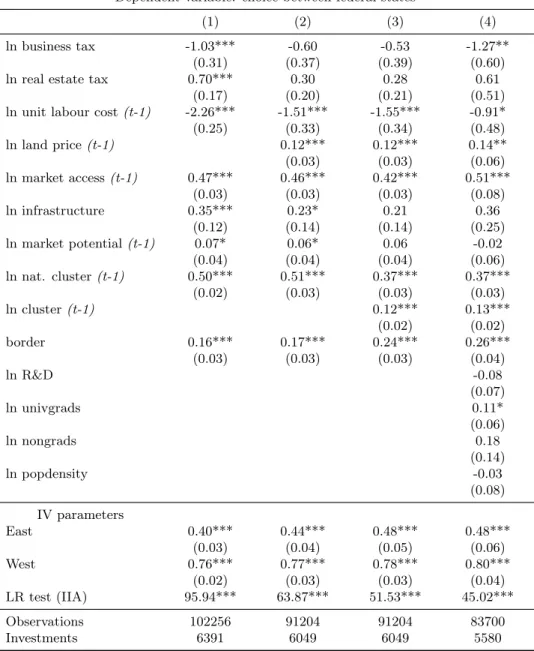
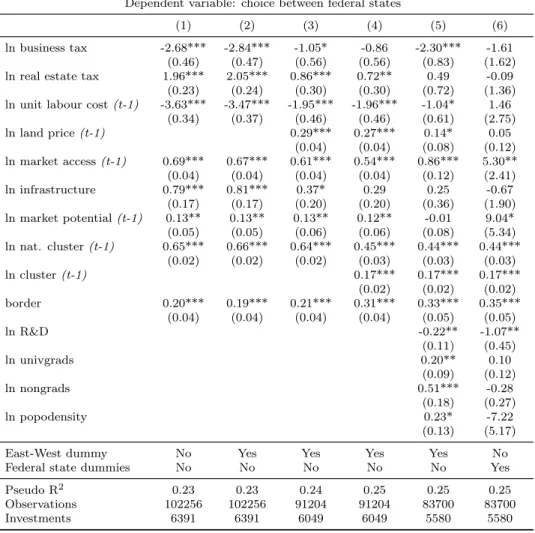
The results from the nested logit estimation are displayed in Table 1. For the regressions in columns (1)-(4), the IV parameters are significantly estimated to lie in the range of [0;1]. The Likelihood Ratio (LR) test rejects the null hypothesis of the IIA, hence, the conditional and the nested logit model can-not be perceived as equivalent. One possibility to mitigate the IIA problem characteristic to the conditional logit model is to include federal state dum-mies as is done in column (6) of Table A.2. This strategy is valid as long as investors have uniform perceptions about the attractiveness of regions. Table A.2, column (6) reveals that the inclusion of federal state dummies leads to substantial changes in the estimated coefficients. While the signs and mag-nitudes of the agglomeration variables and the border dummy remain stable, taxes, factor prices, and the infrastructure variable become insignificant. By contrast, the coefficients on the local and the external market potential in-crease dramatically. This result is not entirely surprising and in line with the findings of Crozet, Mayer, and Mucchielli (2004) for inward FDI into French departments. As in their study, differences in market potential may be more important over time than across federal states. For the other explanatory variables, in contrast, the time-invariant cross-sectional component explains location choices better than the time series variation, an effect, which is in the specification of column (6) already absorbed by the fixed effects. Since the adopted nesting structure is valid, I refrain from further commenting the
13
In fact, the presented coefficients are slight overestimates of the elasticities of location choice probabilities. It can be shown that ∂Pi
∂xi
xi
Pi = γ(1−Pi) for the conditional logit model and∂Pin ∂xi xi Pin =γ 1−Pi|n +λn(1−Pn)Pi|n
for the nested logit model. Hence, the higher the number of alternatives (and nests), the closer is the estimated coefficient to the actual elasticity.
conditional logit results (see Table A.2).14
Column (1) contains the results for the basic equation without land prices due to the fact that these were not available for the entire sample. Business taxes have the expected negative sign, while the real estate tax somehow sur-prisingly shows a significant positive impact. High unit labour costs decrease the probability for a state being chosen as an FDI location. Internal market access as well as – although to a lesser extent – Harris’ external market po-tential, help attracting foreign investors. A good local infrastructure allows for a better attainability of potential consumers in the periphery. Finally, the fixed cost specification of equation (2) seems valid. Both a higher num-ber of existing affiliates with the same source country and within the same industry and the existence of a common border reduce the costs of entering a foreign market and induce investors to decide for that particular federal state.
In general, the results remain stable with the inclusion of the prices for building land in column (2). However, the tax rates can no longer be esti-mated as being significantly different from zero. The positive coefficient of land prices is striking in this context. Together with the positive coefficient of the real estate tax rate in column (1), the result suggests a density ef-fect in metropolitan areas, which attracts investors despite of the relatively high prices. Finally, the inclusion of a variable measuring the costs of the second production factor, land, reduces the negative impact of unit labour costs. The other coefficients remain stable in terms of sign, magnitude, and significance level.
In column (3), in addition to the number of affiliates in the same sector and with the same country of origin (nat. cluster), the total number of affili-ates in the same sector aggregated over all foreign countries of origin (cluster) is included. As expected, the positive influence of the aggregate cluster vari-able is smaller than the impact of the country-specific cluster varivari-able. The finding corroborates that firms particularly benefit from national networks, where no language or cultural barrier impedes informational interchanges (Buch, Kleinert, and Toubal, 2006). Interestingly, the coefficient of cluster has decreased as compared to columns (1) and (2). This result corresponds well to the theoretical prediction of intense competition lowering positive network externalities.
From the additional control variables in column (4), only the share of university graduates has a statistically important impact. While the avail-ability of a highly qualified workforce matters for the location decision of MNEs, non-skilled workers, public R&D expenditures and population
den-14
Note, however, that overall the nested logit coefficients seem to be equal in sign, but smaller in magnitude and less statistically significant than their conditional logit counterparts in Table A.2. This finding suggests that inside East and West Germany the push and pull forces of the explanatory variables are weak compared to the situation where the federal states are chosen independently of the nests.
Table 1: Nested Logit Estimations
Dependent variable: choice between federal states
(1) (2) (3) (4)
ln business tax -1.03*** -0.60 -0.53 -1.27**
(0.31) (0.37) (0.39) (0.60)
ln real estate tax 0.70*** 0.30 0.28 0.61
(0.17) (0.20) (0.21) (0.51)
ln unit labour cost(t-1) -2.26*** -1.51*** -1.55*** -0.91*
(0.25) (0.33) (0.34) (0.48) ln land price(t-1) 0.12*** 0.12*** 0.14** (0.03) (0.03) (0.06) ln market access(t-1) 0.47*** 0.46*** 0.42*** 0.51*** (0.03) (0.03) (0.03) (0.08) ln infrastructure 0.35*** 0.23* 0.21 0.36 (0.12) (0.14) (0.14) (0.25) ln market potential(t-1) 0.07* 0.06* 0.06 -0.02 (0.04) (0.04) (0.04) (0.06) ln nat. cluster(t-1) 0.50*** 0.51*** 0.37*** 0.37*** (0.02) (0.03) (0.03) (0.03) ln cluster(t-1) 0.12*** 0.13*** (0.02) (0.02) border 0.16*** 0.17*** 0.24*** 0.26*** (0.03) (0.03) (0.03) (0.04) ln R&D -0.08 (0.07) ln univgrads 0.11* (0.06) ln nongrads 0.18 (0.14) ln popdensity -0.03 (0.08) IV parameters East 0.40*** 0.44*** 0.48*** 0.48*** (0.03) (0.04) (0.05) (0.06) West 0.76*** 0.77*** 0.78*** 0.80*** (0.02) (0.03) (0.03) (0.04) LR test (IIA) 95.94*** 63.87*** 51.53*** 45.02*** Observations 102256 91204 91204 83700 Investments 6391 6049 6049 5580
Note: This table presents the estimation results of equation (6). The regressions are based on the nested logit estimator. The IV parameters in the [0;1] interval and the significant LR test statistic confirm the nesting structure with East and West Germany as two nests. The dependent variable is the discrete choice of multinational firms to locate in one of 16 German federal states. The independent variables are as described in Section 4.2 and as listed in Table A.1. Based on the specification of column (1), columns (2), (3) and (4) successively introduce land rents, non-nation-specific industry clusters and R&D expenditure, university graduates, school leavers without a degree and population density as additional control variables. Standard errors are in parentheses with significance at the *** p<0.01, ** p<0.05, * p<0.1 level.
sity do not seem to play a role. The theoretical discussion of Section 2 and the descriptive statistics presented in Section 4.1 suggest, however, to look at sectors and activities individually. Especially, distribution-related func-tions of trade affiliates might react to regional condifunc-tions differently than production-related activities of manufacturing affiliates.
5.2 Sector-Specific Estimations
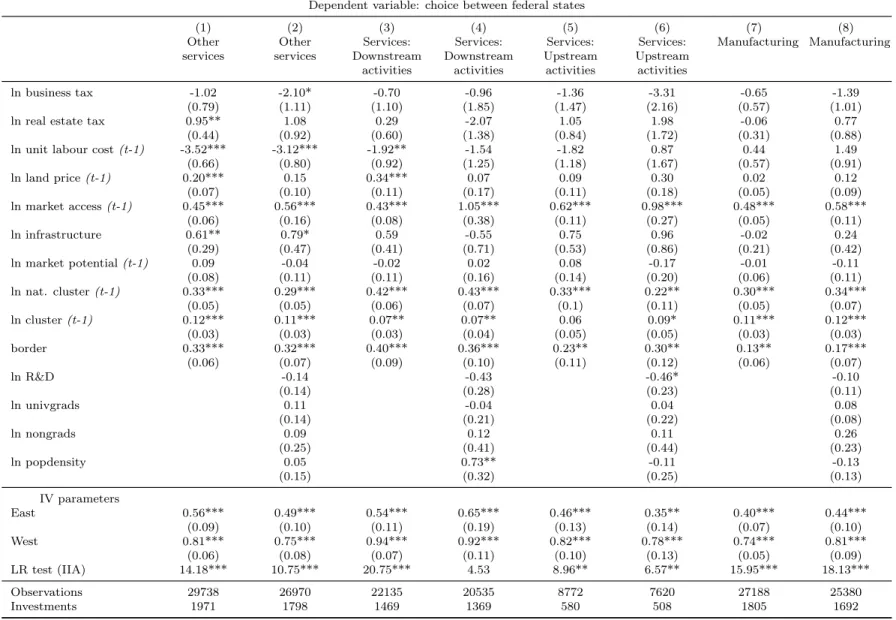
Table 2 reports the estimates for the manufacturing and the service sector as well as for pre- and post-production activities. The first columns contain the results for the baseline specification; the second columns introduce the policy control variables.
Columns (1) and (2) report the location choice determinants of service affiliates, excluding wholesale, retail and R&D affiliates as well as holdings. In contrast to the comparable regressions on the whole sample (Table 1, column(3)), Table 2, column (1) indicates that taxes and the local infras-tructure are relevant for service affiliates. Furthermore, the coefficient of the common border dummy is slightly higher. This last finding may be due to the complexity of some services that necessitate the adjacency to the parent company. In general, the results are robust to the inclusion of the additional control variables in column (2), although the evidence for land rents and tax rates is somewhat ambiguous.
The heterogeneity of the service sector requires, however, a differentiated analysis. To this end, columns (3) and (4) contain the results for downstream activities, like wholesale and retail trade and columns (5) and (6) report the estimates for upstream activities, like R&D and holdings. Taxes and local infrastructure do not seem to matter for wholesale and retail affiliates. This result is plausible against the finding of a large, positive coefficient of population density in column (4).15 Direct customer proximity rather
than the accessibility of potential consumers is crucial for the location of downstream activities at the regional level. The large positive effect of local market access (and also the positive coefficient of land prices in column (3)) supports this interpretation and is also in line with Hanson, Mataloni, and Slaughter (2001). The authors find that US wholesale affiliates have higher sales in high-income countries.
Turning to the upstream activities (columns (5) and (6)), we find that only few of the standard location choice determinants exhibit importance. It is noteworthy, however, that the agglomeration variables have a lower im-pact on upstream activities. If holdings provide headquarter services it is
15
Note that in column (4), the LR test cannot reject the IIA property. As a robustness check, the regression has been repeated using the conditional logit model. The results confirm the relevance of urbanisation for downstream activities as indicated through a positive significant coefficient of population density and market access. The results of this exercise are not presented here, but can be made available upon request.
Table 2: Nested Logit Estimations for Different Sectors and Activities
Dependent variable: choice between federal states
(1) (2) (3) (4) (5) (6) (7) (8) Other services Other services Services: Downstream activities Services: Downstream activities Services: Upstream activities Services: Upstream activities Manufacturing Manufacturing ln business tax -1.02 -2.10* -0.70 -0.96 -1.36 -3.31 -0.65 -1.39 (0.79) (1.11) (1.10) (1.85) (1.47) (2.16) (0.57) (1.01)
ln real estate tax 0.95** 1.08 0.29 -2.07 1.05 1.98 -0.06 0.77
(0.44) (0.92) (0.60) (1.38) (0.84) (1.72) (0.31) (0.88)
ln unit labour cost(t-1) -3.52*** -3.12*** -1.92** -1.54 -1.82 0.87 0.44 1.49
(0.66) (0.80) (0.92) (1.25) (1.18) (1.67) (0.57) (0.91) ln land price(t-1) 0.20*** 0.15 0.34*** 0.07 0.09 0.30 0.02 0.12 (0.07) (0.10) (0.11) (0.17) (0.11) (0.18) (0.05) (0.09) ln market access(t-1) 0.45*** 0.56*** 0.43*** 1.05*** 0.62*** 0.98*** 0.48*** 0.58*** (0.06) (0.16) (0.08) (0.38) (0.11) (0.27) (0.05) (0.11) ln infrastructure 0.61** 0.79* 0.59 -0.55 0.75 0.96 -0.02 0.24 (0.29) (0.47) (0.41) (0.71) (0.53) (0.86) (0.21) (0.42) ln market potential(t-1) 0.09 -0.04 -0.02 0.02 0.08 -0.17 -0.01 -0.11 (0.08) (0.11) (0.11) (0.16) (0.14) (0.20) (0.06) (0.11) ln nat. cluster(t-1) 0.33*** 0.29*** 0.42*** 0.43*** 0.33*** 0.22** 0.30*** 0.34*** (0.05) (0.05) (0.06) (0.07) (0.1) (0.11) (0.05) (0.07) ln cluster(t-1) 0.12*** 0.11*** 0.07** 0.07** 0.06 0.09* 0.11*** 0.12*** (0.03) (0.03) (0.03) (0.04) (0.05) (0.05) (0.03) (0.03) border 0.33*** 0.32*** 0.40*** 0.36*** 0.23** 0.30** 0.13** 0.17*** (0.06) (0.07) (0.09) (0.10) (0.11) (0.12) (0.06) (0.07) ln R&D -0.14 -0.43 -0.46* -0.10 (0.14) (0.28) (0.23) (0.11) ln univgrads 0.11 -0.04 0.04 0.08 (0.14) (0.21) (0.22) (0.08) ln nongrads 0.09 0.12 0.11 0.26 (0.25) (0.41) (0.44) (0.23) ln popdensity 0.05 0.73** -0.11 -0.13 (0.15) (0.32) (0.25) (0.13) IV parameters East 0.56*** 0.49*** 0.54*** 0.65*** 0.46*** 0.35** 0.40*** 0.44*** (0.09) (0.10) (0.11) (0.19) (0.13) (0.14) (0.07) (0.10) West 0.81*** 0.75*** 0.94*** 0.92*** 0.82*** 0.78*** 0.74*** 0.81*** (0.06) (0.08) (0.07) (0.11) (0.10) (0.13) (0.05) (0.09) LR test (IIA) 14.18*** 10.75*** 20.75*** 4.53 8.96** 6.57** 15.95*** 18.13*** Observations 29738 26970 22135 20535 8772 7620 27188 25380 Investments 1971 1798 1469 1369 580 508 1805 1692
Note: This table presents sector-specific estimation results based on the nested logit estimator. Columns (1) and (2) report results for other services, excluding wholesale, retail and R&D affiliates as well as holdings. Columns (3) and (4) report results for downstream activities of wholesale and retail affiliates and Columns (5) and (6) for upstream activities of holdings and R&D affiliates. Columns (7) and (8) report results for manufacturing affiliates. The independent variables of the respective first columns are as in Table 1, column (3) and of the respective second columns as in Table 1, column (4). Standard errors are in parentheses
reasonable to believe that they act independently from potential competi-tors. Interestingly, a high level of public R&D expenditure detracts MNEs from locating their R&D and holding activities in a certain federal state. One possible explanation for this might stem from the actual low number of R&D affiliates within this category. They make up for only around 5% of all affiliates conducting upstream activities. Since holdings are, except for serving as a local headquarter, also established for tax reasons (see We-ichenrieder and Mintz (2007)), they might have claims at odds with usual pre-production activities.
The results for the manufacturing sector are reported in columns (7) and (8). Two main differences with respect to the service sector in general and with respect to downstream activities in particular are striking: first, having a common border with the chosen location is less relevant for manufactur-ers. Second, the relatively low IV parameter (East) suggests that Eastern German federal states are viewed as especially close substitutes by these investors. Thus, since the main investing countries are Western economies (compare Figure A.1) and since manufacturers make up for a large share of investments in East Germany (compare Figure 2), the result seems to de-scribe the particular situation of Germany well. Education policy does, like for the other sectors and activities, not matter for manufacturers. As already noted, the possibilities of local policy makers to gain regional competitive-ness might be considerably weakened by a highly mobile East German labour force.
5.3 Source Country-Specific Estimations
Sections 5.1 and 5.2 have indicated that a common border is relevant for the probability to decide for a certain location but plays less of a role for manufacturers. This finding may already partly explain the specific situation of the East German federal states. Existing nation-specific firm networks also appeared as a robust location choice determinant, suggesting that it might be crucial to attract a number of affiliates from one country which spurs then – ideally via a self-reinforcing process – additional investments from the same country.
To see which regional factors actually pull or push investors from the most important source countries, Table 3 displays the individual regression results for the five most important countries of origin. The LR test and the IV parameters support the nesting structure for Dutch, US and British investors. The LR test could not reject the IIA assumption for Swiss, British and French investors. For this reason, only the conditional logit results are reported for these source countries of inward FDI in Germany.
At the individual country level, it is remarkable that taxes matter only for Swiss and US investors, while the latter do not respond to unit labour costs. In contrast, US MNEs seem to be located in metropolitan areas where land
Table 3: Conditional and Nested Logit Estimations for the Most Important Countries of Origin
Dependent variable: choice between federal states
(1) (2) (3) (4) (5)
NL USA CH GB F
ln business tax -1.00 1.27 -4.12** -0.63 0.18
(0.93) (1.10) (1.82) (2.08) (1.68)
ln real estate tax 0.31 -1.11* 1.85** 1.05 0.48
(0.51) (0.58) (0.88) (1.15) (0.85)
ln unit labour cost(t-1) -2.76*** -0.05 -3.83** -3.80** -2.90
(0.83) (0.93) (1.75) (1.69) (1.96) ln land price(t-1) 0.13 0.26** 0.24 0.27* 0.13 (0.09) (0.10) (0.18) (0.15) (0.17) ln market access(t-1) 0.24*** 0.40*** 0.22* 0.65*** 0.19* (0.07) (0.08) (0.13) (0.15) (0.11) ln infrastructure 0.60* -0.30 1.31** 0.34 0.61 (0.32) (0.40) (0.62) (0.71) (0.62) ln market potential(t-1) -0.05 0.16 -0.30* 0.30 0.00 (0.08) (0.11) (0.18) (0.19) (0.16) ln nat. cluster(t-1) 0.26*** 0.19** 0.28*** 0.26** 0.49*** (0.07) (0.08) (0.11) (0.12) (0.12) ln cluster(t-1) 0.20*** 0.27*** 0.31*** 0.36*** 0.21** (0.06) (0.07) (0.09) (0.09) (0.08) border 0.37*** 0.48** 0.37** (0.11) (0.21) (0.18) IV parameters East 0.50*** 0.39*** (0.11) (0.11) West 0.75*** 0.67*** (0.07) (0.07) LR test (IIA) 8.75** 9.46***
East-West dummy Yes Yes Yes
Federal states dummies No No No No No
Pseudo R2 0.25 0.29 0.18
Observations 20246 12906 9996 9099 8593
Investments 1343 857 663 604 571
Note: This table presents country-specific estimation results based on the nested and the condi-tional logit estimator. The IV parameters in the [0;1] interval and the significant LR test statistic confirm the nesting structure for the Netherlands (column (1)) and the US (column (2)); for Switzerland (column (3)), Great Britain (column (4)) and France (column (5)) the conditional logit results are reported instead. The independent variables are as in Table 1, column (3). (Ro-bust) standard errors are in parentheses with significance at the *** p<0.01, ** p<0.05, * p<0.1 level.
prices are also high. Using wages instead of unit labour costs and omitting land prices, Crozet, Mayer, and Mucchielli (2004) find that US investments even react positively to high wages in French regions. Like in this paper, the authors further estimate a relatively low impact of market access on Dutch investors (column (1)).
When looking at the most important source countries individually, as-sessing the fixed cost specification is of particular interest. The descriptive analysis of Figure A.1 indicates that affiliates of Swiss and Dutch multina-tionals are predominantly located in the adjacent federal states of Baden-Wurttemberg and North Rhine-Westphalia. In the empirical results of Table 3, a common border is, accordingly, estimated to exhibit a significant influ-ence on investments from these countries as well as from France. Further-more, the agglomeration variables indicate that country networks are most important for French investors with a coefficient of 0.49 and least important for US investors (with a coefficient of 0.19). It is remarkable that MNEs from the US, Great Britain and Switzerland, who are assumed to be less af-fected by language barriers when investing in Germany, are even to a larger extent attracted by industry clusters in general than by industry clusters consisting of firms from the same country. Dutch and French investors, on the contrary, benefit more from nation-specific agglomeration. Hence, the empirical evidence not only for the whole sample and for the sectoral regres-sions, but also for individual countries of origin validates the adopted fixed cost specification in equation (2).
The importance of network and border effects has implications especially for East Germany. While the lacking adjacency to strong investing coun-tries is an insuperable problem for East German policy makers, they might consider the promotion of industry clusters. This could be an especially promising strategy with regards to investors that do not heavily rely on nation-specific networks.
6
Conclusions
This study examined and identified the main determinants of inward FDI into German federal states during the time span 1997-2005. Three questions were highlighted: first, in the theoretical part, a profit function was derived according to which foreign multinationals choose their locations. Common borders and nation-specific industry clusters were thought of as facilitating market entry. Possible particularities with regard to the distribution-related activities of trade affiliates were mentioned. Second, the specific situation of East Germany in terms of attracting less MNEs’ affiliates and depend-ing largely on the manufacturdepend-ing sector was accounted for by adoptdepend-ing a nesting structure. The IV parameters of the baseline regressions all point at a higher degree of substitutability among Eastern as compared to
West-ern federal states. Third, the empirical estimations confirm the theoretical presumptions: the theory-consistent specification of fixed costs shows a sig-nificant influence in the conditional and the nested logit estimations with the common border and existing firm clusters turning out as very robust determinants of inward FDI. The individual country regressions showed that network effects arise from aggregate industry clusters as well, but are less important for French investors. Finally, the sector estimates confirm that downstream industries prefer to locate in highly populated, wealthy (West German) federal states.
The findings are of high interest not only for the scientific community but also for policy makers. The insight that local demand and unit labour costs significantly influence foreign investors in their location choices represents indispensable information for regional policy makers when reflecting about ways to enhance the location attractiveness in general or to investors from certain sectors or countries. This latter strategy might be particularly sound, since a critical mass of affiliates from one industry and one country proves to be a reliable pull factor for other investors that operate in the same sector and have the same country of origin.
Although insightful, this study is limited by the availability of data. Due to lacking information about the characteristics of foreign multina-tional firms, a possible heterogeneous behaviour of firms investing at home or abroad cannot be accounted for. This task has therefore to be left for future research.
A
Appendix
Figure A.1: Total Number of Affiliates by Country of Origin (1997-2005)
0 200 400 600 Netherlands SASL TH MVBR SN HB RP SHB NI HH BWBY HE NRW 0 100 200 300 USA HB MVBR TH SASL SH SN RPNI B HH HE BW NRWBY 0 100 200 300 Switzerland MVSA SL TH RP BR HB SH SNNI B HHHE NRWBY BW 0 50 100 150 200 Great Britain SL SA TH MVBR SN HB RP SHB NI HH BWBY HE NRW 0 50 100 150 France HBTH MVSA SH SN BR HHSL NI RPB BY BWHE NRW
Note: In order to retain the confidential nature of the data, country of origin-federal state com-binations with less than three observations have been made anonymous and defined to count at least three observations.
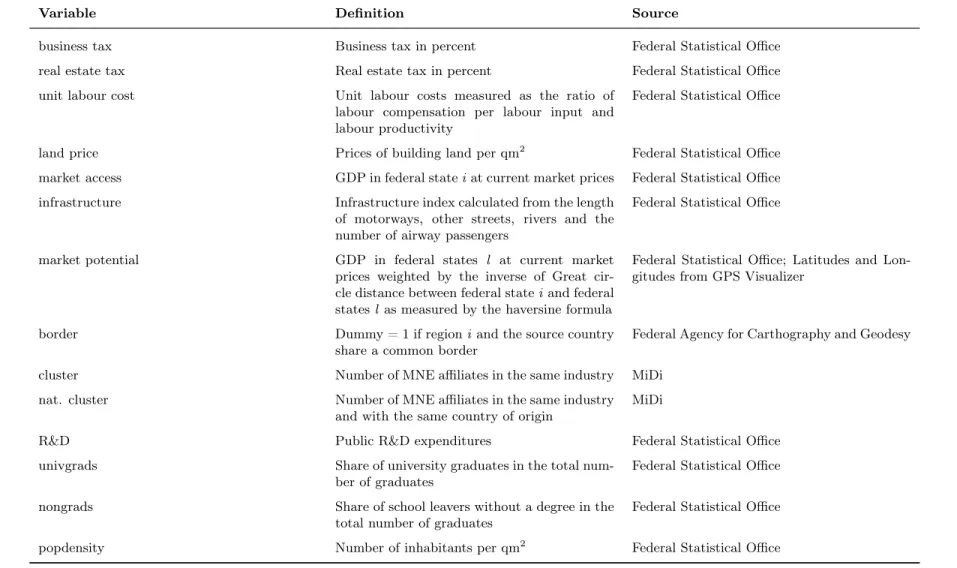
Table A.1: List of Variables
Variable Definition Source
business tax Business tax in percent Federal Statistical Office
real estate tax Real estate tax in percent Federal Statistical Office
unit labour cost Unit labour costs measured as the ratio of
labour compensation per labour input and labour productivity
Federal Statistical Office
land price Prices of building land per qm2 Federal Statistical Office
market access GDP in federal statei at current market prices Federal Statistical Office
infrastructure Infrastructure index calculated from the length
of motorways, other streets, rivers and the number of airway passengers
Federal Statistical Office
market potential GDP in federal states l at current market
prices weighted by the inverse of Great cir-cle distance between federal statei and federal stateslas measured by the haversine formula
Federal Statistical Office; Latitudes and Lon-gitudes from GPS Visualizer
border Dummy = 1 if regioniand the source country
share a common border
Federal Agency for Carthography and Geodesy
cluster Number of MNE affiliates in the same industry MiDi
nat. cluster Number of MNE affiliates in the same industry
and with the same country of origin
MiDi
R&D Public R&D expenditures Federal Statistical Office
univgrads Share of university graduates in the total
num-ber of graduates
Federal Statistical Office
nongrads Share of school leavers without a degree in the
total number of graduates
Federal Statistical Office
2
Table A.2: Conditional Logit Estimations
Dependent variable: choice between federal states
(1) (2) (3) (4) (5) (6) ln business tax -2.68*** -2.84*** -1.05* -0.86 -2.30*** -1.61
(0.46) (0.47) (0.56) (0.56) (0.83) (1.62) ln real estate tax 1.96*** 2.05*** 0.86*** 0.72** 0.49 -0.09 (0.23) (0.24) (0.30) (0.30) (0.72) (1.36) ln unit labour cost(t-1) -3.63*** -3.47*** -1.95*** -1.96*** -1.04* 1.46
(0.34) (0.37) (0.46) (0.46) (0.61) (2.75) ln land price(t-1) 0.29*** 0.27*** 0.14* 0.05 (0.04) (0.04) (0.08) (0.12) ln market access(t-1) 0.69*** 0.67*** 0.61*** 0.54*** 0.86*** 5.30** (0.04) (0.04) (0.04) (0.04) (0.12) (2.41) ln infrastructure 0.79*** 0.81*** 0.37* 0.29 0.25 -0.67 (0.17) (0.17) (0.20) (0.20) (0.36) (1.90) ln market potential(t-1) 0.13** 0.13** 0.13** 0.12** -0.01 9.04* (0.05) (0.05) (0.06) (0.06) (0.08) (5.34) ln nat. cluster(t-1) 0.65*** 0.66*** 0.64*** 0.45*** 0.44*** 0.44*** (0.02) (0.02) (0.02) (0.03) (0.03) (0.03) ln cluster(t-1) 0.17*** 0.17*** 0.17*** (0.02) (0.02) (0.02) border 0.20*** 0.19*** 0.21*** 0.31*** 0.33*** 0.35*** (0.04) (0.04) (0.04) (0.04) (0.05) (0.05) ln R&D -0.22** -1.07** (0.11) (0.45) ln univgrads 0.20** 0.10 (0.09) (0.12) ln nongrads 0.51*** -0.28 (0.18) (0.27) ln popodensity 0.23* -7.22 (0.13) (5.17) East-West dummy No Yes Yes Yes Yes No Federal state dummies No No No No No Yes Pseudo R2 0.23 0.23 0.24 0.25 0.25 0.25
Observations 102256 102256 91204 91204 83700 83700 Investments 6391 6391 6049 6049 5580 5580 Note: This table presents the estimation results based on the conditional logit estimator. The dependent variable is the discrete choice of multinational firms to locate in one of 16 German federal states. The independent variables are as described in Section 4.2 and as listed in Table A.1. Based on the specification of column (1), columns (2), (3), (4), (5) and (6) successively introduce an East-West (0/1) dummy, land rents, non-nation-specific industry clusters, R&D expenditure, university graduates, school leavers without a degree and population density as additional control variables and federal state dummies. Robust standard errors are in parentheses with significance at the *** p<0.01, ** p<0.05, * p<0.1 level.
References
Amiti, M., and B. S. Javorcik (2008): “Trade Costs and Location of
Foreign Firms in China,” Journal of Development Economics,
85(1-2), 129–149.
Arndt, C., and A. Mattes(2008): “Country Evidence on the Impact of
Foreign Ownership on the Performance of German Multinational Firms,” MicroDyn Working Paper, forthcoming.
Barrios, G., H. Görg,andE. Strobl(2006): “Multinationals‘ Location
Choice, Agglomeration Economies and Public Incentives,” Interna-tional Regional Science Review, 29(1), 81–107.
Basile, R. (2004): “Acquisition versus Greenfield Investment: The
Loca-tion of Foreign Manufacturers in Italy,”Regional Science and Urban Economics, 34, 3–25.
Basile, R., D. Castellani, andA. Zanfei(2008): “Location Choices of
Multinational Firms in Europe: The Role of EU Cohesion Policy,”
Journal of International Economics, 74(2), 328–340.
Bellak, C., M. Leibrecht, and A. Riedl (2008): “Labour Costs and
FDI Flows into Central and Eastern European Countries: A Survey of the Literature and Empirical Evidence,” Structural Change and Economic Dynamics, 19, 17–37.
Bitzer, J.,andH. Görg(2008): “Foreign Direct Investment, Competition
and Industry Performance,” Kiel Working Paper 1416, Institut für Weltwirtschaft.
Buch, C., and F. Toubal (2008): “Openness and Growth: The Long
Shadow of the Berlin Wall,” Journal of Macroeconomics, forthcom-ing.
Buch, C. M., J. Kleinert, and F. Toubal (2006): “Where enterprises
lead, people follow? Links between migration and FDI in Germany,”
European Economic Review, 50(8), 2017–2036.
Crozet, M., T. Mayer, and J.-L. Mucchielli (2004): “How do Firms
Agglomerate? A Study of FDI in France,” Regional Science and Urban Economics, 34, 27–54.
Defever, F.(2006): “Functional Fragmentation and the Location of Multi-national Firms in the enlarged Europe,”Regional Science and Urban Economics, 36(5), 658–677.
Fujita, M.,andJ. Thisse(1996): “Economics of Agglomeration,” Journal of the Japanese and International Economies, 10(4), 339–378.
Hanson, G., R. Mataloni, and M. Slaughter (2001): “Expansion
Strategies of U.S. Multinational Firms,” NBER Working Paper 8433, National Bureau of Economic Research.
Harris, C.(1954): “The Market as a Factor in the Localization of Indus-try in the United States,” Annals of the Association of American Geographers, 44(4), 315–348.
Head, K., and T. Mayer (2004): “Market Potential and the Location
of Japanese Investment in the European Union,” The Review of Economics and Statistics, 86(4), 959–972.
Heller, K., and A. Ziegler (2007): Begabt sein in Deutschland. Lit
Verlag, Münster.
Helpman, E., M. Melitz, and S. Yeaple (2004): “Export versus FDI
with Heterogenous Firms,”American Economic Review, 94(1), 300–
316.
Inui, T., T. Matsuura, and S. Poncet (2008): “The Location of
Japanese MNCs Affiliates: Agglomeration, Spillovers and Firm Heterogeneity,” CEPII Working Paper 2008-24, Centre d‘Études Prospectives et d‘Informations Internationales.
Krautheim, S. (2007): “Export-Supporting FDI,” EUI Working Paper
2007/24, European University Institute.
Krugman, P.(1991): “Increasing Returns and Economic Geography,” The
Journal of Political Economy, 99(3), 483–449.
Lipponer, A. (2008): “Microdatabase Direct Investment – MiDi A Brief
Guide,” mimeo, Deutsche Bundesbank.
Mayer, T., I. Méjean, and B. Nefussi (2007): “The Location of
Do-mestic and Foreign Production Affiliates by French Multinational Firms,” CEPII Working Paper 2007-07, Centre D’Etudes Prospec-tives et D’Informations Internationales.
McFadden, D.(1978): “Modelling the Choice of Residential Location,” in
Spatial Interaction Theory and Planning Models, ed. by A. Karquist.
North-Holland, Amsterdam.
Monopolkommission (2006): “Sechzehntes Hauptgutachten der
Monopolkommission 2004/2005,” Working Paper 16/2460, Bundesdrucksache.
Redding, S., and A. Venables (2004): “Economic Geography and
In-ternational Inequality,” Journal of International Economics, 62(1), 53–82.
Train, K. (2003): Discrete Choice Methods with Simulation. Cambridge
University Press, Cambridge.
Uhlig, H. (2008): “The Slow Decline of East Germany,” Working Paper
14553, National Bureau of Economic Research, NBER.
Weichenrieder, A., and J. Mintz (2007): “What Determines the Use
of Holding Companies and Ownership Chains?,” Working Paper 08/03, Oxford University Centre for Business Taxiation.
IAW-Diskussionspapiere
Bisher erschienen:
Nr. 1 (September 2001)
Das Einstiegsgeld – eine zielgruppenorientierte negative Einkommensteuer: Konzeption, Umsetzung und eine erste Zwischenbilanz nach 15 Monaten in Baden-Württemberg
Sabine Dann / Andrea Kirchmann / Alexander Spermann / Jürgen Volkert
Nr. 2 (Dezember 2001)
Die Einkommensteuerreform 1990 als natürliches Experiment. Methodische und konzeptionelle Aspekte zur Schätzung der Elastizität des zu versteuernden Einkommens
Peter Gottfried / Hannes Schellhorn
Nr. 3 (Januar 2001)
Gut betreut in den Arbeitsmarkt? Eine mikroökonomische Evaluation der Mannheimer Arbeitsvermittlungsagentur
Jürgen Jerger / Christian Pohnke / Alexander Spermann
Nr. 4 (Dezember 2001)
Das IAW-Einkommenspanel und das Mikrosimulationsmodell SIMST Peter Gottfried / Hannes Schellhorn
Nr. 5 (April 2002)
A Microeconometric Characterisation of Household Consumption Using Quantile Regression
Niels Schulze / Gerd Ronning
Nr. 6 (April 2002)
Determinanten des Überlebens von Neugründungen in der baden-württem- bergischen Industrie – eine empirische Survivalanalyse mit amtlichen Betriebsdaten Harald Strotmann
Nr. 7 (November 2002)
Die Baulandausweisungsumlage als ökonomisches Steuerungsinstrument einer nachhaltigkeitsorientierten Flächenpolitik
Raimund Krumm
Nr. 8 (März 2003)
Making Work Pay: U.S. American Models for a German Context? Laura Chadwick, Jürgen Volkert
Nr. 9 (Juni 2003)
Erste Ergebnisse von vergleichenden Untersuchungen mit anonymisierten und nicht anonymisierten Einzeldaten am Beispiel der Kostenstrukturerhebung und der Umsatzsteuerstatistik
IAW-Diskussionspapiere
Nr. 10 (August 2003)
Randomized Response and the Binary Probit Model Gerd Ronning
Nr. 11 (August 2003)
Creating Firms for a New Century: Determinants of Firm Creation around 1900
Joerg Baten
Nr. 12 (September 2003)
Das fiskalische BLAU-Konzept zur Begrenzung des Siedlungsflächenwachstums Raimund Krumm
Nr. 13 (Dezember 2003)
Generelle Nichtdiskontierung als Bedingung für eine nachhaltige Entwicklung? Stefan Bayer
Nr. 14 (Februar 2003)
Die Elastizität des zu versteuernden Einkommens. Messung und erste Ergebnisse zur empirischen Evidenz für die Bundesrepublik Deutschland.
Peter Gottfried / Hannes Schellhorn
Nr. 15 (Februar 2004)
Empirical Evidence on the Effects of Marginal Tax Rates on Income – The German Case
Peter Gottfried / Hannes Schellhorn
Nr. 16 (Juli 2004)
Shadow Economies around the World: What do we really know? Friedrich Schneider
Nr. 17 (August 2004)
Firm Foundations in the Knowledge Intensive Business Service Sector. Results from a Comparative Empirical Study in Three German Regions Andreas Koch / Thomas Stahlecker
Nr. 18 (Januar 2005)
The impact of functional integration and spatial proximity on the post-entry performance of knowledge intensive business service firms
Andreas Koch / Harald Strotmann
Nr. 19 (März 2005)
Legislative Malapportionment and the Politicization of Germany’s Intergovernmental Transfer System
Hans Pitlik / Friedrich Schneider / Harald Strotmann
Nr. 20 (April 2005)
Implementation ökonomischer Steuerungsansätze in die Raumplanung Raimund Krumm