E. Ivanov, O. Gluchshenko, H. Andrä, A. Kudryavtsev
Parallel software tool for
decompo-sing and meshing of 3d structures
© Fraunhofer-Institut für Techno- und Wirtschaftsmathematik ITWM 2007 ISSN 1434-9973
Bericht 110 (2007)
Alle Rechte vorbehalten. Ohne ausdrückliche schriftliche Genehmigung des Herausgebers ist es nicht gestattet, das Buch oder Teile daraus in irgendeiner Form durch Fotokopie, Mikrofilm oder andere Verfahren zu reproduzieren oder in eine für Maschinen, insbesondere Datenverarbeitungsanlagen, ver-wendbare Sprache zu übertragen. Dasselbe gilt für das Recht der öffentlichen Wiedergabe.
Warennamen werden ohne Gewährleistung der freien Verwendbarkeit benutzt. Die Veröffentlichungen in der Berichtsreihe des Fraunhofer ITWM können bezogen werden über:
Fraunhofer-Institut für Techno- und Wirtschaftsmathematik ITWM Fraunhofer-Platz 1
67663 Kaiserslautern Germany
Vorwort
Das Tätigkeitsfeld des Fraunhofer-Instituts für Techno- und Wirtschaftsmathematik
ITWM umfasst anwendungsnahe Grundlagenforschung, angewandte Forschung
sowie Beratung und kundenspezifische Lösungen auf allen Gebieten, die für
Tech-no- und Wirtschaftsmathematik bedeutsam sind.
In der Reihe »Berichte des Fraunhofer ITWM« soll die Arbeit des Instituts
konti-nuierlich einer interessierten Öffentlichkeit in Industrie, Wirtschaft und
Wissen-schaft vorgestellt werden. Durch die enge Verzahnung mit dem Fachbereich
Ma-thematik der Universität Kaiserslautern sowie durch zahlreiche Kooperationen mit
internationalen Institutionen und Hochschulen in den Bereichen Ausbildung und
Forschung ist ein großes Potenzial für Forschungsberichte vorhanden. In die
Be-richtreihe sollen sowohl hervorragende Diplom- und Projektarbeiten und
Disser-tationen als auch Forschungsberichte der Institutsmitarbeiter und Institutsgäste zu
aktuellen Fragen der Techno- und Wirtschaftsmathematik aufgenommen werden.
Darüber hinaus bietet die Reihe ein Forum für die Berichterstattung über die
zahl-reichen Kooperationsprojekte des Instituts mit Partnern aus Industrie und
Wirt-schaft.
Berichterstattung heißt hier Dokumentation des Transfers aktueller Ergebnisse aus
mathematischer Forschungs- und Entwicklungsarbeit in industrielle Anwendungen
und Softwareprodukte – und umgekehrt, denn Probleme der Praxis generieren
neue interessante mathematische Fragestellungen.
Prof. Dr. Dieter Prätzel-Wolters
Institutsleiter
Parallel Software Tool for Decomposing and
Meshing of 3D Structures
Evgeny Ivanov
1,∗, Olga Gluchshenko
2,†, Heiko Andr¨
a
1,‡,
Alexey Kudryavtsev
3,§1
Fraunhofer ITWM
2
Technical University Kaiserslautern
3
Institute of Theoretical and Applied Mechanics SD RAS
8 March, 2007
Abstract
An algorithm for automatic parallel generation of three-dimensional unstructured com-putational meshes based on geometrical domain decomposition is proposed in this pa-per. Software package build upon proposed algorithm is described. Several practical examples of mesh generation on multiprocessor computational systems are given. It is shown that developed parallel algorithm enables us to reduce mesh generation time significantly (dozens of times). Moreover, it easily produces meshes with number of elements of order5·107, construction of those on a single CPU is problematic. Ques-tions of time consumption, efficiency of computaQues-tions and quality of generated meshes are also considered.
Keywords: a-priori domain decomposition, unstructured grid, Delaunay mesh gener-ation.
1
Introduction
The use of fully automatic generated unstructured tetrahedral meshes for highly com-plex domains can be one of the most efficient ways to solve large Computational Fluid
∗Corresponding author, Email: [email protected], Telephone: +49631316004304 †Email: [email protected], Telephone: +496312054589
‡Email: [email protected], Telephone: +49631316004470 §Email: [email protected], Telephone: +73833307268
Dynamics (CFD) and Computational Mechanics (CM) problems on parallel comput-ers. While many solvers have been ported to parallel machines, grid generators have left behind. Grids in excess of ten million elements have become common for produc-tion runs in CFD and CM [1–5]. In CFD, a mesh of at least ten million tetrahedra can be required for high Reynolds number viscous turbulent flow simulation over a com-plete aircraft [6]. The expectation is that in near future grids in excess of 108−109 elements will be required [7]. As mesh sizes become as large as this, the process of mesh generation on a serial computer becomes problematic in terms of time and mem-ory requirements. Especially this is true for applications where remeshing is integral part of simulations, e.g. problems with moving boundaries [8–14] or changing topolo-gies [15, 16], where the time required for mesh generation can easily consume more than 50% of the total time required to solve the problem [7]. In addition, the parallel overhead associated with partitioning a mesh generated on a single processor should be also avoided. Therefore, the need for developing parallel mesh generation technique is well justified.
A number of efforts have been reported on different algorithms and codes devel-oped for parallel mesh generation in recent years. The most recent and extensive review of parallel mesh generation methods is given by N. Chrisochoides in [17]. The parallel mesh generated methods are classified in terms of two basic attributes: se-quential technique to mesh individual subproblem and degree of coupling between the subtasks which determines the intensity of the communication and the amount/type of synchronization required between the subproblems.
In this paper we present a parallel 3D unstructured grid generator developed at Fraunhofer ITWM. The software package is based on a-priori geometrical partition-ing of the computational domain into subdomains. The algorithm for meshpartition-ing an individual subdomain is of Delaunay type and the subtasks are fully decoupled.
Developed algorithm is clearly advantageous in terms of computational time and memory usage compare to an a posteriori partitioning method used by mesh partition-ing libraries such as (PAR)METIS [18]. It allows us to use well tested and fine-tuned sequential 2D and 3D triangulators which are capable of producing mesh with guaran-teed quality. The algorithm achieves 100% code re-use and eliminates communication and synchronization. All operations performed preserve original surface mesh. The algorithm produces almost plane interfaces, i.e. interfaces with small perturbations between the subdomains and uses a splitting criterion, which minimizes the interface area and which is sensitive to both the object shape and the grid resolution. In spite of all these advantages the method consists of a sequence of steps, where almost all of them are simple, as opposite of sophisticated algorithms, which are used in other mesh generating methods.
Several real-life examples with complex geometries involving generation of large meshes are given (107−108 elements). It is shown that developed parallel grid gen-erator significantly reduces mesh generation time and allows us to construct meshes which can not be generated on a single CPU because of memory limitations and large computational time.
Rest of the paper is organized as follows: Section 2 formulates the problem and gives description of the algorithm. In Section 3 several real-life 3D examples are considered. Then results are discussed in Section 4 and 5th section summarizes and concludes the paper.
2
Parallel generation algorithm
The goal of the work is to create a parallel grid generator for high-quality tetrahedral grids with good properties (e.g. Delaunay property) for solving PDEs. It should be fully automatic, adaptive (via coupling with the solver) and, of course, able to generate large meshes. The input data is a CAD surface description of an object. The algorithm consists of the following major steps:
1. Decomposition of an object into open non-overlapping subdomains.
(a) computing of center of mass and inertia tensor computation to determine the cutting planes
(b) extracting of all intersecting edges and construction a cross-section contour line.
2. Construction of closed and compatible surface mesh for each subdo-main.
Projection of contour nodes on a cutting plane, construction of 2D constrained Delaunay triangulation on the plane inside the contour and mapping back the contour nodes of the triangulation to original surface positions.
3. Independent parallel volume meshing (without communication) within each subdomain based on and compatible with its surface mesh de-scription.
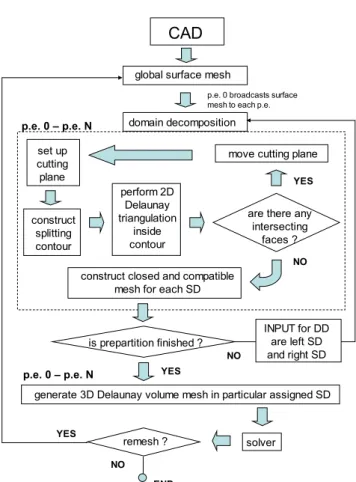
The flow chart of parallel grid generator is shown in Fig.1. Details of the algorithm are given in the following subsections.
2.1
Setting up the cutting planes
Here the center of gravity along with the moment of inertia criterion is used. Each object is cut perpendicular to its smallest principal inertia axis. It means that for each part with the set of nodesV, the inertia matrix is computed by
I= I 11 I12 I13 I21 I22 I23 I31 I32 I33 ,
where matrixIis symmetric and
Iij= v∈V (xvl −xgl)2δij−(x v i −xgi) xvj−xgj .
Here (xg, yg, zg) are coordinates of the center of gravity calculated by assigning unit mass to each node of the mesh. Thus, grid resolution is also taken into account. Then (one of) the eigenvector(s) with the smallest eigenvalue is selected.
This procedure defines planes perpendicular to the smallest principal inertia axis. The actual cutting plane is chosen to go through the center of gravity. This partitioning technique is sensitive to the object shape and grid resolution and can minimize the interface area.
Nevertheless, it turns out to be hard to find a reasonable criterion for predicting a good load balancing in advance. Even if the number of tetrahedra is approximately the same for each subdomain, the CPU time spent for the volume meshing of each part can be quite different [19].
Figure 1: Flow chart of parallel grid generator.
2.2
Construction of the splitting contour
Once the cutting plane is defined, we can construct a cross-section contour where 2D constrained Delaunay triangulation will be performed.
Here we present improved technique of forming the splitting path of edges. The construction of the contour consists of the following steps:
1. Extract all intersected edges of the surface triangulation. 2. Remove all edges with ”hanging” nodes.
3. Sort the edges into a closed loop. 4. Remove multiple paths if they are.
Procedure of forming the contour is shown in Fig.2. For more complex geometry configurations, especially involving corners and concavities, multiple paths can occur. Several examples of such incidents are illustrated in Fig.3. Special care is taken in order to remove all of these incidents.
Figure 2: Construction of the splitting contour: extraction of all intersected edges and forming of closed curve of piecewise straight lines (segments).
Figure 3: Incidents of multiple paths in case of concavity and corner.
2.3
Construction of interface
Two steps are required before the 2D triangulation of the interface can be done: 1. Mapping of the contour nodes on the cutting plane.
2. Rotation intoX−Y plane of the coordinates for 2D triangulation.
The program Triangle [20] from Shewchuk is used for the triangulation of the interface. However, also other Delaunay algorithms can be applied.
After triangulation of the interface with certain constraints on minimal angle and maximum triangle area, the coordinates are reversed back and the contour nodes are mapped back onto their original surface positions. It has been found that it can result in the intersection of triangular faces of the interface grid and the original domain surface grid. This happens when a straight line between two nodes, that form an edge of two-dimensional boundary, can not be drawn in three dimensions without intersec-tion with another part of the mesh, that does not form part of the interface. This is
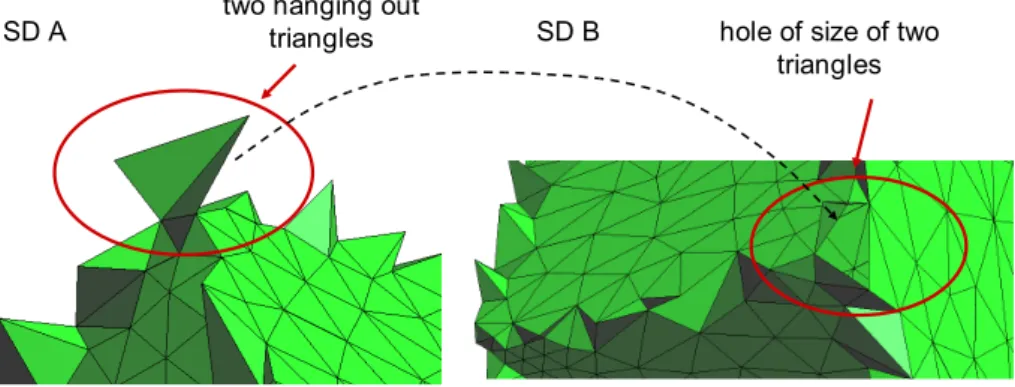
Figure 4: Hole in the mesh and moving of triangles according to special rule.
immediately detected and the cutting plane is moved on a certain step perpendicular to the minimal principal inertia axis till there are no any intersections. This pro-cedure computationally is not expensive and requires only several reconstructions of two-dimensional interface mesh.
2.4
Construction of closed and compatible surface mesh
for each subdomain
Produced surface meshes have to meet two major requirements: they should be water-proof, e.g. be void of holes, and consistent. These are necessary conditions for further generation of tetrahedral mesh inside.
So we have an original surface mesh and triangulated interface. Task is to split the original mesh and obtain two domains with the waterproof and consistent mesh. The general splitting rule for triangles is following: triangle belongs to a certain part if it has at least two vertices there.
There are some exceptions, where triangulation should be split in a different way. It concerns cases, where decomposition according to general rule results in holes in one subdomain and extra triangles in another (see Fig.4).
2.5
Overall domain decomposition & volume mesh
gener-ation
Automatic partitioning is done with use of inertial bisection algorithm, where new center of mass, eigenvectors and inertia axis are recomputed for every subdomain. So the overall domain decomposition of an object can be represented by the binary tree (see Fig.5). When the decomposition reaches prescribed number of subdomains (CPUs) it stops.
Now when partitioning is finished and a closed and compatible surface mesh is created for each subdomain at the last decomposition level, the volume meshes are constructed in parallel. TetGen - a quality tetrahedral mesh generator and three-dimensional Delaunay triangulator from Hang Si [21] has been used for volume De-launay tetrahedralization with certain quality bounds (radius-edge ratio), a maximum
Figure 5: Architecture of overall domain decomposition.
volume bound, a maximum area bound on a facet, a maximum edge length on a segment.
3
Numerical test for real-life problem
3.1
Knee prosthesis components
As first two examples of volume mesh construction in complex domains by using described algorithm components of knee prosthesis produced by Lima Group [22] are taken. In Fig.6 and 7 an a priori decomposition of original surface meshes in these two cases are shown (16 and 8 correspondingly). It can be seen that the algorithm able to handle relatively complex geometries.
3.2
Bearing cap
Next example is a bearing cap to fix a crank shaft at a motor block [23]. This example will be further used for more detailed analysis of algorithm efficiency and quality of produced meshes.
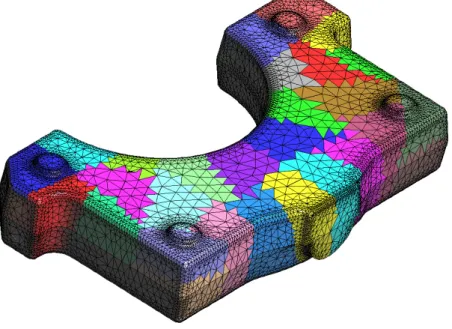
In Fig.8 an a-priori decomposition of computational domain on 32 subdomains is shown.
The simulation was run on the Fraunhofer ITWM cluster with high - bandwidth /low-latency myrinet network: 64 nodes, each node has Dual Xeon CPU 2.4 GHz, 4GB RAM. Three meshes of different sizes were constructed. In Table 1 generation time on a different number of CPUs is given. In case of 400 thousands and 4 millions elements the computational time was reduced dozens of times owing to developed parallel grid generator. If generation of these two meshes is still possible on a single CPU due to reasonable size, then sequential generation of the third mesh with more than 40 millions elements fails. Developed parallel grid generator constructs this mesh on 32 CPUs in approximately 1.5 minutes. The speed-up of volume mesh generation time in
Figure 6: An a-priori domain decomposition of knee prosthesis femoral compo-nent on 16 subdomains.
Figure 7: An a-priori domain decomposition of knee prosthesis tibial component on 8 subdomains.
Figure 8: An a-priori domain decomposition of bearing cap component on 32 subdomains.
Figure 9: Speed-up of volume mesh generation time for the bearing cap geom-etry.
case of 4 million elements is given in Fig.9. As it is seen efficiency of the computations on 32 CPUs is about 60%.
Table 1: Computational time for construction of volume meshes of different sizes
Elements/CPUs 1 2 4 8 16 32
4·105 20.91 10.26 5.78 3.30 2.54 1.25 4·106 169.56 83.07 48.43 26.75 15.02 9.06 4·107 failed 961.45 558.197 356.39 181.08 91.13
4
Results and discussion
Developed parallel grid generator helps to remove a computational bottleneck related with sequential construction of volume mesh. It can be used with parallel solvers providing prepared subdomain for each CPU as well as with other sequential solvers to reduce mesh generation time. In latter case subdomains should be joined back together into one global volume mesh (see Fig.10).
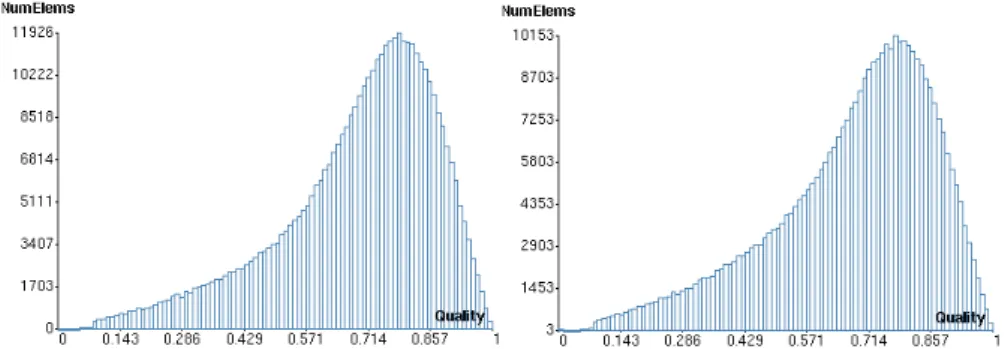
The quality of generated mesh should be acceptable by a solver. It means that mesh constructed by parallel grid generator and mesh generated sequentially on one CPU should not have big difference in quality. In Fig.11 distribution of tetrahedral elements according to shape quality is given for meshes constructed sequentially and
Figure 10: Volume mesh of a bearing cap constructed by parallel grid generator.
by using parallel grid generator. Here the shape qualityQis calculated by
Q=6 √ 2·V ol 6 i=13i ,
whereV ol– tetrahedron volume,i— lengths of its edges. For the regular tetrahedron Q = 1. It is seen that comparable quality is achieved. In both cases the greatest number of tetrahedra are withQ≈0.76÷0.78.
It happened to be hard to find a reasonable criteria for predicting a good load balance in advance. There is no direct relation between number of surface and volume elements. Number of surface elements is just a good indicator. Some unexpected results can appear. Even if number of volume elements in two subdomains is the same, CPU time spent on those two parts can be quite different. This could happen due to, for example, problems related with boundary irregularities.
Although significant progress has been made in devising solutions for certain classes of geometric domains, its solution for general domains is still an open issue. The disadvantage of this approach is the fact that the associated ”optimal” partitioning problem is NP-complete for general regions [24]. However, as it has been seen, the described procedure allows us to generate very large meshes in relatively short time and in computationally efficient manner.
Figure 11: Distribution of elements according to their shape quality. Left — mesh generated sequentially. Right — mesh generated by parallel grid generator.
5
Summary and conclusion
In this paper we have presented a parallel algorithm and software for handling the mesh generation and decomposition preprocessing phases required by domain decomposition based parallel FEM computations. However, it can be used with sequential solvers to speed up mesh generation stage.
Developed algorithm is clearly advantageous in terms of computational time and memory usage compare to an a posteriori partitioning method used by mesh parti-tioning libraries such as (PAR)METIS. It allows us to use well tested and fine-tuned sequential 2D and 3D triangulators which are capable of producing mesh with guaran-teed quality. The algorithm achieves 100% code re-use and eliminates communication and synchronization. All operations performed preserve original surface mesh. The algorithm produces almost plane interfaces, i.e. interfaces with small perturbations between the subdomains and uses a splitting criterion, which minimizes the interface area and which is sensitive to both the object shape and the grid resolution. In spite of all these advantages the method consists of a sequence of steps, where almost all of them are simple, as opposite of sophisticated algorithms, which are used in other mesh generating methods.
The main disadvantage of this approach is the fact that the associated ”optimal” partitioning problem is NP-complete for general regions. So it can be used for a certain class of geometric domains only.
However, it is demonstrated that very large meshes (up to 50 million elements) with complex geometry can be created. It is shown that developed software based on described algorithm is capable of producing large meshes in relatively short time and in computationally efficient manner. It is important to mention that quality comparable with sequentially generated mesh is achieved.
Further work on testing, creating of better programming interface with CAD, handling of examples with more complex geometries and larger meshes and performing local adaptive mesh refinement from CAD level is in progress.
Acknowledgment
This work is supported by the Fraunhofer Institute for Industrial Mathematics (Com-petence Center for High Performance Computing and Visualization), DAAD, TU
Kaiserslautern and Institute of Theoretical and Applied Mechanics SD RAS. The authors are grateful to Franz-Josef Pfreundt and wish to thank S.K. Godunov for his interest to this work and many comments on subject. The work is partially sup-ported by the Kaiserslautern Excellence Cluster Dependable Adaptive Systems and Mathematical Modeling.
References
[1] J.D. Baum, H. Luo and R. L¨ohner, Numerical Simulation of a Blast Inside a Boeing 747, AIAA-93-3091 (1993).
[2] J.D. Baum, H. Luo and R. L¨ohner,Numerical Simulation of a Blast in the World Trade Center, AIAA-95-0085 (1995).
[3] W. Jou, Comments on the Feasibility of LES for Commercial Airplane Wings, AIAA-98-2801 (1998).
[4] S. Yoshimura, H. Nitta, G. Yagawa and H. Akiba,Parallel Automatic Mesh Gen-eration Method of Ten-million Nodes Problem Using Fuzzy Knowledge Processing and Computational Geometry, Proc. 4th World Congress on Computational Me-chanics (WCCM-IV) (CD-ROM) (1998).
[5] D.J. Mavriplis and S. Pirzadeh,Large-Scale Parallel Unstructured Mesh Compu-tations for 3-D High Lift Analysis, ICASE Rep.99-9(1999).
[6] Said R., Weatherill N.P., Morgan K., Verhoeven N.A.,Distributed Parallel Delau-nay Mesh Generation, Comp. Meth. Appl. Mech. Eng. (1999),177, pp. 109-125. [7] R. L¨ohner and J.R. Cebral,Parallel Advancing Front Grid Generation”,
Proceed-ings, 8th International Meshing Roundtable(1999), pp. 67-74.
[8] R. L¨ohner, Three-Dimensional Fluid-Structure Interaction Using a Finite Ele-ment Solver and Adaptive Remeshing, Comp. Sys. In Eng.,1(1990), No. 2-4, pp. 257-272.
[9] E. Mestreau, R. L¨ohner and S. Aita, TGV Tunnel-Entry Simulations Using a Finite Element Code with Automatic Remeshing, AIAA-96-0798 (1996).
[10] E. Mestreau and R. L¨ohner,Airbag Simulations Using Fluid/Structure Coupling, AIAA-96-0798 (1996).
[11] J.D. Baum, H. Luo, R. L¨ohner, C. Yang, D. Pelessone, and C. Charman, A Coupled Fluid/Structure Modeling of Shock Interaction with a Truck, AIAA-96-0795 (1996).
[12] A. Kamoulakos, V. Chen, E. Mestreau and R. L¨ohner,Finite Element Modeling of Fluid/Structure Interaction in Explosively Loaded Aircraft Fuselage Panels Using PAMSHOCK/PAMFLOW Coupling, Conf. on Spacecraft Structures, Materials and Mechanical Testing, (1996).
[13] R. L¨ohner, C. Yang, J. Cebral, J.D. Baum, H. Luo, D. Pelessone, and C. Char-man,Fluid-Structure-Thermal Interaction Using a Loose Coupling Algorithm and Adaptive Unstructured Grids, AIAA-98-2419 (1998).
[14] O. Hassan, L.B. Bayne, K. Morgan and N.P. Weatherill,An Adaptive Unstruc-tured Mesh Method for Transient Flows Involving Moving Boundaries, 5th US Congress on Computational Mechanics (1999), pp. 662-674.
[15] J.D. Baum, H. Luo and R. L¨ohner,The Numerical Simulation of Strongly Un-steady Flows With Hundreds of Moving Bodies, AIAA-98-0788 (1998).
[16] J.D. Baum, H. Luo, E. Mestreau, R. L¨ohner, D. Pelessone and C. Charman, A coupled CFD/CSD Methodology for Modeling Weapon Detonation and Fragmen-tation, AIAA-99-0794 (1999).
[17] Chrisochoides N. A Survey of Parallel Mesh Generation Methods // Brown Uni-versity, Providence RI - 2005.
[18] METIS: Multilevel Partitioning Algorithms, http://www-users.cs.umn.edu/ karypis/metis/
[19] J. Galtier and P.L. George, Prepartitioning as a Way to Mesh Subdomains in Parallel, 5th International Meshing Roundtable, Sandia National Laboratories (1996), pp. 107-122.
[20] J. R. Shewchuk,Triangle: Engineering a 2d quality mesh generator and Delaunay triangulator, Proceedings first workshop on Applied Computational Geometry (1996), pp. 124-133.
[21] H. Si and K. Gaertner, Meshing Piecewise Linear Complexes by Constrained Delaunay Tetrahedralizations, Proceeding of the 14th International Meshing Roundtable (2005).
[22] Lima Group Web Site,
http://www.lima.it/english/prostheses/products/multigen.htm [23] http://www.gienath.com/english/produkte.htm.
[24] P. Wu and Houstis E.N.Parallel Adaptive Mesh Generation and Decomposition, Engineering with Computers12(1996), pp. 155-157.
Published reports of the
Fraunhofer ITWM
The PDF-files of the following reports
are available under:
www.itwm.fraunhofer.de/de/
zentral__berichte/berichte
1. D. Hietel, K. Steiner, J. Struckmeier A Finite - Volume Particle Method for Compressible Flows(19 pages, 1998)
2. M. Feldmann, S. Seibold
Damage Diagnosis of Rotors: Application of Hilbert Transform and Multi-Hypothe-sis Testing
Keywords: Hilbert transform, damage diagnosis, Kal-man filtering, non-linear dynamics
(23 pages, 1998)
3. Y. Ben-Haim, S. Seibold
Robust Reliability of Diagnostic Multi- Hypothesis Algorithms: Application to Rotating Machinery
Keywords: Robust reliability, convex models, Kalman filtering, multi-hypothesis diagnosis, rotating machinery, crack diagnosis
(24 pages, 1998)
4. F.-Th. Lentes, N. Siedow
Three-dimensional Radiative Heat Transfer in Glass Cooling Processes
(23 pages, 1998) 5. A. Klar, R. Wegener
A hierarchy of models for multilane vehicular traffic
Part I: Modeling
(23 pages, 1998)
Part II: Numerical and stochastic investigations
(17 pages, 1998) 6. A. Klar, N. Siedow
Boundary Layers and Domain Decompos-ition for Radiative Heat Transfer and Diffu-sion Equations: Applications to Glass Manu-facturing Processes
(24 pages, 1998) 7. I. Choquet
Heterogeneous catalysis modelling and numerical simulation in rarified gas flows Part I: Coverage locally at equilibrium
(24 pages, 1998)
8. J. Ohser, B. Steinbach, C. Lang
Efficient Texture Analysis of Binary Images
(17 pages, 1998) 9. J. Orlik
Homogenization for viscoelasticity of the integral type with aging and shrinkage
(20 pages, 1998) 10. J. Mohring
Helmholtz Resonators with Large Aperture
11. H. W. Hamacher, A. Schöbel On Center Cycles in Grid Graphs
(15 pages, 1998)
12. H. W. Hamacher, K.-H. Küfer Inverse radiation therapy planning - a multiple objective optimisation approach
(14 pages, 1999)
13. C. Lang, J. Ohser, R. Hilfer
On the Analysis of Spatial Binary Images
(20 pages, 1999) 14. M. Junk
On the Construction of Discrete Equilibrium Distributions for Kinetic Schemes
(24 pages, 1999)
15. M. Junk, S. V. Raghurame Rao
A new discrete velocity method for Navier-Stokes equations
(20 pages, 1999) 16. H. Neunzert
Mathematics as a Key to Key Technologies
(39 pages (4 PDF-Files), 1999) 17. J. Ohser, K. Sandau
Considerations about the Estimation of the Size Distribution in Wicksell’s Corpuscle Problem
(18 pages, 1999)
18. E. Carrizosa, H. W. Hamacher, R. Klein, S. Nickel
Solving nonconvex planar location prob-lems by finite dominating sets
Keywords: Continuous Location, Polyhedral Gauges, Fi-nite Dominating Sets, Approximation, Sandwich Algo-rithm, Greedy Algorithm
(19 pages, 2000) 19. A. Becker
A Review on Image Distortion Measures Keywords: Distortion measure, human visual system
(26 pages, 2000)
20. H. W. Hamacher, M. Labbé, S. Nickel, T. Sonneborn
Polyhedral Properties of the Uncapacitated Multiple Allocation Hub Location Problem Keywords: integer programming, hub location, facility location, valid inequalities, facets, branch and cut
(21 pages, 2000)
21. H. W. Hamacher, A. Schöbel
Design of Zone Tariff Systems in Public Transportation
(30 pages, 2001)
22. D. Hietel, M. Junk, R. Keck, D. Teleaga The Finite-Volume-Particle Method for Conservation Laws
(16 pages, 2001)
23. T. Bender, H. Hennes, J. Kalcsics, M. T. Melo, S. Nickel
Location Software and Interface with GIS and Supply Chain Management
Keywords: facility location, software development, geographical information systems, supply chain man-agement
24. H. W. Hamacher, S. A. Tjandra
Mathematical Modelling of Evacuation Problems: A State of Art
(44 pages, 2001) 25. J. Kuhnert, S. Tiwari
Grid free method for solving the Poisson equation
Keywords: Poisson equation, Least squares method, Grid free method
(19 pages, 2001)
26. T. Götz, H. Rave, D. Reinel-Bitzer, K. Steiner, H. Tiemeier
Simulation of the fiber spinning process Keywords: Melt spinning, fiber model, Lattice Boltzmann, CFD
(19 pages, 2001) 27. A. Zemitis
On interaction of a liquid film with an obstacle
Keywords: impinging jets, liquid film, models, numeri-cal solution, shape
(22 pages, 2001)
28. I. Ginzburg, K. Steiner
Free surface lattice-Boltzmann method to model the filling of expanding cavities by Bingham Fluids
Keywords: Generalized LBE, free-surface phenomena, interface boundary conditions, filling processes, Bing-ham viscoplastic model, regularized models
(22 pages, 2001) 29. H. Neunzert
»Denn nichts ist für den Menschen als Men-schen etwas wert, was er nicht mit Leiden-schaft tun kann«
Vortrag anlässlich der Verleihung des Akademiepreises des Landes Rheinland-Pfalz am 21.11.2001
Keywords: Lehre, Forschung, angewandte Mathematik, Mehrskalenanalyse, Strömungsmechanik
(18 pages, 2001) 30. J. Kuhnert, S. Tiwari
Finite pointset method based on the projec-tion method for simulaprojec-tions of the incom-pressible Navier-Stokes equations Keywords: Incompressible Navier-Stokes equations, Meshfree method, Projection method, Particle scheme, Least squares approximation
AMS subject classification: 76D05, 76M28
(25 pages, 2001) 31. R. Korn, M. Krekel
Optimal Portfolios with Fixed Consumption or Income Streams
Keywords: Portfolio optimisation, stochastic control, HJB equation, discretisation of control problems. (23 pages, 2002)
32. M. Krekel
Optimal portfolios with a loan dependent credit spread
Keywords: Portfolio optimisation, stochastic control, HJB equation, credit spread, log utility, power utility, non-linear wealth dynamics
(25 pages, 2002)
33. J. Ohser, W. Nagel, K. Schladitz
The Euler number of discretized sets – on the choice of adjacency in homogeneous lattices Keywords: image analysis, Euler number, neighborhod
34. I. Ginzburg, K. Steiner
Lattice Boltzmann Model for Free-Surface flow and Its Application to Filling Process in Casting
Keywords: Lattice Boltzmann models; free-surface phenomena; interface boundary conditions; filling processes; injection molding; volume of fluid method; interface boundary conditions; advection-schemes; up-wind-schemes
(54 pages, 2002)
35. M. Günther, A. Klar, T. Materne, R. Wegener Multivalued fundamental diagrams and stop and go waves for continuum traffic equations
Keywords: traffic flow, macroscopic equations, kinetic derivation, multivalued fundamental diagram, stop and go waves, phase transitions
(25 pages, 2002)
36. S. Feldmann, P. Lang, D. Prätzel-Wolters Parameter influence on the zeros of net-work determinants
Keywords: Networks, Equicofactor matrix polynomials, Realization theory, Matrix perturbation theory
(30 pages, 2002)
37. K. Koch, J. Ohser, K. Schladitz
Spectral theory for random closed sets and estimating the covariance via frequency space
Keywords: Random set, Bartlett spectrum, fast Fourier transform, power spectrum
(28 pages, 2002)
38. D. d’Humières, I. Ginzburg
Multi-reflection boundary conditions for lattice Boltzmann models
Keywords: lattice Boltzmann equation, boudary condis-tions, bounce-back rule, Navier-Stokes equation
(72 pages, 2002) 39. R. Korn
Elementare Finanzmathematik
Keywords: Finanzmathematik, Aktien, Optionen, Port-folio-Optimierung, Börse, Lehrerweiterbildung, Mathe-matikunterricht
(98 pages, 2002)
40. J. Kallrath, M. C. Müller, S. Nickel Batch Presorting Problems: Models and Complexity Results
Keywords: Complexity theory, Integer programming, Assigment, Logistics
(19 pages, 2002) 41. J. Linn
On the frame-invariant description of the phase space of the Folgar-Tucker equation Key words: fiber orientation, Folgar-Tucker equation, in-jection molding
(5 pages, 2003) 42. T. Hanne, S. Nickel
A Multi-Objective Evolutionary Algorithm for Scheduling and Inspection Planning in Software Development Projects
Key words: multiple objective programming, project management and scheduling, software development, evolutionary algorithms, efficient set
(29 pages, 2003)
43. T. Bortfeld , K.-H. Küfer, M. Monz, A. Scherrer, C. Thieke, H. Trinkaus
Intensity-Modulated Radiotherapy - A Large Scale Multi-Criteria Programming Problem Keywords: multiple criteria optimization, representa-tive systems of Pareto solutions, adaprepresenta-tive triangulation, clustering and disaggregation techniques, visualization of Pareto solutions, medical physics, external beam ra-diotherapy planning, intensity modulated rara-diotherapy
(31 pages, 2003)
44. T. Halfmann, T. Wichmann
Overview of Symbolic Methods in Industrial Analog Circuit Design
Keywords: CAD, automated analog circuit design, sym-bolic analysis, computer algebra, behavioral modeling, system simulation, circuit sizing, macro modeling, dif-ferential-algebraic equations, index
(17 pages, 2003)
45. S. E. Mikhailov, J. Orlik
Asymptotic Homogenisation in Strength and Fatigue Durability Analysis of Composites
Keywords: multiscale structures, asymptotic homogeni-zation, strength, fatigue, singularity, non-local condi-tions
(14 pages, 2003)
46. P. Domínguez-Marín, P. Hansen, N. Mladenovi ´c , S. Nickel
Heuristic Procedures for Solving the Discrete Ordered Median Problem
Keywords: genetic algorithms, variable neighborhood search, discrete facility location
(31 pages, 2003)
47. N. Boland, P. Domínguez-Marín, S. Nickel, J. Puerto
Exact Procedures for Solving the Discrete Ordered Median Problem
Keywords: discrete location, Integer programming
(41 pages, 2003)
48. S. Feldmann, P. Lang
Padé-like reduction of stable discrete linear systems preserving their stability
Keywords: Discrete linear systems, model reduction, stability, Hankel matrix, Stein equation
(16 pages, 2003) 49. J. Kallrath, S. Nickel
A Polynomial Case of the Batch Presorting Problem
Keywords: batch presorting problem, online optimiza-tion, competetive analysis, polynomial algorithms, lo-gistics
(17 pages, 2003)
50. T. Hanne, H. L. Trinkaus knowCube for MCDM –
Visual and Interactive Support for Multicriteria Decision Making
Key words: Multicriteria decision making, knowledge management, decision support systems, visual interfac-es, interactive navigation, real-life applications.
(26 pages, 2003) 51. O. Iliev, V. Laptev
On Numerical Simulation of Flow Through Oil Filters
52. W. Dörfler, O. Iliev, D. Stoyanov, D. Vassileva On a Multigrid Adaptive Refinement Solver for Saturated Non-Newtonian Flow in Porous Media
Keywords: Nonlinear multigrid, adaptive refinement, non-Newtonian flow in porous media
(17 pages, 2003) 53. S. Kruse
On the Pricing of Forward Starting Options under Stochastic Volatility
Keywords: Option pricing, forward starting options, Heston model, stochastic volatility, cliquet options
(11 pages, 2003) 54. O. Iliev, D. Stoyanov
Multigrid – adaptive local refinement solver for incompressible flows
Keywords: Navier-Stokes equations, incompressible flow, projection-type splitting, SIMPLE, multigrid meth-ods, adaptive local refinement, lid-driven flow in a cav-ity
(37 pages, 2003) 55. V. Starikovicius
The multiphase flow and heat transfer in porous media
Keywords: Two-phase flow in porous media, various formulations, global pressure, multiphase mixture mod-el, numerical simulation
(30 pages, 2003)
56. P. Lang, A. Sarishvili, A. Wirsen
Blocked neural networks for knowledge extraction in the software development process
Keywords: Blocked Neural Networks, Nonlinear Regres-sion, Knowledge Extraction, Code Inspection
(21 pages, 2003)
57. H. Knaf, P. Lang, S. Zeiser Diagnosis aiding in Regulation Thermography using Fuzzy Logic Keywords: fuzzy logic,knowledge representation, ex-pert system
(22 pages, 2003)
58. M. T. Melo, S. Nickel, F. Saldanha da Gama Largescale models for dynamic multi-commodity capacitated facility location Keywords: supply chain management, strategic planning, dynamic location, modeling
(40 pages, 2003) 59. J. Orlik
Homogenization for contact problems with periodically rough surfaces
Keywords: asymptotic homogenization, contact problems
(28 pages, 2004)
60. A. Scherrer, K.-H. Küfer, M. Monz, F. Alonso, T. Bortfeld
IMRT planning on adaptive volume struc-tures – a significant advance of computa-tional complexity
Keywords: Intensity-modulated radiation therapy (IMRT), inverse treatment planning, adaptive volume structures, hierarchical clustering, local refinement, adaptive clustering, convex programming, mesh gen-eration, multi-grid methods
61. D. Kehrwald
Parallel lattice Boltzmann simulation of complex flows
Keywords: Lattice Boltzmann methods, parallel com-puting, microstructure simulation, virtual material de-sign, pseudo-plastic fluids, liquid composite moulding
(12 pages, 2004)
62. O. Iliev, J. Linn, M. Moog, D. Niedziela, V. Starikovicius
On the Performance of Certain Iterative Solvers for Coupled Systems Arising in Discretization of Non-Newtonian Flow Equations
Keywords: Performance of iterative solvers, Precondi-tioners, Non-Newtonian flow
(17 pages, 2004)
63. R. Ciegis, O. Iliev, S. Rief, K. Steiner On Modelling and Simulation of Different Regimes for Liquid Polymer Moulding Keywords: Liquid Polymer Moulding, Modelling, Simu-lation, Infiltration, Front Propagation, non-Newtonian flow in porous media
(43 pages, 2004) 64. T. Hanne, H. Neu
Simulating Human Resources in Software Development Processes Keywords: Human resource modeling, software pro-cess, productivity, human factors, learning curve
(14 pages, 2004)
65. O. Iliev, A. Mikelic, P. Popov
Fluid structure interaction problems in de-formable porous media: Toward permeabil-ity of deformable porous media
Keywords: fluid-structure interaction, deformable po-rous media, upscaling, linear elasticity, stokes, finite elements
(28 pages, 2004)
66. F. Gaspar, O. Iliev, F. Lisbona, A. Naumovich, P. Vabishchevich
On numerical solution of 1-D poroelasticity equations in a multilayered domain Keywords: poroelasticity, multilayered material, finite volume discretization, MAC type grid
(41 pages, 2004)
67. J. Ohser, K. Schladitz, K. Koch, M. Nöthe Diffraction by image processing and its ap-plication in materials science
Keywords: porous microstructure, image analysis, ran-dom set, fast Fourier transform, power spectrum, Bartlett spectrum
(13 pages, 2004) 68. H. Neunzert
Mathematics as a Technology: Challenges for the next 10 Years
Keywords: applied mathematics, technology, modelling, simulation, visualization, optimization, glass processing, spinning processes, fiber-fluid interaction, trubulence effects, topological optimization, multicriteria optimiza-tion, Uncertainty and Risk, financial mathematics, Mal-liavin calculus, Monte-Carlo methods, virtual material design, filtration, bio-informatics, system biology
(29 pages, 2004)
69. R. Ewing, O. Iliev, R. Lazarov, A. Naumovich
On convergence of certain finite difference discretizations for 1D poroelasticity inter-face problems
Keywords: poroelasticity, multilayered material, finite
70. W. Dörfler, O. Iliev, D. Stoyanov, D. Vassileva On Efficient Simulation of Non-Newto-nian Flow in Saturated Porous Media with a Multigrid Adaptive Refinement Solver Keywords: Nonlinear multigrid, adaptive renement, non-Newtonian in porous media
(25 pages, 2004)
71. J. Kalcsics, S. Nickel, M. Schröder Towards a Unified Territory Design Ap-proach – Applications, Algorithms and GIS Integration
Keywords: territory desgin, political districting, sales territory alignment, optimization algorithms, Geo-graphical Information Systems
(40 pages, 2005)
72. K. Schladitz, S. Peters, D. Reinel-Bitzer, A. Wiegmann, J. Ohser
Design of acoustic trim based on geometric modeling and flow simulation for non-woven Keywords: random system of fibers, Poisson line process, flow resistivity, acoustic absorption, Lattice-Boltzmann method, non-woven
(21 pages, 2005)
73. V. Rutka, A. Wiegmann
Explicit Jump Immersed Interface Method for virtual material design of the effective elastic moduli of composite materials Keywords: virtual material design, explicit jump im-mersed interface method, effective elastic moduli, composite materials
(22 pages, 2005) 74. T. Hanne
Eine Übersicht zum Scheduling von Baustellen Keywords: Projektplanung, Scheduling, Bauplanung, Bauindustrie
(32 pages, 2005) 75. J. Linn
The Folgar-Tucker Model as a Differetial Algebraic System for Fiber Orientation Calculation
Keywords: fiber orientation, Folgar–Tucker model, in-variants, algebraic constraints, phase space, trace sta-bility
(15 pages, 2005)
76. M. Speckert, K. Dreßler, H. Mauch, A. Lion, G. J. Wierda
Simulation eines neuartigen Prüfsystems für Achserprobungen durch MKS-Model-lierung einschließlich Regelung
Keywords: virtual test rig, suspension testing, multi-body simulation, modeling hexapod test rig, optimiza-tion of test rig configuraoptimiza-tion
(20 pages, 2005)
77. K.-H. Küfer, M. Monz, A. Scherrer, P. Süss, F. Alonso, A. S. A. Sultan, Th. Bortfeld, D. Craft, Chr. Thieke
Multicriteria optimization in intensity mod-ulated radiotherapy planning
Keywords: multicriteria optimization, extreme solutions, real-time decision making, adaptive approximation schemes, clustering methods, IMRT planning, reverse engineering
(51 pages, 2005)
78. S. Amstutz, H. Andrä
A new algorithm for topology optimization using a level-set method
Keywords: shape optimization, topology optimization, topological sensitivity, level-set
79. N. Ettrich
Generation of surface elevation models for urban drainage simulation
Keywords: Flooding, simulation, urban elevation models, laser scanning
(22 pages, 2005)
80. H. Andrä, J. Linn, I. Matei, I. Shklyar, K. Steiner, E. Teichmann
OPTCAST – Entwicklung adäquater Struk-turoptimierungsverfahren für Gießereien Technischer Bericht (KURZFASSUNG) Keywords: Topologieoptimierung, Level-Set-Methode, Gießprozesssimulation, Gießtechnische Restriktionen, CAE-Kette zur Strukturoptimierung
(77 pages, 2005)
81. N. Marheineke, R. Wegener Fiber Dynamics in Turbulent Flows Part I: General Modeling Framework Keywords: fiber-fluid interaction; Cosserat rod; turbu-lence modeling; Kolmogorov’s energy spectrum; dou-ble-velocity correlations; differentiable Gaussian fields (20 pages, 2005)
Part II: Specific Taylor Drag
Keywords: flexible fibers; k-e turbulence model; fi-ber-turbulence interaction scales; air drag; random Gaussian aerodynamic force; white noise; stochastic differential equations; ARMA process
(18 pages, 2005)
82. C. H. Lampert, O. Wirjadi
An Optimal Non-Orthogonal Separation of the Anisotropic Gaussian Convolution Filter Keywords: Anisotropic Gaussian filter, linear filtering, ori-entation space, nD image processing, separable filters
(25 pages, 2005)
83. H. Andrä, D. Stoyanov
Error indicators in the parallel finite ele-ment solver for linear elasticity DDFEM Keywords: linear elasticity, finite element method, hier-archical shape functions, domain decom-position, par-allel implementation, a posteriori error estimates
(21 pages, 2006)
84. M. Schröder, I. Solchenbach Optimization of Transfer Quality in Regional Public Transit
Keywords: public transit, transfer quality, quadratic assignment problem
(16 pages, 2006)
85. A. Naumovich, F. J. Gaspar
On a multigrid solver for the three-dimen-sional Biot poroelasticity system in multi-layered domains
Keywords: poroelasticity, interface problem, multigrid, operator-dependent prolongation
(11 pages, 2006)
86. S. Panda, R. Wegener, N. Marheineke Slender Body Theory for the Dynamics of Curved Viscous Fibers
Keywords: curved viscous fibers; fluid dynamics; Navier-Stokes equations; free boundary value problem; asymp-totic expansions; slender body theory
(14 pages, 2006)
87. E. Ivanov, H. Andrä, A. Kudryavtsev Domain Decomposition Approach for Auto-matic Parallel Generation of Tetrahedral Grids Key words: Grid Generation, Unstructured Grid, Delau-nay Triangulation, Parallel Programming, Domain De-composition, Load Balancing
88. S. Tiwari, S. Antonov, D. Hietel, J. Kuhnert, R. Wegener
A Meshfree Method for Simulations of Inter-actions between Fluids and Flexible Structures Key words: Meshfree Method, FPM, Fluid Structure In-teraction, Sheet of Paper, Dynamical Coupling
(16 pages, 2006)
89. R. Ciegis , O. Iliev, V. Starikovicius, K. Steiner Numerical Algorithms for Solving Problems of Multiphase Flows in Porous Media Keywords: nonlinear algorithms, finite-volume method, software tools, porous media, flows
(16 pages, 2006)
90. D. Niedziela, O. Iliev, A. Latz
On 3D Numerical Simulations of Viscoelastic Fluids
Keywords: non-Newtonian fluids, anisotropic viscosity, integral constitutive equation
(18 pages, 2006) 91. A. Winterfeld
Application of general semi-infinite Pro-gramming to Lapidary Cutting Problems Keywords: large scale optimization, nonlinear program-ming, general semi-infinite optimization, design center-ing, clustering
(26 pages, 2006)
92. J. Orlik, A. Ostrovska
Space-Time Finite Element Approximation and Numerical Solution of Hereditary Lin-ear Viscoelasticity Problems
Keywords: hereditary viscoelasticity; kern approxima-tion by interpolaapproxima-tion; space-time finite element approx-imation, stability and a priori estimate
(24 pages, 2006)
93. V. Rutka, A. Wiegmann, H. Andrä EJIIM for Calculation of effective Elastic Moduli in 3D Linear Elasticity
Keywords: Elliptic PDE, linear elasticity, irregular do-main, finite differences, fast solvers, effective elas-tic moduli
(24 pages, 2006)
94. A. Wiegmann, A. Zemitis
EJ-HEAT: A Fast Explicit Jump Harmonic Averaging Solver for the Effective Heat Conductivity of Composite Materials
Keywords: Stationary heat equation, effective thermal conductivity, explicit jump, discontinuous coefficients, virtual material design, microstructure simulation, EJ-HEAT
(21 pages, 2006) 95. A. Naumovich
On a finite volume discretization of the three-dimensional Biot poroelasticity sys-tem in multilayered domains
Keywords: Biot poroelasticity system, interface prob-lems, finite volume discretization, finite difference method.
(21 pages, 2006) 96. M. Krekel, J. Wenzel
A unified approach to Credit Default Swaption and Constant Maturity Credit De-fault Swap valuation
Keywords: LIBOR market model, credit risk, Credit
De-97. A. Dreyer
Interval Methods for Analog Circiuts Keywords: interval arithmetic, analog circuits, tolerance analysis, parametric linear systems, frequency response, symbolic analysis, CAD, computer algebra
(36 pages, 2006)
98. N. Weigel, S. Weihe, G. Bitsch, K. Dreßler Usage of Simulation for Design and Optimi-zation of Testing
Keywords: Vehicle test rigs, MBS, control, hydraulics, testing philosophy
(14 pages, 2006)
99. H. Lang, G. Bitsch, K. Dreßler, M. Speckert Comparison of the solutions of the elastic and elastoplastic boundary value problems Keywords: Elastic BVP, elastoplastic BVP, variational inequalities, rate-independency, hysteresis, linear kine-matic hardening, stop- and play-operator
(21 pages, 2006)
100. M. Speckert, K. Dreßler, H. Mauch MBS Simulation of a hexapod based sus-pension test rig
Keywords: Test rig, MBS simulation, suspension, hydraulics, controlling, design optimization
(12 pages, 2006)
101. S. Azizi Sultan, K.-H. Küfer
A dynamic algorithm for beam orientations in multicriteria IMRT planning
Keywords: radiotherapy planning, beam orientation optimization, dynamic approach, evolutionary algo-rithm, global optimization
(14 pages, 2006)
102. T. Götz, A. Klar, N. Marheineke, R. Wegener A Stochastic Model for the Fiber Lay-down Process in the Nonwoven Production Keywords: fiber dynamics, stochastic Hamiltonian sys-tem, stochastic averaging
(17 pages, 2006)
103. Ph. Süss, K.-H. Küfer
Balancing control and simplicity: a variable aggregation method in intensity modulated radiation therapy planning
Keywords: IMRT planning, variable aggregation, clus-tering methods
(22 pages, 2006)
104. A. Beaudry, G. Laporte, T. Melo, S. Nickel Dynamic transportation of patients in hos-pitals
Keywords: in-house hospital transportation, dial-a-ride, dynamic mode, tabu search
(37 pages, 2006) 105. Th. Hanne
Applying multiobjective evolutionary algo-rithms in industrial projects
Keywords: multiobjective evolutionary algorithms, dis-crete optimization, continuous optimization, electronic circuit design, semi-infinite programming, scheduling
(18 pages, 2006) 106. J. Franke, S. Halim
Wild bootstrap tests for comparing signals and images
Keywords: wild bootstrap test, texture classification,
107. Z. Drezner, S. Nickel
Solving the ordered one-median problem in the plane
Keywords: planar location, global optimization, ordered median, big triangle small triangle method, bounds, numerical experiments
(21 pages, 2007)
108. Th. Götz, A. Klar, A. Unterreiter, R. We gener
Numerical evidance for the non-existing of solutions of the equations desribing rota-tional fiber spinning
Keywords: rotational fiber spinning, viscous fibers, boundary value problem, existence of solutions
(11 pages, 2007)
109. Ph. Süss, K.-H. Küfer
Smooth intensity maps and the Bortfeld-Boyer sequencer
Keywords: probabilistic analysis, intensity modulated radiotherapy treatment (IMRT), IMRT plan application, step-and-shoot sequencing
(8 pages, 2007)
110. E. Ivanov, O. Gluchshenko, H. Andrä, A. Ku-dryavtsev
Parallel software tool for decomposing and meshing of 3d structures
Keywords: a-priori domain decomposition, unstruc-tured grid, Delaunay mesh generation
(14 pages, 2007)