ITERATIVE ALGORITHMS FOR TRUST AND
REPUTATION MANAGEMENT AND RECOMMENDER
SYSTEMS
A Thesis Presented to The Academic Faculty
by Erman Ayday
In Partial Fulfillment
of the Requirements for the Degree Doctor of Philosophy in the
School of Electrical and Computer Engineering
Georgia Institute of Technology December 2011
ITERATIVE ALGORITHMS FOR TRUST AND
REPUTATION MANAGEMENT AND RECOMMENDER
SYSTEMS
Approved by:
Professor Faramarz Fekri, Advisor School of Electrical and Computer Engineering
Georgia Institute of Technology
Professor Douglas M. Blough School of Electrical and Computer Engineering
Georgia Institute of Technology
Professor Ian Akyildiz
School of Electrical and Computer Engineering
Georgia Institute of Technology
Professor Ling Liu College of Computing
Georgia Institute of Technology
Professor Steven W. McLaughlin School of Electrical and Computer Engineering
Georgia Institute of Technology
To my lovely wife, my parents,
and in loving memory of my grandfather
ACKNOWLEDGEMENTS
First and foremost, I would like to express my appreciation to my advisor, Prof. Faramarz Fekri, whose knowledge, wisdom, experience, and caring paved the way for success in my academic career. Dr. Fekri has provided me the tools, the will, the power, and the strive to reach success. His support will always be remembered.
I would like to extend my special thanks to Professor Ian F. Akyildiz. I got the chance to learn about wireless sensor networks from him, a pioneer in this field, and to be inspired by his knowledge and personality. I am also indebted to Dr. Akyildiz for creating a family atmosphere for me during his house parties and soccer games. I thank him deeply for being a great mentor and support to me.
I also would like to thank my other thesis committee members: Professor Douglas M. Blough and Professor Ling Liu, whom I had the opportunity to learn a lot from, and Professor Steven W. McLaughlin, whom I had also the opportunity to take a class and to benefit from his valuable insight for my career. I thank all of these outstanding professors for their inspiration, support, and guidance on my thesis.
I have so many friends and colleagues whom I would also like to thank. I would like to thank all my friends at the Georgia Tech Information Processing, Communi-cations and Security (IPCAS) Research Lab for their support. I would like to extend my gratitude to the students, faculty, and staff at the Center for Signal and Image Processing (CSIP), who provided a great, thriving, and friendly work environment.
I would like to thank my great and dear family. My dear mom, Selmin Ayday, who thought me all the languages I can speak, and my dear dad, Can Ayday, who taught me to love research and more importantly to be a good human being. They taught me to be strong and determined. Thank you very much for all your love and support,
and dedication and sacrifices that you made in your lives to make my life a better and more fruitful one. Hearing your voices from miles away has been a great source of energy for me to keep going. I also would like to thank my dear grandmothers Sevim Ayday, Ayten Colpan, and my dear grandfather Zuhtu Colpan for their loving care, support and encouragement. Last but not least, I thank my best friend and dear wife, Meltem. We started this journey 4 years ago together, and her presence has made a significant difference in both my professional and personal life. Thank you for always being there for me.
I would like to dedicate this thesis in the loving memories of Sevgi Soydan, Mustafa Remzi Soydan and my unforgettable grandfather Hayrettin Ayday. Without his sup-port, I wouldn’t even think of achieving this.
TABLE OF CONTENTS
DEDICATION . . . iii ACKNOWLEDGEMENTS . . . iv LIST OF TABLES . . . ix LIST OF FIGURES . . . x SUMMARY . . . xiv I INTRODUCTION . . . 11.1 Iterative Trust and Reputation Management and Its Application to Delay Tolerant Networks (DTNs) . . . 3
1.2 Belief Propagation for Trust and Reputation Management and Its Application to Peer-to-Peer (P2P) Networks . . . 7
1.3 Application of Belief Propagation for Recommender Systems . . . . 9
II BACKGROUND . . . 12
2.1 Trust and Reputation Management for Online Service Provision . . 12
2.1.1 Commercial and Live Reputation Systems . . . 12
2.1.2 Bayesian Approach . . . 14
2.1.3 Cluster Filtering . . . 15
2.2 Security for Delay Tolerant Networks (DTNs) . . . 16
2.2.1 Trust Management in Mobile Ad-hoc Networks (MANETs) . 17 2.3 Trust and Reputation Management in Peer-to-Peer (P2P) Networks 18 2.4 Recommender Systems . . . 19
III ITERATIVE TRUST AND REPUTATION MANAGEMENT MECH-ANISM . . . 21
3.1 Introduction . . . 21
3.1.1 Contributions . . . 22
3.2 Iterative Trust and Reputation Management Mechanism (ITRM) . . 23
3.3 Security Evaluation of ITRM via User Modeling . . . 27
3.3.1 Analytic Evaluation . . . 27
3.3.2 Simulations . . . 30
3.4 Summary . . . 36
IV APPLICATION OF ITRM TO AD-HOC NETWORKS . . . 37
4.1 Introduction . . . 37
4.1.1 Contributions . . . 38
4.2 Trust Management and Adversary Detection in Delay Tolerant Net-works (DTNs) . . . 39
4.2.1 Adversary Models and Security Threats . . . 39
4.2.2 Network/Communication Model and Technical Background in Context . . . 42
4.2.3 Iterative Malicious Node Detection for DTNs . . . 45
4.2.4 Trust Management Scheme for DTNs . . . 47
4.2.5 Security Evaluation . . . 52
4.3 Summary . . . 72
V ITERATIVE TRUST AND REPUTATION MANAGEMENT US-ING BELIEF PROPAGATION . . . 74
5.1 Introduction . . . 74
5.1.1 Contributions . . . 76
5.1.2 Belief Propagation . . . 76
5.2 Belief Propagation for Iterative Trust and Reputation Management (BP-ITRM) . . . 78
5.3 Security Evaluation of BP-ITRM via User Modeling . . . 85
5.3.1 Attack Models . . . 85
5.3.2 Analytic Evaluation . . . 86
5.3.3 Simulations . . . 93
5.4 Summary . . . 101
VI BELIEF PROPAGATION FOR TRUST AND REPUTATION MAN-AGEMENT IN DISTRIBUTED SYSTEMS . . . 103
6.1 Introduction . . . 103
6.1.1 Contributions . . . 104
6.2 Belief Propagation-Based Trust and Reputation Management for P2P Networks (BP-P2P) . . . 105 6.2.1 Secure BP-P2P . . . 110 6.2.2 Efficient BP-P2P . . . 113 6.3 Security Evaluation . . . 116 6.3.1 Threat Model . . . 116 6.3.2 Analytical Evaluation . . . 119 6.3.3 Simulations . . . 123 6.4 Summary . . . 132
VII BELIEF PROPAGATION-BASED ITERATIVE RECOMMENDER SYSTEM . . . 134
7.1 Introduction . . . 134
7.1.1 Contributions . . . 136
7.2 Belief Propagation for Recommender Systems (BPRS) . . . 137
7.3 Evaluation of BPRS . . . 142
7.3.1 Prediction Accuracy . . . 142
7.3.2 Precision and Recall . . . 153
7.3.3 Computational Complexity . . . 155
7.4 Summary . . . 156
VIII CONCLUSION. . . 157
8.1 Contributions . . . 157
8.2 Suggestions for Future Research . . . 160
REFERENCES. . . 162
LIST OF TABLES
1 Notations and definitions. . . 27 2 Computational complexity of Cluster Filtering and ITRM. . . 36 3 Overhead of the proposed trust management scheme for Π = 10 and
Π = 20. . . 72 4 Notations and definitions. . . 86 5 Notations and definitions. . . 116 6 Performance of BPRS in RMSE and MAE vs. number of iterations
when all users connected to each active user via a path are considered. 146 7 Performance of BPRS in RMSE and MAE vs. number of iterations
when only the 2-hop neighbors of each active user are considered. . . 146 8 Performance of BPRS in RMSE and MAE vs. the inconsistency weight
(w) when all users connected to each active user via a path are considered.149 9 Performance of BPRS in RMSE and MAE vs. the inconsistency weight
(w) when only the 2-hop neighbors of each active user are considered. 149 10 Performance of BPRS in RMSE and MAE vs. the BP message weight
when all users connected to each active user via a path are considered. 152 11 Performance of BPRS in RMSE and MAE vs. the BP message weight
LIST OF FIGURES
1 Illustrative example of ITRM. . . 26 2 Waiting time for τ-eliminate-optimal. . . 30 3 MAE performance of ITRM versus time for bad-mouthing and varying
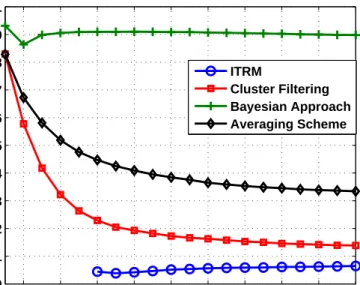
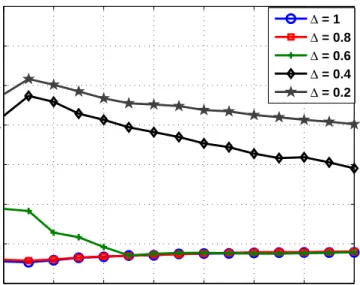
W. . . 33 4 MAE performance of various schemes for bad-mouthing whenW = 0.10. 34 5 MAE performance of various schemes for bad-mouthing whenW = 0.30. 34 6 MAE performance of ITRM for bad-mouthing when W = 0.10 and for
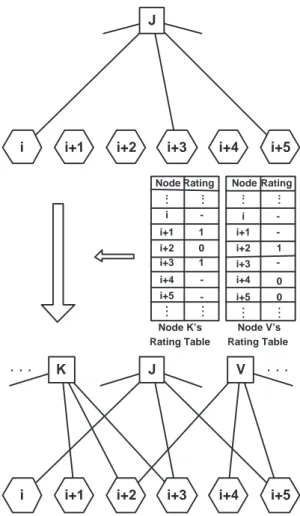
varying ∆. . . 35 7 Collecting and combining the rating tables at the judge nodeJ. . . . 47 8 Indirect type I feedback between nodes A (judge), B (suspect) and C
(witness). . . 50 9 Confidence of a judge node on its verdict vs. the detection level for
W = 0.10. . . 55 10 Mˆ versus the detection level when Σ = 0.95 for different values of W. 56 11 Probability of detection success for fixed k and varying s values with
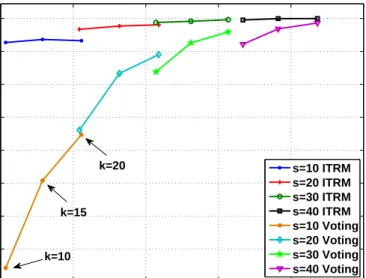
RWP mobility model for W = 0.10. . . 59 12 Probability of detection success for fixed s and varying k values with
RWP mobility model for W = 0.10. . . 60 13 Probability of detection success for fixed k and varying s values with
LW mobility model for W = 0.10. . . 60 14 Probability of detection success for fixed s and varying k values with
LW mobility model for W = 0.10. . . 61 15 MAE performance of various schemes for bad-mouthing whenW = 0.30. 64 16 Fraction of the recovered messages versus time for W = 0.10 with LW
mobility model. . . 66 17 Fraction of the recovered messages versus time for W = 0.40 with LW
mobility model. . . 66 18 Probability of message recovery for a single flow versus time for W =
0.10 with LW mobility model. . . 68 19 Probability of message recovery for a single flow versus time for W =
20 Packet delivery ratio versus time forW = 0.10 with LW mobility model. 70 21 Packet delivery ratio versus time forW = 0.40 with LW mobility model. 70 22 Factor graph between the SPs and the raters in (20). . . 81 23 Setup of the scheme. . . 82 24 Message from the factor nodekto the variable nodeaat theνth iteration. 84
25 Message from the variable nodeato the factor nodekat theνth iteration. 85
26 Probability of BP-ITRM to satisfy Condition1 versus fraction of ma-licious raters. . . 92 27 Probability that BP-ITRM is an ǫ-optimal scheme versus fraction of
malicious raters for different ǫ values. . . 92 28 The averageǫ values for which BP-ITRM is an ǫ-optimal scheme with
high probability versus fraction of malicious raters. . . 93 29 MAE performance of BP-ITRM versus time when W of the existing
raters become malicious in RepTrap [105]. . . 96 30 Change in average trustworthiness of malicious raters versus time for
BP-ITRM when W of the existing raters become malicious in Rep-Trap [105]. . . 97 31 The average number of iterations versus time for BP-ITRM when W
of the existing raters become malicious in RepTrap [105]. . . 97 32 MAE performance of various schemes when 30% of the existing raters
become malicious in RepTrap [105]. . . 98 33 MAE performance of BP-ITRM versus time when W of the existing
raters become malicious and rating values are integers from{1, . . . ,5}
in RepTrap [105]. . . 99 34 MAE performance of various schemes when 30% of the existing raters
become malicious and rating values are from{1, . . . ,5}in RepTrap [105]. 99 35 MAE performance of various schemes when 30% of the newcomer raters
are malicious. . . 100 36 Message from the factor node (client) k to the variable node (server)
a at the νth iteration. . . 109
37 Message from the variable node (server) a to the factor node (client) k at the νth iteration. . . 109
39 Probability of BP-P2P to provide an MAE that is less than ǫ versus fraction of malicious peers. . . 122 40 The average MAE values provided by BP-P2P with high probability
versus fraction of malicious peers. . . 123 41 The average number of iterations versus time for BP-P2P to converge
whenW of the existing peers become malicious. . . 126 42 MAE performance of BP-P2P versus time whenW of the existing peers
become malicious. . . 127 43 Change in average trustworthiness of malicious clients versus time for
BP-P2P whenW of the existing peers become malicious. . . 127 44 MAE performance of various schemes when different fractions of the
existing peers become malicious at the first time-slot the attack is applied.128 45 MAE performance of BP-P2P for different values ofξ and for different
fractions of malicious peers at the first time-slot the attack is applied. 128 46 MAE performance of BP-P2P for different ξ values and for W = 25%
malicious peers, at different time-slots. . . 129 47 MAE performance of various schemes when the rating values are from
Υ ={1, . . . ,5}. . . 130 48 MAE performance of BP-P2P when the attackers only attack as
mali-cious clients, at different time-slots. . . 131 49 MAE comparison of different attack scenarios for different fractions of
malicious peers at the first time-slot the attack is applied. . . 132 50 Graphical representation of the scheme from userz’s point of view. . 139 51 Message exchange between the factor node k and variable nodea. . . 141 52 Performance of BPRS in RMSE vs. number of iterations when: (i) all
users connected to each active user via a path, and (ii) only the 2-hop neighbors of each active user are considered. . . 145 53 Performance of BPRS in MAE vs. number of iterations when: (i) all
users connected to each active user via a path, and (ii) only the 2-hop neighbors of each active user are considered. . . 146 54 Performance of BPRS in RMSE vs. the inconsistency weight (w) when:
(i) all users connected to each active user via a path, and (ii) only the 2-hop neighbors of each active user are considered. . . 148
55 Performance of BPRS in MAE vs. the inconsistency weight (w) when: (i) all users connected to each active user via a path, and (ii) only the 2-hop neighbors of each active user are considered. . . 148 56 Performance of BPRS in RMSE vs. the BP message weight when: (i)
all users connected to each active user via a path, and (ii) only the 2-hop neighbors of each active user are considered. . . 151 57 Performance of BPRS in MAE vs. the BP message weight when: (i)
all users connected to each active user via a path, and (ii) only the 2-hop neighbors of each active user are considered. . . 151 58 Recall. . . 154 59 Precision vs Recall. . . 155
SUMMARY
This thesis investigates both theoretical and practical aspects of the design and analysis of iterative algorithms for trust and reputation management and rec-ommender systems. It also studies the application of iterative trust and reputation management mechanisms in ad-hoc networks and P2P systems.
First, an algebraic and iterative trust and reputation management scheme (ITRM) is proposed. The proposed ITRM can be applied to centralized schemes, in which a central authority collects the reports and forms the reputations of the service providers (sellers) as well as report/rating trustworthiness of the (service) consumers (buyers). It is shown that ITRM is robust in filtering out the peers who provide unreliable ratings. Next, the first application of Belief Propagation algorithm, a fully iter-ative probabilistic algorithm, on trust and reputation management (BP-ITRM) is proposed. In BP-ITRM, the reputation management problem is formulated as an inference problem, and it is described as computing marginal likelihood distributions from complicated global functions of many variables. However, it is observed that computing the marginal probability functions is computationally prohibitive for large scale reputation systems. Therefore, the belief propagation algorithm is utilized to efficiently (in linear complexity) compute these marginal probability distributions. In BP-ITRM, the reputation system is modeled by using a factor graph and reputation values of the service providers (sellers) are computed by iterative probabilistic mes-sage passing between the factor and variable nodes on the graph. It is shown that BP-ITRM is reliable in filtering out malicious/unreliable reports. It is proven that BP-ITRM iteratively reduces the error in the reputation values of service providers due to the malicious raters with a high probability. Further, comparison of BP-ITRM
with some well-known and commonly used reputation management techniques (e.g., Averaging Scheme, Bayesian Approach and Cluster Filtering) indicates the superior-ity of the proposed scheme both in terms of robustness against attacks and efficiency. The introduction of the belief propagation and iterative message passing methods onto trust and reputation management has opened up several research directions. Thus, next, the first application of the belief propagation algorithm in the design of recommender systems (BPRS) is proposed. In BPRS, recommendations (predicted ratings) for each active user are iteratively computed by probabilistic message passing between variable and factor nodes in a factor graph. It is shown that as opposed to the previous recommender algorithms, BPRS does not require solving the recommen-dation problem for all users if it wishes to update the recommenrecommen-dations for only a single active user using the most recent data (ratings). Further, BPRS computes the recommendations for each user with linear complexity, without requiring a training period while it remains comparable to the state of art methods such as Correlation-based neighborhood model (CorNgbr) and Singular Value Decomposition (SVD) in terms of rating and precision accuracy.
This work also explores fundamental research problems related to application of iterative and probabilistic reputation management systems in various fields (such as ad-hoc networks and P2P systems). A distributed malicious node detection mecha-nism is proposed for delay tolerant networks (DTNs) using ITRM which enables every node to evaluate other nodes based on their past behavior, without requiring a central authority. Further, for the first time. the belief propagation algorithm is utilized in the design and evaluation of distributed trust and reputation management systems for P2P networks. Several schemes are extensively simulated and are compared to demonstrate the effectiveness of the iterative algorithms and belief propagation on these applications.
CHAPTER I
INTRODUCTION
Trust and Reputation are crucial requirements for most environments wherein entities participate in various transactions and protocols among each other. In most online service systems, the consumer of the service (e.g., the buyer) has no choice but to rely on the reputation of the service provider (e.g., the seller) based on the latter’s prior performance. A reputation management mechanism is a promising method to protect the users against deceitful service providers. This mechanism lets a user to have some foresight about the service providers before using (or purchasing) their services. By using a reputation management scheme, an individual peer’s reputation can be formed by the combination of received reports (ratings). Hence, after each transaction, a party who receives the service (referred to as the rater) provides (to the central authority) its report about the quality of the service provided for that transaction. The central authority collects the reports and updates the reputations of the service providers. The reputation mechanism, however, opens up new vulnerabilities as the raters may provide unreliable or malicious reports, demonizing the reputations of the service providers unfairly. Therefore, the main goal of a reputation mechanism is to determine the service qualities of the service providers and the trustworthiness of the raters based on their reports about the service qualities. Hence, the success of a reputation scheme depends on the robustness of the mechanism to accurately evaluate the reputations of the service providers and the trustworthiness of the raters.
Trust and reputation mechanisms have various application areas from online ser-vices [3–7] to Mobile Ad-hoc Networks (MANETs) [23, 24, 39, 96]. Most well-known commercial web sites such as eBay, Amazon, Netflix and Google use some types of
reputation mechanisms. Another interesting potential application of trust and rep-utation management schemes is the peer review process of the journals/conferences to protect good papers against unfair reviews. Although generally considered essen-tial to academic quality, peer review has been criticized as ineffective and sometimes unfair. A reputation mechanism can be implemented to prevent such issues.
Online auction and shopping web site, eBay, stresses the importance of reputation systems by saying that “feedback is an essential part of what makes eBay a successful community” [2]. As eBay spokesperson Lisa Malyon puts it: “As eBay has evolved, our feedback system has evolved. By relying on the feedback of other users, our buyers are able to make purchases based on confidence and trust. Sellers are no longer rated on the number of transactions; it is the service they offer for each individual transac-tion”. On the other hand, buyers and sellers seem to be engaged in a war of attrition where negative feedback is one of the main weapons, and now eBay has announced that sellers will no longer be able to leave negative feedback on buyers, hoping that this will help to rebalance things. Randy Farmer, author of the forthcoming book Building Web Reputation Systems (with Bryce Glass) states that a user-generated, negative public rating is simply too problematic to be left to the crowd. On the other hand, a reputation system cannot give accurate results without negative feedbacks. Hence, eBay admits that there is still a crucial need to improve the existing reputa-tion systems. Indeed, eBay announced that it is considering changes to its feedback system that will be used soon [1].
According to a research conducted by the Pew Internet and American Life Project, A quarter of online Americans have taken advantage of one of the Internet’s true powers: the ability to let users collectively decide whether to trust a product, service or individual.“The more voices that are in the mix, the better off everybody is” said Lee Rainie, director of the Pew group [8]. Thus, an increasing number of commercial sites are following the lead long since set by Amazon.com, eBay and others that allow
users to weigh in on the value or reputations of products or other users of the service. It is foreseeable that the social web is going to be driven by these reputation systems. As in every system, trust and reputation management systems are also subject to malicious behaviors. Malicious raters may attack particular service providers in order to undermine their reputations while they help other service providers by boosting their reputations. Similarly, malicious service providers may provide good service qualities for certain customers in order to keep their reputations high while cheating the other customers. Moreover, malicious raters (or service providers) may collab-oratively come up with sophisticated attacking strategies by exploiting their prior knowledge about the reputation mechanism. Hence, building a resilient trust and reputation management system that is robust against malicious activities becomes a challenging issue.
In summary, we believe that trust and reputation management systems will lead various applications from the social web to ad-hoc networks in near future and there are needs for scalable and attack resilient reputation systems. In this thesis, we first propose an iterative trust and reputation management algorithm and its application to Delay Tolerant Networks (DTNs). Then, we introduce the first application of the BP algorithm for trust and reputation management and study its application for Peer-to-Peer (P2P) networks. Finally, relying on the similarities between the repu-tation and recommender systems and successful application of iterative algorithms on reputation systems, we study the application of BP algorithm for recommender systems. We briefly summarize these works in following.
1.1
Iterative Trust and Reputation Management and Its
Application to Delay Tolerant Networks (DTNs)
One of the primary objectives of this thesis is to develop a trust and reputation management scheme that not only provides immunity against malicious ratings but also discourages the service providers from any unfair and discriminating behaviors.
Our work on reputation systems stems from the prior success in the use of iterative algorithms, such as message passing techniques and Belief Propagation (BP) [83,110] in the decoding of Low-Density Parity-Check (LDPC) codes in erasure channels [75, 98]. These algorithms rely on graph-based representations of codes, where decoding can be viewed as message passing between the nodes in the graph. Moreover, they are shown to perform at error rates near what can be achieved by the optimal scheme, maximum likelihood decoding, while requiring far less computational complexity (i.e., linear in the length of the code). We believe that these significant benefits offered by iterative algorithms can be tapped in to benefit the field of reputation systems.
To achieve this, focusing mainly on centralized reputation management systems, we first introduce the “Iterative Trust and Reputation Mechanism” (ITRM) [11] in Chapter 3. ITRM is an algebraic trust and reputation management scheme inspired by the earlier work on iterative decoding of error-control codes in the presence of stopping sets [74,75,98]. In this work, we show the benefit of using iterative algorithms to detect and filter out unreliable ratings in a trust and reputation management system. Then, in Chapter 4, we explore the application of ITRM for Delay Tolerant Networks (DTNs).
DTNs are relatively new class of networks [38], wherein sparseness and delay are particularly high. In conventional MANETs, the existence of end-to-end paths via contemporaneous links is assumed in spite of node mobility. It is also assumed that if a path is disrupted due to mobility, the disruption is temporary and either the same path or an alternative one is restored very quickly. In contrast, DTNs are characterized by intermittent contacts between nodes, leading to space-time evolution of multihop paths (routes) for transmitting packets to the destination. In other words, DTNs’ links on an end-to-end path do not exist contemporaneously, and hence intermediate nodes may need to store, carry, and wait for opportunities to transfer data packets towards their destinations. Hence, DTNs are much more general than
MANETs in the mobile network space (i.e., MANETs are special types of DTNs). Applications of DTNs include emergency response, wildlife surveying, vehicular-to-vehicular communications, healthcare, military, and tactical sensing.
Compared to traditional MANETs, common problems in packet communication such as routing, unicasting, broadcasting and multicasting become sufficiently harder in DTNs even with lossless links (i.e., no packet erasures due to communication link). This increase in difficulty can be directly attributed to the lack of knowledge on the network topology, and the lack of end-to-end paths. Hence, the schemes for routing packets have to be primitive such as forwarding to the next available node, injecting multiple copies into available nodes and employing erasure block codes [101]. On the other hand, depending upon the model for mobility, efficient communication schemes for stationary ad-hoc networks can be extended partially or wholly to DTNs.
As in MANETs, adversary may mount several threats against DTNs to reduce the performance of the network. The most serious attacks are due to the Byzantine (insider) adversary in which one or more legitimate nodes have been compromised and are fully controlled by the adversary. A Byzantine-malicious node may mount the following attacks in order to give serious damage to the network: 1. Packet drop, in which the malicious node drops legitimate packets to disrupt data availability, 2. Bogus packet injection, in which the Byzantine node injects bogus packets to consume the limited resources of the network, 3. Noise injection, in which the malicious node changes the integrity of legitimate packets, 4. Routing attacks, in which the adversary tempers with the routing by misleading the nodes, 5. Flooding attacks, in which the adversary keeps the communication channel busy to prevent legitimate traffic from reaching its destination, and 6. Impersonation attacks, in which the adversary impersonates the legitimate nodes to mislead the network. We note that because of the lack of end-to-end path from a source to its destination in DTNs, routing attacks are not significant threats for such networks. Attacks on packet integrity may be
prevented using a robust authentication mechanism in both MANETs and DTNs. However, packet drop is harder to contain because nodes’ cooperation is fundamental for the operation of these networks (i.e., a group of nodes cooperate in routing each others’ packets using multihop wireless links without any centralized control). This cooperation can be undermined by Byzantine attackers, selfish nodes, or even innocent but faulty nodes. Therefore, we focus on packet drop attack which gives serious damages to the network in terms of data availability, latency, and throughput. Finally, Byzantine nodes may individually or in collaboration attack the security mechanism (e.g., the trust management and malicious node detection schemes).
In MANETs, reputation-based trust management systems are shown to be an effective way to cope with adversary. By establishing trust with the nodes it has or has not directly interacted, a node in the network diagnoses other nodes and predicts their future behavior in the network. Hence, trust plays a pivotal role for a node in choosing with which nodes it should cooperate, improving data availability in the network. Further, examining trust values has been shown to lead to the detection of malicious nodes in MANETs. Despite all the progress for securing MANETs, achieving the same for DTNs leads to additional challenges. The special constraints posed by DTNs make existing security protocols inefficient or impractical in such networks as will be discussed in Section 2.2.1. Thus, In Chapter 4, we propose a distributed malicious node detection mechanism for DTNs [12] using ITRM which enables every node to evaluate other nodes based on their past behavior, without requiring a central authority. Our results show that the resulting scheme effectively provides high data availability and low latency in the presence of Byzantine attackers. We also show that the proposed iterative mechanism is far more effective than some well-known reputation management techniques (e.g., Bayesian framework and EigenTrust) in detecting Byzantine nodes.
1.2
Belief Propagation for Trust and Reputation
Manage-ment and Its Application to Peer-to-Peer (P2P)
Net-works
In Chapter 5, we expand our work in Chapter 3 and introduce the first application of the BP algorithm (a fully probabilistic and iterative algorithm), on centralized trust and reputation management systems. Different from our initial work in Chapter 3, in this work, we view the reputation management problem as an inference problem and describe it as computing marginal likelihood distributions from complicated global functions of many variables. Further, we utilize the BP algorithm to efficiently (in linear complexity) compute these marginal probability distributions. Thus, we in-troduce the “Belief Propagation-Based Iterative Trust and Reputation Management Scheme” (BP-ITRM). We show the efficiency and robustness of BP-ITRM both via analysis and extensive simulations in a centralized setting.
In a distributed infrastructure, trust and reputation management is more compli-cated than in centralized solutions. Hence, in Chapter 6, we focus on P2P networks and explore the application of BP-based trust and reputation management algorithms in a completely decentralized environment in the presence of malicious peers mounting attacks. Peer-to-peer (P2P) networks are commonly defined as distributed architec-tures in which the workload is partitioned between the peers and each peer is equally privileged. As opposed to traditional client-server networking (in which certain peers are responsible for providing resources while other peers only consume), in P2P net-works, every peer plays the role of both a client and a server. In other words, each peer provides access to its resources (e.g., processing power or storage) as a server without the need for a central authority. P2P networks especially became popular as distributed file sharing systems in which peers exchange files between each other (such as Gnutella or Napster).
Due to their size and the distributed architecture, P2P systems are highly vulner-able to attacks by the malicious peers. The most common attack to P2P systems is in the form of injecting inauthentic files (or introducing viruses) to the network. Mali-cious behavior in P2P networks is mainly confronted by utilizing trust and reputation management systems in which clients get to rate the servers based on the quality of the transactions. A trust and reputation management mechanism is a promising method to protect the client by forming some foresight about the servers before using their resources. Using a distributed trust and reputation management mechanism, reputation values of the servers and the trustworthiness values of the clients (on their ratings) can be computed by the peers without needing a central authority. As a result of this, malicious behavior can be detected and honest behavior can be en-couraged in the network. As we discussed before, trust and reputation management systems are also subject to malicious behaviors. Malicious peers may attack the sys-tem to undermine (or boost) the reputation values of certain peers. Hence, building a resilient trust and reputation management system that is robust against malicious activities in a decentralized environment becomes a challenging issue. Despite recent advances in trust and reputation management in P2P networks, there is yet a need to develop reliable, scalable and dependable schemes that would also be resilient to various ways a distributed trust and reputation system can be attacked. Thus, in Chapter 6, for the first time, we utilize the BP algorithm in the design and eval-uation of distributed trust and reputation management systems for P2P networks. We introduce the “Belief Propagation-Based Trust and Reputation Management for P2P Networks” (BP-P2P). We show via analysis and simulations that BP-P2P is resilient against attacks in a distributed environment. Further, we show that the computational complexity of BP-P2P grows only linearly with the number of peers and the communication overhead of BP-P2P is lower than the well-known EigenTrust algorithm.
1.3
Application of Belief Propagation for Recommender
Systems
Relying on our success in the reputation management problem, in Chapter 7, we ex-tend the BP-based technique to arrive at scalable, accurate and robust recommender systems. Today, the quantity of available information grows rapidly, overwhelming consumers to discover useful information and filter out the irrelevant items. The ex-plosive growth of the Internet has made this issue increasingly more serious. Thus, the user is confronted with a big challenge of finding the most relevant information or item in the short amount of time. Without some support, the process of filtering out irrelevant items and finally selecting the most appropriate one could be very difficult. Recommender systems are aimed at addressing this overload problem, suggesting to the users those items that meet their interests and preferences the best in a particular situation and context. These systems are used to direct users towards items they will like while interacting with large information spaces. More generally, recommender systems can learn about user preferences and profile over time, based on data min-ing algorithms, and automatically suggest products (from a large space of possible options) that fit the user needs.
Currently, recommender systems are used in a variety of application domains, e.g., books, movies, and music. Most well-known commercial web sites such as eBay, Amazon and Netflix use some types of recommender systems. Further, recommender systems have applications in advertisements; which is a successful source of income for Google and social networking web sites. By finding similarity among people’s choices, recommender systems can be used for the customer directed advertising in which users are directed toward those items that meet their needs and preferences the best. Hence, it is foreseeable that the social web is going to be driven by these recommender systems.
The online movie rental service, Netflix, emphasizes the importance of recom-mender systems and the need to improve them by saying that “if there is a much bet-ter approach, it could make a big difference to our customers and our business” [7]. Indeed, in September 2009, the company awarded a $1 million prize to a team of engineers, statisticians and researchers that improved the accuracy of its movie rec-ommendation system by 10%. “Personalized recrec-ommendations,” says Brent Smith, Amazon’s director of personalization, “are at the heart of why online shopping offers so much promise”.
However, there are certain challenges to design accurate and scalable recommender systems. On one hand, unfortunately, recommender systems have to operate on in-complete profiles because users either do not like to disclose lots of personal informa-tion and preferences, and/or are not completely aware about their preferences. On the other hand, with the rapid growth of information flow, an increasing number of appli-cations require recommender systems to make predictions without full knowledge of the problem they are trying to solve. The available data for the recommender systems is incomplete, uncertain, inconsistent and/or intentionally-contaminated. Challenges of this sort underlie the prediction problem in electronic commerce (where relevant information is hidden by parties who may have an incentive to misreport it), and on-line services (where the quality of predictions in the present depends on information revealed only in the future). Hence, new research needed to focus on algorithms which meet these challenges in the face of such uncertainty and yet maintain computational efficiency.
The two main collaborative filtering approaches that emerged as victorious from the Netflix Prize [7] are neighborhood methods and latent factor models. Neigh-borhood methods use similarity functions such as the Pearson Correlation or Cosine Distance to compute sets of neighbors to a user or an item. Recommendations are then computed by using data from those neighbors. On the other hand, latent factor
models such as Matrix Factorization [93] solve the recommendation problem by de-composing the user-item matrix and learning latent factors for each user and item. The underlying assumption is that both users and items can be modeled by a reduced number of factors. This approach has proven to be the most accurate method in the Root Mean Square Error (RMSE) sense. However, most existing and highly popular recommender systems are shown to be prone to malicious behavior [29, 97] and they have scalability issues. In other words, they fall short of incorporating the attack pro-files and the extra noise generated by the malicious users. Further, each new update (using the most recent data or ratings) for a particular active user requires to solve the entire problem for every user in the system, making it unattractive for large scale systems. On the other hand, Matrix Factorization methods are optimized to mini-mize RMSE. However, it is widely argued that RMSE cannot serve as a good proxy for usage precision accuracy [31]. Therefore, there is yet a need to develop scalable and dependable schemes. Thus, we formulate the recommender system problem as finding the marginal probability distributions of the unknown variables on a factor graph and we introduce the “Belief Propagation-Based Iterative Recommender Sys-tem” (BPRS) in Chapter 7. We show that BPRS computes the recommendations for each user instantaneously (with linear complexity) using the most recent data and without requiring a training period. Further, we show that BPRS also provides com-parable usage prediction and rating prediction accuracy to other popular methods such as Correlation-based neighborhood model (CorNgbr) [18] and Singular Value Decomposition (SVD) [102].
Finally, Chapter 8 summarizes the completed work and points out some of the possible future research directions.
CHAPTER II
BACKGROUND
In this chapter, we review the work related to the trust and reputation management schemes, security of Delay Tolerant Networks (DTNs), trust and reputation manage-ment in Peer-to-peer (P2P) networks, and recommender systems.
2.1
Trust and Reputation Management for Online Service
Provision
We may classify reputation mechanisms for centralized systems as i) global reputa-tion systems, where the reputareputa-tion of a service provider is based on the ratings from general users [25, 68], and ii) personalized reputation systems (i.e., recommender sys-tems), where the reputation of a service provider is determined based on the rat-ings of a group of particular users, which may be different in the eyes of different users [35,108] (personalized reputation systems will be discussed in Section 2.4). The most famous and primitive global reputation system is the one that is used in eBay. Other well-known web sites such as Amazon, Epinions, and AllExperts use a more advanced reputation mechanism than eBay. Use of the Bayesian Approach is also proposed in [25, 103]. Finally, [35] proposed to use the Cluster Filtering method [64] for reputation management. We briefly review these schemes in the following. 2.1.1 Commercial and Live Reputation Systems
The most famous and primitive global reputation system is the one that is used in eBay [5]. In eBay, after each transaction, sellers and buyers rate each other with the ratings 1 (positive), 0 (neutral) or −1 (negative), and the total rating of a peer is the sum of the individual ratings it received from the other peers. To provide information
about the recent behavior of a peer, ratings about the past 6 months, ratings about the past month and the ratings about the past 7 days are kept separately. It is shown in [78] that, even this simple reputation mechanism provides the sellers with high reputation to sell their items more than the other sellers. However, there are a few major problems about the reputation scheme of eBay as well. Since all individual ratings are weighted equally, the unfair ratings (the ones coming from the malicious peers) are not filtered, and hence, they effect the reputation values of the sellers significantly. Moreover, since each peer initially starts with a reputation of 0, any peer with a negative reputation value may sign in to the system again with a new ID to increase its reputation value to 0. Another problem about the eBay is that since peers can see the ratings of each other in a transaction, peers give good ratings to each other most of the time which causes the reputation values to increase for each peer. EBay charges each seller a fee for selling an item to prevent fake transactions between peers (to avoid the collaboration of the peers to increase each others reputations). However, the loss due to the fake transactions can be compensated by the gain after having a high reputation value.
The well known online shopping site Amazon also uses a reputation system to rate its products [4]. Members give ratings to the products between 1 and 5, and each member is treated equally for their ratings as in eBay. The difference of Amazon from eBay is that users can also vote on the reviews of the other users on the products. This mechanism determines each reviewers rank as a function of the helpful votes it received.
Epinions [6], is a product review site in which users can rate and review items. Similar to Amazon, users can also give ratings to the reviews. Hence, the ratings of members on a review and on a product are considered separately. As a result of this, users are classified based on the quality of their ratings. In Epinions, users are motivated to write high quality reviews to the products by getting paid, and authors
of more useful reviews earn more than the others.
An expert site, AllExperts [3], also uses a global centralized reputation system to rate the experts who provide service by answering the questions of the users. In [3], depending on the quality of the reply, the user who asked the question rates the expert on various aspects with a rating from 1 to 10. The average rating of an expert is basically the average of the individual ratings it receives from the users to whom it provided a service. The number of questions an expert answered is also displayed along with its average rating. However, there is no security mechanism against malicious peers and unfair ratings in [3], which makes this system vulnerable to malicious activities.
It is worth noting that the above reputation management mechanisms compute the average (or weighted average) of the ratings received for a product (or a peer) to evaluate the global reputation of a product (or a peer). Hence, these schemes are vulnerable to collaborative attacks by malicious peers.
2.1.2 Bayesian Approach
In Bayesian reputation systems [25,103], thea posteriori reputation value of a peer is computed combining its a priory reputation value with the new ratings received for that peer. The reputation of a peer is represented in the form of Beta PDF parameter tuple (α, β) (amount of positive and negative feedbacks) or the expectation value of the Beta PDF. When nothing is known, thea priori distribution is the uniform Beta PDF withα= 1 andβ = 1 . Then, after observingrpositive andsnegative outcomes, thea posteriori distribution is the Beta PDF withα=r+ 1 andβ=s+ 1. A PDF of this type expresses the uncertain probability that future interactions will be positive. Further, the reputation score is commonly defined in the form of the probability expectation value of the Beta PDF. Moreover, Bayesian reputation systems use a threshold method to determine and update the report reliability (reliability of the
ratings) of the peers. The server checks whether the received ratings are within a definite interval. Peers whose ratings lie within the interval are considered to be honest. Hence, reliability of a peer increases when the peer reports a reliable rating but decreases otherwise.
Since we present and evaluate our proposed trust and reputation management frameworks (ITRM and BP-ITRM) in a centralized setting, the most well-known Bayesian Approaches in Buchegger’s work [25] and Whitby’s work [103] can be con-sidered as similar. In [25], if a rater’s rating is deviated more than the deviation thresholdd from the calculated reputation value, its trustworthiness value is updated accordingly. Further, if a rater’s trustworthiness exceeds a definite threshold t, it is detected as malicious. Similarly, in [103], instead of using the deviation threshold, the authors check if the calculated reputation value for the service provider falls be-tween a definite interval for each rater’s rating distribution. Furthermore, we identify that both [25] and [103] have the same shortcoming against colluding malicious raters; both [25] and [103] first calculate the reputation value of a particular service provider, and then based on the calculated value, they adjust each rater’s trustworthiness value. On the other hand, when the malicious raters collude, it is likely that the majority of the ratings to the victim service providers will be from malicious raters. In this scenario, the Bayesian Approach not only fails to filter the malicious ratings but it also punishes the honest raters which rates the victim service providers.
2.1.3 Cluster Filtering
Cluster Filtering [35] performs a dissimilarity test among the raters and then updates the reputation values of the peers using only the honest raters. Cluster Filtering [35] introduces a mechanism of controlled anonymity to avoid unfair ratings from malicious raters. To reduce the effect of unfair ratings, the authors first use collaborative filtering techniques [40, 80] to determine a neighborhood group of rater peers whose
ratings over many subjects are similar. They then propose the Cluster Filtering approach [64] to filter out the unfair ratings. The idea of this approach is to apply a divisive clustering algorithm to separate the ratings into two clusters, the lower rating cluster and the higher rating cluster. Ratings in the lower rating cluster are considered as fair ratings. Ratings in the higher rating cluster are considered as unfair ratings, and therefore are excluded or discounted. To deal with the situation where ratings vary over time, the Cluster Filtering approach considers only the ratings within the most recent time window whose width is influenced by the frequency of fair ratings.
Different from these existing schemes, our proposed algorithms (ITRM [11] and BP-ITRM [16]) are graph based iterative algorithms motivated by the previous success on message passing techniques and belief propagation algorithms.
2.2
Security for Delay Tolerant Networks (DTNs)
Several works in the literature have focused on securing DTNs. In [88], the chal-lenges of providing secure communication (i.e., confidentiality) in DTNs is discussed and the use of Identity-Based Cryptography (IBC) [32] is suggested. In [55], source authentication and anonymous communication as well as message confidentiality are provided using IBC. In [26], the use of packet replication is proposed to improve message delivery rate instead of using cryptographic techniques. We note that the existing techniques to secure DTNs are aimed to provide data confidentiality and authentication only. On the other hand, our proposed trust-based scheme provides malicious node detection and high data availability with low packet latency in the presence of Byzantine attacks. In MANETs, reputation-based trust management sys-tems are shown to be an effective way to cope with adversary. In the following we discuss these systems and their impracticality for DTNs.
2.2.1 Trust Management in Mobile Ad-hoc Networks (MANETs)
The main goal for building a reputation system in MANETs is to protect the reactive routing protocol from attackers and increase the performance of the network. A recent review of these secure routing protocols for MANETs [73] indicates that these protocols either use the watchdog mechanism or Acknowledgement (ACK) messages to build trust values between the nodes. In MANETs, a node evaluates another by using either direct or indirect measurements. Building reputation values by direct measurement is either achieved by using the watchdog mechanism or by using the ACK from the destination. Building reputation values by just relying on the direct measurements and using the watchdog mechanism is proposed in [65, 69]. These schemes rely on monitoring the neighbor node to detect possible misbehavior. In other words, once a node forwards its packets to a specific node, it monitors the node by overhearing its transmission. Hence, a malicious node is detected by its neighbor when it drops a packet or changes the integrity of a packet. In [23, 24], the use of indirect measurements to build reputation values is also allowed while the watchdog mechanism is used to obtain the direct measurements. In these schemes, a node uses the reputation values that are established by some other node along with its own direct measurements. In [13, 15, 37, 61, 107], reputation values are constructed using the ACK messages sent by the destination node. In other words, a source node, which has established a path to its destination, would blame a path with a negative ACK and would attempt to use a path with higher credentials to increase the efficiency.
We note that these techniques are not applicable to DTNs due to the following reasons. In DTNs, a node cannot use the watchdog mechanism and monitor another intermediate node after forwarding its packets to it. This is because links on an end-to-end path do not exist contemporaneously, and hence an intermediate node needs to store, carry and wait for opportunities to transfer those packets. As a result, the node loses connection with the intermediate node which it desires to monitor. This
implies that a Byzantine node in DTNs can get packets from a legitimate node, then move away and drop the packets. Similarly, relying on the ACK packets from the destination to establish reputation values would fail in DTNs because of the lack of a fixed common multihop path from the source to the destination. Even if we assume an ACK from destination to the source (which incurs large latency), this feedback packet travels to the source via intermediate nodes that are different from the set of nodes that delivered the data packet to the destination. More specifically, the source node, upon receiving a negative ACK, cannot decide which node on the forwarding path is to be blamed. Lastly, using indirect measurements is possible in DTNs. However, it is unclear as to how these measurements can be obtained in the first place.
2.3
Trust and Reputation Management in Peer-to-Peer (P2P)
Networks
Trust and reputation management systems for P2P networks received a lot of atten-tion [9, 30, 33, 43, 52, 53, 79]. In [79] and [52], authors cover most of the work on the use of trust and reputation management systems for P2P networks. Most proposed P2P trust and reputation management mechanisms utilize the idea that a peer can monitor others and obtain direct observations [9] or a peer can enquire about the rep-utation value of another peer (and hence, obtain indirect observations) before using the service provided by that peer [30, 33].
EigenTrust [53] is one of the most popular reputation management algorithms for P2P networks. In EigenTrust algorithm, each peer i rates another peer j by rating each downloaded file (from peer j) either as positive (if the downloaded file is au-thentic) or negative (if the downloaded file is fake). Each peer maintains a sum of all his transactions with other peers in a local trust vector. Then, the local trust values are aggregated around the network and normalized so that malicious peers will not be able to assign arbitrarily high trust values to other malicious peers. This normal-ization ensures that all trust values will lie between 0 and 1. Global reputation of
each peeri is computed from the local trust values assigned to peeri by other peers. These local trust values are weighted by global reputations of assigning peers. This process iteratively continues until the global reputation values converge (the change in global reputation values drops below a threshold). The EigenTrust algorithm is constrained by the fact that trustworthiness of a peer (on its feedback) is equivalent to its reputation value. However, trusting a peer’s feedback and trusting a peer’s service quality are two different concepts. A malicious peer can attack the trust and reputation management system while providing a high quality service. Further, the EigenTrust algorithm relies on the presence of pre-trusted peers in the network which is not practical in most networks. Most importantly, the EigenTrust algorithm com-putes the global reputation values by a simple iterative weighted averaging mechanism which is vulnerable to collaborative attacks from the malicious peers.
Use of the Bayesian framework is also proposed in [23] (Bayesian framework is discussed in Section 2.1.2). In schemes utilizing the Bayesian framework, each repu-tation value is computed independent of the other nodes’ repurepu-tation values. However, the ratings provided by the nodes induce a probability distribution on the reputation values. These distributions are correlated because they are induced by the overlap-ping set of nodes. The strength of our proposed approach (BP-P2P) stems from the fact that it tries to capture this correlation in analyzing the ratings and computing the trust and reputation values.
2.4
Recommender Systems
Techniques to build recommender systems [10, 81, 86, 87] can be classified into two main categories: i) content-based filtering [17, 46] in which the system uses behav-ioral data about a user to recommend items similar to those previously consumed by the user, and ii) collaborative filtering [40, 80] in which the system compares one user’s behavior against the other users’ behaviors and identifies items which were
preferred by similar users. There are also hybrid methods combining these two tech-niques [27]. Collaborative filtering algorithms also fall into two general classes: i) memory-based algorithms [21, 45, 77] in which the value of an unknown rating is computed by aggregating the ratings of some other users for the same item, and ii) model-based algorithms [28, 48, 49, 51, 56–58, 67] in which the system uses the collec-tion of the ratings to learn a model that is then used to make rating prediccollec-tions. Methods that combine both memory-based and model-based algorithms are also sug-gested [71]. Memory-based algorithms are further classified into user-based [47, 62], item-based [36, 54, 84], and hybrid methods [100]. On the other hand, model-based algorithms include clustering methods [67], probabilistic methods [49], methods ex-ploiting Singular Value Decomposition (SVD), Principal Component Analysis (PCA) and Maximum Margin Matrix Factorization (MMMF) techniques [41, 85, 93, 102].
The application of Bayesian networks and message passing algorithms for rec-ommender systems is also studied in the past [34, 94]. In [94], the message passing technique is used to determine the latent factors of the users and items (as an alter-native to SVD). In [34], because of the fuzziness associated with the ambiguity in the description of the ratings, a (non-iterative) inference is proposed among the users to remove this ambiguity. The key difference between our proposed approach and the other message passing-based methods is that, we describe the recommendation prob-lem as computing marginal likelihood distributions from complicated global functions of many variables. To solve this problem whose complexity grows exponentially, we resort to the Belief Propagation (BP) algorithm whose computational efficiency (i.e., linear in the number of users) is driven by exploring the way in which the global functions factors into a product of simpler local functions. Inspired by successful applications of BP algorithms in various fields such as decoding of error correcting codes [59, 60, 66, 104], Artificial Intelligence [70], and reputation systems [16], we de-velop a new accurate and scalable recommender system.
CHAPTER III
ITERATIVE TRUST AND REPUTATION
MANAGEMENT MECHANISM
3.1
Introduction
As we discussed in Chapter 1, trust and reputation are crucial requirements for most environments wherein entities participate in various transactions and protocols among each other. On the other hand, trust and reputation management systems are sub-ject to various malicious behaviors. Hence, there is yet a need to develop reliable, scalable and dependable reputation management schemes that would also be resilient to various ways a reputation management system can be attacked. Focusing mainly on centralized reputation systems, the ultimate objective of this chapter is to develop a trust and reputation management scheme that not only provides immunity against malicious ratings but also discourages the service providers from any unfair and dis-criminating behaviors. To achieve this, we propose an algebraic iterative algorithm referred as “Iterative Trust and Reputation Mechanism” (ITRM). As in every trust and reputation management mechanism, we have two main goals: 1. Computing the service quality (reputation) of the peers who provide a service (henceforth referred to as Service Providers or SPs) by using the feedbacks from the peers who used the service (referred to as the raters), and 2. Determining the trustworthiness of the raters by analyzing their feedback about SPs. We consider the following major at-tacks that are common for any trust and reputation management mechanisms: i) Bad-mouthing, in which malicious raters collude and attack the SPs with the highest reputation by giving low ratings in order to undermine them, and ii) Ballot-stuffing, in which malicious raters collude to increase the reputation values of peers with low
reputations. Further, we evaluate ITRM against some sophisticated attacks (which utilizes bad-mouthing or ballot-stuffing with a strategy) such as RepTrap [105] or the one in which malicious raters provide both reliable and malicious ratings to mislead the algorithm.
Our proposed iterative algorithm is inspired by the earlier work on the improved iterative decoding algorithm of LDPC codes in the presence of stopping sets [75, 98]. In iterative decoding of LDPC, every check-vertex (in the graph representation of the code) has some opinion of what the value of each bit-vertex should be. The iterative decoding algorithm would then analyze the collection of these opinions to decide, at each iteration, what value to assign for the bit-vertex under examination. Once the values of the bit-vertices are estimated, in the next iteration, those values are used to determine the satisfaction of the check-vertex values. The novelty of this work stems from the observation that a similar approach can be adapted to determine SPs’ repu-tation values as well as the trustworthiness of the raters. Furthermore, the analysis of reputation systems resembles that of the code design problem. In LDPC, one of the goals is to find the decoding error for the a fixed set of check constraints. Similarly, in ITRM, our goal is to specify the regions of trust for the set of the system parameters. A region of trust is the range of parameters for which we can confidently determine the reputation values within a given error bound. We acknowledge, however, that we have a harder problem in the case of reputation systems as the adversary dynamics is far more complicated to analyze than the channel noise in the coding problem. 3.1.1 Contributions
The main strengths of the ITRM scheme are summarized in the following.
1. The proposed algorithm computes the reputations of the service providers accu-rately (with a small error) in a short amount of time in the presence of attackers. 2. ITRM is a robust and efficient methodology for detecting and filtering out
unreliable ratings (from malicious raters) in a short amount of time.
3. ITRM detects the malicious raters with a high accuracy, and updates their trust-worthiness accordingly. Hence, ITRM enforces the malicious raters to execute low grade attacks in order to remain undercover.
4. The proposed ITRM algorithm has a computational complexity that is linear with the number of raters. Hence, ITRM is scalable and suitable for large scale implementations.
3.2
Iterative Trust and Reputation Management
Mecha-nism (ITRM)
Let T Rj be the global reputation of the jth SP. Further, T Rij represents the rating
that the peer ireports about the SP j, whenever a transaction is completed between the two peers. Moreover, Ri denotes the (report/rating) trustworthiness of the ith
peer as a rater1. The first step in developing ITRM is to interpret the collection of the raters and the SPs together with their associated relations as a bipartite graph, as in Fig. 1(a). In this representation, each rater corresponds to a check vertex in the graph, shown as a square and each SP is represented by a bit vertex shown as a hexagon in the graph. If a rater i has a rating about the jth SP, we place an edge
with value T Rij from the ith check-vertex to the jth bit-vertex. As time passes, we
use the age-factored values as the edge values instead. To each edge {ij}, a value W Rij =wijT Rij is assigned, where W Rij is the age-factored T Rij value. The factor
wij(t) is used to incorporate the time-varying aspect of the reputation of the SPs (i.e.,
time-varying service quality). We use a known factor wij(t) = ˆλt−tij where ˆλ and tij
are the fading parameter and the time when the last transaction between the rater i and the SP j occurred, respectively. If a new rating arrives from the ith rater about
1
All of these parameters (T Rj, T Rij andRi) may evolve with time. However, for simplicity, we
the jth SP, our scheme updates the new value of the edge {ij} by averaging the new
rating and the old value of the edge multiplied with the fading factor.
We consider slotted time throughout this discussion. At each time-slot, ITRM will be executed using the input parameters Ri and W Rij to obtain the reputation
parameters (e.g., T Rj) and the list of malicious raters (referred to as the blacklist).
Initially, the blacklist is set empty. Details of ITRM may be described by the following procedure at the Lth time-slot. Let R
i and T Rij be the parameter values prior to the
present execution (the Lth execution) of ITRM algorithm. Let also T Rν
j and T Rνij
be the values of the bit-vertex and the {ij}th edge at the iteration ν of the ITRM
algorithm. Prior to the start of the iteration (ν = 0), we set T Rν=0
ij = T Rij and
compute the initial value of each bit-vertex (referred to as the initial guess T Rν=0
j )
based on the weighted average of the age-factored edge values (W Rν
ij) of all the edges
incident to the bit-vertex j. Equivalently, we compute
T Rνj = P i∈Aj Ri×W Rνij P i∈Aj Ri×wij(t) , (1)
where Aj is the set of all check-vertices connected to the bit-vertex j. It is
interest-ing to note that the initial guess-values resemble the received information from the channel in the channel coding problem. Then, the first iteration starts (i.e., ν = 1). We first compute the average inconsistency factor Cν
i of each check-vertex i using
the values of the bit-vertices (i.e., T Rν−j 1) for which it is connected to. That is, we compute Ciν = 1 P j∈Bi ˆ λt−tij X j∈Bi d(T Rν−ij 1, T Rν−j 1), (2) where Bi is the set of bit vertices connected to the check-vertex i and d(·,·) is a
distance metric used to measure the inconsistency. We use the L1 norm (absolute
value) as the distance metric, and hence, d(T Rν−1
After computing the inconsistency factor for every check-vertex, we list them is as-cending order. Then, the check-vertex i with the highest inconsistency is selected and placed in the blacklist if its inconsistency is greater than or equal to a definite threshold τ (whose choice will be discussed later). If there is no check-vertex with inconsistency greater than or equal toτ, the algorithm stops its iterations. Once the check-vertex i is blacklisted, we delete its rating T Rν
ij for all the bit-vertices j it is
connected to. Then, we update the values of all the bit-vertices using (1). This com-pletes the first iteration of ITRM. The iterative algorithm proceeds to other iterations exactly in the same way as the first iteration, updating the values of the bit-vertices and blacklisting some other check-vertices as a result. However, once a check-vertex is placed in the blacklist, for the remaining iterations it is neither used for the evalu-ation of T Rj values nor for the inconsistency measure of the check-vertices. We stop
the iterations when the inconsistencies of all the check-vertices (excluding the ones already placed in the blacklist) fall below τ.
As an example, ITRM is illustrated in Fig. 1 for 7 raters, 3 SPs, and τ = 0.7. It is assumed that the rates are integer values from {1, . . . ,5} and the actual reputations of the SPs, ˆT Rj, are equal to 5. For simplicity, we assumed wi’s to be equal to 1 and
Ri’s to be equal for all raters. Furthermore, we assumed that the peers 1, 2, 3, 4, and 5
are honest but 6 and 7 are malicious raters. The malicious raters (6 and 7) mount the bad-mouthing attack in this example by rating the SPs with ˆT Rj = 5 as 1 (to degrade
their reputations). Fig. 1(a) shows theT Rij values (illustrated by different line-styles)
prior to the execution of ITRM. The T Rj values and the individual inconsistencies
of the raters after each iteration are also illustrated in Fig. 1(c). We note that the algorithm stops at the third iteration when all the raters have inconsistencies less than τ. Fig. 1(c) indicates how ITRM gives better estimates of T Rj’s compared to
the weighted averaging method (which is correspond to the zero iteration). Fig. 1(b) illustrates the edges after the final iteration of ITRM. It is worth noting that the
malicious raters 6 and 7 are blacklisted and their ratings are accordingly deleted. Moreover, rater 3, although honest, is also blacklisted at the third iteration. We note that this situation is possible when an honest but faulty rater’s rating have a large deviation from the other honest raters.
(c) te xt 5 TRij = 5 TRij = 4 TRij = 3 TRij = 2 TRij = 1 rater peer blacklisted rater service provider Iteration C1 0 1 2 1.1 3 .85 .43 .12 C2 .72 .43 .35 .38 C3 .10 .35 .77 -C4 1.52 1.23 .65 .63 C5 1.1 .85 .43 .12 C6 1.87 2.42 -Iteration TR1 TR2 TR3 0 1 2 4.8 4.8 4.8 3 2.75 3.5 3.33 4.33 4.5 3 4.75 5 4.5 5 5 5 R1 R2 R3 R4 R5 R6 R7 S1 S2 S3 (b) 5 5 5 R1 R2 R3 R4 R5 R6 R7 S1 S2 S3 (a) 1.87 -C7 TR11 TR73
Figure 1: Illustrative example of ITRM.
3.2.1 Managing Raters’ Trustworthiness
We update the Ri values using the set of all past blacklists together in a Beta
distri-bution [25]. Initially, prior to the first time-slot, for each rater-peeri, the Ri value is
set to 0.5 (φi = 1 andϕi = 1). Then, if the rater-peeriis blacklisted, Ri is decreased
by setting
ϕi(t+ 1) = ¯λϕi(t) + (Ci+ 1−τ)δ, (4)
otherwise, Ri is increased by setting
where ¯λ is the fading parameter and δ denotes the penalty factor for the blacklisted raters. We note that updating Ri values via the Beta distribution has one major
disadvantage. An existing malicious rater with low Ri could cancel its account and
sign in with a new ID (whitewashing). This problem may be prevented by updating Ri’s using the method proposed in [108].
3.3
Security Evaluation of ITRM via User Modeling
In order to facilitate future references, frequently used notations are listed in Table 1.
Table 1: Notations and definitions. D Number of malicious raters
H Number of honest raters N Number of service providers
W D/(D+H) (i.e., fraction of malicious raters) m Rating given by an honest rater
n Rating given by a malicious rater
X Total number of malicious ratings T Rij received by a victim SP
d Total number of newly generated ratings, per time-slot, by an honest rater b Total number of newly generated ratings, per time-slot, by a malicious rater ˆb Total number of newly generated attacking/malicious ratings, per time-slot,
by a malicious rater
∆ ˆb/b(i.e., fraction of attacking ratings per time-slot)
µ Total number of un-attacked SPs rated by an honest rater
3.3.1 Analytic Evaluation
We adopted the following models for various peers involved in the reputation sys-tem. We assumed that the quality of SPs remains unchanged during time-slots. We provided the evaluation for the bad-mouthing attack only, as similar results hold for ballot-stuffing and combinations of bad-mouthing and ballot-stuffing. We let ˆT Rj
be the actual reputation value of the jth SP. Ratings (i.e., T R
ij) generated by the