Double Marginalization in Performance-Based Advertising:
Implications and Solutions
Chrysanthos Dellarocas Boston University School of Management
First draft: August 2009. Current draft: March 2010
Abstract
An important current trend in advertising is the replacement of traditional pay-per-exposure (pay-per-impression) pricing models with performance-based mechanisms in which advertisers pay only for measurable actions by consumers. Such pay-per-action (PPA) mechanisms are be-coming the predominant method of selling advertising on the Internet. Well-known examples include pay-per-click, pay-per-call and pay-per-sale. This work highlights an important, and hith-erto unrecognized, side-effect of PPA advertising. I find that, if the prices of advertised goods are endogenously determined by advertisers to maximize profits net of advertising expenses, PPA mechanisms induce firms to distort the prices of their goods (usually upwards) relative to prices that would maximize profits in settings where advertising is sold under pay-per-exposure meth-ods. Upward price distortions reduce both consumer surplus and the joint publisher-advertiser profit, leading to a net reduction in social welfare. They persist in current auction-based PPA mechanisms, such as the ones used by Google and Yahoo. In the latter settings they always reduce publisher revenues relative to pay-per-exposure methods. In extreme cases they also lead to rat-race situations where, in their effort to outbid one another, advertisers raise the prices of their products to the point where demand for them drops to zero. I show that these phenomena constitute a form of double marginalization and discuss a number of enhancements to today’s PPA mechanisms that restore equilibrium pricing of advertised goods to efficient levels.
Keywords: performance-based advertising, sponsored search, keyword auctions, double marginaliza-tion, mechanism design
Acknowledgments: Many thanks to Jason Hartline, Lorin Hitt, De Liu, Michael Schwarz, Siva Viswanathan and seminar participants at Harvard, Wharton, Tepper, Toulouse IDEI and Boston University for valuable feedback on an earlier version of this work.
Half the money I spend on advertising is wasted; the trouble is, I don’t know which half. John Wanamaker, owner of America’s first department store
1
Introduction
John Wanamaker’s famous quote has been haunting the advertising industry for over a century. It now serves as the motivation behind much of the innovation taking place in Internet-based advertis-ing. From Google, Yahoo and Microsoft, to Silicon Valley upstarts, some of the best and brightest technology firms are focusing a significant part of their energies on new mechanisms to reduce ad-vertising waste. These come in many forms but have one thing in common: a desire to replace traditional pay-per-exposure (also known as pay-per-impression) pricing models, in which advertis-ers pay a lump sum for the privilege of exposing an audience of uncertain size and interests to their message, with performance-based mechanisms in which advertisers pay only for measurableactions by consumers. Pay-per-click sponsored search, invented by Overture and turned into a multi-billion dollar business by Google, Yahoo and other online advertising agencies, is perhaps the best known of these approaches: advertisers bid in an online auction for the right to have their link displayed next to the results for specific search terms and then pay only when a user actually clicks on that link, indicating her likely intent to purchase. Pay-per-call, pioneered by firms such as Ingenio (acquired by AT&T in 2007), is a similar concept: the advertiser pays only when she receives a phone call from the customer, usually initiated through a web form. Pay-per-click and pay-per-call are viewed by many as only an intermediate step towards what some in the industry consider to be the “holy grail of advertising”: the pay-per-sale approach where the advertiser pays only when exposure to an advertising message leads to an actual sale. All of these approaches are attempting to reduce all or part of Wanamaker’s proverbial waste by tying advertising expenditures to consumer actions that are directly related or, at least, correlated with the generation of sales. In the rest of the paper I will refer to them collectively as pay-per-action (PPA) pricing models.
The current surge in pay-per-action advertising methods has generated considerable interest from researchers in a variety of fields including economics, marketing, information systems and computer science. This is important and timely since most of these methods have been invented by practitioners and their properties and consequences are not yet fully understood. Although the literature (surveyed in Section 2) has made significant advances in a number of areas, an important area that, so far, has received almost no attention is the impact of various forms of PPA advertising on the prices of the advertised products. With very few exceptions (also discussed in Section 2), papers in this stream of research have made the assumption that the prices of the goods being advertised are set exogenously and independently of the advertising payment method.
In this paper I make the assumption that the prices of the goods being advertised are an en-dogenous decision variable of firms bidding for advertising resources. I find that, if such prices are endogenously determined by advertisers to maximize profits net of advertising expenses, PPA advertising mechanisms induce firms to distort the prices of their goods (usually upwards) relative
to the prices that would maximize their profits in settings where there is no advertising or where advertising is sold under pay-per-exposure methods. Upward price distortions reduce both consumer surplus and the joint publisher-advertiser profit, leading to a net reduction in social welfare.
My results are driven by the fact that the publisher and the advertisers are independent profit maximizing agents that interact in a “supply chain” type of relationship (i.e. the publisher supplies an advertising slot to an advertiser who then uses it to advertise and sell a product to consumers). When both of these agents independently set the marginal prices they charge to their respective downstream customers to optimize their profit margins, an inefficiency somewhat akin to the well-known concept of double marginalization occurs.
The phenomenon is very general and occurs in any setting where the publisher and advertisers have some degree of market power. Specifically, I show that such price and revenue distortions also arise in search advertising auctions, such as the ones currently used by Google and Yahoo. In the latter settings they always lead to lower publisher revenues relative to pay-per-exposure methods. Price distortions are more severe in settings where the set of competing advertisers have similar valuations for the advertising slot. In the extreme case where the set of competing advertisers have identical valuations, they lead to rat race situations where, in their effort to outbid one another, advertisers raise the prices of their products to the point where demand for them drops to zero.
I discuss how today’s auction-based search advertising mechanisms can be enhanced to restore efficient pricing. I propose two broad sets of ideas. The first idea requires the advertiser to disclose to the publisher both her bid as well as the product price she intends to charge. The publisher then makes the advertiser’s current round quality weight a function of both her past history (which is what the current generation of PPA keyword auctions already do) and her current round product price (something current mechanisms do not do). The second idea is to construct mechanisms whereby advertisers are charged some form of penalty, e.g. an auction participation fee, following periods where no triggering actions (i.e. clicks, sales, etc.) occur. I show that my enhanced mechanisms maximize the joint publisher-advertiser profit and have identical revenue and allocation properties to an optimal pay-per-exposure mechanism.
The rest of the paper is organized as follows. Section 2 discusses related work. Section 3 introduces the paper’s core intuitions through a simple posted price example setting. Section 4 illustrates methods of restoring efficient pricing in the context of my example setting. Section 5 shows how the ideas of the previous sections apply to the practically important case of auction-based search advertising. Section 6 proposes ways of restoring efficient product pricing in auction-based search advertising. Finally, Section 7 concludes.
2
Related Work
This work relates to a number of important streams of marketing, economics, information systems and computer science literature. Nevertheless, the phenomenon discussed herein has so far not been addressed by any of these literatures.
Sponsored search advertising
Pay-per-click online advertising, such as sponsored search links, is one of the most successful and highly publicized methods of performance-based advertising. It is the main source of revenue for sites like Google and Yahoo and one of the fastest growing sectors of the advertising industry. Not surprisingly, this field has experienced an explosion of interest by both researchers and practitioners. Important advances have been made on understanding the properties of the generalized second price (GSP) auction mechanisms that are currently the prevalent method of allocating advertising resources in such spaces (see, for example, Athey and Ellison 2008; Edelman et al. 2007; Varian 2007). A related stream of research has proposed several extensions to baseline GSP auctions that aim to improve their properties. The following is an illustrative subset: Aggarwal et al. (2006) propose an alternative advertising slot auction mechanism that is revenue-equivalent to GSP but induces truthful bidding (GSP does not); Feng et al. (2007), Lahaie and Pennock (2007) and Liu and Chen (2006) explore the allocative efficiency and publisher revenue implications of alternative methods for ranking bidders, including “rank by bid” and “rank by revenue”; Katona and Sarvary (2008) explore the equilibrium behavior of keyword auctions under more sophisticated assumptions about users’ search behavior; Ashlagi et al. (2008) and Liu et al. (2008b) explore auction design in the presence of competing publishers.
Growing attention is also being given to the perspective of advertisers bidding on such auctions; the most important problems here include how to identify appropriate keywords (Abhishek and Hosanagar 2007; Joshi and Motwani 2006; Rutz and Bucklin 2007) and how to dynamically allocate one’s budget among such keywords (Borgs et al. 2007; Cary et al. 2007; Feldman et al. 2007; Rusmevichientong et al. 2006). Finally, researchers have paid attention to incentive issues that are inherent in pay-per-action advertising, most important among them being the potential for click fraud, i.e. the situation where a third party maliciously clicks on an advertiser’s sponsored link without any intention of purchasing her product (Immorlica et al. 2006; Wilbur and Zhu 2008) as well as the advertiser’s incentive to misreport the frequency of her triggering action in order to avoid paying the publisher (Agarwal et al. 2009; Nazeradeh et al. 2008).
The above theoretical and algorithmic contributions are complemented by a growing number of empirical works (e.g. Animesh et al. 2009; Ghose and Yang 2009; Goldfarb and Tucker 2007; Rutz and Bucklin 2008; Yao and Mela 2009b). For comprehensive overviews of current research and open questions in sponsored search auctions the reader is referred to excellent chapters by Feldman et al. (2008), Lahaie et al. (2007), Liu et al. (2008a) and Yao and Mela (2009a).
Interestingly, almost all papers on this burgeoning field assume that an advertiser’s value per sale is exogenously given and do not consider how the performance-based nature of advertising affects the advertiser’s pricing of the products being sold. The only two exceptions I am aware of are Chen and He (2006) and Feng and Xie (2007). Chen and He (2006) study seller bidding strategies in a paid-placement position auction setting with endogenous prices and explicit consumer search. However, they only assume a pay-per-exposure mechanism and derive results that are essentially identical to my Proposition 7 i.e. (using the language of my paper) that advertisers price their product at the
point that maximizes their per-exposure value function. Feng and Xie (2007) focus on the quality signaling aspects of advertising and propose a model that is in many ways orthogonal to mine. I discuss their paper later in this section.
Performance-based contracting
Performance-based advertising is a special case of performance-based contracting. Contract theory has devoted significant attention to such contracts, as they can help balance incentives in principal-agent settings where moral hazard exists or where the sharing of risk between the two parties is a concern (Holmstrom 1979; Holmstrom and Milgrom 1987, 1991). In the context of information goods, Sundararajan (2004) studies optimal pricing under incomplete information about the buyers’ utility. He finds that the optimal pricing usually involves a combination of fixed-fee and usage-based pricing. Closer to the context of this work, Hu (2006) and Zhao (2005) study how performance-based advertising contracts that optimally balance the incentives of both the publisher and the advertise can be constructed. They both find that the optimal contract must have both a fixed and a performance-based (i.e. PPA) component. Once again, however, both of these studies consider the prices of advertised products as fixed and not as an endogenous decision variable under the control of advertisers.
Advertising and Product Prices
The relationship between product prices and advertising has received quite a bit of attention in the economics and marketing literature. These literatures have primarily focused on the quality signaling role of prices in conjunction with advertising. The main result is that the simultaneous presence of prices and advertising improves a firm’s ability to successfully signal its quality to consumers because firms can partially substitute quality-revealing price distortions with quality-revealing advertising expenditures (see, for example, Fluet and Garella 2002; Hertzendorf and Overgaard 2001; Milgrom and Roberts 1986; Zhao 2000). Almost all works in this stream of literature assume that advertising is sold under a traditional pay-per-exposure model.
The only exception I am aware of is Feng and Xie (2007). They study how the move from exposure-based to performance-based advertising affects the ability of price and advertising to signal product quality. Their main result is that such a move generally reduces the number of situations where advertising expenditures can be used to signal quality and increases the prices charged to consumers, since firms must now rely harder on the price signal to reveal their quality. Their result relies on the assumption that higher quality firms are more likely to have a higher proportion of repeat customers who would be clicking and purchasing the product anyway, but who nevertheless induce incremental advertising charges in a performance-based model. Therefore, performance-based advertising is relatively more wasteful for high quality vs. low quality firms and this moderates a high quality firm’s incentive to spend more on advertising.
My results are orthogonal to this work since in my model price distortions are unrelated to the advertisers’ desire to signal their quality or to the presence of repeat customers; they occur even
in settings where consumers have perfect knowledge of each advertiser’s quality or where repeat customers do not exist. As I explain in Section 3, my results are driven by the fact that the publisher and the advertisers are independent profit maximizing agents that interact in a “supply chain” type of relationship (i.e. the publisher supplies an advertising slot to the advertiser who then uses it to advertise and sell a product to consumers). When both of these agents independently set the marginal prices they charge to their respective downstream customers to optimize their profit margins, an inefficiency akin to the well-known concept of double marginalization occurs.
In summary, the traditional literature on advertising has examined various aspects of the rela-tionship between product prices and advertising expenditures in settings that essentially correspond to what I call pay-per-exposure. On the other hand, the rapidly growing literature on performance-based advertising has largely assumed that product prices are exogenous to the choice of advertise-ment payadvertise-ment mechanism. This work breaks new ground by showing that when one endogenizes product prices, performance-based advertising mechanisms create incentives for price distortions that have negative consequences for most stakeholders.
3
The core intuitions
In this section I establish the connection between the double marginalization problem and price distortions in performance-based advertising through the use of a example posted price setting. I also review some of the classic solutions to the problem.
3.1 The double marginalization problem
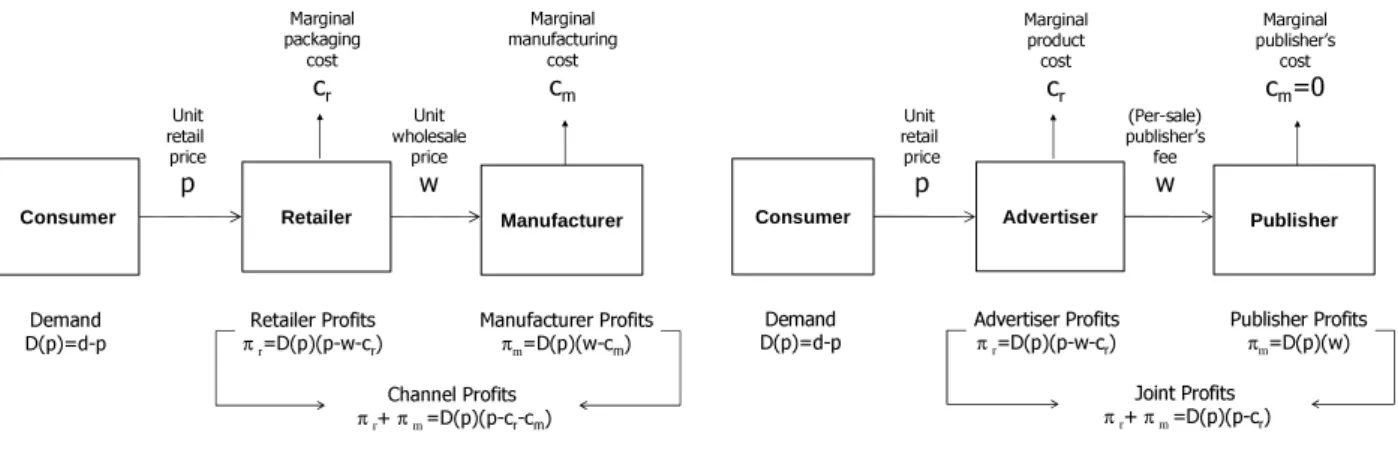
Consider a setting where an upstream monopolist manufacturer sells raw materials to a retailer who, in turn, packages them and sells them to consumers. The retailer is a monopolist in the downstream market. The manufacturer’s constant marginal production cost is denoted by cm and the retailer’s marginal packaging cost bycr. The manufacturer sells the product to the retailer at wholesale price
w and the retailer sells the product to end consumers at a retail price p. (Figure 1a). Demand is assumed to be linear, taking the form D(p) = d−p, where d is assumed to be greater than total marginal cost c=cm+cr.
If the manufacturer and retailer are vertically integrated, the retail price p would be chosen to maximize the total channel profit π(p) = D(p)(p−c). It follows that the profit maximizing retail price equals d+2c, yielding an efficient sales quantity of d−2c and a channel profit of (d−4c)2. The manufacturing and retail departments can then negotiate a transfer price wto divide the total channel profit.
If the manufacturer and retailer are not vertically integrated, they independently choose their respective prices to maximize their own profits. In this setting, the manufacturer moves first by offering a wholesale price w. Consequently, the retailer faces a profit of πr(p|w) = D(p)(p−cr−
w) and responds by choosing a profit maximizing retail price d+cr+w
2 . Anticipating the retailer’s reaction, the manufacturer chooses w to maximize his profit function πm(w|p) =D(p)(w−cm) =
(a) Classic supply chain setting (b) Performance-based advertising setting
Consumer Retailer Manufacturer
Demand
D(p)=d-p πRetailer Profitsr=D(p)(p-w-cr) Manufacturer Profitsπm=D(p)(w-cm)
Unit retail price p Unit wholesale price w Channel Profits πr+ πm =D(p)(p-cr-cm) Marginal packaging cost cr Marginal manufacturing cost cm
Consumer Advertiser Publisher
Demand D(p)=d-p Advertiser Profitsπr=D(p)(p-w-cr) Publisher Profits πm=D(p)(w) Unit retail price p (Per-sale) publisher’s fee w Joint Profits πr+ πm =D(p)(p-cr) Marginal product cost cr Marginal publisher’s cost cm=0
Figure 1: Analogies between a classic supply chain setting and performance-based advertising. ¡
d−d+cr+w
2 ¢
(w−cm). The profit maximizing wholesale price then equals d+cm−cr
2 > cm (under the assumption d > c=cm+cr), inducing a retail price 3d4+c that exceeds the efficient retail price
level of d+2c. Consequently, the manufacturer ends up with a profit of (d−8c)2 and the retailer earns (d−c)2
16 . The total profit realized in this channel shrinks to 3(d−c)2
16 , which corresponds to only 75% of the integrated channel profit. Consumers also end up clearly worse off since they pay a higher retail price.
The above inefficiency stems from the double price distortion which occurs when two independent firms (manufacturer, retailer) stack their price-cost margins, thus the term double marginalization. The phenomenon has been identified by Cournot (1838) even though its first concrete analysis is most often attributed to Spengler (1950). It is easy to show that it occurs under any downward sloping demand curve D(p) and that it is also not confined to monopoly settings; it is present in any setting where the manufacturer and retailer each havesome market power and therefore, mark up their respective prices above marginal cost.
3.2 A survey of classic solutions
An extensive literature has proposed solutions to the double marginalization problem (see, for ex-ample, Jeuland and Shugan 1983; Rey and Vergé 2008). Most solutions rely on the manufacturer imposing some vertical restraints to the retailer. For instance, including a resale price maintenance provision in a retail contract can directly stipulate the efficient retail price. Alternatively, aquantity forcing contract specifies the minimum volume of sales the retailer must achieve. Setting this to the integrated channel efficient quantity forces the retailer to choose the efficient price level. Both such contracts involve the manufacturer directly interfering with the retailer’s pricing decision and are often frowned upon, or legally unenforceable in some countries.
A less intrusive solution is to use a two part tariff. Specifically, the manufacturer charges the retailer both a fixed franchise fee f and a marginal wholesale price w. The retailer profit function becomesπr(p|w, f) =D(p)(p−cr−w)−f. As before, for a givenf the profit maximizing retail price
is d+cr+w
2 with the corresponding retailer profit being
(d−cr−w)2
franchise fee up to (d−cr−w)2
4 −u whereu is the reservation utility of the retailer. The manufacturer thus chooseswto maximizeπm(w|p, f) =D(p)(w−cm)+f =
¡ d−d+cr+w 2 ¢ (w−cm)+(d−cr−w) 2 4 −u. The profit maximizing wholesale price then is w=cm, inducing the efficient retail price ofp= d+2c
and an efficient integrated channel profit equal to (d−4c)2. The central idea of two part tariffs in this setting is to eliminate one of the margins: the manufacturer sets his price equal to marginal cost and uses the franchise fee to gain his share of the surplus. As a result, the retailer faces a margin that is identical to that of an integrated channel. With the price distortion removed channel efficiency is restored.
The use of quantity discount contracts is yet another method for solving the double marginal-ization problem. For example, consider a contract that specifies a unit wholesale price equal to w= Df +g, wheref, gare non-negative constants andDis the total quantity bought by the retailer. With such a scheme, the higher the consumer demand (and, therefore, the quantity ordered by the retailer) the lower the retailer’s average cost. Since higher demand implies lower retail price, this provides the retailer with incentives to keep her price low. In fact, it is easy to see that this price contract is equivalent to a two-part tariff: for both contracts the total cost to the retailer for a given quantityD isf +Dg. The quantity discount scheme can be viewed as an average-cost version of a two-part tariff. Consequently, the reasoning outlined in the previous paragraph applies here as well. If the manufacturer sets g = cm, the retailer’s equilibrium price will equal the retail price at the efficient level. The manufacturer and retailer can then divide the surplus by appropriately setting f.
3.3 Analogy with performance-based advertising
In this section I show how the previous setting has a direct analogy to an advertising context. Instead of a manufacturer, consider a monopolist publisher who owns an advertising resource, such as a billboard located at a busy city square, a time slot in prime time TV, or space at the top of a popular web page. Instead of a retailer, consider a monopolist advertiser who produces a product or service at marginal costcr. Since the advertising resource is an information good, I assume that
the publisher’s marginal cost cm is zero. I further assume that at least some consumers will not be aware of the product unless the product is advertised on the publisher’s resource. Therefore, gaining access to the publisher’s resource results in incremental demand for the product equal to D(p) (Figure 1b).
Consider first a setting where access to the advertising resource is made usingpay-per-exposure (PPE) contracts. In such contracts the publisher charges the advertiser an upfront flat fee f that is independent of the actual revenue that the advertiser is able to realize thanks to the advertising resource. The advertiser’s profit function is thenπr(p|f) =D(p)(p−cr)−f. It is easy to see that, in
such a setting, the publisher’s feef does not impact the advertiser’s pricing problem. The advertiser will choose the price that maximizes her incremental sales profit. For example, ifD(p) =d−p(where d > cr) the retail price would be set to d+2cr, yielding an efficient sales quantity of d−2cr and a channel
profit of (d−cr)2
f.
Let us now see how the situation changes when the publisher sells access to the advertising resource using performance-based contracts. The most straightforward example of such contracts is a pay-per-sale (PPS) contract whereby the advertiser pays the publisher a fee w for every sale realized. In this setting the advertiser’s profit function is equal toπr(p|w) =D(p)(p−cr−w)and the publisher’s profit function equal to πm(w|p) =D(p)w. The reader can readily verify that the above
profit functions are identical to those of the classic manufacturer-retailer double marginalization example of Section 3.1 whencm= 0. With reference to that example, ifD(p) =d−p, at equilibrium
the publisher will set his per-sale fee w at d−cr
2 and the advertiser will price her product at 3d+4cr. Notice that this price is higher than the sales profit maximizing price d+cr
2 that the advertiser would choose for her product if advertising was sold using a PPE contract. Accordingly, it leads to lower demand. The publisher ends up with a profit of (d−cr)2
8 and the advertiser earns (d−cr)
2
16 . The total profit realized in this channel shrinks to 3(d−cr)2
16 , which corresponds to only 75% of the channel profit if advertising was sold using PPE contracts. Consumers also end up clearly worse off since they pay a higher retail price.
As was the case with the classic double marginalization problem, the above phenomena are fairly general: they occur for any downward sloping demand curveD(p)and are also present in any setting where the publisher and advertiser each havesome market power and are, therefore, able to mark up their respective prices above marginal cost. Finally, they are orthogonal to the specific mechanism used by the publisher to allocate his resource to advertisers. More concretely, Section 5 shows that similar price distortions are present in auction-based allocation methods, such as the ones used by search engines to allocate online advertising space.
3.4 Generalization to arbitrary pay-per-action contracts
Pay-per-sale is only one example of a more general class of performance-based advertising contracts that are often referred to by the term pay-per-action. This section shows how the phenomena identified in the previous sections generalize to this broader class of contracts.
Pay-per-action (PPA) approaches make payment to the publisher contingent on a triggering action that is either a sale, or some other consumer action (e.g. click, call) that has the following properties:
1. It is linked to the advertising, i.e. only consumers who have been exposed to this particular advertising message can perform the triggering action.
2. It is anecessary step of a consumer’s purchase decision process. This means that even though not all consumers who perform the triggering action may buy the product, consumers cannot purchase the product without performing the triggering action.
Let V(p) denote the ex-ante value the advertiser expects to obtain from leasing the advertising resource. In most real-life settings this value will be equal to the incremental sales profit that the advertiser expects to realize by leasing the resource and can thus be expressed asV(p) =D(p)(p−cr)
where p is the unit price of the advertised product, cr is the corresponding unit cost and D(p) is
the increase in demand due to advertising. Value V(p) will be split between the advertiser and the publisher and will, thus, also be referred to as the joint advertiser-publisher profit. Irrespective of the precise functional form of V(p), assumptions 1-2 above allow us to uniquely express it as a productV(p) =U(p)W(p)where:
U(p) is the expectedtriggering action frequency (TAF) and W(p) is the expectedvalue-per-action (VPA).
The precise meanings of U(p) and W(p) depend on the specifics of the payment contract. For example:
• In pay-per-sale contracts U(p) is equal to the incremental demand due to advertising while W(p)is equal to the unit profit.
• In pay-per-click contracts U(p) is equal to the per-period audience size times the probability of a click (theclickthrough rate) andW(p)is equal to the conditional probability of a purchase given a click (the conversion rate) times the unit profit.
• Traditional per-per-exposure contracts are a special case of the above framework whereU(p) = 1 andW(p) =V(p).
A special case of particular importance in online settings is that of personalized ads, such as the ones displayed in response to a keyword search. In such settings the size of the audience is one. The above framework applies to this special case as well, the only difference being that function U(p)
would then denote the triggering action probability.
In the rest of the paper I am assuming that the publisher has a way of obtaining reliable ob-servations of triggering actions and, therefore, that strategic misreporting of triggering actions from the part of the advertiser is not an issue.1
Consider now a generalpay-per-action (PPA) contract whereby the advertiser pays the publisher a fee w every time a triggering action occurs. In this more general setting the advertiser’s profit function is equal to πr(p|w) =U(p)(W(p)−w) =V(p)−U(p)wand the publisher’s profit function equal to πm(w|p) =U(p)w. Let p∗ be the price that maximizes V(p). It is easy to see that this is
the price that maximizes πr(p|w) whenw= 0. It is also (see Section 3.3) equal to the product price
pE that the advertiser would choose under a pay-per-exposure contract.2 Now, in any PPA setting
where the publisher has some market power, he will charge a pricew >0(otherwise, he will make no profits). From monotone comparative statics theory (Topkis 1998) it follows that if the cross-partial
1Addressing an advertiser’s incentive to misreport the frequency of payment triggering action to the publisher is
an important consideration in pay-per-action schemes but orthogonal to the focus of this paper. See Agarwal et al. (2009) and Nazerzadeh et al. (2008) for discussion and proposed solutions.
2Throughout the paper I am using superscripts to denote the payment mechanism that quantities of interest are
associated with. For example,pE denotes the product price advertisers will choose when advertising is sold using a
pay-per-exposure (E) mechanism whereaspAdenotes the product price when advertising is sold using a pay-per-action
derivative ∂π2r
∂w∂pis positive (negative) everywhere, the profit maximizing pricepA= arg maxpπr(p|w)
is a monotonically increasing (decreasing) function of w. It is ∂πr2
∂w∂p =−U0(p), which is positive if
and only if U0(p)<0for all p. Under these conditions, ifw >0 it will bepA> p∗ =pE, leading to
joint advertiser-publisher profitV(pA)< V(p∗) =V(pE). I have thus shown the following result: Proposition 1: In all PPA settings where (i) both the publisher and the advertiser have some market power and (ii) the triggering action frequency satisfies U0(p)<0 for allp, the following hold: 1. The advertiser prices her products at a price pA that is strictly higher than the price pE she
would charge if advertising was sold using pay-per-exposure.
2. The above price distortion leads to lower consumer surplus and a lower joint advertiser-publisher profit compared with a setting where advertising was sold using pay-per-exposure. The assumption U0(p) < 0 implies that at least some consumers have some (possibly imperfect) information about the price of the products being advertised before performing the action that triggers payment to the publisher.3 This assumption obviously holds in the context of pay-per-sale
contracts. It also holds in pay-per-click or pay-per-call settings where either (i) product prices are displayed on the ad, or (ii) a section of the consumer population has access to such prices before clicking or calling through separate information channels (e.g. product reviews, price comparison charts, previous clicks or calls to the same company, etc.) or (iii) a section of the population has sufficient industry knowledge (i.e. “knows” something about the advertiser’s value function and the publisher’s price structure) to be able to infer (possibly imperfectly) these prices.
4
Restoring efficiency in performance-based advertising
In Section 3.2 I discussed two classic solutions to the double marginalization problem: two part tariffs and quantity discounts. I begin this section by arguing that none of these solutions satisfactorily applies to performance-based advertising. The rest of the section then proposes two new ideas that can be used to eliminate price distortions in such settings.
The equivalent of a two part tariff in the performance-based advertising setting would be a contract where the publisher charges the advertiser a fixed fee f and a per-action fee equal to his marginal cost. The assumption of zero publisher marginal cost implies that there would only be a fixed fee. But this would be equivalent to a pure PPE contract. Two part tariffs, are thus, not useful in restoring efficiency if one wants to retain a performance-based compensation component. For zero marginal cost, quantity discount contracts translate to contracts where the per-action fee charged by the publisher would be equal to Df, i.e. inversely proportional to the volumeDof incremental sales due to advertising (or, more broadly, equal to Uf, i.e. inversely proportional to the triggering action
3If no consumer knows anything about the price of an advertised product before performing the action (click, call,
sale, etc.) that triggers payment to the publisher then it will beU0(p) = 0for allp. The advertiser’s action of raising
the price of her product then has no effect in terms of reducing the expected total payment to the publisher. In such a setting the advertiser has no incentive to deviate from the pricep∗that maximizes the value she obtains from the
frequency U). The problem here is that sales (or, more broadly, triggering actions) only materialize after the advertiser obtains the resource and, sometimes, are spread out over a substantial time period. Effective quantity discount contracts are often impractical in such cases. The problem is even more severe in personalized ad settings where the triggering action occurs either once (in which case the advertiser pays the publisher) or not at all (in which case the advertiser pays nothing). In such cases quantity discount contracts are infeasible.
Although the standard approaches to eliminating inefficiencies due to double marginalization do not readily apply to performance-based advertising, it is possible to construct variants of these approaches that are better suited to this context. The rest of this section proposes two such ideas.
4.1 Price-based fee schedules
The main complication of applying the quantity discount idea in the context of performance-based advertising is that the incremental quantity sold because of advertising (or, more broadly, the trig-gering action frequency) is only known ex-post. However, if the publisher has sufficiently precise knowledge of the advertiser’sexpected triggering action frequency functionU(p)and if the advertiser can credibly disclose her product price p to the publisher, the publisher can construct a contract where the per-action fee charged to the advertiser can be set ex-ante equal to Uf(p), i.e. inversely proportional to the expected triggering action frequency given the advertiser’s price. It is then straightforward to prove the following result:
Proposition 2. In PPA settings where the advertiser discloses her product price p and the publisher sets the per-action fee charged to the advertiser equal to Uf(p), where f is a constant small enough to make the advertiser’s participation individually rational and U(p) is an accurate assess-ment of the advertiser’s expected triggering action frequency (or probability) as a function of product price, the advertiser prices her products at the point pA = p∗ that maximizes the joint advertiser-publisher profit.
The above solution is effective in a wide range of settings. It works well in settings where the triggering action frequency is a stochastic function of product price and also in the important special case of personalized ad settings where U(p) is a probability function. On the minus side it requires the advertiser to truthfully announce her product price and the publisher to be able to monitor the extent to which the advertiser adheres to her announcement.
4.2 History-based fee schedules
In settings where the advertiser and the publisher interact repeatedly, the publisher can use the “shadow of the future” to induce the advertiser to price her products at the joint profit-maximizing level. The applicable solutions differ depending on whether the triggering action frequency is a deterministic or stochastic function of product price.
Deterministic settings. In deterministic settings the publisher can induce efficient product pricing by committing to make next period’s per-action fee a declining function of the current
period’s observed triggering action frequency: the more often the advertiser pays the publisher today, the lower the per-action fee she will have to pay tomorrow. This scheme gives the advertiser a disincentive to increase her current period product price. IfU0(p)<0, as product price increases, the current period’s triggering action frequency declines. A lower triggering action frequency leads to a lower total advertising expenditure this period but (because of the increase in next period’s per-action fee) to a higher advertising expenditure next period.
The following proposition shows that, in settings where the triggering action frequency is a deterministic function of product price, the publisher can always design a per-action fee schedule that balances these two forces and induces the advertiser to price her products at the point that maximizes the joint advertiser-publisher profit.
Proposition 3. Consider an infinite horizon repeated PPA setting where (i) the triggering action frequency is a deterministic functionU(p)of product price and (ii) the per-action feewt (t= 0,1, ...)
charged by the publisher to the advertiser at period t has the following expression:
wt= w0 ift= 0 w0 h 1 +1δ ³ 1− Ut−1 U(p∗) ´i ift >0
where 0< w0 < W(p∗), p∗ = arg maxpV(p), U(p) is the triggering action frequency function as a
function of product price p,Ut−1 is the observed triggering action frequency at periodt−1 andδ is the advertiser’s discount factor.
In such a setting, for all t = 0,1, ..., the advertiser will price her products at the level pA t =p∗
that maximizes the joint advertiser-publisher profit.
Stochastic settings. If the relationship between product price and the observed triggering action frequency (or probability) is stochastic, repeated interaction can still induce efficient pricing. However, the solution now always involves the publisher charging advertisers some fixed (i.e. non-performance-based) fees in addition to performance-based fees, at least some of the time.
I will convey the intuition behind these ideas by restricting my attention to personalized ad settings, i.e. settings where the audience size is equal to one and the triggering action probability is U(p). Such settings are practically important in online domains as well as analytically tractable. According to Proposition 2, the publisher can induce the advertiser to price her product at the point p∗ that maximizes the joint advertiser-publisher profit by asking her to disclose her current period product price pA and then setting the current period per-action fee equal to f
U(pA). If the
advertiser’s (per-period) reservation utility is u, the publisher can set the constant f as high as V(p∗)−u, resulting in discounted lifetime publisher profits 1
1−δ[V(p∗)−u]and discounted lifetime
advertiser profits 1−uδ.
If the publisher cannot credibly learn the advertiser’s current period product price he can still induce her to price at point p∗ by setting up a schedule of fixed and per-action fees that depend on the advertiser’s history of past triggering actions. For example, I will prove that the following two-state mechanism can achieve the desired objective:
Mechanism M1:
State H: All advertisers begin the game at state H. While they are in state H advertisers are charged a per-action feewH. If a triggering action occurrs during the current period the advertiser remains in state H, otherwise she transitions to state L.
State L: For every period that advertisers are in state L they are charged a fixed fee f and a per-action feewL. If a triggering action occurrs during the current period the advertiser
transitions to state H otherwise she remains in state L. The following result provides the details:
Proposition 4. Consider an infinite horizon PPA setting that is characterized by joint advertiser-publisher profitV(p), triggering action probabilityU(p)and the above two-state mechanism M1. The advertiser’s per-period reservation utility is u. If the publisher sets:
f = (V(p∗)−u)1
δ
wH =wL= (V(p∗)−u)
the advertiser always prices her products at pA=p∗ and the publisher extracts the maximum lifetime profits that are consistent with the advertiser’s reservation utility.
The gist of the above idea is to give the advertiser an incentive to increase the probability of a triggering action (by lowering her price) by charging her an additional fixed fee on periods that im-mediately follow periods where the advertiser leased the resource but there was no triggering action. Observe that, compared to a pure PPA solution (e.g. the price-based fee schedule of Section 4.1), this solution involves a lower per-action fee (V(p∗)−u versus VU(p(∗p)∗−)u) coupled with an occasional
fixed fee(V(p∗)−u)1
δ. The discounted payoffs of both the advertiser and the publisher are identical
to those obtained using a pure PPA (e.g. price-based fee) solution.
If advertisers are averse to the idea of paying a non-performance-based fee to the publisher, it is possible to design a variant of this approach where the expected present value of the non-performance-based fees is equal to zero. The idea is to extend Mechanism M1 so that, in addition to charging advertisers a fixed fee f when they are at state L, the publisher also offers them a fixed subsidy s when they are at state H such that the discounted lifetime sum of the fixed fees and subsidies is zero. The following result provides the details:
Proposition 5. Consider an infinite horizon PPA setting that is characterized by joint advertiser-publisher profitV(p), triggering action probabilityU(p) and an extension of mechanism M1 that in-volves a subsidyswhile at state H and a feef while at state L. The advertiser’s per-period reservation utility is u. If the publisher sets:
s= (V(p∗)−u)1−U(p∗) U(p∗) f = (V(p∗)−u)1−δ(1−U(p∗)) δU(p∗) wH =wL= V(p ∗)−u U(p∗)
then (i) the advertiser always prices her products at pA = p∗, (ii) the discounted lifetime sum of the non-performance-based fees and subsidies is equal to zero and (iii) the publisher extracts the maximum lifetime profits that are consistent with the advertiser’s reservation utility.
Notice that in the above result the per-action fee is equal to the per-action fee VU(p(∗p)∗−)u in a pure
PPA setting. This is intuitive since the system of non-performance-based fees and subsidies has zero net present value so the publisher obtains his net revenue from the per-action fees only.
All preceding solutions require the introduction of non-performance-based fees in addition to performance-based fees, at least part of the time. It is tempting to think that one could perhaps design a mechanism that induces optimal pricing using performance-based fees alone. The idea would be to charge a higher per-action fee following a period where there was no triggering action and a lower fee following a period where such action occurred. As was the case above, such mechanisms will give the advertiser additional incentives to increase the probability of a triggering action by keeping her price low. The following result shows that such schemes are indeed feasible. However all such mechanisms where the publisher charges positive per-action fees must involve a rule whereby the advertiser is expelled from the game after k consecutive periods where no triggering action occurs. For that reason, they can never be as efficient as mechanisms that charge both fixed and per-action fees.
Proposition 6: All pure PPA mechanisms that induce advertisers to always price their products at the point pA = p∗ that maximizes the per-period joint advertiser-publisher profit V(p) have the following properties:
1. Either the publisher’s per-action fees are zero for all periods or advertisers are expelled from the game afterkconsecutive periods where no triggering action occurs, for some integer k≥1.
2. In all such mechanisms the advertiser’s discounted lifetime payoff (net of publisher fees) is equal to 11−−δδkV(p∗).
3. For all finite k, the discounted lifetime joint publisher-advertiser profit is strictly lower than what can be achieved by an infinite horizon two-state fee schedule that involves both fixed and per-action fees (such as mechanism M1).
The detailed expressions of the per-action fees imposed by the publisher to the advertiser and of the associated publisher profits as a function ofkcan be obtained for special cases of such mechanisms.4
The intuition behind Part 3 of the above result is simple. The probability of k consecutive periods with no triggering action(1−U(p∗))kis always positive (though, for largek, potentially very small).
Therefore, with virtual certainty, all advertisers will be expelled from the game after a sufficiently large finite number of periods. For that reason, the social efficiency of this mechanism can never be as high as that of a game where the advertiser is never expelled. In practice, however, it can get arbitrarily close.
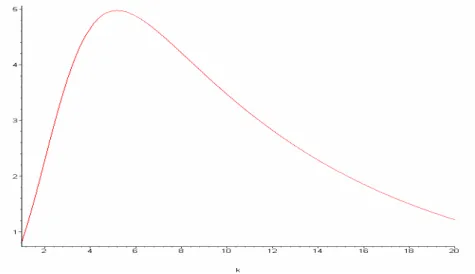
4Appendix A provides a full analysis of such a special case and shows that there exists an optimalkthat maximizes
A note about incomplete information settings. The analysis of this and the following sections assumes that the publisher has perfect knowledge of the advertiser’s payoff function. In real-life applications this is seldom the case. However, if there is repeated interaction between the advertiser and the publisher, as it is common in real-life advertising settings, the literature on strategic learning (Young 2004; Young 2007) has shown that under a wide range of assumptions it is possible for the publisher to learn the advertiser’s payoff function within an arbitrarily small margin of error. The results of this paper then hold at the limit where the publisher has fully learned the advertiser’s payoff function.
5
Double marginalization in search advertising auctions
This Section shows that the price distortions that were identified in Section 3 occur in the practically important case of sponsored search keyword auctions. It also analyzes the economic implications of these distortions for the various stakeholders.
Consider, as before, a setting where a monopolist publisher owns an advertising resource and leases it on a per-period basis to a heterogeneous population of N advertisers. Advertisers are characterized by a privately known unidimensional type q ∈ [q, q], independently drawn from a distribution with CDF F(q). An advertiser’s type relates to the attractiveness of her products or services to consumers; I assume that ceteris paribus higher types are, on average, more attractive. In the rest of the paper I will refer toq as the advertiser’s quality, even though other interpretations are possible.5 An advertiser’s quality affects the ex-ante value V(p, q) she expects to obtain from
leasing the advertising resource for one period. As in Section 3.4 value V(p, q) will be equal to the incremental sales profit that the advertiser expects to realize by leasing the resource.
In the rest of the paper I will use the notation fi(x1, ..., xn) , i= 1, ..., n to denote the partial
derivative of f(·) with respect to itsith variable. For example,V2(p, q) = ∂V∂q(p,q). The following are assumed to hold for all p∈R+ and q∈[q, q]:
A1 V(p, q)is unimodal in p, attaining its unique maximum at some p∗(q)>0
A2 limp→∞V(p, q) = 0
A3 V2(p, q)>0
A1 and A2 are common and intuitive consequence of treating V(p, q) as a sales profit function. A3 implies that some information about an advertiser’s type becomes available to consumers at some point during the advertising-purchasing process, but still allows for a fairly general range of settings (for example: settings where this information might be noisy, where only a subset of consumers are informed, where firms might attempt to obfuscate their true types, etc.).
Each period the publisher allocates the resource to one of the competing firms using a Vickrey auction. Auction-based allocation of advertising resources is the norm in sponsored search
advertis-5 For example, in settings with network effects (e.g. when the advertisers are social networks)qcan be the size of
ing and is also not uncommon in offline settings (e.g. superbowl ads). The double marginalization effects I discuss in this paper are orthogonal to whether the publisher offers one or several (identical or vertically-differentiated) resources. This allows us to ignore the multi-unit mechanism design complications present, say, in sponsored search position auctions (Athey and Ellison 2008; Edelman et al. 2006; Varian 2007) and focus on a single-unit auction.
Traditionalpay-per-exposure (PPE) methods charge advertisers a fee that is levied upfront and is independent of the ex-post value that advertisers obtain by leasing the resource. In a Vickrey auction setting each advertiser bids the highest such fee she is willing to pay. The auctioneer allocates the resource to the top bidder and charges her the second-highest bid. Assuming that every other bidder of type y bids an amount equal to βE(y) and that, as I will later show, it is £βE¤0(y) ≥0, at a symmetric Bayes-Nash equilibrium an advertiser of type q bids bE(q) and sets the price of her
product at pE(q) to maximize her net expected profit:
ΠE(q;bE(q), pE(q), βE(·)) = [βE]−1(bE(q)) ˆ q ¡ V(pE(q), q)−βE(y)¢G0(y)dy (1)
where G(y) =FN−1(y) is the probability that every other bidder’s type is less than or equal to y and G0(y) is the corresponding density.6 At equilibrium it must also be βE(q) =bE(q). The above
specification subsumes the special case where product pricesp(q)are given exogenously. In the latter case, a bidder of typeqsimply chooses a bidbE(q;p(·))that maximizesΠE(q;bE(q;p(·)), p(q), βE(·))
subject to βE(q) =bE(q;p(·)).
I use the following shorthand notation:
ΠE(q) advertisers’ PPE equilibrium profit function (endogenous product prices) ΠE(q;p(·)) advertisers’ PPE equilibrium profit function (exogenous product prices)
According to standard auction theory (e.g. Riley and Samuelson 1981) the expected publisher revenue associated with bidsβ(y)is equal to:
RE(β(·)) =N q ˆ q z ˆ q β(y)G0(y)dy F0(z)dz (2)
I use the following shorthand notation:
RE =RE(bE(·)) publisher’s PPE equilibrium revenue (endogenous product prices)
RE(p(·)) =RE(bE(·;p(·))) publisher’s PPE equilibrium revenue (exogenous product prices)
The following result characterizes the most important properties of allocating the resource using
6 Throughout this paper I restrict my attention to symmetric Bayes-Nash equilibria. Unless specified otherwise,
PPE bidding
Proposition 7: In PPE settings where advertisers endogenously set the prices of their advertised products to maximize profits net of advertising expenditures:
1. Advertisers bid their expected ex-ante value of acquiring the resource, given their price: bE(q) =V(pE(q), q)
2. Advertisers set the price of their products at the point that maximizes their ex-ante expected value of acquiring the resource:
pE(q) = arg max
p V(p, q) =p
∗(q)
3. Equilibrium PPE publisher revenues are equal to or higher to publisher revenues obtained in any PPE setting where the prices of advertised products are set exogenously:
RE =RE(p∗(·))≥RE(p(·))
with the inequality strict if and only if p∗(q)6=p(q) for at least one q ∈[q, q].
The principal takeaway of the above proposition is that auction-based PPE mechanisms induce all competing advertisers to price their products at the point that maximizes the joint advertiser-publisher profit. This is the point that maximizes the social efficiency, as well as the advertiser-publisher revenues that are attainable through the use of the auction mechanism.
Pay-per-action (PPA) approaches make payment to the publisher contingent on a triggering action that is either a sale, or some other consumer action (e.g. click, call) that (i) is linked to the advertising, i.e. only consumers who have been exposed to this particular advertising message can perform the triggering action and, (ii) is a necessary step of a consumer’s purchase decision process. As discussed in Section 3.4 the above assumptions allow us to uniquely express the advertiser’s ex-ante value function as a product V(p, q) =U(p, q)W(p, q) where U(p, q) is the expected triggering action frequency (or, in the special case of personalized ads, the triggering action probability) and W(p, q) is the expectedvalue-per-action.
Early PPA sponsored search mechanisms used a simple rank-by-bid (RBB) allocation rule: Ad-vertisers bid the maximum per-action fee they were willing to pay. The slot was allocated to the highest bidder who paid a per-action fee equal to the second highest bid. RBB mechanisms do not always allocate the resource to the advertiser that values it the most and, thus, do not optimize publisher revenues.7 For that reason they were quickly abandoned in favor of, more sophisticated,
7For example, consider a setting where the per-action valueW(p, q)and the total valueV(p, q) =U(p, q)W(p, q)
are negatively correlated for all q. Then, the advertiser who has the highest per-action valueW(p, q) will be able to place the highest bid and win the resource, even thought the total value she expects to generate by leasing the resource is the lowest among all advertisers.
rank-by-revenue mechanisms. The idea behind rank-by-revenue (RBR) is the following: The pub-lisher computes a quality weight ui for each advertiser. The quality weight is typically based on past performance data and attempts to approximate that advertiser’s expected triggering action frequency U(p, q). Once bidders submit their bids bi the publisher computes a score si = uibi for
each bidder. Assuming that (as we will show) advertisers place bids equal to their expected value-per-action W(p, q), the score is an estimation of the expected total value V(p, q) = U(p, q)W(p, q)
that the advertiser will generate by acquiring the resource. The publisher allocates the resource to the bidder with the highest score and charges the winning bidder an amount u2b2/u1 equal to the second highest score divided by the winning bidder’s quality weight. It has been shown that RBR methods have better allocative efficiency and auctioneer revenue properties than RBB (Feng et al. 2007; Lahaie and Pennock 2007; Liu and Chen 2006). Both Google and Yahoo use variants of this mechanism in their sponsored link auctions. For these reasons, the rest of the section will focus on RBR-PPA mechanisms.
LetΦ(q, s)denote an advertiser’s beliefs about every other bidder’s joint quality (q) and score (s) distribution. At equilibrium these beliefs must be consistent with bidding and publisher behavior. Let Φ(q) ≡ F(q) and Φ(s) be the corresponding marginal distributions and let Ψ(s) = [Φ(s)]N−1 denote the advertiser’s belief that every other bidder’s score will be less than s. Denote the ad-vertiser’s current quality weight as u. The single period specification of the advertiser’s RBR-PPA bidding problem is to choose a bid bA(q, u) and a pricepA(q, u) that maximize:
ΠA(q, u;bA(q, u), pA(q, u)) =´ubA(q,u) 0 U(pA(q, u), q) ¡ W(pA(q, u), q)− s u ¢ Ψ0(s)ds =V(pA(q, u), q)Ψ(ubA(q, u))−U(pA(q, u), q)³´ubA(q,u) 0 usΨ0(s)ds ´ (3)
where V(pA(q, u), q) is the expected total value of the resource, Ψ(ubA(q, u)) is the probability of
winning the auction, ´0ubA(q,u)usΨ0(s)ds is the expected per-action payment to the publisher and U(pA(q, u), q)is the expected number of times (or probability) that the payment will be made if the
advertiser wins the auction.
The corresponding single period RBR-PPA publisher revenue is equal to:
RA(bA(·,·), pA(·,·)) =N q ˆ q Eu|q U(pA(q, u), q) ubA(q,u) ˆ 0 s uΨ 0(s)ds F0(q)dq (4)
whereEu|q[·]denotes expectation with respect tou conditional on an advertiser’s type being q. The publisher’s objective is to use u as an approximation of an advertiser’s triggering action frequency. Of particular interest, therefore, is the behavior of the system at the limit where the publisher has obtained “correct” estimates of all quality weights, i.e. where each quality weight is equal to the respective advertiser’s expected equilibrium triggering action frequency:
I use the following shorthand notation to refer to equilibrium quantities in such “correct quality weight” equilibria:
pA(q) =pA(q, U(pA(q), q)) equilibrium product prices
bA(q) =bA(q, U(pA(q), q)) equilibrium bids
ΠA(q) = ΠA(q, U(pA(q), q);bA(q), pA(q)) equilibrium advertiser’s profits
RA=RA(bA(q), pA(q)) equilibrium publisher’s revenue
In the rest of the paper I make the following technical assumption: A4 ∂q∂ £V(pA(q), q)¤≥0 for allq
The above assumption states that, at any PPA equilibrium, and given the price that each adver-tiser type charges for her products, higher types derive higher value from obtaining the advertising resource. The following proposition summarizes equilibrium bidding behavior and revenues in the above setting:
Proposition 8: If advertising is sold on an RBR-PPA basis, the following hold:
1. Advertisers set the price of their products at a point pA(q, u) that has the following properties:
pA(q, u)> p∗(q) if U 1(p, q)<0 for all p pA(q, u)< p∗(q) if U 1(p, q)>0 for all p pA(q, u) =p∗(q) if U 1(p, q) = 0 for all p
2. In settings that admit interior solutions advertisers bid their expected ex-ante value per action given their price:
bA(q, u) =W(pA(q, u), q)
3. In settings that admit interior solutions and where, additionally, the publisher sets every ad-vertiser’s quality weight to her respective equilibrium triggering action frequency, product prices pA(q) are solutions of the following equation:
V1(pA(q), q)G(q)−U1(pA(q), q)ZA(q) = 0 (5)
where ZA(q) = ³´q
q V(pA(y), y)G0(y)dy
´
/U(pA(q), q) is the expected per-action payment to
the publisher.
Proposition 8 shows that the price distortion due to the double marginalization effect that is induced by performance-based advertising persists in RBR-PPA settings. Note that Parts 1 and 2 of the Proposition hold true for any quality weights u, i.e. not only in settings where the publisher has “correct” assessments of each advertiser’s expected triggering action frequency.
The rest of the section will show that, in this special context this price distortion has a series of negative implications: It always reduces consumer surplus, social welfare and publisher revenues.