Research Article
Efficient Big Integer Multiplication and Squaring Algorithms for
Cryptographic Applications
Shahram Jahani, Azman Samsudin, and Kumbakonam Govindarajan Subramanian
School of Computer Sciences, Universiti Sains Malaysia, Penang 11800, MalaysiaCorrespondence should be addressed to Azman Samsudin; [email protected]
Received 15 November 2013; Revised 4 July 2014; Accepted 5 July 2014; Published 24 July 2014 Academic Editor: Jin L. Kuang
Copyright © 2014 Shahram Jahani et al. This is an open access article distributed under the Creative Commons Attribution License, which permits unrestricted use, distribution, and reproduction in any medium, provided the original work is properly cited. Public-key cryptosystems are broadly employed to provide security for digital information. Improving the efficiency of public-key cryptosystem through speeding up calculation and using fewer resources are among the main goals of cryptography research. In this paper, we introduce new symbols extracted from binary representation of integers called Big-ones. We present a modified version of the classical multiplication and squaring algorithms based on the Big-ones to improve the efficiency of big integer multiplication and squaring in number theory based cryptosystems. Compared to the adopted classical and Karatsuba multiplication algorithms for squaring, the proposed squaring algorithm is 2 to 3.7 and 7.9 to 2.5 times faster for squaring 32-bit and 8-Kbit numbers, respectively. The proposed multiplication algorithm is also 2.3 to 3.9 and 7 to 2.4 times faster for multiplying 32-bit and 8-Kbit numbers, respectively. The number theory based cryptosystems, which are operating in the range of 1-Kbit to 4-Kbit integers, are directly benefited from the proposed method since multiplication and squaring are the main operations in most of these systems.
1. Introduction
The growth of digital technologies has an exponential trend and as a consequence the need of information security also increases even more than before [1, 2]. Cryptography is an essential tool in providing a reasonable solution for this necessity. The modern field of cryptography consists of two main areas, the symmetric-key cryptography and the public-key cryptography. The same public-key is used in symmetric-public-key cryptosystems to encrypt and decrypt a message, while the public-key cryptosystems use two keys in their protocols. Most of the public-key cryptosystems [3] use modular expo-nentiation in their calculation. For example, Diffie and Hell-man introduced the first key exchange scheme in 1967 that is based on the modular exponentiation [4]. Few years later in 1978, one of the most used public-key cryptosystems, RSA [3], is also based on the modular exponentiation. ElGamal key exchange [5] is another example of public key that has been developed based on the modular exponentiation.
Modular exponentiation, 𝑏 = 𝑎𝑥mod𝑛, is a one-way function because the inverse of a modular exponentiation
(𝑥 = 𝑑log𝑎𝑏) is a known hard problem [6–8]. To achieve a comfortable level of security, the length of the key material for these cryptosystems must be larger than 1024 bits [9], and in the near future, it is predicted that 2048-bit and 4096-bit systems will become standard [10].
Calculating modular exponentiation for a large exponent and large modulo is a costly operation and therefore improv-ing its efficiency has become an important research issue for researchers in cryptography and mathematics. There are two main approaches currently being employed in order to improve the efficiency of modular exponentiation: improving the involved operations, exponentiation, and division, sepa-rately, and improving both of the operations simultaneously. Residue number system (RNS) [11] and Montgomery mod-ular multiplication [12] are examples of the first approach, while binary andm-ary exponentiation or Barrett reduction [13] are instances from the second approach. This paper focuses on the second approach, by proposing a new number representation, which will improve the squaring and mul-tiplication operations, two of the three main operations in calculating modular exponentiation [14].
Volume 2014, Article ID 107109, 9 pages http://dx.doi.org/10.1155/2014/107109
Input: positive integers𝑎and𝑥 > 1.
Output:𝑏 = 𝑎𝑥
(1) Set𝑏 ← 1and𝑠 ← 𝑎. (2) While𝑥 ̸= 0do the following:
(2.1) If𝑥is odd then𝑏 ← 𝑏 × 𝑠. //(𝑘/2)multiplication if𝑘 =log2𝑏. (2.2) Set𝑥 ← ⌊𝑥/2⌋.
(2.3) If𝑥 ̸= 0 then𝑠 ← 𝑠 × 𝑠. //(𝑘 − 1)multiplication. (3) Return𝑏.
Algorithm 1: Right-to-left binary exponentiation,b=ax.
Input: positive integers𝐴 = (𝑎𝑛, . . . , 𝑎0)𝑟having𝑛 + 1base𝑟digits and𝐵 = (𝑏𝑚, . . . , 𝑏0)𝑟having𝑚 + 1base𝑟digits.
Output: the product𝐴 ⋅ 𝐵 = (𝑐𝑚+𝑛+1, . . . , 𝑐0)𝑟in base𝑟.
Note:(𝑢V)𝑟are two single-precision digits in baser, indicating the result of the addition. (1) For𝑖from 0 up to𝑚 + 𝑛 + 1do:𝑐𝑖← 0.
(2) For𝑖from 0 up to𝑚do the following: (2.1)𝑐𝑎𝑟𝑟𝑦 ← 0.
(2.2) For𝑗from 0 up to𝑛do the following:
(2.2.1) Compute(𝑢V)𝑟= 𝑐𝑖+𝑗+ 𝑎𝑗⋅ 𝑏𝑖+ 𝑐𝑎𝑟𝑟𝑦, set𝑐𝑖+𝑗←V, and𝑐𝑎𝑟𝑟𝑦 ← 𝑢. // u and v are
(2.3)𝑐𝑖+𝑛+1← 𝑢. // single-precision
(3) Return(𝑐𝑚+𝑛+1, . . . , 𝑐0). // digits in base r Algorithm 2: Multiple-precision classical multiplication, CM(𝐴, 𝐵).
The naive approach of calculating the exponentiation is by doing repetitive multiplication, which is not an efficient way for calculating large exponent. A better alternative for calculating exponentiation is by employing binary exponen-tiation; that is, if 𝑏 = ∑𝑘−1𝑖=0(𝑏𝑖2𝑖), where 𝑏𝑖 = {0, 1}, then
𝑎𝑏= ∏𝑘−1𝑖=0(𝑎2𝑖𝑏𝑖). The term𝑎2𝑖can be obtained by squaring the
(𝑖 − 1)th term,𝑎2𝑖−1. The number of operations for calculating
𝑎𝑏by using the na¨ıve method is(𝑏−1)multiplications. On the other hand, the binary method requires only(𝑘−1)squarings and𝑘/2multiplications (on average), where𝑘 = log2𝑏(see Algorithm 1). Consequently, improving the multiplication and squaring operations (as found in algorithm such as the right-to-left algorithm and its variants [6–8]) will inherently improve the efficiency of the exponentiation calculation [7].
2. Multiplication and Squaring Algorithms
The most well-known algorithms for multiplication of two large integers or two polynomials are classical [15], Karatsuba-Ofman’s [16], Toom-Cook’s [17,18], and fast Fou-rier transform (FFT) multiplication algorithms [19]. In spite of all the differences in these methods, which sometimes make them apparently unrelated to each other, these methods have been founded based on the same idea, that is, how to represent a polynomial to behave efficiently in calculations. The classical method uses coefficient representation, while the other three methods use point-value representation. This representation conversion enables us to reduce the cost of convolution from𝑂(𝑛2)of classical method to a lower costfor point-to-point multiplication. The process of finding point-value representation from its coefficient representation is called “evaluation” or “point evaluation” and the reverse process is known as “interpolation.”Table 1summarizes the differences among the multiplication algorithms by their complexity, technique, and representation used.
Algorithms such as FFT and Toom-Cook have lower algorithm complexity. However, because of the preprocess-ing overheads such as the divide and conquer, evaluation, and interpolation, the operating cost of these algorithms is actually much higher, making them useful only when the integers are extremely large. Consequently, only classical and Karatsuba multiplication algorithms and their combination are being used in current cryptosystem. This is especially true after considering circumstances such as memory constraints and the practical finite field size.
2.1. Classical Multiplication and Squaring Algorithms. In positional numeral system [15], the natural way of multiply-ing numbers, known as classical multiplication algorithm, is by multiplying each digit of the multiplicand by each digit of the multiplier and then adding up all the properly shifted results. This method requires a multiplication table for single digits available to the algorithm. Knuth’s classical multiplication algorithm [15] can be stated as shown in Algorithm 2.
The complexity of the classical multiplication algorithm is𝑂(𝑛2). Therefore, the number representation that has fewer digits theoretically should run faster than the number representation that has more digits in its representation.
In addition, the density of nonzero digits in the numbers influences the number of addition that has to be carried out by the classical multiplication algorithm as well.
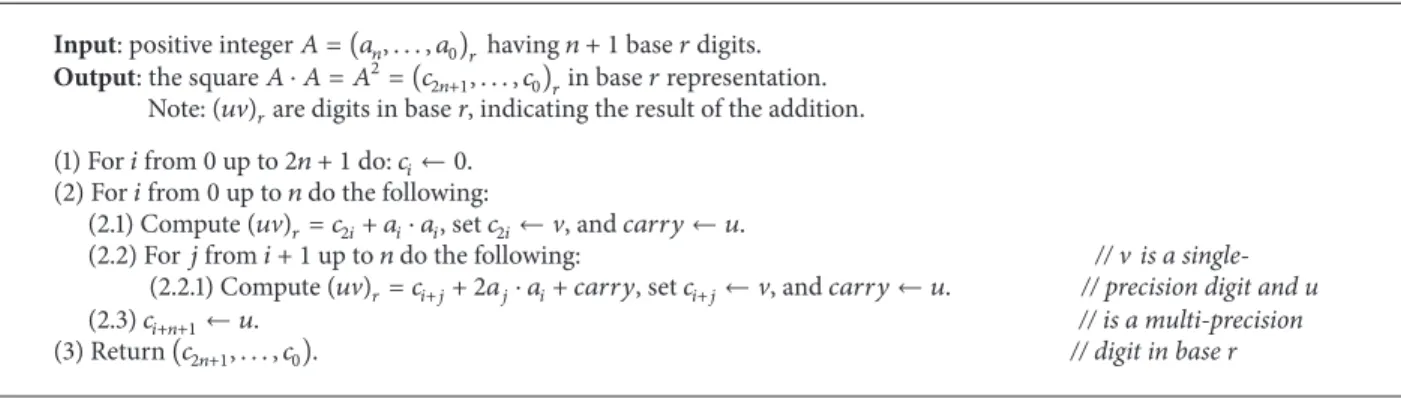
Algorithm 3shows the modified version ofAlgorithm 2 that computes the squaring operation efficiently for binary numbers. The efficiency of the modified squaring algorithm comes from Steps 2.1 to 2.2.1. Since the products of𝑎𝑗⋅ 𝑎𝑖and
𝑎𝑖⋅ 𝑎𝑗 are the same, this product is therefore calculated just once in Step 2.2.1. Note that(𝑢V)𝑟in Step 2.2.1 ofAlgorithm 3 is the result of the addition. InAlgorithm 3, V is a single-precision digit, while 𝑢is a multiple-precision digit. With this improvement, the number of partial products in the squaring algorithm is𝑛(𝑛 − 1)/2 less than what was found inAlgorithm 1.
2.2. Karatsuba Multiplication and Squaring Algorithms.
Karatsuba’s algorithm is an efficient scheme for multiplying two large numbers or two polynomials. It was introduced by Karatsuba and Ofman in 1960 and published in 1962 [20]. This algorithm is a remarkable example of the divide and conquer paradigm [21, 22], specifically for its binary splitting [23]. This method requires three multiplications and four additions in each iteration. To apply the algorithm both numbers are split into a lower and an upper half (for simplicity, assume n is even):
𝐴 = 𝐴𝐿× 𝑟𝑛/2+ 𝐴𝑅,
𝐵 = 𝐵𝐿× 𝑟𝑛/2+ 𝐵𝑅. (1)
The halves𝐴𝑅, 𝐴𝐿, 𝐵𝑅, and𝐵𝐿are split again in half in the next iteration step. Since every step exactly halves the number of coefficients, the algorithm terminates after 𝑡 = log2𝑛steps.Algorithm 4shows the recursive Karatsuba algo-rithm (assuming the lengths of𝐴and𝐵are even). We can use Karatsuba algorithm for squaring with small modification. Algorithm 5shows these modifications in Steps 2-3.
Combining other multiplication algorithms with Karat-suba algorithm is another technique that has been used by researchers [24]. The study on squaring and multiplying large integers by Zuras has shown the 2-way, 3-way, and 4-way approaches for calculating big integer multiplication [25]. Sadiq and Ahmed [26] have extended the work further and summarized the results after splitting the long numbers into multi partitions (up to 10 partitions). More details on squaring algorithms can be found in the literature [6,8,27– 29].
3. Big-Ones Representation and
the Proposed Algorithms
In this section, the Big-one (Bo) integer representation and the proposed multiplication and squaring algorithms, which are based on this representation, are presented. Big-one representation is created based on the binary number representation. Big-one is a compact representation with low Hamming weight (HW) compared to the binary number representation.
A Big-one is the numeric value of a sequence of 𝑛 consecutive binary symbol “1” with length𝑛and is denoted by𝑂𝑛. Examples of Bo’s are 𝑂1= 12= 1and𝑂3 = 1112= 7. Consider
𝑂𝑛=⏞⏞⏞⏞⏞⏞⏞⏞⏞1 ⋅ ⋅ ⋅ 1𝑛 2=𝑛−1∑
𝑖=0
2𝑖= 2𝑛− 1. (2)
A set of all Bo’s is called Big-ones’ set and is denoted by𝑂 =̂
{𝑂1, 𝑂2, 𝑂3, . . .} = {12, 112, 1112, . . .} = {1, 3, 7, 15, . . .}.
Big-Ones Number System (BONS).Let𝐴 = (𝑎𝑛. . . 𝑎2𝑎1𝑎0)2 be a number in radix 2, where 𝑎𝑖 ∈ ̂𝑂 ∪ {0}. This num-ber system is called Big-one numnum-ber system and denoted as BONS. For example, 𝐴 = 111010101011112 can be represented by𝑂30𝑂10𝑂10𝑂10000𝑂4in BONS. This number system is redundant. To transform BONS into a canonic (not redundant) representation, the maximum length of Big-ones is used. The canonical version of BONS is known as CBONS. CBONS is a compressed representation of Big-one, by ignoring all the zeros and modifying the notation𝑂𝑛 to
𝑂(𝑛,𝑃), where𝑃shows the position of the specified Big-one in the binary number. Specifically,𝑃is the position of the least significant bit of the specified Big-one in the binary number. For example, we can write11101011110000112 in CBONS as𝑂(3,13)𝑂(1,11)𝑂(4,6)𝑂(2,0). To optimize the calculations based on CBONS, we can limit the length of maximum Big-ones to “𝑤” (𝑂(𝑛,𝑃)such that𝑛 ≤ 𝑤) which we identified in this paper as themaximum lengthof Big-ones [30–32].
3.1. Big-Ones Analysis. From the definition of CBONS, it is apparent that there will be at least one digit zero bounding from the left and at least another digit zero bounding from the right of each Big-one digit (except for the least and most significant bits). Consequently, to calculate the number of 𝑂𝑙s in any given binary number, we have to calculate the probability of “0𝑂𝑙0” patterns appearing in the binary number. Since the probability of digit “1” and digit “0” appearing in a binary digit is1/2, therefore it follows that the probability of𝑂𝑙 appearing in a binary number is𝑃(𝑂𝑙) =
1/2𝑙+2. As a result, the number of 𝑂
𝑙s in an 𝑛-bit binary number is𝑁(𝑂𝑙) = 𝑛/2𝑙+2. To calculate the Hamming weight of Bo’s in a Big-one number system, it is enough to calculate the total number of Big-ones, 𝑁(𝑂𝑙), where 1 ≤ 𝑙 ≤ 𝑛. Consider HW(in CBONS) = 𝑛 ∑ 𝑙=1 𝑁 (𝑂𝑙) =∑𝑛 𝑙=1 𝑛 2𝑙+2 = 𝑛4∑𝑛 𝑙=1 2−𝑙= 𝑛4(∑𝑛 𝑙=0 2−𝑙− 1) . (3) Since 𝑚 ∑ 𝑛=0 2−𝑛= 2−𝑚(2𝑚+1− 1) , (4)
Table 1: Comparison of the well-known polynomial multiplication algorithms.
Multiplication algorithm Technique Representation Complexity
Divide and conquer Point evaluation Interpolation
Classical — — — Coefficient representation 𝑂 (𝑛2)
Karatsuba √ — — Coefficient representation 𝑂 (𝑛1.58)
Toom-Cook √ √ √ Point-value representation 𝑂 (𝑛log(2𝑘−1)/log𝑘)
FFT √ √ √ Point-value representation 𝑂 (𝑛log𝑛log log𝑛)
Table 2: The Hamming weight of Big-ones in CBONS for an 8-Kbit binary number. Big-one’s length (𝑤) 1 2 3 4 5 6 7 8 9 10 11 >12 (𝑁𝑛) 1024 510 257 127 64 33 16 8 4 2 1 2 (∑𝑛 𝑘=1 𝑁𝑘) 1024 1534 1791 1918 1982 2015 2031 2039 2043 2045 2046 2048 HW/𝑤 (∑ 𝑛 𝑘=1𝑁𝑘 8192 ) = 2048 8192= 1 4
(3) can therefore be written as HW(in CBONS) = 𝑛
4(2−𝑛(2𝑛+1− 1) − 1) = 𝑛4(2 − 2−𝑛− 1) = 𝑛4(1 − 2−𝑛) .
(5)
For large enough 𝑛, the number of Big-ones (Hamming weight of CBONS) would be
HWBONS(calculated)≅
𝑛
4. (6)
Table 2 shows the result of calculating the number of Big-one digits in an 8-Kbit binary number from 10,000 randomly generated binary numbers. As the table indicates, the experimental result does agree with the value found in (6). Table 2 also indicates that the occurrence of Big-ones decreases as the length of Big-ones increases. The goal of the following experiment is therefore to find the optimized length for CBONS, to be used in LCBONS (limited length CBONS). The length, identified as𝑤, is important for applications such as multiplication and squaring. This is because the size of 𝑤 will determine the size of the look-up table (LUT) that needs to be used by the respective algorithms.Table 3 indicates that the practical value for𝑤is 5 since the Hamming weight when𝑤 = 5is only slightly bigger than the optimum Hamming weight for CBONS (25.8% compared to 25%) but at the same time will produce a relatively compact LUT. Consequently, the following proposed multiplication and squaring algorithms will use LCBONS with𝑤 = 5.
3.2. Converting Binary Representation to Big-Ones
Represen-tation. Algorithm 6shows how to convert a binary
repre-sentation to CBONS reprerepre-sentation. In Step 2.2.1, the flag
NewBois set to true if𝑎𝑖𝑎𝑖−1 =“10” and at the same time the position of the new Big-one is saved in “pos.” In Step 2.3.1, while the flagNewBois true, the length of current Big-one (Length) is increased by one in each iteration of the loop until
𝑎𝑖𝑎𝑖−1 = “01” is found. The end of Big-one is identified by setting the flagNewBoto false in Step 2.3.2. Then, the length and position of the newly discovered Big-one digit are saved in𝑐𝑖𝐿and𝑐𝑖𝑝, respectively, where𝑖is the position of new Big-one in array C.
Algorithm 7is the modified version ofAlgorithm 6after applying the maximum length of Big-one in BONS. In Step 2.3.3 ofAlgorithm 7, the length of the current Big-one digit is checked. If the length of the Big-one is bigger than𝑤, then the relevant pointer will backtrack one bit and set the value𝑎𝑖to 0. Step 2.4 ofAlgorithm 7acts similar to Step 2.4 inAlgorithm 6which has been explained earlier.
To use Algorithms 6 and 7 efficiently in squaring and multiplication, we assume that the output of these algorithms is in the form of(𝑑𝑛, . . . 𝑑0), where𝑑𝑖 = 𝑐𝑖𝐿. To show this point, we change the names of algorithms toBin2BO-Land
Bin2LBO-Laccordingly.
3.3. Proposed Multiplication and Squaring Algorithm.
Algorithm 8 is a modification of Algorithm 2, which has been designed based on the LBONS. In Step 1, by using function Bin2LBO-L, 𝐴is converted to𝐴. Output𝐴 is a special representation of𝐴in LCBONC representation that shows the length of Big-ones. Step 3.1 is introduced to ignore the zeros in𝐴and consequently will help reduce the number of operations. Another difference is related to Step 3.2.1.1 which uses the function LUT(𝑎𝑗, 𝑏𝑖). This function fetches the product of two Big-ones by lengths of𝑎𝑗and𝑏𝑖from a precalculated look-up table.
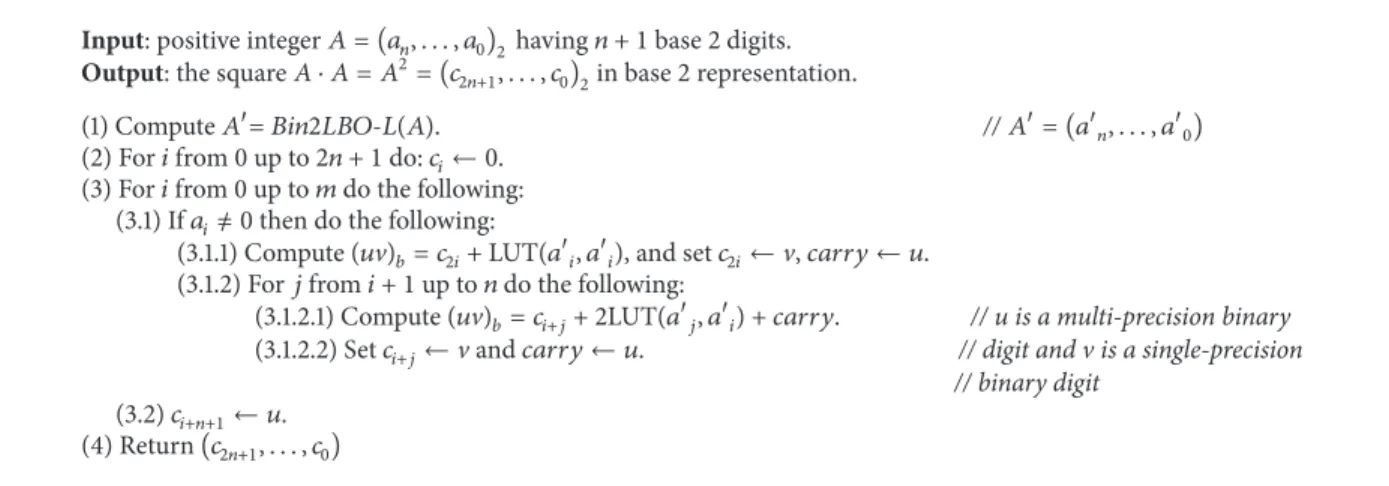
The proposed squaring algorithm (see Algorithm 9) is a modified version ofAlgorithm 3. In Step 1, by executing the converter Bin2LBO-L, 𝐴is converted to𝐴 which is a special representation of𝐴in LCBONS representation with maximum length being employed (𝑤 = 5). Other differences are related to Step 3.1, which has been proposed by Knuth [15] to ignore the zeros in 𝐴. Similar to Algorithm 8, in
Input: positive integer𝐴 = (𝑎𝑛, . . . , 𝑎0)𝑟having𝑛 + 1base𝑟digits.
Output: the square𝐴 ⋅ 𝐴 = 𝐴2= (𝑐
2𝑛+1, . . . , 𝑐0)𝑟in base𝑟representation.
Note:(𝑢V)𝑟are digits in baser, indicating the result of the addition. (1) For𝑖from 0 up to2𝑛 + 1do:𝑐𝑖← 0.
(2) For𝑖from 0 up to𝑛do the following:
(2.1) Compute(𝑢V)𝑟= 𝑐2𝑖+ 𝑎𝑖⋅ 𝑎𝑖, set𝑐2𝑖←V, and𝑐𝑎𝑟𝑟𝑦 ← 𝑢.
(2.2) For𝑗from𝑖 + 1up to𝑛do the following: // v is a single-(2.2.1) Compute(𝑢V)𝑟= 𝑐𝑖+𝑗+ 2𝑎𝑗⋅ 𝑎𝑖+ 𝑐𝑎𝑟𝑟𝑦, set𝑐𝑖+𝑗←V, and𝑐𝑎𝑟𝑟𝑦 ← 𝑢. // precision digit and u
(2.3)𝑐𝑖+𝑛+1← 𝑢. // is a multi-precision
(3) Return(𝑐2𝑛+1, . . . , 𝑐0). // digit in base r
Algorithm 3: Multiple-precision classical squaring, SQ(𝐴).
Table 3: Big-ones’ distribution in an 8-Kbit binary number in LCBONS for different Big-one’s length. Maximum size of Big-ones (𝑤)
9 8 7 6 5 Big-ones’ length 1 1026 1028 1032 1040 1057 2 511 512 514 518 527 3 258 258 259 261 266 4 127 128 128 129 131 5 64 64 64 65 133 6 33 33 33 66 7 16 16 33 8 8 16 9 8 HW 2051 2055 2063 2079 2114 (HW/𝑤) % 25.0 25.1 25.2 25.4 25.8
Input: positive integers 𝐴 = (𝑎𝑛, . . . , 𝑎0)𝑟and𝐵 = (𝑏𝑛, . . . , 𝑏0)𝑟having𝑛 + 1base𝑟digits.
Output: the product𝐶 = 𝐴 ⋅ 𝐵.
(1) If 𝑛 = 1then return𝐶 = 𝐴 × 𝐵. (2) Split𝐴,𝐵into two equal parts:
𝐴 = 𝐴𝐿× 𝑟𝑛/2+ 𝐴𝑅, and𝐵 = 𝐵𝐿× 𝑟𝑛/2+ 𝐵𝑅.
(3) Compute the following:
𝑑1=KA(𝐴𝐿, 𝐵𝐿);𝑑0=KA(𝐴𝑅, 𝐵𝑅), and𝑑0,1=KA(𝐴𝑅+ 𝐴𝐿, 𝐵𝑅+ 𝐵𝐿). (4) Return𝐶 = 𝑑1× 𝑟𝑛+ (𝑑0,1− 𝑑0− 𝑑1) × 𝑟𝑛/2+ 𝑑0.
Algorithm 4: Recursive Karatsuba algorithm,𝐶 =KA(𝐴, 𝐵).
Input: positive integers 𝐴 = (𝑎𝑛, . . . , 𝑎0)𝑟having𝑛 + 1base𝑟digits.
Output: the product𝐶 = 𝐴 ⋅ 𝐴 = 𝐴2.
(1) If 𝑛 = 1then return𝐶 = 𝐴 × 𝐴 = 𝐴2. (2) Split𝐴into two equal parts𝐴𝐿and𝐴𝑅:
𝐴 = 𝐴𝐿× 𝑟𝑛/2+ 𝐴𝑅.
(3) Compute the following:
𝑑1=SQKA(𝐴𝐿);𝑑0=SQKA(𝐴𝑅), and𝑑0,1=SQKA(𝐴𝑅+ 𝐴𝐿). (4) Return𝐶 = 𝑑1× 𝑟𝑛+ (𝑑0,1− 𝑑0− 𝑑1) × 𝑟𝑛/2+ 𝑑0.
Input: positive integers𝐴 = (𝑎𝑛, . . . , 𝑎0)2having𝑛 + 1base 2 digits.
Output:𝐶 = (𝑐𝑛, . . . , 𝑐0)2having𝑛 + 1digits in CBONS and non-zero𝑐𝑖= (𝑐𝑖𝐿, 𝑐𝑖𝑃).
(1) Set;𝑎−1← 0,𝑎𝑛+1← 0.
(2) For𝑖from 0 up to𝑛 + 1do the following: (2.1) Set𝐿𝑒𝑛𝑔𝑡ℎ ← 0
(2.2) If𝑎𝑖𝑎𝑖−1= 10then do the following: (2.2.1) Set𝑁𝑒𝑤𝐵𝑜 ← 𝑇𝑟𝑢𝑒;𝑝𝑜𝑠 ← 𝑖. (2.3) While(𝑁𝑒𝑤𝐵𝑜)do the following:
(2.3.1) Increase𝐿𝑒𝑛𝑔𝑡ℎand𝑖by 1.
(2.3.2) If𝑎𝑖𝑎𝑖−1= 01then Set𝑁𝑒𝑤𝐵𝑜 ← 𝐹𝑎𝑙𝑠𝑒. (2.4) If𝐿𝑒𝑛𝑔𝑡ℎ > 0then do the following:
(2.4.1) Set𝑐𝑖𝐿← 𝐿𝑒𝑛𝑔𝑡ℎand𝑐𝑖𝑃← (𝑝𝑜𝑠 − 1). (3) Return(𝑐𝑛, . . . , 𝑐0).
Algorithm 6: Binary to Big-one converter algorithm,𝐵𝑖𝑛2𝐵𝑂(𝐴).
Input: positive integers𝐴 = (𝑎𝑛, . . . , 𝑎0)2 having𝑛 + 1base 2 digits and positive integer𝑤.
Output:𝐶 = (𝑐𝑛, . . . , 𝑐0)2having𝑛 + 1digits in LCBONS and non-zero𝑐𝑖= (𝑐𝑖𝐿, 𝑐𝑖𝑃).
(1) Set;𝑎−1← 0,𝑎𝑛+1← 0.
(2) For𝑖from 0 up to𝑛 + 1do the following: (2.1) Set𝐿𝑒𝑛𝑔𝑡ℎ ← 0
(2.2) If𝑎𝑖𝑎𝑖−1= 10then do the following: (2.2.1) Set𝑁𝑒𝑤𝐵𝑜 ← 𝑇𝑟𝑢𝑒;𝑝𝑜𝑠 ← 𝑖. (2.3) While(𝑁𝑒𝑤𝐵𝑜)do the following:
(2.3.1) Increase𝐿𝑒𝑛𝑔𝑡ℎand𝑖by 1.
(2.3.2) If𝑎𝑖𝑎𝑖−1= 01then Set𝑁𝑒𝑤𝐵𝑜 ← 𝐹𝑎𝑙𝑠𝑒. (2.3.3) If𝐿𝑒𝑛𝑔𝑡ℎ = 𝑤then do the following:
(2.3.3.1) Set𝑁𝑒𝑤𝐵𝑜 ← 𝐹𝑎𝑙𝑠𝑒and𝑎𝑖−1← 0. (2.3.3.2) Decrease𝑖by 1.
(2.4) If𝐿𝑒𝑛𝑔𝑡ℎ > 0then do the following: (2.4.1) Set𝑐𝑖𝐿← 𝐿𝑒𝑛𝑔𝑡ℎand𝑐𝑖𝑃← (𝑝𝑜𝑠 − 1). (3) Return(𝑐𝑛, . . . , 𝑐0).
Algorithm 7: Binary to limited Big-one converter algorithm,𝐵𝑖𝑛2𝐿𝐵𝑂(𝐴).
Input: positive integers𝐴 = (𝑎𝑛, . . . , 𝑎0)2and𝐵 = (𝑏𝑚, . . . , 𝑏0)2having𝑛 + 1base 2 digits.
Output: the product𝐴 ⋅ 𝐵 = (𝑐𝑚+𝑛+1, . . . , 𝑐0)2in base 2 representation.
(1) Compute𝐴=𝐵𝑖𝑛2𝐿𝐵𝑂-𝐿(𝐴)and𝐵=𝐵𝑖𝑛2𝐿𝐵𝑂-𝐿(𝐵). //𝐴= (𝑎𝑛, . . . , 𝑎0) (2) For𝑖from 0 up to𝑚 + 𝑛 + 1do:𝑐𝑖← 0. //𝐵= (𝑏𝑛, . . . , 𝑏0) (3) For𝑖from 0 up to𝑚do the following:
(3.1) Set𝑐𝑎𝑟𝑟𝑦 ← 0
(3.2) If𝑏𝑖 ̸= 0then do the following:
(3.2.1) For𝑗from 0 up to𝑛do the following:
(3.2.1.1) Compute(𝑢V)𝑏= 𝑐𝑖+𝑗+LUT(𝑎𝑗, 𝑏𝑖) + 𝑐𝑎𝑟𝑟𝑦. // u is a multi-precision binary digit (3.2.1.2) Set𝑐𝑖+𝑗←Vand𝑐𝑎𝑟𝑟𝑦 ← 𝑢. // v is a single-precision binary digit (3.3)𝑐𝑖+𝑛+1← 𝑢.
(4) Return(𝑐2𝑛+1, . . . 𝑐0).
Input: positive integer𝐴 = (𝑎𝑛, . . . , 𝑎0)2having𝑛 + 1base 2 digits.
Output: the square𝐴 ⋅ 𝐴 = 𝐴2= (𝑐
2𝑛+1, . . . , 𝑐0)2in base2representation.
(1) Compute𝐴=𝐵𝑖𝑛2𝐿𝐵𝑂-𝐿(𝐴). //𝐴= (𝑎𝑛, . . . , 𝑎0) (2) For𝑖from 0 up to2𝑛 + 1do:𝑐𝑖← 0.
(3) For𝑖from 0 up to𝑚do the following: (3.1) If𝑎𝑖 ̸= 0then do the following:
(3.1.1) Compute(𝑢V)𝑏= 𝑐2𝑖+LUT(𝑎𝑖, 𝑎𝑖), and set𝑐2𝑖←V,𝑐𝑎𝑟𝑟𝑦 ← 𝑢. (3.1.2) For𝑗from𝑖 + 1up to𝑛do the following:
(3.1.2.1) Compute(𝑢V)𝑏= 𝑐𝑖+𝑗+2LUT(𝑎𝑗, 𝑎𝑖) + 𝑐𝑎𝑟𝑟𝑦. // u is a multi-precision binary (3.1.2.2) Set𝑐𝑖+𝑗←Vand𝑐𝑎𝑟𝑟𝑦 ← 𝑢. // digit and v is a single-precision
// binary digit (3.2)𝑐𝑖+𝑛+1← 𝑢.
(4) Return(𝑐2𝑛+1, . . . , 𝑐0)
Algorithm 9: Multiple-precision classical squaring, BOSQ(𝐴).
Step 3.1.2.1 the function LUT(𝑎𝑗, 𝑎𝑖) is used to fetch the product of two Big-ones from a precalculated look-up table.
4. Results and Discussion
To compute the Big-ones Hamming weight, 10,000 ran-dom numbers [33] were generated with different maximum lengths,𝑤 = 2, . . . , 10, and different number lengths ranging from 32 bits to 8 Kbits. The results are summarized in Tables 2and3. According to this data, the Hamming weight for the numbers larger than 64 bits with𝑤 = 5is about 25.8%. If we increase the value of𝑤to 10, we can achieve slightly better Hamming weight value, that is, about 25%. However, to create a look-up table that can support𝑤 = 10, we have to use four times more memory than the case of𝑤 = 5. The size of LUT for the case of𝑤 = 5is 50 bytes (5 × 5 × 2bytes) for squaring and multiplication. In this paper, the result gathered is based on the case of𝑤 = 5.
Tables2and3indicate the execution time of the classical squaring (CLSQ) and multiplication (CM MUL), Karatsuba squaring (KASQ) and multiplication (KA MUL), and also the proposed squaring and multiplication algorithm against different bit lengths, which are randomly generated. The tests were conducted on a machine with an AMD Phenom (TM) 9950 Quad-Core processor, 3 GB RAM, Windows XP (Service Pack 3) OS, and Dev-C++ version 4.9.9.2 compiler.
According toTable 4the proposed multiplication rithm is more efficient than CM MUL and KA MUL algo-rithms for multiplication numbers ranging from 32 bits to 8 Kbits, which is the range of numbers used by the current number theory based cryptosystems. The proposed multipli-cation algorithm is about 2.3 times faster than CM MUL for multiplying 32-bit numbers and about 3 times faster for mul-tiplying 64-bit numbers. For numbers ranging from 128 bits to 8 Kbits, this ratio fluctuates between 3.3 and 3.9. Generally, the Karatsuba multiplication algorithm (KA MUL) with algorithm complexity 𝑂(𝑛1.58)is slower than the proposed algorithm (with algorithm complexity𝑂(𝑛2)) for multiplying numbers ranging from 32 bits to 8 Kbits.Table 4shows that the proposed algorithm is about 7 times to 9.6 times faster
than Karatsuba algorithm for multiplying 32-bit to 64-bit numbers. The speed-up ratio continuously declines from 9.6 to about 2.4 times faster for multiplying numbers in the range of 64-bit to 8-Kbit numbers.
According toTable 5, the proposed squaring algorithm is more efficient than CLSQ and KASQ algorithms for squaring numbers ranging from 32 bits to 8 Kbits. The proposed algorithm is about 2 times faster than CLSQ for squaring 32-bit numbers and this ratio gradually increases to 3.7 times for squaring 8-Kbit numbers. In general, the Karatsuba algorithm (KASQ) is slower than the proposed algorithm for squaring numbers between the ranges of 32 bits and 8 Kbits. Table 5shows that the proposed algorithm is about 7.9 times to 10.4 times faster than Karatsuba algorithm for squaring 32-bit to 64-bit numbers. The speed-up ratio continuously declines from 10.4 to about 2.5 times faster for squaring numbers in the range of 64-bit to 8-Kbit numbers.
5. Conclusion
A multiplication and a squaring algorithm with a small look-up table, which are based on the classical multiplication algorithm and Big-ones’ representation, are presented in this paper to speed up the squaring and multiplication calculation in public-key cryptography algorithms. The efficiency of the classical multiplication and squaring algorithm does not cover the whole range of numbers that is used by number theory based cryptosystems. In many instances, it has been reported that, at the threshold of 255 digits, the Karatsuba algorithm is performing better than the classical algorithm. In the proposed method, binary numbers are first converted to Big-one representation before being processed by the proposed multiplication or squaring algorithms. Compact representation with low Hamming weight of the Big-one representation decreases the number of submultiplication operations in the squaring and multiplication calculation. The experimental result gathered indicates that the proposed squaring and multiplication algorithm are efficient enough to substitute either the classical algorithm or Karatsuba algorithm or the hybrid of the two algorithms for squaring
Table 4: Execution time (msec) of multiplication algorithms.
Algorithm Length of numbers (bits)
32 64 128 256 512 1024 2048 4096 8192
CM MUL 0.007 0.024 0.082 0.316 1.15 4.41 18.01 63.8 285
KA MUL 0.021 0.077 0.260 0.754 2.35 7.28 21.32 64.9 199
Proposed multiplication 0.003 0.008 0.028 0.087 0.32 1.34 4.66 19.6 84 Table 5: Execution time (msec) of squaring algorithms.
Algorithm Length of numbers (bits)
32 64 128 256 512 1024 2048 4096 8192
CLSQ 0.00494 0.0162 0.056 0.221 0.812 3.09 12.61 44.2 192
KASQ 0.01917 0.0599 0.179 0.533 1.653 4.91 15.02 45.1 141
Proposed squaring 0.00247 0.0058 0.019 0.059 0.231 0.97 3.4 13.2 57
numbers. This finding should increase the performance of number theory based cryptosystems which depend heavily on the process of exponentiation (a process that depends on squaring and multiplication) of large integers in achieving the desired level of security.
Conflict of Interests
The authors declare that there is no conflict of interests regarding the publication of this paper.
Acknowledgment
The researchers would like to thank the Universiti Sains Malaysia for supporting this research through Project Grant (1001/PKOMP/817059).
References
[1] N. Boudriga, “Security of mobile communications,” in Proceed-ings of the IEEE International Conference on Signal Processing and Communications (ICSPC ’07), pp. li–lii, 2007.
[2] L. Li and L. Tao, “Security study of mobile business based on WPKI,” inProceedings of the 8th International Conference on Mobile Business (ICMB ’09), pp. 301–304, Dalian, China, June 2009.
[3] R. L. Rivest, A. Shamir, and L. Adleman, “A method for obtaining digital signatures and public-key cryptosystems,” Communications of the Association for Computing Machinery, vol. 21, no. 2, pp. 120–126, 1978.
[4] W. Diffie and M. E. Hellman, “New directions in cryptography,” Institute of Electrical and Electronics Engineers, vol. 22, no. 6, pp. 644–654, 1976.
[5] T. ElGamal, “A public key cryptosystem and a signature scheme based on discrete logarithms,” inAdvances in Cryptology, vol. 196 ofLecture Notes in Computer Science, pp. 10–18, 1985. [6] D. M. Gordon, “A survey of fast exponentiation methods,”
Journal of Algorithms, vol. 27, no. 1, pp. 129–146, 1998.
[7] N. Nedjah and L. de Macedo Mourelle, “A review of modular multiplication methods and respective hardware implementa-tions,”Informatica, vol. 30, no. 1, pp. 111–129, 2006.
[8] T.-J. Chang, C.-L. Wu, D.-C. Lou, and C.-Y. Chen, “A low-complexity LUT-based squaring algorithm,” Computers & Mathematics with Applications, vol. 57, no. 9, pp. 1494–1501, 2009.
[9] H. Zhengbing, R. M. Al Shboul, and V. P. Shirochin, “An efficient architecture of 1024-bits cryptoprocessor for RSA cryptosystem based on modified Montgomery’s algorithm,” in Proceedings of the 4th IEEE Workshop on Intelligent Data Acquisition and Advanced Computing Systems: Technology and Applications (IDAACS ’07), pp. 643–646, September 2007.
[10] J.-C. Bajard and L. Imbert, “A full RNS implementation of RSA,” IEEE Transactions on Computers, vol. 53, no. 6, pp. 769–774, 2004.
[11] N. S. Szabo and R. I. Tanaka, Residue Arithmetic and Its Applications to Computer Technology, McGraw-Hill, 1967. [12] P. L. Montgomery, “Modular multiplication without trial
divi-sion,”Mathematics of Computation, vol. 44, no. 170, pp. 519–521, 1985.
[13] P. Barrett, “Implementing the Rivest, Shamir and Aldham public-key encryption algorithm on standard digital signal processor,” in Proceedings of CRYPTO’86, Lecture Notes in Computer Science, pp. 311–323, 1986.
[14] A. J. Menezes, P. C. van Oorschot, and S. A. Vanstone,Handbook of Applied Cryptography, CRC Press, New York, NY, USA, 1997. [15] E. Knuth,The Art of Computer Programming, Addison-Wesley,
1997.
[16] A. Karatsuba and Y. Ofman, “Multiplication of multidigit numbers on automata,”Soviet Physics Doklady, vol. 7, no. 7, pp. 595–596, 1963.
[17] A. L. Toom, “The complexity of a scheme of functional elements realizing the multiplication of integers,”Soviet Mathematics, vol. 3, pp. 714–716, 1963.
[18] S. A. Cook,On the minimum computation time of functions [Ph.D. thesis], Department of Mathematics, Harvard University, May 1966.
[19] A. Schonhage and V. Strassen, “Schnelle Multiplikation großer Zahlen,”Computing in Science & Engineering, vol. 7, pp. 139–144, 1971.
[20] A. Karatsuba and Y. Ofman, “Multiplication of many-digital numbers by automatic computers,”USSR Academy of Sciences, vol. 145, pp. 293–294, 1962.
[21] T. H. Cormen, C. E. Leiserson, and R. L. Rivest,Introduction to Algorithms, MIT Press, 2000.
[22] A. V. Levitin, Introduction to the Design and Analysis of Algorithms, Addison Wesley, 2002.
[23] R. P. Brent, “Fast multiple-precision evaluation of elementary functions,”Journal of the Association for Computing Machinery, vol. 23, no. 2, pp. 242–251, 1976.
[24] J. Von Zur Gathen and J. Shokrollahi, “Fast arithmetic for polynomials over F2in hardware,” inProceedings of the IEEE Information Theory Workshop (ITW ’06), pp. 107–111, Punta del Este, Uruguay, March 2006.
[25] D. Zuras, “More on squaring and multiplying large integers,” IEEE Transactions on Computers, vol. 43, no. 8, pp. 899–908, 1994.
[26] M. Sadiq and J. Ahmed, “Complexity analysis of multiplication of long integers,”Asian Journal of Information Technology, vol. 5, no. 2, 2006.
[27] W. Yang, P. Hseih, and C. Laih, “Efficient squaring of large integers,”IEICE Transactions on Fundamentals of Electronics, Communications and Computer Sciences, vol. E87-A, no. 5, pp. 1189–1192, 2004.
[28] N. Rampersad, J. Shallit, and M. W. Wang, “Avoiding large squares in infinite binary words,”Theoretical Computer Science, vol. 339, no. 1, pp. 19–34, 2005.
[29] D. Zuras, “On squaring and multiplying large integers,” in Pro-ceedings of the IEEE 11th Symposium on Computer Arithmetic, pp. 260–271, July 1993.
[30] S. Jahani,ZOT-M𝐾: a new algorithm for big integer multiplication [dissertation], Universiti Sains Malaysia, 2009.
[31] S. Jahani and A. Samsudin, “Karatsuba multiplication algorithm based on the big-digits and its application in cryptography,” in Proceedings of the 3rd International Conference on Cryptology & Computer Security (Cryptology ’12), 2012.
[32] S. Jahani and A. Samsudin, “Karatsuba-ZOT multiplication algorithm and its application in cryptography,”Applied Mechan-ics and Materials, vol. 241–244, pp. 2417–2423, 2013.
[33] M. Matsumoto and T. Nishimura, “Mersenne Twister: a 623-dimensionally equidistributed uniform pseudo-random num-ber generator,”ACM Transactions on Modeling and Computer Simulation, vol. 8, no. 1, pp. 3–30, 1998.
Submit your manuscripts at
http://www.hindawi.com
Hindawi Publishing Corporation
http://www.hindawi.com Volume 2014
Mathematics
Journal ofHindawi Publishing Corporation
http://www.hindawi.com Volume 2014
Mathematical Problems in Engineering
Hindawi Publishing Corporation http://www.hindawi.com
Differential Equations
International Journal of
Volume 2014
Hindawi Publishing Corporation
http://www.hindawi.com Volume 2014 Hindawi Publishing Corporationhttp://www.hindawi.com Volume 2014
Hindawi Publishing Corporation
http://www.hindawi.com Volume 2014
Mathematical PhysicsAdvances in
Complex Analysis
Journal of Hindawi Publishing Corporationhttp://www.hindawi.com Volume 2014
Optimization
Journal ofHindawi Publishing Corporation
http://www.hindawi.com Volume 2014
Combinatorics
Hindawi Publishing Corporation
http://www.hindawi.com Volume 2014
International Journal of
Hindawi Publishing Corporation
http://www.hindawi.com Volume 2014
Journal of
Hindawi Publishing Corporation
http://www.hindawi.com Volume 2014
Function Spaces
Abstract and Applied Analysis
Hindawi Publishing Corporation
http://www.hindawi.com Volume 2014 International Journal of Mathematics and Mathematical Sciences
Hindawi Publishing Corporation http://www.hindawi.com Volume 2014
The Scientific
World Journal
Hindawi Publishing Corporationhttp://www.hindawi.com Volume 2014
Hindawi Publishing Corporation
http://www.hindawi.com Volume 2014
Discrete Dynamics in Nature and Society
Hindawi Publishing Corporation
http://www.hindawi.com Volume 2014 Hindawi Publishing Corporation
http://www.hindawi.com Volume 2014
Discrete Mathematics
Journal ofHindawi Publishing Corporation
http://www.hindawi.com Volume 2014 Hindawi Publishing Corporationhttp://www.hindawi.com Volume 2014