FFusion 2 Technology Programme 1999–2002
Final Report T ekes • FFusion 2 T echnology Pr ogramme 1999 –2002 Final Report 1 03FFusion 2
Technology Programme
1999–2002
Final Report
Technology Programme Report 1/2003
National Technology Agency Kyllikinportti 2
P.O. Box 69, FIN-00101 Helsinki, Finland Tel. +358 105 2151, fax +358 9 694 9196
e-mail: [email protected] www.tekes.fi
FFusion 2
Technology Programme
1999–2002
Final Report
Eds. Seppo Karttunen Karin Rantamäki
National Technology Agency Technology Programme Report 1/2003
Tekes – your contact for Finnish technology
Tekes, the National Technology Agency, is the main financing organisation for applied and industrial R&D in Finland. Funding is granted from the state budget.
Tekes’ primary objective is to promote the competitiveness of Finnish in-dustry and the service sector by technological means. Activities are aimed at diversifying production structures, increasing productivity and exports and creating a foundation for employment and social well-being. Tekes fi-nances applied and industrial R&D in Finland to the extent of nearly 400 mil-lion euros annually. The Tekes network in Finland and overseas offers excel-lent channels for cooperation with Finnish companies, universities and re-search institutes.
Technology programmes – part of the innovation chain
The technology programmes are an essential part of the Finnish innovation system. These programmes have proved to be an effective form of coope-ration and networking for companies and the research sector for develo-ping innovative products and processes. Technology programmes promote development in specific sectors of technology or industry, and the results of the research work are passed on to business systematically. The program-mes also serve as excellent frameworks for international R&D cooperation. Currently, 45 extensive technology programmes are under way.
ISSN 1239-1336 ISBN 952-457-095-5 Cover: Oddball Graphics Oy
Page layout: DTPage Oy Printers: Paino-Center Oy, 2003
Foreword
The FFusion 2 technology programme has provided the national setting for fusion research activity in Finland during 1999–2002. The objective of the programme was to promote collaboration between research institutes and the industry in R&D work for International Thermonuclear Experimental Reactor, ITER. The programme has been a fully integrated project in the European Fusion Programme of Framework Programme 5.
Thanks to the recent, excellent progress in the study of fusion, the world is now ready for the next step: to go forward with the exploration of burning plasma in ITER. ITER’s design was completed in 2001 and negotiations on the ITER legal entity as well as on site selection, cost sharing issues, and procurement rules have started. Negotiations should be concluded by mid 2003, after which, the decision to construct ITER is in the hands of politicians. Globally, there is a growing interest to-wards fusion: the United States seriously considers rejoining ITER and the Repub-lic of China has expressed a strong interest in becoming an ITER partner. Tekes’ contribution has been focussed on technology: the ITER vessel/in-vessel area (mainly first-wall materials), multimetal components, joining and beam welding methods, welding and cutting robots as well as water-hydraulic tools and manipula-tors for divertor maintenance. Another important part of the programme has been edu-cation and training which have had a significant role from the very beginning of the programme. In fusion physics, we have gained a lot of scientific visibility by partici-pating in and co-ordinating experiments and research projects in JET. The programme has produced a lot of excellent and internationally recognised research results. The future of fusion research in Finland will be very closely connected to interna-tional co-operation. From the good experiences gained from this programme, we are looking forward to contributing to a technology-driven international pro-gramme, which should lead to an energy source that is both economically and so-cially acceptable. Many questions, such as quality of life, progress, security, and well being are linked to the theme of energy and environment and thus, have a direct impact on the issue of fusion energy.
The National Technology Agency of Finland, Tekes, would like to express its sin-cere thanks to all the individuals, enterprises and institutes who have contributed to the programme. This gratitude is extended also to the international scientific and in-dustrial fusion community, with special thanks being given to the Head of the Tekes Research Unit, Dr. Seppo Karttunen from VTT, who has carried out the programme in such an outstanding way.
Helsinki, November 19th, 2002
Summary
This report summarises the results of the FFusion 2 technology programme during the period between 1999 and 2002. FFusion 2 is a continuation of the previous FFUSION research programme that took place from 1993 to 1998. The FFusion 2 technol-ogy programme is fully integrated into the Euro-pean Fusion Programme, i.e., Key Action “Con-trolled Thermonuclear Fusion” in the fifth Frame-work Programme, through the bilateral Contract of Association and the multilateral European Fusion Development Agreement (EFDA). The Associa-tion Euratom-Tekes was established in 1995. At the moment, 21 Euratom Fusion Associations are working together on key action fusion.
There are four research areas in the FFusion 2 tech-nology programme: (1) fusion physics and plasma engineering, (2) vessel/in-vessel materials and components, (3) remote handling and inspection systems, and (4) system studies. The FFusion 2 team consists of research groups from the VTT Technical Research Centre of Finland, the Hel-sinki, Tampere and Lappeenranta Universities of Technology and the University of Helsinki. The FFusion 2 co-ordinating unit is VTT Processes. The industry is also involved in each of the re-search areas. Industrial activities related to the FFusion 2 programme are co-ordinated by Prizz-tech. A key element of the FFusion 2 programme is the close collaboration between VTT, the universi-ties and the industry, which has resulted in dy-namic and versatile research teams that are suffi-ciently large and flexible to tackle challenging re-search and development projects. The distribution of work between research institutes and industry has also been clear.
The total expenditure of the FFusion 2 technology programme for 1999–2002 amounted to€12 mil-lion in research work at VTT and the universities with an additional€3 million for projects by the Finnish industry. The funding of the FFusion 2 programme was mainly provided by Tekes (38%),
Euratom (30%) and the participating institutes and industry (30%).
The FFusion 2 research teams have played an ac-tive role in the EFDA JET and Technology Work-programmes. Work on theoretical and computa-tional fusion physics at VTT and the Helsinki Uni-versity of Technology has been very productive and on a high scientific level. The main emphasis has been on participating in the JET Workpro-gramme and Task Forces, including fusion tech-nology. Several JET experiments have been co-ordinated by the Association Tekes and the scien-tific contribution to the tokamak database has been important and visible. A remarkable arsenal of simulation codes have been developed, which has secured us a firm position in the European Fusion Programme. The principal topics have been ra-dio-frequency heating, transport barriers, edge plasma phenomena and plasma-wall interactions. A set of tungsten-coated tiles was installed in the divertor region of JET. The coating was prepared by Diarc Technology and it survived well the high heat and particle flux tests at the JET neutral beam test bed. Collaboration with other Associations on the same topics has been active, too.
In fusion technology, the focus has been on the vac-uum vessel and in-vessel materials, components and remote handling systems. Research on joining techniques and multimetal first-wall components, including the manufacturing and characterisations of potential materials and joints, has been carried out in collaboration with VTT, Metso Powdermet and Outokumpu Poricopper. After extensive irra-diation, high heat flux testing, and characterisa-tion, a high strength copper alloy, CuCrZr, was se-lected as the ITER copper to be mainly used as a heat sink in the first wall structure. Further me-chanical testing of copper under neutron irradia-tion started in collaborairradia-tion with SCK-CEN and Risø with a VTT-designed radiation rig installed in the BR-2 research reactor. Hot isostatic pressing
(HIP) is the most promising joining method for the first wall components with cooling tubes. Small and medium-size mock-ups have been manufac-tured, tested and characterised, proving the good quality of joints. Development of superconducting niobium-titanium and niobium-tin wires for the ITER magnets is carried out mainly by Outokum-pu Poricopper.
A full-scale optomechanical prototype of the in-vessel viewing system has been completed and tested showing its feasibility for ITER vessel view-ing. It is a very successful example of a joint pro-ject with complementary expertise from VTT In-stitutes (mechanics and optics), Helsinki Univer-sity of Technology (imaging system) and Fortum (system design and prototype). Water-hydraulic maintenance tools and manipulators have been de-veloped and prototyped by the Tampere University of Technology in collaboration with Hytar and Adwatec. The hardware has successfully been tested at the divertor refurbishment platform in Brasimone demonstrating the feasibility of wa-ter-hydraulic systems in the fusion reactor environ-ment. A virtual design and operation of various systems can reveal problems and weak points in the design, providing substantial savings in the de-velopment phase as was the case in the design task of the intersector welding and cutting robot carried out at the Lappeenranta University of Technology. In addition, the Association Euratom-Tekes partic-ipated in the European ITER site studies and safety analysis for conceptual power plant and contrib-uted to the socio-economic programme in close collaboration with the other Associations.
The FFusion 2 team has prepared and contributed to over 160 articles in scientific journals. A fair num-ber of university degrees have been completed dur-ing the programme period: nine Doctorates, two Li-centiates and twelve Masters. Industrial activities related to the FFusion 2 technology programme and joint projects with the Finnish industry and the FFusion 2 programme on materials, multimetal components and superconductors have been a key element in establishing the Satakunta Centre of Expertise on materials technology.
In 2001, the Association Tekes hosted two interna-tional workshops dealing with plasma-edge and first-wall issues. In September 2002, the 22nd Symposium on Fusion Technology (SOFT) was held in Helsinki, bringing together over 450 partic-ipants. The symposium was organised by VTT, Fortum and Prizztech. All three conferences re-ceived a lot of positive feedback from their partici-pants.
The decision on building ITER may take place in the near future. The Finnish industry sees the con-struction of ITER as a major opportunity and is ready to provide the technology and expertise for the project. The subsequent know-how and tech-nology transfer gained from participating in ITER construction will strengthen the industry and make it more competitive in future technology markets. The new Fusion technology programme com-mencing in 2003 will continue to foster co-opera-tion with the industry to support it in technology development and in the challenge of building the ITER.
Contents
Foreword Summary
1 FFusion 2 Technology Programme . . . 1
1.1 Background . . . 1
1.2 European Fusion Research Programme – Key-Action “Controlled Fusion” and ITER . . . 2
1.3 FFusion 2 Programme Objectives . . . 4
1.4 FFusion 2 Research Areas . . . 4
1.5 Participating Institutes and Companies . . . 6
1.5.1 National Technology Agency of Finland (Tekes) . . . 6
1.5.2 Finnish Fusion Research Unit. . . 6
1.5.3 Industrial Companies. . . 7
1.6 National Steering Committee. . . 7
1.7 FFusion 2 Programme Funding . . . 7
1.8 International Collaboration . . . 9
1.8.1 Association Euratom-Tekes . . . 9
1.8.2 Participation in the Committees of the EU Fusion Programme. . . 9
1.9 European and Other International Collaboration . . . 10
1.10 Public Information . . . 11
2 Fusion Physics and Plasma Engineering. . . 13
2.1 Radio-Frequency Heating of Tokamak Plasmas . . . 13
2.1.1 Ion Cyclotron Heating Experiments in JET . . . 14
2.1.2 Particle-in-Cell Simulations of Lower Hybrid and Ion Bernstein Waves . . . 17
2.1.3 Gyrotron Development for ITER . . . 21
2.1.4 ICRF Antenna Design for ITER . . . 23
2.2 Transport and MHD in Conventional Tokamak Scenarios . . . 24
2.2.1 Edge Transport Physics in Tokamaks . . . 25
2.2.2 Edge MHD and Divertor Loading . . . 32
2.3 Advanced Tokamak Scenarios and Alternative Reactor Concepts . . 37
2.3.1 Empirical ITB Formation Threshold Condition on JET. . . 38
2.3.2 Impact of Different Heating and Current Drive Methods on the Early q-profile Evolution in JET . . . 39
2.3.3 Core Current Hole with LHCD Preheating in JET . . . 41
2.3.4 ITB Generation in Low-Current Tokamaks . . . 42
2.3.5 Toroidal Ripple as the Trigger to Improved Core Confinement . . . 43
2.3.6 Wall Stabilisation of External Kinks in ASDEX Upgrade . . . . 44
3 Fusion Reactor Materials Research . . . 47
3.1 Vessel/In-Vessel Materials and Joints. . . 47
3.1.1 Fabrication of HIPed FW Panel . . . 47
3.1.2 Characterisation of FW Mock-Ups . . . 49
3.1.3 In-Situ Testing of Irradiated Materials . . . 50
3.2 High Power Nd:YAG Laser Welding of Vacuum Vessel Sectors of ITER . . . 53
3.2.1 Introduction . . . 53
3.2.2 Experimental . . . 53
3.2.3 Results and Discussion . . . 54
3.2.4 Conclusions . . . 56
3.3 Development of High Precision Intersector Weld/Cut Robot . . . 56
3.4 Plasma Facing Materials and Tritium Retention. . . 59
3.4.1 Hydrogen Retention in Plasma Facing Materials and Flakes Formation. . . 59
3.4.2 Molecular Dynamic Simulation of Plasma-Surface Interactions. . . 64
3.4.3 Erosion, Deposition and Material Transport at JET . . . 66
Introduction . . . 66
3.5 Fusion Neutronics . . . 71
3.5.1 Background . . . 71
3.5.2 ITER Neutronics . . . 71
3.5.3 Work on Conceptual Power Plant Study . . . 72
4 Remote Handling and Viewing . . . 75
4.1 Development of Waterhydraulic Tools and Manipulators for ITER Divertor Maintenance . . . 75
4.1.1 Introduction . . . 75
4.1.2 Multi Link Joint . . . 75
4.1.3 Tools for the Divertor Cassette Refurbishment . . . 77
4.1.4 Water Hydraulic Actuators for ITER Maintenance Devices . . 80
4.1.5 In-Vessel Dexterous Manipulator (Maestro manipulator) . . . . 81
4.1.6 Virtual Prototyping of Cassette Multifunctional Mover (CMM) . 85 4.2 In-Vessel Viewing System for ITER . . . 89
4.2.1 Introduction . . . 89
4.2.2 Re-installation of the IVVS Prototype . . . 89
4.2.3 Imaging . . . 91
4.2.4 Radiation Resistance of Optical Fibres . . . 92
4.2.5 Conclusions . . . 93
5 Fusion Technology – System Studies . . . 95
5.1 Socio-Economic Studies . . . 95
5.1.1 Introduction . . . 95
5.1.2 Waste Disposal . . . 95
5.1.3 Impacts of the Future Environment . . . 97
5.1.4 Conclusions . . . 98
5.2 ITER Site Studies . . . 98
5.3 Conceptual Power Plant Studies – Safety Assessment . . . 100
Annex A FFusion 2 Projects and EFDA Tasks . . . 103
Annex B Participating Institutes, Companies and Research Personnel 1999–2002 . . . 107
Annex C Seminars and Meetings . . . 117
Annex D Doctoral, Licentiate and Graduate Theses. . . 119
Annex E Publications and Reports 1999–2002 . . . 121
1 Fusion Physics and Plasma Engineering . . . 121
1.1 Publications in Scientific Journals – Fusion Plasma Physics . 121 1.2 Conference Articles – Fusion Plasma Physics . . . 128
1.3 Research Reports – Fusion Plasma Physics . . . 140
2 Fusion Technology – Materials . . . 140
2.1 Publications in Scientific Journals – Fusion Materials . . . 140
2.2 Conference Articles – Fusion Materials . . . 142
2.3 Research Reports – Fusion Materials . . . 145
3 Fusion Technology – Remote Handling and Viewing. . . 147
4 Fusion Technology – System Studies . . . 149
5 General Articles and Other Publications . . . 150
6 Patents . . . 151
1
FFusion 2 Technology Programme
1.1 Background
Fusion energy research has a clear, long-term goal of developing commercially and environmentally viable fusion power plants as an important part of a sustainable energy combination in the future. The next step in this development work is ITER – Inter-national Tokamak Experimental Reactor, which will open the “way” (“iter” in Latin) for the future by demonstrating the scientific and technical feasi-bility of fusion energy production. Harnessing fu-sion energy is one of the most challenging misfu-sions of mankind, so global collaboration, such as ITER, is the best approach to meeting this challenge. In Europe, fusion research is a fully integrated and co-ordinated programme that makes good use of the resources in the most efficient manner. Joint ex-periments such as JET – Joint European Torus – have made Europe the leader in fusion research around the world. Since 1999, the European Fu-sion Development Agreement (EFDA) and the Contracts of Association are the main tools for im-plementing the Euratom Fusion Programme. EFDA covers both JET and technology activities. The Association Euratom-Tekes was established on March 13, 1995. Tekes became the 14th Euratom
Association in the EU Fusion Programme. At the moment, there are 21 Euratom Fusion Associa-tions from the European Union, Switzerland and the newly associated countries.
The FFusion 2 technology programme, from 1999 to 2002, was a continuation of the previous FFusion energy research programme. The national pro-gramme structure has been very useful in organis-ing the national activities and brorganis-ingorganis-ing together smaller research groups to form more competitive units for the European Fusion Programme. This has clearly strengthened the role of Finnish fusion research in the international fusion community. The national programme period corresponds to the
helps in adapting to new trends and priorities, rules and funding schemes.
The main objective of the FFusion 2 technology programme is to carry out high-quality technology research and promote collaboration in R&D work with the industry to make preparations for building ITER. The research activities are focused on a few important topics in fusion plasma physics, reactor in-vessel materials and components as well as re-mote handling maintenance systems.
The emphasis in the fusion physics research has been on the joint experimental work at the JET Fa-cility, the most powerful fusion experiment in the world. This has provided challenging tasks and op-portunities for our young scientists and engineers to work in a fully international environment and pro-duce the most relevant data for ITER. Compared with the previous FFusion programme period, the research is now better organised and the responsibil-ities at the European programme level have consid-erably increased. The Task Force activities in JET and ASDEX Upgrade have made our work much more productive and visible. The focus of physics research is shifting towards edge plasma physics and engineering, which evolved from the merging of plasma physics and surface physics groups. The industry is involved in diagnostics development as well as in plasma facing materials and coatings for the present experiments and ITER.
Fusion technology activities are focused on the vacuum vessel and in-vessel materials, joining methods and multimetal components. Manufac-turing processes are developed in the industry; re-search institutes are responsible for materials test-ing and the characterisation of joints and compo-nents. Water-hydraulic tools and manipulators for remote maintenance operations, welding robots and in-vessel viewing system are the third focus area of the FFusion 2 technology programme, in 25 75 95 100 0 5 25 75 95 100 0 5 25 75 95 100 25 75 95 100
The industry plays a major role in building ITER, al-though it needs support from fusion technology ex-perts in design, testing and quality control. The ac-companying research programme will tackle the re-maining physics and R&D questions, prepare the ex-perimental programme and train personnel for ITER. The FFusion 2 technology programme, one-third physics and two-thirds technology, is well balanced to meet the future demand of fusion expertise for ITER and the accompanying research programme.
1.2 European Fusion Research
Programme – Key-Action
“Controlled Fusion” and ITER
The EU Fusion Programme (Key Action “Con-trolled Thermonuclear Fusion” in the 5th Frame-work Programme) is a fully integrated programme that includes all magnetic fusion research carried out in the Member States, Switzerland and in the newly associated states of Bulgaria, the Czech Re-public, Hungary, Latvia, Romania, Slovakia and Slovenia. The Community funding for the 5th Framework Programme (FP5) is€788 million. Thetotal financing, including national funding, has been approximately€450 million per annum dur-ing FP5 (1999–2002).
The main elements of the European Fusion Pro-gramme are the Association proPro-grammes that are defined by the bilateral Contracts of Association (CoA) with Euratom and the multilateral European Fusion Development Agreement (EFDA), which covers fusion technology activities and the exploi-tations of the JET Facilities. JET is still the largest fusion research installation in the world, holding the world record fusion power of 16 megawatts. The JET Joint Undertaking ended in December 1999. Since the beginning of 2000, JET Facilities have been exploited by the research teams from the Associations and the Euratom Association UKAEA is responsible for operating the JET ma-chine. JET research activities and operation are im-plemented by the multilateral EFDA and JET Im-plementing Agreement (JIA) and by the JET Oper-ating Contract (JOC) between UKAEA and Euratom. European participation in the scientific work on JET is co-ordinated by the EFDA Close Support Unit (CSU) in Culham.
JET = Joint European
Torus
Technology Programme
ITER Technology
Long Term Technology
EFDA =
European Fusion Development
Agreement
21 Associations
including Tekes
EU Commission Research DG
Figure 1. Organisation of the European Fusion Programme, which consists of the integrated programmes in the Euratom Associations and the EFDA JET and EFDA Technology activities.
25 75 95 100 0 5 25 75 95 100 0 5 25 75 95 100 25 75 95 100
The EFDA Technology Programme is co-ordinated by the EFDA CSU in Garching. The emphasis of the technology work programme is in the next step (ITER) activities to support ITER design. The main areas are physics integration, vessel/in-vessel materials and components, magnet structure and integration as well as ITER site preparation. Other EFDA technology fields are long-term materials re-search, tritium breeding, safety and environmental issues, system studies, including socio-economic research, and conceptual power plant studies. A significant proportion of European fusion re-search is carried out in national laboratories under the Contract of Associations.. There are several medium-size and small tokamaks and plasma de-vices in the associated laboratories. The latest are the new stellarator JT-II at CIEMAT in Spain and the spherical tokamak MAST at UKAEA, which started operation in the late 1990s. In addition, sev-eral upgrades of existing devices have taken place; for example, the enhancements of the power han-dling capacity of Tore Supra to extend the
dis-divertor in TEXTOR; and the more versatile heat-ing systems in ASDEX Upgrade. A large super-conducting stellarator device, Wendelstein 7-X, is under construction at Greifswald, Germany. The final design of ITER was completed in July 2001. In addition to design, seven big demonstra-tion projects were also successfully completed. The overall objective of ITER is to demonstrate the scientific and technical feasibility of fusion as an energy source. The fusion power reaches 400–500 megawatts with a power amplification of Q >10 in the standard scenario and Q > 5 in the steady-state mode with non-inductive current drive. New tech-nologies and manufacturing methods have had to be developed during the ITER engineering design ac-tivities by the different industries and the research sector; for example, superconductors, multimetal first-wall components, various remote handling techniques, plasma heating systems and diagnos-tics methods. The most important achievement was the demonstration of Niobium-Tin supercon-ductor technology by the manufacturing of a
cen-Figure 2. JET Plasma chamber showing the limiters on the inner wall and the divertor structure on the bottom. Radio-frequency heating antennas are on the outer wall. 25 75 95 100 0 5 25 75 95 100 0 5 25 75 95 100 25 75 95 100
coil (EU). Both magnets exceeded their design pa-rameters. Regarding the recent progress in toka-mak physics, the ignition (Q > 30) is not excluded. The direct construction cost of ITER, including spares and R&D during construction, is approxi-mately€3 900 million. Negotiations on the ITER Legal Entity (ILE), site, cost sharing, procurement specifications and implementing agreement started in 2001 and they should be complete by mid 2003. After that, the resulting agreement will be forwarded to the political decision makers of the ITER partners. Four sites for ITER have been pro-posed: Cadarache in France, Vandellòs in Spain, Clarington in Canada and Rokkasho in Japan.
1.3 FFusion 2 Programme
Objectives
The FFusion 2 technology programme is fully inte-grated into the European Fusion Programme, which has set a long-term goal of “the joint cation of safe, environmentally sound prototype re-actors, which should result in the construction of economically viable power stations”. The national
short-term objectives of the FFusion 2 Programme are:
• to carry out high-quality scientific and techno-logical research in collaboration with other Eu-ropean Fusion Associations for the EuEu-ropean Fusion Programme and ITER
• to promote collaboration between the research institutes, universities and Finnish industry in the R&D work for ITER design, and making preparations for its construction
• to benefit from the technology transfer and spin-offs from a large international research programme, and use the knowledge gained for other technology applications.
Active participation in the Euratom Fusion Pro-gramme and ITER Engineering Design Activities has provided the Finnish science and technology community and the participating hi-tech compa-nies with challenging opportunities and projects.
1.4 FFusion 2 Research Areas
The FFusion 2 technology programme is divided into two major areas: 1) fusion physics & plasma engineering and 2) fusion technology.
The physics programme is carried out at the VTT Technical Research Centre of Finland, the Hel-sinki University of Technology (HUT), and the University of Helsinki (UH). The research areas in fusion plasma physics are:
• particle and energy transport and MHD phe-nomena
• fusion plasma engineering on radio-frequency heating and plasma diagnostics
• plasma-wall interactions and surface studies of plasma facing materials.
Since 2000, the emphasis in fusion plasma physics has been on participating in the S/T Order and No-tification work of the EFDA JET Workprogramme. The contribution of the Association Euratom-Tekes consists of the scientific co-ordination of ra-dio-frequency heating experiments, preparation, modelling and data analysis of experiments under the following Task Forces: H (heating), S1 and S2 (confinement and advanced scenarios), M (MHD), E (exhaust), T (transport), and FT (fusion
technol-Figure 3. ITER – International Tokamak Experi-mental Reactor is a global project for demon-strating the scientific and technical feasibility of magnetic fusion. 25 75 95 100 0 5 25 75 95 100 0 5 25 75 95 100 25 75 95 100
ogy). Work has been carried out both on the JET site and by remote participation from VTT and HUT with an access to the JET computers and da-tabase.
IPP Garching and Greifswald (Germany), CEA Cadarache (France), ENEA Frascati (Italy), CRPP Lausanne (Switzerland) and IPP-CZ Prague (Czech Republic) constitute the other collabora-tion programs for physics.
The ITER tasks, dealing with the R&D and design of radio-frequency systems, have been partly per-formed under the physics programme or by the EFDA Technology Tasks and Contracts. These ac-tivities include optimisation of the ion cyclotron heating antenna, analysis of fast electrons and hot spots in the lower hybrid launcher as well as the de-sign of the coaxial gyrotron for ITER. In addition, neutronics calculations and a nuclear analysis for various heating systems have been carried out. The technology programme of the Association Euratom-Tekes has been carried out at VTT, HUT, the Tampere University of Technology (TUT) and the Lappeenranta University of Technology (LUT), in close collaboration with the Finnish industry.
The technology research covers the following three fields:
• ITER vessel/in-vessel materials and components
• Superconducting wire development • System studies.
The focus is on the vessel/in-vessel area in which the major activities are in the first-wall materials and multimetal components, joining techniques such as HIP and beam welding, characterisation of materials and joints, plasma facing materials, coat-ings including tritium issues and remote handling and viewing systems. Superconductor develop-ment mainly consists of industrial activity by Outokumpu Poricopper Oy. System studies include socio-economic research on the external costs of fusion, safety studies for conceptual power plant studies and European ITER site studies.
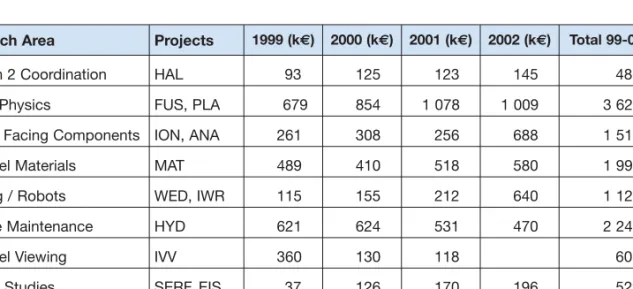
The respective volumes of the FFusion 2 research projects and industrial projects in the main re-search areas are given in Table 1. The summary of the EFDA Technology Tasks and Contracts in 1999–2002 is given in Annex 1.
The industry is involved in all Association technol-ogy tasks related to vessel/in-vessel materials and
Research Area Projects 1999 (k€) 2000 (k€) 2001 (k€) 2002 (k€) Total 99-02 (k€)
FFusion 2 Coordination HAL 93 125 123 145 486
Fusion Physics FUS, PLA 679 854 1 078 1 009 3 620
Plasma Facing Components ION, ANA 261 308 256 688 1 513
In-Vessel Materials MAT 489 410 518 580 1 997
Welding / Robots WED, IWR 115 155 212 640 1 122
Remote Maintenance HYD 621 624 531 470 2 246
In-Vessel Viewing IVV 360 130 118 608
System Studies SERF, EIS 37 126 170 196 529
Industrial Projects 1 133 660 693 628 3 114
Table 1. Funding of the main research areas of the FFusion 2 technology programme in 1999–2002. The detailed EFDA Technology Task summary is given in Appendix 1.
25 75 95 100 0 5 25 75 95 100 0 5 25 75 95 100 25 75 95 100
remote handling systems. In addition, there have been several industrial ITER design tasks through the European Fusion Engineering and Technology (EFET) Consortium.
The underlying technology in reactor in-vessel materials includes the further development of frac-ture resistance test methods and verification of specimen size effects, measuring techniques for characterising surface film properties of metals in coolant water environments and the development of non-destructive examination techniques appli-cable to the inspection of primary wall modules. Collaboration with the EFDA Close Support Units in Garching and Culham, Associations CEA (France), Association ENEA Brasimone (Italy), FZK Karlsruhe (Germany), Risø (Denmark), SCK-CEN (Belgium), VR (Sweden) and CRPP Lausanne (Switzerland) has played an essential role in the fusion technology activities of the FFusion 2 Programme.
1.5 Participating Institutes and
Companies
1.5.1 National Technology Agency of Finland (Tekes)
The National Technology Agency, Finland (Tekes) is the main funding authority and co-ordinator for technological research and development activities in Finland. The fusion research co-ordinators in Tekes have been Technology Director Seppo Hannus (1999), Technology Manager Reijo Munther and Senior Technical Adviser Juha Linden.
1.5.2 Finnish Fusion Research Unit Research activities in the FFusion 2 technology pro-gramme are carried out in several VTT research in-stitutes and universities. The co-ordinating unit is VTT Processes and the programme manager of the FFusion 2 is Seppo Karttunen, acting as Head of Re-search Unit of the Association Euratom-Tekes. The Finnish Fusion Research Unit consists of the following research groups from the institutes and universities, which have been participating in the fusion research that occurred in 1999–2002: VTT Technical Research Centre of Finland: • VTT Processes1(FFusion 2 co-ordination,
fu-sion plasma physics, plasma-wall interactions, neutronics)
• VTT Industrial Systems2(materials, remote handling)
• VTT Electronics (remote handling) Helsinki University of Technology (HUT): • Department of Engineering Physics and
Mathe-matics (fusion plasma physics, diagnostics) • Laboratory of Automation Technology
(remote handling)
University of Helsinki (UH):
• Accelerator Laboratory (plasma-wall inter-actions)
Tampere University of Technology (TUT): • Institute of Hydraulics and Automation
(remote handling)
Lappeenranta University of Technology (LUT):
• Laboratory of Machine Automation (remote handling)
1 VTT Energy and VTT Chemical Technology were combined into a new unit, VTT Processes, starting in 2002. 2 VTT Automation and VTT Manufacturing Technology were combined into a new unit VTT Industrial Systems,
starting in 2002. 25 75 95 100 0 5 25 75 95 100 0 5 25 75 95 100 25 75 95 100
1.5.3 Industrial Companies
Industrial activities related to the FFusion 2 pro-gramme are co-ordinated by Prizztech Oy. Three industrial groups are qualified for ITER activities and they are participating in the European Fusion Programme (Key Action “Fusion”):
1. The Finnish Remote Handling Group consist-ing of Advatec Oy, Fortum Power and Heat Oy, Hytar Oy, PI-Rauma Oy, Platom Oy, Plustech Oy, Rocla Oy and Tehdasmallit Oy. (Technol-ogy: 11. Qualification of Standards and Tools) 2. The Finnish Blanket Group consisting of Aker Mäntyluoto Oy, Diarc Technology Oy, Fortum Power and Heat Oy, High Speed Tech Oy, Metso Engineering Oy, Metso Powdermet Oy, Outo-kumpu Poricopper, Patria Finavitec Oy and PI-Rauma Oy. (Technologies: 5. Plasma Facing Component Mock-Ups, 6. Vacuum Vessel, Shield and Tritium Breeding Blanket Segment Mock-Ups)
3. Outokumpu Poricopper Oy / Superconductors. (Technology: 7. Strand)
Fortum is a partner in the European Fusion Engi-neering and Technology (EFET) Consortium. The EFET partners are: Ansaldo Richerche (Italy), Belgatom (Belgium), Fortum (Finland), Fram-atome ANP GmbH (Germany), FramFram-atome ANP SAS (France), IBERTEF (Spain) and NNC (UK).
1.6 National Steering Committee
The national steering committee of the FFusion 2 technology programme prepares the Finnish fu-sion research strategy, advises in the planning of fusion research and promotes collaboration with the Finnish industry.The members of the FFusion 2 Steering Committee are
Chairman Rainer Salomaa,
Helsinki University of Technology Members
• Iiro Andersson, Prizztech Oy
• Eeva Ikonen, Finnish Academy (2000–2001)
• Juhani Keinonen, University of Helsinki • Lenni Laakso, Outokumpu Poricopper Oy
(1999)
• Juha Linden, Tekes (2002) • Reijo Munther, Tekes
• Lasse Mattila, VTT Processes (1999)
• Olli Naukkarinen, Outokumpu Poricopper Oy (2000–2002)
• Pertti Pale, EFDA CSU Culham / Prizztech Oy • Pentti Pulkkinen, Finnish Academy
(2001–2002)
• Rauno Rintamaa, VTT Industrial Systems • Rolf Rosenberg, VTT Processes (2000-2002) • Arto Timperi, Plustech Oy
• Harri Tuomisto, Fortum Nuclear Services Secretary
Jukka Heikkinen, VTT Processes FFusion 2 programme manager Seppo Karttunen, VTT Processes
There have been 13 FFusion 2 Steering Committee meetings in the programme period between 1999 and 2002.
1.7 FFusion 2 Programme Funding
The FFusion 2 technology programme/activities of the Association Euratom-Tekes is financed by Euratom and by the national institutions of Tekes, the Finnish Academy of Sciences, the participating institutes (VTT, HUT, TUT, LUT and UH) and the industry.Figure 4 shows the yearly funding of the FFusion 2
technology programme from 1999 to 2002. The distribution of the total funding between the differ-ent organisations during the four-year period 1999–2002 is shown in Figure 5. The total funding of the FFusion 2 research activities for 1999–2002 is approximately€12.1 million. The total volume of the industrial activities related to the FFusion 2 programme is about€3.1 million for the same pe-riod. Thus, the overall expenditure in 1999–2002 is about€15.2 million. 25 75 95 100 0 5 25 75 95 100 0 5 25 75 95 100 25 75 95 100
The relative volume of the research and develop-ment work in the participating institutions can be seen in Figure 6. VTT accounts for about 38% of the research volume, the universities 41%, and the industry 21%. 0 1 2 3 4 1999 2000 2001 2002 Technology Contracts Technology Tasks Underlying Technology Physics and JET Technology
Figure 4. Yearly funding by research fields (in millions of€) of the Association Euratom-Tekes in 1999–2002.
Association Euratom – Tekes Funding 1999-2002 VTT 9 % Universities 13 % Academy 2 % Industry 9 % Euratom 29 % Tekes 38 %
Figure 5. Distribution of the funding of the FFusion 2 technology programme and the rela-ted industrial R&D projects between the different organisations for the period 1999–2002.
The total value of the funding is approximately
€15.2 million.
Association Euratom – Tekes Research Volumes 1999-2002 HUT 16 % TUT 14 % UH 7 % LUT 4 % Industry 21 % VTT 38 %
Figure 6. Research volumes of the participating institutions, VTT, the universities and the industry in 1999–2002. The total amount of expenditures for the period 1999–2002 is approximately€15.2 million. 25 75 95 100 0 5 25 75 95 100 0 5 25 75 95 100 25 75 95 100
1.8 International Collaboration
1.8.1 Association Euratom-TekesThe FFusion 2 technology programme is fully inte-grated into the European Fusion Programme. The Association Euratom-Tekes was established when the Contract of Association between Euratom and Tekes was signed in Helsinki, on March 13, 1995. The present Contract of Association extends to the end of 2003. Finland, represented by Tekes, was a member of the JET Joint Undertaking from May 7, 1996 until the end of 1999. From the beginning of 2000, JET activities have been conducted under the multilateral EFDA and JIA Agreements. The Association Tekes is the responsible organisation and partner in those agreements. Other contracts signed by the Association Euratom-Tekes include the multilateral Staff Mobility Agreement. The FFusion 2 technology programme covers all re-search activities of the Fusion Rere-search Unit of the Association Euratom-Tekes.
Association Steering Committee
The activities of the Finnish Association Euratom-Tekes are steered by the Association Steering Committee. It supervises the execution of the Con-tract of Association, adopts the details of the programme, ensures the progress of the research activities and steers them towards the programme objectives. The Association Steering Committee also appoints the Head of Research Unit on the proposal of Tekes.
The members of the Association Steering Committee are:
• Umberto Finzi, EU Commission, Research DG (Chairman in 1999, 2000)
• Hardo Bruhns, EU Commission, Research DG (Chairman in 2002)
• Johannes Spoor, EU Commission, Research DG • Reijo Munther, Tekes, (Chairman in 2001) • Mikko Kara, VTT (1999)
• Markku Auer, VTT (2000-2002)
• Harri Tuomisto, Fortum Nuclear Services • Jukka Heikkinen, VTT (secretary)
The Association Steering Committee has had 4 meetings during the period 1999–2002. The Steering Committee accepts annual accounts, yearly budgets and research programme, and the annual reports of the Research Unit.
1.8.2 Participation in the Committees of the EU Fusion Programme The Finnish representatives on the various Commit-tees of the EU Fusion Programme are given below. Consultative Committee for the Euratom Specific Research and Training Programme in the Field of Nuclear Energy – Fusion (CCE-FU): • Seppo Karttunen, VTT
• Reijo Munther, Tekes JET Council (JC): • Seppo Karttunen, VTT • Reijo Munther, Tekes
JET Executive Committee (JEC): • Reijo Munther, Tekes
• Rainer Salomaa, HUT
Fusion Physics Committee (FPC): • Seppo Karttunen, VTT
• Rainer Salomaa, HUT
Fusion Industry Committee (CFI): • Juho Mäkinen, Outokumpu Oyj EFDA Steering Committee (EFDA SC): • Seppo Karttunen, VTT
• Reijo Munther, Tekes
EFDA JET Sub-Committee (EFDA JS): • Rainer Salomaa, HUT
EFDA Technology Sub-Committee (EFDA TS): • Rauno Rintamaa, VTT
EFDA Public Information Committee (EFDA CPI):
• Seppo Karttunen, VTT (CPI Chairman) The EFDA Committee structure was streamlined in 2002 by combining EFDA JS and EFDA TS, and very recently also the FPC, into a new EFDA Sci-ence and Technology Advisory Committee (STAC) and establishing the Administration and Financing Advisory Committee (AFAC). The Finnish mem-25 75 95 100 0 5 25 75 95 100 0 5 25 75 95 100 25 75 95 100
maa (HUT) in STAC and Juha Linden (Tekes) in AFAC.
In the 5th Framework Programme, independent external advisory committees (EAG) were nomi-nated for all key actions to advice the Commission. EAG members are not directly involved in the re-search activities related to the key action. The Finnish members of the fusion EAG were Heikki Kalli (1999-2001) and Pekka Pirilä (2002). Seppo Karttunen and Reijo Munther are members of the IEA Fusion Power Co-ordinating Committee. The following fusion committees and expert groups have Finnish representatives:
• Jukka Heikkinen is a member of the Co-ordinating Committee for Fast Wave Heating (CCFW). • Seppo Karttunen is a member of the Co-ordinating
Committee for Lower Hybrid Heating and Cur-rent Drive (CCLH).
• R. Salomaa is a member of the European Fusion Information Network (EFIN).
• Seppo Tähtinen is a Materials Liaison Officer in the European Blanket Project
• Olgierd Dumbrajs is a member of the interna-tional experts commission on Electron Cyclo-tron Wave Systems.
Olgierd Dumbrajs, Jukka Heikkinen, Seppo Kart-tunen, Jari Likonen and Rainer Salomaa partici-pated in various Ad-Hoc-Groups to evaluate e.g., JET enhanced performance activities, Tore Supra CIMES project and cost share actions in the newly associated countries.
1.9 European and Other
International Collaboration
In plasma physics and plasma-wall interactions, the Association Euratom-Tekes participates in the EFDA JET and ASDEX Upgrade work pro-grammes. Other physics collaboration related to radio-frequency heating and current drive takes place mainly with Tore Supra at CEA Cadarache and FTU at ENEA Frascati. ITER gyrotron devel-opment work is carried out in collaboration with the Associations FZK Karlsruhe and CRPP Lau-sanne. Stellarator activities include the Wendelstein
AS-7 experiments at Garching and the Wendel-stein 7-X diagnostics development at Greifswald. In fusion technology, there are joint research pro-jects with the Associations Risø and SCK-CEN in Belgium dealing with the in-situ materials testing under neutron irradiation. Collaboration with ENEA Frascati and Brasimone includes the in-ves-sel viewing system and divertor refurbishment platform. Water-hydraulic manipulators and weld-ing robots have been developed with CEA. The EFDA CSU in Garching co-ordinates the Euro-pean collaboration in fusion technology tasks and work for ITER.
The staff mobility scheme of the EU Fusion Pro-gramme has offered excellent opportunities for the exchange of scientists and engineers in Europe. There have been 18 staff mobility visits of 1 to 6 months in 1999–2002. Longer visits of over one year have been made to JET, NET Team and IPP through other arrangements. In addition, several shorter bilateral visits have taken place since 1993. The longer visits to the EFDA Close Support Units in Culham and Garching and UKAEA JET Opera-tors Team were:
• Pertti Pale at EFDA CSU Culham, 1999–2002
• Herkko Plit at EFDA CSU Garching, 2000–2002
• Ben Karlemo at EFDA CSU Garching, 2001–2003
• Mervi Mantsinen at UKAEA JOC, 2000–2002
• Tuomas Tala at UKAEA JOC, 2000–2001
• Johnny Lönnroth at UKAEA JOC, 2002–2004
• Marko Santala at UKAEA JOC, 2002– 2004.
Some collaboration with non-EU countries has also taken place, e.g., with the Ioffe Institute in St. Pe-tersburg (fusion theory, Globus tokamak), the Insti-tute for Applied Physics in Nizhny Novgorod (gyrotrons), with DIII-D in San Diego on radio-fre-quency heating and edge plasmas and with the Uni-versity of California at Berkeley on Particle-in-Cell codes. Annual fusion symposiums between HUT and the Ioffe Institute have been organised. 25 75 95 100 0 5 25 75 95 100 0 5 25 75 95 100 25 75 95 100
Two international workshops and a large fusion technology conference were held in Finland: the 8thInternational Workshop on Plasma Edge
Phe-nomena, Espoo, 10–12 September 2001, the 9thth
European Fusion Physics Workshop, Saariselkä, 11–13 December 2001 and the 22ndSymposium on
Fusion Technology (SOFT) Helsinki, 9–13 Sep-tember 2002.
1.10 Public Information
The revised Fusion Expo premiered at the Helsinki University of Technology in September and Octo-ber 1999. The opening took place SeptemOcto-ber 10th
and was followed by a Fusion Seminar. Visitors to the Fusion Expo included professors, students, several high school groups and the general public. In addition, some special events were organised. The Expo attracted a great deal of interest in media and the highlights were an interview and a program on a nationwide television channel. The Finnish version of the Fusion Expo CD and the Expo Book-let were widely distributed to high schools and re-search institutes. The Association Tekes produced a video film on Finnish fusion research, mainly to be used in the future on the “Association Wall” in Fusion Expo.
The Symposium on Fusion Technology (SOFT), Helsinki, 9–13 September 2002 attracted a lot of publicity in Finland. SOFT and recent develop-ments in fusion research were referred in the nation wide and local newspapers as well as on the nation-wide television channels including the main eve-ning news.
Other public information actions were:
• The FFusion 2 brochures on the research activi-ties of the Tekes Association, Euratom and ITER development were published in Finnish and English in 2001 and a FinnFusion brochure “Fusion and Industry” was published by Prizz-tech in 2002.
• A lecture series in fusion technology and plasma physics at the Helsinki University of Technol-ogy in 1999 and 2001 and the Lappeenranta Uni-versity of Technology in 2000 and 2002 as well as a lecture in the Plasma Heating and Current Drive Course at the Culham Science Centre by Association Tekes staff.
• Two invited talks on fusion in a FACTE (Finnish Academies for Technology) Seminar. The semi-nar audience included executives from the in-dustry and parliament members from all major political groups.
• An invited talk at the Energy 2000 Congress in Tampere. The congress program, including fu-sion, attracted the local media.
• An ITER/CERN-Industry Seminar for industry executives and politicians was organised in 2000.
• The FFusion 2 Newsletter has appeared three times per annum during 1999–2002 and four Annual FFusion 2 Seminars with speakers in-vited from other Associations and EFDA CSUs. In addition, several general articles on fusion en-ergy and research, interviews for newspapers and science programs in national radio channels plus Studia Generale Lectures and Seminars for a broader audience. EFDA Newsletters and the Fu-sion brochures by the CommisFu-sion and EFDA have been widely distributed on various occasions.
25 75 95 100 0 5 25 75 95 100 0 5 25 75 95 100 25 75 95 100
2
Fusion Physics and Plasma Engineering
VTT Processes
S. Karttunen (Programme Manager), J. Heikkinen (Project Manager),
T. Pättikangas, K. Rantamäki and T. Tala Helsinki University of Technology Advanced Energy Systems
R. Salomaa (Project Manager), P. Aarnio,
M. Airila, K. Alm-Lytz, T. Carlsson, O. Dumbrajs, L. Hämäläinen, V. Hynönen, S. Janhunen,
T. Kiviniemi, J. Koponen, T. Kurki-Suonio, A. Kulvik, P. Kåll, A. Lampela, J. Lönnroth, M. Mantsinen, P. Nikkola, A. Ranta-aho, S. Saarelma, A. Salmi, K. Salminen, M. Santala, S. Sipilä, V. Tulkki and F. Tuomisto
From 1999 to 2002, the work within fusion physics and plasma engineering was strongly focused on the modelling of experiments and design efforts at various European fusion facilities, e.g., JET in England, ASDEX Upgrade and Wendelstein 7-AS in Germany, and on the international ITER project. The main fields of research were radio-frequency heating and transport processes in tokamak and stellarator plasmas, in which the fusion and plasma engineering group has acquired a high level of ex-pertise and knowledge.
In comparison to the contents of the work for the previous four-year period (1995–1998), research is visibly more target-oriented and has wider respon-sibilities at the European programme level, includ-ing the Task Force participation in JET and ASDEX Upgrade. In addition, the shift of the re-search focus towards the edge plasma physics and engineering is evident. It was realised by merging the plasma physics and surface physics groups. About two-thirds of the scientists and students are with the edge plasma and wall-interaction physics. The ASCOT 5-D orbit-following edge-oriented particle code development efforts and the labora-tory built for handling tritium and beryllium con-taminated samples for wall material surface
analy-sis form the backbone of the reactor edge-related research.
Sustaining fusion energy production in a magneti-cally confined chamber requires the understanding of a complex interplay between the core (burn) and edge plasma regions as well as the wall-interac-tion. All this provides fusion technology with un-compromising conditions justifying the core phys-ics research along with the edge research and co-ordination for technology. The group members have actively participated in various international committees and ad-hoc groups for co-ordinating and evaluating physics and engineering in their field, and have also been entrusted with several in-ternational review and referee duties.
As high-lights in fusion plasma physics Associa-tion Euratom-Tekes organised both the 8th
Interna-tional Workshop on Plasma Edge Theory in Fusion Devices in Espoo and the 9th European Fusion
Physics Workshop in Saariselkä, both in the Fall 2001. The Association also has the privilege of hosting the 10thEuropean Fusion Theory
Confer-ence in 2003.
2.1 Radio-Frequency Heating of
Tokamak Plasmas
Before the energy-producing fusion reactions can occur in a deuterium-tritium plasma, the plasma has to be heated to a very high temperature. In modern tokamaks, the external heating is provided by either neutral beam injection (NBI), or by ra-dio-frequency (rf) waves. Fusion reactions pro-duce alpha particles, which are the nuclei of He-4 atoms. These alphas have a kinetic energy of 3.5 MeV, which is collisionally transferred to plasma ions and electrons. Ignition is achieved if the alpha heating alone is able to sustain the temperature of the plasma fuel, and the auxiliary heating can be turned off.
In rf heating, wave frequencies ranging from 10 MHz to up to 200 GHz are applied. The three im-portant rf heating technologies, ion cyclotron, lower hybrid, and electron cyclotron heating, in or-der of increasing frequency, are well developed. These differ in their related wave power genera-tion, launching, propagagenera-tion, and absorption mechanisms. While the basic heating mechanism for these schemes is well understood and proven in experiments for some time now, significant prog-ress in this field has only been recently made in de-veloping more efficient power sources, optimising the launching of the wave, and using the heating waves for plasma control and diagnostics.
2.1.1 Ion Cyclotron Heating Experiments in JET
Ion cyclotron waves and neutral beam injection provide the main means for bulk plasma heating at JET. In a reactor, direct heating of the fuel ions can only be accomplished with ion cyclotron waves. In addition to heating and burn control, ion cyclotron waves have proven useful in MHD control. Ion cy-clotron heating experiments have played an impor-tant role in the recent JET Campaigns.
Alpha tail production with ion cyclotron resonance heating of4He beam ions in JET plasmas
Experiments have been carried out for the first time on JET with the 3rdharmonic ion cyclotron
reso-nance heating of4He beam ions in order to produce
a high-energy population of4He ions to simulate
3.5 MeV fusion-born alpha particles. The success-ful acceleration of4He beam ions to the MeV energy
range was confirmed by measurements of gamma ray emission from the reaction9Be(α,nγ)12C and
ex-citation of Alfvén eigenmodes, and was consistent with the observed heating of the background elec-trons and sawtooth stabilisation. Sawtooth stabilisa-tion by fast4He ions was found to give rise to large
amplitude sawteeth, which trigger magnetohydro-dynamic instabilities called neo-classical tearing modes, which, in turn, degrade confinement (Fig-ure 7). The largest high-energy populations of4He
ions were obtained with the highest energy 4He
beams, as expected. In these conditions, fast4He
ions provided up to 80–90% of the plasma heating. The scheme will be used in the forthcoming JET campaign with 4He plasmas for dedicated
al-pha-particle studies.
Figure 7. Sawtooth stabilisation by fast 4He ions gives rise to large-amplitude sawtooth crashes, which trigger long-lived magnetic perturbations (neo-classical tearing modes with the toroidal and
Controlling the profile of ion-cyclotron-resonant ions in JET with the wave-induced pinch effect
Direct evidence for the wave-induced pinch of fast ions in the presence of asymmetric ICRF waves (co-current spectrum leading to an inward pinch and a counter-current spectrum to an outward pinch) was obtained. This was made possible by recent advances in the tomographic reconstruction of the gamma-ray emission from nuclear reactions between ICRF-accelerated high-energy ions and bulk ions. With waves launched predominantly in the co-current direction, a higher radial gradient of gamma-ray emission, and thus of fast ions, was ob-tained than with waves in the counter-current di-rection. This result, together with concurrent dif-ferences in Alfvén eigenmodes, sawtooth periods, electron temperatures and fast ion energies show that the ICRF-induced pinch can provide a tool to affect the radial fast ion profile and the plasma heating profile during ICRF. The ICRF-induced pinch is used to enhance the performance of dis-charges with internal transport barriers. When the waves propagate along the plasma current (inward pinch), the formation of an internal transport bar-rier has been found to be prompter and the neutron yield up to a factor of two higher than for propaga-tion against the current.
Observation of a new type of magnetohydro-dynamic activity in low-density discharges with a high-power ICRH
The question of sawtooth stabilisation at very high fast ion energy contents has been addressed with ion cyclotron resonance frequency heating and varying plasma density, controlled by deuterium gas puffs. When the plasma density decreases so it is below a certain threshold, the sawtooth fre-quency and the crash duration time increase by a factor of five. The experimental results appear to be consistent with the present theoretical picture of sawtooth and fishbone mode stability, exploring the domain with a very large fast ion population. First observation of p-T fusion in JET tritium plasma with ICRF heating of protons
High-power ICRF heating of a hydrogen minority ion species in JET tritium plasmas has been found
to generate a total neutron rate that is about 40% larger than the 14 MeV neutron rate originating from fusion reactions between bulk tritium ions and deuterium minority ions. The T(p,n)3He
fu-sion reaction, caused by ICRF-accelerated pro-tons, is identified as a source for producing the ex-cess neutron emission. This reaction is endother-mic and has a proton energy threshold of about 1 MeV and a peak cross section at about 3.0 MeV. Analysis of ion cyclotron heating and
current drive atω ≈2ωcHfor sawtooth control in JET plasmas
Ion cyclotron heating and current drive atω ≈2ωcH
in JET deuterium plasmas with a hydrogen con-centration nH/(nD+nH) in the range of 5–15% have
been analysed, comparing results of numerical computer modelling with experiments. Second-harmonic hydrogen damping is found to be maxi-mised by placing the resonance on the low-field-side of the torus, which minimises the competing direct electron damping and parasitic high-har-monic D damping in the presence of D beams. The shape of the calculated current perturbation and the radial localisation of the heating power density have been found to be consistent with the experi-mentally observed evolution of the sawtooth pe-riod when the resonance layer moves near the q=1 surface.
Development of ICRF mode conversion for localised bulk electron heating on JET
ICRF mode conversion heating (using3He in D
and4He plasmas) has been developed at JET for
localised on-axis or off-axis sources of electron heating. By properly programming the 3He gas
flow, a steady-state, off-axis peaked power deposi-tion on the electrons has been maintained through-out the ICRF heating phase (up to 5 s, limited by technical constraints). The parametric dependence of the location of the direct electron power deposi-tion has been found to be consistent with theoreti-cal expectations. The scheme has been used for ro-tation experiments without external momentum in-put and fast particle effects, for electron transport studies, etc.
Preparing ICRH in future JET campaigns: high-power ICRF heating scenarios in JET deuterium-tritium plasmas
The installation of the new ITER-like ICRF launcher at JET is expected to increase the total coupled ICRF power by about a factor of two. The effects of the increased power on the performance of ICRF heating scenarios used in JET deute-rium-tritium (DT) plasmas have been investigated and optimised using numerical computer model-ling. This optimisation includes tailoring the pro-file and energy of ICRF-accelerated ions using multiple frequencies to maximise bulk ion heating and/or fusion reactivity. The ICRF heating experi-ments carried out during the 1997 JET DTE1 cam-paign, with up to 8–9 MW of ICRF power applied using a single frequency operation, serve as the starting point for this work. In general, multiple frequency schemes have been found to give im-proved (by up to 100%) ion heating and fusion re-activity as compared with a single resonance in the plasma centre. Deuterium minority heating with PICRF= 15 MW was found to give the highest
fu-sion reactivity, corresponding to Q = Pfus/PICRF≈
0.45 (Figure 8). The highest bulk ion heating frac-tion of≈65% (Pci ≈10 MW) was obtained with 3He minority heating using n
He/ne= 6%.
Phasing effects on coupled power and plasma edge
Operating ICRF antennae with a monopole phas-ing is known to improve the couplphas-ing as the eva-nescent region in front of the antenna becomes more transparent for low parallel wave numbers excited. However, in contrast to the previous A1 antenna set at JET, the present A2 type antennae do not couple monopole power efficiently. Moreover, harmfully increased edge interaction has been ob-served with this phasing. With both A1 and A2 an-tennae, no access to H-mode was possible with monopole phasing. Thus, dipole (0π0π) antennae are routinely employed to heat the core plasma without perturbing the edge, whereas monopole (0000) antennae can be used to modify edge and scrape-off-layer (SOL) properties by driving edge convection.
In monopole heating experiments (up to 8MW coupled power) with PION modelling of the mea-sured NPA from the heated fast tail hydrogen ions, it was found that centre absorption reached almost 50% with the fundamental hydrogen minority heating in agreement with the single pass absorp-tion predicabsorp-tion. No H-mode transiabsorp-tion was ob-served. It was thus concluded that a high heating efficiency may be reached with monopole phasing whenever the single-pass absorption can be made strong for it.
It has been suggested that the rf-driven convection can affect H-mode properties, such as the particle confinement time and the Edge Localised Mode (ELM) repetition rate, and reduce the divertor heat load by broadening the SOL. However, recent mixed-phasing (monopole-dipole) experiments at JET, showed undesirable antenna-plasma interac-tions for L-mode plasmas using A2 antennae. In particular, phasing the four antennae alternately in monopole and dipole around the torus produced a heavy interaction with a monopole antenna (see Figure 9). The strong interaction region was con-nected by the field lines to the adjacent dipole an-tenna. A similar interaction was not observed using either pure monopole or pure dipole phasing., nor Figure 8. Contour plot of Q = Pfus/PICRFas a
function of nDand nefor deuterium minority heating using the optimised multiple frequency scheme (solid lines) and a single frequency
A sheath analysis performed in co-operation with the Lodestar Research Corporation, USA suggests that the observed interaction in L-mode is due to arcing induced by a large dc sheath potential differ-ence and the resulting current flow, between anten-nae with mixed phasings. Combining the sheath and arcing physics, the following quantitative cri-terion, Is≡necsA > Imin, is obtained, where Iminis
the minimum current to sustain an arc (for typical materials 1–10 A), where A is the projection of the sheath interaction area normal to the magnetic field. Taking ne~1011cm-3, Te~50 eV, A~(100cm)2
sin 3o= 500 cm2, one obtains the estimate I s= 40 A,
which is the right order of magnitude to sustain an arc. If this is indeed the mechanism responsible for the observed interactions, the analysis suggests that the future mixed-phasing experiments may be successful in H-mode plasmas, which have a lower density near the antenna.
Analysis of combined neutral beam injection and fast wave current drive on the DIII-D tokamak
In experiments with a combined fast wave current drive (FWCD) and deuterium neutral beam
injec-tion on the DIII-D tokamak, an enhanced fusion re-activity and fast ion energy content have been ob-served in the presence of FWCD, with a concomi-tant low FWCD efficiency. High-harmonic hydro-gen and deuterium cyclotron damping in these dis-charges have been investigated and found respon-sible for the observed low FWCD efficiency since a number of high-harmonic hydrogen and deuterium cyclotron resonance layers exist in the plasma. Ac-cording to ICRF modelling with the PION code, high-harmonic damping of fast waves gives rise to enhanced fusion reactivity and fast ion energy con-tent consiscon-tent with the experimental observations.
2.1.2 Particle-in-Cell Simulations of Lower Hybrid and Ion Bernstein Waves
Lower hybrid (LH) waves in the frequency range 1–10 GHz are used to heat and drive the non-induc-tive current in tokamak plasmas. A non-inducnon-induc-tive current drive is necessary for steady-state opera-tion in tokamaks. LH waves are the most efficient method of driving off-axis current and thus modi-fying the current profile for improved plasma con-Figure 9. With 4 MW (0000) superimposed on 4 MW (0π0π), a severe interaction with
the antenna structure (see CCD frame) was observed, with sputtering of high Z impuri-ties (O,C,Ni). When the applied (instantaneous) potential difference V between the an-tennae is large, the net current flows to the antenna with a larger sheath potential.
finement. Ion Bernstein (IB) wave heating in the frequency range 20–400 MHz has been used in some high field tokamaks and may become impor-tant for heating spherical and compact tori. For both LH and IB, waveguide grills are used for wave excitation in the plasma.
LH wave coupling
Efficient coupling of lower hybrid waves to plasma is the key issue for the future use of LH power for heating and current drive. The coupling is usually modelled with the aid of linear wave equations. Recently, the particle-in-cell (PIC) method has been proposed and applied to these kinds of simu-lations. The electromagnetic PIC codes are devel-oped well enough so that they can be used to study the coupling from a full-scale 32-waveguide grill to plasma. The advantage of the PIC method is that it also takes into account the non-linear and kinetic effects. With this new tool, it is also possible to study the coupling at very low densities, even be-low the cut-off density, and at steep gradients, where the usual approximations fail.
Here, the coupling of the LH power is studied with the particle-in-cell code XOOPIC. The code is two-dimensional in configuration space and
three-dimensional in velocity space. It is fully electro-magnetic, relativistic and allows parallel comput-ing. Calculations have so far been made for both the Tore Supra and JET.
In the simulations the waveguides are fed with a pure transverse electromagnetic (TEM) mode, which is the principal mode in this geometry. Part of the wave power is always reflected back from the grill mouth. The reflection coefficients can be determined from the decrement in the Poynting flux averaged over a few wave periods in time. The Poynting fluxes are measured close to the wave source.
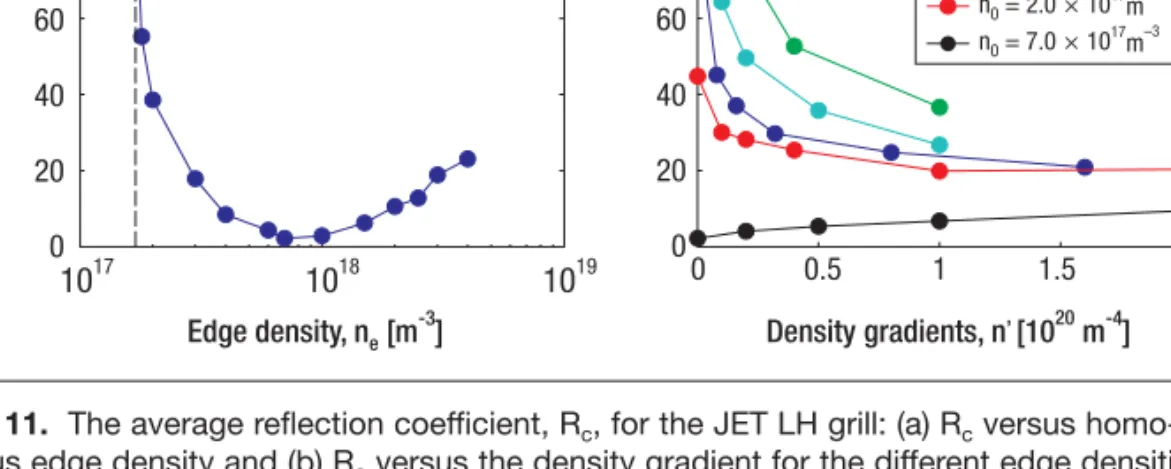
For JET, the coupling simulations have been made for various plasma densities and linear density gra-dients. The reflection has a minimum of only 2.2% near the density of ne=7×10¹⁷m-3. The reflection
increases strongly when the density approaches the cut-off density. In addition, above the optimum density, the reflection increases. Around the opti-mum density, the linear density gradient has only a weak effect on the coupling, at least when the den-sity scale length is long enough, i.e., n/n’>1 cm. Close to the cut-off density, the gradient reduces the reflection from the grill mouth remarkably.
Figure 10. Toroidal electric field in the near field of the Tore Supra grill. The wall structure is denoted at the bottom of the figure. The edge density was ne=1018m-3and the density gra-dient, ne’=1020m-4. Most of the launched power is carried by the principal mode n||=-1.9 pro-pagating to the left. The second mode, n||=5.8 propagating to the right, is also seen.
Parasitic absorption and fast particle generation
One problem related to the LH coupling is the for-mation of strong asymmetric heat loads, which may limit high power operation. Such hot spots have been observed in several LH current drive ex-periments on components that are magnetically connected to the grill region. The hot spots, and the related impurity influx, are especially inconve-nient in long-pulse discharges since they limit the power level of the grill. Experiments indicate that the hot spots are generated by fast electrons created in front of the grill and flowing along the magnetic field lines to the wall. A strong candidate for the formation of the fast electrons is the parasitic ab-sorption of the short wave length modes of the LH power spectrum. The modes with a parallel refrac-tive index of n||= 25 have a low enough phase
ve-locity that they are absorbed by electrons within a very narrow distance, a few mm, in front of the launcher. Due to the overlapping of the modes, the cold edge electrons Te~ 25 eV can reach energies
of up to 2 keV through stochastic acceleration in the electric field in front of the LH grill.
The parasitic absorption has been studied with electrostatic particle-in-cell (PIC) simulations. In order to have a more realistic spectrum, the surface charge density used as the grill model in the PIC code XPDP2 was calculated from the output of the
SWAN coupling code. Simulations have been made mainly for the Tore Supra, but JET and ITER have also been considered.
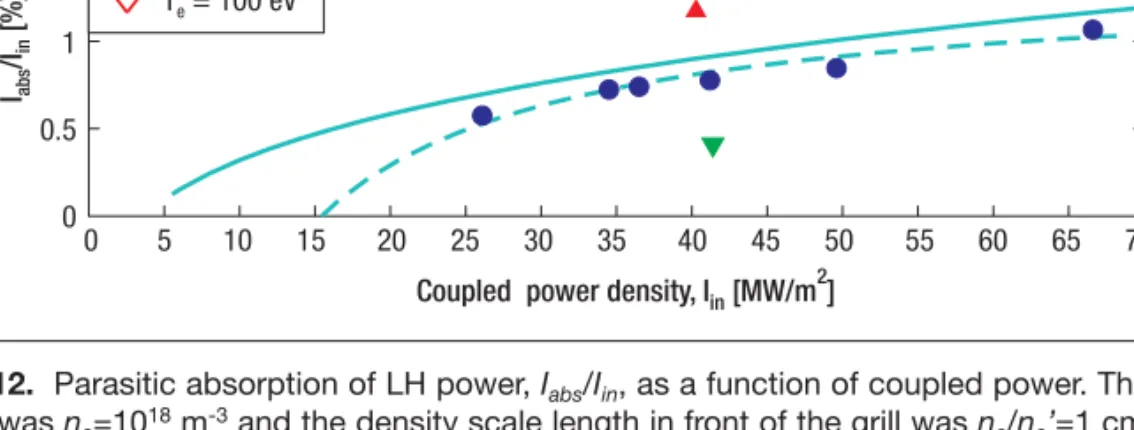
The PIC simulations for the Tore Supra confirm the suggestions that the fast electrons could be created by parasitic absorption. The electrons were indeed accelerated to almost 2 keV. The absorption in-creases with the edge density, the edge temperature and the coupled power. The density dependence in the range ne=0.6 to 2×10¹⁸m-3was weak. The
ab-sorption in this density range was about 0.7–0.8% causing heat loads of around 5 MW/m2. The
ab-sorption becomes stronger as a function of the cou-pled power. For a density of ne=1×10¹⁸m-3, the
ab-sorption was 0.6% at the lowest simulated power density 26 MW/m2and slightly above 1% at the
power density of 67 MW/m2. The corresponding
heat loads on the wall were 1.5 and 12 MW/m2,
which are in agreement with the experiments at Tore Supra. Assuming that the temperature does not affect the wave spectrum, a clear increase with the temperature was seen in the absorption. The ab-sorption increases from 0.4% at Te=12.5 eV to
1.7% at Te=100 eV. At the same time, the heat load
on the wall increased from 2 to 12 MW/m2.
Calcu-lations made for the ITER LH launcher, confirmed the anticipation made based on the SWAN spec-trum; the power content in the high-n||part of the
spectrum of the ITER grill is so low that no absorp-tion was seen.
Density gradients,n,[10 m ]20 -4 Edge density,ne[m ]-3 100 80 60 40 20 0 100 80 60 40 20 0 0 0.5 1 1.5 2 Reflection coeffient, R[%] 1017 1018 1019 n = 0 10 0 n = 1.0 m n = 1.6 10 m n = 2.0 10 m n = 7.0 10 m 0 0 0 0 17 –3 17 3 17 3 17 3 × × × × – – –
Figure 11. The average reflection coefficient, Rc, for the JET LH grill: (a) Rcversus homo-geneous edge density and (b) Rcversus the density gradient for the different edge densities.