Cite this article as: Polat, G., Turkoglu, H., Damci, A. (2019) "A Grading System-based Model for Detecting Unbalanced Bids during the Tendering Process", Periodica Polytechnica Architecture, 50(2), pp. 139–147. https://doi.org/10.3311/PPar.12669
A Grading System-based Model for Detecting Unbalanced Bids
during the Tendering Process
Gul Polat1*, Harun Turkoglu1, Atilla Damci1
1 Department of Civil Engineering, Faculty of Civil Engineering, Istanbul Technical University, Maslak, 34469 Istanbul, Turkey * Corresponding author, e-mail: [email protected]
Received: 12 June 2018, Accepted: 06 February 2019, Published online: 04 June 2019
Abstract
Unbalanced bidding is a common practice used in both unit price and lump sum contracts. Contractors may unbalance their bids in different forms for various reasons. The studies in the literature either focus on developing optimization models that assist contractors in winning contracts and maximizing profits of their bids through unbalancing or developing models that assist owners in detecting and/or preventing unbalanced bids during the bid evaluation stage. Unbalanced bidding is one of the most controversial subjects in the construction management literature and practice. Although there is no consensus on whether it is unethical or not, this practice is not usually for the benefit of owners. Therefore, owners have the right to reject the unbalanced bids and create a fair competition environment if they have a mechanism to detect it during the bid evaluation process. The main objective of this study is to propose a model, which consists of five different grading systems and helps owners in detecting unbalanced bids during the tendering process. In the proposed model, owners may either calculate the individual grades of each bidder or calculate the final score of each bidder by assigning different weights to these grading systems according to the project characteristics or their own needs. The final scores and bid prices of the contractors can be simultaneously evaluated. In order to demonstrate the applicability of the proposed model, an illustrative example is presented. It can be concluded that the proposed model can be effectively and easily used by owners for detecting unbalanced bids. This paper is the revised version of the paper that has been published in the proceedings of the Creative Construction Conference 2018 (Polat et al., 2018).
Keywords
unbalanced bid, detection model, owner, grading system, an illustrative example
1 Introduction
Design-Bid-Build is the oldest, most familiar and tradi-tional project delivery system in the construction indus-try. Although various alternatives (e.g. Design-Build, Professional Construction Management, etc.) to this proj-ect delivery system have been developed, it is still most commonly preferred by a great number of owners, par-ticularly in the public sector. Construction projects built according to this project delivery system mainly
under-goes five sequential phases:
1. pre-design phase, 2. design phase, 3. bid and award phase, 4. construction phase, and 5. post construction phase.
In the bid and award phase, the owners aim to select the most appropriate contractors, who are capable of
com-pleting the project in budget, on time and at desired qual -ity (Mehta et al., 2009). Therefore, this phase plays a key role in the overall project success.
Unbalanced bidding can be defined as a process of manip -ulating the prices of various bid items by increasing the prices of some items and simultaneously decreasing the prices of other items without changing the total bid price (Cattell et al., 2007). Construction bidders may tend to submit unbal-anced bids for various reasons such as achieving competitive advantage over other bidders, who submit balanced bids, and
thereby winning the contract, minimizing the financing cost of the project, improving cash flow, increasing the profit, etc.
There are several types of unbalancing, depending on the contractor's motivation for employing this practice. The most common types are front-end loading, back-end
loading, and quantity error exploitation (Cattell et al., 2007). In the first practice, i.e. front-end loading, construc -tion bidders tend to change the unit prices of some items by offering higher, than average prices for items that will be carried out at the beginning of the project, whereas offering lower prices for items that will be carried out at the end of the project (Su and Lucko, 2015). This
prac-tice may improve the contractor's cash flow. That is why this practice is also named as cash-flow unbalancing
(Hyari et al., 2016). On the other hand, it may bring about higher owner payments when the value of time is taken into account (Nikpour et al., 2017).
Contrary to front-end loading, back-end loading is the process of overpricing items that will be carried out
at the end of the project or are expected to have a higher
rate of escalation (Cattell et al., 2007). Back-end loading may lead to larger amounts in escalation in compensation
for inflation (Cattell et al., 2008). This type of practice is
common in long duration construction projects carried out
in high inflation rate countries (Nikpour et al., 2017). Quantity error exploitation, a.k.a. individual rate load -ing, usually occurs when a contractor predicts variations
in the design documents or identifies overestimation and/ or underestimation in the measured quantities. In this case, contractors tend to increase the prices of items whose quan -tities are underestimated and to lower the prices of items
whose quantities are underestimated (Cattell et al., 2008;
Prajapati and Bhavsar, 2017; Su and Lucko, 2015). In this type of pricing strategy, the contractor may considerably
increase his profit by taking advantage of the error in the quantities measured by the owner (Hyari, 2016).
Unbalanced bidding can be employed by contractors when they are bidding unit price or lump sum contracts (Su and Lucko, 2014). In unit price contracts, bids can be unbalanced by manipulating unit prices of items without affecting the total bid price. In general, owners make the award decision based on the total bid price and do not pay much attention to variations in unit prices of items offered by different bidders.
For this reason, it is more difficult to detect unbalanced bids created by quantity error exploitation for owners, especially
in unit price contracts (Nikpour et al., 2017). Therefore, this
study focused on unbalanced bids created using quantity error exploitation in unit price contracts.
The main objective of this study to provide own-ers with a model, which may assist them in detecting
unbalanced bids. The proposed model uses five different
grading systems. Owners may assign different weights
to these grading systems and thereby the final score of
each bidder can be calculated. All bidders can be
eval-uated based on the calculated final scores as well as the
offered bid prices. In order to demonstrate how the pro-posed model can be performed in construction projects,
an illustrative example is presented. The findings of this
study revealed that the proposed model can help owners in detecting and preventing unbalanced bids during the bid evaluation stage.
The abstract, introduction, unbalanced bidding in the construction industry, detection and prevention of
unbal-anced bids: the developed models, and conclusions sections
have been revised in this version of the paper. The abstract section has been changed for enabling better
understand-ing of the objective and findunderstand-ings of the research. The lit -erature review presented in the introduction, unbalanced bidding in the construction industry, and detection and
pre-vention of unbalanced bids: the developed models sections
has been considerably improved by adding new references so that the importance and contribution of this paper to
the existing body of knowledge can be better understood.
In the conclusions section, limitations of this study and the future direction of this research have been clearly stated.
2 Unbalanced Bidding in the Construction Industry
The idea of unbalanced bidding is not a new concept in the construction industry. It is commonly acknowledged that
unbalanced bidding was first introduced by Gates (1967) as a bidding strategy. Later, Stark (1968) proposed a lin -ear programming model for optimizing unbalanced bids. Following these studies, numerous researches have been conducted to address unbalanced bids.
Unbalanced bidding is one of the most contentious top-ics in the construction management domain. While some researchers encourage unbalanced bidding and consider it as a bidding strategy, others discourage this practice and consider it as an unethical and illegal (Hyari, 2017).
In the literature, there are numerous studies focusing on unbalanced bidding. These studies can be categorized into
two main categories:
1. the studies that aim to develop optimization mod-els that assist contractors in winning contracts and
maximizing profits of their bids through unbalanc -ing (e.g. Afshar and Amiri, 2010a; 2010b; Cattell
et al., 2008; Christodoulou, 2008; Liu et al., 2009;
2. the studies that aim to develop models that assist
owners in detecting and/or preventing unbalanced
bids during the bid evaluation stage (e.g. Arditi and
Chotibhongs, 2009; Bell, 1989; Hyari, 2016; Hyari et
al., 2016; Nikpour et al., 2017; Renes, 2012; Shrestha et al., 2012; Skitmore and Cattell, 2013; Venkatesh and Rao, 2017; Wang, 2004; Yin et al., 2010).
Although there is no consensus on whether unbalanced bidding is ethical or not, there are various disadvantages of unbalanced bids for owners, such as; prevention of real
com-petition environment, risk of unbalanced bid being excluded
in the bid evaluation stage, if it is detected by owner, obli-gation of owner to pay in advance in unbalanced bid cre-ated by front-loading, obligation of owner to pay more due to
inflation in unbalanced bid created by end-loading, failure of
the lowest bidder at the end of project, ease of entry into the
construction industry, etc. (Gransberg and Riemer, 2009;
Loulakis and McLaughlin, 2011).
3 Detection and Prevention of Unbalanced Bids: The Developed Models
Owners intend to detect unbalanced bids in advance as a preventive action because of its negative effects on the overall project performance. In the literature, there are few
studies that aim to assist owners in detecting and/or pre -venting unbalanced bids during the bid evaluation process. Unbalanced bidding is not forbidden in the construction industry, but some researchers consider it as an unethical and risky strategy. If an owner has a simple and system-atic mechanism to detect unbalanced bids, a fair competi-tion environment can be created. Therefore, deteccompeti-tion of
unbalanced bids, especially quantity error exploitation,
is a critical issue for owners. This type of unbalancing is
much more difficult to detect than front-end loaded bids. Bell (1989) proposed a single percentage factor method,
which prevents unbalanced bidding in unit price contract.
This method aims to preclude quantity error exploita -tion bids and also prevent front-loading and end-load-ing of bid. Wang (2004) developed an electronic based procedure to manage bid unbalancing in lump sum con-tracts. This method mainly focuses on the adjustment of
rates submitted by the lowest bidder in estimated quan
-tities and the rates submitted by all qualified bidders
without affecting the total bid price of bidder. Arditi and Chotibhongs (2009) developed two separate process-ing models to detect unbalanced bids created by
front-end loaded and quantity error exploitation. These models
are based on comparing prices of each bid item with the engineer’s (i.e. owner's) estimates and the average prices offered by bidders. Yin et al. (2010) stated that unbalanced bidding is a tool to win the contract with the lowest price for contractors. On the other hand, unbalanced bids may cause lower contract price but higher project completion price. Their study provides a reference for owner's proj-ect investment control. Renes (2012) suggested that unbal-ance bidding can be eliminated or mitigated by hiding
quantities of activity estimated by owner, and also pro
-posed that estimated quantities for each bid item may
be presented to bidders as a range of values rather than as a single value. Shrestha et al. (2012) conducted a linear correlation analysis to investigate whether bidders were applying front-end loading method or not. Skitmore and Cattell (2013) presented a simulation study, which illus-trates the likely impacts of using typical unbalanced bid detection methods under some assumptions. Hyari (2016) proposed a model for prevention of unbalanced bids rather than detection. The model provides a systematic proce-dure, which uses the average unit price of all bidders to adjust unit price of every bid item submitted by each bid-der without affecting the total bid amount of the bidbid-der. Hyari et al. (2016) presented a detection model to help owners in detecting unbalanced bids. The proposed model
is based on considering uncertainty in estimated quanti -ties of activity in order to detect unbalanced bids in the bid evaluation stage. The model uses Monte Carlo simu-lation to measure the risk impacts of differences between
actual quantities of activity and estimated quantities to
evaluate submitted bids. Venkatesh and Rao (2017) pro-posed an approach, which aims to help owners in selecting optimum bidder through neutralizing the impact of largely varied bid prices. Nikpour et al. (2017) proposed a
detec-tion tool, which develops Bid Markup Distribudetec-tion Index Graph (BMDI), to identify unbalanced bids in unit price
contracts during the bid evaluation process. The devel-oped tool also uses Monte Carlo simulation to consider the impacts of cost uncertainties and risks.
4 The Proposed Unbalanced Bid Detection Model
This study aims to provide owners with a model, which may assist them in detecting unbalanced bids.
For this purpose, the existing models were reviewed. The proposed detection model uses five different grading
systems. Owners may assign different weights to these
grading systems and thereby the final score of each bidder
the calculated final scores as well as the offered bid prices. The five different grading systems in the proposed model are explained briefly in the Sections 4.1-4.5.
4.1 First Grading System
The main idea behind this grading system is to compare the ratio of each activity's total price in the bid price offered by each bidder with the one estimated by the owner. From the bidder's viewpoint, the price of each activity i (i = 1, 2, …, n)
is calculated multiplying its quantity (qi) by its unit price estimated by the bidder (bupi). From the owner's view-point, the price of each activity i (i = 1, 2, …, n) is
calcu-lated multiplying its quantity (qi) by its unit price estimated by the owner (oupi). The bid price (BP) is the sum of prices
of every activity estimated by bidders (Eq. (1)), whereas the
estimated construction cost (ECC) is the sum of prices of
every activity estimated by owner (Eq. (2)). The ratio of
each activity's total price estimated by each bidder in the bid price (bri) and the ratio of each activity's total price esti-mated by the owner in the estiesti-mated construction cost (ori)
are calculated using Eqs. (3) and (4). Then the comparison ratio for the first grading system (r1) is calculated by dividing
bri by ori (see Eq. (5)). Having calculated this comparison
ratio, a grade is given to each activity (g1i) based on the
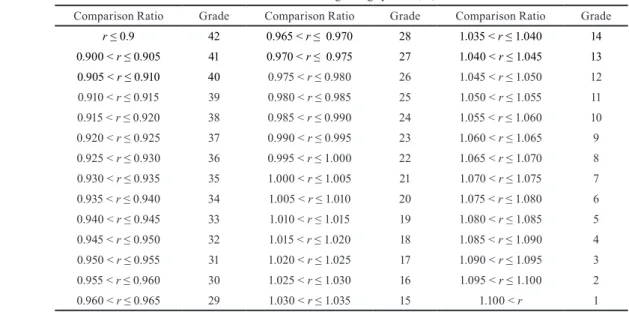
inter-vals given in Table 1. The total score obtained from the first
grading system (BTS1) is calculated using Eq. (6), where gmax is the maximum value of the grading system 1 (gmax = 42).
BP bup qi i i n = × =
∑
1 (1) ECC oup qi i i n = × =∑
1 (2) br bup q BP i= i i × (3) or oup q ECC i = i i × (4) r br orii 1= (5) BTS br g g i i i n 1 1 1 100 = × × =∑
max (6)4.2 Second Grading System
The main idea behind this grading system is to compare the unit price of each activity i (bupi) offered by each bid-der with the ones estimated by the owner (oupi). In this grading system, the comparison ratio (r2) is calculated
using Eq. (7). Bidders obtain a grade for each activity (g2i) based on the intervals given in Table 1. The total score received from the second grading system (BTS2) is found
using Eq. (8), where gmaxis the maximum value of the
grading system 2 (gmax = 42).
r bup oupii 2= (7) BTS br g g i i i n 2 2 1 100 = × × =
∑
max (8)4.3 Third Grading System
The main idea behind this grading system is to compare the unit price of each activity (bupi) offered by each bidder
Table 1 Grade values for grading system 1, 2, 3 and 5
Comparison Ratio Grade Comparison Ratio Grade Comparison Ratio Grade
r ≤ 0.9 42 0.965 < r ≤ 0.970 28 1.035 < r ≤ 1.040 14 0.900 < r ≤ 0.905 41 0.970 < r ≤ 0.975 27 1.040 < r ≤ 1.045 13 0.905 < r ≤ 0.910 40 0.975 < r ≤ 0.980 26 1.045 < r ≤ 1.050 12 0.910 < r ≤ 0.915 39 0.980 < r ≤ 0.985 25 1.050 < r ≤ 1.055 11 0.915 < r ≤ 0.920 38 0.985 < r ≤ 0.990 24 1.055 < r ≤ 1.060 10 0.920 < r ≤ 0.925 37 0.990 < r ≤ 0.995 23 1.060 < r ≤ 1.065 9 0.925 < r ≤ 0.930 36 0.995 < r ≤ 1.000 22 1.065 < r ≤ 1.070 8 0.930 < r ≤ 0.935 35 1.000 < r ≤ 1.005 21 1.070 < r ≤ 1.075 7 0.935 < r ≤ 0.940 34 1.005 < r ≤ 1.010 20 1.075 < r ≤ 1.080 6 0.940 < r ≤ 0.945 33 1.010 < r ≤ 1.015 19 1.080 < r ≤ 1.085 5 0.945 < r ≤ 0.950 32 1.015 < r ≤ 1.020 18 1.085 < r ≤ 1.090 4 0.950 < r ≤ 0.955 31 1.020 < r ≤ 1.025 17 1.090 < r ≤ 1.095 3 0.955 < r ≤ 0.960 30 1.025 < r ≤ 1.030 16 1.095 < r ≤ 1.100 2 0.960 < r ≤ 0.965 29 1.030 < r ≤ 1.035 15 1.100 < r 1
with the average of unit prices (aupi) offered by n number of bidders. The average unit price of each activity is
calcu-lated using Eq. (9) and the comparison ratio (r3) is calculated
using Eq. (10). Bidders obtain the grade (g3i) according to the comparison ratio obtained for each activity (see Table 1). Then, the total score received from the second grading sys-tem (BTS3) is found using Eq. (11), where gmaxis the maxi -mum value of the grading system 3 (gmax = 42).
aup bup bup bup n i = n + +…+ 1 2 (9) r bup aupii 3= (10) BTS br g g i i i n 3 3 1 100 = × × =
∑
max (11)4.4 Fourth Grading System
The main idea behind this grading system is to compare the bid price offered by the bidder (BP) with the estimated construction cost (ECC). The comparison ratio (r4) is
cal-culated by Eq. (12). Bidders obtain the grade (g4) accord-ing to this ratio based on the intervals presented in Table 2. The total score for grading system 4 (BTS4) is calculated
using Eq. (13), where gmax= 21.
r BP ECC 4 = (12) BTS g g 4 4 100 = × max (13)
4.5 Fifth Grading System
The main idea behind this grading system is to compare
to the sum of total prices of activities whose quantities
may likely increase during the construction phase offered by bidders (bris) with the ones estimated by the owner (oris)
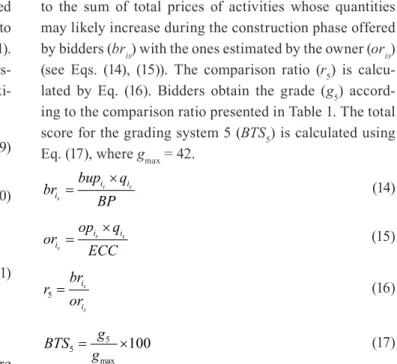
(see Eqs. (14), (15)). The comparison ratio (r5) is
calcu-lated by Eq. (16). Bidders obtain the grade (g5) accord-ing to the comparison ratio presented in Table 1. The total score for the grading system 5 (BTS5) is calculated using
Eq. (17), where gmax= 42.
br bup q BP is i i s s = × (14) or op q ECC is i i s s = × (15) r br or i i s s 5= (16) BTS g g 5 5 100 = × max (17) A comparison rate is calculated for all grading systems.
Bidders obtain grades according to these ratios. Grading
tables (Tables 1 and 2) have been prepared so that bidders can be evaluated fairly.
Two different grading tables were prepared within
scope of the proposed model. Grading system 1, 2, 3,
and 5 have a wide range, while grading system 4 has a nar-row range. This indicates that grading system 4 is more sensitive than the others. In grading system 4, if the com-parison rate is higher than 1.050, it gets the lowest grade (gmin = 1), while if it is lower than 0.950, it gives the highest grade (gmax = 21). This function also applies to the others, only the limit values are different.
Finally, different weights to these grading systems can
be assigned to calculate the final score of each bidder. The final scores of bidders are calculated using Eq. (18) and they are evaluated based on their final scores as well
as the total bid price.
FS w BTS w BTS w BTS w BTS w BTS = × + × + × + × + × 1 1 2 2 3 3 4 4 5 5 (18)
where w1is the weight for the first grading system, w2 is for the second one, w3 is for the third one, w4 is for the fourth one, w5is for the fifth one.
Table 2 Grade values for grading system 4
Comparison Ratio Grade Comparison Ratio Grade
r ≤ 0.950 21 1.005 < r ≤ 1.010 10 0.950 < r ≤ 0.955 20 1.010 < r ≤ 1.015 9 0.955 < r ≤ 0.960 19 1.015 < r ≤ 1.020 8 0.960 < r ≤ 0.965 18 1.020 < r ≤ 1.025 7 0.965 < r ≤ 0.970 17 1.025 < r ≤ 1.030 6 0.970 < r ≤ 0.975 16 1.030 < r ≤ 1.035 5 0.975 < r ≤ 0.980 15 1.035 < r ≤ 1.040 4 0.980 < r ≤ 0.985 14 1.040 < r ≤ 1.045 3 0.985 < r ≤ 0.990 13 1.045 < r ≤ 1.050 2 0.990 < r ≤ 0.995 12 1.050 < r 1 0.995 < r ≤ 1.000 11
5 Illustrative Example
In order to illustrate how the proposed model can be applied
in construction projects, an example is presented. The pre
-sented example consists of 72 activities, 10 of which are related to groundwork, in other words, quantities of these
activities may increase during the construction phase. The unit price of each activity estimated by the owner
are taken from "The Construction and Installation Unit Prices and Market Values Book" published by Ministry of Environment and Urban Planning in 2017 in Turkey.
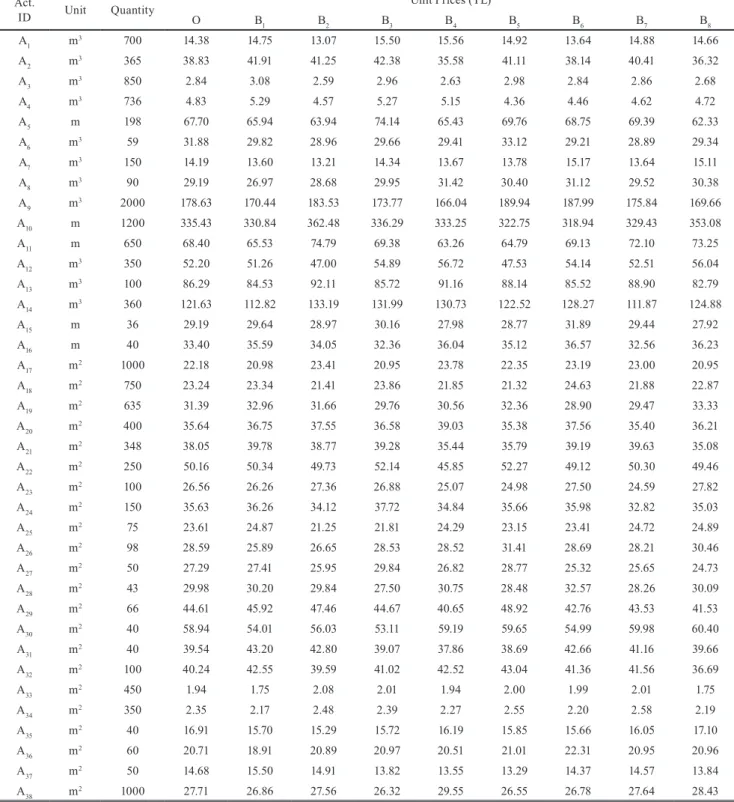
8 different bidders have been asked to propose unit prices for these activities. The units, quantities, unit prices of
these 72 activities estimated by the owner (O) and
pro-posed by 8 bidders (B) are presented in Table 3. Table 3 Input data for illustrative example
Act. ID Unit Quantity Unit Prices (TL) O B1 B2 B3 B4 B5 B6 B7 B8 A1 m3 700 14.38 14.75 13.07 15.50 15.56 14.92 13.64 14.88 14.66 A2 m3 365 38.83 41.91 41.25 42.38 35.58 41.11 38.14 40.41 36.32 A3 m3 850 2.84 3.08 2.59 2.96 2.63 2.98 2.84 2.86 2.68 A4 m3 736 4.83 5.29 4.57 5.27 5.15 4.36 4.46 4.62 4.72 A5 m 198 67.70 65.94 63.94 74.14 65.43 69.76 68.75 69.39 62.33 A6 m3 59 31.88 29.82 28.96 29.66 29.41 33.12 29.21 28.89 29.34 A7 m3 150 14.19 13.60 13.21 14.34 13.67 13.78 15.17 13.64 15.11 A8 m3 90 29.19 26.97 28.68 29.95 31.42 30.40 31.12 29.52 30.38 A9 m3 2000 178.63 170.44 183.53 173.77 166.04 189.94 187.99 175.84 169.66 A10 m 1200 335.43 330.84 362.48 336.29 333.25 322.75 318.94 329.43 353.08 A11 m 650 68.40 65.53 74.79 69.38 63.26 64.79 69.13 72.10 73.25 A12 m3 350 52.20 51.26 47.00 54.89 56.72 47.53 54.14 52.51 56.04 A13 m3 100 86.29 84.53 92.11 85.72 91.16 88.14 85.52 88.90 82.79 A14 m3 360 121.63 112.82 133.19 131.99 130.73 122.52 128.27 111.87 124.88 A15 m 36 29.19 29.64 28.97 30.16 27.98 28.77 31.89 29.44 27.92 A16 m 40 33.40 35.59 34.05 32.36 36.04 35.12 36.57 32.56 36.23 A17 m2 1000 22.18 20.98 23.41 20.95 23.78 22.35 23.19 23.00 20.95 A18 m2 750 23.24 23.34 21.41 23.86 21.85 21.32 24.63 21.88 22.87 A19 m2 635 31.39 32.96 31.66 29.76 30.56 32.36 28.90 29.47 33.33 A20 m2 400 35.64 36.75 37.55 36.58 39.03 35.38 37.56 35.40 36.21 A21 m2 348 38.05 39.78 38.77 39.28 35.44 35.79 39.19 39.63 35.08 A22 m2 250 50.16 50.34 49.73 52.14 45.85 52.27 49.12 50.30 49.46 A23 m2 100 26.56 26.26 27.36 26.88 25.07 24.98 27.50 24.59 27.82 A24 m2 150 35.63 36.26 34.12 37.72 34.84 35.66 35.98 32.82 35.03 A25 m2 75 23.61 24.87 21.25 21.81 24.29 23.15 23.41 24.72 24.89 A26 m2 98 28.59 25.89 26.65 28.53 28.52 31.41 28.69 28.21 30.46 A27 m2 50 27.29 27.41 25.95 29.84 26.82 28.77 25.32 25.65 24.73 A28 m2 43 29.98 30.20 29.84 27.50 30.75 28.48 32.57 28.26 30.09 A29 m2 66 44.61 45.92 47.46 44.67 40.65 48.92 42.76 43.53 41.53 A30 m2 40 58.94 54.01 56.03 53.11 59.19 59.65 54.99 59.98 60.40 A31 m2 40 39.54 43.20 42.80 39.07 37.86 38.69 42.66 41.16 39.66 A32 m2 100 40.24 42.55 39.59 41.02 42.52 43.04 41.36 41.56 36.69 A33 m2 450 1.94 1.75 2.08 2.01 1.94 2.00 1.99 2.01 1.75 A34 m2 350 2.35 2.17 2.48 2.39 2.27 2.55 2.20 2.58 2.19 A35 m2 40 16.91 15.70 15.29 15.72 16.19 15.85 15.66 16.05 17.10 A36 m2 60 20.71 18.91 20.89 20.97 20.51 21.01 22.31 20.95 20.96 A37 m2 50 14.68 15.50 14.91 13.82 13.55 13.29 14.37 14.57 13.84 A38 m2 1000 27.71 26.86 27.56 26.32 29.55 26.55 26.78 27.64 28.43
The estimated construction cost (ECC) estimated by the owner is 13,766,619.41 TL, and the bid prices offered
by 8 bidders are 14,043,276.86 (BP1), 13,826,569.14 (BP2),
13,389,997.59 (BP3), 13,624,850.19 (BP4), 13,947,114.50 (BP5),
13,622,893.85 (BP6), 13,641,083.17 (BP7), and
13,538,572.61 (BP8), respectively. In this study, the weights
are 20 % for first grading system, 15 % for the second one,
10 % for the third one, 15 % for the fourth one, and 40 %
for the fifth one. It should be kept in mind that these weights can differ depending on the needs of the owner. The final scores calculated for 8 bidders are presented in Table 4.
Based on the final scores presented in Table 4, Bidder 8 (B8) achieved the highest final score and
Bidder 3 (B3) achieved the lowest final score. Although B3
offered the lowest bid price and received the highest grades from the second, third and fourth grading systems,
it received the lowest final score because it received the lowest grade from the fifth grading system whose weight is the highest one. Consequently, B3 achieved a very low
score in the fifth grading system and this negatively affected the final score. On the other hand, B8 is above average grade in all grading systems, although it does
not offer the lowest bid price and has got the highest final
score. Therefore, B8 is the most appropriate bidder for the owner. It can be concluded that B3 offers the most unbal-anced bid, whereas B8 offers the most balanced bid.
Act. ID Unit Quantity Unit Prices (TL) O B1 B2 B3 B4 B5 B6 B7 B8 A39 m2 450 43.24 39.04 46.78 45.19 46.00 43.59 45.01 45.12 47.13 A40 m2 900 32.39 34.31 29.90 34.25 33.58 32.77 29.28 31.71 29.34 A41 m2 650 33.90 33.90 30.71 36.87 36.48 30.83 35.46 31.94 31.03 A42 m2 100 6.29 6.84 5.71 6.33 5.92 5.68 5.97 6.86 6.02 A43 m2 1000 1.29 1.29 1.31 1.23 1.40 1.36 1.22 1.19 1.18 A44 m2 150 7.33 7.01 6.67 6.64 7.45 7.91 7.12 7.29 7.64 A45 m2 2000 11.78 11.58 12.45 11.39 11.86 12.38 11.66 12.90 12.94 A46 m2 1600 30.04 29.74 30.87 31.84 27.61 30.66 31.46 29.77 30.38 A47 m2 2000 29.56 30.55 30.33 30.01 32.43 28.17 30.23 29.49 27.07 A48 m3 600 4.59 4.65 4.72 4.72 4.68 4.50 4.27 4.87 4.15 A49 m3 450 5.84 5.36 6.42 5.29 5.88 6.11 5.41 6.06 5.64 A50 m2 750 4.83 5.29 4.61 4.97 5.18 4.77 4.79 4.86 5.21 A51 m2 1600 115.81 107.85 117.90 125.97 116.49 107.78 122.21 120.78 120.28 A52 m2 650 136.51 142.73 139.82 133.89 126.59 128.11 149.12 141.47 126.39 A53 m2 650 88.36 89.02 81.44 91.52 92.22 93.89 89.25 79.90 81.71 A54 m2 250 123.24 133.28 134.02 112.88 133.04 134.99 119.83 131.82 114.27 A55 m2 690 50.34 48.72 47.31 53.42 49.00 46.54 53.07 51.53 45.89 A56 m2 600 170.88 157.50 161.31 160.47 179.91 166.13 182.67 164.95 182.67 A57 m2 350 319.38 338.86 338.76 344.12 339.48 325.54 350.95 306.97 302.08 A58 m2 400 250.09 261.30 253.70 264.69 249.89 244.55 265.10 264.46 226.00 A59 ton 1300 2096.56 2127.33 2152.31 1941.54 2089.57 2077.30 2026.49 1988.62 2045.57 A60 ton 1650 2017.94 2140.37 2143.31 1877.71 1975.24 1998.95 1887.98 2160.53 1974.92 A61 ton 350 1972.66 1871.37 1796.76 2120.92 2169.36 1789.12 2155.85 1837.37 1987.05 A62 ton 1000 1939.23 1985.11 1832.36 1762.37 1999.50 2115.62 2044.00 1860.08 1918.36 A63 ton 1150 1914.79 1914.13 1780.31 2038.14 1781.33 1987.31 1875.30 1810.11 1885.75 A64 ton 200 3386.01 3642.50 3635.81 3425.98 3236.22 3658.23 3346.48 3591.23 3238.26 A6 kg 4000 8.64 9.39 8.07 8.58 7.87 8.65 9.13 8.38 7.97 A66 m2 2000 9.59 9.16 10.29 10.06 9.74 10.16 9.55 8.82 10.51 A67 m2 600 13.00 12.96 13.32 14.30 14.00 13.68 11.84 12.36 14.07 A68 m2 150 5.23 5.62 5.34 5.53 5.32 5.06 4.91 5.17 5.45 A69 m2 2000 15.65 14.26 16.26 14.72 16.25 15.96 14.87 15.75 16.47 A70 m2 2000 18.56 19.20 16.81 18.13 19.78 18.95 17.37 17.73 18.78 A71 m2 700 28.60 27.78 27.36 26.28 31.23 30.24 27.97 27.13 28.49 A72 m2 2000 20.88 21.98 22.75 22.95 19.38 19.91 21.36 19.67 22.51
6 Conclusions
Unbalanced bidding is a major issue and an important unethical problem for owner in the construction indus-try. Owner has right to reject unbalanced bids, but it is hard to detect unbalancing because award decision mostly depends on the total bid price and changes in unit price of bid items are usually not taken into consideration. For these
reasons, it is more difficult for owner to detect quantity error exploitation bids, especially in unit price contracts.
If an owner can detect an unbalanced bid, a fair competi-tion environment can be created in the bidding process.
This study focuses on quantity error exploitation in unit
price contracts and aims to provide owners with a model, which assists them in detecting the potential unbalanced bids. In order to achieve this objective, the relevant lit-erature was reviewed and then a model was proposed. The proposed model is designed to detect unbalanced bids
by using five different grading systems. The final scores
of bidders are calculated by assigning different weights to these grading systems. Bidders are evaluated according to
their final scores as well as the total bid price. In order to
demonstrate how the proposed model can be performed
in construction projects, an illustrative example was pre -sented. The outcomes of proposed model have shown that it is a useful tool for detecting unbalanced bids created
by quantity error exploitation method in unit price con -tracts. This study also showed that when selecting the most appropriate contractor for project, owner should take into consideration not only bid price offered by bidders but also unit prices offered for each item.
This study is limited as it only focuses on unbalanced
bids created by using quantity error exploitation method
in unit price contracts. In future studies, the models addressing unbalanced bids in different types of contracts
and created by using front-end loading / back-end loading
can be developed.
References
Afshar, A., Amiri, H. (2010a) "A min-max regret approach to unbalanced bidding in construction", KSCE Journal of Civil Engineering, 14(5), pp. 653–661.
https://doi.org/10.1007/s12205-010-0972-0
Afshar, A., Amiri, H. (2010b) "Risk-based approach to unbalanced bid-ding in construction projects", Engineering Optimization, 42(4), pp. 369–385.
https://doi.org/10.1080/03052150903220964
Arditi, D., Chotibhongs, R. (2009) "Detection and prevention of unbal-anced bids", Construction Management and Economics, 27(8), pp. 721–732.
https://doi.org/10.1080/01446190903117785
Bell, M. L. (1989) "Unbalanced Bidding in Government Contracts", Master of Laws Thesis, George Washington University.
Cattell, D. W., Bowen, P. A., Kaka, A. P. (2007) "Review of Unbalanced Bidding Models in Construction", Journal of Construction Engineering and Management, 133(8), pp. 562–573.
https://doi.org/10.1061/(ASCE)0733-9364(2007)133:8(562)
Cattell, D. W., Bowen, P. A., Kaka, A. P. (2008) "A simplified unbal-anced bidding model", Construction Management and Economics, 26(12), pp. 1283–1290.
https://doi.org/10.1080/01446190802570506
Christodoulou, S. E. (2008) "A bid-unbalancing method for lower-ing a contractor's financial risk", Construction Management and Economics, 26(12), pp. 1291–1302.
https://doi.org/10.1080/01446190802596238
Gates, M. (1967) "Bidding Strategies and Probabilities", Journal of the Construction Division, 93(1), pp. 75–110.
Gransberg, D. D., Riemer, C. (2009) "Impact of Inaccurate Engineer's Estimated Quantities on Unit Price Contracts", Journal of Construction Engineering and Management, 135(11), pp. 1138–1145.
https://doi.org/10.1061/(ASCE)CO.1943-7862.0000084
Hyari, K. H. (2016) "Handling Unbalanced Bidding in Construction Projects: Prevention Rather Than Detection", Journal of Construction Engineering and Management, 142(2), article ID: 04015060.
https://doi.org/10.1061/(ASCE)CO.1943-7862.0001045 Table 4 Final scores of each bidder
Bidders
ID Grad. Sys.#1(20 %) Grad. Sys.#2(15 %) Grad. Sys.#3(10 %) Grad. Sys.#4(15 %) Grad. Sys.#5(40 %) ScoreFinal Ranking
B1 61.71 52.74 39.12 31.82 50.00 48.94 6 B2 58.84 56.31 45.27 50.00 66.67 58.91 2 B3 57.99 68.34 59.75 77.27 2.38 40.37 8 B4 59.25 64.84 53.22 63.64 54.76 58.35 3 B5 61.14 54.01 42.19 40.91 42.86 47.83 7 B6 58.83 64.07 53.38 63.64 52.38 57.21 4 B7 57.67 62.71 52.26 59.09 38.10 50.27 5 B8 60.07 67.24 57.40 68.18 61.90 62.83 1
Hyari, K. H. (2017) "The Controversy around Unbalanced Bidding in Construction: Seeking a Fair Balance", Journal of Professional Issues in Engineering Education and Practice, 143(1), article ID: 04016015.
https://doi.org/10.1061/(ASCE)EI.1943-5541.0000300
Hyari, K. H., Tarawneh, Z. S., Katkhuda, H. N. (2016) "Detection Model for Unbalanced Pricing in Construction Projects: A Risk-Based Approach", Journal of Construction Engineering and Management, 142(12), article ID: 04016078.
https://doi.org/10.1061/(ASCE)CO.1943-7862.0001203
Liu, X., Lin, L, Zang, D. (2009) "Stochastic Programming Models and Hybrid Intelligent Algorithm for Unbalanced Bidding Problem", Computer and Information Science, 2(1), pp. 188–194.
https://doi.org//10.5539/cis.v2n1p188
Loulakis, M. C., McLaughlin, L. P. (2011) "State Board Affirms Agency Rejection of Unbalanced Bid", Civil Engineering Magazine Archive, 81(12), p. 100.
https://doi.org/10.1061/ciegag.0000705
Mehta, M. L., Scarborough, W., Armpriest, D. (2009) "Building Construction: Principles, Materials, and Systems", 2nd ed., Pearson Prentice Hall, Columbus, Ohio, USA.
Ministry of Environment and Urban Planning (2017) "The Construction and Installation Unit Prices and Market Values Book", 1st ed., Ministry of Environment and Urban Planning, Ankara, Turkey. Nassar, K. (2004) "Using Spreadsheets to Optimally Unbalance
a Construction Bid", Cost Engineering Journal, 46(12), p. 28. Nikpour, B., Senouci, A., Eldin, N. (2017) "Detection Tool for Unbalanced
Bids", Open Journal of Civil Engineering, 7(3), pp. 409–422. https://doi.org/10.4236/ojce.2017.73028
Polat, G., Turkoglu, H., Damci, A. (2018) "Detection of Unbalanced Bids: A Case Study", In: Creative Construction Conference, CCC 2018, Ljubljana, Slovenia, pp. 432–439.
https://doi.org/10.3311/CCC2018-057
Prajapati, R. R., Bhavsar, J. J. (2017) "Unit Quantity Contract as a Mitigation of Unbalanced Bidding", Kalpa Publications in Civil Engineering, 1, pp. 157–162.
Renes, S. (2012) "Fighting skewed bids in the EU, A comparative analy-sis", Master of Laws Thesis, Erasmus School of Law, Rotterdam, the Netherlands.
Shrestha, P. P., Shrestha, K., Joshi, V. (2012) "Investigation of Unbalanced Bidding for Economic Sustainability", In: International Conference on Sustainable Design, Engineering, and Construction, ICSDEC 2012, Fort Worth, Texas, USA, pp. 609–616.
https://doi.org/10.1061/9780784412688.073
Skitmore, M., Cattell, D. (2013) "On being balanced in an unbalanced world", Journal of the Operational Research Society, 64(1), pp. 138–146.
https://doi.org/10.1057/jors.2012.29
Stark, R. M. (1968) "Unbalanced Bidding Models - Theory", Journal of the Construction Division, 94(2), pp. 197–210.
Su, Y., Lucko, G. (2014) "Unevenly Distributed Markup in Cash Flow Modeling with Singularity Functions", In: Construction Research Congress 2014, Atlanta, Georgia, USA, pp. 1438–1447.
https://doi.org/10.1061/9780784413517.147
Su, Y., Lucko, G. (2015) "Synthetic cash flow model with singular-ity functions for unbalanced bidding scenarios", Construction Management and Economics, 33(1), pp. 35–54.
https://doi.org/10.1080/01446193.2015.1012527
Venkatesh, S., Rao, S. V. (2017) "Evaluation Model for Unbalanced Bidding in Construction Industry", International Journal of Engineering Science and Computing (IJESC), 7(5), pp. 12520–12524.
Wang, W. C. (2004) "Electronic-Based Procedure for Managing Unbalanced Bids", Journal of Construction Engineering and Management, 130(3), pp. 455–460.
https://doi.org/10.1061/(ASCE)0733-9364(2004)130:3(455) Yin, Y.-l., Qiao, L., Li, B. (2010) "Research on the owner's tactics to
unbalanced bid under the mode of Code of Valuation with Bill Quantity of construction works", In: 17th International Conference
on Industrial Engineering and Engineering Management, IEEM, Xiamen, China, pp. 249–252.