ISSN-L: 2501 - 9988 Available on-line at: http://www.oapub.org/soc
DOI: 10.46827/ejmms.v5i3.864 Volume 5 │ Issue 3 │ 2020
PERSPECTIVE OF INTERNAL PROCESS
BASED ON MULTIDIMENSIONAL
PERFORMANCE MODELS
IN DEVELOPMENT OF ZAKAT MANAGEMENT ACCOUNTING
iAsmuni1ii, Muslim Marpaung2, Kamilah3
1Universitas Islam Negeri Sumatera Utara,
Indonesia
2Politeknik Negeri Medan,
Indonesia
3Universitas Islam Negeri Sumatera Utara,
Indonesia
Abstract:
We realize that the internal process is one of the most important perspectives among the various perspectives and dimensions of performance measurement of the Zakat Management Organization which must always adapt to change and development, including the development of management accounting. This study uses a qualitative approach with the application of ANP (Analytic Network Process). The research respondents consisted of 5 people including practitioners, experts and academics. The results found that there were 2 problems in the perspective of the Internal Process based on the Multidimensional Performance Model, namely the problem of low program innovation and limited after-service. The priority solution in overcoming this problem is a follow-up service solution and priority strategies that can be done through Research and Development, Gradual and Sustainable Service Systems and Shariah Compliance. The findings in this study are expected to help the management of Zakat Management Organizations in the decision-making process as the development of management accounting based on multidimensional performance models.
JEL: M11; M41
Keywords: Zakat, management, accounting, management accounting, internal process, performance, multidimensional, after-sales service quality
i This article was presented at the 2019 International Conference on Contemporary Islam and Muslim
Societies (IConCIMS) on 23 October 2019 at Raz Plaza Hotel & Convention, Medan, Indonesia.
1. Introduction
A company or organization will experience a life cycle. Organizations must always become accustomed to changes and developments in their milieu in order to survive and extend their life cycle. For this reason, a strategy is needed in overcoming the existing problems encountered in the face of increasingly fierce competition. At this moment in time, to be able to survive, an organization is not sufficient just to have a good product, but also requires a good internal process, namely the existence of a continuous product innovation and excellent after-service. Several previous studies have examined this internal process perspective, but no research has been found on the internal process perspective of the Zakat Management Organization as the development of Zakat Management Accounting.
Performance measurement systems that are extensively used today emphasizes more on improving current activities and processes, but the balanced scorecard suggests that the management of an organization determines a comprehensive value chain, including the innovation process - through the introduction of customer needs in the present and the future which will further develop solutions to meet those needs - then the operational process - delivering products and services to customers - then continued with after-sales services where this service is carried out after the sale is made, this will add value to the products and services received by customers (Kaplan and Norton, 2014). The research focuses on this internal process perspective because it plays an important role in achieving organizational performance and is a very striking differentiator between the performance measurement system with the balanced scorecard and the traditional performance measurement system. Performance measurement systems have traditionally placed a focus on improving and controlling various accountability centers in organizations which depend on financial measurement and monthly reporting which in this case has many limitations (Kaplan, 1984). Meanwhile, the balanced scorecard performance measurement measures performance with a financial and non-financial focus, namely financial, customer, growth and learning perspectives and internal processes. In addition, shariah compliance is one of the novelties of this research as the development of Sharia Management Accounting in the Zakat Management Organization (OPZ).
The research location chosen is in Indonesia because it is among the countries of the world that have relatively large potential for progress including the potential for growth in the field of zakat. The World Giving Index 2018 Charities Aid Foundation (CAF) in its report A Global View of Giving Trends, published at the end of 2018, stated that Indonesia succeeded in occupying the top position as the most generous country in the world, where Indonesia earned a score to help others by 46%, in addition it also managed to obtain a score to donate material by 78% and a score to volunteer by 53%, while Australia and Zealand were ranked second and third, while the United States ranked fourth. This makes this research fairly fascinating and, according to the latest phenomenon, empirical findings are needed in the field.
2.Literature Review
Zakat is one of the means to create social welfare and eradicate poverty. Social welfare is formed through the distribution of assets to the poor, oppressed people (mustad'afin) so that these assets do not stop at the pockets of the rich and the powerful. Furthermore, zakat can also eradicate poverty through the distribution of zakat assets to mustahik so that the person can fulfill his basic rights, including the right to obtain food, clothing, housing, education, and health. Zakat should be managed by an institution so that the collection, distribution and utilization of zakat can be done optimally. Along with the development of increasingly advanced technology, zakat management can be developed through digital technology. This can facilitate muzakki in paying zakat and amil in managing zakat. A study entitled Islamic philanthropy and the private sector in Indonesia stated that Islamic philanthropy in the private sector occurred as evidenced by the formation of zakat collectors in companies and the spread of Islamic charitable organizations in Indonesia.
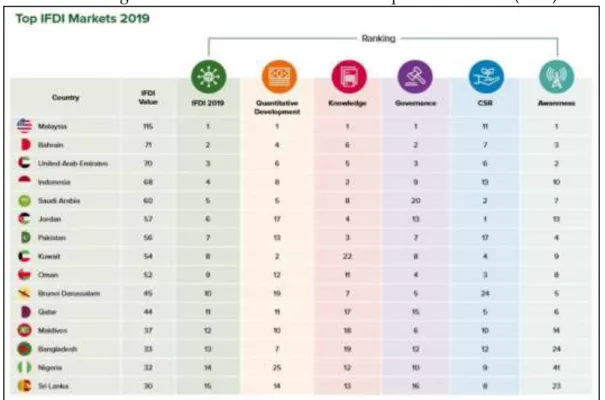
This research is about Islamic philanthropy in Southeast Asia and in Indonesia in particular with the participation of the business sector in social activities (Latief, 2013). It accentuates the relationship between Muslim institutions and other social organizations. There are various factors that have motivated the private sector to carry out social activities using religious jargon and symbols. Muslim unions have been instrumental in the corporate spread of Islamic philanthropy. At the present time, Indonesia has experienced a rapid increase in sharia economic development where Indonesia is ranked 1st in the Global Islamic Finance Report (GIFR) 2019, up from rank 6 in 2018. Factors affecting among them are Indonesia collecting zakat of IDR. 8.1 trillion, land endowments of 366,700 locations (49,589.99 Ha) and endowments in the amount of IDR. 255 M (Global Islamic Finance Report, 2019). Indonesia is also ranked 4th based on IFDI 2019, which rose from 10th place in 2018 (Islamic Finance Development Indicator, 2019). The following table shows the ranking of the Global Islamic Finance Report (GIFR) in 2019.
In the table below, Indonesia is ranked 4th after Malaysia, Bahrain and the United Arab Emirates. The data in the two tables can be attributed to the social conditions of the community at the level of social welfare which has the greatest potential to be extracted through zakat as its mediation.
From the table below, it can be seen that Indonesia's position is ranked first, while Malaysia and Iran are ranked second and third. We can compare this with the data in the following table:
Table 1.1: Ranking the Global Islamic Finance Report (GIFR) in 2019
Table 1.2: Ranking Table of the Islamic Finance Development Indicator (IFDI) in 2019
In another study entitled “The balanced scorecard and the strategic learning
process: a system dynamics modeling approach” conducted by Steen Nielsen and Erland
H. Nielsen, it was revealed that small changes in a single endogenous variable could cause the system to change significantly. First, this made a conceptual contribution which
focuses on building the BSC model; improved learning by showing the results of four simple lean simulation scenarios on predetermined and lagging financial indicators. Second, we also make a useful contribution to the design and quantification of BSC by including changes for the short and long term and the time delay between performance measures and perspectives, something that has been emphasized several times in the literature as an assumption of "trade-offs" (Nielsen and Nielsen, 2015). Based on Islamic Marketing research through Zakat Institutions in Indonesia by Asep Saepudin Jahar (2015) it was discussed that Dompet Dhu'afa showed that marketing of zakat is done through inherent values in securing justice, this is not intended to commercialize religion but rather to increase awareness of the benefits of zakat among the community.
3. Zakat Management Organization (OPZ) Performance Measurement Model
The Zakat Management Organization (OPZ) in Indonesia consists of the official zakat management organization of the government, in the form of the Central Amil Zakat Agency (BAZNAS) which oversees the National Amil Zakat Agency (BAZNAS) at the Provincial Level and the National Amil Zakat Agency (BAZNAS) at the Regency / City Level. In addition, there is also the Amil Zakat Institution (LAZ) which is managed by a private body but has been registered with the National Amil Zakat Agency (BAZNAS) according to its position. As for its management, the Zakat Management Organization (OPZ) in Indonesia refers to Law Number 23 of 2011 concerning Management of Zakat.
The following picture shows the National Zakat Management System in Indonesia:
Figure 1.1: National Zakat Management System (Nasional, B. A. Z., 2016)
The zakat management system in Indonesia has the principles of Islamic law, trustworthiness, expediency, justice, legal certainty, integrated and accountability in an effort to increase the effectiveness and efficiency of services in zakat management,
increase the benefits of zakat to realize social welfare in the community and poverty reduction efforts. The welfare system in Islam has been arranged in such a way based on the Qur'an and hadiths, including: zakat, alms, infaq, grants, endowments and qurban (Zakiyah, 2011).
Programs that are planned and carried out in connection with this goal must be integrated between Zakat Institutions, Zakat Subjects and Objects, in terms of collection, distribution and utilization, reporting and accountability, financing, guidance and supervision that are integrated and require the participation of the community to participate in overseeing their implementation. In general, the management of zakat can be divided into 2 parts namely zakat collection activities and zakat distribution activities. The zakat collection fund can be empowered for mustahik if the truth of the mustahik data has been examined, determine the priority scale of mustahik based on the most need of assistance and consider the location of mustahik in the environment. After fulfilling the basic needs above, the zakat collection fund can also be empowered in the form of productive zakat by considering several things such as the existence of a profitable business and having been considered by the board of consideration based on a business feasibility study, conducting guidance, monitoring and evaluation and making reports (Soemitra, 2009).
Chapra (1979) said that one of the important functions of the Islamic economy and welfare in a country is to eradicate the problem of population poverty in a country and create conditions of full employment and create a high level of growth. This is because economic resources are the mandate of Allah SWT and it is obligatory for us to use these resources efficiently. Zakat Management Organization (OPZ) must provide a guide in the management of zakat so that zakat management activities can take place more efficiently and systematically according to the Qur'an and Hadith, so that transparent, accountable information is needed and communicated through publication to the public so as to avoid misunderstanding and can increase public awareness to pay zakat (Mohd, K. B., Hamzah and Johari, 2016). In addition, measurement of financial and non-financial performance must share criteria such as reliability, comparability and relevance. Maines, L. A., et. al. (2002) provides an academic literature related to non-financial performance measures and provide conclusions and recommendations regarding this. Meanwhile, Research Firmansyah, I., & Sukmana, W. (2014) found that there were internal and external problems in the management of zakat. Internal problems are caused by the lack of leadership and performance of the OPZ due to the absence of local regulations (Perda), while external problems regarding the distribution of zakat institutions and people who are less aware of the existence of Baznas. Wahjudi (2018) found that there was a positive correlation between the quality of after sales service and customer satisfaction, which would later affect customer loyalty, quality effectiveness and after sales service in retaining old customers and encouraging new customers (Maines, L. A., et. al., 2002). This is in line with the goals of the national zakat management system which is to increase the effectiveness and efficiency of services in the management of zakat, increase the benefits of zakat to realize public welfare and poverty reduction.
4. Performance and Multidimensional Performance in Zakat Management Accounting
Performance can be associated with the phrases of job performance or actual performance, which means the actual achievements that have been attained. Moeheriono (2010) states that performance as a result of work that can be achieved by a person or group of people in an organization. Performance is one of the fields of study in management accounting which has the main function of helping the manager (internal) of the company in the decision-making process. As for developing performance measures that assist managers in planning and controlling their organizations, Chenhall (2007) clarifies that there are some problems, when viewed from a broader management perspective, which are related to the effective development of performance actions. The multidimensional performance referred to in this study includes financial performance, customers, internal processes, growth and learning as well as shariah compliance. Kaplan (1996) suggests the development of performance measures from various dimensions (multidimensional) by combining profit-based (financial) steps with non-financial measures.
Accounting is a service activity that provides information in the form of financial numbers about economic entities that help economic decision making and make choices among various actions, as the Accounting Principle Board (1970) states that accounting is a service activity. Its function is to provide quantitative information, primarily financial in nature, about economic entities that are intended to be useful in making economic decisions in making reasoned choices among alternative courses of action. The Management Accounting is an accounting section that helps the management (internal) of the company by carrying out management functions for the decision-making process. Hansen & Mowen (2005) suggested that Management Accounting Information is used primarily to meet the needs of internal company parties and is more future-oriented as well as more detailed because it is for the purpose of broader and multidisciplinary evaluation and decision making. The Zakat Management Accounting referred to in this study is accounting information that helps the management of the Zakat Management Organization (OPZ) in the decision making process for the achievement of the objectives of zakat management as above, namely increasing the effectiveness and efficiency of services in managing zakat; increasing the benefits of zakat to realize welfare community and poverty alleviation.
Each organization will make every effort to improve quality, improve results, maximize output and reduce costs for various internal processes. In the Balanced Scorecard, the objectives and measures of the Internal Process are derived from explicit strategies to meet stakeholder expectations. Innovation (the initiation, adoption and implementation of new ideas or activities in an organizational setting) is reviewed in terms of organizational context, structure, and member attitudes as according to Pierce (1977) innovation is the implementation of new ideas and activities in an organizational environment that can be seen from the context of the organization itself, the attitudes and
behavior of members of the organization and the existing structure of the organization. These can be used as a direction for research in the future or as a theoretical construction. Meanwhile, Rigopoulou (2008) examines the effect of after-sales service on customer satisfaction, customer behavior to repurchase products and word of mouth (WOM). This research was conducted on customers from major retail chains in Greece that market electrical equipment. The results of the study, which obtained 420 responses, found that the quality of after-sales service affects customer satisfaction so that it will also affect the customer's intention and behavior to make a repurchase. For this reason, after-sales service affects the supply and quality of relationships with customers.
The importance of the quality of this after sale service has been widely recognized by all sectors of the industry because it is considered as a value added product including industries and organizations that produce services. This is expected to increase customer satisfaction and customer loyalty to the company or organization. This post-service also has relevance to the progress of the company, the ability to improve the performance and development of the company's products and the service sector organization program.
5. Research Methodology
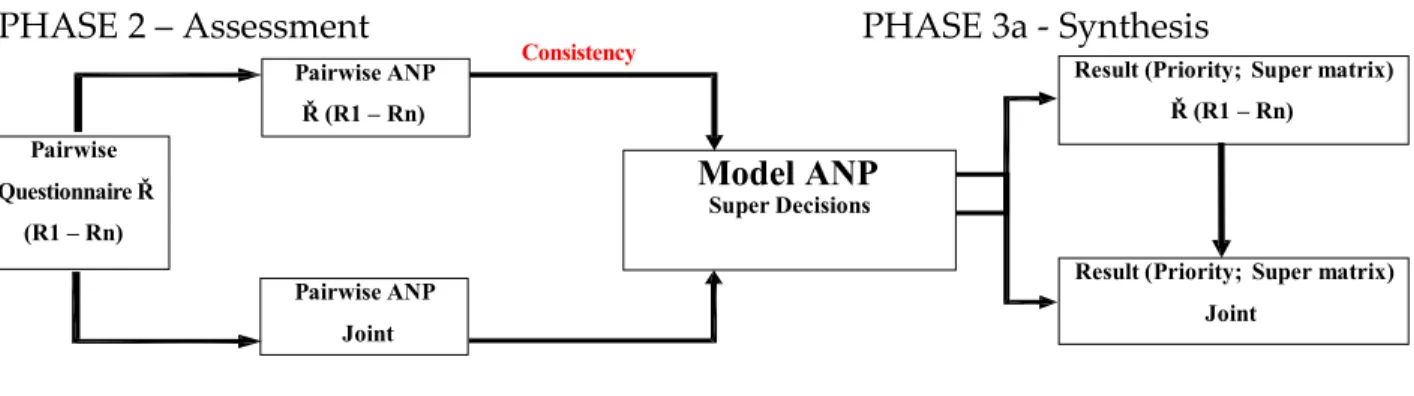
This research uses a descriptive qualitative method by taking data through in-depth interviews, literature studies, and data processing using the Analytic Network Process. Analytic Network Process (ANP) is a mixed research method, in which quantitative methods are used in a study, so that the data obtained are more complete, comprehensive, valid, objective and reliable. Analytic Network Process (ANP) is also a method that uses an assumption approach in solving various forms of problems by synthesizing problems and using priority scale to produce the highest level of priority. The network formed in ANP is more varied and wider, the feedback network causes the assessment to be more complex. Even so, the results of comparison will be more accurate. The question approach used is the level of influence of one element on other elements which is more influential. When determining influence, of course the respondent's answer will be more objective. The stages of research in ANP can be seen in the following figure:
Figure 1.2: Research Stages (Ascarya, 2010)
A. Research Stages - PHASE 1-Decomposition: Literature Review (attached)
To find out the results of individual assessments of the respondents and determine the results of opinions in one group carried out an assessment by calculating the geometric mean (Saaty & Vargas, 2006). The formula for finding the geometric mean can be obtained by multiplying all the values before rooting it with n, where n is the total number of numbers in the set.
Figure 1.3: Research Phase-PHASE I Decomposition (Ascarya Literature Review, 2010)
B. Research Stages - PHASE 2 Assessment and PHASE 3a Synthesis
PHASE 2 – Assessment PHASE 3a - Synthesis
Consistency
Figure 1.4: Research Phase-Phase 2 Assessment & Phase 3a Synthesis (Ascarya, 2010) The data collection method is done through literature review studies, observations and in-depth interviews, the results of which are then analyzed using descriptive analysis techniques. The data collected is then described. Subsequently, conclusions are drawn about each component on the basis of predetermined criteria. Researchers conducted in-depth interviews to the research respondents consisting of practitioners, experts and academics.
Table 1.2: List of informants / Research Respondents
No. Informants Initial / Respondents Description
1. RO Practitioner
2. FA Practitioner
3. RE Practitioner
4. MU Expert
5. SA Academic
Source: Processed Data.
Furthermore, literature review is conducted according to the field of study, so as to facilitate researchers and respondents in providing an understanding of Zakat Management Accounting in relation to multidimensional performance.
5.1 Testing the Validity of Research Data
The testing of the validity of the data in this study so that it can be said to be valid and reliable data, is carried out through the triangulation method, namely the researcher uses the method to get data from different sources through several respondents from practitioners, experts and academics, besides triangulation method, where researchers conduct a variety of different methods namely in-depth interviews to improve researchers' understanding of what has been discovered. Then, the results of in-depth interviews with one respondent will be compared with the results of in-depth interviews with other respondents. The next step, researchers compile an ANP questionnaire based on the results of in-depth interviews that have been made in the framework. Finally, the
q
- Result (Priority;Super matrix)
Ř (R1 – Rn) Consistency Pairwise ANP Ř (R1 – Rn) Pairwise Questionnaire Ř (R1 – Rn)
Result (Priority;Super matrix) Joint
Pairwise ANP Joint
Model ANP
researcher makes a comparison with the decomposition of literature review results regarding the field of study. Researchers conducted data analysis techniques from Miles & Huberman (1984) in Sugiono (2017), namely:
• Data reduction is an effort to summarize data by selecting the main things and focus on the things that are important.
• Data display (data presentation) is an effort in organizing and compiling a relationship pattern so that it is easy to understand, in this case the data can be in the form of a chart, diagram, table or a brief description.
• Conclusion / verification is a preliminary drawing conclusion that are temporary and can change if no evidence is found supporting the initial conclusions later.
6. Result and Discussion
This research in Zakat Management Accounting found problems in the perspective of the internal process which included the problem of program innovation and the problem of post service in which the method is a part of management accounting. It continues to experience development and evolution from the way to evaluate performance to become a method that can be used in management systems in building learning processes within an institution or organization. It can be used as a tool for formulating and making changes by integrating all aspects of an institution, both financial and non-financial (Rangkuti, 2017). The findings of this study are as follows:
Internal Process Problem Clusters have 2 (two) sub-clusters: the M-Innovation Program cluster and the M- post service cluster. The results of the geomean sub-cluster calculation M-post service is the highest geomean of 0.47139, in line with the results of Darmawati's research (2013) which is a case study at the Regional Amil Zakat Agency (BAZDA) of Banyumas Regency. The aim is to explore and analyze BAZDA management based on the Balanced Scorecard with three perspectives: customers, internal business processes, learning and growth. The contribution of this research is the prototype of strategic planning for the Banyumas Regency BAZDA in the Balanced Scorecard. After Sales Service (Post sale service) is to provide customer satisfaction done by providing an annual report as the responsibility for the management of ZIS funds and reports published through newspapers and audited by public accountants, but this second report has not been done by BAZDA.
Internal process solution cluster has 2 (two) sub-clusters: SO-follow up service post-service and SO-innovative product sub-cluster. The results of geomean sub-cluster calculation SO-follow up after sale service is the highest geomean of 0.5000. This is in line with the results of Prasetyoningrum's research (2015) which found that a solution to the collection of zakat is needed through ball pick-up strategies by establishing partnerships such as using mailing, friendship, or other media that can be used in order to establish partnerships. This is in accordance with the follow up service solutions after the service provided by the zakat management institution towards muzakki who has distributed zakat in the institutions.
Internal process strategy cluster has 3 (three) sub-clusters: ST-Gradual & Sustainable Service System (SS), ST-Research & Development (RnD) and ST-Shariah Compliance. The results of the ST-Shariah Compliance sub-cluster geomean calculation is the highest geomean of 0.306. This is in line with the results of Taha's (2017) study which found that the accessibility of zakat information is still very limited and not freely accessible to the public. This shows a low level of transparency, so it is interesting to explore how zakat institutions in Malaysia is being organized in relation to the religious dimension and obtain results that show the low transparency practiced by zakat institutions. This study recommends that the public must know their right to obtain information directly from the zakat institution, and the zakat institution is expected to improve their management system. Zakat management in Malaysia is considered to be less transparent due to the information disclosed and the high level of confidentiality of zakat institutions. This study examines the relationship between religiosity and transparency related to the performance of zakat institutions. The results of the study found that the aspect of religiosity is an important influence on the performance of zakat institutions because it can be a source of innovation in the management of zakat institutions. On the other hand, the performance of zakat institutions is strongly influenced by four perspectives of balanced scorecard in improving the performance of zakat institutions.
7. Results of Data Processing and Cluster Synthesis of Internal Process Problems
Internal Process Problem Clusters have 2 (two) sub-clusters: the M-Innovation Program sub-cluster and the M-post service sub-cluster. The results of the geomean sub-cluster calculation M- post service are the highest geomean of 0, 47140, and then followed by the geomean sub-cluster M-Innovation Program of 0.47139.
Next, a synthesis of the internal process problem cluster is performed, the results of which determine the priority of internal process problems based on the Multidimensional Performance Model in the Development of Zakat Management Accounting. Internal process is that there is a sub-cluster M-post service, but the results of the acquisition of the rater agreement for the cluster internal process problems for all respondents is 36%, This means that the agreement of all respondents to the priority order of the internal process problems based on Multidimensional Performance Model in the Development of Zakat Management Accounting in the form of post Service and M-Innovation Program by 36%. It can be understood that the level of agreement among respondents is quite high. The reason can be caused by the existence of various differences in the respondent's background, age level and work experience, both among respondents who come from practitioners (the Amil Zakat Agency and the Amil Zakat Institution), the experts and academics. Henceforth, it is expected to be able to intensively, periodically and continuously discuss various glitches and efforts to find solutions to problems related to internal processes within the zakat management agency both in the form of FGD (Focus Group Discussion), seminars, hospitality and others. This
is aimed to increase understanding and unity of ideas in solving internal process problems faced in the management of zakat based on multidimensional performance models in Zakat Management Accounting.
The following figure shows the results of the synthesis of priority cluster Internal Process Problems based on the opinion of each respondent and based on the average value (geomean) of all respondents:
Figure 1.5: the results of the synthesis of cluster priorities internal process problems based on the opinion of each respondent and based on the average value (geomean) of all respondents The picture above shows the results of the synthesis of internal process problems cluster, including the M-Innovation Program cluster and the M- post service sub-cluster. Based on the results of data processing, the geomean value for the M-innovation program sub-cluster is 0.47139 and the geomean M- post service value is 0.47140. The above results are in accordance with Umer Chapra's research (1979) in The Islamic welfare state and its role in the economy, saying that the state must play an adequate role to realize the objectives of the Islamic system without too much sacrifice individual freedom or social welfare compromise.
8. Shariah Compliance
Shariah Compliance is one aspect to measure the level of compliance of an organization or institution to the principles of sharia. This study seeks to assess Shariah compliance from the perspective of internal process perspectives. Shariah compliance referred to in this study is the maqashid shari'ah side of the above aspects (the maqashid shari'ah aspect of the internal process). Ibn 'Ashur's principle regarding Ar-Rawaj (circulation of assets) which explains the capability to develop property for human prosperity, in this case that assets are traded so that wealth develops for the prosperity of humanity. This is in accordance with innovative product solutions and follow-up/ post-service existing in the internal process aspects of this research, where the development of services to muzakki is needed, either by increasing zakat management program innovations to obtain greater results and benefits for the Ummah and improving post-service to increase customer
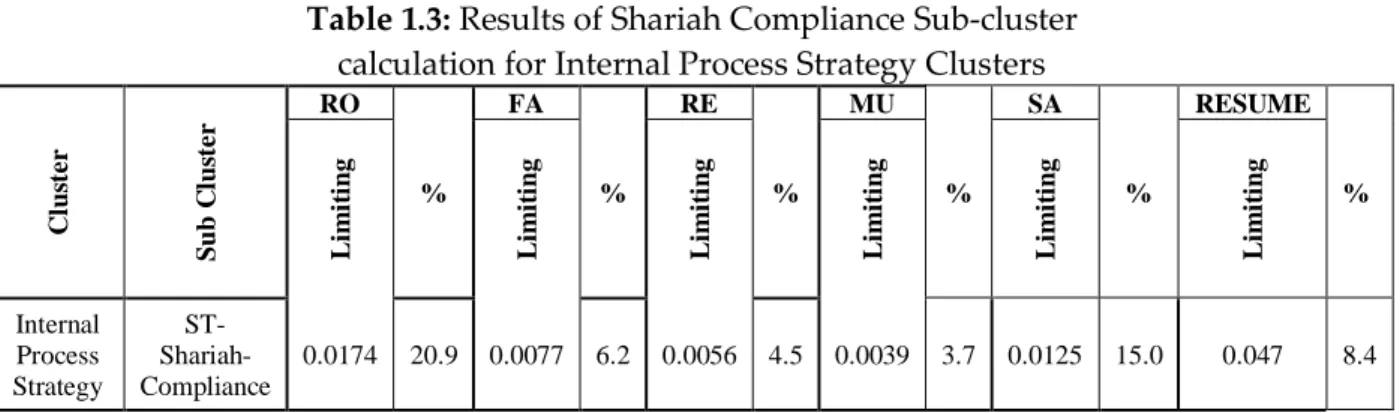
satisfaction. This is certainly expected to be able to enhance the benefits of the services provided to muzakki who have entrusted their management and distribution of zakat to the impossible through the Zakat Management Organization (OPZ). It is in line with the principle of Maqashid Shari'ah put forward by Ibn 'Asyur, namely ar-Rawaj, namely circulation assets between various parties, namely muzakki to mustahik through zakat management institutions as amil Institutions, are expected to be carried out in the right ways so as to avoid conflicts and disputes. The following table shows the Shariah Compliance Strategy for the Internal Process Strategy Cluster at 8.4%.
Table 1.3: Results of Shariah Compliance Sub-cluster calculation for Internal Process Strategy Clusters
C lu st er S u b C lu st er RO % FA % RE % MU % SA % RESUME % L im it in g L im it in g L im it in g L im it in g L im it in g L im it in g Internal Process Strategy ST- Shariah-Compliance 0.0174 20.9 0.0077 6.2 0.0056 4.5 0.0039 3.7 0.0125 15.0 0.047 8.4
The table above shows the percentage of calculation results from all respondents' responses to the Shariah Compliance sub-cluster for the Internal Process Strategy Cluster of 8.4%.
9. Recommendation
At this time, a good product is considered as not adequate. Market competition requires excellent after-sales service. Quality of post service has been identified as a source of revenue and competitive advantage. On the other hand, other industrial sectors are ready to pay attention to the quality of after sales service. Likewise, in increasing synergy among stakeholders, the Organization of Zakat Management (OPZ) must improve innovative products and improve post service follow up, especially for muzakki who have entrusted their zakat management to be channeled to mustahik through the Zakat Management Organization (OPZ).
10. Conclusion
In this particular section, it can be concluded that, this study aims to explore the relationship between internal process problems including the issue of low program innovation and the problem of limited post services as well as internal process solutions which include enhancing innovative products and solutions to improve follow-up service then internal process strategies. This includes research and development strategies, gradual and sustainable service systems and shariah complaints for Zakat Management Organizations (OPZ). This study conducted a survey of 5 respondents from
practitioners, experts and academics. The data of the study is processed using ANP (Analytic Network Process) with multi-decision software.
References
Ali, N. N. M., Taha, R., Embong, M. R., & Nor, M. N. M. (2014). Developing a multidimensional performance of zakat collection system in East Coast Region. Procedia-Social and Behavioral Sciences, 164, 84-90.
Chapra, M. U. (1979). The Islamic welfare state and its role in the economy, The Islamic Foundation, Leicester, U.K.
Chenhall, R. H., & Langfield-Smith, K. (2007). Multiple perspectives of performance measures. European management journal, 25(4), 266-282.
Darmawati, D., Lestari, U. P., & Widyastuti, U. (2013, November). Implementasi Perspektif Pembelajaran dan Pertumbuhan , Proses Bisnis Internal dan Pelanggan dalam Perencanaan Strategis (Studi kasus pada Badan Amil Zakat Daerah/BAZDA Kabupaten Banyumas). In Performance (Vol. 4, No. 1).
Firmansyah, I., & Sukmana, W. (2014). Analisis problematika zakat pada Baznas Kota Tasikmalaya: pendekatan metode Analytic Network Process (ANP). Jurnal Riset Akuntansi dan Keuangan, 2(2), 392-406.
Jahar, A. S. (2015). Marketing Islam Through Zakat Institutions in Indonesia. Studia Islamika, 22(3), 405-442.
Kaplan, R. S. (1984). The evolution of management accounting. In Readings in accounting for management control (pp. 586-621). Springer, Boston, MA.
Kaplan, Robert S. (1984). "Yesterday's Accounting Undermines Production." Harvard Business Review 62, no. 4 (July–August 1984): 95–101
Kaplan, Robert S. Dan Norton, David P. (1996). Using the Balanced Scorecard as a Strategic Management System. Harvard Business Review.
Kaplan, Robert S. Dan Norton, David P. (2014). Balanced Scorecard Menerapkan Strategi Menjadi Aksi, Jakarta, Erlangga.
Latief, H. (2013). Islamic philanthropy and the private sector in Indonesia. Indonesian Journal of Islam and Muslim Societies, 3(2), 175-201.
Maines, L. A., Bartov, E., Fairfield, P., Hirst, E., Iannaconi, T., Mallett, R., ... & Vincent, L.
(2002). American Accounting Association’s Financial Accounting Standards
Committee Comments to the FASB on Nonfinancial Performance Measures. Accounting.
--- (2002). Recommendations on disclosure of nonfinancial performance measures. Accounting Horizons, 16(4), 353-362.
Mohd, K. B., Hamzah, M. Z. D., & Johari, F. (2016). Managing the Institution of Zakat: Case Study of Muallaf in Selangor, Malaysia. Advances in Islamic Finance, Marketing, and Management: An Asian Perspective, 325.In Advances in Islamic
Finance, Marketing, and Management: An Asian Perspective (pp. 325-339). Emerald Group Publishing Limited.
Nielsen, S., & Nielsen, E. H. (2015). The balanced scorecard and the strategic learning process: a system dynamic modeling approach. Advances in Decision Sciences, 2015. Pierce, J. L., & Delbecq, A. L. (1977). Organization structure, individual attitudes and
innovation. Academy of management review, 2(1), 27-37.
Rigopoulou, I. D., Chaniotakis, I. E., Lymperopoulos, C., & Siomkos, G. I. (2008). After-sales service quality as an antecedent of customer satisfaction: The case of electronic appliances. Managing service quality, 18(5), 512-527.
Saaty, T. L., & Vargas, L. G. (2006). Decision making with the analytic network process (Vol. 282). Springer Science+ Business Media, LLC.
Soemitra, A. (2009). Bank dan lembaga keuangan syariah. Kencana.
Wahjudi, D., Kwanda, T., & Sulis, R. (2018). The impact of after-sales service quality on customer satisfaction and customer loyalty of middle-upper class landed housings. Jurnal Teknik Industri, 20(1), 65-72.
Zakiyah, Z. (2011). Islamic welfare system dealing with the poor in rural area. Indonesian Journal of Islam and Muslim Societies, 1(1), 37-67.
Global Islamic Finance Report 2019.
Creative Commons licensing terms
Authors will retain copyright to their published articles agreeing that a Creative Commons Attribution 4.0 International License (CC BY 4.0) terms will be applied to their work. Under the terms of this license, no permission is required from the author(s) or publisher for members of the community to copy, distribute, transmit or adapt the article content, providing a proper, prominent and unambiguous attribution to the authors in a manner that makes clear that the materials are being reused under permission of a Creative Commons License. Views, opinions and conclusions expressed in this research article are views, opinions and conclusions of the author(s). Open Access Publishing Group and European Journal of Management and Marketing Studies shall not be responsible or answerable for any loss, damage or liability caused in relation to/arising out of conflict of interests, copyright violations and inappropriate or inaccurate use of any kind content related or integrated on the research work. All the published works are meeting the Open Access Publishing requirements and can be freely accessed, shared, modified, distributed and used in educational, commercial and non-commercial purposes under a Creative Commons Attribution 4.0 International License (CC BY 4.0).