Abstract
Improving performance has been the mantra and driving force
behind much of New Zealand’s public sector
1reform work since
the mid- to late 1980s. These reforms have had a positive effect
and this performance drive remains important today. However, it
would also be fair to say that New Zealand and its public sector
have changed significantly over the past two to three decades, and
these changes have altered the relationship between the public sector
and the public of New Zealand. The public are demanding more
of our public accountability system. In today’s diverse, dynamic
and connected world, how well the public sector tells its story and
assures the public it is meeting its expectations is as important as
how well the public sector manages itself and delivers services.
Keywords
public accountability, trust and confidence, performance,
public service reform, public audit
John Ryan
Does public
accountability
even matter
if the public sector is
performing well?
John Ryan began his term as Controller and Auditor-General on 2 July 2018. He has held senior executive positions in a range of public sector organisations and in the private sector. His experience spans corporate, regulatory and operational management, and assurance.
S
ince the mid- to late 1980s, the focus of New Zealand’s public sector has been firmly on improving service delivery and fiscal control. This focus followed a decade of poor economic growth, high inflation, rising unemployment and a worsening fiscal balance (Carroll, 2012, p.10).In its briefing to incoming ministers in 1987, the New Zealand Treasury observed that effective management systems were crucial ‘if the electorate is to have confidence that its interests are being pursued by the Government’. The Treasury (successfully) argued, among other things, that ‘[s]ystems of accountability and incentives have not adapted over time to encourage the most efficient and most effective public service’ (Treasury, 1987). In response, reforms were introduced that included improving parliamentary scrutiny, better monitoring arrangements, and stronger management incentives for good performance. In particular, the Public Finance Act 1989 ushered in an era of greater transparency and replaced an input-focused approach
This long-term focus on public sector performance goes a long way towards explaining why the State Services Commission’s most recent Kiwis Count survey shows that a large proportion of New Zealanders (80%) trust the public sector based on their most recent experience of using public services. The high trust shown by people who use public services has been steadily increasing over time. It is also reasonably consistent across all demographic variables measured.
However, the same survey also shows that only half of New Zealanders (50%) trust the public sector brand more generally, and that there are some significant differences between regions, ethnicity and population ages, and among those with disabilities. Mäori and Pasifika communities, especially, have low trust in the public sector generally (Sate Services Commission, 2019, pp.5–6). New Zealand usually compares favourably with other countries in surveys of public trust. However, the findings from this survey raise an interesting question. Why would New Zealanders have relatively low trust in the public sector brand when they have such high trust in its performance?
The State Services Commission explains that, based on similar surveys in Canada, when people evaluate services they have used recently, they draw on particular memories of actual experiences. However, when people judge the public sector more generally, they draw on opinions and possibly stereotypes of government, and these tend to be negative. The original Canadian survey suggests that these opinions or stereotypes could derive from the media, friends or political events (Erin Research Inc., 1998, p.6).
While these explanations help in understanding how the two findings could differ, they do not explain why these ‘negative’ opinions and stereotypes exist in
the first place.
In working within the public sector for many years, I have seen a lot of competent, reliable and honest people work very hard to ensure that the public’s taxes and rates are used to deliver public services in an effective and efficient way. However, what I also see is that a lot of the information we
sector does and why; nor is the information presented in a way that New Zealanders can find, relate to, understand, examine or act on. Dormer, in researching accountability and public governance in New Zealand, also observes that, currently, ‘governments, and individual government agencies, often publish significant amounts of information that is neither read nor understood by those to whom they are accountable’ (Dormer, 2018, pp.31–2).
Negative opinions and stereotypes derived through the media, friends or political events will certainly affect the public’s overall perception of the public sector. One of the reasons why these
opinions and stereotypes may exist to begin with is that the public may not have the right information, in the right form, at the right time and place, to make an informed judgement of trustworthiness.
It may also clarify why O’Neill in the United Kingdom observes that, although ‘the accountability revolution has made striking advances, in which increased demands for control and performance, scrutiny and audit have been imposed … we find in fact growing reports of mistrust’ (O’Neill, 2002, p.14).
The role of public accountability in maintaining public trust and confidence
A recent discussion paper by my office asserts that, in today’s diverse, dynamic and connected world, how well the public sector tells its story and assures the public it is meeting their expectations is as important as how well the public sector manages itself and delivers services (Office of the Auditor-General, 2019). In other words, the public accountability system is as important as the public management system.
accountability arrangements, it suggests that the public is demanding more of our public accountability system. The paper discusses four possible reasons why the public accountability system may need rethinking if it is to continue to support public trust and confidence in the public sector more generally.
What the public sector thinks is important is not what the public thinks is important
In discussing the many public accountability concerns that arose in the wake of the 1995 Cave Creek disaster, Scott observed that, despite the ‘rapid development of accountability systems, the
demand by the public for accountability seems louder’, and that perhaps ‘the failure of the array of sophisticated accountability institutions to satisfy the growing demands for accountability means that the wrong approach has been taken or, at the very least, that something in the approach is missing’ (Scott, 2001, pp.155, 157).
One possible reason for Scott’s observation that something may be missing is the significant differences that can exist between what the public thinks is important for holding the public sector accountable and what the public sector thinks is important. For example, research in the United States found that leaders in government, business, education and health believed improved accountability resulted from improved targets and benchmarks, but the public believed that improved accountability addressed broad moral and ethical issues (Johnson, Rochkind and DuPont, 2011, p.6). Furthermore, leaders relied on greater transparency and disclosure, but this did not necessarily reassure the public. Rather,
… public agencies may be too focused
on publishing measures that matter to
them rather than on what matters to
the public.
the public often felt overwhelmed and manipulated (ibid., pp.11–12).
Other research supports these findings, suggesting that public agencies may be too focused on publishing measures that matter to them rather than on what matters to the public. Espeland and Sauder observe that ‘making institutions accountable now usually means making them “auditable”’ (Espeland and Sauder, 2007, p.2). According to Power, auditability for organisations involves, among other things, less public dialogue, lower levels of trust and less localised standards (Power, 1994, pp.7, 26–70). Gill and Zuccollo, in discussing the role and limits of performance measures in a public accountability context, claim that ‘what managers think is important in terms of performance can often differ from what citizen and service users think is important’ (Gill and Zuccollo, 2012, p.5).
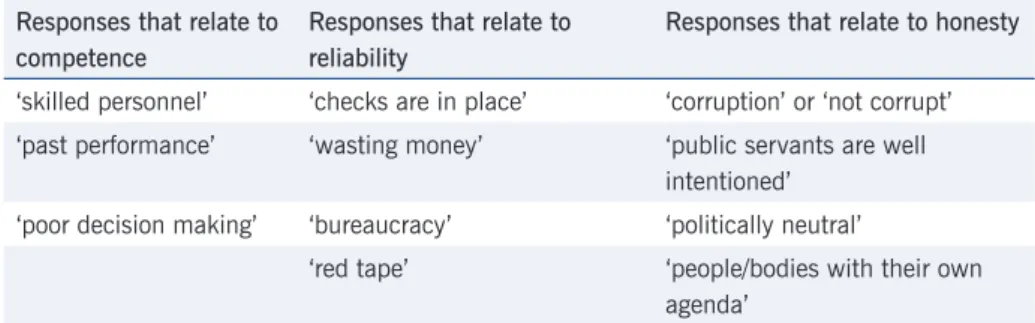
O’Neill suggests that three main attributes play a major role in how people judge the trustworthiness of others: competence, reliability and honesty (O’Neill, 2013). In 2012 my office asked New Zealanders what were important factors in trusting or not trusting public organisations. Figure 1 categorises the responses from the internal research report, under the three attributes.
What the responses show is that all three attributes are clearly important and a trusting relationship cannot be built on competence or performance alone. Public organisations also need to demonstrate integrity and ethical behaviours such as dependability, reliability, fairness, loyalty and truthfulness. As Miller and Listhaug observe, assessing trust in government is a ‘summary judgement’ that the system is ‘fair, equitable, honest, efficient and
responsive to society’s needs’ (Miller and Listhaug, 1990, p.358). Simply put, there is little point in a well-performing system
if it is seen to be lacking in integrity and ethical values.
Changes in technology and media platforms are changing the nature of the relationship between the public and the public sector
In many countries, including New Zealand, societal and individual expectations are changing as a result of more access to information, evolving technologies and media platforms, and greater interconnectedness. Today, more than ever, information is available to be aggregated, distributed, scrutinised, and used within and outside the public sector. Roy noted as early as 2008 that ‘information is everywhere, and answerability has been diffused in many directions beyond Parliament’ (Roy, 2008, p.546). For a public accountability system to be effective in an increasingly connected and informed world, it needs to have structures and processes that can meet multiple, and sometimes fluid, public relationships and expectations.
Today, how the public establishes trust is becoming less institutionalised and more individualised through distributed networks of individuals. Although questions about trust may remain the same (for example, who are you? is your information reliable? will you do what you say?), establishing trust with a wide network of online strangers is based on immediate reputational feedback mechanisms rather than traditional processes, intermediaries and institutions. New businesses are increasingly placing the reputational feedback mechanism at the centre of their business models. For example, Uber relies on a feedback system for drivers and customers to manage the behaviour of both parties and enable access to the platform.
Although the public sector has cautiously embraced new technologies and forms of social media, the pervasiveness of the media’s influence on the public means that the public sector needs to be able to work with and leverage this relationship in a more proactive way. In the last few decades, the media has fundamentally changed as a result of the internet, new technologies, and competition for revenue in a shrinking and increasingly fragmented market. The consequences of these changes have been serious for media institutions and have significantly affected how well- informed certain communities are. At the same time, the internet, the rise of social media and new technologies have made it significantly easier for misinformation and ‘fake news’ to spread.
Recent research in Canada found that, although there was greater access to public information about government, there was little evidence that technology had improved the amount and quality of oversight (Lindquist and Huse, 2017, pp.645–6). The authors suggested that more thinking was needed about how to involve the public more, including looking at the ways accountability information was supplied and used by Parliament and the public.
What success looks like and how it should be demonstrated is changing
Central agencies are proposing reforms to improve the stewardship of New Zealanders’ intergenerational well-being. These reforms are not intended to lessen the public sector’s accountability obligations but to change the focus, form and approach of those obligations. Many New Zealand researchers have already suggested that a move towards more collaboration and an outcomes focus means that new accountability models, such as joint or shared accountabilities, may be needed. As part of those changes, the public audit function may also need to adapt and evolve.
Maintaining the public’s trust and confidence will be an important part of the shift from a ‘management’ approach to a ‘system stewardship’ approach. For Ranson and Stewart, a stewardship approach in the public sector involves ‘not merely giving an account by the steward but also that the steward can be held to account and that
Does Public Accountability Even Matter if the Public Sector is Performing Well?
Figure 1: Important factors in trusting and not trusting public organisations – responses to our 2012 survey
Responses that relate to competence
Responses that relate to reliability
Responses that relate to honesty
‘skilled personnel’ ‘checks are in place’ ‘corruption’ or ‘not corrupt’
‘past performance’ ‘wasting money’ ‘public servants are well
intentioned’
‘poor decision making’ ‘bureaucracy’ ‘politically neutral’
‘red tape’ ‘people/bodies with their own
(Ranson and Stewart, 1994, p.241) The current reforms are also focusing more on well being outcomes. Compared with agency inputs, activities and outputs, well being outcomes are more interrelated, dynamic, uncertain and long term. Encouraging and supporting public sector objectives such as learning, adaptability, strategic thinking, representation and innovation may be as important as focusing on incentivising good decision making, internal control and performance.
Accountability information about well-being outcomes may be less precise when compared with traditional activity or output information. The information will also need to reflect the aspirations of multiple parties who may be affected by those outcomes. This may mean more targeted data and less reliance on averages or majority populations. Waring warns that approaches to preparing wellbeing outcome indicators should avoid ‘the all-too-common approach of trying to raise averages and not worrying enough about those left behind’ (Waring, 2018, p.83).
Because of these many differences, new ways of describing what success looks like may also be needed. These could include, for example, measuring the sustainability, resilience and fairness of wellbeing outcomes, where the focus is on issues of equity and legitimacy rather than just performance.
In Wales, for example, the Well-being of Future Generations (Wales) Act 2015 is designed to ensure that all ‘public bodies take account of the long-term, help to prevent problems occurring or getting worse, take an integrated and collaborative approach, and considers and involves people of all ages’ (Welsh Government, 2016, p.3). Under the act, there are five new measures of agency success: long-term thinking, prevention, integration, collaboration and involvement. These are wider than the traditional measures of agency performance, and the Welsh Audit Office audits each new measure. The auditor-general for Wales recently commented that he had to audit behaviours of public officials as part of his role.
To support this new wellbeing approach, public accountability structures in Wales
have also been strengthened, including through new and/or expanded review roles for the future generations commissioner, overview and scrutiny committees, and the auditor-general for Wales (ibid., pp.6, 13, 34).
Again, compared to traditional activity and output measures, outcomes will be of more interest to people and communities because of their direct impacts on people’s daily lives. The mechanisms and forums through which an account is given and judgements made may need to evolve to allow more familiar, convenient and relevant options to interact and engage. Simply publishing output information may not be enough to meet the public’s expectations. Different forums in different places and at different times may be needed to ensure that the account is understood and informed judgements made. For example, more direct, collective and community-based accountability forums may be more relevant when dealing with Mäori/Crown relationships.
The relationship with Ma-ori is evolving
While accountability may be a universal desire for most people, there is not one universal way of approaching and establishing accountability. Greater cultural diversity can offer both insights and opportunities to improve public accountability systems and the relationships between governments and different cultures.
established when the Treaty of Waitangi was signed in 1840. However, throughout the country and over time, the quality of that relationship has varied. As noted earlier, Mäori trust in the public sector brand is currently lower than that of non-Mäori.
As part of the recently proposed reforms to the state sector, there is a significant focus on supporting the Mäori/ Crown relationship and improving the public sector’s capability to meet Mäori needs and aspirations. Holding senior public officials accountable for supporting this relationship is an important part of the reforms. A new Mäori/Crown Relations portfolio has recently been created that seeks to establish a closer partnership between Mäori and the Crown to resolve social and environmental challenges and to develop opportunities for economic development. Being properly accountable for that partnership will be an important part of ensuring that the relationship is resilient and sustainable. Understanding the expectations of all parties, and particularly what the Mäori community expects, is an essential first step.
Accountability in tikanga Mäori is highly contextual, reflects cultural relationships that are more collective than individual, and involves more direct accountability avenues. It also has a mix of formal and informal mechanisms. Mäori perspectives on public accountability differ in many ways from what is sometimes referred to as the ‘Western’ approach. To fully understand these differences, we must first ask what accountability to Mäori would look like. Learning from these answers will help achieve a more relevant public accountability system and allow stronger and more durable relationships with Mäori in a post-Treaty settlement world.
Does public accountability matter if the public sector is performing well?
In the last 30 years, new challenges and opportunities for the public sector have emerged from considerable changes in technology, social and cultural diversity, and the way the public sector delivers public services and what it focuses on. New
Performing
competently
might not
be enough,
by itself,
to maintain
public trust
and confidence.
Zealanders have also become increasingly informed and connected, and the country is moving quickly into a ‘Post-Treaty’ period would be 1840 - 2019. In this more diverse, dynamic and connected world, the public demands more from our public accountability system. How the public sector tells its story and assures the public it is meeting its expectations will be fundamental to maintaining the public’s trust and confidence in the public sector.
Although public officials and their agencies are primarily accountable to their ministers and through them to Parliament, they must also act to maintain the trust and confidence of the public they serve. The public may expect a more direct accountability relationship, not just as users of public services but as the ultimate owners of public resources. In parts of the public sector this is already happening with, for example, greater public participation in policy development. However, much more will need to be done if the public sector is to engender and maintain increased public trust and confidence.
The current system of public accountability has many strengths, but the public sector cannot be complacent. Performing competently might not be enough, by itself, to maintain public trust and confidence. The public’s changing expectations could mean, for example, that more emphasis on behaviours, like truthfulness, respect and fairness, is needed.
The recently announced reforms to the state sector envision a unified public service, focused on agencies working together to improve outcomes, as stewards of New Zealanders’ intergenerational well-being. These reforms are an opportunity to shape a system of public accountability that complements the public management system and meets the needs of New Zealanders today and in the future.
To realise this opportunity, public accountability will need to be thought about from the perspective of those it is there to provide assurance to. It involves developing closer and more direct relationships with communities of people, and this starts with the public sector understanding what is important to these communities, when it is important, and why.
What could this mean for the role of the public audit?
The public audit function continues to be a fundamental part of the public accountability system. As the public sector moves towards greater stewardship, shared values, collaboration and a focus on wider wellbeing outcomes, the public audit function will need to adapt.
The idea of stewardship means being motivated by common objectives, having shared interests, and working together to achieve shared goals. Auditing in a stewardship environment could mean, for example, that an audit of a set of financial statements would focus on helping an entity ensure that its financial story is understandable, engaging and useful, rather than simply materially correct at one point in time.
Traditional audit practices, including the performance audit, help improve organisational performance by independently reviewing management and governance disciplines for internal controls, processes, reporting, guidelines and policies. A greater focus on intergenerational wellbeing outcomes may extend the audit across time and into new areas of organisational success, such as collaboration, innovation and involvement.
The European Organisation of Supreme Audit Institutions has also observed that ‘[e]thics, integrity and transparency of state
officials’ and civil servants’ actions have become a growing focus of public attention’ (European Organisation of Supreme Audit Institutions, 2014, p.7). As such, more and more ethical audits are being carried out in various countries as a way of building integrity, fostering ethical decision making and safeguarding the reputation of the organisation. As an example, the Brazilian Court of Audit has used ‘enhanced’ performance audits to help identify and reduce social inequalities. The audits focused on three issues of equity, geographical distribution of resources, access to goods and services and results achieved by programmes.
Conclusion
The public accountability system has served us well over the past 30 years but it may no longer be keeping pace with the public’s expectations for greater public sector accountability. Attempts by the public sector to reduce this growing expectation gap through greater participation, openness and transparency are a good start, but they may not fully capture what the public expects of the public sector in terms of being accountable. The recently announced public sector reforms will continue to alter the relationships that exist within the public sector and between the public sector and the public. New ways of thinking about public accountability are needed if we are to maintain and build New Zealander’s trust and confidence in the public sector.
1 For the purposes of this article, public sector means the government of the day and its agencies, including local government and its agencies.
Carroll, N. (2012) ‘Structural change in the New Zealand economy 1974–2012’, draft paper for the Long-Term Fiscal External Panel, Wellington: Treasury
Dormer, R. (2018) ‘Accountability and public governance in New Zealand’, summer research paper for the Office of the Auditor-General
Erin Research Inc. (1998) ‘Citizens first: summary report’, Erin Research Inc. for the Citizen-centred Service Network, Canadian Centre for Management Development
Espeland, W.N. and M. Sauder (2007) ‘Rankings and reactivity: how public measures recreate social worlds’, American Journal of Sociology, 113 (1), pp.1–40
European Organisation of Supreme Audit Institutions (2014) Auditing
Ethics in the Public Sector: general overview of SAI’s practices
Gill, D. and J. Zuccollo (2012) Role and Limits of Performance Measures:
report of the Performance Measurement Research Project for the Technical Working Group, Wellington: NZIER
References
confidence in schools, business, government, and more, Public Agenda
and the Kettering Foundation
Lindquist, E. and I. Huse (2017) ‘Accountability and monitoring government in the digital era: promise, realism and research for digital-era governance’, Canadian Public Administration, 60 (4), pp.627–56
Miller, A. and O. Listhaug (1990) ‘Political parties and confidence in government: a comparison of Norway, Sweden and the United States’,
British Journal of Political Science, 20 (3), pp.357–86
Office of the Auditor-General (2013) Learning from Public Entities’ Use of
Social Media, Wellington: Office of the Auditor-General
Office of the Auditor-General (2019) Public Accountability: a matter of trust
and confidence, Wellington: Office of the Auditor-General
O’Neill, O. (2002) ‘Called to account’, lecture 3, Reith Lectures 2002: A Question of Trust, BBC
O’Neill, O. (2013) ‘What we don’t understand about trust’, TED talk, June, www.ted.com
enabling the learning society, New York: St Martin’s Press
Roy, J. (2008) ‘Beyond Westminster governance: bringing politics and public service into the networked era’, Canadian Public Administration, 51 (4), pp.541–68
Scott, G. (2001) Public Management in New Zealand: lessons and
challenges, Wellington: New Zealand Business Roundtable
State Services Commission (2019) Kiwis Count: New Zealanders’
satisfaction with public services, 2018 annual report, Wellington: State
Services Commission
Treasury (1987) Government Management: brief to the incoming
government 1987, volume 1, Wellington: Treasury
Waring, M. (2018) Still Counting: wellbeing, women’s work and
policy-making, Wellington: Bridget Williams Books
Welsh Government (2016) ‘Shared purpose: shared future. Statutory guidance on the Well-being of Future Generations (Wales) Act 2015’, https://gov.wales/well-being-future-generations-wales-act-2015-guidance