Organisational Change and Development
Hillary O. Odor
Department of Business Administration, Faculty of Management Sciences, University of Benin, Benin City, Nigeria
Abstract
A good planning and genuine implementation of change is something that every organisation must do to remain competitive in the ever dynamic business environment. Unarguably, the impact of environmental dynamism accounts for most of the major cause of organisational change and development, which may either be spontaneous or is being influenced by a radical leader in his quest for a better business process solutions in reaction to a competitors action.This paper therefore, discusses organisational change and development in its simplest form by looking at the major causes of change, change agents, and the different approaches of change management. Incidentally, it has been discovered from the review of extant literature that rather than being a concept of its own, organisational development is one of the major approaches to managing organisational change. Therefore, this paper proposes that organisational development as a much broader concept and not just as one of the approaches to managing change and explore it various interventions mechanism, with their relative organisational behaviour implication.
Keywords: change, development, external environment, internal environment, organisation
1.0. Introduction
It is symbiotically imperative that for one to fully understand the importance of the construct of organisational change and development there is a need to appreciate what an organisation is in terms of its characteristics as an open system. It is indeed the good knowledge and grasps of the characteristics that will pave the way for a better analysis and understanding of organisational change and development, with special emphasis on strategies for managing organisational change. Marshak (2008) made some significant contribution to the literature on organisational change and development in his paper on the “hidden barriers to organisational change.” Bushe and Marshak (2009) did a great write up in “Revisioning organisation development: Diagnostic and dialogic premises and patterns of practice”. Buchanan, and Dawson, (2007) wrote on “discourse and audience: organisational change as multi‐story process”. Brown and Humphreys (2003) wrote on “epic and tragic tales: Making sense of change.” This study will review the literature to better understand the construct of organisational change and by extension, development. Going by the way economists analyze the concept of economic growth and development, one would have assumed that the concept of organisational development should be a broader concept than organisational change. To the economist, economic growth is an increase in the gross domestic product of a country over a period of time, while economic development is defined as economic growth plus change. In other words, an economy may be growing but cannot be said to be developed. In the same line of thinking, the author assumes that organisational change is a subset of organisational development. This means that for one to talk about organisational development, he must of necessity, talk about organisational change. According to Bushe organisational development is not “about change”, but about creating great organisations (as cited Bushe & Marshak, 2009). Under these specific conditions organisational development is very good at helping leaders create change while developing great organisations. However, “there is no one viable, generalised model of a great organisation because any solution to a problem of organising inevitably creates another problem” (Bushe, 2017, p. 212). This study will review the extent literature to identify the position of the two concepts: organisational change and organisational development. But before then we will look at what an organisation is.
1.1 What is an organisation?
An organisation is “a consciously coordinated social entity, with a relatively identifiable boundary, which functions on a relatively continuous basis to achieve a common goal or a set of goals” (Robbins, 2001, p. 704).
Organisations are open systems that receive input from their external environment, which they transform into output and give back to the external environment. In that sense, organisations can be said to depend on their environment for survival and sustainability.
Every organisation has an identifiable and permeable boundary which acts as an interface between it and its operating environment. All organisational activities take place within the defined boundaries. An organisation must have a purpose which it sets out to achieve, and as an open system, an organisation needs information in order to survive and operate successfully within its set boundaries. The information can come from the external environment by way of feedback or can come from the internal source through informal groupings.
1.2 What is organisational change?
The partial or total adaption of a new idea, concept or behaviour by organisational members is referred to as organisational change (Burnes, 2004). Little wonder, Yang, Zhuo, & Yu, (2009), argues that changing the vision and mission statements, organisational strategy, organisational cultures, organisational structure, system, techniques of production and leadership style are some of the targets of organisational change. It arises as a result of pressures from the external environment and the need for internal alignment of structural defects.
From a broader perspective, change refers to a system of continuous transformation that take place in one or more organisational domain such as organisational technology, structure and human resources (Sofat, Kiran, & Kaushik, 2015).
Organisational change usually originate from discrepancies noticed from environmental dynamism, which takes the form of series of activities that support the process of improvement in the capabilities of individuals and groups that work in organisations (Kassim, Tahajuddin, Shahzad, Isa, & Mat, 2010).
Organisational change is a consequence of changes in the business activities as well as the outcome of managerial perception, choice and action (Daft, 2010).
In the opinion of Kotter and Schlesinger (2008), organisational change implies or means the same thing as organisational transformation. However, change implementation is a more rigorous activity than it is often being perceived Szabla, (2007), that is why it is estimated that two thirds of all organisational change effort does not succeed. According to Bennebroek Gravenhorst, Werkman, and Boonstra (1999), despite this growing attention given to organisational change effort, more than 50 percent of all change initiative still does not succeed (as cited in Win, 2004, p. 129).
The goals of organisational change are very many, but they major ones centers on performance improvement, prevention or elimination of organisational crisis, and capacity to withstand competition and environment turbulence (Isern & Pung, 2007).
Therefore, all prospective change program must be supported by effective communication process for the following reasons: To convince the employees on the need for change, to enable individuals to appreciate the positive impact that the change will have on them, if successfully implemented, to identify any structural loophole in the change process, and to keep open the channels of communication as the plan progresses.
This change effort is often referred to as planned change. However, this type of change effort has its own draw-back, which according to some authors, is too much emphasis is incremental change, which makes is unreliable in situation that requires rapid approach to institutional and transformational change (Rune, 2005).
Cummings and Worley note that it is because of the multi-faceted nature of organisational change that the concept is viewed from a number of different perspectives, using multiplicity of models and theories (McAleese, & Creed, 2013, p. 105), which sometimes are conflicting.
For the fact that organisations are political systems, so many change efforts in organisations are not initiated to further the interest of the organisation, in terms of better process or output, rather to benefit their own people or individuals. The same is true when you look at an organisation as a fragmentary system of distinct units each pursuing conflicting goals.
The same way we talk about organisational learning: Organisations don’t learn, it is the individuals in the organisation that learn. Work teams, groups and organisations don’t change, but the individuals in the work group, groups and organisations change. Organisations can only change if and only if members change their attitudes, behaviour and dispositions.
1.3 Types of Change
Changes has been classified in some many different ways by different authors using different perspectives, for instance Gersick, (1991) defines his classification as gradual or revolutionary; Dunphy and Stace, (1988) classify
organisational change” (Cummings, Bridgman, & Brown, 2015, p. 43). His model is based on premises that before introducing a change into an organisation, the individuals in the organisation must be prepared for the change, there must be motivated to change and there must be an established and integrated mechanism for bringing about the change in behaviours of all the organisational members (Chand, 2015).
Unfreezing the status quo: This involves recognizing the need for a change and improvement (Mullins, 2007). According to Marquis and Huston, “during this stage change agents and all those involved in leading the process of change source for information required to solve the identified problem or lapses” (as cited in Mitchell, 2013, p. 9). This step is very important because it requires that leaders and managers should educate and motivate their subordinate so that they can buy the idea of change (Change Management Coach, 2015, p. 1). It is very important to state at this point that any change process initiative involves two divergent types of forces. It is therefore necessary at this stage to identify the driving force of the change as well as the restraining forces of change which is alternatively referred to as the benefits and costs of the change implementations (Change Management Coach, 2015, p. 1).
Movement to a desired position: This involves the development of new behaviour and attitudes and the execution of the change program (Mullins, 2007). This is a very critical stage and according to Change Management Coach (2015), the following must be done to ensure a successful movement. “You must provide continuous education on the need for the change that is taking place, you must provide extensive support to staff especially those that are resistant, and you must maintain an undiluted flow of communication with your subordinate regarding the change process, especially the benefits to be derived” (Change Management Coach, 2015).
Refreezing: This means “stabilizing a change intervention by striking a balance between the driving forces of change and the restraining forces through policies, procedures, structures and cultural norms (Robbins, & Judge, 2007, p. 659). For this stage to be successful, two things must be noted here: “The employees must not be rushed, therefore, they must be given ample time to adapt to the new change, and there is need to emphasize the benefits of the change initiative” (Change Management Coach, 2015. p. 2).
One of the criticisms of the Lewin model is that it is broad and rather too abstract (Eldrod II, &Tippett, 2002). Furthermore, Lewin’s model assumed that organisations operate in a stable state, which to a great extent, is not true. Moreso, Kurt Lewin model appears to be only relevant for managing small-scale change projects, and did not take into cognizance the concept of viewing an organisational as a political system (Burnes, 2004. Still on small or incremental change, Sorensen (2002) argues that organisations with strong cultures are very good when it comes to incremental changes, but they do not do well when it comes to radical changes (as cited in Robbins & Judge, 2007). Furthermore, Child (2005) argues that “Lenin’s postulations appear to be too rigid and his thinking of ‘refreezing’ cannot be applied in today’s complex and dynamic world that requires more of fluidity than rigidity” (p. 293). However, several other authors like McAleese, Creed and Zutshi (2013), have countered some of those criticisms. For instance, the above authors argue that “there has been an unparallel adaptation of Lewin’s theoretical heritage is sufficiently robust to withstand the criticisms of the refreeze stage” (McAleese, Creed, & Zutshi, 2013, p. 104).
1.4.2 Kotter 8- Steps Change Model
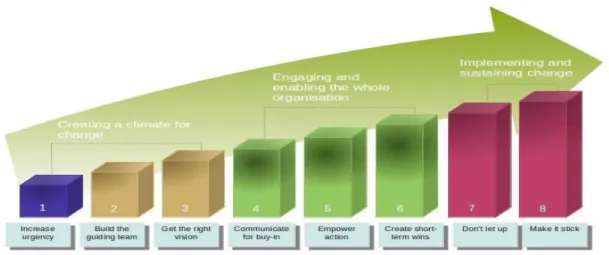
Kotter and Cohen (2002) investigated the various issues and impediments that people encounter in the course of initiating organisational changes, and came to a logical conclusion that a change initiative can only be successful when individuals are able to change their cognitions and behaviour by sincerely talking to their hearts. It was on the basis of the above shortcomings that Kotter suggested the following eight steps plan for implementing organisational change. The idea behind his insight is that when there is a vision for the change process, there will be a reduction in the rate of errors; this will lead altogether to an increase in the rate of success (Kotter, 2014).
Fig. 1: Kotter’s 8-step change model
Adapted from Kotter (1996).
From the figure above, the first three steps (1, 2 and 3) focus is on creating an enabling environment for change to take place. Steps 4 to 6 focus on ensuring that all organisational members are actively involved in the process of change. The last two steps-7 and 8- (never giving up and making it stick) is all about ensuring the stability and sustenance of the change.
It is always a common phenomenon for organisational leaders to rush into a change program without having a clear conviction of what the impetus for the change is. More often than not, most organisational leaders erroneously assume that they can use the direct influence of their personality drive change and change related processes. Therefore, rather than communicating and aligning with those people that will implement the change, they singlehandedly plan the process and expect the subordinates to just follow. It is on the basis of the above that a guiding coalition becomes imperative, more so, since no individual has all the knowledge, skills and abilities that is required to bring about successful organisational change. However, all is not too well with Kotter’s model of change.
The major weaknesses of Kotter’s model is that the model appears to be too mechanistic, it is mostly applicable to large organisations and finally, it is not capable of sustaining a change program or any major transformation agenda (“The Hub Event”, n.d, para. 8). In the opinion of O’Keefe (2011) Kotter’s model for managing change has two major drawbacks as follows: Firstly, Kotter assumes change to be a one-off activity, which must be carefully managed. Secondly, he projected the model in such a way that will make employees to be suspicious of the change and therefore lose trust and credibility, as leaders make changes without the other employees’ own input. In other words, the model makes employees to be mere instruments of change (O’Keefe, 2011, para. 2). In another development, but flowing from the same direction, Lewin’s approach has also been criticized on the basis that it has become obsolete because it is only applicable in a world where the business environment is stable. This criticism is understandable since at the time of Lewin postulation, the business and economic environment were relatively stable. Secondly the model assumes that change is an unusual phenomenon in an otherwise peaceful world. This happens to support the reactive approach who strongly believes that change occurs only when there is a shock in both external and internal environment of an organisation. However, this assumption is not realistic considering today’s turbulent, chaotic and dynamic
used to solve a specific organisational identified problem. Action research requires the “active involvement of the organisational change agent so as to identify, promote and evaluate the issues at hand and recommend practical solutions as the case may be” (Fellows & Liu, 2003, p. 21). Generally, action research can be divided into three categories (Collis, & Hussey, 2003).
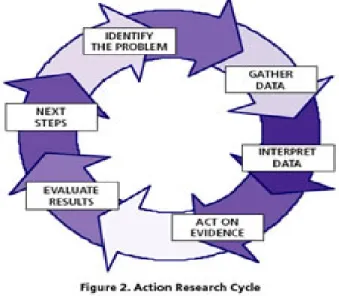
Classical action research views research as a way of testing tentative statement in a real world environment. Contemporary action research focuses on logical ideas of both individuals and group when undertaking research (Collis, & Hussey, 2003). Critical action research is a specific type of action research that adopts a deep-rooted approach with the objective of improvement performance (Collis, & Hussey, 2003). The ability of participants to actually perceive the need for a change and be willing to collaborate in the process of change is indeed one of the major characteristics of action research (Meyer, 2000). When this is done, all stakeholders will perceive the change process and the outcome of the process to be meaningful, reliable and actionable. Just like a normal scientific research process, action research has five basic logical steps (Terrance, 2000, p. 9).
Figure 2: Action research process Adopted from Ferrance, 2000, p. 9)
Action Research Process
Problem identification: This involves interviews, reviews of opinions of the employees’ records.
Gathering of data: This is an attempt aimed at sourcing for the required set of data that is relevant to the study. Interpretation of data: Once data is gathered, the next thing is to analyse the data so that the data can now be in usable state. Once that is achieved, the analysed data is now interpreted for easy understanding by those who will utilize that data.
Action: The change agent and the employees carry out the plans to remedy the problematic situation identified at the diagnosis stage.
Evaluation: Initial data is used as a benchmark and evaluation is made to ascertain the success or otherwise of the change process.
Next step: Thereafter the process continues because it is a never-ending process.
1.4.4 Organisational Development
“Organisational development refers to a special field involving well-trained people with expertise in facilitating successful organisational development interventions” (McNamara, 2015, para. 2) to enhance improvement in organisations. It is a generic term used to describe various interventions strategies employed by organisations with the objective of increasing the capability of individuals and teams. Patching refers to OD as synonymous with management development, which he defines as activities having no direct physical impart on the organisation, but that its effectiveness lies in changing the behaviour of managers and employees (as cited in Mullins, 2007). However, organisational development is a much broader scope than management development, since management development is aimed specifically at developing the competencies of organisational leaders in some specialized areas of knowledge.
Organisational development is “the organisation-wide application of behavioural science knowledge to the planned improvement, and reinforcement of the strategies, structures, and processes that lead to organisation effectiveness” (Cummings, & Worley, 2009, p. 121). One of the major goals of organisation development is to create an environment where organisations will be more open and more adaptive to learning in their quest to be learning organisations, because it is only a learning organisation that are action oriented towards learning by way
of vitality and through imbibing a learning culture (Theodore, 2012).
McLean (2010) views organisation development as “any process or activity, based on the behavioural sciences, that, either initially or over the long term, has the potential to develop in an organisational setting enhanced knowledge, expertise, productivity, satisfaction, income, interpersonal relationships, and other desired outcomes, whether for personal or group/team gain, or for the benefit of an organisation, community, nation, region, or, ultimately, the whole of humanity” ( p. 9).
It is an “applied behavioural science approach to planned changes and development of an organisation because the emphasis on OD is more on improving organisation capabilities rather than the actual organisational processes and it is about large scale organisational change that is based on people’s perception and behaviour” (Mullins, 2007, p. 720).
Shvindina (2016) views organisational development as consistent with organisational transformations, which means the accumulation of organisational capabilities to solve organisational problem and to react to external challenges. Organisational development is not about restructuring or a reducing organisational layer, that is why Church defines OD by first outlining what he considers not being OD for instance, downsizing and process consolidation are not part of OD. He thereafter defines OD as a systematic organisational change (as cited in Maier, Leban, & Orr-Alfeo, 2001). The idea here is that it is not every change that can be classified as organisational development.
1.5 Underlying Values in OD Interventions
1. People should be treated with respect
2. There must be trust, openness and collaborative organisational climate 3. Less emphasis should be placed on hierarchical structures
4. Confrontation: Issues bothering on employees must be treated head-on
5. People that will be affected by the change must be included in the planning and execution of the change process.
1.6 Organisational Development Strategies/Techniques
Sensitivity training: This is also called T-group (Mullins, 2007): These are training groups that change behaviour and attitudes of employees though unstructured group interaction. Training is usually on process rather than on content.
Survey feedback: This involves the use of questionnaire to illicit information from the employees. The interview is aimed at identifying the discrepancies among members perception, discussion follows and remedies are suggested. It is one of the human based processes OD intervention strategies aimed at enabling the employees to develop better understanding of their own and others behaviour for the purpose of improving interpersonal, intra-group, and inter-group relations (Obiewa, 2016).
Process consultation: The aim of process consultation is to increase the value the relationships among individuals working in groups especially among students and teachers to achieve their common goals. It focuses on the context of interpersonal and group interactions rather than on what of the content (Schmuck, 1995).
Team building: This involves a clear understanding of the mutual expectations from individuals, as well as the modalities of working with one another as collaborators in other to optimize the performance of each team member. It has to do with building a common value for the team, creating a strategic vision for the team, and crafting specific role for each team member (Tearle, 2015).
Appreciative inquiry: This intervention strategy seeks to identify the key organisational competencies with a view to developing those competencies so as to achieve individual and organisational improvements.
stage. Participants are encouraged to form groups or categories for the purpose of creating special projects.
Destiny/Delivery stage: This stage was initially called delivery stage, until Cooperrider changed it to destiny when he discovered that delivery seem to be associated with traditional management change approach. This has brought about a lot of criticism from appreciative inquiry researchers (as cited in Bushe, 2011).
According to Obiewe (2016) all organisation development interventions or strategies that are rooted in the engineering, industrial psychology and in the applied fields of sociology and humanities are referred to as socio-techo structural interventions. The following fall under the socio-structural interventions: Job enlargement; Job enrichment; Structural design; Downsizing; Re-engineering; Total quality management, and Work design. The purpose of which is to (1) increase efficiency in work content, enhance task completion method, and building a mutual relationship among workers, and (2) reduce operational costs by replacing outdated materials and equipment.
1.7 Benefits of Organisational Development Interventions
According to Hawai Pacific University (2015), organisation that engages full organisational development program enjoys the following benefits: Continuous Improvement, effective communication, continuous employee development, quality products and services and increase in the organisations’ bottomline.. When stakeholders define the change and allow leaders to manage the change process, there is a high probability of a successful change process, but when leaders define the change and personally manage the change process, it often leads to failure. In the same way if stakeholders define the changes and allow staff to manage the change process, it will fail unless the leaders buy in to the outcome of the change process (Maxton & Bushe 2017).
According to Rune (2005) the major cause of these failures has to do basic lack of a valid framework on change planning and implementation which make leaders to over-rely on inconsistent theories and models that lack empirical validation. It is as a result of this that the author argues that to have a successful OD intervention organisational leaders must be enthusiastic about improving the organisation’s ability to adapt to environmental challenges. In order to improve their organisations, they must use both attitudinal and behavioural change processes that will increase the organisation’s ability to understand its vision, reduce the extent to which emotions influences group and organisational decisions making processes, procedures and actions, and as well, increase the organisation’s capacity to achieve its potentials.
Summary and Conclusion
A good planning and genuine implementation of change is something that every organisation must do to remain competitive in the ever dynamic business environment. It is symbiotically imperative that for one to fully understand the construct of organisational change and development there is a need to appreciate what an organisation is in terms of its characteristics as an open system. Managing organisational change effectively is a key to achieving the objective of any change initiative. Lewin change model, Kotter eight steps model, action research and organisational development are some of the various approaches of managing change at organisational level. Although each of these has its own peculiarity, organisational development tends to have a wider acceptance than all the other approaches to managing change in organisations because it emphasizes both change in structure and culture of the organisation. Some of the organisational development interventions or strategies were also reviewed. The author proposes that rather than treating organisational development as one of the strategies for managing change, it should be treated as a broader conceptualization.
References
Brown, A. D., & Humphreys, M. (2003). Epic and tragic tales: Making sense of change. Journal of Applied Behavioral Science, 39(2), 121-144.
Bryman, A. & Bell, E. (2011). Business Research Methods, (3rd ed). Oxford University Press.
Buchanan, D., & Dawson, P. (2007). Discourse and audience: organisational change as multi‐story process. Journal of Management Studies, 44(5), 669-686.
Burnes, B. (2004) Managing Change: A strategic approach to organisational dynamics (4th ed) Harlow: Prentice Hall.
Bushe, G. R., & Marshak, R. J. (2009). Revisioning organisation development: Diagnostic and dialogic premises and patterns of practice. Journal of Applied Behavioral Science, 45(3), 112-127.
Bushe, G.R. (2017). Creating collaborative organisations that can persist: The partnership principle. OD Practitioner, 49(3), 23-29.
Chand, S. (2015). Action research model of organisation development. Your Article Library. Retrieved
from:http://www.yourarticlelibrary.com/hrm/action-research-model-of-organisation-development-explained-with-diagram/35317
Change Management Coach (2015). The Kurt Lewin Change Management Model. Retrieved from http://www.change-management-coach.com/kurt_lewin.html
Child, J. (2005). Organisation: Contemporary principles and practice. Oxford: Blackwell. Retrieved from: http://journals.sagepub.com/doi/full/10.1177/0018726715577707
Collis, J. & Hussey, R. (2003). Business research. A practical guide for undergraduate and graduate students, (2nd ed), Palgrave: Macmillan.
Cooperrider, D.L., & Srivastva, S., (1987). Appreciative inquiry in organisational life. Research in organisational change and development, 1, 129-169.
Cooperrider, D.L., Whitney, D. & Stavros, J.M. (2008). Appreciative inquiry handbook (2nd Ed.) Brunswick, OH: Crown Custom Publishing.
Cummings, T. & Worley, C. (2009). Organisation development and change. (9th ed). Mason, OH: Cengage/South-Western.
Daft, R.L (2010). Organisation theory and design (10th ed) St. Paul: West Pub. Company.
Dunphy, D.C., & Stace, D.A. (1988). Transformational and coercive strategies for planned organisational change: Beyond the O.D. model. Sage Journals, 9(3), 317-334.
Eden, G. & Huxham, C. (1996). Action research for the study of organisations. In S.R. Clegg, C, Hardy, and W.R. Nord (eds). Handbook of organisation studies. London: Sage
Eldrod II, P. D., & Tippett, D. D. (2002). The “death valley” of change. Journal of Organisational Change Management, 15(3), 273–291.
Fellows, R. F., & Liu, A. M.M. (2003). Research methods for construction (4th ed). Wiley Blackwell.
Fry, R., Barrett, F., Seilling, J., & Whitney, D. (2002) (eds.), Appreciative inquiry & organisational transformation: Reports from the Field Westport, CT: Quorum.
Gersick, C.J.G. (1991). Revolutionary change theories: A multilevel exploration of the punctuated equilibrium paradigm. The Academy of Management Review, 16(1), 10-36. DOI: 10.2307/258605
Hawaii Pacific University (HPU). (2015). 5 key benefits of organisational development. Retrieved from: https://explorance.com/2013/11/5-key-benefits-organisational-development/
Isern, J, Pung, &., & A. (2007). Harnessing energy to drive organisational change. McKinsey Quarterly 1, 16-19. Kassim, A. W., Tahajuddin, S. B., Shahzad, A., Isa, E. V., & Mat, N. (2010). Preliminary insights into the role of
space in organisational change. The Journal of International Management Studies, 5(2), 50-58. Kotter, J. P. (1996). Leading change. Boston, MA: Harvard Business School Press.
Kotter, J., & Schlesinger, L. (2008). Choosing strategies for change. Harvard Business Review.
Kotter, J.P., & Cohen, D.S. (2002). The heart of change: Real-life stories of how people Change their organisations.
Levy, A.(1986). Second-order planned change: Definition and conceptualization. Organisational Dynamics, 15(1), 5-17, 19-23. doi.org/10.1016/0090-2616(86)90022-7
Maier, D, Leban, B., & Orr-Alfeo, D. (2001). A value statement on OD: An interview with practitioner-scholar Dr. Allan Church. Organisational Development Journal, 19(3), 69-74.
Marshak, R. J. (2008). The hidden barriers to organisational change. Invited lecture at the Graduate School of Global Human Resource Development, Chung Ang. University, Seoul, Korea.
Maxton, P.J. & Bushe, G.R. (2017). Individual cognitive effort and cognitive transition during an organisational change process. Submitted to Human Relations.
McAleese, I, Creed, A., & Zutshi, A. (2013). A response to critique of the refreeze step in Lewin’s model of organisational change from the viewpoint of organisational behaviour. International journal of the Academy of Organisational Behavior Management, 4, 104-123.
McLean, G.N. (2010). A Review of: “Organisation Development: Principles, Processes, Performance. International Public Manangement Journal, 13(2). https://doi.org/10.1080/10967491003756831
School of business and public management, KCA University, in partial fulfillment for the award of Bachelor of commerce.
Parkin, P. (2009), Managing change in healthcare: Using action research. Research Gate: doi 10.4135/9781446269350
Reason P., & Bradbury, H. (2006). Handbook of action research: Concise paperback edition. London, England: Sage.
Riel, M. (2010). Understanding action research. Retrieved from Center for Collaborative principle. OD Practitioner, 49(3), 23-29.
Robbins, S (2001). Organisational behaviour: Concepts, controversies, and applications, (9th ed). Upper Saddle River, NJ: Prentice-Hall.
Robbins, S. P., & Judge, T. (2007). Organisational behaviour. Upper Saddle River, N.J: Pearson/Prentice Hall. Rune, B. (2005). Organisational change management: A critical review. Journal of Change Management, 5(4),
369-380. Doi: 10.1080/14697010500359250
Schmuck, R.A.(2010). Process consultation and organisational development. Journal of Educational and Pyschological Consultations, 6(3), 199-205. doi.org/10.1207/s1532768xjepc0603_1
Shvindina, H. O. (2016). The applicability of the social development and organisation development theories at the enterprise, Economic Processes Management. International Scientific E-Journal, 4, 124-150.
Sofat, K., Kiran, R., & Kaushik, S, (2015). Organisational change and organisational commitment: An empirical study of it organisations in India. Global Journal of Management and Business (A), 15(6), 39-49.
Sorensen, J.B. (2002). The Strength of Corporate Culture and the Reliability of Firm Performance. Administrative Science Quaterly. Sage Journals, 47(1), 70-91. https://doi.org/10.2307/3094891
Szabla, D. (2007). A multidimensional view of resistance to organisational change: exploring cognitive, emotional and intentional responses to planned change across perceived change leadership strategies. Human Resource Development Quarterly, 18(4), 525-558.
Tearle, R. (2015).Organisation intervention interventions: What type of organisational development of
intervention do you need? Retrieved from
https://changedesignsportal.worldsecuresystems.com/public/team/team_strategy/Team intervention.html Terrance, E. (2000). Themes in education: Action research. Providence, RI: Northeast and Islands Regional
Educational Laboratory. Retrieved from: www.lab.brown.edu.
The Hub Event (2015). The Pros and Cons of Kotter's 8 Step Model. Retrieved from: http://www.thehubevents.com/resources/leading-change-john-kotter-039-s-8-step-model-18/
Theodore, J. (2012). Organisational development interventions in learning organisations. International Journal of Management & Information Systems, 17(1). doi: https://doi.org/10.19030/ijmis.v17i1.7591
Wim J. L. Elving, (2005).The role of communication in organisational change, corporate communications: An International Journal, 10(2), 129-138.
doi: 10.1108/13563280510596943
Winter, R. & Munn-Giddings, C. (2001). A Handbook for action research in health and social care. London: Routledge
Yang, R. S., Zhuo, X. Z., & Yu, H. Y. (2009). Organisation theory and management: Cases, measurements, and industrial applications. Taipei: Yeh-Yeh.