Eliminating Code Duplication in Cascading Style Sheets
Davood Mazinanian
A Thesis In the Department
of
Computer Science and Software Engineering
Presented in Partial Fulfillment of the Requirements For the Degree of
Doctor of Philosophy (Software Engineering) at Concordia University
Montréal, Québec, Canada
August 2017 c
Concordia University
School of Graduate Studies
This is to certify that the thesis prepared
By: Mr. Davood Mazinanian
Entitled: Eliminating Code Duplication in Cascading Style Sheets
and submitted in partial fulfillment of the requirements for the degree of
Doctor of Philosophy (Software Engineering)
complies with the regulations of this University and meets the accepted standards with respect to originality and quality.
Signed by the final examining commitee:
Chair Dr Jia Yuan Yu External Examiner Dr Foutse Khomh Examiner Dr Juergen Rilling Examiner Dr Wahab Hamou-Lhadj Examiner Dr Peter Rigby Supervisor Dr Nikolaos Tsantalis Approved by
Dr Volker Haarslev, Graduate Program Director 30 August 2017
Dr Amir Asif, Dean
Abstract
Eliminating Code Duplication in Cascading Style Sheets
Davood Mazinanian, Ph.D.Concordia University, 2017
Cascading Style Sheets (i.e., CSS) is the standard styling language, widely used for defining the presentation semantics of user interfaces for web, mobile and desktop applications. Despite its popularity,CSShas not received much attention from academia. Indeed, developing and maintaining
CSScode is rather challenging, due to the inherent language design shortcomings, the interplay of
CSS with other programming languages (e.g., HTML and JavaScript), the lack of empirically-evaluated coding best-practices, and immature tool support. As a result, the quality of CSS code bases is poor in many cases.
In this thesis, we focus on one of the major issues found in CSScode bases, i.e., theduplicated code. In a large, representative dataset of CSS code, we found an average of 68% duplication in style declarations. To alleviate this, we devise techniques for refactoring CSS code (i.e., grouping style declarations into new style rules), or migrating CSS code to take advantage of the code ab-straction features provided by CSS preprocessor languages (i.e., superset languages for CSS that augment it by adding extra features that facilitate code maintenance). Specifically for the migration transformations, we attempt to align the resulting code with manually-developed code, by relying on the knowledge gained by conducting an empirical study on the use of CSSpreprocessors, which revealed the common coding practices of the developers who useCSSpreprocessor languages.
To guarantee the behavior preservation of the proposed transformations, we come up with a list of preconditions that should be met, and also describe a lightweight testing technique. By applying a large number of transformations on several web sites and web applications, it is shown that the transformations are indeed presentation-preserving, and can effectively reduce the amount of duplicated code inCSS.
Acknowledgments
First and above all, I praise God, the Almighty, for all the gifts that I had in my life: health, strength, a wonderful family, and all the remarkable people that I was inspired by and learned from. My deepest gratitude goes to Dr. Nikolaos Tsantalis: thanks for accepting me as your student, believing in me, being always beyond just a supervisor, and helping me to grow with your continuous support and mentorship. I have learned a great deal from you, both as a person, and as a researcher. I’m grateful for the support of my PhD committee, Drs. Juergen Rilling, Wahab Hamou-Lhadj, Peter Rigby, and Foutse Khomh. Especially, I’m grateful to Dr. Rigby for his outstanding course (Open Source Software and MSR); what I learned there significantly aided me throughout my studies. I would like to express my gratitude to Dr. Ali Mesbah for his insightful feedback and collab-oration on my first paper, Dr. Emad Shihab for exceptionally helpful discussions, and Dr. Danny Dig, for being an inspirational researcher who not only extraordinarily supported me when we col-laborated on papers, but also took any opportunity for teaching me true life lessons.
Thanks to all the people who made the time at Concordia fantastically joyful. Especially, my incredible friends, Dr. Laleh Eshkevari, Shahriar Rostami and Matin Mansouri, from whom I learned a lot, together with whom I laughed a lot – and, of course, we also researched a bit!
Saeed Sarencheh, Sultan Wehaibi, Everton Maldonado, Asif AlWaqfi, Moiz Arif, Rabe Abdalka-reem, Raphi Stein, Zackary Valenta, Andy Qiao, Giri Krishnan – and several others – thank you very much for all the friendship and support. Thanks also to the friends outside Concordia, including but not limited to Ameya Ketkar, for tirelessly working with me on our OOPSLA paper.
Even if I was a native English speaker, I wouldn’t be able to express my feelings about certain people in words. My parents, Mahmood and Parivash: sorry for not being around when you needed me, and thanks for letting me live miles apart from you to follow what I liked the most. My lovely brothers, Danial and Dariush: thanks for being there for our parents instead of me. My brother in law, Mehran: thanks for being the best brother in law ever! And lastly, my wife, Mehrnoosh: this was simply impossible without you. I’m truly blessed to have you in my life. Thank you very much for all the support, kindness, care, understanding, patience, sacrifice, and love.
Contents
List of Figures ix List of Tables xi 1 Introduction 1 1.1 Problem Statement . . . 2 1.2 Thesis Contributions . . . 3 1.3 Thesis Organization . . . 4 1.4 Related Publications . . . 5 2 Background 7 2.1 The History . . . 7 2.2 TheCSSLanguage . . . 8 2.3 CSSSyntax . . . 9 2.4 Value Propagation . . . 11 2.5 At-rules . . . 13 2.6 CSSSpecifications . . . 14 2.6.1 CSSVersions . . . 142.6.2 CSSSpecification Standardization Stages . . . 15
2.7 Chapter Summary . . . 15
3 Related Work 16 3.1 The Analysis and Maintenance of CSSCode . . . 16
3.1.1 General Studies . . . 16
3.1.2 Code Quality . . . 17
3.1.3 Alternative Language Proposals forCSS. . . 23
3.1.4 Clone Detection inCSS . . . 24
3.1.6 Other Related Studies . . . 26
3.2 Clone Detection in Web Applications . . . 30
3.3 Empirical Studies on Language Features Usage . . . 31
3.4 Automated Code Migration . . . 32
3.4.1 Migration of the Legacy Systems . . . 32
3.4.2 Migration of Web Systems . . . 32
3.5 Chapter Summary . . . 33
4 Refactoring Duplication WithinCSS 34 4.1 Introduction . . . 34
4.2 Duplication inCSS. . . 35
4.2.1 Duplication Types . . . 36
4.2.2 Eliminating Duplications . . . 38
4.3 Method . . . 39
4.3.1 Abstract Model Generation . . . 39
4.3.2 Preprocessing . . . 41
4.3.3 Duplication Detection . . . 42
4.3.4 Extracting Refactoring Opportunities . . . 42
4.3.5 Ranking Refactoring Opportunities . . . 46
4.3.6 Preserving Order Dependencies . . . 47
4.4 Evaluation . . . 50
4.4.1 Experiment Design . . . 50
4.4.2 Results . . . 52
4.4.3 Comparison with Federman and Cook’s approach [Dav10] . . . 55
4.4.4 Discussion . . . 58
4.5 Chapter Summary . . . 60
5 An Empirical Study on the Use of CSSPreprocessors 62 5.1 Introduction . . . 62
5.2 CSSPreprocessor Features . . . 64
5.2.1 Variables . . . 64
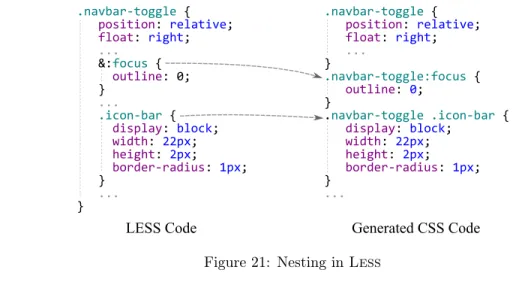
5.2.2 Nesting . . . 64
5.2.3 Mixins . . . 66
5.2.4 The “Extend” Construct . . . 66
5.3 Experiment Setup . . . 67
5.3.2 Data Collection . . . 68
5.4 Empirical Study . . . 72
5.4.1 Variables . . . 73
5.4.2 Nesting . . . 75
5.4.3 Mixin Calls . . . 77
5.4.4 The “Extend” Construct . . . 81
5.5 Threats to Validity . . . 83
5.6 Chapter Summary . . . 83
6 Migrating CSS to Preprocessors by Introducingmixins 85 6.1 Introduction . . . 85
6.2 Abstraction Mechanisms inCSSPreprocessors . . . 86
6.3 Automatic Extraction of Mixins . . . 87
6.3.1 Grouping Declarations for Extraction . . . 87
6.3.2 Detecting Differences in Style Values . . . 89
6.3.3 Introducing a Mixin in the Style Sheet . . . 94
6.3.4 Preserving Presentation . . . 98
6.4 Evaluation . . . 101
6.4.1 Experiment Design . . . 101
6.4.2 Results . . . 104
6.4.3 Limitations . . . 108
6.5 Comparison with Charpentier et al.’s Approach [CFR16] . . . 109
6.5.1 Summary of the Method . . . 109
6.5.2 Comparison . . . 109
6.6 Threats to Validity . . . 114
6.7 Chapter Summary . . . 115
7 CSSDev: A tool suite for the analysis and refactoring of CSS 116 7.1 Introduction . . . 116
7.2 Tool Design . . . 118
7.2.1 CSS Model Generator Module . . . 118
7.2.2 Duplication Module . . . 119
7.2.3 Crawler Module . . . 119
7.2.4 Dependency Module . . . 119
7.2.5 Preprocessor Module . . . 119
7.3 Tool Features . . . 120
7.3.1 Clone Detection . . . 120
7.3.2 Extracting Order Dependencies . . . 121
7.3.3 Clone Refactoring . . . 124
7.4 Chapter Summary . . . 126
8 Conclusions and Future Work 127 8.1 Summary of the Findings . . . 127
8.2 Future Work . . . 129
8.2.1 Current Limitations . . . 129
8.2.2 Other Possible Opportunities for Future Research . . . 130
List of Figures
1 Basic rule syntax inCSS . . . 9
2 Class selectors. . . 10
3 Use of @mediaat-rules inCSS . . . 13
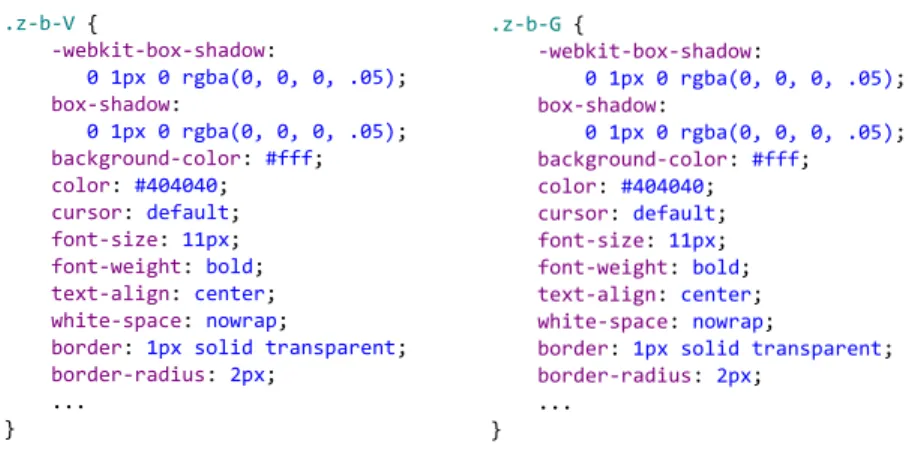
4 Type I duplication in Gmail’sCSS . . . 37
5 Declaration duplication in Gmail’sCSS . . . 38
6 Shorthand and individual declarations . . . 38
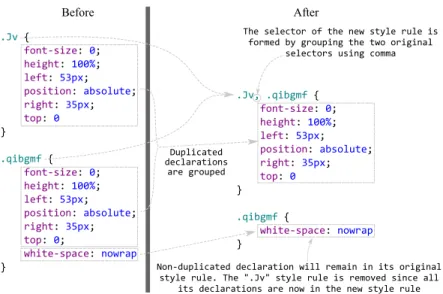
7 Grouping style declarations to remove duplication . . . 39
8 A hierarchical object model forCSS . . . 40
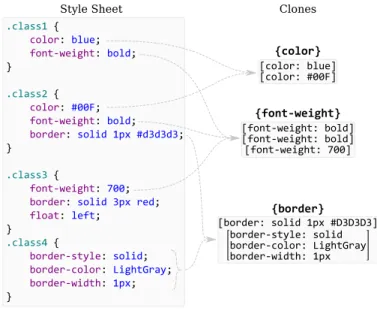
9 Clones extracted from a style sheet . . . 42
10 Dataset for the style sheet of Figure 9 . . . 44
11 FP-Treefor the dataset of Figure 10 . . . 45
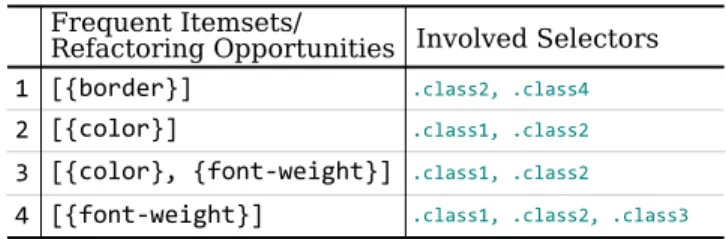
12 Output of the FP-Growth algorithm for the style sheet of Figure 9 . . . 46
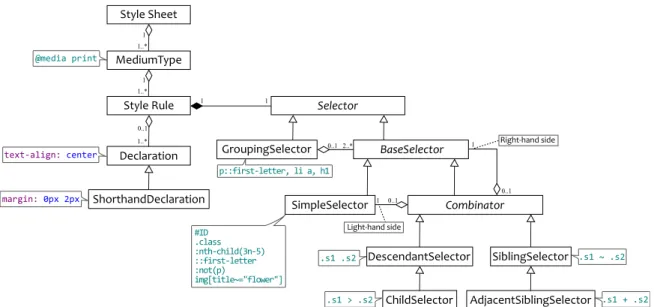
13 Order dependencies before and after refactoring . . . 48
14 Breaking presentation semantics with improper refactoring . . . 49
15 Characteristics of the analyzedCSSfiles . . . 51
16 Ratio of the duplicated declarations . . . 53
17 Statistics for the detected clones . . . 53
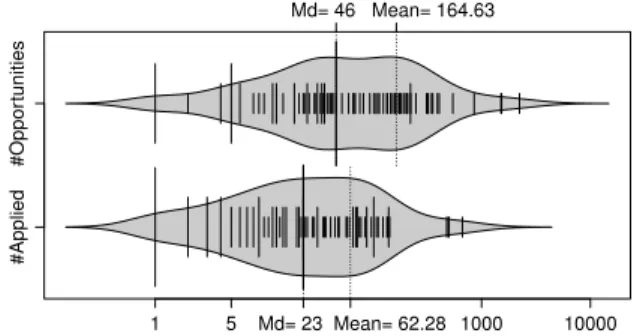
18 Initial refactoring opportunities vs. applied presentation-preserving refactorings . . . 54
19 Order dependencies and size reduction . . . 54
20 Variables inLess . . . 65
21 Nesting inLess . . . 65
22 Mixin inLess . . . 66
23 Extending style rules inLess . . . 67
24 Characteristics of the analyzed preprocessor files . . . 70
25 The workflow applied for the collection and analysis of the experimental data . . . . 70
26 Variable types distribution (numbers represent percentages) . . . 76
28 Number ofmixincalls . . . 78
29 Number of property declarations insidemixins . . . 79
30 Number ofmixinparameters . . . 79
31 Parameter reuse across vendor-specific properties . . . 80
32 Percentage of websites usingextend or parameterlessmixins . . . 82
33 Mixin example . . . 88
34 Alternative ways for extracting amixin . . . 90
35 Mixin for shorthand/individual properties . . . 94
36 Mergingmixin parameters . . . 97
37 Intra-style rule order dependencies . . . 99
38 Characteristics of the analyzed CSS files . . . 104
39 Example of interpolated property name . . . 107
40 Example of !importantuse in arguments . . . 107
41 Comparison of the time taken for detecting migration opportunities . . . 114
42 Duplication view . . . 120
43 Crawler settings . . . 122
44 Overriding dependencies View . . . 123
45 Affected DOM elements view . . . 124
46 Refactoring options wizard . . . 125
List of Tables
1 Different representations for therebeccapurplecolor. . . 37
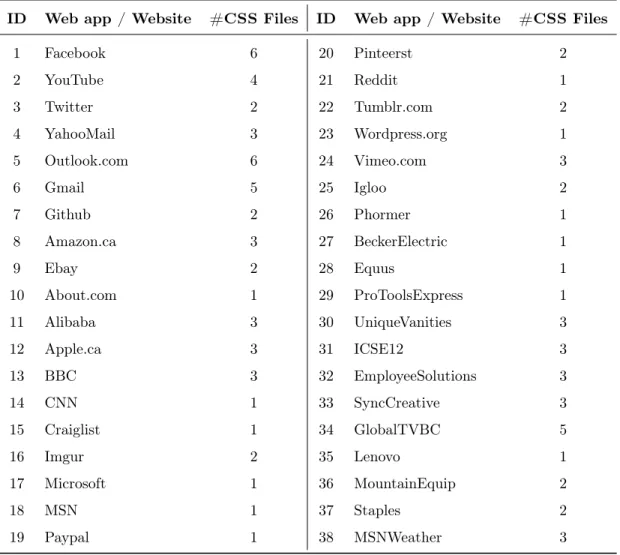
2 Selected subjects . . . 51
3 Statistical model’s estimated parameters . . . 56
4 List of the websites used in the study . . . 69
5 Overview of the collected data . . . 71
6 Scope of variables . . . 74
7 Categorization of value types . . . 75
8 Use ofnesting . . . 76
9 Frequent itemsets of style properties . . . 89
10 Individual Style Properties (ISPs) . . . 92
11 List of the supported style properties . . . 93
12 Overview of the collected data . . . 103
Chapter 1
Introduction
Cascading Style Sheets (henceforth,CSS) is thelingua franca for styling: it is extensively used for defining the presentation semantics (e.g., layout and typography) of user interfaces of web, mobile and desktop applications. CSSwas originally designed for defining how structured documents devel-oped using a markup programming language (e.g.,HTMLorSVG) should be presented. It is widely used in today’s web development – over 90% of web developers useCSS[Moz10] in 90% of the web sites [Web16]. CSSis also increasingly used in mobile app development through frameworks (e.g., Apache Cordova, Ionic) that generatehybridapps, i.e., mobile apps that look like native applications on mobile devices, yet they are actually developed using client-side web languages (HTML, CSS
andJavaScript). There are also similar frameworks for developingdesktopapplications (e.g.,
Elec-tron) which have resulted into a plethora of successful cross-platform applications (e.g., R-Studio, Atom test editor, Visual Studio Code). Progressive web apps, in whichCSS plays a crucial role, are also gaining momentum: web applications that are installable on mobile devices, are connection-independent (i.e., they can run offline or on low-bandwidth connections), and can access to resources of mobile devices which were formerly allowed only in native apps (e.g., sending push notifications). As a result, CSShas become an important language with applications in many different domains. This has madeCSSone of the most-used programming languages in the industry. In 2014, GitHub repositories containingCSScode outnumbered the ones containing PHP, Ruby and C++ [Car14].
Indeed,CSSnow plays a vital role in businesses by directly affecting the perceived user experience of their online presence. At Dropbox, for example, there existed around 1200CSS files (and other files that were used to generateCSS), exceeding 150K line of code. In one incident, a change in some of these files unknowingly broke the presentation of a revenue-generating page that the developers were not aware it even existed, and lack of adequate tools resulted to concealing the fact that the critical page depended on the modified CSS file. This could even damage Dropbox’s professional
relationship with the business partner that relied on the broken page [Ede14].
CSS can frequently undergo maintenance activities. Boryana and Zaytsev found that in the course of January to April 2015, there were 2,282,788 commits pushed to GitHub where a CSS
code was modified. WhileCSShas a relatively simple syntax [Con13], some of its complex features (e.g., inheritance, cascading, specificity, initial values [Lie05, Wor17]), its interplay withHTMLand
JavaScript, and the inherent inadequacy of code reuse mechanisms, make both the development
and maintenance of CSS code cumbersome tasks [MM12] for developers. In addition, despite the popularity,CSS has received a very limited attention from academia, especially from the software engineering research community. This explains why CSS development is far from a rigorous and disciplined process, and lacks established design principles and effective tool support [GLQ12].
1.1
Problem Statement
Mature programming languages often provide a comprehensive list of language constructs which allow code reuse, e.g., functions and variables. There exist complementary mechanisms for code reuse in different programming paradigms. Object-oriented programming languages, for instance, offerinheritance,object composition,mixins, and traits.
In CSS, however, abstraction constructs are inadequate, immature, or even nonexistent. For example, there is no notion of functions inCSS. At the time of writing this thesis, theCSS specifi-cations for variables (called custom properties inCSS), are in thecandidate recommendation stage, meaning that variables are still considered as an experimental feature [Con15], and have not been fully-supported by some web browsers yet.
Consequently, duplicated code exists to a large extent in CSS. Nevertheless, no studies have looked into theexistence of duplicated code inCSS, andhow it can be refactored.
Thesis Statement 1: Code duplication is prevalent in CSS, and refactoring can be a viable solution for eliminating duplication inCSS.
For avoiding duplicated code in CSS, developers sometimes tend to use a higher-level program-ming language that supports more mature abstraction mechanisms. CSSpreprocessorshave emerged as the de-facto solution to this aim: superset languages forCSSthat augment it by adding constructs that facilitate code reuse (e.g., function-like constructs, which are calledmixins in the preprocessors jargon). The code written in a CSS preprocessor is compiled (more precisely, transpiled) to pure
CSS. The use of CSS preprocessors is a trend in the industry [Coy12, Uni15], and leading web companies have already adopted them. Some examples of popular preprocessors are Less, Sass,
Google Closure Style Sheets, and Stylus. However, it is unknown to us how the features ofCSS pre-processors that do not exist inCSSare utilized by developers. In other words, we don’t know what developers want to achieve when usingCSS preprocessors that they can’t easily fulfill in “vanilla”
CSS(e.g. eliminating duplicated code using function-like constructs).
Thesis Statement 2: CSSdevelopers useCSSpreprocessors to a large extent to avoid duplicated code (among the other goals).
Despite the gradual adoption of preprocessors in the web development community, there is still a large portion of front-end developers and web designers using solely “vanilla” CSS. An online poll with nearly 13,000 responses from web developers [Coy12] revealed that 46% of them develop only in “vanilla” CSS, mostly because they are not aware of preprocessors. Therefore, there is a large community of web developers that could benefit from tools that help them in automatically
migrating their “vanilla” CSS code to a preprocessor of their preference. Specifically, function-like constructs inCSSpreprocessors can be beneficial in eliminating duplicated code.
Thesis Statement 3: Migration of CSScode to take advantage of function-like constructs in CSSpreprocessors can be automated.
In the next section, we briefly describe what we are going to do in this thesis, in order to support the mentioned thesis statements.
1.2
Thesis Contributions
In this thesis, we make the following contributions:
• We study the problem of duplicated code in CSS and report to what extent it exists in the
CSScode base of several web sites / web applications (Chapter 4).
• We define three types of duplication in CSS (that can be eliminated within CSS, i.e., by refactoring using a built-in CSS construct), and propose an efficient technique for detecting the instances of these three types of duplicated code (Chapter 4).
• We introduce an approach for refactoring the instances of the mentioned three types of du-plicated code in CSS. We discuss how we can be sure that the proposed transformations are
presentation-preserving (i.e., the behavior of theCSScode remains unchanged after refactor-ing), by providing a list ofsafety preconditions for the refactoring (Chapter 4).
• We empirically assess how developers take advantage of preprocessor languages (Chapter 5), in order to:
– Gain an understanding of developers’ practices that can help when developing automatic techniques for migrating CSSto preprocessor languages, so that the resulting code will look closer to what developers manually write,
– Aid developers to take full advantage ofCSSpreprocessors, by spotting the features that are underused by developers, and
– Reveal opportunities forCSSpreprocessor language designers to revisit the design of these languages, e.g., by adding support for new features (which are currently implemented by developers in an ad-hoc manner), or making existing features easier to use, or eliminating features that are not adopted by developers.
• We propose a technique for identifying the instances of duplicated code in CSSthat can be refactored to take advantage of the function-like constructs (the so-called mixins) in CSS
preprocessor languages (i.e., migrating CSS code to preprocessors). These instances include the ones that can be refactored withinCSS, however, there are instances that can be eliminated
only by using aCSSpreprocessor, which will be explained. We then discuss different ways for refactoring these instances, and also introduce techniques for testing the safety of the applied transformations (Chapter 6).
• We provide details about the implementation of the proposed techniques for refactoring and migration of CSSin a comprehensive tool suite and an Eclipse plug-in (Chapter 7).
1.3
Thesis Organization
To better understand the rest of this thesis, in Chapter 2, we will provide background information about the history and syntax of CSS, how it interacts with HTML and JavaScript, how web browsers read and understand CSScode and render web pages, and how the core features of CSS
(e.g., cascading, specificity, inheritance) work. In Chapter 3, a summary of related works will be given. The works related toCSSitself are scarce in the literature. However, as we are dealing with
clone refactoring forCSS, we will briefly cover the related works from the clone community. Also, we will look at empirical studies that aimed at understanding how developers use language features, i.e., the ones that have similar goal to our empirical study on the use of CSS preprocessors but in other programming languages. Finally, we will review a few works that devised similar techniques formigrating code written in various traditional programming languages.
Chapters 4, 5, 6 and 7 are dedicated to the main contributions of this thesis, which were mentioned earlier. The conclusions and some promising avenues for future work are discussed in Chapter 8.
1.4
Related Publications
Earlier versions of the work done in this thesis have been published in the following papers: 1. Davood Mazinanian, Nikolaos Tsantalis, and Ali Mesbah, “Discovering Refactoring
Oppor-tunities in Cascading Style Sheets,” in the Proceedings of the 22nd ACM SIGSOFT Interna-tional Symposium on the Foundations of Software Engineering (FSE), pp. 496-506, 2014. 2. Davood Mazinanian, and Nikolaos Tsantalis, “An empirical study on the use of CSS
prepro-cessors,” in the Proceedings of the 23rd IEEE International Conference on Software Analysis, Evolution, and Reengineering (SANER), 2016. [Best paper candidate award]
3. Davood Mazinanian, and Nikolaos Tsantalis, “Migrating Cascading Style Sheets to Pre-processors by Introducing Mixins,” in the Proceedings of the 31st IEEE/ACM International Conference on Automated Software Engineering (ASE), 2016.
4. Davood Mazinanian, “Refactoring and Migration of Cascading Style Sheets (Towards opti-mization and improved maintainability),” The 24th ACM SIGSOFT International Symposium on the Foundations of Software Engineering (FSE), Doctoral Symposium Track, 2016. 5. Davood Mazinanian, and Nikolaos Tsantalis, “CSSDev: Refactoring duplication in
Cas-cading Style Sheets,” The 39th International Conference on Software Engineering (ICSE), Demonstrations Track, 2017.
The following papers were published in parallel to the abovementioned publications. While they are not directly related to this thesis, at the same time, they are not completely irrelevant, as their topics include clone refactoring (although for Java systems), improving the maintainability of programs written in another web language (i.e., JavaScript), and empirical studies on how developers use a newly-introduced language feature (i.e., lambda expressions in Java 8).
6. Davood Mazinanian, Ameya Ketkar, Nikolaos Tsantalis, Danny Dig, “Understanding the use of lambda expressions in Java,” The 2017 ACM SIGPLAN International Conference on Object-Oriented Programming, Systems, Languages, and Applications (OOPSLA’17). 7. Laleh Eshkevari, Davood Mazinanian, Shahriar Rostami, and Nikolaos Tsantalis,
“JS-Deodorant: Class-awareness for JavaScript programs,” The 39th International Conference on Software Engineering (ICSE), Demonstrations Track, 2017.
8. Nikolaos Tsantalis, Davood Mazinanian, and Shahriar Rostami, “Clone Refactoring with Lambda Expressions,” The 39th International Conference on Software Engineering (ICSE), 2017. [Distinguished paper award]
9. Shahriar Rostami, Laleh Eshkevari,Davood Mazinanian, and Nikolaos Tsantalis, “Detect-ing Function Constructors in JavaScript,” in the Proceed“Detect-ings of the 2016 IEEE International Conference on Software Maintenance and Evolution (ICSME) - Early Research Achievements Track, 2016
10. Davood Mazinanian, Nikolaos Tsantalis, Raphael Stein, and Zackary Valenta, “JDeodorant: Clone Refactoring,” 38th International Conference on Software Engineering (ICSE), Formal Demonstrations Track, Austin, Texas, USA, May 14-22, 2016.
11. Nikolaos Tsantalis,Davood Mazinanian, and Giri P. Krishnan, “Assessing the Refactorabil-ity of Software Clones," IEEE Transactions on Software Engineering, vol.41, no.11, pp.1055-1090, Nov. 1 2015
Chapter 2
Background
In this section, we briefly talk about the history of CSS language, its syntax and semantics, and how it interacts with HTML and JavaScript. Knowing the history of CSS will help to further understand the importance of CSSand its role in shaping the current state of practice in web (and, as mentioned, mobile and desktop) application development.
As it will be discussed, the syntax of CSS is simple, but its semantics are more complicated to capture. Understanding the semantics of CSS is crucial for defining safety preconditions which guarantee that the transformations proposed in this thesis are presentation-preserving.
2.1
The History
As a crucial part of the World Wide Web, the Hyper Text Markup Language (i.e., HTML) was proposed by Tim Berners-Lee, which was initially a simple structured document format: themarkup tags defined theroleof the text in the document, in the form of HTMLelements (e.g., paragraphs were enclosed in the <p></p> tags, and there were other tags for headings, hyperlinks, etc.). In
HTML, however, there was no way to indicate how each element should be presented in the web browser. The presentation semantics of each element (e.g., with what font a heading or a piece of normal text should be displayed) was therefore determined solely by the web browser.
To address this deficiency, presentational tags and attributes were introduced in HTML. For example, the<b></b> tag was used for making a piece of text (enclosed in the tag) bold-faced, or the<blink></blink>tag for creating blinking texts.
However, the decision of having the means for defining presentation semantics insideHTMLcode hinderedcontent re-usability. Web browsers are not the only media on which anHTMLdocument could be displayed. One might want toprint the document, or display it on a wearable device, or – in case of a visually-impaired person – use a text-to-speech device to read the document. In all
these situations, the same content should be logically re-used, but with different presentation on each presentational medium.
This issue led the people involved in the standardization of web technologies to agree that there is a need for adapting style sheets for web. In the traditional typography and printing industry, style sheets were used asguidelines for consistent presentation of documents. Similarly, style sheets on web would allow the creators and authors of web pages to define a consistent presentation for multiple presentation devises (i.e., content re-usability). More importantly, one set of style sheets could be re-used for multiple web pages, enablingstyle re-usability.
Among the several proposals for a style sheet standard for web, “CascadingHTMLStyle Sheets” by Håkon Wium Lie [Lie94] was gained a momentum, which later became the Cascading Style Sheets (CSS) which is now thelingua franca for styling. A detailed discussion of the history of CSS(and other proposals for style sheets in web) can be found in Lie’s doctoral thesis [Lie05]. In the next section, we briefly explain the syntax and semantics of CSS.
2.2
The
CSS
Language
CSSis a style sheet language and is used to define the presentation semantics of structured docu-ments (predominantlyHTMLandSVG). In this thesis, we call the structured documents on which
CSScode is applied target documents. Henceforth, the terms CSSand style sheets might be used interchangeably in this thesis (whileCSSis a specific language for creating style sheets, the extensive prevalence of CSSmakes this decision natural).
The wayCSSworks is quite simple: CSScode is attached to the target document(s), and styles are defined for one or a group of elements of the target documents. There are three ways to attach
CSScode toHTMLfiles:
Inline CSScode is defined inside thestyleattributes for eachHTMLtag that needs to be styled (e.g., <p style="...CSS style declarations...">...styled paragraph...</p>).
Internal CSS code is defined inside the<style>tags in the HTMLfiles. The<style> tags can appear almost everywhere in the HTML file, but developers usually put them close to the beginning of the file, inside the<head>tag.
External CSS code is defined in external files, and the files are attached to HTMLpages using theCSSfiles’ URLs declared in the<link />tags in theHTMLfiles (the<link />tags are in turn defined in the <head>tag of the page).
For example,<link href="theme.css" rel="stylesheet" />attaches theCSSfiletheme.css to the enclosing HTMLfile.
CSS Selectors
CSSoffers a comprehensive list of selectors, which we briefly discuss in this section. Understanding how selectors work is important to reveal the intricacies associated with detecting thedependencies
betweenCSSstyle rules (e.g., when two style rules have – possibly lexically-different – selectors that select the same elements of the target documents, and assign values to the same style properties for the selected elements, there is a dependency between these two style rules). As we will see, dependencies between style rules can affect the refactorings done on theCSScode.
The universal selector (i.e.,*): Selects all the elements of the target document). It is sometimes used with combinators (which will be discussed shortly), so that you can, for instance, select all the elements which are the children of a specific element.
Type selectors: A type selector selects elements of a specific tag. For example, as it is also mentioned earlier, selectorpselects all the paragraph tags (<p>).
Class selectors: A group of declarations could be defined in a style rule for which the selector is a
class selector. It is then possible to apply the same class to many different elements thus avoiding the duplication of declarations. Figure 2 shows an example of a class selector.
HTML CSS
<div class="class1">
content
</div>
<span class="class1">
content </span> .class1 { color: red; font: 10pt tahoma; }
Figure 2: Class selectors.
ID selectors: It is possible to set an ID for elements in the target documents, using the ID attribute of each element. For example, theHTMLtag<div id="toolbar"/>corresponds to adivelement for which the ID is equal to"toolbar". The#toolbarCSS selector, which is called anID selector, can be used to select the element(s) with this ID.
Attribute selectors: We can also add attribute conditions to a selector. If selectorS selects a set of elements S, a selector of the format S[attr operator value] selects the subset elements of S for which, in the target document, attribute attr is defined and set to a substring of value. Theoperatordefines the condition for the substring [Wor17]. For example, a[target]selects all <a>elements that have thetargetattribute set to any value, andimg[src $= ".png"] selects all <img>elements that have the “.png” suffix in theirsrcattribute value.
Pseudo Classes and Pseudo Elements: Pseudo classescan be used to filter the elements selected by a given selector. For example,:not(div)selects all elements except fordivelements. There are
alsostructural pseudo classes, such as tr:nth-child(2n+1)which selects every odd row (denoted by<tr>tags inHTML) in every table (the<table>tag) of the target document.
Pseudo-elements create abstractions about elements in the target document, beyond those spec-ified by the HTMLstandards [Wor17]. Thep::first-line selector, for example, selects only the first line of the text inside every<p>element.
Combinators: We cancombine various selectors to achieve more specific selectors, using different
combinators. Assuming we have two selectors A and B, we can combine them as follows:
A B (descendant combinator) selects all elements selected by B, which are descendants of the elements selected by A.
A > B (child combinator) selects all elements selected by B, which are direct children of the elements selected by A.
A ∼B (general sibling combinator) selects all elements selected by B, which have an element selected by A as a sibling.
A + B (adjacent sibling combinator) selects all elements selected by B, which are directly pre-ceded by a sibling element selected by A.
Grouping selectors (also known as selector lists or multiple selectors): Finally, there is the possibility ofgrouping different selectors in CSS. For instance, if we want to declare the same style declarations for allh1andh2HTMLelements, we could use theh1, h2 CSSselector. Note that, this allows re-using style declarations and thus avoids code duplication. In fact, the refactoring proposed in Chapter 4 uses grouping selectors to eliminate duplicated code in CSS.
2.4
Value Propagation
After the elements of target documents are selected using CSS selectors, the web browser tries to assign values to each style property of the selected elements. Knowing the way web browsers assign values to style properties is important, as it helps in understanding the later discussions which prove that the transformations introduced in this thesis are presentation-preserving.
For each target document being rendered in a web browser, style sheets come from the following sources (i.e., the style origins):
1. Each web browser has some embedded style sheets, calleduser-agent style sheets, that define the default style values for someCSS properties when there is no attached style sheet to the target document being rendered, or for the style properties for which the attached style sheets do not define values.
2. Web browsers also allow end users to make custom style sheets that override the user-agent style sheets (i.e., theuser style sheets).
3. The CSScode that is attached to the target documents (also known asauthor style sheets). The author style sheets can beexternal,embedded orinline, as mentioned before.
For each selected element, there could be style declarations with the same style properties with values assigned to them. These conflicting style declarations can come from each of the mentioned origins. The web browser prioritizes the style declarations coming from each of these origins in the order given here (i.e., the so-called cascading rules). As a result, if an author style sheet defines value for the font property, it will override the possible definitions of the same property in the user and user-agent style sheets. For conflicting style declarations defined in author style sheets, web browsers give priority to the style rules declared in the inline style sheets, then embedded style sheets, and then external style sheets.
What if there are conflicting style declarations within the same externalCSSfile? In such cases, theselectors specificities of the style rules enclosing the conflicting style declarations determine the “winning” declaration, i.e., the more specific selector has priority over the less specific ones [Wor17]. For example, selector.menu aselects all the hyperlinks (denoted by<a>tags inHTML) which are the children of the elements with class.menu(e.g.,<div class="menu">...</div>). This selector is more specific than selectora, which selects all hyperlinks regardless of their location in the target documents. As a result, any declaration in .menu a will override the declarations with the same property ina.
When for two conflicting style declarations the style rules’ origins and selectors specificities are the same, the position of the style rules in theCSSfile determines the winning declaration (i.e., the last declaration overrides the previous ones).
It is also possible to add the!importantannotation as the last style value in a style declaration. Using !important will invert the specificity calculations, in order to make a balance between the ability of users and developers in overriding style declarations. For example, a user of a web page can create a style sheet which overrides the author style sheet, i.e., inverting the priority of user and author style sheets. Interestingly, unjustified use of the!importantkeyword is known to be a code smell inCSS[Gha14].
For some specific style properties (e.g., color, font), CSS supports inheritance in values by taking advantage of the hierarchical structure of target documents. For example, if we applycolor: blue to the<body>element, all child elements of the<body>tag will be automatically styled with the blue color. For other properties where value inheritance is not applied automatically, one might explicitly enforce it by replacing the style values withinherit(e.g.,margin: inherit).
Finally, if none of the mentioned methods does not yield a value for a specific style property, the web browser will assign theinitial value to the style property, as defined inCSSspecifications.
2.5
At-rules
There are specific statements inCSScalledat-rules, which start with@(UnicodeU+0040). At-rules can appear in embedded or external style sheets, just like normal style rules. Some examples of at-rule statements in CSS include @font (which allows to specify the characteristics of external fonts),@import(which allows to import styles from oneCSS file into the other),@keyframes (for defining animations), and the @media at-rule, which allows to define style rules for specific media (e.g., printers, mobile and wearable screens).
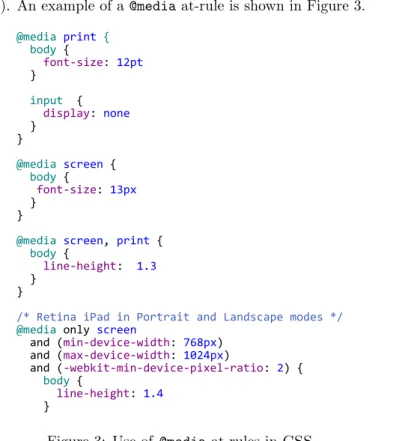
The @media at-rule plays a crucial role when creating responsive user interfaces, i.e., user in-terfaces that can be adapted to different presentation media, even on-the-fly (consider a web page being displayed on a mobile phone, and the user rotates her screen to display the website in the landscape mode. The web browser can switch between style rules based on the conditions defined in the@mediaat-rules). An example of a@mediaat-rule is shown in Figure 3.
@media print { body { font-size: 12pt } input { display: none } } @media screen { body { font-size: 13px } }
@media screen, print { body {
line-height: 1.3 }
}
/* Retina iPad in Portrait and Landscape modes */ @media only screen
and (min-device-width: 768px) and (max-device-width: 1024px) and (-webkit-min-device-pixel-ratio: 2) { body { line-height: 1.4 }
Figure 3: Use of @mediaat-rules inCSS
In Figure 3, the first@mediaat-rule defines style declarations for the document when it is printed out. In this case, the font for the entire document is set at 12 points, and all the<input>tags are
set not to be displayed. Here, the developer did not want to show elements such as text boxes in the printed version of the document. The next @mediaat-rule defines the font of the text to be 13 pixels for the entire document on all screens. The line height of the text (i.e., the spacing between the lines) is set to be 1.3 both for screens and printers. However, the last@mediaoverrides the value for the line height for specific devises with higher pixel densities (e.g., Retina iPads) to be 1.4. If the developer omitted the last@mediaat-rule, the text would be less readable, since the lines would be displayed closer together.
It is worth mentioning that, in all the proposed techniques in this thesis, style declarations defined in the@mediaat-rules are considered and duplicated style declarations are extracted having the@mediaat-rules in mind, as we will see in the next sections.
2.6
CSS
Specifications
For anyone who deals withCSS, especially for the researchers working on developing analysis tools for it, it is crucial to know about the wayCSS is standardized. The standards can change rapidly and new features (e.g., new style properties) can be introduced regularly. Consequently, a complete
CSSanalysis tool should be able to keep up with these quick changes to the specifications.
2.6.1
CSS
Versions
The standardization of CSSis led by theCSSworking group (i.e., theCSSWG) in the World Wide Web Consortium (i.e., W3C). The CSSWG’s members are from browser vendors, several leading companies in the software industry, and independentCSSexperts.
The versions of CSSspecifications are calledlevels. At first, all the specifications of CSSwere a monolithic unit. Since the monolithic specifications were difficult to maintain and develop, after
CSSspecifications level 2.1, the members of the CSSWGdecided to divide the specifications into several modules (e.g., the Backgrounds and Borders or theText modules). Each module follows its own development path; consequently, the term CSS3 is rather loose, since there is no single, monolithic specification forCSS3. At the time of writing this thesis, there are modules inCSSthat are at the final stage of development in Level 3 (e.g., theBackgrounds and Borders Module Level 3), while some other are at the earlier stages (e.g., the Animations Module Level 3). There are even modules at the fourth level in their early development stages, e.g., theCSS Selector Modules
2.6.2
CSS
Specification Standardization Stages
The members of the CSSWG first create an editor’s draft of the specifications when a change is proposed. When the specifications are ready from the internal members’ point of view, it is published to the public as aworking draft. The external bodies can then discuss it and comment on the possible difficulties of its implementation, and several versions of the working draft are created. The working draft specifications can be even rejected. Otherwise, the specifications reach theFirst Public Working Draft. The CSSWGwill continue working on this version, and finally a deadline is set so that all the comments are collected from the involved parties, i.e., the Last Call Working Draft is created.
When specifications are thoroughly tested by theCSSWGand browser vendors, the specifications reach the Candidate Recommendation stage. To continue to the next stage (i.e., the Proposed Recommendations), the CSSWG demonstrates two correct implementations of the specifications. Then, a higher-level committee in theW3Corganization (namely, theW3CAdvisory Committee) decides whether the specifications can be elevated to the final stage of Recommendation.
Note that, the Recommendation stage does not mean that the specifications are stable. Web browsers start implementing the specifications at theCandidate Recommendation stage, therefore,
CSSanalysis tools should start supporting the new features from that point. TheRecommendation
stage in fact means that the specifications aredead, because there will be still errors in the specifica-tions that are not going to be fixed in thatlevel of the specifications. Instead, theCSSWGprefers to start the new level of the specifications (e.g., from level 3 to level 4), and this usually happens even before the specifications are at theRecommendationstage.
2.7
Chapter Summary
In this chapter, we provided a brief history of CSS, explained the syntax of its core, (partially) talked about its semantics, and discussed how the standardization process of CSS works. We will frequently refer to this chapter in Chapters 4, 5, 6, and 7, since the provided information will be extensively required.
Chapter 3
Related Work
There has not been much work done onCSS(and, in general, style sheet languages) in the academic literature, and this is despite the widespread adoption of CSSin practice. It is safe to conclude that “style sheet languages are terribly underresearched”. Surprisingly, this is stated in 1999 by Philip M. Marden and Ethan V. Munson [JM99], and this statement is still perfectly valid after almost two decades.
In this chapter, we have categorized the related works into four sections. First, we look at the few works done on the analysis and maintenance of CSS code. Then, since the goal of this thesis is to study the problem of code duplication in CSS, we briefly summarize the works done in the “software clones” community. Among the plethora of studies in this domain, we only focus on the works done specifically for web languages, since they are more related to the topic of this thesis.
Next, as we have conducted an empirical study on the use of CSS preprocessors, we discuss some of the studies that have similar goals to ours, yet in other domains (e.g., other program-ming languages and paradigms). Finally, considering that we have proposed an automatic and presentation-preserving approach for migratingCSScode to preprocessors, we will list some of the papers related to the automatic migration of source code.
3.1
The Analysis and Maintenance of
CSS
Code
3.1.1
General Studies
There are few works in the literature that investigate style sheet languages from different points of view, like their history, features, and shortcomings. While they are not directly related to the topic of this thesis, studying them can help in understanding the challenges that understanding, analyzing, and refactoringCSScode impose.
Of the first publications that looked into style sheet languages (including CSS) was a short article authored by Marden and Munson in the Computer Journal in 1999 [JM99]. The authors discuss the “accessibility” as the great vision of web, which can only be achieved by allowing content and presentation vary independently, so that the end users “have the final say on the presentation”. This separation of concerns is allowed in the presence of mature style sheet languages. The authors discuss some of the flaws in the two main standard style sheet languages at the time, XSL1 (the
eXtensible Stylesheet Language) andCSS, and show how this great vision is “blinded” due to these flaws. These flaws, however, were not studied in academia, leading the authors to call style sheet languages as “unexplored terrain”.
As mentioned, the language that we know today as CSS is based on the proposal by Håkon Wium Lie. Lie summarize the history of CSS, how it works, and a lot of the subtleties associated with its development in his PhD thesis [Lie05]. In addition, he lists other style sheet proposals beforeCSS, deeply analyzes their strengthens and weaknesses, and explains why they did not gain the momentum asCSSdid. Today’sCSSis, however, much more complex than what Lie describes in his PhD thesis.
Quint and Vatton [QV07] outline the state of the art (of course, in 2007) of techniques and tools for editing style sheets. They pinpoint challenges CSS developers face and conclude that there is a crucial need for robust CSS debuggers and rule analyzers. They also propose ways for aiding
CSSdevelopers in editing style sheets. The proposed methods are implemented in Amaya, a web authoring tool developed by the same authors [QV04]. The authors claim that using Amaya can solve many of the mentioned problems in editing style sheets. Today, all the major web browsers include built-in debugging tools (e.g.,FireFox’sFireBug) that share more or less the same features
asAmaya.
3.1.2
Code Quality
The quality of CSScode has been of interest in a number of studies in the literature, which will be discussed in this section.
Quality Metrics
Keller and Nussbaumer [KN09, KN10] come up with an “abstractness factor” for CSS: a more abstract CSScode is the one that can be applied on target documents with different content, and changes to the content will not cause faulty presentation. For example, the authors argue that
1
XSL is a family of standards by the World Wide Web consortium (i.e., W3C), that is recommended for trans-forming and presenting XML documents. The subset of XSL standard that is used for defining formatting (the XSL Formatting Objects or XSL-FO) is, however, rarely used in practice, and the development of its standard has stopped. Note that, XSL-FO was mainly used for formatting XML documents for printed media, which can now be done using CSS’s paged-media features.
type selectors (e.g., p for paragraphs) are more abstract (and less specific) than class selectors (e.g., .c1). Consequently, a higher proportion of style rules with type selectors in a style sheet means a more abstract style sheet. Through conducting an empirical study, the authors compute and compare the abstractness factor of human-written versus machine-generated CSS code, and conclude that humansbeat machines in authoringCSS code in making more abstract style sheets. The authors, however, use theCSScode generated by WYSIWYG web editors for the comparison. These tools generate CSS code when the developer drag-and-drops user interface elements into
HTMLdocuments. Notwithstanding, generatingCSScode by using CSSpreprocessors is a trend in the industry [MT16a], and there is no study about the quality of the generated code fromCSS
preprocessors. Note that, refactoring duplicated declarations in CSS does not have any effect on the abstractness factor of CSS, as it does not have any effect onCSSselectors.
Adewumi et al. [AMIO12] proposed six complexity metrics for CSS, inspired from traditional code complexity metrics. The metrics include:
• Sum of the lengths of the style rules in a CSS file. Length of a style rule is measured by counting the number of style declarations declared in it. This metric is a proxy for size inCSS
code, and generally, size has a high positive correlation with complexity. • The number of style rules in aCSSfile, as another size metric,
• The entropy metric. For traditional code, previous works used entropy to measure variety in size, structure, connections between the elements, or other code attributes. Similarly, the authors used entropy to measure the variety of style rule types in a CSSfile, as a proxy for complexity. Style rules with type selectors and style rules with id selectors are two different style ruletypes to name.
• The number of extended style blocks. Extended rule blocks have selectors that add additional conditions to the selectors of existing style rules, e.g., style rule with selector a:hoveris an extended style rule in Adewumi et al.’s definition,
• The average number of style declarations defined per style rule, which is another size metric, • The number of cohesive style rules , i.e., the ones that possess only one style declaration. There are several limitations with this work that make using the proposed metrics impractical for any study that deals withCSScode quality. First, what these metrics actually measure should be intuitively understood by the reader, as they are not given by the authors. For example, we don’t know the reason why the authors used selectortypes when measuring variety, or whyextended style rules are more complex. Second, some of the defined metrics are not necessarily useful. For example,
the proposed size metrics potentially highly correlate, so one might use a general size metric (e.g., the number of style rules in theCSSfile) instead of using the proposed metrics. Third, the definition of some of the metrics is not necessarily complete, for example, thecohesiveness metric: a style rule that only contains style declarations for defining values for text properties (e.g.,text-align,font, letter-spacing) can still be considered as a very cohesive style rule, while the style rule can have more than one style declaration. Finally, and the most importantly, while the authors provide a very shallow discussion for validating these metrics, there is no empirical validation conducted to support the claim that the proposed metrics actually measure CSScode quality. Therefore, using these metrics is by no means reliable, and a similar study (yet in a much more complete manner), is certainly required.
Bad Practices and Code Smells
There are tools that can detect bad practices inCSS, such asCSS LintandW3C Validator. At the time of writing this thesis,CSS Lintincorporated 32 rules for identifying problems inCSScode, organized in six categories. These categories includepossible errors (practices that are known to be error-prone, e.g., setting size attributes for anHTMLelement, which can be tricky due to the special
box-model ofCSS),compatibility(setting style properties that may behave differently across different web browsers),performance (practices that are known to be bad performance-wise),maintainability
(usingCSS features, like!important, which make understandingCSS code difficult),accessibility
(obvious style definitions that will lead to reduced accessibility for users, e.g., outline: none that removes the border of text boxes in target documents, making them difficult to be recognized), andOOCSS (not following OOCSS guidelines2). W3C Validatorservice is provided by the World
Wide Web Consortium (i.e.,W3C, of which theCSSWorking Group is responsible for standardizing
CSS), and tests CSS code against CSS specifications, identifies a number of potential usability problems (e.g., when an element does not have a background color, but the text on it has color, it warns the developers that the rendered text might be illegible), and also checks for syntactical problems (e.g., missing curly brackets).
In her Master’s thesis, Gharachorlu [Gha14] proposed eight code smells in CSS, complementing
what CSS Lint and W3C Validator can identify. These code smells are classified into three
categories: rule-based (including non-external and overly long style rules),selector-based (including selectors having too much cascading, with high specificity, containing erroneous adjoining pattern where developers incorrectly drop a space character between class and id selectors in a combinator, and overly general selectors), andproperty-based (undoing styles, where style values are reset to zero or none, and hard-coded values). The detection rules for detecting the proposed code smells are
2
OOCSS is an abbreviation for Object-OrientedCSS. As its name suggests, OOCSS is inspired from Object-Oriented Programming and promotesCSScode that is more reusable and maintainable [Sul13]
implemented in a tool calledCSSNose, and the author investigated the prevalence of the proposed code smells, in addition to the smells detected by CSS Lint and W3C Validator (total of 26 smell types) in 500 websites. She observed that 499 out of the 500 websites contained at least one instance of CSScode smell, andCSSproperties with hard-coded values and undoing styles are the most prevalent code smells, found in 96% of the websites. Moreover, the author fit a regression model to predict the existence of code smells inCSScode.
While the mentioned tools provide a starting point toward having a complete repertoire of CSS
bad practices, it turns out that the definitions of some of the code smells that they detect should be revisited. As an example, Gharachorlu’s definition ofundoing style code smell is not necessarily correct, as stated by Punt et al. [PVZ16]. Gharachorlu counts every style property set to zero or noneas an instance of theundoing style. However, Punt et al. argues that this code smell essentially happens when a developer sets a value to a style property that already has a value (e.g., through inheritance, initial values, or cascading), and then resets it back to the original value. This definition (called the A?B*A pattern by Punt et al.) is broader than Gharachorlu’s, and also makes more sense, as resetting styles in this way can have negative impact on understanding where a style value actually comes from. The instances of this code smell with this definition cannot be identified by
CSSNose(i.e., false negatives). On the other hand, an example of a false positive for theundoing
stylecode smell can happen inCSSNosewhen a developer wants to hide an element, so she correctly and logically sets itsdisplayproperty tonone. This is detected as a code smell inCSSNose, while it is not. Punt et al. proposes a tool for detecting the instances of the A?B*A code smell and refactoring it within the web browser.
In any case, the prevalence of various smells in CSScode bases can be alarming. However, we are yet to see any work that investigates the severity of these code smells and quantifies their adverse impact. As a result, such a study is needed before making any attempt to eliminate code smells in
CSS trough refactoring. Among the code smells, however, refactoring duplicated code – which is the topic of this thesis – can have immediate return of investment (e.g., smaller CSSfile size that has to be transmitted over the Internet). Nevertheless, the infrastructure developed in this thesis can accommodate any refactoring inCSS.
Code Conventions
Having code conventions facilitate theinformation exchange between the developers [PJ15], leading to better code understandability and readability [Spi11]. Goncharenko and Zaytsev [GZ15, Gon15, GZ16] look into the existence of code conventions for CSS. The authors explain that CSS code conventions exist, although not from the World Wide Web Consortium, but from theCSSdeveloper community. They used a special search engine that aggregates the results of multiple other search
engines to collect data about CSS code conventions, and come up with a catalog of 143 code conventions forCSS. The authors further developed a tool, namely CssCoco, that uses ontologies for detecting violations from code conventions inCSScode.
Detection and Refactoring of Dead Code
Dead (i.e., unreachable) code has been a hot topic of research in academia. For CSS code, dead code means style rules and declarations that are ineffective. This happens, for example, when a style rule has a selector that selects nothing in the target documents, or a style declaration that is always overridden by other style declarations through cascading. Detecting dead code is a challenging task in CSS, as parts of one CSS file can become used or unused, depending on the target document on which the CSSfile is applied. For instance, consider a piece of JavaScriptcode that adds the following element to a login page of a web application, after the user enters a wrong password: < span class = " error " > The p a s s w o r d is not correct ! </ span >
This is done at runtime on a specific event. Now, consider that the attached CSS file to the login page defines a style rule like this:
. error { color : red ; }
This piece of CSScode is ineffective (i.e., dead) when there is no authentication error, since there is no element for which theclass attribute is equal toerror. This practice (i.e., adding elements at runtime to the target documents) is indeed extensively done in today’s web applications. An empirical study [BM13] showed that 95% of the websites (out of a corpus of 500 websites) contain client-side content that is initially hidden andJavaScriptis used to inject the content at runtime. The study found that, in these websites, 62% of the states of target documents are initially hidden. Using @media rules also makes detecting dead code challenging. Consider a piece of CSS code inside a @media rule defined for a specific device (e.g., a printer, or a smart watch). The enclosed code will be ineffective unless the target document is rendered on the specific device for which the media is defined.
Mesbah and Mirshokrae [MM12] developed Cilla, a tool that detects unmatched and ineffec-tive selectors, overridden style properties, and undefined classes. The tool employs an automated technique which analyzes the runtime relationship between theCSSrules and the elements in tar-get documents of dynamic web applications. This is done by crawling the web application using
Crawljax, a tool that mimics the behavior of users by clicking on differentclickableelements (e.g.,
hyperlinks, buttons, and elements for which the an event handler is attached for theclick event).
approach identifies ineffective CSS code with respect to the explored states. The authors report that, on average, 60% of style rules in today’sCSSfiles are redundant. For the work done in this thesis, we usedCrawljaxto identify dependencies between style declarations, which are necessary to consider when refactoringCSScode.
Genevès et al. [GLQ12] showed thattree logicscan be used to apply static analysis onCSS: target documents are encoded as binary trees (as the approach works with binary trees), andCSSselectors and properties are translated to logical formulas. This representation makes several static analyses possible using tree logics, for example, the emptiness (i.e., ineffectiveness) of selectors – which basically means dead code inCSS– is checked when a selector’s logical formula is notsatisfiablefor a given target document. The authors also mention similar use cases of the approach, like checking for the equivalence of selectors (i.e., two selectors select the same element), the coverage without properties nor inheritance (i.e., whether there are elements in the target document that are not covered by anyCSSselector), and thecoverage with inheritance for a given property (i.e., whether some style value is set to a given style property for all the elements of a target document, considering the propagation of values defined by the inheritance mechanism of CSS).
The refactorings introduced in this thesis require detecting the dependencies betweenCSS decla-rations to be done safely. Some of these dependencies can be detected using Genevès et al.’s proposed technique. However, this approach does not consider the presence ofJavaScriptor server-side pro-gramming languages for the analysis (e.g., the former given example of the addition of anHTML
element at runtime usingJavaScript). Not only this can lead to false positives in their approach, but it misses dependencies that exist in specific states of the target documents. In addition, employ-ing Genevès et al.’s approach that requires encodemploy-ing target documents to binary trees, modelemploy-ing the problem as a logical formula, and using a special solver for detecting the dependencies would be an overkill; as we will see, the dependencies can be detected by using straightforward rules defined on the style rules’ selectors and declarations, after attaching theCSSfile under analysis to the target documents and mapping its style rules to the target documents’ elements.
Hague et al. [HLO15] developed a tool, called TreePed, with the goal of detecting redundant (i.e., dead) style rules inCSS. In contrast toCillathat uses dynamic analysis,TreePedattempts to detect redundant style rules using static analysis. The authors proposed atree-rewriting model of the updates done on the target documents’ tree structure at runtime byJavaScript(e.g., injecting new elements, adding CSS classes to the existing elements in the target documents, or removing target documents). The proposed approach outperforms Cillain correctly detecting some of the cases that might be invisible to dynamic analysis, e.g., due to the sensitivity of dynamic analysis to the configuration of the crawler. However, as the work stands as a proof of concept, the model captures only the features of JQuery, a popular JavaScript library, that is used for modifying
target documents at runtime, and does not consider the modifications done using pureJavaScript
or otherJavaScript libraries. That’s why a tweaked version of this approach was not used in this thesis for detecting dependencies betweenCSSdeclarations.
Bosch et al. [BGL14a, BGL14b, BGL15] introduced an approach for reducing the size of CSS
files by removing redundant style declarations and rules based on static analysis. In their approach, redundant CSSrules are the ones that can be detected within the CSS file, without the need for mapping the CSS file to any target document, i.e., where reasoning from the CSS file alone is possible. For example, the authors defineverbose declarations as two declarations which are equal, but they are defined in style rules with equivalent selectors (e.g., li.foo and li[class=‘foo’] are equivalent). Verbose declarations are redundant and can be removed from the style sheet. The authors propose a technique for eliminating such redundant style rules, and ague why the existence of @media rules can affect the refactorings. As mentioned before, we also take care of the@media rules in our refactorings.
Note that, in addition to detecting redundant style rules (which is also done by Cilla and
TreePed), the goal of Bosch et al. is toeliminatethe redundantCSSstyle rules, and the elimination
is done aiming at reducingCSS file size. The proposed refactoring in Chapter 4 of this thesis also seeks size reduction by removing duplicated style declarations inCSSfiles. As a result, the approach of Bosch et al. is complementary to ours, as it will be discussed later.
3.1.3
Alternative Language Proposals for
CSS
Both academia and the industry have come up with tools and approaches for augmenting CSS
to compensate for its shortcomings. From the industry, CSS preprocessors have almost become the de facto way of developing style sheets. CSS preprocessors are discussed in more detail in Chapter 5. The proposals from the academia, however, have not gained much momentum, but we briefly introduce the reader with some of them in this section.
Badros et al. [BBMS99] introduced the notion of the Constraint Cascading Style Sheets (i.e.,
CCSS) that extendCSSby allowing the developers to define arbitrary linear arithmetic constraints (e.g., to control elements’ positions and sizes), and finite-domain constraints (e.g., to control font properties). An example of a constraint in CCSS is @constraint #c1[width] = #c2[width], which forces the two elements to have the same width. The proposal has been implemented in the
Amayaweb browser, that we formerly talked about.
Wieser [Wie06] proposed CSSNG, an enhanced version of
CSS for supporting some dynamic features inCSS. For example, inCSSNG, the developer is allowed to write:
*:: before {
content : element ( " span " , " elem " ); }
This style rule selects all the elements in the target document (i.e., using the universal selector*), and an element in the following form is injectedbeforeeach selected element:
< span > elem </ span >
Note that, the element is added before each element as the selector uses the ::beforepseudo element. Normally, this is done usingJavaScript, because thecontentproperty in CSSdoes not allow addingHTML tags before (or after) the selected element (although normal text is allowed).
CSSNGallows this by using the
element()function.
Serrano [Ser10] proposed HSS, a preprocessor language for CSSthat supports custom proper-ties (acting like variables), user-defined functions, conditional expressions, user-defined types (i.e., variable selectors) and the support for arithmetic calculations. Like any other CSS preprocessor, theHSS code should be first compiled to pure CSS. Note that, most of the features supported in
HSSare also supported in the industrial CSSpreprocessor languages (e.g.,LessandSass). How-ever, HSS does not support selector nesting, a handy and extensively-used feature supported by the industrial CSSpreprocessor languages (as we will see in Chapter 5,nesting is one of the most popular language features used by the developers).
HSShas not been adopted by the industry. This could be possibly explained by the fact that the syntax of theHSS-specific features is radically different from pureCSS, in contrast to the industrial
CSS preprocessors that have a very similar syntax to pure CSS. That’s also why we did not use
HSSin our empirical study (Chapter 5), because we couldn’t find any website that usedHSS.
3.1.4
Clone Detection in
CSS
Mao et al. [MCD07] proposed an approach for the automatic migration fromtable-based structure
to the style-based structure for web pages, and in a step of this approach, duplicated style rules are identified using a traditional clone detector. The authors first use table recognition techniques to detect portions of web pages that use tables (i.e., the <table></table> elements) for layout. This was a frequent anti-pattern in web application development, becauseCSSdid not provide any layout mechanism3. This anti-pattern is an abuse of tables that brings several performance and
maintenance problems. Detecting tables used for defining layouts is first done on single web pages, and then theHTMLtables are transformed to a nested, hierarchical structure based on<div></div> elements. In the next step, for each web page, the correspondingCSScode is generated for styling the <div></div> elements. Then, the clone detection approach proposed by Cordy et al. [CD04]
3
is used in order to find duplicated code across the generated CSS files to consolidate them into a unifiedCSSfile, which could be applied to different web pages.
In Mao et al.’s technique, a set of style rules that are exactly the same (with the exception of style rule’s selector) are detected as clones. Only one instance of the cloned style rules are kept, and the rest are removed. The locations in theHTMLfiles under analysis where the removed style rules are used are in turn updated to use the single style rule that is kept. This kind of detection and analysis that is used by Mao et al. is sufficient for finding duplicated code with no differences in style declarations (except for white spaces and comments). However, the approach proposed in this thesis is able to detect more advanced types of duplicated code inCSS files at a finer granularity, as will be discussed in the next chapter.
In a technical report, Federman and Cook [Dav10] show the applicability of the Formal Concept Analysis (i.e., FCA) for grouping style declarations that are exactly the same intogrouping selectors
in CSS. FCA allows analyzing data which describes relationships between a set of objects, and a set of attributes that those objects might possess. Using FCA, one can investigate the data with queries like “what is the set of objects that all share a set of particular attributes?”. In the Federman and Cook’s approach, style rules act as objects, and style declarations as attributes. With this representation, the aforementioned query will essentially result into the set of style declarations that are repeated in some style rules, and can be in turn refactored to eliminate duplication.
As we will discuss in Chapter 4, this is very close to what we have proposed in this thesis for refactoring duplication code withinCSS. There are, however, several shortcomings in the Federman and Cook’s approach, that our work has attempted to solve. We list some of these shortcomings in detail in Chapter 4.
There are also tools in the web development community for detecting or removing duplicated code in CSS. CSSCSS [Moa13], for example, is a clone detection tool designed specifically for
CSS. It detects declaration-level refactoring opportunities in a manner similar to our technique; however, it supports only exactly copied-and-pasted CSS code, and does not detect the majority of the advanced types of duplication that the proposed approach in this thesis can detect. It also does not provide any way for refactoring the detected duplication instances. CSSPurge[Qua13] detects duplicated style rules (i.e., the ones with exactly same selectors) and merges all of them into a single style rule, removing style declarations that it assumes will not be applied, with the assumption that they will b