A DECISION SUPPORT MODEL TO IMPROVE
ROLLING STOCK MAINTENANCE
SCHEDULING BASED ON RELIABILITY AND
COST
December 2014
Thesis presented in fulfilment of the requirements for the degree of Master of Engineering in Engineering Management in the Faculty of
Engineering at Stellenbosch University
Supervisor: Prof. Cornelius J. Fourie Co-supervisor: Prof. P. J. Vlok
by
i DECLARATION
By submitting this thesis electronically, I declare that the entirety of the work contained therein is my own, original work, that I am the sole author thereof (save to the extent explicitly otherwise stated), that reproduction and publication thereof by Stellenbosch University will not infringe any third party rights and that I have not previously in its entirety or in part submitted it for obtaining any qualification.
15 August 2014
Copyright © 2014 Stellenbosch University All rights reserved
ii ABSTRACT
The demand for rail travel has increased over the years. As a result, it is becoming mandatory for railway industries to maintain very high availability of their assets to ensure that service levels are high. Railway industries require both their infrastructure and rolling stock assets maintained efficiently to sustain reliability. There has been on-going research on how maintenance can be carried out in a cost effective manner. However, the majority of this research has been done for infrastructure and the rolling stock maintenance has not been properly covered.
The purpose of this research is to contribute to the maintenance sector of rolling stock for railway industries by developing a decision support model for rolling stock based on reliability and cost. The model is developed as an optimization problem of a system containing several components dependent on each other with different reliability characteristics. In this model, a mixed integer nonlinear problem is developed and solved using an exact method and metaheuristics methods. The Metrorail facility in Cape Town was chosen as a case study. Failure history and cost data were gathered from the facility and the information was applied to the model developed. The case study was investigated and different results were achieved using both exact and metaheuristics methods.
The final result from the study is an optimal maintenance schedule based on reliability and cost. The developed model serves as a practical tool railway companies can adopt to schedule rolling stock maintenance to achieve a high level of reliability and at the same time maintaining minimum cost expenditure.
iii OPSOMMING
Die vraag na spoorvervoer het oor die jare toegeneem. Dus het dit belangrik geword dat die spoorweg se bates hoogs toeganklik moet wees om te verseker dat die vlak van dienslewering hoog bly. Die spoorweg industrie besef dat hulle infrastruktuur, lokomotiewe, waens ens. effektief in stand gehou moet word sodat dit betroubaar kan wees. Navorsing word nog steeds gedoen oor hoe instandhouding op ’n koste-effektiewe wyse gedoen kan word. Die meeste van hierdie navorsing gaan egter oor infrastruktuur en instandhouding word nie ordentlik gedek nie.
Die doel met hierdie navorsing is om by te dra tot die instandhoudingsektor van die spoorweg deur om ’n besluit-ondersteunende model vir lokomotiewe, waens, ens wat op betroubaarheid en koste gegrond is, te ontwikkel. Die model is ontwikkel as ’n optimasie probleem van ’n sisteem wat verskillende komponente wat van mekaar afhanklik is maar oor verskillende betroubaarheidskenmerke beskik, inluit. In hierdie model word ’n gemengde, heeltal nie-lineêre probleem ontwikkel en met ’n eksakte metode en metaheuristiese metodes opgelos. Die Metrorail fasiliteit in Kaapstad is vir die gevalle studie gekies. Die geskiedenis van mislukkings en koste data is by die fasiliteit versamel en die inligting is op die model wat ontwikkel is, toegepas. Die gevalle studie is ondersoek, en verskillende resultate is met eksakte en metaheuristiese metodes bereik.
Die finale uitkomste van die studie is ’n optimale instandhoudingskedule wat op betroubaarheid en koste gegrond is. Die model wat ontwikkel is dien as ’n praktiese instrument wat spoormaatskappye kan gebruik om die instandhouding van lokomotiewe, waens ens. te reël sodat ’n hoë vlak van betroubaarheid bereik kan word en kostes terselfdertyd tot ’n minimum beperk kan word.
iv ACKNOWLEDGEMENTS
I would like to express my deepest appreciation to the following people for their support in making this thesis a success:
o To the Almighty God for making His grace available to me throughout this research. o To Prof C. J. Fourie for his support, guidance and productive criticism throughout the
period of this research.
o To Prof Vlok, for his guidance during this research
o To my parents Mr. & Prof. Asekun and my sisters for their love, support and prayers during my studies.
o To members of PRASA Engineering Research Chair Stellenbosch team for their support and willingness to assist me whenever I called on them.
o To the staff of Metrorail for availing the necessary information I needed to complete the research.
o To the Ishekwene’s for their financial and moral support.
o To Uvile Kwatsha for her patience, understanding and words of encouragement during though times.
o To the ministers and members of The Redeemed Christian Church of God Desire of Nations Stellenbosch for providing spiritual support during difficult times.
“Every good and perfect gift is from above, coming down from the Father of the heavenly lights, who does not change like shifting shadows.”
v Table of Contents Declaration ... i Abstract ... ii Opsomming ... iii Acknowledgements ... iv Glossary ... xii Chapter 1: INTRODUCTION ... 1 1.1 Background ... 1 1.2 Problem Statement ... 3
1.3 Research Purpose and Objectives ... 3
1.4 Research Design and Methodology ... 3
1.5 Research Hypothesis... 4
1.6 Thesis Outline ... 4
Chapter 2: MAINTENANCE, MAINTENANCE PLANNING AND SCHEDULING... 5
2.1 Introduction ... 5 2.2 Maintenance ... 5 2.3 Maintenance Objectives ... 7 2.4 Maintenance Strategies ... 9 2.4.1 Corrective Maintenance ... 10 2.4.2 Reactive Maintenance ... 10 2.4.3 Preventive Maintenance ... 11
2.4.4 Periodic Maintenance (Time directed maintenance TDM) ... 11
2.4.5 Predictive Maintenance ... 12
2.4.6 Proactive Maintenance ... 12
2.4.7 Reliability-Centered Maintenance (RCM) ... 13
2.4.8 Total Productive Maintenance ... 14
2.4.9 Lean Maintenance ... 14
2.5 Importance of Maintenance planning and scheduling ... 15
2.6 Maintenance Planning ... 16
2.7 Maintenance Scheduling ... 20
2.8 Rolling Stock Maintenance ... 21
2.9 Chapter Conclusion ... 22
Chapter 3: MAINTENANCE DECISION MODELS ... 23
3.1 Introduction ... 23
vi
3.3 Classification of maintenance optimization ... 24
3.4 Maintenance optimization in Railway ... 26
3.5 Multi-component Maintenance Models ... 28
3.6 Maintenance Optimization Methods ... 29
3.6.1 Exact optimization methods ... 29
3.6.2 Metaheuristics optimization methods ... 32
3.6.3 Multi-Objective Models ... 35
3.6.4 Simulation Model ... 36
3.7 Modelling of Repairable Systems ... 37
3.7.1 Failure data ... 38
3.7.2 Trend Test ... 38
3.7.3 NHPP model ... 40
3.7.4 Parameter Estimation ... 42
3.8 Age reduction models ... 45
3.9 Chapter Conclusion ... 45
Chapter 4: DECISION MODEL FOR ROLLING STOCK ... 47
4.1 Introduction ... 47 4.2 Model Formulation ... 47 4.2.1 System Definitions ... 49 4.2.2 Cost of Maintenance ... 52 4.2.3 System reliability ... 54 4.2.4 Decision model ... 55 4.3 Solution Methodology ... 56 4.3.1 Excel Solver ... 56 4.3.2 Genetic Algorithm ... 57 4.3.3 Simulated Annealing ... 59 4.4 Chapter Conclusion ... 60
Chapter 5: CASE STUDY ... 61
5.1 Introduction ... 61
5.2 Metrorail ... 61
5.3 Case Study ... 62
5.3.1 Coaches and trailers ... 65
5.3.2 Maintenance Strategy for rolling stock ... 65
5.3.3 Maintenance Management System ... 66
vii
5.3.5 Maintenance Cost ... 67
5.3.6 Maintenance Planning and scheduling ... 67
5.3.7 Problems faced in maintenance planning and scheduling ... 68
5.4 Case study Application ... 68
5.4.1 Components Selection ... 68
5.4.2 Reliability of components ... 69
5.4.3 Parameters for case study ... 72
5.5 Chapter Conclusion ... 74
Chapter 6: RESULTS, INTERPRETATION OF RESULTS AND DISCUSSION ... 75
6.1 Introduction ... 75
6.2 Case Study maintenance Strategy ... 75
6.3 Three possible scenario outcomes ... 76
6.3.1 No maintenance ... 76
6.3.2 Maintenance ... 76
6.3.3 Replacement ... 77
6.4 Results using Excel ... 78
6.4.1 EXCEL/LINGO solutions ... 78
6.4.2 EXCEL/GANetXL Solutions ... 80
6.4.3 Comparison of Both Solutions ... 82
6.5 Genetic Algorithm Results ... 83
6.5.1 Fitness 1 ... 83
6.5.2 Fitness 2 ... 86
6.5.3 Comparison of fitness functions ... 88
6.6 Simulation Annealing Results ... 90
6.6.1 Fitness 1 ... 90
6.6.2 Fitness 2 ... 92
6.6.3 Comparison of fitness functions ... 94
6.7 Analysis of all solutions ... 96
6.8 Chapter Conclusion ... 97
Chapter 7: CONCLUSIONS AND RECOMMENDATIONS... 98
7.1 Specific conclusions ... 98
7.2 Achievement of Research Objectives and Hypothesis ... 98
7.3 Contribution to real world practice ... 99
7.4 Recommendations for Future Work ... 99
viii APPENDIX 1 ... xiii APPENDIX 2 ... xviii APPENDIX 3 ... xx APPENDIX 4 ... xxvi APPENDIX 5 ... xxxi APPENDIX 6 ... xxxiv APPENDIX 7 ... xl
ix LIST OF FIGURES
Figure 2.1: Components failure rate over time (Bathtub Curve)(Klutke, Kiessler & Wortman
2003) ... 6
Figure 2.2: Failure forms of a component of a piece of equipment (Smith 1993) ... 7
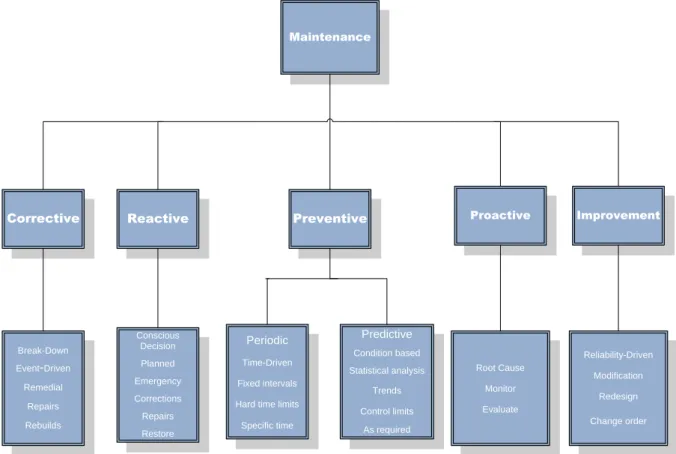
Figure 2.3: Structure of maintenance adapted from (Mobley 2011:9) ... 9
Figure 2.4: Lean maintenance practices (Smith, Hawkins 2004) ... 15
Figure 2.5: Maintenance planning and scheduling module (Duffuaa et al., 2001) ... 16
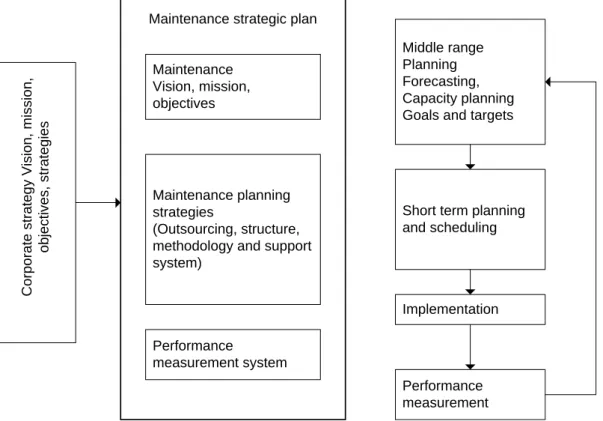
Figure 2.6: Maintenance planning process (Al-Turki 2009) ... 19
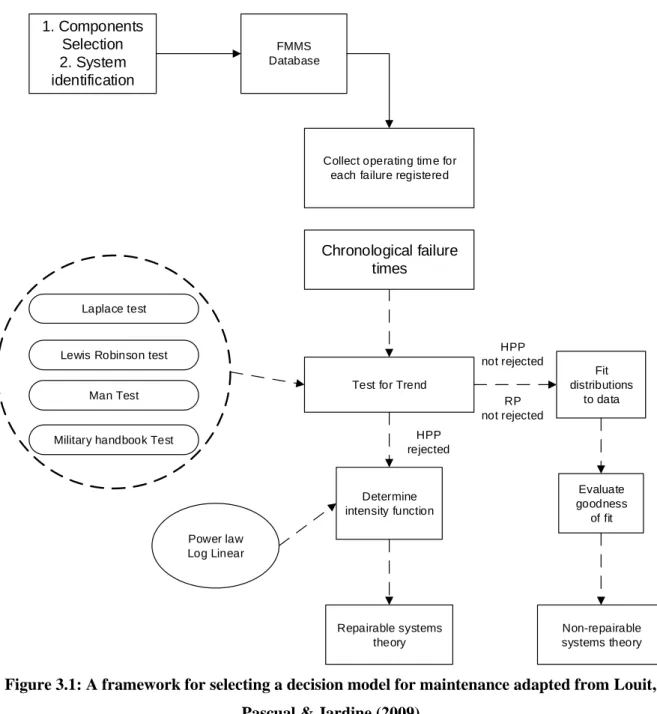
Figure 3.1: A framework for selecting a decision model for maintenance adapted from Louit, Pascual & Jardine (2009) ... 44
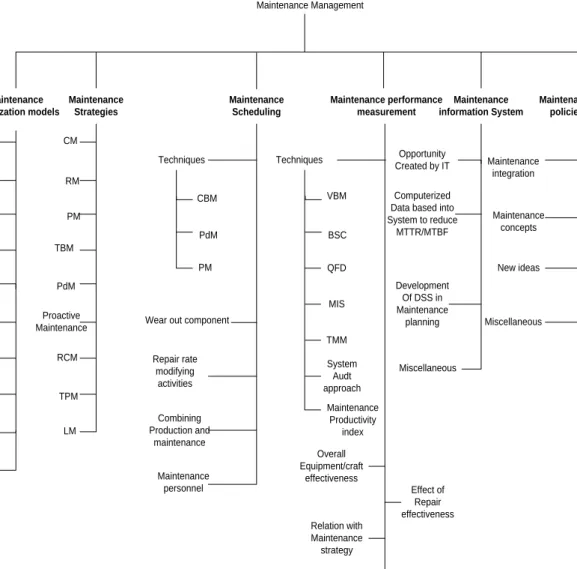
Figure 3.2: Maintenance management classification tree showing various sub areas based on Garg & Deshmukh (2006) ... 46
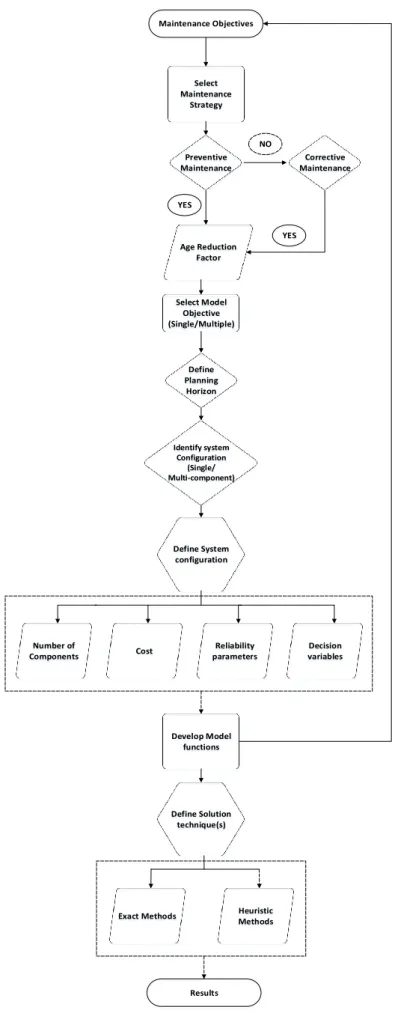
Figure 4.1: Flow chart for developing Decision model ... 48
Figure 4.2: Effect of period j maintenance on rate of occurrence of failure on component (Moghaddam, Usher 2011) ... 51
Figure 4.3: Effect of period j replacement on rate of occurrence of failure on component (Moghaddam, Usher 2011) ... 52
Figure 4.4: Genetic algorithm flow diagram (Yun, Han & Park 2012) ... 57
Figure 4.5: Simulated annealing flow diagram (Yun, Han & Park 2012) ... 60
Figure 5.1: Metrorail Salt River Maintenance Operations ... 62
Figure 5.2: Inter-relations between departments (Rommelspacher 2012) ... 63
Figure 5.3: Metrorail maintenance interval ... 67
Figure 5.4: Metrorail 5M2A Motor Coach subsystems ... 69
Figure 5.5: Reliability diagram of components ... 70
Figure 5.6: Data analysis process ... 70
Figure 5.7: Cumulative time Failure plot ... 71
Figure 6.1: System reliability for maintenance strategy of case study. ... 75
Figure 6.2: System reliability for no maintenance or replacement ... 76
Figure 6.3: System reliability for maintenance action over planning period ... 77
Figure 6.4: Excel/LINGO Pareto optimal fronts ... 78
Figure 6.5: System reliability using EXCEL/LINGO (R = 50%, C = R13 202 504.88) ... 79
Figure 6.6: Pareto optimal front from EXCEL and GANetXL ... 81
Figure 6.7: System reliability using EXCEL/GANetXL (R=50%, C= R12 550 430) ... 82
Figure 6.8: Excel/LINGO & Excel GANetXL Pareto optimal fronts ... 83
x
Figure 6.10: Genetic Algorithm Pareto Optimal fronts for fitness function 1 ... 85
Figure 6.11: System reliability for fitness 1 (W1=30%, W2=70%) ... 86
Figure 6.12: Genetic Algorithm Pareto Optimal fronts for fitness function 2 ... 87
Figure 6.13: System reliability for fitness 2 (R=50.3%, C= R12 834 562.76) ... 88
Figure 6.14: Genetic Algorithm Pareto Optimal fronts for fitness function 1 & 2 ... 89
Figure 6.15: Genetic Algorithm System reliability for both fitness functions ... 90
Figure 6.16: Simulated Annealing Pareto Optimal fronts for fitness function 1 ... 91
Figure 6.17: System reliability for fitness 1 (W1=30%, W2=70%) ... 92
Figure 6.18: Simulated Annealing Pareto Optimal fronts for fitness function 2 ... 93
Figure 6.19: System reliability for fitness 2 (R=51.67%, C= R17 787 577.04) ... 94
Figure 6.20: Simulated Annealing Pareto Optimal fronts for fitness function 1 & 2 ... 95
Figure 6.21: Simulated Annealing System reliability for both fitness functions ... 95
xi LIST OF TABLES
Table 3-1: Maintenance optimization classification adapted from (Hilber 2008) ... 25
Table 5.5-1: Number of each type of motor coach available ... 65
Table 5-2: Result of Laplace and Least Square test ... 72
Table 5-3: Parameters for Case study ... 73
Table 5-4: Genetic Algorithm and Simulated Annealing Parameters ... 73
Table 6-1: Preventive maintenance schedule for case study ... 75
Table 6-2: EXCEL/LINGO Pareto optimal solutions ... 78
Table 6-3: Pareto optimal preventive maintenance and replacement schedule for EXCEL/LINGO (R = 50%, C = R13 202 504.88) ... 79
Table 6-4: EXCEL/GANetXL Pareto Optimal solutions ... 80
Table 6-5: Pareto optimal preventive maintenance and replacement schedule for EXCEL/GANetXL (R=50%, C= R12 550 430) ... 81
Table 6-6: Genetic Algorithm Pareto optimal solutions for fitness function 1 ... 84
Table 6-7: Pareto optimal preventive maintenance and replacement schedule for GA fitness 1 (W1=30%, W2=70%) ... 85
Table 6-8: Genetic Algorithm Pareto optimal solutions of fitness function 2 ... 87
Table 6-9: Pareto optimal preventive maintenance and replacement schedule for GA fitness 2 ... 88
Table 6-10: Simulated Annealing Pareto optimal solutions for fitness function 1 ... 91
Table 6-11: Pareto optimal preventive maintenance and replacement schedule for SA fitness 1 (W1=30%, W2=70%) ... 92
Table 6-12: Simulated Annealing Pareto optimal solutions of fitness function 2 ... 93
Table 6-13: Pareto optimal preventive maintenance and replacement schedule for SA fitness 2 ... 94
Table 6-14: Comparison of all solution methods ... 96
xii
GLOSSARY
CM Corrective Maintenance RM Reactive Maintenance RTF Run-To-Failure PM Preventive Maintenance TDM Time Directed Maintenance PdM Predictive Maintenance CBM Condition based Maintenance RCM Reliability Centred Maintenance TPM Total Productive MaintenancePRASA Passenger Rail Agency of South Africa FMMS Fleet Maintenance Management Software MIP Mixed Inter Programming
MINLP Mixed integer Non-linear Programming
DP Dynamic programming
GA Genetic Algorithm
SA Simulated Annealing
HPP Homogeneous Poisson Process NHPP Non-homogeneous Poisson Process GRG Generalized Reduced Gradient
1
CHAPTER 1:
INTRODUCTION
1.1 Background
Railway systems consist of both mechanical and electrical components combined into several systems containing a large number of moving parts. To achieve an acceptable railway service level, each system needs to kept operational and regular maintenance is the essential factor to achieving this. A railway system can be sub-divided into two sub-systems namely: rolling stock and Infrastructure. Rolling stock refers to all the vehicles that move on a railway. These vehicles can either be powered or unpowered vehicles or a combination of both. Examples of rolling stock include locomotives, railroad cars, coaches and wagons. Rolling stock is the most maintenance intensive part of the railway system and therefore, the most vulnerable if maintenance is neglected. According to Wyman (2009) “maintenance accounts for approx. 30% of the lifecycle costs of a high-speed train, making it the largest rolling stock operating cost factor besides energy”. When a train breaks down during operation, it immediately blocks the railway track. This delay causes a disruption to the timetable schedule for that track untill the train either becomes operational or removed from the track. Reliability is therefore the key to a successful railway operation thus making maintenance the number one priority if ongoing reliability is to be ensured.
The importance of the maintenance functions and maintenance management has greatly grown in all sectors of manufacturing and service organizations. The principal reason for this growth is the continuous expansion in the capital inventory, the requirements for the functioning of systems and the outsourcing of maintenance. Thus, as maintenance management gains importance, support from science is needed to improve it. Maintenance being a key to maintaining reliability in a system needs to be performed properly to ensure effective use of resources. There are several strategies for carrying out maintenance but irrespective of the strategy adopted by an organisation, proper planning and scheduling is necessary to ensure the objectives of maintenance are met. For this reason, it is important to have a decision support system in place which would aid in efficient planning and scheduling of the maintenance strategy adopted. According to Dekker and Scarf (1998), maintenance management could have benefited from the advent of a large area in operations research, called maintenance optimization.
2 The failure of a critical component in a rolling stock system during operation can cause multiple ripple effects. Firstly, the system is delayed and then fails to adhere to time schedules. Secondly, other planned operations using the same infrastructure would be delayed and ultimately, this would cause a loss and a decrease in service levels for the rail service provider. Therefore, it is important to have a tool in place to ensure that maintenance is efficiently carried out to reduce the probability of a failure occurring during system operation. This tool can be referred to as maintenance optimization. Maintenance optimization is a useful tool to aid in decision support for maintenance. The results achieved from the process can be used by a maintenance manager for efficient maintenance planning and scheduling support.
The optimization process can be developed using various methods. It can involve a process of improving maintenance policies by making changes to the features and conditions to make it more practically applicable. For example by taking into account working conditions, the service schedule of the corporation, safety issues, perfect and imperfect actions. In general, maintenance optimization models are categorized by the way they represent fuzziness in parameters, models and set-ups as well as how they represent expected variability. The model can either use deterministic or probabilistic methods for representation. Probabilistic models make use of probability distributions to add fuzziness in parameters, the model and scenarios as well as the expected variability for the scenarios. On the other hand, deterministic methods do not provide information about potential risk which results in non-optimal maintenance planning for systems (Ghosh & Roy 2009).
The overall efficiency of any rail company is a function of its operations and maintenance planning, scheduling and quality of service. It can be assumed that like many organizations, there are opportunities to improve the overall efficiency of the maintenance department of a rail company even when the opportunities are not very obvious. This research is focused on how the maintenance function of rail companies, corporations and establishments can be improved, by developing a decision support model for maintenance scheduling of rolling stock based on reliability and cost. The study includes a practical application of the model in a maintenance facility of a suitable case, the Metrorail Maintenance Facility Cape Town. Recommendations from this study could be used by the case study and other companies, corporations and establishments to improve the maintenance scheduling of their rolling stock or systems.
3 1.2 Problem Statement
The railway industry is an asset intensive industry that depends heavily on the performance of their assets, in particular rolling stock. A railway industry cannot survive if their trains are allowed to deteriorate because of lack of or poor maintenance. This implies that a high level of reliability is required. Maintenance of rolling stock components can become very expensive; it becomes even more expensive to replace the equipment that has deteriorated as a result of poorly planned maintenance or neglect of maintenance. Little research has been carried out to improve rolling stock maintenance in the railway industry. The majority of the research carried out in this area has focused on how to solve maintenance problems in railway infrastructure. There is no standard decision model based on cost and reliability that maximizes the efficiency in rolling stock maintenance scheduling has been developed.
1.3 Research Purpose and Objectives
The purpose of this research is to develop a decision support model based on reliability of components and cost associated with maintenance of rolling stock to produce an efficient maintenance schedule for rolling stock components. The study aims to apply the developed model to a suitable case study as well as use efficient maintenance planning and scheduling to assist rail companies that could improve reliability at lower maintenance costs.
1.4 Research Design and Methodology
For the purpose of achieving the stated research objectives, an extensive literature study will be conducted to understand experts’ opinions on decision models in maintenance planning and scheduling. Various models and methods for maintenance planning and scheduling from other rail companies and industries will be investigated. An appropriate decision support model will be identified and used to develop a decision support model for rolling stock maintenance. This will be achieved using relevant sources of information.
The research will be of empirical form, i.e. it will involve the collection of rolling stock components failure and cost data from a suitable rolling stock maintenance facility’s database. The data gathered would be analysed to identify critical failing components. The failure data of these components as well as their cost will be used to develop the decision support model. The information gathered will also be used as input data to the proposed
4 decision support model and the results could be tested at the company’s maintenance facility. From the model, recommendations on how to improve the current process in rolling stock maintenance will be made.
1.5 Research Hypothesis
The use of reliability and cost as objective criteria for maintenance decision support modelling in rolling stock will result in a more efficient maintenance schedule that could improve the maintenance function of a railway company
1.6 Thesis Outline
This thesis is organized as follows:
Chapter 1 gives an introduction to the research and outlines the objectives and method of the research that would be carried out.
Chapter 2 presents a comprehensive literature survey on maintenance; maintenance strategies; maintenance planning and scheduling; and rolling stock maintenance.
Chapter 3 presents a review of literature on maintenance decision models.
Chapter 4 discusses the decision support model developed and presents methods of solution for the developed model.
Chapter 5 gives an overview of the case study selected for this research and discusses how maintenance planning and scheduling is carried out in the specific case. The proposed model is applied to the case study.
In chapter 6 results and the implications of the results of the decision support model is discussed.
Chapter 7 concludes the research and presents recommendations and potential future research.
In keeping with the outlined layout, the next chapter presents a comprehensive review of literature on the topic of study.
5
CHAPTER 2: MAINTENANCE, MAINTENANCE PLANNING AND SCHEDULING
2.1 Introduction
Chapter one presented the research problem, stated aims and hypothesis of the study. In this chapter, an overview of maintenance and its objectives are presented. A literature study on the different maintenance strategies as well as the importance of planning and scheduling maintenance is discussed to provide a background to the research problem. Also given in the chapter is an overview of maintenance planning and scheduling highlighting their key elements. The chapter closes with a discussion of literature on maintenance in the rolling stock environment.
2.2 Maintenance
The role of maintenance has become very important in all kinds of industries. As such, the need for maintenance has increased over the years and companies have come to adopt maintenance as an activity that adds value rather than view it as a necessary evil for expenses which contributes to the business profit (Sharma, Yadava & Deshmukh 2011). Maintenance actions involve implementing every decision made at all levels of an organisation in order to achieve and sustain a high level of reliability and availability of its asset. It deals with specific methods, resources and personnel utilized in order to keep a piece of equipment or system running efficiently during its designed life (Anderson & Neri 1990).
Any piece of equipment is designed to function for a period of time after which its performance is expected to degrade. When this happens, maintenance is needed to rectify the equipment after failure or when a failure is foreseen. In a (normal case) maintenance is performed to keep a piece of equipment functional during its designed life considering that the practical operation of the components of a piece of equipment is a time-based function. It can therefore, be said that poor maintenance will degrade the condition of the equipment. A brief understanding of the fundamental principles of failure is required to fully grasp the concept of maintenance. A piece of equipment is said to have failed when it no longer operates within its stipulated design specifications. Smith (1993) explains that failure can also occur within a complex system which consists of other subsystems that have failed even when these may not be visible and the equipment still stays in operation. This is called a
6 “hidden failure”. It is necessary to check for such failures, as they could result to operational failures and/or accidents.
A component’s statistical lifespan can be illustrated with the use of a graphical representation called the bathtub curve (see Figure 2.1). The curve shows that a component has a high probability of failure during its first few weeks of operation, which could be as a result of errors during its installation or manufacturer. This period is referred to as the infant mortality period. Following the infant mortality period is the normal life period. In this period, the equipment exhibits a relatively low probability of failure for a long period although the component may experiences random failures. After the normal life period, the probability of failure becomes relatively high as a result of the equipment reaching its wear-out period (Klutke, Kiessler & Wortman 2003).
Failu er Rate Age(t) Infant mortality Normal Life Wear out
Figure 2.1: Components failure rate over time (Bathtub Curve)(Klutke, Kiessler & Wortman 2003)
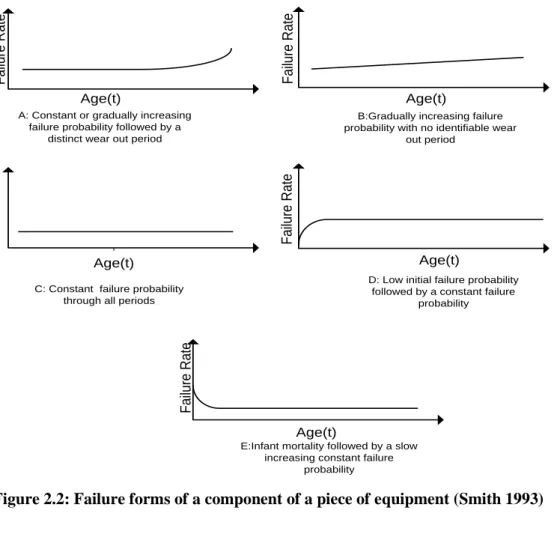
It has however, been shown by the commercial avaition industry, that this is not the case for every component. An investigation conducted by Smith (1993) found that a component can experience five other failure forms besides the bathtub curve. These forms are based on the age-reliability relationship of the components and are illustrated in Figure 2.2
7 Failure R ate Failure R ate Failure Ra te Failure R ate Failure Ra te Age(t) Age(t) Age(t) Age(t) Age(t)
A: Constant or gradually increasing failure probability followed by a
distinct wear out period
B:Gradually increasing failure probability with no identifiable wear
out period
C: Constant failure probability through all periods
D: Low initial failure probability followed by a constant failure
probability
E:Infant mortality followed by a slow increasing constant failure
probability
Figure 2.2: Failure forms of a component of a piece of equipment (Smith 1993)
Although these failure forms represent the combinations of failure probabilities in the aviation industry, it can also be assumed that the probability of failures of components in other industries can take these forms. However, one must consider that the ratio of these probabilities could differ slightly with respect to the type of component. Smith’s study established that the most common age-reliability failure form (in Figure 2.2 above) shows a high initial probability of failure rate and decreases to a lower and constant probability of random failure with time. According to Smith (1993), an understanding of these different failure forms has an effect on choosing an appropriate maintenance strategy.
2.3 Maintenance Objectives
Maintenance has been practised as far back as the 1930s before the Second World War, when the engineers believed maintenance was not needed as it increased cost of production and had no impact on the value of the production. Emphasis was to minimize the system cost rate but the importance of reliability performance was not taken into consideration (Sharma, Yadava & Deshmukh 2011). As a result, maintenance was only carried out after a system breaks
8 down. However, during the World War II in the 1940s, there were advances in engineering and scientific technology which brought about new kinds of maintenance that were cost effective and maintenance was categorized as a function of the production system.
In recent times, organizations have been made aware of the importance of environmental safety, quality of products and services thereby making maintenance an important aspect of their asset to contribute to the growth and success of the company. These have led to the need for defining the purpose of maintenance and creating maintenance objectives in order to measure performance in meeting these objectives. According to Dekker (1996:230), the purpose and objectives of maintenance are defined as follows:
Reducing breakdowns and emergency shutdowns.
Maximizing production at lower cost, highest quality and within optimum safety standards.
Optimizing the use of maintenance resources.
Optimizing the utilization of resources to reduce downtime.
Increasing reliability of the operating systems.
Improving spares parts stock control.
Optimizing capital equipment life.
Improving equipment efficiency which reduces scrap rate.
Identifying and implementing cost reductions.
Optimizing the useful life period of the equipment.
Minimising energy usage.
Maintenance contributes towards organizational profit, hence the need to include it in corporate objective (Sharma, Yadava & Deshmukh 2011). It is therefore important that maintenance objectives are consistent with the goals of production and that they are comprehensive enough to include specific responsibilities (Kelly 2006).
Dekker (1996:230) summarized maintenance objectives into four distinctive heading namely;
Ensuring system function
Ensuring system life
Ensuring safety
9 Dekker suggests that providing the correct reliability, availability, capability and efficiency should be the main maintenance objectives for a system to be maintained.
2.4 Maintenance Strategies
Mobley (2011) identifies run to failure and preventive maintenance as the two most common maintenance management strategies used by organizations to achieve their maintenance objectives. These strategies can be managed using the different types of maintenance, that is, corrective, reactive, preventive, proactive and improvement. These are explained in the sections that follow and summarized in Figure 2.3 below. It is important to note that each of these strategies has different age reduction impacts on system, as will be discussed in detail in Chapter 3: Maintenance Preventive Corrective Improvement Break-Down Event-Driven Remedial Repairs Rebuilds Periodic Time-Driven Fixed intervals Hard time limits Specific time Reliability-Driven Modification Redesign Change order Conscious Decision Planned Emergency Corrections Repairs Restore Predictive Condition based Statistical analysis Trends Control limits As required Reactive Proactive Root Cause Monitor Evaluate
10
2.4.1 Corrective Maintenance
Corrective Maintenance (CM) aims to maximise the effectiveness of all critical systems, minimise breakdowns, minimise unnecessary repairs, and reduce the deviations from optimum operating conditions. CM is event-driven and involves tasks performed to identify, isolate, and amend faults of a failed piece of equipment so that its operational conditions can be restored within the tolerances or limits established for in-service. CM is associated with break downs, emergencies, remedial and repairs and often times require rebuilding the equipment. Depending on the impact of the fault, CM can either be performed instantly or delayed if the system requires to be shut down in order to make repairs. It is by far the simplest type of maintenance strategy. Equipment service levels are generally below acceptable levels and the quality of product is usually affected (Wireman 2005).
2.4.2 Reactive Maintenance
Reactive maintenance (RM) is similar to corrective maintenance (CM) but defers in that RM involves a conscious decision to allow a piece of equipment operate until it breaks down before CM actions are carried out. It is used for run-to-failure maintenance management approach therefore sometimes referred to as Run-To-Failure maintenance (RTF). RM is carried out in order to repair, replace and restore actions performed on a system after a failure has occurred for the purpose of restoring the system to an acceptable working condition (Mobley 2011). This is the oldest and most expensive type of maintenance practiced. This type of maintenance is known to be associated with high expenses in spare parts inventory, machine down time, overtime labour costs and low production availability. RM can be subdivided into two different categories, namely:
Emergency maintenance (EM): refers to maintenance which is done immediately or at the earliest possible time in order to reinstate a failed equipment to achieve maximum productivity with minimum wasted effort or expense.
Breakdown maintenance (BM): refers to maintenance performed after a failure which is considered to be advanced has occurred. In this case, provision would have been made in the form of repair method, spares, materials, labour and equipment to tackle the breakdown.
11
2.4.3 Preventive Maintenance
Preventive maintenance (PM) aims to minimize the probability of failure occurring during the operation of a piece of equipment. PM involves maintenance tasks carried out to avoid premature equipment damage as well as reducing unscheduled interruption that could lead to corrective activities. The maintenance tasks are based on completed time or hours of operation and scheduled on the basis of the mean time to failure (MTTF) statistic (Mobley 2011). According to Vasili, Hong & Ismail (2011), PM involves a set of management, administrative and technical actions which are aimed at reducing the age of the equipment for the purpose of improving the availability and reliability of the system.
PM can become very expensive if not done effectively and efficiently. It is generally understood that it involves regular inspection of equipment to check for failures or faults. This is not always the case as PM activities can be used to satisfy most of the maintenance objectives set out by an organisation. PM can either be performed as Periodic (Time-based) maintenance or as Predictive (Condition-based) maintenance.
PM tolerates planned downtime’s addition into the production schedule and decreases the occurrence of breakdowns. It also reduces maintenance cost because cost is used for part replacement only while also reducing the risks of injury and environmental degradation.
2.4.4 Periodic Maintenance (Time directed maintenance TDM)
Time directed maintenance are activities that take place based on a measure of interval. This could be in the form clock time, calendar days, number of cycles or number of kilometres travelled. The activities consist of occasionally inspecting, overhauling and cleaning a piece of equipment, replacing affected parts to prevent unexpected failure and process complications (Levitt 2003).
TDM is broken down into two tasks: Based (TB) which is an Inspection task and Time-Based Instructive task (TBI) which refers to tasks that involve opening up a piece of equipment. TB has been the major application of PM, but lately, there has been an increase in computer simulations and automation which necessitating a shift from TB maintenance to Predictive maintenance.
12
2.4.5 Predictive Maintenance
Predictive maintenance (PdM) is done by forecasting possible failures based on regular monitoring of a piece of equipment for the purpose of preserving its components from failure and sustain it against hazards. PdM a data oriented type of maintenance and doesn’t necessarily require the purchase of new equipment (Levitt 2003). PdM is sometimes also referred to as Condition based maintenance (CBM) or Condition Monitoring.
PdM/CBM is a systematic or scheduled maintenance where specific components are replaced at regular intervals as they become worn. It is a process in which the decision to replace or not is based on the outcome of a diagnosis study (Lyonnet 1991). PdM is made popular by the use of control systems in a piece of equipment for the purpose of gathering data and feeding the data to a condition-based maintenance decision system.
PdM is a tool used to generate corrective activities. CM activities generated from PdM can be planned and scheduled because of the time interval between the diagnosis and the required corrective action. It is a very accurate PM strategy when used to manage serious equipment wear. PdM can be expensive to implement at first, but this effect is cushioned by its ability to bring maintenance closer to production and supporting quality programs (Levitt 2003).
PdM improves system reliability while reducing maintenance costs in that, the reduced number of maintenance activities causes a decrease of human fault impacts. As mentioned earlier, PdM implementation has high installation cost, the costs involved are divided unequally as a result of unpredictable maintenance periods. The value of minor part of a piece of equipment is usually higher than the actual equipment; hence, PdM is used rarely for less important parts of a piece of equipment (Liu, Wang & Golnaraghi 2010).
2.4.6 Proactive Maintenance
Proactive Maintenance is the opposite of RM; its focus is on determining the root causes of machine wear and failure and resolving those causes before they manifest. Proactive maintenance is seen as money saving maintenance practice because of its ability to reduce machine wear and failure thereby reducing the need for maintenance. It uses a technique of monitoring and correcting failure root causes in a piece of equipment for example contamination (Swanson 2001).
13 Proactive maintenance differs from PM and PdM in that it makes use of corrective activities to eradicate the sources of failure. This strategy extends equipment life as opposed to relying on conventional conditions for impending machine breakdown. It also uses systematic scheduled maintenance to avoid e breakdowns. Proactive maintenance does not accept failure as a routine or anticipate crisis failure maintenance, all of which are characteristics of PM and PdM. When used correctly, proactive maintenance prevents loss of productivity due to broken or inoperable piece of equipment and this saves costs (Swanson 2001).
2.4.7 Reliability-Centered Maintenance (RCM)
This type of maintenance is reliability-driven. It is aimed at reducing the need for maintenance of equipment by improving the reliability of the machine. This is achieved by focusing on ways to preserve the function of a piece of equipment in its totality and not part specific. It involves modification of the equipment by adding accessories that could support a part thereby reducing its need for regular maintenance. It also involves redesigning or changing the order of operation if applicable (Mobley 2011). Reliability-centered maintenance (RCM) is based on the principle that analysing the costs of failure and the definite preventive maintenance with the use of a well-disciplined decision logic analysis process can give room for more efficient life time maintenance and logistic support programs (Duarte et al., 2010).
RCM has been identified as a very efficient and well used strategy for the preservation of operational efficiency of a piece of equipment. RCM functions by finding an equilibrium point between high maintenance costs and cost of preventive maintenance policies while, taking into consideration the potential shortening of useful life of the piece of equipment (Afefy 2010). RCM is defined by four characteristic features which include preserving system functionality, identifying specific failure modes that result to functional failures, prioritizing the failure node by order of importance, and selecting an applicable and effective PM activities to eliminate the failure modes (Rommelspacher 2012).
14
2.4.8 Total Productive Maintenance
Total Productive Maintenance (TPM) is a newly defined concept of maintenance program. TPM is a strategy that gives emphases on operator’s involvement in the basic aspects of maintenance. In TPM, operators are expected to take possession of any piece of equipment they operate by performing routine maintenance activities during the normal operation of the piece of equipment (Rommelspacher 2012). The goal of the TPM program is to increase production significantly while simultaneously increasing employee self-esteem and job satisfaction. It is directed primarily to the commercial manufacturing environment (Kalbande, Sawlekar & Thampi 2010).
TPM shows the importance of accepting maintenance as a vital part of a business and not to be viewed as a non-profit activity. Activities of maintenance such as down town, repairs, are to be scheduled as part of the production process. The reason for doing this is to reduce unscheduled maintenance, breakdown and emergency during system operation. This aligns with the objective of TPM which is to eliminate equipment breakdowns, speed losses and inconsequential stoppages. According to Kalbande, Sawlekar & Thampi (2010), TPM promotes defect-free production, just-in-time (JIT) production, and automation.
2.4.9 Lean Maintenance
Lean maintenance was introduced as a prerequisite for successfully implementing lean in maintenance. It is a planned and scheduled maintenance approach which is achieved by the combination of TPM practices and RCM strategies. Lean maintenance has a foundation of TPM; this means in order to successfully implement lean in maintenance, TPM should have been established and operating efficiently (Smith & Hawkins 2004). The objective of lean maintenance is eliminating every type of waste in the maintenance process without taking serious reliability problems into account. However Ghayebloo and Shahanaghi (2010) state that this is not necessarily the case and developed a multi-objective decision making model to apply lean maintenance to decrease waste and increase system reliability. Lean maintenance is shown in Figure 2.4.
15
PLANNING AND SCHEDULING
DOCUMENTATION WORK ORDER
SYSTEM CMMS PREDICTIVE MAINTENANCE ROOT CAUSE FAILURE ANALYSIS TOTAL PRODUCTIVE MAINTENANCE (TPM)
LEAN MAINTENANCE PRACTICES
Figure 2.4: Lean maintenance practices (Smith, Hawkins 2004)
2.5 Importance of Maintenance planning and scheduling
Organizations are making efforts to increase profitability by increasing labor productivity, while at the same time maintaining a high level of quality, service and timelines. For this to be achieved, the importance of maintenance management has grown in all organizations. Maintenance is an important aspect in the life cycle of assets and needs to be planned and scheduled efficiently to minimize the costs involved. As maintenance operations increase in complexity, so does the complexity of the maintenance functions. These operations involve complex mechanical faults which require a level of skilled human resources to tackle. Assigning the right repair skills to carry out the maintenance operations would reduce the downtime of production. It is therefore important to ensure that maintenance activities meet the organizational objectives whereby total operating and maintenance costs are reduced (Paz & Leigh 1994).
Manpower, equipment and material are the three major resources required for executing maintenance. These resources differ in their impacts on production and are managed differently. Manpower has been shown to be the most vulnerable of the resources, which makes it very difficult to control. Maintenance management is not involved with manpower’s direct labor cost, rather it can be used to schedule i.e. how, when and where maintenance work is to be carried out which eventually has an effect on the total maintenance cost. An effective distribution of manpower through scheduling would increase the productivity of the workforce (Paz & Leigh 1994). Duffuaa et al., (2001) also state the importance of planning and scheduling by regarding it as the most critical aspect of the maintenance process.
The objective of maintenance planning and scheduling is to reduce the idle time of equipment and maintenance personnel, minimize total scheduling time, reduce delay time of certain job, increase work time efficiency, maximize equipment availability and minimize shut-down cost and time (Duffuaa & Al-Sultan 1997). When this objective is carried out successfully, maintenance cost is reduced considerably, maintenance workforce is utilized efficiently
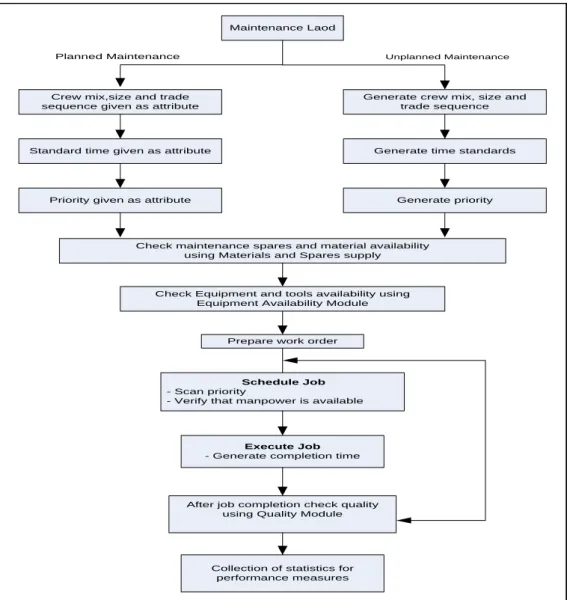
16 thereby reducing disruptions in the system. The quality of maintenance work is improved with efficient planning and scheduling as it undertakes the best methods and actions and assigns the most experienced workers for the job (Al-Turki 2009). A module for maintenance planning and scheduling is presented in Figure 2.5.
Maintenance Laod
Crew mix,size and trade sequence given as attribute Standard time given as attribute
Priority given as attribute
Generate crew mix, size and trade sequence Generate time standards
Generate priority
Check maintenance spares and material availability using Materials and Spares supply
Check Equipment and tools availability using Equipment Availability Module
Collection of statistics for performance measures
Prepare work order
Schedule Job
- Scan priority
- Verify that manpower is available
Execute Job
- Generate completion time
After job completion check quality using Quality Module
Planned Maintenance Unplanned Maintenance
Figure 2.5: Maintenance planning and scheduling module (Duffuaa et al., 2001)
2.6 Maintenance Planning
An understanding of the process of successfully carrying out maintenance is required for all the different strategies of maintenance discussed above. Irrespective of the kind of maintenance, some kind of preparation or plan is needed to carry out the necessary maintenance activities. This preparation is known as maintenance planning, which helps to increase overall efficiency and effectiveness in maintenance (Al-Turki 2009).
17 Planning involves the process of determining future decisions and actions required to achieve a set of objectives. It involves the identification of parts and tools required and suitable to carry out a job. Planning helps to achieve set out objectives efficiently by minimizing costs, reducing risks and missing possibilities (Umar M & Al-Turki 2009). A maintenance plan is important in that it helps to determine the most cost-effective way to maintain the value of an
asset.The three basic levels of planning processes are:
1. Long Range planning (covers a period of 2 years and above) 2. Medium range planning (between a month and a year) 3. Short range planning (includes daily and weekly plans)
Maintenance planning relates to the job capacity and workforce planning. It gives a detailed process of how a maintenance force should operate and a comprehensive outline for major overhauling, construction jobs, preventive maintenance plans, plant shutdowns and vacation planning. Duffuaa et al., (1999) summarises the process of a proper planning after a job request has been made as follows:
Define job content.
Plan job work order by specifying job scope. Specify craft and establish skill level for the job. Estimate required time to execute the job. Specify anticipated parts and tools. Order parts and tools.
Specify special tools required and obtain them. Review safety process.
Create a priority work sheet for the job. Estimate cost required to complete the job Complete the work order.
Review and control backlog.
18
Maintenance planning strategies
The state of a piece of equipment is affected by the operating capacity and the maintenance actions carried out on it. Commercial consumption and market considerations determine the production plans for a system. This in turn determines the operational load the system is scheduled to undergo. Therefore maintenance planning has to take into consideration the production planning, maintenance decisions, equipment inherited reliability as well as market and commercial requirements (Al-Turki 2009).
Tsang (2002) identified four dimensions of maintenance strategies as service delivery strategies (in-house vs. outsourcing maintenance), organization and work structure, maintenance methodology, and support system (information system, training performance management and reward system). The first dimension deals with service delivery, which involves the decision to either assign maintenance internally within the organisation or outsource it. Outsourcing maintenance activities has some potential benefits some of which include reduction of total System costs, work is done faster, use of specialists, new technologies are implemented and more attention given by the organisation to strategic asset management issues. However, there are some risks involved with outsourcing maintenance tasks such as loss of critical skills, loss of cross functional communications and loss of control over a supplier (Al-Turki 2009). In order to balance this, suggestions are made for organization to not outsource maintenance management and planning but rather outsource the implementation on the maintenance plan once the risk and costs involved have been carefully considered (Murthy, Atrens & Eccleston 2002).
The second dimension is the organization and work structure which is classified as a highly functionalized process within which maintenance is organized into specific jobs. Decisions to be made here include: plant flexibility or plant specialized tradesman, unified or isolated workshops, and trade specialized or multi-skilled trade-force. The third dimension, maintenance methodology, deals with the strategic decision to choose between the different maintenance strategies discussed earlier. In order to make this decision, the organization’s global objectives are considered and the maintenance strategy selected based on it. (de Moura Xavier et al., 2013)
The fourth dimension of selecting the support system involves choosing the appropriate tools for information system, training, performance measurement and reward system. Also the
19 organizational objectives are to be considered when selecting the tools. One of the tools being adopted lately is the Enterprise Resource Planning (ERP) which has the ability to integrate different functional areas within the organization for efficient maintenance planning and scheduling.
Ambika (2009) investigated the use of Reliability, Availability, Maintainability and Safety (RAMS) and Life Cycle Cost (LCC) in maintenance planning strategy. The investigation showed that the combination of RAMS and LCC will provide a solution that will optimise maintenance strategy. The decision support models will be discussed in later sections of this research report.
Maintenance planning strategy is developed focusing on the corporate objectives in line with its strategies. Strategic decisions are made in relation to the service delivery, organization and work structure, maintenance strategies and supporting systems which result to the need to plan the capacity and workforce requirements. The weekly and daily plans are developed and scheduled for implementation. This is then followed performance measurement for continuous improvement (Al-Turki 2009). Figure 2.6 shows a summary of the maintenance planning process.
Middle range Planning Forecasting, Capacity planning Goals and targets
Short term planning and scheduling Implementation Performance measurement Maintenance Vision, mission, objectives Maintenance planning strategies (Outsourcing, structure, methodology and support system)
Performance measurement system Maintenance strategic plan
Corpo rate st rateg y Vi s ion, missio n , obje ctives , st rateg ies
20 2.7 Maintenance Scheduling
After a strategic maintenance plan has been developed, the next requirement for implementation is to allocate resources and workforce to the planned activities. This process is referred to as scheduling. Scheduling deals with assigning jobs with the necessary required resources (material and work force) which are arranged in the order of execution. The tasks are allocated durations, predecessors, successors and resource availability. Maintenance scheduling is therefore, the scheduling of planned maintenance activities (Al-Turki 2009). It is a process of executing the six elements of a successful maintenance job namely, the mechanic(s), tools, materials and spare parts, availability of scheduled machine, required information for job execution and approved permissions in an outlined efficient manner. Scheduling can be categorized into three main levels
1. Master Schedule (Medium range schedule: 3 months to 1 year) 2. Weekly Schedule
3. Daily Schedule
The master schedule relies on existing maintenance work orders. It is used to create a balance between medium range planning activities and available resources. This level of scheduling gives an overview of resource requirements and necessary plans are put in place to have them available when needed. The master schedule is revised often and updated to reflect changes to plan and completed maintenance work. The weekly schedule is created from the master schedule; it gives the description of the current operations schedules and economic considerations. The daily schedule is prepared from the weekly schedule, it gives description of the activities to be executed for the day. In some cases the weekly schedule is interrupted for emergency maintenance activities.
Al-Turki (2009) presents the following as necessary requirements to carry out scheduling effectively:
1. Written work orders that are derived from a well-conceived planning process. This includes work to be done, methods to be followed, crafts needed, spare parts needed, and priority.
21 3. Information about craft availability for each shift.
4. Stocks of spare parts and information on restocking.
5. Information on the availability of special equipment and tools necessary for maintenance work.
6. Access to the plant production schedule and knowledge about when the facilities will be available for service without interrupting the production schedule.
7. Well-define priorities for maintenance work.
8. Information about jobs already scheduled that are behind the schedule (backlog).
Al-Turki (2009) ) further outline the scheduling procedure as follows: 1. Sort backlog work orders by skills needed.
2. Arrange orders by their priority.
3. Compile a list of completed and carry over jobs.
4. Consider job duration, location, travel distance, and the possibility of combining jobs in the same area.
5. Schedule multi-skill jobs to start at the beginning of every shift. 6. Issue a daily schedule.
7. Authorize a manager to compose work assignments. 2.8 Rolling Stock Maintenance
Railway industries have been considered as an environmental friendly transportation mode and its demand has been increasing over the years. There is a need to maintain a high level of reliability, safety, availability and maintainability within a rail system. This however, is a challenging task to accomplish considering the two main sub-systems that make up the railway system, namely the Rolling stock and Infrastructure. Infrastructure includes signal, power supply and rail tracks while Rolling stock refers to all vehicles that move on a rail track which could be coaches, wagons and locomotives. Of these two, Rolling stock can be classified as the most important and most vulnerable (Park et al., 2011).
Rolling stock has a huge effect on the service level of the system because the service level of the rail system is directly proportional to the safety and comfort of the passengers. In order to achieve the required service level, the quality of the rolling stock performance needs to be improved continually and this can be achieved with proper maintenance. A train is also
22 classified as rolling stock and it comprises of several rail vehicles connected in series. The combination of these vehicles are complex, but can be redistributed and reconfigured to include embedded systems, which are combined together to provide a high quality transportation service (Umiliacchi et al., 2011).
Rolling stock maintenance has been categorized generally into corrective maintenance and preventive maintenance (Cheng & Tsao 2010). Nevertheless, these maintenance strategies have been found to be ineffective. Majority of maintenance activities in rolling stock companies are directed towards preventive maintenance, which often leads to incorrect maintenance work, frequent down time, unnecessary maintenance tasks and often reverts to CM/BM (Rezvanizaniani et al., 2008). Given this scenario, rolling stock industries need to select a maintenance schedule for the adopted strategy that will increase system reliability and reduce the need for regular maintenance.
Selecting an effective maintenance strategy is an essential concern for a rolling stock industry. Various studies have been done to try to achieve a more efficient maintenance strategy to maintain high system reliability and reduce maintenance cost. In rolling stock, safety is the most significant factor in achieving reliability and the wheel sets are the most critical part of the subsystem (Rezvanizaniani et al., 2008).
2.9 Chapter Conclusion
The importance of maintenance as a value adding activity was highlighted in this chapter. The major objective of maintenance is to contribute to an organizations profit either by minimizing, identifying, or improving an element of the organization’s objective. The reliability and availability of components increase when a proper maintenance strategy is adopted. These strategies have been described briefly and it can be summarised into two major categories which are corrective and preventive maintenance for rolling stock. To properly execute maintenance, it needs to be planned and scheduled efficiently to reduce the production loss time and cost. Off all the resources required for maintenance, manpower is the most challenging resource to control in maintenance management and should therefore be scheduled in the most efficient way possible.
23 CHAPTER 3: MAINTENANCE DECISION MODELS
3.1 Introduction
Chapter two discussed maintenance, maintenance planning and scheduling. This chapter covers the decision models for maintenance improvement. The chapter begins with a brief description of maintenance optimization as a tool for decision making. Maintenance optimization and its application are also discussed in detail in this chapter. Also discussed in the chapter are rolling stock systems and models used to achieve optimization in multi-component system and the methods used for optimization problems. The analyses and reliability of repairable systems are also covered by presenting the Homogeneous and Non-homogeneous Poisson processes.
3.2 Maintenance Optimization
Since maintenance became a frequent practice of industries, researchers have worked on various ways to efficiently schedule maintenance. The maintenance scheduling problem can also be formulated as a maintenance optimization problem (Paz & Leigh 1994). The aim would be to find an optimum balance between maintenance cost and maintenance objectives while considering all possible constraints. For example, the aim can be to derive a solution to either minimize or maximize system maintenance cost and a maintenance objective such as system reliability measures or some sort of other performance indicator. It could also be a combination of the two criteria to minimize maintenance cost and maximize reliability simultaneously (Sharma, Yadava & Deshmukh 2011).
Maintenance optimization models in this paper are defined as those models or processes by which maintenance strategies, planning or scheduling is being improved. Maintenance optimization models are made up of mathematical models which focus on deriving the optimal balance between maintenance costs and benefits of maintenance or the most appropriate time to execute maintenance. Several factors are considered when attempting to achieve an optimal maintenance schedule. These factors include: safety, health, environment, maintenance cost, failure cost, opportunity cost and replacement cost (Dekker & Rommert 1998).
Maintenance optimization has been realised through the use of various modelling techniques such as decision making tools, reliability maintenance models, algorithms, simulation,
24 mathematical programing, statistical methods and search techniques. These methods have been used individually and in some cases combined, to achieve an optimal maintenance strategy either by minimizing cost or maximising reliability/availability depending on the objective of the researcher. According to Dekker (1996), maintenance optimization process involves four aspects:
1. Description of a technical system, its function and importance.
2. Modelling of the deterioration of the system in time and possible sequences for the system.
3. A description of the available information about the system and the actions open to management
4. Objective function and an optimization technique which helps in finding the optimal balance
3.3 Classification of maintenance optimization
Maintenance optimization models can either be qualitative or quantitative. Qualitative models include TPM, RCM, and plant asset management (PAM) while quantitative models include deterministic/stochastic models such as Markov decision, Bayesian models and integer programming (Garg & Deshmukh 2006). It is important to note that maintenance optimization is only a tool to improve the overall maintenance process and therefore, to achieve an effective performance in the maintenance process, the optimization model, maintenance policies, maintenance costs and system reliability all need to be considered instantaneously (Sharma, Yadava & Deshmukh 2011). A general model for maintenance optimization is presented in Vatn et al., (1996) where safety, health and environmental objectives, maintenance costs, downtime cost are all taking into consideration.
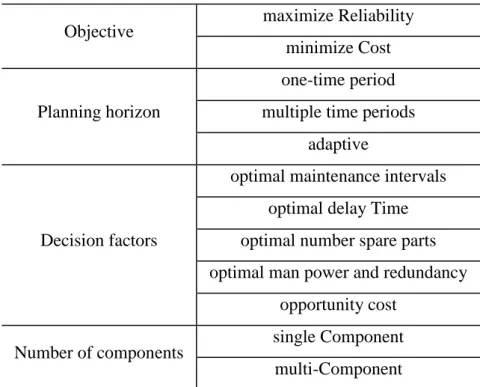
Maintenance optimization can be classified using the objective, planning horizon, decision factors and the number of components of the problem (Hilber 2008). When performing maintenance optimization, there are two common objectives often considered which are to maximize reliability or to minimize cost. These objectives are usually performed with defined constraints. In the case of reliability, the constraints could be cost and in the case of minimizing cost, the constraint can be a required level of reliability. The planning horizon for maintenance optimization can be performed in three ways, namely a one-time period, which involves optimizing maintenance for a next time period, for example, a year; multiple time
25 periods; or long time periods ranging up to 20 years or more. In this scenario, the net present value of cost parameters is usually considered. The third is an adaptive approach that suggests a long period plan but adaptable to changes that occur in the maintenance system during that period.
Maintenance optimization can also be classified using decision factors. Such factors vary depending on the amount and kind of data available and the elements that make up the objectives of an organization. Providing a comprehensive list of the decision factors could be a difficult task. However, the common decision factors often considered in literature include: optimal maintenance intervals, optimal delay time, optimal number spare parts, optimal man power, opportunity cost and redundancy.
Maintenance optimization models vary depending on the amount of components considered for optimization. It could either be a single component or multi-component optimization model. The single component considers optimizing the most critical or expensive component in the system. It could also be a system with subcomponents which is considered as one component. The multi-component considers optimizing several components in the system each with its own different reliability characteristics simultaneously.
Table 3-1: Maintenance optimization classification adapted from (Hilber 2008)
MAINTENANCE OPTIMIZATION CLASSIFICATION Objective maximize Reliability
minimize Cost
Planning horizon
one-time period multiple time periods
adaptive
Decision factors
optimal maintenance intervals optimal delay Time optimal number spare parts optimal man power and redundancy
opportunity cost Number of components single Component
26 Table 3-1 shows the summary of maintenance optimization classification. In an ideal optimization model, the objectives should consider all necessary decision factors listed. In reality however, most optimization models do not consider all these factors, which provide a less optimal solution to the actual optimal maintenance. This is due to the extreme difficulty in solving a model by including all the decision factors in one model. It is therefore important to choose the factors for optimization carefully. That choice could require several optimal solutions considering different decision factors (Hilber 2008). The railway industry has benefited from maintenance optimization models.
3.4 Maintenance optimization in Railway
Rolling stock is a very important aspect of a railway system. However, not much research has been done to improve maintenance operations in rolling stock. Majority of the work done focuses on railway infrastructure. It is established from literature that railway operators have shifted attention to preventive maintenance but the methods of efficiently scheduling these PM activities have been a concern to many countries (Soh, Radzi & Haron 2012). Every maintenance project will require a certain amount of resources, expertise, and crew siz