DOI: http://dx.doi.org/10.21609/jiki.v9i2.383
DOCUMENT CLUSTERING BY DYNAMIC HIERARCHICAL ALGORITHM BASED ON FUZZY SET TYPE-II FROM FREQUENT ITEMSET
Saiful Bahri Musa, Andi Baso Kaswar, Supria, and Susiana Sari
Department of Informatics Engineering, Faculty of Information Technology, Institut Teknologi Sepuluh Nopember, Jl. Teknik Kimia, Gedung Teknik Informatika, Surabaya, 60111, Indonesia
E-mail: [email protected] Abstract
One of ways to facilitate process of information retrieval is by performing clustering toward collection of the existing documents. The existing text documents are often unstructured. The forms are varied and their groupings are ambiguous. This cases cause difficulty on information retrieval process. More-over, every second new documents emerge and need to be clustered. Generally, static document clus-tering method performs clusclus-tering of document after whole documents are collected. However, per-forming re-clustering toward whole documents when new document arrives causes inefficient clus-tering process. In this paper, we proposed a new method for document clusclus-tering with dynamic hierar-chy algorithm based on fuzzy set type-II from frequent item set. To achieve the goals, there are three main phases, namely: determination of keyterm, the extraction of candidates clusters and cluster hierar-chical construction. Based on the experiment, it resulted the value of F-measure 0.40 for Newsgroup, 0.62 for Classic and 0.38 for Reuters. Meanwhile, time of computation when addition of new document is lower than to the previous static method. The result shows that this method is suitable to produce so-lution of clustering with hierarchy in dynamical environment effectively and efficiently. This method also gives accurate clustering result.
Key Words:Dynamic Hierarchical Algorithm, Fuzzy Set Type-II, Document Clustering.
Abstrak
Salah satu cara untuk mempermudah proses information retieval adalah dengan melakukan peng-klasteran terhadap koleksi dokumen yang ada. Dokumen teks yang ada seringkali tidak terstruktur, formatnya bervariasi, dan pengelompokannya ambigu. Hal ini menimbulkan kesulitan dalam proses information retrieval. Selain itu, setiap detik dokumen baru bartambah dan perlu untuk dikelompokkan. Pada umumnya, metode pengklasteran dokumen statis melakukan pengklasteran dokumen setelah kese-luruhan dokumen terkumpul. Namun, melakukan pengklasteran ulang terhadap kesekese-luruhan dokumen ketika dokumen baru tiba mengakibatkan proses pengklasteran menjadi tidak efisien. Penelitian ini mengusulkan metode baru untuk pengklasteran dokumen dengan algoritma hierarki dinamis berbasis fuzzy set type-II dari frequent itemset. Untuk mencapai tujuan tersebut, terdapat 3 tahapan utama yang akan dilakukan, yaitu; ekstraksi keyterm, ekstraksi kandidat klaster dan pembangunan hirarki klaster. Berdasarkan eksperimen yang telah dilakukan diperoleh nilai F-Measure 0,40 untuk Newsgroup, 0,62 untuk Classic, dan 0,38 untuk Reuters. Sedangkan waktu komputasi pada saat penambahan dokumen dapat direduksi dibanding dengan metode statis sebelumnya. Hasil percobaan terhadap beberapa dataset koleksi dokumen menunjukkan bahwa metode ini tidak hanya sesuai untuk menghasilkan solusi peng-klasteran secara hirarki dalam lingkungan yang dinamis secara efektif dan efisien, tetapi juga membe-rikan hasil pengklasteran yang akurat.
Kata Kunci:Algoritma Hirarki Dinamis, Fuzzy Set Tipe-II, Pengklasteran Dokumen.
1. Introduction
Plentiful information as a result from development of information technology is a big advantage for the seeker of information. However, at the same ti-me the big problem appears as a result of the incre-ase of exist data where it's difficult to determine needed information from large quantity of unne-cessary/unimportant data. So, information retrieval
(IR) and information extraction (IE) are present to handle the problem. Managing, accessing, search-ing, and big browsing repository from text docum-ent need efficidocum-ent organizing from the information. In that case, document clustering have important role as tool that organize document collection to be meaningful cluster collection to increase informati-on retrieval efficiency and document management [1].
However, the increasing of text document ex-plosively on the internet and must be clustered ge-nerally have unstructured form and their groupings are ambiguous. So they cause the difficulties in se-eking and managing document. One of methods that functions to organize document collection is document clustering hierarchically. Document clu-stering into structure of tree hierarchically is able to increase efficiency of IR [2–4]. However, there are some challenges in hierarchy document clus-tering, namely; high dimensionality, scalability, accuracy, easy of browsing and meaningful cluster label [2-5].
Some researchers [2–4,6] use frequent item-set from association rule for document manageme-nt. The method is able to solve the problem like re-duction of dimension, input of cluster amount and the ease of seeking by meaningful label. Next, Chen et al [4] show that Fuzzy Frequent Item-set-based on Hierarchical Clustering method (F2IHC) can avoid overlapping cluster and increase the ac-curacy of document clustering result. However the method uses fuzzy set type-1. Fuzzy set type-1 that has function of distinct membership is not able to model uncertainty directly [7].
On the other hand, method of fuzzy set type-2 has interval membership function which is able to model uncertainty in defining membership func-tion on fuzzy set type-1 [7-8]. Then, Sari et al [9] build a document clustering method hierarchically
based on fuzzy set type-2 from frequent item-set to increase the quality of clustering result. Fuzzy set type-2 trapezoidal as upper membership function and fuzzy type-II triangular as bottom membership function toward frequent item-set that gotten from association rule mining to increase the accuracy of document clustering. The proposed method is able to produce qualified cluster and to solve the ambi-guity. However the recommended method is only implemented in the static document. In environ-ment of dynamic information like World Wide Web is necessary to apply adaptive method for organi-zing of document.
Static clustering methods generally do clus-tering where the entire document had been ready before applying clustering algorithms. When add-ing a new document, it is necessary to do reclu-stering toward the whole documents. However, performing re-clustering toward the whole docum-ents when new documdocum-ents come afterward, caused the process of clustering are not efficient.
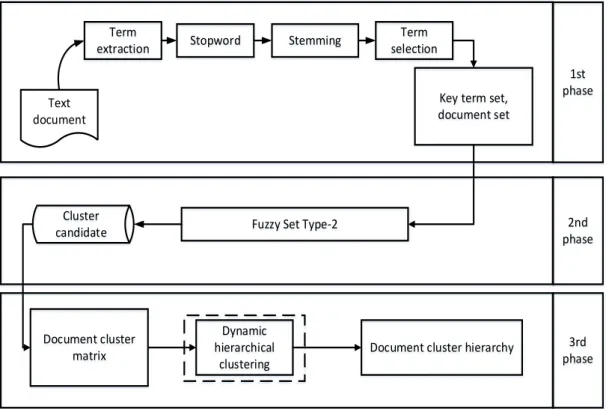
In this paper, we proposed a new method for document clustering with Dynamic Hierarchical Algorithm based on Fuzzy Type-II from the Fre-quent Item-set. Type-II fuzzy sets used to over-come the problem of ambiguity and dynamic clus-tering method with dynamic hierarchical algorithm can process documents added or eliminated to or from the collection. Dynamic algorithm has the ca-pability to renew clustering when data is added or
Term
extraction Stopword Stemming selectionTerm
Key term set, document set
Fuzzy Set Type-2 Cluster candidate Text document Document cluster matrix Dynamic hierarchical clustering 1st phase 2nd phase 3rd phase Document cluster hierarchy
Issue 2, June 2016
eliminated from the collection. This algorithm ena-bles us dynamically to track the large-scale of in-formation constantly changing, either inserted to the web every day, without having to perform a complete clustering. The proposed method is ex-pected to perform dynamical documents clustering so re-clustering toward all existing documents are not necessary to do as well as overcoming the pro-blem of ambiguity so it can provide accurate clus-tering results at the same time.
2. Methods
There are several phases are done for document clustering with dynamic hierarchical clustering
al-traction of cluster candidate is a process done to gi-ve value of fuzzy for frequent item-set and to get 1-itemset candidate. Cluster construction is a pro-cess to build a cluster hierarchy for frequent item-set.
Keyterm Extraction
The first phase is the process of keyterm extracti-on. The aim of keyterm extraction is to get the most representative term to be input for cluster candida-te extraction phase. The input of this phase is the collection of document that will be clustered, while the output of this phase is in the keyterms. The pr-ocedure that must be done in this phase is the ex-TABLE1
FUZZY MEMBERSHIP FUNCTION TYPE-IITRAPEZOIDAL AND TRIANGULAR DEFENITION.
Upper Membership Function (UMF) Lower Membership Function (LMF)
𝑊𝑊𝑖𝑖𝑖𝑖𝐿𝐿.𝑈𝑈�𝑓𝑓𝑖𝑖𝑖𝑖� = ⎩ ⎪ ⎨ ⎪ ⎧ 1,𝑎𝑎 ≤ 𝑓𝑓𝑖𝑖𝑖𝑖≤ 𝑏𝑏 �𝑓𝑓𝑖𝑖𝑖𝑖− 𝑐𝑐� (𝑏𝑏 − 𝑐𝑐) ,𝑏𝑏 ≤ 𝑓𝑓𝑖𝑖𝑖𝑖≤ 𝑐𝑐 0, 𝑓𝑓𝑖𝑖𝑖𝑖≥ 𝑐𝑐 𝑎𝑎,𝑑𝑑,𝑏𝑏1= min (𝑓𝑓𝑖𝑖𝑖𝑖) 𝑏𝑏=�min (𝑓𝑓𝑖𝑖𝑖𝑖) +2 𝑐𝑐1� 𝑊𝑊𝑖𝑖𝑖𝑖𝐿𝐿.𝐿𝐿�𝑓𝑓𝑖𝑖𝑖𝑖� = ⎩ ⎪ ⎨ ⎪ ⎧�𝑓𝑓𝑖𝑖𝑖𝑖− 𝑎𝑎1� (𝑏𝑏1− 𝑎𝑎1) , 𝑎𝑎1≤ 𝑓𝑓𝑖𝑖𝑖𝑖≤ 𝑏𝑏1 �𝑓𝑓𝑖𝑖𝑖𝑖− 𝑐𝑐1� (𝑏𝑏1− 𝑐𝑐1) ,𝑏𝑏1≤ 𝑓𝑓𝑖𝑖𝑖𝑖≤ 𝑐𝑐1 𝑎𝑎1= 0 𝑊𝑊𝑖𝑖𝑖𝑖𝑀𝑀.𝑈𝑈�𝑓𝑓𝑖𝑖𝑖𝑖� = ⎩ ⎪ ⎨ ⎪ ⎧�𝑓𝑓𝑖𝑖𝑖𝑖− 𝑑𝑑� (𝑒𝑒 − 𝑑𝑑) ,𝑑𝑑 ≤ 𝑓𝑓𝑖𝑖𝑖𝑖≤ 𝑒𝑒 1, 𝑒𝑒 ≤ 𝑓𝑓𝑖𝑖𝑖𝑖≤ 𝑓𝑓 �𝑓𝑓𝑖𝑖𝑖𝑖− 𝑔𝑔� (𝑓𝑓 − 𝑔𝑔) ,𝑓𝑓 ≤ 𝑓𝑓𝑖𝑖𝑖𝑖≤ 𝑔𝑔 𝑐𝑐,ℎ=𝑎𝑎𝑎𝑎𝑔𝑔(𝑓𝑓𝑖𝑖𝑖𝑖) 𝑒𝑒=�𝑐𝑐1+𝑎𝑎𝑎𝑎𝑔𝑔(𝑓𝑓𝑖𝑖𝑖𝑖)� 2 𝑓𝑓=�𝑎𝑎𝑎𝑎𝑔𝑔(𝑓𝑓𝑖𝑖𝑖𝑖) +2 𝑓𝑓1� 𝑊𝑊𝑖𝑖𝑖𝑖𝑀𝑀.𝐿𝐿�𝑓𝑓𝑖𝑖𝑖𝑖� = ⎩ ⎪ ⎨ ⎪ ⎧�𝑓𝑓𝑖𝑖𝑖𝑖− 𝑑𝑑1� (𝑒𝑒1− 𝑑𝑑1) ,𝑑𝑑1≤ 𝑓𝑓𝑖𝑖𝑖𝑖≤ 𝑒𝑒1 �𝑓𝑓𝑖𝑖𝑖𝑖− 𝑓𝑓1� (𝑒𝑒1− 𝑓𝑓1) ,𝑒𝑒1≤ 𝑓𝑓𝑖𝑖𝑖𝑖≤ 𝑓𝑓1 𝑐𝑐1,𝑑𝑑1 =�min (𝑓𝑓𝑖𝑖𝑖𝑖) +2𝑎𝑎𝑎𝑎𝑔𝑔(𝑓𝑓𝑖𝑖𝑖𝑖)� 𝑒𝑒1=𝑎𝑎𝑎𝑎𝑔𝑔(𝑓𝑓𝑖𝑖𝑖𝑖) 𝑊𝑊𝑖𝑖𝑖𝑖𝐻𝐻.𝑈𝑈�𝑓𝑓𝑖𝑖𝑖𝑖� =��𝑓𝑓(𝑖𝑖 − ℎ) ,𝑖𝑖𝑖𝑖− ℎ� ℎ ≤ 𝑓𝑓𝑖𝑖𝑖𝑖≤ 𝑖𝑖 1, 𝑖𝑖 ≤ 𝑓𝑓𝑖𝑖𝑖𝑖≤ 𝑗𝑗 𝑔𝑔,𝑗𝑗,ℎ1=𝑚𝑚𝑎𝑎𝑚𝑚(𝑓𝑓𝑖𝑖𝑖𝑖) 𝑖𝑖=�𝑔𝑔1+𝑚𝑚𝑎𝑎𝑚𝑚(𝑓𝑓2 𝑖𝑖𝑖𝑖)� 𝑊𝑊𝑖𝑖𝑖𝑖𝐻𝐻.𝐿𝐿�𝑓𝑓𝑖𝑖𝑖𝑖� =� 0, 𝑓𝑓𝑖𝑖𝑖𝑖≤ 𝑔𝑔1 �𝑓𝑓𝑖𝑖𝑖𝑖− 𝑔𝑔1� (ℎ1− 𝑔𝑔1) ,𝑔𝑔1≤ 𝑓𝑓𝑖𝑖𝑖𝑖≤ ℎ1 𝑓𝑓1,𝑔𝑔1 =�𝑎𝑎𝑎𝑎𝑔𝑔(𝑓𝑓𝑖𝑖𝑖𝑖) +2𝑚𝑚𝑎𝑎𝑚𝑚(𝑓𝑓𝑖𝑖𝑖𝑖)
(𝑫𝑫= {𝒅𝒅𝟏𝟏,𝒅𝒅𝟐𝟐,𝒅𝒅𝟑𝟑, … ,𝒅𝒅𝒏𝒏}) in order to obtain the set
of term𝑻𝑻𝑫𝑫= {𝒕𝒕𝟏𝟏,𝒕𝒕𝟐𝟐,𝒕𝒕𝟑𝟑, … ,𝒕𝒕𝒏𝒏}). The set of term 𝑻𝑻𝑫𝑫 still contains common words (stop word) such
as "and, with, what, etc.", so it`s needed the stop word-removal process to eliminated the stop word. Stop word removal is used contains 571 words in English.
Stemming process is performed then on the remaining term by stemming WordNet 2.0. This process aims to return the exist word into their ba-sic form. To get the most representative keyterm, the term selection is based on calculations𝒕𝒕𝒕𝒕.𝒊𝒊𝒅𝒅𝒕𝒕, 𝒕𝒕𝒕𝒕.𝒅𝒅𝒕𝒕 and𝒕𝒕𝒕𝒕𝟐𝟐. Term which has value more than the minimum threshold value𝒕𝒕𝒕𝒕.𝒊𝒊𝒅𝒅𝒕𝒕 (α), minim-um threshold𝒕𝒕𝒕𝒕.𝒅𝒅𝒕𝒕 (β), and minimum threshold 𝒕𝒕𝒕𝒕𝟐𝟐 (γ) are defended as a set of keyterms. To get
the value of keyterms set, we use equation(1) for𝒕𝒕𝒕𝒕.𝒊𝒊𝒅𝒅𝒕𝒕, equation(2) for 𝒕𝒕𝒕𝒕.𝒅𝒅𝒕𝒕 and equation(3) for𝒕𝒕𝒕𝒕𝟐𝟐. 𝑡𝑡𝑓𝑓.𝑖𝑖𝑑𝑑𝑓𝑓𝑖𝑖𝑖𝑖=∑𝑚𝑚𝑓𝑓𝑖𝑖𝑖𝑖𝑓𝑓𝑖𝑖𝑖𝑖 𝑖𝑖=1 ∗log � |𝐷𝐷| ��𝑑𝑑𝑖𝑖|𝑡𝑡𝑖𝑖∈𝑑𝑑𝑖𝑖,𝑑𝑑𝑖𝑖∈𝐷𝐷��� (1) 𝑡𝑡𝑓𝑓𝑑𝑑𝑓𝑓𝑖𝑖𝑖𝑖=𝑇𝑇𝑇𝑇 ∗ 𝐷𝐷𝑇𝑇, (2) where 𝑇𝑇𝑇𝑇= 𝑓𝑓𝑖𝑖𝑖𝑖 ∑𝑚𝑚𝑖𝑖=1𝑓𝑓𝑖𝑖𝑖𝑖 ,𝐷𝐷𝑇𝑇= ��𝑑𝑑𝑖𝑖| 𝑡𝑡𝑖𝑖∈𝑑𝑑𝑖𝑖,𝑑𝑑𝑖𝑖∈𝐷𝐷�� |𝐷𝐷| 𝑡𝑡𝑓𝑓𝑖𝑖𝑖𝑖2=𝑡𝑡𝑓𝑓𝑖𝑖𝑑𝑑𝑓𝑓𝑖𝑖𝑖𝑖∗ 𝑡𝑡𝑓𝑓𝑑𝑑𝑓𝑓𝑖𝑖𝑖𝑖 (3)
Cluster Candidate Extraction
The second phase is performing the cluster candi-date extraction to provide value of fuzzy for frequ-ent item set and get 1-itemset candidate. In giving
fuzzy value for frequent item-set, using member-ship functions of fuzzy set type-II as the upper tra-pezoidal membership function (UMF) and triangu-lar membership function as lower membership fu-nction (LMF) will be optimal (Figure 2).
Term-frequency (𝒕𝒕𝒕𝒕) fuzzy set of documents 𝒅𝒅𝒊𝒊denoted as (𝑭𝑭𝒊𝒊𝒊𝒊,𝑾𝑾𝒊𝒊𝒊𝒊𝒓𝒓.𝒛𝒛). 𝑭𝑭 value has the range [𝟎𝟎,𝟏𝟏]. In 𝑭𝑭𝒊𝒊𝒊𝒊consists of three regionals, namely Low (𝑳𝑳), MID (𝑴𝑴) and High (𝑯𝑯). 𝑭𝑭𝒊𝒊𝒊𝒊denoted as {𝐖𝐖𝐢𝐢𝐢𝐢𝐋𝐋.𝐔𝐔(𝑭𝑭𝒊𝒊𝒊𝒊)/𝒕𝒕𝒊𝒊•𝑳𝑳.𝑼𝑼,𝑾𝑾𝒊𝒊𝒊𝒊𝑴𝑴.𝑼𝑼(𝑭𝑭𝒊𝒊𝒊𝒊 )/
𝒕𝒕𝒊𝒊•𝑴𝑴.𝑼𝑼,𝑾𝑾𝑯𝑯𝒊𝒊𝒊𝒊.𝑼𝑼(𝑭𝑭𝒊𝒊𝒊𝒊 )/𝒕𝒕𝒊𝒊 • 𝑯𝑯.𝑼𝑼}, {𝑾𝑾𝒊𝒊𝒊𝒊𝑳𝑳.𝑳𝑳(𝑭𝑭𝒊𝒊𝒊𝒊 )/𝒕𝒕𝒊𝒊 •
𝑳𝑳.𝑳𝑳,𝑾𝑾𝒊𝒊𝒊𝒊𝑴𝑴.𝑳𝑳(𝑭𝑭𝒊𝒊𝒊𝒊 )/𝒕𝒕𝒊𝒊 • 𝑴𝑴.𝑳𝑳,𝑾𝑾𝒊𝒊𝒊𝒊𝑯𝑯.𝑳𝑳(𝑭𝑭𝒊𝒊𝒊𝒊 )/𝒕𝒕𝒊𝒊•
𝑯𝑯.𝑳𝑳}. 𝒕𝒕𝒊𝒊 • 𝒓𝒓.𝒛𝒛
are regional fuzzy 𝒕𝒕𝒊𝒊. 𝒁𝒁 can serve as UMF (𝑼𝑼) or LMF (𝑳𝑳). For a term (𝒕𝒕𝒊𝒊,𝒕𝒕𝒊𝒊𝒊𝒊) in the document (𝒅𝒅𝒊𝒊), 𝐖𝐖𝐢𝐢𝐢𝐢𝐫𝐫.𝐳𝐳(𝒕𝒕𝒊𝒊𝒊𝒊) is the membership de-gree 𝒕𝒕𝒊𝒊 in 𝒅𝒅𝒊𝒊 which
is defined in Table 1.
Where 𝒎𝒎𝒊𝒊𝒏𝒏�𝒕𝒕𝒊𝒊𝒊𝒊� is the minimum frequency term in𝑫𝑫, 𝒎𝒎𝒎𝒎𝒎𝒎�𝒕𝒕𝒊𝒊𝒊𝒊� is the term maximum freque-ncy of the term in 𝑫𝑫 and 𝒎𝒎𝒂𝒂𝒂𝒂�𝒕𝒕𝒊𝒊𝒊𝒊�= (𝒎𝒎𝒊𝒊𝒏𝒏�𝒕𝒕𝒊𝒊𝒊𝒊�
+𝒎𝒎𝒎𝒎𝒎𝒎 (𝒕𝒕𝒊𝒊𝒊𝒊))/𝟐𝟐.
Fuzzy frequent item-set which has higher su-pport value than minimum susu-pport value will take into account as candidate 1-itemset. The support value calculation of a term derived from the ration between the value of the fuzzy frequent itemset and the amount document. Candidate cluster (𝐜𝐜�) can be obtained from the collection of documents (𝐃𝐃). 𝐜𝐜� may also be denoted as 𝐜𝐜�(𝒕𝒕𝟏𝟏,𝒕𝒕𝟐𝟐,…𝒕𝒕𝒕𝒕)or𝐜𝐜�(τ). Candi-date cluster has 2-tupples denoted as𝐜𝐜�=�𝐃𝐃�𝐜𝐜,𝛕𝛕�, where 𝐃𝐃�𝐜𝐜 is part of 𝑫𝑫 and 𝛕𝛕 is the fuzzy frequent item-set to describe𝐜𝐜�. 𝛕𝛕 is denoted as 𝛕𝛕= �𝐭𝐭𝟏𝟏,𝐭𝐭𝟐𝟐, … ,𝐭𝐭𝐪𝐪� ⊆ 𝐊𝐊𝐃𝐃. 𝐊𝐊𝐃𝐃 is collection of keyterms 𝑡𝑡1 𝑡𝑡2 ⋯ 𝑡𝑡𝑝𝑝 𝑑𝑑1 𝑤𝑤11𝑚𝑚𝑚𝑚𝑚𝑚−𝑅𝑅𝑖𝑖 𝑤𝑤12𝑚𝑚𝑚𝑚𝑚𝑚−𝑅𝑅𝑖𝑖 ⋯ 𝑤𝑤1𝑝𝑝𝑚𝑚𝑚𝑚𝑚𝑚−𝑅𝑅𝑖𝑖 𝑊𝑊 = 𝑑𝑑2 𝑤𝑤21𝑚𝑚𝑚𝑚𝑚𝑚−𝑅𝑅𝑖𝑖 𝑤𝑤22𝑚𝑚𝑚𝑚𝑚𝑚−𝑅𝑅𝑖𝑖 ⋯ 𝑤𝑤2𝑝𝑝𝑚𝑚𝑚𝑚𝑚𝑚−𝑅𝑅𝑖𝑖 ⋮ ⋮ ⋮ ⋱ ⋮ 𝑑𝑑𝑛𝑛 𝑤𝑤𝑛𝑛1𝑚𝑚𝑚𝑚𝑚𝑚−𝑅𝑅𝑖𝑖 𝑤𝑤𝑛𝑛2𝑚𝑚𝑚𝑚𝑚𝑚−𝑅𝑅𝑖𝑖 ⋯ 𝑤𝑤𝑛𝑛𝑝𝑝𝑚𝑚𝑚𝑚𝑚𝑚−𝑅𝑅𝑖𝑖 𝑛𝑛𝑚𝑚𝑛𝑛
Figure. 3. Document Term Matrix.
𝑐𝑐̃1 ⋯ 𝑐𝑐̃2 𝑐𝑐̃3 ⋯ 𝑐𝑐̃𝑘𝑘
𝑡𝑡1 𝑔𝑔11𝑚𝑚𝑚𝑚𝑚𝑚−𝑅𝑅𝑖𝑖 ⋯ 𝑔𝑔12𝑚𝑚𝑚𝑚𝑚𝑚−𝑅𝑅𝑖𝑖 𝑔𝑔13𝑚𝑚𝑚𝑚𝑚𝑚−𝑅𝑅𝑖𝑖 ⋯ 𝑔𝑔1𝑘𝑘𝑚𝑚𝑚𝑚𝑚𝑚−𝑅𝑅𝑖𝑖
𝐺𝐺 = 𝑡𝑡2 𝑔𝑔21𝑚𝑚𝑚𝑚𝑚𝑚−𝑅𝑅𝑖𝑖 ⋯ 𝑔𝑔22𝑚𝑚𝑚𝑚𝑚𝑚−𝑅𝑅𝑖𝑖 𝑔𝑔23𝑚𝑚𝑚𝑚𝑚𝑚−𝑅𝑅𝑖𝑖 ⋯ 𝑔𝑔2𝑘𝑘𝑚𝑚𝑚𝑚𝑚𝑚−𝑅𝑅𝑖𝑖
⋮ ⋮ ⋱ ⋮ ⋮ ⋱ ⋮
𝑡𝑡𝑝𝑝 𝑔𝑔𝑝𝑝1𝑚𝑚𝑚𝑚𝑚𝑚−𝑅𝑅𝑖𝑖 ⋯ 𝑔𝑔𝑝𝑝2𝑚𝑚𝑚𝑚𝑚𝑚−𝑅𝑅𝑖𝑖 𝑔𝑔𝑝𝑝3𝑚𝑚𝑚𝑚𝑚𝑚−𝑅𝑅𝑖𝑖 ⋯ 𝑔𝑔𝑝𝑝𝑘𝑘𝑚𝑚𝑚𝑚𝑚𝑚−𝑅𝑅𝑖𝑖 𝑛𝑛𝑚𝑚𝑝𝑝
Issue 2, June 2016
D and q are the number of keyterms that are included in 𝛕𝛕. Collection of cluster candidate is denoted as𝐂𝐂�𝐃𝐃= { 𝐜𝐜�𝟏𝟏,𝐜𝐜�𝟐𝟐,𝐜𝐜�𝟑𝟑, … ,𝐜𝐜�𝐤𝐤}, where k is the total amount of cluster candidate.
Cluster Hierarchy Construction
The third phase is the tree cluster construction. The process consists of two steps, namely: Document-Cluster Matrix (DCM) and construct a cluster hie-rarchy using dynamic hierarchical clustering algo-rithm. DCM functions to place each document to the proper cluster, so each ciq contains subset of the document. To achieve this goal, de-fined two ma-trices, that is Document-Term Matrix (DTM) and Term-Cluster Matrix (TCM). DTM (𝑊𝑊) is the wei-ght of term tj in the document 𝑑𝑑𝑖𝑖and tj∈ L1. The first step is to consider each candidate cluster
c
�(τ)= c�(𝑡𝑡1,𝑡𝑡2,…𝑡𝑡𝑞𝑞) by fuzzy frequent item-setτ. τ is
considered as a reference to generate target of clus-ter. To present the importance of document in the candidate cluster c�l, then calculated the similarity of the terms in 𝑑𝑑𝑖𝑖and c�l (Figure 3).
𝑊𝑊𝑖𝑖𝑖𝑖𝑚𝑚𝑚𝑚𝑚𝑚−𝑅𝑅𝑖𝑖
is the weight of term 𝑡𝑡𝑖𝑖 in the docu-ment 𝑑𝑑𝑖𝑖∈c�l and 𝜆𝜆 is the minimum value of the confidence. TCM (𝐺𝐺) is a matrix p x k (Figure 4). TCM for 1 ≤ j ≤ p, 1 ≤ l ≤ k calculated by using equation (4) where score calculated by using equa-tion (5).
𝑔𝑔𝑖𝑖𝑗𝑗𝑚𝑚𝑚𝑚𝑚𝑚−𝑅𝑅𝑖𝑖= 𝑠𝑠𝑠𝑠𝑠𝑠𝑠𝑠𝑠𝑠�𝐶𝐶̃𝑙𝑙𝑞𝑞�
∑𝑛𝑛𝑖𝑖=1𝑊𝑊𝑖𝑖𝑖𝑖𝑚𝑚𝑚𝑚𝑚𝑚−𝑅𝑅𝑖𝑖, (4)
Each 𝑔𝑔𝑖𝑖𝑗𝑗𝑚𝑚𝑚𝑚𝑚𝑚−𝑅𝑅𝑖𝑖 in TCM presents the degree of importance of keyterms 𝑡𝑡𝑖𝑖in a candidate cluster
c
�(τ) by referring to all documents which haveτ.
𝒔𝒔𝒔𝒔𝒔𝒔𝒓𝒓𝒔𝒔�𝑪𝑪�𝒍𝒍𝒕𝒕�= � ∑ 𝑾𝑾𝒊𝒊𝒊𝒊𝒎𝒎𝒎𝒎𝒎𝒎−𝑹𝑹𝒊𝒊𝒊𝒊𝒕𝒕𝒕𝒕=𝟏𝟏, 𝒅𝒅𝒊𝒊∈𝒔𝒔�𝒍𝒍𝟏𝟏,𝒕𝒕𝒊𝒊∈𝑳𝑳𝟏𝟏 ∑ 𝒘𝒘𝒊𝒊𝒊𝒊𝒎𝒎𝒎𝒎𝒎𝒎−𝑹𝑹𝒊𝒊 𝒅𝒅𝒊𝒊∈𝒔𝒔�𝒍𝒍𝒕𝒕,𝒕𝒕𝒊𝒊∈𝑳𝑳𝟏𝟏 𝝀𝝀 ,𝒔𝒔𝒍𝒍𝒔𝒔𝒔𝒔 � (5) 𝜷𝜷𝐒𝐒𝐢𝐢𝐒𝐒�𝐜𝐜𝐱𝐱 ,𝐜𝐜𝐲𝐲�= ∑𝐧𝐧𝐝𝐝𝟏𝟏∈𝐜𝐜𝐱𝐱 ,𝐜𝐜𝐲𝐲𝐯𝐯𝐢𝐢𝐱𝐱𝐱𝐱𝐯𝐯𝐢𝐢𝐲𝐲 �∑𝐧𝐧𝐝𝐝𝟏𝟏∈𝐜𝐜𝐱𝐱 (𝐯𝐯𝐢𝐢𝐱𝐱)𝟐𝟐𝐱𝐱∑𝐧𝐧𝐝𝐝𝟏𝟏∈𝐜𝐜𝐲𝐲 �𝐯𝐯𝐢𝐢𝐲𝐲�𝟐𝟐 (6)
The first graph is an undirected graph, where the vertices are the cluster and there is an edge bet-ween node 𝒊𝒊 and𝒊𝒊. Furthermore, the graph is called β-similarity graph. In this graph, an edge is formed between vertex 𝒊𝒊 and𝒊𝒊, if the vertex j is β-similar to the vertex𝒊𝒊. Two clusters are 𝜷𝜷-similar if the si-milarity of both is greater than or equal to𝜷𝜷, where β is determined parameter by the user who presents a minimum similarity threshold. 𝜷𝜷-cluster simila-rity between two target clusters 𝐜𝐜𝐱𝐱and 𝐜𝐜𝐲𝐲,𝐜𝐜𝐱𝐱≠ 𝐜𝐜𝐲𝐲, is defined by equation(6).
The second graph is called max-𝑺𝑺 graph. Max-𝑺𝑺 graph relies on the maximum β-similarity relationship and it is a sub-graph of the first one. Vertices of the graph is the same as vertices in the graph 𝜷𝜷-similarity. Vertices 𝒊𝒊 and 𝒊𝒊 given the edge, if cluster 𝒊𝒊 is the most 𝜷𝜷-similiar to cluster𝒊𝒊. The use of Max-S graph not only reduce time and room utilize (because it has a little edges) but also pro-duce dense cluster.
Being given a cluster hierarchy that previous-ly was created using the algorithm. If there is a new document addition of the cluster, the cluster at all levels of the hierarchy should be revised. When a new document arrives, singleton will be created and 𝜷𝜷 -similarity graph at the bottom level is up-dated. 𝑺𝑺 Graph updating Completely disconnected? Subgraph updating END No Yes New Cluster Cover updating Beta-similarity graph Updating of the next
level graph
Max-S graph
vertices of 𝑵𝑵 to max-𝑺𝑺 graph. Find the most 𝜷𝜷 –si-milar vertices of each vertex in 𝑵𝑵 and add the cor-responding edges to max-S graph. Find all vertices for which a vertex in 𝑵𝑵 is its most 𝜷𝜷-similar and update the corresponding edges. The value of 𝜷𝜷 -similarity the same for all levels of hierarchy le-vels.
A cover routine applied to the max-S graph to renew cluster. Let 𝑵𝑵 be the set of vertices added to the max-𝑺𝑺 graph. Let, also, 𝑵𝑵𝑵𝑵 be the set of edges added to the max-S graph. Let 𝑸𝑸 be a queue with the vertices to be processed, 𝑸𝑸 ≠Ø. Put the rem-aining vertices of the clusters into 𝑸𝑸. Remove these clusters from the list of the existing clusters. Put all vertices of 𝑵𝑵 into the queue 𝑸𝑸. Build the connected components from the vertices in 𝑸𝑸 and add them to the list of existing clusters. For each edge of 𝑵𝑵𝑵𝑵, merge the clusters to which its vertices belong. When a cluster is created on the hierarchy level, 𝜷𝜷 -similarity graph next level should be updated. This process is repeated until the graph completely dis-connected.
3. Results and Analysis
The implementation of the method is supported by Intel ® Core ™ i3-2120 CPU @ 3.30GHz (4CPUs) processor, with a RAM of 4 GB and Java Develop-ment Kit 6 update 31 with Netbeans IDE 8.0.1. Regarding the evaluation of the method, we used 1000 documents from Classic, 1930 documents fr-om Reuters and 1000 document frfr-om Newsgroup. Therefore the evaluation of the proposed method is based on the scalability and F-Measure of the hie-rarchical cluster.
Overall F-Measure will be measured using equation(7). 𝑇𝑇(𝐶𝐶) =∑ �𝑗𝑗𝑖𝑖� |𝐷𝐷| 𝑗𝑗𝑖𝑖∈𝐿𝐿 𝑚𝑚𝑎𝑎𝑚𝑚 {𝑇𝑇} 𝑐𝑐𝑖𝑖∈𝐶𝐶 , (7)
where |𝐷𝐷| is the amount of all document in dataset 𝐷𝐷. 𝐶𝐶 is a cluster obtained from system. 𝐿𝐿 is the class label that obtained from dataset. |𝑐𝑐𝑖𝑖| is the amount of document in cluster 𝐶𝐶. |𝑙𝑙𝑗𝑗| is the amount of do-cument in class 𝐿𝐿. 𝑇𝑇 is the F-measure, P is the pre-cision and R is recall obtained from equation(8) to equation(10) respectively. 𝑇𝑇=𝑃𝑃+𝑅𝑅2𝑃𝑃𝑅𝑅 (8) 𝑃𝑃=�𝑠𝑠𝑖𝑖∩𝑗𝑗𝑖𝑖� |𝑠𝑠𝑖𝑖| (9) 𝑅𝑅=�𝑠𝑠𝑖𝑖∩𝑗𝑗𝑖𝑖� �𝑗𝑗𝑖𝑖� (10)
In the keyterm extraction process, the amount of keyterms depends on the minimum threshold. The keyterms that has tf. idf, tf. df, and tf2 more than
threshold value will be consider as the keyterm. The obtained keyterms are supposed to be the representative keyterm toward document colle-ction.
In the candidate extraction phase of the clus-ters using fuzzy set type-II and with 𝑚𝑚𝑖𝑖𝑛𝑛𝑚𝑚𝑚𝑚𝑛𝑛 high-er than 20%, we obtained 4 clusthigh-ers from the data-set Classic, 9 clusters from Reuters and 15 from Newsgroup. If the 𝑚𝑚𝑖𝑖𝑛𝑛𝑚𝑚𝑚𝑚𝑛𝑛 used is too low, it will obtained many cluster candidate. Therefore, it is possible to results a low clustering accuracy. On the other hand, if we use high 𝑚𝑚𝑖𝑖𝑛𝑛𝑚𝑚𝑚𝑚𝑛𝑛 value, it is pos-sible that it will obtained a litle cluster candidate which doesn`t represent the whole documents wi-thin the document collection.
TABLE2 F-MEASURE RESULT Addition
process
Classic Reuters NewsGroup
Proposed Static method Proposed Static method Proposed Static method 1 0.62 0.62 0.39 0.39 0.39 0.39 2 0.62 0.62 0.39 0.39 0.40 0.39 3 0.62 0.62 0.38 0.38 0.40 0.39 TABLE3 TIME EXECUTION Addition process
Classic Reuters NewsGroup
Proposed (s) Static method (s) Proposed (s) Static method (s) Proposed (s) Static method (s) 1 98 149 1229 1316 979 940 2 36 231 403 1608 357 1303 3 54 252 573 2207 615 1877
Issue 2, June 2016
In the cluster construction phase, the graph that was formed was a vertex that was obtained usi-ng type-II fuzzy sets. First of all, all documents that were placed in the various cluster, uses the DCM method. Thus, from the above process, each of the cluster candidates have got their own members. Based on the result of clustering and construction of the hierarchy structure, we obtained the values of F-Measure as mention in Table 2. The experi-ment was done by doing the process of docuexperi-ments addition periodically. Based on the experiments th-at were done, we obtained value F-Measure as mu-ch as 0.40 from Newsgroup, 0.62 from classic and 0.38 from Reuters after clustering the whole docu-ments. The F-Measure value decreased in each ad-ditional document process because the more docu-ments, the more possibility of cluster formed. Whi-ch means, eaWhi-ch document will occupy a cluster that is not supposed.
To show the dynamic and efficiency of the proposed method, documents clustering was intial-ly carried out. Next, with the assumption that there are new documents, these new documents are clus-tered immediatelly. From Table 3, we can see that in every clustering process, the proposed method can reduce document clustering processing time consideredly when compared with the static me-thod which means, the proposed meme-thod can im-prove the efficiency of the document clustering method in term of time execution if there are new documents.
The proposed method can performs clustering process faster than the previous method because the proposed method only apply the whole proces-ses toward the document comes afterward then find the similarity value toward the existing clus-ters (vertex). Therefore, the document that has just been added can join in cluster that has been formed be-fore or form new hierarchy. While the previous me-thod performs clustering toward the whole docu-ments either the document comes after-ward or the document that has been clustered before.
Beside that we can also know, the proposed method can give value F-measure as good as the method before. This can happen because of the ob-tained result from cluster candidate extraction usi-ng fuzzy set type-II that overcome ambiguity pro-blem and each exist document has been joined in its own cluster. Therefore, we can know that the proposed method is effective and more efficient in clustering the document.
For addition, proposed method can improve the efficiency in terms of RAM usage. In every clustering process/when the the addition of new
do-ic, it is requires allocation of 18.98 MB RAM by using the proposed method and 19.09 MB by using conventional method. Then we added 200 new do-cuments in the second iteration. RAM usage using the proposed method only increased by 4 MB. While conventional method increased about 20.19 MB.
4. Conclusion
In this paper we proposed a new document cluster-ing method by dynamic hierarchical algorithm ba-sed on fuzzy set type II from frequent item-set. Dy-namic hierarchical algorithm used to perform dy-namic document clustering and fuzzy set type II used to solve ambiguity problems when clustering. From the obtained results, the proposed method can improve efficiency in terms of time of cluster-ing and RAM usage because the proposed method only apply the whole processes toward the docu-ment comes afterward then find the similarity value toward the existing clusters (vertex). Besides that, it can be seen that the proposed method gives good accuracy of the clustering.
Reference
[1] T. M. Nogueira, H. A. Camargo, S. O. Re-zende, R. W. Luís, and S. Carlos-sp, “Fuzzy Rules for Document Classification to Impro-ve Information Retrieval,” Int. J. Comput. Inf. Syst. Ind. Manag. Appl., vol. 3, pp. 210–217, 2011.
[2] F. Beil, M. Ester, B. Bc, and C. Va, “Frequent Term-Based Text Clustering,” 2002.
[3] B. C. M. Fung, “Hierarchical Document Clus-tering using Frequent Itemsets,” 2002. [4] C.-L. Chen, F. S. C. Tseng, and T. Liang,
“Mining Fuzzy Frequent Itemsets for Hierar-chical Document Clustering,” Inf. Process. Manag., vol. 46, no. 2, pp. 193–211, 2010. [5] J. Han and M. Kamber, Data Mining Concept
and Techniques. 2006.
[6] T. Hong, K. Lin, and S. Wang, “Fuzzy Data Mining for Interesting Generalized Associ-ation Rules,” Fuzzy Sets Syst., vol. 138, pp. 255–269, 2003.
[7] J. M. Mendel and R. I. B. John, “Type-2 Fuzzy Sets Made Simple,” Fuzzy Syst. IEEE Trans., vol. 10, no. 2, pp. 117–127, 2002. [8] J. T. Starczewski, “Efficient Triangular
Type-2 Fuzzy Logic Systems,” Int. J. Approx. Rea-son., vol. 50, no. 5, pp. 799–811, 2009. [9] S. Sari and A. Z. Arifin, “Clustering
Doku-nal Manajmemen Teknologi XVI, 2012, pp. 1–8.
[10] R. Gil-garcía and A. Pons-porrata, “Dynamic Hierarchical Algorithms for Document
Clus-tering,” Pattern Recognit. Lett., vol. 31, no. 6, pp. 469–477, 2010.