The Greenhouse Gas Protocol
Guidelines for Quantifying GHG Reductions from
Grid-Connected Electricity Projects
W O R L D R E S O U R C E S I N S T I T U T E
Mike McCormick, California Climate Action Registry, USA Scott Murtishaw, California Public Utilities Commission, USA Adam Diamant, Electric Power Research Institute, USA John Cowan, Environmental Interface, Ltd., Canada Jim Platts, ISO New England, USA
Koji Toyama, Kansai Electric Power Co., Inc., Japan Shintaro Yokokawa, Kansai Electric Power Co., Inc., Japan Alissa Boardley, Natural Resources Canada, Canada Jiyoung Yu, Natural Resources Canada, Canada Namat Elkouche, Natural Resources Canada, Canada
Rob Fowler, New South Wales Greenhouse Gas Abatement Scheme, Australia Mikako Kokitsu, Osaka Gas Co., Ltd., Japan
Kyle Davis, PacifiCorp, USA
Michael Lazarus, Stockholm Environment Institute, USA Bruce Biewald, Synapse Energy Economics, Inc., USA Hieda Yasushi, Tokyo Electric Power Co., Inc., Japan Hiroyuki Takahashi, Tokyo Electric Power Co., Inc., Japan Satoshi Yoshida, Tokyo Gas Company, Japan
Lisa Hanle, U.S. Environmental Protection Agency, USA Florence Daviet, World Resources Institute, USA Ryan Levinson, World Resources Institute, USA Mohan Reddy, Zenith Energy, India
Contributors
W O R L D R E S O U R C E S I N S T I T U T E A U T H O R Derik Broekhoff
C O R E C O N T R I B U T O R S
This team was instituted in January 2005 and participated in the development and revision of the final document.
Table of Contents
P A R T I : B A C K G R O U N D A N D K E Y C O N C E P T S 3
C H A P T E R 1
Introduction
41.1 About the Greenhouse Gas Protocol Initiative 5
1.2 About the GHG Protocol for Project Accounting 5
1.3 About the Guidelines for Grid-Connected Electricity Projects 5
1.4 Who Should Use These Guidelines? 6
1.5 How to Use These Guidelines 6
1.6 Guideline Overview 7
1.7 Issues Not Addressed in These Guidelines 9
C H A P T E R 2
Key Concepts
102.1 Quantifying GHG Reductions from Projects 11
2.2 Grid-Connected Project Activities 11
2.3 Baseline Emissions for Grid-Connected Project Activities 11
2.4 The Build Margin (BM) 13
2.5 The Operating Margin (OM) 13
2.6 Determining Relative Build Margin and Operating Margin Effects 13
2.7 Applying the Project Protocol to Grid-Connected Project Activities 14
2.8 Grid Boundaries 16
2.9 GHG Accounting Principles 16
C H A P T E R 3
Electricity Reduction Project Activities
183.1 Types of Electricity Reduction Project Activities 19
3.2 Determining Electricity Savings 19
3.3 Determining Avoided Grid Generation 21
3.4 Estimating Baseline Emissions and Quantifying GHG Reductions 22
P A R T I I G H G A C C O U N T I N G G U I D E L I N E S 24
C H A P T E R 4
Defining the GHG Assessment Boundary
264.1 Identifying Project Activities 27
4.2 Identifying Primary Effects 27
4.3 Considering All Secondary Effects 27
4.4 Estimating the Magnitude of All Secondary Effects 28
4.5 Assessing the Significance of Secondary Effects 29
C H A P T E R 5
Determining the Extent of Build Margin and Operating Margin Effects
305.1 Assessing Grid Capacity Demand 31
5.2 Assessing Whether the Project Activity Meets Capacity Demand 32
C H A P T E R 6
Selecting a Method to Estimate Build Margin Emissions
34C H A P T E R 7
Identifying the Baseline Candidates
367.1 Defining the Product or Service Provided by the Project Activity 37
7.2 Identifying Possible Types of Baseline Candidates 37
7.3 Defining the Geographic Area and Temporal Range 39
7.4 Defining Other Criteria Used to Identify Baseline Candidates 41
7.5 Identifying the Final List of Baseline Candidates 42
7.6 Identifying the Baseline Candidates that Represent Common Practice 42
C H A P T E R 8
Justifying the Baseline Scenario and Characterizing the Build Margin
448.1 Performing a Comparative Assessment of Barriers 46
8.2 Justifying the Baseline Scenario 47
C H A P T E R 9
Estimating the Build Margin Emission Factor
509.1 Estimating BM Emissions Using a Single Baseline Candidate 51
9.2 Estimating BM Emissions Using the Performance Standard Procedure 51
C H A P T E R 1 0
Estimating the Operating Margin Emission Factor
5410.1 Choosing the Right Method 55
10.2 Ex Ante or Ex Post Emission Factors 55
10.3 Calculating Annual Emission Factors 56
10.4 Descriptions of the OM Calculation Methods 57
C H A P T E R 1 1
Estimating Baseline Emissions
66C H A P T E R 1 2
Monitoring and Quantifying GHG Reductions
6812.1 Creating a Monitoring Plan 69
12.2 Quantifying GHG Reductions 71
C H A P T E R 1 3
Reporting GHG Reductions
72P A R T I I I E X A M P L E S O F B A S E L I N E E M I S S I O N R A T E C A L C U L A T I O N S 74
P A R T I V S U P P L E M E N T A R Y I N F O R M A T I O N 84
A N N E X A
Functional Differences of Grid-Connected Power Plants
85A.1 Baseload vs. Load-Following Power Plants 85
A.2 Firm vs. Non-Firm Power Plants 85
A N N E X B
Power Plant Capacity, Grid Capacity Demand, and Capacity Value
86A N N E X C
Glossary
88References
92Other Contributors
95Table of Contents 2
hese guidelines were developed to supplement theGreenhouse Gas Protocol for Project Accounting,published in December 2005 by the World Resources Institute and the World Business Council for Sustainable Development. The chapters in Part I contain background information related to the GHG accounting and quantification procedures described in Part II. Chapter 1 provides an introduction and overview of how these guidelines can be used. Chapter 2 contains information on key concepts necessary to understand and perform the GHG accounting procedures. Chapter 3 provides guidance on special considerations related to project activities that reduce consumption of grid electricity (i.e., energy efficiency and similar project activities).
T
PART I:
BACKGROUND AND KEY CONCEPTS
4
P A R T I : Concepts and Principles
hese guidelines explain how to quantify reductions in greenhouse gas emissions (referred to as “GHG reductions”) resulting from projects that either generate or reduce the consump-tion of electricity transmitted over power grids. They are designed as a supplement to the
Greenhouse Gas Protocol for Project Accounting (“Project Protocol”),and as such are focused on practical and simplified methods for estimating GHG reductions. They do not describe how to model the effects of a project on grid operations and development. Although modeling may be the most accurate method for estimating GHG reductions on systems as complex as electricity grids, these guidelines are intended for use in situations where extensive modeling would be too costly or insufficiently transparent.
Introduction
T
1
1.1
About the Greenhouse Gas
Protocol Initiative
The Greenhouse Gas Protocol Initiative is a multi-stakeholder partnership of businesses, non-governmental organizations, governments, academics, and others convened by the World Business Council for Sustainable Development (WBCSD) and the World Resources Institute (WRI). Launched in 1998, the Initiative’s mission is to develop internationally accepted GHG accounting and reporting standards and protocols, and to promote their broad adoption. The GHG Protocol is comprised of two separate modules:
• The GHG Protocol Corporate Accounting and Reporting Standard(Corporate Standard), revised edition, published in March 2004.
• The GHG Protocol for Project Accounting (Project Protocol), published in December 2005.
1.2
About the GHG Protocol
for Project Accounting
TheProject Protocolis the most comprehensive, policy-neutral accounting tool for quantifying the greenhouse gas benefits of climate change mitigation projects (referred to as “GHG projects”). It is the culmination of a unique four-year dialogue among business, environmental, and government experts led by WRI and WBCSD. TheProject Protocolprovides the cornerstone for efforts led by WRI and others to develop globally compatible standards for a robust and thriving greenhouse gas market.
TheProject Protocol:
• Provides a credible and transparent approach to quantifying and reporting GHG emission reductions. • Enhances the credibility of GHG project accounting
by means of common accounting concepts, procedures, and principles.
• Provides a platform for harmonizing different project-based GHG initiatives and programs.
Although theProject Protocolcontains extensive require-ments, it is flexible with regard to how they are met. This flexibility arises largely because key elements of GHG project accounting relate to policy questions related to the design of project-based GHG programs and trading systems, including questions about environmental integrity, cost, and administrative burdens. Because theProject Protocolis intended to be policy neutral, decisions related to program and policy design are left to the discretion of its users.
1.3
About the Guidelines
for Grid-Connected Electricity Projects
These guidelines are designed to facilitate the use of the Project Protocolfor projects that affect grid electricity generation (referred in these guidelines as “grid-connected project activities”). The guidelines are applicable to two general types of project activities:1.Project activities that supply electricity to the grid. These project activities generate electricity and deliver it into the power grid, in effect displacing electricity from other sources. An example would be a wind turbine that provides electricity to the grid.
2.Project activities that reduce consumption of grid electricity.These types of project activities reduce the need for grid-based electricity by either (1) improving the efficiency with which grid electricity is used for a partic-C H A P T E R 1 : Introduction
ular application; or (2) generating electricity onsite so that supply from the grid is unnecessary. An example would be a project to install energy efficient lighting in a building that uses grid electricity.
Special considerations related to electricity reduction project activities are covered in Chapter 3. However, the general guidance for estimating baseline emissions and quantifying GHG reductions (Part II of these guidelines), is the same for both types of project activities.
1.4
Who Should Use These Guidelines?
These guidelines should be of interest to anyone seeking credible techniques to account for GHG reductions from projects that affect the production or consumption of grid electricity. There are two primary audiences envisioned for these guidelines:
1.Project developers seeking to quantify GHG reductions outside the context of a particular GHG offset program or regulatory system.For these users, the guidelines provide a rigorous, comprehensive, and credible set of procedures to account for GHG reductions resulting from an individual project activity. The guidelines are designed to be program- and policy-neutral and therefore afford considerable flexibility in the choice of procedures and calculation methods. Partly because of this, however, they also prescribe a substantial amount of detailed analysis, documentation, and reporting on the part of project developers. The guidelines are generally more detailed than what may be prescribed under a typical GHG offset program or trading system.
2.Designers of initiatives, systems, and programs that incorporate grid-connected GHG projects.These users will find a comprehensive set of guidelines for deriving marginal grid emission factors, to be used in determining the GHG emissions displaced or avoided by different types of project activities. Deriving standard emission rates is done by following the same basic procedures used to estimate the baseline emissions of individual projects.
1.5
How to Use These Guidelines
How these guidelines are used depends on whether they are used for: (1) quantifying GHG reductions for a specific project activity; or (2) developing a standard baseline emission rate that can be applied to multiple project activities.
Q U A N T I F Y I N G G H G R E D U C T I O N S F O R A S P E C I F I C P R O J E C T A C T I V I T Y
To quantify the GHG reductions for a specific project activity, users of these guidelines should follow all the basic require-ments and procedures of theProject Protocol. This means: • Fully accounting for both the intended and unintended
changes in GHG emissions caused by a project activity. InProject Protocolterminology, these are the project activity’s “primary” and “secondary” effects (see Section 2.4 of theProject Protocol). Guidance related to secondary effects for grid-connected project activities is presented in Chapter 4 of these guidelines.
• Estimating baseline emissions.Quantifying GHG reduc-tions involves comparing actual GHG emissions after a project activity is implemented to an estimate of what emissions would have been under its baseline scenario. The most critical part of GHG project accounting is deriving a reasonable and accurate estimate of baseline emissions.1 Chapters 5 through 11 of these guidelines explain how to estimate baseline emissions for grid-connected project activities. Chapter 8 contains procedures for justifying the baseline scenario, which also serve to demonstrate an individual project activity’s “additionality.”2
• Monitoring project performance.Accurately quantifying GHG reductions requires monitoring both a project’s performance and any parameters related to estimates of its baseline emissions. Chapter 12 of these guidelines provides guidance on monitoring grid-connected project activities and quantifying their GHG reductions.
• Reporting GHG reductions.Accurate and comprehensive reporting about a project is necessary to assure stakehold-ers that GHG reductions have been credibly quantified. Chapter 13 of the guidelines presents basic reporting requirements for grid-connected project activities.
D E V E L O P I N G A S T A N D A R D B A S E L I N E E M I S S I O N R A T E
To develop a standard baseline emission rate for multiple project activities, users of these guidelines only need to consult guidance related to estimating baseline emissions. Because developing a standard baseline emission rate does not involve assessment of an individual project activity, it is not necessary to justify a baseline scenario (Chapter 8). Thus, only the procedures and guidance contained in Chapters 5-7 and 9-11 need to be followed.
Developing standard baseline emission rates is usually done in conjunction with programs or trading systems that incorporate project-based GHG reductions. The design of such programs is beyond the scope of these guidelines. However, the following issues should be considered in devel-oping and using standard baseline emission rates.
First, any individual GHG projects that use a standard baseline emission rate to quantify their GHG reductions
C H A P T E R 1 : Introduction 6
should also follow procedures for quantifying secondary effects, monitoring project performance, and reporting project information. These procedures are necessary to fully and credibly account for GHG reductions from individual projects. GHG programs that employ standard baseline emission rates should therefore specify rules for secondary effect accounting, monitoring, and reporting.
Second, many grid-connected project activities involve zero-emission technologies (e.g., wind or solar power) that will by definition have lower emissions than a standard baseline emission rate. The practical implication is that any zero-emission project activity would automatically be credited with GHG reductions, even if it is not “additional.”3 Developers of standard baseline emission rates are therefore encouraged to adopt specific tests or criteria for establish-ing the additionality of individual projects. Such tests are beyond the scope of these guidelines, but a general discus-sion of additionality and additionality tests may be found in Chapter 3 of theProject Protocol.
Finally, because different types of project activities will have different impacts on the grid, it will rarely make sense to try to derive a general, “all-in-one” baseline emission rate for all types of projects. Rather, standard baseline emission rates should be specified for types of project activities that share the same operating characteristics, and therefore have approximately the same effects on grid emissions. For example, wind energy, biomass energy, and industrial energy
efficiency projects should generally use different baseline emission rates, even on the same grid.
1.6
Guideline Overview
These guidelines contain four parts. Part I provides background information, descriptions of key concepts, and an overview of special considerations for project activities that reduce consumption of grid electricity. Part II offers full guidance on accounting for GHG reductions from individual grid-connected electricity projects. Part III presents examples of how these guidelines can be applied to estimate baseline emissions for three different grid-connected electricity projects. Part IV contains supplementary information.
P A R T I : B A C K G R O U N D A N D K E Y C O N C E P T S • Chapter 1: Introduction
This chapter introduces the GHG Protocol Initiative, the Project Protocol, and the guidelines for grid-connected electricity projects. It outlines the uses and limitations of the guidance and provides an overview of what the guidelines contain.
C H A P T E R 1 : Introduction
• Chapter 2: Key Concepts
This chapter presents the basic concepts and assumptions necessary to estimate baseline emissions and account for the GHG reductions from grid-connected project activities. It also explains how general accounting concepts and terminology from theProject Protocol are applied to grid-connected project activities. • Chapter 3: Electricity Reduction Project Activities
This chapter covers special considerations for estimating GHG reductions from project activities that reduce consumption of grid electricity. For these project activities, quantifying GHG reductions first requires quantifying the amount by which they reduce (or “avoid”) generation from grid-connected power plants. This chapter provides a brief overview of methods for estimating avoided generation and highlights GHG accounting questions unique to these types of projects. It is not, however, a comprehensive guide to baseline estimation for these projects (see Section 1.7, below).
P A R T I I : A C C O U N T I N G G U I D E L I N E S
• Chapter 4: Defining the GHG Assessment Boundary This chapter describes how to define the “GHG assess-ment boundary”4 for grid-connected project activities, including how to identify common secondary effects. • Chapter 5: Determining Build Margin and Operating
Margin Effects
This chapter contains special guidance related to estimating baseline emissions for grid-connected project activities. Specifically, it describes how to estimate the relative effects a project activity will have on the “build margin” (BM), or new power plant construction, and the “operating margin” (OM), or electricity from existing power plants.
• Chapter 6: Selecting a Method to Estimate Build Margin Emissions
The chapter covers how to choose a method to estimate GHG emissions associated with the build margin. • Chapter 7: Identifying the Baseline Candidates
For grid-connected project activities, baseline candidates are alternative types of power plants used to represent the build margin.5 This chapter describes how to identify baseline candidates, usually from recent capacity additions on the local power grid.
• Chapter 8: Justifying the Baseline Scenario and Characterizing the Build Margin
This chapter explains how to establish a baseline scenario for grid-connected project activities using the project-specific procedure described in theProject Protocol. It also explains how to use this procedure to identify a single “baseline candidate” (power plant) to represent the build margin.
• Chapter 9: Estimating the Build Margin Emission Factor
This chapter describes how to determine an emission factor for the build margin, derived either from a particular type of power plant identified in Chapter 8, or using the perform-ance standard procedure from theProject Protocol. • Chapter 10: Estimating the Operating Margin
Emission Factor
This chapter provides guidance on applying four different types of methods for estimating operating margin emissions (i.e., emissions from existing power plants whose operation is curtailed in response to the project activity). For some methods, detailed steps are described. For others, the methods are outlined and details of their application must be determined by their users.
• Chapter 11: Estimating Baseline Emissions This chapter describes how to calculate a baseline emission rate using the “Build Margin” and “Operating Margin” emission factors derived in Chapters 9 and 10. It also describes how to calculate overall baseline emissions using the baseline emission rate. • Chapter 12: Monitoring and Quantifying GHG
Reductions
This chapter describes the essential elements of a monitoring plan for grid-connected project activities. It also provides guidance on quantifying GHG reductions from grid-connected project activities.
• Chapter 13: Reporting GHG Reductions
This chapter lists unique items of information that should be reported when reporting the GHG reductions for grid-connected project activities.
P A R T I I I : W O R K E D E X A M P L E S O F B A S E L I N E E M I S S I O N R A T E C A L C U L A T I O N S
Part III presents examples of how these guidelines can be applied to estimate baseline emissions for three different grid-connected electricity projects: a biomass energy project, a wind project, and a small-scale energy efficiency project. Each project involves unique considerations and uses different methods for calculating build margin and operating margin emissions.
P A R T I V : S U P P L E M E N T A R Y I N F O R M A T I O N Part IV contains supplementary annexes, a glossary, references, and acknowledgements.
C H A P T E R 1 : Introduction 8
1.7
Issues Not Addressed
in These Guidelines
Like theProject Protocol, these guidelines do not address every issue related to the development of GHG projects, or the “crediting,” recognition, and sale of their GHG reductions. Specifically, aspects of GHG projects related to sustainable development, stakeholder consultation, confidentiality, verification, and uncertainty are not addressed. For grid-connected project activities, the following important issues are also not addressed: • Estimating electricity savings for energy efficiency
projects, and other projects that reduce consumption of grid electricity.While these guidelines are intended to apply equally well to projects that generate electricity or reduce its consumption, they do not cover important aspects of baseline estimation for the latter. GHG reductions associated with electricity reduction projects depend on how much electricity they save, which requires a separate baseline analysis unrelated to GHG emissions. Chapter 3 of these guidelines presents a brief overview of methods for determining electricity savings, but refers readers to other sources for detailed guidance. Once electricity savings are determined, these guidelines can be used to quantify their associated GHG reductions. Unique GHG quantification issues for electricity reduc-tion project activities are noted in Secreduc-tion 3.4, and in relevant areas throughout the guidelines.
• Ownership of GHG reductions.Project developers seeking to turn GHG reductions into a saleable commodity (e.g., an emission reduction credit) should establish clear legal or contractual claims to the GHG reductions. This is a particular concern for grid-connected project activities, since in many cases GHG reductions will occur at power plants not owned by the project developers. Whether this is a significant issue depends largely on whether the power plant owners have an interest in claiming or reporting the GHG reductions themselves. Generally, instances where potential double-counting or double-claiming of GHG reductions occur must be resolved through legal or policy measures. The specific means for doing so are beyond the scope of these guidelines.
• Modeling of displaced grid emissions.These guidelines are designed to help quantify GHG reductions from grid-connected project activities following the general procedures of theProject Protocol. It assumes that project developers generally do not have access to sophisticated models of electricity grid operation and development. The procedures presented in the guidance for estimating “Build Margin” and “Operating Margin” GHG emissions are essentially simplified methods for approximating activities on highly complex systems. Computer models exist that can examine in an integrated fashion the effect of a new project on current grid operations and future capacity additions. In theory, these models are a very suitable means for quantifying the GHG
reductions expected from implementing a grid-connected project activity. The use of such models is not discour-aged, but how to use them is beyond the scope of these guidelines. If they are used to quantify project-based GHG reductions for the purpose of emissions trading, they should generally be combined with project-based additionality tests, which are also not addressed here. • Additionality.Under theProject Protocol, additionality
is addressed through the application of baseline proce-dures.6 A project activity is presumed to be “additional” if it can be shown that either: (1) the project activity and its baseline scenario involve different technologies or practices (project-specific baseline procedure); or (2) the project activity’s emissions are lower than the baseline emission rate (performance standard baseline procedure). No additionality tests are prescribed. Where these guidelines are used to quantify GHG reductions from an individual project activity, additionality is established by using the project-specific procedure. Developing a standard baseline emission rate for multiple project activities, however, is analogous to following the performance standard procedure. As noted above, many grid-connected project activities involve zero-emission technologies that will by definition have lower emissions than a standard baseline emission rate. While it may be tenable in some policy contexts to treat these technolo-gies as automatically additional, users of these guidelines are strongly encouraged to develop credible screening tests for additionality in conjunction with developing standard baseline emission rates. Appropriate tests will be context-specific and policy-driven, and are not defined in these guidelines. See Chapter 3, Section 3.1 of the Project Protocolfor further discussion.
N O T E S
1 See Sections 2.8 and 2.9 of theProject Protocolfor explanations of the terms “baseline scenario” and “baseline emissions.” 2 For a full explanation of additionality and how it is
addressed under theProject Protocol, see Section 2.14 of the
Project Protocol.
3 For further discussion of additionality and “performance standard” baseline emission rates, see Section 2.14 and Chapter 9, Box 9.2 of theProject Protocol.
4 See theProject Protocol, Section 2.5.
5 See Section 2.7 of theProject Protocol for a general definition of baseline candidates.
6 See theProject Protocol, Section 2.14. C H A P T E R 1 : Introduction
10
P A R T I : Concepts and Principles
hese guidelines explain how to account for GHG reductions that result from projects that displace or avoid power generation on electricity grids. The complex nature of power grid operations can make this task challenging, and to make it manageable these guidelines employ a number of simplifying assumptions and concepts. This chapter presents the basic concepts and assumptions that – together with the procedures of theProject Protocol– are used to account for the GHG reductions that result from grid-connected project activities.
Additional background related to the functioning of grids and power plants is provided in Part IV (Annexes A and B).
Key Concepts
T
2
2.1
Quantifying GHG Reductions from Projects
Quantifying a project’s GHG emission reductions is done by subtracting actual GHG emissions associated with the project’s implementation from an estimate of GHG emissions under its “baseline scenario” (referred to as “baseline emissions”). See Figure 2.1.TheProject Protocolrefers to changes between baseline and actual emissions as “GHG effects.” Fully accounting for GHG reductions requires assessing both the intended change caused by a project activity (i.e., its “primary effect”) and any unintended changes (i.e., “secondary effects”).1The primary effect for all grid-connected project activities is the reduction of combustion emissions from grid-connected power plants.2 Most of the guidance in Part II of these guidelines pertains to estimating the baseline emissions for this primary effect. Chapter 4 covers the identification and quantification of common secondary effects.
2.2
Grid-Connected Project Activities
In the context of these guidelines, a grid-connected project activity is any kind of activity that displaces or avoids the generation of electricity distributed over power grids. Broadly, there are two types of grid-connected project activities:
1.Project activities that supply electricity to the grid. These project activities generate electricity and deliver it into the power grid, in effect displacing electricity from other sources. GHG reductions occur where the emission rate of the project activity is lower than that of displaced sources. Throughout these guidelines, these kinds of project activities are referred to aselectricity generation project activities.
2.Project activities that reduce consumption of grid electricity.These types of project activities reduce the need for grid-based electricity by either (1) improving the efficiency with which grid electricity is used for a particular application; or (2) generating electricity onsite so that supply from the grid is unnecessary. GHG reductions occur to the extent that combustion emissions on the grid are avoided (and, where onsite generation is involved, project activity GHG emissions are lower than emissions from grid sources). Throughout these guidelines, these kinds of project activities are referred to aselectricity reduction project activities.Special considerations for electricity reduction project activities are presented in Chapter 3.3
These guidelines focus exclusively on GHG accounting for grid-connected project activities, and are not relevant for projects whose primary effect does not involve a change in grid-wide GHG emissions. Some electricity sector GHG projects may involve a combination of grid-connected and “off-grid” project activities. A combined heat-and-power project, for example, will consist of two project activities: (1) generation of heat energy that displaces combustion emissions from thermal generation; and (2) generation of electricity that displaces combustion emissions from grid-connected power plants. The GHG reductions from the first (off-grid) project activity should be accounted for using the general procedures of theProject Protocol. GHG reductions from the second project activity should be accounted for using these guidelines. Table 2.1 provides some examples of electricity sector GHG projects, their associated project activities and primary effects, and whether these guidelines address them.
2.3
Baseline Emissions
for Grid-Connected Project Activities
The baseline emissions for a grid-connected project activity are estimated by determining the GHG emissions of the sources of electricity that the project activity displaces or avoids. A key assumption of these guidelines is that a project activity can displace or avoid the operation of exist-ing grid-connected power plants and/or the construction and operation of new power plants. Further, it is assumed that these effects can be distinguished and separately assessed. Generation displaced from existing power plants is referred to as the “operating margin” (OM). Generation from potential new capacity, whose construction is avoided due to the project activity, is referred to as the “build margin” (BM). Both these concepts are further described below (Sections 2.4 and 2.5). Projects that provide firm power will usually affect only the BM. However, many types of projects will affect both the OM and BM, and some may affect the OM exclusively.C H A P T E R 2 : Key Concepts 11 F I G U R E 2 . 1
Quantifying GHG Reductions
from Projects
Claimed GHG reductions relative to baseline scenario Baseline Emissions Project Emissions G H G E M IS S IO N S Y E A R 1 Y E A R 2}
12
T A B L E 2 . 1
Examples of Electricity Sector GHG Projects and Grid-Connected Project Activities
G H G P R O J E C T
Install and operate grid-connected wind turbine facility Install and operate grid-connected natural gas combined-cycle power plant Install and operate combined heat-and-power generation equipment at an electric grid-connected building
Retrofit an existing grid-connected coal-fired power plant to improve its generation efficiency and capacity
Install compact fluores-cent light bulbs in an existing building Retrofit an off-grid diesel generator to improve its generation efficiency
P R O J E C T A C T I V I T Y
Generate zero-emission electricity from wind energy
Generate low-emission electricity from high-efficiency natural gas plant 1. Generate electricity for
onsite consumption, avoiding the need for grid electricity 2. Generate heat for onsite
consumption, avoiding the need for a separate boiler 1. Generate current levels
of electricity output more fuel-efficiently
2. Generate more grid electricity, due to greater capacity and utilization Reduce consumption of grid electricity
Generate electricity more efficiently
P R I M A R Y E F F E C T
Reduce combustion GHG emissions from grid-connected power plants
Reduce combustion GHG emissions from (higher emitting) grid-connected power plants Reduce combustion GHG emissions from grid-connected power plants
Reduce combustion GHG emissions from generating (onsite) energy
Reduce combustion GHG emissions from “off-grid” electricity generation* Reduce combustion GHG emissions from grid-connected power plants
Reduce combustion GHG emissions from grid-connected power plants
Reduce combustion GHG emissions from off-grid electricity generation G R I D -C O N N E -C T E D ? Yes Yes Yes No No* Yes Yes No A D D R E S S E D B Y T H E S E G U I D E L I N E S ? Yes Yes
Yes. See Chapter 3.
No. Account for GHG reduc-tions usingProject Protocol
general procedures. No. Account for GHG reduc-tions usingProject Protocol
general procedures. Yes
Yes. See Chapter 3.
No. Account for GHG reduc-tions usingProject Protocol
general procedures. * Although the electricity from this project activity is still delivered to the grid, the GHG reductions the project activity causes occur at the coal-fired power plant itself (because
of its enhanced fuel efficiency) and not at other grid-connected power plants. The project activity is therefore not considered a “grid-connected” project activity for the purposes of these guidelines.
In general terms, baseline emissions are estimated by (1) determining the extent to which the project activity affects the BM and OM (covered in Chapter 5); (2) deter-mining appropriate emission factors for the BM and OM (covered in Chapters 6 through 10); and (3) calculating an overall baseline emission rate (covered in Chapter 11). The general formula for the baseline emission rate of grid-connected project activities is:
(1)
E R
b a s e l i n e =wB M
+ (1-w
)O M
Where:•
ER
baselineis the baseline emission rate with respect to generation (e.g., tons CO2-equivalent / MWh);•
BM
is the build margin emission factor (t CO2-e / MWh);4•
OM
is the operating margin emission factor (t CO2-e / MWh);•
w
is the weight (between 0 and 1) assigned to the build margin.In this formula,
w
indicates where the generation produced (or reduced) by the project activity would have come from in the baseline scenario, i.e., if the project activity had not been implemented. A weight of 1 means that all generation produced or saved by the project activity would have come from an alternative type of new capacity built in place of the project activity (the BM). A weight between 0 and 1 means that some of the generation would have come from new capacity (BM) and the remainder from existing capacity (the OM). A weight of 0 means that all of the generation would have been provided by existing power plants, and no new capacity would have been built in place of the project activity. Section 2.6, below, describes some basic concepts behind how to assign a value tow
. Full guidance for assigning this weight is provided in Chapter 5.As described in Section 2.1, GHG reductions are deter-mined by subtracting total project activity emissions from total baseline emissions. Total baseline emissions for a given time period are estimated by multiplying the baseline emission rate (ERbaseline) times the total electricity generated or avoided by the project activity over that time period (see Chapter 11).
2.4
The Build Margin (BM)
Many grid-connected project activities are able to help satisfy a grid’s need for new power plant capacity.5In these cases, another potential power plant either does not need to be built or can be reduced in size. In other words, the project activity will constitute an alternative choice for meeting the grid’s demand for new capacity. The incremental new capacity displaced by a project activity, and its associated generation, are referred to as thebuild margin. Build margin emissions are estimated from the GHG emission rates of recent capacity additions, or in some cases, planned and under-construction capacity (see Chapter 7).
2.5
The Operating Margin (OM)
Theoperating marginrefers to electricity generation from existing power plants whose output is reduced in response to a project activity. OM emissions are estimated using methods that attempt to approximate the emissions from the specific power plants whose operation is displaced. In theory, this estimation requires identifying which power plants are providing electricity at the margin (i.e., the last to be switched on-line or first to be switched off-line) during times when the project activity is operating. OM emissions can vary considerably over time depending on load levels, the types of power plants on the grid, and the order in which they are dispatched to meet load. Figure 2.2 presents a simplified example involving a grid with three different power plants: a 50 MW coal plant (dispatched first); a 30 MW natural gas plant (dispatched second); and a 10 MW oil-fired plant (dispatched only to meet peak loads). The last resource to be dispatched in each hour is at the OM, as indicated at the bottom of the figure. Generation provided or avoided by the project activity may therefore affect a different marginal resource in each hour. In theory, estimating OM emissions can be a complex and data intensive task, matching a project activity’s output to the marginal generating sources in each hour. In practice, a diversity of estimation methods can be used that vary in their complexity and accuracy. The major types of OM emission estimation methods, along with guidance for choosing an appropriate method, are presented in Chapter 10 of these guidelines.
2.6
Determining Relative Build Margin and
Operating Margin Effects
As described in Section 2.3, grid-connected project activities can affect the build margin, the operating margin, or both. A critical step in estimating baseline emissions involves assigning appropriate weights to both of these possible C H A P T E R 2 : Key Concepts
effects. Per Equation 1 in Section 2.3, this means assigning a value to
w
for the BM, and (1-w
) for the OM. This step is performed in Chapter 5 of these guidelines, as a prelude to applying theProject Protocol’sbaseline procedures. The main determinant of a project activity’s relative effect on BM or OM emissions is the extent to which it meets demand for new capacity, and therefore displaces new capac-ity at the BM. Generally, projects that provide firm power will only affect the BM. There are three questions toconsider, however, in determining an appropriate value for
w:
1.Does demand for new capacity exist?A first order question is whether there is in fact demand for new capacity on the grid where the project activity is located. If the grid has more than enough capacity to meet foreseeable power demands, then the project activity may not actually displace any new capacity because no new builds are otherwise occurring. In these cases, the appropriate value for
w
is zero. This will be a rare circumstance for project activities that generate electric-ity, however, since most are strongly influenced by the same economic conditions that drive the timing of other new generation resources.2.Is the project activity considered as a source of new capac-ity?Some project activities may be implemented for reasons having nothing to do with the grid’s need for new capacity. These can include electricity-reduction project activities (see Chapter 3) whose primary purpose is to
avoid the need for grid-based power at a particular site. If grid operators give no consideration to the project activity in determining their capacity requirements,
then the project activity may not displace new capacity. Once again, the appropriate value for
w
would be zero. In some cases, project activities involving certain types of “small” power plants may fall into this category, although the possible cumulative effects of small plants on capacity demand should still be considered.3.What is the project activity’s capacity value?All else being equal, the project activity’s capacity value will be the primary indicator of its relative effect on the BM see Annex B for an explanation of capacity value). A high capacity value means that the project activity will have a greater impact on new capacity (the BM), and less of an impact on the OM. Project activities that provide firm power – and therefore have a capacity value roughly equivalent to their rated capacity – will generally affect only the BM (
w
= 1). Box 2.1 explains how a project’s capacity value is used to derive a value forw
for the purpose of estimating baseline emissions.2.7
Applying the Project Protocol to
Grid-Connected Project Activities
The baseline estimation and GHG accounting methods described in Part II of these guidelines are based on the general procedures of theProject Protocol. There are, however, some important differences and unique considera-tions that arise when applying theProject Protocolto grid-connected project activities.As explained in previous sections, grid-connected project activities differ from other types of projects in that their “baseline scenarios” can simultaneously involve GHG emissions from both the BM and OM. InProject Protocol terminology, this means the baseline scenario can involve both “implementation of a baseline candidate” (the BM) and the “continuation of current activities” (the OM). See Box 2.2 for explanations of these terms.6
TheProject Protocolitself does not address the possibility of simultaneous effects on both the BM and OM. Determining the relative extent of these effects is done through a unique assessment described in Chapter 5 of these guidelines (and outlined above in Section 2.6).
2 . 7 . 1 E S T I M A T I N G B M E M I S S I O N S
TheProject Protocolcontains two procedures for estimating baseline emissions: theproject-specificprocedure and the performance standardprocedure. Both these procedures can be applied to estimate BM emissions for grid-connected project activities. Table 2.2 presents the basic options for
C H A P T E R 2 : Key Concepts 14
F I G U R E 2 . 2
Simplified Example of Changes in the
Operating Margin Over a Typical Day
O M : G A S O I L O I L G A S C O A L 100 90 80 70 60 50 40 30 20 10 0 12PM 3PM 6PM 9PM 12AM T O T A L L O A D (M W ) O I L ( C A P A C I T Y 1 0 M W ) G A S ( C A P A C I T Y 3 0 M W ) C O A L ( C A P A C I T Y 5 0 M W )
estimating BM emission factors, along with the relevant baseline procedure associated with these options. Where these guidelines are used to develop a standard baseline emission rate unrelated to a specific project activity (see Section 1.5), using the project-specific procedure to estimate BM emissions is not feasible. Instead, BM emissions can be estimated using the performance standard procedure, or by simply identifying the most conservative (lowest emitting) capacity alternative.
2 . 7 . 2 E S T I M A T I N G O M E M I S S I O N S
In contrast to the BM, OM emissions are estimated using separate methods unrelated to the project-specific or performance standard procedures. These methods are described in Chapter 10 of these guidelines.
2 . 7 . 3 J U S T I F Y I N G T H E B A S E L I N E S C E N A R I O F O R I N D I V I D U A L P R O J E C T A C T I V I T I E S When quantifying GHG reductions for a specific project activity, users of these guidelines are advised to justify the basic presumption that the project activity’s baseline scenario involves BM and/or OM generation.7This is done by using the project-specific procedure to show that the project activity faces higher barriers and/or lower net benefits (excluding GHG reduction benefits) than at least one of its alternatives. As described in Section 2.14 of the Project Protocol, this is equivalent to establishing the project activity’s “additionality.” Guidance for applying the project-specific procedure to grid-connected project activi-ties is provided in Chapter 8 of these guidelines.
C H A P T E R 2 : Key Concepts
15
B O X 2 . 1
Using Capacity Value to Determine
Displaced BM Generation
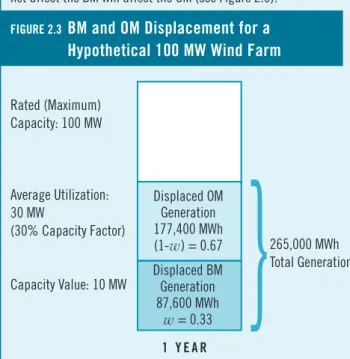
Rated (Maximum) Capacity: 100 MW Average Utilization: 30 MW (30% Capacity Factor) 265,000 MWh Total Generation Capacity Value: 10 MW 1 Y E A RFor the purpose of estimating baseline emissions, generation is what matters, not capacity – baseline emissions are determined by the amount of generation a project activity displaces or avoids. The weight assigned to the BM represents the proportion of a project activity’s generation that would have been provided by new capacity in the baseline scenario. If a project activity is able to fulfill demand for new capacity, then its capacity value is used to determine the maximum level of firm generation it can provide, and therefore the level of displaced BM generation.
For any given time period, displaced BM generation is calculated by multiplying the project activity’s capacity value by the number of hours in that time period. For example, a project activity with a capacity value of 10 MW would displace 87,600 MWh of BM gener-ation over one year (10 MW x 8,760 hours/year). The appropriate value for
w
(i.e., the weight assigned to the BM) is determined by comparing this level of generation to the project activity’s total expected generation over the same time period. Total expected generation is determined from the project activity’s expected capacity factor, or average utilization. A 100 MW wind farm with a capacity factor of 30 percent, for example, would have an average utilization of 30 MW and would produce a total of 265,000 MWh per year. If it had a capacity value of 10 MW, the appropriate value forw
would be (10 MW / 30 MW) = 0.33. Any generation that does not affect the BM will affect the OM (see Figure 2.5).FIGURE 2.3
BM and OM Displacement for a
Hypothetical 100 MW Wind Farm
A couple of caveats apply to this approach. First, capacity value is generally determined according to a project’s statistically reliable output during times of peak load, which is not necessarily the same as its continuously reliable output over a year. If a project’s reliable output is higher (or lower) during times of peak demand than at other times, its designated capacity value may be too high (or too low) for the purpose of determining displaced BM capacity. Second, using this approach requires a reasonably good estimate of the project’s expected capacity factor. The expected capacity factor should be based on the same set of assumptions about its opera-tion that is used to determine its capacity value.
B O X 2 . 2
“Baseline Candidates” and the
“Continuation of Current Activities”
Abaseline candidateis an alternative technology or practice that could provide the same product or service as the project activity. For grid-connected project activities, baseline candi-dates will consist of different types of power plants that could have been built in place of the project activity. In other words, they will be BM alternatives. Baseline candidates for the BM are identified by following the requirements of theProject Protocol,using the guidance in Chapter 7 of these guidelines.
A baseline scenario involving thecontinuation of current activ-itiescan mean different things depending on the type of project activity (see Chapter 8 of theProject Protocol,including Box 8.7). For grid-connected project activities, the continuation of current activities means that existing power plants would have provided the generation produced or avoided by the project activity. The continuation of current activities thus equates to generation at the OM.
Displaced OM Generation 177,400 MWh (1-
w
) = 0.67 Displaced BM Generation 87,600 MWhw
= 0.33}
2.8
Grid Boundaries
Accurately calculating both BM and OM emissions requires defining the boundaries within which electricity generation is displaced or avoided. Although it is often possible to obtain data on GHG emissions and power generation within legal or political boundaries (e.g., by country, state, or province), these data may not correspond to the sources of GHG emissions affected by a project activity. Grid-connected project activities will generally only affect power generation and GHG emissions on the same grid. Where a power grid is connected to other grids, the project activity may also affect generation on neighboring grids. In any case, the geographic area within which to evaluate baseline emissions will be determined by grid boundaries, not legal or political boundaries.
The boundaries of a power grid will be determined by technical, economic, and regulatory-jurisdictional factors. Regardless of these factors, generation on a grid must be coordinated in order for it to function properly, so a central grid operatoris required to dispatch power plants in accor-dance with engineering and economic constraints. The precise institutional nature of the grid operator will differ from system to system.8Nevertheless, the simplest way to define grid boundaries is according to the set of power plants and transmission lines under the control of a single grid operator.
In the context of theProject Protocol,grid boundaries determine the geographic area within which “baseline candidates” are identified (see Chapter 7 of theProject Protocol). The grid boundary should not be confused with the “GHG Assessment Boundary” (Chapter 5 of theProject Protocol), which defines and encompasses all GHG emission sources affected by a project activity – including those that are unrelated to BM and OM displacement. For grid-connected project activities, the GHG assessment boundary can encompass unintended changes in emissions from
sources that are not connected to the grid, that are unrelated to fossil fuel combustion, or that may be located in other regions (e.g., where fuel extraction occurs). See Chapter 4 for further guidance.
Section 7.3 of these guidelines provides further guidance on how to define grid boundaries. The grid boundary will be the same for calculating both BM and OM emissions for a given project activity.
2.9
GHG Accounting Principles
The GHG accounting principles outlined in Chapter 4 of theProject Protocolshould always guide decisions about GHG accounting for grid-connected project activities. The principles are:
• Relevance • Completeness • Consistency • Transparency • Accuracy • Conservativeness
Full descriptions of these principles are provided in the Project Protocol. Where appropriate, their application is also discussed in these guidelines. In some cases, it is neces-sary to strike a balance between competing principles. For example, in estimating grid emission factors it may be necessary to sacrifice accuracy for conservativeness where accuracy is difficult or costly to achieve.
C H A P T E R 2 : Key Concepts 16
T A B L E 2 . 2
Options for Estimating Build Margin Emissions
B M I S R E P R E S E N T E D B Y …
The “most likely” capacity alternative
The most “conservative” (least emitting) capacity alternative
A weighted blend of capacity alternatives B A S E L I N E P R O C E D U R E Project-specific Project-specific Performance standard E X P L A N AT I O N
The project-specific procedure is used to identify the capacity alternative (i.e., “baseline candidate”), with the least barriers or greatest net benefits (excluding GHG reduction benefits). This alternative is used to represent the BM and calculate BM emissions. The project-specific procedure is used, but the most conservative viable alternative is chosen rather than the alternative with the least barriers/greatest benefits. BM emissions are calculated from this lowest-emitting alternative.*
The performance standard procedure is used to calculate a BM emission rate. The BM emission rate will reflect a weighted average (or weighted percentile) of the emission rates of different capacity alternatives. * The lowest-emitting alternative is sometimes called a “proxy plant” for the BM, because it is used as a conservative stand-in for the “actual” BM.
N O T E S
1 For full descriptions of these concepts, see Chapter 2 of the
Project Protocol.
2 In theProject Protocol’stypology of GHG sources and sinks (Section 2.3 of theProject Protocol), the category of GHG emissions addressed by these guidelines is referred to as “combustion emissions from grid-connected electricity.” 3 These guidelines do not directly address projects that upgrade or
improve the efficiency of power grid transmission and distribu-tion lines. Although these projects share many characteristics with improvements to end-use efficiency, they usually involve grid-specific engineering interventions whose effects should be modeled to accurately estimate any associated GHG reductions. Such modeling is beyond the scope of these guidelines. 4 Throughout these guidelines, BM and OM emission rates are
referred to as “emission factors” because they are components (factors) of the overall baseline emission rate.
5 This will generally be true if the project activity has a positive “capacity value” and can be relied on to help meet the grid’s peak load requirements. See Annex B for further explanation of these concepts.
6 For further reference, see theProject ProtocolSections 2.7 and 2.8, and Chapter 8. In particular, see Box 8.7 regarding estimation of baseline emissions from the “continuation of current activities.”
7 See Section 2.8 and Chapter 8 of theProject Protocol.
8 Depending on the system, the grid operator may alternately be referred to as a “system dispatcher,” “control area opera-tor,” “independent system operaopera-tor,” “regional transmission organization,” etc.
18
P A R T I : Concepts and Principles
lectricity reduction project activities reduce GHG emissions by avoiding grid-based gener-ation. These project activities involve either: (1) improving the efficiency with which grid electricity is used for a particular application; or (2) generating electricity onsite so that supply from the grid is unnecessary. (These guidelines do not directly address projects that upgrade or improve the efficiency of power grid transmission and distribution systems.)
Electricity Reduction
Project Activities
E
3
In terms of accounting for GHG reductions, electricity reduction and generation project activities can be treated analogously. The difference is that the amount ofavoided generation is used to determine baseline emissions instead of the amount of generation. Whereas project activity gener-ation can be metered and measured, avoided genergener-ation must be inferred from an estimate of the project activity’s electricity savings. Electricity savings can be determined using the same methods prescribed in theProject Protocol for determining GHG reductions, or by using commonly accepted methods developed by energy efficiency experts. In this chapter:
• Section 3.1 explains the two broad types of electricity reduction project activities (individual activities and programs);
• Section 3.2 provides a general overview of appropriate methods for estimating electricity savings;
• Section 3.3 describes how to calculate avoided grid generation from estimated electricity savings; • Section 3.4 discusses how to estimate baseline
emissions and quantify GHG reductions from electricity reduction project activities, using estimates of avoided grid generation.
This chapter is not intended to be a guide to determining electricity savings associated with different types of electric-ity reduction projects. Rather, it provides a general overview that should be supplemented with other guidance and materials. Once electricity savings are determined for a project activity, they can be used in conjunction with the rest of these guidelines to estimate baseline emissions and quantify GHG reductions (as described in Section 3.4).
3.1
Types of Electricity Reduction
Project Activities
Electricity reduction project activities can be broadly grouped into two categories:
• Individual end-user activities.An individual end-user activity is a specific energy-saving measure implemented and managed by an electricity consumer, often at a single facility.
• Wide-area programs.Wide-area programs involve coordinated activities to help a large number of consumers reduce grid electricity consumption. They are typically implemented by utilities, grid operators, non-governmental organizations, or governments, and may involve information and educational campaigns; working with manufacturers and vendors to increase the supply and distribution of energy efficient equipment; and/or financial or other incentives for electricity users to install specific technologies or change their operations in a manner that reduces electricity consumption.
Within these categories, many types of projects are possible. Specific methods for determining electricity savings (and associated GHG reductions) can differ depending on whether projects involve new construction or retrofits; whether they involve energy conservation, efficiency improvements, distributed generation, or demand response programs; and whether they involve individual pieces of equipment or entire energy systems (such as “green” buildings). Detailed guidance related to these different project possibilities is beyond the scope of the guidelines. The following section provides a general overview of methods to determine electricity savings.
3.2
Determining Electricity Savings
Just as GHG reductions involve the absence of emissions, electricity savings involve the absence of electricity use. Like GHG reductions, electricity savings cannot be directly C H A P T E R 3 : Electricity Reduction Project Activities
measured. Instead they are determined by comparing actual electricity consumption with estimates of baseline consumption derived from an appropriate analysis. This chapter briefly describes methods for determining electricity savings that may be used in conjunction with theGHG Protocol for Project Accounting. A full discussion of techniques for determining electricity savings for different types of projects and programs, however, is beyond the scope of these guidelines. References to external standards and documents are provided where appropriate.
The term adjusted consumption baselineis commonly used to describe the amount of grid electricity that would have been consumed without the project activity. The avoided site electricity usage, orelectricity savings,is then determined by subtracting actual electricity consumption during the project activity’s operation from the adjusted consumption baseline. The term “adjusted consumption baseline” is used because estimates of baseline electricity consumption must often be adjusted to account for changes in usage unrelated to the
project activity. For example, if a manufacturing plant’s production level drops, the associated reduction of energy should not be confused with any reduction caused by an efficiency-enhancing project activity. Thus, baseline estimates of electricity consumption generally must be re-stated using actual measurements of project activity conditions. Without such adjustment, a portion of the differ-ence between baseline estimates and project activity usage may be attributed to events unrelated to the project activity. The adjusted consumption baseline may be identified and justified by following the procedures of theProject Protocol, or by using a recognized international standard for evaluat-ing end-user efficiency projects.
3 . 2 . 1 D E T E R M I N I N G T H E A D J U S T E D C O N S U M P T I O N B A S E L I N E U S I N G T H E P R O J E C T P R O T O C O L
TheProject Protocol’smethods for estimating baseline emissions can also be used to determine an adjusted consumption baseline. The full application of theProject Protocolfor this purpose is not presented here. KeyProject Protocolchapters to consult include the following:
• Chapter 5: The GHG Assessment Boundary.Electricity reduction projects may have both intended and
unintended effects on electricity consumption and energy usage, analogous to “primary” and “secondary” effects on GHG emissions. These effects should be considered in determining overall electricity savings and GHG reduc-tions. Guidance from existing energy efficiency project evaluation standards (see next section) can be used to help identify these effects.
• Chapter 7: Identifying the Baseline Candidates.For the adjusted consumption baseline, “baseline candidates” will represent alternative technologies or practices capable of delivering the same end-use service as the project activity. For example, depending on the nature of the project activity, the baseline candidates could be alternative light bulbs that would provide the same amount of illumination; alternative electric motors that would provide the same amount of work; or alternative onsite power generation technologies that would provide the same amount of electricity.
• Chapter 8: Project-Specific Procedure.The project-specific baseline procedure can be used to assess the baseline candidates and identify the most likely baseline scenario alternative. In many cases, especially where the project activity involves an addition or retrofit to existing facilities, the most likely alternative may be the “continu-ation of current activities.”1In these cases, the adjusted consumption baseline can be determined from historical grid electricity usage rates.2Adjustments should be made to re-state this historical usage to what it would be under the actual conditions of the project activity’s operation.
C H A P T E R 3 : Electricity Reduction Project Activities 20
• Chapter 9: Performance Standard Procedure.The performance standard procedure can in some cases be used to estimate the adjusted consumption baseline for energy efficiency project activities. In this case, the performance metric specified (seeProject Protocol Section 9.1) should reflect marginal watt-hours of electricity required per unit of service provided (e.g., marginal kWh per unit of production). The baseline candidates are then assessed using this performance metric. The performance standard will determine the adjusted consumption baseline. In most cases, this should be a better-than-average usage rate (seeProject ProtocolSection 9.4).
3 . 2 . 2 D E T E R M I N I N G T H E A D J U S T E D C O N S U M P T I O N B A S E L I N E U S I N G O T H E R M E T H O D S
Well-developed standards exist for determining the adjusted consumption baseline for individual end-user activities. The Efficiency Valuation Organization’s International Performance Measurement and Verification Protocol (IPMVP),for example, contains extensive guidance for this purpose, including detailed descriptions of computation methodologies and monitoring methods.3 Another industry guideline is the American Society of Heating, Refrigerating, and Air-Conditioning Engineers’ (ASHRAE)Guideline 14-2002.4
For wide-area programs, a number of guidelines have been developed to facilitate estimation of electricity savings, and an extensive body of relevant research is available online. Until recently, these methods have focused on energy savings and or avoided costs of generation from energy efficiency, rather than reductions in GHG emissionsper se.5 GHG reductions can be calculated as a function of electric-ity savings following the guidelines presented in this document. However, due to the frequent involvement of institutional actors, unique considerations may arise in justifying the baseline scenario for wide-area programs (e.g., in the assessment of their barriers and benefits relative to “standard” grid capacity alternatives, following the guidance in Chapter 8 of these guidelines). A full discus-sion of these considerations and related policy questions is outside the scope of these guidelines.
3.3
Determining Avoided Grid Generation
When electrical energy is transmitted and distributed over power lines, a portion of it is lost due to resistance and other forms of dissipation. The amount of electricity delivered to consumers is therefore less than the amount generated at power plants, usually by around 7 to 10 percent. For a project activity that generates electricity, the energy lost over transmission and distribution (T&D) systems before reaching consumers may be assumed to be roughly the same as for the sources of generation the project activity displaces. Thus, a project activity that generates 1 MWh of electricity is assumed to displace 1 MWh of electricity from other sources, even though they may be located elsewhere on the grid.
Analogously, 1 MWh of electricity savings means that more than 1 MWh of electricity no longer needs to be generated by power plants. Thus, in order to estimate grid GHG reductions, electricity savings must be converted to a corre-sponding amount of avoided grid generation. Avoided grid generation should be calculated as follows:
C H A P T E R 3 : Electricity Reduction Project Activities
21
B O X 3 . 1
Using Historical Data to Determine
the Adjusted Consumption Baseline
for GHG Projects
Standard methods for determining an adjusted consumption baseline (such as those described in the IPMVP Volume I) often rely on historical measurements of electricity usage prior to the implementation of a project activity. Using historical information to characterize the baseline implies that the project activity’s baseline scenario involves the “continuation of current activi-ties” (see theProject Protocol,Section 2.8 and Chapter 8). As noted in Section 3.1.1, this may be reasonable for many electric-ity reduction project activities. For the purpose of GHG reduction accounting, however, a full analysis should be conducted to demonstrate that the baseline scenario would not involve an alternative new technology or practice, and would not involve the project activity itself (in which case the project activity would not be additional; see theProject Protocol, Section 2.14).
For example, some project activities may replace obsolete equip-ment with a currently available, standard equivalent. Since technology tends to improve over time, the standard replacement is likely to reduce electricity usage relative to historical levels. At the same time, the replacement would be likely to occur regard-less of any considerations about GHG reductions and climate change. Because of this, the projected baseline scenario would involve the same replacement, so no GHG reductions would occur relative to baseline emissions. For the project activity to produce quantifiable GHG reductions, it would have to involve a more energy efficient model than current “standard” equipment. Where historical measurements are used to determine the adjusted consumption baseline, the methods described under theProject Protocol’sproject-specific baseline procedure (Chapter 8) should be used to confirm that the baseline scenario involves the “continuation of current activities.”
(2)
G E N
proj,t=1
S
-L
t Where:•
G E N
proj,t is total grid generation avoided by the project activity for time periodt
.•
S
tis total electricity savings for time periodt
, derived using an appropriate method as described in Section 3.2. •L
is the average fraction of generated power that is lostwithin the grid where the project activity is located. This fraction can generally be obtained from local grid opera-tors. In some cases, utility companies are also required to report this fraction to their regulator. Where theft or un-metered customers are present, their estimated total consumption should be removed before deriving
L
. The magnitude of line losses can change over time as a grid develops. Thus, the quantity used forL
may be monitored and updated over time as appropriate (see Chapter 12).3.4
Estimating Baseline Emissions and
Quantifying GHG Reductions
Estimating baseline emissions for electricity reduction project activities is done by multiplying avoided generation (
G E N
proj,tin Equation 2) by an appropriate baseline emission rate, determined using the procedures in Chapters 5 through 11 of these guidelines. For the general baseline emissions formula, see Equation 20 in Chapter 11. In deriving a baseline emission rate, the same types of considerations that apply to generation project activities also apply to electricity reduction project activities. The baseline emission rate can have both a BM and OM compo-nent, and the same methods can be used to estimate BM and OM emission factors. The following specific considerations, however, will arise for electricity reduction projects: Chapter 5: Determining the Extent of BM and OM Effects • Many individual end-user project activities are small inscale, and are often implemented for reasons wholly unrelated to grid capacity requirements. These types of project activities will have little or no effect on the BM (see Section 5.2).
• For larger end-user project activities and for wide-area programs, a key consideration will be quantifying their effects on grid electricity consumption and translating these effects into estimates of their “capacity value” and “