Behavioral Health Data Quality Improvement Action Plan
To Support the Creation of the:
National Behavioral Health Dashboard
Overview:
While the community behavioral healthcare system nationally collects a large amount of data, the lack of uniformity in the collection processes has resulted in an inability to share comparable service information with funders at the state and national levels. The lack of an ability to support with data the number of persons served for all funding sources, the services these persons received and the outcomes achieved has resulted in a default funding advocacy position of “we are doing a lot of good, serving a lot of people… trust us!”.
Other segments of the healthcare industry have continued to refine and uniform their data measurement capacities for the funders which have resulted in an increasing disparity between the service level and outcome data being presented by other healthcare entities (i.e., FQHCs, hospital systems, etc.) and the behavioral health system.
The general decline in grant funding support for community behavioral health during the past decade is evidence that the “trust us” approach to funding advocacy is not working. The National Council for Behavioral Health and the Service Process Quality
Management (SPQM) measurement service have joined in a new initiative to support the mining of de-identified aggregate data that has been appropriately transformed to accurately represent national service encounter terminology.
Measurement Capacity Outcomes:
SPQM has been collecting service encounter data for the past twelve years and has utilized more than 100 million behavioral health service encounters derived from multiple transaction platforms in more than 250 community behavioral healthcare providers and statewide data measurement initiatives located nationally.
awareness and advocacy needs. SPQM will deploy for the National Council its own
National Behavioral Health Dashboard secure web portal that will allow secure access 24 hours per day by persons authorized by the National Council to receive a security license.
The site will host standardized dashboards based on the identified measurement needs of the National Council by using de-identified aggregate National Metadata that is available at this time. Also, the dashboard site will support exporting individual reports from the website to local computers.
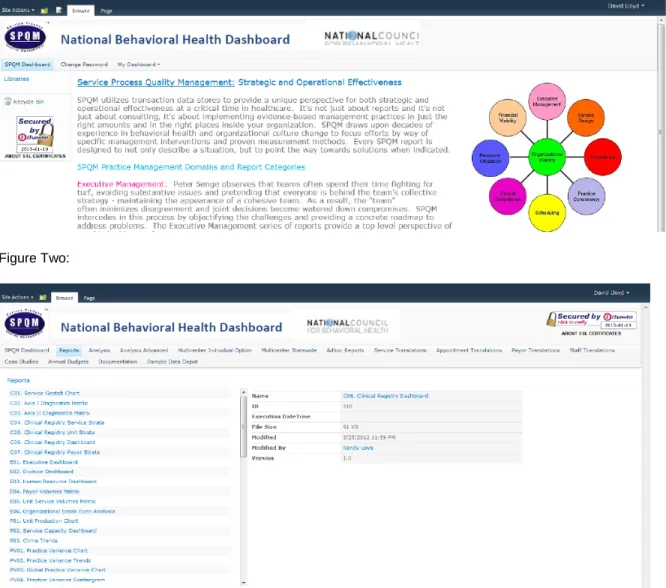
Figure One provides a sample National Behavioral Health Dashboard page and Figure Two provides a sample individual dashboard page.
Figure One:
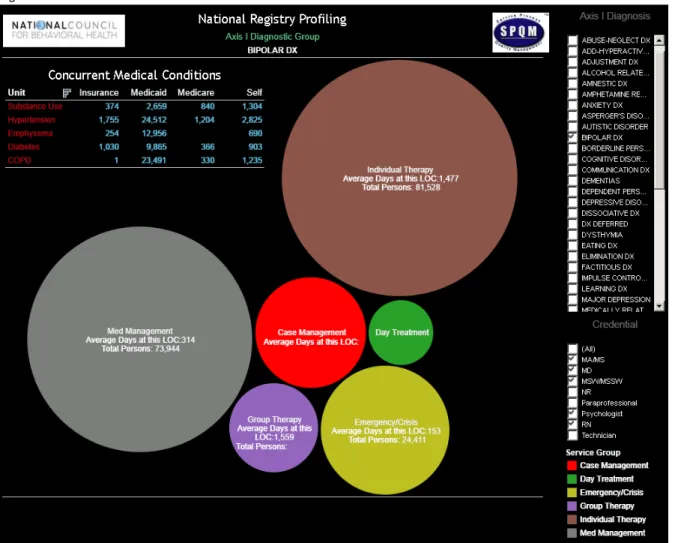
Figure Three provides an example of a specific National Registry Profiling dashboard that allow for interactive selection of specific primary Axis I diagnoses and provide the service array that is being used to treat this diagnosis along with the payers billed for the services. The example given is Bi-Polar Disorder.
Figure Three
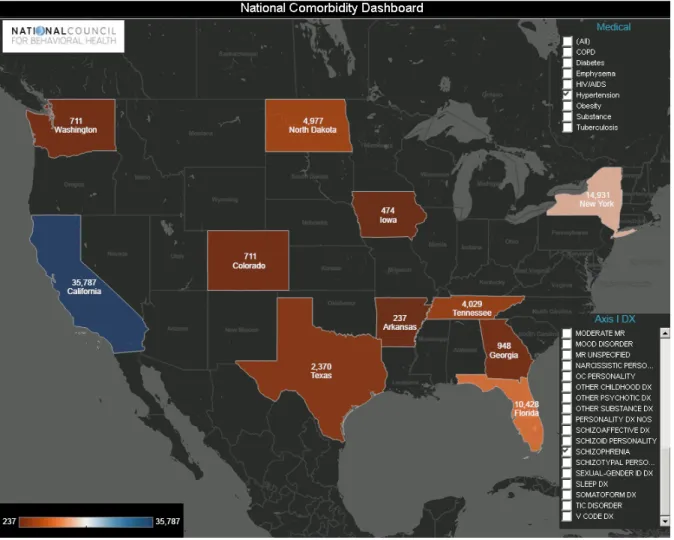
Figure Four on the next page provides a sample dashboard that identifies national co-morbidity rates based on selected medical and Axis I primary behavioral health conditions. The example provided is the prevalence of hypertension and
Schizophrenia. Again the National Council staff can select on the fly the medical and behavioral health combinations and the intensity map will automatically regenerate allowing the resulting report to be exported and used in PowerPoint presentations or printed media.
Figure Four
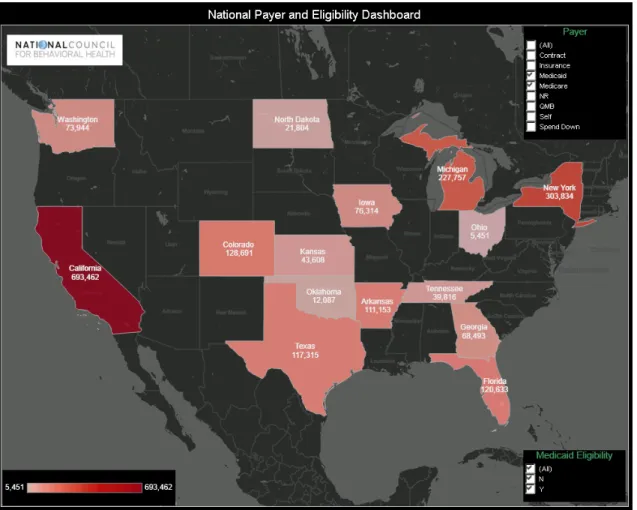
Figure Five provides a sample national payer and client eligibility dashboard indicating the first payers billed for services and an ability to indicate if the clients are Medicaid eligible or not. This approach can be used to compare the level of private third party insurance payers for services as more and more states implement health insurance exchanges. Likewise, as more clients become eligible for Medicaid benefits under the ACA, the change in payer status can be tracked.
Figure Five
Scope of Work:
To move the National Behavioral Health Dashboard plan forward, specific actions will need to be taken as outlined below:
1. The National Council will take the lead in contacting all current local and state level behavioral health entities contributing data to the SPQM data warehouse to request their voluntary participation in the plan. The recommended focus of communication is outlined below:
Community behavioral health organizations are the backbone of the public mental health and addictions safety net throughout the country. Historically, the public mental health and addictions system has been separated from the rest of the healthcare system, underfunded, frequently misunderstood, and ignored by
policy-state and county revenue collection, has presented a profound challenge to our nation’s mental health and addictions safety net system.
Additionally, with the continued economic downturn, states have been unable to allocate sufficient funds to support Medicaid, which serves as a major funding source for community mental health and addictions services and is funded through state and federal obligations. The loss of enhanced federal financing for Medicaid will likely result in additional cuts to provider rates and available services and accelerate actions by states to adopt managed care for aged, blind, and disabled populations.
Request Your Assistance and Participation:
The National Council has asked MTM Services to amend its SPQM contract to allow for the analysis of de-identified data at the state level, and aggregated across participating CBHOs/participating states to support ongoing state and federal advocacy to protect funding for community behavioral health services and to support national policy efforts. This effort would provide valuable information to support policy advocacy on your behalf.
Please complete the attached Participation Agreement e-Form and return it to the National Council indicating your willingness to participate and/or your need for additional information about the national data quality improvement initiative.
NOTE: Additional support to encourage participation can be generated at the
upcoming National Council Conference in Las Vegas by inviting the current SPQM clients to attend an information session to share the vision of the new National Behavioral Health Dashboard capacity and benefits.
2. SPQM will develop a set of metadata that can be used at the national level to support transforming aggregate data to comparable national identifiers for:
a. Service Types/Groups b. Primary Diagnostic Groups c. Primary Funders
d. Gender
e. Population Groups – Child/Adolescent, Adult and Senior Adult
f. National Data Quality Indicators among them are practice variance indicators g. Service Density Indicators by CPT and Diagnostic Profile
h. National Norms for Practice Variance and Related Costs and Revenues i. Measures will be client counts, transactions and direct service hours
3. If the proposed national measurement model is supported, SPQM will confirm the estimate of costs to:
a. Transform the data currently in individual data marts based on respective permissions received
b. Create a new National Behavioral Health Data Mart that will contain the National Metadata for a trend period which will be stored in a separate data mart within the SPQM Data Warehouse.
c. Create and deploy the National Council’s web portal to host the National Behavioral Health Dashboards
d. Develop specific dashboards that are needed for advocacy and information sharing
e. Provide support for the issuance of security license for the persons authorized by the National Council
Implementation Timeline:
It is estimated that it will take approximately three months from funding availability and permission from service encounter data contributors to fully populate and deploy the National Council’s web portal.
Please confirm if there is additional information needed to support this action plan and/or confirm if a demonstration of the web portal model and its capacity are needed.