† Currently R&D Strategy Department *1 Home UTM
: A trademark of NTT DOCOMO, Inc.
*2 onefoneTM: A trademark of NTT DOCOMO,
Inc.
*3 IEEE 802.11a/b/g: WLAN standards speci-fied by IEEE using the 5.2 GHz and 2.4 GHz frequency bands and supporting a maximum bit rate of 54 Mbit/s.
Home U Service System
Home Zone Broadband IMS
1. Introduction
The upgrading of home Internet connections to broadband (high-speed, large-capacity service) and the evolu-tion of Internet Protocol (IP) technolo-gy in recent years have led to the devel-opment and diffusion of video-delivery and IP Telephony services for the con-sumer market. At the same time, the mobile terminal, which was traditional-ly used outdoors as a matter of common sense, has come to be used even inside the home as a personal tool. The use of rich content like music and video from mobile terminal is also becoming popu-lar.
An example of IP Telephony ser-vice provided by NTT DOCOMO is “Business mopera IP Centrex,” which was launched in November 2006 as an in-office solution for corporate users [1].
In contrast, the Home U service launched in June 2008 targets general FOMA users and typical user environ-ments like the home. This service, which is in the vanguard of the broad-band mobile phone market, allows users to enjoy high-speed packet com-munications and flat-rate IP Telephony with the N906iL onefoneTM*2 FOMA/WLAN dual terminal [2] using an existing fixed broadband line and wireless LAN (WLAN) router also known as a Home GateWay (HGW).
This article describes the Home U service and system and describes the service implementation method.
2. Home U Service
Overview
2.1 Provided Services
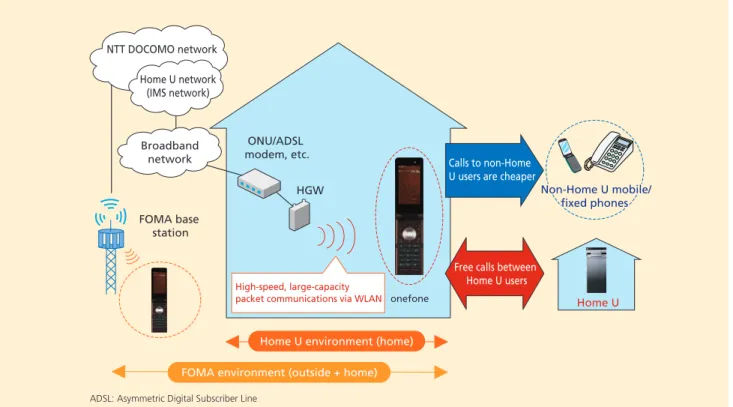
The Home U service overview is shown in Figure 1and the specific ser-vices that can be used under Home U
are summarized below.
1) High-speed Packet Communications With Home U, users can enjoy high-speed packet communications over WLAN. The onefone terminal conforms to the Institute of Electrical and Electronics Engineers (IEEE) 802.11a/b/g*3 WLAN standards enabling packet communications at a maximum 54 Mbit/s (specification value) during transmission and recep-tion.
2) IP Telephony
In addition to mobile phone num-bers used by FOMA services (090/080 numbers), IP Telephony numbers (050 numbers) have been newly assigned for Home U use and Voice over IP (VoIP) calls using 050 numbers can be made. Frequently used FOMA network ser-vices can also be accessed as usual in Home U.
Home U Service System
Bunshin Yamauchi Koichiro Kunitomo Ken Uchiyama†
Satoru Imai
A system has been developed for the Home UTM*1 consumer-oriented service that allows users to enjoy high-speed packet communications and flat-rate VoIP from FOMA/WLAN dual terminals in a home broadband environment.
2.2 Service Requirements In planning the Home U service, it was decided that the following features must be provided.
• A “Home U area” formed by con-necting an HGW to a broadband line in a user’s home must provide added value to the “home zone”— the most prominent space in the use of mobile terminals in daily life. • Large-capacity content like music
and video must be processed at high speed to enhance the enjoyment factor.
• VoIP communications with more reasonable calling rates must be
supported.
• Setup of Home U must be simple. • IP Telephony “class C” overall
voice transmission quality as described in a ministerial ordinance [3] on technical standards based on the Telecommunications Business Law must be guaranteed. IP
Tele-phony quality classes*4are shown in
Table 1 [4].
• Advanced user authentication on the same level as FOMA must be provided and an IP security (IPsec) tunnel between the onefone and Home U network must be estab-lished.
*4 IP Telephony quality classes: class A sat-isfies the same quality requirements as conven-tional fixed-line phones, class B is equivalent to mobile-phone quality, and class C indicates the minimum level that must be maintained in calls. (Here, the expressions “as in fixed-line phones” and “as in mobile phones” relate to general voice transmission quality rate
(R-value). They are not meant to mean that end-to-end delay or other functions must satisfy fixed-line-phone or mobile-phone levels.
ADSL: Asymmetric Digital Subscriber Line ONU: Optical Network Unit
FOMA base station
HGW ONU/ADSL modem, etc.
Home U environment (home) FOMA environment (outside + home)
Free calls between Home U users Home U Non-Home U mobile/ fixed phones Non-Home U mobile/ fixed phones Calls to non-Home
U users are cheaper
onefone High-speed, large-capacity
packet communications via WLAN Broadband
network (IMS network)
Figure 1 Home U service overview
Class A (as in fixed-line phones) General voice transmission
quality rate (R-value) *1
End-to-end delay
>80 <100 ms
Class B (as in mobile phones)
>70 <150 ms
Class C
>50 <400 ms
*1 R-value: A value specified by ITU-T G.107 calculated from network and terminal quality factors. Calculated from 20 types of input parameters such as noise, sound quality, echo, delay, and gaps. ※1 Figures in the table are satisfied with a 95% probability.
3. System Overview
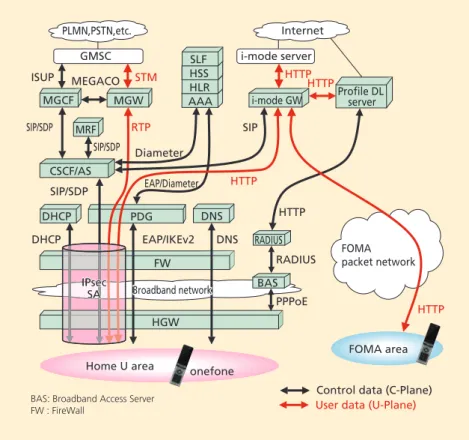
To realize the Home U service, we deployed functions and designed the system in accordance with the above service requirements and based on the IP Multimedia Subsystem (IMS)*5[5] and Interworking-Wireless Local Area Network (I-WLAN)*6[6] standards conforming to the 3rd Generation Part-nership Project (3GPP).3.1 System Configuration The configuration of the Home U network is shown in Figure 2. In the current development, we deployed an
array of functions for the Home U net-work such as Packet Data Gateway (PDG) for terminating an IPsec tunnel (hereinafter reffered to as “IPsec Secu-rity Association (IPsec SA)”), Call State Control Function (CSCF) for per-forming session control by Session Ini-tiation Protocol (SIP)*7, Application Server (AS) for achieving IMS ser-vices, Authentication, Authorization and Accounting (AAA) functions and Home Subscriber Server (HSS) for managing authentication and subscriber information, and Subscriber Locator Function (SLF) for identifying a user’s HSS.
In addition, functions previously deployed for the Business mopera IP Centrex system are being used here for the Media Gateway Control Function (MGCF) and Media GateWay (MGW) that provide interconnectivity with existing circuit switching networks such as Public Land Mobile Networks (PLMNs) like FOMA and the Public Switched Telephone Network (PSTN). These previously deployed functions are also being applied to the Media Resource Function (MRF) that per-forms media processing such as guid-ance playback. Likewise, functions pre-viously deployed for the “mopera U”*8 [7] system are used for the Remote Authentication Dial In User Service (RADIUS)*9server that performs Point-to-Point Protocol over Ethernet (PPPoE)*10authentication. Using previ-ously deployed functions in this way makes for efficient function deploy-ment and speedy service provision.
Finally, to simplify onefone profile settings, the profile DownLoad (DL) server equipped with a profile creation function and profile DL function is deployed in the FOMA network.
3.2 Always-on Connection NTT DOCOMO introduced IMS in PushTalk [8], a Push-to-Talk over Cel-lular (PoC)*11service that was launched in November 2005. PushTalk uses the FOMA packet network, that is, the General Packet Radio Service (GPRS)
*5 IMS: A communication system standardized by 3GPP for achieving multimedia services by integrating communication services of the fixed-line network, mobile communications network, etc. using IP technology and SIP (see *7) protocol as used in VoIP.
*6 I-WLAN: A standard defined by 3GPP to enable interworking between 3GPP systems
and WLAN.
*7 SIP: A call control protocol defined by the Internet Engineering Task Force (IETF) and used for IP Telephony with VoIP.
*8 mopera U: Internet connection service for NTT DOCOMO FOMA users.
*9 RADIUS: A protocol standardized by IETF for uniform management of network user authenti-cation and usage records.
*10 PPPoE: A protocol standardized by IETF to enable PPP to be used on Ethernet.
*11 PoC: A half-duplex-type voice communication service standardized by OMA (see *24) for using a mobile terminal as a transceiver.
Home U Service System
Broadband network Broadband network HGW PDG CSCF/AS MGCF MGW HLR HSS MRF EAP/IKEv2 SIP/SDP RTP SIP/SDP HTTP GMSC STM ISUP DHCP MEGACO SIP/SDP FW AAA Diameter SLF RADIUS HTTP PLMN,PSTN,etc.
Control data (C-Plane)
User data (U-Plane)
i-mode server SIP Internet RADIUS PPPoE BAS Profile DL server FOMA area HTTP FOMA packet network i-mode GW DNS DNS DHCP IPsec SA IPsec SA onefone Home U area HTTP HTTP
BAS: Broadband Access Server FW : FireWall
EAP/Diameter
nection bearer to the IMS network. Here, bearer settings and registration with the IMS network are performed whenever sending and receiving a call to make efficient use of radio resources. In contrast, Home U uses WLAN and the broadband network as an IP-CAN, and whenever a onefone is with-in range of the Home U area, the sys-tem is always in a bearer-established and IMS-registration-completed state. Taking advantage of the WLAN bearer feature whereby radio resources can be shared by several people, the system provides an always-on connection to the Home U network enabling session setup time for IP Telephony or packet communications to be shortened.
3.3 Quality Control Functions With Home U, providing VoIP via WLAN and the broadband network incurs the risk of degraded voice quality due to delays, fluctuations, etc. It is also known that call quality can deteriorate in an environment mixed with data communications. To ensure voice qual-ity under such conditions, Home U incorporates a Call Admission Control (CAC) function and Quality of Service (QoS) control function.
The CAC function limits the num-ber of onefone terminals that can receive signals under one HGW. Since Network Address Port Translation
different Remote IP address*13. By hav-ing the PDG associate Remote IP addresses with global IP addresses on the Wide Area Network (WAN) side of the HGW, the number of onefone ter-minals that can receive signals under one HGW can be managed.
The QoS control function is achieved by mapping the Type of Ser-vice (ToS) / Differentiated SerSer-vices (DS)*14field in the Remote IP header of downlink (from the Home U network to onefone) packets to the ToS/DS field in the transport IP header at the PDG. In this way, an HGW that supports Wi-Fi MultiMedia (WMM)*15can prioritize those downlink packets that are voice packets and transmit them to the onefone. On the onefone side as well, WMM can be supported so that voice packets among uplink (from onefone to the Home U network) packets can be
ets on both the uplink and downlink in the WLAN link to be given priority over data communication packets. As a result, high-quality calls can be achieved even in an environment mixed with data communications.
3.4 Security Functions
Home U incorporates various secu-rity functions to protect user communi-cations over WLAN and the broadband network.
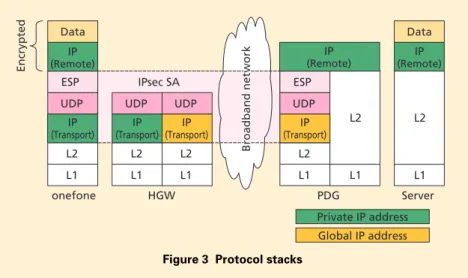
For the WLAN link in the user’s house, packets are concealed by using a function like Wi-Fi Protected Access 2 Pre-Shared Key (WPA2-PSK)*16, and for the link between onefone and PDG, packet concealment and packet-alter-ation detection is handled by Encapsu-lating Security Payload (ESP)*17. The protocol stacks for onefone, PDG, and server are shown in Figure 3.
*12 IP-CAN: An access network for connecting to the IMS network.
*13 Remote IP address: In this article, a private IP address within IPsec SA allocated to a one-fone terminal for communicating with the Home U network.
*14 ToS/DS: One of several fields included in the header of an IP packet. Used for specifying the packet’s priority for the purpose of QoS con-trol.
*15 WMM: A standard specifying data priority processing and power-saving functions for Wireless Fidelity (Wi-Fi) to guarantee inter-connection between 802.11a/b/g products.
*16 WPA2-PSK: A WLAN security system stan-dard for Wi-Fi conforming to IEEE 802.11i and having downward compatibility with WPA.
*17 ESP: A function performing IP-packet authen-tication and encryption standardized by IETF. L2 UDP ESP L2 UDP ESP IP (Remote) IP (Remote) IP (Remote) Data L2 L2 IP (Transport) IP (Transport) IP (Transport) IP (Transport) IPsec SA L1 onefone PDG L1 Server Data L1 L1 Private IP address Global IP address Encrypted
Broadband networkBroadband network
L2 UDP L2 UDP HGW L1 L1
Authentication is automatically per-formed by Extensible Authentication Protocol-Authentication and Key Agreement (EAP-AKA)*18using infor-mation stored in the Universal Identity Module (UIM), i.e. the FOMA card, at the time of IPsec SA setup. This enables advanced user authentication on the same level as FOMA in contrast to IP Telephony service provided by a general ISP in which the user is asked to input an ID and password.
4. Service
Implementa-tion Method
This chapter describes the functions deployed for providing the Home U
service.
4.1 Preliminary Communication Settings
Various preliminary settings are needed before using Home U services such as VoIP or i-mode communica-tions.
1) Profile DL Function
To connect to the Home U network, the onefone needs to set a WLAN con-nection profile such as the Extended Service Set IDentifier (ESSID)*19and a SIP connection profile such as a SIP address (Public User Identity: 050-number@domain) that acts as a phone number in the Home U service.
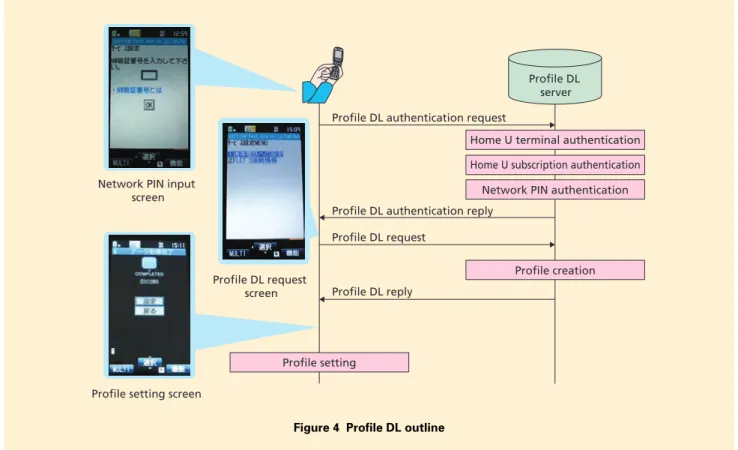
The profile DL process is shown in
Figure 4. The onefone connects to the profile DL server described above by Hyper Text Transfer Protocol (HTTP) using the FOMA packet network (pro-file DL authentication request). The profile DL server checks whether the terminal is Home U-compatible and whether a Home U subscription exists, and carries out authentication by a net-work PIN. Then, on receiving a request for profile from the onefone (profile DL request), the profile DL server gener-ates user-dependent information (ESSID, SIP address, etc.) and user-independent fixed information (profile name, security system, etc.) (profile
*18 EAP-AKA: An authentication and key-sharing system for third-generation mobile communi-cations standardized by IETF.
*19 ESSID: A network identifier in IEEE 802.11. An access point and WLAN terminal having the same ESSID can communicate.
Home U Service System
Profile DL server Profile DL authentication request
Profile setting
Network PIN authentication Home U terminal authentication Home U subscription authentication
Profile DL authentication reply Profile DL request
Profile DL reply
Profile creation Network PIN input
screen
Profile DL request screen
Profile setting screen
required information (profile setting) [9].
In addition to the above, “Home U Configuration Software” can be used on a PC to connect to the profile DL server via the Internet so that profile settings like ESSID, security system, and PPPoE information can be made in an HGW too.
2) IP-CAN Setup
In Home U, the HGW in the user’s home connects to the Home U network via a broadband network. It is therefore necessary for a PPPoE link to be estab-lished from the HGW beforehand to put the system in a state where it can con-nect to the Home U network.
3) IPsec SA Setup
On entering the Home U area, the onefone establishes a WLAN connec-tion with the HGW according to the previously set profile.
Provided that the WLAN connec-tion profile in quesconnec-tion is for Home U use, an IPsec SA is established between the onefone and the PDG by Internet Key Exchange version 2 (IKEv2)*20.
Before establishing the IPsec SA, the onefone requests the Domain Name System (DNS) server specified in the profile to resolve the WLAN Access Point Name (W-APN) and then speci-fies the PDG to set up the IPsec SA.
At this time, the onefone also sets information for identifying the type of
can be provided in accordance with ter-minal capability.
The Home U area is a private IP network in the user’s home. As described above, the system performs NAPT between the onefone and PDG. Consequently, by adding a User Data-gram Protocol (UDP) header using Net-work Address Translation-Traversal (NAT-T)*21, an IPsec SA can be estab-lished between the PDG and a onefone terminal in range of the HGW (Fig. 3). 4) SIP Registration
A onefone terminal performs SIP registration after setting up IPsec SA. First, the onefone requests a Proxy-CSCF (P-Proxy-CSCF) address from the Dynamic Host Configuration Protocol (DHCP) server, which was assigned when setting up the IPsec SA.
The onefone then sends the SIP REGISTER method (hereinafter referred to as “REGISTER”) to the P-CSCF. On receiving REGISTER, that P-CSCF sends REGISTER to an Inter-rogating-CSCF (I-CSCF), which requests a suitable Serving-CSCF (S-CSCF) from SLF/HSS using Diame-ter*22. The I-CSCF then forwards REG-ISTER to that S-CSCF. This S-CSCF performs registration processing for HSS using Diameter, stores the profile for the user in question, and returns a reply to REGISTER to the originating onefone via the above P-CSCF.
Among the services provided under FOMA i-mode, Home U can provide communication services on the occa-sion of a user operation like accessing a site and a “push” operation on the one-fone from the NTT DOCOMO-network side such as receipt of i-mode mail or i-channel*23information. Home U can also perform FOMA communications from within the Home U area based on a mobile terminal operation performed by the user. Here, the NTT DOCOMO network decides whether certain com-munications are of the FOMA or Home U type so that services applica-ble to each type can be provided. 1) Home U i-mode Connection
When setting up an IPsec SA, the i-mode GateWay (GW) receives user information from the PDG and saves the state of that user.
In the Home U system, Home U i-mode communications and FOMA i-mode communications converge at the i-mode GW. Here, at the time of a push operation (such as incoming mail), the i-mode GW decides the transmission path in FOMA or Home U depending on the type of push service (i-mode mail, i-channel, etc.) and the user’s FOMA/Home U in-range status. 2) Push System
To perform a push operation on a onefone via the Home U network at the time of incoming i-mode mail or an
*20 IKEv2: A key management protocol standard-ized by IETF.
*21 NAT-T: Technology standardized by IETF enabling SIP to be used in a NAT environment. *22 Diameter: A RADIUS-enhanced protocol
standardized by IETF.
*23 i-channel: An information delivery service for FOMA i-mode users in NTT DOCOMO.
i-channel information update, the sys-tem uses the SIP-Push procedure stan-dardized by the Open Mobile Alliance (OMA)*24[10]. Multiple systems have been specified for OMA SIP-Push, but to simplify SIP registration processing for the onefone in the Home U network, a system that uses the SIP MESSAGE method (hereinafter referred to as “MESSAGE”) was adopted. Here, a MESSAGE that is generated at i-mode GW arrives at the onefone via I/S/P-CSCF. If the user is in an IPsec SA-established state in the Home U area, i-mode GW generally performs a push on the onefone by way of the Home U network, but if i-mode communications as in accessing a site or getting mail are being performed via the FOMA net-work, the i-mode GW will perform the push via the FOMA network along the same path as the above communica-tions.
Although an out-of-service condi-tion can be detected by a periodic health check performed by the PDG on the onefone, a SIP-Push can fail due to the time interval between moving and detecting the out-of-service condition. To cover such a situation, the i-mode GW is equipped with a function that retries the push operation from the FOMA network when the SIP-Push fails in the Home U network.
4.3 VoIP Communications Control
The following describes VoIP com-munications control for IP Telephony services.
1) Connecting within the Network Given that an originating onefone is in range of a Home U area and is call-ing in WLAN mode, the onefone sends a SIP INVITE method (INVITE) to the P-CSCF (originating P-CSCF) used at the time of registration. The originating P-CSCF then sends the INVITE to the S-CSCF under which the originating onefone resides (originating S-CSCF). The originating S-CSCF now deter-mines from a number translation table that the destination number belongs to its own network (050 numbers for Home U use), and it derives from an SLF/HSS inquiry the S-CSCF under which the terminating onefone resides (terminating S-CSCF) and sends the INVITE to the terminating S-CSCF. Next, the terminating S-CSCF sends the INVITE to the terminating onefone via the P-CSCF. Finally, in response to the incoming call, the terminating onefone performs an off-hook operation that generates the sending of a reply to INVITE to the originating onefone via the P/S-CSCF thereby establishing a VoIP session. This procedure for estab-lishing a VoIP session includes media information negotiation in the body of INVITE and reply messages based on the offer/answer model of Session
Description Protocol (SDP). As a result, Real-time Transport Protocol (RTP)*25 packets can be directly exchanged between the originating and terminating terminals. The VoIP session so estab-lished generally uses ITU-T G.711*26as a voice codec resulting in high-quality voice calls on the same level as PSTN.
During a VoIP session, the P-CSCF performs SIP-based health check on the onefone at short intervals enabling an out-of-service condition to be detected early and also reducing power con-sumption of the onefone.
2) Connecting with Other Networks As described above, the Home U network allows VoIP-based calls using SIP/RTP IP protocols. Thus, when interconnecting with an existing circuit-switched network like FOMA, inter-working with ISDN User Part (ISUP) and Synchronous Transfer Mode (STM) signals becomes necessary. When the S-CSCF determines from a number translation table that the desti-nation number belongs to another net-work, it sends the INVITE to MGCF where a SIP-to-ISUP conversion is per-formed. The system then performs syn-chronization using MGW and MEdia GAteway COntrol (MEGACO) and converts from RTP to STM enabling interconnection with an existing net-work.
As for an incoming call from anoth-er network into the Home U network, an ISUP Initial Address Message
*24 OMA: An industry standardization organiza-tion that aims to standardize service and appli-cation technology and achieve interoperability in mobile communications.
*25 RTP: A protocol standardized by IETF for delivering voice, video, and other media in real time.
*26 G.711: A standard specification for 64 kbit/s fixed bit rate voice encoding defined by International Telecommunication Union Telecommunication Standardization Sector (ITU-T) and used for transmitting voice signals
in a fixed telephone network.
(GMSC) is converted at the MGCF and sent to I-CSCF as an INVITE message. The I-CSCF then executes an SLF/HSS inquiry using Diameter and sends INVITE to the terminating S-CSCF. Finally, in the same way as described above, the INVITE message arrives at the terminating onefone via P-CSCF enabling the call to be connected.
5. Conclusion
This article outlined the Home U service and system and described the service implementation method. We expect Home U to make the use of mobile phones even more convenient within the home zone.
Home U system to achieve, for exam-ple, interworking with the home net-work and automatic delivering of updated information and large-capacity content based on in-range status.
References
[1] N. Matoba et. al: “Business mopera IP Centrex Service System,”NTT DoCoMo Technical Journal, Vol. 8, No. 4, pp. 4-10, Mar. 2007 .
[2] Y. Morinaga et. al: “FOMA / WLAN Dual Terminal (onefone), NTT DOCOMO Techni-cal Journal, Vol. 10, No. 3, pp. 12-16, Dec. 2008.
[3] Ministry of Internal Affairs and Commu-nications, “Specifying Details of Regula-tions for TelecommunicaRegula-tions Facilities for Telecommunications Business”(In
nications: “Study Group on IP Network Technology Report,”Feb. 2002 (In Japan-ese) .
[5] 3GPP TS 23.228: “IP Multimedia Subsys-tem (IMS); Stage 2”
[6] 3GPP TS 23.234: “3GPP system to Wire-less Local Area Network (WLAN) inter-working; System description”
[7] M. Takehara et. al: “M1000 and MAPS for Expansion of Business-Oriented Ser-vices,”NTT DoCoMo Technical Journal, Vol. 7, No. 2, pp. 46-53, Sep. 2006. [8] N. Yoshida et. al: “PushTalk Service
Sys-tem,”NTT DoCoMo Technical Journal, Vo. 7, No. 4, pp. 4-12, Mar. 2006 . [9] Y. Morinaga et. al: “N902iL:
FOMA/Wire-less LAN Dual Terminal,”NTT DoCoMo Technical Journal, Vol. 9, No. 2, pp. 11-19, Sep. 2007 .