GROWTH IN CITIES
Edward L. Glaeser Hedi D. Kallal Jose A. Scheinkinan
Andrei Shleifer
Working Paper No. 3787
NATIONAL BUREAU OF ECONOMIC RESEARCH 1050 Massachusetts Avenue
Cambridge, MA 02138 July 1991
We are grateful to the National Science, Sloan, and Bradley Foundations for financial support; to Robert Barro, Gary Becker, Carol Heim, Vernon Henderson, Lawrence Katz, Robert Lucas, Sherwin Rosen, Julio Roternberg, T.W. Schultz, and George Tolley for helpful comments; and to Christopher Kim for research assistance. This paper is part of NBER's research program in Growth. Any opinions expressed are those of the authors and not those of the National Bureau of Economic Research.
July 1991
GROWTH IN CITIES
ABSTRACT
Recent theories of economic growth, including Romer (1986), Porter (1989) and Jacobs (1969), have stressed the role of technological spillovers in generating growth. Because such knowledge spillovers are particularly effective in cities, where communication between people is more extensive, data on the growth of industries in different cities allows us to test some of these theories. Using a new data set on the growth of large industries in 170 U.S. cities between 1956 and 1987, we find that local competition and urban variety, but not regional
specialization, encourage employment growth in industries. The evidence suggests that important knowledge spillovers might be between, rather than within industries, consistent with the theories of Jacobs (1969).
Edward L. Glaeser Hedi D. Kallal
Department of Economics Department of Economics
University of Chicago University of Chicago
1126 E. 59th Street 1126 E. 59th Street
Chicago, IL 60637 Chicago, IL 60637
Jose A. Scheinkman Andrei Shleifer
Department of Economics Department of Economics
University of Chicago Harvard University
1126 E. 59th Street Littauer Center 315
Chicago, IL 60637 Cambridge, MA 02138
1. INTRODUCTION
Some historians have argued that most innovations are made in cities (Jacobs, 1969; Bairoch, 1988). The cramming of individuals, occupations, and industries into close quarters provides an environment in which ideas flow quickly from person to person. Jacobs (1969, 1984) argues that these interactions between people in cities greatly facilitate technological advance.
Such a dynamic view of cities fits nicely with the recent work on economic growth, which views externalities (and particularly externalities associated with knowledge spillovers) as the 'engine of growth' (Romer 1986, Lucas 1988). If geographical proximity facilitates transmission of ideas, then we should expect knowledge spillovers to be particularly important in cities. After all, intellectual breakthroughs must cross hallways and streets more easily than oceans and continents. This paper uses a new data set on American cities and industries to test the new growth theories. Because these theories are most compelling in the context of city growth, our focus on cities gives them the benefit of the doubt.
We focus on three theories. The Marshall-Arrow-Romer (MAR) externality concerns knowledge spillovers between firms in an industry. Arrow (1962) is an early formalization; Romer (1986) is a recent and influential statement. Applied to cities by Marshall (1890), this view says that the concentration of an industry in a city helps knowledge spillovers between firms, and therefore the growth of that industry and of that city. A good example would be computer chips in Silicon Valley (Arthur 1990). Through spying, imitation, and rapid inter-firm movement of highly skilled labor, ideas are quickly disseminated among neighboring firms. The MAR theory also predicts, like Schumpeter (1942), that local monopoly is better for growth than local competition, because local monopoly restricts the flow of ideas to others and so
allows externalities to be internalized by the innovator. When externalities are internalized, innovation and growth speed up.
Porter (1990), like MAR, argues that knowledge spillovers in specialized geographically-concentrated industries stimulate growth. He insists, however, that local competition, as opposed to local monopoly, fosters the pursuit and rapid adoption of innovation. He gives examples of Italian ceramics and gold jeweliy industries, in which hundreds of firms are located together and fiercely compete to innovate since the alternative to innovation is demise. Porter's externalities are maximized in cities with geographically specialized, competitive industries.
Jacobs (1969), unlike MAR and Porter, believes that the most important knowledge transfers come from outside the core industry. As a result, variety and diversity of geographically proximate industries rather than geographical specialization promote innovation and growth. One example is the brassiere industry, which grew out of dressmakers' innovations, rather than the lingerie industry. Jacobs also favors local competition because, like Porter, she believes it speeds up the adoption of
technology.
These theories of dynamic externalities are extremely appealing because they try to explain simultaneously how cities form and why they grow. MAR's and Porter's theories, in particular, predict that industries should specialize geographically -- to absorb the knowledge spilling over between firms. In addition, they predict that regionally specialized industries should grow faster because neighboring firms can learn from each other much better than geographically isolated firms. In contrast, Jacobs' theory predicts that industries located in areas that are highly industrially diversified should grow faster. Despite their differences, all these theories have
different from the more standard location and urbanization externality theories that address the formation and specialization of cities (Henderson 1986), but not city
growth.
-Weexamine the predictions of the various theories of knowledge spillovers and growth using a new data set on geographic concentration and competition of industries in 170 of the largest United States cities. We ask which industries in which cities have grown fastest between 1956 and 1987 and why? All three theories of dynamic externalities focus on knowledge spillovers but differ in where they believe the source of externalities is and what makes the capture of these externalities most effective. The theories are not always mutually exclusive but rather offer different views of what is most important. By testing empirically in which cities industries grow faster, as a function of geographic specialization and competition, we can learn which, if any, externalities are important for growth.
Our results can be briefly summarized. Our findings are based on a cross-section of city-industries (e.g., New York apparel and textiles, Philadelphia apparel and textiles, Philadelphia electrical equipment), where knowledge spillovers should be easier to find than by looking at whole cities. In a cross-section of city-industries, we find that, as measured by employment, industries grow slower in cities where they are more heavily overrepresented. For example, the primary metals industry grew rapidly in Savannah, Georgia, where it was not heavily represented in 1956, and declined in Fresno, California, where it was heavily overrepresented. These results do not favor the local within-industry externality theory of MAR and Porter, according to which industries should grow faster precisely in places where they are overrepresented.
We also find that industries grow faster in cities where firms in those industries are smaller than the national average size of firms in that industry. If we take the
viewthat spreading the same employment over more firms increases local competition between these firms and therefore the spread of knowledge, this result supports Porter's and Jacob's view that local competition promotes growth. One could also take the view that smaller firms grow faster, which however is not strictly compatible with the MAR model or with other evidence. Finally, city-industries grow faster when the rest of the city is less specialized. This result supports Jacobs' view that city diversity promotes growth as knowledge spills over industries. The evidence is thus negative on MAR, mixed on Porter and consistent with Jacobs.
If MAR externalities are not important, why are so many cities specialized in a few industries? There are many other externalities that explain regional specialization and city formation but that do not specifically focus on knowledge spillovers and growth. For example, Marshall (1890) has argued that firms in the same industry
often locate next to each other to share various inputs, including specialized labor. Many other "localization" externalities are discussed by Lichtenberg (1960), Henderson (1986, 1988), Arthur (1990), and Rotemberg and Saloner (1990), among others. Henderson (1986) in particular presents empirical evidence indicating that output per manhour is higher in firms that have other firms from the same industry located nearby. Static localization externalities can thus easily account for city specialization, but not for growth.
Finally, there is also some work explaining why firms might want to locate in places where local demand is high, what Henderson (1986) calls "urbanization" externalities. These models tend to predict that firms in different industries should
locate next to each other, which suggests that they cannot be the complete story of cities. Lichtenberg (1960), Murphy, Shleifer and Vishny (1989) and Krugman (1991a,b) all present models of such externalities. Like localization externalities,
urbanization externalities explain patterns of industry location rather than of growth. Wepresent some evidence strongly pointing to theimportance of urbanization externalities.
The next section of the paper goes through the prediction of different views of externalities and city growth. Section 3 describes the data. Section 4 presents results for growth of city-industries. Section 5 deals with localization and urbanization externalities. Section 6 concludes.
2. THEORIES OF DYNAMIC EXTERNALITIES
The models of city growth we consider stress the role of dynamic externalities, and more specifically knowledge spillovers, for city growth. According to these models, cities grow because people in cities interact with other people, either in their own or in other sectors, and learn from them. Because they pick up this knowledge without paying for it, these knowledge spillovers are externalities. The frequency of interaction with other people is ensured by their proximity in a city. Because this proximity makes externalities particularly large in a city, all the models predict that cities grow faster than rural areas where externalities are less important because people interact less.
The theories of city growth that we present differ along two dimensions. First, they differ in whether knowledge spillovers come from within the industry or from other industries. Second, they differ in their predictions of how local competition affectsthe impact of these knowledge spillovers on growth.
The MAR theory of spillovers focuses on spillovers within industry. Knowledge accumulated by one firm tends to help other firms' technologies, without appropriate compensation. In Silicon valley, microchip manufacturers learn from each other because people talk and gossip, products can be reverse engineered, and employees
7
move between firms. In New York, fashion designers move between firms and take their knowledge with them. The same was true of the Bangladeshi shirt industry in the 1980s, where hundreds of firms were founded by people who were initially employed by Jointventure with a Korean firm. Physical proximity facilitates this free information transmission. In this case, industries that are regionally specialized and benefit most from the within industry transmission of knowledge should grow faster. Cities that have such industries should grow faster as well.
In MAR models of externalities, innovators realize that some of their ideas will be imitated or improved upon by their neighbors without compensation. This lack of property rights to ideas causes innovators to slow down their investment in
externality-generating activities, such as R&D. If innovators had monopoly on their ideas, or at least if they had fewer neighbors who imitated them immediately, the pace of innovation and growth would rise. The MAR models tend to imply that whereas local competition is bad for growth, local concentration is good for growth because innovators internalize the externalities (see Romer 1990).
The effect of local competition is the primary difference between MAR and Porter's models. In Porter's model, local competition accelerates imitation and improvement of the innovator's ideas. Although such competition reduces the returns to the innovator, it also increases pressure to innovate: firms that don't advance technologically are bankrupted by their innovating competitors. Porter believes that the second effect is by far the more important. Ruthless competition between local competitors leads to rapid adoption of the innovations of others and to improvement upon them, and so generates industry growth. In contrast, local monopolies lead a quieter life as their managers consume perquisites rather than risk innovation. Porter gives striking examples of Italian ceramics and gold jewelry industries, the German
print making industry and many others which grew through rampant imitation of new technologies and improvement upon them. All these industries are highly
geographically concentrated--presumably to facilitate the flow of ideas and imitation. Because MAR and Porter agree that the most important technological
externalities are within industry, they also agree that regional specialization is good for growth both of the specialized industries and of the cities they are in. However, MAR would argue that local monopoly is good because it allows internalization of externalities. In contrast, Porter would argue that local competition is good because it fosters imitation and innovation. In our empirical work, we will look at the effects of both specialization and local competition on the growth of industries in cities.
The third theory that stresses knowledge spillovers is that of Jacobs (1969). Jacobs' idea is that the crucial externality in cities is cross-fertilization of ideas across different lines of work. New York grain and cotton merchants saw the need for national and international financial transactions and so the financial services industry was born. A San Francisco food processor invented equipment leasing when he had trouble finding financing for his own capital; the industry was not invented by the bankers. In a more systematic account, Rosenberg (1962) discusses the spread of machine tools across industries, and describes how an idea is transmitted from one industry to another. Scherer (1982) presents systematic evidence indicating that around 70 percent of inventions in a given industry are used outside that industry. Much evidence thus suggests that knowledge spills over across industries. Because cities bring together people from different walks of life, they foster transmission of ideas.
In Jacobs' theory, industrial variety rather than specialization is conducive to growth, because in diversified cities there is more interchange of different ideas. She
contrasts Manchester, a specialized textile city that eventually declined, with broadly diversified Birmingham, which eventually flourished. Bairoch supports Jacobs by arguing that ".. . thediversity of urban activities quite naturally encourages attempts to apply or adopt in one sector (or in one specific problem area) technological solutions adopted in another sector' (1988, p. 336).
In the debate between local monopoly and competition, Jacobs comes squarely on the side of competition. She writes: "Monopolies gratuitously harm cities and suppress what their economies are capable of achieving . . . extortionateprices,
harmful though they most certainly are, are the least of disadvantages of monopolies, for monopolies forestall alternate methods, products and services" (1984, p. 227). Like Porter, Jacobs favors local competition because it stimulates innovation.
Figure 1 summarizes the three theories we described. The empty square is the model that would say that the ideas conducive to growth come from outside the industry, but monopoly is best able to take advantage of them. The model does not seem very plausible, and so we leave the square empty. Our next task is to put some empirical structure on this theoretical outline.
3. THE DATA
Construction of the Data Set
Our data set was constructed from the 1956 and 1987 editions of County Business Patterns (CBP), produced by the Bureau of the Census. The year 1956 was chosen because it was the first year with comprehensive data; 1987 was the last year available. 1956 data was assembled by hand from hard copy; 1987 data are available on computer tapes.
establishments2 by 2-digit industry for every county in the United States. We obtained wages by dividing payroll by employment. Since our focus is on cities rather than counties, we aggregate data across counties into metropolitan area units as described below. When counties are aggregated, the wage number is total payroll in a city divided by total employment. Since we run cross-section regressions, we keep all variables nominal.
Cities were constructed from a list of top 170 Standard Metropolitan Areas (SMAs) in 1956 America contained in County Business Patterns Book (CBP). In some cases, an SMA contains several counties; in others (only in New England) several SMAs split a single county. The problem is to decide which counties should be included in a given city, since it would be impractical to include all counties in a SMA. We included in each city the largest counties that cover the SMA until their combined payroll added up to at least 80 percent of the total payroll of the SMA jn both 1956 and ]987. This procedure makes sure that if substantial growth of employment occurred in counties in a SMA that were small or non-existent in 1956, these counties are included in the city. The multi-county unit arrived at using this procedure is the city we focus on.4
2We use the 1956 Census definition of an establishment, which is an actual firm rather than a plant. In later years, the Census redefined the establishment to be a plant. For our purposes, a firm is what's appropriate, so the 1956 definition is good.
3lncluding all the counties that are part of the SMA would be extremely time consuming because to find out which industries in a SMA are the largest--a procedure we use to construct the data—we would have to add up by hand employment in all the potentially largest industries over all the counties. Adding extra counties also
significantly worsens missing data problems discussed below. To simplify the first problem, and to avoid the second, we have restricted the subset of counties included in the city.
4This procedure for constructing a city might introduce errors for larger cities, which cover numerous counties. To test whether this problem is responsible for our results, we repeated the analysis for the smallest 75 percent of the cities in the
For each city constructed through aggregating counties, we use data on the six largest 2-digit industries, where size is measured by 1956 payroll. We only use six industries because we are interested in regionally specialized industries, but also hand collection limits how many industries we can take.
In some cases where an industry in a county has only a few establishments, CBP for confidentiality reasons does not reveal exact information on employment in that county-industry. Instead, they typically present the range in which the employment in a given industry in a given county lies, such as 0 to 20 or 5,000 to 10,000. In a few cases where the employment in a given county-industry is below 50 CBP presents no employment number at all. To construct our sample, we had to address this problem of missing variables, which is particularly severe when a city contains several counties only one of which has missing data.
We addressed this problem as follows. If exact data were missing for some county-industry in 1956, we simply omitted that industry from the sample and replaced it by the next largest industry in that city for which complete data were available for all counties. The missing data problem was not significant in 1956, however, since we are selecting the largest city-industries as of 1956.
If exact data were missing for some county-industry in 1987, we estimated the employment in that county-industry at the midpoint of the range provided by County Business Patterns. For example, if CBP reported the employment in county-industry to be between 0 and 20, we used 10; if the report was between 5,000 and 10,000, we used 7,500. In a multi-county city, we then added these estimates to precise employment numbers for the counties for which they were available. In the few
sample. The results were very similar to the ones reported below. For this reason, we use the whole sample in the results reported in this paper.
county-industries with employment under 50 where CBP did not even provide a range, we used 25 as the employment number. This procedure enabled us to compute employment for all but 4 of the 1706 = 1020 city-industries. The reason we had to drop 4 city-industries is that "ordnance and accessories,' an industry that occurred 4 times in our sample in 1956, was discontinued as a qualified industry by 1987. Of the
1016 city-industries in this sample, employment in 833 was provided exactly, and employment in the other 183 was estimated as described above.
Although CBP presents ranges of employment by county-industry, it does not provide any information on payroll in the cases where exact employment numbers are omitted. As a result, we cannot estimate wages for these observations. Consequently, the wage regressions we present below are estimated on 834 city-industries for which we have exact data on employment and payroll.
Description of the Data
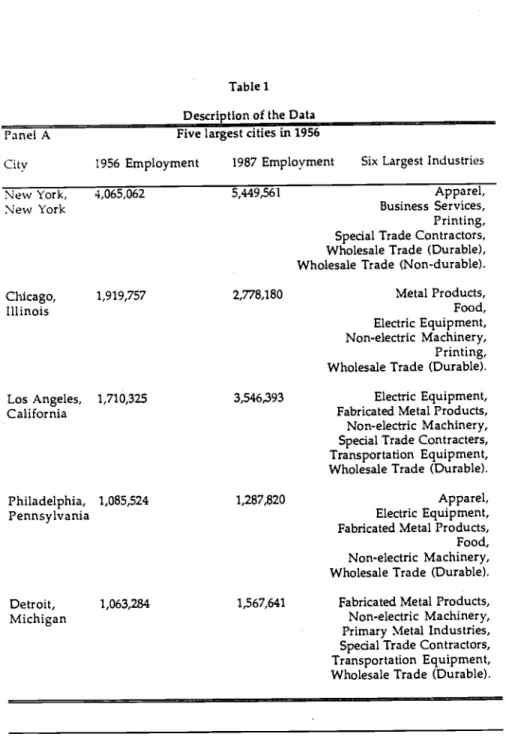
Since we are using a new data set, it may be helpful to present a simple description of the data. This is done in Table 1. The first panel of the Table describes the five smallest and the five largest cities in our sample as of 1956, their employment in 1956 and 1987, and the six largest industries in each of them. Note first that the largest city-New York—has employment of over 4 million, while the smallest—Laredo, Texas—has only 7,500 employees. Clearly our procedure of looking at SMAS gets us down to fairly small places. The panel also shows a great variety of top industries across cities, although wholesale durables and non-durables are big in many of them.
Panel B describes the ten largest city-industries in our sample. New York City apparel is the largest city-industry in the U.S. in 1956 with over 350,000 employees. Transportation equipment in Detroit, which is of course autos, is the third largest. New York City appears six and Chicago two times on this list.
Panel C describes the most common city-industries in the sample. Wholesale trade in durables is the most common: it appears in 146 cities. A few other service categories appear as well, but the predominant type of most common sector is manufacturing. In particular, non-electrical machinery, primary metals, fabricated metals, transportation equipment, and electric equipment all appear quite often. The typical stories of externalities apply to many of these industries. In most of our analysis, we have pooled manufacturing and services, although we discuss below what happens when wholesale trade is removed from the sample, as well as how services are different from manufacturing.
Panel D lists the 5 fastest growing and 5 fastest declining city-industries in terms of employment. The panel gives three impressions. First, rapidly declining city-industries were more regionally concentrated than the rapidly growing ones. Second,
industries grew faster in diversified cities than in specialized ones. Third, fast-growing city-industries were more competitive, as measured by establishments per employee, than shrinking city-industries. All of these three impressions turn Out to be our general empirical findings.
-The panel also shows that the fastest growing city-industries tended to be in the south, west and south-west, whereas the slowest growing city-industries were often in the east and the midwest. This finding points to some basic economic forces at work, such as capital moving to low wage areas. A cynic might say that temperature determined city growth, or that we are only observing the decline of U.S. manufac-turing. These objections are not valid, since we will be comparing how fast the same industry grows in different Cities. We will also control for location in the south.
More importantly, the decline in certain industries (notably steel, but possibly autos as well) may be related to the theories discussed in this paper. Both steel and
auto production were regionally concentrated (autos in Michigan and steel in Pennsylvania). Both industries had only moderate levels of competition. In both industries, innovation was arguably lacking, particularly in areas where these industries were concentrated.
Thesteelindustry, according to Reutter (1988), has missed opportunities which were exploited by their competitors in less sterile environments. Big steel lost market share not only to foreign competitors, but to American mini-mills located in
non-traditional areas such as Roanoke, Virginia, or Florida. Use of concrete in construction also badly hurt steel. The first major use of concrete took place in a Hempstead, Long Island shopping complex, far away from the traditional steel mills. Both concrete and shopping malls were major post-war innovations coming not from the established building material centers (such as Pennsylvania) but from smaller, more diversified areas. The steel industry may have declined not just because of foreign competition or some exogenous decline in manufacturing, but, in part, due to forces stressed by Porter and Jacobs. Our statistical work suggests that this stoiy of steel is a rule rather than an exception.
4. RESULTS ON THE GROWTH OF INDUSTRIES ACROSS CITIES If externalities are important for growth then the clearest way to find these effects is by looking at the growth of the same sectors in different cities, and checking in which cities these sectors grow faster. The unit of observation is then an industry in a city, and we look at the growth rates of these industries as a function of our measures of knowledge spillovers.5 The sample includes 1016 observations on the
5We have also performed the analysis using cities as a unit of observation. These regressions have not produced any statistically significant coefficients on our measures of externalities, although these measures tend to be much cruder for cities than they are for city-industries.
top six 2-digit 1956 industries in 170 cities. Table 2 describes the variables. Since we do not have measures of output, employment growth is our best measure of industry growth.6 The mean of this variable is zero, indicating that in an average city-industry in our sample employment did not grow. The standard deviation of this number, 1, indicates the enormous dispersion of growth records. This dispersion may reflect the decline of some mining and manufacturing industries and the growth of services.
Our measure of specialization of an industry in a city is the fraction of the city's employment that this industry represents in that city, relative to the share of the whole industry in national employment:
industry empl't in city/total empl't in city
(1) specialization . ,
industry empl t in U.S./total empl t in U.S.
This variable measures how specialized a city is in an industry relative to what one would expect if employment in that industry was scattered randomly across the U.S. The variable corrects for situations where a city-industry is large only because the city is large. Because we are looking at the largest industries and because of regional specialization, the mean of this variable is 3.37. In our cities, top industries are overrepresented relative to what one would expect if they were randomly scattered over the United States. Interestingly, the maximum of this variable is 182.35 for anthracite mining in the Wilkes-Barre and Hazleton SMA. The prediction of both MAR andPorter is that high specialization of an industry in a city should speed up growth of that industry in that city.
Our measure of local competition of an industry in a city is the number of firms per worker in this industry in this city relative to the number of firms per worker in this industry in the United States:
6Labor-saving innovations or any growth that mainly affects capital will not he adequately represented by this measure.
—firmsin city-industry/workers in city-industry (2) competition— firmsin U.S. industry/workers in U.S. industry
A
value greater than1 means thatthisindustryhasmore firmsrelative toits size in thiscity than it doesintheU.S. Oneinterpretation ofthevaluegreater than I is that the industry in the city in locally more competitive than it is elsewhere in the U.S. Alternatively, a value of the competition variable greater than I can mean that firms in that industry in that city are just smaller than they are on average in the United States. It is very hard to distinguish smaller firms from more competitive firms using our data. Unfortunately, we do not have data on output of individual firms, and so cannot construct concentration ratios. Since we are looking at industries with large employment in their respective cities, we expect the mean of thiscompetition variable to be below 1; in fact it is .75. Interpreting Porter liberally, a higher value of this measure of competition should be associated with faster growth.
Finally, to address Jacobs' theory we need a measure of variety of industries in the city outside the industry in question. The measure we use is what fraction of the city's employment the largest five industries other than the industry in question account for in 1956. The mean of this ratio is .35: citiesare not well-diversified. The lower this ratio, the more diverse the city is, the faster should the industry in question grow according to Jacobs.
Table 3 presents our results for employment growth across city-industries, with 1016 observations. We include the 1956 log of wage and log of employment in city industry, a dummy variable indicating a southern city, and the national employment growth in that industry as controls in the regressions. City-industries with high initial wages might grow slower because the firms pursue cheaper labor elsewhere. High observed initial employment reduces employment growth because of either measurement error or more serious economic factors. The MAR view is somewhat
incompatible with the presence of real (as opposed to measurement induced) mean reversion, but since we are not correcting for potential measurement problems we do not use such mean reversion as evidence against the MAR externalities. We also include national employment change in the industiy to correct for demand shifts. This correction is particularly important for traditional manufacturing industries, many of which have declined in the post-war United States.
The control variables tend to have the expected signs. High initial employment in an industry in a city leads to slower growth of that industry's employment.
Employment in an industry in a city grows faster when employment in that industry in the whole country grows faster. Interestingly, the coefficient on national industry employment growth is above 1. Factors shifting employment in national industries seem to be more influential in urban than in rural areas. Southern cities also grew significantly more than cities outside the south. Somewhat surprisingly, initial wages in a city-industry are uncorrelated with subsequent employment growth.
The results on externalities reveal several interesting findings. Equation (1) shows that industries that are more heavily concentrated in the city than they are in the U.S. as a whole grow slower. The effect is statistically significant, but qualitatively small. As we raise the measure of specialization by one standard deviation (9.02), cumulative growth of employment over 30 years slows by twelve percent total, which is about one ninth of a standard deviation. This result is the opposite of the predic-tion of MAR model. We not only fail to find positive evidence in favor of MAR, but the data point in the opposite direction: geographic specialization reduces growth.
In equation (2), the coefficient on the competition variable is positive and very significant. More firms per worker in a city-industry relative to the national average leads to higher growth of that city-industry, consistent with Porter's and Jacobs'
hypothesis. Going from as many to twice as many firms per worker as the national average (2.5 standard deviations) raises growth of employment in city industry by 59 percent over 30 years, which is almost two thirds of a standard deviation. Of course, another interpretation of this finding is that smaller firms grow faster. However, recent evidence (Davis and Haltiwanger 1990) indicates that in fact smaller firms do not grow faster once one takes account of the fact that they have a higher probability of death than larger firms. We should also mention that the 'small firms grow faster' model is inconsistent with the MAR view that monopolies that internalize externalities are good for growth. So even though the positive evidence in favor of competition is somewhat ambiguous, the negative evidence on MAR is more clear cut.
Equation (3) shows that industries in cities where other large industries are relatively small grow faster. As we reduce the share of city employment taken up by the five largest industries other than the one in question by .1 (a standard deviation), cumulative employment growth in the city-industry over 30 years falls by 9 percent (one tenth of a standard deviation). This result suggests that not having dominant industries as neighbors, or alternatively having a greater variety of neighbors, helps own growth. This finding is consistent with the importance of knowledge spillovers from outside the industry stressed by Jacobs.
Equation (4) in Table 3 uses all measures of externalities simultaneously. The results remain statistically significant. They confirm our finding that industry overrepresentation hurts its growth. The fact that the coefficient is of the wrong sign relative to what MAR predicts, and is statistically significant, is evidence against the importance of permanent within-industry knowledge spillovers for growth.
Competition within the city-industry continues to exert a positive influence on the growth of its employment, and the coefficient hardly changes from equation (2). The
resultthat concentrationof other industries in the city hurts the growth of an
industry'semploymentcontinuesto be strong. The overall results arenot favorable to MAR, mixedon Porter, and favorable to Jacobs.
We have checked therobustness of these results
in a
numberof ways. First, our resultsmightbedriven bythemining industries, whichexhibitextraordinary regional specialization, andhave declined sharply in postwar years in part because prices fell andin part because mineral stocks were depleted. We have run the regressionsin Table 3 without the mining industries, and the results are similar in terms of sign patterns andstatistical significance.Second, one could arguethatknowledge spilloversaremore importantin manufacturingthaninservices because technological progress is more rapid in manufacturing. Without subscribing tothis objection,wetested it empirically by splittingthe industries into manufacturing and non-manufacturing. Our results hold qualitatively forboth subsamples.
All
coefficients on the externality variables remain significantinthe non-manufacturing regression, and all but the coefficient on urban variety variable are significantformanufacturing.If
anything,the resultsappearto be stronger fornon-manufacturing.Third,on the suggestion of Professor Henderson, we have divided manufacturing industries into ubiquitous (fabricated metals, non-metallic metals, non-electrical machinery etc) and more specialized (electrical equipment, transport equipment, primary metals, pulp and paper, textiles and apparel, leather products, etc.).
4
Accordingto Professor Henderson, externalities should be more pronounced in more specialized manufacturing industries. We have run our regressions using the two manufacturing subsamples separately. The negative effect of our specialization measure on industry growth is stronger and more statistically significant for ubiquitous
manufacturing, but the effect remains negative, though insignificant, for more specialized manufacturing as well. There is certainly no evidence that the coefficient is positive, as MAR would suggest.
Although we have measured industry growth using employment growth, a better measure would be productivity growth. As we do not observe output, we can only measure productivity by wages, which for a variety of reasons are very imperfect. First, productivity increases might not accrue to labor, especially as migration occurs; in the long run identical workers must be indifferent between cities. Second, declining industries might fire their less able and experienced workers first--creating an artificial rise in wages. Third, certain technological innovations (e.g., the assembly line) might make it easier to hire less expensive workers. Fourth, rent-sharing might also be a factor, especially in those industries (steel, coal, autos) with heavy union involvement. A further problem with the wage data is that we have no estimates of wages for counties without precisely reported employment numbers. The restriction of the sample to 834 observations could induce a sample selection bias. Given these objections, our results on wage growth should be interpreted as at best secondary to employment growth results.
Table 4 presents the findings in the same format as Table 3. High initial wages in city-industry reduce wage growth, but high initial employment in a city-industry helped wage growth, although as we saw before it hurt employment growth. This result might reflect a selection effect: high employment leads to employment cuts which for reasons of seniority affect least well-paid workers most, leading to an increase in the average wage of those who remain employed.
Equation (1) shows that city-industry specialization has no effect on wage growth, which does not support the MAR view, although the coefficient no longer has the
wrongsign. When other measures of externalities are added in equation (4), the coefficient is insignificant and has the wrong sign. City-industry competition reduces wage growth (the coefficient is significant), which is inconsistent with the view that competition contributes to productivity growth that accrues to the workers. We do not think that the latter position can be ascribed to Porter. Finally, diversity in a city helps wage growth of the industry, consistent with Jacobs' view that productivity growth is helped by diversity.
None of the evidence we have presented supports the importance of within-industry knowledge spillovers for growth. If such spillovers are particularly pronounced at geographical proximity, the evidence is detrimental to the theories of MAR and Porter that focus on these spillovers. We end this discussion with a word of caution, however. We are looking at large mature cities that are not growing very fast and are in many cases declining--making ours a very special sample. Within-industry knowledge spillovers may not matter for such mature industries, while being much more important at the early stages of an industry. For example, these spillovers might be very important when a new industry is born and organizes itself in one
location, but unimportant as this industry matures and geographical proximity becomes less important for the transmission of knowledge. Our data, unfortunately, cannot address this industry life-cycle model. At the least, however, we are rejecting the strong version of the MAR theory, that predicts that within-industry knowledge spillovers lead to permanent self-sustaining growth in cities.
5. STATIC EXTERNALECONOMIES:LOCALIZATION AND URBANIZATION
Localization
contributes to growth. This resultraises an important problem: if geographical specialization does not contribute to growth, why is it so prevalent? In this section, we address this problem. We also look for the evidence of urbanization externalities: those that make different industries locate next to each other to form a city.
There are several reasons for regional specialization that are not dynamic externalities that contribute to growth. Most obviously, natural resource or transport advantages often favor a particular location, and those apply equally to all firms in the industry. For example, the oil industry at the turn of the century was located in Ohio, near the discovered oil. Bairoch (1988) reports that during the Industrial Revolution most new cities located near the supplies of energy. One could also argue that the auto industry located in the Midwest in part to economize on transport costs.
But, in addition to these natural reasons for specialization, there are several static externalities that contribute to specialization but not to growth. Perhaps most important is the idea of saving on moving inputs, suggested by Marshall (1890). A whole industry might locate near the place of common suppliers to both reduce the cost of getting supplies and to have a closer flow of information to suppliers. In addition, many firms producing specialized products that are subject to wildly fluctuating firm demand but more stable industry demand would locate together. By doing so, they enable specialized labor to move easily between firms without moving between cities, as in the previously mentioned case of New York fashion industry. More generally, when firms share any input that is not costlessly mobile, it pays them to locate together near that input and so save on moving this input (see Lichtenberg 1960 and Henderson 1986, 1988). More recently, Rotemberg and Saloner (1990) argued that firms locate together to commit to compete for labor and not pay monopsony wages. This effective commitment enables firms to attract labor in the
firstplace. There are clearly many reasons for regional specialization other than knowledge spillovers.
Ourfindingsare consistent with the importance of localization externalities as long as the location of firms next to each other to take advantage of these
externalities is finished when our sample begins. In this case, there is no reason that regionally specialized industries should grow faster. If, in contrast, we observed young industries, where entry of firms to take advantage of localization externalities was still taking place, we would still expect employment in regionally specialized industries to grow faster as entry takes place. Our results would then reject the importance of localization externalities, just as they reject MAR-Porter models.- Since we are focusing on the largest city-industries, however, the assumption that they are mature seems reasonable. Our findings do not reject the localization externalities playing a role in determining regional specialization.
Urbanization
Although cities are usually specialized in a few lines of work, they also typically pursue many other activities outside the main lines. Many of these activities are entirely unrelated to each other. This suggests another type of externality operating in a city. Firms locate in a city because local demand is high there, and so they can sell some of their output without incurring transport costs. This is obviously most important for high fixed cost industries. Lichtenberg (1960) argues that this externality explains why the insurance industry once located in New York City. Murphy, Shleifer, and Vishny (1990) discuss such pecuniary externalities; Krugman (1991a,b) models city formation based on local demand. Henderson (1986) refers to these effects as urbanization externalities and presents empirical evidence suggesting that they are not important for productivity.
Thesemodels imply thatwhen an industry grows, it raises local payrolls and thereforelocal demand,and so helps the growth of other possibly unrelated industries in that city which adjust to higher demand. As a result, growth rates of different industries in a city are positively correlated. This argument is most compelling for local services, which probably grow when city exports grow.
The argument against urbanization externalities is crowding. When an industry in a city grows, it raises wages and rents and so makes it more expensive for other industries to expand in that city. Conversely, when an industry in a city shrinks, it frees up land and labor and so makes growth of other industries more attractive. Urbanization externalities and crowding have the opposite implications for the data.
Our data enable us to test these predictions, as is done in Table 5. The dependent variable in the regression is employment growth in the city outside the four largest industries, and the key independent variable is employment growth in these four largest industries. The evidence indicates very strongly that small industries grow when large industries do. A 1 percent increase in the four industry employment growth leads to a .5 percent increase in employment growth outside these industries.
We replicated this result for several combinations of dependent and independent variables. The evidence consistently points in favor of aggregate demand spillovers
and against crowding. Of course, another possible interpretation of this finding is that there are some city effects that attract all industries to some cities, but recall that we at least control for the 1956 wage level in our sample. Overall, the results support the role of urbanization externalities in city growth, consistent with theoretical work of Murphy, Shleifer, and Vishny (1989) and Krugman (1991a,b).
6. CONCLUSION
shown that at the city-industry level, specialization hurts, competition helps and city diversity helps employment growth. Our best interpretation of this evidence is that
inter-industry knowledge spillovers are less important for growth than spillovers across industries, particularly inthecase of fairly mature cities. The Jacobs-Rosenberg-Bairoch model, in which knowledge transmission takes the form of adoption of an innovation by additional sectors seems to be the most consistent with the evidence.
An important objection to these results that we have mentioned already is that we are looking at a particular period in the United States history in which traditional manufacturing industries have faired poorly because of import competition and at particular very mature cities. Our results may then not be applicable for more dynamic time periods or places. On this theory, MAR externalitiesmatter the most when industries grow. We cannotaddress this objection with our data.
The evidence suggests that cross-fertilization of ideas across industries speeds up growth. The growth of cities is one manifestation of this phenomenon, but there may be others. The results would imply, for example, that open societies, with substantial labor mobility across industries, will exhibit greater spread of ideas and growth. Similarly, the cross-fertilization perspective argues in favor of such labor flows as immigration and migration across areas. If Jane Jacobs is right, the research on growth should change its focus from looking inside industries to looking at the spread
of ideas across sectors.
Although we interpret many of our findings as pointing to cross-fertilization of ideas across industries, our evidence on this point is indirect. Another view consistent with many of our findings is that externalities are not particularly important, and that the standard neoclassical forces drive most of city and industry growth. For example, we have found that employment grows slower where it is already high, and that wages
grow slower where they are already high. Competition for scarce space and labor may play as large or even larger role in the growth of cities as do the externalities. In focusing on increasing returns and externalities, it is important to remember that they often are not strong enough to overcome the more conventional competitive forces.
27 References
Arrow, Kenneth J. (1962), The Economic Implications of Learning by Doing,' Review of Economic Studies 29: 155-173.
Arthur, W. Brian (1989), "Silicon Valley Locational Clusters: When Do Increasing Returns Imply Monopoly?" Working Paper, Santa Fe Institute.
Bairoch, Paul (1988), Cities and Economic Development, Chicago: University of Chicago Press.
Davis, Steve J. and John Haltiwanger (1990), "Gross Job Creation, Gross Job Destruction, and Employment Reallocation," Mimeo, University of Chicago. Diamond, Charles A. and Curtis J. Simon (1990), "Industrial Specialization and the
Returns to Labor," Journal of Labor Economics 8: 175-201.
Henderson, J. Vernon (1986), "Efficiency of Resource Usage and City Size," Journal of Urban Economics 19: 47-70.
Henderson, J. Vernon (1988), Urban Development: Theory. Fact, and Illusion, New York: Oxford.
Jacobs, Jane (1969), The Economy of Cities, New York: Vintage Books.
Jacobs, Jane (1984), Cities and the Wealth of Nations, New York: Vintage Books. Krugman, Paul (1991a), "Increasing Returns and Economic Geography," Journal of
Political Economy, June.
Krugman, Paul (1991b), 'Cities in Space: Three Simple Models,' Mimeo, MIT. Lichtenberg, Robert M. (1960), One Tenth of a Nation, Cambridge: Harvard
University Press.
Lucas, Robert E., Jr. (1988), "On the Mechanics of Economic Development," Journal of Monetary Economics 22: 3-42.
Murphy, Kevin M., Andrei Shleifer, and Robert W. Vishny (1989), "industrialization and the Big Push," Journal of Political Economy 97: 1003-1026.
Porter, Michael E. (1990), The Competitive Advantage of Nations, New York: Free Press.
Reutter, Mark (1988), Sparrows Point: Making Steel: The Rise and Ruin of American Industrial Might, New York: Simon & Schuster.
Romer, Paul M. (1986), "Increasing Returns and Long Run Growth.' Journal of Political Economy 94: 1002-1037.
Romer, Paul M. (1990), "Endogenous Technological Change", Journal of Political Economy 98: 71-101.
Rosenberg, Nathan (1963), 'Technological Change in the Machine Tool Industiy, 1840-1910," Journal of Economic History 23.
Rotemberg, Julio, and Garth Saloner (1990), "Competition and Human Capital Accumulation: a Theory of Interregional Specialization and Trade", MIT Mimeo. Scherer, F.M. (1982), Interindustiy Technology Flows in the United States, Research
Ehy 11: 227-245.
Schumpeter, Joseph A. (1942), Capitalism. Socialism, and Democracy, New York: Harper.
Apparel, Business Services, Printing, Special Trade Contractors, Wholesale Trade (Durable), Wholesale Trade (Non-durable). Metal Products, Food,
Electric Equipment,
Non-electric Machinery, Printing, Wholesale Trade (Durable). Los Angeles, 1,710,325
California
Philadelphia, 1,085,524Pennsylvania
3,546,393 1,287,820 Electric Equipment,Fabricated Metal Products,
Non-electric Machinery,
Special Trade Contracters,
Transportation Equipment, Wholesale Trade (Durable). Apparel, Electric Equipment,
Fabricated Metal Products,
Food, Non-electric Machinery, Wholesale Trade (Durable).
Fabricated Metal Products,
Non-electric Machinery, Primary Metal Industries, Special Trade Contractors, Transportation Equipment, Wholesale Trade (Durable).
Table 1
Description of the Data Panel A Five largest cities in 1956
City 1956Employment 1987 Employment Six Largest Industries
4,065,062 5,449,561 New York, New York Chicago,
Illinois
1,919,757 2,778,180Detroit,
Michigan
1,063,284 1,567,641San Angelo, 12,188 California
Fort Smith,
19,089Arkansas
Sioux Falls, 19,096 South Dakota Apparel, Apparel Stores, Auto Dealers, General Merchandise,Transport Services,
Wholesale Trade (Durable).Auto Dealers,
Communications,
General Contractors, General Merchandise, Special Trade Contractors, Wholesale Trade (Non-durable). Auto Dealers,Communications,
General Contractors, General Merchandise, Special Trade Contractors, Wholesale Trade (Durable).Auto Dealers,
Food, Food Stores, Special Trade Contractors, Wholesale Trade (Durable), Wholesale Trade (Non-durable). Auto Dealers, Food,Insurance,
Trucking, Wholesale Trade (Durable), Wholesale Trade (Non-durable). Laredo,Texas
Panel A(continued) Five smallestcities in 1956
City 1956Employment 1987 Employment Six Largest Industries
7, 458 25,397 Ogden, 13,958
Utah
29,720 40,715 55,057 59,398Panel B City
New York ,NewYork
New York, New York Detroit, Michigan Los Angeles, California New York, New York New York, New York New York, New York Chicago, Illinois Chicago, Illinois New York, New York Panel C
Industry
Wholesale Trade (Durable) 146
Food and kindred products 78
Non-electric Machinery 76
Special trade contractors 70
Transportation equipment
60Wholesale trade (Non-durable) 59
Automotive dealers & service stations 55
Fabricated metal products 48
Primary metal industries
46Electrical machinery 38
Table 1 (continued) Ten largest city-industries
Industry
Employment
23 366,928 50 241,754 37 233,761 37 228,619 51 157,833 27 151,905 73 143,043 36 125,425 35 121,847 17 114,267Most common city-industries
Five fastest growing city-industries
City-industry Growth Diversity Concentration
Albuquerque, New Mexico, 3.325 0.217 1.500
Business Services 1.090
San Jose, California, 2.765 0.290 0.835
Electric Machinery 2.582
San Jose, California, 2.407 0.310 1.008
Wholesale Trade (Durable) 0.883
San Jose, California, 2.403 0.311 0.930
Transportation Equipment
0.876Atlantic City, New Jersey 2.345 0.373 0.418
Hotels
11.221Panel D Five slowest growing city-industries
City-industry Growth
Diversity Competition
Concentration Scranton, Pennsylvania -5.417 0.387 0.931Anthracite Coal Mining 113.139
Manchester, New Hampshire -5.161 0.331 0.272
Leather Products 19.559
Wikes-Barre-Hazleton, PA -5.078 0.466 0.279
Tobacco Products 21.193
Hamilton-Middletown, Ohio -4.813 0.513 0.326
Primary Metal Industries 4.271
Gadsden, Alabama, -4.714 0.406 0.185
Textile Mills 4.876
Growth=Log(employment in l987/employment in 1956), Diversity=City's other
top
five industries' share of 1956 total city employment,Competition=Establjsments per employee relative to establishments per employee in the U.S. industry,
ConcentrationCityindustry's share of city employment relative to U.S. industry's
share of U.S. employment in 1956.Table 2
Variable Means and Standard Deviations
Variable
Mean
St. Dev. # of Obs.Log(employment in 1987/ 0.00236 1.004 1016
employment in 1956) in the city-industry
Log(U.S. employment in 1987/ 0.308 0,459 1016
U.S. employment in 1956) in the industry outside the city
Wage in the city-industry 1.063 0.244 1016
in 1956 in thousands of dollars
per quarter
Employment in the
0.0097 0.0228 1016city-industry in 1956 (in millions)
City-industry's share of city employment 3.367 9.019 1016 relative to U.S. industrys share of U.S.
employment in 1956
Establishments per employee in the city- 0.752 0.416 1016
industry relative to establishments per employee in the U.S. industry
City's other top five industries 0.351 0.100 1016
share of 1956 total city employment
Log(wage in 1987/wage in 1956) 1.649 0.208 833
in the city-industry
Log(US. wage in 1987/U.S 1.645 0.144 833
wage in 1956) in the industry
outside the city
VariableMeans and Standard Deviations
Variable Mean St. Dev. # of Obs.
Log(employment in 1987/ 0.980 0.424 170
employment in 1956) in the city
Wage in the city in 1956 0.864 0.114 170
Employment
0.118 0.298 170in the city in 1956
Employment growth
-0.0312 0.648 170in the four biggest
industries
Table 3
City-industry employment growth between 1956 and 1987 Dependent Variable Log(employment in 1987/employment in 1956)
in the city-industry
(1) (2) (3) (4)
Constant -0.423 -0.932 -0.181 -0.513
(-3.280) (-7.214) (-1.141) (-3.373)
Log (U.S. employment in 1987/ 1.140 1.209 1.237 1.148
U.S. employment in 1956) in the (19.282) (23.024) (22.552) (20.418)
industry outside the city
Wage in the city-industry in 1956 0.0137 0.0226 0.0379 0.027
(0.126) (0.217) (0.347) (0.259)
Employment in the city-industry -2.898 -3.280 -3.91 -4.080 in 1956 — in millions (-2.636) (-3.109) (-3.458) (-3.803)
Dummy variable indicating
0.426 0.416 0.370 0.378presence in the South
(7.528) (7.678) (6.366) (6.849) City-industry's share of city -0.0128 . . -0.00799employment relative to industry's
(-4.349) (.) (.) (-2.805)share of U.S. employment in 1956
Establishments per employee in the . 0.587 . 0.561 city-industry relative to establishments (.) (10.330) (.) (9.824)
per employee in the U.S. industry in 1956
City's other top five industries share . . -0.894 -0.913
of total city employment in 1956 (.) (.) (-3.458) (-3.725)
Adjusted R2 0.3916 0.4394 0.3874 0.4502
Number of observations 1016 1016 1016 1016
City-industry wage growth between 1956 and 1987
Variable
Log(wage in 1987/wage in 1956) in the city-industry(1) (2) (3) (4)
Constant
0.332 0.379 0.398 0.440(5.090) (5.886) (5.767) (6.477)
Log(U.S.wage in 1987/U.S 0.961 0.975 0.959 0.973
wage in 1956) in the industry (22.400) (23.214) (22.457) (23.210)
outside the city
Wage in the city-industry -0.270 -0.270 -0.266 -0.267
in 1956 (-9.835) (-10.080) (-9.733) (-9.973)
Employment in the
1.025 1.111 0.849 0.938 city-industry in 1956 — (3.794) (4.179) (3.075) (3.461)in millions
Dummy variable indicating
0.0175 0.0161 0.0094 0.00853presence in the South
(1.353) (1.271) (0.713) (0.660)City-industry's share of city 0.00053 . . -0.000233
employment relative to industry's
(0.739) (.) (.) (-0.326)share of U.S employment in 1956
Establishments per employee in the . -0.0850 . -0.0845
city-industry relative to establishments (.) (-6.164) (.) (-6.057)
per employee in the U.S. industry in 1956
City's other top five industries' . . -0.172 -0.161
share of 1956 city employment (.) (.) (-2.870) (-2.732)
Adjusted R2 0.3832 0.4099 0.3889 0.4139
Number of observations
833 833 833 833Table 5
Employment growth of small industries between 1956 and 1987 Variable Log(employment in 1987/employment in 1956)
in the city outside the four biggest industries
Constant
1.410(7.380)
1956 Employment -0.196
outside the four biggest (-2.361)
industries
1956 Wage -0.455
outside the four biggest (-2.010)
industries
Employment growth 0.458
in the four biggest (13.739)
industries
Adjusted R2 0.5910
Number of observations 170