Dynamic Skin: interacting with Space
An inter-media interface between people and space TeNg-WeN CHANg, HeNg JIANg, SHeNg-HAN CHeN
National Yunlin University of Science and Technology, Douliu, Taiwan [email protected]
and
SAmBIT DATTA
Curtin University, Perth, Australia [email protected]
abstract. Space in its physical form provides the major architectural experience for the people inside the space. How people interact with their surrounding space dynamically is a noteworthy research topic. Architectural skin (or “skin” in this project) is the physical interface between people and their surroundings. The skin in this sense repre-sents an inter-media that receive/sense the interactive behaviours of people and react back into space. Further, the skin needs to be mediated and reacted dynamically according to the interaction behaviours. With the case studies, the knowledge of skin design has achieved and then applied to develop three prototypes. In order to achieve the feasibility of skin design for dynamic skins, the multiple channels of input sensors are desired. Thus, a system called dynamic skin is proposed and details of process are evaluated. In order to incorporate the diverse scenario appeared in the cases and prototypes, a distributed system approach such as multi-agent system design is appealing to us. We propose a distributed dynamic skin platform that cannot only provide sufficient interaction between people and space, but also extending such space to the cloud and network.
1. Background: interacting with space
Space in its physical form provides the major architectural experience for the people inside the space. How people interact with their surrounding space dynamically is a noteworthy research topic. Traditionally, the dynamics appear in the moving of people through the space and the shadow/physical changes caused by the environment to the space itself. With sensory and media tech-nology nowadays, the dynamic interaction between people and space might be literally changed by the behaviours of people inside the space. This pro-vides the motivation of our studies on the reformation of “architectural skin”. Architectural skin (or “skin” in this project) is the physical interface between people and their surroundings. Space thus represents the physical and infor-matics both.
Skin as an inter-media between people and space: Skin as an enclosure
of building as well as its reflection of human body triggers the awareness of
place for the habitants thus the people inside the space. The interaction behav-iours between people and space are following the same interaction paradigm
of human body then associate and reflect onto the interaction between people
and space (Bloomer and moore 1977). The skin in this sense represents an inter-media that receive/sense the interactive behaviours of people and react back into space. Further, the skin needs to be mediated and reacted dynami-cally according to the interaction behaviours. The space needs to understand what people behaviour and to perform the reaction.
Ubiquitous interaction and Robotic transformation: In order to accomplish the mediated requirement of the skin described above, two requirements are ubiquitous interaction and robotic transformation (Weiser 1991). As developed from ubiquitous computing, the sensory technology such as embodied sensors in space or motion captures has brought the gestural information into a proxi-mal meaning that allows us to understand what the interactive behaviours of people are. This is the crucial step to achieve the stage of “space understands” (Jeng 2005). Additionally, the robotic transformation mostly developed in robotic or responsive building provides the necessary piece of puzzle to build a responsive skin. With these technologies, interacting with space is realised a robotic structure that can sense the interactive behaviours and react with mechanic transformation. Interaction Scenario Analysis: even with the tech-nologies above, the skin is still heavily depended on the individual analysis for specialised engineering purpose. These can be seen in the case studies session.
Too fragment to have a unified design process that can facilitate and understand
the interaction of “interacting with space” and provide useful design informa-tion for further design requirement. Scenario analysis in interacinforma-tion design is
design cases. Scenario analysis focused on the analysis of events and their con-sequences based on the interaction occurred in each event and their context. By separating the interaction into a set of scenarios, the interaction paradigm of skin then can be analysed and described for prototyping for evaluation. Our
approach is finding a way to design a dynamic skin utilising the behaviours of
interacting with space. With the reviews and case studies, our research con-cluded with a process model and design techniques. Three skin design pro-totypes for testing the process model as well as the techniques are conducted and described in the later session. each skin project has its own motif and system design. By going through four different prototypes, the design process
and system concept are then analysed to achieve a unified model for designing dynamic skin and suitable scenario refinement is discussed as well.
2. case studies
For understanding the basic framework of designing a skin mentioned above, we collected all the related projects from two sources: CUmINCAD and Inter-active Architecture Org. The selection criteria are (1) what are the systematic presentations of skins and (2) how these skins interact with people? The cases
are classified into three groups as below: 2.1. STRUCTURAl TRANSFORmATION
First group of cases is structural transformation. The responses of skin are via changing the shape of skin structurally. Show Room by ernst giselbre-cht + partner is a dynamic façade comprised of a set of programmable white windows. Computer programs and mechanical devices control the openings
of window that allow a customisation of the sunlight filters based on the user
preferences as shown in Figure 1.
Figure 1. Show Room by Ernst Giselbrecht + Partner, 2007.
This skin is about the variation of components and their structural transforma-tion that can demonstrate the concept required in this research. The variatransforma-tion is done through electricity power and no sensors on the human behaviours to form a truly interaction.
Aegis Hyposurface (goulthorpe 2001) is a responsive skin that is com-prised of a set of units. each unit has independent (light/sonic) sensor, triangle surface and mechanic structure to form the responses as shown in Figure 2. The variation of skin is done through the translation movement of each trian-gle surface. The units are also connected to form a surface.
Figure 2. Aegis Hyposurface (Goulthorpe 2001). 2.2. meDIATeD TRANSFORmATION
Another presentation of skin is through its mediated presentation. Tower of Winds by Ito & Associates is a re-design of a water reservoir for the air con-ditioning system in the mall beneath it. The skin is comprised of a series of
reflective plates and surrounding by an aluminium surface. The lights are
inserted in the space between the aluminium panels and on the surface of tower. The variation of skin is done by the variation of the intensity and direc-tion of various light sources according to the natural light/weather condidirec-tions, wind speed and external noise.
Figure 3. The variation of the skin of Toyo Ito & Associates’ Tower of Winds.
Son-O House (Spuybroek 2004) is a place with various sounds composition based on the gestural information of people. Skin in Son-O House comprised of gesture sensors and speakers. people can interact with the skin via both moving in the space and gestures.
Figure 4. Son-O House (Spuybroek 2004). 2.3. INTeRACTINg TRANSFORmATION
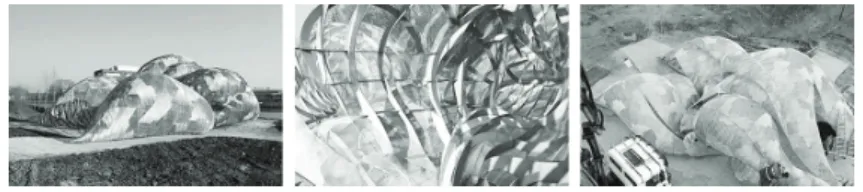
Third group of skins are interacting transformation that are aiming to provide a two-way communication between space and people. Hylozic Soil (Beesley 2007) is a large installation (as shown in Figure 5). The leaves and their stems/ branches contain sensors and actuators to react to the behaviours of people. people act and send the signals to the controllers that then actuate the motor to form different shapes physically.
Figure 5. Hylozoic Soil (Beesley 2007). 2.4. ANAlySIS
There are many similarities in these skin designs. Briefly speaking, despite of
the physical or mediated presentation, the interaction of skin can be described as “sensing-computing-transforming”. Sensing can take people or the envi-ronmental information as inputs. And the transformation can be either physi-cal or mediated. Additionally, the connection between units of skin has created another dimensional transformation.
3. exploration: three skins
3.1. FlOATINg SKIN (HSU 2009)
Floating skin is the first project we developed for testing the interaction in a
coexisting space. Floating skin contains both physical and virtual information and presentation to utilise the touch and clap action of people.
Interactive Behaviours and Interaction modes The interactive behav-iours are basically touch and the skin reacting with movement. each unit of
Floating skin will either react directly while touched by people or as a chain reaction transmitted from other units.
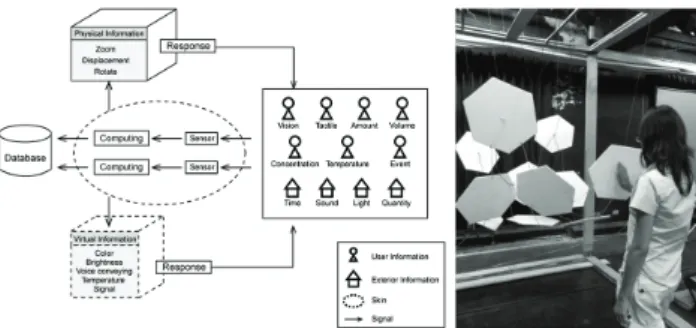
Sensors and System Model The floating skin is comprised of units that
have its own touch sensors and vibration motors. And all units are chained together to form a skin. The translation and rotation of each unit generates the reaction to the touches by people. The system model is shown:
Figure 6. System Model (left) and interaction (right) of Floating Skin (Hsu 2009). Structure Design The units of floating skin are Hexagonal and connected
together by wires, gears and stepper motors to form a skin as shown above. The wires and gears are responsible for the shapes.
Lessons Learned The interaction between people and space lies upon the behaviours people conducted and the transformation feedbacks of skin. Touch
is used as a simple gesture and floating structure maintains the varied feed -backs from skin. Shape of dynamic skin did generate different experience and responding to the interaction directly attract more attention from people. 3.2. DANCINg SKIN (CHeN eT Al. 2011)
Street Dance is chosen for the variety of dance poses by extremities and show the wave and variety motion of street dance. The motions of extremities of dancer were cooperated with every joint of human body, just like folding form skin that should use structure to make skin motion and do different motion again.
Interactive Behaviours and Interaction modes The interactive behaviours are dancers move and skin reacts. Based on the data collected, the dancer’s movements are divided into Chest, Bottom, Hand and Foot. The skin is on the basic of H shapes and constructed by eight H. The H shapes construction is divided into upper and lower limbs, corresponding to the four body parts with joints: hand, chest, bottom and foot, to simulate the motion directions.
The joints are single direction joint and double direction joint. Single direction joint is situated at the top and the bottom end of the structure that
can move back and forth. The double direction joint situated in the middle of the structure, which connected the top to bottom with four junctions, this joint have the ability to move from front to back, right to left two directions, move-ment through these two kind of joints. For example, the dancer made a wave movement starting from chest pass down to the bottom; the skin may also achieve such motion through the joints and reach the same kind of motion. The system is designed base on interaction between using dancer’s continuous body movement for the skin to produce the same motion.
Figure 7. The dancer and dancing skin (Chen et al. 2011).
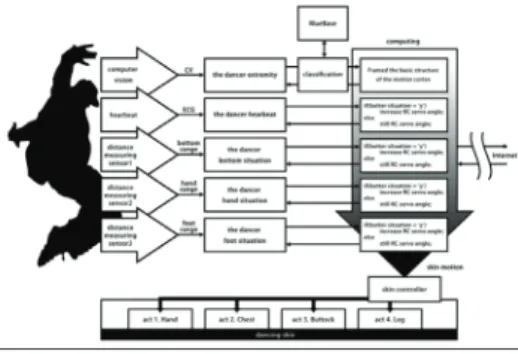
Sensors and System Model Dancing Skin is comprised of (a) Input: gathering data detected by optical sensor, heartbeat sensor, Distance measuring sensor
for classification and rule base; (b) Operation processing: After processing sensors classification, and comparing with functions, produces motion infor -mation from skin in advance; (c) Output: After obtaining the infor-mation, using the skin controller to pass on to the actuation motor, enables the cortex.
Figure 8. The system diagram of dancing skin (Chen et al. 2011).
Lessons Learned Dancing skin explores the structure transformation with body movement. Using human structure as reference for skin structure, the
mapping and reacting between skin structure and pe ople’s movement are explored. Such mapping creates a reference for skin’s motion design and gearing relation of the skin’s joints.
3.3. mUSIC SKIN (JIANg eT Al. 2011)
In music skin, we explore another different input information: sound-based expression (music) and its physical expression (skin). Additionally, the inter-actions with the skin are divided into two way-of-communication between performer (people) to skin A and skin B to audience (people). These two skins can be two totally different skins in two locations (on stage with performer, off stage with audience).
Interactive Behaviours and Interaction modes music skins are designed to be the inter-media between people (performers and audiences). performers
and audience’ physical changes will reflect onto their behaviours, such as skin
temperature, heart beats, voice, body movements and so on. These onstage or offstage behavioural changes can be measured and sensed, then, are utilised for interacting with the skin.
Figure 9. System diagram and physical skin of Musical Skin (Jiang et al. 2011). Sensors and System Model Sensor components are classified in three groups:
performer, music and audience. Different group will have different technology based on their activities. (1) performer: the sensors for performers are based on their physical information while performing on stage. each sensor has its own wireless feature such that it will not disturb the performance. (2) music: the sensor for music is sonic sensor, using microphone to collect the sound and computing unit as synthesizer to analyse/encode the signals. (3) Audience: sonic sensor for sensing the volume of audience’s response and optical sensor for gesture of audience.
With the analysis from performer, audience and dynamic skin structure, we implement a prototype called “musical Skins” that have double skins system: one is on stage and another is outside the concert hall, namely onstage skin and façade skin. Onstage skin collects the information from performer and music, and then outputs the feedback from the audience.
Lessons Learned Two separate skins are developed and the connections
between these two skins are also explored. The benefits for two skins design are the interaction behaviours for each skin and people are easily identified and can be expanded with different location and fit into different context.
4. System refinement
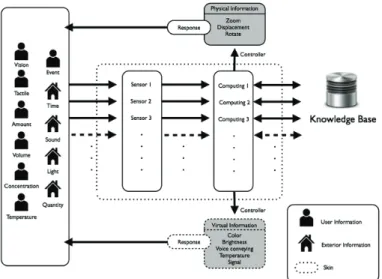
With the case studies, the knowledge of skin design has achieved and then applied to develop three skin prototypes. A generic system diagram for dynamic skin has concluded as shown in Figure 10. One major concept is in order to achieve the feasibility of skin design for dynamic skin, the multiple channels of input sensors are desired. Additionally, for incorporating further gestures recognition, the system has to be ad-hoc and allows further extension on input. For the output, skin should be divided into skeleton and the skin levels. each level will have different consideration on the power required and knowledge base for transformation. In addition, the material itself is another important factor. This system framework will be adjusted according to the different scenario.
5. conclusion: towards a distributed dynamic skin platform
Interacting with space is an interesting design research topic. most of
realisa-tion is based on the specific requirement in different context. This research
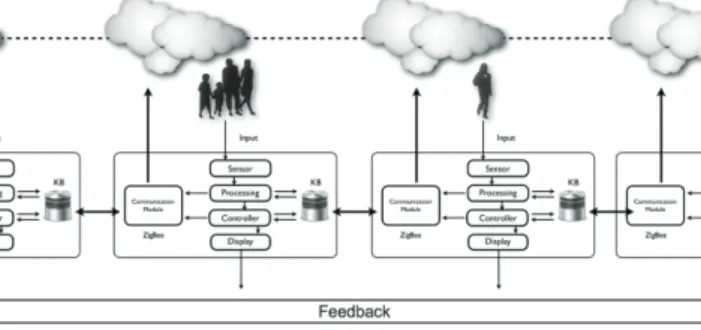
starts with case studies to discover a systematic approach for the skin. Further with three skin prototypes for testifying the approach. With hand-on experi-ence, a generic system concept called dynamic skin is proposed and details of process are evaluated. In order to incorporate the diverse scenario appeared in the cases and prototypes, a distributed system approach such as multi-agent system design is appealing to us. We further propose a distributed dynamic
skin platform (as shown in Figure 11) that can not only provide sufficient
interaction between people and space, but also extending such space to the cloud and network.
Figure 11. Agent skin system. references
Beesley, p.: 2007, Hylozoic Soil, Riverside Architectural press, Toronto.
Bloomer, K. C. and moore, C. W.: 1977, Body, Memory, and Architecture, yale University press, New Haven.
Chen, S.-H., Chang, T.-W. and Shih, S.-C.: 2011, Dancing Skin: An Interactive Device for Motion, in Jacko, J. A. (ed.), Proc. 14th International Conference HCI Part II, Orlando, 409–416.
goulthorpe, m.: 2001, Aegis Hyposurface, Routledge, New york.
Hsu, T.-m.: 2009, A Study of Co-Existing Interactive Interface for Responsive Skin, masters thesis, National yunlin University of Science and Technology, Douliu.
Jeng, T.-S.: 2005, Smart space of the future: designing a ubiquitous interactive environment, in Chiu, m.-l. (ed.), Insights of Smart Environments, ARCHIDATA, Taipei, 67–84.
Jiang, H., Chang, T.-W. and liu, C.-l.: 2011, Musical Skin: A Dynamic Interface for Musical Performance, in Jacko, J. A. (ed.), Proc. 14th International Conference HCI Part II, Orlando, 53–61.
Spuybroek, l.: 2004, NOX: Machining Architecture, Thames & Hudson, london. Weiser, m.: 1991, The computer of the 21st century, Scientific American, 265(3), 66–75.