Sedera, Wasana and Rosemann, Michael and Doebeli, Gabriella (2003) A
Process Modelling Success Model: Insights from a Case Study. In
Proceedings 11th European Conference on Information Systems
, pages
pp. 1-11, Naples, Italy.
This is the author-manuscript version of this work - accessed from
http://eprints.qut.edu.au
A PROCESS MODELLING SUCCESS MODEL:
INSIGHTS FROM A CASE STUDY
ABSTRACT
Contemporary concepts such as Business Process Re-engineering and Process Innovation emphasize the importance of process-oriented management concepts as a businesses paradigm. Large scaled multimillion-dollar implementations of Enterprise Systems explicitly and implicitly state the importance of process modeling and its contribution to the success of these project. While there has been much research and publications on alternative process modeling techniques and tools, little attention has focused on post-hoc evaluation of actual process modeling activities or on deriving comprehensive guidelines on ‘how-to’ conduct process modeling effectively. This study aims at addressing this gap. A comprehensive a priori process modeling success model has been derived and this paper reports on the results obtained from a detailed case study at a leading Australian logistics service provider, which was conducted with the aim of testing and re-specifying the model.
1.
INTRODUCTION
Business process management represents an integrated approach for the process-centred alignment of business directions and Information Technology. Process models can be defined as “abstract descriptions of an actual or proposed process, that represent selected process elements considered important to the purpose of the model and that can be enacted by a human or a machine” (Curtis et al., 1992, p. 76). “Process modeling is an approach for visually depicting how businesses conduct their operations; defining and depicting business processes, including entities, activities, enablers and the relationships between them” (Gill, 1999, p.5). Process modeling has seen widespread acceptance, particularly in large IT-enabled Business Process Re-Engineering projects (Davenport, 1993). Practitioners and researchers have discussed extensively the various applications of process modeling at different phases of an Information Systems project (e.g. Curtis et al., 1992; Rosemann, 2000; Gulla and Brasethvik, 2000). While there has been much research on alternative process modeling techniques, little attention has focused on the post-hoc evaluation of actual process modeling activities or on deriving complete, comprehensive guidelines on ‘how-to’ conduct process modeling effectively. This paper reports on a study that aims to address this gap and proposes a process modeling success measurement framework with an embedded instrument, derived from empirical research. The key research question of this study is: “How can organisations conduct process modeling successfully?” This general question is further divided into an analysis of the independent variables that impact the success of the modelling project and the dependent variables that characterise the actual project success. In detail, the two research questions are:
What are the critical success factors of process modeling?
How can the success of a process modeling initiative be measured?
The proposed success measurement framework aims at evaluating not only the models themselves, but the whole process modeling initiative. Thus, the unit of analysis of this study is the process modeling project, including both the evaluation of the product (the process model), and the evaluation of the process of designing and applying the model. This corresponds with the focus on product quality and process quality made in most quality management approaches.
‘Success’ is a complex phenomenon, with multiple facets and perspectives (Kallenis et al., 1998). Thus, in the quest for deriving the dependent variable(s) to measure success, a clear definition of
success is required.. In the context of this study the process modeling project is regarded as successful if it is efficient and effective. Process modeling effectiveness can be described as the extent to which it supports the fulfilment of the objectives that underlay the modeling project. Process modeling efficiency is to conform to the resources (cost and time) assigned to the project.
The key contribution of this study is the identification of factors that lead to a successful process modeling initiative, and a valid mechanism to effectively measure the process modeling effectiveness. The study’s secondary contributions, such as the detailed analysis of the different constructs and the documentation of the process of research will benefit Information Systems academics in general and more specifically, those interested in similar evaluative studies of modeling approaches. The overall study utilizes a multi-method approach; with multiple case studies followed by a survey. This paper reports on the findings obtained through the first case study. The overall research design is first introduced, with an introductory overview of the a-priori model. This paper then provides a brief introduction to the case study method, its methodological appropriateness to this study and its overall design. The next section introduces the case site and presents the findings obtained from of the case study, finally concluding with an overview to the next phases of the study.
2.
RESEARCH DESIGN
A comprehensive literature review was conducted at the first stage of this study; (a) to identify candidate process modelling success factors and measures and, (b) to identify and justify the methodology most applicable to studies of this nature. An a-priori process modelling success measurement model was derived and a multiple case study (to re-specify the a-priori model – theory building) followed by a survey approach (to test the derived model – theory testing) was selected as the two main data collection methods (Gable, 1994). This paper reports on the findings derived from the first case study, conducted at a leading Australian logistics and transport organisation.
2.1 A-priori model
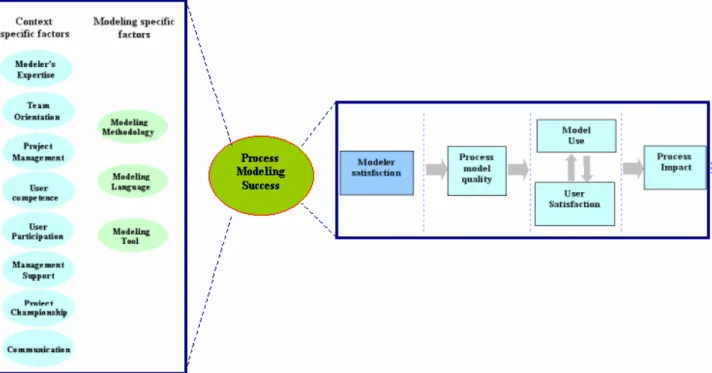
The primary purpose of the a-priori model was to derive a list of candidate process modelling success factors and measures, which was as complete as possible, and a comprehensive literature review was conducted for this purpose. Figure 2.1 depicts the a-priori model and Appendix A summarises and defines the constructs of this model. We are aware that this model still has been very complex in terms
of the number of involved factors. This trade-off between completeness and complexity is always a characteristic of research on success factors. In the first phases of our research we focus on the completeness of the model. In later phases we will be focussing on reducing the complexity.
Critical success factors within the context of this research, can be defined as the key aspects (areas) where ‘things must go right’ in order for the process modeling initiative to flourish (following Mc Nurlin and Sprague, 1989, p. 97). Due to the lack of theoretical and empirical evidence of process modeling critical success factors, a review of the related literature was conducted to extract those factors that were directly or indirectly mentioned as important. Related domains were included in the review in order to obtain a list of candidate process modeling success factors that was as complete as possible. The main areas were (1) generic process modeling; (2) software engineering and conceptual modeling; (3) quality of data and general information models; (4) business process reengineering and Enterprise Systems success; and (5) Information System success (See Sedera et al, 2001 for a detailed justification for selecting these domains). A preliminary analysis of the factors extracted from the literature pointed to 11 potential candidate success factors, which were then clustered within the two groups of “modelling-specific factors” and “context-specific factors”. The modelling-specific factors were (1) Modeling methodology, (2) Modeling language, and (3) Modeling tool. The context specific factors were (4) Modeller’s expertise, (5) Modeling team orientation, (6) Project management, (7) User participation, (8) User competence, (9) Communication, (10) Leadership, (11) Top management support (Sedera et al, 2001).
“MIS researchers should develop their own measures only as a last resort, and only after comprehensive research and examination of existing instruments have been undertaken” (Zmud and Boynton, 1991, p.154). This study has drawn upon the work on Information Systems (IS) success, and other work pertaining specifically to the fields of process modeling (especially conceptual model quality), as the basis for identifying the dependent variable to measure process modeling success. (a) modeller satisfaction, (b) process model quality, (c) model use, (d) model-user satisfaction, and (e) process impact , were extracted as the candidate process modeling success measures from this review: (Sedera et al, 2002)
Unfortunately, there was little prior work in relation to process modeling success that this study could base its foundations on. Thus, the a-priori model was based on ‘hypothesized’ candidate success factors and measures, which were derived from other domains and a strategy to empirically re-specify and justify the model, within the context of process modelling was essential.
2.2 The Use of Case Studies
“The case study method refers to a group of methods which emphasize qualitative analysis” (Gable 1991, p. 31). It is defined as an “Empirical inquiry that investigates a contemporary phenomenon within its real-life context” (Yin, 1994, p.13) and can be conducted for exploratory, explanatory or descriptive purposes (Tellis, 1997; Yin, 1994). Case studies are applied to serve both exploratory (to identify important factors and measures of process modelling success) and explanatory (to aid in the design and interpretation of the survey) functions in this research. Deciding if and when to use case studies will depend on (a) the type of research question, (b) the control an investigator has over the actual behavioural events, and (c) the focus on contemporary as opposed to historical events (Yin, 1994). Benbasat et al. (1987) state that when the context of investigation, ‘takes place over time, is a complex process involving multiple actors and is influenced by events, that happen unexpectedly, a case study approach is well suited’; this holds true with research pertaining to business process modelling, thus justifying the use of case study approach for this research. Yin (1994) states the relevance of a single case study is high, when the researcher wants to identify new and previously un-researched issues. He also states that multiple case designs are desirable, when the intent of the researcher is to build and test a theory (Yin, 1994; Gable 1994). Based on these foundations, a single pilot study and a multiple case study has been included in to the overall case design, and this paper
reports on the findings of the pilot case study. The main goals of the case studies are: (i) To test the a-priori model that has been derived, (ii) to aid in the design of the survey and (iii) to aid in analysing the survey data.
2.3 Case study design
Case study research in the discipline of Information Systems suffers from some shortcomings. Often there is (a) no clear statement of rationale for a single vs. multiple case study, (b) little information supplied about research objectives and plans, (c) the choice of the case sites is not tied to the design, (d) ambiguous data collection methods and few details supplied, (e) infrequent use of triangulation and (f) lack of adherence to rules of procedures (Benbasat et al., 1987). These and other potential weaknesses of the case approach have been addressed in this study.
A comprehensive case study protocol was derived, carefully documenting all procedures relating to the data collection and analysis phases of the study. The protocol defines the structure of the overall case study effort and is specially advantageous for exploratory studies as this, for (1) they force the researcher to consider in advance, the objectives and goals of the study, (2) to help avoid redundant effort, and any potential omissions of the data collection and finally (3) to support the communication and documentation efforts (Gable 1991; Yin, 1994).
As the study investigates on process modeling critical success factors and measurers, the primary selection criteria for the selection of case sites, was the intense application of process modeling. A sampling frame (defining the contextual elements such as who to contact, where to contact, how to contact etc.) was derived based on past theories and the study objectives, and strictly adhered to in selecting case sites and informants. Qualitative data collection mechanism as in-depth interviews, observations, and content analysis of existing documentation was conducted to collect ‘rich’ information about the process modelling initiatives. The interviews had three embedded phases, first to gather generic information about the modelling activities, then to elicit potential success factors and measures independent from the a-priori model and finally to test the a-priori model by specifically inquiring about the existence of the a-priori constructs. All relevant data were maintained in a ‘case database’ (Yin, 1984; Mile and Huberman, 1984) and close linkage between the data, evidence and the research goals were maintained through out the analysis. The qualitative data analysis tool NVivo 2.0 was utilized, to capture code and report the findings of the case study.
“Codes are tags or labels for assigning units of meaning to the descriptive or inferential information compiled during a study” and mainly consists of three kinds: descriptive, interpretive and pattern (Miles and Huberman, 1984, p. 55 and 57). All three methods were applied within this study to derive the study findings. A predefined set of codes was derived as a starting point for this study, however they were refined, as the analysis took place. A tree like node structure was initially created to capture the success factors and success measures of the a-priori model. The coding was then conducted in three phases. In phase 1 we coded any direct or implied existence of the constructs (of the a-priori model) within the data, simultaneously identifying any new constructs. In phase 2 we analysed the information already coded within phase 1, i.e. extracting the information already coded under each of the constructs to confirm the appropriateness with the categorization. Furthermore, this data was then further coded to separate between citations that indicated mere existence of the constructs versus those that specifically stated the criticality of the construct. Phase 3 conducted in-vivo coding, identifying the key words stated under each constructs as a mean to identifying potential sub constructs in the design of the survey.
3.
INTRODUCTION TO THE CASE SITE
The reported case study was conducted at Queensland Rail (QR), in Queensland, Australia. Queensland Rail is a Queensland state Government owned corporation that provides transport and logistics business solutions to a diverse range of customers throughout the State, Australia and overseas. With annual operating revenue of over 2 billion AUD, 9,500 km of narrow gauge track, and
around 14,000 staff, QR is one of Australia’s largest and most modern rail networks. QR initially commenced the application of business process modeling as a technique to support the quality management movement that was initiated in the late 1980’s and was then applied within major restructuring events that QR went through in the 1990s. Business process modeling soon evolved to a strategic methodology at QR and it is presently used within QR as a means of understanding and communicating the business activities of all levels across different stakeholders of the organisation, a technique to identify business improvement opportunities and re-engineer, and a technique to streamline the automation of complex processes. A number of projects, with business process modeling as an integral part, (such as work request automations, freight booking system reengineering, train control transitions and rail supply chain optimisation projects), have been conducted at QR to date, and they are in the process of further enhancing their modelling practices with the design of a corporate wide modelling standard.
Queensland Rail was selected as the pilot case site for this study for a number of reasons. QR has been conducting process modelling quite intensively, for a range of different applications and purposes, and all the requirements of the sampling frame (see table 2.1) were easily accessible. The overall interest from Queensland Rail into this study and the sponsorship received (in terms of willingness to participate) was another factor that influenced this decision. The case study was conducted within the period of four months (from July to November 2002). Over 16 interviews and meeting were conducted with various stakeholders involved in process modelling projects within QR and over 25 project-related documents were analysed in detail.
4.
FINDINGS
“The analysis of case study evidence is one of the least developed and most difficult aspects of doing case studies” (Yin, 1994, p. 102). A comprehensive literature review on case study methodological publications was conducted by the researchers in the quest for addressing this issue within this study. Four main case data analysis techniques have been discussed widely; pattern matching, explanation building, time series analysis and program logic (Yin, 1994) and many supplementary tools and techniques for data analysis have been presented with vivid examples (Miles and Huberman, 1984).
Pattern coding [“a way of grouping the summaries into a smaller number of overarching themes or constructs” (Miles and Huberman, 1984, p. 68-9)] and ‘Pattern matching’ was conducted to ‘compare an empirically based pattern of variables with the predicted one; the a-priori model. Internal validity is enhanced when the patterns coincide. If the case study is an explanatory one the patterns may relate to the dependent or independent variables (Gable, 1991; Tellis, 1997; Yin, 1994). The core purpose of this exploratory/explanatory case study was to test the completeness and correctness of the constructs of the a-priori model and to get preliminary insights in to the interrelationships among the factors and measures, which would aid in the survey design and analysis stages of the study. Instances of factors for the success and /or failure of the projects were coded and analysed together with constructs, which were mentioned as potential success measures.
Explanation building was also applied within the analysis of this case study. To some extent it is a special type of pattern matching with the goal of analysing the case study data by stipulating a set of explanations; causal links and trying to ‘explain the phenomenon’ (Yin 1994; Audet and d’Amboise, 2001). In this study, with the purpose being to test the completeness and correctness of the constructs in the a priori model, we used explanation building only at instances where the empirical evidence suggested a change to the a priori model.
We have also used a special type of time series analysis technique; chronologies – the analysis of chronological events, especially in the documentation of the case study narratives, which was a tool we applied in the verification of the findings via the key informants.
4.1 Revising the A-Priori-Model
‘Numbers’, usually get ignored in qualitative research, however a lot of counting actually does take place in qualitative studies when judgements are made. For example we “identify themes or patterns that happened a number of times and that consistently happens a specific way” (Miles and Huberman, 1984, p.215). The case study database maintained within NVivo was extensively interrogated and various functionalities of the tool were utilised to extract the data required for the prepositions being tested; often in the form of counts and data points, which were then further drilled down to answer ‘how’ and ‘why’; questions. The following section summarises how the dependent (success factors) and the independent (success measures) variables were tested and respecified. Quotes are sometimes provided, however the sources are unidentified to maintain confidentiality.
4.1.1 The Success Factors
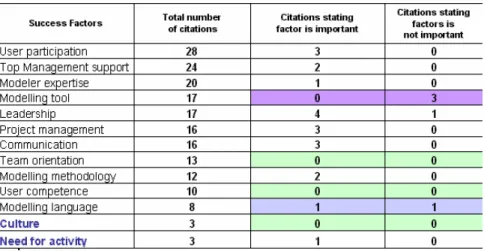
The overall citations for the different factors were extracted and analysed to check for the completeness (see Table 4.1 – column 2). Citations that specifically stated that the factor was important or not were also incorporated to this analysis (see table 4.1 – column 3 & 4) to gain an overall impression on the completeness of the independent variables of the model and to obtain a sense of understanding over the relative criticality of the factors.
Table 4.1: Number of general citations for the success factors and relative criticality
It is difficult to objectively conclude the criticality of the constructs based on the number of citations as they could have been biased based on the interview protocols. The user participation, top management support, modeler expertise, leadership, project management, communication and modeling methodology constructs all validated the proposition of the a-priori model by having high numbers of general citations as well as citations to justify the importance of the factors. All of the above, (except for leadership), had at least one citation to indicate its criticality to a modeling project and had no citations that indicated it was not important. The citation which coded under the “not important” node for the leadership construct, stated that “…when the project's initially started he <the leader> got everything going …, but then after the initial phase of the project he probably wasn't really needed any more”, indicating that leadership plays a bigger role at the beginning of a project, more than at other times, and thus does not dismiss nor question its importance as a critical success factors, but instead explains that it is more important at the beginning of the project.
The modelling language and modeling tool both had citations that stated they were not critical for the success of a modeling initiative. ‘Modeling language’ had the lowest number of citations (only 8) among the pre-specified success factors. However, the need for a ‘standardised meaning across’; (which is the resulting benefit of having a syntactical guidelines) was emphasised throughout the data. It was also stated that a language could be beneficial only if the people understood it. Thus, we concluded that the modelling language was an important element within a modelling initiative. However, it has to be simple enough for the relevant stakeholders to comprehend. The modeling tool construct had a high number (17) of general citations. There was no positive indication as a critical success factor but instead 3 specific indications as not being a critical success factor. When specifically asked if the modeling tool was a critical success factor the response was; “No. We're talking about fairly simple processes, and more or less, we're trying to discover how they work.
Whereas I think that quite a lot of the features are thrown in software is not particularly of value. Not the way that we were using it as a presentation tool so”, indicating that the tool’s importance depends on the complexity of the actual process and what one intended to do with the models.
Two new constructs were identified; “need” and “culture”. The ‘need’ construct captured how important the overall initiative is, ‘Culture’ was the organisational readiness to accept and participate in a modelling initiative. ‘Need’ (i.e. how necessary is the modelling activity) had an impact on the overall model as the existence of some of the other factors were influenced by this variable. Thus, it seemingly became a moderating variable to some of these factors such as top management support and project management (see table 4.2 below). However, no strong evidence was collected from this case study to indicate the importance of having ‘culture’ as a separate construct in the re-specified process modeling success measurement model. The data indicated that culture will be influential for the initiation of a modeling project; but not much specifically to the ‘success’ of the project.
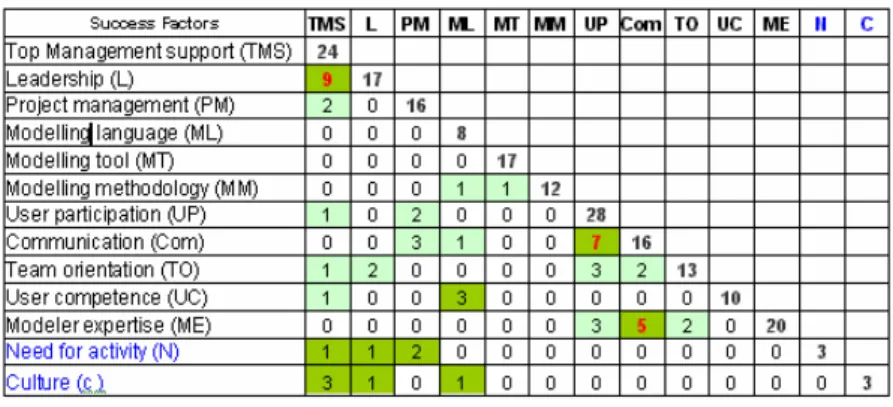
Table 4.2: Potential interrelationships among the success factors
A matrix intersection table mapping the coded information by factors. This was derived to analyse any potential overlaps and redundancies among the success factors. Table 4.2 summarizes the findings from this analysis.
A high proportion of the (9/17) citations coded under leadership were also coded under top management support. One potential explanation for this at the case site, the leadership role was carried out by the sponsor (top management) themselves. Consequently, the respondents almost always used the terms leadership and sponsorship as synonyms. Fur further analysis, a matrix search was done to extract the information coded under each construct that did not intersect with one another. The resulting information coded under top management support captured other related sub constructs such as funding, decision making etc., indicating that top management support is a multi-perspective construct. Where as, the content coded only under leadership had weaker implications of leadership within the projects. The details coded under the ‘leadership intersection top management support’ section further justified that leadership is another sub construct of top management support. Thus, it was concluded that the leadership construct will be removed as an independent construct and will be placed as sub construct under top management support. The top management support construct had overlaps with other constructs such as ‘need’, ‘culture’, ‘user participation’ etc. These intersections did not imply any construct redundancies, rather they implied causal relationships; top management support influencing the existence of these constructs.
phenomenon may be the fact that in most of the projects analysed
nother point of potential redundancies was identified within the communication construct. The A
importance of “communication” was specifically mentioned a number of times. However, there seemed to be a high level of overlap with the data coded under communication and other constructs, especially user participation (7/16 coding references) and modeler expertise (5/16 coding references). A closer analysis of the communication construct aided in making the observation that there seemed to be two types of communication processes within a modeling project; (a) information sharing: communication among the modeling team members for sharing information and (b) feedback: communication between the modelers and the users to confirm the correctness of the models. The content coded under ‘feedback’ was identical to the intersection between communication and user participation. Thus, this segment was included as a sub construct of user participation. The ‘information sharing’ did not map on to either of the other factors very effectively. However, it can be argued that this is one aspect that should be addressed within a good project management plan. For
this reason, it was included under project management. A matrix of differences between communication and the two re-located sub constructs of communication (feedback and information sharing) was derived. The results supported the conclusion that the core aspects of communication will be captured under user participation (the ‘feedback’ aspect) and project management (the ‘Information sharing’ aspect). Moreover, there will not be a separate communication construct in the new success measurement model. Furthermore, ‘communication’ appeared to be a type of skill required for a modeler. Thus a new sub construct under modeller expertise was included in order to depict this.
Both the user competence and team orientation constructs had no evidence to justify the criticality to
4.1.2 The success measures der
he ‘modeler satisfaction’ construct, proved to be the weakest measure as it was said to be “too the success of process modeling. Team orientation seemed to be ‘scattered’ across a number of constructs. A matrix difference analysis among what was coded under team orientation intersections and team orientation was conducted, and no significant result was found. There was no evidence to counter argue its importance, to eliminate either construct from the model. Thus, they remain as candidate critical success factors for process modeling within the re-specified model. All other overlaps indicated in Table 4.2 were all analysed in detail. Only indications of potential causal relationships among these factors were found and no further construct redundancies were identified from this case study.
The amount of data coded un the success measurement nodes was quite low compared to the success factors. Further analysis of the data concluded that the interview protocol had to be refined to gather more data on the success factors, and/ or the respondents were not familiar with concepts of ‘measurement’. C
to the measurement for process modelling success, or any other kind of measurement.
Table 4.3: Number of general citations for the success measures and their relevance
onsequently, they were not able to provide detailed insights relating
T
biased”, and thus was removed from the model. The ‘model quality’ construct had the highest number of generic citations and justification in terms of its relevance as a measurement construct for this context. ‘Model use’ had mixed evidence; its importance was stated; for example “…if they don't use it then that person has failed…well the modelling has failed anyway”. However, its relevance was questioned in terms of how to actually measure it. The ‘user satisfaction’ construct had a relatively high number of general citations, yet none that
specifically stated it was a relevant success measure or not. Nevertheless, there was no evidence to counter argue its importance, and this construct remained in the model. The final construct; ‘process impact’ had only two citations, yet both citations specifically mentioned the importance of this measure; “The measure has to be whether you impact on the process or not”. No new success measures were identified from the data
Table 4.4: Potential interrelationships among the success measures
Theory and past studies suggests that the dimensions for measuring success may have causal relationships (Delone and Mclean, 1992). Data was analysed from this case study to identify such potential interrelationships among the proposed success measures (see Table 4.4). The modelers indicated that their satisfaction with the overall project increases when the models are being used by
the users. “They're going to be much more satisfied if they're actually used to do a good job in the project”. The quality of the models seem to have a direct impact on the use of the models “if they <the models> were bad you couldn't use them”, and ‘model use’ seemed to have an influence on ‘Process impact’; “Well, I guess if they pick up anything in the model, it's always going to be successful. The overlapping coding reference between process impact and user satisfaction indicates that user satisfaction can be applied as one way to tap into the process impact construct.
4.1.3 Identification of contingency variables
4.2 The Re-specified A-Priori Model
separate
5.
CONCLUSION AND OUTLOOK
s of a case study, aimed at testing an a-priori process
project stakeholders will take place, to test the derived model. Contingency variables, in the context of this
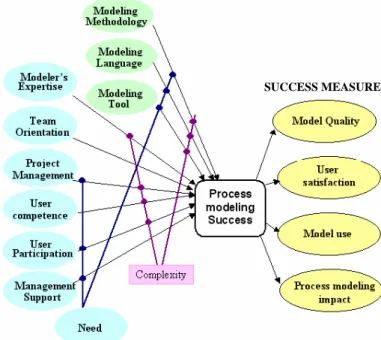
study, are defined as those identifiable variables that impact on the strength of the variables (dependent and/or independent) for process modeling success. They are are beyond the control of the involved stakeholders. The complexity of the process being modelled was identified as an important contingency variable to be considered in the re-specification of the process modeling success model. It proved to have a significant moderating effect on the success factors, such as the importance of a modeling tool, modeling method and user competence.
The sections above reported on the
analysis of the independent and dependent variables of the a-priori model. Figure 4.1 summarizes the re-specified success model. The leadership and communication constructs were relocated within the model and no longer existed as separate constructs. A new variable; ‘need’, defin
initiative, was identified, justified and included as a moderating success factor in the model. A contingency variable, ‘complexity of the processes being modelled’ was identified, justified and included in the model as a moderating variable. Modeler satisfaction was justified as an inappropriate measure for success and was removed from the model.
SUCCESS FACTORS
SUCCESS MEASURES
Figure 4.1: The Re-specified process modelling success model ed as the overriding need to conduct the modeling
This paper presented the empirical finding
modelling success model. The paper first introduced the research background, discussed the overall research method and an a-priori model, and then presented the findings from the analysis of the case data. Reliability was achieved with the use of a detailed case protocol and a structured case database. Construct validity was achieved within the study, with the use of multiple sources of evidence, establishing a chain of evidence with a well-structured case database, and by having the key informants review the results. Internal validity was achieved by the application of concrete data analysis techniques such as pattern matching and explanation building (Yin 1994). However, external validity has not been addressed effectively in this study. It is a common draw back of most single case study findings, as the data is difficult to be generalised within a broader context. Research studies should have an appreciation of the importance of comparison in research, which is not possible with a single case study alone. The findings presented here have to be explored further. We currently conduct a second case study with a Department within Queensland Government. A third case study will follow to further specify the current model. Finally, a worldwide survey targeting different process modelling
6.
REFERENCES
Audet , J. and d'Amboise, G. (2001) "The Multi-site study: An Innovative Research Methodology", The e 6, Number 2, June. Also available at http://www.nova.edu/ssss/QR/QR6-Qualitative report, Volum
2/audet.html
Benbasat, I and Zmud, R., W., (1999) "Empirical Research in Information Systems: The practice of relevance, MIS Quarterly, vol 2, Number 1, March, 3-16.
rtis, B., Kelle
Cu r, M., I., Over, J., (1992) "Process modelling", Communications of ACM, (35:9),
Ga case study and survey of factors affecting
ied out for the Small Enterprises Computerisation Programme in Singapore", Doctoral
Ga
Gill, P. J., (1999), "Application development: business snapshot – September.
ble, G., (1991) "Consultant Engagement Success Factors: A
client Involvement in, and satisfaction with, consultant engagement in computer system selection projects, carr
thesis, University of Bradford.
ble, G., G., (1994) "Integrating Case Study and Survey research methods: an example in Information Systems", European Foundation of Information Systems, (3:2), p.112-126.
business modelling tools help
Gu large-scale reengineering
Miles, M., B., Huberman, A., M., (1984) "Qualitative data analysis: a source book of new methods", Sage
Rosemann, M., (2000) "Using Reference Models within the Enterprise Resource Planning Life Cycle",
Sedera, W., Rosemann, M., Gable, G. G., (2001) "Process Modelling for Enterprise Systems: Factors
nd
ol. 3, Harvard Business School, Boston,
AP
Independent variable -Success Factors instructions that describes and guides the process of
the
he “syntactic rules” of the selected process modelling technique.
companies align their business and technology goals", Information Week, April, 1999 lla, A. J., Brasethvik, T., (2000) “On the challenges of business modelling in
projects”, in Proceedings of the 4th International Conference on Requirements Engineering, Schaumburg, Ill., 19-23 June, pp. 17-26.
Kanellis, P., Lycett, M., Paul, R., J., (1998) "An interpretative systems success: from concept to practical application", Information Systems Success Measurement, series in Information Technology Management, Idea Group Publishing.
McNurlin, C., B., Sprague, H., R., (1989) "Information Systems Management in practice", Prentice Hall, Second Edition.
publications.
Australian Accounting Review, Vol. 3, No. 22, November, pp. 19-31.
Critical to Success", in Proceedings of the 12th Australasian Conference of Information Systems. Eds.: G. Finnie et al., 5-7 December, Coffs Harbour, Australia, pp. 585-596.
Sedera, W., Rosemann, M., Gable, G. G. (2002) "Measuring Process Modelling Success", in Proceedings of the 10th European Conference of Information Systems, (ECIS). Ed.: S. Wrycza. Gdansk, Poland, 6-8 June, pp. 331-341.
Tellis, W., (1997) "Introduction to Case study", The Qualitative Report, Volume 3, Number 2, July. Also available at http://www.nova.edu.ssss/QR/QR3-2/tellis.html.
Yin, R., K., (1994) "Case study research methods", 2 edition, Sage publications.
Zmud and Boynton (1991) “Survey measures and instruments in MIS: inventory and appraisal”, in Information Systems Research Challenge: Survey Research, V
pp. 149-180.
PENDIX A: DEFINING THE CONSTRUCTS OF THE A PRIORI MODEL
Modelling Methodology: A detailed set of Modelling Language: The grammar or t
modelling (It includes activities such as definition of the model architecture, the modelling procedure, model lifecycle management and model quality assurance).
Modelling Tool: The application that facilitates the design, maintenance and distribution of process-models.
Modelers’ Expertise: The experiences of the project member in terms of conceptual modelling in general and process modelling in particular.
(those who design the process models) of ject
Model Use: How extensively the models are applied and utilised
User satisfaction: The extent to which users believe process modelling meets the fulfilment of
easures the effects of process Modelling Team Orientation: The 'infrastructure'
that should exist in a successful process modelling team, such as an appropriate mix of internal and external members, representation from all modelled processes, team leadership and vision
Project Management: The formal definitions of the project scope, milestones, and plans.
User Participation: The degree of input from users, for the derivation and maintenance of the models.
User Competence: The amount of knowledge the users have about the modelling tool and modelling procedures.
Top Management Support: The level of commitment by senior management in the organizations to the process modelling project, in terms of their own involvement and the willingness to allocate valuable organizational resources. Leadership: The existence of a high level sponsor who has the power to steer the project, by setting goals and legitimate changes.
Communication: This describes exchange of information (feedback and reviews) amongst the project team members and the analysis of feedback from users.
Dependent variables - Success Measures Modeller satisfaction: The extent to which the modellers
believe process modelling meets the fulfilment the objectives that underlay the modelling pro and the extent to which they believe that process modelling was efficient and enjoyable.
Process-model quality: The extent to which all desirable properties of a model are fulfilled to satisfy the needs of the model users in an effective and efficient way”.
the objectives that underlay the modelling project Process impact: M
modelling on the process’ performance. Here, the ‘process’ refers to the processes or functions that are applying modelling.