EFFECTIVENESSS OF PARTICIPATORY METHODS IN TEACHING OF
ENGLISH SUBJECT IN COMMUNITY SECONDARY SCHOOLS INMOSHI RURAL DISTRICTS: CHALLENGES AND PROSPECTS
DAVID E. SHIRIMA
A DISSERTATION SUBMITTED IN PARTIAL FULFILLMENT OF THE REQUIREMENTS FOR THE DEGREE OF MASTER OF EDUCATION IN ADMINISTRATION, PLANNING AND POLICY STUDIES M.ED APPS OF
THE OPEN UNIVERSITY OF TANZANIA
i
CERTIFICATION
The undersigned certifies that she has read and hereby recommends for acceptance by the Open University of Tanzania a dissertation entitled: “Participatory Methods in Teaching of English Subject in Community Secondary Schools in Moshi Rural District: Challenges and Prospects” in partial fulfillment of the requirements for the degree of Masters of Education in Administration, Planning and Policy Studies (M.ED APPS) of the Open University of Tanzania.
... Dr. E.Swai
(Supervisor)
ii
DECLARATION AND COPYRIGHT
I, David E. Shirima, declare that this dissertation is my own original work and that it has not been presented and will not be presented to any other University for a similar or any other degree award.
Signature……...
This dissertation is copyright material protected under the Berne Convention, the Copyright Act 1999 and other international and national enactments, in that behalf, on intellectual property. It may not be reproduced by any means, in full or in part, except for short extracts in fair dealings, for research or private study, critical scholarly review or discourse with an acknowledgement, without the written permission of the Director of Post Graduate Studies, on behalf of both the author and the Open University of Tanzania.
iii
ACKNOWLEDGEMENT
This work is a product of remarkable contributions of collaborative efforts of many individuals. Unfortunately, it is not possible to mention each one by name. But I find it imperative to single out the following persons for special thanks. First, I would like to extend my sincere gratitude to my supervisor Dr.Swai E., for her guidance and support. Her valuable scholarly advice, inputs, critics and encouragement was fruitful in shaping this work to the present form.
Second, I am indebted to my employer, E.L.C.T Northern Diocese: Agape Lutheran Junior Seminary for granting me a study leave. Without forgetting my senior teaching staff who gave their support and advice during the whole period of my studies. Third, I wish to express my sincere thanks to my friends Hawa Mpate, Dani Fussy who are assistant lectures at UDSM-MUCE, my brother and sister Dennis and Mesiya for their prayers, materials and moral support.
Fourth, I am grateful to the Kilimanjaro Regional Administrative Secretary (RAS) and Moshi District Administrative Secretary (DAS) for grating me permission to conduct a study in Moshi Rural. Special thanks to the Moshi Zonal English School Inspectors, Head teachers, English teachers and students from Community Secondary Schools who participated in this study. Lastly, I am thankful to all my fellow students for their cooperation, encouragement and suggestion during the time of my studies. However, I remain solely responsible for any shortfalls in the structure and the content of this work.
iv
DEDICATION
This work is dedicated to my beloved father Elia Nelson Shirima and my mother Monyiaichi Christopher Machange who devoted their meager resources to lay down the foundation of my education. Otherwise, I could not have reached where I am today. I also dedicate this work to my lovely Wife Belina Josenido Mkama who worked hard to build my confidence towards achieving the goals of my studies.
v
ABSTRACT
This qualitative study examines the effectiveness of Participatory Methods in Teaching of English subject in community secondary schools in Moshi Rural District. Specifically, the study: explored teaching methods being used in teaching of English subject, assessed the students’ perceptions on the use of Participatory methods in teaching English subject, examined the challenges facing English teachers in using participatory methods to teach English subject. The study was underpinned by Context, Input, and Process, Product (CIPP) model that was adopted and modified from Stufflebeam 1971. Purposive, stratified and simple random sampling techniques were employed to obtain 85 respondents, made up of Zonal school inspector for English subject, heads of school, and heads of English departments, English teachers and students. Data were collected through interviews, focus group discussions, and observations.
The study findings revealed that teachers employ participatory techniques with little knowledge on how to practice them, most students have positive perception on the use of participatory methods but it was less practiced due to large class size and the fact that most had no mastery of English language.
The study recommends that the concerned education authorities such as MoEVT, TIE, REOs, DSEOs, should formulate sound policies to enable proper training of teachers so that they select and use appropriate participatory teaching methods for overall betterment of teaching English in secondary schools.
vi
TABLE OF CONTENTS
Page
CERTIFICATION ... i
DECLARATION AND COPYRIGHT ... ii
ACKNOWLEDGEMENT ... iii DEDICATION ... iv ABSTRACT ... v TABLE OF CONTENTS ... vi LIST OF FIGURES ... x LIST OF APPENDICES ... xi
ABBRE VIATIONS AND ACRONYMS ... xii
CHAPTER ONE 1.0 THE PROBLEM AND ITS CONTEXT ... 1
1.1 Introduction ... 1
1.2 Background to the Problem ... 1
1.3 Statement of the Problem. ... 7
1.4 Purpose and Objectives of the Study ... 7
1.5 Research Questions; ... 8
1.6 Significance of the Study ... 8
1.7 Delimitation of the Study ... 9
1.8 Operational Definitions. ... 9
1.9 Summary of the Chapter ... 10
CHAPTER TWO 2.0LITERATURE REVIEW...11
2.1 Introduction ... 11
2.2 Common teaching methods in teaching of English subject ... 11
2.3 Students’ perceptions on the use of participatory methods in teaching of English subject ... 14
2.4 Challenges facing English subject teachers in using participatory methods.. 15
2.5 Summary of the Literature review ... 21
vii
2.7 Conceptual Framework ... 21
2.8 Summary of the Chapter ... 23
CHAPTER THREE 3.0 RESEARCH METHODOLOGY ... 24
3.1 Introduction ... 24
3.2 Research Approach ... 24
3.3 Research Design ... 25
3.4 Geographical Area of the Study ... 25
3.5 Study Population ... 27
3.6 Sample and Sampling Techniques ... 28
3.7 Methods of Data Collection ... 30
3.7.1 Data type and source ... 30
3.7.2 Methods of Data Collection ... 30
3.8 Validity and Reliability of the Study ... 32
3.8.1 Validity ... 32
3.8.2 Reliability ... 33
3.9 Data Analysis Procedures ... 33
3. 10 Ethical Considerations ... 34
3.11 Summary of the Chapter ... 35
CHAPTER FOUR 4.0 DATA PRESENTATION AND ANALYSIS OF THE FINDINGS...36
4.1 Introduction ... 36
4.2 Teaching methods being used in teaching of English subject... 36
4.3 Students’ perceptions on the use of participatory methods in teaching of English subject ... 40
4.4 The Challenges facing English teachers in using participatory methods to teach English subject ... 44
4.4.1 Class size ... 44
4.4.2 Students’ little knowledge on the use of English language ... 45
4.4.3 Insufficient Teaching and Learning materials... 46
viii
CHAPTER FIVE
5.0 SUMMARY, CONCLUSIONS AND RECOMMENDATIONS...49
5.1 Introduction ... 49
5.2 Summary of the Major Findings ... 49
5.2.1 Teaching methods being used in teaching of English subject... 49
5.3.2 Students perceptions on the use of Participatory methods ... 49
5.3.3 Challenges facing English teachers in implementing Participatory Methods 50 5.4 Discussion of the Major Findings ... 50
5.4.1 Teaching methods being used in Teaching of English Subject... 50
5.4.2 Students Perceptions on the Use of Participatory Methods ... 50
5.4.3 Challenges Facing English Teachers in Implementing Participatory Methods 51 5.5 Conclusions ... 51
5.6 New Development in Knowledge ... 52
5.7 Recommendations ... 52
5.7.1 Recommendations for Action ... 52
5.7.2 Recommendations for further Research ... 53
5.8 Summary of the Study ... 53
REFERENCES ... 54
ix
LIST OF TABLES
Table 1.1 The trend of National Examination Performance of English Subject in CSEE (2000-2011) ... 6 Table 3.1 Total Sample by Category and Gender ... 29
x
LIST OF FIGURES
xi
LIST OF APPENDICES
Page
Appendix A: Interview Guide for English Teachers ... 61
Appendix B: Interview Guide for Heads of Schools ... 62
Appendix C: Interview Guide for Head of English department ... 63
Appendix D: Focus Group Discussion Guide for Students ... 64
Appendix E: Interview Guide for School Inspectors ... 65
Appendix F: Lesson Observation Checklist ... 66
xii
ABBRE VIATIONS AND ACRONYMS CDs Compact Discs
CIPP Context, Input, Process, Product
CSEE Certificate of Secondary Education Examination DAS District Administrative Secretary
DSEO District Secondary Education Officer EMAC Education Material Approval Committee ESR Education for Self –Reliance
ETP Education and Training Policy FGD Focus Group Discussion
MoEC Ministry of Education and Culture
MoEVT Ministry of Education and Vocational Training NECTA National Examination Council of Tanzania RAS Regional Administrative Secretary
REOs Regional Administrative Officers ROM Read Only Memory
SEDP Secondary Education Development Plan TIE Tanzania Institute of Education
TSR Teacher Student Ratio TVs Televisions
UNESCO United Nations Educational Scientific and Cultural Organization URT United Republic of Tanzania
1
CHAPTER ONE
1.0 THE PROBLEM AND ITS CONTEXT 1.1 Introduction
In recent years more emphasis has been put on the use of participatory methods in teaching of all subjects at all levels of education across all countries in the world. Uncertainty however exists on the practice of participatory methods in teaching of English language specifically in community secondary schools in Tanzania because there is pronounced poor performance of English language subject in recent years. In this regard, this research aims to examine the challenges of using participatory methods in teaching of English subject in community secondary schools in Moshi Rural District in Kilimanjaro Region. This chapter presents the background to the study, statement of the problem, purpose and objectives of the study, research questions, significance of the study, and delimitations of the study and the operational definitions of the terms as used in this study.
1.2 Background to the Problem
The teaching and learning environment has a great impact on students’ academic performance (Chapman and Adams, 2002). Particularly good teaching and learning environment ensures that teachers involve all the children to participate in their learning (Clarke, 2003). In this regard, schools in Tanzania, like elsewhere need a good teaching and learning environment that will ensure provision of quality education to young people to enable them to make sense of what they learn with a goal to function effectively in society.
2
In Tanzania, different efforts have been made to ensure that the quality of education is improved to cope with the worlds dramatic changes, socially, economically and politically. Among others, one of the efforts has been to change the curriculum from content-based, that is, from teaching the subject to competence-based, or in other words, to teach the students. The 1997 curriculum was content based whereby teachers dominated the instructions and suppressed student creativity (Tilya & Voogt, 2002). In addition, the shift was the adherence to the objectives of Secondary Education Development Plan (SEDP I), which insisted that quality improvement is the key objective of having market responsive curriculum with an efficient delivery system (URT, 2004). Therefore, Competence Based Curriculum aims at enabling learners to operate in complex and contradictory environment characterized by ill-defined problems, informal collaboration, dynamics and highly integrated process upon completion of their studies (Westera, 2001). It also emphasizes on the development of analytical skills to enable the learner to meet the demands of today’s labor market.
In 2004 Tanzania Institute of Education (TIE) adhered to the objectives of Secondary Education Development Plan (SEDP), which insisted on quality improvement in secondary education (URT, 2004) and carried out a survey to review secondary education curriculum in Tanzania. The review led to paradigms shift. A shift from content based to Competence Based Curriculum (URT, 2005). This paradigm shift in Tanzania involved the change from 1997 content –based curriculum to that of competence-based of 2005. This shift was attributed by several factors. One being that content-based curriculum was overloaded with contents to be
3
taught within a year, which led the teachers struggle to cover the syllabus rather than equipping learners with appropriate skills and knowledge (Kitta, 2004). Competent based curriculum is not a new idea in Tanzania, for it has been there since time in memorial. In fact, inculcating competences in students is in line with Education for Self-Reliance (ESR) philosophy that was introduced in Tanzania in 1967. The philosophy of ESR stemmed from the idea that learning should not be separated from daily living. More specifically ESR insisted on empowering learners with independent and creative thinking as well as the ability to combine knowledge and skills with practice (Ishumi, 1976; URT, 1995; UNESCO, 2006).
Within the content based curriculum, teachers dominated the instructions and suppressed students’ creativity (Tilya & Voogt, 2002). Central to the adoption of competence based curriculum of 2005 was to shift this teachers’-domination to students-domination by allowing students to take an upper hand in learning. Currently, the use of participatory teaching methods is emphasized at all levels of the education system in Tanzania. Policy documents such as Education and Training Policy (ETP), teacher education curriculum and Secondary School encourage participatory teaching methods as appropriate means for effective teaching and learning in Secondary schools (Mdima, 2005). Additionally, participatory methods are regarded as a core mission of competence based curriculum execution. Competence based curriculum directs and emphasizes in building potential authentic skills and knowledge to learners and not in accumulating credentials and obtaining certificates (Mulder, 2004). In the current knowledge society and the rapid growing science and technology, there is a great need of having graduates with capabilities to
4
solve the real world problems and undertake tasks as outlined by the given job criteria (Cohen 2005; Mulder, 2004).
Suffolk (2004) argues that effective teaching can be achieved only when participatory teaching methods is applied. Participatory teaching methods compel teachers to create learning environments which give a room for students to discover by themselves instead of being spoon fed. Participatory teaching methods develops creativity, fosters problem solving and intrinsic motivation (Mdima, 2005). The assumption behind participatory teaching methods is that students are given an opportunity to actively construct meaning and understanding during the learning process. Participatory teaching methods discourage passive assimilation of knowledge and support acquisition of knowledge, skills and attitudes by solving life problems (MOEC, 2005).
Mdima (2005) argues that, learning is much more participatory when there is a feeling of involvement in the classroom. The involvement can only be achieved when participatory teaching methods is used in the classrooms. This means that guaranteed democratic environment among teachers and students in the instructional setting, reduced teacher’s control and more time for information exchange and collaboration in the class. It also promotes positive learning outcomes and activates students ‘interests towards English.
However, English language has been a burning issue in Tanzania secondary education. This issue has been researched and debated for over four decades and the
5
debate is becoming more controversial as we move into competence-based curriculum. The controversy is whether Tanzania should stick to Kiswahili, the National Language or should go along the grain with others in the globalized world, which use English. In 2009 the Ministry of Education and Vocational Training (MoEVT, 2009) proposed a new Education and Training Policy that requires English to be the language of instruction from nursery school to tertiary education. While this study is not set to dwell on the language of instruction in Tanzania, it is worth mentioning that, teaching in a foreign language, or teaching a foreign language may create an impediment in offering a chance for students to construct knowledge. Participatory teaching methods involves helping the students to use the acquired knowledge to deal with various challenges in their life, including ability to communicate effectively. (Mosha, 2011).
The situation is contrary as Qorro, (2004) and Vuzo, (2011) observe. Most of the learners and graduates in Tanzania are poor in using English language in their daily communication and in classroom discourse. They lack apt skills in writing, reading, listening and speaking using English language.
Moreover, the successfully use of participatory teaching methods can also be indicated by among others, improvement of students’ performance in exams. Since the introduction of Competence Based Curriculum in Tanzanian secondary schools, it is observed that the failure rate have been increasing in the final Secondary Education Examination (CSEE) for English subject. Table 1.1 shows the trend of
6
National Examination performance of English subject in CSEE from the year 2000 to 2011.
Table 1.1 the trend of National Examination Performance of English Subject in CSEE (2000-2011)
Year Candidate sat Candidates passed (A-D grades) % Passed % Failed by (F Grade) 2000 91623 55890 60.9 39.1 2001 106784 61935 59.8 40.2 2002 126780 76068 59.6 40.4 2003 143420 77447 54.4 45.6 2004 158930 87412 55.7 44.3 2005 179456 93317 52.9 47.1 2006 196434 187791 55.3 44.7 2007 200150 100075 49.5 50.5 2008 218678 111526 51.2 48.8 2009 249282 129627 48.5 51.5 2010 350753 161346 45.9 54.1 2011 448722 192950 43.1 56.9 Source: URT (2000-2011)
The data in Table 1.1 indicates that between the years 2000-2005 the failure rate ranges from 39.1 to 47.1%. This was the period before the introduction of the competence based curriculum which stressed the use of participatory methods in teaching of English subject. However, the failure rate increased to 48.8% for the first graduates in 2008 under the implementation of the new curriculum which emphasized the use of participatory teaching methods. The situation went worse in the year 2009 and 2010 in which the failure rate increased by 3%. More failure was observed in the year 2011 where the failure rate increase to 56.9 which is more than a half of the total students who sat for CSEE examination. The concern of the
7
researcher is that why these failure rates are more pronounced at the period when the usage of participatory teaching methods is emphasized in Community secondary schools?
1.3 Statement of the Problem.
Despite the emphasis put forward by various educational reforms and authorities on the use of participatory teaching methods in teaching of English subject, still there are evidences of majority of students being poor in several aspects related to the learning of English. This is confirmed by Mkumbo (2011) and Vuzo (2011)’ studies which insisted that the majority of graduates are unable to exercise what they have learned in the classroom to what is happening in the real world. Moreover, Mosha (2011) reported that there have been complains from employers that many graduates are incapable of exercising duties to the expected standards when employed. Nor do those posses apt skills in writing, reading, listening and speaking using English language. However the available literature has hardly delved into examining participatory methods in teaching of English subject in Tanzania’s secondary schools. This study therefore, sought to fill this knowledge gap. Particularly, the study intends to investigate the effectiveness of participatory methods in teaching of English subject in community secondary schools in Moshi Rural District.
1.4 Purpose and Objectives of the Study
The purpose of this study was to examine effectiveness of participatory methods in teaching of English subject in community secondary schools in Moshi Rural Districts: Challenges and Prospects. More specifically the study seeks to:
8
1. Explore teaching methods that are used in teaching of English subject in community secondary schools
2. Assess the students’ perceptions on the use of participatory methods in teaching of English subject in community secondary schools
3. Examine the challenges facing English teachers in using participatory methods to teach English subject in community secondary schools.
1.5 Research Questions;
1. What are the teaching methods that are used in teaching of English subject in community secondary school?
2. What are the students’ perceptions on the use of participatory methods in teaching of English subject in community secondary schools?
3. What challenges do English teachers face in using participatory methods when teaching of English subject in community secondary schools?
1.6 Significance of the Study
The study sought to revealed the effectiveness of participatory methods in teaching of English subject in community secondary school. The information generated was expected to be used by different education stakeholder inform various education stakeholders such as MoEVT, TIE, teachers, School Inspectors, Secondary Educational officers and Heads of schools to promote appropriate practice on the effectiveness of participatory teaching methods in teaching of English subject in community secondary schools. This generated information helped them to take appropriate measures in improving teaching of English subject in Community
9
Secondary Schools. Furthermore the finding of this study has formed the basis for further research on the use of participatory methods in teaching of English subject.
1.7 Delimitation of the Study
This study delimited itself in participatory methods in teaching of English subject. This study involved only four community secondary schools in Moshi Rural. On part of respondents the study involved only Zonal Inspector of schools for English subject, Heads of schools, Heads of English department, and English teachers and Form one to form four students. The study employed qualitative approach informed by a case study design. In this regard, the results and conclusions are delimited to the studied schools only.
1.8 Operational Definitions.
Participatory teaching methods: This refers to the way in which teachers and students are in constant interaction, active involvement and continuous exchange of views and ideas in the overall teaching and learning of English.
Community Secondary Schools: These are schools built or restricted in each ward by local communities and then submitted to the government for supply of teaching and learning materials as well as academic and supporting staff. The local communities continue to be responsible for developing and maintaining basic structures of the school under their local government. These schools enroll students from the same geographical locality unlike the public and private secondary schools which enroll students from different places in the country.
10
1.9 Summary of the Chapter
This chapter has introduced the problem that drove a researcher’s desire to undertake the present study. It has presented the background of the study where the criticality of the problem has been shown followed by the statement of the problem. The chapter has also highlighted the purpose of the study, specific objectives and the research questions that guide the study. Then it followed by the significance of the study in which the questions of how and to whom the findings are useful were addressed. The chapter has winded up by presenting the delimitation and the operational definitions of key terms as used in this study. The next chapter focuses on the review of literature related to the study’s research problem.
11
CHAPTER TWO 2.0 LITERATURE REVIEW 2.1 Introduction
This chapter presents the review of related literature review. The chapter presents the following: the teaching methods in teaching of English subject in community secondary schools, students’ perceptions on the use of participatory methods in teaching of English subject in community secondary schools, challenges facing English teachers in using participatory methods to teach English subject in community secondary schools. The chapter also presents the research gap identified and what the researcher intends to fill in. The last part of this chapter presents conceptual frame work of the study.
2.2 Common teaching methods in teaching of English subject
A Teaching methods comprises the principles and ways used for instruction. In Tanzanian secondary schools, mostly used teaching methods include class participation, demonstration, recitation, memorization, or combinations of these .The choice of teaching methods to be used depends largely on the information or skill that is being taught, and it may also be influenced by the aptitude and enthusiasm of the students.
According to Omari (1995), teachers adopt teaching methods that would transmit knowledge to the learners who in turn try to remember the content transmitted to them by teachers or specified books even if they do not understand that content or does not make sense to them.
12
According to Omari (2003), observation done in schools revealed that, participatory teaching methods have been reduced to putting the pupils in groups of 10 to 12 and asking them to discuss something that may be vague and may not need to be discussed. It is evident that discussion as participatory teaching methods can facilitate learner’s participation in the learning process, but the way teachers interpret it into the classroom practice reveals that, there is confusion of what it is and how they can use it to enhance learner’s participation (Omari, 2006). Although such confusions was expected to happen in the initial stage of the change from teacher centered to learner centered teaching. The curriculum for teachers’ education has been changing from time to time, the core aspect covered include principles of education, education psychology, research in education, teaching methods and curriculum teaching (MOEC,1995).
Koda (2007) points out that, there is a need for using liberating pedagogy meaning participating teaching and learning. Similarly, Barret (2007) found out that, many teachers in Tanzania talk of learners’ participation in learning as “good practice”. This is due to the fact that it is argued that pupils learn best when they are actively involved in the learning process through various tasks and in collaboration with others (the teacher or peers).
Ogondiek (2005) conducted a study to examine the effectiveness of adoption and implementation of Competence Based Curriculum in Vocational training centers in Dar es Salaam and Dodoma particularly in Mathematics subject. The findings uncovered that, Mathematics teachers as well as teacher trainees were still clinging to
13
the old method of teaching, which is lecture method. Similarly, the assessment of students’ performance was mainly paper-based. Although it is a recent study in Tanzanian soil, the study, however, did not delve into examining what make teachers retain to the old methods of teaching and assessment of students. Additionally, the study was conducted in Vocational Training centers particularly in mathematics subject. Thus, the findings could not be applied to secondary schools, particularly in English subject.
Tilya and Mafumiko (2010) conducted a library based research on the compatibility between teaching methods and Competence Based Curriculum in Tanzanian Secondary Schools. The study explored how far teachers were faring with the implementation of Competence Based Curriculum. The results revealed that, teachers’ practices in the classroom have generally remained traditional. The traditional teaching method referred to is the lecture method which most of the time is pre-occupied with teacher-talk-and-chalk while students listen and write. The findings also revealed that, the assessment of students’ performance was still geared to pass examinations and not on assessing the level of competency attained by the students during their secondary education. According to Ndunguru (1984) in the policy for education for self reliance, which was introduced in 1967, emphasized learner participation by making the learners learn by doing. The emphasis on participatory methods is rooted in the constructivist learning theory, which suggests that, learners learn better when they actively participating in the teaching and learning process.
14
According to (Emsheimer and Mtana, 2004) the issue of participatory teaching seems to be the ability of teacher educates to use participatory teaching methods. Therefore there is a need to provide educators with professional supports which can help them demonstrate the use of the participatory teaching methods under different contexts.
2.3 Students’ perceptions on the use of participatory methods in teaching of English subject
Mdima (2005) conducted a study on acceptability and use of learner centered teaching approach among primary school teacher. His focus was on impact of quality on delivery education using qualitative method .He found that, students perceive, that learning is much more participatory when there is a feeling of involvement in the classroom. He suggested that, the involvement can only be achieved when participatory teaching methods is used in the classroom.
Emsheimer and Mtana (2004) did a study on participatory methods in Primary school in Morogoro. The focus was on possibilities and challenges in working with participatory methods using qualitative method. They found that, students claimed that, teachers failed to use participatory teaching methods because of lack of teaching and learning materials like maps, models. They suggested that, if schools have to adopt participatory methods there is a need to rethink the issue of increasing teaching and learning materials.
15
Mwinsheikhe (2002) conducted a study on the use of English as the language of instruction in Tanzania secondary schools. The study focused on the linguistic interactions that took place in the process of teaching and learning science using qualitative and quantitative method. She interviewed three classes that is, form one, two and form three. She found that, students claimed that, they do not interact in the process of teaching and learning. She suggested that, if students do not understand the language used in teaching there is no way you can transmit new knowledge and ideas to students.
Kitta & Tilya, (2010) did a study on the status of learner centered in Tanzania context. Their focus was on learner centered learning assessment in qualitative and quantitative methods. They found that, many teachers complement lecture method by simply putting students in groups of four or five and give them small tasks to perform. The study concluded that, many students seem to be bored and confused as to what was the point (In many classroom teaching circumstances, teachers’ preparations of lesson plans, instructions as well as assessment of students have not significantly changed as per competence based requirements.
2.4 Challenges facing English subject teachers in using participatory methods
Also, Malekela, (2003) did a study on English as a medium of instruction in post primary education in Tanzania. His focus was on English as a medium of instruction using qualitative method. He found that, English teachers in Tanzania secondary schools face problems in teaching tenses, spelling, pronunciations, word order and
16
conditionals. He also maintained that, these problems were caused by the non availability of media resources in language teaching. He suggested that, school authorities should take effective measures to devise appropriate mechanism for solving the problem of shortage of media resources.
Vuzo, (2010) did a study on the problem of integrating English language teaching strategies and the learning process in Tanzania secondary school classrooms. Her focus was on integrating English language teaching strategies and the learning process using qualitative method. He found out that, scarcity of media resources was the chief course of students’ problems in the mastery of English language as a subject and medium of instruction in Tanzania. She suggested that, educational planners should integrate quantitative and qualitative approach in planning for education. This integration will make sure that, optimal members of schools are constructed and all necessary resources for smooth teaching and learning are available.
Additionally, Vuzo (2010) observed that, teachers guiding reading aloud, silent reading and pair/group discussion were dominant strategies in teaching reading and speaking skills. She also realized that, the teachers did not involve all the students in the teaching and learning process because such strategies required sufficient and adequate teaching and learning facilities, but Tanzanian secondary schools were lacking such facilities. Therefore, the study concluded that the English learning process takes place in only few students and not the whole class. She suggested that,
17
teachers should use different forms of participatory methods in order to suit with the situation which exists in schools.
Quorro, (2007) conducted a research on the effectiveness of the school inspectorate in improving teachers’ quality. A case study of English language teaching in Tanzania established that problems in teaching in secondary schools included a lack of teaching resources. This situation affected students’ performance in the sense that, having inadequate teaching resources was a threat to learners’ achievement. She recommended that, school administrators and inspectors should monitor the allocation of teaching resources in order to foster teaching in English subject.
Additionally, Kitundu (2012) conducted a qualitative study on teaching and learning of writing in English in Tanzanian secondary schools and found out that, through observation in classroom students in secondary school copied notes most of the time because they could not write their own notes due to insufficient knowledge and skills of writing in English. This was evidenced by the number of spelling errors in their presented written texts. He suggested that, resources including books, stationary news papers, and other reading materials are necessary to bring about changes. That means, improving the teaching and learning of English language among learners to meet the writing requirements of secondary education.
Kikoti, (2004) conducted a study in the teaching and learning of English grammar in Tanzanian secondary school classrooms and found that, the schools studied had no sufficient media resources for English learning such lack of teaching and learning
18
facilities were found to influence teachers choice of grammar teaching approach, particularly, the acute shortage of textbooks was strong factor that caused grammatical problems among students. Hence, he suggested that for effective teaching and learning in classroom the concern authorities such as MoEC should provide media resources in schools in order to foster teaching and learning of English subject.
Masawe (2003) presented a paper at a forum on community of practice on learner centered learning at Kurasini in Dar es Salaam. His focus was in media resources in secondary schools. He revealed that, reasons for Tanzanian failure in the examinations include inadequacy of teaching and learning resources. He tried to analyze the performance of ordinary level national examination for five years (1993-1997) and attributed such failure to new availability of media resources in teaching and learning. He suggested that, access to quality education, and producing perceptible learning environment should be the foremost priority of education in Tanzania.
Studies conducted in different regions such as Morogoro, Tanga, Kilimanjaro and Dar es Salaam, Mwanza and Mara regions, depicts the acute shortage of physical resources in secondary schools. For instance in his study Matekere (2003) revealed shortage of libraries, classrooms at Mgeta and Mvomero secondary schools in Morogoro region. Makene (2004) reveals critical shortage of physical structures at Usangi, Tarakea, Makanya and Mwika secondary schools in Kilimanjaro region. The report by Abdullah (1996) disclosed the shortages of classrooms, libraries,
19
laboratory, at Miburani secondary school in Temeke District in Dar es Salaam region. Perhaps, amazingly, it was found that due to shortage of physical resources, the office of the academic master was used as store. They suggested that acute shortage of physical infrastructure such as laboratories and classrooms in secondary schools, is an obstacle toward raising the quality of education for individual and national development at large.
Many studies conducted in different secondary schools in Tanzania, (see for example those of Kasandiko, 2006; Mosha, 2006 and others) unveil that, there is unproportional ratios between students and textbooks. For instance, in his study Kasandiko (2006) found that, Igogo and Lugeye secondary schools in Mwanza region had no geography and history books at all. In other subjects the book-students ratios ranged from 1:8 to 1: 71. Mosha (2006) argues that, most of the schools especially in rural areas are in short supply of basic textbooks and reference materials. Thus, they concluded that effective teaching and learning for both teachers and students is affected by the shortage of instructional materials.
According to (URT 2001).revealed that, competition among education sub sectors made secondary education sector rank the third in the budget share. For instance, in 2007/2008 sub sectors of education got the following share: primary education 64.4%, higher education 24.4%, secondary education 9.3% and teacher education 1.7% of all education sector budget (URT 2008:97). It is obvious that, the budget allocated to secondary education sub sector is small. Therefore, it cannot meet the financial demands of secondary schools. As a result, secondary schools depend on
20
parents’ contributions such as school fee and other unreliable contributions. The amount contributed is small, and some parents due to poor income cannot afford paying school fee (URT 2001). The situation leads most of the secondary schools to be poorly equipped in terms of educational resources such as textbooks, computers, teachers’ guides, laboratory facilities and other media. As a consequence, learning is much theoretical and habitual which does not help students’ development of English skills.
Furthermore, Emsheimer and Mtana, (2004) did a study on participatory methods in Primary schools in Morogoro. Their focus was on possibilities and challenges in working with participatory methods using qualitative method. Their findings indicated that, the curriculum is a challenge to teachers in using participatory methods in teaching English. According to them, teachers’ choice of teaching approach is greatly influenced by the content of the curriculum. Therefore they suggested that, in Tanzania curricula are very prescriptive and also there is a lot of content to be covered. As a result they suggested that, teachers feel compelled to cover the syllabi than using participatory methods, which require more time.
Abagi and Sifuna, (2006) conducted a study on evaluation of’ Tusome Vitabu”.Their focus was on teaching and learning in qualitative method ,the findings indicated that, teaching and learning have been compromised by large classes because some teachers teach large classes with the number of students ranging from 60-100 per class. It was observed in such large class learners do not get the attention they deserve and as a result most of them do not learn much .They suggested that,
21
teacher has to be very innovative to be able to apply the different participatory teaching methods to fit different contexts.
2.5 Summary of the Literature review
The literature surveyed in this study shows important attributes concerning with methods used in teaching using participatory methods. The aspects that were given special focus are common teaching methods in teaching of English subject, students’ perceptions on the use of participatory methods in teaching of English subject, challenges facing English teachers in using participatory methods to teach English subject. It was surveyed through using the related empirical studies within Tanzania.
2.6 Research Gap
Studies conducted in Tanzania dealt much with investigating how language use impact the use of participatory teaching methods as well as how the scarcity of resources interfere smooth interactions in teaching and learning of English. Majority of this study hardly dealt with the participatory methods in teaching of English subject in community secondary schools in Moshi rural districts: challenges and prospects. Therefore the study intended to fill this knowledge gap.
2.7 Conceptual Framework
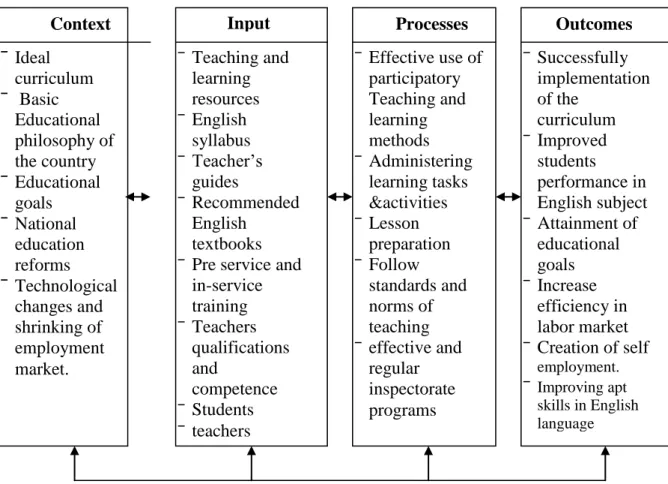
The researcher adopted and modifies the Context, Input, Process and Product (CIPP) model from Stufflebeam (1971). This model view the effective use of participatory methods as an integrated process which involves relationships of constructs (variables) on which the collection and analysis of data is based.
22
Fig 1.1 Conceptual framework for the study Adapted and modified from Stufflebeam 1971
In light of this study, the Context includes: Ideal curriculum, basic educational philosophy of the country, educational goals, National educational reforms, technological changes and shrinking of the employment market. Under these contexts we need to have appropriate inputs such as: teaching and learning resources, English syllabus, teachers’ guides, recommended English textbooks, pre-service and in-service training and teachers’ qualifications and competence teachers and students so as to have desired processes. The processes include: effective use of participatory teaching and learning methods, administering of appropriate learning tasks and activities, lesson preparations, follow standards and norms of teaching and effective and regular inspectorate programs. On the other hand, the processes need to be
‾ Ideal curriculum ‾ Basic Educational philosophy of the country ‾ Educational goals ‾ National education reforms ‾ Technological changes and shrinking of employment market. ‾ Successfully implementation of the curriculum ‾ Improved students performance in English subject ‾ Attainment of educational goals ‾ Increase efficiency in labor market ‾ Creation of self employment. ‾ Improving apt skills in English language Context Input s ‾ Teaching and learning resources ‾ English syllabus ‾ Teacher’s guides ‾ Recommended English textbooks ‾ Pre service and
in-service training ‾ Teachers qualifications and competence ‾ Students ‾ teachers Processes ‾ Effective use of participatory Teaching and learning methods ‾ Administering learning tasks &activities ‾ Lesson preparation ‾ Follow standards and norms of teaching ‾ effective and regular inspectorate programs Outcomes
23
careful undertaken with the help of the said contexts and inputs to come up with the desired outcomes such as: successful implementation of the curriculum, improved students’ performance in English, attainment of educational goals, increased efficiency in labor market, creation of self employment and improving apt skills in English language.
2.8 Summary of the Chapter
This chapter has reviewed literature on the methods used in teaching of English subject, students perceptions on the use of participatory methods in teaching English subject, challenges facing English teachers in using participatory methods, summary of the literatures review as well as research gap that the present study sought to fill. Finally, the chapter has presented the conceptual frame work for the study. The next chapter focus on the methodological procedure employed to realize the study’ objectives.
24
CHAPTER THREE
3.0 RESEARCH METHODOLOGY 3.1 Introduction
This chapter presents the research methods and procedures that the researcher employed for data collection and analysis. It includes the research approach, research design, and geographical area of the study, target population, sample and sampling techniques, methods of data collection, validity and reliability of the study, ethical considerations as well as data processing and analysis procedures.
3.2 Research Approach
The present study employed a qualitative approach. Qualitative research approach allows studying a phenomenon in its real life situation, without any sort of manipulation of data (Creswell, 2003). In this study, the researcher spends time with the participants; creates rapport to obtain first-hand information and experiences on the participatory methods in teaching of English subject. Given the fact that participants’ behaviors are unpredictable (tend to change with time and context), the settings that is community secondary schools environment was used to enable the study’s participants to provide information in a more relaxed manner.
Moreover, qualitative approach allows mutual relationship between the researcher and the participants during data collection. This mutuality allows the researcher to cultivate the inside of the participant to develop insights and ultimately generate bulky and wide information about the research problem under exploration (Cohen et al., 2000). In the light of this study, the researcher was directly involved in
25
interviews, discussions and observations with the participants, striving to tap the insights and ultimately generate bulky and wide information on the participatory methods in teaching of English subject.
3.3 Research Design
This study employed a case study design. The case study design is concerned with practical investigation of a phenomenon in detail within its real life context as it appears in its natural form (Creswell, 2009; Yin, 2009). The case study design was deemed appropriate in this study, because the researcher intend to explore in-depth the participatory methods in teaching of English subject.
3.4 Geographical Area of the Study
This study was conducted in Kilimanjaro Region. The region is located in the Northern part of Tanzania. It is bordered by Mara Region in the North, Arusha Region in Western part and Tanga and Dodoma Regions in the southern part. Kilimanjaro Region is chosen because it is the leading region in Tanzania with a large number of Community Secondary Schools. There are about 216 registered Community Secondary Schools in Kilimanjaro Region up to date (URT, 2011).
Kilimanjaro region was selected as the study area due to its accessibility of the required community secondary schools. All four community secondary schools sample were located in Moshi rural, thus reachable by whatever means of transport, also to represent other mainland rural areas because most of this community were built in this district according to the Ministry of Educational and Technical records.
26
Therefore the situation provided the researcher with an opportune population for picking the sample of schools and respondents to participate in the study.
Administratively, the region has seven districts namely Moshi Municipality, Moshi Rural, Siha, Hai, Mwanga, Same and Rombo. Since the region is large, and the researcher intends to undertake an in-depth study, only Moshi Rural was studied. Moshi Rural was chosen because there is a pronounced poor overall performance of English subject in Certificate of Secondary Education Examination (CSEE) particularly in recent years of 2008-2011. There have been observed cases in community secondary schools in Moshi Rural where by majority of form four students leave secondary education with division zero (URT, 2008-2011).
Within Moshi Rural there are about 15 community secondary schools. But the researcher focuses on four schools which are located near to the private schools. The assumption is that teachers in those community secondary schools may be involved in part time teaching in those nearby private schools. Therefore, these teachers may either facilitate or hamper effective use of participatory teaching methods in two ways respectively. One, teachers may learn from those private schools on the use of participatory teaching and apply them in their host schools (Community secondary schools). Two, teachers may be in hurry to cover the lectures in their schools and rush for other lessons in private schools.
27
3.5 Study Population
The population of this study was all school inspectors of English subject, heads of community secondary schools, and heads of English subject departments, English teachers and students from all community secondary schools in Moshi Rural Districts.
Zonal School Inspectors: These were chosen because they concerned with the responsibility of assessing teachers’ progress in the effective use of participatory teaching methods in teaching of English subject. They are also responsible for advising teachers on how they can go on improving the practice in their daily teaching and learning.
Heads of school: Heads of school were involved in this study by virtue of their administrative position. Among others, school heads are entitled to ensure that any changes in the teaching and learning methods are carefully adopted, implemented and effectively supervised for overall better performance of their schools.
Heads of English subject department: These were included in the study because they are responsible for supervising all activities related to the teaching of English in their schools. They shared information on the practice of participatory methods in teaching of English subject. Also, they provided information on how they co-operate with English teachers to deal with the execution of participatory teaching methods. English Teachers: These are the key implementers of the English subject curriculum. They are responsible for accommodating and adopting any changes in the teaching and learning of English. Their position of key curriculum implementers at classroom level and school in general made these teachers possess valuable information on the participatory methods in teaching of English subject.
28
Students: Students benefit directly from the actual teaching and learning process in the classroom. They are the ones who are constantly exposed to different methods of teaching. These students share information on the participatory methods in teaching of English subject.
3.6 Sample and Sampling Techniques
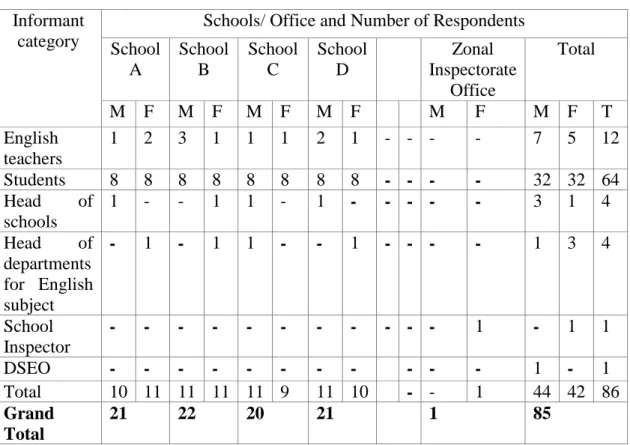
As it is not possible to study the whole target population, a sample of 85 respondents was drawn from the population. These 85 respondents were considered appropriate and adequate in this study because qualitative studies seek to provide in-depth insights in understanding of the problem under study rather than simply to generalize the data collected.
These respondents were obtained through three techniques; purposive, stratified and simple random sampling. Purposive sampling was used to obtain four (4) community secondary schools which are located near to the private schools. Again, purposive sampling was used to obtain one (1) Zonal Inspector of Schools for English subject because they are the only ones in those positions. Moreover, purposive sampling was used to obtain four (4) heads of school and four (4) heads of English subject department because their number corresponds to the number of the schools selected. Similarly, purposive sampling was used to obtain 12 English teachers because they are the one concerning with the teaching of English Subject.
On the other hand, 64 students were obtained through purposive, stratified and simple random sampling techniques. Purposively, form one up to form four students
29
were included in the study. This is because all students are assumed to be exposed to the participatory methods during their daily learning. On reaching each form, the researcher put students in strata of male and females (stratified sampling). From each stratum 2 students were randomly picked to make a total of 4 students from each form. The total number of students that was included in focus group discussion in each school was 16. Thus in all four schools the total number of students that included were 64.
Table 3.1 Total Sample by Category and Gender Informant
category
Schools/ Office and Number of Respondents School A School B School C School D Zonal Inspectorate Office Total M F M F M F M F M F M F T English teachers 1 2 3 1 1 1 2 1 - - - - 7 5 12 Students 8 8 8 8 8 8 8 8 - - - - 32 32 64 Head of schools 1 - - 1 1 - 1 - - - - - 3 1 4 Head of departments for English subject - 1 - 1 1 - - 1 - - - - 1 3 4 School Inspector - - - - - - - - - - - 1 - 1 1 DSEO - - - - - - - - - - - 1 - 1 Total 10 11 11 11 11 9 11 10 - - 1 44 42 86 Grand Total 21 22 20 21 1 85
Source: Researcher’s own creation Key: M= Male, F= Female
30
3.7 Methods of Data Collection 3.7.1 Data type and source
In this study the researcher intends to consult sources of data, primary and secondary data. Primary data are the first hand information obtained direct from the participants. The primary data were deemed appropriate for this study because the researcher seeks to capture first-hand information from the voices of the participants on the participatory methods in teaching English subject. On the other hand, secondary data are those which have been documented. The secondary data were considered relevant for this study as the researcher intend to review past events that are the previous preparation of curricular documents (lesson plans, schemes of work, teacher’s guides, and lesson notes). Secondary data also help to supplement the primary data obtained from interviews and classroom observations.
3.7.2 Methods of Data Collection
Interview: This study employs semi-structured interview because the researcher intends to capture first-hand information through probing deeper into participants’ experiences, feelings, opinions and suggestions concerning the participatory methods in teaching of English subject. Interviews help to collect data on the participatory methods in teaching of English subject. The researcher interviewed Zonal School Inspector, Head of Schools, Head of English departments and English teachers. The aim of using different mentioned stakeholders was to cross-check the authenticity of the collected data. The interview sessions took 10-15 minutes. With the consent of the participants, the responses were recorded using the voice recorder. The responses were kept in the computer files for later review, transcription and coding.
31
Observation: In this study, the researcher conducted non-participant classroom lesson observations. It was non-participant because the researcher was not directly involved in the teaching, observed what was taking place during English lessons with a checklist. Observation was considered appropriate for this study because of the researcher’s intent to collect data on the way participatory methods are being executed in the real classroom context. Also this method was deployed to establish challenges that hampers English teachers when employing participatory teaching methods.
Form one to form four teachers and students were observed during the lessons. In each school 8 lessons were observed in a week. Every single observation took 80 minutes because all English lessons are scheduled as double period (80 minutes) in the syllabus. All English teachers teaching form one to form four were observed. The total number of the lessons that was observed in all 4 schools was 32 in a total duration of 4 weeks (one month). During observation, the researcher started by noting the number of students in a class. Then, a list of features and activities needed for the execution of participatory teaching methods were noted as present, absent well prepared, poor prepared and yes or no in the researchers’ observational checklist. Similarly, the researcher observed students’ responses during the lesson to see how they interact with the teachers.
Focus Group Discussion (FGD): FGD was employed to collect data from 64 students 16 from each school. FGDs were important because it was difficult for the researcher to conduct interviews for all 64 students for an in depth study. The
32
assumption was that students’ bear similar information on the participatory methods in teaching of English thus, FGDs helped students to build on each other’s responses on the topic at hand. The total number of focus group discussions in all 4 schools was 8. Each group comprised 8 students; from form one to form four each of this group comprised 4 males and 4 females. The discussions were held inside the classrooms after class hours. Each discussion took about 15-20 minutes. With the students’ consent, FGDs’ responses were recorded using the voice recorder. The information obtained from FGDs helped to crosscheck the information obtained from observations and interviews with teachers and other stakeholders.
3.8 Validity and Reliability of the Study 3.8.1 Validity
Validity in qualitative research looks for depth, richness and the scope of the data achieved, participants approached, the extent of triangulation and objectivity of the researcher (Cohen et al., 2000). In this study, different procedures were taken to ensure that, the researcher achieve a valid study. First, the researcher selected the participants who were information rich about the topic under investigation. Hence, the collected data was a reflection of what the researcher intended to achieve. Again, the researcher triangulated the sources of data and the methods of data collection. In this case, interviews, observations, focus group discussions and document search were employed. On the other hand, Zonal English School inspectors, heads of schools, heads of English departments, English teachers and students were included in the study. Triangulation of data sources and methods of data collection helped to confirm the authenticity of the collected data.
33
3.8.2 Reliability
Unlike in quantitative research, reliability issues in qualitative research do not concern with piloting of the instruments for data collection. This is because in qualitative studies, the reality is subjective to a particular context and may not be generalized to another context. In qualitative studies reliability issues concern with meaningfulness of the data collected and consistency of the approach being used across different researchers (Bogdan & Biklen, 1992; Cohen et al., 2000). In this study, the researcher ensured reliability in the following ways. First, the language that was used, Kiswahili in this case was appropriate and understood by the participants. The use of Kiswahili increases the participants’ confidence to express them freely.
Second, during data analysis, the researcher sought more clarification and interpretation of not well understood concepts from the participants to clear any ambiguities. Third, the researcher discussed step by step the design of the study and the methods to be used in data collection and analysis. The researcher also presented a comprehensive discussion of the findings by including the informants’ evidence using their own language on a given context when deemed appropriate.
3.9 Data Analysis Procedures
As the data collected could not be presented as a whole, the researcher analyzed the data to have a clear and easy interpretation and discussion of the findings. The analyzed data included: the information about teaching and learning methods being used in teaching of English subject in community secondary schools, students
34
perceptions on the use of participatory methods in teaching of English, challenges that teachers encounter when employing participatory teaching methods. Since the study was confined to qualitative data, the collected information was subjected to content analysis. First of all, data from interviews, focus group discussions and observation schedules were transcribed. Then it was read through carefully to establish a general sense of the information and to reflect on its overall meaning. Then data were presented, discussed and the report was produced.
3. 10 Ethical Considerations
In this study, the researcher adhered to the following ethical issues:
Research Clearance Letters: The permission to conduct this study was obtained from relevant authorities of the Open University of Tanzania including: the Vice Chancellor (VC) of the Open University of Tanzania, Kilimanjaro Region Administrative Secretary (RAS) and Moshi Rural District Administrative Secretary (DAS). These letters were used to introduce the researcher to the respective schools. Informed Consent: The researcher clearly explained the purpose of the study to the participants. He clarified on the research problem, purpose of the study, the short term and long term benefits and loss due to their participation in this study. The researcher asked for the participants’ consent whenever he wanted to record their voices during interviews and focus group discussions and whenever he wanted to take photos related to the study. Again, the researcher informed the participants that their participation is free, and they had the right to withdraw at any time with no repercussions.
35
Assurance of Confidentiality: The researcher assured confidentiality by maintaining anonymity of the respondents. The respondents’ names as well as school names were not mentioned in the report. Instead pseudo names or letters were used to represent schools, teachers and students. The information collected was kept safely so that no any unauthorized individual was able to access it. Furthermore, the researcher clarified to the respondents that the information sought was only for research purpose, thus no any respondents was victimized for providing needed information.
3.11 Summary of the Chapter
This chapter has presented the methodological procedures of the study that led to the collection and analysis of data on the participatory teaching methods in teaching of English subject. The chapter has presented the design and approach of the study, the study area, the population from which the sample was drawn and the sampling techniques. It has also highlighted the data types and methods of data collection, validity and reliability of the study, data analysis procedures as well as ethical issues relevant in conducting this study. The next chapter focuses on data presentation, and analysis of the findings.
36
CHAPTER FOUR
4.0 DATA PRESENTATION AND ANALYSIS OF THE FINDINGS 4.1 Introduction
This chapter presents the findings on the participatory methods in teaching of English subject in community secondary schools in Moshi Rural. The chapter draws on data generated through face-to-face interviews, focus group discussions, and observations. The presentation and discussion is organized alongside three research objectives: teaching methods being used in teaching of English subject; students’ perceptions on the use of participatory methods in teaching of English subject in community secondary schools; and the challenges facing English teachers in using participatory methods to teach English subject in community secondary schools.
4.2 Teaching methods being used in teaching of English subject
Teachers were requested to describe the methods that they usually used in teaching English languageThe intention of the first objective was to explore the common teaching methods being used in teaching of English subject in community secondary schools in Moshi rural. To that effect, several different methods were used to generate relevant data on this objective. The question was: Which methods of teaching and learning do you use in your daily teaching of English subject?
This question was posed to sixteen teachers teaching English subject in four schools, four teachers from each school, some of the methods mentioned included: brainstorming, group discussion, demonstrations and question and answers. As one male teacher affirmed: