volumes of documents and make them easily accessible through a network, intranet or the Internet. If documents managed by the system contain sensitive information and/or have longstanding value, the system must provide granular security controls and auditing capabilities, provide long term archival and disaster recovery capabilities and offer formal records management controls to make sure records are managed properly throughout their lifecycle.
An EDMS should utilize an open architecture and non-proprietary file formats to ensure content is always accessible over time and the organization
deploying the system always retains full ownership over the documents and data stored in the system. A system employing an open architecture can run on readily available hardware running industry standard operating systems and will utilize standard database management software. The system should store imaged documents as single-page TIFF images with Group IV
compression because it minimizes network bandwidth requirements and is the worldwide standard for long term archival.
The system should store documents on any standard hardware storage device in self-contained volumes for disaster recovery purposes. Volumes should be configured to match the physical storage capacity of the preferred non-volatile storage media for offsite storage and should provide the ability to add a search engine and viewer to archived volumes so critical information can be
accessed offline in the event of a natural disaster or unavoidable hardware failure. Archived volumes should be able to be attached to a restored or emergency system selectively to facilitate the fastest possible recovery from a disaster.
In terms of functionality, the system should be easy to deploy, configure and customize to meet the specific needs of any organization. The system should employ an intuitive interface so it’s easy to use by anyone with limited
experience using a computer. The system should be fully Unicode and support multiple languages for OCR and full-text searching as well as menus and prompts. Basic technical and functional requirements are detailed in Attachment 1 – Document Management System Evaluation Checklist. Records management and security requirements are more specialized and multiple governments have developed their own standards. The first and most detailed standard developed for electronic records management
applications was the US Department of Defense records management standard (DoD 5015.2). This standard was developed specifically for electronic
System #1 System #2 System #3
Capture
Does the product work with a wide variety of scanners? Can you use hybrid and
specialized capture devices such as copier-scanners and microfilm scanners?
Does the system auto-name documents while scanning according to user, date or other values?
Can you scan additional pages into existing documents? Can you perform image adjustments to remove noise, remove lines, crop, rotate and perform other image clean-up? Does the system automatically remove blank pages?
Can you archive electronic documents including images, text, spreadsheets, PDFs, movies, AutoCAD and sound files in their native file formats?
Can you send documents to the system from Windows® Explorer™?
Can you archive documents from Microsoft® applications? Can you automatically extract e-mail metadata?
Does the system support
mandatory metadata acquisition? Can you import electronic documents and directories by dragging and dropping? Can you export and import documents, folders and their metadata by using briefcases? Can you convert electronic documents to archival images without printing and scanning
Is there form alignment and dropout for precise zone OCR? Can you extract template and identification data from images? Can you extract data by zone OCR, bar code recognition or Optical Mark Recognition (OMR)?
Can you look up external metadata keyed by extracted data or data entered manually? Can you use extracted data for document or folder naming, indexing or as input to other processes?
Does the system identify documents by recognizing forms or by matching extracted data? Does the system use identification for document separation or individualized processing? Can you imprint images with Bates numbers, lookup data or bitmaps?
Can you schedule document uploading to the repository?
Storage
Is the location of document data fully configurable and storable on any network volume?
Is there a separate document folder hierarchy from physical storage volumes?
Can you configure volume size and set rollover limits?
Is there full support for rewritable, read-only, removable or fixed volumes?
Can you migrate documents to different physical volumes? Can you set document content files to read-only for magnetic WORM support?
Can you transfer document storage volumes with metadata and folder organization intact? Can you attach large numbers of
documents and folders?
Can you create different templates for distinct document types? Are there constraints forcing users to enter template information in specified formats?
Is there color-coding to distinguish document types? Can you reassign or update templates or fields at any time? Are selection lists available to standardize template entries? Can you generate searchable text from PDFs and CAD files? Can you autopopulate template information to documents from parent folders?
Does the program support simultaneous OCR from multiple workstations?
How many languages are supported by the OCR?
Search and Retrieval
Are template field searches supported?
Do full-text searches cover the entire database?
Are fuzzy searches supported? Can you search by security tag, volume, creation or modification date, note text or other criteria? Can you save search criteria for repeated execution?
Are proximity searches supported?
Can you perform name searches by document or folder?
Can you combine search criteria to narrow results (Boolean searching)?
Can you limit search results by folder?
Are search terms highlighted to show their precise location within returned documents?
Can you save search results in folders for quick reference and
Does the software offer a flexible print configuration?
Is there accurate scaling of print output to match the original document?
Can you e-mail archived documents as TIFF or PDF? Is cross-platform retrieval with standard Web browsers supported?
Can you distribute and archive records on non-erasable media? Can you distribute documents on royalty-free CDs and DVDs? Do CDs provide built-in search engines for access on any PC? Are there Web browser-based document management capabilities (thin client)? Can you create published repositories based on search results?
Can you drag and drop documents into e-mail?
Security
Are there storage and security measures supporting regulatory compliance?
Are there privilege rights controlling administrative functions?
Are there feature rights controlling functions like scanning, printing, searching and importing?
Are there access rights
determining the level of access for users or groups?
Are there volume access rights determining permission to import data volumes?
Are there template field access controls limiting users’ ability to see and edit template fields? Can you determine effective rights for any user?
maximum idle time before users are automatically logged out? Can you allow or deny security rights explicitly through inheritance?
Is inheritance controlled through flexible scoping options? Do security tags place special restrictions on documents and folders?
Are you able to securely redact sensitive portions of documents? Are there various levels of audit tracking for compliance and accountability?
Can you control security permissions centrally or delegate to department heads?
Is there native support for single sign on?
Can you securely wipe digital records on destruction?
Can you force printouts to include security watermarks for tracking origins?
Can you require users to indicate the reason for document export?
Workflow
Are you able to model work processes with an intuitive graphical interface?
Can you automate document movement with rules-based routing?
Can you maintain productivity with automated notifications? Is audit tracking available to improve accountability? Can you accommodate ad hoc participation in the workflow environment?
Document Management
Is there an intuitive folder view to make organization easy and flexible?
Can you display document names, template fields and volume
Can you track document versions and customize how you search for display versions?
Are there check-in/check-out capabilities?
Is there support for dockable windows, or flexible viewing of images, text, thumbnails and template fields?
Can you establish document linking relationships?
Can public and private folders be set up to allow document sharing, mail folders and ad hoc
workflow?
Can you highlight text and images?
Can users place sticky notes on documents with searchable text and hyperlinks?
Can you stamp images with customized or predefined graphics?
Are annotations image overlays that do not modify the original document?
Are there informational tags to alert users to special properties? Can you display black and white, color or grayscale images? Can you edit text files created by OCR?
What is the maximum zoom magnification?
Does the software support full panning, rotation and contrast?
Records Management
Is the system DoD 5015.2 certified?
Using the system, can you integrate records management, document management and imaging in one environment? Can you create records from documents already under management?
Can you track current locations of transferred records?
Can you screen records for eligibility for transfer, accession or destruction?
Can you confirm destruction of eligible records?
Can you find records according to status or location?
Can you specify multiple events that are necessary before records can be cut off?
Can you specify trigger events determining which retention schedules apply to records? Can you configure retention schedules so that superseded records are sent into final disposition?
DoD 5015.02-STD
ELECTRONIC RECORDS
MANAGEMENT
SOFTWARE APPLICATIONS
DESIGN CRITERIA
STANDARD
April 25, 2007
ASSISTANT SECRETARY OF DEFENSE FOR NETWORKS AND INFORMATION INTEGRATION/
FOREWORD
This Standard is reissued under the authority of DoD Directive 5015.2, “Department of Defense Records Management Program,” March 6, 2000, (Reference (a)) which provides implementing and procedural guidance on the management of records in the Department of Defense. It sets forth mandatory baseline functional requirements for Records Management Application (RMA) software used by the DoD Components in implementing their records management programs; defines required system interfaces and search criteria that RMAs shall support; and describes the minimum records management requirements that must be met based on current National
Archives and Records Administration (NARA) regulations.
DoD 5015.2-STD, “Design Criteria Standards for Electronic Records Management Software Applications,” June 19, 2002, (Reference (b)) is hereby canceled.
This Standard applies to the Office of the Secretary of Defense, the Military Departments, the Chairman of the Joint Chiefs of Staff, the Combatant Commands, the Inspector General of the Department of Defense, the Defense Agencies, the DoD Field Activities, and all other
organizational entities within the Department of Defense (hereafter referred to collectively as the “DoD Components”).
The standard is effective immediately for all new electronic records management information systems development efforts. Commercial products applying for testing after the standard date will be held compliant to this standard. Commercial products listed as compliant to version 2 of this standard on the product register are grandfathered until their version 2 compliance expires, which is two years after their last test date. The Heads of the DoD Components may issue supplementary instructions only when necessary to provide for unique requirements within their organizations, provided those instructions do not adversely affect interoperability and
compatibility with DoD Automated Information Systems (AIS) across the Global Information Grid (GIG) architecture.
Send recommended changes to this Standard to:
Office of the Deputy Assistant Secretary of Defense/ Deputy Chief Information Officer,
Information Policy Directorate Voice: 703-602-1007 1851 South Bell Street FAX: 703-602-0830
Suite 600 DSN: 324-1007
This Standard is approved for public release; distribution is unlimited. The DoD Components, other Federal Agencies, and the public may obtain copies of this Standard via the Internet at: http://www.dtic.mil/whs/directives.
TABLE OF CONTENTS Page FOREWORD ...1 TABLE OF CONTENTS...3 TABLES ...4 REFERENCES ...7 DEFINITIONS...11
ABBREVIATIONS AND ACRONYMS ...28
C1. CHAPTER 1 - GENERAL INFORMATION ...30
C1.1. PURPOSE ...30
C1.2. LIMITATIONS ...31
C2. CHAPTER 2 - MANDATORY REQUIREMENTS...32
C2.1. GENERAL REQUIREMENTS ...32
C2.2. DETAILED REQUIREMENTS ...33
C3. CHAPTER 3 - MANAGEMENT OF CLASSIFIED RECORDS ...58
C3.1. MANAGEMENT OF CLASSIFIED RECORDS...58
C3.2. OPTIONAL SECURITY FEATURES ...64
C4. CHAPTER 4 – MANAGING RECORDS FOR THE PRIVACY ACT AND THE FREEDOM OF INFORMATION ACT ...66
C4.1. MANAGEMENT OF PRIVACY ACT RECORDS...66
C4.2. MANAGEMENT OF FREEDOM OF INFORMATION ACT RECORDS...79
C4.3. ACCESS CONTROL FOR PRIVACY ACT AND FREEDOM OF INFORMATION ACT RECORDS ...86
C5. CHAPTER 5 - TRANSFERS...92
C5.1. TRANSFER RMA TO RMA INTEROPERABILITY...92
C5.4. TRANSFER ACCESS CONTROL. ...110
C6. CHAPTER 6 - NON-MANDATORY FEATURES ...112
C6.1. REQUIREMENTS DEFINED BY THE ACQUIRING OR USING ACTIVITY ....112
C6.2. OTHER USEFUL RMA FEATURES...113
C6.3. SEARCH AND DISCOVERY INTEROPERABILITY ...116
C6.4. NON-MANDATORY ACCESS CONTROL...116
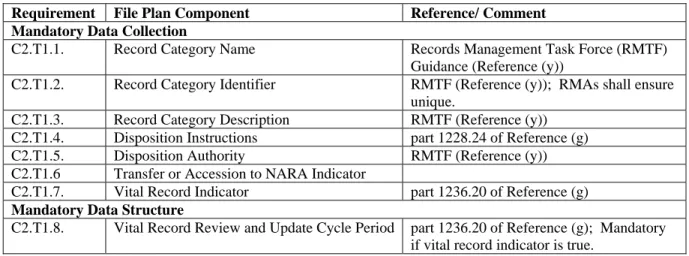
TABLES C2.T1. FILE PLAN COMPONENTS...33
C2.T2. RECORD FOLDER COMPONENTS...34
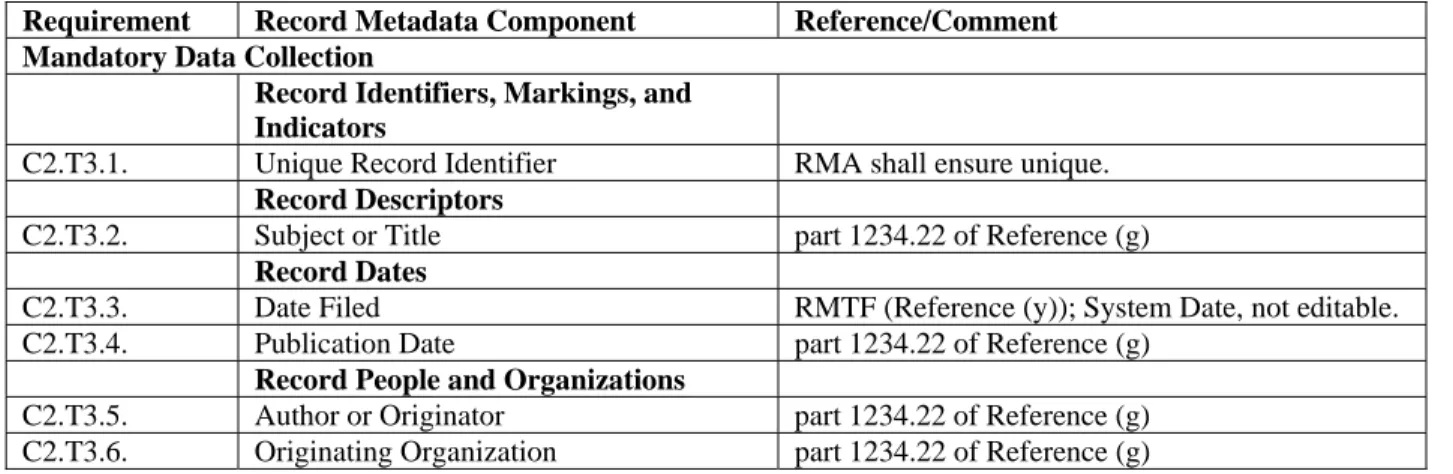
C2.T3. RECORD METADATA COMPONENTS...37
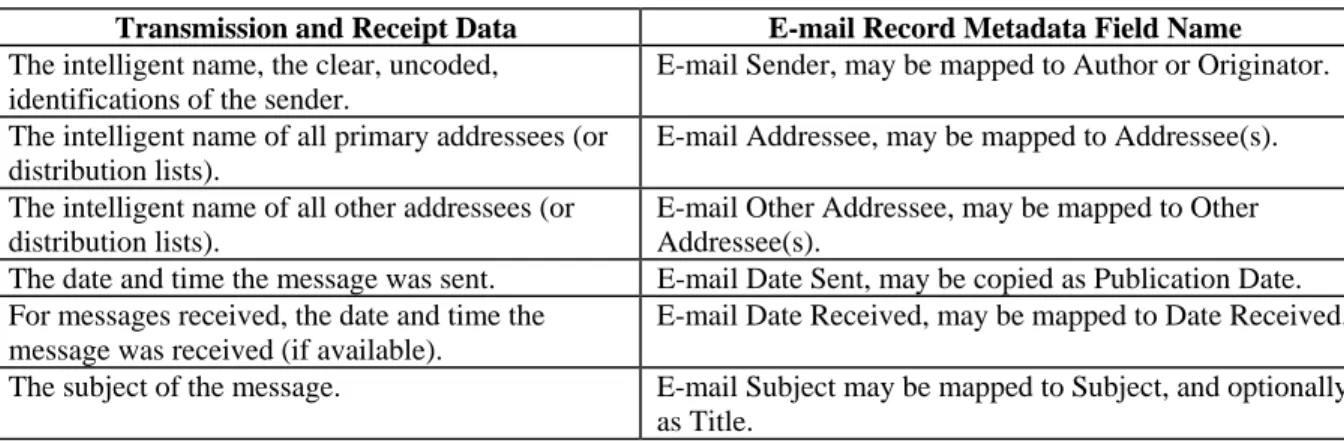
C2.T4. TRANSMISSION AND RECEIPT DATA ...41
C2.T5. RECORD METADATA COMPONENTS...42
C2.T6. MANDATORY AUTHORIZED INDIVIDUAL REQUIREMENTS ...49
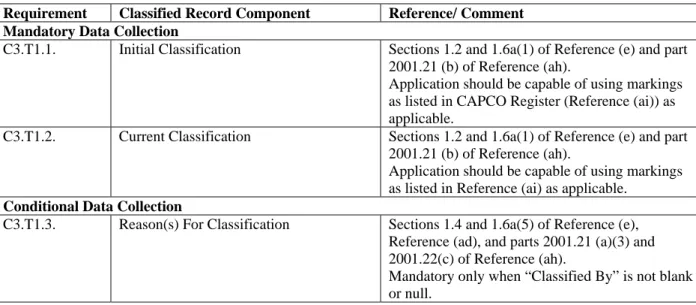
C3.T1. CLASSIFIED RECORD COMPONENTS ...58
C3.T2. CLASSIFIED RECORD AUTHORIZED INDIVIDUAL REQUIREMENTS ...63
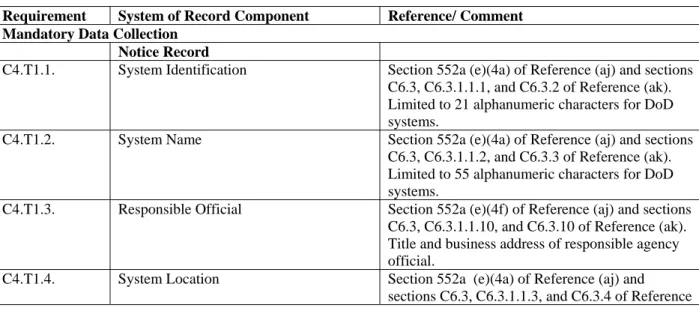
C4.T1. SYSTEM OF RECORD COMPONENTS ...66
C4.T2. PRIVACY ACT FILE COMPONENTS ...69
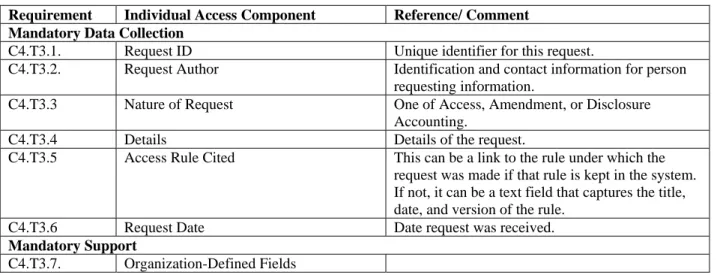
C4.T3. INDIVIDUAL ACCESS REQUEST COMPONENTS...70
C4.T4. ACCESS RECORD COMPONENTS ...71
C4.T5. DENIAL COMPONENTS...72
C4.T6. APPEAL COMPONENTS ...72
C4.T7. AMENDMENT COMPONENTS ...73
C4.T8. DISPUTE COMPONENTS ...74
C4.T9. DISCLOSURE REQUEST COMPONENTS...75
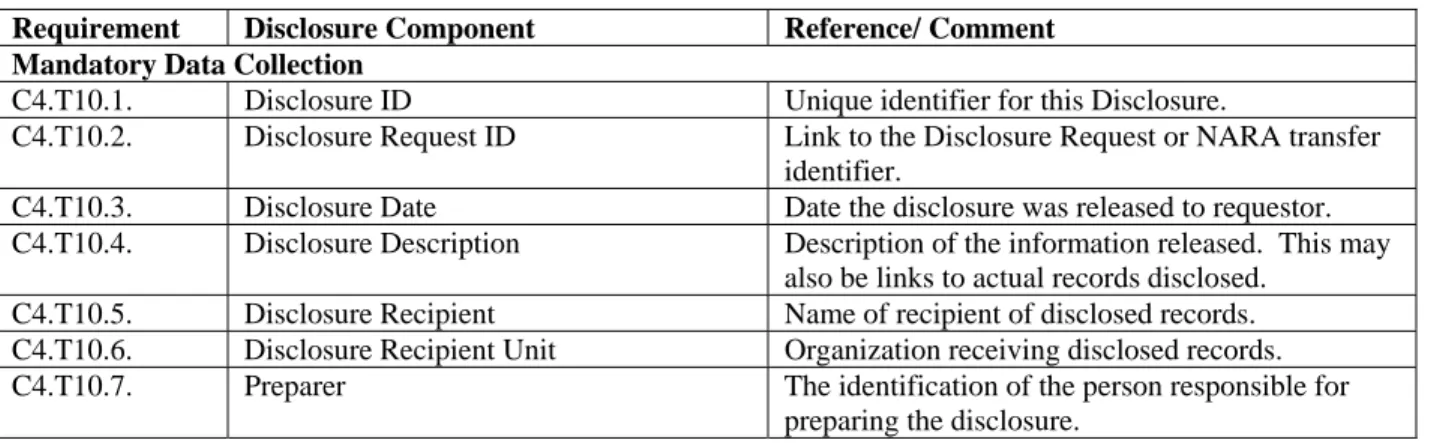
C4.T10. DISCLOSURE METADATA COMPONENTS ...75
C4.T11. ACCOUNTING RECORD COMPONENTS...77
C4.T12. EXEMPTION COMPONENTS ...78
C4.T13. MATCHING PROGRAM COMPONENTS ...78
C4.T14. ACCESS RULES COMPONENTS...79
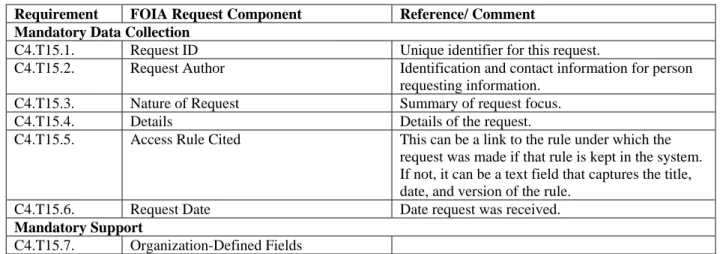
C4.T15. FOIA REQUEST COMPONENTS ...80
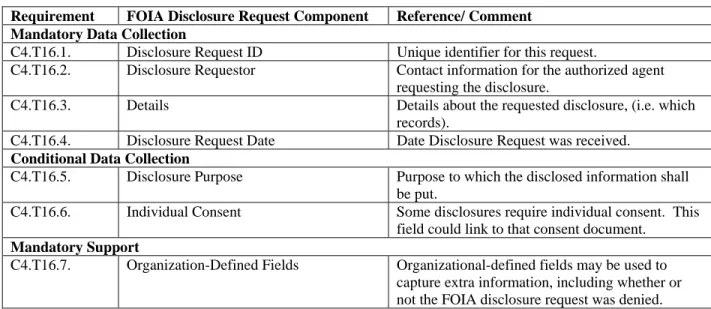
C4.T16. FOIA DISCLOSURE REQUEST COMPONENTS ...81
C4.T17. FOIA DISCLOSURE COMPONENTS ...81
C4.T18. FOIA EXEMPTION COMPONENTS ...83
C4.T19. FOIA APPEAL COMPONENTS ...84
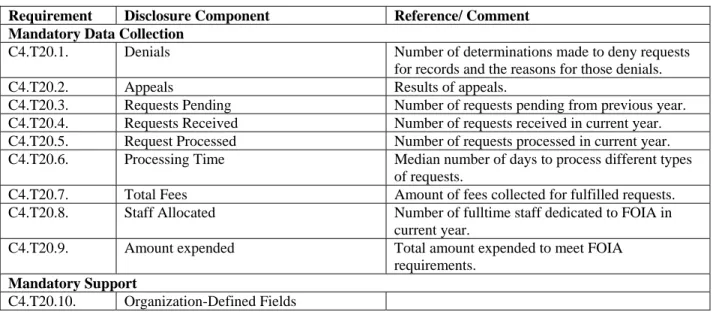
C4.T20. FOIA REPORTS METADATA DISCLOSURE COMPONENTS ...85
C4.T21. AUTHORIZED INDIVIDUAL REQUIREMENTS FOR PRIVACY ACT AND FOIA RECORDS...86
C5.T1. RECORD LEVEL CORE (DEFINED MANDATORY) ...94
C5.T4. RECORD LEVEL PDF (DEFINED MANDATORY)...96
C5.T5. RECORD LEVEL DIGITAL PHOTOGRAPH (DEFINED MANDATORY)...96
C5.T6. RECORD LEVEL WEB RECORDS (DEFINED MANDATORY)...97
C5.T7. RECORD LEVEL SCANNED (DEFINED OPTIONAL) ...98
C5.T8. RECORD LEVEL PDF (DEFINED OPTIONAL)...98
C5.T9. RECORD LEVEL DIGITAL PHOTOGRAPH (DEFINED OPTIONAL)...98
C5.T10. RECORD LEVEL WEB RECORD (DEFINED OPTIONAL)...99
C5.T11. RECORD (TRANSFER MANDATORY) ...99
C5.T12. RECORD (TRANSFER DEFINED OPTIONAL) ...100
C5.T13. RECORD (TRANSFER ORGANIZATION-DEFINED) ...100
C5.T14. RECORD LEVEL LIFECYCLE (TRANSFER MANDATORY) ...101
C5.T15. RECORD LEVEL LIFECYCLE ( TRANSFER ORGANIZATION-DEFINED) .101 C5.T16. FOLDER LEVEL (DEFINED TRANSFER LIFECYCLE MANDATORY)...102
C5.T17. FOLDER LEVEL LIFECYCLE (TRANSFER LIFECYCLE ORGANIZATION-DEFINED) ...102
C5.T18. FOLDER LEVEL (TRANSFER MANDATORY) ...102
C5.T19. FOLDER LEVEL (TRANSFER DEFINED OPTIONAL) ...103
C5.T20. FOLDER LEVEL (TRANSFER ORGANIZATION-DEFINED) ...103
C5.T21. COMPUTER FILE CORE ( DEFINED MANDATORY)...104
C5.T22. SECURITY MARKING METADATA ...105
C5.T23. DOWNGRADING AND DECLASSIFICATION METADATA...105
C5.T24. RECORD CATEGORY (DEFINED TRANSFER MANDATORY) ...106
C5.T25. EVENTS (DEFINED TRANSFER MANDATORY) ...107
C5.T26. EVENTS (TRANSFER ORGANIZATION-DEFINED) ...107
C5.T27. TRIGGER (DEFINED TRANSFER MANDATORY) ...107
C5.T28. TRIGGER (TRANSFER ORGANIZATION-DEFINED) ...108
C5.T29. VITAL RECORD REVIEW (DEFINED TRANSFER MANDATORY)...108
C5.T30. VITAL RECORD REVIEW (TRANSFER ORGANIZATION-DEFINED)...109
C5.T31. LIFECYCLE PHASE (DEFINED TRANSFER MANDATORY) ...110
C5.T32. LIFECYCLE PHASE (TRANSFER ORGANIZATION-DEFINED) ...110
C5.T33. AUTHORIZED INDIVIDUAL REQUIREMENTS FOR TRANSFER ACCESS CONTROL...110
REFERENCES
(a) DoD Directive 5015.2, “Department of Defense Records Management Program,” March 6, 2000
(b) DoD 5015.2-STD, “Design Criteria Standards for Electronic Records Management Software Applications,” June 19, 2002 (hereby canceled)
(c) Director of Central Intelligence Directive 6/3, “Protecting Sensitive Compartmented Information within Information Systems,” May 24, 2000
(d) Deputy Assistant Secretary of Defense for Networks and Information Integration Specification, “Department of Defense Discovery Metadata Specification (DDMS), Version 1.3,” July 29, 20051
(e) Executive Order 12958, “Classified National Security Information,” as amended by
Executive Order 13292, “Further Amendments to Executive Order 12958,” March 28, 2003 (f) National Archives and Records Administration, “Disposition of Federal Records – A
Records Management Handbook,” 19972
(g) Title 36, Code of Federal Regulations, Parts 1194.21, 1194.22, 1194.31, 1220.14, 1222.10, 1222.32, 1222.50, 1228.24, 1228.270, 1228.54, 1228.58, 1228.60, 1234.2, 1234.22,
1234.24, 1234.28, 1234.30, 1234.32, 1234.34, 1236.14, and 1236.20
(h) International Organization for Standardization (ISO)/International Electrotechnical
Commission (IEC) 11179-1, “Information technologies – Metadata Registries,” September 15, 20043
(i) Section 3301 of title 44, United States Code, “Definition of Records”
(j) Section 3511 of title 44, United States Code, “Establishment and Operation of Government Information Locator Service”
(k) Federal Information Processing Standard Publication 192, “Application Profile for the Government Information Locator Service,” December 7, 19944
(l) DoD Instruction 8520.2, “Public Key Infrastructure and Public Key Enabling”, April 1, 20045
(m) Section 2901 of title 44, United States Code, “Definitions”
(n) Organization for the Advancement of Structured Information Standards Reference Model for Service Oriented Architecture 1.0, August 2, 20066
(o) ISO 23081-1, “Information and Documentation — Records Management Processes- Metadata Records,” January 15, 20067
1 http://www.afei.org/news/documents/DDMS-v1_2.pdf 2 http://www.archives.gov/records-mgmt/publications/disposition-of-federal-records/ 3 http://standards.iso.org/ittf/PubliclyAvailableStandards/c035343_ISO_IEC_11179-2004(E).zip 4 http://www.itl.nist.gov/fipspubs/fip192.htm 5 http://www.dtic.mil/whs/directives/corres/pdf/i85202_040104/i85202p.pdf 6 http://www.oasis-open.org/committees/download.php/19679/soa-rm-cs.pdf
(p) DoD Directive 5400.07, “DoD Freedom of Information Act (FOIA) Program”, October
28, 2005
(q) Section 2902 of title 44, United States Code, “Objectives of Records Management” (r) DoD Chief Information Officer Memorandum, “DoD Net-Centric Data Strategy,” May 9,
2003
(s) DoD Directive 8320.2, “Data Sharing in a Net-Centric Department of Defense,” December 2, 2004
(t) NARA Guidance, “Electronic Records Management Guidance on Methodology for Determining Agency-unique Requirements,” August 23, 20048
(u) Section 3103 of title 44, United States Code, “Transfer of Records to Records Centers” (v) ISO 8601, “Data elements and interchange formats – Information interchange –
Representation of dates and times,” December 3, 20049
(w) Section 794d of title 29, United States Code, “Electronic and Information Technology” (x) Section 3303 of title 44, United States Code, “Lists and Schedules of Records”
(y) Records Management Task Force Guidance, “Functional Baseline Requirements and Data Elements for Records Management Application Software,” August 28, 199510
(z) Director of Central Intelligence Directive (DCID) 6/6, “Security Control on the Dissemination of Intelligence Information,” July 11, 2001
(aa) DoD Directive 5210.83, “Department of Defense Unclassified Controlled Nuclear Information (DoD UNCI),” November 15, 1991
(ab) DoD 5400.7-R, “DoD Freedom of Information Act Program Regulation,” September 1998 (ac) DoD Directive 5230.24, “Distribution Statements on Technical Documents,” March 18, 1987
(ad) DoD 5200.1-R, “Information Security Program Regulation,” January 14, 1997 (ae) Section 3105 of title 44, United States Code, “Safeguards”
(af) Section 2909 of title 44, United States Code, “Retention of Records”
(ag) Executive Order 12968, “Access to Classified Information,” August 4, 1995 (ah) Title 32, Code of Federal Regulations, Part 2001, “Classified National Security
Information,” current edition
(ai) Controlled Access Program Coordination Office (CAPCO), “The Authorized Classification & Controlled Markings Register”11
(aj) Section 552a of title 5, United States Code
(ak) DoD 5400.11-R, “Department of Defense Privacy Program,” August 1983 (al) Organization for the Advancement of Structured Information Standards (OASIS)
Specification, “Universal Description, Discovery and Integration v3.0.2 (UDDI),” February 200512 8 http://www.archives.gov/records-mgmt/policy/requirements-guidance.html 9 http://www.iso.org/iso/en/prods-services/popstds/datesandtime.html 10 http://jitc.fhu.disa.mil/recmgt/func_req.doc 11 http://www.cms.ic.gov/capco or http://www.cms.cia.sgov/capco
(am) Assistant Secretary of Defense for Command, Control, Communications, and Intelligence Plan, “DoD Information Management (IM) Strategic Plan, Version 2.0,” October 1, 199913 (an) DoD Chief Information Officer Architecture, “Global Information Grid Architecture,
Version 2.0,” December 9, 200314
(ao) Joint Requirements Oversight Council Memorandum, “Global Information Grid Capstone Requirements Document, JROCM 134-01,” August 30, 2001
(ap) DoD Directive 4630.5, “Interoperability and Supportability of Information Technology (IT) and National Security Systems (NSS),” May 4, 2004
13
DEFINITIONS
DL1.1. Access. The ability or opportunity to gain knowledge of stored information. DL1.2. Access Control. The term “access control” has the following meanings:
DL1.2.1. A service feature or technique used to permit or deny use of the components of a communication system.
DL1.2.2. A technique used to define or restrict the rights of individuals or application programs to obtain data from, or place data onto, a storage device.
DL1.2.3. The definition or restriction of the rights of individuals or application programs to obtain data from, or place data into, a storage device. Types of access control methods include Mandatory Access Control and Discretionary Access Control (Reference (c)).
DL1.2.4. The process of limiting access to the resources of an AIS to authorized users, programs, processes, or other systems. (DL1.15)
DL1.2.5. The function performed by the resource controller that allocates system resources to satisfy user requests.
DL1.3. Accession. The act of transferring physical custody of documentary material to an archival institution.
DL1.4. Addressee. The name of the organization or individual to whom a record is addressed. DL1.5. Application. The system or problem to which a computer is applied. Reference is often made to an application as being either of the computational type (arithmetic computations predominate) or of the data processing type (data handling operations predominate).
DL1.6. Application Administrators. The individuals who are responsible for setting up the RMA infrastructure write the configuration plan and periodic changes for Network System Administrator implementation.
DL1.7. Attachment. A record, object, or document associated with another document or record and filed in the RMA or transmitted as part of the other document or record.
DL1.8. Attribute. The term “attribute” is defined in Deputy Assistant Secretary of Defense for Networks and Information Integration Specification (Reference (d)).
documented as it occurs or afterward. An audit trail may identify unauthorized actions in relation to the records, e.g., modification, deletion, or addition.
DL1.10. Authenticity. A condition that proves that a record is genuine based on its mode (i.e., a method by which a record is communicated over space or time), form (i.e., the format or media that a record has upon receipt), state of transmission (i.e., the primitiveness, completeness, and effectiveness of a record when it is initially set aside after being made or received), and manner of preservation and custody.
DL1.11. Authorized Individual. A Records Manager or other person specifically designated by the Records Manager as responsible for managing various aspects of an organization's records. DL1.12. Author, Originator, or Creator. The person, office, or designated position responsible for creation or issuance of a document. The author, originator, or creator is usually indicated on the letterhead or by signature. For RMA purposes, the author, originator, or creator may be designated as a person, official title, office symbol, or code.
DL1.13. Auto-Filing. The ability of an RMA to automatically file records without user intervention.
DL1.14. Backward Compatible. The ability of a software program or piece of hardware to read files in previous versions of the software or hardware.
DL1.15. Biometrics. The measurable physical characteristics or personal behavioral traits used to recognize the identity or verify the claimed identity of an individual. (DL1.2)
DL1.16. Boolean Operators. The operators of Boolean algebra. Boolean operators may be represented in various ways. Often they are simply written as “AND,” “OR,” and “NOT”. While any number of logical “ANDs” (or any number of logical “ORs”) may be chained together without ambiguity, the combination of “ANDs” and “ORs” and “NOTs” can lead to ambiguity. In such cases, parentheses may be used to clarify the order of operations. As always, the
operations within the innermost set of parentheses is performed first, followed by the next set out, etc., until all operations within parentheses have been completed. Then any operations outside the parentheses are performed.
DL1.17. Bulk Load. An automatic data import.
DL1.18. Business Rules. The descriptions of operations, definitions and constraints that apply to an organization in achieving its goals. For example, a business rule might state that no credit check is to be performed on return customers. Other rules might define a tenant in terms of solvency or list preferred suppliers and supply schedules. These rules would then be used to help
the organization to better achieve goals, communicate among principals and agents,
communicate with interested third parties, demonstrate fulfillment of legal obligations, operate more efficiently, automate operations, and perform analysis on current practices.
DL1.19. Cascading Style Sheets (CSS). A stylesheet language used to describe the presentation of a document written in a markup language. Its most common application is to style web pages written in Hypertext Markup Language (HTML) and Extensible Hypertext Markup Language (XHTML), but the language can be applied to any application of Extensible Markup Language (XML), including Scalable Vector Graphics (SVG) and Extensible User Interface Language (XUL). The CSS specifications are maintained by the World Wide Web Consortium (W3C). DL1.20. Classification Guide. A documentary form of classification guidance issued by an original classification authority that identifies the elements of information regarding a specific subject that must be classified and establishes the level and duration of classification for each such element. (Reference (e)).
DL1.21. Classified Information. The information that has been determined pursuant to Executive Order (EO) 12958, as amended by EO 13292 (Reference (e)) or any predecessor order, to require protection against unauthorized disclosure, and that is marked to indicate its classified status when in documentary form.
DL1.22. Classification Markings. The identifications or markings that leave no doubt about the classified status of the information, the level of protection required, and the duration of the classification. Such markings include: Overall Markings, Portion Markings, Classified by line, Reason line, Derived from line, and Declassify on line (Reference (e)).
DL1.23. Common Access Cards (CAC). The cards that feature bar-coding, a magnetic strip, and an embedded integrated circuit chip used for access to buildings, to computer systems, etc. DL1.24. Compression. A process, which using special software, reduces the file size of a given electronic file.
DL1.25. Copy. In electronic records, the action or result of reading data from a source (the RMA’s repository), leaving the source data unchanged, and writing the same data elsewhere on a medium that may differ from the source (a user workspace or other device) (NARA Handbook, Reference (f)).
DL1.26. Create. In electronic records, the action or result of filing a new record and its associated metadata.
DL1.28. Cutoff. To cut off records in a file means to break, or end, the record at regular intervals to permit disposal or transfer in complete blocks and, for correspondence files, to permit the establishment of new files. Cutoffs are needed before disposition instructions can be applied because retention periods usually begin with the cutoff, not with the creation or receipt, of the records. In other words, the retention period normally does not start until the records have been cut off. Cutoffs involve ending input to old files and starting input to new ones at regular intervals (Reference (f)). Cutoff is sometimes abbreviated as COFF and is also called file cutoff or file break.
DL1.28.1. For records with retention periods of less than 1 year, the cutoff is at an interval equal to the retention period. For example, if a record series has a 1-month retention period, cut the file off at the end of each month and then apply the retention period (that is, hold the file 1 more month before destroying it).
DL1.28.2. For records with retention periods of 1 year or more, the cutoff is at the end of each fiscal (or calendar) year. For example, if the disposition instruction for a correspondence file is “Destroy after 3 years,” then destroy it 3 years after the annual cutoff date has been reached.
DL1.28.3. For records with retention periods based on an event or action, cutoff on the date the event occurs or when the action is completed, and then apply the retention period. For example, if the disposition for case working papers is “Destroy when related case file is closed,” then cut off and destroy the working papers when closing the related file.
DL1.28.4. For records with retention periods based on a specified time period after an event or action occurs, apply the retention period after the placement in an inactive file on the date the event occurs or when the action is completed and the inactive file is cutoff at the end of each fiscal (or calendar) year. For example, if the disposition for a case file is “Destroy 6 years after case is closed,” then destroy 6 years after the annual cutoff along with all other case files closed during that year.
DL1.29. Cycle. The periodic replacement of obsolete copies of vital records with copies of current vital records. This may occur daily, weekly, quarterly, annually, or at other designated intervals as specified by regulation or by the Records Manager (part 1236.14 of title 36 Code of Federal Regulations (CFR), (Reference (g))).
DL1.30. DoD Discovery Metadata Specification (DDMS). The Department of Defense Discovery Metadata Specification defines discovery metadata elements for resources posted to community and organizational shared spaces. The DDMS specifies a set of information fields used to describe any data or service asset that is made known to the Enterprise.
DL1.31. Database. In electronic records, a set of data elements, consisting of at least 1 file or of a group of integrated files, made available to several users (part 1234.2 of Reference (g)).
DL1.32. Database Management System (DBMS). A software system used to access and retrieve data stored in a database (part 1234.2 of Reference (g)).
DL1.33. Data Element. Unit of data for which definition, identification, representation and permissible values are specified by means of a set of attributes (ISO Standard, Reference (h)). DL1.34. Date Filed. The date and time that an electronic document was filed in the RMA and declared a record. This date and time shall be assigned by the computer at the time the record is filed in the RMA.
DL1.35. Declassification. The authorized change in the status of information from classified information to unclassified information (Reference (e)).
DL1.36. Declassification Guide. The written instructions issued by a declassification authority that describes the elements of information regarding a specific subject that may be declassified and the elements that must remain classified (Reference (e)).
DL1.37. Defense Message System (DMS). A secure and accountable writer–to-reader messaging service accessible from world-wide DoD locations to tactically deployed users and other designated Federal users, with interfaces to Allied users and Defense contractors. DL1.38. Denial Authority. The name, title, position, and signature or electronic signature of individual designated with permission to deny access to records requested under the Privacy Act, or FOIA.
DL1.39. Derivative Classification. The incorporating, paraphrasing, restating or generating in new form information that is already classified, and marking the newly developed material consistent with the classification markings that apply to the source information. Derivative classification includes the classification of information based on classification guidance. The duplication or reproduction of existing classified information is not derivative classification (Reference (e)).
DL1.40. Destruction. In records management, the primary type of disposal action. Methods of destroying records include selling or salvaging the record medium and burning, pulping,
shredding, macerating, or discarding it with other waste materials (part 1228.58 of Reference (g)).
DL1.41. Disposition. Those actions taken regarding Federal records after they are no longer required to conduct current Agency business (Reference (f)). These actions include:
DL1.41.1. The transfer of records to Agency storage facilities or Federal Record Centers (FRCs).
DL1.41.2. The transfer of records from one Federal Agency to another. DL1.41.3. The transfer of permanent records to NARA.
DL1.41.4. The disposal of temporary records no longer needed to conduct agency business, usually by destruction or, occasionally, by donation of temporary records to an eligible person or organization after the authorized retention period has expired and after NARA has approved the donation (part 1228.60 of Reference (g)).
DL1.42. Disposition Action. The action to be taken when a disposition date occurs (e.g., interim transfer, accession, or destroy).
DL1.43. Disposition Action Date. The fixed date on which the records in a file become due for final disposition.
DL1.44. Disposition Authority. The legal authority that empowers an Agency to transfer
permanent records to NARA or to carry out the disposal of temporary records. Must be obtained from NARA and also, for certain records proposed as temporary, from the GAO (Reference (f)). DL1.45. Disposition Instruction. The directions for cutting off records and carrying out their disposition (transfer, retirement, or destruction) in compliance with NARA's regulations and the General Records Schedule. Disposition instructions in an RMA include retention-related fields such as authority, transfer location, active or dormant chronological retention periods, and conditional retention periods (Reference (f)).
DL1.46. Disposition Instruction Type. One of three ways of scheduling a disposition
instruction: time, event, or a combination of both time and event. (DL1.57, DL1.129, DL1.130, and Reference (f)).
DL1.47. Document. The information set down in any physical form or characteristic. A document may or may not meet the definition of a record.
DL1.48. Document Type Definition (DTD). A Document Type Definition is a set of
declarations that conform to a particular markup syntax and that describe a class, or “type”, of SGML or XML documents, in terms of constraints on the structure of those documents. A DTD
specifies, in effect, the syntax of an “application” of SGML or XML, such as the derivative language HTML or XHTML. This syntax is usually a less general form of the syntax of SGML or XML.
DL1.49. Downgrade. A determination by a declassification authority that information classified and safeguarded at a specified level shall be classified and safeguarded at a lower level
(Reference (e)).
DL1.50. Drop-Down Lists. A predefined set of data used to populate certain record metadata fields.
DL1.51. Dublin Core. The Dublin Core is a metadata element set which is a standard for cross-domain information resource description. It includes all Dublin Core Metadata Initiative terms (that is, refinements, encoding schemes, and controlled vocabulary terms) intended to facilitate discovery of resources. The Dublin Core has been in development since 1995 through a series of focused invitational workshops that gather experts from the library world, the networking and digital library research communities, and a variety of content specialties.
DL1.52. Edit. A function that allows the user to change an existing record's metadata. DL1.53. Electronic Mail Message. A document created or received via an electronic mail system, including brief notes, formal or substantive narrative documents, and any attachments, such as word processing and other electronic documents, which may be transmitted with the message (part 1234.2 of Reference (g)).
DL1.54. Electronic Mail System. A computer application used to create, receive, and transmit messages and other documents. Excluded from this definition are file transfer utilities (software that transmits files between users but does not retain any transmission data), data systems used to collect and process data that have been organized into data files or data bases on either personal computers or mainframe computers, and word processing documents not transmitted on an e-mail system. (Part 1234.2 of Reference (g)).
DL1.55. Electronic Record. The information recorded in a form that requires a computer or other machine to process it and that satisfies the legal definition of a record according to section 3301 of title 44 of United States Code (USC) (Reference (i)).
DL1.56. Embedded Fonts. The technology that allows fonts used in the creation of a document to travel with that document, ensuring that a user sees documents exactly as the designer
DL1.57. Event Disposition. A disposition instruction in which a record is eligible for the specified disposition (transfer or destroy) upon or immediately after the specified event occurs. No retention period is applied and there is no fixed waiting period as with “timed” or
combination “timed-event” dispositions. Example: “Destroy upon completion of Government Accountability Office Audit” (Reference (f)).
DL1.58. Exchangeable Image File Format (EXIF) Information. The exchangeable image file format is a specification for the image file format used by digital cameras.
DL1.59. Exemption Categories. A list of specific reasons, as specified in EO 12958, as amended, that agency heads use to exempt classified material from automatic declassification. DL1.60. Extensibility. A system design principle where the implementation takes into consideration future growth. It is a systemic measure of the ability to extend a system and the level of effort required to implement the extension. Extensions can be through the addition of new functionality or through modification of existing functionality. The central theme is to provide for change while minimizing impact to existing system functions.
DL1.61. File. An arrangement of records.
DL1.61.1. When used as a noun, this term is used to denote papers, photographs,
photocopies, maps, machine-readable information, or other recorded information, regardless of physical form or characteristic. Files are accumulated or maintained on shelves, in filing equipment, boxes, or machine-readable media, and they occupy office or storage space (part 1220.14 of Reference (g)).
DL1.61.2. When used as a verb, this term is used to define the act of assigning and storing records in accordance with the file plan (Reference (f)).
DL1.62. File Plan. A document containing the identifying number, title, description, and disposition authority of files held or used in an office (Reference (f)).
DL1.63. Format. For electronic records, this term refers to the computer file format described by a formal or vendor standard or specification, such as ISO/IEC 8632-1 [Information
Technology - Computer Graphics - Metafile for the Storage and Transfer of Picture Description Information (CGM)]; ISO/IEC 10918 [Joint Photographic Experts Group (JPEG)]; WordPerfect for Windows; or Microsoft Word for Windows. For non-electronic records, the format refers to its physical form: e.g., paper, microfilm, and video.
DL1.64. Freeze. The suspension or extension of the disposition of temporary records that cannot be destroyed on schedule because of special circumstances, such as a court order or an
investigation. A freeze requires a temporary extension of the approved retention period (Reference (f)).
DL1.65. Global Information Grid (GIG). The globally interconnected, end-to-end set of information capabilities, associated processes and personnel for collecting, processing, storing, disseminating, and managing information on demand to Warfighters, policy makers, and support personnel. The GIG includes all owned and leased communications and computing systems and services, software (including applications), data, security services, and other associated services necessary to achieve information superiority.
DL1.66. Government Information Locator Service (GILS). A Federal Government service to help the general public locate and access information throughout the Federal Government according to section 3511 of title 44 USC (Reference (j)). GILS describes the information available in those resources and provides assistance in obtaining that information. GILS uses network technology and international standards for information search and retrieval. These standards are described in the Federal Information Processing Standard (FIPS) Publication 192, “Application Profile for the Government Information Locator Service” (Reference (k)).
DL1.67. International Color Consortium/Image Color Management (ICC/ICM) Profile. The profile describing exactly how the primary colors map to device independent color.
DL1.68. Imaging Tools. The software and hardware that works together to capture, store, and recreate images.
DL1.69. Information. Facts, data, or instructions in any medium or form.
DL1.70. Ingest. The ability of an RMA to bring in exported records and record metadata. DL1.71. Inheritance. The field inherits data from the same field in the parent object. DL1.72. Intelligent Name. An intelligent name is a clear, uncoded identification of the individual.
DL1.73. Interdependent Fields. The values placed in one field have an affect on what related fields are mandatory or what data can be entered into those fields.
DL1.74. Interoperability. The ability of systems, units, or forces to provide services to and accept services from other systems, units or forces and to use the services so exchanged to enable them to operate effectively together.
DL1.75. Keyboard Shortcut. A keyboard shortcut (also known as an accelerator key, shortcut key, or hotkey) is one or a set of keyboard keys that, when pressed simultaneously, perform a predefined task. Such a task could be done with the computer's pointing device, but would require the user to take his or her hands off of the keyboard, and then place them on said device. Hence, they are a shortcut in that they save the user time.
DL1.76. Life Cycle. The records life cycle is the life span of a record from its creation or receipt to its final disposition. It is usually described in three stages: creation, maintenance and use, and final disposition.
DL1.77. Lifecycle Phase. A specific phase of a record’s existence from creation through final disposition.
DL1.78. Linking. The action of referencing or associating records with one another.
DL1.79. Location of Record. A pointer to a record’s location. Examples: an operating system path and filename, the location cited within a file plan, or the location of a magnetic tape rack. DL1.80. Marginalia. The general term for notes, scribbles, doodles and editorial comments made in the margin of a book. Marginalia can add or detract from the value of a book, depending on the book and the author of the marginalia
DL1.81. Media Type. The material or environment on which information is inscribed (e.g., microform, electronic, paper).
DL1.82. Move. The function that allows the user to relocate records and metadata.
DL1.83. Multiple Sources. The information classified based on two or more source documents, classification guides or combination of both (Reference (e)).
DL1.84. Namespace. An XML namespace is a W3C standard for providing uniquely named elements and attributes in an XML instance. An XML instance may contain element or attribute names from more than one XML vocabulary. If each vocabulary is given a namespace then the ambiguity between identically named elements or attributes can be resolved. All element names within a namespace must be unique.
DL1.85. Office Applications. The software packages that perform a variety of office support functions, such as word processing, desktop publishing, spreadsheet calculations, electronic mail, facsimile transmission and receipt, document imaging, optical character recognition (OCR), workflow, and data management. These applications are generally used to generate, convert, transmit, or receive business documents.
DL1.86. Optical Character Recognition (OCR). The recognition of printed or written text characters by a computer. This involves analysis of the scanned-in image and then translation of the character image into character codes, such as American Standard Code for Information Interchange (ASCII). OCR is being applied by libraries, businesses, and government agencies to create text-searchable files for digital collections. OCR is also used to help process checks and credit card slips and sort the mail.
DL1.87. Original Classification. An initial determination that information requires, in the interest of national security, protection against unauthorized disclosure (Reference (e)).
DL1.88. Originating Organization. The official name or code identifying the office responsible for the creation of a document.
DL1.89. Permanent Record. A record appraised by NARA as having sufficient historical or other value to warrant continued preservation by the Federal Government beyond the time it is normally needed for a particular Agency's administrative, legal, or fiscal purposes (Reference (f)).
DL1.90. Public Key-Enabled. The incorporation of the use of certificates for security services such as authentication, confidentiality, data integrity, and non-repudiation (DoD Instruction, Reference (l)).
DL1.91. Portal. A single point of access for all repositories and databases storing electronic records and record metadata.
DL1.92. Producing Applications. The software that feeds records into the RMA.
DL1.93. Product Combinations. The result of integrating two or more distinct products, where typically, one product primarily creates records and another product performs the records’ retention schedule tracking.
DL1.94. Privileged Users. The individuals who are given special permission to perform functions beyond those of typical users.
DL1.95. Publication Date. The date and time that the author or originator completed the
development of or signed the document. For electronic documents, this date and time should be established either by the author or from the time attribute assigned to the document by the application used to create the document. This is not necessarily the date or time that the document was filed in the RMA.
DL1.96. Public Key Infrastructure (PKI). An arrangement that provides for third party vetting of, and vouching for, user identities. It also allows binding of public keys to users. This is usually carried out by software at a central location together with other coordinated software at
distributed locations. The public keys are typically in certificates.
DL1.97. Rebuild. Reconstructing the records management environment after a disaster.
DL1.98. Receipt Data. The information in electronic mail systems regarding dates and times of receipt of a message, or acknowledging receipt or access by specific addressee(s). It is not the date and time of delivery to the Agency. If receipt data are provided by the computer system, they are a required part of documents or records received through electronic mail (part 1234.2 of Reference (g)).
DL1.99. Record. The information, regardless of medium, that details business transactions. Records include all books, papers, maps, photographs, machine-readable materials, and other documentary materials, regardless of physical form or characteristics. Records are made or received by an Agency of the United States Government under Federal law or in connection with the transaction of public business. Records are preserved or appropriate for preservation by that Agency or its legitimate successor as evidence of the organization, functions, policies, decisions, procedures, operations, or other activities of the Government or because of the value of data in the record (Reference (i)).
DL1.100. Record Category. A description of a particular set of records within a file plan. Each category has retention and disposition data associated with it, applied to all record folders and records within the category.
DL1.101. Record Category Identifier. An Agency's alphanumeric or numeric identifier indicating a unique record category.
DL1.102. Record Element. A logical data structure comprised of embedded record elements and record attributes.
DL1.103. Record Folder. A record folder is an extension to the file plan either as a static structure or an aggregate gathering of records. It is used to manage case records and to break other records into periods supporting retention and disposition.
DL1.104. Record Identifier. An element of metadata, a record identifier is a data element whose value is system-generated and that uniquely identifies a particular record.
DL1.105. Records Management. The planning, controlling, directing, organizing, training, promoting, and other managerial activities involving the life cycle of information, including
creation, maintenance (use, storage, retrieval), and disposal, regardless of media. Record management procedures are used to achieve adequate and proper documentation of Federal policies and transactions and effective and economical management of Agency and
organizational operations as stated in Section 2901 of Title 44 of USC (Reference (m)).
DL1.106. Records Management Application. The software used by an organization to manage its records. An RMA’s primary management functions are categorizing and locating records and identifying records that are due for disposition. RMA software also stores, retrieves, and
disposes of the electronic records that are stored in its repository.
DL1.107. Records Managers. The individuals who are responsible for records management administration.
DL1.108. Record Metadata. The information describing data; that is, information describing the structure (data elements), interrelationships, and other characteristics of records (ISO Standard (Reference (o))).
DL1.109. Recovery/Rollback Capability. The ability to re-establish the system following any system failure.
DL1.110. Redaction. The separation of disclosable from non-disclosable information by
removing or permanently blocking out individual words, sentences or paragraphs, or the removal of whole pages prior to the release of the document.
DL1.111. Referential Integrity. The capability of ensuring that all references are updated or deleted as necessary when a key reference is changed in a database environment.
DL1.112. Regrade. A determination by a classification or declassification authority that information classified and safeguarded at a specified level requires a different level of classification and safeguarding.
DL1.113. Relational Integrity. The capability of ensuring that “children” in a database or hierarchical structure are updated or deleted appropriately as actions are taken on the “parent.” Maintaining relational integrity prevents “orphans.”
DL1.114. Rendering Aid. The capability to properly render and present metadata content and context.
DL1.115. Rendition. The replication that provides the same content but differs from the reference because of storage format, or storage medium.
DL1.116. Repository for Electronic Records. A direct access device on which the electronic records and associated metadata are stored.
DL1.117. Retention Period. The length of time that a record must be kept before it can be destroyed. Records not authorized for destruction are designated for permanent retention. Retention periods for temporary records may be expressed in two ways (Reference (f)).
DL1.117.1. A fixed period from the time records in the series or system is created.
Normally, a fixed period that follows their regular cutoff dates. For example, the phrase “destroy after 2 years” provides continuing authority to destroy records in a given series 2 years after their creation (normally 2 years after their regular cutoff date).
DL1.117.2. A fixed period after a predictable event. Normally, a fixed period following the systematic cutoff applied after completion of an event. The wording in this case depends on the kind of action involved. Note the following examples:
DL1.117.2.1. “After completion” (as of a study, project, audit). DL1.117.2.2. “After sale or transfer” (as of personal or real property). DL1.117.2.3. “After publication” (as of monthly reports).
DL1.117.2.4. “After superseded” (as of an administrative directive). DL1.117.2.5. “After revision or cancellation” (as of a form).
DL1.117.2.6. “After acceptance or rejection” (as of an application).
DL1.118. Retention Schedule. A plan for the management of records listing types of records and how long they should be kept; the purpose is to provide continuing authority to dispose of, transfer, or archive records.
DL1.119. Roles. The grouping of resource permissions defined for an application. DL1.120. Scheduled Records. The records whose final disposition has been approved by NARA.
DL1.121. Screening. The aggregation and review of records for management and disposition purposes.
DL1.122. Service-oriented Architecture (SOA). A paradigm for organizing and using
distributed capabilities that may be under the control of different ownership domains. It provides a uniform means to offer, discover, interact with, and use capabilities to produce desired effects that are consistent with measurable preconditions and expectations (Reference (n)).
DL1.123. Source Document. An existing document that contains information that is
incorporated, paraphrased, restated, or generated in new form into a new document (Reference (e)).
DL1.124. Standardized Data Element. The data elements as defined by particular stakeholder groups or communities of interest including but not limited to type, size, label, definition and value domain.
DL1.125. Storage. The space for non-active records, which can be digital, optical, or physical. DL1.126. Subject. The principal topic addressed in a record.
DL1.127. Supplemental Markings. The document markings not necessarily related to classification markings, but which elaborate on or clarify document handling, e.g., “ORCON (Originator Controlled);” Special Access Programs; “RD (Restricted Data).”
DL1.128. System of Records. A group of records under the control of any agency from which information is retrieved by the name of the individual or by an individual identifier.
DL1.129. Time Disposition. A disposition instruction specifying when a record shall be cut off and when a fixed retention period is applied. The retention period does not begin until after the records have been cut off. Example: “Destroy after 2 years — cut off at the end of the calendar (or fiscal) year; hold for 2 years; then destroy” (Reference (f)).
DL1.130. Time-Event Disposition. A disposition instruction specifying that a record shall be disposed of at a fixed period of time after a predictable or specified event. Once the specified event has occurred, then the retention period is applied. Example: “Destroy 3 years after close of case.” The record does not start its retention period until after the case is closed — at that time its folder is cutoff and the retention period (destroy after 3 years) is applied (Reference (f)). DL1.131. Transfer. The act or process of moving records from one location to another,
especially from the office space in which the record is used, to Agency storage facilities or FRCs, from one Federal Agency to another, or from office or storage space to NARA for permanent preservation. Transfer does not relieve the owning organization of legal and management responsibilities for non-permanent records. Transferring permanent records to NARA does not transfer legal ownership and responsibility for the records to NARA until an SF
258, Agreement To Transfer Records To The National Archives Of The United States is generated by NARA and approved by the transferring Agency. (Reference (f)).
DL1.132. Transmission Data. The information in electronic mail systems regarding the date and time messages were sent or forwarded by the author or originator. If this data is provided by the electronic mail system, it is required as part of the record for documents that are transmitted and received via electronic mail (part 1234.2 of Reference (g)).
DL1.133. Trigger. The procedures that are stored in a database and executed or “fired” when a table is modified. Triggers are very powerful tools that can be used to perform many tasks such as restricting access to specific data, perform logging, or auditing of data sets.
DL1.134. Unscheduled Records. The records that do not have a NARA-approved final disposition.
DL1.135. Upgrade. A determination that certain information requires, in the interest of national security, a higher degree of protection against unauthorized disclosure than currently provided, together with a changing of the classification designation to reflect such higher degree. The determination to reclassify information pursuant to EO 12958 as amended by EO 13292 (Reference (e)) is a form of classification upgrade for the purposes of this Standard. DL1.136. User-Definable Fields. The fields defined during application configuration by authorized individuals to support organization-specific information management and access requirements.
DL1.137. Version. Changes in version imply substantive changes in content rather than differences in format,
DL1.138. View. The function that allows the user to look at the metadata and content of a record in a viewer or other application.
DL1.139. Vital Records. The essential Agency records needed to meet operational
responsibilities under national security emergencies or other emergency or disaster conditions (emergency operating records) or to protect the legal and financial rights of the Government and those affected by Government activities (legal and financial rights records). They are subject to periodic review and update. Emergency operating records are the type of vital records essential to the continued functioning or reconstitution of an organization during and after an emergency. Included are emergency plans and directive(s), orders of succession, delegations of authority, staffing assignments, selected program records needed to continue the most critical Agency operations, and related policy or procedural records assisting Agency staff in conducting
Legal and financial rights records are those essential to protecting the legal and financial rights of the Government and of the individuals directly affected by its activities. Examples include accounts receivable records, social security records, payroll records, retirement records, and insurance records. These records were formerly defined as “rights-and-interests” records (part 1236.14 of Reference (g)).
DL1.140. Web Services. A standardized way of integrating web-based applications using open standards over an Internet Protocol backbone. Web services allow applications developed in various programming languages and running on various platforms to exchange data without intimate knowledge of each application’s underlying IT systems (Reference (s)).
DL1.141. Workflow. The tasks, procedural steps, organizations or people, required input and output information, and tools needed for each step in a business process. A workflow approach to analyzing and managing a business process can be combined with an object-oriented
programming approach, which tends to focus on documents, data, and databases.
DL1.142. EXtensible Stylesheet Language Transformations (XSLT). The styling of an XML document by describing how one XML document is transformed into another XML document. DL1.143. XML Schema. An XML schema is a description of a type of XML document,
typically expressed in terms of constraints on the structure and content of documents of that type, above and beyond the basic syntax constraints imposed by XML itself. An XML schema
ABBREVIATIONS AND ACRONYMS AIS Automated Information System
ASCII American Standard Code for Information Interchange BIFF Binary Interchange File Format
C4ISR Command, Control, Communications, Computers and Intelligence Surveillance and Reconnaissance
CAC Common Access Card CFR Code of Federal Regulations
CGM Computer Graphics Metafile COFF Cutoff
COTS Commercial-Off-The-Shelf CSS Cascading Style Sheets
DBMS Database Management System
DCID Director of Central Intelligence Directive DISA Defense Information Systems Agency
DISR DoD Information Technology Standards Registry DDMS DoD Discovery Metadata Specification
DMS Defense Message System
DoDD Department of Defense Directive DTD Document Type Definition
E-mail Electronic mail
EXIF Exchangeable Image File Format
FIPS Federal Information Processing Standard FOIA Freedom of Information Act
FRC Federal Records Center
GAO Government Accountability Office GIF Graphic Image Format
GIG Global Information Grid
GILS Government Information Locator Service GOTS Government Off-the-Shelf HTML Hyper Text Markup Language IAR Individual Access Request
ICC/ICM International Color Consortium/Image Color Management
IC ISM Intelligence Community Metadata Standard for Information Security Markings
IEC International Electrotechnical Commission
IM Information Management
ISO International Organization for Standardization
IT Information Technology
JITC Joint Interoperability Test Command JPEG Joint Photographic Experts Group
JTA Joint Technical Architecture
LAN Local Area Network
NARA National Archives and Records Administration NOS Network Operating System
NSS National Security Systems OCR Optical Character Recognition OLE Object Linking and Embedding ORCON Originator Controlled OSD Office of the Secretary of Defense PDF Portable Document Format
PKI Public Key Infrastructure PNG Portable Network Graphics
RD Restricted Data
RMA Records Management Application RMTF Records Management Task Force SGML Standard Generalized Markup Language SMTP Simple Mail Transfer Protocol
sRGB Standard Red Green Blue SOA Service Oriented Architecture
SOR System of Records
SORN System of Records Notice STD Standard SVG Scalable Vector Graphics
TCP/IP Transmission Control Protocol/Internet Protocol TIFF Tagged Image Interchange Format
UCNI Unclassified Controlled Nuclear Information UDDI Universal Description Discovery and Integration URL Uniform Resource Locator
USC United States Code
UUID Universally Unique Identifier
WAN Wide Area Network
W3C World Wide Web Consortium
XHTML eXtensible Hypertext Markup Language XML eXtensible Markup Language
XSLT eXtensible Stylesheet Language Transformations XUL XML User-interface Language
C1. CHAPTER 1
GENERAL INFORMATION
C1.1. PURPOSE
C1.1.1. This Standard sets forth mandatory baseline functional requirements and requirements for classified marking, access control, and other processes, and identifies non-mandatory features deemed desirable for Records Management Application (RMA) software. This revised version of the Standard incorporates requirements for managing Freedom of Information Act and Privacy Act records (Reference (p)). This version also incorporates baseline requirements for RMA to RMA interoperability and archival transfer to the NARA.
C1.1.2. This Standard describes the minimum records management requirements that must be met in accordance with section 2902of title 44 United States Code (USC) Reference (q) and guidance and implementing regulations promulgated by NARA. The word “shall” identifies mandatory system standards and the word “should” identifies design objectives that are desirable but not mandatory.
C1.1.3. This version also expects the development of RMA software to adhere to DoD net-centric information sharing principles and is intended to provide guidance to vendors
(References (r) and (s)). The DoD Components shall use this Standard in the implementation of their records management programs to include certification testing by Joint Interoperability Test Command (JITC). DoD Chief Information Officer Memorandum (Reference (r)) and DoD Directive (Reference (s)) detail the DoD information sharing principles, identifying the need to make data holdings visible, accessible, understandable, and trusted. The DoD records are an important part of the DoD information assets, and as such should be included in efforts to improve information sharing. New requirements found in this Standard are intended to ensure that for the Department of Defense, RMA software shall facilitate DoD Component, Service, and Agency efforts to share information. The goal of this Standard relative to the DoD records is to make records:
C1.1.3.1. Visible by developing and registering standardized metadata.
C1.1.3.2. Accessible through web services with usable, standardized interfaces.
C1.1.3.3. Understandable through the availability and use of rich metadata describing the records and their context.
C1.1.4. As part of the DoD movement towards net-centric information sharing, RMA software should migrate towards providing standards-compliant services for the Department of Defense. These services would provide the capability to announce an RMA’s holdings and request records, making records both visible and accessible. The services would be paired with service connection instructions, making the service itself understandable. DoD users of RMA software would then incorporate these services into a larger service-oriented architecture to achieve broader information sharing.
C1.2. LIMITATIONS
This Standard addresses a minimum set of baseline functional requirements applicable to all RMAs used within the Department of Defense. For the Defense Information Systems Agency's (DISA) Joint Interoperability Test Command (JITC) to certify that an RMA is compliant with this Standard, these minimum requirements must be met, regardless of organizational and specific needs. Using organizations may identify additional requirements to satisfy their site-specific needs, but these functions shall not be tested nor certified as compliant by JITC. Examples of site-specific needs are the capability to capture and manage DMS records, and the capability to adopt features described as optional in Chapter C6 of this Standard. Site-specific requirements shall be addressed in detail in a later version of this Standard. Please refer to NARA Guidance, “Electronic Records Management Guidance on Methodology for Determining Agency-unique Requirements” (Reference (t)).