002699_ID18_04-B2235
Greenpoint Petroleum Remediation Project
(Off-Site Plume Area)
Vapor Intrusion/Indoor Air Sampling Report
for the 2006/2007 Heating Season
Site No. S224087
Brooklyn, New York
July 2007
Prepared for:
NEW YORK STATE DEPARTMENT OF ENVIRONMENTAL CONSERVATION
Division of Environmental Remediation 625 Broadway
Albany, New York 12233
able of Contents
T
Section Page1 Introduction ... 1-1
1.1 Purpose ... 1-1 1.2 Site History... 1-12
Soil Vapor Intrusion Sampling... 2-1
2.1 Introduction ... 2-1 2.2 Pre-sample Planning and Community Participation... 2-1 2.3 Pre-sampling Inspection ... 2-3 2.4 Sampling Procedures ... 2-4 2.4.1 Sub-slab Vapor ... 2-4 2.4.2 Ambient Air sampling ... 2-5 2.4.3 Quality Control... 2-6 2.5 Sample Analysis ... 2-6 2.6 Data Validation... 2-7
3 Analytical
Results ... 3-1
4 References ... 4-1
AppendixA
NYSDEC Sampling Program Letters ... A-1
B
Indoor Air Quality Questionnaire and Building
Inspection Form ... B-1
C
Laboratory Analytical Data Reports... C-1
D
Data Usability Summary Reports for Laboratory
02:002699_ID18_04-B2235 v R_Soil Vapor Intrusion-Greenpoint - Final.doc-07/10/07
ist of Tables
L
Table Page
2-1 Greenpoint Vapor Intrusion Investigation Sample Collection Summary,
2006/2007 Heating Season, Brooklyn, New York... 2-8 3-1 Vapor Intrusion Investigation Results, 2006/2007 Heating Season, Greenpoint
ist of Figures
L
Figure Page
1-1 Greenpoint Vapor Intrusion Project Area, Greenpoint, Brooklyn, New York... 1-3 2-1 Greenpoint Vapor Intrusion Sample Location Map, Greenpoint Brooklyn,
02:002699_ID18_04-B2235 ix R_Soil Vapor Intrusion-Greenpoint - Final.doc-07/10/07
ist of Acronyms
L
ADR Automated Data Review
ASP Analytical Services Protocol
ASTM American Society for Testing and Materials COC chain-of-custody
DER Division of Environmental Remediation
DUSR Data Usability Summary Report
EEEPC Ecology and Environment Engineering, P.C. ELAP Environmental Laboratory Accreditation Program GC/MS gas chromatography/mass spectrometry
mL milliliter µg/m3 micrograms per cubic meter
NAPL non-aqueous phase liquid
NYSDEC New York State Department of Environmental Conservation NYSDOH New York State Department of Health
NYSOAG New York State Office of the Attorney General NYSOSC New York State Office of the State Comptroller
PID photoionization detector
ppb parts per billion
ppbv parts per billion by volume
ppmv parts per million by volume QAPP Quality Assurance Project Plan
QC quality control
USEPA United States Environmental Protection Agency
02:002699_ID18_04-B2235 1-1 R_Soil Vapor Intrusion-Greenpoint - Final.doc-07/10/07
Introduction
Pursuant to Work Assignment No. D004435-18, Ecology and Environment Engi-neering, P.C. (EEEPC) has prepared this vapor intrusion sampling report on be-half of the New York State Department of Environmental Conservation
(NYSDEC), Division of Environmental Remediation (DER), for services associ-ated with the Greenpoint Petroleum Remediation Project (Off-Site Plume Area - Site No. S224087), located in Brooklyn, Kings County, New York.
1.1 Purpose
The purpose of the vapor intrusion investigation described herein is to provide analytical data to evaluate possible exposure concerns related to chemical vapors from the underlying historical and current free product (petroleum) from the Greenpoint site. The work described here involved sampling vapor from below the basement slab or lowest floor level of structures, basement ambient air, first floor ambient air, and/or outdoor air to determine and evaluate the possibility of vapor intrusion from the subsurface into these structures. The results of the inves-tigation are expected to be used by NYSDEC and the New York State Department of Health (NYSDOH) for future planning. NYSDOH will evaluate chemical ex-posure hazards, if any, and make structure-specific recommendations to property owners.
1.2 Site
History
Petroleum refining within the Greenpoint area began in 1866. More than 50 re-fineries had been established along Newton Creek by 1870, which produced fuel oils, gasoline, kerosene, and refinery oil. Refinery operations ceased in 1966, and petroleum bulk storage discontinued in 1993 on the ExxonMobil-owned proper-ties of the former refinery parcels. British Petroleum began operation of a bulk fuel storage terminal in 1969, which continues to operate today (New York State Department of Conservation January 2007).
On September 2, 1978, the U.S. Coast Guard discovered an oil spill entering Newtown Creek from Meeker Avenue. In 1979, an investigation of the spill be-neath the Greenpoint area determined the release to be approximately 52 acres, with the total spill volume consisting of approximately 17 million gallons of pe-troleum products.
Subsurface petroleum product recovery has been occurring in areas of Greenpoint since 1979 and include the former ExxonMobil Brooklyn Terminal, the BP Brooklyn Terminal, the former Paragon Oil Terminal, and the ExxonMobil off-site treatment system located at the corner of Meeker Avenue and Bridgewater Street. In addition to the recovery systems, both hard and soft booms are de-ployed on parts of Newtown Creek to contain various petroleum seeps. As of 2006, approximately 9.5 million gallons of product had been recovered from the plume areas.
The spill area beneath Greenpoint consists of a plume of light, non-aqueous phase liquid (NAPL) occurring near the top of the water table. Recent investigations estimate the plume currently extends as far north as the ExxonMobil Brooklyn Terminal, as far south as the Brooklyn-Queens Expressway, and to the west to an area located between Monitor Street and Kingsland Avenue. Free product has impacted both a shallow aquifer and a deeper regional aquifer.
Soil Vapor Intrusion Sampling
2.1 Introduction
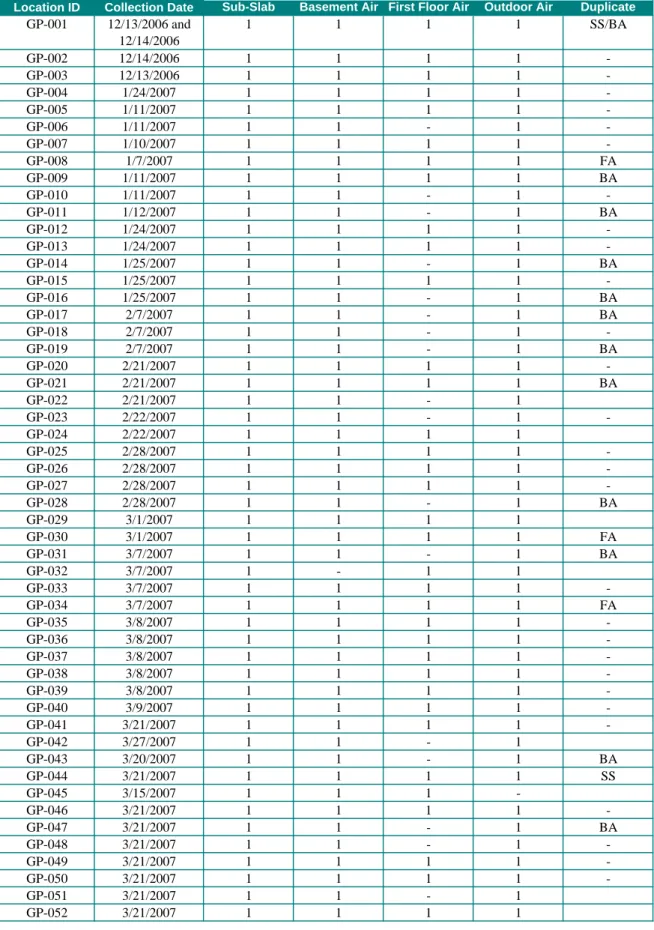
The vapor intrusion sampling investigation was completed at 52 properties in the Greenpoint area of Brooklyn (see Table 2-1 and Figure 2-1). The study area was selected by NYSDEC and consisted primarily of residential structures with some commercial operations. Sampling was conducted at structures for which property owners and tenants had volunteered and provided permission. EEEPC assisted NYSDEC in obtaining permission from 36 homeowners to complete the vapor intrusion sampling at various locations throughout the study area. In addition, NYSDEC was contacted in February 2007 by representatives of an additional 22 homeowners located in the study area who were also interested in vapor intrusion sampling. Of the 22 homes, EEEPC was able to sample 16 locations during the 2006/2007 heating season. In accordance with EEEPC’s revised Work Plan for Indoor Air Quality Monitoring at the Greenpoint Site (EEEPC January 2007), the vapor intrusion investigation included concurrently collecting vapor/air samples from beneath the building slab, ambient basement air, ambient air from the first floor (if the basement was not used as living space), and ambient outdoor air. Pre-sample inspections and sampling activities were conducted in accordance with NYSDOH’s November 2006 Standard Operating Procedure, Soil Vapor Intrusion in New York State. Figure 2-1 depicts all locations where soil vapor intrusion sampling was conducted during the 2006/2007 heating season.
2.2 Pre-sample Planning and Community Participation
Before sampling, EEEPC assisted NYSDEC with various tasks related to finding volunteers from the community to participate in the sampling program. The fol-lowing steps were taken by EEEPC and NYSDEC to obtain volunteers:■ A study area for the initial sampling was selected by NYSDEC in consultation with other state agencies, including NYSDOH, the New York State Office of the Attorney General (NYSOAG), and the New York State Office of the State Comptroller (NYSOSC).
■ A website was created by NYSDEC to inform the general public about Green-point’s operation and remedial history, current remediation and containment
2. Soil Vapor Intrusion Sampling
02:002699_ID18_04-B2235 2-2
R_Soil Vapor Intrusion-Greenpoint - Final.doc-07/10/07
methods, the soil vapor and residential vapor intrusion investigation, and con-tact information for key personnel.
■ NYSDEC was contacted by 12 residents in the area at the beginning of the project who were interested in having their residences sampled. NYSDEC passed the contact information about these residents to EEEPC to coordinate completion of an access agreement form and to schedule sampling.
■ EEEPC developed a database of owner/tenant information based on a list of parcels of potential sampling sites provided by NYSDEC. The database used real property tax information to find owner names and mailing addresses for addresses located within the study area. NYSDEC generated a standard letter that was sent to each property owner that described the sampling program and the process of collecting the samples and requested that owners with an inter-est in participating in the study return a signed access permission form to NYSDEC. The mailing was then translated into Spanish and Polish, and a package containing the information written in all three languages—English, Spanish, and Polish—was sent to 388 property owners on November 29, 2006. The information package included a cover letter, map of the study area, de-scription of sampling procedures, a list of frequently asked questions and an-swers, and an access permission form. Copies of all three packages are lo-cated in Appendix A.
■ Approximately 30 of the letters in the first mailing were returned to EEEPC because of an incorrect mailing address. Information packages were read-dressed to “Resident” at the subject property address and were mailed on January 17, 2007.
■ EEEPC researched public information channels (telephone books, Internet, etc.) to obtain telephone numbers for property owners and residents who had not responded to the first mailing. Approximately 220 residents were tele-phoned by EEEPC in January 2007 to discuss volunteering for the sampling program.
■ EEEPC assisted NYSDEC and NYSDOH with two public-availability ses-sions in the Greenpoint area designed to inform homeowners of the specifics of the vapor intrusion sampling program and to answer their questions. The meetings were held on December 13, 2006, at the auditorium of St. Cecelia’s church on North Henry Street. EEEPC reserved the meeting location, pre-pared basic presentation materials regarding soil vapor intrusion and sampling, and had four representatives attend the sessions to answer questions concern-ing the logistics of the samplconcern-ing.
■ A second database was developed to track and maintain contact with property owners and residents who volunteered for the sampling program. The data-base included addresses of property owners and residents who had returned
forms to NYSDEC indicating they wanted to be included in the program, dates that EEEPC contacted the owners by phone to schedule appointments for sampling, and the scheduled sampling dates. Periodically, a report was gener-ated from this database and sent to NYSDEC to provide the addresses that had been scheduled.
■ NYSDEC sent multiple teams of people to Greenpoint to go door-to-door to ask residents whether they were interested in volunteering for the sampling program. The NYSDEC teams were in Greenpoint during the week of Janu-ary 22 and 29, 2007. On two of the days, EEEPC representatives assisted NYSDEC with this work.
■ In January 2007, EEEPC developed another mailing to property owners that had not responded to the initial mailings of November 29, 2006, and January 17, 2007. This mailing, sent via certified mail with return receipts requested, was sent to 337 addresses on January 26, 2007.
A total of 72 property owners returned a signed access agreement form to
NYSDEC, with 66 volunteering their residences for sampling and 6 residents de-clining. Of the 66 positive responses, 53 houses were scheduled for soil vapor intrusion sampling. Thirteen residences were not able to be sampled because of either a lack of response to phone calls to attempt to schedule a sampling date or a late response declining sampling before the end of the heating season. Two resi-dents on Apollo Street who had volunteered lived in the same building. There-fore, sampling was conducted at 52 residences.
2.3 Pre-sampling Inspection
A building inspection and product inventory was conducted at each structure to be sampled before initiating sampling in order to identify conditions that may have affected or interfered with the proposed testing. The building inspection work involved interviewing the building owner or tenant regarding the construction of the building (type of structure, floor layout, materials used, etc.), physical condi-tion of the building (age of heating system, cracks/holes in basement floors, fire damage, etc.), and characteristics of people living in the building (number, ages, number of smokers, etc.). The product inventory was designed to identify poten-tial air sampling interference by characterizing the type and use of chemicals and products containing volatile organic compounds (VOCs), keeping in mind the goal of the investigation and site-specific contaminants of concern. Household and construction products potentially containing VOCs on the air sampling ana-lyte list were recorded, and a parts per billion (ppb) photoionization detector (PID) was used to screen product storage and other areas of the building for potentially significant sources of VOCs. The pre-sampling inspection and product inventory work was conducted one day before placement of the sampling canisters, when-ever possible, to allow for the removal of any products or chemicals identified that could have affected evaluation of the analytical data. In all cases, sampling did
2. Soil Vapor Intrusion Sampling
02:002699_ID18_04-B2235 2-4
R_Soil Vapor Intrusion-Greenpoint - Final.doc-07/10/07
not have to be delayed, but some sample locations were altered as deemed neces-sary because of certain chemicals and activities (see Table 2-1).
The building inspections and product inventories were recorded on NYSDOH Center for Environmental Health Indoor Air Quality Questionnaire and Building Inventory forms (New York State Department of Health October 2006) (with modifications by EEEPC to incorporate additional information). Photographs of sample locations were collected whenever possible. Sample Indoor Air Quality Questionnaire and Building Inventory and field sample collection forms are pro-vided in Appendix B of this report.
2.4 Sampling
Procedures
All sub-slab vapor and ambient air samples were collected in specially prepared, evacuated stainless-steel canisters provided by the laboratory. The canisters were prepared in accordance with analytical method TO-15 (United States Environ-mental Protection Agency [USEPA] January 1999). All samples were collected in 6-liter “Summa” canisters. All sample collection times were approximately 24 hours, and regulators were provided by the laboratory to maintain flow for the 24-hour collection period at approximately 4 milliliters (mL) per minute. The regula-tors were designed to maintain a consistent differential vacuum pressure and flow rate throughout the sampling period. The laboratory also provided pressure
gauges with regulators to check that appropriate vacuums existed at the start of the sampling and at the time of sample collection. All canisters were individually cer-tified clean by the laboratory prior to use.
Vapor intrusion air samples were assigned an ID according to the convention in which a two- or three-letter code identifies the site: GP was used to identify the Greenpoint area. The letter code is followed by a sequential number that identi-fies all samples from a single structure. For example, the first Greenpoint struc-ture sampled was GP-001, GP-002 was used for the second strucstruc-ture sampled, and so on. Sub-codes were used to identify the type of sample collected at each struc-ture. SS stands for sub-slab vapor samples; BA for indoor air, basement samples; FA for indoor air, first floor samples; and OA for outdoor air samples.
2.4.1 Sub-slab Vapor
A total of 53 sub-slab vapor samples were collected at 52 different structures (not including quality control [QC] samples) (see Table 2-1). Before each sample was prepared, a visual assessment of the condition of the floor was conducted. When-ever possible, the sample was generally located near the middle of the basement in an area that was out of the line of traffic and away from major cracks and other floor penetrations (e.g., sumps and pipes).
Sample preparation began by drilling a 1-inch diameter hole approximately ½ inch into the floor to provide a “shoulder” for creating a seal. Next, a ½-inch diameter hole was drilled the remainder of the way through the concrete floor slab. Con-crete dust generated during drilling was swept away from the drill hole to prevent
it from falling into the hole but was not vacuumed to avoid potentially pulling sub-slab vapors into the building. Teflon-lined polyethylene tubing was inserted into the hole and was placed no farther than 2 inches below the bottom of the floor slab. Granular bentonite was mixed with water to a puttylike consistency, then placed around the tubing at the floor penetration and packed tightly around the tubing. An additional seal of thin polyethylene was then placed over the bentonite seal and around the tubing. A low-flow vacuum pump or a syringe was then used to withdraw at least three volumes of the sample tubing into a Tedlar bag that was removed from the structure to prevent potential cross-contamination. Before dis-charging the bag outside, the organic vapor concentration of the purged air was measured using a PID.
The tubing was then connected to the flow control valve/pressure gauge assembly and this was attached to a pre-cleaned and pre-evacuated sample canister (i.e., 6-liter Summa canister). The sample canister and regulator numbers and starting gauge pressure were recorded for each location. Each sample was assigned a sample identification number that was written on the canister ID tag, chain-of-custody (COC) form, and field data collection form. Whenever possible, a photo-graph of the sample location was taken immediately after the sample canister was deployed to verify that the canister was not disturbed during sample collection. One sub-slab sample canister was identified as having been disturbed by the EEEPC sample teams (GP-001-SS), with a replacement sub-slab sample deployed at the time that disturbance of the initial sample was identified.
After the sample collection period of approximately 24 hours elapsed, the final gauge pressure was recorded, the flow control valve was closed, the
regula-tor/gauge assembly was removed, and the labeled sample canister was placed back into the original shipping box. The sample tubing and bentonite were removed and the hole was filled with hydraulic cement. After completing sampling, the canisters were shipped to the laboratory for analysis.
2.4.2 Ambient Air sampling
Ambient air samples collected during the course of the study included basement air, floor air, and outdoor air. A total of 64 basement air samples, 37 first-floor air samples, and 51 outdoor air samples were collected (not including QC samples) from the 52 structures sampled (see Table 2-1). The sample canisters for all ambient air samples were placed on a stable surface approximately 3 feet above the floor or ground surface. The basement air samples were generally lo-cated near the sub-slab sample location in the center of the basement. First-floor samples were located in frequently used rooms (i.e., primarily living rooms, din-ing rooms, and kitchens) but in a low-traffic area to prevent any disturbance by the homeowner or tenant. Outdoor air samples were placed off the ground and away from high automobile traffic (back or side yards) whenever possible. No specific sources of emissions were identified by field personnel during the outdoor ambi-ent air sample collection.
2. Soil Vapor Intrusion Sampling
02:002699_ID18_04-B2235 2-6
R_Soil Vapor Intrusion-Greenpoint - Final.doc-07/10/07
All basement, first-floor, and outdoor ambient air samples were set up similarly. The flow control valve/pressure gauge assembly was attached to a pre-cleaned and pre-evacuated sample canister (6-liter Summa canister) and the valve was opened. The sample canister and regulator numbers and starting gauge pressure were re-corded for each location. Each sample was assigned a sample identification num-ber that was written on the canister ID tag, COC form, and field data collection form. Whenever possible, a photograph of the sample location was taken imme-diately after the sample canister was deployed to verify that the canister was not disturbed during collection. One first-floor sample canister was identified by the EEEPC sampling team as having been disturbed (GP-025-FA); however, with NYSDEC’s concurrence, a replacement sample was not deployed because a base-ment air sample was also collected, and this is the primary indoor air sample used by NYSDOH to evaluate exposure concerns.
After the sample collection period of 24 hours elapsed, the final gauge pressure was recorded, the flow control valve was closed, the regulator/gauge assembly was removed, and the labeled sample canister was placed back into the original shipping box. After completing sampling, the canisters were shipped to the labo-ratory for analysis.
2.4.3 Quality Control
Field QC samples included 12 duplicates, which can be identified with the letter “D” following the sub-code in the sample ID. Duplicate samples provide insight as to the homogeneity of the sample matrix and establish a degree of confidence that the sample represents site conditions. Field duplicates were collected at the rate of 1 duplicate per 20 original samples (5%). Ambient air duplicates were col-lected from only basement and first-floor sample locations, with two canisters set up adjacent to one another. A review of the duplicate sample results is provided in the Data Usability Summary Reports (DUSRs) in Appendix D. There were no impacts on data usability associated with the field duplicate sample results.
2.5 Sample
Analysis
Analysis was performed using USEPA Method TO-15 (Determination of Volatile Organic Compounds [VOCs] in Air Collected in Specially-Prepared Canisters and Analyzed by Gas Chromatography/Mass Spectrometry [GC/MS]) for VOCs and modified ASTM (American Society for Testing and Materials) method D-1946 for methane. There is no target compound list for Method TO-15; therefore, a list of 78 compounds was selected by NYSDEC and NYSDOH. The analyte list includes chlorinated VOCs as well as petroleum and fuel-related products. All analytes in all sample types analyzed using method TO-15 were reported in mi-crograms per cubic meter (μg/m3) with the exception of undecane, dodecane, and tert-Butyl alcohol, which was reported only in parts per billion by volume (ppbv). Methane results were reported in parts per million by volume (ppmv). Sample analyses were conducted by Air Toxics, Ltd. of Folsom, California. Air Toxics, Ltd. is certified by the NYSDOH Environmental Laboratory Approval Program
(ELAP) for environmental analyses of air and emissions. Original laboratory re-ports (data validation qualifiers are applied) are provided in Appendix C.
2.6 Data
Validation
All laboratory deliverables were reviewed in accordance with the Quality Assur-ance Project Plan (QAPP) (EEEPC January 2007) and appropriate air method and general reporting requirements from NYSDEC’s Analytical Services Protocol (ASP) (June 2000). The data were qualified following general guidelines in the USEPA’s Contract Laboratory Program National Functional Guidelines for Or-ganic Data Review, EPA 540/R-99-008 (USEPA October 1999). DUSRs were prepared for each laboratory report (based on sample delivery group) as specified in NYSDEC’s Guidance for the Development of Quality Assurance Plans and Data Usability Summary Reports (July 1999). The data review included an evaluation of the following:
■ Holding times;
■ Initial and continuing calibration; ■ Reporting limits;
■ Laboratory blanks;
■ Laboratory control samples; ■ Field duplicates;
■ Sample result verification; and
■ Method-specific QC samples (e.g., GC/MS tunes).
DUSRs were prepared for the Air Toxics, Inc. laboratory reports by EEEPC’s pro-ject chemist. All DUSRs were reviewed by EEEPC’s Quality Assurance Director. DUSRs for the Air Toxics, Inc. laboratory reports are provided in Appendix C. Any deviations from acceptable QC specifications are discussed in the DUSRs. Qualifiers were added to the data, when appropriate, to indicate potential concerns with data usability, and these qualifiers were transferred to the data summary ta-bles in Section 3.
Air Toxics, Inc. laboratory reports submitted as part of this task were electroni-cally reviewed by EEEPC’s project chemist using the USEPA’s Automated Data Review (ADR) program. As data were being validated, preliminary results were submitted to NYSDEC and NYSDOH for assessment.
Table 2-1
Sub-Slab Basement Air First Floor Air Outdoor Air Duplicate
GP-001 12/13/2006 and 12/14/2006 1 1 1 1 SS/BA GP-002 12/14/2006 1 1 1 1 -GP-003 12/13/2006 1 1 1 1 -GP-004 1/24/2007 1 1 1 1 -GP-005 1/11/2007 1 1 1 1 -GP-006 1/11/2007 1 1 - 1 -GP-007 1/10/2007 1 1 1 1 -GP-008 1/7/2007 1 1 1 1 FA GP-009 1/11/2007 1 1 1 1 BA GP-010 1/11/2007 1 1 - 1 -GP-011 1/12/2007 1 1 - 1 BA GP-012 1/24/2007 1 1 1 1 -GP-013 1/24/2007 1 1 1 1 -GP-014 1/25/2007 1 1 - 1 BA GP-015 1/25/2007 1 1 1 1 -GP-016 1/25/2007 1 1 - 1 BA GP-017 2/7/2007 1 1 - 1 BA GP-018 2/7/2007 1 1 - 1 -GP-019 2/7/2007 1 1 - 1 BA GP-020 2/21/2007 1 1 1 1 -GP-021 2/21/2007 1 1 1 1 BA GP-022 2/21/2007 1 1 - 1 GP-023 2/22/2007 1 1 - 1 -GP-024 2/22/2007 1 1 1 1 GP-025 2/28/2007 1 1 1 1 -GP-026 2/28/2007 1 1 1 1 -GP-027 2/28/2007 1 1 1 1 -GP-028 2/28/2007 1 1 - 1 BA GP-029 3/1/2007 1 1 1 1 GP-030 3/1/2007 1 1 1 1 FA GP-031 3/7/2007 1 1 - 1 BA GP-032 3/7/2007 1 - 1 1 GP-033 3/7/2007 1 1 1 1 -GP-034 3/7/2007 1 1 1 1 FA GP-035 3/8/2007 1 1 1 1 -GP-036 3/8/2007 1 1 1 1 -GP-037 3/8/2007 1 1 1 1 -GP-038 3/8/2007 1 1 1 1 -GP-039 3/8/2007 1 1 1 1 -GP-040 3/9/2007 1 1 1 1 -GP-041 3/21/2007 1 1 1 1 -GP-042 3/27/2007 1 1 - 1 GP-043 3/20/2007 1 1 - 1 BA GP-044 3/21/2007 1 1 1 1 SS GP-045 3/15/2007 1 1 1 -GP-046 3/21/2007 1 1 1 1 -GP-047 3/21/2007 1 1 - 1 BA GP-048 3/21/2007 1 1 - 1 -GP-049 3/21/2007 1 1 1 1 -GP-050 3/21/2007 1 1 1 1 -GP-051 3/21/2007 1 1 - 1 GP-052 3/21/2007 1 1 1 1
Soil Vapor Intrusion Investigation Sample Collection Summary, 2006/2007 Heating Season, Greenpoint Area, Brooklyn, New York
Location ID
Sample Collection Date
Sample Type (w/Centek)
02:002699_ID18_04-B2235
! ( ! ( !( !( ! ( ! ( ! ( ! ( ! ( !( ! ( ! ( ! ( ! ( ! ( ! ( !( ! ( ! ( ! ( ! ( ! ( ! ( ! ( ! ( ! ( ! ( ! ( ! ( ! ( ! ( ! ( ! ( ! ( ! ( ! ( ! ( ! ( ! (!( ! ( ! ( ! ( !( ! ( ! ( !( !( ! (!( !( ! (
TR-SY Patricks Cathedral TR-SY Patricks Cathedral
McGorrick Park McGorrick Park Recreation Area Recreation Area NEWTOWN CREEK Greenpoint Ave Broo klyn Q ueen s Exp ressw ay K in gs la nd GP-004 GP-001 GP-051 GP-005 GP-041 GP-017 GP-032 GP-036 GP-020 GP-033 GP-024 GP-026 GP-025 GP-035 GP-008 GP-034 GP-045 GP-009 GP-047 GP-010 GP-044 GP-030 GP-028 GP-003 GP-007 GP-027 GP-042 GP-046 GP-037 GP-013 GP-018 GP-023 GP-011 GP-043 GP-052 GP-029 GP-038 GP-039 GP-012 GP-049GP-048 GP-050 GP-006 GP-040 GP-031 GP-015 GP-021 GP-016 GP-019 GP-022 GP-014 GP-002 0 250 500 1,000 Feet !
( Vapor Intrusion Sampling Location
Transportation Line Buildings
Approximate Plume Location
(Based on Information compiled from ExxonMobil April 2006 Quarterly Progress Report and SAIC 2007 Supplemental Site
Figure 2-1 Greenpoint Vapor Intrusion Sample Location Map Greenpoint Brooklyn, New York
£
New YorkCANADA
Site Location