Scalable Access Control For Web Services
Gayatri Swamynathan Department of Computer Science
UC Santa Barbara, CA 93106 [email protected]
Tyler Close, Sujata Banerjee, Rick McGeer HP Labs
Palo Alto, CA 94043 [email protected] Ben Zhao, Kevin Almeroth
Department of Computer Science UC Santa Barbara, CA 93106 {ravenben,almeroth}@cs.ucsb.edu
Abstract
Controlling access to a large distributed service is a potentially error prone process that may nega-tively impact request throughput and usability. Our Authorization-Based Access Control (or ABAC) URL rewriter solves this problem by providing locally veri-fiable authorizations and delegation tracking compati-ble with common web tools. Our access control mech-anism is reusable, distributed and meets the scaling requirements of large distributed services. We demon-strate the successful operation of our proposed mecha-nism on HP’s real-time network monitoring and mea-surement web service,S3.
1 Introduction
Controlling user access is critical to the success-ful operation and widespread adoption of large-scale distributed web services. The security framework for such services must address the three-fold challenge of user authentication (identity verification), autho-rization (access provided to user) and accountability (monitoring activity and controlling abuse) in order to control user access and prevent distributed-denial-of-service (DDOS) attacks.
Access control lists (or ACLs) have remained a pop-ular choice for securing distributed web applications due to their simplicity and ease of application inte-gration. In ACL-based authorizations, a user is
au-thenticated by a challenge-response mechanism (such as passwords or digital certificates) and the request is granted if the user responds properly to the challenge and possesses access rights to the requested resource. Employing ACL-based authorizations for large-scale distributed services lends itself to several problems. First, servers or nodes in the system need to either con-tact a central server to determine a users privilege, or maintain a local ACL. Granting or revoking user ac-cess involves synchronization between all nodes in the system. The need for periodic synchronization could bring the system down in the case of a network parti-tion.
Second, as the overall system grows, dependence on central lists also aggravates the problem of scalabil-ity. ACLs are also known to suffer poor access times for large lists. Finally, ACLs are a coarse-grained au-thority mechanism and lack the flexibility to easily im-plement multiple security policies and fine-grained au-thorities.
Large-scale distributed web services, consequently, are in need of a robust and scalable access control solution. Moreover, in the hands of malicious users, such services make for an effective distributed-denial-of-service tool. In this paper, we present ABAC
(Authorization-Based Access Control) URL rewriter, a
reusable, distributed, capability-based access control solution that solves the challenge of securing large-scale distributed services in a highly scalable manner.
We implement our capability-based design on S3, HP’s real-time network monitoring and management
web service comprising hundreds of machines distrib-uted across a geographically dispersed wide-area net-work [3]. Our solution is lightweight with minimal memory and run-time overheads. Additionally, we employ only standard web tools to develop our secu-rity solution which proves its quick and easy integra-tion with existing distributed web applicaintegra-tions.
The remainder of the paper is organized as fol-lows. We discuss the design and implementation of the ABAC URL rewriter in Section 2. Next, we analyze our design and its performance in Section 3. Our con-clusions and future work are presented in Section 4.
2 Approach
We tackle the problem of user authorizations by employing a capability-based security design. While ACL-based authorizations permit users to name re-sources and then verify whether users have access to the identified resource (for example, using password-based schemes), a capability-password-based approach prohibits a user from even identifying a resource she does not have access to. Only users that possess a capability or authority - an unforgeable pointer to a resource - have the ability to identify and access a resource.
Before discussing the design of our capability-based ABAC URL rewriter on theS3web service, we
first introduce the operation ofS3and present the ob-jectives that drive our design framework for large-scale distributed services similar toS3.
2.1 S3: A Scalable Sensing Service
S3is a Scalable Sensing Service for real-time
mon-itoring and management of large networked systems. S3 represents a typical web service comprising hun-dreds of machines distributed across a geographically dispersed wide-area network. Each machine or server in theS3infrastructure operates a sensing pod which is a web-service enabled collection of lightweight mea-surement sensors that collect network information at the machine. Only authorized users of S3 are pre-sented the ability to conduct third-party sensing mea-surements between any two machines using uniform resource locators (URLs) that identify the machines and the sensing service(s) requested.
The S3 sensing information enables network man-agement components to detect network failure or anomalous behavior, improve path selection, and make network decisions at very fine timescales. Fast re-sponse, consequently, is a critical requirement for users of the sensing data. Centralized security solu-tions lead to poor response times, and also subvert the operation of the system in the event of network partitioning. Access control should also scale easily to integrate the addition of new users and measure-ment servers to the system. Finally, user authoriza-tions need to be fine-grained to accommodate various policy specifications.
2.2 Objectives
The design of the ABAC URL rewriter is guided by several goals that are necessary requirements for a successful access control mechanism.
• Decentralized: A server must continue process-ing requests correctly, even if under network par-tition.
• Efficient: The mechanism must not adversely im-pact request throughput.
• Lightweight: Both server and client deployment costs must be minimal and must integrate well with existing web tools, such as web browsers. • Open: The solution must facilitate and manage
the inclusion of additional users, servers, and ser-vices.
• Extensible: The mechanism must support the ex-pression of additional access checks on requests.
2.3 The ABAC URL rewriter service
To meet these objectives, our access control solu-tion interposes a URL rewriter service between each protected web service and network clients. The central idea behind our design is that the underlying service cannot be directly accessed from the open Internet; rather, it can only be accessed by the URL rewriter. Each network client presents to the rewriter service a request to access the underlying service, and a token which explicitly grants authorization to used the ser-vice. The URL rewriter satisfies itself that the token
User’s Browser
https://s3.hp.com/
ABAC URL Rewriter
http://localhost/
S Web Service3 X.509 CERTIFICATE
User’s Public Key CN= "op=ping" Signature
GET ./?dst=64.0.11.12&key=<BASE64> GET ./?dst=64.0.11.12&op=ping
time=69.2ms time=69.2ms
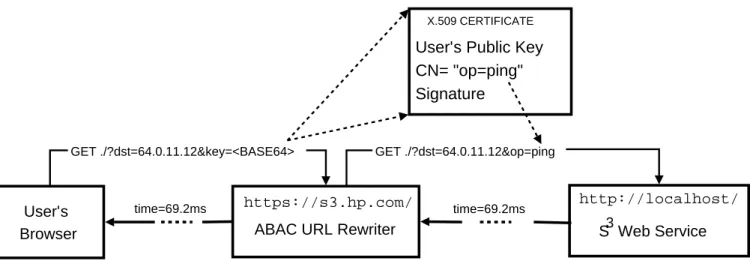
Figure 1. Request-response interaction
is genuine and still valid, then invokes the underlying service on the client’s behalf, and finally returns the results to the original requestor.
Each network client and URL rewriter service is is-sued an identity certificate, signed by an identity cer-tificate authority (CA) known to all clients and servers. Additionally, each client is issued a set of authority
certificates by an administrative CA server. An
thority certificate contains the public key of the au-thorized client and a URL query string specifying the authorized request arguments. For ease of implemen-tation, this URL query string is contained in the com-mon name (CN) field of the X.509 certificate (as seen in figure 1). For instance, S3 users are given autho-rizations to access different sensing services like ping, traceroute, etc. The string ‘ping’ in the CN field would indicate the capability of a user to only ping any des-tination machine, while the string ‘traceroute’ in the CN field would indicate the capability to only perform theS3 traceroute operation between any two destina-tion hosts. A client’s identity and authority certificates share the client’s public key. This public key binds the various authority certificates of a user to its single identity certificate.
Both the identity and administrative CA servers are hosted by the operator of theS3service. These servers manage the addition of users to theS3service and the creation, delegation and tracking of authorizations. A new user account is created with a copy of the user’s X.509 identity certificate, email address and an op-tional description of the user. To delegate, the holder
of an authorization sends a request specifying the au-thority certificate to delegate and the X.509 identity certificate of the user to delegate to. The administra-tive server, after checking the authorization certificate using the algorithm similar to that in figure 2 (de-scribed later), will log the delegator’s identity certifi-cate, the authorization certificertifi-cate, and the delegates’ identity certificate. The administrative server then re-turns a newly created authorization certificate, specify-ing the same URL transform, but the delegates’ public key. The delegator can then transmit the new autho-rization certificate to the delegate by any convenient means, such as email.
All authorization certificates are only valid for a given time interval. Near expiration, the administra-tive CA server collects the request logs from all the measurement servers and searches them for use pat-terns deemed abusive according to an algorithm spec-ified by the S3 service operator. For example, using
a given ‘ping’ authorization, or any of its delegations, more than 10,000 times a month, may be deemed abu-sive. TheS3service operator can then choose to notify
the users of the abuse, change the detection algorithm so that the pattern is not deemed abusive, or terminate the identified user accounts. Only active user accounts may refresh their authorizations for use in the next ser-vice interval.
Users of theS3service are notified of the system’s logging features and usage expectations and so are aware they can be held accountable for any abuse, ei-ther by themselves or any of their delegates.
Account-ability is expected to foster careful use, and delegation, of authorizations.
2.4 The ABAC algorithm
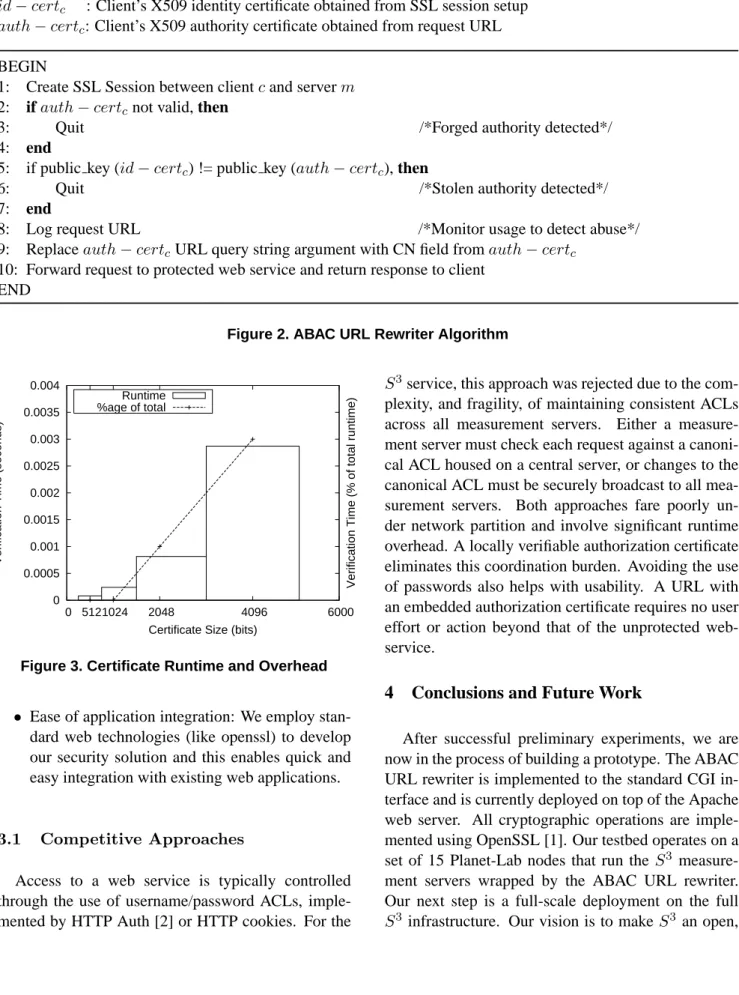
A typical runtime request through the URL rewriter is depicted in Figure 1. The algorithm implemented by the ABAC URL rewriter service is described by the pseudo-code in Figure 2.
Once an SSL session is set up between a client and a server, we first check whether the authority certifi-cate presented by the client is valid and issued by the administrative CA. Assuming the administrative CA keeps its private key secret, a client is unable to forge an authority certificate that will pass verification.
Next, we ensure that the authority certificate is pre-sented only by the client that it was issued to. As-suming the client keeps its private key secret, the SSL protocol ensures an attacker is unable to setup an SSL connection under the client’s public key. This proof also establishes ownership of the authority certificate, since it must specify the same public key. As a result, an attacker who steals a copy of an authority certificate is unable to use it, since without the corresponding pri-vate key, the certificate cannot be presented over an au-thenticated SSL connection. Once a client is verified as an authorized user,S3 performs the measurements and returns a response to the client.
By embedding the authorization certificate within a request URL argument, the protected web service re-mains usable by common, unmodified web browsers. All major web browsers support the SSL protocol, as well as installation of client identity certificates. Al-though unusually long, the request URLs can be used in normal HTML hyperlinks and forms. Modern web browsers do not have the URL length limitations of earlier generations.
Through web browser compatibility, the human user can operate the protected web service, unaware of any of the cryptographic operations used for access-control. Delivery of authorizations to a user can take the form of an HTML web page, or email, containing a series of hyperlinks, one for each authorization. Since the authorizations are only usable by the intended re-cipient, interception or theft of the web page, or email, is not an issue.
3 Analysis and Performance of ABAC
Some salient features of our access control design include the following.
• Attack-resistant design: We employ secure sock-ets in our capability-based design to deny unau-thorized users and servers from maliciously par-ticipating in the system. Second, a malicious user snooping the network for authority certifi-cates will be unable to use the acquired capabili-ties since it needs to be aware of the correspond-ing identity certificates used to initiate the SSL sessions. Third, it is impossible for authorities to be forged without the possession of the adminis-trative CAs private key. Finally, each users activ-ity is logged to audit usage and counter abuse. • Decentralized design: Our capability-based
solu-tion is decentralized and operates relatively in-dependent of any central management. Each S3
measurement server only stores the public cer-tificates of the identity CA and the administra-tive CA, and verifies the authenticity of a client identity or authority certificates using these pub-lic root certificates. No central access control lists are necessary because the possession of a author-ity implies that the user is authorized to request the service. Response times are quick and the se-curity framework is robust to network partition-ing.
• Lightweight and scalable: Our design is highly scalable and easily accommodates the addition of newS3users, servers and services. New users are assigned authorities based on their authorization level and registered with the system. New servers only need to possess the public certificates of the two CAs in order to verify clients. Lastly, addi-tion of new S3 services does not affect the secu-rity wrapper in any way.
• Negligible run-time overheads: As seen in fig-ure 3, our performance results for S3 indicate that authority certificate verification takes about 0.0025% of the overall request run-time (less than 0.0005 seconds) for a 4096 bit certificate. This overhead is expected to also be negligible in typ-ical web services.
LABELS
id−certc : Client’s X509 identity certificate obtained from SSL session setup auth−certc: Client’s X509 authority certificate obtained from request URL BEGIN
1: Create SSL Session between clientcand serverm 2: ifauth−certcnot valid, then
3: Quit /*Forged authority detected*/
4: end
5: if public key (id−certc) != public key (auth−certc), then
6: Quit /*Stolen authority detected*/
7: end
8: Log request URL /*Monitor usage to detect abuse*/ 9: Replaceauth−certcURL query string argument with CN field fromauth−certc
10: Forward request to protected web service and return response to client END
Figure 2. ABAC URL Rewriter Algorithm
0 0.0005 0.001 0.0015 0.002 0.0025 0.003 0.0035 0.004 6000 4096 2048 1024 512 0
Verification Time (seconds)
Verification Time (% of total runtime)
Certificate Size (bits) Runtime
%age of total
Figure 3. Certificate Runtime and Overhead
• Ease of application integration: We employ stan-dard web technologies (like openssl) to develop our security solution and this enables quick and easy integration with existing web applications.
3.1 Competitive Approaches
Access to a web service is typically controlled through the use of username/password ACLs, imple-mented by HTTP Auth [2] or HTTP cookies. For the
S3service, this approach was rejected due to the com-plexity, and fragility, of maintaining consistent ACLs across all measurement servers. Either a measure-ment server must check each request against a canoni-cal ACL housed on a central server, or changes to the canonical ACL must be securely broadcast to all mea-surement servers. Both approaches fare poorly un-der network partition and involve significant runtime overhead. A locally verifiable authorization certificate eliminates this coordination burden. Avoiding the use of passwords also helps with usability. A URL with an embedded authorization certificate requires no user effort or action beyond that of the unprotected web-service.
4 Conclusions and Future Work
After successful preliminary experiments, we are now in the process of building a prototype. The ABAC URL rewriter is implemented to the standard CGI in-terface and is currently deployed on top of the Apache web server. All cryptographic operations are imple-mented using OpenSSL [1]. Our testbed operates on a set of 15 Planet-Lab nodes that run the S3 measure-ment servers wrapped by the ABAC URL rewriter. Our next step is a full-scale deployment on the full S3 infrastructure. Our vision is to makeS3 an open,
subscription-based web service for network measure-ments.
Furthermore, while we have layered the authoriza-tion protocol on top of http for convenience, we be-lieve that this approach can be used by other applica-tion level protocols and, indeed, at the transport or net-working layer of the stack. The critical feature that we require is the ability to pass an encrypted authorization to a service authenticator, and this can be supported by virtually any well-designed protocol.
References
[1] Openssl: The open source toolkit for SSL/TLS, http://www.openssl.org/.
[2] RFC 2617.
[3] P. Yalagandula, P. Sharma, S. Banerjee, S. Basu, and S.-J. Lee. S3: a scalable sensing service for monitoring large networked systems. In INM ’06: Proceedings
of the 2006 SIGCOMM workshop on Internet network management, September 2006.