The e"ects of integration on regional disparities:
Convergence, divergence or both?
Mariassunta Giannetti
SITE, Stockholm School of Economics, Box 6501, Sveavagen 65, 113 83 Stockholm, Sweden
Received 1 October 1998; accepted 1 May 2001 Abstract
This paper o"ers an explanation for the coexistence of convergence across coun-tries and the lack thereof at the regional level in the European Union. The model shows that, even if it accelerates growth and brings convergence across countries, the intensi5cation of international knowledge spillovers due to more cross-country in-teraction may exacerbate within-country regional disparities, if regions with di"erent specialization do not bene5t evenly from the exchange of knowledge. The empirical evidence supports the implications of the model. In particular, the data show that regions specialized in advanced sectors at the beginning of the sample period became more similar in terms of per capita income, while regions specialized in traditional sectors lagged. c2002 Elsevier Science B.V. All rights reserved.
JEL classi"cation:O52; O41; O18; F15
Keywords: Regional growth; Integration; Knowledge spillovers; Learning-by-doing
1. Introduction
Many observers have pointed out that during the 1980s and the early 1990s regional disparities in the European Union showed no tendency to decrease and, on the contrary, they increased, while the cross-country dispersion of per capita GDP decreased (Neven and Gouyette, 1995; Fagerberg and Verspagen, 1996; Magrini, 1999). Moreover, the development experience of the poorest
E-mail address:[email protected] (M. Giannetti).
0014-2921/02/$ - see front matter c2002 Elsevier Science B.V. All rights reserved. PII: S0014-2921(01)00166-0
regions was not uniform. In particular, a few regions, such as Ireland and some regions of Spain and Portugal, showed improvements in economic conditions, while Greece and the Italian Mezzogiorno lagged. This period coincided with deeper economic integration within the European Union mainly through the adoption of the White Paper for the completion of the Single Market in 1985, which was accompanied by a signi5cant increase in intra-EU FDI and cross-border M&A (European Economy, 1997).1 Undoubtedly, these developments brought a greater exchange of informa-tion and interacinforma-tion across countries that were already freely exchanging goods. Can this increase in interaction among countries explain the puzz-ling evolution of the cross-country and cross-region inequalities within the EU?
This paper shows that indeed, a greater interaction across countries by intensifying international knowledge spillovers may signi5cantly alter the dy-namics of convergence across countries and, within countries, across regions. It presents a two-country two-sector model which explicitly recognizes that most countries in the EU have regions with very di"erent specializations. The traditional sector can be located anywhere, but there are only a few regions where it is optimal to produce the high-tech good. As in Krugman (1987) and Lucas (1988) the high-tech sector is the only one subject to endogenous productivity improvements due to a learning-by-doing process, which also bene5t from international knowledge spillovers. If countries ini-tially have di"erent levels of productivity in the high-tech sector, their com-parative performance depends on the intensity of knowledge spillovers. If these are low, the high-tech sector expands faster in the initially more pro-ductive country. Countries do not converge, but regions become more similar in the less productive country, which progressively loses its high-tech sector. The intensi5cation of knowledge spillovers, due to more cross-country inter-action, signi5cantly alters these growth paths. Stronger knowledge spillovers bring convergence across regions that can competitively produce the high-tech good. It also brings convergence across countries since the high-tech sector becomes an increasing share of total output. On the other hand, disparities are ampli5ed within countries where there are regions specialized in the tra-ditional sector. Indeed, the data show that the lack of convergence at the regional level hides a process of polarization across groups of regions, and that regions which at the beginning of the 1980s had a larger high-tech sec-tor are becoming more similar, even if their initial levels of per capita in-come were very di"erent.2 Furthermore, this process appears to take place 1Indeed, the increase in intra-EU FDI following the completion of the single market program
was four times faster than the increase in intra-EU trade.
essentially from the second half of the 1980s, when the cross-country inter-action actually increased.
The present model builds on the copious literature on integration and growth and, in particular, on the seminal works of Krugman (1987), Lucas (1988), Grossman and Helpman (1990), Rivera-Batiz and Romer (1991) and Young (1991).3 As in Krugman’s and Lucas’ approach, the possibility of the lock-in e"ect of specialization arises. In their models, specialization causes divergence in per capita income, because endogenous productivity im-provements a"ect mainly the production of the high-tech sector and because after integration countries generally specialize in the sector in which they have a comparative advantage.4
In contrast to Krugman and Lucas, however, the comparative disadvantage of a country that incompletely specializes in a traditional sector does not necessarily increase over time in my model, because, as in Grossman and Helpman (1991) and Rivera-Batiz and Romer (1991), I emphasize that ben-e5ts from economic integration result not only in a more eKcient allocation of production, but also in the transmission of knowledge. The conclusions I reach are similar to Smulders and van de Klundert (1996) and Goodfriend and McDermott (1998) who study the interaction between knowledge spillovers and market shares in the growing sectors, and also 5nd that the intensity of international knowledge spillovers is crucial in determining convergence across countries. My model extends their result in that it analyzes the ef-fects of specialization and knowledge spillovers between two economies with strong regional disparities and focuses on the convergence process of regions within countries, in addition to countries. In order not to identify each region with a sector, I explicitly model a dualistic economy and consider hetero-geneous types of labor and this permits to have a non-trivial evolution of within-country regional inequalities.
The remainder of the paper is organized as follows. Section 2 presents the model. Section 3 analyzes the competitive equilibrium and the central planner allocation. Section 4 presents the empirical evidence, and Section 5 concludes.
3The theme of regional divergence has also been analyzed by the literature on geography
and trade (see, for instance, Krugman, 1991). These contributions adopt a di"erent perspective: they analyze the e"ects of variations in transport costs (considered as a proxy for the level of economic integration) on a 5rm’s location decision and the implications in terms of growth remain implicit.
4Young (1991) shows that international specialization may cause uneven growth in a more
general model that endogenizes the movements of goods out of the learning-by-doing sector into a mature sector in which learning-by-doing no longer occurs. Young’s main conclusions is that, relative to autarky, free trade increases the growth rate of the developed countries and lowers that of the less developed countries.
2. The model
At the beginning of the 1980s, EU countries were already highly inte-grated through trade. The great innovation brought by the completion of the process of economic and monetary integration was the increase in the ex-change of information across countries, favored by the increase in intra-EU FDI and cross-border M&A. Indeed, recent empirical studies (Keller, 2001) show that cross-country interaction and informational exchange are power-ful means of technological di"usion that do not depend directly on trade Lows. Therefore the developments of the 1980s may have a"ected the pro-cess of convergence within the EU, even if countries were already freely trading.
To represent this situation this section presents a model that studies the e"ects of knowledge exchange through international knowledge spillovers on the growth paths of two economies, Home and Foreign, which freely trade high-tech and traditional goods. High-tech and traditional goods are produced using two di"erent production functions. Only the high-tech sector technol-ogy is subject to endogenous productivity improvements due to a process of learning-by-doing, whose speed depends on the intensity of international knowledge spillovers determined by the level of interaction between the two economies.
In order to capture the situation of the EU, which already had strong within-country regional inequalities at the beginning of the 1980s, I assume that in each economy there are two regions: a technologically advanced North (n) and a relatively backward South (s), where the technology to produce the high-tech good is not available and which therefore does not bene5t from international knowledge spillovers.5
Home and Foreign di"er only in the initial level of total factor productivity in the high-tech sector and, without loss of generality, I assume that Foreign is initially at a more advanced stage of the learning process than Home.
The following describes only the Home economy. Foreign is to be con-sidered completely symmetric, unless stated otherwise. Foreign variables are denoted with an asterisk. Moreover, since the model is dynamic all vari-ables depend on time, but I will omit the time index for simplicity of notation.
5The assumption that the high-tech good cannot be produced in the South is made for
simplicity’s sake alone and could be obtained as an equilibrium outcome. If, for historical reasons, the South had lower productivity, under the assumption that the market for skilled labor is pooled within a country, it could never produce the high-tech good at a competitive price in equilibrium.
2.1. Production
The two 5nal goods are produced by perfectly competitive pro5t maxi-mizing 5rms and are perfectly tradable between regions as well as between countries.
The technology of the traditional sector, available in both regions, is rep-resented by a Cobb–Douglas production function using skilled and unskilled labor:6
Xi= (Li
x)(Hxi)1−; 0¡ ¡1; (1)
where Xi is the production of the traditional good in regioni, Hi
x and Lix are,
respectively, skilled and unskilled workers, employed in the traditional sector in regioni, andi∈ {n; s}. The total factor productivity in the traditional sector has been normalized to 1.
The production function of the high-tech sector is also Cobb–Douglas, for a given value of the productivity parameter, N:
Y=NL
yHy1−; 0¡ ¡1; (2)
where Y is the output of the high-tech sector, Hy and Ly are, respectively,
skilled and unskilled workers employed in this sector. I omit regional su-perscripts since under the assumptions of the model the production of the high-tech sector can only be located in the North.
The total factor productivity of the high-tech sector depends on the techni-cal knowledge accumulated in a country, and can be interpreted as experience accumulated in the production of the high-tech good as well as services of-fered to high-tech 5rms in a region.7 The total factor productivity of the high-tech sector increases over time, because of a learning-by-doing process external to 5rms. The dynamics ofNis described by the following di"erential equation: dN dt 1 N = 1 +N∗ N hy; (3)
where hy ≡Hy=Ly is the ratio of skilled to unskilled labor employed in the
high-tech sector, N∗ is the level of productivity of Foreign’s high-tech sector 6I do not explicitly consider capital as a factor of production. This is irrelevant for the
purpose of the model as capital is not a source of comparative advantage, if it is perfectly mobile.
7Some surveys among 5rms conducted by the European Commission have pointed out that
the availability of services to enterprises (legal and consulting services, transport, communica-tion, education and training centers) 5gures highly among the factors leading to a disadvantage in lagging regions. Distance to markets, on the other hand, is not perceived as a serious disad-vantage in peripheral regions. Economic factors seem to be more important than geographical disadvantages.
and ∈[0;1] measures the degree of interaction between the two countries and determines the intensity of international knowledge spillovers.8
Productivity improvements in the high-tech sector depend positively on the skill intensity of the production technique. The ‘intensity’ of skilled workers employed in the high-tech sector inLuences how fast the existing stock of knowledge can be exploited to generate further increases in the total factor productivity of this sector, because skilled workers are more often employed in non-routine activities, which are more likely to lead to productivity im-provements. Moreover, productivity improvements are achieved more easily when the intensity (rather than the number) of skilled workers is higher, since this favors the informational exchange among skilled workers.9 Interestingly, by making productivity improvements dependent on an intensity rather than a scale variable, this process of learning-by-doing avoids the scale e"ects often built into learning-by-doing processes.10 It is not necessarily true that, other things being equal, large countries with large amounts of resources devoted to the high-tech sectors grow faster and this makes both catching up and lagging behind possible.
Even if only the stock of technical knowledge accumulated in the region enters into a given region production function, the higher the interaction be-tween countries (measured by the parameter ), the greater the contribution of experience accumulated in the foreign country to an acceleration of the learning process at Home: skilled workers employed in the high-tech sector meet and exchange experiences and information and, consequently, productiv-ity grows faster because skilled workers can use a larger stock of knowledge. Firms in both sectors maximize pro5ts, taking prices and the level of total factor productivity in the high-tech sector as given. Their pro5t-maximizing factor demands are:
wi L=(Lix)−1(Hxi)1−; wi H= (1−) (Lix)(Hxi)−; i∈ {n; s}; wn L=pyNLy−1Hy1−; wn H=pyN(1−)LyHy−; (4)
8If = 0 the interaction between the two countries is so low that technical knowledge
accumulated abroad has no e"ect on the domestic learning-by-doing process. On the other hand, if= 1 the two economies have so high familiarity that technical knowledge accumulated abroad is as important as the domestic stock of technical knowledge.
9The empirical evidence provided by Backus et al. (1992) supports a learning-by-doing
process driven by the skill intensity of the production technique, as they show that the intensity of human capital (and not the stock) has positive e"ects on the growth rate of GDP and on the growth rate of the value added of manufacturing.
10Jones (1995) provides evidence that the prediction of ‘scale e"ects’ in many endogenous
where wi
H and wLi are, respectively, wages for skilled and unskilled labor in
regioni,py is the price of the high-tech good and the price of the traditional
good has been normalized to one.
2.2. Consumers
There is a large number of consumers who maximize their lifetime util-ity from consumption subject to their budget constraints. The utilutil-ity of the representative consumer is given by
U0=
∞
0 e
−t[1=C(−1)=
y +(1−)1=Cx(−1)=]=(−1)dt; where ∈(0;1): (5)
Utility depends on consumption of the traditional good, Cx, and of the
high-tech good,Cy, respectively. The utility from future consumption is
dis-counted at rate . The instantaneous utility function depends on two parame-tersand. The parameter represents the elasticity of substitution between the two goods and is assumed to be greater than one.11 This means that the two 5nal goods are relatively good substitutes and implies that the share of income spent in the high-tech good increases if its price goes down. This as-sumption is needed to allow the expansion of the value added of the high-tech sector as productivity grows, and is necessary in order to have divergence in value added besides that in total factor productivity.12 It is justi5able on the basis of the empirical evidence which shows that traditional goods are a de-creasing share of total consumption in advanced economies, where high-tech goods often substitute traditional goods commonly used for the same pur-pose (e.g. fertilizers substitute manure, computers substitute typewriters, etc.), thanks to technological progress.13
Consumers di"er in their labor endowment (they can be either skilled or unskilled) and in their region of residence and inelastically supply SH units of skilled labor and SLn and SLs units of unskilled labor in the North and the 11All the results presented in Section 3 about the transition dynamics of convergence and
divergence continue to hold if = 1. The only di"erence concerns the balanced growth path that would be reached in 5nite time.
12Most two-sector models of dualistic economies assume that the elasticity of substitution
between traditional and high-tech goods is unitary (See, for instance, Premer and Walz, 1994, and Englemann and Walz, 1995.) In this case, consumers spend constant shares of their incomes in both goods and productivity improvements in a sector are transferred wholly to the price of the good. Consequently, in equilibrium there cannot be divergence in value added across regions in the long run.
13Alternatively, the share of income spent on traditional goods could be decreasing over time
if preferences were non-homothetic as in Matsuyama (1992). However, this would signi5cantly complicate the solution of the model because, as is made clear below, consumers and regions di"er in their labor income.
South, respectively. Consumers also own shares in all the domestic 5rms and receive pro5tsi
l, where i∈ {n; s}; l∈ {Hi; Li} .
As is common in multiple sector growth models, which focus on the pro-duction side of the economy, I do not allow consumers to smooth their con-sumption over time.14 Hence, I assume that there are no assets through which individuals can borrow and lend and that therefore, at each timet the implicit interest rate adjusts to ensure that consumers actually consume their current income. This assumption is made for expositional simplicity only and does not have any inLuence on the cross-region equilibrium dynamics of sectoral value added.15
Under these assumptions, the budget constraint of a consumer endowed with l-type of labor in region i at any given date t is
(pyCy+Cx) =will+il; (6)
where
i∈ {n; s}; l∈ {Hi; Li}:
Since preferences are homothetic, only total income and the relative prices of the two goods are relevant for determining aggregate demand. With constant-returns-to-scale technologies, pro5ts are zero in equilibrium. Therefore, Home total income is the sum of the labor incomes of skilled and unskilled workers, and is equal to wHHS +wnLLSn+wsLLSs.
Aggregate demand for the high-tech good and the traditional good is, respectively, Cy=p − y (1−) (wHHS +wLnLSn+wsLLSs) + (1−)p1− y (7) and Cx=(wH S H+wn LLSn+wsLLSs) + (1−)p1− y : (8)
2.3. Factor endowments and assumptions on labor mobility
Supplies of both types of labor are 5xed and exogenously given.
Skilled labor is completely mobile across regions of a country, but not across countries. Unskilled labor, on the contrary, is immobile even across 14Lucas (1988) and Young (1991) make similar assumptions in models of learning-by-doing
and comparative advantage.
15Indeed, under my assumptions on the instantaneous utility function, consumers care only
about the intratemporal allocation of consumption, but not about the path of aggregate consump-tion over time. Therefore, the Low of assets between the two countries would be indeterminate, if intertemporal trade were allowed.
regions. This assumption is well supported by empirical evidence showing that during the last two decades migration among European regions has been scarce and involved almost exclusively skilled labor.16 In addition, it allows me to avoid the unlikely outcome that southern regions become completely depopulated in 5nite time. Immobility of unskilled workers implies the exis-tence of sector-speci5c factors of production in the South and prevents pro-ductivity of skilled workers in the South from falling to zero. I will discuss in the next section how the results are a"ected by this assumption.
2.4. Equilibrium
An equilibrium for this two-country economy is an allocation of the factors of production {Hy; Hxn; Hxs; Lnx; Lsx; Ly; Hy∗; Hxn∗; Hxs∗; L∗y; Lnx∗; Lsx∗} and of
consumption goods {Cx; Cy; Cy∗; Cx∗} and a price system {py; wH; wnL; wsL; w∗H;
wn∗
L ; wsL∗} that satis5es the following conditions:
(i) Domestic and foreign consumers maximize their utility taking prices as given.
(ii) Domestic and foreign 5rms maximize pro5ts taking factor prices and N and N∗ as given.
(iii) Both types of labor are fully employed. The labor market clearing conditions at Home are
Ly+Lnx= SLn;
Ls x= SLs;
Hy+Hxs+Hxn= SH; (9)
where SLs and SLn are the total endowments of unskilled workers in the South and the North, respectively, and SH is the total endowment of skilled labor of Home. Analogous full employment conditions are satis5ed in Foreign.
(iv) Goods markets clear: Cy+Cy∗=Y+Y∗.
(v) Total factor productivity is described in Home and Foreign, respec-tively, by the following system of di"erential equations:
dN dt 1 N = 1 +NN∗ hy; (10) dN∗ dt N1∗= 1 + NN∗ h∗ y;
where N0 and N0∗ are given.
In equilibrium, since skilled workers are perfectly mobile within a coun-try, their remuneration must be equal across regions, but there can be wage di"erentials across countries and for unskilled workers also across regions, because international migration is not allowed and unskilled workers are a region speci5c factor. The implications of the assumptions on factor mobil-ity for cross-country and cross-region convergence are discussed in the next section.
3. Knowledge spillovers and the dynamics of regional inequalities 3.1. Positive analysis
Without loss of generality I study the equilibrium path under the assump-tion that att= 0 Foreign is at a relatively more advanced stage of the learning process than Home (i.e. N0¡ N0∗).
The temporary equilibrium at any datet depends on the relative productiv-ity of Home and Foreign in the high-tech sector, which is the determinant of international specialization in the model. At t= 0, since the northern region of Foreign is more productive, Foreign will produce relatively more high-tech goods than Home. Whether the pattern of specialization converges or not in the long run depends on the intensity of knowledge spillovers and the ini-tial levels of productivity in the two countries, N0 and N0∗, which jointly determine (directly, and through the price of the high-tech good) the skill intensity of the production technique, and, therefore, the growth rate of total factor productivity in Home and Foreign.
The dynamics of the model is described by a system of di"erential equa-tions consisting of the high-tech sector learning-by-doing processes of Home and Foreign, and by the equation that describes the dynamics of the price of the high-tech good, py, which is a function of N and N∗ (as follows from
the equilibrium condition in the high-tech sector) and is needed to establish the equilibrium paths of the factor intensities,hy andh∗y. These, in turn, are a
function ofpyN andpyN∗, respectively. A sketch of the derivation of their
functional form as well as the expression of the di"erential equation for py
can be found in the appendix.
There is convergence in the pattern of specialization and, consequently, in GDP per capita if total factor productivity grows faster in Home than in Foreign. The learning-by-doing mechanism implies that this depends on the skill intensity of the production technique and the intensity of knowledge spillovers. The skill intensity of the production technique of the high-tech sector works against convergence. In fact, the more advanced country always adopts a more intensive technique of production, when the North becomes
completely specialized in the high-tech sector, as always happens after a certain date (in this case hy (h∗y) is increasing in pyN (pyN∗), as is proven
in the appendix and obviously pyN ¡ pyN∗).17 This implies that if →
0, there is always divergence in total factor productivity across the northern regions of Home and Foreign. At the same time, there is convergence between the traditional and the advanced regions in Home, as the high-tech sector contracts in the North: within-country regional inequalities decrease over time in the poorer country. The balance growth path is described in Proposition 1.
Proposition 1(Divergence at the country level). If there is divergence across the advanced regions of Home and Foreign and;consequently;across countries; the economy converges asymptotically to a balanced growth path in which both regions of Home are specialized completely in the traditional sector
HSS
y = 0;dNN = 0
;
while Foreign specializes completely in the high-tech sector
H∗SS y →H;S dN ∗ N∗ → S H S Ln : Proof. See the appendix.
Notice that if dN=N ¡dN∗=N∗, the knowledge spillover increases also for given, because the productivity gap is increasing over time. This may even-tually counteract the e"ect of the skill intensity of the production technique. The economy converges to the balanced growth path described in Proposition 1, only if Home loses the high-tech sector before the productivity gap (and there-fore the knowledge spillovers) increases to the point to bring convergence. Home actually loses the high-tech sector if the price of the high-tech good decreases to the point that the following condition is satis5ed:
S H k2−k1(pyN) 1=(−)− k1 k2−k1( SL n + SLs)60; where k1≡ 1− 1− (1−)=(−) =(−)
17The dynamics of the model would be similar if I used an intensity variable of the high-tech
and k2≡ 1− 1− (1−)=(−) =(−) :
This condition implies that the optimal level of employment in the high-tech sector of Home is zero. Given the level of familiarity between Home and Foreign, this is more likely to happen the lower the elasticity of substitution between high-tech and traditional goods,, and the larger the initial value of the productivity gap, which implies a lower price of the high-tech good for given N.
An increase in may interrupt the process of divergence as the knowl-edge gap necessary to bring convergence decreases, and this may avoid the loss of the high-tech sector in Home. Of course, this will bring divergence within countries, because the southern region does not bene5t from knowl-edge spillovers. A more detailed description of the transition dynamics and the balanced growth path is provided in the appendix.
Proposition 2(Convergence across countries and divergence across regions). As increases; there is convergence across the advanced regions of Home and Foreign for a greater range of di>erences in the initial total factor productivity of the high-tech sector; and the catching-up of productivity levels occurs in "nite time. The economy asymptotically converges to a balanced growth path in which both Home and Foreign are completely spe-cialized in the high-tech sector and the following conditions hold:
NSS=N∗SS and dN N = d N∗ N∗ = (1 +) S H S Ln: Proof. See the appendix.
Proposition 2 establishes that if international knowledge spillovers are strong enough, the regions where the high-tech sector is located will converge.18 Since the value added of the high-tech sector is an increasing share of GDP in both countries, there is also convergence at the country level. On the other hand, regional disparities within Home are accentuated, as the growth of the 18If= 1 there is always convergence across countries if SLn¿LSs. If this condition is
satis-5ed,hy(h∗y) is a concave function ofpyN(pyN∗) and it is possible to prove that international
high-tech sector in the North is fueled by the migration of skilled workers from the South.19
In the equilibrium with cross-country convergence, the growth rate of pro-ductivity is larger than in the case where Home loses the high-tech sector for both countries even after Home has caught up and in the asymptotic balanced growth path.20 In fact, Home and Foreign mutually bene5t from the experience they accumulate and integration increases the growth rate, as usually happens in models that take into account the growth e"ects of knowl-edge spillovers (Rivera-Batiz and Romer, 1991). Since the convergence pro-cess implies that country specialization converges, the Lows of inter-industry trade decrease over time. Although the model does not explicitly consider intra-industry trade, it indirectly predicts that in the long run this becomes relatively more important. This is perfectly compatible with the experience of the European Union.
The model relies on assumptions that allow us to specify the conditions under which integration may lead to convergence. The assumptions on factor mobility are crucial in this regard: international labor market segmentation is necessary to guarantee the convergence even when knowledge spillovers are strong. Until productivity levels catch up, wages di"er in Home and Foreign and the remuneration of skilled labor is higher in the more productive coun-try. This assumption may be appropriate for the EU because language barriers are still an impediment to free labor mobility, even for more skilled workers, and because international wage di"erentials are not bound to last over time if a convergence process is in progress. If skilled workers were mobile, they would migrate towards Foreign until their remuneration became equalized. In this case, Home would lose the high-tech sector, which would concen-trate in the industrial region of Foreign and, consequently, there could be no convergence either across countries or across regions. On the other hand, if unskilled workers were perfectly mobile within a country, it would be easier to achieve convergence across countries, even if the intensity of knowledge spillovers were low. In fact, in this case, as unskilled workers would never become a relatively scarce factor in the North, the wage di"erential between skilled and unskilled workers would increase over time, if, as is plausible, the high-tech sector were more skill intensive than the traditional sector. As a consequence, a less skill intensive technique of production would be used in Foreign and this would obviously favor convergence.
19It is showed in the appendix that the employment of skilled workers in the high-tech
sector,Hy, expands as the value of total factor productivity,pyN, improves at Home, which
is a necessary condition for convergence across the northern regions of Home and Foreign.
20This is, of course, true under the simplifying assumption that the two sets of accumulated
Finally, I made the assumption that factor endowments are 5xed and sym-metric across countries. If Foreign had a larger endowment of skilled workers than Home, a common balanced growth path could never be reached, because the larger endowment of skilled workers would guarantee higher skill intensity in the high-tech sector, as well as faster productivity improvements. However, this assumption appears less restrictive if one considers that skill acquisition is actually endogenous: if knowledge spillovers were strong enough to bring convergence, higher skill premia in Home would foster skill acquisition and the convergence of factor endowments across countries.
3.2. Normative analysis
The mechanism of learning-by-doing which leads to endogenous growth in the model relies on an externality, since in the competitive equilibrium pro-ducers do not internalize that a higher skill intensity of the production tech-nique used in the high-tech sector leads to larger productivity improvements. As is the usual case in endogenous growth models (Barro and Sala-i-Martin, 1995), a central planner who maximizes the utility of the representative agent that has the labor endowment of this two-country economy would allocate relatively more (less) skilled (unskilled) workers to the production of the high-tech sector.21
Is it optimal for the central planner to foster convergence by employing more skilled workers in the high-tech sector of the less productive country? The solution of the optimal control problem of the central planner presented in the appendix shows that this strategy is not optimal if the intensity of knowledge spillovers is suKciently high or the productivity gap small. In this case, interventions which distort the allocation of the factors of production would lower aggregate welfare, as they would decrease the current GDP and the speed of accumulation of knowledge of the high-tech sector. Interestingly, in an economy where the exchange of knowledge is high it is better to leave knowledge spillovers to work in order to achieve convergence, and to use transfers to redistribute income to poorer regions.
However, if this condition is not satis5ed or if the initial productivity gap is high, it may be convenient to increase the skill intensity of the production technique in Home in order to accelerate the learning process and allow both Home and Foreign to bene5t from a larger stock of knowledge. Of course, this is true only if it is convenient to produce high-tech goods in Home and, 21The maximization of the utility of the representative agent that has the whole economy
labor endowment ensures that an eKcient allocation of the factors of production is reached. Transfers across countries, across regions and skilled and unskilled workers would ensure that there are no welfare losses.
therefore, it is more likely to happen if both countries are at a relatively early stage of the development process.
4. Empirical evidence
The model has strong implications for the dynamics of cross-country and cross-region convergence and the e"ects of the intensi5cation of knowledge spillovers. Although a direct test of the model is not an easy task, I will show that data are compatible with the theoretical implications by focusing on the European experience in the period 1980–1992.22
To confront the model with the data, I need to be more speci5c about the empirical counterparts of the concepts of high-tech sector and knowl-edge spillovers. The greatest diKculty when assessing the validity of the implications of the model is that it relies on a clear-cut distinction between low-technology traditional sectors and high-technology sectors that bene5t from knowledge spillovers. Very often, this distinction does not match the usual sectoral categorizations, as di"erent phases in the production of a given product may involve a di"erent technological content. Moreover, sectoral data at the regional level that are homogeneous for the EU countries are scarce and not very detailed.23 The least coarse sectoral disaggregation comprises only the three macro-sectors of the economy (agriculture, industry and ser-vices). Of course, this does not allow us to identify the high-tech sectors, but I believe that a proxy for regional specialization can be used to de5ne high-and low-tech regions. For this purpose, I use the agriculture share of value added and de5ne the regions in which this was greater than 11% in 1980 (this is approximately the 75th percentile of the distribution of this variable among the regions in the sample in 1980) as specialized in traditional sectors. Another diKculty common to the empirical literature on trade and growth is assessing the intensity of international knowledge spillovers and establish-ing when interaction among countries actually increased. This is a gradual process and very diKcult to measure from the data.24 However, one can rely 22This is the only time span for which it is possible to 5nd a complete dataset with regional
data for 10 EU countries.
23The only available source of homogeneous data is the REGIO dataset of EUROSTAT.
The geographical disaggregation I use is the NUTS2 which covers 108 European regions. In particular, I have 3 regions for Belgium, 1 for Denmark, 22 for France, 11 for Germany (considering West Germany alone), 11 for Great Britain, 13 for Greece, 1 for Ireland, 20 for Italy, 4 for the Netherlands, 7 for Portugal, and 18 for Spain. See Paci (1997) for a detailed description of the dataset.
24Most literature has measured R&D spillovers either by using R&D expenditures (Coe
et al., 1997) or the number of patents (Eaton and Kortum, 1996) in the trading partners. Here, I want to focus on a broader concept of knowledge spillovers that encompasses softer information that is not included in the de5nition of R&D.
Fig. 1. The dispersion of per capita income among the EU countries.
on anecdotal evidence and place this change of regime in the middle of the 1980s. There is evidence that during this period the implementation of the Single Market Programme was accompanied by a sharp increase in intra-EU FDI and cross-border M&A (European Economy, 1997) and these are noto-riously a powerful vector of international knowledge spillovers (Blomstrom and Kokko, 1996).
Bearing this in mind, the implications of the model can be summarized as follows:
• Cross-country convergence is expected to be concentrated in the second subperiod (1986–1992) together with a reduction in the dispersion of per capita income in the more industrialized regions.
• The growth rates of regions that were initially endowed with a wider indus-trial structure should be positively correlated with the productivity gap in the most advanced sectors, even after controlling for the usual determinants of growth rates, as the initially less productive regions should be the ones bene5ting most from the increased knowledge exchange. This is especially true in the second subperiod and does not hold for regions specialized in traditional sectors.
Below, I show that the data are compatible with the implications of the model. First, at the country level the standard deviation of per capita in-come indeed decreased only from the mid-1980s (Fig. 1), when the intensity of knowledge spillovers probably increased. The mechanism of convergence
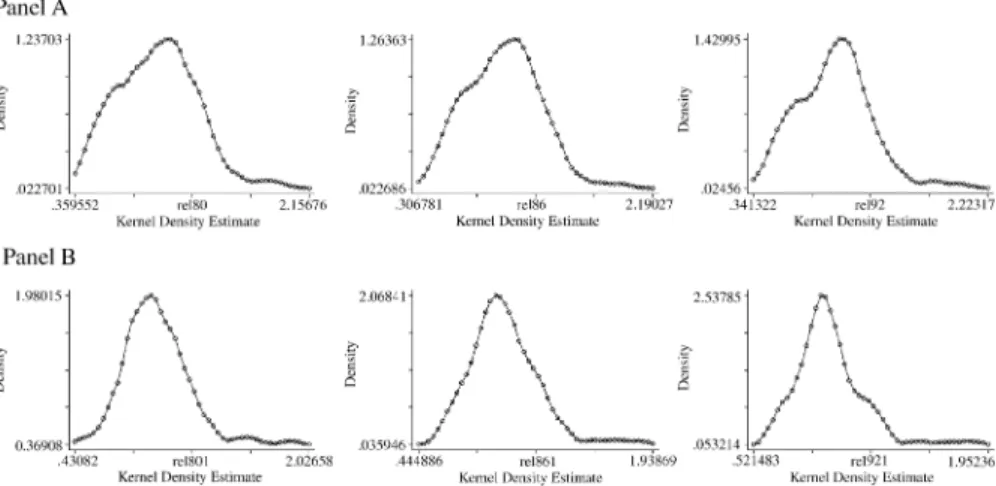
Fig. 2. The dynamics of regional incomes. Panel A. Panel A presents the Kernel estimation of the density function of per-capita income relative to the EU average for 108 European regions in 1980, 1986 and 1992 respectively. Panel B. Panel B presents the kernel estimation of the density function of per-capita income relative to the regions with similar specialization (as de5ned in Section 4) for 108 European regions in 1980, 1986 and 1992 respectively.
also seems con5rmed. If one looks at the countries for which it is easier to identify the integration shock because they joined the European Union during the 1980s (Portugal, Spain and Greece), it emerges that Portugal and Spain, which closed the gap from the leader economy, had bigger changes in indus-trial structure than Greece, whose income gap remained stable.25 This event was accompanied by a 20% (64%) increase in the interquantile range26 of the regional distribution of income in Spain (Portugal), while in Greece it decreased by more than 50% in the same period.
More detailed supportive empirical evidence can be found by looking at regional data from the 10 EU countries listed above (footnote 23). Some insights can be gauged from the evolution of the distribution of regional in-come over time.27 Fig. 2 shows the distribution of regional per capita income 25My elaboration using the OECD-STAN database shows that the share of value added of
the more technologically advanced sectors of manufacturing expanded by 10% and 5% in Spain and Portugal, respectively, in the 1980–1992 period and by only 1% in Greece. In the same period, Spain reduced the income gap from 60% of the GDP of the leader economy (Germany) to 70%, Portugal closed the gap from 49% to 58%, while the income of Greece remained approximately 54% of Germany GDP. Both the catching up and the change in the industrial structure took place exclusively in the 1986–1992 subperiod in Portugal.
26The interquantile range is given by the di"erence between the 75th and 25th percentiles
of the distribution and is, therefore, an index of dispersion, whose value is not inLuenced by convergence among subgroups of observations unlike the standard deviation.
27The density function of regional income is estimated using a Kernel estimator. For details,
relative to the EU average in 1980, 1986 and 1992. It is apparent that dur-ing the 1980s there was a process of convergence among the higher-income regions, which was more pronounced in the second subperiod when the sup-port of the distribution became signi5cantly smaller. Moreover, the lower tail of the distribution did not show any tendency to concentrate and presents a somewhat bimodal shape. When one conditions the regional income to the income of regions with similar specializations, as de5ned above, the dis-tribution becomes clearly unimodal and tends to become signi5cantly more concentrated during the sample period. Following Quah (1997) this may be interpreted as evidence of convergence clubs based on industrial specializa-tion, as the specialization at the beginning of the period seems to explain well the dynamics of cross-region incomes. Once again, this e"ect seems to be concentrated in the 1986–1992 period, when the increase in the height of the density function and the contraction of its support are more pronounced. The cross-section analysis of the determinants of growth rates may reveal whether the data support the mechanism that leads to convergence in the model. As is usual in growth regressions (Barro and Sala-i-Martin, 1991) I regress regional growth rates on the variables of interest and on a few control variables, whose value is always taken at the beginning of the period under consideration.
According to the predictions of the model, when knowledge spillovers are strong enough to bring convergence, the growth rates of per capita income should be higher in regions which have a larger productivity gap and are specialized in advanced sectors. In the data, due to lack of sectoral disag-gregation, the productivity gap will be proxied by the labor productivity of manufacturing.28 I also introduce a dummy variable equal to 1 for the coun-tries that joined the European Union during the sample period (Greece in 1981; Spain and Portugal in 1986) to check whether integration had any level e"ects on regional growth rates.
As control variables, I introduce the initial value of per capita income, which is positively correlated with the productivity of labor in the manu-facturing sector and, if omitted, may lead to a spurious correlation between regional growth rates and my measure of the productivity gap.29 I also con-trol for the agricultural share of value added and the Her5ndal index of em-ployment in services, agriculture and industry in the regression. Even though I do not explicitly consider services in my model, I introduce this control variable because most public sector employment is concentrated in services. The role of the Her5ndal index, which measures how much employment is 28This is positively correlated with the total factor productivity which is used in the model,
but is much more diKcult to measure in the data.
29The initial level of GDP per capita helps also to control for eventual asymmetric e"ects
concentrated in one of the three macro-sectors of the economy, is to control for the exceptionally good performance of regions which derive their wealth from being political centers of major importance (e.g. Paris and Brussels). The performance of these regions is not likely to depend on the variables suggested in the model, and the Her5ndal index makes it possible to control for this. Moreover, regions with higher levels of public sector employment, which (as in Italy) may be a form of implicit transfer, may have a higher level of income for a given level of industrial development, but would still have enough room for the technological mechanism of convergence consid-ered here. Furthermore, in the regions endowed with natural resources (such as Hessen or Nordrhein-Westfalen in Germany) employment is very concen-trated in industry, and performance is likely to depend on natural endowment rather than on the mechanism of technological transmission I wish to stress. By using the Her5ndal index, I can also control for this e"ect. The reason for introducing the agricultural share of value added is to control whether con-vergence is driven by the secular contraction of agriculture in less advanced regions, which could induce a spurious correlation between the productivity gap and the regional growth rates.
I expect to 5nd a negative correlation between regional growth rates and productivity in manufacturing in the subgroup comprising only the more in-dustrialized regions and this to hold especially in the second subperiod, when knowledge spillovers are believed to have been more intense.
Table 1, which presents the estimates of coeKcients of growth regressions for the whole period and for the two subperiods 1980–1986 and 1986–1992 and distinguishes between regions specialized in traditional and high-tech sec-tors, shows that the model 5nds support in the data also in this respect.
European regions with higher productivity gaps do indeed grow faster, as shown by the negative and signi5cant coeKcient of relative productivity: interestingly, for 1986–92 and for the whole period, this is true only for the subsample of the advanced regions, while for regions specialized in traditional sectors, higher initial productivity is associated with higher growth in the last six years. In contrast, a higher productivity gap was associated with faster growth in the 5rst subperiod in both groups of regions, probably indicating that the richest and most productive regions were maintaining their positions while the others were converging, as the model predicts if the intensity of knowledge spillovers is low. This guess is then con5rmed, because if I restrict the sample to the quartile of most productive regions the coeKcient of the initial level of productivity is positive and not signi5cant in the 1980–1986, but is negative and signi5cant at the 1% for 1986–1992.30
The coeKcients of the other variables also present signi5cant di"erences across the two groups of regions. Interestingly, it is possible to identify a
M. Giannetti /European Economic Review 46 (2002) 539–567
Dependent All regions, Regions Industrialized All regions, Regions Industrialized All regions, Regions Industrialized variable:a 1980–1992 specialized regions, 1980–1986 specialized regions, 1986–1992b specialized regions
Average in traditional 1980–1992 in traditional 1980–1986 in traditional 1986–1992
growth rate sectors, sectors, sectors,
of GDP 1980–1992 1980–1986 1986–1992 (1) (2) (3) (4) (5) (6) (7) (8) (9) Log of GDP −0:008861 −0:0167335 −0:0033306 −0:0168551 0.01592 −0:0190807 −0:0008669 −0:049387 0.0124196 (−2:216)∗∗ (−1:481) (−0:758) (−2:492)∗∗ (0.619) (−3:172)∗∗∗ (−0:0128) (−2:302)∗∗ (1:766)∗ −0.3715283 −0.4240598 −0.1086566 −0.4358277 0.1955579 −0.4647303 −0.023918 −0.822449 0.2708911 Agriculture −0:0518553 −0:0620407 0.0473415 −0:051655 −0:1204319 0.0492632 −0:0520557 −0:0036495 0.0454198 share of (−3:969)∗∗∗ (−2:678)∗∗ (1.233) (−2:776)∗∗ (−2:282)∗∗ (0.938) (−2:8)∗∗∗ (−0:083) (0.74) value added −0.5977123 −0.6459011 0.1828425 −0.3671859 −0.6077492 0.1420452 −0.3948215 −0.0249677 0.1172818 Her5ndal 0.0211188 0.1450641 0.0442442 0.0730744 0.3607735 0.0865369 −0:0308367 0.0706454 0.0019516 index (1.694) (2:103)∗∗ (2:682)∗∗∗ (3:592)∗∗∗ (2:296)∗∗ (3:834)∗∗∗ (−1:517) (−0:539) (0.074) 0.1874663 0.3602713 0.3919117 0.4000308 0.4343082 0.5722705 −0.1801172 −0.1152949 0.0115576 Relative −0:0094936 −0:0118278 −0:0101456 −0:0119222 −0:0532545 −0:0078627 −0:007065 0.0295988 −0:0124285 productivity (−2:507)∗∗∗ (−1:332) (−3:317)∗∗∗ (−2:835)∗∗ (−2:634)∗∗ (−1:878)∗ (−1:414) (1:756)∗ (−2:540)∗∗ −0.4913343 −0.4281372 −0.4191096 −0.3805214 −0.9343892 −0.2424874 −0.2405967 0.7040592 −0.3432571 New 0.0006792 −0:0056074 0.0037301 −0:0059021 0.0043124 −0:0044874 0.0072604 −0:0080324 0.0119477 integration (0.345) (−0:401) (1:754)∗ (−1:810)∗ (0.408) (−1:542) (2:229)∗∗ (−0:912) (3:513)∗∗∗ dummy 0.0422325 −0.0921769 0.2036895 −0.2263289 0.1035924 −0.1829379 0.2970689 −0.2615858 0.4361904 Constant 0.0884361 0.1135365 0.0247274 0.1297405 −0:2214628 0.13438298 0.0471316 0.4485358 −0:084935 (2:521)∗∗∗ (1.566) (0.632) (2:577)∗∗∗ (−1:416) (2:087)∗ (0.811) (2:818)∗ (−1:130)
N. obs.: 108 N. obs.: 26 N. obs.: 82 N. obs.: 108 N. obs.: 26 N. obs.: 82 N. obs.: 108 N. obs.: 26 N. obs.: 82
R2= 0:34 R2= 0:54 R2= 0:38 R2= 0:28 R2= 0:44 R2= 0:35 R2= 0:18 R2= 0:29 R2= 0:29 aOne, two and three asterisks indicate that the variable is signi5cant at 10%, 5%, 1%, respectively.
bThe 5rst number in each cell is the estimated parameter. The t-statistics calculated using the White correction are given in parenthesis. The
number in bold character is the-coe@cient, which measures how many standard deviations the dependent variable is predicted to move if the independent variable moves one standard deviation. Regions specialized in traditional sectors are the ones whose agriculture share of value added was larger than 11% in 1980; the industrialized regions are the remaining ones.
signi5cant positive growth e"ect of the dummy for the recently joined regions only for the subsample of more industrialized regions. This positive growth e"ect is concentrated in the second subperiod.
There is weak evidence of conditional convergence, because the coeKcient of the initial level of income is negative and signi5cant only in a few cases. The Her5ndal index and the agricultural share of value added are not sig-ni5cant in the second subperiod. If I consider the average growth rate over the whole sample period, the agricultural share of value added has a negative and signi5cant coeKcient in the subsample of the traditional regions only. As one would expect on the basis of the model presented above, the initial specialization does not negatively inLuence the growth performance of the re-gions that bene5t from the international knowledge spillovers. Moreover, the Her5ndal index is positive and signi5cant in both subsamples, indicating that a concentration of employment in one macro-sector of the economy enhances growth.
Di"erences in coeKcients among regions with di"erent specializations are signi5cant in all three periods considered, as is evident from the Chow test, which allows us to reject the null hypothesis that the coeKcients are equal at 1%: this also supports the view that regions with di"erent specializations have di"erent growth paths. The null hypothesis of the equality of parameters can be rejected at 1% even when the test is restricted to the parameter of the variable proxying for the productivity gap, but only in the two subperiods. To check the robustness of the results, I divided the regions into 5ve groups with approximately the same number of regions according to the level of their agricultural share of GDP, in order to check whether it is also possible to detect di"erences in regional growth paths among groups of regions which are expected to be similar. On the basis of the Chow test it was not possible to detect signi5cant di"erences in parameters among the three subgroups of more industrialized regions. In contrast, there are signi5cant di"erences in parameters between the two subgroups of regions specialized in the traditional and the high-tech sectors, respectively, and, more surprisingly, also between the two subgroups of regions specialized in the traditional sector.31
5. Conclusions
This paper o"ers a positive explanation of the evolution of regional disparities within the European Union, where convergence among coun-tries did not result also in convergence among regions. I suggest that, if 31The statistics associated with the test allow to reject the null that the parameters are equal
among these subgroups of regions with a level of con5dence of 1%. Moreover, the coeKcient of the productivity level in manufacturing was negative and signi5cant in the three groups of industrialized regions and insigni5cant and positive in the remaining two.
international knowledge spillovers a"ect certain sectors only, integration and greater exchange of knowledge among countries whose regions have het-erogeneous specialization spur growth and bring convergence among regions specialized in high-tech sectors, but create harsher disparities within indi-vidual countries. As a consequence, di"erences in income among countries diminish, as the European experience shows, because the value added of the technologically advanced regions is a rising share of GDP.
Sectoral specialization and international knowledge spillovers may also ex-plain why employment levels are growing in richer regions and contracting elsewhere, as pointed out in various empirical studies at the national level (See, for example, de la Fuente (2002) who points out a growing concentra-tion of employment in the richer regions of Spain.)
From a normative point of view, the central planner allocation can o"er interesting insights. The model suggests that in regions that already have a small high-tech sector an industrial policy which fosters employment in the growing sector is welfare-reducing, if knowledge spillovers are strong. How-ever, regions completely specialized in traditional sectors may still bene5t from attempts to increase the productivity of the more technologically ad-vanced sectors, as, for instance, the Welsh development agency did in Wales by o"ering highly professional public services to new 5rms, or in Ireland where industrial policy contributed to the recent sustained growth phase by increasing services and research infrastructure. In fact, by favoring the de-velopment of a small high-tech sector in laggard regions these policies can have dramatic e"ects, because they enable the poorest regions to bene5t from international knowledge spillovers. Moreover, the model suggests that their success depends crucially on labor market policies, as pooled labor markets within countries with dualistic structures may represent an obstacle to the emergence of the high-tech sector in the less developed regions.
Acknowledgements
I am especially grateful to Marco Pagano and Carlos VVegh for many com-ments and suggestions. I also thank Ana Balcao, Matteo Bugamelli, Roger Farmer, Harald Uhlig (the editor), Andrea Lamorgese, David Levine, Francesco Pigliaru, Fabiano Schivardi, and an anonymous referee, as well as seminar participants at the 1998 annual meeting of the EEA, the 1998 ASSETmeet-ing at the University of Bologna, UCLA, the 1999 SED meetASSETmeet-ing in Al-ghero and the 1999 conference on Dynamics, Economic Growth and Interna-tional Trade in Tilburg. Financial support from Ente Einaudi and Comitato Nazionale Ricerche (CNR) is gratefully acknowledged. Any remaining errors and shortcomings are mine only.
Appendix A
A.1. The functional form of skill intensity of the production technique in the high-tech sector
To show that hy(h∗y) is a function of pyN(pyN∗), it is necessary to equate
the marginal productivity of skilled workers across regions within a coun-try and across sectors, because skilled workers are assumed to be perfectly mobile.
Two cases must be distinguished, as the North may or may not also produce the traditional good. The North of a country becomes completely specialized in the high-tech sector when the level of total factor productiv-ity rises high enough (i.e. if the following condition which implies that the optimal level of employment in the traditional sector of the North is zero is satis5ed: k2 k2−k1 S LN +k k1 2−k1 S LS− HS k2−k1(pyN) 1=(−)¡0;
where the expressions ofk1 andk2 are given in Section 3). After pyN grows
to this point, hy is increasing in pyN, since the high-tech sector can expand
only because new skilled workers move to the North, while the employment of unskilled workers cannot increase because these are immobile across re-gions. When the advanced region is incompletely specialized in the high-tech sector, it is easily derived from the equilibrium conditions that hy is a
de-creasing function ofpyN, if the high-tech sector (as is plausible) is the more
skill intensive, which in terms of the parameters of the production function implies ¿ . Otherwise, hy(h∗y) is always increasing in pyN(pyN∗).
How-ever, Propositions 1 and 2 hold even without any restriction on the factor intensities.
A.2. Transition dynamics and balanced growth paths
Cross-country convergence depends on the growth rates of total factor pro-ductivity in Home and Foreign, which determine whether the specialization and, consequently, the GDP of Home and Foreign converge.
The high-tech sector expands if there is an increase in the employment of this sector. In what follows, I look at the time path of skilled workers’ employment.
Since skilled workers are freely mobile across regions and sectors, their marginal productivity must be equal in all the regions of a country regardless of the sector in which they are employed. By di"erentiating the equation
which equals total factor productivity and rearranging one gets32 S H −Hy + Hy dHy Hy = dpy py + d N N : (A.1)
The above equation makes clear that the high-tech sector expands only if pyN increases over time. This implies that the high-tech sector expands if
productivity improvements are faster in absolute value than price reductions. The di"erential equation which describes the time path of py, needed to
have a complete description of the dynamics, is obtained by di"erentiating the equilibrium condition in the market for the high-tech good, and by substituting for dN=N and dN∗=N∗ in the following equation:
dpy py =− Y Y+Y∗ +A A+A∗+B dN N − Y∗ Y+Y∗ +A∗ A+A∗+B dN∗ N∗ ; (A.2) where A≡ Y Y+Y∗ NL y dLy dN + (1−)HNy dHy dN − (1−)p−y + (1−)p1− y S HNddwNH −LSNNdwnL dN −LS S NdwsL dN 33 ; B≡+(1−)(1−)p1y− + (1−)p1− y ¿1
32This is the total di"erential of the marginal productivity of skilled workers if the North
is completely specialized in the high-tech sector in equilibrium. In the case of incomplete specialization of one or both industrialized regions, the analysis is similar.
33To write the previous equation in terms of Aand A∗, it is necessary to take into account
that in equilibrium NddLNy=pyddLpy y; N dHy dN =pyddHpyy and Ndwki dN =pydw k i dpy; wherek∈ {n; s}andi∈ {H; L}.
since ¿1 by assumption, and A∗ is de5ned similarly to A with the corre-sponding foreign variables.
If dN∗=N∗¿dN=N, the high-tech sector expands in Foreign relative to Home. In fact from the above equation it is evident that dpy=py is a weighted
sum of dN=N and dN∗=N∗ with weights less or equal to 1. This implies that dN∗=N∗¿|dp
y=py| and, therefore, the high-tech sector expands in Foreign.
In contrast, it does not expand as fast in Home and de5nitively contracts if py →0 and, consequently, B→1, because in this case dpy=py becomes a
weighed average of the productivity improvements in Home and Foreign and this obviously implies that |dpy=py|¿dN=N.
The balanced growth path in a two-sector model is reached only when there is no reallocation of the factors of production across sectors and the international division of labor remains constant. This is possible only if pyN
andpyN∗ remain constant and implies that a balanced growth path can only
be reached asymptotically ast → ∞and, consequently,py→0. This follows
from the fact that only if py tends to zero there are no longer incentives
to reallocate the factors of production to the high-tech sector, as all the im-provements in productivity are transferred to the price level. In turn, this is possible only if N → ∞, because otherwise there would be an in5nite excess demand for the high-tech good.
If and the initial level of the productivity gap are such that dN∗=N∗¿ dN=N until Home loses the high-tech sector and, consequently, total factor productivity improvements cease, Home becomes completely specialized in the traditional sector. In Foreign total factor productivity will continue to improve and when py tends to zero, these improvements will be transferred
entirely to the price level. The balanced growth path is reached as t → ∞ and Foreign becomes completely specialized in the high-tech sector.
On the other hand, if and the initial level of productivity gap are such in order to bring convergence, after a certain date ˆt the following condition holds: dN∗=N∗¿dN=N.
Consequently, the catch up will happen in 5nite time. Afterwards the employment of the high-tech sector expands at the same pace in Home and Foreign. The asymptotic balanced growth path is described in Proposition 2, and for the reasons described above it can be reached only as t→ ∞.
A.3. Central planner’s allocation
The central planner maximizes the utility of the representative agent of this two-country economy (even if endowments di"er across individuals, the solution of this problem may reach an allocation of the factors of produc-tion which leads to higher utility for all the consumers with the appropriate
transfers) U0= ∞ 0 e −tU(C y; Cx) dt (A.3)
subject to the following resources constraints:
Cy=Y +Y∗; Cx=X+X∗; Hy= SH−Hx; Ly= SL−Lx;
H∗
y= SH −HX∗; L∗y= SL−L∗x;
and to the usual non-negativity constraints. The control variables are Cy; Cx; Hy; Hx; Ly; Lx; Hy∗; HX∗; L∗y; L∗x:
The Hamiltonian function associated to this problem is H=U(Cy; Cx) +#(t)(N +N∗) +#∗(t)(N∗+N);
where #(t) and #∗(t) are the costate variables associated with the law of motions of total factor productivity in Home and Foreign.
If it is convenient to produce high-tech goods in both countries, the 5rst-order conditions of this problem are
−UxdX N dHx +U yddHY y +#(N +N ∗ ) 1SLn ¿0; −UxdX N∗ dH∗ x +U ydY ∗ dH∗ y +# ∗(N∗+N ) 1SLn ¿0; −UxdX N dLx +U yddLY y −#(N +N ∗)hy S Ln ¿0; −UxdX N∗ dL∗ x +U ydY ∗ dL∗ y −# ∗(N∗+N)h∗y S Ln¿0; d#=− (hy−)#+hy∗#∗+UyddYN ; d#∗=−(h∗ y−)#∗+hy#+UydY ∗ dN∗ ;
dN= (N+N∗)h y; dN∗= (N∗+N)h∗ y; lim t→∞e −t#N= 0; lim t→∞e −t#∗N∗= 0; N0; N0∗ given.
When one transforms the problem in a stationary one by taking the ratio of N0 to N0∗, it becomes evident that in a neighborhood of the balanced growth path with cross-country convergence the previous system of di"erential equa-tions can be approximated by the following:
d#=− ( Sh−)#+hSy#∗+UyddYN ; d#∗=− ( Sh−)#∗+h#S +U ydY ∗ dN∗ ; dN N − dN∗ N∗ =−2h NSN∗ + 2hS with the boundary conditions given above.
By solving the previous system of di"erential equations I get an expression for # 1 +N∗ N and #∗1 + N N∗ :
The 5rst-order conditions with respect to the control variable of the optimal control problem which solves the central planner’s allocation imply that
h∗ y¿ hy i" #∗ 1 + N N∗ ¿ # 1 +N∗ N :
SuKcient conditions for having the above inequality satis5ed are: (i) ¿1
3; (ii) N2
0 ¿2N0∗(N0∗−N0), which is always satis5ed if the gap between N0 and N∗