POST-MORTEM SHEAR TESTING OF IMMEDIATELY LOADED
3 MM AND 6 MM MINISCREW IMPLANTS AT SIX WEEKS
POST INSERTION IN THE BEAGLE DOG
Damen M. Caraway, B.S., D.D.S.
An Abstract Presented to the Faculty of the Graduate School of Saint Louis University in Partial Fulfillment
of the Requirements for the Degree of Master of Science in Dentistry
Abstract
Introduction: The use of miniscrew implants for
orthodontic anchorage has raised questions concerning their limitations. Specifically, the maximum shear force that an immediately loaded miniscrew can withstand has not been investigated. The specific aim of this study is to determine the maximum shear resistance of miniscrew
implants. The effect of immediate loading on the maximum shear resistance of miniscrew implants will be compared between implants of two different lengths, and with three different applied force loads. A comparison of shear force at failure will also be made according to the depth of the miniscrews in bone. Methods: The sample was derived from five skeletally mature beagle dogs that had 60 miniscrews placed at predetermined locations in the palate and buccal surface of the mandible. Miniscrews were immediately
loaded with either 0 (control), 600, or 900 g. After six weeks of continuous force application, 45 of the miniscrews remained in place. The dogs were then sacrificed, and bone samples from the maxilla and mandible were dissected such that each contained one orthodontic miniscrew. The bone specimens were mounted in dental stone for testing purposes and secured in a universal vice for mechanical testing.
Testing was performed by the application of a shear force in the same direction as the original force until failure of the implant. The maximum force sustained by the
implants prior to failure was recorded in Newtons (N).
Results: The mean shear force at failure of 6 mm miniscrew implants was significantly higher (53.0 N ± 8.3 N) (Mean ± SE) than that of 3 mm implants (31.9 N ± 4.1 N). No significant difference in force at failure was noted between implants that were immediately loaded, and those that served as controls. A significant difference was determined to be present between the groups formed by
extent of bony purchase. The groups with 2-3 mm and 3 mm+ of bony purchase showed a significantly higher shear force at failure than the groups with 0-1 mm or 1-2 mm of
insertion depth. Shear force at failure showed a
moderately strong correlation (r=0.57) with the depth of the miniscrew in bone. Conclusions: Immediate loading of miniscrews has no significant effect on maximum shear force at failure. Complete cortical engagement by miniscrews may result in significantly higher shear resistance.
Miniscrews as short as 3 mm can withstand shear forces well beyond levels typically used in orthodontics.
POST-MORTEM SHEAR TESTING OF IMMEDIATELY LOADED
3 MM AND 6 MM MINISCREW IMPLANTS AT SIX WEEKS
POST INSERTION IN THE BEAGLE DOG
Damen M. Caraway, B.S., D.D.S.
A Thesis Presented to the Faculty of the Graduate School of Saint Louis University in Partial Fulfillment
of the Requirements for the Degree of Master of Science in Dentistry
COMMITTEE IN CHARGE OF CANDIDACY: Professor Rolf G. Behrents,
Chairperson and Advisor
Assistant Professor Ki Beom Kim
DEDICATION
To my lovely wife, Tiffany, for her unwavering support during my years of formal (and informal) education; I thank you for your love, patience, sacrifice, and understanding in my pursuit for something better. I love you more than words can describe.
To my wonderful children, Avery, Gavin, and Sydney; the time not spent with you during my professional training will ultimately allow me to spend more time with you in the future; I do this all for you.
To my parents, who inspired me to be a little better and supported me every step of the way.
To all the teachers in my many years of education; I express to you my gratitude, and hope you always feel that your efforts are appreciated.
ACKNOWLEDGEMENTS
I would like to acknowledge the following individuals: Dr. Rolf Behrents for chairing my thesis committee. Thank you for your guidance, insights and time. You have fulfilled your responsibility in teaching me how to think.
Dr. Don Oliver for serving on my thesis committee. You are a great teacher and mentor. Your love for
orthodontics and teaching are obvious. Thank you for your time and suggestions.
Dr. Ki Beom Kim for serving on my thesis committee. I truly appreciate your assistance with the writing of my thesis.
I would also like to thank the following individuals for their help and expertise:
Dr. Micah Mortensen for his diligence and assistance throughout the entire process of developing and completing this thesis.
Dr. Heidi Israel for her assistance with the statistics in this project.
The Orthodontic and Education Research Foundation for contributing to the funding of this project.
TABLE OF CONTENTS
List of Tables...v
Chapter 1: Introduction...1
Chapter 2: Review of the Literature Anchorage in Orthodontics...4
In Search of Skeletal Orthodontic Anchorage....5
Osseointegrating Titanium Implants...6
Alternative Forms of Skeletal Anchorage...8
Palatal Implants...9
Palatal Onplants...10
Miniplates...11
Orthodontic Miniscrew Implants...11
Design...12
Sites for Placement...15
Time of Loading...16
Applied Force...18
Miniscrew Implant Stability...19
Testing of Bone Screws...21
Management of Bone Samples...21
Pull-Out Tests...22
Orthopedic Screws...23
Maxillofacial Rigid Fixation Screws..23
Orthodontic Miniscrews Implants...24
Shear Tests...26
References...28
Chapter 3: Journal Article Abstract...37
Introduction...39
Methods and Materials...44
Sample Selection...44
Miniscrew Implants...44
Preparation of Samples for Testing...45
Mechanical Testing...46
Statistical Analysis...47
Results...49
Miniscrews Failures...49
Maximum Shear Force Measurements...50
Discussion...53
Conclusions...61
References...63
LIST OF TABLES
Table 3.1: Type, Location and Load Category of
Surviving Miniscrews.....50 Table 3.2: Maximum Shear Force at Failure in
Newtons (N)...51 Table 3.3: Mann-Whitney U Test Results of Loaded
Versus Control Implants...52 Table 3.4: Kruskal-Wallis and Scheffe´ Post Hoc Results
of Maximum Force at Failure by Depth
CHAPTER 1: INTRODUCTION
In orthodontics, malpositioned teeth are moved into proper alignment by the application of force. This force originates from wires, elastics and other appliances
attached to the teeth. Often, teeth that are in proper alignment are used to provide the force to move those that are not, and are referred to as anchorage teeth. In
accordance with Newton’s third law, there is a reactive or “equal and opposite force” for every applied orthodontic force. Unfortunately, these reactive forces often result in undesirable movements of the teeth serving as anchorage.
Anchorage, broadly defined as the degree of resistance to displacement, is a critical component to successful orthodontic treatment. As a result,
orthodontists have historically used a variety of appliances and strategies to enhance anchorage,
particularly when minimal movement of the teeth providing the anchorage is desired. This allows the movement of
malaligned teeth while leaving teeth that do not need to be moved relatively undisturbed.
Anchorage enhancing appliances, such as headgear, are highly dependent upon patient compliance for success.
In an effort to establish anchorage without significant reliance on patient cooperation, other forms of anchorage have been investigated. Restorative dental implants, despite their stability in bone, have limited use in
orthodontics due to cost, an extensive healing period after surgical placement, and anatomic placement limitations. Still, the use of these titanium dental implants as a form of anchorage has provided the potential for absolute,
compliance independent, orthodontic anchorage.
Orthodontic miniscrew implants have been designed to circumvent the limitations posed by restorative dental
implants. These smaller bone screws are significantly less expensive, are easily placed and removed, and can be placed in almost any intra-oral region, including between the
roots of the teeth. Some basic questions remain, however, concerning the limitations of miniscrews. Specifically, what is the maximum amount of lateral or shear force that can be applied to these miniscrews before they fail? How does a force that is applied immediately after the
miniscrew is placed affect the maximum holding power of the implant? To what extent does the total length of screw engaged in bone affect the maximum shear force the implant can withstand? These are questions that remain unanswered in the literature.
The present study intends to provide information on the maximum shear force that immediately loaded orthodontic miniscrew implants can withstand before failure. In a
preliminary study,1 3 and 6 mm orthodontic miniscrews were placed in the maxilla and mandible of the beagle dog and immediately loaded. Two levels of force were applied (600 and 900 grams). After a period of six weeks, the dogs were sacrificed. These implanted miniscrews were utilized in the present study to determine the maximum shear force that can be applied prior to implant failure. Comparisons of the maximum force at failure will be made according to implant length (3mm, 6mm), applied force (0g, 600g, 900g), location (maxilla, mandible) and depth of the screws in bone.
CHAPTER 2: REVIEW OF THE LITERATURE
Anchorage in Orthodontics
The attainment and control of anchorage is
fundamental to the successful practice of orthodontics and dentofacial orthopedics. According to Newton’s well-known law of physics, action and reaction forces are equal and opposite. In orthodontics, anchorage is used to describe resistance to reaction forces.2 Teeth are the usual source of anchorage and, in the typical orthodontic biomechanical situation, are pitted against one another to produce tooth movement. The teeth serving as the anchorage unit, by
virtue of their number, position, size and number of roots, intend to offer resistance to movement so as to bring about the movement of the other teeth. A threshold value of
force to initiate tooth movement has not been identified,3 but appears to be very low.2 For example, tooth movement has been detected with as little as 4 gm of force.4
Considering this principle, is has been concluded that the practice of pitting more teeth with a larger root surface area against fewer teeth with less surface area in intra-arch mechanics may not be sufficient to prevent movement of anchor teeth.5-7 Therefore, in order to achieve increased
anchorage control, a supplemental form of anchorage is
often required. Traditionally, headgear and intermaxillary elastics have been used as forms of supplemental anchorage.2 While this form of supplemental mechanics may be effective in increasing anchorage, effectiveness depends upon the cooperation of the patient. Consequently, orthodontic anchorage control has historically been contingent on
patient compliance. Due to the inconsistent nature of such compliance,8 orthodontists often note the unfavorable
reciprocal movement of the intra-arch and inter-arch “anchor” teeth.
In Search of Skeletal Orthodontic Anchorage
Orthodontists have recognized that stability of reactive anchorage units could be significantly increased if orthodontic anchorage could be provided by the skeletal bone itself,9 and in the 1940s began to conduct research on the subject. An early study by Bernier and Canby suggested that surgical vitallium bone screws were inert and stable in bone.10 However, when Gainsforth and Higley9 attempted to use these screws as a source of orthodontic anchorage they were largely unsuccessfully.
Subsequently, many other investigators have attempted to identify a successful form of skeletal anchorage through the use of a variety of endosseous implants and bone plates. In addition to the original study using surgical vitallium screws, research was
conducted during this early era on each of the following: blade implants,11 vitreous carbon,12,13 bio-glass coated
aluminum oxided,14 and vitallium implants.15,16 All of these implant types have exhibited some degree of success in terms of implant stability when subjected to orthodontic forces. However, each implant system exhibited some form of weakness such that stability was unpredictable.
Consequently, none of these implant systems have gained widespread clinical acceptance. It was not until the development of osseointegrating titanium implants that a reliable source of skeletal anchorage was established and found widespread clinical application.
Osseointegrating Titanium Implants
In the 1960s, Brånemark discovered the unique
healing response exhibited by bone when it was exposed to titanium. He and his colleagues later described the
process by which a titanium fixture could be embedded and incorporated into bone.17 This phenomenon became known as osseointegration, and was introduced to restorative
dentistry in 1965. From this principle came the
development of titanium dental implants, which resemble the root of a tooth (approximately 4 mm X 9-15 mm) and provide for the replacement of missing teeth without compromising adjacent teeth. Dental implants, having been proven highly successful,18 have been referred to as “the most influential change in dentistry during the last half-century.”19
Despite the discovery of osseointegration in the 1960s and rapid development of traditional titanium dental implants, such devices were not evaluated for use as
orthodontic anchorage until the 1980s.20-25 In an early study by Roberts and associates, they demonstrated that implant osseointegration and stability persisted despite the application of an orthodontic force.20 Consequently, osseointegrating titanium dental implants were considered an effective source of skeletal orthodontic anchorage.26-29
Endosseous titanium dental implants have been used to provide anchorage independent of patient compliance and without the need to accept unfavorable reciprocal movement of anchor teeth. Unfortunately, dental implants are
that limit routine use in orthodontics. For example, the size of restorative implants (approximately 4 mm X 9-15 mm) limits the anatomic sites available for placement (e.g., edentulous areas or the retromolar region). Furthermore, use of these implants is highly dependent on a precise 2-stage surgical protocol and a healing time of 3-6 months prior to the application of orthodontic force.18,20,22,30 Considering the time required to complete orthodontic treatment alone, this additional time for healing is
considered a significant deterrent in terms of the use of dental implants. Such limitations have motivated a search for alternative forms of orthodontic anchorage via
implants.
Alternative Forms of Skeletal Anchorage
Based on the need to develop a form of skeletal anchorage in orthodontic patients, alternate forms of implant anchorage have been developed. These devices include palatal implants, palatal onplants, surgical miniplates, and miniscrews.
Palatal Implants
Designed after a traditional restorative implant, palatal implants are intended to osseointegrate and provide a rigid point of attachment for the teeth. The Straumann Orthosystem® (Institut Straumann AG, Waldenburg,
Switzerland) is an example of a palatal implant. This type of implant consists of three parts: a self-tapping
endosseous body, a smooth cylindrical collar, and an octagonal head used to connect attachments.31
In terms of placement, after the removal of a small circular section of palatal mucosa and the preparation of an appropriate pilot hole, the implant is inserted,
covered, and allowed to heal.32 After a healing period of at least 3 months32,33 a second surgical procedure is
performed to uncover the implant and place an apparatus that allows attachment to the teeth.
Despite the established success of palatal implants in providing anchorage, there are, again, certain drawbacks to this system that have limited clinical acceptance. The size of the implant and the invasive surgical procedures required for placement, use and removal are likely the most significant disadvantages. In addition, the healing time required prior to loading, and the time and cost associated with fabrication of custom attachments make this type of
implant even less appealing. Lastly, because these implants are not intended to be permanent, there are
potential problems associated with their removal from the palate. If the degree of osseointegration cannot be
overcome by the use of a hand ratchet, trephination of the implant and the surrounding bone must be performed. This procedure leaves a void in the palatal bone which is left to granulate and heal over time.32
Palatal Onplants
The palatal onplant, developed by Block and Hoffman, is a unique device consisting of two parts: a dome shaped disk (7 mm diameter x 3.5 mm thick) and an abutment that screws into the center of the disk.34 This fixture is designed to lay against the bone of the palate under the periosteum. This is in contrast to palatal implants which penetrate the bone. When surgically placed
subperiosteally, bone grows into the hydroxyapatite-coated surface of the disk resulting in osseointegration. This process of osseointegration requires at least 10 weeks of healing,35,36 after which an incision is made and the
abutment is attached and left protruding through the soft tissue. The palatal onplant shares similar disadvantages with the palatal implant. The possible locations for
placement are limited, and three surgeries and an extended healing time are required.
Miniplates
Miniplates are derivatives of rigid fixation plates used in maxillofacial surgery. They are secured to the bone with two or three bone screws and have an extension arm designed to extend through the mucosa into the oral cavity. The arm, which measures 10.5-16.5 mm, serves as a point of attachment for the orthodontic appliance. Unlike the previously described palatal implants and onplants, miniplates can be placed in various locations including the zygomatic buttress, the periform rim, and the lateral
border of the mandible.37 A surgical flap is required to place miniplates, and a healing period is reccommended.38 A second surgical procedure is required to remove the plates when they are no longer needed.
Orthodontic Miniscrew Implants
The development and improvement of dental implants and maxillofacial fixation methods brought about the
been designed to circumvent the shortcomings of other forms of skeletal anchorage in the context of orthodontic
anchorage. The first successful screw shaped implant used exclusively for orthodontic anchorage was reported in 1983. In this report maxillary incisor intrusion was accomplished in a deep-bite patient with a miniscrew for anchorage.15 Since that time many miniscrew designs have been developed, and there has been a dramatic increase in use and
popularity. It has been argued, however, that their utilization has preceded a thorough understanding of the biology involved and their mechanical potentials.39
Design
In recent years, many different miniscrew implants have been designed and manufactured for orthodontic use. Today, the material of choice for miniscrews is titanium. Titanium allows for the small size and weight of the
miniscrew without compromising strength and
biocompatibility.40 The common shape of these designs is a threaded cylindrical body with a conical tip. Variations center on the basic features of the screw portion in terms of diameter, length, thread width and pitch, and head
design. Another important variation involves the screw being self-tapping and self-drilling. The sharp threads of
a self-tapping screw cut into the bone and advance the screw as it is turned. All screws are self-tapping. All screws are not self-drilling, however. Those that are not require the preparation of a drilled pilot hole prior to insertion. Self-drilling screws have a drill-shaped point and a specialized cutting flute that allows insertion
without prior drilling. This type of miniscrew, sometimes called drill-free, has been shown to exhibit more bone-to-metal contact and less mobility than miniscrews placed with a pre-drilled pilot hole.41
The design of a miniscrew can significantly affect its function and stability. Increased length, which can provide for bicortical placement, improves primary, or initial, stability.42 Numerous studies have reported successful use of miniscrews 6 mm in length.43-47 When Deguchi et al. loaded 96 implants (1 mm x 5 mm) with 200-300 g of force, 93 of the miniscrews were still stable after 3 months.48 There are no reports in the literature, however, of the stability of miniscrews shorter than 4 mm.
The diameter of a miniscrew is another design
feature that seems to play an important role in stability. Miniscrew diameters vary widely among, and within different manufacturers. Miniscrews currently on the market range in diameter from 1.2 to 2.0 mm. Various diameters of
miniscrews have been shown to be successful in providing anchorage. Park et al. reported on 227 miniscrews of four types with diameters of 1.2 mm and 2.0 mm.49 The overall success rate was 91% and no difference was noted between the implants of different diameters. In a case report describing the use of miniscrews in non-extraction
treatment, miniscrews measuring 1.2 mm X 6 mm were used with success to move an entire arch en masse.50 There appears to be a limit, with regard to the diameter of
miniscrews, below which success is compromised. In a study by Miyawaki et al.,51 all 1.0 mm diameter screws failed, but the 1.5 mm and 2.3 mm diameter screws showed no significant differences with success rates of 83.9% and 85%,
respectively. The authors concluded that a diameter of less than 1.0 mm was a significant criterion associated with failure. The advantage of a thinner screw is that it can be placed in more locations, such as between the roots of teeth. The drawback, however, is the greater potential for screw fracture.52 Cope has stated that the minimum diameter to avoid metal failure should be 1.5 mm.53
Sites for Placement
Numerous studies and clinical reports show a variety of implant placement sites including the retromolar pad,54 palate,55,56 and the maxillary and mandibular buccal cortex.51 In addition, it has been shown that implants can be
inserted into the anterior nasal spine, the symphysis57 and are the only type of implant that can be placed between the roots of the teeth.58
In studies of miniscrew implants that have been performed on dogs, implants have been placed in the
palate,43,59,60 the lingual cortical plate of the mandible,45 and the maxillary and mandibular buccal cortex.43,44
The literature is conflicting when comparing the stability of implants placed in the maxilla versus those placed in the mandible. Cheng and colleagues found that miniscrews in the posterior mandible were susceptible to increased failure rates when compared to the anterior mandible, anterior maxilla, and posterior maxilla.61 Tseng et al. also found higher failure rates of miniscrews in the mandible.62 Relating bone contact to stability,
Wehrbein and associates found a 79% bone-to-implant contact in the maxilla as compared to 68% in the posterior
In contrast to the aforementioned studies, two
additional studies suggest a higher degree of stability for implants placed in the mandible. Deguchi et al. reported that implants placed in the mandible were found to have higher bone-to-implant contact,48 while Bischof et al. showed that 3 months after placement, implants in the mandible were more stable than those placed in the maxilla.64
Time of Loading
Suggested healing times for orthodontic miniscrew implants cover a broad range. One of the earliest studies on these implants recommended a period of 9 months prior to force application.54 The lack of consensus is evidenced by a more recent study. Using the beagle dog as a model, Ohmae et al. tested the efficacy of miniscrews for
orthodontic intrusion.65 After allowing six weeks for the 4 mm long miniscrews to heal, they were loaded with a 150 g of force. At the end of the 18 week loading period, all 36 of the implants were stable in the bone, and 4.5 mm of
intrusion had been achieved. Despite this success, the author suggested that the 6 week healing time may still have been too short.
Immediate loading of miniscrews has become more common, with several reports in the literature to support the practice.57,66-68 Doi conducted a study in which 48 miniscrews (6 mm) were placed in the jaws of four beagle dogs. Immediately after placement, two miniscrews were connected to each other by nickel titanium coil springs that produced either 300 or 600 g of force. Two of the 48 miniscrews were placed near erupting teeth and failed
shortly after placement. This required their removal, and the exclusion of the other miniscrews to which they were connected. The force remained active for 5 weeks. At the end of the testing period 5 out of the 44 remaining
miniscrews demonstrated significant mobility. The author concluded that miniscrews can be loaded immediately with orthodontic, and even orthopedic, force levels with a success rate of 100%.43
Another study by Owens was designed to place 56
miniscrews (1.8 mm X 6 mm) into the jaws of 7 beagle dogs.69 Twenty-one of the implants were immediately loaded with
either 25 or 50 g of force. Even though three of the immediately loaded miniscrews failed within 21 days of placement, a comparison of the delayed vs. immediately loaded miniscrews showed no differences in failure rate. This data suggests that the success of miniscrew implants
is not dependent on timing of implant loading. There are no studies in the literature, however, that have described the affect immediate loading has on the maximum amount of force an implant can withstand before failing.
Applied Force
The literature supports the view that a wide variety of force loads can be applied to miniscrew implants without the implant failing. In an early study, miniscrews were loaded with 60, 120 and 180 g of force.16 After 28 days, the implants showed no significant movement at any of the force levels described. Another author described the placement of 96 miniscrews into the buccal and lingual cortical plates of 8 mature beagle dogs.45 The implants were immediately loaded with 25, 50, or 100 g of force which remained active over 98 days. One of the 96
miniscrews, which was loaded with 100 g of force, failed after 50 days, but all others remained stable in the bone. In another study, after a healing period of 12 weeks, a group of 20 miniscrews were loaded with 250 to 350 g.70 All of the miniscrews withstood the force until they were
removed 3 months later. In another study, Doi immediately loaded miniscrews with either 300 or 600 g and noted
measured the displacement of the miniscrews and reported an average of less than 0.5 mm per implant loaded with 600 g. Turley et al. placed implants in the zygomatic buttress of dogs, and allowed them to heal for 20 weeks.22 The implants successfully withstood a load of 1000 g for 18 weeks.
Though these studies have demonstrated a range of force loads that can be applied to miniscrews without significant failure, there is no research delineating the maximum force load that can be sustained by orthodontic implants.
Miniscrew Implant Stability
In contrast to osseointegrating dental implants, miniscrew implants are intended to be temporary. Thus, the screws are intentionally not subjected to surface
treatments (e.g., sandblasting, etching, plasma spraying) designed to increase the percentage of bone-to-implant
contact.60 At the time of miniscrew removal, integration is overcome by hand with a surgical driver.
Upon placement, the ability of a miniscrew to provide anchorage depends on the mechanical retention provided by intimate contact between bone and the surface of the implant. This mechanical retention, also known as
primary stability, is critically important for orthodontic anchorage to be successful,71 and is influenced by several
factors. For instance, implants with greater diameter and thread depth will have a larger surface area in contact with bone, and theoretically, more primary stability. The quality and quantity of the bone into which miniscrews are placed also influences their primary
stability and subsequent success.72,73 Cortical bone is much denser than cancellous bone, and provides for more intimate contact between the bone and the threads of the miniscrew.
A recent study found a weak but significant positive
correlation (r = 0.39) between cortical bone thickness and miniscrew implant pull-out strength in dog bone.59
Indirectly, Miyawaki and colleagues related cortical bone thickness to implant failure by noting that patients with high mandibular plane angles were more likely to experience implant failure.51 The link was provided by Tsunori et al. who quantified a thinner cortical plate in patients with high mandibular plane angles.74
The extent to which miniscrew design and bone quality influence the stability of miniscrews and the
maximum force they can withstand is not completely known or described in the literature. It has been suggested that orthodontists are still in search of the formula for
ultimate miniscrew stability.39 As different variables that affect miniscrew stability are investigated, such as
miniscrew design, stability can be quantified for
comparison. Quantifying the stability of miniscrews is accomplished by performing the same tests on miniscrews that are used to evaluate orthopedic bone screws.
Testing of Bone Screws
Before World War II, selection of screws for
orthopedic implantation was based primarily on the ease of insertion.75 Later, stability became the primary selection factor and tests were designed to determine the differences between various screws. The most common test performed on bone screws of any type is the pull-out test. An
alternative to the pull-out test is the shear test, which examines the effects of tangential or lateral forces.
Management of Bone Samples
Many of the tests performed on bone screws utilize non-living bone. It is important to note that for accurate correlation of fresh bone tests to living bone, proper
of bony samples are essential.76 Various methods that have been used to adequately preserve bone have been described in the literature. In early tests, bone samples were wrapped in wet paper towels, enclosed in plastic, and stored at 7°C for no more than 48 hours.77 More recently, fresh bone samples have been stored in refrigerated
physiologic saline,78 wrapped in saline soaked gauze and stored at -15°C,59 or simply sealed in plastic bags and stored at -25°C prior to testing.79 It has been shown that the freezing process does not have an adverse effect on the elastic properties of bone.76,80,81
Pull-Out Tests
The pull-out test is considered an accurate method of evaluating the relative strength or “holding power” of surgically placed bone screws.77,82 Holding power is defined as the maximum uniaxial tensile force needed to produce failure in the bone.83 Pull-out tests measure holding power against tension applied along the longitudinal axis of the screws. Results of pull-out tests have been reported on numerous types of bone screws.
Orthopedic Screws
Several authors have reported specific results of pull-out tests on screws used in orthopedic surgery.77,84,85 Koranhi et al. placed large diameter screws in canine and bovine femurs to test the difference between two thread types.77 No difference between the screws was detected, but the results showed a linear relationship between pull-out strength and cortical bone thickness. In another study, screws intended for use on the spine were inserted into porcine (pig) vertebral bodies.84 Despite differences in diameter (6.5-7.5 mm), length (25-35 mm) and thread depth (1-1.8 mm), no significant differences were noted in axial pull-out strength which measured an average of 268 lbs (1194 N). The authors concluded that the shorter test screws with increased thread depth could provide as much holding power as the routinely used longer screws.
Maxillofacial Rigid Fixation Screws
The designs of currently available orthodontic miniscrew implants are similar to rigid fixation bone screws. Rigid fixation bone screws, used in orthognathic surgery to affix rigid plates to the bones of the face, have been tested by means of pull-out tests.78,82,86-88 Foley et al. tested five different types of fixation screws in
the long bones of a mongrel dog and found a mean pull-out tension of 44.5 kilograms (436 N).82 In another study, five additional types of fixation screws were tested using bones from the skull and mandible of human cadavers.86 The screws varied in diameter and length and demonstrated pull-out strengths of up to 620 N (1 N = 102 g). In pull-out tests of 2.0 mm diameter screws in porcine rib with a cortical thickness of between 0.5 and 2.0 mm, Boyle et al. found a mean pull-out force of 21 kg (205 N).88 In a similar test by the same author another group of 2.0 mm diameter screws showed pull-out strengths ranging from 16-25 kg
(157-254 N).78
It should be noted that the results of tests performed on screws in animal bone may not directly correlate to human orofacial cortical bone due to
differences in mechanical properties. Specifically, in the dog model the alveolar process has a higher density than the equivalent structure in the human.89
Orthodontic Miniscrews Implants
Recently, three studies have been conducted on the pull-out strength of orthodontic miniscrew implants. Pickard placed miniscrews in cadaver mandibles and
and resistance to failure.90 The study also intended to identify the maximum holding power of miniscrew implants in the human mandible. Pulling on the implants at various angles, he determined that a direction of force along the long axis of the implant offered the greatest resistance to failure. The results of his axial pull-out tests showed a maximum force at failure of 342 N ± 80.9 N (Mean ± S.D.). Huja and colleagues have conducted two studies on the pull-out strength of miniscrews. Both of the studies were
designed to determine the maximum pull-out strength of miniscrews in the maxilla and mandible of beagle dogs. In the first study, the implants were placed and tested
immediately after the dogs were sacraficed.59 Average pull-out strength of all implants measured 222 N. The second study tested the screws in the same manner after they were allowed to heal, unloaded, for 6 weeks.60 Average pull-out strength of implants after 6 weeks of unloaded healing was 245 N. There was no significant difference in the pull-out strengths between the two time periods. The authors did, however, show a weak but positive correlation between pull-out strength and cortical plate thickness in both
Shear Tests
Although tests of the stability of bone screws have been primarily focused on pull-out, it is important to recognize that these pull-out tests alone are not totally adequate to measure the anchorage potential of bone screws. They do not, for example, address shearing forces which are present in a clinical setting.82 There is a limited number of reports on shear testing of bone screws or implants in the literature.84,90 Glatzmaier et al. tested the shear
strength of a bioresorbable polylactide implant in vitro.91 These experimental implants showed a shear force at failure of 50 N. Pierce et al, working with instrumentation screws used in the vertebral bodies of the spine, conducted pull-out and shear tests on screws with diameters of between 6.5 and 7.5 mm.84 The results showed an average maximum shear force at failure of 786 N.
Pickard has conducted the only shear tests on orthodontic miniscrew implants.90 As described above, he studied the effect of orientation of miniscrew implants on resistance to failure. Placing miniscrews in human cadaver bone and immediately afterwards performing shear tests, he determined that the mean shear force required to cause failure (123 N) is roughly a third of the mean axial pull-out force (342 N).
There are no reports in the literature of shear
tests on miniscrew implants that have been placed in living bone and allowed to heal, nor have there been shear tests performed on miniscrews that have been immediately loaded. The purpose of this study is to determine the affect of immediate loading on the maximum shear resistance of miniscrew implants, and to compare this effect between
implants of two different lengths, and with three different applied force loads (0, 600 g, 900 g). This will be
accomplished in a dog model using a sample involving 3 mm and 6 mm miniscrews that were immediately loaded or
unloaded (control) for a period of six weeks, and then subjecting both loaded and control implants to shear force testing. The goal of shear force testing is to imitate, as closely as possible, the conditions that exist when an
orthodontic miniscrew is subjected to lateral forces in the mouth. Many variables are responsible for the maximum
shear force a miniscrew can withstand. By studying the expression of these variables, this study may give
clinicians a better indication of what can be expected of orthodontic miniscrews in clinical practice.
References
1. Mortensen MG. A comparison of stability of 3 and 6mm miniscrew implants immediately-loaded with two different force levels in the beagle dog. Master's Thesis. Center for Advanced Dental Education. Saint Louis University. St.
Louis, MO. 2007.
2. Proffit W, Fields H. Contemporary Orthodontics. Saint Louis, MO: CV Mosby; 2003.
3. Melsen B, Bosch C. Different approaches to anchorage: a survey and an evaluation. Angle Orthod 1997;67:23-30.
4. Weinstein S, Haack DC, Morris LY, Snyder BB, H.E. A. On an equilibrium theory of tooth position. Angle Orthod
1963;33:1-26.
5. Brodie AG, Bercea MN, Gromme EJ, Neff CW. The
application of the principles of the edgewise arch in the treatment of Class II, Division 1. Angle Orthod 1937;7:1-14.
6. Dincer M, Iscan HN. The effects of different sectional arches in canine retraction. Eur J Orthod 1994;16:317-323. 7. Thiruvenkatachari B, Pavithranand A, Rajasigamani K, Kyung HM. Comparison and measurement of the amount of anchorage loss of the molars with and without the use of implant anchorage during canine retraction. Am J Orthod Dentofacial Orthop 2006;129:551-554.
8. Sinha PK, Nanda RS. Improving patient compliance in orthodontic practice. Semin Orthod 2000;6:237-241.
9. Gainsforth B, Higley L. A study of orthodontic anchorage possibilities in basal bone. Am J Orthod Oral Surg
1945;31:406-416.
10. Bernier JL, Canby CP. Histologic studies on the
reaction of alveolar bone to vitallium implants. J Am Dent Assoc 1943;30:188.
11. Linkow LI. The endosseous blade implant and its use in orthodontics. Int J Orthod 1969;7:149-154.
12. Sherman AJ. Bone reaction to orthodontic forces on vitreous carbon dental implants. Am J Orthod 1978;74:79-87. 13. Oliver S, Mendez-Villamil C, Evans C, Schnitman P,
Shulman L. Change in position of vitreous carbon implants subjected to orthodontic forces [abstract]. J Dent Res 1980;59:280.
14. Lubberts R, Turley P. Force application to bioglass coated alumina implants of various sizes. J Dent Res 1982;61:339.
15. Creekmore TD, Eklund MK. The possibility of skeletal anchorage. J Clin Orthod 1983;17:266-269.
16. Gray JB, Steen ME, King GJ, Clark AE. Studies on the efficacy of implants as orthodontic anchorage. Am J Orthod 1983;83:311-317.
17. Brånemark PI, Adell R, Breine U, Hansson BO, Lindstrom J, Ohlsson A. Intra-osseous anchorage of dental prostheses. I. Experimental studies. Scand J Plast Reconstr Surg
1969;3:81-100.
18. Adell R, Lekholm U, Rockler B, Brånemark PI. A 15-year study of osseointegrated implants in the treatment of the edentulous jaw. Int J Oral Surg 1981;10:387-416.
19. Christensen GJ. The 'mini'-implant has arrived. J Am Dent Assoc 2006;137:387-390.
20. Roberts WE, Smith RK, Zilberman Y, Mozsary PG, Smith RS. Osseous adaptation to continuous loading of rigid endosseous implants. Am J Orthod 1984;86:95-111.
21. Roberts WE, Helm FR, Marshall KJ, Gongloff RK. Rigid endosseous implants for orthodontic and orthopedic
anchorage. Angle Orthod 1989;59:247-256.
22. Turley PK, Kean C, Schur J, Stefanac J, Gray J, Hennes J et al. Orthodontic force application to titanium
endosseous implants. Angle Orthod 1988;58:151-162. 23. Douglass JB, Killiany DM. Dental implants used as orthodontic anchorage. J Oral Implantol 1987;13:28-38.
24. Odman J, Lekholm U, Jemt T, Brånemark PI, Thilander B. Osseointegrated titanium implants--a new approach in
orthodontic treatment. Eur J Orthod 1988;10:98-105.
25. Higuchi KW, Slack JM. The use of titanium fixtures for intraoral anchorage to facilitate orthodontic tooth
movement. Int J Oral Maxillofac Implants 1991;6:338-344. 26. Rasmussen R. A new dimension--implant-assisted
orthodontics. Dent Implantol Update 1991;2:24-26. 27. Thilander B, Odman J, Grondahl K, Friberg B.
Osseointegrated implants in adolescents. An alternative to replacing teeth? Eur J Orthod 1994;16:84-95.
28. Prosterman B, Prosterman L, Fisher R, Gornitsky M. The use of implants for orthodontic correction of an open bite. Am J Orthod Dentofacial Orthop 1995;107:245-250.
29. Spear FM, Mathews DM, Kokich VG. Interdisciplinary management of single-tooth implants. Semin Orthod
1997;3:45-72.
30. Smalley WM, Shapiro PA, Hohl TH, Kokich VG, Brånemark PI. Osseointegrated titanium implants for maxillofacial protraction in monkeys. Am J Orthod Dentofacial Orthop 1988;94:285-295.
31. Cousley R. Critical aspects in the use of orthodontic palatal implants. Am J Orthod Dentofacial Orthop
2005;127:723-729.
32. Crismani AG, Bernhart T, Bantleon HP, Cope JB. Palatal implants: The Straumann Orthosystem. Semin Orthod
2005;11:16-23.
33. Huang LH, Shotwell JL, Wang HL. Dental implants for orthodontic anchorage. Am J Orthod Dentofacial Orthop 2005;127:713-722.
34. Block MS, Hoffman DR. A new device for absolute
anchorage for orthodontics. Am J Orthod Dentofacial Orthop 1995;107:251-258.
35. Janssens F, Swennen G, Dujardin T, Glineur R, Malevez C. Use of an onplant as orthodontic anchorage. Am J Orthod Dentofacial Orthop 2002;122:566-570.
36. Hong H, Ngan P, Han G, Qi LG, Wei SH. Use of onplants as stable anchorage for facemask treatment: A case report. Angle Orthod 2005;75:453-460.
37. Sugawara J, Daimaruya T, Umemori M, Nagasaka H, Takahashi I, Kawamura H et al. Distal movement of mandibular molars in adult patients with the skeletal anchorage system. Am J Orthod Dentofacial Orthop
2004;125:130-138.
38. Daimaruya T, Takahashi I, Nagasaka H, Umemori M,
Sugawara J, Mitani H. Effects of maxillary molar intrusion on the nasal floor and tooth root using the skeletal
anchorage system in dogs. Angle Orthod 2003;73:158-166. 39. Cope JB. Temporary anchorage devices in orthodontics: A paradigm shift. Semin Orthod 2005;11:3-9.
40. Favero L, Brollo P, Bressan E. Orthodontic anchorage with specific fixtures: Related study analysis. Am J Orthod Dentofacial Orthop 2002;122:84-94.
41. Kim JW, Ahn SJ, Chang YI. Histomorphometric and
mechanical analyses of the drill-free screw as orthodontic anchorage. Am J Orthod Dentofacial Orthop 2005;128:190-194. 42. Pierrisnard L, Renouard F, Renault P, Barquins M.
Influence of implant length and bicortical anchorage on implant stress distribution. Clin Implant Dent Relat Res 2003;5:254-262.
43. Doi PAK. A comparison of stability of immediately
loaded mini-implants with two different force levels in the beagle dog. Master's Thesis. Center for Advanced Dental Education. Saint Louis University. St. Louis, MO. 2006. 44. Owens SE. Clinical and biological effects of the mini implant for orthodontic anchorage: An experimental study in the beagle dog. Tex Dent J 2005;122:672.
45. Carillo R. Intrusion and root resorption of multiradicular teeth using mini-screw implants as
anchorage. Dallas, TX: Baylor College of Dentistry; 2004. 46. Park HS, Lee SK, Kwon OW. Group distal movement of teeth using microscrew implant anchorage. Angle Orthod 2005;75:602-609.
47. Park HS, Kwon TG, Kwon OW. Treatment of open bite with microscrew implant anchorage. Am J Orthod Dentofacial
Orthop 2004;126:627-636.
48. Deguchi T, Takano-Yamamoto T, Kanomi R, Hartsfield JK, Jr., Roberts WE, Garetto LP. The use of small titanium screws for orthodontic anchorage. J Dent Res 2003;82:377-381.
49. Park HS, Jeong SH, Kwon OW. Factors affecting the clinical success of screw implants used as orthodontic anchorage. Am J Orthod Dentofacial Orthop 2006;130:18-25. 50. Park HS, Kwon TG, Sung JH. Nonextraction treatment with microscrew implants. Angle Orthod 2004;74:539-549.
51. Miyawaki S, Koyama I, Inoue M, Mishima K, Sugahara T, Takano-Yamamoto T. Factors associated with the stability of titanium screws placed in the posterior region for
orthodontic anchorage. Am J Orthod Dentofacial Orthop 2003;124:373-378.
52. Melsen B. Mini-implants: Where are we? J Clin Orthod 2005;39:539-547; quiz 531-532.
53. Cope J. Temporary anchorage devices in orthodontics: A paradigm shift. Semin Orthod 2005:3-9.
54. Roberts WE, Marshall KJ, Mozsary PG. Rigid endosseous implant utilized as anchorage to protract molars and close an atrophic extraction site. Angle Orthod 1990;60:135-152. 55. Kyung SH, Hong SG, Park YC. Distalization of maxillary molars with a midpalatal miniscrew. J Clin Orthod
2003;37:22-26.
56. Park HS, Jang BK, Kyung HM. Maxillary molar intrusion with micro-implant anchorage (MIA). Aust Orthod J
2005;21:129-135.
57. Costa A, Raffainl M, Melsen B. Miniscrews as
orthodontic anchorage: A preliminary report. Int J Adult Orthodon Orthognath Surg 1998;13:201-209.
58. Kanomi R. Mini-implant for orthodontic anchorage. J Clin Orthod 1997;31:763-767.
59. Huja SS, Litsky AS, Beck FM, Johnson KA, Larsen PE. Pull-out strength of monocortical screws placed in the maxillae and mandibles of dogs. Am J Orthod Dentofacial Orthop 2005;127:307-313.
60. Huja SS, Rao J, Struckhoff JA, Beck FM, Litsky AS. Biomechanical and histomorphometric analyses of
monocortical screws at placement and 6 weeks postinsertion. J Oral Implantol 2006;32:110-116.
61. Cheng SJ, Tseng IY, Lee JJ, Kok SH. A prospective study of the risk factors associated with failure of
mini-implants used for orthodontic anchorage. Int J Oral Maxillofac Implants 2004;19:100-106.
62. Tseng YC, Hsieh CH, Chen CH, Shen YS, Huang IY, Chen CM. The application of mini-implants for orthodontic anchorage. Int J Oral Maxillofac Surg 2006;35:704-707. 63. Wehrbein H, Merz BR, Hammerle CH, Lang NP.
Bone-to-implant contact of orthodontic Bone-to-implants in humans subjected to horizontal loading. Clin Oral Implants Res 1998;9:348-353.
64. Bischof M, Nedir R, Szmukler-Moncler S, Bernard JP, Samson J. Implant stability measurement of delayed and immediately loaded implants during healing. Clin Oral Implants Res 2004;15:529-539.
65. Ohmae M, Saito S, Morohashi T, Seki K, Qu H, Kanomi R et al. A clinical and histological evaluation of titanium mini-implants as anchors for orthodontic intrusion in the beagle dog. Am J Orthod Dentofacial Orthop 2001;119:489-497.
66. Freudenthaler JW, Haas R, Bantleon HP. Bicortical titanium screws for critical orthodontic anchorage in the mandible: A preliminary report on clinical applications. Clin Oral Implants Res 2001;12:358-363.
67. Park HS, Bae SM, Kyung HM, Sung JH. Micro-implant anchorage for treatment of skeletal Class I bialveolar protrusion. J Clin Orthod 2001;35:417-422.
68. Takano-Yamamoto T, Miyawaki S, Koyama I. Can implant orthodontics change the conventional orthodontic treatment? Dental Diamond 2002;27:26-47.
69. Owens SE. Experimental evaluation of tooth movement in the beagle dog utilizing the mini-implant for orthodontic anchorage. Dallas, TX: Baylor College of Dentistry; 2004. 70. Asikainen P, Klemetti E, Vuillemin T, Sutter F, Rainio V, Kotilainen R. Titanium implants and lateral forces. An experimental study with sheep. Clin Oral Implants Res 1997;8:465-468.
71. Huja SS. Biologic parameters that determine success of screws used in orthodontics to supplement anchorage. In: McNamara JJ, editor. Implant Anchorage in Orthodontics. 31st Annual Moyers Symposium. Ann Arbor, MI: In press; 2005.
72. Kido H, Schulz EE, Kumar A, Lozada J, Saha S. Implant diameter and bone density: Effect on initial stability and pull-out resistance. J Oral Implantol 1997;23:163-169. 73. Schwimmer A, Greenberg AM, Kummer F, Kaynar A. The effect of screw size and insertion technique on the stability of the mandibular sagittal split osteotomy. J Oral Maxillofac Surg 1994;52:45-48.
74. Tsunori M, Mashita M, Kasai K. Relationship between facial types and tooth and bone characteristics of the mandible obtained by CT scanning. Angle Orthod 1998;68:557-562.
75. Lyon WF, Cochran JR, Smith L. Actual holding power of various screws in bone. Ann Surg 1941;114:367.
76. Evans FG. Preservation effects. In: Mechanical Properties of Bone. Springfield, IL: Charles C Thomas; 1973.
77. Koranyi E, Bowman CE, Knecht CD, Janssen M. Holding power of orthopedic screws in bone. Clin Orthop Relat Res 1970;72:283-286.
78. Boyle JM, 3rd, Frost DE, Foley WL, Grady JJ. Torque and pullout analysis of six currently available self-tapping and "emergency" screws. J Oral Maxillofac Surg 1993;51:45-50.
79. Haher TR, Yeung AW, Caruso SA, Merola AA, Shin T, Zipnick RI et al. Occipital screw pullout strength. A
biomechanical investigation of occipital morphology. Spine 1999;24:5-9.
80. Dechow PC, Huynh T. Elastic properties and biomechanics of the baboon mandible (abstract). Am J Phys Anthropol
1994;22:94-95.
81. Zioupos P, Smith CW, An YH. Factors affecting
mechanical properties of bone. In: Mechanical Testing of Bone and the Bone-implant Interface. New York, NY: CRC Pres.; 2000, p 65-85.
82. Foley WL, Frost DE, Paulin WB, Jr., Tucker MR. Uniaxial pullout evaluation of internal screw fixation. J Oral
Maxillofac Surg 1989;47:277-280.
83. Cantwell M. Comparison of holding power of bone screws. T. A. M. Report, unpublished 1968;294.
84. Pierce W, Sucato D, Young S, Picetti G, Morgan D. Axial and tangential pullout strength of uni-cortical and
bi-cortical anterior instrumentation screws. Proceedings of the 49th Annual Meeting of the Orthopedic Research Society; February 2-5, 2003. New Orleans, LA: Rosemont (Ill):
Orthopedic Research Society; 2003.
85. Schatzker J, Sanderson R, Mrunaghar JP. The holding power of orthopedic screws in vivo. Clin Orthop
1975;108:115.
86. Saka B. Mechanical and biomechanical measurements of five currently available osteosynthesis systems of self-tapping screws. Br J Oral Maxillofac Surg 2000;38:70-75. 87. Ellis JS, Laskin DM. Analysis of seating and fracturing torque of bicortical screws. J Oral Maxillofac Surg
1994;52:483-486.
88. Boyle JM, 3rd, Frost DE, Foley WL, Grady JJ. Comparison between uniaxial pull-out tests and torque measurement of 2.0-mm self-tapping screws. Int J Adult Orthodon Orthognath Surg 1993;8:129-133.
89. Reitan K, Kvam E. Comparative behavior of human and animal tissue during experimental tooth movement. Angle Orthod 1971;41:1-14.
90. Pickard MB. Effect of mini-screw orthodontic implant orientation on implant stability and resistance to failure at the bone-implant interface. Master's Thesis. Baylor College of Dentistry. Dallas, TX. 2004.
91. Glatzmaier J, Wehrbein H, Diedrich P. Biodegradable implants for orthodontic anchorage. A preliminary
CHAPTER 3: JOURNAL ARTICLE
Abstract
Introduction: The use of miniscrew implants for
orthodontic anchorage has raised questions concerning their limitations. Specifically, the maximum shear force that an immediately loaded miniscrew can withstand has not been investigated. The specific aim of this study is to determine the maximum shear resistance of miniscrew
implants. The effect of immediate loading on the maximum shear resistance of miniscrew implants will be compared between implants of two different lengths, and with three different applied force loads. A comparison of shear force at failure will also be made according to the depth of the
miniscrews in bone. Methods: The sample was derived from
five skeletally mature beagle dogs that had 60 miniscrews placed at predetermined locations in the palate and buccal surface of the mandible. Miniscrews were immediately
loaded with either 0 (control), 600, or 900 g. After six weeks of continuous force application, 45 of the miniscrews remained in place. The dogs were then sacrificed, and bone samples from the maxilla and mandible were dissected such that each contained one orthodontic miniscrew. The bone
specimens were mounted in dental stone for testing purposes and secured in a universal vice for mechanical testing. Testing was performed by the application of a shear force in the same direction as the original force until failure of the implant. The maximum force sustained by the
implants prior to failure was recorded in Newtons (N). Results: The mean shear force at failure of 6 mm miniscrew implants was significantly higher (53.0 N ± 8.3 N) (Mean ± SE) than that of 3 mm implants (31.9 N ± 4.1 N). No significant difference in force at failure was noted between implants that were immediately loaded, and those that served as unloaded controls. A significant difference (p<0.05) was determined to be present between the groups formed by millimetric measurements of bony purchase. The groups with 2-3 mm and 3 mm+ of bony purchase showed a
significantly higher shear force at failure than the groups with 0-1 mm or 1-2 mm of insertion depth. Shear force at failure showed a moderately strong correlation (r=0.57)
with the depth of the miniscrew in bone. Conclusions:
Immediate loading of miniscrews has no significant effect on maximum shear force at failure. Complete cortical
engagement by miniscrews may result in significantly higher shear resistance. Miniscrews as short as 3 mm can
withstand shear forces well beyond levels typically used in orthodontics.
Introduction
The attainment and control of anchorage is
fundamental to the successful practice of orthodontics and dentofacial orthopedics. Teeth are the usual source of anchorage and, in the typical orthodontic treatment, are pitted against one another to produce tooth movement. Teeth, alone, do not provide absolute, or maximum
anchorage.1-3 If maximum anchorage is needed, a
supplemental form of anchorage is usually required. Headgear serves as an effective form of supplemental anchorage, but it depends upon the cooperation of the patient for success. Due to the inconsistent nature of
such compliance,4 orthodontists often note the unfavorable
reciprocal movement of intra-arch and inter-arch “anchor” teeth.
Orthodontists have long recognized that stability of reactive anchorage units could be significantly increased if orthodontic anchorage were provided from within skeletal
successful form of skeletal anchorage through the use of a
variety of endosseous implants,6-8 but were largely
unsuccessful.
Since the time that Brånemark introduced the biologic basis of osseointegration, titanium dental implants have been used for the replacement of missing teeth. Subsequently, dental implants were evaluated for their use as orthodontic intraoral anchorage in the
1980s.9-14 Restorative implants for orthodontic usage,
however, have significant disadvantages such as cost, an extensive healing period after surgical placement, and anatomic placement limitations that preclude routine use.
Miniscrew implants have been developed to enhance orthodontic anchorage and minimize the need for patient compliance. They provide significant advantages over
dental implants due to their versatility of placement, ease
of removal, and lower cost,15 and have seen a dramatic
increase in use and popularity in recent years.
Multiple case reports have documented the successful
use of miniscrews,16-22 but some results have been
conflicting. Success rates in human subjects, for example,
range from 49% to 100%.3,23 There is also a lack of
consensus concerning ideal miniscrew design, placement techniques, allowable force levels, and timing of force
application. The lack of consistent results and consensus may be due to the fact that there are major questions
concerning orthodontic miniscrews that need to be answered through basic science and clinical trials.
One such question is: what is the maximum force that orthodontic miniscrews can withstand? The ability of a miniscrew to provide anchorage depends on the mechanical retention provided by intimate contact between bone and the surface of the implant. This mechanical retention, also known as primary stability, is influenced by several
factors. For instance, implants with greater diameter and thread depth will have a larger surface area in contact with bone, and theoretically, will achieve greater primary stability. The quality and quantity of the bone into which miniscrews are placed also influences their stability and
subsequent success.24,25 Cortical bone, for example, is much
denser than cancellous bone, and provides for more intimate contact between the bone and the threads of the miniscrew.
The extent to which these and other factors
influence the stability of miniscrews and the maximum force they can withstand is not completely known or described in the literature. It has been suggested that orthodontists are still in search of the formula for ultimate miniscrew
Recently, three studies have been conducted on the pull-out strength of orthodontic miniscrew implants. Pickard placed miniscrews (1.8 mm x 6 mm) in cadaver
mandibles and evaluated the effects of implant orientation
on stability and resistance to failure.27 The results of
his axial pull-out tests showed a maximum force at failure
of 342 N ± 80.9 N (Mean ± S.D.). Huja and colleagues have
conducted two studies on the pull-out strength of
miniscrews. Both of the studies were designed to determine the maximum pull-out strength of miniscrews in the maxilla and mandible of beagle dogs. In the first study, the
implants (2 mm x 6 mm) were placed and tested immediately
after the dogs had been killed.28 The second study tested
the screws in the same manner after they were allowed to
heal, unloaded, for 6 weeks.29 Average pull-out strength of
implants after 6 weeks of unloaded healing was 245 N. In each of these studies, pull-out tests were performed. Pull-out tests measure holding power against tension applied along the longitudinal axis of screws. Pull-out tests alone are not totally adequate to measure the anchorage potential of bone screws because they do not address shearing forces which are present in a clinical
situations in which a lateral or tangential force is applied to the head of a miniscrew.
Pickard has conducted the only shear tests on
orthodontic miniscrew implants.27 As described above, he
studied the effect of orientation of miniscrew implants on resistance to failure. Placing miniscrews in human cadaver bone and immediately afterwards performing shear tests, he determined that the mean shear force required to cause failure (123 N) is roughly a third of the mean axial pull-out force (342 N).
There are no reports in the literature of shear
tests on miniscrew implants that have been placed in living bone and allowed to heal, nor have there been shear tests performed on miniscrews that have been immediately loaded. The specific aim of this study is to determine the maximum shear resistance of miniscrew implants. The affect of immediate loading on the maximum shear resistance of
miniscrew implants will be compared between implants of two different lengths, and with three different applied force loads. A comparison of shear force at failure will also be made according to the depth of the miniscrews in bone.
Methods and Materials Sample Selection
Five beagle dogs were utilized as the model for this
study. As part of a previous study31 these dogs were
acquired, maintained and had implant placement surgery performed in the Comparative Medicine Department at Saint
Louis University School of Medicine.31
Miniscrew Implants
A total of 12 surgical grade titanium implants were placed in the mouth of each dog. The miniscrews used for
this study were the AbsoAnchor® system (Dentos, Inc.,
Daegu, Korea). Two different lengths of miniscrews were used for the study: 3 mm and 6 mm. The 6 mm miniscrews are commercially available. The 3 mm miniscrews were specially constructed for this and the preceding project by Dentos, Inc. Both implants measured 1.3 mm in diameter, and had a notched design at the tip that allowed for self-drilling. Two implants of the same length were organized as a pair, and a third implant was placed between the pair to serve as an unloaded control. The implant pairs were loaded with either 600 or 900 g of force at the time of placement with nickel titanium coil springs. Four sets of 3 implants (2
study and 1 control) were placed in each dog, with one set being placed in each of the following locations: maxillary right palate, maxillary left palate, mandibular left
buccal, and mandibular right buccal. One set of 6 mm miniscrews and 3 sets of 3 mm miniscrews (1 palatal and 2 mandibular buccal) were placed in each dog with the 6 mm set always being placed in the palate.
Preparation of Samples for Testing
Six weeks following initial miniscrew placement the dogs were sacrificed with a lethal dose (3-5 ml) of
pentobarbital (Euthanasia-5, Henry Schein, Inc., Port Washington, NY), and the jaws were immediately removed by dissection. The direction of intraoral force application was precisely marked on each implant with indelible ink, and the coil springs providing the force were carefully removed from the implants. All soft tissue was removed from the jaws, and they were then sealed in plastic bags and frozen at -30°C until the time of testing.
On the day of testing, individual bones were allowed to thaw to room temperature and were dissected into small segments such that each contained one miniscrew surrounded by at least 4 mm of bone. Each segment was radiographed from various angles to allow detection of broken implants
or sheared tips, and to determine whether bicortical engagement had occurred.
In order to determine the amount of miniscrew
engaged in the bone, repeat measures of the length of screw protruding from the bone were made with a digital caliper, and the mean values recorded in millimeters for each
implant. The amount of implant engaged in bone was then determined by subtraction from the known length of each miniscrew.
The last step in preparation for testing was
completed by embedding the bone segments into a small (4 cm x 4 cm) square receptacle containing freshly mixed, unset dental stone. The surface of the bone into which the miniscrew was inserted was left uncovered. The stone was allowed to set for 10 to 15 minutes resulting in a rigid block that could be secured for shear testing.
Mechanical Testing
The shear testing was completed with an Instron Machine Model 1011 (Instron Corp, Canton, MA) outfitted with a 100 lb load cell. To allow forces to be applied at right angles to the miniscrews, a variable angle vice was used to hold each stone block. The vice was secured to a custom x-axis and y-axis sliding table which was bolted to
the frame of the Instron. The vice and sliding table could be locked into place, which allowed the miniscrew to be oriented and firmly held in the correct position for testing. To ensure that the line of action was directly through the head of the miniscrew and in the same direction as the initial intraoral force load, a plumb bob was used to align each implant prior to testing. The Instron
machine was used to subject the screws to shear forces until failure. A predetermined crosshead speed of 1.0 mm per minute was used. Forces were applied to the screws by threading two 0.012 inch stainless steel ligatures through the head of each miniscrew and tying them to a custom hook attached to the Instron machine. The load-displacement data were recorded, and the peak load at failure was
obtained from the readout and reported in Newtons (N). All dissections, bone specimen preparation, testing and data recording were performed by one operator (DC).
Statistical Analysis
Independent sample t tests were used to compare the maximum force at failure of 3 mm versus 6 mm miniscrews. Independent sample t tests were also used to compare the differences between the maximum force at failure of the
3 mm implants placed in the maxilla and the mandible.
Maximum force at failure was compared between the different force load groups (0, 600, and 900 g) by means of a one-way analysis of variance (ANOVA). Loaded (0g) and unloaded (600g, 900g) implant groups were compared using independent t tests, and, due to small sample sizes, a non-parametric equivalent of the t test (Mann-Whitney U) was also
performed. The results of both tests are reported here. A measurement of millimeters of bone engaged by each miniscrew was used to create the following groups: 0-1 mm, 1-2 mm, 2-3 mm and 3 mm+. The maximum force at failure between these groups was compared. Due to the small sample size of individual groups, a non-parametric test analogous to ANOVA (Kruskal-Wallis) was used in this comparison. A manual calculation using a Scheffé like test was then performed. This post hoc test allows intergroup
differences to be identified by ranking group means against a calculated chi squared statistic. A critical value for significance was determined by calculation. Two group comparisons were evaluated against the critical value and deemed significant if in excess of it.
In order to further investigate the relationship between maximum force at failure and the depth of the miniscrews in bone, a Pearson Correlation test was
completed using raw millimetric measurements. All
statistics were performed with α = 0.05. Descriptive
statistics, independent sample t tests, ANOVA, Mann-Whitney U, Kruskal Wallis, and Pearson correlation tests were
executed with the SPSS statistical program, version 14.0 (SPSS Incorporated, Chicago, IL).
Results
Miniscrew Failures
During the six week course of force application, ten 3 mm experimental, and five 3 mm control miniscrews failed. Twelve of the miniscrews that failed (80%) had been placed in the mandible. Two of the 6 mm miniscrews were
compromised during dissection of the bony segments and were rendered unsuitable for testing. These losses resulted in the exclusion of 17 of the originally placed miniscrews. The 43 implants remaining in the mouths of the five dogs served as the sample for this study. Thirty 3 mm
miniscrews and thirteen 6 mm miniscrews were subjected to shear force testing. All of the 6 mm miniscrews and 12 of the 3 mm miniscrews were located in the palate, while 18 of the remaining 3 mm implants were in the mandible. A
summary of the type and location of the remaining implants is presented in Table 3.1.
Table 3.1: Type, Location and Load Category of Remaining Miniscrews
Maxilla Mandible
Type of
Implant Loaded Control
Loaded Control Total
3 mm 8 4 12 6 30 6 mm 9 4 0 0 13 Total 17 8 12 6 43
During shear testing, thirteen miniscrews fractured at the bone level. Two 3 mm miniscrew (10%) and eleven 6 mm miniscrews (85%) broke. Only two of the thirteen 6 mm implants subjected to shear testing survived the process without fracturing. The miniscrews fractured at shear force levels ranging from 26 to 126 N. All the miniscrews that fractured during testing were included in the
statistical analysis, as failure of either the bone or the screw constituted the maximum shear force tolerance.
Maximum Shear Force Measurements
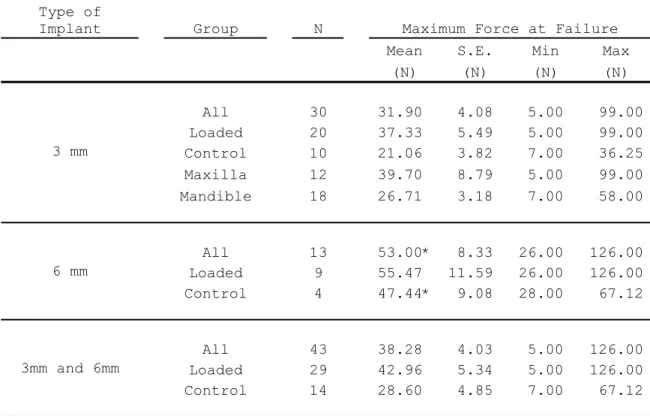
The maximum shear force at failure of 6 mm miniscrew implants was significantly higher than that of the 3 mm