GOAL: A Load-Balanced Adaptive Routing Algorithm for Torus Networks
∗Arjun Singh , William J Dally , Amit K Gupta , Brian Towles
Computer Systems Laboratory
Stanford University
{
arjuns, billd, agupta, btowles
}
@cva.stanford.edu
Abstract
We introduce a load-balanced adaptive routing algo-rithm for torus networks, GOAL - Globally Oblivious Adap-tive Locally - that provides high throughput on adversar-ial traffic patterns, matching or exceeding fully randomized routing and exceeding the worst-case performance of Chaos [2], RLB [14], and minimal routing [8] by more than 40%. GOAL also preserves locality to provide up to 4.6× the throughput of fully randomized routing [19] on local traffic. GOAL achieves global load balance by randomly choosing the direction to route in each dimension. Local load bal-ance is then achieved by routing in the selected directions adaptively. We compare the throughput, latency, stability and hot-spot performance of GOAL to six previously pub-lished routing algorithms on six specific traffic patterns and 1,000 randomly generated permutations.
1
Introduction
Interconnection networks based ontorusork-aryn-cube topologies [3] are widely used as switch and router fabrics [5], for processor-memory interconnect [13], and for I/O interconnect [12]. Torus networks have highpath diversity, offering many alternative paths between a message source and destination. A good routing algorithm chooses between these paths in a manner that exploits locality to provide low latency, balances load to provide high throughput on ad-versarial traffic patterns, and gracefully handles momentary overloads to provide stability.
Many applications require the interconnection network to provide high throughput onadversarialtraffic patterns. In an Internet router, for example, there is no backpressure
∗This work has been supported in part by the Richard and Naomi
Horowitz Stanford Graduate Fellowship (Singh), a grant from the Stan-ford Networking Research Center (Gupta), an NSF Graduate Fellowship, a grant from the MARCO Interconnect Focus Research Center at Stan-ford University (Towles) and a grant from Cray, Inc. through DARPA subcontract CR02-C-0002 under U.S. government Prime Contract Num-ber NBCHC020049.
on input channels so the interconnection network used for the router fabric must handle any traffic pattern, even the worst-case, at the line rate or packets will be dropped. To meet their specifications, I/O networks must provide guar-anteed throughput on all traffic patterns between host and disk nodes. Some multicomputer applications are charac-terized by random permutation traffic1. This arises when
operating on an irregular graph structure or on a regular structure that is randomly mapped to the nodes of the ma-chine. Performance on these applications is limited by the throughput of the network on adversarial patterns.
A routing algorithm must strike a balance between the conflicting goals of providing low latency on local traffic and providing high throughput on adversarial traffic. To achieve high performance on local traffic, minimal routing algorithms that choose a shortest path for each packet -are favored. Minimal algorithms, however, perform poorly on worst-case traffic due to load imbalance. With a mini-mal routing algorithm, an adversarial traffic pattern can load some links very heavily while leaving others idle. To im-prove performance under worst-case traffic, a routing algo-rithm must balance load by sending some fraction of traffic over non-minimal paths - hence destroying some of the lo-cality.
Previous work has attempted to address the issue of pro-viding high worst-case performance while preserving local-ity. Valiant’s randomized algorithm [19] gives good per-formance on worst-case traffic, but at the expense of com-pletely destroying locality and hence giving very poor per-formance on local traffic and greatly increasing latency. The Chaos routing algorithm [2] employs randomization to mis-route from a shared queue of packets in each node when the network becomes congested. However, the misrouting de-cision is very localized and does not address the global load imbalance caused by adversarial traffic patterns. Minimal adaptive routing [8], [9] also suffers from this global load imbalance. The RLB algorithm [14] globally load balances
1Random permutation trafficin which each node sends all messages
to a single, randomly-selected node should not be confused withrandom
traffic, but performs poorly on worst-case patterns because it cannot locally adapt to traffic.
In this paper, we introduce Globally Oblivious Adap-tive Locally(GOAL) - a non-minimal, adaptive routing al-gorithm for torus networks that strikes a balance between the conflicting goals of locality and load balance. GOAL combines the global load balance of oblivious routing with the local balance of adaptive methods. GOAL obliviously chooses the direction of travel in each dimension weight-ing theshortdirection more heavily than thelongdirection in a manner that globally balances channel load while pre-serving some locality. Once the directions are selected, the packet is adaptively routed to the destination in the resulting quadrant. This adaptive routing avoids the local imbalance created by adversarial patterns.
The GOAL algorithm offers high throughput on worst-case patterns — matching or exceeding the performance of Valiant’s algorithm, and exceeding the worst-case perfor-mance of Chaos, RLB, and minimal routing by more than 40%, on known adversarial traffic patterns. At the same time GOAL exploits locality giving 4.6×the throughput of Valiant on local traffic and more than 30% lower zero-load latency than Valiant on uniform traffic. Because it is lo-cally adaptive, GOAL matches the performance of Chaos and minimal adaptive routing on hot-spot traffic. Because it occasionally routes the long way around, GOAL does not match the performance of minimal algorithms on local traf-fic - achieving only 58% the throughput of minimal algo-rithms on nearest neighbor traffic. However, we show that anyminimal algorithm asymptotically has at best half the worst-case throughput as Valiant’s algorithm.
The remainder of this paper describes the GOAL algo-rithm in more detail and compares its performance to other routing algorithms. Section 3 derives theoretical bounds on the performance of minimal and non-minimal algorithms. Section 4 describes the GOAL algorithm in detail. We mea-sure the performance of GOAL in Section 5 and compare its performance to existing routing algorithms.
2
Preliminaries
2.1
Definitions and Conventions
We restrict our discussion to multi-dimension torus ork -ary n-cube networks. Ak-aryn-cube is andimensional torus network withknodes per dimension giving a total of
N =knnodes. Each link is unidirectional, hence there are
two links between adjacent nodes — one for each direction. A packet may be divided into fixed size units called flits. Each link has unit capacity, i.e. it can forward one flit per cycle.
In all the algorithms evaluated in this paper (except the Chaos routing algorithm [2]), credit-basedvirtual channel
flow control [4] is employed. To make the algorithms stable, age-based arbitration is used with the oldest packet winning the contested resource. All addition and subtraction on node coordinates is performed modulokyielding a result that is in the range[0, k−1].
Traffic pattern (αΛ) -Λis aN×Ndoubly sub-stochastic destination matrix where each entry0 ≤ λi,j ≤ 1 is
equal to the probability that nodeichooses nodejas its destination. All nodes inject the same average num-ber of packets,α, per time step into the network. A node isoversubscribedif the sum of its row or column entries inΛ is greater than1. A traffic pattern is ad-missibleif none of the nodes in its destination matrix, Λis oversubscribed.
Permutation matrix (Π) - A destination matrixΛ with a single1entry in each row and column. All other en-tries are0.
Routing algorithm (R) - A routing algorithm maps a source- destination pair to a path through the network from the source to the destination. Oblivious algo-rithms select the path using only the identity of the source and destination nodes. Adaptive algorithms may also base routing decisions on the state of the net-work. Both oblivious and adaptive algorithms may use randomization to select among alternative paths. Minimalalgorithms only route packets along a short-est path from source to dshort-estination whilenon-minimal ones may route packets along longer paths.
Channel load (γc(R,Λ)) - The expected number of
pack-ets that cross channel c per cycle for the destination matrixΛand routing algorithmR.
Normalized worst-case channel load (γwcn(R,Λ)) - The
expected number of packets crossing the heaviest loaded channel normalized to the network capacity2,
γwcn(R,Λ) = maxc∈Cγc(R,Λ)
k/8 ,
whereCis the set of all channels in the network.
Saturation throughput (Θ(R,Λ)) - The average number of packets that can be injected by all the nodes in the network per time step so as to saturate the worst-case link to its unit capacity.
Θ(R,Λ) = 1
γwcn(R,Λ)
2The network capacity is the maximum load that the bisection of the
network can sustain for uniformly distributed traffic. In ak-aryn-cube
subjected to uniform random traffic, there are k2n packets trying to cross
the4kn−1(unidirectional) links in the bisection. Hence, each link in the
Worst-case saturation throughput (Θwc(R)) - The
worst-case saturation throughput for routing algo-rithmR over the space of all admissible destination matrices,
Θwc(R) = min
Λ Θ(R,Λ)
2.2
Performance Measures
For a given traffic pattern Λ and routing algorithm R
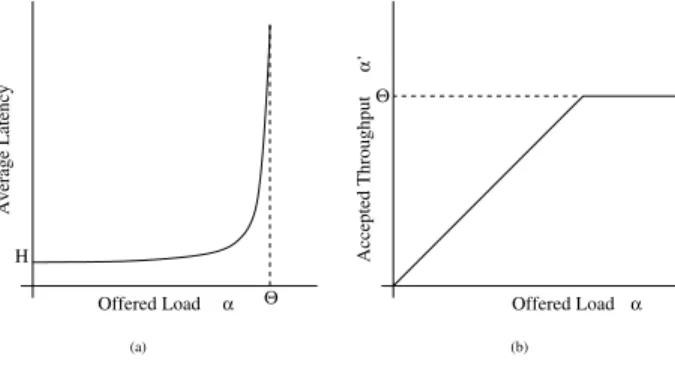
we can describe the performance of an interconnection net-work with two graphs as shown in Figure 1. The steady-state performance of the network at offered loads below the saturation point is described by Figure 1(a) which shows the average latency per packet plotted against the offered load α. The zero-load latency or hop-countH is the y -intercept of this curve and the saturation throughputΘ is thex-coordinate of the asymptote. At offered loads greater thanΘ, average steady-state latency is infinite.
Θ H Offered Load α Average Latency Θ Offered Load α Accepted Throughput α ’ (a) (b)
Figure 1. (a) Notational latency vs. offered load graph. (b) Accepted throughput vs. of-fered load.
Figure 1(b), which shows a plot of accepted trafficαas a function of offered loadα, describes network performance after the saturation point, whenα >Θ. We report the min-imum accepted traffic over all source-destination pairs to reflect the throughput achieved for the specified traffic ma-trixΛ. Under heavy load, the source-destination pairs with less contention deliver more packets than other pairs. In ef-fect, these pairsget aheadof the other pairs. However, the amount of the desired destination matrixΛthat is delivered is governed by theslowestpair (the one with the least ac-cepted throughput).
At offered loads less than the saturation point all traffic is delivered soα(α) =α. Beyond the saturation point ac-cepted traffic is flat for astablerouting algorithm. That is,
α(α) = Θforα≥Θ. Forunstablealgorithms, through-put degrades beyond saturation. This occurs for some non-minimal algorithms where, due to congestion, average path length increases with offered traffic. Instability may also
occur when global fairness is not maintained and hence the throughput of the slowest source-destination pair is reduced after saturation because more of a critical shared resource is being granted to a faster source-destination pair.
0 1 2 3
4 5
6 7
Figure 2. Minimally routed pattern0→3,1→
2,5→6.
To illustrate why we computeαas the minimum across all source-destination pairs, consider an 8-ary 1-cube net-work routing three flows as shown in Figure 2. There are three source nodes - 0, 1 and5- sending packets to des-tination nodes 3, 2 and6 respectively. All source nodes inject the same load, αinto the network. As we increase the injected load for each node from zero up to the satura-tion point, α = 0.5, none of the links in the network are saturated and the average accepted load α∗ and the mini-mum accepted loadαacross the flows are both the same, i.e. α∗=α=α. Suppose we now increaseαto 1.0. Link 1 →2becomes saturated and allocates half of its capacity to each of the two flows0→3and1 →2. However, link 5 →6offers its full capacity to flow5→6. The accepted loads for nodes2,3and6are therefore0.5,0.5and1.0 re-spectively. Hence,α∗ = 2/3 = 0.67while theα = 0.5. The minimum numberαreflects the amount of the original destination matrixΛthat is being delivered, the extra traffic on5→ 6represents additional traffic beyond theαΛthat is not part of the specified destination matrix.
3
Performance Bounds
In this section, we make some claims regarding the per-formance of different types of routing algorithms.
Claim 1. No routing algorithm can guarantee a throughput greater than half the network capacity onk-aryn-cubes. Proof. We prove this claim by showing that for a particular traffic permutation, no routing algorithm,R∗can achieve a saturation throughput greater than0.5. Consider the permu-tationΠdia, in which every source sends a packet half way
across the ring in each dimension. In ak-ary2-cube, every source (i, j) sends to(i+k/2, j+k/2). In such a per-mutation, there are a total ofknpackets, each packet being nk/2hops away from its destination. This implies that all the packets need to traverse at least(kn)nk/2links in the
network. However, there are(2n)knlinks in ak-aryn-cube
network. Therefore, no matter what routing algorithm,R∗
γwcn(R∗,Πdia)≥ (k
n)nk/2
(k/8)(2n)kn = 2
⇒ Θwc(R∗)≤Θ(R∗,Πdia)≤0.5
Claim 1 therefore, gives us an upper bound on the worst-case performance of any routing algorithm.
Claim 2. Valiant’s algorithm gives optimal worst-case throughput but performs identically on every admissible destination matrix onk-aryn-cubes.
Proof. Let us first consider any permutation matrix, Π∗. Valiant’s algorithm,Rval, involves two completely random
phases. A source node first sends a packet to a completely random intermediate nodeqand then fromqto the actual destination. On average, a packet traverses k4 hops per di-mension in each of the two phases. So, in all, thekn
pack-ets of Π∗ traverse2n(k4)links simultaneously. There are (2n)knlinks in the network that uniformly support this
traf-fic. Since, all the channels are identically loaded forRval,
∀c, γc(Rval,Π∗) = k n2n(k 4) 2nkn = k 4 (1)
By the result of Birkhoff [1], anyadmissibledestination ma-trix,Λ∗, can be written as a weighted combination of per-mutation matrices: Λ∗= i φiΠi, s.t. i φi= 1 (2) Hence, ∀c, γc(Rval,Λ∗) =γc(Rval, i φiΠi) (3)
As shown in [17], due to the linearity of channel loading in oblivious routing algorithms, such asRval, we can rewrite
(3) as: ∀c, γc(Rval,Λ∗) = iγc(Rval, φiΠi) =iφiγc(Rval,Πi) =iφik4 = k4 from(1),(2)
Since all channels are identically loaded, we get
γwcn(Rval,Λ∗) =k/k/48 = 2. Therefore,
Θwc(Rval) = Θ(Rval,Λ∗) = 0.5
Claim 2 shows that Valiant’s algorithm gives optimal worst-case saturation throughput. However, it destroys the locality of every traffic pattern reducing it to the worst case. Valiant also doubles the average path length of any packet thereby resulting in very high latency even at low offered load.
Next, let us consider the class ofminimalrouting algo-rithms.
Claim 3. No minimal routing algorithm can guarantee a throughput asymptotically greater than 25% the network capacity onk-aryn-cubes.
Proof. Consider the tornado traffic permutation, Πtor, in which every source sends a packet to a destination that is one less than half-way across the ring in a single dimen-sion. For e.g., in an8-ary2-cube, every source(i, j)sends to(i+k/2−1, j). A minimal routing algorithm, Rmin,
will only employ links in one direction in the ring, leaving the links going the other direction idle. Links in only one dimension will be used. All other links will be idle. Fig-ure 3 shows how minimally routing tornado trafficon an 8-ary1-cube causes the packets to rotate around the ring in a single direction like a tornado, keeping the links in the other direction completely idle. Hence,
γwcn(Rmin,Πtor) =k/k/2−81
⇒ Θwc(Rmin)≤Θ(Rmin,Πtor) =k/k/2−81 ≈0.25
(fork/2>>1) 0 1 2 3 4 5 6 7
Figure 3. Minimally routed tornado traffic on
an 8-ary 1-cube. Clockwise link load is 3.
Counter clockwise link load is 0.
Therefore, from a worst-case throughput point of view, a minimal algorithm performs sub-optimally.
4
GOAL
The GOAL algorithm routes a packet from a source node
s={s1, . . . , sn}to the destination noded={d1, . . . , dn}
by obliviously choosing the direction to travel in each of the
the RLB algorithm [14]). Choosing the directions selects the quadrantin which a packet will be routed in a man-ner that balances load among the quadrants. Then, trav-eling only in the selected directions, the packet is routed adaptively froms tod. At each hop, the router advances the packet in theproductivedimension that has the shortest queue.
In each dimension, the choice of direction is made to ex-actly balance the load on the channels in the two directions. In each dimensioni, the distance in the shorter of the two directions is∆i = min(di−si, si−di). The direction of
the short path isri = +1if ∆i = di−si andri = −1
otherwise. The selected direction is based on a probability distribution favoring the short path. To exactly balance the load due to symmetric traffic we send each packet in the short direction,ri, with probabilityPri = k−k∆i and in the
long direction,−ri, with probabilityP−ri =∆ki.
For example, suppose we are routing from s = (0,0)
to d = (2,3) in an 8-ary 2-cube network (8 × 8 2-D torus). The distance vector is∆ = (2,3), the minimal di-rection vector isr = (+1,+1), and the probability vector isP = (0.75,0.625). We have four choices for choosing directions, (+1,+1), (+1,−1), (−1,+1), and (−1,−1)
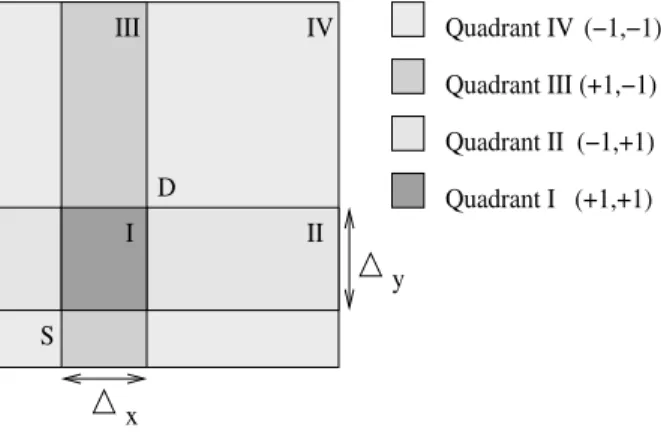
which we choose with probabilities 0.469, 0.281, 0.156, and 0.094 respectively. Each of these four directions describes a quadrant of the 2-D torus as shown in Figure 4. The weighting of directions routes more traffic in the minimal quadrant(+1,+1)(shaded darkest) and less in the quad-rant that takes the long path in both dimensions(−1,−1)
(shaded lightest). D I IV II III S y x Quadrant IV Quadrant III (+1,−1) Quadrant II (−1,+1) Quadrant I (+1,+1) (−1,−1)
Figure 4. Quadrants in a k-ary 2 cube for a
given source S (0,0) and destination D (2,3).
Once we have selected the quadrant, the packet is routed adaptively within that quadrant. A dimensioniis produc-tiveif, the coordinate of the current nodexi differs from di. Hence, it is productive to move in that dimension since
the packet is not already at the destination coordinate. At
each hop, the productive dimension with the shortest output queue is selected to advance the packet.
(0, 0) (2, 3) x y S D
Figure 5. Example route from S (0,0) to D (2,3) through the minimal quadrant (+1,+1).
For example, consider the case above where we are rout-ing froms = (0,0)tod = (2,3)in an 8-ary 2-cube net-work. Suppose the routing algorithm has obliviously cho-sen the minimal quadrant,(+1,+1). One possible route of the packet is shown in Figure 5. On the first hop, the pro-ductive dimension vector isp= (1,1)that is both thexand
ydimensions are productive. Suppose the queue in thex di-mension is shorter so the packet proceeds to node (1,0). At (1,0)pis still (1,1) so the packet can still be routed in either
xory. At this point, suppose the queue in theydimension is shorter, so the packet advances to node (1,1). At (1,1)p
is still (1,1) and this time the route is inxto (2,1). At this point, the packet has reached the destination coordinate in
xsop= (0,1). Since the only productive dimension isy, the remaining hops are made in theydimension regardless of queue length.
4.1
Virtual Channels and Deadlock
Our implementation of GOAL employs 3 virtual chan-nels (VCs) per unidirectional physical channel (PC) to achieve deadlock freedom in the network. This is an ex-tension of the scheme proposed in the∗-channels algorithm [8] applied to the non-minimal GOAL algorithm. There are two types of virtual channels per PC,∗andnon-∗. Packets will move through the∗-channelsonlywhen traversing the most significantproductivedimension. Thenon-∗channels are fully adaptive and can be used at any time. In order to make the∗-channel subnetwork free from deadlock, we have two ∗-channels per PC -∗0 and∗1. ∗1 (∗0) is used if the packet has (has not) crossed a wrap-around edge in the current dimension. With these constraints it can be seen
that the channel dependency graph3for the∗-channels asso-ciated with GOAL is acyclic. Moreover, no∗-channel can ever participate in a deadlock cycle. Hence, every packet that has not reached its destination always has a∗-channel in the set of virtual channels it can possibly use to make for-ward progress tofor-wards its destination. Therefore, if VCs are assigned fairly, deadlock can never arise. The formal proof is a simple extension of that provided in Appendix A of [8] and is not presented in this paper.
4.2
Livelock and Packet Ordering
Livelock is a condition whereby a packet keeps circu-lating within the network without ever reaching its desti-nation. Freedom from such a critical condition must be guaranteed. All minimal algorithms like DOR, ROMM and MIN AD4guarantee livelock freedom with fair arbitration
since each channel traversed by a packet reduces the dis-tance to the destination. Valiant’s algorithm is also deter-ministically livelock free since it is minimal in each of its phases. The Chaos scheme uses randomization to misroute from a shared queue of packets in each node during con-gestion. This randomization only ensures that the algorithm isprobabilisticallylivelock free. Both the RLB and GOAL algorithms while non-minimal, provide deterministic free-dom from livelock. Once a route has been selected for a packet, the packet monotonically makes progress along the route, reducing the number of hops to the destination at each step. Since there is no incremental misrouting, all pack-ets reach their destinations after a predetermined, bounded number of hops.
The use of a randomized or adaptive routing algorithm can and will cause out of order delivery of packets. If an application requires in-order packet delivery, a possible so-lution is to reorder packets at the destination node using the well known sliding window protocol [16].
5
Performance evaluation
In this section we compare the throughput and latency of the seven routing algorithms described in Table 1 on the local and adversarial traffic patterns described in Table 2 and on 1,000 random permutations. We also compare the latency histograms for these algorithms on random traffic, their performance onhot-spottraffic and their stability post saturation.
The first two traffic patterns in Table 2, NN and UR, arebenignin the sense that they naturally balance load and hence give good throughput with simple routing algorithms. The next three patterns, BC, TP, and TOR, are adversar-ialpatterns that cause load imbalance. These patterns have
3For a detailed explanation of channel dependency graphs, see [6].
4See Table 1 for a description of these algorithms.
Name Description
VAL Valiant’s algorithm - route to a random nodeq(phase 1) anywhere in the network, then to the destination (phase 2). Deadlock is avoided using 2 subnetworks (for each phase) of 2 VCs each [19].
DOR Dimension-order routing - route in the min-imal quadrant inxfirst, then iny. Deadlock is avoided using 2 VCs [15].
ROMM Two-phase ROMM - route to random node
qin the minimal quadrant, then to destina-tion [10]. Deadlock is avoided using the same scheme as in VAL .
RLB Randomized Local Balance [14] - choose a quadrant Q to route in according to a weighted probability distribution, then route within Q first to a random inter-mediate node then to the destination ran-domizing the order of matching dimen-sions. Deadlock is avoided using Linder and Harden’s scheme [9].
CHAOS The Chaos routing algorithm. Deadlock is avoided using deflection routing [2]. MIN AD Minimal Adaptive (or the∗-channels
algo-rithm) - always route in the minimal quad-rant, routing adaptively within it. Deadlock is avoided using 3 VCs [8].
GOAL Globally Oblivious Adaptive Locally -choose a quadrant Q to route in accord-ing to a weighted probability distribution, then route within Q adaptively. Deadlock is avoided using 3 VCs [8].
Table 1. The routing algorithms evaluated in this paper.
been used in the past to stress and evaluate routing algo-rithms [14], [17], [2], [7], [8], [10]. Finally, the worst-case pattern is the traffic pattern that gives the lowest through-put. In general, the worst-case pattern may be different for different routing algorithms. As shown in [17], the worst-case pattern for oblivious algorithms such as DOR, ROMM, VAL and RLB can be restricted to traffic permutations and may be analytically computed. These patterns are reported in [14]. However, there is no known analytical method to determine the worst case traffic pattern for adaptive routing algorithms.
5.1
Experimental Setup
Measurements in this section have been made on a cycle-accurate network simulator that models the pipeline of each
Name Description
NN Nearest Neighbor - each node sends to one of its four neighbors with probability 0.25 each.
UR Uniform Random - each node sends to a ran-domly selected node.
BC Bit Complement -(x, y)sends to(k−x−
1, k−y−1).
TP Transpose -(x, y)sends to(y, x). TOR Tornado -(x, y)sends to(x+k
2 −1, y).
WC Worst-case - the traffic pattern that gives the lowest throughput by achieving the maxi-mum load on a single link [17].
Table 2. Traffic patterns for evaluation of rout-ing algorithms
router as described in [11]. Routing is assumed to take one 20 FO4 pipeline stage for each algorithm as supported by gate-level designs. All the assumptions regarding the net-work model stated in Section 2.1 hold for the experimental setup. Each packet is assumed to be one flit long and each virtual channel is8flits deep. The total buffer resources are held constant across all algorithms, i.e. the product of the number of VCs and the VC channel buffer depth is kept con-stant. For the CHAOS algorithm (which does not use VCs), we increase the number of buffers in the shared queue of each node. All contention is resolved using the age-based arbitration, always giving priority to a packet with an older time-stamp since injection. All latency numbers presented are measured since the time of birth of the packets and in-clude the time spent by the packets in the source queues. We have simulated two topologies, 8-ary 2-cube and 16 -ary2-cube, but present only the results for the8-ary2-cube topology due to space constraints. The results obtained for the16-ary2-cube topology follow the same trend.
All simulations were instrumented to measure steady-state performance with a high degree of confidence. The simulator was warmed up under load without taking mea-surements until none of the queue sizes changed by more than 1% over a period of 100 cycles. Once the simula-tor was warmed up, all injected packets were labeled for measurement for100/load cycles. The simulation was then run until all labeled packets reached their destinations. The packet sample size was chosen to ensure that measurements are accurate to within3%with99%confidence.
5.2
Throughput on Specific Permutations
Figure 6 shows the saturation throughput for each algo-rithm on each traffic pattern. The two benign traffic pat-terns are shown in Figure 6(a) while the four adversarial
patterns are shown in Figure 6(b) with an expanded vertical scale. The figure shows that GOAL achieves performance at least as good as VAL on the adversarial patterns while offering significantly more performance on the benign pat-terns - 52% higher throughput on random traffic and 4.6× the throughput on nearest-neighbor. However, the through-put of GOAL does not match the performance of minimal algorithms on the local patterns. This is the price of good worst-case performance.
Figure 6 also shows that the minimal algorithms, DOR, ROMM and MIN AD, offer high performance on benign traffic patterns but have very poor worst-case performance. Because the adaptivity of CHAOS is local in nature, its per-formance is comparable to that of MIN AD, a minimal al-gorithm. VAL gives provably optimal worst-case perfor-mance but converts every traffic pattern to this worst case giving very poor performance on the benign patterns and sub-optimal performance on several of the adversarial pat-terns.
The exact worst-case throughput for the oblivious algo-rithms — DOR, ROMM, VAL and RLB — is shown in Fig-ure 6(b). Since there is no known method to evaluate the worst case pattern for adaptive algorithms, the worst case graphs shown for CHAOS, MIN AD and GOAL show the lowest throughput over all traffic patterns we have simu-lated. We know from claim (3) that MIN AD saturates at 0.33 for tornado traffic fork = 8 and further deteriorates to 0.285 fork= 16. Chaos does not do appreciably better on tornado traffic saturating at 0.35 and 0.30 fork= 8and
k= 16respectively. The worst case pattern for GOAL that we know of at this point is theΠdiapermutation discussed
in claim (1) on which it saturates at 0.50.
The latency-load curves for the benign UR pattern for all the algorithms are shown in Figure 7. On this benign pattern the minimal algorithms give the best performance, VAL gives the worst performance, and GOAL falls midway between the two. CHAOS, MIN AD, and DOR all offer minimal zero-load latency and unit throughput because they always take the shortest path. Because VAL performs two rounds of randomized routing, its zero load latency is twice that of the minimal algorithms and its saturation throughput is half of theirs. Because GOAL occasionally routes the long way around its latency is increased and its throughput is reduced compared to the minimal algorithms. However, it offers substantially better performance than VAL while giving the same performance as VAL on worst-case traffic.
Figure 8 shows the latency-load curves for each rithm on the adversarial TOR pattern for each of the algo-rithms. Here the balanced algorithms RLB and GOAL offer the best performance because they efficiently balance load across the two directions in the xdimension. VAL does nearly as well but has more than twice the zero load la-tency as the balanced algorithms because of its two-phase
0 0.5 1 1.5 2 2.5 3 3.5 4 4.5
VAL DOR ROMM RLB CHAOS MIN AD GOAL
Satur ati o n Thr oughput NN UR 0 0.1 0.2 0.3 0.4 0.5 0.6 0.7 0.8 0.9
VAL DOR ROMM RLB CHAOS MIN AD GOAL
Satur ati o n Thr oughput BC TP TOR WC (a) (b)
Figure 6. Comparison of saturation throughput of seven algorithms on an 8-ary 2-cube for (a) two benign traffic patterns and (b) four adversarial traffic patterns.
0 0.1 0.2 0.3 0.4 0.5 0.6 0.7 0.8 0.9 1 0 10 20 30 40 50 60 70
Normalized Offered Load (α)
Average Delay per packet (cycles)
Uniform Random Traffic
VAL RLB GOAL ROMM DOR MIN AD CHAOS
Figure 7. Performance of different algorithms on UR (Uniform Random) traffic.
nature and because it takes gratuitous hops in they dimen-sion. The minimal algorithms, DOR, MIN AD, and ROMM all perform poorly (37% lower throughput than GOAL) on the tornado pattern because they route all of the traffic in the shorter direction, leaving the channels in the other direction idle. While CHAOS is not a minimal algorithm, its adaptiv-ity is local in nature and thus is not able to globally balance load across directions. Thus the performance of CHAOS closely matches the performance of MIN AD on all adver-sarial patterns, including TOR.
5.3
Throughput on Random Permutations
One might ask how often permutations as bad as the ad-versarial patterns of Figure 6 occur in practice. To address this question, we measured the performance of each
algo-0 0.1 0.2 0.3 0.4 0.5 0.6 0 10 20 30 40 50 60 70 80
Normalized Offered Load (α)
Average Delay per packet (cycles)
Tornado Traffic VAL CHAOS GOAL RLB ROMM MIN AD DOR
Figure 8. Performance of different algorithms on TOR (Tornado) traffic.
rithm on 1,000 random permutations5. Histograms of
sat-uration throughput over these permutations for six of the algorithms are shown in Figure 9. No histogram is shown for VAL because its throughput is always 0.5 for all permu-tations. All the other routing algorithms have bell-shaped histograms. The highest, average and worst throughput in this experiment for each of the algorithms are presented in Figure 10.
The figures show that over the 1,000 permutations, GOAL is the only algorithm with a worst-case throughput that matches or exceeds that of VAL. The minimal algo-rithms and CHAOS do substantially worse. GOAL out-performs the best of these algorithms, MIN AD, by 31%. The figures also show that despite the fact that it obliviously routes a fraction of traffic the long way around, GOAL has the highest average case throughput of all of the algorithms,
5These103 permutations are selected from theN! = kn!possible
0.2 0.3 0.4 0.5 0.6 0.7 0.8 0 5 10 15 20 25 Saturation Throughput %age of 1000 permutations DOR 0.2 0.3 0.4 0.5 0.6 0.7 0.8 0 5 10 15 20 25 Saturation Throughput %age of 1000 permutations ROMM (a) (b) 0.2 0.3 0.4 0.5 0.6 0.7 0.8 0 5 10 15 20 25 Saturation Throughput %age of 1000 permutations RLB 0.2 0.3 0.4 0.5 0.6 0.7 0.8 0 5 10 15 20 25 Saturation Throughput %age of 1000 permutations CHAOS (c) (d) 0.2 0.3 0.4 0.5 0.6 0.7 0.8 0 5 10 15 20 25 Saturation Throughput %age of 1000 permutations MIN AD 0.2 0.3 0.4 0.5 0.6 0.7 0.8 0 5 10 15 20 25 Saturation Throughput %age of 1000 permutations GOAL (e) (f)
Figure 9. Histograms for the saturation
throughput for 103random permutations. (a)
DOR, (b) ROMM, (c) RLB, (d) CHAOS (e) MIN AD (f) GOAL
outperforming MIN AD by 5%. This shows clearly that even for an averagepermutation, global load balance en-hances performance and it is worth obliviously misrouting (as in GOAL) to achieve this balance.
The figure also shows the importance of using adaptive routing to achieve local balance6. GOAL has 49% higher
average throughput and 75% higher worst-case throughput than RLB which also uses quadrant selection to achieve global balance but attempts to obliviously achieve local bal-ance. For the same reason, the unbalanced adaptive algo-rithms MIN AD and CHAOS outperform the minimal obliv-ious algorithms, DOR and ROMM. MIN AD slightly out-performs CHAOS in terms of both average and worst-case throughput. This suggests that for most permutations, local misrouting is not advantageous.
6This advantage of adaptive routing has also been noted in [2].
0 0.1 0.2 0.3 0.4 0.5 0.6 0.7 0.8 0.9
DOR ROMM RLB VAL CHAOS MIN AD GOAL
Satur ati o n Thr oughput
Best Case Average Worst Case
Figure 10. Best-case, Average and
Worst-case Saturation Throughput for 103 random
traffic permutations.
5.4
Latency
To compare the latency of the seven algorithms, we com-puted latency histograms between a representative source-destination pair in a network loaded with uniform random traffic for each algorithm. In an 8-ary 2-cube loaded with uniform traffic, the Manhattan distance between a source and a destination node can range from 1 to 8. In our experi-ments, we chose to measure the latency incurred by packets from a source to 3 different destination nodes with a back-ground of uniform random traffic at0.2offered load:
• A(0,0) toB(1,1) - path length of 2 representing very local traffic.
• A(0,0) toC(1,3) - path length of 4 representing semi-local traffic.
• A(0,0) toD(4,4) - path length of 8 representing non-local traffic.
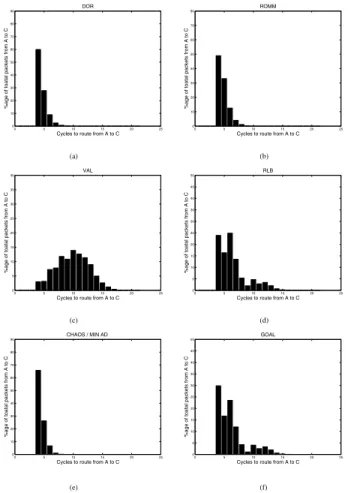
The histograms for semi-local paths (packets fromAto
C) are presented7 in Figure 11. Each histogram is com-puted by measuring the latency of 104packets for the test pairs. For all experiments, offered load was held constant at 0.2. The experiment was repeated for each of the seven routing algorithms.
The latency,T, incurred by a packet is the sum of two components,T = H +Q, whereH is the hop count and
Qis the queueing delay. The average value ofH is con-stant while that ofQrises as the offered load is increased. For a minimal algorithm, H is equivalent to the Manhat-tan disManhat-tanceDfrom source to destination. For non-minimal algorithms,H≥D.
0 5 10 15 20 25 0 10 20 30 40 50 60 70 80 90
Cycles to route from A to C
%age of toatal packets from A to C
DOR 0 5 10 15 20 25 0 10 20 30 40 50 60 70 80
Cycles to route from A to C
%age of toatal packets from A to C
ROMM (a) (b) 0 5 10 15 20 25 0 5 10 15 20 25 30 35 40
Cycles to route from A to C
%age of toatal packets from A to C
VAL 0 5 10 15 20 25 0 5 10 15 20 25 30 35 40 45 50
Cycles to route from A to C
%age of toatal packets from A to C
RLB (c) (d) 0 5 10 15 20 25 0 10 20 30 40 50 60 70 80 90
Cycles to route from A to C
%age of toatal packets from A to C
CHAOS / MIN AD 0 5 10 15 20 25 0 5 10 15 20 25 30 35 40 45 50
Cycles to route from A to C
%age of toatal packets from A to C
GOAL
(e) (f)
Figure 11. Histograms for 104packets routed
from node A(0,0) to node C(1,3). (a) DOR, (b) ROMM, (c) VAL, (d) RLB, (e) CHAOS and MIN AD, (f) GOAL.
The results for all the three representative paths are pre-sented in Figure 12. Under benign traffic at low load, the three minimal algorithms, DOR, ROMM, and MIN AD, and CHAOS (which behaves minimally at low load) give the lowest latency. All of these algorithms have a minimal hop count,H = 4, and the queueing delayQis exponentially distributed with means ranging from 0.44 cycles for MIN AD to 0.76 cycles for ROMM. This difference in queueing delay further shows the advantage of adaptivity. The result is a latency histogram with a peak atH = 4that falls off exponentially.
The balanced algorithms, RLB and GOAL, have higher latency (40% higher than minimal) and broader distribu-tions than the minimal algorithms because they route a frac-tion of the traffic in the non minimal quadrants. Depending on the quadrant chosen the hop count for a given packet is
H =4, 6, 10, or 12. With the weighted choice of quadrants
the average hop count isH = 5.5and the distribution is the superposition of four exponential distributions, one for each quadrant. This increase in latency compared to the minimal algorithms is one of the costs of providing high worst-case throughput. However the balanced algorithms offer much lower latency than VAL. GOAL is on average 2.45 times, 1.60 times and 1.12 times faster than VAL on local, semi-local and non-semi-local paths respectively.
VAL has the highest latency and broadest distribution be-cause it operates in two random phases. Depending on the choice of intermediate node the hop countH can be any even number between 4 and 12. The average hop count is
H = 8, and the broad distribution is the superposition of ex-ponentially decaying distributions starting at each of these hop counts. 0 2 4 6 8 10 12 VA L DO R RO MM RLB CHA OS MIN AD GOA L Average Latency (cycles)
H (A-B) Q (A-B) H (A-C) Q (A-C) H (A-D) Q (A-D)
Figure 12. Average total - hop (H) and
queue-ing (Q) - latency for 104packets for 3 sets of
representative traffic paths at 0.2 load.
5.5
Stability
In this subsection, we evaluate the stability of each rout-ing algorithm, that is its throughput with offered traffic in excess of the saturation throughput. As described in Sec-tion 2.2 for a given destinaSec-tion matrixΛand rate of offered trafficα we measure the accepted traffic,α as the mini-mumaccepted load over all source-destination pairs sending packets.
Figure 13 showsα∗ (upper line), theaverageaccepted throughput and α (lower line), the minimum accepted throughput vs. α for the BC permutation on GOAL and CHAOS routing algorithms. The figure shows that CHAOS is quite unstable on this adversarial traffic pattern due to injection-queue starvation. Since CHAOS employs deflec-tion routing to avoid deadlock, it accepts traffic from the node (source queue) only if resources are available after serving the input channels and the shared queue. Thus, at high, non-uniform loads, the source queues on nodes in
0.1 0.2 0.3 0.4 0.5 0.6 0.7 0.8 0.1 0.15 0.2 0.25 0.3 0.35 0.4 0.45 0.5 0.55 0.6 Offered Load (α) Accepted Throughput GOAL throughput on BC α* α, 0.1 0.2 0.3 0.4 0.5 0.6 0.7 0.8 0.1 0.15 0.2 0.25 0.3 0.35 0.4 0.45 0.5 0.55 0.6 Offered Load (α) Accepted Throughput CHAOS throughput on BC α* α, (a) (b)
Figure 13. Accepted Throughput for BC traffic on (a) GOAL and (b) CHAOS.
high-traffic areas are starved indefinitely leading to a nearly zeroα. However, GOAL is stable with accepted traffic,α
flat after saturation. The other five algorithms are also stable post saturation with age-based arbitration and their graphs are not presented due to space constraints.
It is worth noting that some algorithms presented in the literature such as those in [7] show that the accepted throughput degrades after saturation. This is because these schemes either use deadlock recovery techniques [18] or strictescape paths which drain the packets that may be in-volved in a deadlock. Hence, when deadlock starts to occur frequently after saturation, the throughput of the network degrades to the bandwidth of the deadlock free lanes or escape channels. The four oblivious algorithms — VAL, DOR, ROMM and RLB — use deadlock avoidance, i.e. they achieve deadlock freedom by ensuring that the chan-nel dependency graph (see [6]) of all the virtual chanchan-nels used is acyclic. Hence, they are stable after saturation. MIN AD and GOAL use the∗-channels as the deadlock free es-cape paths for packets that maybe involved in a deadlock in the fully adaptivenon-∗channels. However, these escape paths are notstrictlymeant for packets involved in a poten-tial deadlock in thenon-∗channels, i.e. packets entering the ∗-channels can always go back to thenon-∗ones and vice versa. Hence, none of the adaptivity is lost and the through-put is sustained post saturation.
5.6
Performance on Hot-Spot traffic
Occasionally a destination node in an interconnection network may become oversubscribed. This may occur in a switch or router due to a transient misconfiguration of rout-ing tables. In a parallel computer such a hot spotoccurs when several processors simultaneously reference data on the same node.
We evaluate the performance of five algorithms on hot-spot traffic by using ahot-spot patternsimilar to that used in [2]. We first select a background traffic pattern, bit
com-plement (ΛBC), on which most of the algorithms give
sim-ilar performance. On top ofΛBC, five nodes8are selected
which are five times more likely to be chosen as destina-tions than the other nodes. In the resulting matrixΛHS all
rows sum to one, but the five columns corresponding to the five hot-spot nodessum to five. Since the three adaptive algorithms — CHAOS, MIN AD and GOAL — and two oblivious algortihms — VAL and DOR — give similar per-formance onΛBC, we present results for these five on the
resultingΛHStraffic. 0 0.1 0.2 0.3 0.4 0.5 0.6
VAL DOR CHAOS MIN AD GOAL
Satur ati o n Thr oughput BC HS
Figure 14. Saturation Throughput for the Hot-Spot traffic pattern and the background Bit Complement pattern.
Figure 14 shows the performance of each routing al-gorithm on the hot-spot pattern and the background BC pattern. The adaptive algorithms, CHAOS, MIN AD, and GOAL have similar performance on hot-spot traffic. They clearly outperform the oblivious algorithms because adap-tivity is required to route around the congestion resulting from hot nodes. VAL gives throughput lower than 0.5 on hot-spot traffic because the traffic matrix is no longer ad-missible.
6
Conclusion
In this paper, we give a theoretical justification for the advantage of non-minimal routing that proves that any min-imal routing algorithm can have worst-case performance at best half as good as a well balanced non-minimal algorithm onk-aryn-cubes. Based on that argument, we introduce a load-balanced, non-minimal adaptive routing algorithm for torus networks, GOAL, that achieves high throughput on adversarial traffic patterns while preserving locality on be-nign patterns. GOAL matches or exceeds the throughput of Valiant’s algorithm on adversarial patterns and exceeds the
8These five hot-spot nodes are chosen very close to each other to stress
worst-case performance of Chaos, RLB, and minimal rout-ing by more than 40%. GOAL exploits locality to give 4.6× the throughput of Valiant on local traffic and more than 30% lower zero-load latency than Valiant on uniform traffic.
GOAL globally balances network load by obliviously choosing the direction of travel in each dimension, in ef-fect randomly picking a quadrant in which to transport the packet. The random choice of directions is made us-ing distance-based weights that exactly balance load in each dimension. Once the quadrant is selected, GOAL lo-cally balances load by routing adaptively within that quad-rant. GOAL employs a new algorithm for deadlock free-dom based on an extension of the∗-channels approach [8] (which is for minimal routing) to handle the non-minimal case. This provides deadlock freedom with just3 virtual channels per physical channel. Unlike CHAOS, GOAL is deterministically livelock free since within the selected quadrant distance to the destination is monotonically de-creased with each hop.
We compare GOAL to four previously published obliv-ious algorithms, VAL, DOR, ROMM and RLB and two state-of-the-art adaptive routing methods CHAOS, and MIN AD, and present a comparison in terms of throughput, latency, stability, and hot-spot performance. This evaluation includes throughput histograms on random permutations and latency histograms for CHAOS and MIN AD that have not been previously reported. GOAL provides the highest throughput of the seven algorithms on four adversarial pat-terns and on the average and worst-case of 1,000 random permutations. The cost of this high worst-case throughput is a modest degradation on local traffic. GOAL achieves only 58% and 76% of the throughput of minimal algorithms on nearest neighbor traffic and uniform traffic respectively. Due to oblivious misrouting, GOAL also has 40% higher la-tency on random traffic than the minimal algorithms; how-ever it has 38% lower latency than VAL. Finally, the paper analyzes network performance beyond saturation through-put and shows for the first time that due to fairness issues CHAOS is unstable in this regime for certain permutations. The development of GOAL opens many exciting av-enues for further research. Other topologies with path di-versity, such as Cayley graphs and hierarchical networks, may benefit from GOAL-like routing algorithms if a method of globally balancing traffic on these topologies can be de-veloped. A method to determine the worst-case traffic pat-tern for an adaptive routing algorithm, analogous to [17] for oblivious routing algorithms, would provide more pre-cise determination of performance on adversarial traffic pat-terns. It is also interesting to ask what new topologies may be enabled by GOAL-like routing algorithms.
References
[1] G. Birkhoff. Tres observaciones sobre el algebra lineal.
Univ. Nac. Tucum´an Rev. Ser. A, 5:147–151, 1946.
[2] K. Bolding, M. L. Fulgham, and L. Snyder. The case for chaotic adaptive routing.IEEE Transactions on Computers, 46(12):1281–1291, 1997.
[3] W. J. Dally. Performance analysis of k-ary n-cube inter-connection networks. IEEE Transactions on Computers, 39(6):775–785, 1990.
[4] W. J. Dally. Virtual-channel flow control.IEEE Transactions on Parallel and Distributed Systems, 3(2):194–205, 1992. [5] W. J. Dally, P. Carvey, and L. Dennison. Architecture of the
Avici terabit switch/router. InProceedings of Hot Intercon-nects Symposium VI, August 1998, pages 41–50, 1998. [6] J. Duato, S. Yalamanchili, and L. Ni. Interconnection
Net-works An Engineering Approach. IEEE Press, 1997. Chap-ter 3: A Theory of Deadlock Avoidance.
[7] J. Duato, S. Yalamanchili, and L. Ni. Interconnection Net-works An Engineering Approach. IEEE Press, 1997. Chap-ter 9: Performance Evaluation.
[8] L. Gravano, G. Pifarre, G. Pifarre, P. Berman, and J. Sanz. Adaptive deadlock- and livelock-free routing with all mini-mal paths in torus networks.IEEE Transactions on Parallel and Distributed Systems, 5(12):1233–1252, Dec. 1994. [9] D. Linder and J. Harden. An adaptive and fault tolerant
wormhole routing strategy for k-ary n-cubes. IEEE Trans-action on Computers, 40(1):2–12, Jan. 1991.
[10] T. Nesson and S. L. Johnsson. ROMM routing on mesh and torus networks. InProc. 7th Annual ACM Symposium on Parallel Algorithms and Architectures SPAA’95, pages 275– 287, Santa Barbara, California, 1995.
[11] L.-S. Peh and W. J. Dally. A delay model for router micro-architectures,.IEEE Micro, 21(1):26–34, 2001.
[12] G. Pfister. An Introduction to the InfiniBand Arechitecture (http://www.infinibadta.org). IEEE Press, 2001.
[13] S. Scott and G. Thorson. The cray t3e network: adaptive routing in a high performance 3d torus. InProceedings of Hot Interconnects Symposium IV, Aug. 1996.
[14] A. Singh, W. J. Dally, B. Towles, and A. K. Gupta. Locality-preserving randomized routing on torus networks. InProc. 12th Annual ACM Symposium on Parallel Algorithms and Architectures SPAA’02, Winnipeg, Canada, 2002.
[15] H. Sullivan, T. Bashkow, and D. Klappholz. A large scale, homogeneous, fully distributed parallel machine, ii. In
Proceedings of the 4th Annual International Symposium on Computer Architecture., pages 118–124, Mar. 1977. [16] A. S. Tanenbaum. Computer Networks, 3rd ed. Prentice
Hall, 1996. Pages 202-219.
[17] B. Towles and W. J. Dally. Worst-case traffic for oblivious routing functions. InProc. 12th Annual ACM Symposium on Parallel Algorithms and Architectures SPAA’02, Winnipeg, Canada, 2002.
[18] A. K. V. and T. M. Pinkston. An efficient fully adaptive deadlock recovery scheme: Disha. InProceedings of the 22nd Annual International Symposium on Computer Archi-tecture., pages 201–210, Jun. 1995.
[19] L. G. Valiant. A scheme for fast parallel communication.