Insights into the daily life of Le Corbusier:
the agendas in the Fondation Le Corbusier
Tim Benton
ARTICLE INVITÉ
Le Corbusier. Immeuble GB. Perspective extérieur. FLC 12469.
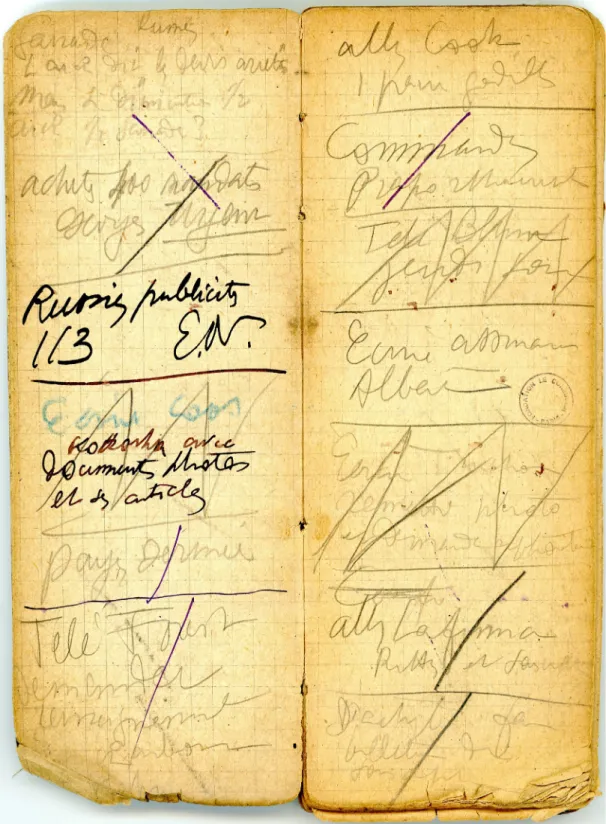
FIG. 1 Le Corbusier, Diary covering
June to September 1920, fols. 3v et 4r FLC F3(3)1.
INSIGHTS INTO THE DAILY LIFE OF
LE CORBUSIER: THE
AGENDAS
IN
THE FONDATION LE CORBUSIER
1
Tim Benton
doi : 10.4995/lc.2020.14333Abstract: The resources available for research at the Fondation Le Corbusier are many and varied. Among these, -interpret. The organisation of the diaries has to be understood. The pages of the diaries are undated. Establishing the approximate dates for each page presents a challenge that can only be overcome by reference to a wide range a number of worked examples, an indication is given of some of the insights that can be obtained from mining this data.
Keywords: Le Corbusier; archives; diaries; agendas.
Résumé :
les agendas proposent des indications intéressantes et révélatrices sur la vie privée et publique de Le Cor-une date à chaque page nécessite Cor-une recherche complexe dans la documentation de la Fondation. Ce texte propose quelques solutions pour arriver à analyser ce matériel, avec quelques cas études et quelques trou-vailles intéressantes.
Mots-clé : Le Corbusier; archives; diaries; agendas.
Resumen: Los recursos disponibles para la investigación en la Fundación Le Corbusier son muchos y va-riados. Entre ellos, las agendas
menudo difíciles de leer y aún más difíciles de interpretar. La organización de los diarios debe ser comprendi-da. Las páginas de los diarios no tienen fecha. Establecer las fechas aproximadas de cada página representa un desafío que sólo puede superarse mediante las referencias de una amplia gama de otra documentación. Este documento ofrece sugerencias sobre cómo analizar e interpretar este difícil material. Con una serie de ejemplos trabajados, se da una indicación de algunos de los conocimientos que pueden obtenerse de la ex-tracción de estos datos.
Palabras clave: Le Corbusier; archivos; diarios; agendas.
1. The article was published in Les Cahiers de la recherche architecturale, urbaine et paysagère, September 2020. https:// journals.openedition.org/ craup/4301. I would like to thank the chief editor Frédéric Pousin for his support in allowing for this double publication.
the 36 personal diaries (‘agendas
years2. Why study this material? The diaries are of particular interest because they record daily events,
conversations and intentions for which no other evidence is available. The Le Corbusier archive is of interest beyond the biography of the architect. It presents a very complete record of architectural practice in the twentieth century, allowing for detailed analysis of successful and failed building projects. But it also contains a mass of material on the economic and cultural life of Paris and the many places Le Corbusier visited in his lifetime. For example, there are over one thousand letters and documents pertaining to the unsuccessful industrial and commercial undertakings that occupied Le Corbusier’s time and energy from 1917 until his bankruptcy in 19233. This documentation provides insights into the recession in France in the early 1920s and
the problems posed by the war reparations clauses in the Treaty of Versailles. There is also a mass of documentation of Le Corbusier’s attempts to lobby international leaders and opinion formers to support his project for the Palace of the League of Nations which reveals many of the diplomatic fractures that undermined the attempts to establish a stable world peace.
Among the sources available to scholars are Le Corbusier’s sketchbooks and the little notebooks that he took with him everywhere and in which he noted things of interest and made sketches. These have been extensively studied, as have been his collections of postcards and photographs4. Many scholars have consulted the
diaries in pursuit of particular pieces of information, but few have worked out how they were constructed and how to date the information. This is because, unlike conventional printed diaries, these agendas have no dates on each page. This note is intended to help scholars make use of this information. As I try to demonstrate, understanding the diaries requires lateral research into other sources. To this end, I have given a number of detailed examples showing how puzzles can sometimes be resolved by cross-checking with the correspondence, address books and other information.
2. Fondation Le Corbusier
book. 3. Tim Benton. “From Jeanneret to Le Corbusier: rusting iron, bricks and coal and the modern Utopia.”
Massilia
4. Danièle Pauly et al.
Le Corbusier catalogue raisonné des dessins Tome I Années de formation et premiers voyages, 1902-1916 (Bruxelles: Archives d’architecture moderne; Fondation Le Corbusier, d’Isabelle Godineau et de Giuliano Gresleri. Le Corbusier, viaggio in Oriente: gli inediti di Charles Edouard Jeanneret, fotografo e scrittore. (Venezia; Paris: Marsilio; Fondation Le Corbusier, Tim Benton. LC foto: Le Corbusier: secret photographer. (Baden, London: Lars Müller, Le Corbusier, et al. Album La Roche [with an essay by Stanislaus von Moos translated by Irene von Moos]. (Paris:
Gallimard-Burriel Bielza, Luis and Giuliano Gresleri.
Le Corbusier la passion des cartes. (Bruxelles: Mardaga,
FIG. 2 Le Corbusier, Covers of the agendas F3(3)4, F3(5)7 and F3(6)2.
The diaries
The diaries employ small squared paper with rounded corners and are hand-stitched. They have black imitation covers, three of them with the Gallia manufacturers stamp. The notebooks between 1920 and 1925 measure approximately 7 x 19 cm., several with the sticker of the Papeterie Normand, 32 passage du Havre, Paris. from the later 1930s have between 90 and 105 pages. Some pages have become detached over the years. The agendas for the 1920s and 1930s therefore contain over 1500 pages, or 3,000 sides of notes (recto and
Deciphering the handwriting
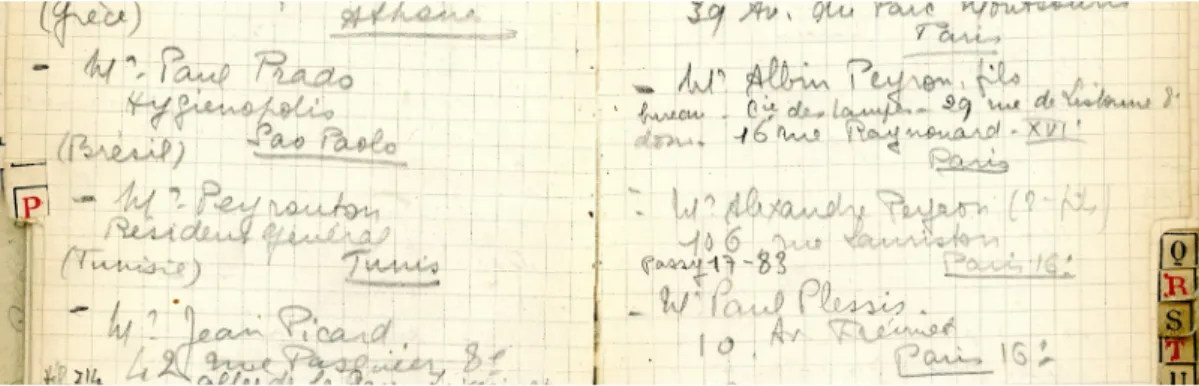
In these agendas Le Corbusier jotted down notes, often on the move or on the telephone, in pencil or pen. The clarity and legibility of the handwriting varies enormously, but it is impossible in some cases to decipher a name of names. An address book, mostly written by a secretary or assistant but with some additions by the master, covers the period of the 1940s with some names derived from the 1930s correspondence5. This is usually
more legible than Le Corbusier’s notes.
The names and details are clearly copied from Le Corbusier’s notes, since there are frequent question marks, and many of the names are accompanied by ‘M?’, indicating that the secretary did not know the gender of the person or whether they had a professional title. A notebook including names, addresses and telephone numbers in Le Corbusier’s hand also covers the 1940s6. A careful transcription of these two documents
names. For example, among the records for the Esprit Nouveau
subscribers7. In the diary for 1938 is a list of people to co-opt for his petition about the Palais des Soviets8.
Another useful source of names is the index to the interwar correspondence provided by the Fondation Le Corbusier9. Under the heading ‘Correspondance’ the website includes some of the names of people with
whom Le Corbusier corresponded in the period preceding 1946 arranged alphabetically. Organized separately are other collections of correspondence, such as that associated with the Briqueterie d’Alfortville, the Esprit Nouveau magazine and all the built and unbuilt architectural projects. After the war, the correspondence is listed under Courriers Chronologiques and organized by year. On the computers at the Fondation Le Corbusier, but not on the website, names throughout the database can be found using a global search. As a last resort, among many: a name that could be read as ‘Addoc’, ‘Addi’ or ‘Addo’ appears frequently in the agenda for March to October 1935. The address book gives us R. Addor, engineer, of 16 Avenue Duval-le-Camus,
Saint-10.
Interpreting the data
between data and information, between signs transposed into recognisable language and a full understanding of what the words mean. A correctly transcribed name can be considered as data: information involves knowing who the person is, why Le Corbusier might have wanted to meet or talk with him or her and why this might be important. Data about an event become information when one knows when it took place, where, who For example, in his diary begun on 20 May 1938 we read ‘Pégurier’ of 9 rue Falguière11. This appears to be an
invitation to lunch on Thursday 23 June 193812
of her house ‘Rev Estello’ (‘près de Saint-Tropez’13. A letter from this lady to Le Corbusier’s mother of 31
March 1937 had invited her to stay at her house near Saint-Tropez, which she called ‘Le Pelou’14. She clearly
5. 6.
folios include addresses, accumulated in haphazard order. The remaining pages include notes and appointments. At the end are some pages of visiting cards. Most of the relate to the period of the war and shortly after. On folios 16v and 17r are lists of folders and suitcases left in the Queens Hôtel Vichy after Le Corbusier’s departure in 1942. A card from Helena Simkhovitch is the only record of his trip to New York in 1946. 7.
These lists include some information of place of origin. The spelling of the names is not perfect. Lists of names associated with the journal Plans can be 8.
9. www.
fondationlecorbusier.fr/ Archives/Correspondance. Excluded from this list is correspondence associated with the architectural projects, travel, lectures, publications and some other subjects such as the Briqueterie d’Alfortville Société Éverite which are listed under ‘Ateliers’. 10. Visiting card of René correspondence about 13.
11.
architect Henri Pacon also lived at 9 rue Falguière. 12. The Tuesday of the same week is dated 21 June 1938.
13. 14.
FIG. 3 Le Corbusier’s address book, compiled in the early 1950s. FLC F3(6)7.
15. On 13 May
1937 Le Corbusier writes to a Mr. Steele, explaining that Mme Pégurier is the widow of an artist with a large address at 21 rue de Pontoise and was presumably in a position to help her out16. Le Corbusier and Yvonne
stayed with Mme Pégurier at ‘Rev Estello’ in March 1938 and again in July and August 193817. This little
snippet of life becomes interesting when we learn that Le Corbusier must have been staying at ‘Rev Estello’
18. It also
dispels the idea that the only place Le Corbusier and Yvonne visited on the Côte d’Azur was the Villa au bord de mer
retired General of the French Salvation Army Albin Peyron, but the names and addresses of his two sons, one of whom, also named Albin, was the client of the weekend house ‘Le Sextant’ at Les Mathes, designed by Le Corbusier in 193519.
Content and organisation of the diaries
Le Corbusier used these slim diaries for various purposes: notes about meetings or about things he had
up, he began a new notebook. It follows from this that the pages in the ‘front-matter’ proceed chronologically from left to right, while those of the ‘end-matter’ advance from right to left (from the end in the direction of the
agendas where he followed this system. On folio
agenda
noted events dated 16 and 17 February while on folio 40r he notes dates of the 19th to the 25th.
The value of these agendas lies in part in the inherent interest of the notes and observations. For example in late June 1932 Le Corbusier notes: ‘Écrire Fueter; avons intention photo collage, envoyer des documents’. the Pavillon Suisse a year later20. Some of the notes in the end-matter include drafts of lectures or presentations,
sketches of paintings or buildings and commentaries on things he had seen and heard. For example, on folios 46v and 47r of an agenda begun in May 1922 are little sketches in plan and elevation of skyscrapers associated with his project for Une ville contemporaine de trois millions d’habitants and a note to put the railway stations underground21. In another agenda
of Immeubles-Villas for the Franco-American company, dated July 1922. On folios 45v and 46r, which follow Le Corbusier made three astonishing sketches of ideas for developing the area around the Salvation Army
15. 16.
17. Postcard from Le Corbusier’s mother to Le Corbusier and Yvonne at Rev-Estello 12 March 1938, letter of 19 July 1938 to Mme Pégurier asking if he and Yvonne could stay by a postcard from Georges Pelorson to Le Corbusier, readdressed to Rev Estello on 19 July 1938 (FLC Le Corbusier’s brotherof 12 August 1938, also readdressed to Rev Estello can be dated to around 18 July, address ‘Mme Pégurier Rev Eestello, rue Gambetta Saint-Tropez, Var. 18. Letter of Le Corbusier
to his mother 23 August 1938, with an account of his accident on the 13th 19. Tim Benton. “Le Corbusier e il vernacolare: Le Sextant à Les Mathes 1935”, in Le Case per artisti sull’Isola Comacina. (A. Canziani. 22-43. 20.
Rudolf Fueter, Rector of Zurich University played a key role in supporting Le Corbusier against criticism from many compatriots. 21.
pages can only be dated approximately, to May 1922.
FIG. 4
Detail of folios 8v and 9r of the diary covering May 1938 to November 1939. FLC F3(6)5.
project, a massive extension of the Salvation Army hostel22. These sketches were done while he was at his
mother’s house, a visit that ended on 26 September 193223.
Sometimes, the preparatory notes Le Corbusier jotted down for his lectures are of particular value because we have little or no other record of their contents. For example, in June 1934, during his tour of Italy, Le Corbusier made sketches and notes for his lectures in Rome and Milan24. On folios 77v and 78r, he inserts Italian
examples, such as Bologna, with its famous medieval towers, and Genoa, into his usual arguments about many remain irreproachable. On the facing page he illustrates the Cathedrals of Soissons and Notre Dame and, in a coloured sketch labelled ‘Les Harmoniseurs’ he shows a view along the newly created via del Impero in Rome, with the Coloseum closing the view, the Basilica of Maxentius on the right and, on the left, a glazed façade. This was the site chosen for the Palazzo del Littorio, for the design of which a competition was being held. His argument is that old and new can coexist, united by the common scale of man.
Similarly, on various pages of the end matter of the agenda for February 1937 to May 1938 there are notes for his lecture on the ‘Phénomène créateur’ at the Kunsthalle Zurich on 12 January 1938, on the occasion of the exhibition of his paintings. These preparatory notes for lectures are particularly valuable because very few of them were transcribed or described by journalists25.
Clues to intangible memory
The abundant documentation in the Fondation Le Corbusier, including hundreds of thousands of letters, tends associated with these notes will never be known; we cannot tell what he said on the phone or in a meeting unless it led to a result worth documenting. But this fugitive record gives us a good idea about what was primarily concerning Le Corbusier. For example, Le Corbusier’s devotion to his master Auguste Perret began house for the sculptor and collector Pierre Gaut, an early subscriber to L’Esprit Nouveau. Gaut and Le Corbusier were in correspondence in January 1922 to design and build a Citrohan-like house in the square Montsouris, not far from Ozenfant’s studio26. All seemed to be going well until Gaut wrote on 8 May to say that he had
entrusting the project to another architect27. This architect turned out to be Auguste Perret, and Le Corbusier
was not pleased28. The diary records a number of meetings and telephone calls connected with this unhappy 29.
have preceded Gaut’s letter of rejection of 8 May. We also know from the agenda that Le Corbusier visited Gaut at 6.30 p.m. on a Tuesday, probably 23 May 192230 and rang Perret around 17 May31.
22. See axonometric view FLC 10919. Brian Brace Taylor. Le Corbusier la Cité de refuge Paris 1929-1933. 79; and Fig. 82 and Oeuvre complete 1929-1934, 109. 23. Letter to his mother 27 24.
passim. On folio 89v a sketch of a landscape is annotated ’14 heures 45 lecture notes and other observations extend to 75v. 25. Tim Benton.
Le Corbusier conférencier. 26. See e.g. a letter of 13 February 1922 in which build a house based on his Citrohan project for 60,000 francs, plus 40,000 for the the reply of 18 February in which Gaut accepts Le Corbusier proceeded to present his client with the tenders on 11 March, amounting to 50,500 francs, except for the central 27.
28. Le Corbusier wrote to Perret on 18 May calling on him to stand aside and complaining that Perret viewed him as a rival who had stolen his ideas. FLC 29.
30. 31.
Personal life
The agendas also give us a glimpse of how the personal and professional lives of Le Corbusier intertwined. bank account for her with the Crédit Lyonnais bank in May 192832
enigmatic note, ‘Dr Von’, presumably a rendez-vous with a doctor for his wife Yvonne33. On September 26 he
notes the registration plates of a number of cars involved in a car accident, complete with sketch plan. He later complains that the insurance company had only reimbursed him 726frs against his repair bill of around 1,800 frs34
like these examples, provide unique insights into his activities. In Agenda
Renaudoux at 26 avenue Wilson, probably on Monday 10 July. Another appointment on Thursday 13 July doctor Winter for accompanying him to or from hospital for a painful operation on his colon that he describes to his mother on 15 August35. The operation had been much more disagreeable than he had thought, and he
was still on a diet.
32. 33. 34. 50r. 35. Le Corbusier to his mother, 15 August 1922
Dating
It is clear from these examples that it would be very helpful to know as precisely as possible when each note these notebooks are undated. Although the Fondation calls them ‘agendas’
the Second World War, are commercial diaries with printed dates. When he noted forthcoming meetings, he these ‘week-pages’. The trick is to identify to which week he is referring, which then dates the notes on the
lundi 29 nov’ [1937], ‘mardi 30 nov’ and ‘mercredi 1 dec’36.
lunchtime appointments with Jacques Lipchitz, for whom he was building a studio in Boulogne-sur-Seine37.
For Friday he notes an appointment at 8.00 pm with Raymond Cogniat who had written a generally favourable account in En attendant on Le Corbusier’s project for the City for Three Million people, exhibited at the Salon
36. He makes similar notes of dates on several pages in this diary.
37.
Lipchitz and Miestchaninof studios were done around May 1923 but the project only got under way in set of numbered drawings. See: Tim Benton. Les Villas parisiennes de Le Corbusier et Pierre Jeanneret, 1920-1930. (Paris: Editions de la
FIG. 5
Le Corbusier, fanciful perspective of Cité de Refuge, already in construction (above) and project for developing the surrounding area with a Cité d’Hébergement. FLC F3(5)4 fols. 26v and 27r. FIG. 6
Le Corbusier, sketch plan of area to North of the Cité de Refuge, as far as the rue Tolbiac, indicating location of ‘immense housing estate’. FLC F3(5)4 fol 27v. FIG. 7
Le Corbusier, notes for a lecture in Milan, June 1934. FLC F3(5)9 77v and 78r.
d’Automne. The clipping provided by the Argus press agency gives the date as ‘décembre 1922’. On the however, by the note against Friday: ‘6 ½ [18.30] conseil SEIE’. We know from the minutes of the Assemblée Générale of SEIE held on 29 December that a meeting of the Conseil had been held on Friday 8 December 192238.
commencé le 20 nov 1922’. Given that he dated the beginning of the next diary 23 January 1923, we have a clear terminus post quem and terminus ante quem
entire period. We can date each of these week-pages, therefore, and assume that any pages of notes before these week-pages relate to things before that week. By this calculation the third week after 20 November 1922 Tuesday took place on the 5th of December.
not usually note appointments during his vacations and only sporadically during his travels. This means that we can set aside weeks in August and at other times when we know he was travelling or was ill. For example, ‘lundi 16 sept.’
agendas, dealing with the period June 1920 to November 1922, there are no ‘weeks’ at all39 Albert illustration 11 Sept
Rythmique 40
connections with other documents. Fortunately, we have a lot of dated correspondence from this period, when Le Corbusier had a secretary and was engaged in a number of failed business schemes linked to the Briqueterie d’Alfortville41. So, on folio 2r Le Corbusier notes ‘voir Wallace prospectus’ and there is a letter to Wallace et
Dreger about publicity for L’Esprit Nouveau magazine dated 31 May 192042. On folio 3r is a note ‘Étudier
tuyaux Eternit’. Eternit was the name of the French company that Le Corbusier wanted to direct, supplying asbestos tiles and tubing manufactured by the Swiss Everite company. Sure enough, there is a letter to Everite on 15 June about Everite asbestos tubes. Next to this is a note ‘Écrire Loos’ which follows on from a telegram Le Corbusier sent to Adolf Loos on 26 May. And so on. Piecing together the fragments of surviving correspondence gradually builds up a chronological picture.
écrire Bonifas Prapo Voisin’. In a letter to Paul Bonifas of 20 July 1920, Le Corbusier refers to Praportchetovitch’s prefabricated
43. Le Corbusier had ordered one of these prefabricated houses from
Praportchetovitch, and there is correspondence about this in June and July 192044. We must assume that
Le Corbusier was not happy because he strongly advises Bonifas not to use these houses which, he says, are merely baraques and unsuitable for use in winter. Instead, he urges him to use the Voisin prefabricated houses currently on show at the Exposition des Arts Décoratifs. The letter also mentions the Voisin aeroplane and automobile company. A Voisin prefabricated house by Noël and Patout is illustrated in L’Art décoratif d’aujourd’hui, and Le Corbusier was writing the articles for this book in 1923. On folio 39v Le Corbusier notes, Le Corbusier sends Lafuma a cheque for 13,538 frs for the purchase of paper for the magazine, specifying that the cheque is predated 31 July45 écrire Loos’, and there is indeed a
letter to Loos dated 21 July 192046
1920.
It can be seen that this kind of research depends on a considerable backlog of data. In my own case, I have accumulated a database of around 20,000 documents, mostly concerning Le Corbusier but also some
agendas that overlap with my own research interests. But my personal database only records documents relevant to research projects I have undertaken.
38.
(Société d’entreprises industrielles et d’études
was the company set up in 1916 to supervise the brick factory at Alfortville and for Le Corbusier to design projects for the parent company SABA (Société d’applications du béton armé
Bornand. H. Allen Brooks.
Le Corbusier’s formative years: Charles-Edouard Jeanneret at La Chaux-de-Fonds(Chicago: Universityof ChicagoPress 473.
39.
40. This refers to the illustration advertising the Dalcrozian class of ‘Cours de Rythmique’ run by Le Corbusier’s brother Albert (L’Esprit Nouveau No 41. See: Tim Benton. “From Jeanneret to Le Corbusier…”, 28-39.
42. 43.
simple digital search engines in archives is that spelling of names is critical. Le Corbusier spells Praportchetovitch his correspondence with taken the spelling from an advertisement in Le Petit Parisien, Paris 28 April 1920, page 4 promoting the Praportchetovitch ‘baraquements pliants’ for ‘agriculteurs
44. Eg Le Corbusier to Praportchetovitch 13 July Le Corbusier refused to pay for the baraque and later tried to return it to Praportchetovitch (9 March
45. 46. Le Corbusier to Adolf Loos,3 Gisela Str. Vienna, chasing him up for articles that he had promised the editors of L’Esprit Nouveau
FIG. 8
Le Corbusier, a note on the past and sketches of the via del Impero Rome, June 1935. FLC F3(5)9 86v and 87r.
The Fondation Le Corbusier archive
The Fondation archive includes around 400,000 documents of various sorts that have been digitised and can be accessed through a database. Unfortunately, this database has certain limitations. Most of the documents are held in A4 cardboard boxes, containing up to 200 sheets each. These were originally given alphanumeric numbers have been changed twice in the history of the Fondation but are now stable. The current database consists of an index of the label of each box rather than an index to each sheet. Over the years, the archivists have added considerable further information to each ‘label’, which has enriched the search engine. For example, the labels of boxes including the post war correspondence, which are ordered chronologically, have annotated in this way. For example, there are several boxes of documents for each of Le Corbusier’s built and unbuilt projects, containing tens of thousands of letters to clients and entrepreneurs. These names do not all appear in the general online index. To give one example, the painter and glazier used by Le Corbusier and Jeanneret in almost all their constructions of the 1920s, A. Célio, is referred to only once in the Fondation database under correspondence47
for each project on which he worked. Similarly, there are over 1,700 documents connected with the Briqueterie d’Alfortville and the various agencies for which Jeanneret worked between 1918 and 1923, mostly consisting of letters to business associates. Hardly any of these names appear in the index under ‘Correspondance’. Or again, Le Corbusier engaged in a massive propaganda campaign to reverse the judgement of the competition under Correspondance, but not all. For example, seven letters are recorded to or from the Czech ambassador Stephen Osusky, but many more exist in the archive. This is a problem when dealing with the agendas for 1930-1931, which are full of references to Ambassador Osusky.
When did the Jeanneret-La Roche project begin?
Part of the function of the agendas is to provide negative evidence of contacts. For example, Le Corbusier dated the large house projected for the mouth of the square du Docteur Blanche as 1922, but there is no documentation to support this. This project was located on land being managed by the Banque Immobilière de Paris and its director Esnault48. In the agenda
area, having adapted the house of M. Berque in the Villa Montmorency in 1921-2 and worked on a big project in 1922 to build a block of apartments for the Franco-Américaine company and its director Charles Sée. The Jeanneret-Raaf houses is in agenda
Aller Esnault p. Sarmiento lui demander les combinaisons hypothèques’ and on folio 37 he notes ‘Télé[phoner] Sarmiento’ and ‘aller Esnault
would visit the bank ‘mardi prochain à 3h30 avec un achat en vue.’49 Esnault in his letter of reply on 31 March
says he will be away until the 9th April and, sure enough, Le Corbusier makes a note after 8 April, ‘Télé Esnault
terrain villa Montmorency Alb[ert]’50. A second meeting with Esnault for 5.00 pm on Thursday 12 April is noted 51
with the paper trail. The fact that there are no mentions of Mr Esnault or any of the other possible clients for
Oeuvre
complète 52.
Écrire parents p vacances B’. ‘B’ may stand for the picturesque hamlet of Chables-sur-Blonay in Switzerland where the Jeanneret family
47. This is a letter concerning Le Corbusier’s refurbishment of FLC 48. Confusingly, Le Corbusier’s secretary at this time was also called Esnault. 49. 50. Esnault to Le Corbusier and agenda 51. agenda 52. Tim Benton. Le Corbusier conférencier. 47.
often rented a chalet for their vacation. In a letter to the lawyer Tell Perrin on 21 June 1920 he said he would be joining his parents in Châbles-sur-Blonay in 18 days53. Other documents attest to the fact that Le Corbusier
was staying with his parents in Châbles in August54. We are helped by a note on folio 5v that reads: ‘URGENT
cheque Praportchetovitch
a cheque for 1,800 frs55. There is also a reference, on folio 8v to planning a trip to Bordeaux and a letter of 12
June refers to planning a meeting in Bordeaux56. Putting all this together, we can deduce that these notes were
made between 12 and 19 June and refer to events that would take place subsequently. It is impossible to be more precise than this. Agenda
to divide up the pages of notes. With only one date in the whole diary, in the end-matter, on folio 88v, recording a payment to his brother Albert of 100 francs on 6 August 1920, there is great variation possible in the dating, particularly since the next agenda only begins on 1 February 1922.
subsequent agendas for the 1920s and 1930s have a reasonable array of ‘weeks’ once the weeks for vacations and extended travel are discounted. There are some omissions. There are no diaries between September 1920 and February 1922, from April to June1923, from January to July 1924 and from November 1926 to January 1928 (with the exception of some fragments of the agenda agenda for September 1929 to July 1930 is missing, so that we have no notes of the long lecture tour in South America but we do have an agenda
for the 1935 lecture tour of the United States.
53.
54. Letter from Fabrique de Fenêtres Kiefer in Zurich to Le Corbusier, 24 August 1920, addressed to Chables 55.
56. Le Corbusier to Rodriguez 12 June 1920, planning a meeting with Simonot in Bordeaux (FLC
FIG. 9
Le Corbusier, Diary of No-vember 1922 to January 1923, folios 9v and 10r, 5 De-cember 1922. .FLC F3(3)5. FIG. 10
Le Corbusier, Diary covering June to September 1920, fo-lios 39v and 40r. FLC F3-3-1.
What is the point of this labour-intensive research into the dating of the agendas? The diaries give an insight or his sessions at the gym playing basketball are often indicated. Much of Le Corbusier’s work was done on the telephone or in face to face meetings. Although we cannot usually know what happened in these conversations, their frequency and timing alone are of great value in understanding the sequence of events. before a trip. Although he was usually so busy on his visits abroad for lectures or conferences that the system of ‘weeks’ does not survive, an indication of notes taken while away from Paris is often betrayed by the word ‘Retour’, indicating something that has to be done when he returns.
The agendas provide an astonishingly rich, if tantalising glimpse not only into Le Corbusier’s professional and private life but also to that of many busy architects in the inter-war period. I hope that this work will help open up this rich resource to researchers.
Benton, Tim. “From Jeanneret to Le Corbusier: rusting iron, bricks and coal and the modern Utopia.” Massilia nº 2 Benton, Tim. «Le Corbusier e il vernacolare: Le Sextant à Les Mathes 1935». Le Case per artisti sull’Isola Comacina, 22-43. A. Canziani. Como: NodoLibri, 2010.
Benton, Tim. Les Villas parisiennes de Le Corbusier et Pierre Jeanneret, 1920-1930. Paris: Editions de la Villette, 2007 (First edition 1984).
Benton, Tim. LC foto: Le Corbusier: secret photographer. Baden, London: Lars Müller, Springer distributor, 2013. Benton, Tim. Le Corbusier conférencier. Paris: Le Moniteur, 2007.
Brooks, H. Allen. Le Corbusier’s formative years: Charles-Edouard Jeanneret at La Chaux-de-Fonds. Chicago: University of Chicago Press, 1997.
Burriel Bielza, Luis and Giuliano Gresleri. Le Corbusier la passion des cartes. Bruxelles: Mardaga, 2013.
Gresleri, Giuliano. Le Corbusier, viaggio in Oriente: gli inediti di Charles Edouard Jeanneret, fotografo e scrittore. Venezia; Paris: Marsilio; Fondation Le Corbusier, 1985.
Le Corbusier, et al. Album La Roche [with an essay by Stanislaus von Moos translated by Irene von Moos]. Paris: Gallimard-Electa, 1996.
Pauly, Danièle, and Le Corbusier. Le Corbusier: albums d’Afrique du Nord: voyages au M’Zab 1931 et 1933. Bruxelles, Paris: Archives d’architecture moderne éditions; Fondation Le Corbusier, 2013
Pauly, Danièle, et al. Le Corbusier catalogue raisonné des dessins Tome I Années de formation et premiers voyages, 1902-1916. Bruxelles: Archives d’architecture moderne éditions; Fondation Le Corbusier, 2019. (Avec la collaboration d’Isabelle Godineau et de Gauthier Bolle)
Taylor, Brian Brace. Le Corbusier la Cité de refuge Paris 1929-1933. Paris: L’Equerre, 1981.
Bibliography Author
Tim Benton Les villas de Le Corbusier et
Pierre Jeanneret : 1920-1930 Le Corbusier
conférencier, (2007, éditions anglais et français) a reçu le Grand Prix du livre de l’Académie de l’Architecture. Le livre LC Foto Le Corbusier photographer (Lars Muller 2013) et son livre Le Corbusier peintre a Cap Martin
Le Corbusier: mes années sauvages (Le Piquey, 2015 Les vacances de Le Corbusier, 2015. Une autre exposition - E-1027 Restauration de la villa en bord de mer - a aussi été associé avec un catalogue du même nom, en 2016. Une troisième exposition et catalogue ont été inaugurés à Roquebrune-Cap-Martin : Benton, Tim, Elisabetta Gaspard Emina, Maria Salerno, and Magda Rebutato, Ici règne l’amitié, Rencontres en bord de mer: E-1027, L’Étoile de mer, Le Cabanon à Roquebrune-Cap-Martin. (Paris
Cap Moderne; Eileen Gray et Le Corbusier, la modernitè au bord de mer
Eileen Gray, Jean Badovici et Le Corbusier. Il a collaboré avec l’Association Cap Moderne dans la restauration et gestion du site à Roquebrune-Cap-Martin.