Detecting Network Intrusions via Sampling : A Game Theoretic Approach
Murali Kodialam
T. V. Lakshman
Bell Laboratories
Lucent Technologies
101 Crawfords Corner Road
Holmdel, NJ 07733, USA
{
muralik, lakshman
}
@bell-labs.com
Abstract
In this paper, we consider the problem of detecting an in-truding packet in a communication network. Detection is ac-complished by sampling a portion of the packets transiting se-lected network links (or router interfaces). Since sampling en-tails incurring network costs for real-time packet sampling and packet examination hardware, we would like to develop a net-work packet sampling strategy to effectively detect netnet-work in-trusions while not exceeding a given total sampling budget. We consider this problem in a game theoretic framework, where the intruder picks paths (or the network ingress point if only short-est path routing is possible) to minimize chances of detection and where the network operator chooses a sampling strategy to maximize the chances of detection. We formulate the game the-oretic problem, and develop sampling schemes that are optimal in this game theoretic setting.
I. INTRODUCTION
In this paper, we consider the problem of detecting intrusions in a communication network. There is growing literature on providing security in communication networks. Two key areas of interest in security are intrusion detection and intrusion pre-vention. In this paper, we deal with the problem of intrusion detection. Intrusion in networks takes many forms including denial of service attacks, viruses introduced into the networks, etc. Typically, in an intrusion problem, the intruder attempts to gain access to a particular file server or website in the network. In this paper, we consider a stylized intrusion problem. In this problem, the intruder attempts to send a malicious packet to a given node in the network. The network attempts to detect this intrusion. The detection mechanism is packet sampling and ex-amination in the network.
The idea in sampling is that some portion of packets travers-ing designated links (or router interfaces) are sampled and ex-amined in detail to determine whether the packet is an intruder packet. This packet examination may be simple (limited to spe-cific packet header fields as in packet filtering) or may involve
a more detailed examination of the packet. To prevent packet mis-ordering or reduction of link throughput this examination has to be done preferably at line rates. Packet sampling has been previously proposed for a variety of networking purposes. For instance, the SRED scheme in [6] uses packet sampling to estimate the number of active TCP flows in order to stabilize network buffer occupancy for TCP traffic. Only packet headers need be examined for this scheme. The scheme proposed in [7], also uses packet sampling and it is used for fair link-bandwidth allocation. Sampling has also been proposed to infer network traffic and routing characteristics [3]. Whereas, these applica-tions require only sampling based on packet header compar-isons, intrusion detection may entail a more thorough exami-nation of sampled packets. Also, unlike some of the sampling applications mentioned above, sampling for intrusion detection requires near line-speed packet examination since copying sam-pled packets or packet-headers for off-line analysis is not suffi-cient to prevent intruding packets from getting through. Hence, in the design of an intrusion detection scheme it is imperative to keep the sampling costs in mind.
We study this intrusion detection via sampling problem in a game theoretic setting. Game theory has been used exten-sively to model different networking problems. This work in-cludes the work of Shenker for modeling service disciplines [10], Akella et. al. for TCP performance [2], and Korilis, Lazar and Orda [5] for modeling routing problems. To the best of our knowledge, this is the first attempt to model intru-sion detection via sampling in communication networks using a game-theoretic framework. This work is closely related to drug interdiction models. In particular the work of Washburn and Wood [11] who considered drug interdiction in a game the-oretic framework. This work differs from the drug interdic-tion models in two ways. First, in the drug interdicinterdic-tion models the objective is to deploy agents which is a discrete allocation problem. In our case, the detection is by means of sampling. Therefore the game theoretic results are much more natural than the discrete allocation models. Secondly, in our case, the game theoretic problem naturally leads to a routing problem (to
maximize the service provider’s chances of detecting intruding packets) which is absent in the drug interdiction problem. The solution to the game theoretic formulation is a maximum flow problem and the routing problem can be formulated as a multi-commodity flow problem. We also consider various extensions and variants to the basic models.
II. PROBLEMDEFINITION
The problem set-up is outlined in three steps. First, we de-scribe the network, then we define the adversaries in the game-theoretic framework, and finally we describe the objective of the game that is played between the adversaries.
A. Network Set-Up
We consider a network G = (N, E)whereN is the set of nodes andE is the set of unidirectional links in the network. We assume that there arennodes andmlinks in the network. We assume that the capacity of linke∈Eis denoted byceand
the amount of traffic flowing on linkeis denoted byfe. Given
two nodesuandvin the network, let Puv represent the set of
paths fromutovinG. Given anm-vectorw, we useMuv(w)
to denote the maximum flow that can be sent from node uto nodevusingwas the link capacities. We use the parameterw
explicitly when we defineMuv()to indicate that dependence of
the maximum flow on the link capacities. Corresponding to this maximum flow between nodesuandv, there is a minimum cut comprising of a set of links in the network. This set of links in this minimum cut will be represented byCv
u(c).
B. Network Intrusion Game
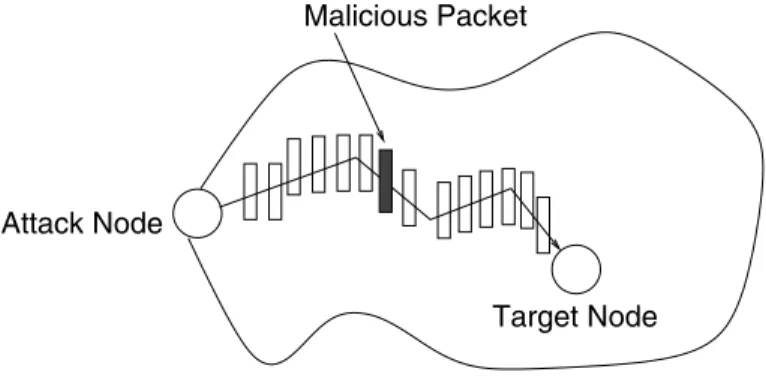
The network intrusion detection game is played on the net-work between two players: the Service Provider and the In-truder. The objective of the intruder is to inject amalicious packetfrom some attack nodea∈ N with the intention of at-tacking a target nodet ∈ N. We assume that an intrusion is successful when the malicious packet reaches the desired tar-gettnode without detection. In order to detect and prevent the intrusion, the service provider is allowed to sample packets in the network. We assume that sampling takes place on the links in the network. It is easy to modify the model to consider the case, where the sampling is done at the nodes in the network. If during the course of sampling, the service provider samples the malicious packet then the intrusion is assumed to be detected and thwarted. The game is pictorially illustrated in Figure 1. C. The Objective and the Constraints of the Game
If there is no bound on the amount of sampling that can be done by the service provider, then the service provider can po-tentially inspect every packet that flows through the network
Malicious Packet
Target Node Attack Node
Fig. 1. Network Intrusion Game
and hence detect the malicious packet. Sampling the packets flowing on a link involves setting up the appropriate sampling filters and examining the packets. These can be fairly expen-sive operations to perform in real time. Therefore, we assume that the service provider has a sampling bound ofB packets per second over the entire network. This sampling effort can be distributed arbitrarily over the links in the network. One way of implementing the sampling scheme is for each link to pick some fraction of the packets flowing through it and send it to a central intrusion detection node in the network which examines the packet in more detail. The sampling bound can be viewed as the maximum rate at which the intrusion detection node can process packets in real time. If a linkethat has a traffic offe
flowing on it, is sampled at ratesethen the probability of
detect-ing a malicious packet on this link is given bype=se/fe. The
sampling budget constraint implies thate∈Ese≤B. We
for-mulate the game theoretic problems in terms ofpe. We assume
that both the players have complete information about the topol-ogy of the network and all the link flows in the network. The service provider can have access to this information either from link-state routing protocols with traffic engineering extensions that distribute flow information throughout a network area or by explicit link polling from management systems. We assume that the adversary injecting intruding packets has this informa-tion available as well since this makes the service provider’s detection problem more difficult. Similarly, we also assume that the intruder is capable of picking paths in the network so as to make the detection problem for the service provider more difficult. However, in Section V-A, we also consider the case where only shortest path routing is allowed in the network.
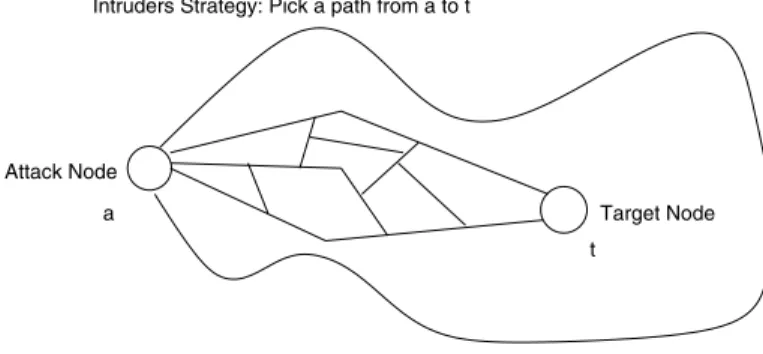
1) Strategies for the Two Players: In the case of the intruder, a pure strategy would be to pick a path fromP∈ Pt
afor the
ma-licious packet to traverse fromstot. The intruder, in general, can use a mixed strategy. In the case of a mixed strategy, the in-truder has a probability distributionqover the set of paths inPt a such thatP∈Pt aq(P) = 1. LetV ={q: P∈Pt aq(P) = 1}
of paths betweenaandt. The intruder then picks pathP ∈ Pt a
with probabilityq(P). The strategy for the service provider is to determine a set of links on which sampling has to be done. The strategy for the service provider is to choose the sampling rate se on link esuch that e∈Ese ≤ B. If the malicious
packet traverses linkewith a sampling rate ofseon a link with
flowferesults in the malicious packet being detected with
prob-abilitype=se/fe. LetU ={p:e∈Epefe≤B}represent
the set of detection probability vectors pthat satisfy the sam-pling budget constraint. (Note thatpis anm- vector.) Instead of viewing the service provider as picking the sampling rates at the links, we view the service provider as picking a set of detection probabilities at the links which belongs in the setU. Figures 2 and 3 depict the intruder’s and the service provider’s actions.
Attack Node
Target Node a
t Intruders Strategy: Pick a path from a to t
Defenders Strategy: Pick the sampling rates at the links
Fig. 2. Intruder’s Problem
Attack Node
Target Node a
t
Sampling on arcs belonging to a-t mincut
Fig. 3. Service Provider’s Problem
2) Payoff Matrix: Assume that the intruder and the service provider each have chosen a strategy. This implies that the in-truder has picked a probability distribution q over the set of paths in Pt
a and the service provider has picked a set of
de-tection probabilities p at the links. The payoff that we con-sider, is the expected number of times the malicious packet is
detected as it goes fromatot. For a given pathP ∈ Pt a, the
expected number of times that a packet is detected is given by
e∈Ppe. The probability that this pathP is picked by the
intruder is given byq(P). Therefore the expected number of times a packet is detected as it goes from the source to the des-tination for a fixed strategy from both adversaries is given by
P∈Pt a q(P) e∈P pe .
Interchanging the order of summation, we get P∈Pt a q(P) e∈P pe = e∈E pe P∈Pa:tPe q(P) .
This can be equivalently written in a matrix form as qTM p
whereM is anm× |Pt
a|path-arc incidence matrix. Each row
inM represents a link in the network and each column ofM
represents a path between nodesaandt. The entry correspond-ing to roweand columnP is set to one ife ∈ P and to zero otherwise. A more natural payoff, is the probability of detec-tion of the malicious packet as opposed to the expected num-ber of times the malicious packet is detected. In this case for a fixed pathP ∈ Pt
a, the probability of the malicious packet
being detected is given by1− e∈P(1−pe).This objective
is non-linear inpe which makes the game theoretic problem
intractable. However, the two payoffs that we outlined above coincide if the optimal solution for the service provider is to sample at most one link on any pathP ∈ Pt
awithq(P) >0.
We call this strategy aminimal sampling strategy. We show later that for all the problems we consider, the optimal solution is a minimal sampling strategy.
3) Objective of the Adversaries: The intruder fears that if his strategy is known to the service provider then service provider will choose a strategy that
maxp∈UP∈Pt aq(P)
e∈Ppe. Therefore the
objec-tive of the intruder is to pick a distributionq()that minimizes this maximum value. In other words, the objective of the intruder is to min q∈V maxp∈U P∈Pt a q(P) e∈P pe .
The objective of the service provider, using a similar argument is max p∈U minp∈V P∈Pt a q(P) e∈P pe .
This is a classical two person zero-sum game and the following minmax result is well known.
Theorem 1: There exists an optimal solution to the intrusion detection game where
θ= min q∈V maxp∈U P∈Pt a q(P) e∈P pe = max p∈U minq∈V P∈Pt a q(P) e∈P pe ,
whereθis the value of the game.
In the rest of this paper, we show how this minmax optimal solution can be computed for the intrusion detection game and use that insight to route flows in the network.
III. SOLUTION OF THEGAME
We now consider the solution of the minmax problem formu-lated in the last section. The idea is to get some insight into the structure of the problem which will enable us to extend the so-lution to more complex cases. Consider the intruders problem.
min q∈V maxp∈U e∈E pe P∈Pt a:Pe q(P) .
For a fixedq ∈ V the inner maximization problem is the fol-lowing: max e∈E P∈Pt a:Pe q(P) pe e∈E fepe ≤ B pe ≥0
Associating a dual variable λwith the budget constraint, we obtain the following dual optimization problem.
minB λ feλ ≥ P∈Pt a:Pe q(P) ∀e∈E λ ≥0
Substituting this optimization problem in the intruders minmax formulation makes it the following minimization problem.
minB λ P∈Pt a:Pe q(P) ≤ feλ ∀e∈E P∈Pt a q(P) = 1 λ ≥0
Interpretingq(P)as a flow on pathP, the constraint
P∈Pt a:Pe
q(P)≤feλ
restricts the flow on a link e to be feλ. Therefore feλ
can be interpreted as the capacity of link e. The constraint
P∈Pv
uq(P) = 1 enforces one unit of flow to be sent from
the source to the destination. Assume thatfeis the capacity of
linkein the network. The objective then is to determine the smallest scaling factorλ, on the links in the network so that a flow of one unit can be sent from the source to the destination. This can be done as follows:
• Assume that linkehas capacityfeand determine the
max-imum flow,Mat(f)from theatotusing these capacities.
• Setλ =Mat(f)−1. By scaling the capacities byλ, note
that a flow of one unit is sent fromatot.
• The value of the gameθ=BMat(f)−1.
Any maximum flow fromatotcan be decomposed into a set of flows on paths fromatotusing standard flow decomposition techniques. From network flow duality, note that corresponding to the maximum flow value there is a minimum cut. The stable operating point for the intruder and the service provider are the following:
• Intruders Strategy: Solve the maximum flow Mat(f),
fromatot using a capacity offeon linke. Using
stan-dard flow decomposition techniques, decompose the max-imum flow into flow on paths P1, P2, . . . , Pl from a to
t. with flows ofm1, m2, . . . , mlrespectively. (Note that
l
i=1mi = Mat(f).) The intruder introduces the
ma-licious packet along the path Pi with probability mi ∗
Mat(f)−1.
• Service Providers Strategy: The service provider
com-putes the maximum flow fromatotusingfeas the
capac-ity of linke. Lete1, e2, . . . , erdenote the arcs in the
cor-responding minimum cut with flowsf1, f2, . . . , fr. From
dualityri=1fi=Mat(f). The service provider samples
linkeiat rateBfiMat(f)−1.
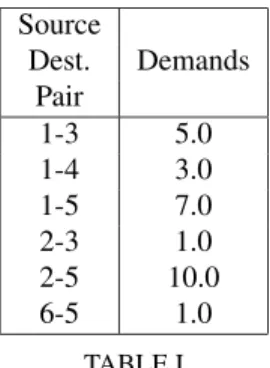
We now illustrate the above results on the example shown in Figure 4. The numbers next to the links are the flows on the links. How these flows are generated is discussed in detail in a subsequent section. For now assume that the flows on the links are given. Assume that there is a sampling budgetB of 5 units. anda = 1andt = 5are the attack and target nodes respectively. The links(1,2),(4,5)belonging to the minimum
a−tcut are shown in thick lines. The minimum cut (and hence the maximum flow) has a value of 11.5 units. The intruder’s strategy is the following:
• Introduce the malicious packet along the path 1-2-5 with probability 7.0/11.5
• Introduce the malicious packet along the path 1-2-6-5 with probability 0.5/11.5
• Introduce the malicious packet along the path 1-3-4-5 with probability 4.0/11.5
The minmax strategy for the service provider is the follow-ing:
• Sample link 1-2 at rate 5/11.5 giving a total sampling rate
of (5×7.5)/11.5 on that link.
• Sample link 4-5 at rate 5/11.5 giving a total sampling rate of (5×4.0)/11.5 on that link.
Note thatθ= 5/11.5is the value of the game.
1 2 3 4 5 6 a t 7.5 7.5 6.0 7.0 4.0 7.0 7.0 5.5 Minimum Cut
Fig. 4. Example of Network
The following observations can be made about the minmax optimal solution:
• The optimal strategy for the service provider is to sample
packets on the mincut with respect to the traffic flows. This implies that along any path that the intruder would choose, the malicious packet will be sampled at most on one link. Therefore this is a minimal sampling scheme.
• IfB ≥Mat(f)then note that the malicious packet will
al-ways be detected. IfB < Mat(f)then there is a non-null
probability that the malicious packet will not be detected. IV. ROUTING TOIMPROVE THEVALUE OF THEGAME In the last section, we showed that the value of the network intrusion game is given byBMat(f)−1. All along, we assumed
that the flowf on the links is fixed. The flows on the links are a result of routing the demands (aggregate traffic between node pairs) in the network. In this section, we explore the case where the service provider adjusts the flows in the network in order to maximize the value of the game. Corresponding to each pair of nodes in the network, there could potentially be demands that have to be routed from the first node in this pair to the second node. Each node pair between which there is some de-mand that has to be routed is termed a source-destination pair or a commodity. We assume that there areKsource-destination demand pairs (commodities) in the network. The source node
Source Dest. Demands Pair 1-3 5.0 1-4 3.0 1-5 7.0 2-3 1.0 2-5 10.0 6-5 1.0 TABLE I
SOURCE-DESTINATIONPAIRS ANDDEMANDS
Source Paths Flow Dest. Pair 1-3 1-3 5.0 1-4 1-2-3-4 0.5 1-3-4 2.5 1-5 1-2-6-5 6.0 1-2-3-4-5 1.0 2-3 2-3 1.0 2-5 2-5 7.0 2-3-5 3.0 6-5 6-5 1.0 TABLE II
FLOWS FORBASECASE
for commoditykwill be represented bys(k), the destination node byd(k)and the amount of demand (bandwidth) that has to be routed for this source-destination pair isb(k). The service provider has to route these flows in the network respecting the link capacity constraints. For the example shown in Figure 4, each link is assumed to have a capacity of 10 units. The dif-ferent source-destination pairs and the corresponding demands are shown in Table I. These demands have to be routed in the network such that the link capacity constraints are respected. There are several ways of routing these demands. One com-monly used method is to route the demands such that the max-imum link utilization in the network is minimized. (This can be solved as a maximum concurrent flow problem.) The link flows shown in Figure 4 are a result of routing the demands in order to minimize the maximum utilization in the network. The routing is given in Table II.
We now explore the case where the service provider routes these flows such that the value of the network intrusion game is maximized. In other words, the service provider routes the source-destination demands such that the maximum probabil-ity of detection of the malicious packet is increased. We first
formulate this problem and then explore different heuristics to solve the problem. Recall that Psd((kk)) represents the set of paths between the source nodes(k)and the destination node
d(k)for commodityk. For notational simplicity, we refer to Psd((kk)) as Pk. Note that Pk represents the set of valid paths
to route commodity k. Let X = {x(P) : P∈Pkx(p) = d(k) ∀k,kP∈Pk:e∈Px(P) ≤ ce ∀e ∈ E}.Note thatX
denotes an allocation of flow on paths in the network which meets the demand for each commodity while satisfying the ca-pacity constraints on the links in the network. Given a fea-sible routing vector, x ∈ X, the flow on link eis given by
fe = kP∈Pk:e∈Px(P). From Section III, the value of
the game is given by B/Mat(f). The objective of the
ser-vice provider then is to route the source destination demands such that the resulting value ofMat(f)is as small as possible.
Therefore the objective of the service provider is to solve the following optimization problem.
min x∈XMat( k P∈Pk:e∈P x(P)).
This can be written more explicitly as
min x∈X P∈Pt a y(P) P∈Pu:ve∈P y(P) ≤ k P∈Pu:ve∈P x(P) y(P) ≥ 0.
Unfortunately this problem cannot be solved as a linear pro-gramming problem. It is possible to reformulate this problem as a non-convex optimization problem but it is not clear if there is a solution technique to solve this problem. We therefore de-velop two different heuristics to get good solutions to this opti-mization problem.
A. Flow Flushing Algorithm
Let the m-vectors c andf represent the link capacity and the flow on the link respectively. The flow on the links is a result of routing the different source- destination demands in the network. It is easy to see that
Mat(f) +Mat(c−f)≤Mat(c).
This is true since the set of flows in the two terms on the left hand side of the inequality is a feasible flow for the right hand side of the inequality. ThereforeMat(f)≤Mat(c)−Mat(c−
f).Iff is the result of routing the source-destination demands then Mat( k P∈Pk:e∈P x(P))≤M(c)−M(c− k P∈Pk:e∈P x(P)).
Instead of minimizing the left hand side of the inequality, we minimize the upper bound represented by the right hand side of the inequality. Sincecis fixed, this is equivalent to maximizing
M(c−kP∈Pk:e∈Px(P))subject to the constraint thatx∈ X.We write this more formally as:
max P∈Pv u y(P) k P∈Pk:e∈P x(P) ≤ ce ∀e∈E P∈Pu:ve∈P y(P) ≤ k P∈Pk:e∈P x(P) ∀e∈E P∈Pk x(P) = d(k) ∀k x(P) ≥ 0 ∀P ∈ Pk ∀j ∀k y(P) ≥ 0 ∀P ∈ Pv u ∀j ∀k
It is easy to view this as a multi-commodity flow problem with
K+ 1commodities. There are the originalKcommodities and an additional commodity betweenaandt. The size of the de-mands for the firstKcommodities are known. We perform a bisection search to determine the largest value of the commod-ityK+ 1that still results in a feasible routing for the firstK
commodities. In order to develop an efficient algorithm it is better to formulate the problem as a maximum concurrent flow problem and perform the bisection search for this problem in-stead. We do not give the details of the solution procedure. In the case of the flow flushing algorithm, the link flows for the ex-ample in Figure 4 are shown in Figure 5 and the corresponding routing is shown in Table III.
1 2 3 4 5 6 a t Minimum Cut 7.23 7.6 8.21 5.19 3.95 7.76 2.19 6.6 9.95
Fig. 5. Flow Flushing Algorithm
The maximum flow Mat(f) on this network is 9.95 units.
Source Paths Flow Dest. Pair 1-3 1-3 5.00 1-4 1-2-3-4 0.76 1-3-4 2.23 1-5 1-2-5 7.00 2-5 2-5 1.21 2-6-5 6.60 2-3-4-5 2.19 2-3 2-3 1.00 6-5 6-5 1.00 TABLE III
FLOWS FORBASECASE
heuristic that can be used by the service provider to improve the probability of detection of the malicious packet.
B. Cut Saturation Algorithm
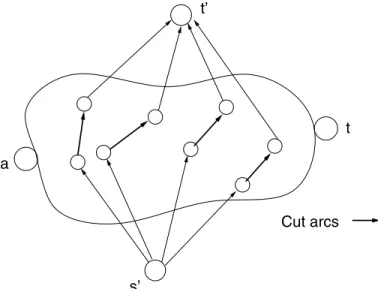
This algorithm relies on the fact that the maximum flow be-tweenaandt is upper bounded by the size of anya−t cut. LetCrepresent the set of links in somea−tcut. Given any linke∈E, letα(e)andβ(e)represent the start and end nodes of that link. The cut saturation algorithm picks some a−t
cut and tries to direct flow away from this cut. Once the source-destination demands are routed, this cut will be small and hence will limit the maximuma−tflow. This is done as follows: In-troduce two new nodessandt. Introduce an arc between node s and all nodesα(e)for alle ∈ C. Similarly introduce links
between each nodeβ(e)for eache ∈C and the nodet. The
objective now is to determine the highest flow that can be sent from s to t while maintaining the feasibility of routing the
source-destination demands. The modification of the network is shown in Figure 6. The only links shown in the network are the cut links.
This problem can be solved almost identically to the Flow Flushing Algorithm, except that theK+ 1commodity flows go between nodess andt. One way of choosing the cut that is to be saturated is as follows: Assume that we currently have a routing of the source-destination demands resulting in a flow of
f(e)on linke. Determine a minimuma−t cut (using these flowsf as the capacities). Take this cut to beC and now at-tempt to saturate this cut. Continuing the example in Figure 4, assume that the cut that we saturate comprises of the links
(1,2)and(4,5). The links flows are shown in Figure 7 and the corresponding flows are shown in Table IV.
The maximum flowMat(f)on this network is 8.0 units. The
value of the gameθ= 5/8.Therefore, in this example, the cut a
t
s’
t’
Cut arcs
Fig. 6. Cut Saturation Algorithm Network Set-up
1 2 3 4 5 6 a t Minimum Cut 9.7 5.3 1.0 4.7 1.7 8.15 8.15 7.15 7.0
Fig. 7. Cut Saturation Algorithm
saturation algorithm gives a better solution that the flow flush-ing algorithm.
V. VARIANTS ANDEXTENSIONS
We consider several variants of the problem outlined above. The first variant that we consider is the case where the intruder can introduce the malicious packet at one of a set of nodesA⊂ N. We assume thatt /∈A.The second variant that we consider is the case where the objective of the intruder is to reach any one of of a set of nodesT ⊂N. We assume thatA∩T =∅.Both these cases are easy to solve by introducing a super source node that is connected to all nodes inAand connecting all nodes in
T to a super sink node. The game is now played between the super source node and the super sink node. Another variant is the case where the intruder can introduce the packet at any one
Source Paths Flow Dest. Pair 1-3 1-3 5.00 1-4 1-3-4 3.00 1-5 1-3-4-5 1.70 1-2-5 5.30 2-5 2-5 2.85 2-6-5 7.15 2-3 2-3 1.00 6-5 6-5 1.00 TABLE IV
FLOWS FORBASECASE
of a set of nodesA but we assume that the intruder does not have control of the routing in the network. Instead, we assume that the routing in the network is shortest path routing like in OSPF or IS- IS. We term this a shortest path routing game. A. Shortest Path Routing Game
We now consider the problem where the routing in the net-work is along shortest paths. We assume that each link has a length and packets are routed from the source to the destination along shortest paths according to this length metric. We assume that ties are broken arbitrarily. Therefore given any two nodes in the network, there is a unique path from one node to the other. Given a target node, all packets arriving at this node traverse the shortest path tree. Shortest path routing implies that there is a unique tree rooted at the destination. A packet introduced at any node in the network traverses the unique path from that node to the destination along the links in the shortest path tree. We use
Ato represent the set of nodes that the intruder can introduce a malicious packet into the network. The objective of the intruder is to determine which node of this setAto introduce the packet into and the objective for the service provider is to determine the sampling rate at the links subject to a sampling budget of
B. The main difference between this problem and the problem that we originally studied is the fact that it is easy to compute the maximum flow and hence the minimum cut on a tree. The algorithm for solving this problem is the following:
• Eliminate all leaf nodes in the routing tree that do not be-long toA. LetTrepresent this tree. LetP(i)represent the predecessor of nodeionT.
• SetL(i) =∞for all leaf nodes.
• While there are no leaf nodes do
– Pick a leaf nodei. Letebe the edge connectingito
P(i). SetL(P(i))←L(P(i)) + min{L(i), fe}.
• OutputL(t).
Note thatL(d)represents the maximum flow that can be sent from all the nodes inAto the destination noded. The value of the game isB/L(d).
VI. EXPERIMENTALRESULTS
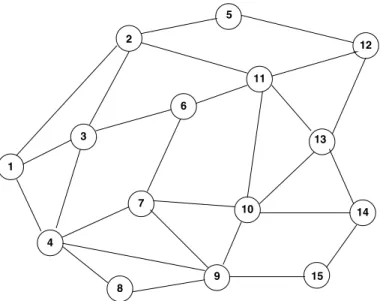
In this section we evaluated the algorithms developed on two networks. The first network is shown in Figure 8. Each undi-rected link in the figure represents two diundi-rected links each hav-ing a capacity of 10 units. We performed the followhav-ing
experi-1 2 4 8 10 6 5 13 14 12 15 11 7 3 9
Fig. 8. Experimental Network 1 ments:
• Single attack node and single target node. (3 problems).
• Multiple attack node and single target node. (1 problem).
• Multiple attack node and multiple target node. (1 prob-lem).
For each of the cases, we ran three different algorithms. 1) Routing to minimize the highest utilized link withf1
rep-resenting the m-vector of link flows as a result of this routing algorithm.
2) Routing with flow flushing algorithm withf2
represent-ing them-vector of link flows as a result of this routing algorithm.
3) Routing with cut saturation algorithm withf3
represent-ing them-vector of link flows as a result of this routing algorithm.
LetM(fi)fori= 1,2,3represent the maximum flow that can
be sent from nodeatotusingfias the link capacities. IfBis
the sampling budget, then the value of the gameθ =B/M().
Table V shows the values of M()instead of θ. The smaller that value ofM, the better the chances of detection for a given sampling budget.
Attack Target M(f1) M(f2) M(f3) Node(s) Node(s) 1 13 13.2 8.9 9.1 5 7 9.2 7.55 7.55 7 11 16.4 7.3 7.1 1,2,4,8 13 16.2 9.4 8.7 1,2,4,8 12,13,14 24.88 19.5 18.9 TABLE V
COMPARISON OFDIFFERENTROUTINGALGORITHMS
From the table, note that the maximum flow value and hence the value of the game can be changed significantly by changing the routing in the network. In most of the examples the perfor-mance of the flow flusing algorithm and the cut saturation algo-rithm are quite similar, and better than the simple minimization of maximum link utilization algorithm
A. Effect of Capacity on the Value of the Game
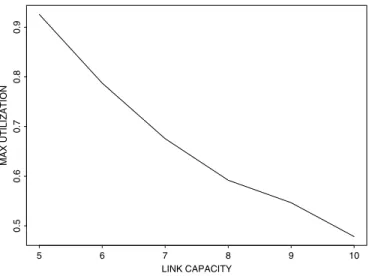
As the amount of spare capacity in a network increases, the opportunity to reroute flows increases. This implies that the service provider can improve the probability of detection by exploiting the spare capacity to reroute flows. We illustrate this in the following set of experiments, using a second example network, where the capacity of the links in the example network are fixed at some constant valueC. If the value ofCincreases, then the opportunity to reroute flows goes up. We consider the intrusion detection game between nodesa= 1andt= 13. The demands in the network are uniformly distributed between zero and one. We first run the algorithm to route the flow such that maximum utilization of any link is minimized. This maximum utilization value versus the link capacityCis shown in Figure 9. As the maximum utilization becomes lower, the amount of spare capacity to reroute flows increases in the network. This implies that both the flow flushing algorithm as well as the cut saturation algorithm will have more alternate paths. In Figure 10, we show the performance of the flow flushing algorithm as the value of C increases. The straight line in the plot shows the performance of the base case which is the routing algorithm that minimizes the maximum utilization. Thea−tmaximum flow is independent of the value ofC. In the case of the flow flushing algorithm, thea−tmaximum flow value decreases with increasing link capacity. It asymptotes at about8.8. The same kind of performance was observed in the case of other attack-target pairs as well as the case for multiple attack sites.
VII. CONCLUDINGREMARKS
We considered the problem of detecting intruding packets in a network by means of network packet sampling. Since
LINK CAPACITY MAX UTILIZATION 5 6 7 8 9 10 0.5 0.6 0.7 0.8 0.9
Fig. 9. Max. Utilization vs. Link Capacity for flow routing to minimize maximum link utilization.
LINK CAPACITY 1-13 MAXIMUM FLOW 5 6 7 8 9 10 9 1 0 1 11 21 31 4
MAXFLOW BEFORE FFA MAXFLOW AFTER FFA
Fig. 10. Performance of flow flushing algorithm for different link capacities
packet sampling and examination in real-time can be expen-sive, the network operator must devise an effective sampling scheme to detect intruding packets injected into the network by an adversary. We considered the scenario where the adver-sary has considerable information about the network and can either pick paths to minimize chances of detection or can pick a suitable network ingress-point if only shortest path routing is al-lowed. The detection via sampling problem was formulated in a game-theoretic framework. The solution to this game-theoretic problem is a max-flow problem from which the stable operat-ing points are obtained. We also considered the network
op-erator’s problem of routing aggregate traffic between ingress-egress pairs as to to maximize the chances of detection within a given packet sampling budget. We proposed two heuristic al-gorithms for solving this problem. Finally, we evaluated the performance of the developed algorithms on some sample net-works.
REFERENCES
[1] R. K. Ahuja, T. L. Magnanti, J. B. Orlin,Network Flows: Theory, Algo-rithms, and Applications, Prentice Hall, 1993.
[2] Akella, A., Karp, R., Papadimitriou, C., Seshan, S., Shenker, S., “Selfish Behavior and the Stability of the Internet: A Game Theoretic Analysis of TCP”,Proceedings of SIGCOMM 2002, 2002.
[3] Duffield, N., Greenberg, A., Grossglauser, M., Rexford, J., “A Framework for Passive Packet Measurement”. IETF Draft, work in progress, draft-duffield-framework-papame-01, February 2002.
[4] Garg, N., and K¨onemann, J., “Faster and Simpler Algorithms for Multi-commodity Flow and other Fractional Packing Problems”,Proceedings of the 39th Annual Symposium on Foundations of Computer Science, pp.300-309, 1998.
[5] Korilis, Y., Lazar, A., Orda, A., “Architecting Noncooperative Networks”, IEEE Journal on Selected Areas in Communications, pp. 1241-1251, September 1995.
[6] Ott, T. J., and Lakshman, T. V., and Wong, L. H., “SRED: Stabilized RED”,Proceedings of Infocom 1999, pp. 1346-1355, 1999.
[7] Pan, R., Prabhakar, B., Psounis, K., “CHOKE, A Stateless Active Queue Management Scheme for Approximating Fair Bandwidth Allocation”, Proceedings of Infocom 200, pp. 942-951, 2000.
[8] Owen, G.,Game Theory, Academic Press, New York.
[9] Shahrokhi, F., and Matula, D., “The Maximum Concurrent Flow Prob-lem”,Journal of the ACM, 37, pp. 318-334, 1990.
[10] Shenker, S., “Making Greed Work in Networks: A Game-Theoretic Anal-ysis of Switch Service Disciplines”,IEEE/ACM Transactions on Net-working, 1995.
[11] Washburn, A., and Wood, K., “Two-Person Zero-Sum Games for Net-work Interdiction”,Operations Research, 43, pp. 243-251, 1995.