Bayesian Deep Reinforcement Learning via Deep Kernel Learning
Junyu Xuan, Jie Lu, Zheng Yan, Guangquan Zhang Centre for Artificial Intelligence, University of Technology Sydney
Sydney, NSW 2007, Australia
E-mail:{Junyu.Xuan, Jie.Lu, Yan.Zheng, Guangquan.Zhang}@uts.edu.au
Abstract
Reinforcement learning (RL) aims to resolve the sequential decision-making under uncertainty problem where an agent needs to interact with an unknown environment with the expectation of optimising the cumulative long-term reward. Many real-world problems could benefit from RL, e.g., industrial robotics, medical treatment, and trade execution. As a representative model-free RL algorithm, deep Q-network (DQN) has recently achieved great success on RL problems and even exceed the human performance through introducing deep neural networks. However, such classical deep neural network-based models cannot well handle the uncertainty in sequential decision-making and then limit their learning perfor-mance. In this paper, we propose a new model-free RL algorithm based on a Bayesian deep model. To be specific, deep kernel learning (i.e., a Gaussian process with deep kernel) is adopted to learn the hid-den complex action-value function instead of classical deep learning models, which could encode more uncertainty and fully take advantage of the replay memory. The comparative experiments on standard RL testing platform, i.e., OpenAI-Gym, show that the proposed algorithm outweighs the DQN. Further investigations will be directed to applying RL for supporting dynamic decision-making in complex envi-ronments.
Keywords:Reinforcement learning, Uncertainty, Bayesian deep model, Gaussian process
1. Introduction
Reinforcement learning (RL)22, as an important branch of machine learning, aims to resolve the se-quential decision-making under uncertainty prob-lems where an agent needs to interact with an un-known environment with the expectation of opti-mising the cumulative long-term reward. A moti-vating example is the self-driving car. If we con-sider a car as the agent and the traffic conditions (e.g., traffic light signal and speed limitation) as the environment, RL can endow the car the abil-ity to autonomously and safely choose actions (e.g., breaking, turning, and lighting) corresponding to difference traffic conditions when driving on road.
Since the environment is unknown to the car, such ability needs to be learned through the so-called ‘trail-and-error’ strategy that is to learn an optimised action-selection policy through interacting with this environment?. Thus, there are two goals for the agent during the interaction with the environment: explorationwhich aims to perceive more about the environment and exploitation which aims to opti-mise the policy under current information about the environment. Apart from self-driving cars, many real-world tasks could be formalised as sequential decision-making under uncertainty problems and then benefit from RL, such as: industrial robotics9, medical treatment11, and trade execution14.
According to whether maintaining a
computa-Received 15 October 2018
tional model for the environment, existing RL algo-rithms could be categorised as being either model-based or model-free. Model-model-based RL algorithms improve the policy learning through modelling the environment, e.g., simulating the interactions with the environment model in hand or planning ahead using the model. Due to the lack of such environ-ment model, model-free RL cannot infer the effect from environment dynamics and efficiently explore the space. However, for some complex environ-ments with large scale states, it is too difficult to accurately build their models. Model-free RL al-gorithms directly learn the policy without requiring an explicit environment model. Recently, one sem-inal model-free RL algorithm, i.e., deep Q-network (DQN)13, has achieved great success on Atari games and substantially promote the development of RL. The advanced ability of DQN comes from two as-pects: 1)deep learning models; DQN adopts deep neural networks to replace the traditional Q-table for the hidden action-value function learning. For complex environments with large or even near infi-nite number of states, Q-table is not appropriate due to the large-scale storage and high computation re-quirements; 2)experience replay; The historical in-teractions are saved as replay memory and sampled in DQN to stochastically update deep neural net-works, which can reduce the dependency between sequential interactions and then increase the effi-ciency of the algorithm. However, the classical deep neural networks used in DQN cannot handle uncer-tainty well due to its deterministic nature. As de-fined, RL aims to handle sequential decision-making under uncertainty, so how to capture and deal with uncertainty is essential for RL. Besides, all the saved historical interactions are equally treated in DQN, but they are in fact different for model training and convergence.
In this paper, we propose a new model-free RL algorithm based on a Bayesian deep model - deep kernel learning28, which is able to encode more un-certainty and fully take advantage of the saved his-torical interactions. Specially, the deep kernel learn-ing is a Gaussian process (GP)16 with a deep ker-nel modelled by a deep neural network, which has
both advantages of deep neural network and GP. We adopt the deep kernel learning to replace the origi-nal deep neural network, which could encode more uncertainty. For example, the prediction of action-value function from this algorithm is not just the action but also the variance of such action. Fur-ther, a new weighted sampling strategy is devel-oped. The prediction variance from deep kernel learning is used as the weight for each historical in-teraction, and then the model is updated using the samples from weighted interactions. The experi-mental evaluation on standard RL testing platform -OpenAI.Gym∗- has demonstrated that the new al-gorithm could reach larger scores. In summary, the main two contributions of this article are as follows:
• we propose a new model-free RL algorithm based
on deep kernel learning with better performance comparing the classical deep neural network-based one;
• a new weighted sampling strategy is developed to fully take advantage of the replay memory to fur-ther improve the algorithm performance.
The remainder of this article is organised as fol-lows. Section 2 discuses related work. The new model-free RL algorithm is introduced in Section 3. Section 4 evaluates the proposed RL algorithm on standard RL testing platform through comparing the classical algorithm. Section 5 concludes this study and discusses possible future work.
2. Related Work
In this section, we briefly review the related work of this study. The first part summarizes the litera-ture on model-free reinforcement learning and the second part summarizes the literatures on Bayesian deep models.
2.1. Model-free RL
Model-free RL aims to learn an optimal policy for an agent without explicitly modelling the environ-ment. Existing works in this direction can be mainly ∗https://gym.openai.com/
grouped into three categories: value-based, policy-based, and combined22. Policy-based RL is to di-rectly optimise the parameters of the policy aiming to maximise the expected reward, and policy gradi-ent is a typical algorithm of this category. Value-based RL is to learn the action-value function first aiming to minimise the temporal difference error and then design the policy based on this function. According to the difference on the computation of temporal difference error, there are two kinds in value-based RL:on-policyone which computes the temporal difference error based on current policy, e.g., SARSA; off-policy one which computes the temporal difference error based on greedy policy, e.g., Q-learning. Deep Q-Networks (DQN)13 is a seminal work of Q-learning, which adopts deep neu-ral network to approximate the Q-function. Such algorithm is proofed successful on Atari games and even exceeds the human performance. Based on DQN, Double-DQN24 is proposed to separately model action-selection and Q-function by two deep neural networks, which resolves the possible over-estimate problem in DQN. The performance can be further improved by splitting Q-function into state function and advantage function in Dueling DQN26. There are also works that try to combine two cate-gories, e.g., Deep Deterministic Policy Gradient10. This paper will only target on DQN and replace the traditional deep neural network with Bayesian deep models, and other advanced extensions can also be easily adopted later.
2.2. Bayesian deep model
The Bayesian paradigm for machine learning, also known as Bayesian (machine) learning, is to ap-ply probability theories and techniques to represent and learn knowledge from data. Some renowned examples are Bayesian network, Gaussian mixture models, hidden Markov model15, Markov random field, conditional random field, and latent Dirichlet allocation1. Compared to other learning paradigms, Bayesian learning has distinctive advantages: 1) rep-resenting, manipulating, and mitigating uncertainty based on a solid theoretical foundation -
probabil-ity; 2) encoding the prior knowledge about a prob-lem; 3) good interpretability thanks to its clear and meaningful probabilistic structure. Inspired by the recent success of deep learning, researchers start to pay attention to build Bayesian deep models25 aiming to combine the advantages from two areas. One straightforward strategy is to assign probabilis-tic prior for parameters of traditional deep neural networks, e.g., Gaussian prior 6,4. Such Bayesian method could avoid some of the pitfalls of stochas-tic optimisation. Bayes by Backprop2 -a varia-tional inference method- is proposed to efficiently resolve these models. Another strategy is to pave the probabilistic models deeply. Deep belief net-works 8 may be the earliest one, which has undi-rected connections between its top two layers (it is actually a RBM7) and downward directed connec-tions between all its lower layers. Its advantage is that it needs less time to train the model, but there is no feedback from top to bottom. On the contrary, Deep Bolzman Machine (DBM)18, which is the multi-layered RBM, requires more time for model training but there is feedback from top to bot-tom so it is more robust. The hidden units in DBN and DBM are restricted to be binary. To resolve this constraint, Gamma belief networks29 and deep poisson factor analysis5are proposed using Gamma and Negative-binomial distributions, which could build deep structure with nonnegative real hidden units. Deep latent Gaussian model17is another deep Bayesian model built by Gaussian distributions. Be-yond Gaussian distributions, Gaussian process (GP) is also adopted for constructing Bayesian deep mod-els. For example, deep neural network is used to construct a deep kernel as the covariance function of GP in deep kernel learning28,27; the other idea is to pave more Gaussian process on each other known as deep Gaussian process3.
3. The Proposed Model
RL is often modelled by a Markov decision process as†<S,A,P,R,γ >, whereSis a set of environment states,Ais a set of agent actions,Pdefines the state transition of environment,Rdefines the reward from † https://en.wikipedia.org/wiki/Markov decision process
environment, andγ is the discount factor. The goal
of RL is the agent policy π(s)which is a mapping
from environment states to actions aiming to max-imise the (discounted) expected long-term reward
E[∑∞t=1γtrt], wherert is the reward fromt-th
inter-action.
3.1. Preliminary: Deep Q-Network
Q learning12 is a methodology to resolve RL by evaluating the valueQ(s,a) of action agiven state s which is also known as Q-function. Such value could be considered as the expected “reward” from taking this action under this state. To learn this action-value function (a.k.a., Q-function), an effec-tive method is temporal difference learning21which minimises the difference between current value of an action and its optimal value according to the next step
||Q(st,at)−(rt+γtmax
a0 Q(st+1,a
0)||
F (1)
where st+1 = P(st,at) is the next state of
envi-ronment by taking action at. DQN adopts deep
neural network (DNN)20 to model Qθ(s,a) where θ denotes the parameters of the deep neural
net-work. With the sequential interaction,θ is
contin-uously optimised using Eq. (1) as the loss func-tion. Another significant contribution of DQN is the experience replay based on a constructed mem-ory which is composed of historical interactions< st+1,st,at,rt >. When learning the RL algorithm
(i.e., training θ), a number of interactions are
uni-formly sampled from the memory.
3.2. Bayesian deep RL
We propose a Bayesian Deep RL (DBRL) to adopt Gaussian process with deep kernel28 to model Q(s,a). A Gaussian Process (GP)16is defined as a collection of random variables, any finite number of which have (consistent) joint Gaussian distributions f(x)∼GP(m(x),kϑ(x,x0)) (2) wherem(x) is the mean function and kϑ(x,x0) is a
kernel function parameterised by ϑ, e.g.,
Polyno-mial kernel and Radial basis function kernel (RBF).
GP is often used as the prior for functions and is able to approximate complex and nonlinear func-tional forms given a number of observations. To fur-ther improve the ability on function approximation, deep kernel learning (DKL) incorporates the deep learning idea to the kernel learning
kϑ(gθ(x),gθ(x 0
)) (3)
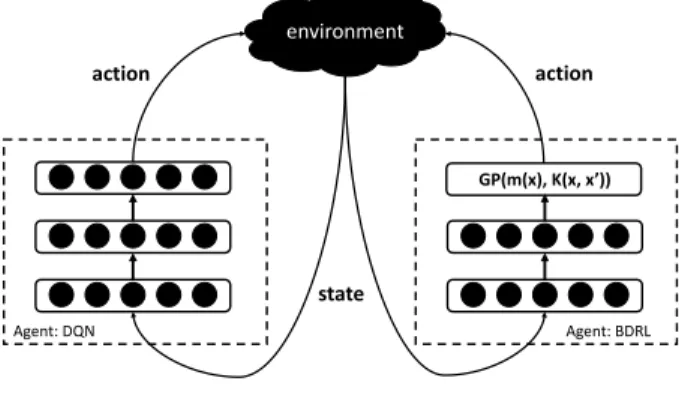
where g(·) is a deep neural network-based data transformation. When applying this deep kernel-GP to RL, we adopt the same framework with DQN and replace the traditional DNN by DKL as illustrated in Fig. 1. The advantage of BDRL comparing DQN is the capability of encoding more uncertainty. That is to say, the prediction from the BDRL is not only the action value but also its variance which could be simple seen as the confidence of this prediction. Next, we will utilise such variance to better take ad-vantage of replay memory.
environment state action GP(m(x), K(x, x’)) Agent: DQN Agent: BDRL action
Fig. 1. Interaction between an environment and two agents: DQN and BDRL
Experience replay is another genius in DQN, where historical interactions are saved in memory for Q-function learning. The original memory struc-ture is
<st+1,st,at,rt> . (4)
We add the action uncertainty (i.e., prediction stan-dard deviation) from GP as another column to the memory,
<st+1,st,at,ut,rt > . (5)
Rather than uniform sampling, weighted sampling is adopted when the historical interactions are re-trieved for model training, where each interaction is
weighted by
wi=
(1−σ(ui))α
∑i(1−σ(ui))α
(6) whereσ()denotes the sigmoid function andα con-trols the contribution of this weight. Whenα =0,
it degenerates to uniform sampling. This weight-ing schema prefers the interaction with small un-certainty. The whole procedure of the algorithm is summarised in Algorithm 1.
Input:An environment:envand n episode Output: interactions:<st,at,rt >and
parameters of Q-function:θ,ϑ initializationθ,ϑ; step = 0; while n episode>0do a,u= agent.chooseAction(s); s0,r, done = env.step(a); agent.store(<s,a,u,r,s0>); agent.updateMemoryWeight() by Eq. (6);
θ,ϑ = agent.update() using Eq. (1) as loss
function; s=s0; ifdonethen s= env.reset(); n episode−−; end step++; end
Algorithm 1:Bayesian deep RL
4. Experiments
We evaluate BDRL on a open RL testing platform: OpenAI.gym and compare it with DQN in this sec-tion.
4.1. Setting
In the following, we choose the simple environment ‘CartPole-v1’‡in OpenAI.gym. This environment has two actions (i.e., move left or right), its state is a
four dimensional vector, and a reward of +1 is pro-vided for every timestep that the pole remains up-right. One episode ends when the pole is more than 15 degrees from vertical or the cart moves more than 2.4 units from the center. At first, we take 10,000 steps to explore the state space and construct the initial experience memory, where the action is ran-domly chosen not from RL algorithms. After the exploring, we take 15,000 steps to train the RL al-gorithms usingε-greedy strategy with a decreasing
ε value and minimum value 0.01. Finally, we test
10,000 steps only using RL algorithms and record the total reward as score for each episode. The higher score means better RL algorithm. The mem-ory size is set as 10,000 and the batch size is 32. Every 150 steps, the fixed target Q-function is up-dated by the latest evaluation Q-function. The other two hyper-parameters areγ=0.99 and learning rate
0.00025 for the optimisor. For DQN, we build a deep neural network that contains two hidden fully connected linear layers with 512 and 128 nodes and activation function is ReLU. For BDRL, we use a deep neural network containing two hidden (linear) layers with 10 nodes in each layer and activation function is tanh, and RBF kernel is used for GP. The implementation of BDRL is based on DKL§.
4.2. Results
At first, we compare the performance of DQN and BDRL under same setting where both of them use uniform sampling when retrieving replay memory for deep model update. The result is shown in Fig. 2, where the scores of all episodes in testing stage are plotted. According to this figure, we can observe that: 1) BDRL can reach much higher score than DQN. The highest score from BDRL is 346, which means the car makes 346 moves with the bar upright. 2) The average score of BDRL (113.52) is also bet-ter than the one of DQN (98.33). 3) The episode number of BDRL (88) is smaller than the one of DQN (102) within the same number of steps (i.e., 10,000). 4) Although the overall results of BDRL is better than DQN, the line for BDRL is with stronger ‡ https://gym.openai.com/envs/CartPole-v1/
fluctuation than the one for DQN, which means the results from BDRL is unstable comparing with the ones from DQN. 0 10 20 30 40 50 60 70 80 90 100 episode 0 50 100 150 200 250 300 350 Score DQN BDRL
Fig. 2. Evaluation of the efficiency of BDRL through com-paring with DQN on ‘CartPole-v1’. The scores (the higher is the better) of all episodes in testing stage from both al-gorithms are plotted. The average scores from BDRL and DQN are 113.52 and 98.33, respectively.
0 10 20 30 40 50 60 70 80 90 episode 0 50 100 150 200 250 300 350 score Uniform Weighted
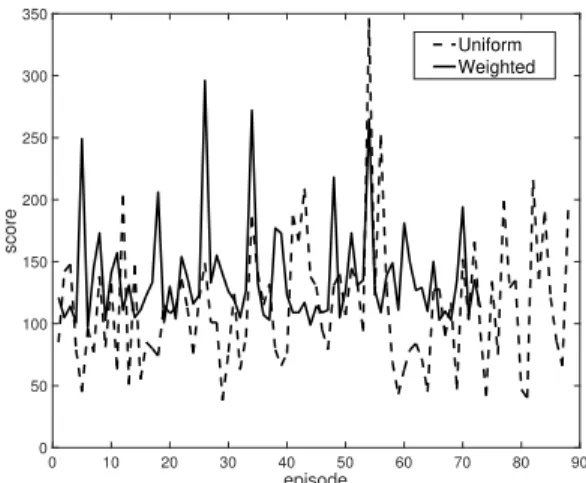
Fig. 3. Evaluation of the efficiency of uncertainty-based weighted sampling strategy for replay memory on ‘CartPole-v1’. The scores (the higher is the better) of all episodes in testing stage from BDRL with uniform and weighted strategies are plotted. The average scores from BDRL with weighted and BDRL with uniform are 136.75 and 113.52, respectively.
Then, we evaluate the proposed weighted sam-pling strategy for replay memory. We run BDRL using two different sampling strategy: uniform and
weighted (according to Eq. (6) withα=0.1. Note
that during the exploring stage, the action is ran-domly chosen and their weights are also ranran-domly assigned. The result is shown in Fig. 3, where the scores of all episodes in testing stage are plotted. According to this figure, we can observe that: 1) The episode number of BDRL with weighted (73) is smaller than the one of BDRL with uniform (88) within the same number of steps (i.e., 10,000). 2) The average score of BDRL with weighted (136.75) is also better than the one of BDRL with uniform (113.52). Therefore, we can draw the conclusion that the proposed uncertainty-based weighted sam-pling strategy could better take advantage of replay memory and improve the efficiency of the BDRL.
5. Conclusions and Further Study
In this study, we have presented a new model-free reinforcement learning (RL) algorithm based on Bayesian deep model. This Bayesian deep RL (BDRL) algorithm has unique advantages compared with deep Q-network (DQN) that is the deep neu-ral network (DNN)-based RL algorithm, i.e., more ability to handle uncertainty and take advantage of past experience. The experiments on standard rein-forcement learning testing platform demonstrated its effectiveness on RL tasks, and the comparison with DQN showed the superior performance of the pro-posed algorithm than the DNN-based one. In this paper, we only use on one simple task to demon-strate the effectiveness of the proposed ideas, and we will test them using more and harder tasks in the fu-ture. We believe that this study is only a start point, and there are many interesting following works. One interesting direction for further study would be to add more Gaussian process layers to the deep archi-tecture based on deep Gaussian process3; the sec-ond interesting direction is to build new Bayesian nonparametric deep models23 for more flexible Q-function learning with less tunable parameters; the third one is to incorporate the temporal difference error19 and marginal likelihood from GP into the weights for interactions in replay memory; and the last one is to apply fuzzy systems techniques to the Q-learning process to deal with decision processes?
in which the goals and constraints are fuzzy in na-ture. These future investigations are expected to pro-vide backbones for applying RL techniques to sup-port dynamic decision-making in complex situations that involve massive data domains, agents, and envi-ronments.
Acknowledgments
This work is supported by the Australian Re-search Council (ARC) under Discovery Grant DP170101632.
References
1. David M Blei, Andrew Y Ng, and Michael I Jordan. Latent dirichlet allocation.Journal of Machine Learn-ing Research, 3(Jan):993–1022, 2003.
2. Charles Blundell, Julien Cornebise, Koray Kavukcuoglu, and Daan Wierstra. Weight uncertainty in neural networks.arXiv preprint arXiv:1505.05424, 2015.
3. Andreas Damianou and Neil Lawrence. Deep gaus-sian processes. InArtificial Intelligence and Statistics, pages 207–215, 2013.
4. Yarin Gal and Zoubin Ghahramani. Bayesian convolutional neural networks with bernoulli ap-proximate variational inference. arXiv preprint arXiv:1506.02158, 2015.
5. Ricardo Henao, Zhe Gan, James Lu, and Lawrence Carin. Deep poisson factor modeling. In C. Cortes, N. D. Lawrence, D. D. Lee, M. Sugiyama, and R. Gar-nett, editors,Advances in Neural Information Process-ing Systems 28, pages 2800–2808. Curran Associates, Inc., 2015.
6. Jos´e Miguel Hern´andez-Lobato and Ryan Adams. Probabilistic backpropagation for scalable learning of bayesian neural networks. In International Confer-ence on Machine Learning, pages 1861–1869, 2015. 7. Geoffrey E Hinton. Training products of experts by
minimizing contrastive divergence. Neural Computa-tion, 14(8):1771–1800, 2002.
8. Geoffrey E Hinton, Simon Osindero, and Yee-Whye Teh. A fast learning algorithm for deep belief nets.
Neural Computation, 18(7):1527–1554, 2006. 9. Abhishek Kumar and Rajneesh Sharma. Linguistic
lyapunov reinforcement learning control for robotic manipulators.Neurocomputing, 272:84–95, 2018. 10. Timothy P Lillicrap, Jonathan J Hunt, Alexander
Pritzel, Nicolas Heess, Tom Erez, Yuval Tassa, David Silver, and Daan Wierstra. Continuous control
with deep reinforcement learning. arXiv preprint arXiv:1509.02971, 2015.
11. Ying Liu, Brent Logan, Ning Liu, Zhiyuan Xu, Jian Tang, and Yangzhi Wang. Deep reinforcement learn-ing for dynamic treatment regimes on medical registry data. InHealthcare Informatics (ICHI), 2017 IEEE International Conference on, pages 380–385. IEEE, 2017.
12. Francisco S Melo. Convergence of q-learning: A sim-ple proof. Institute Of Systems and Robotics, Tech. Rep, pages 1–4, 2001.
13. Volodymyr Mnih, Koray Kavukcuoglu, David Sil-ver, Andrei A Rusu, Joel Veness, Marc G Bellemare, Alex Graves, Martin Riedmiller, Andreas K Fidjeland, Georg Ostrovski, et al. Human-level control through deep reinforcement learning. Nature, 518(7540):529, 2015.
14. Yuriy Nevmyvaka, Yi Feng, and Michael Kearns. Re-inforcement learning for optimized trade execution. In
Proceedings of the 23rd international conference on Machine learning, pages 673–680. ACM, 2006. 15. Lawrence R Rabiner. A tutorial on hidden markov
models and selected applications in speech recogni-tion.Proceedings of the IEEE, 77(2):257–286, 1989. 16. Carl Edward Rasmussen and Christopher KI
Williams. Gaussian process for machine learning. MIT press, 2006.
17. Danilo Jimenez Rezende, Shakir Mohamed, and Daan Wierstra. Stochastic backpropagation and approxi-mate inference in deep generative models. In Pro-ceedings of the 31st International Conference on In-ternational Conference on Machine Learning-Volume 32, pages II–1278. JMLR. org, 2014.
18. Ruslan Salakhutdinov and Geoffrey Hinton. Deep boltzmann machines. In David van Dyk and Max Welling, editors,Proceedings of the Twelth Interna-tional Conference on Artificial Intelligence and Statis-tics, volume 5 of Proceedings of Machine Learn-ing Research, pages 448–455, Hilton Clearwater Beach Resort, Clearwater Beach, Florida USA, 2009. PMLR.
19. Tom Schaul, John Quan, Ioannis Antonoglou, and David Silver. Prioritized experience replay. arXiv preprint arXiv:1511.05952, 2015.
20. David Silver, Aja Huang, Chris J Maddison, Arthur Guez, Laurent Sifre, George Van Den Driessche, Ju-lian Schrittwieser, Ioannis Antonoglou, Veda Panneer-shelvam, Marc Lanctot, et al. Mastering the game of go with deep neural networks and tree search.Nature, 529(7587):484, 2016.
21. Richard S Sutton. Learning to predict by the methods of temporal differences. Machine Learning, 3(1):9– 44, 1988.
22. Richard S Sutton, Andrew G Barto, et al. Reinforce-ment learning: An introduction. MIT press, 1998.
23. Yee Whye Teh and Michael I Jordan. Hierarchi-cal bayesian nonparametric models with applications.
Bayesian Nonparametrics, 1:158–207, 2010.
24. Hado Van Hasselt, Arthur Guez, and David Silver. Deep reinforcement learning with double q-learning. InAAAI, volume 2, page 5. Phoenix, AZ, 2016. 25. Hao Wang and Dit-Yan Yeung. Towards bayesian
deep learning: A framework and some existing meth-ods. IEEE Transactions on Knowledge and Data En-gineering, 28(12):3395–3408, 2016.
26. Ziyu Wang, Tom Schaul, Matteo Hessel, Hado Has-selt, Marc Lanctot, and Nando Freitas. Dueling net-work architectures for deep reinforcement learning. In
International Conference on Machine Learning, pages 1995–2003, 2016.
27. Andrew G Wilson, Zhiting Hu, Ruslan R Salakhut-dinov, and Eric P Xing. Stochastic variational deep kernel learning. InAdvances in Neural Information Processing Systems, pages 2586–2594, 2016.
28. Andrew Gordon Wilson, Zhiting Hu, Ruslan Salakhutdinov, and Eric P Xing. Deep kernel learn-ing. In Artificial Intelligence and Statistics, pages 370–378, 2016.
29. Mingyuan Zhou, Yulai Cong, and Bo Chen. Aug-mentable gamma belief networks.Journal of Machine Learning Research, 17(1):5656–5699, 2016.