Title
Querying Large-scale Knowledge Graphs Permalink https://escholarship.org/uc/item/7wq7n7gv Author Yang, Shengqi Publication Date 2015 Peer reviewed|Thesis/dissertation
Querying Large-scale Knowledge Graphs
A Dissertation submitted in partial satisfaction
of the requirements for the degree of
Doctor of Philosophy
in
Computer Science
by
Shengqi Yang
Committee in Charge:Professor Xifeng Yan, Chair Professor Divyakant Agrawal Professor Tao Yang
Professor Divyakant Agrawal
Professor Tao Yang
Professor Xifeng Yan, Committee Chairperson
Copyright c° 2015 by
and to my wife, He Bu,
My deepest acknowledge goes to my Ph.D. advisor, Professor Xifeng Yan, for his serious supervision and guidance. His invaluable advice, insightful vision, and constructive criticism have always promoted me to conduct the cutting edge projects in this fast growing era. Without the countless discussion and talk with him, I could not be able to establish the frontier works that could have the impact on the development of this research area. Meanwhile, Professor Yan also demon-strates great enthusiasm for educating us toward a meaningful lifetime career.
I would also like to thank my committee members, Professor Divyakant Agrawal, and Professor Tao Yang, for serving on my committee and providing many insightful suggestions on my research.
My cordial thanks to my collaborators: Professor Yinghui Wu, Dr. Mudhakar Srivatsa, Dr. Arun Iyengar, Dr. Arijit Khan, Dr. Jianguang Lou, Dr. Qiang Fu, Bo Zong, Huan Sun, Yanan Xie, and Tianyu Wu. They always inspired me and played the crucial role in every piece of my work. I also want to thank my friends, who have been supporting me to go through many difficulties in my research work and the Ph.D. life.
It is a great fortune for me to attend several internships during my study. This gives me many chances to interact with other people, discover the industry and review my research. I would like to thank all the mentors, Mudhakar Srivatsa,
Shengqi Yang
Education
2010-2015 University of California, Santa Barbara, USA
Ph.D., Computer Science
Advisor: Prof. Xifeng Yan
Research: Graph Search and Graph Management
Thesis: Querying Large-scale Knowledge Graphs
2007-2010 Beijing University of Post and Telecoms, China
M.S., Computer Science
2003-2007 Beijing University of Post and Telecoms, China
B.S., Computer Science
Experience
2010 – 2015 Research Assistant, University of California, Santa Barbara.
Advisor: Prof. Xifeng Yan
Project: Graph Search and Graph Management.
Summer 2014 Student Intern, Facebook Inc., Menlo Park, CA.
Summer 2012 Student Intern, IBM T.J. Watson Research Center, NY.
Advisor: Dr. M. Srivatsa and Dr. A. Iyengar
Project: Keyword Search on Large Graphs.
Summer 2011 Student Intern, IBM T.J. Watson Research Center, NY.
Advisor: Dr. M. Srivatsa and Dr. A. Iyengar
Project: Distributed Graph Search.
Selected Publications
Z. Guan, S. Yang, H. Sun, M. Srivatsa and X. Yan.
Fine-Grained Knowledge Sharing in Collaborative Environments. In TKDE, 2015.
S. Yang, Y. Xie, Y. Wu, T. Wu, H. Sun, J. Wu and X. Yan.
SLQ: A User-friendly Graph Querying System. In SIGMOD, 2014 (Demo).
S. Yang, Y. Wu, H. Sun and X. Yan. Schemaless and
Structure-less Graph Querying. InVLDB, 2014
Y. Wu,S. Yang, M. Srivatsa, A. Iyengar and X. Yan.
Summa-rizing Answer Graphs Induced by Keyword Queries. In VLDB, 2014.
Y. Li, P. Kamousi, F. Han,S. Yang, X. Yan and S. Suri.
Mem-ory Efficient Minimum Substring Partitioning. In VLDB, 2013.
S. Yang, X. Yan, B. Zong and A. Khan. Towards Effective
Partition Management for Large Graphs. InSIGMOD, 2012.
Honors and Awards
ICDE Best Poster Award, 2013 SIGMOD Travel Award, 2012 Samsung Scholarship, 2009
National Scholarship (China), 2006 National Scholarship (China), 2004
Querying Large-scale Knowledge Graphs
Shengqi YangWith the rise of the Internet, social computing and numerous mobile applica-tions have brought about a large amount of unstructured entity data, including places, events, and things. On one hand, the entity data, populated by a vari-ety of data sources, is growing at an ever increasing speed. On the other hand, the service suppliers expect to render the entities pertinent to the things present in the information need of the users, rather than the data that merely matches the request strings. To meet these challenges, knowledge graph has been widely adopted in practice and become a fundamental building block for many commer-cial products from better recommendation systems to enhanced search engines.
As the knowledge graph subsumes humongous valuable content, there is an emerging need for the querying techniques that can extract and deliver the in-formation from the data to the users. However, querying the real-life knowledge graph is not a trivial task. It has to deal with complex, unstructured graph data that can’t fit a specific data model. Although there are many research efforts that aim in this direction, they typically have not addressed the real challenges: (1)
standing since the rigid string matching is often not desirable. (3) The querying system must scale to large heterogeneous graph data.
In this thesis, we propose to tackle the challenges by primarily introducing a novel framework, Schemaless Graph Querying (SLQ), which supplies a flexible mechanism to querying large knowledge graphs. In essence, the query engine is built upon a set of transformation functions that automatically map keywords and linkages from a query to their matches in a graph. The end users are therefore not required to describe their queries precisely as that by most querying systems. To return the most relevant results in a fast way, SLQ also incorporates a learned ranking model that shall not rely on manually labeled data especially when the training data is difficult to obtain. This in turn gives rise to efficient top-K search techniques.
SLQ is designed inherently to better understand the user query intent. Rather than merely performing syntax based search, SLQ introduces the ontology base matching technique that can as well produce semantically related results. By leveraging an ontology index, an effective filtering mechanism is proposed to fast extract the top-K results based on the similarity quality. Moreover, a result summarization technique is invented to help the user inspect the excessive number
result view based on their search intents.
Another key problem in the context of graph querying is that this process needs to run under severe time constraints. The efficient search techniques are introduced from both the algorithm and the system aspects. In terms of the algorithm, we propose STAR, a framework for fast top-K searching for star queries. The technique is further extended to tackle general graph queries. From the system aspect, we investigate the distributed processing of large graphs in a cluster and propose the graph partitioning approaches. The technique is able to adapt in real time to changes in the query workload.
In summary, my research is introduced based on the hypotheses that as the knowledge graph becomes more available, there is a great chance of serving user queries in a better way. My contributions devote to realize this vision mainly for the applications of graph querying.
Professor Xifeng Yan
Acknowledgements v
Curriculum Vitæ vii
Abstract x
List of Figures xvii
List of Tables xix
1 Introduction 1
1.1 Schemaless Graph Querying . . . . 5
1.2 Fast Top-k Graph Querying . . . . 7
1.3 Ontology-based Graph Querying . . . . 9
1.4 Result Summarization . . . . 10
1.5 Distributed Graph Query Processing . . . . 11
1.6 Summary . . . . 12
2 Schemaless Graph Querying 15 2.1 Introduction . . . . 16
2.2 Preliminary . . . . 22
2.3 Schemaless Graph Querying . . . . 24
2.4 Offline Learning . . . . 27
2.4.1 Ranking Function . . . . 27
2.4.2 Transformation Weights . . . . 30
2.4.3 Automatic Training Instance Generation . . . . 31
2.5 Online Query Processing . . . . 32
2.5.4 Exact Matching for Trees . . . . 43
2.6 Indexing . . . . 44
2.7 Extensions . . . . 47
2.8 Experimental Evaluation . . . . 49
2.8.1 Experimental Settings . . . . 49
2.8.2 Case Study: SLQ vs. IR-based Search . . . . 53
2.8.3 Experimental Results . . . . 54
2.9 Related Work . . . . 63
2.10 Summary . . . . 65
3 Fast Top-k Search in Knowledge Graphs 66 3.1 Introduction . . . . 67
3.2 Preliminaries . . . . 73
3.3 Threshold Algorithm . . . . 76
3.4 Star-based Top-k Matching. . . . 80
3.5 Star Query. . . . 82
3.5.1 Top-k Search . . . . 82
3.5.2 d-bounded Star Query . . . . 89
3.6 Top-k Star Join . . . . 94
3.6.1 Top-k Star Rank Join. . . . 95
3.6.2 Query Decomposition. . . . 99
3.6.3 Optimization: Determine the Parameters . . . . 103
3.7 Experimental Evaluation . . . . 104
3.7.1 Experimental Setup. . . . 104
3.7.2 Evaluation Results . . . . 106
3.8 Related Work . . . . 113
3.9 Summary . . . . 116
4 Ontology-based Graph Querying 118 4.1 Introduction . . . . 119
4.2 Ontology-based Subgraph Querying . . . . 125
4.2.1 Graphs, Queries and Ontology Graphs . . . . 125
4.2.2 Ontology-based Subgraph Querying . . . . 128
4.3 Querying Framework . . . . 130
4.4 Ontology-based Indexing . . . . 132
4.4.1 Ontology Index . . . . 132
4.8 Summary . . . . 155
5 Summarizing Answer Graphs 157 5.1 Introduction . . . . 158
5.2 Preliminary . . . . 164
5.2.1 Keyword Induced Answer Graphs . . . . 164
5.2.2 Answer Graph Summarization . . . . 166
5.3 Quality Measurement . . . . 169
5.3.1 Coverage Measurement . . . . 169
5.3.2 Conciseness Measurement . . . . 171
5.3.3 Summarization Problems . . . . 172
5.4 Computing α-Summarization . . . . 174
5.4.1 Computing 1-Summary Graphs . . . . 175
5.4.2 Minimum α-Summarization . . . . 181
5.5 Computing K Summarizations. . . . 187
5.6 Experimental Evaluation . . . . 191
5.6.1 Experimental Settings . . . . 191
5.6.2 Performance on Real-life Datasets . . . . 194
5.7 Related Work . . . . 198
5.8 Summary . . . . 200
6 Distributed Graph Processing 203 6.1 Introduction . . . . 204
6.2 System Design. . . . 208
6.2.1 Graph Partitioning . . . . 210
6.2.2 Two-Level Partition Management . . . . 212
6.2.3 Meta-data Management . . . . 214 6.2.4 Performance Optimizer . . . . 215 6.3 Complementary Partitioning . . . . 215 6.4 On-demand Partitioning . . . . 219 6.4.1 Partition Replication . . . . 220 6.4.2 Cross-partition Hotspots . . . . 220
6.4.3 Track Cross-partition Queries . . . . 221
6.4.4 Dynamic Partitioning. . . . 222
6.5 Runtime Optimization . . . . 228
6.5.1 Query Routing . . . . 228
6.5.2 Partition Workload Monitoring . . . . 230
6.6.1 Evaluation with a SPARQL Benchmark. . . . 234
6.6.2 Evaluation with Real Graph Datasets . . . . 239
6.7 Related Work . . . . 247
6.8 Summary . . . . 250
7 The Architecture of SLQ 251 7.1 System Design. . . . 251
7.2 Demonstration . . . . 253
8 Conclusion and Future Directions 256 8.1 Conclusion . . . . 256
8.2 Future Directions . . . . 260
1.1 Searching a knowledge graph. . . . . 2
2.1 Searching with transformations. . . . . 17
2.2 Schemaless graph querying framework. . . . . 24
2.3 Ranking function. . . . . 29
2.4 Graph sketch and top-k searching. . . . . 37
2.5 Indexing for matching. . . . . 45
2.6 Case study: querying knowledge graphs. . . . . 53
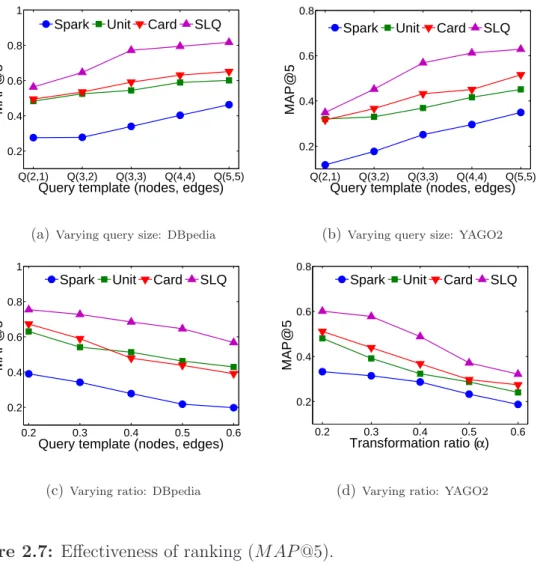
2.7 Effectiveness of ranking (MAP@5). . . . . 55
2.8 Efficiency of top-k search (k = 20). . . . . 58
2.9 Search time: effect of k (20∼100). . . . . 59
2.10 Scalability evaluation on Freebase.. . . . 61
2.11 Cross query evaluation on Freebase. . . . . 62
3.1 Top-k subgraph querying. . . . . 69
3.2 The enumerations in graphTA. . . . . 77
3.3 Optimal match selection. . . . . 87
3.4 d-bounded star querying. . . . . 92
3.5 Selection of α value. . . . . 99
3.6 The distribution of the top-k matching score. . . . . 101
3.7 The effect of search bound d.. . . . 107
3.8 Efficiency of star querying. . . . . 109
3.9 Evaluation on the top-k join.. . . . 110
3.10 Scalability evaluation of top-k search on Freebase. . . . . 112
4.1 Searching a graph for traveling. . . . . 121
4.2 Ontology-based matching. . . . . 123
4.6 Construction of concept graphs. . . . . 139
4.7 Generating subgraph Gv. . . . . 144
4.8 Evaluation on ontology-based subgraph querying. . . . . 149
4.9 Case study: queries and the matches. . . . . 153
5.1 Graph summarization. . . . . 159
5.2 Keyword query on a knowledge graph. . . . . 162
5.3 Answer graphs and summary graphs. . . . . 167
5.4 Dominance relation. . . . . 175
5.5 Computing minimum α-summary graph. . . . . 187
5.6 Summary graphs for a 2-partition. . . . . 190
5.7 Evaluation on summarization. . . . . 202
6.1 Distributed query access pattern. . . . . 205
6.2 Sedge: system design. . . . . 209
6.3 Complementary partitioning.. . . . 211
6.4 Two-level partition architecture. . . . . 213
6.5 Color-block and envelop collection. . . . . 223
6.6 Duplicate vertex. . . . . 227
6.7 Number of cross-partition queries. . . . . 235
6.8 Performance of complementary and on-demand partitioning. . . . 237
6.9 Complementary partitioning.. . . . 242
6.10 Partition replication. . . . . 243
6.11 Dynamic Partitioning: runtime cost. . . . . 244
6.12 Dynamic partitioning: response time. . . . . 244
6.13 Cross-partition queries vs. improvement ratio. . . . . 245
6.14 Dynamic update and synchronization cost. . . . . 246
7.1 SLQ: architecture. . . . . 252
1.1 Real-life knowledge graphs.. . . . 4
2.1 Transformations in SLQ. . . . . 18
2.2 Manual evaluation (NDCG@5). . . . . 54
2.3 Sample coverage for training. . . . . 60
4.1 Effectiveness of querying real-life graphs. . . . . 148
4.2 Effectiveness of indexing . . . . 153
5.1 Summarization examples. . . . . 180
5.2 Keywords queries for DBLP. . . . . 192
5.3 Keywords queries and the answer graphs for DBpedia and YAGO. 193 6.1 Graph datasets. . . . . 240
1 AlgorithmtopK . . . . 40 2 AlgorithmgraphTA . . . . 78 3 AlgorithmSTAR . . . . 80 4 Algorithmstark . . . . 83 5 Algorithmstarjoin . . . . 96 6 AlgorithmOntoIdx . . . . 135 7 AlgorithmCGraph . . . . 136 8 AlgorithmmSum . . . . 201
Introduction
Graph querying is widely adopted to retrieve information from emerging graph databases, e.g., knowledge graphs, information and social networks. Given a query, it is to find reasonable top answers (i.e., matches for the query) from a data graph. Searching real-life graphs, nevertheless, is not an easy task es-pecially for non-professional users. (1) Either no standard schema is available or schemas become too complicated for users to completely possess. (2) Graph queries are hard to write and interpret. Structured queries (e.g., XQuery [23] and SPARQL [66,117]) require the expertise in complex grammars while keyword queries [119, 152] can be too ambiguous to reflect user search intent. Moreover, most of these methods adopt predefined ranking model [66, 119], which is barely able to bridge the gap between the queries and the true matches. (3) Moreover, it is a daunting task for users to inspect a large number of matches produced from querying large-scale heterogeneous graph data.
" Jaguar" " history" " America" "Jaguar"
...
"Panthera On ca" Panthera "Black Panther" Melanism ontology Query result summarizationG
history habitat " America" (continent) offer company city history Black Panther (animal) history habitat south American (continent) Panthera On c a (animal) history habitat north American (continent)result 1 result 2 result 3
USA (country) Jaguar XK (car) result Dearborn (country) United States history (animal) Ford (company) (city) "America" (country) Chicago(city) offer1
...
offern (city) New York k...
(car) XJ Line schemaless & structureless searchontology-based search
Figure 1.1: Searching a knowledge graph.
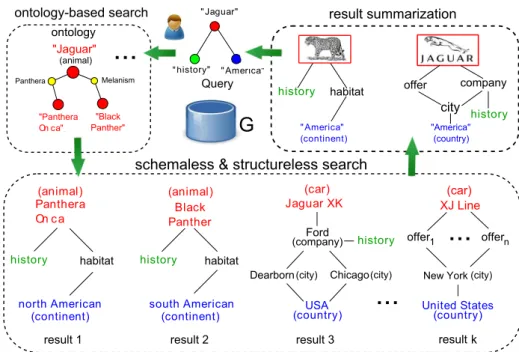
Example 1: Consider a query asking “tell me about the history of Jaguar in America.” The query can be presented as either a keyword query “Jaguar history America,” or a small graph in Figure 1.1. To find answers for such a simple query is, nevertheless, not easy. There are several challenges problems: (1) How to find matches that are semantically related to the query? A keyword e.g., “Jaguar” may not have identical matches, but instead can be matched with entities that are semantically close, i.e., luxury cars or animals. (2) Which answer is better? A large number of possible answers can be identified by various matching
mech-scientific name, while “Jaguar XK” is another match obtained simply by string transformations. A ranking model should be employed and tuned with or without manual tuning effort. (3) How to deliver the good answers to the users in query time? Since the end users are usually impatient, it is critical to quickly identify the best among a large number of answers. (4) How to help users better under-stand results without inspecting them one by one?. For example, different species related to Jaguar (result 1 and result 2), or various car prototypes (result 3 to result k). This kind of complexity contrasts to the impatience of web users who are only interested in finding good answers in a short time. 2
To answer these questions, we propose SLQ, a novel graph querying system for schemaless graph querying [160]. (1) To better understand search intent, SLQ
interprets queries with external ontology to find semantically close matches. (2) It automatically supports multiple mapping functions, namely, transformations, e.g., synonym, abbreviation, ontology, to identify reasonable answer via learning to rank, and works with both (a) a cold-start strategy that requires no manual ef-fort for system tuning, and (b) a warm-start strategy to adjust the ranking model with available user feedback and query logs. (3) A fast top-k search strategy is integrated with SLQ. It can fast retrieve the best matches of a graph, without relying on precomputed index and match scores. (4) To help users better under-stand results and refine their queries, it supports concise result summarization.
Users may inspect small summaries, and then decide to (a) drill-down for details, or (b) interactively refine queries with interesting summaries. (5) In response to the widely adopted distributed solutions and the large-scale graph data,SLQ also incorporates a distributed realization of graph querying processing by leveraging novel and effective graph partitioning techniques.
In addition, SLQ supports a wide range of queries. Users may issue (1) a keyword query as a set of keywords, where each keyword describes an entity; or (2) a (not necessarily connected) graph query, where each query node has a set of labels as conditions, and an edge between two nodes, if any, specifies the relation constraints posed on two query nodes by users. We demonstrate SLQ over three major knowledge graphs,i.e.,DBpedia, YAGO2 and Freebase as described in the table below. A single such knowledge graph could have more than 10K types of entities, making it difficult for users to fully grasp.
Table 1.1: Real-life knowledge graphs.
Graphs entities relations node types relation types
DBpedia [1] 3.7M 20M 359 800
YAGO2 [66] 2.9M 11M 6,543 349
Freebase[2] 40.3M 180M 10,110 9,101
To the best of our knowledge, the innovations introduced in SLQ are not seen before in any previous graph querying systems (e.g., [23, 66, 107, 117, 119]).
Ac-querying large-scale complex graph data. Our design is to help the user access the graphs in a much easier and powerful manner. It is capable of finding high-quality answers when prior structured query languages do not work.
Before formally presenting the techniques, we summarize our key contributions inSLQ as follows.
1.1
Schemaless Graph Querying
In the core of SLQ is the schemaless querying approach, which introduces a principled way to match the queries from the users to the data entities in the knowledge graph. It consists of two main components, transformation based matching and a ranking model that can be learned in both offline and online manner. As remarked earlier, SLQ does not require a user to describe a query precisely as required by most search applications. Hence to render this high flex-ibility to the users, we propose a mechanism of transformation: given a query, the query evaluation is conducted by checking if its matches in a graph database can be reasonably “transformed” from the query through a set of transformation functions.
Matching Quality Measurement. To measure the quality of the matches in-duced by various transformations, SLQ adopts a ranking function of weighted
transformations. The function incorporates two types of score functions: node matching and edge matching score function. Each score function aggregates the contribution of all the possible transformations with corresponding weights. More specifically, by harnessing the probabilistic graphical model, we define the ranking function with Conditional Random Fields [136], since it satisfies two key consid-erations: using training data, its formulation could optimize the weights of the transformations for good ranking quality; the inference on the model provides a mechanism to search top-k matches quickly.
Ranking model learning. A key issue is how to select a ranking function by determining reasonable weights for the transformations. Instead of assigning equal weights or calibrating the weights by human effort,SLQ automatically learns the weights from a set of training instances. Each instance is a pair of a query and one of its relevant (labeled as “good”) answers. The learning aims to identify for each transformation a weight, such that if applied, the model ranks the good answers as high as possible for each instance.
SLQ begins with a cold-start stage where no manual effort is required for instances labeling, and can be “self-trained” in the warm-start stage, using user feedback and query logs. When no user query log is available, SLQ randomly extracts a set of subgraphs from the data graph as “query templates.” It then
queries. Intuitively, each training query should have the corresponding templates as its “good matches,” since the query can be transformed back to the template.
Query Processing. SLQ efficiently finds top matches, leveraging approximate inferencing[136]. It treats a query as a graphic model and the matches as assign-ment to its random variables (query nodes). By propagating messages among the nodes in the graphical model, the inference can identify top assignments (matches) that maximize the joint probability (ranking score) for the model. Together with a graph sketch data structure, this technique dramatically reduces the query pro-cessing time, with only small loss of match quality (less than 1% in our validation).
We introduce schemaless graph querying in more details in Chapter 2.
1.2
Fast Top-k Graph Querying
Since the queries could be quite ambiguous, the search may result in an ex-cessive number of answers. The top-k graph querying intends to quickly identify the answers of high-qualityw.r.t. a ranking function. Efficient top-k querying is a well-studied problem in relational databases [70], XML [55, 121], and RDFs [144]. In contrast to these class techniques, knowledge graph querying has its unique properties and comes with new challenges and opportunities: (1) The matching score that combines multiple similarity measures has to be calculated and ranked
online, (2) query answers are often inexact, and (3) query graphs are usually small. We show that a direct application of prior approaches in this new setting does not work well.
In SLQ, we propose STAR, a framework to exploit fast top-k search for star queries and efficiently assemble them to answer general graph queries. STAR has two components: A fast top-k algorithm for single star-shaped queries and an assembling algorithm for general graph queries. The assembling algorithm uses fast star querying as building blocks and iteratively sweeps the star match lists with dynamically adjusted bound. When the size of Q and k is bounded by a constant, we show that the time complexity of answering single star queries is linear to |E|, the edge number of G. For approximate graph matching where an edge can be matched to a path with bounded length d, we extend the algorithm using message passing and achieve time complexityO(d2|E|+md), wheremis the
maximum node degree inG. Our algorithm does not require any pre-built indices. Using three real-life knowledge graphs, we experimentally verify thatSTARis 5-10 times faster than the state-of-the-art TA-style subgraph matching algorithm, and 10-100 times faster than a graph search algorithm based on belief propagation.
1.3
Ontology-based Graph Querying
In contrast to conventional graph querying systems, SLQ does not limit itself with single, fixed search semantic. Instead, it employs a set of matching functions that are more capable to find good matches in heterogeneous graphs [160]. We start by demonstrating ontology-based search, as an example for various matching mechanisms integrated in SLQ.
One of the challenges is to find the semantically related matches. SLQleverages ontology-based search [157] to bridge the entities from queries and data graphs via a set of ontology closeness metrics. Given external ontology graphs (e.g., DBPe-dia Ontology [1]),SLQfinds the semantically related entities (specified by a close-ness measure) in the ontology graphs for each entity (keyword) in a query [157]. A straightforward “substituting-and-querying” method may next interpret the query by substituting the keywords with their related entities, which in turn have matches in the data graph. Top matches can then be extracted by processing each new query. However, it may yield a tremendous number of queries. Instead,
SLQ leverages an effective ontology index [157]. In a nutshell, it computes several sketches of the data graph using the ontology graph. Each sketch is induced by grouping the nodes that are semantically close. Upon receiving a query, SLQ can efficiently identify the top matches by querying on these small sketches only.
Example 2: While there are no similarly labeled entities for “Jaguar” in the data graph (Figure 1.1), SLQ checks an ontology graph, and identifies its two semantically related matches (as a type of animal): “Panthera Onca,” its scientific name and “Black Panther,” its melanistic color variant. These can hardly be found by conventional IR metrics or string similarity, or by using the query and data
graph alone. 2
SLQwraps ontology-based searching with (a) an ontology transformation func-tion that maps a keyword to a set of valid entities, and (b) an ontology index. These are seamlessly integrated in the query processing of SLQ. We formally introduce this component in Chapter 4.
1.4
Result Summarization
Due to the sheer volume of data, graph querying usually generates a lot of results that are too many to inspect. This not only makes the understanding of the results a daunting task, but also frustrates the users to continue refining the search. The result summarization feature ofSLQaddresses the two challenges in a “two-birds-with-one-stone” way by leveraging [156]. (1) Given a query and a set of matches,SLQeffectively describes all the matches (as graphs) with a fewsummary graphs. A summary graph preserves the connectivity of the keyword pairs. By
reviewing the summary graphs, users easily get intuitive “big pictures” of all the matches. (2) The summary graphs can further be used to refine the search by suggesting new query nodes or edges, or be issued directly as new queries.
Example 3: SLQprovides two intuitive summaries for the matches in Figure 1.1. The first summary indicates that “Jaguar” refers to animals living in America continents with evolution history. The second shows that it refers to a certain type of cars sold by dealers and companies in major cities of USA, with the company history in car industry. In addition, new nodes or keywords, e.g., “offer,” are suggested to users to inspire queries with new interests. 2
We introduce the summarization technique in more details in Chapter 5.
1.5
Distributed Graph Query Processing
Knowledge graphs are often massive with millions, even billions of vertices, making common graph operations computationally intensive. In the presence of properties associated with nodes/edges, it is clear that graph data can easily scale up to terabytes in size. The recent Linked Open Data project has published more than 20 billion RDF triples [61]. Although the RDF data is generally represented in triples, the data inherently presents graph structure and is therefore interlinked. Not surprisingly, the scale and the flexibility rise to the major challenges to the
knowledge graph management. Fortunately, as large-scale the commodity clus-ters become available and affordable, various successful distributed platforms and solutions [53, 54, 94, 99, 124, 129, 162] are emerging as a critical avenue for data intensive computing on massive graphs.
In SLQ, we introduce a Self Evolving Distributed Graph Management Envi-ronment (SEDGE), to minimize inter-machine communication during graph query processing in a cluster environment. In order to improve query response time and throughput, SEDGE introduces a two-level partition management architec-ture with complimentary primary partitions and dynamic secondary partitions. These two kinds of partitions are able to adapt in real time to changes in query workload. Sedge also includes a set of workload analyzing algorithms whose time complexity is linear or sublinear to graph size.
The details of SEDGE is discussed in Chapter 6.
1.6
Summary
With the ever-increasing volume and complexity of the real-world knowledge graph, there is an urgent need to make use of the data effectively and efficiently. Among the various applications, intelligent search has been emerging as a critical approach in today’s major platforms, such as Apple’s Siri, Google’s Knowledge
Graph, Microsoft’s Cortana, and Facebook’s Graph Search. In response to these applications, however, the success of the traditional search techniques over tra-ditional data, such as relational database, XML, and RDFs, cannot be restored to support intelligent search since 1) the data is no long well structured so that a good data schema can be leveraged in the search. In practice, the data is un-structured and usually can be represented as a general graph with rich attributes. Search over graphs of such kind is more complicated because even a simple key-word search in graphs poses an NP-hard problem,i.e.,, Steiner Tree problem. 2) the queries from the users are usually quite ambiguous and not well formulated. Although the query models, like SQL, SPARQL, and XQuery, are expressive, they require expert knowledge. This is prohibitive for non-professional users. 3) By leveraging more information, such as the graph structure, node/edge content and the semantic relation (e.g., Ontology), the search system should tend to capture the latent meaning of the user’s query and return the most satisfying results in online manner.
In summary, we propose SLQ, which aims at integrating innovative graph querying techniques that allow the users to easily acquire their information need from complex knowledge graph. We endeavor to design efficient algorithms that can process user’s query in online manner, while without sacrificing any generality in practice. SLQis a real system that can not only demonstrate the usability of the
proposed techniques, but also suggest great opportunities for leveraging knowledge graphs in many real applications.
The dissertation is organized as follows. Chapter 2 introduces the schemaless graph querying framework, which lies at the core ofSLQ. Chapter 3 presents the fast top-k graph querying methods. Chapter 4 discusses the semantic matching when ontology information is available. Chapter 5 introduces the summarization techniques on query results. We also present the distributed query processing in Chapter 6 and the system architecture of SLQ in Chapter 7. We conclude the work and outline the future directions in Chapter 8.
Schemaless Graph Querying
Querying complex graph databases such as knowledge graphs is a challenging task for non-professional users. Due to their complex schemas and variational information descriptions, it becomes very hard for users to formulate a query that can be properly processed by the existing systems. We argue that for a user-friendly graph query engine, it must support various kinds of transformations such as synonym, abbreviation, and ontology. Furthermore, the derived query results must be ranked in a principled manner.
In this chapter, we introduce a novel framework enabling schemaless graph querying, where a user need not describe queries precisely as required by most databases. The query engine is built on a set of transformation functions that automatically map keywords and linkages from a query to their matches in a graph. It automatically learns an effective ranking model, without assuming manually labeled training examples, and can efficiently return top ranked matches using
graph sketch and belief propagation. The architecture of SLQis elastic for “plug-in” new transformation functions and query logs. Our experimental results show that this new graph querying paradigm is promising: It identifies high-quality matches for both keyword and graph queries over real-life knowledge graphs, and outperforms existing methods significantly in terms of effectiveness and efficiency.
2.1
Introduction
Graph querying is widely adopted to retrieve information from emerging graph databases, e.g., knowledge graphs, information and social networks. Searching these real-life graphs is not an easy task especially for non-professional users: either no standard schema is available, or schemas become too complicated for users to completely possess. For example, a single knowledge graph could have more than 10K types of entities, as illustrated in Table 1.1, not to mention the different presentations of entity attributes.
This kind of complexity contrasts to the impatience of web users who are only interested in finding query answers in a short period. The existing struc-tured query techniques such as XQuery [23] and SPARQL [117] are barely able to address such challenge. There is a usability issue arising from query prepara-tion. Keyword queries (e.g.,[75,86,152]) were proposed to shield non-professional
users from digesting complex schemas and data definitions. Unfortunately, most of keyword query methods only support a predefined similarity measure, such as approximate string matching [96] and ontology-based matching [157]. A gen-eral, systematic approach that automatically supports multiple measures (e.g., synonym, abbreviation, ontology, and several more summarized in Table 2.1) all together is lacking.
In this chapter, we present a principle that could take multiple matchings into account. Under this principle, given a query Q, query evaluation is conducted by checking if its matches in a graph database G can be “transformed” from Q
through a set of transformation functions.
Q
G
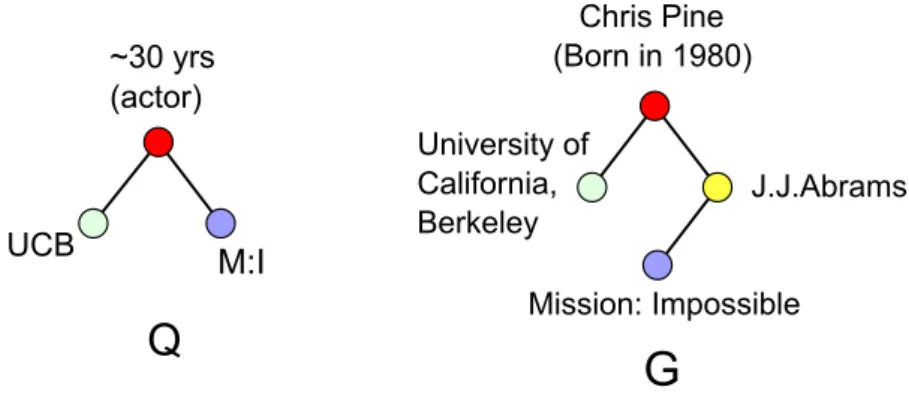
M:I UCB ~30 yrs (actor) University of California, Berkeley J.J.Abrams Mission: Impossible Chris Pine (Born in 1980)Figure 2.1: Searching with transformations.
Example 4: To find a movie star in a knowledge graph, a graph query Q is issued (Figure 2.1), which aims to find an actor whose age is around 30 (“30
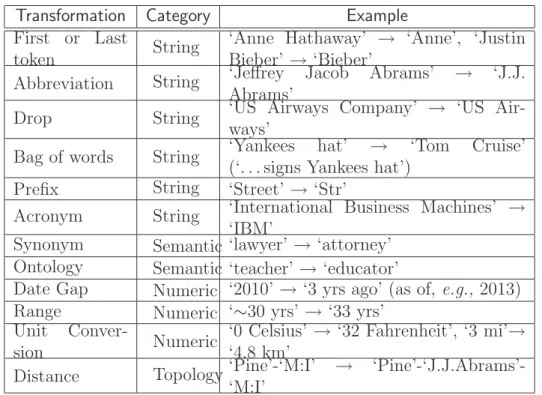
Table 2.1: Transformations inSLQ.
Transformation Category Example
First or Last
token String
‘Anne Hathaway’ → ‘Anne’, ‘Justin Bieber’→ ‘Bieber’
Abbreviation String ‘Jeffrey Jacob Abrams’ → ‘J.J.
Abrams’
Drop String ‘US Airways Company’ways’ → ‘US
Air-Bag of words String ‘Yankees hat’ → ‘Tom Cruise’
(‘. . . signs Yankees hat’)
Prefix String ‘Street’→ ‘Str’
Acronym String ‘International Business Machines’ →
‘IBM’
Synonym Semantic ‘lawyer’→ ‘attorney’
Ontology Semantic ‘teacher’→ ‘educator’
Date Gap Numeric ‘2010’→ ‘3 yrs ago’ (as of, e.g., 2013)
Range Numeric ‘∼30 yrs’ →‘33 yrs’
Unit
Conver-sion Numeric
‘0 Celsius’→ ‘32 Fahrenheit’, ‘3 mi’→
‘4.8 km’
Distance Topology ‘Pine’-‘M:I’ →
‘Pine’-‘J.J.Abrams’-‘M:I’
yrs”), graduated from UC Berkely (“UCB”), and may relate to movie “Mission: Impossible” (“M:I”). One may identify a match forQas shown in Figure 2.1. The match indicates that “30 yrs” in Qrefers to an actor “Chris Pine” who was born in 1980, “UCB” is matched to the University of California, Berkeley, and “M:I” refers to the movie “Mission:Impossible.” Traditional keyword searching based on IR methods or string similarity cannot identify such matches. 2
Given a few transformation functions, one might find many matches of Q
following two questions: (1) how to determine which match is better? (2) how to efficiently identify the top ranked matches?
Intuitively, the selectivity, the popularity, and the complexity of transforma-tion functransforma-tions shall be considered and used as a ranking metric for these matches. How to choose, from many possible transformations, an appropriate ranking met-ric that leads to good matches? First, a searching algorithm should be deployed to determine the best transformation for different portions of a query. For exam-ple, “UCB” should be automatically transformed to entities using it as acronym, rather than string edit distance. This requires a weighting function for various transformations. Second, to identify such a function, manual tuning should be reduced to a minimum level. Instead of asking users to tune the weights, learning to rank [87, 139] is more appropriate. Unfortunately, it usually needs manually labeled training data, again a daunting task for end users. Finally, since there could be too many matches to inspect, it is important to only return top-k re-sults. While desirable, this top-k search problem is much more challenging due to the presence of different transformations, compared to its single transformation counterpart.
Contributions. This work proposes a first-kind of graph querying framework that answers all these questions.
(1) We propose a new, generalized graph searching problem: Given a queryQ, a graph G and a library of transformation functions L, where there are multiple matches inGthat can be transformed fromQby applyingL, it is to find the top-k rantop-ked matches for Q. In contrast to traditional graph searching using single, predefined similarity metric such as string similarity, we use a metric combining transformations of various kinds. The metric itself is automatically learned.
(2) We proposeSLQ, a general graph query framework for schemaless querying. It consists of two phases: offline learningand online query processing. (a) Given multiple matches transformed from Q, how to decide a proper ranking metric? Certainly a manually picked combination function, e.g., averaging, is not going to work elegantly. We show that this problem can be solved by a parameterized ranking model. We adopt conditional random fields [136], as it not only gives a good ranking model, but also indicates a fast matching search algorithm. In the offline learning phase, the framework needs to solve the cold-start problem, i.e.,, where to find training samples to train the model. Manually labeled matches might be too costly for a few sample queries. A systematic approach is hence introduced to create sample queries and answers by extracting subgraph queries from G, inject transformations to these queries, and form query-answer pairs for training. (b)Given a ranking metric, how to efficiently find top ranked matches?
NP-hard. We propose a polynomial time heuristic top-k algorithm for online query processing. The problem is tractable for tree-structured queries, and an exact, polynomial time algorithm is developed. Both algorithms stop once k best matches are identified, without inspecting every match. In practice, they run very fast.
(3) Using several real-life data/knowledge graphs, we experimentally verify the performance of our graph querying engine. It outperforms traditional keyword (Spark [96]) and approximate graph searching (NeMa [79]) algorithms in terms of quality and efficiency. For example, it is able to find matches that cannot be identified by the existing keyword or graph query methods. It is 2-4 times faster than NeMa, and is orders of magnitude faster than a naive top-k algorithm that inspects every match.
To the best of our knowledge, these results are among the first efforts of de-veloping a unified framework for schemaless and structureless querying. SLQ is designed to help non-professional users access complex graph databases in a much easier manner. It is a flexible framework capable of finding good matches when structured query languages do not work. New transformations and ranking met-rics can beplugged in to this framework easily. The proposed framework can also be extended to query relational data, where a similar usability problem exists. The contribution of this study is not only at providing a novel graph querying
paradigm, but also at the demonstration of unifying learning and searching for much more intelligent query processing. The proposed techniques can be adapted easily to a wide range of search applications in databases, documents and the Web.
2.2
Preliminary
Property graph model. We adopt a property graph model [122]. A graph G
= (V, E) is a labeled graph with node set V and edge set E, where each node
v ∈ V has a property list consisting of multiple attribute-value pairs, and each edge e ∈ E represents a relationship between two entities. The model is widely adopted to present real-life schemaless graphs. To simplify our presentation, we will first treat all the information associated with nodes and edges as keywords, and then differentiate type and value in Section 2.7.
Queries. We formulate a query Q as a property graph (VQ, EQ). Each query
node in Q describes an entity, and an edge between two nodes, if any, specifies the connectivity constraint posed on two query nodes. Q could be disconnected when a user is not sure about a specific connection. This query definition covers both keyword query [152] (query nodes only) and a graph pattern query [28]
that is connected. How to handle disconnected queries including keyword queries is given in Section 2.7.
Traditional graph querying assumes structured queries formulated from well-defined syntax and vocabulary (e.g., XPath and SPARQL). We consider general queries that might not exactly follow the structure and semantic specifications coded in a graph database.
Transformations and matches. To characterize the matches ofQ, we assume a library L of transformation functions (or simply transformations). A transforma-tion f can be defined on the attributes and values of both nodes and edges of Q. The transformation functions can be specified in various forms,e.g.,(string) trans-formation rules [8]. Table 2.1 summarizes several common transtrans-formations. These transformations consider string transformation, semantic transformation, numeric transformation, and topological transformation (as edge transformations). For ex-ample, “Synonym” allows a node with label “Tumor” to be mapped to the node “Neoplasm.” All these transformations are supported in our implementation. New transformations, such as string similarity (e.g.,spelling error) [95] and Jaccard dis-tance on word sets [79] can be readily plugged intoL. Our focus is to show a design combining different transformations, not to optimize a specific transformation.
A node or edge in Qmatches its counterparts in a data graph Gwith a set of transformed attributes/values, specified by a matching (function) φ. A match of
Q, denoted asφ(Q), is a connected subgraph of G induced by the node and edge matches. For each attribute/value, we only consider one-time transformation, as the chance for transforming multiple times is significantly lower.
2.3
Schemaless Graph Querying
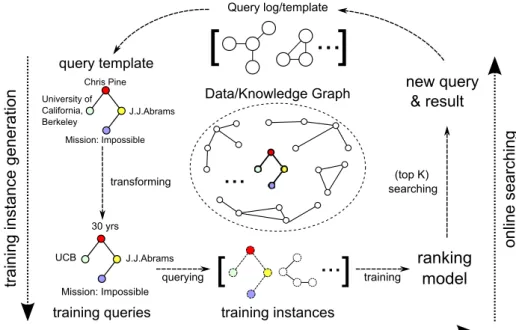
In this section, we provide an overview of SLQ, and its three key components: matching quality measurement, offline learning, and online query processing.
Query log/template
[
...
]
[
...
]
training instances transforming querying ranking model training (top K) searching offline learning new query & result on line se ar ch in g tra in in g in st a nce g en er ation University of California, Berkeley Chris Pine J.J.Abrams Mission: Impossible UCB 30 yrs Mission: Impossible J.J.Abrams training queries query template Data/Knowledge Graph...
Matching quality measurement. GivenQ and a matchingφ ofQ, we need to measure the quality of φ(Q) by aggregating the matching quality of correspond-ing nodes and edges. Intuitively, an identical match should always be ranked highest; otherwise, φ(Q) shall be determined by the transformations, as well as theirweightsto indicate how “important” they are in contributing to a reasonable match. One possible strategy is to assign equal weight to all transformations. Cer-tainly, it is not the best solution. For example, given a single node query, “Chris Pine,” nodes with “C. Pine” (Abbreviation) shall be ranked higher than nodes with “Pine” (Last token). A predefined weighting function is also not good, as it is hard to compare transformations of different kinds. We introduce a novel learning approach to figure out their weights (Section 2.4).
Offline model learning. There might exist multiple matches for Q in a graph
G using different transformations. An advanced model should be parameterized and be able to adjust the weights of all possible transformations. If a historical collection of queries and user-preferred answers is available, through a machine learning process, one can automatically estimate weights so that the user-preferred answers could be ranked as high as possible.
As suggested from previous work [87], the best practice for learning a model is to employ a query log generated by real users. However, the log might not be available at the beginning. On the other hand, the system does need a set of
good-quality query-answer pairs to have its weights tuned. This becomes the chicken or the egg dilemma. In Section 2.4.2, we introduce a method to automatically generate training instances from the data graph.
Online top-k searching. Once the parameters of the ranking function are esti-mated in the offline learning, one can process queries online. Fast query processing techniques are required to identify top ranked matches based on the ranking func-tion. This becomes even more challenging when multiple transformations are applicable to the same query, and the answer pool becomes very large. While the problem is in general intractable, we resort to fast heuristics. The idea is to construct a small sketch graph by grouping the matches in terms of Q and the transformations. The algorithm first finds the matches in the sketch graph that are likely to contain the top-k answers. It then “drills down” these matches to extract more accurate matches from the original graphG. This design avoids the need of inspecting all the matches.
Putting the above components together, Figure 2.2 illustrates the pipeline of SLQ. It automatically generates training instances from data graphs and any available query log. Using the training set, it learns a ranking model by estimating proper weights for the transformations. In the online stage, it applies efficient top-k searching to find best matches for new queries. A user can provide feedbactop-k by
log to further improve the ranking model. In the following sections, we discuss each step in detail.
2.4
Offline Learning
GivenGand a library Lof transformations, the offline learning module gener-ates a ranking model, without resorting to human labeling efforts. In this section, we present two key components, the parameter estimation and automatic training instance generation.
2.4.1
Ranking Function
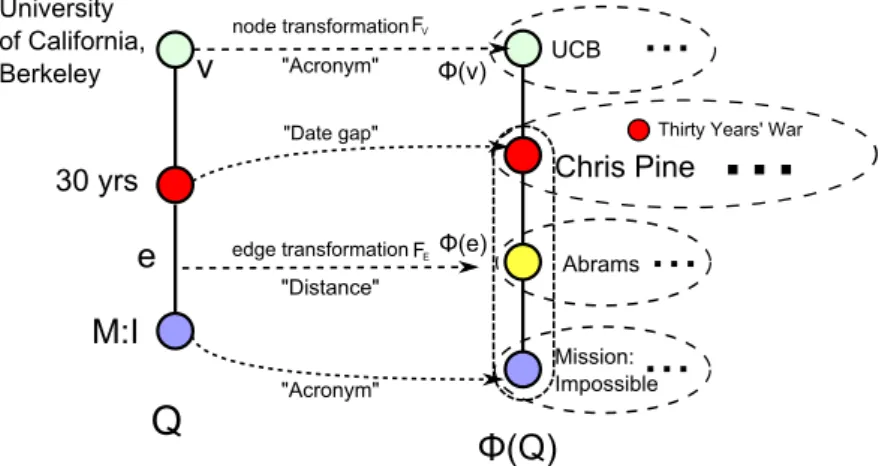
GivenQandφ(Q), a node matching cost functionFV(v, φ(v)) is introduced to
measure the transformation cost from a query nodev to its match φ(v). It aggre-gates the contribution of all the possible transformations{fi} with corresponding
weight {αi},
FV(v, φ(v)) = X
i
αifi(v, φ(v)) (2.1)
where eachfi returns a binary value: it returns 1 if its two inputs can be matched
function is defined as
FE(e, φ(e)) = X
i
βifi(e, φ(e)) (2.2)
which conveys the transformation(s) from a query edgee to its match φ(e). φ(e) can be a path in φ(Q) with the two endpoints matched with those in e. {fi}
can be extended to support real-valued similarity functions. We instantiate our querying framework with a set of commonly used transformations, as in Table 2.1. Other user-specified transformations can also be plugged in.
We now introduce a ranking function that could combine multiple nodes and edges matches together. There are two important factors to consider. First, using training data, it shall be able to optimize parameters {αi} and {βi} for good
ranking quality. Second, the ranking function shall have a mechanism to search top-k matchings quickly. Enumerating all possible matches of a query graph and then sorting their scores is not a good mechanism. We give a probabilistic formulationthat satisfies both requirements. The superior performance ofSLQcan already be demonstrated by this formulation. We leave the search and comparison of various probabilistic models in terms of ranking quality and query response time to future work.
Given Q and a match φ(Q), we use probability P(φ(Q)|Q) as a measure to evaluate the matching quality,
P(φ(Q)|Q) = 1 Z exp( X v∈VQ FV(v, φ(v)) + X e∈EQ FE(e, φ(e))) (2.3)
where Z is a normalization function so that P(·)∈[0,1].
The ranking functionP(φ(Q)|Q) can be naturally interpreted withconditional random fields(CRFs), a widely applied graphical model (see [136] for more details). In our formulation, the nodes and edges in each query Q are regarded as the observed nodes and structures in CRFs; the nodes and edges in each match φ(Q) to be predicted are regarded as the output variables. CRFs directly models the distribution of the output variables given the observed variables, which naturally serves as our matching quality measure.
University of California, Berkeley 30 yrs M:I UCB Chris Pine Abrams Mission: Impossible
Q
Φ(Q) v Φ(v) e Φ(e) "Date gap" "Distance"...
...
...
...
Thirty Years' War FV node transformation FE edge transformation "Acronym" "Acronym"
Example 5: Recall the Q and a match φ(Q) (Figure 2.3). Each node, e.g., 30 yrs, may have multiple matches via multiple transformations, as remarked earlier. The quality of the match P(φ(Q)|Q) is computed by aggregating the quality of each node and edge match in φ(Q), determined by a weighted function of all
transformations. 2
Two key differences between SLQand the existing graph query algorithms are (1) we support multiple transformations; and (2) the weight of these transforma-tions are learned, rather than user-specified. The probabilistic ranking function is a vehicle to enable these two differences.
2.4.2
Transformation Weights
To determine the weights of transformations W ={α1, α2, ...;β1, β2, ...}, SLQ
automatically learns from a set of training instances. Training instances can be regarded as past query experiences, which can teach the system how to rank the results when new queries arrive. Each training instance is a pair of a query and one of its relevant answers. Intuitively, we want to identify the parameters W that can rank relevant answers as high as possible for a given query in the training set T. We choose parameters such that the log-likelihood of relevant matches is
maximized, W = arg max W X T logP(φ(Q)|Q) (2.4)
Optimizing objective functions like Eqn. 2.4 has been studied extensively in machine learning community [136]. We adopt the standard Limited-memory BFGS (L-BFGS) [89] algorithm, as it requires less memory than other approaches. Complexity. Based on the analysis of [136], the worst time complexity of training CRFs in our problem setting is O(N|Q||Vm|2|T|), where (1) N is the number of
gradient computations performed by the optimization, (2) |Q| is the size of the largest query in the training set, (3) |Vm| is the largest number of the matches
a query node or edge may have, and (4) |T| is the number of training instances. Experimental results (Table 2.3 in Section 2.8) show that its training time is affordable for large real-life graphs, as only a small sample of the graph is needed. |Vm|2 is also not an issue here as one can avoid using less-selective queries.
2.4.3
Automatic Training Instance Generation
A key issue in SLQ is how to cold-start the system when no user query log is available. We developed an innovative strategy to generate artificial training instances. It turns out that this strategy works far better than just giving equal weight to all transformations. Our system first randomly extracts a set of
sub-graphs from the data graph and treat them as query templates. For each template ˆ
Q, it injects a few transformations to ˆQ and generates a set of training queries
Q. Intuitively, each training query Q should have ˆQ as its good match, since Q
can be transformed back to ˆQ. The system also identifies exact matches of Q in
G. Consequently, the matches identical to Q form training instances too. The weights of transformation functions are learned by ranking ˆQ as high as possible in the matches of Q, but below those identical matches of Q inG.
The identical matches play a key role of determining the weight of transforma-tions. For example, with respect to a query template “Barack Obama,” a match “B. Obama” is more preferred than “Obama” as there are less identical matches of “B. Obama” (i.e.,with higher selectivity). Therefore, by populating the training instances with random queries and results, the method can gauge the impact of transformations automatically in terms of selectivity. The second reason for this cold-start strategy to work well is that it covers different cases comprehensively, as it randomly and uniformly samples subgraphs from the data graph.
2.5
Online Query Processing
In this section, we introduce the online query processing technique that finds top-k ranked matches forQ in Gwith the highest scores. To simplify the
discus-sion, we assume that each transformation fi checks if a query node (resp. edge)
matches a node (resp. path) in G in constant time.
The query processing problem is in general NP-hard, as one may verify that subgraph isomorphism [113] is its special case. To precisely compute P(φ(Q)|Q), one has to inspect every possible match, which is a daunting task. A straightfor-ward algorithm identifies the match candidates for query node/edge via all trans-formations inO(|Q||G||L|) time, enumerates all possible result matches, and com-putes their rank scores to find top-k ones. Its complexity isO(|Q||G||L|+|G||Q|),
which does not scale over large G.
Observing the hardness of the exact searching (e.g., subgraph isomorphism), one shall not expect a fast solution with complete answers (except for tree queries). Instead, we resort to two heuristics. The first one leverages an inference technique in graphical models that has been verified to be efficient and accurate in prac-tice [161] (Section 2.5.1). The second one further improves it by building a sketch of G so that low-score matches can be pruned quickly (Section 2.5.2). Our top-k algorithm based on these two techniques (Section 2.5.3) could reduce the query processing time in orders of magnitude, while only small loss of answer quality is observed (less than 1% in our experiments). Moreover, it can deliver exact top-k matches when Qare trees (Section 2.5.4), which is desirable as many graph queries are indeed trees.
Section 2.5.1 briefly introduces the first heuristic,LoopyBP, which needs some background knowledge to digest [153]. The readers may skip it without difficulty in understanding the remaining sections.
2.5.1
Finding Matches
The idea of LoopyBP is to treat Q as a graphical model, where each node is a random variable with a set of matches as possible assignments. It finds top assignments (matches) that maximizes the joint probability for Q (with highest matching quality). To this end, LoopyBP leverages inferencing techniques [153], which iteratively propagates “messages” among the nodes to estimate the match-ing quality.
GivenQ,LoopyBPidentifies a matchφ(Q) that maximizesP(φ(Q)|Q) by seek-ing maxuib(ui) [161]. For each nodevi ∈VQ and its match ui, b(ui) is formulated
as: b(ui) = max ui FV(vi, ui)Πvj∈N(vi)m (t) ji(ui), (2.5)
for each matchui of vi and each vj in the neighborhood setN(vi) of vi inQ. Here m(jit)(ui) is a message (as a value) sent to ui from the matches ofvj ∈N(vi) at the
tth iteration: m(jit)(ui) = max uj FV(vj, uj)FE((vj, vi),(uj, ui)) (2.6) · Y vk∈N(vj)\vi m(kjt−1)(uj),
for each match uj of vj. (uj, ui) represents the match of the query edge (vj, vi).
Intuitively, the score b(ui) is determined by the quality of ui as a node match to vi (FV), the quality of edge matches, e.g., (uj, ui), attached to ui (FE), and the
match quality of its neighbors uj as messages (mji(ui)). Hence the node u with
the maximum b(·) and its “surrounded” node and edge matches naturally induce a match with good quality in terms of matching probability.
Algorithm. Based on the formulation,LoopyBPfinds top matches in three steps. (1) It first initializes the messages of each node m(0)(·) = 1. (2) It iteratively
up-datesb(·) following message propagation until none ofb(·) in successive iterations changed by more than a small threshold. (3)LoopyBPidentifies best node matches
u=argmaxub(u), and then extracts top-k matchesφ(Q), following a backtracking strategy [161]. More specifically, LoopyBPfirst selects a match uwith the highest score b(·), and induces a top 1 match φ(Q)1 following the node matches with top b(·) scores connected tou. It then finds a next best match by performing two mes-sage propagations: (a) it identifies a match u0 of a node v in Q with the second
propagation to find a top matchφ(Q)2, fixingφ(v) =u0; (b) it performs a second
round of propagation where φ(v) 6= u0, to “trace back” to an earlier state of the
scores in (a), and prepare to extract a next best match. It repeats the above process until k matches are identified (see details in [161]).
Complexity. The propagation only sends messages following edge matches as paths of bounded length d constrained by edge transformation in L. Thus each propagation traverses, for each match u of v, up to the set Vd of d hops of u in G. The algorithm takes O(I|Q||V||Vd|) time for message propagation in total I
iterations, where a single iteration completes when each node exchanges a message with each of its neighbors. In addition, it takes O(|Q|) time to construct a best (top-1) matching φ for Q. Putting these together, the process of finding one match takes overall O(I|Q||V||Vd|) time. To find k matches, at most 2k rounds of propagation are conducted with backtracking, where each round denotes the start to the convergence of a propagation. Hence it identifies top k matches in
O(k∗I|Q||V||Vd|) time. Note thatdis typically small: Edges are usually matched with short paths as observed in keyword and graph searching [79, 86].
2.5.2
Sketch Graph
upper level matches level matches lower ~30 yrs (actor) UCB UCB
...
...
...
match partition "Bag of words" M:I "Acronym" "Date gap" University of California Berkley Mission: Impossible (movie) University of California, Berkeley J.J.Abrams Mission: Impossible Chris Pine (Born in 1980) (Q) 1 upper level matching "Acronym" M:I UCB ~30 yrs (actor) Q ~30 yrs (actor) UCB M:I GR1 "Acronym" "Date gap" "Acronym" ~30 yrs (actor) UCB GR2 "Bag of words" "Bag of words"lower level matching
(Q) 2 Paula Patton (Born in 1975) Mission: Impossible UC Berkley Jane Carter
...
sketch graph...
Chris Pine...
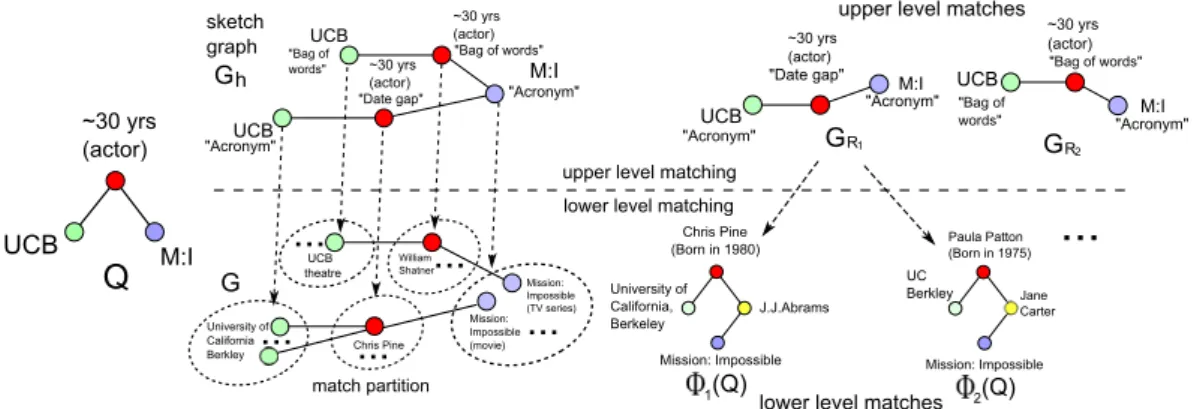
h G G William Shatner M:I ~30 yrs (actor) "Bag of words" "Acronym" UCB theatre Mission: Impossible (TV series)Figure 2.4: Graph sketch and top-k searching.
formations: Each match contributes the same matching score when it conducts the same type of transformation. Following this, we construct a sketch graph Gh
from G induced by Q and L. The idea is to efficiently extract matches from a much smallerGh, and then drill down to find more accurate “lower level” ones.
We denote asσi the set of all matches for a nodevi inQ. (1) Amatch partition
of σi is a set of partitions {σi1, . . . , σin} of σi, such that for any two nodes in σij,
they can be mapped to vi via the same transformation fj ∈ L. (2) The sketch
graphGh ofGcontains a set ofhyper nodes, where each hyper nodeu(vi,fj)denotes
a match set σij of vi in Q induced by fj. There is an edge connecting two hyper
nodes u(vi,fm) and u(vj,fn) if and only if (vi, vj) is an edge of Q. Thus the match
score of an edge in Gh establishes anupper bound of its underlying edge matches
sketchesGby grouping the matches of each query node as a single node, as long as they can match to the query node by the same transformation. Note that a sketch graph Gh can also be queried by LoopyBP. We denoted as GR an “upper level
match” from Gh, and distinguish it from a “lower level match” Gr as a subgraph
of G. Gr is contained in GR if each node of Gr is in a hyper node of GR.
One may verify that the rank score of each upper level match GR indicates an
upper boundof the rank scores of all the lower level matches it contains:
Lemma 1: For any upper level match GR (specified by matching φR) and any lower level match Gr contained in GR (specified by φr), maxφr(vi)b(φr(vi)) ≤
maxφR(vi)b(φR(vi)), where vi ranges over the query nodes in VQ. 2
Proof sketch: We prove by induction on the iterations that for any vi ∈VQ at
any iteration t, m(jit)(φr(vi)) ≤ mji(t)(φR(vi)). (1) Let t = 1. Since FV(vi, φr(vi))
= FV(vi, φR(vi)) and FE(e, φr(e)) ≤ FE(e, φR(e)), we have m(1)ji (φr(vi)) ≤
m(1)ji (φR(vi)), by the definition of GR and Eqn. 2.6. (2) Assume m(jit)(φr(vi)) ≤ m(jit)(φR(vi)) for t < n. When t =n, one can verify that mnji(φr(vi)) is no larger
than mn
ji(φR(vi)), again with Eqn. 2.6. Hence, by Eqn. 2.5,b(φr(vi)) ≤b(φR(vi)).
Note that the size of Gh is independent of |G|: it is bounded by O(|Q|2|L|2)
where|Q|and|L|are typically small. Moreover, Gh can be efficiently constructed
using indexing techniques (Section 2.6).
Example 6: A sketch graph Gh is illustrated for the query Q in Figure 2.4. A
node UCB with label “Acronym” in Gh points to a group of matches via
trans-formation “Acronym.” Given Q and Gh,LoopyBP provides an upper level match
GR1, which contains two lower level matches φ1(Q) and φ2(Q), with rank scores
bounded by that of GR1. 2
2.5.3
Top-k Search
UsingLoopyBPand sketch graph as building blocks, we next present our top-k searching algorithm. The algorithm, denoted astopK, is illustrated in Figure 1.
Given Q, G, L and integer k, topK initializes a top k match list L, and a Boolean flag terminate to indicate if the termination condition (as will be dis-cussed) is satisfied (line 1). It next constructs a sketch graph Gh (lines 2-4).
Given G,Q and Gh, it dynamically updates L with newly extracted matches, by
applying LoopyBP over the sketch graph Gh and G iteratively (lines 5-9). More
specifically, topK repeats the following two steps, until the termination condition is satisfied (terminate =true).
Algorithm 1Algorithm topK Input: G, Q, L, integer k;
Output: L: top k ranked matches;
1: top k listL=∅;terminate =false; 2: for each v inQ do
3: initialize valid match candidates w.r.t. L; 4: end for
5: construct sketch graph Gh;
6: GR :=LoopyBP(Gh);
7: while terminate= false do
8: update L with top k matches fromLoopyBP(GR);
9: GR := LoopyBP(Gh);
10: update terminate; 11: end while